



Abstract
Utilizing Marsh’s frame of reference theory, this article seeks understanding about boys’ perceptions of giftedness and how academic and social self-perceptions are influenced by gender and ability practices. The literature proposes that gender and ability perspectives influence how boys construct their self-perceptions and how teachers develop stereotypes of male students who are identified as gifted and talented. The findings reveal that the conceptualizations of giftedness contribute to gifted boys developing healthy self-perceptions and influence the complexities of instructional design for gifted learners. The findings also suggest that schools should encourage spaces for students’ voices to be heard through inclusive curriculum design.
Introduction
A variety of research in gifted education and statistical underachievement of young learners points to distressing analyses discussing the unaddressed academic and social and emotional needs of boys identified as gifted and talented (Stahl & Keddie, 2020; Neu &Weinfeld, 2007). The plight to understand students’ needs can often create imbalances between educators’ perceptions about giftedness and how it manifests itself in young children, particularly males. The long-time gender gap debates have posed uncertainties about how to address young males’ academic and social-emotional needs in a traditionally predominate feminist educational system. These uncertainties have resulted in some teachers to “emphasize gifted students” intellectual potential without regard for their social-emotional connections to learning, thus demonstrating a “lack of understanding about how students’ academic and social perceptions influence how they feel about themselves” (Stahl & Keddie, 2020; Watts, 2020, p. 46; Huyge et al., 2015; Bailey, 2011; Shavelson, et al., 1976). The notion of giftedness becomes complicated when juxtaposing it with educators’ perceptions about the relationship between issues of ability and gender, and whether these complexities influence pedagogical practices and students’ self-concepts as learners. Matthews et al. (2010) encourage educational awareness about integrating social-emotional needs into classroom spaces; a critical aspect for developing gifted students’ self-perceptions.
Addressing the relationships between ability and gender in conjunction with pressing concerns about boys and achievement, this article discusses the complexities of diversity in relation to the social constructions and instructional implications of the male gender and the conceptualizations of highly intellectual abilities. Specifically, this paper explores whether the self-perceptions of young males identified as gifted and talented influence their academic, social, and emotional health as students in elementary public schools. To understand these social conceptions, an ethnographic study was conducted to examine 22 male gifted students’ personal perspectives about themselves and school and provide deeper insights into their social and academic wellbeing in the classroom. Addressing gaps in research involving elementary-age students (Pinxten, et al., 2015), the overarching goal for this work was to give gifted boys a voice about their school experiences, and to understand how school plays an essential role in developing their self-concepts as learners. The frame of reference theory (Marsh, 1990a; 1990b) was utilized as a lens to understand how the boys in this study developed academic and social self-perceptions influenced by gender and ability practices. The role gender stereotypes play in shaping boys’ classroom experiences and classroom teachers’ normative conceptions of giftedness were also explored. The following research questions were prioritized for this study:
1. What are the challenges, if any, that elementary-aged boys identified as gifted face?
2. How do boys identified as gifted conceptualize the social aspects of school?
3. How do boys identified as gifted perceive themselves as students?
Frame of Reference Theory
Marsh (2007) and Williams and Montgomery (1995) articulate that self-concept development has long been linked to potentialities of academic achievement and their relationship to educational considerations for high-ability students.
Marsh (1990a) focused on the role of social comparisons and frames of reference, leading to the construction of the frame of reference theory. Marsh’s (1990b) model explains internal and external comparisons students often make to define their self-concepts as learners among their peers within similar frames of reference. The development of internal and external comparisons was found to be common between math and verbal skills and consisted of students’ feelings about their potential to perform well in math as compared to their abilities in other subject areas, thereby influencing students’ academic and social dispositions (Pinxten et al., 2015; Shaalvik & Rankin, 1990). Shaalvik and Rankin (1990) and Marsh et al. (1985) found that students compared their self-perceptions as learners to their peers within a similar frame of reference to judge their own academic abilities, and that “they use this relativistic impression of their academic ability as one basis for forming their academic self-concept” (p. 546).
Gifted students, though self-knowingly have high intelligence scores as compared to their peers who are not identified as gifted, make similar comparisons within school frames of reference. These comparisons could prove to be problematic for gifted students, as suggested by Swiatek (2004), because even though they demonstrate high intellectual abilities, they may negatively perceive or avoid challenging subjects or tasks if they have a low self-concept in those content areas. On the contrary, gifted students may excel and pursue more challenging content in specific subjects based on their perceptions of their superior abilities as compared to their peers. Interestingly, Marsh (1990a, 1990b) argued that students who believe they possess low academic skills may also perceive themselves to have high social self-concepts. Understanding this notion may have important implications in terms of how gifted students externally demonstrate their actual and/or perceived abilities.
Marsh’s (1990a, 1990b) frame of reference theory can serve as a model for understanding the development of gifted boys’ self-concepts. Findings from Martin et al.’s (2017) study illuminate the need for understanding the complexities of the frame of reference theory and its influence on pedagogy and curriculum development. Martin et al. (2017), Marsh and Hau (2004), Williams & Montgomery (1995), and others also posit that a teacher’s critical goal for students should be to help them construct healthy self-perceptions as learners and as individuals. Conceptualizing the frame of reference theory elucidates the need to deepen educators’ understanding of effective curriculum development that incorporates social and emotional instructional practices into effective academic pedagogy, thereby helping gifted students construct healthy self-concepts.
Gifted Boys’ Self-Perceptions within the Social and Academic Context
One central area of scholarship for this study focuses on how gifted boys perceive their academic abilities and social standings among their peers. Händel et al. (2013) assert, “The aim to assist students in developing their gifts is not unproblematic, as their cognitive needs are often seen to conflict with their social needs” (p. 99). Addressing their high academic needs sometimes leads to neglecting their social needs which creates social and academic tensions for gifted students (Hebert, 2011).
Further, Kitsantas et al. (2017), Gallagher (2015), Rentzsch et al. (2011), and Barber and Mueller (2011) sought to understand if being labeled as gifted attributed to more social acceptance and increased self-esteem. Kitsantas et al.’s (2017) and Rentzsch et al.’s (2011) research examined the negative connotations and other social functioning issues that peers often associate with elementary and adolescent students who are gifted, such as being called a “nerd” or a “teacher’s pet” and their possible effects on gifted students’ behaviors. They, and Morawska and Sanders (2008), also explored several factors that influence peer acceptance, or lack thereof, including work effort, sports, and extracurricular interests, and gender differences that may perceive them as being different (Rentzsch et al., p.146–148). These researchers found similar results; high achievement was admired by school peers, but only if gifted students showed a conscious level of modesty about it (Barber & Mueller, 2011; Rentzsch et al., 2011). Additionally, Barber and Mueller (2011, p. 111) argued, “Giftedness has the potential to be either a social advantage or a social disadvantage” depending upon the classroom context and curriculum designed to support and enforce their academic expectations. For instance, male students who were perceived as being highly social, yet less academic, were noted as more accepted by their peers than boys who were highly academic and less social.
Influence of Gender Role on Teachers’ Perceptions
Bailey’s (2011) examination of gifted students and their ego development illustrated that teachers are traditionally trained to emphasize intellectual potential rather than the influence of emotional development on learning. Bailey (2011) considered, however, that students’ intellectual achievement must be in conjunction with attention to emotional health, which proves problematic when juxtaposing academics and gendered approaches to learning. Further, Bailey’s (2011) study found that teachers held gendered assumptions that tended to overestimate their knowledge about the academic, social, and emotional needs of gifted boys. She offered that gifted students “experience the world from a qualitatively different perspective because of the unique social and emotional characteristics of this population”; therefore, teachers’ approaches to understanding best-fit instructional practices should include the social and emotional aspects to student growth (Bailey, 2011, p. 219–220).
Along those lines, Preckel et al. (2015) mentioned that existing literature portrays some gifted stereotypes such as uniquely high academic ability accompanied with social awkwardness and emotional instability as reasons for why teachers believe many gifted students are perceived differently than their average ability peers. However, for boys, they, along with Kerr and Huffman’s (2018) similar research on gender and giftedness, found in their study that teachers focused more on boys’ negative behaviors than their positive ones and associated giftedness with maladjustment more often in their male students than in their female students, rendering them less likely to believe their male students would benefit from gifted programming (Preckel et al., 2015).
Finding similar analyses, a study by Baudson and Preckel (2016) explored the disharmony between how teachers perceived gifted students and their personal classroom experiences of teaching these students. Teachers’ conceptions of giftedness affected how they treated their gifted students and their approaches to a curriculum designed to meet their academic and social needs (Baudson & Preckel, 2016). Several key findings included evidence that teachers over-relied on stereotypes of giftedness such as maladjustment, high academic abilities in all content areas, and contributed boys’ high intelligence to innate abilities and girls’ intelligence to commitment and effort (Baudson & Preckel, 2016). The findings illuminated the need for deeper understandings about gifted construction and appropriate instructional environments for which gifted students may thrive (Baudson & Preckel, 2016).
Teachers’ Normative Conceptions of Giftedness
Traditionally, in U.S. schools, teachers play critical roles in identifying individual needs and services for students who demonstrate academic or social needs and uniqueness (Richotte et al., 2016). Specific to gifted and talented students, Moon and Brighton (2008) contend that a critical examination of gifted education should include how teachers conceptualize giftedness and found that teachers’ responses illuminated the beliefs that the more “social and personal development and language and literacy skills” students demonstrated at earlier grades, the more teachers were inclined to identify them with gifted potential (p. 462). However, teachers’ conceptions about how giftedness manifests itself in earlier grades led primary grade teachers to lean more toward traditional understandings about how giftedness is perceived in their classrooms. Teacher participants in this study struggled to identify other talent-related skills not typically stereotyped as gifted aptitudes which represented that aside from traditional, or stereotypical identification factors, teachers may or may not have clear conceptions of how giftedness can be manifested in learners from multicultural or various socioeconomic backgrounds (Moon & Brighton, 2008).
Kaya (2015) suggests that how teachers conceptualize giftedness, such as those discussed in Rothenbusch et al.’s (2016) research, influences whom they refer for gifted and talented evaluations and programming. Kaya (2015) found that teachers’ conceptions of giftedness varied from possessing high intelligence as evidenced in achievement scores to expectations of mature social and psychological development. Kaya (2015) attributed the variances in defining giftedness to teachers’ training and their personal and classroom experiences with gifted students and conclude that their awareness of how they perceive giftedness influences classroom conditions which promote positioning for some students to be categorized as gifted and talented. Kaya (2015) also suggested that “teachers tended to evaluate giftedness of a certain student relative to the other students in the classroom” (p. 69). Using academic or performance comparisons as a criterion for identifying intellectual ability positions the classroom spaces and the transactions that occur in those spaces is especially crucial for understanding how giftedness is situated in the learning environment (Endephols-Ulpe & Ruf, 2006).
Along those lines, Eremeeva et al. (2016) argue that teachers’ normative conceptions of giftedness influence the conditions within classroom spaces that develop or promote the notion of giftedness and discuss the teachers’ responsibility to understand and identify cognitive abilities before they can create opportunities in the classroom that enrich or promote their intellectual potential (Eremeeva et al., 2016). This examination of literature provokes interest in understanding how the classroom environments and the transactions that occur in those spaces influence how teachers perceive normative conceptions of giftedness.
Understanding how the teachers’ perceptions and the classroom conditions converge to form normative conceptions of giftedness is also an important discussion in this research. The literature proposes that teachers’ perceptions, attitudes, and instructional practices for gifted students are influenced by their conceptions of giftedness (Baudson & Preckel, 2016). Since teacher referrals are critical instruments in the evaluation process, situating the literature as outlined in this review, highlights the importance of understanding the conditions in classroom spaces that identify and promote gifted categorization for some students, particularly considering the role gender plays on giftedness construction.
Research Design and Methodology
Participants and Research Sites
After obtaining permission from the school district and school principals, this ethnographic fieldwork was conducted at two PK-5 elementary schools within the same urban school district in the U.S. that were similar in enrollment size but culturally and socioeconomically diverse. I researched and selected these sites because they were within a fifteen-mile radius of each other, yet they served very different and diverse student populations. Both schools enrolled approximately 600 students at the time of this study. One elementary school, Rizemore Elementary School (pseudonym), has a long-standing designation as a Title I school with about 80% of the student population served by the free and reduced federal lunch program during any given school year. Approximately 57% of Rizemore’s student population is ethnically diverse and about 28% of their students speak two or more languages, yet only about 60 students are in the gifted and talented (GT) program. In contrast, about 25% of the student population enrolled at the second elementary school, Mayfield Elementary School (pseudonym), was served by the free and reduced federal lunch program every year. Mayfield’s ethnic diversity averages about 35% with only 9% of the student population speaking two or more languages. This school has approximately 100 students in its GT program.
I utilized purposeful sampling to plan to include a total of 10–12 students (five-to-six students from each research site) who met the following criteria: (a) male students enrolled in grades three through five, (b) identified as gifted and talented by the school district’s evaluation measures, and (c) enrolled in the Gifted and Talented (GT) program at their school sites for at least one year or more prior to the 2019 school year. There was a total of 47 male students who fit these criteria from both participating school sites (19 students, about 32%, from Rizemore’s gifted populations compared to 28 students from Mayfield’s, 28% of its total gifted education students). An astounding 22 gifted male students, eight Rizemore students, and 14 Mayfield students agreed to become members of this vital study. 27% of the participants were non-White which was comparable to the total sampling population. Five out of eight study participants enrolled at Rizemore Elementary identified as non-White. However, only one study participant from Mayfield identified a non-White. Given the total diverse populations at both school sites, these numbers demonstrate that students who have been identified and/or qualified for their gifted and talented programs were not diversely represented in either school site given the total ethnic student populations at both sites.
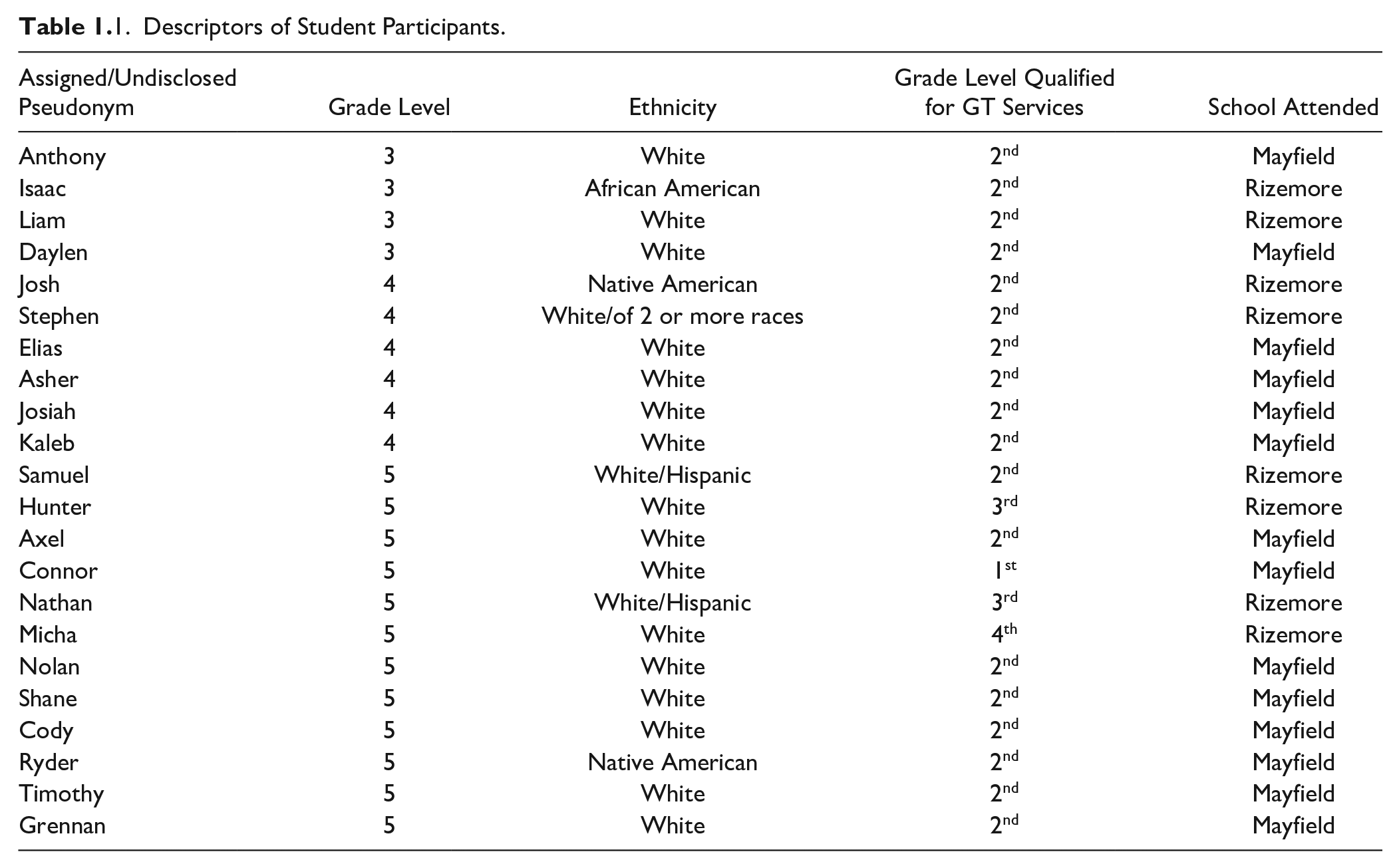
All of the participants qualified for the district’s GT program during their first through third grade school years. The participating district uses evaluation measures for gifted and talented identification that include the Cognitive Abilities Test (CogAT) and a multi-criteria matrix designed by the participating district to identify specific academic abilities. Teachers recommend students who demonstrate consistent academic or creative skills above grade level for the GT program beginning as early as first grade. Qualifying students demonstrate an overall intelligence test score of 120 or higher as measured by the CogAT, or they achieve a score of 120 or higher on one or more CogAT subtests and score a minimum of 40 points on the district-designed matrix for gifted identification. Table 1.1 indicates the student participants’ undisclosed pseudonyms (given as an ethical consideration), current grade levels and school attended, ethnicities, and the grade levels in which they indicated they qualified for gifted programming.
Descriptors of Student Participants.
Data Collection
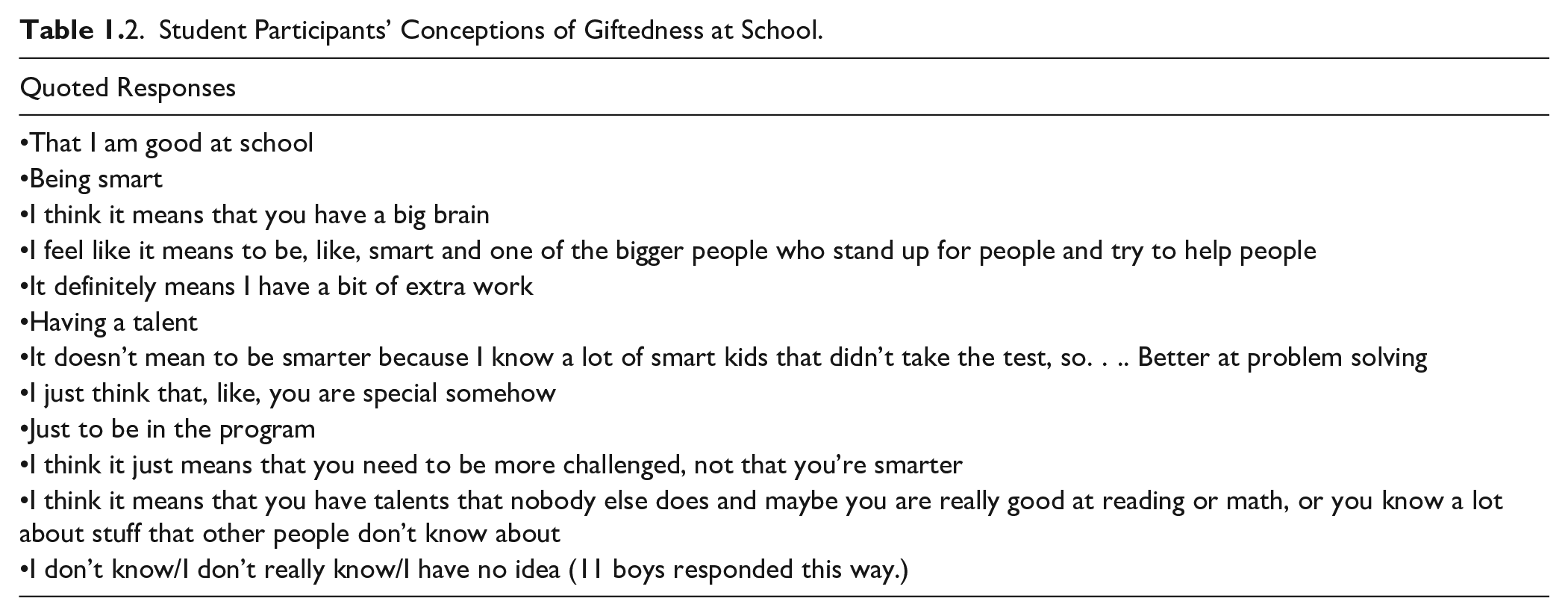
Close immersion into both research sites provided rich data collected from classrooms and unstructured school-time observations and fieldnotes (see Table 1.2), individual interviews with the participants, and teacher and parent questionnaires. Fieldnotes included rich descriptions of the settings, activities, behaviors and emotions, recounts of conversations with all the participants, and researcher personal self-reflections (Emerson et al., 1998). All data was triangulated and coded using multiple analytic methods to explore thorough thematic analyses and make empirical assertions based upon emerging themes threaded throughout the selected types of data.
Student Participants’ Conceptions of Giftedness at School.
Classroom and unstructured school-time observations/fieldnotes
A total of 56 observations from August 2019 to December 2019 were completed during four months of fieldwork: 22 observations at Rizemore and 34 observations at Mayfield elementary schools. Each observation lasted from one to three hours depending on students’ schedules and the number of students observed at each given time. Students were observed individually and together with other participants and non-participants during various instructional times such as in the general education classrooms, specials rotations (which engage students in extracurricular activities), the GT pull-out program times, lunches and recess, and other unstructured times such as in the hallways and passing periods.
Individual participant interviews
One semi-structured individual interview was conducted with each participant during the school day. The interviews lasted approximately 10–20 minutes, with all participants being asked the same questions, and subsequent questions varied based on their responses to the standard questions. Informal discussions were held with the participants’ classroom teachers about the assignments observed so that basic understandings of what the students were expected to be learning and doing could be compared later to what the participants discussed during the interviews about their schoolwork, the classroom environment, and teachers’ expectations of them as gifted learners.
Data Analysis
Social constructionism provided the epistemological framework and the frame of reference theory served as a theoretical lens to analyze data. Farrell (2016) contends that few ethnographic studies imply that the lack of interrogated spaces in masculine curriculum causes concerns for designing equitable approaches for boys to learn, especially those who negotiate high levels of intellect. I focused on the observation events and interview conversations “in close detail while also allowing them to also play out” as I was the spectator within the participants’ school settings (Heath & Street, 2008, p. 63). Therefore, the observation fieldnotes, interview transcripts, and questionnaires were triangulated to enhance validity and discover themes threaded throughout these sources. Ongoing engagement in self-reflexivity using personal memos and jottings served to address the confirmability of the research (Lincoln & Guba, 1985). The students or their teachers clarified any questions I had from the observations. Delving into coding the member’s meanings to help illuminate a critical question surfacing from the data: Why does no one tell students who qualify for gifted programming what it means to be considered gifted? This question evolved as the thread line throughout three salient themes that emerged as findings from the data collection: Theme 1: What Does it Mean to be Gifted; Theme II: Perception of Gifted Boys in Classroom Spaces; and Theme III: Complexities of Curriculum and Instructional Design.
Findings
Theme I: What Does it Mean to be Gifted?
The Boys’ Perspectives
The most significant theme that emerged from the interviews and observations was the boys’ lack of understanding about what giftedness means and how they perceived themselves as individuals identified by their schools as gifted. 11 of the 22 male students who participated in the individual interviews responded to the question, “What do you think it means to be considered gifted at school” by stating, “I don’t (really) know.” Even with restating the question by posing, “What does it mean to be gifted,” these students struggled to answer. 10 of the 22 boys gave one or two characteristics to describe what they think it might mean, which not only explained what they did know about gifted students, but also how they characterized themselves.
Visual imagery, Figure 1, expresses the characteristics the boys used to describe what it meant to be gifted. The picture of the boy filled with descriptive characteristics of himself as a gifted individual adds a sense of voice and humanism deserved of my participants who, through me as the researcher, can tell their stories.
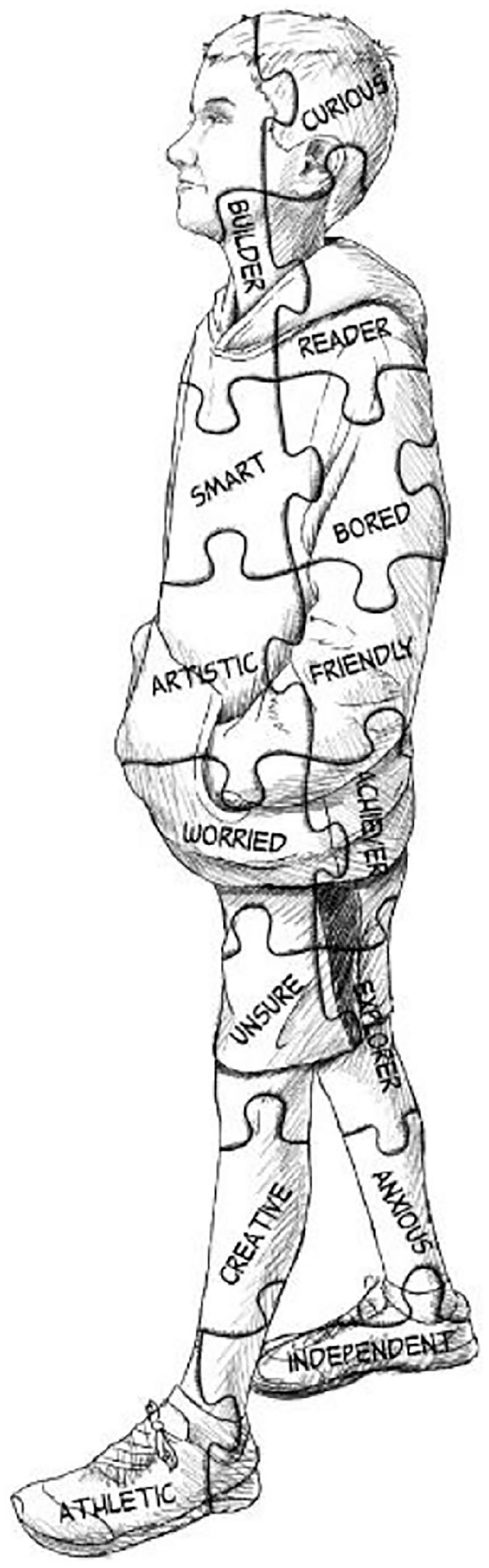
Participants’ Descriptions of Giftedness.
The boys’ voices and understandings of giftedness indicated their perceptions about what it means to be gifted among their peers at school. During the observations, the only times evident to the participants or their peers that they were a part of the school-identified gifted population was when they left their classrooms to attend the GT pull-out program. Differentiated work was not offered to them at either school site that might have set them apart from their peers.
11 students struggled to explain what giftedness was or said they did not know what it meant to be gifted, so follow-up questions were posed. The questions were (1) did anyone explain to you what it means to be gifted, and (2) has anyone ever explained to you how you got into the gifted program? The boys’ strikingly similar conversations during their interviews illuminated some unique perspectives about gifted identification. Answering the first follow-up question, Kaleb, 4th grade, explained, “I don’t remember if anyone told me, but my brother and sister both go to GT”; a notion that he must be gifted because his siblings also were in the gifted program. Josiah, 4th grade, admitted, “I’m having trouble describing being gifted. I think it means you have a big brain. . .that to be gifted, you are very kind and generous, but I just thought of that myself”; conceptualizing that being gifted, or smart, is associated with the social aspects of one’s personality.
Attempting to find an answer to the same question, Grennan, 5th grade, expressed, “Uh. . .that’s a good question. I don’t know. It’s hard. No one really told me what it meant.” Likewise, Elias’, 4th grade, reply mirrors many of the other boys’ when asked if anyone told him what it means to be gifted: “No, they (teachers) said I just passed a test.”
As soon as Elias mentioned passing a test, it appeared important to ask the second follow-up question about whether they were informed about how they “got into” the gifted program to see if other students also associated their giftedness to passing “the test.” They were asked if they remembered when they began attending the GT program, and then I inquired about how the boys found out they qualified for the program. The purpose of these inquiries was to see if the boys understood how a student qualified for advanced programs, thus serving to explore deeper their notions of giftedness. The boys did not recall having been explained the purpose of taking a test and how the results or indicators of the test identified them as gifted. The overwhelming response from 20 out of 22 boys showed they remembered taking a test near the end of first grade through mid-year of third grade, and then they were told they got to go to the gifted program at their respective school sites. Axel, fifth grade, candidly described his perspective on qualifying for the GT program in this way: So, basically, one day someone comes in and says, ‘Hey, come over here. We aregonna’ take a test.’ So, I take a test and I succeeded, and I went to GT. I didn’t know Iwasgonna’ take a test though. I think my mom just signed me up and I didn’t knowanything about it.
Students were also asked, “Do you remember what grade you were in when you a test?” Asher, 4th grade, also recalled taking a test and then being told that he was going to start going to the gifted class, “I remember that I took a test in first grade, but I didn’t start going to the GT class until I went to second grade.” Further, Asher explained that he knew that test was to see if he could attend the GT class but was never informed how or why the test was used to identify him as gifted and talented. Several other students remembered taking a test in second grade and being told they would be attending the gifted class during the school day. Nolan, 5th grade, also could not describe how he was told he was qualified for the GT program, adding, “I think, just, that, like, everybody is smart enough to be in the program. They just don’t want to be in the program”; underlying that he did not understand the caliber of his intellectual functioning that qualified him for the GT program.
In sum, the boys’ overall responses to what it meant to be gifted supported the generalized notion that they viewed giftedness in a shared reality; that being gifted and qualifying for the GT program meant to have taken a test and then being told they were going to the gifted class during a designated time in their school day. 20 of the 22 boys recalled taking the test near the end of first grade through mid-year of third grade.
However, when asked, none of them could explain the actual purpose of the test, how the test identified them as being gifted, or what their unique talents and skillsets were.
Theme II: Perceptions of Gifted Boys in Classroom Spaces
The Boys’ Perspectives
The second theme centered on how the participants’ abilities and gender influence the ways in which they perceived schooling and their positions as gifted students within school spaces. Comparing the boys’ interview conversations with the school observations guided this emerging theme central to understanding how gifted boys perceive themselves at school.
It was important to understand first how the boys described themselves and discover the kinds of things they liked to do at school or at home. Both pieces of information expressed how they viewed themselves in relation to their abilities or gender. All but one boy described themselves by sharing what they liked to do rather than describing something about their personality. That may have been due to their developmental ages or simply because of the way the questions were formulated. Nonetheless, their remarks were insightful and most of them stated several things they liked to do rather than just one thing. Playing sports was the most popular answer with soccer, football, and baseball as the top sports they enjoyed playing. The second most popular activity was recreational reading which included genres such as Greek mythology, graphic novels, and fantasies. Nonfiction was not on their list of favorites. Many expressed their feelings about nonfiction texts like Isaac, 3rd grade, did, “Nonfiction is kind of boring to me. Fiction books are fun to read, and you learn things but also get fiction stuff.” Reading class was not enjoyable, however, for several of the boys because they felt their classes were “too easy” or they lacked personal connections with the required readings.
Other students like Josh and Elias, both 4th graders, told me that they loved to draw fictional characters they created or famous cartoon characters when they had free time during school. Five boys shared that they really enjoyed playing video games.
During the interview conversations, the boys discussed things they liked or did not like about school. The boys’ overwhelming response to what they enjoyed most about school involved the social times such as lunch, recess, or any time in which they got to be with their friends, so exploring the boys’ social opportunities was a priority during my observations. The teachers implemented various forms of group work or collaboration time, which could have counted as part of their socialization time, but were not because the boys did not consider those times enjoyable social interactions with peers because they were paired with other students that may or may not have been their friends. And, according to their responses, the majority did not enjoy group work with their peers.
Nine boys also mentioned that they preferred free reading time or activities academic when at school. 15 out of the 22 boys revealed that math was their favorite subject. Most boys who named math as being their favorite subject did so because they felt they mastered math skills with ease. Grennan, 5th grade, described how he felt about math, “It’s hard, but you build on it and once you get it, then you know it”; inferring that the challenge that math often provided and the feeling of overcoming that obstacle was what he liked most about this subject. Samuel, 5th grade, added, “I like the bigger problems. I like to work them out in my head, but sometimes the teachers say to show your work.” However, not all boys stated that math was their favorite subject. Hunter, 5th grade explained I don’t like math because either I don’t understand it at all, or I understand it so much thatI already know it, so it doesn’t challenge me enough. I either get it better than anybody, or I don’t. I like it when they [teachers] are kind of challenging me, not like where I’mjust kind of sitting there wondering, ‘what do I do now?’
Although not all the boys chose math as their favorite subject, it was not because they did not enjoy it. Rather, our conversations about math mirrored the underpinnings of the frame of reference theory. Many of the boys liked math because it was easy for them in comparison to how they felt they did in other subjects; hence, identifying their presumed academic weaknesses as one of their least favorite subjects. When asked why writing was their least favorite, nine boys stated there were aspects of writing that they did not think they performed well in such as “the grammar part of it” or writing in general. Shane, 5th grade, shared, “I’m not the greatest writer” and Grennan, 5th grade, admitted, “It’s a lot harder for me because I’m not the best at it.” Ryder, 5th grade, best described his dislike for writing class by saying, “I don’t like writing because the English language is stupid. That’s why. Cuz’ there are no rules or too many rules. But, like, you can’t follow any of them. Like every single rule has an exception.”
In all, the boys discussed academic areas in which they felt they were “good at” or the ones in which they felt they were “not very good at,” but there were no apparent links to their giftedness or abilities in relation to being identified as gifted. The boy’s feelings paint a bigger picture as to how they compare their abilities to their weaknesses, as theorized in Marsh’s (1990b) frame of reference theory. The boys made internal comparisons about their abilities, and some made external comparisons as to being “better” at certain subjects than others, or how their abilities were made explicit by their grades on the report cards. I understood these comparisons through Marsh’s theoretical lens but continued to seek understandings about how boys’ lack of understanding themselves as gifted individuals could have helped them realize that just because they are identified as gifted, does not mean they are gifted in all academic areas.
Theme III: Complexities of Curriculum and Instructional Design
The Boys’ Perspectives
The third theme that emerged was the understanding that the participants shared a desire for diversity and equity with classroom instruction. The boys’ preferences for learning and interacting demonstrated that they wanted differentiated learning challenges yet also desired to be a valued part of the classroom group. Their positive feelings and connections to their gifted classes highlighted important attributes of pedagogy in which they wished were offered more in the general education settings, such as more rigorous instructional approaches designed to keep them engaged, help them feel valued as gifted learners, and gain a deeper understanding what it really means to be a gifted child.
What was it about the GT class that all the participants loved so much? The responses matched the ways in which the boys told me they learned best. Some of the boys shared similar replies and all are noteworthy to include in Table 1.3 because they spoke to the wishes for curriculum and instruction designed to match their academic needs.
The Student Participants’ Feelings about the GT Program.
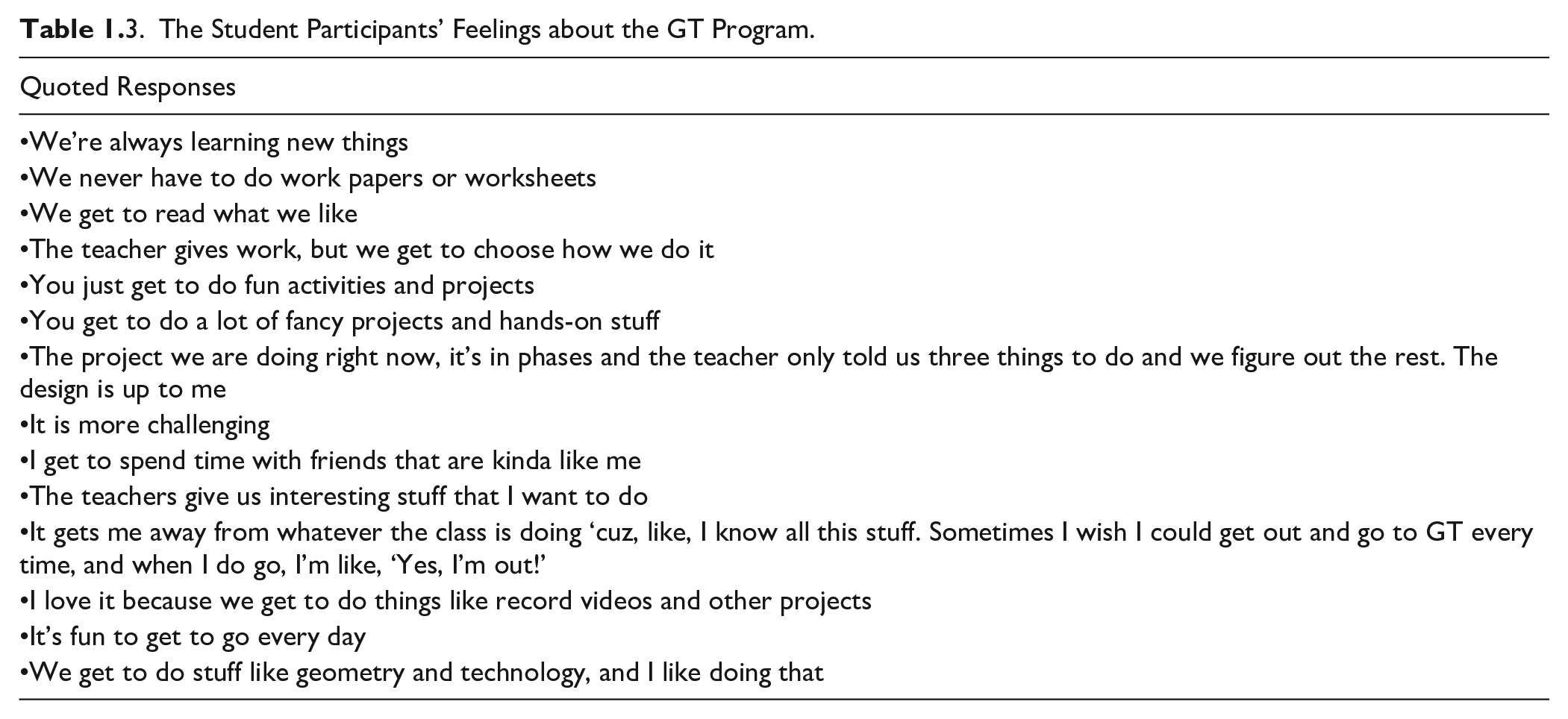
The observations conducted in the GT classes connected to what the boys shared during the individual interviews. The students spent most of their time out of their seats working on projects which included configuring sizes, shapes, and formulating probabilities of functionalities and outcomes. Students designed architecture and worked through confusions they encountered in the ways they chose for themselves. They had the freedom to work with partners or create projects on their own, which was especially important for the boys in my study.
During the interviews, the boys were questioned about how they preferred to learn. 15 out of the 22 students divulged they would much rather work independently than with a group. Cody’s, 5th grade, feelings about group work echoed many of the boys’ sentiments as well, “I don’t like to work in groups, in like big groups. It’s just kinda’ hard to get everyone to work. Sometimes it’s just easier to work by myself.” Axel, 5th grade, felt that group work depends on the assignment, “If I don’t know the subject then I don’t mind working in groups even though they are super slow. If I do know the subject, then, no, I don’t like working in groups.” Ryder, 5th grade, admitted he prefers independent work because “I can work at my own pace, and you don’t have to translate everything to someone else in a different way.” The boys’ preferences for working by themselves, even though they are not afforded that opportunity to the extent they wished they had, may indicate they are not given spaces to cultivate their own ways of learning because of teachers’ personal preferences to instructional approaches.
When asked if there was anything about being gifted they did not like, the boys admitted that while they liked being “smart,” there were aspects about it that they did not appreciate. Two boys had similar comments as Timothy’s, 5th grade, “I don’t like being called gifted, but I don’t, like, say anything if they do. Like, really, I don’t bask in it. I don’t want to brag about it.” While Timothy enjoyed being considered gifted, he did not use it to set himself apart from his peers. However, I observed that setting the boys apart was inevitable in some classrooms. Since both schools’ GT programs were designed as pull-out programs, the boys left general instruction time to attend. Ironically, the boys enjoyed leaving class, some to get out of the work they felt they already knew how to do, especially during their reading block. I witnessed teachers say, “GT kids, it’s time to go,” or “If you are in GT, then it’s time for you to leave.”; constantly signaling the students who had been identified as gifted and talented among those who had not.
Lastly, what the boys wished their teachers knew about them as gifted learners? 10 of the boys expressed personal information that they wished their teachers knew about their lives. Most candidly, Anthony, 3rd grade, revealed, “I don’t like it when I get upset because I feel like teachers don’t understand the situation.” He continued to explain one scenario in which he was told to apologize for something he felt he did not do that, in his mind, did not warrant an apology. Asher and Josiah, both 4th graders, and Micha, 5th grade, wanted teachers to know their other talents that they had not had the opportunities to share in school, such as their musical talents, hobbies, and outside of school interests. Six boys stated like, Connor, 5th grade, “I don’t know. I think they already know everything about me.” Their views signaled that either they had positive experiences with making connections to their teachers, or they perceived their teachers the way many students do—they were the holders of all knowledge.
Discussion
The aim of this research was to illustrate gifted boys’ voices about their school experiences and understand how school plays an essential role in developing their self-concepts as learners. This study contributes to scholarly literature in the fields of gifted and general education programs by addressing gaps in research involving elementary-age students’ personal perceptions about school. These findings and implications also serve to strengthen Marsh’s theoretical framework (Marsh, 1990a; 1990b) and other research such as Hebert’s (2011) by substantiating the claims that self-concepts and social and emotional developments are influenced by school practices.
Thorne (2010) asserts that “to learn from children, adults have to challenge the deep assumption that they already know what children are like” (p. 12). The findings unveiled several facets about the boys and their school lives that were yet to be discovered. The most critical aspect disclosed the complexities about what giftedness really meant to the student participants; however, most of the participants did not understand what it meant to be identified as gifted because no one explained it to them; or at least told them in developmentally appropriate ways. The boys could not articulate what their intellectual gifts were and how they were fundamental, or not, to who they were as individual members of the gifted education community and their general education classroom environments. This left them questioning how they fit into the general curriculum or what it was like being a gifted child. There is a lack of conversations that could have helped the boys better understand who they are as individuals and how they could have utilized their skills to adapt to the academic, social, and emotional demands of schooling (Grantham Gubbins, et al., 2021; Hebert, 2011; Marsh 1990a; Marsh & Shavelson, 1985; Marsh et al., 1985). Jenkins and Demaray (2015) argue that students’ self-concepts are inherently linked to their academic achievement. Young, gifted students should be afforded respectful conversations about what it means to be gifted and how their intellectual capacities converge to develop the whole child. Furthermore, O’Connor (2012) posits that students’ overall wellbeing and self-esteem are influenced by how they perceive themselves as children labeled as gifted in institutional spaces.
The lack of ethnically diverse representation among the student participants complicated the aim to include male students from various ethnic backgrounds in order to pursue a more wholistic approach to the implications for practice, rather than a majority White teacher and student stance. This study prompts the question about whether one’s Whiteness and assumptions of how boys, especially boys of color, influence how they perceive intersections of masculinity with academic intelligence; and for lack of better terms, the understanding of how to play the game of school (Lensmire, 2017; Hall, 2003; Ferguson, 2000). Changing viewpoints involves educating teachers about how to best support the needs of all students and erasing the assumptions that all students must prescribe and be treated according to traditional gendered, or White stereotypical, roles (Farrell, 2016; Orr, 2011; Slocumb, 2004).
Limitations
Strong qualitative research should include a small population, but excluding members who were willing to participate seemed counterproductive to the larger aim of obtaining students’ voices about this research. A large sample size proved to be a tremendous amount of time and effort; especially given the ethnographic nature of this study, but not excluding members provided a broader picture of the school culture.
Second, a critical concern that emerged from this study was the lack of a diverse ethnic student sample population. The sample population did not represent an equitable comparison to the overall school demographics at both sites, thus opening further possibilities to extend research about ethnic underrepresentation in gifted programming and the examination of teachers’ stereotypes about giftedness in students who are not White. Further interrogation of this concern may acknowledge intentional and unintentional personal stereotypes and biases and uncover long-standing issues in under-identification of minority students for gifted programming, or whether educators “who are from different cultural backgrounds than the students they are evaluating can be effective in nominating those students as gifted” (Plucker & Peters, 2016, p. 59). Perhaps there is the issue of whether the CogAT tests used in this district, and others, should be re-evaluated through a cultural lens to determine if the evaluation process is equitable and culturally considerate.
Lastly, since the findings relied on students’ perceptions, they cannot be validated with sources such as achievement or other school reporting data. Explicit data like grades and achievement scores were excluded so as not to focus on recorded data about their performances; rather, this study focused on the perceptions and perspectives of all participants.
Implications for Practice
This study presents several vital implications for curriculum and instructional application to current teaching practices. All educators, pre-service to current educators at all levels of education, can reflect on this kind of work to address complexly structured classrooms made up of all types of learners. Adults can learn from children’s own perceptions that are expressed in ways that help to better understand these complexities of designing equitable and valued instructional environments.
Explore the Constructions of Giftedness with Children
GT teachers and classroom teachers should consider explaining to gifted students what it means to be considered gifted and talented. According to Letina (2020), Lo and Porath (2017), Pfeiffer (2012), and Delisle and Galbraith (2002), there is not an absolute definition of gifted. However, there are common characteristics and strengths that should be explained in terms that young students understand so that they can learn to use them. Avoiding the responsibility to help children discover themselves sends gifted students mixed messages and portrays the negative perception that they are different or not accepted. Delisle and Galbraith (2002) also state that adults should avoid sending other messages telling gifted students that “it is okay be smart, as long as you are not too smart” (p. 22). In other words, they believe that depending on how adults approach these conversations may leave gifted students feeling as though society does not accept people when they exhibit superior intellect above others or that to acknowledge their abilities is portrayed as being elitist (Lo &Porath, 2017).
Recognize Intersections of Gender and Ability
Letina (2020) and Bianco et al. (2011) strongly acknowledge, as other researchers do, that teachers play essential roles in referrals and identification of gifted students and that what they believe about students and the conceptions of giftedness decide whom they refer for GT services. Teachers have relied on stereotypes about what giftedness is and how it manifests itself in either boys or girls. Bianco et al. (2011) found that students who did not necessarily exhibit stereotypical characteristics of either gender were more likely to be considered gifted, thus increasing their chances of referral or the teachers’ beliefs that they were, in fact, gifted.
Some participants’ behavioral challenges were another consideration. Their behaviors, according to Hamilton and Jones (2016) and Delisle and Galbraith (2002), pose concerns for some teachers when juxtaposing them with their abilities. Their negative behaviors tended to be addressed before their academic needs, when denying attention to their academic or emotional needs may have been the antecedents to their misbehaviors. Misunderstanding behavioral needs may prevent other potentially identified students from qualifying for services based on biases or stereotypes about how gender and ability intersect in young children (Legewie & DiPrete, 2012; Delisle & Galbraith, 2002).
School Influences Self-Concept Formation
Students compare their strengths, especially the skills their teachers value the most, to their presumed weaknesses which really may not be weaknesses at all. When teachers promote “approaches for developing excellence,” students feel successful in one subject, their self-concepts improve, and their motivations for achievement follows (Mudrak et al., 2020). However, when students perceive they have weaknesses, their self-concept suffers and so do their levels of effort.
Students’ self-concepts are positively formed when their learning needs are met, their skillsets are addressed, and they are not left feeling that because they are already high-level readers that they should be self-managing their own learning in reading class (Hebert & Smith, 2018).
Open Spaces for Students’ Voices
Kumashiro (2012) believes that schooling greatly influences who we are as individuals and the ways of making sense of who we are. Educational experiences play such vital roles in one’s self-development, and are enhanced when students have a voice about how it works and helps them to develop their whole person. Students should participate in developing their learning targets and express their preferred methods of instruction. Their accountability increases to achieve those targets and they become more mindful of the roles they play in their own learning. Students can provide useful and unique insights about how to improve instruction if given the opportunity to be a part of the planning process with teachers (Watts, 2020). Incorporate short questionnaires or surveys about the current methods of teaching. Work with students to practice continual reflection of their personal learning goals and preferred methods for learning. Prioritize time to learn about students’ funds of knowledge so that student backgrounds, interests, learning styles, and cognitive levels are addressed through adapting curriculum and pedagogy (Sleeter & Carmona, 2017).
Implement ways of understanding the students and open spaces for conversations that value them as human beings. Through these conversations, teachers may find out things about their students they might not otherwise have known. As stated, most of the boys in this study preferred to work independently or with students with similar skillsets. Johnsen and Kendrick (2005) state that gifted students “often do more of the teaching than the learning” when teachers place them into heterogenous groups without consideration for differentiation of the lesson learning goals that increase rigor and attention to their learning needs (p. 20). Their feelings about group work may go against common teaching strategies that include grouping students on various levels of ability; therefore, at what cost is the notion that working in varied groups outweigh the potential for academic progress for students who often feel left behind? Reflecting on students’ individual needs helps center students at the core of pedagogical practices. As in this study, most student participants felt it was important for their teachers to know personal aspects of their lives, such as musical and athletic talents, or hobbies that do not always get showcased at school. Telling me that they wanted teachers to know personal things about them demonstrates their desires for personal connections with their teachers.
Pursue Inclusive Curriculum Design
The question of whether schools are designing inclusive spaces for gifted children remains threaded throughout research in gifted education (Letina, 2020; Grantham Gubins et al., 2021; Johnsen & Kendrick, 2005). Based on this study’s findings, many of the issues of providing proper services for gifted children in public education stems from the lack of articulated conceptions about giftedness and equity with identification practices. The boys in this study exemplified the need for both cohesive, inclusive, and rigorous instruction regardless of whether teachers agree that gifted students are adequately served, and perhaps better served, in specialized gifted programs, or whether the responsibility should primarily rest on the classroom teacher’s shoulders. Further, rethinking gifted services for students should “consider the pluralistic nature of our society and the importance of achieving excellence without neglecting equity” among students in which we serve (Grantham Gubbins et al., 2021, p. 219).
Conclusion
According to Pinxten et al. (2015), there is limited research centering elementary-age students and their voices about schooling; therefore, this study contributes to critical gaps in gifted education. This in-depth analysis through the frame of reference lens illuminated three central findings described in themes regarding elementary-age boys’ and teachers’ perceptions of giftedness and school spaces: the conceptions of giftedness, the perceptions of gifted boys in classroom spaces, and the complexities of curriculum and instructional design. These themes were situated through the participants’ groups that included the boys and their general education teachers to understand how each sample population understands the complicated intersections of gender and ability and their influence on self-perception. The findings led to practical implications for educators and the impetus for further research for the sake of improving socially constructed understandings, or mutually constructed understandings of the school experiences for young people.
Footnotes
Declaration of conflicting interests
The author(s) declared no potential conflicts of interest with respect to the research, authorship, and/or publication of this article.
Funding
The author(s) received no financial support for the research, authorship, and/or publication of this article.
