



Abstract
In light of our forced migration to the online world, this article argues in favor of a widespread evolution of our approach to education, drifting from rigid to flexible models. Such an optimal system would be able to change from one form and function to another, even in mid-course, without compromising pedagogy. This system has to be based on evidence-based innovative pedagogies and scholarships of teaching and learning. The article proposes a “Convertible Learning System” (CLS)—a synergistic optimization of relative strengths of traditional and online learning approaches, while simultaneously allowing the flexibility that we realize is now critical. Although the examples lie in the realms of tertiary education, the concepts and implications can be beneficial at educational levels.
Keywords
Introduction
It’s a warm sunny day as you drive down a beautiful mountain road in your convertible. You feel the wind in your hair and the sun on your face, it’s good to feel the outdoors and to see the vastness of our sky. Suddenly a dark cloud moves in and swallows the sun, leaving the air cold against your now chilled arms. Slowing down the car you quickly put the roof up, close the windows, and turn on the heat. Within moments, after only a brief slow down or pause, you are back on the road and comfortable again. The experience is not the same as it was when the weather was nice, and in many ways, it’s not as good as it was, but what it lacks in interactions with the outdoors it may gain via a closer interaction with the interior. For example, the radio now sounds much clearer and there is a general calm that was not there previously. Most critically, despite the change, movement towards the destination continued virtually uninterrupted, and when the weather turns nice again the roof can be lowered, and the sun enjoyed. Back to the feeling of openness and freedom!
A dark cloud has moved over much of our world, and it has resulted in education being moved indoors or, more accurately, online with a speed that is breathtaking. Many describe this as crisis management or emergency teaching, finding a sufficient way to educate “until the cloud passes.” The current cloud we call COVID-19. Not only has it been slow in passing, it may be just one of several waves, each a new dark cloud. It would be naive to believe that what we have experienced will simply pass. Moreover, while this pandemic may be the first event in our lifetimes to cause such a worldwide shut down of everything, it would also be naive to think that environmental issues or various other clouds might not also have that ability, and we have been slowly allowing these clouds to gather knowing they will, sooner or later, visit our skies. Amidst the many questions this cloud has brought along, there is one that might change the education landscape in general, and tertiary education in particular, forever. When the current cloud passes, should we run back to the shelter of our traditional methods, or will we have to learn, adapt and continue our journey in ways that anticipate cloudy days?
In the current article, we argue in favor of a widespread evolution of our education approach away from rigid models and towards a more flexible educational system, something that can change its form and function. Like the convertible, we would like to make the most of traditional (i.e., human) approaches when things are good, while also having the ability to quickly transition to online (i.e., digital) approaches and making them an indispensable part of our new pedagogical system. More importantly, the realization has dawned that these recurring times of online learning will introduce us to new ways of prioritizing and new ways of being innovative in our teaching. The remainder of this paper makes the case of this “convertible” approach while also clarifying what such an approach might look like. When possible, concrete examples of such flexible practices are highlighted.
To be clear at the outset, our goal is to highlight a structured approach to providing education that supports the deepest possible learning while offering flexibility as needed. Thus, we do not describe any new educational techniques specifically. Rather, we consider how a range of powerful evidence-based learning processes (Mitchell, 2008, 2013) can be organized to create a powerful and flexible approach to education. Our focus is inspired from the concept of scaffolding and the “zone of proximal development” (Vygotsky & Cole, 1978) that can help us hold these processes together and the manner in which it allows us to focus our educational efforts at a level that is dictated in part by challenges like those represented by COVID-19.
Driving the Convertible
Needless to say, people, including instructors and students, feel more comfortable and organized when they are living and working in ways they know. Migration to a new world can cause disruptions to our plans and disrupts our way of living, teaching, and learning (Benhura & Naidu, 2019). The outbreak of coronavirus caused nothing less than a “forced migration” to a new world where teaching and learning happens holistically online (Joordens, 2020; Stafford, 2020). As instructors felt abruptly cut off from their students, classrooms, and offices, they had to deal with a new very different teaching and learning context, and expecting guidance and help from their institutions, the latter were not in a better situation as they were fully preoccupied feeling the full brunt of the COVID-19 shock. The impact of the COVID-19 crisis on e-learning, and distance education, in general, has been tremendous (Teras et al., 2020; Toquero, 2020). Online learning, once marginal in the minds of educators and administrators of educational institutions, has become mainstream and in most cases, the only option for education to continue during the time of disruption. Some critics of online and e-learning pre–COVID-19 may find their arguments not valid anymore after COVID-19 given that online learning provided the only safe option for educational institutions in most countries worldwide (Peterson, 2001).
An educational system’s flexibility, or lack thereof, becomes obvious during times of disruption. When a crisis, like COVID-19, strikes, the flexibility to move from one learning mode to another is much needed (Huang et al., 2020). When the system has adequate flexibility, it is more likely to respond quickly and seamlessly with minimal disruptions. Demands for a more flexible approach to education existed even before COVID-19 (Mills et al., 2017; Vadeboncoeur & Padilla-Petry, 2017). The traditional university was built on the assumption that students were young, typically male students who lived near or on campus, and who were preparing for a future career. The current student body is much more varied. It now includes students across the gender and age range, some of whom find it challenging to be on campus at specified times due to life commitments including part-time students or even full-time jobs as well as women with children or with other responsibilities (Thomas, 2014). Thus, even prior to COVID-19, students valued flexibility in how they could engage with universities (Bassili & Joordens, 2008; Bassili, 2008).
Now that COVID-19 has arrived, it’s not clear when we will leave its shadow. Several sources are now predicting that it could take us 18 months to 3 years to learn how to “live with COVID-19,” assuming it cannot be simply eradicated by a vaccine. Note that part of this “learning to live with COVID-19” may include changes in how we educate ourselves and our children. Even if COVID-19 does somehow cease to be a major health threat, there is no reason to think this disruption is a one-time-only event. For instance, at the end of 2002, SARS affected several countries around the world, and in order to contain the virus, face-to-face teaching was banned in several regions in China. Similarly, in 2009, the outbreak of H1N1 flu affected several countries around the world, causing school closures in many countries and areas, such as Bulgaria, China, France, Italy, Japan, New Zealand, Serbia, South Africa, Thailand, the United Kingdom, and the United States (Cauchemez et al., 2014).
Flexibility allows individuals and organizations to deal more effectively with uncertainty by identifying new information and incorporating it into decisions as soon as it becomes available (Eapen, 2010). Since the outbreak of coronavirus in December 2019, education systems worldwide showed significantly different levels of flexibility in their responses to the crisis in order to contain the COVID-19 pandemic (Daniel, 2020). Despite the fact that the vast majority of schools and higher education institutions closed their campuses, it became obvious that some institutions were more agile and were able to seamlessly and quickly migrate to the online space. Legislations, instructions, decision-making, and preparedness (in terms of mindsets and infrastructure) were determinants of the institutions’ ability to adopt online teaching as the only teaching mode available for them during the blockade in order not to terminate the schooling/academic year. Nevertheless, some systems took the decision to halt the academic year (e.g., Kuwait), while others took the decision to resume teaching shortly after the closure with the associated chaos and pitfalls (e.g., Jordan).
Many higher education institutions responded to the crisis in the form of the “emergency remote teaching” (ERT) model (Bozkurt & Sharma, 2020). The model distinguished responses and practices as they are not usually planned in advance, and involves a sudden shift from traditional teaching into a remote one as a swift response to emergency situations. This is appropriate perhaps if teaching and learning is expected to return to normalcy when the emergency state passes (Affouneh et al., 2020). However, a proper online learning model is well-planned and can be part of the teaching practices in normal situations (Hodges et al., 2020; Schlesselman, 2020) and can provide the source of flexibility highlighted here as highly desirable in uncertain times.
Beyond the Traditional Views of Flexible Education—Toward CLS
The traditional view of flexible education mainly focused on providing more access to education through abundance of open online resources (Tlili et al., 2019) and was primarily focused on higher education as enrollments worldwide are expected to double by 2025 (Maslen, 2012). According to Beaudoin (2016), flexible learning is a comprehensive approach that enables institutions to be “more responsive and relevant” to diverse student populations. Therefore, it is concerned with the changing characteristics of students in higher education encouraging more flexibility to allow less traditional students gain more access to higher education.
In the pre–COVID-19 world, online learning was often used as a substitute for traditional face-to-face approaches to learning, although at times, the two approaches were combined to provide more flexibility for students (Bassili & Joordens, 2008). Thanks to the elimination of specific time and place commitments, students who could not attend a traditional learning institution for either logistic or financial reasons could often engage in learning online. This convenience factor was attractive even to students who were attending traditional institutions, allowing them more flexibility to experience their learning when and how they preferred.
Even beyond pandemics, fundamental changes and disruptions are happening more frequently in the forms of natural disasters (e.g., climate change, tsunamis, and pandemics) or human-made crises including wars and conflicts (Changnon et al., 2000). We have not been good stewards of our planet, and we have not yet learned how to live together in peace. Thus, existential crises seem to be lining up, each challenging our traditional approaches in different ways, and education is no exception. All of this suggests that we need to widen this concept of education flexibility further.
We wish to advocate for a new more inclusive approach, one that combines the relative benefits of traditional and online learning either at a program level or perhaps even at a course level. In fact, the optimal system would be one that can almost immediately change from one approach to another even mid-course, without missing a beat, and all the while providing the best pedagogy possible. It would also be based on evidence-based innovative pedagogies, capitalizing on the great scholarship of teaching and learning that has been booming over the last few decades. What would such an approach look like?
Throughout the remainder of this article, we will attempt to discuss educational flexibility from a number of perspectives with the goal of describing a system that provides the optimal combination of online and face-to-face learning. Note we are not proposing some general form of blended learning (Boelens et al., 2017) but, rather, a specific approach that combines traditional and online elements in a manner designed to allow for flexibility in learning, while maximizing the pedagogical experience beyond levels reached using traditional approaches alone. We imagine a hybrid educational approach—the convertible learning system—that provides a synergistic optimization of the relative strengths of both traditional and online learning approaches, while simultaneously allowing the sort of flexibility that we argue is now critical.
The Convertible Learning System
To provide the clearest possible sense of what we imagine, we will break the learning experience into three components, each of which will be considered separately. The first component is what might traditionally be called “The Lecture” but that we will instead refer to as the Content Learning component. This is where a professor either explains the content to students, or at least highlights the relevance of the content thereby motivating the students to want to learn and understand. The second component is what might traditionally be called “Assignments” but that we will instead refer to as the Deepening Learning and Developing Skills component. This is where students work with the knowledge they are learning, potentially exercising and developing transversal skills as they do (Pârvu et al., 2014). Finally, there are Summative High-Stakes Assessments. These typically occur at the end of some unit or course to gauge how much the student has learned in the course.
Just prior to discussing each of these three areas though, it seems critical to highlight an important distinction we will connect with throughout our proposal, the distinction between learning content versus learning skills. This issue is discussed in detail in other sources (Beckett & Slater, 2005; Joordens et al., 2019) but the core of the distinction is this. Information, like the content of a course, can be learned via simple exposure, especially if the content is presented in an engaging way. Skills however only develop through repeated use of the skill, preferably with a context that is supportive of skill development right from the adolescent stage (World Health Organization, 1994), and one that provides rich feedback (Joordens et al., 2019). You can learn a lot about some skills like playing guitar from a lecture, but if you want to learn how to play guitar, that requires a different approach wherein learning is tied to the amount of practice performed and the extent to which the learning environment provides structure and feedback (Balım, 2013).
Even well prior to COVID-19, many were arguing that our students' success in life may depend as much if not more on the skills that can bring to the workplace than on the knowledge they might bring (Silva, 2009), and these skills and competencies being integral for life-long learning (Sala et al., 2020). There is every reason to believe that the future job market will become even more dynamic and unpredictable after COVID-19, and thus, transversal skills like critical and creative thought, effective communication and collaboration, awareness of one’s own strengths and weaknesses, and psycho-social and emotional well-being (Ministry of Education and Employment, 2020) will be critical to student success. Thus, in conceiving of the optimal Flex Ed approach to learning, we must keep this distinction in mind and must consider the merits of any proposal in terms of its ability to develop and enhance both knowledge and skills.
Content Learning
Both traditional and online approaches to learning have merits, and the challenge to creating an effective hybrid approach is to combine these merits to optimize the learning experience. When it comes to the delivery of content, the traditional approaches seem ill suited to students living in a world of stimulating distractions and, as we have seen, it is also very prone to disruption by events like COVID-19. Consider the fact that many traditional lectures are an hour or longer, sometimes up to 3hours, with content being delivered often by one individual speaking contiguously with only occasional breaks. This sort of “data dump” goes well beyond a typical human ability to sustain attention (Manly et al, 1999) and serves well the concept of the “banking system” model of education (Bybee, 2020) by ultimately presenting more information to students that they can effectively consider within a single sitting (Miller, 1956; 2003).
It is for this reason that most e-learning approaches, including those embraced by the platforms that provide Massive Open Online Courses (MOOCs), present content in shorter more focused “chunks” that students can watch in a short period of time and that deliver a smaller number of core points effectively. For example, rather than lecturing for an hour, create four or five shorter instructional videos that hit specific subpoints well. Chunked lectures are even easier for students to “digest” and to integrate with their lives, and providing information in this distributed manner is a preferred approach for learning, something originally demonstrated by Ebbinghaus et al. (1913). Note that this approach would not seem appropriate if attempted in traditional settings, when we have a lecture hall for some period of time, we want to use it all. But when content is delivered online, this approach works very well.
However, while there are clear benefits to presenting content online, there is also something important that is lost. The basic difference between online and in-classroom learning is the separation of the instructor from the student and students from each other which often causes a feeling of isolation among students (Palloff & Pratt, 2007). Specifically, traditional lectures featured a human being who was present, who could see the learners directly as they learned, and often lectures conclude with an interaction with this human in real time. A chance to converse, to ask intelligent questions, and think along with the professor who can actively and immediately scaffold students’ learning, is a critical exercise of interpersonal skills involving one’s professor and classmates. In addition, students may have spoken with each other about the content during or just after its presentation, allowing a social component to learning that is also valuable (Palincsar, 1998).
Pre-recorded videos cannot provide real-time human-to-human interactions focused on the content, at least not at this time. However, it is possible to combine the pre-recorded videos with online discussion to add value in this respect (Tang et al., 2020). Still, a previous study showed how the traditional face-to-face teaching model was superior to the online and the combined model especially when it comes to abstract content as some courses in maths, engineering, and other fields include a large amount of formulas and abstract concepts when face-to-face was more appreciated and effective (Toto & Nguyen, 2009). In addition, the ultimate goal of skill learning is to be able to interact effectively with other humans in real time, and to get to that point, students need practice. These interactions were one way, albeit an informal and self-directed way, that students gained this practice. Thus, we need to acknowledge the importance of real-time human-to-human interactions, and if they are not occurring in the context of content delivery, then we need them to occur elsewhere in the learning process.
Yes, one can augment online lectures with online office hours, and those hours are intended to provide something akin to that post-class opportunity of interpersonal interaction. They may deliver to some extent, but humanity can still be lost. Students may be less likely to join an online office hour than they would to join an impromptu conversation that they might literally run into as they leave the classroom. Those students who do attend online office hours almost always leave their cameras off (Castelli & Sarvary, 2021). This is partly because they feel they can do other things while attending, which means their mind is distracted. One cannot easily have distracted conversations with professors in the traditional context, but it seems easy and effective online. Perhaps, but at the cost of a real human interaction, the sort that might allow students to, say, excel in a job interview.
So how can one have the benefits of an online approach to guided content learning, while retaining the sort of human interactions that are so critical for our students? Note this will be our theme throughout, how to bring humanity to a hybrid learning approach. In the case of guided content learning, there are two ideas worthy of consideration as we consider optimal approaches, both of which are forms of so-called flipped learning for deep learning (Awidi & Paynter, 2019; Flipped Learning Global Initiative, 2020; Danker, 2015).
The most successful implementations of flipped learning occur in courses wherein students are learning some processes or procedures as is common in fields like mathematics, physics, chemistry, etc. (Eichler & Peeples, 2016; Lai & Hwang, 2016; Schultz et al., 2014). In these contexts, it makes a lot of sense for students to learn the theory and the process first via online lectures and then come together to put the learning into practice with a more traditional context. Once again, the online lectures provide a convenient and potentially superior way to learn the theory, and the students then benefit from the human interaction as they attempt to demonstrate and enhance their knowledge with support from teaching staff and fellow students. Specifically, these sessions provide students with real-time practice of thinking critically and creatively, communicating with peers, and collaborating when necessary to solve problems, all within a “human” context.
Applying the flipped approach in some other course contexts can be less natural. For example, in an Introductory level “breadth” course, where the true challenge for students is memorizing a great deal of content, the online lectures can clearly play a role in supporting content learning, but it is less obvious and can be more challenging for the traditional portion of the approach. However, even in these courses, teachers need to help students make sense of the new concepts and knowledge they are learning. So, for example, class time might consist of collaboratively creating concept maps (Bijlani et al., 2013) that connect various parts of the information students are learning and provoking discussions, brainstorming, and questioning throughout. If the course includes some controversial issues, techniques like formal debates (Brown & Wilson, 2016; Fournier-Sylvester, 2013) could be used to allow students to explore the controversy further while engaging critical thought and communication skills.
There is an additional challenge of course, these courses are also often very large—the third author of this paper teaches an 1800-student course, for example. How one can work with these many students in some active manner? One can, of course, use technology to try to create interaction at scale, but if the purpose of class time is to work with knowledge in human ways, then perhaps such large classes should be broken down into more manageable sized groups when they come to our institutions. Learning at scale is great for the content learning part of the process but reducing the scale to sizes more common in real-world problem-solving contexts (e.g., corporate contexts) would likely be the optimal approach; however, this can be idealistic for some universities.
One implication of all this is that all of us should change our mindsets about lecturing. We should acknowledge that students largely prefer consuming information online, especially if we create it in a way that respects their complex lives and provides engaging learning in small chunks (Guida et al., 2012). If we get used to doing this as a matter of course, then our content delivery will become immediately immune to disruptions in where learning happens.
Then, when we can meet face-to-face, we should use our “class time” in a typical flipped way. Giving students problems to solve related to their learning, and assisting them, and allowing them to assist one another, as they work through the problems. Again, this is a great context for encouraging students to exercise their thinking and interaction skills while being supported and while gaining real-time feedback.
Note that these classes will be disturbed if face-to-face meetings are ever not possible due to a virus or any other reason. Some level of disturbance is inevitable and as we will highlight subsequently, at these times, we can continue to work on building the foundations of real-time human interaction skills in a digital context. Ultimately though, the skills should be practiced in a face-to-face real-time manner, and when it is possible for students to be together, these flipped sessions will provide one mechanism for providing this kind of support.
The implication then is that we view the “in class” opportunities as targets of opportunity. That is, when necessary, our focus is on online learning, and on ensuring students are gaining knowledge and developing their skillset with a digital context. This becomes our default approach, and the one we use anytime face-to-face interactions are unwise. However, at times when it is safe to meet face-to-face, we have pre-planned activities ready to go that focus on working with the knowledge and working with other students under the guidance of faculty. These are our opportunities to “humanize” the skill learning and we wait for them, then cease and make the most of them when they occur.
Before leaving our discussion of online lectures, it is important to also emphasize that when giving lectures online, we should appreciate and use the freedom from time and space limitations that are associated with traditional lectures. We can use a much better approach of creating shorter, more engaging videos that attempt to make a smaller number of points in a much better way. Thus, students can learn a thing or three; then, they can walk away and think about those things. They can consolidate their learning (Ozan & Ozarslan, 2016) before adding new information. In fact, they can choose when they feel ready to learn that new information. Such a distributed approach to information learning has long been known to be superior to the so-called “massed learning” that is typical of traditional approaches (Pechstein, 1921; Son & Simon, 2012).
Following from all this, we come to our first strong assertion regarding the optimal Flex Ed System. We should no longer see our classrooms as the place where our primary lectures are given. Rather, the primary lectures that comprise a course should be presented as a set of well-crafted videos that bring the information to students in smaller chunks and that leverage all we now know about how to make a lecture engaging. According to RIFS (relevance, interest, fun, and social) Taxonomy, content learning can be made more engaging by highlighting its relevance, by leveraging interest, or by making it fun and/or social (Joordens et al., 2019). With such a carefully crafted set of videos in hand, content learning can seamlessly occur irrespective of whether or not students can meet face to face. CAST (Centre for Applied Special Technology, Malta) is already doing exceptional work in this direction by designing research based transformative solutions, strategies, systems, practices, and tools for learning, assessment, equity, and access in alignment with the Universal Design of Learning (UDL) principles (Meyer et al., 2014).
Also, of relevance is that students can configure their own learning environment when consuming content presentations online. Many traditional classrooms are now very large. It’s no longer unusual for classes to include anywhere from 100 to 500 students within them, almost all of whom have laptops open during lectures. Imagine sitting somewhere in such a class, looking through a sea of laptops displaying a range of potentially distracting stimuli to a professor who is speaking beyond them. Is this the optimal learning environment? How might it compare to a student who can see and hear the professor clearly and directly on their computer or even phone? Apparently, technology is substantially mediating the interaction between instructors and students and it cannot be overlooked anymore. Rather, in this case, the medium is reshaping teaching and learning fundamentally (Kozma, 1991) in the sense that the content and the learning process at large are being transformed in order to fit into the medium whether it is synchronous online learning or any other offline medium (e.g., video, website, and e-book). Therefore, when trying to utilize any media in teaching, the characteristics and advantages of that media must be taken into account and invested into better learning outcomes.
Perhaps one example will make this point clear. Companies like TopHat are now providing platforms that intermix readings with assessment, animations, short videos, and demonstrations. Their platform also allows instructors to directly embed their lectures within appropriate spots of the content. The result is students interacting with the content in a rich multi-media way that combines active and passive learning. For example, students might read a little about some topic, that reading is followed by a short well-crafted lecture wherein the instructor expands on or otherwise “takes off” from the reading. All of this can be followed by some assessment questions that allow students to confirm their learning while they are learning. This is the sort of rich interwoven learning experience that at least has a chance of competing with the other ways students encounter information (e.g., social media). It should perhaps become our default approach to content presentation.
Deepening Learning and Developing Skills
As highlighted above, transmitting information to our students is one critical aspect of the education we provide. This sort of learning lays a great foundation, but our ultimate goal is to help our students develop and succeed as human beings, and for this to occur they need to understand the information they have learned deeply, and they also need to develop the critical transversal skills including cognitive skills like critical thought, creative thought, and metacognitive awareness, as well as the skills involved in working with others including expressive communication, receptive communication, and effective collaboration (Pereira & Costa, 2017).
For the first part, knowledge and information transfer, technology can do a great job in terms of scale and time. Instructors can rely on technology to transfer content to students through any available medium which could be short videos, webpages, textbooks, etc. However, this is the basic and easy part of the two phases of the teaching process: information and knowledge transfer, and sense-making of the knowledge (Bruner, 1960). The latter is the fundamental role of instructors, while technology can overpower instructors in the former. Understanding this notion can help us emphasize the most important aspect of education without wasting precious time on aspects of education that can be performed well by the technology. Despite the fact that we are stressing the importance of the human side of face-to-face interaction, it is also important to emphasize the quality of that time. The ultimate goal is not the face-to-face meeting per se; rather, it is the added value it can bring into teaching and learning. Thus, we need to keep questioning the role of the teacher (Figure 1) and the role of the students in light of the ultimate purpose of education. The role of teachers and the role of technology in teaching and learning (Khan, 2012).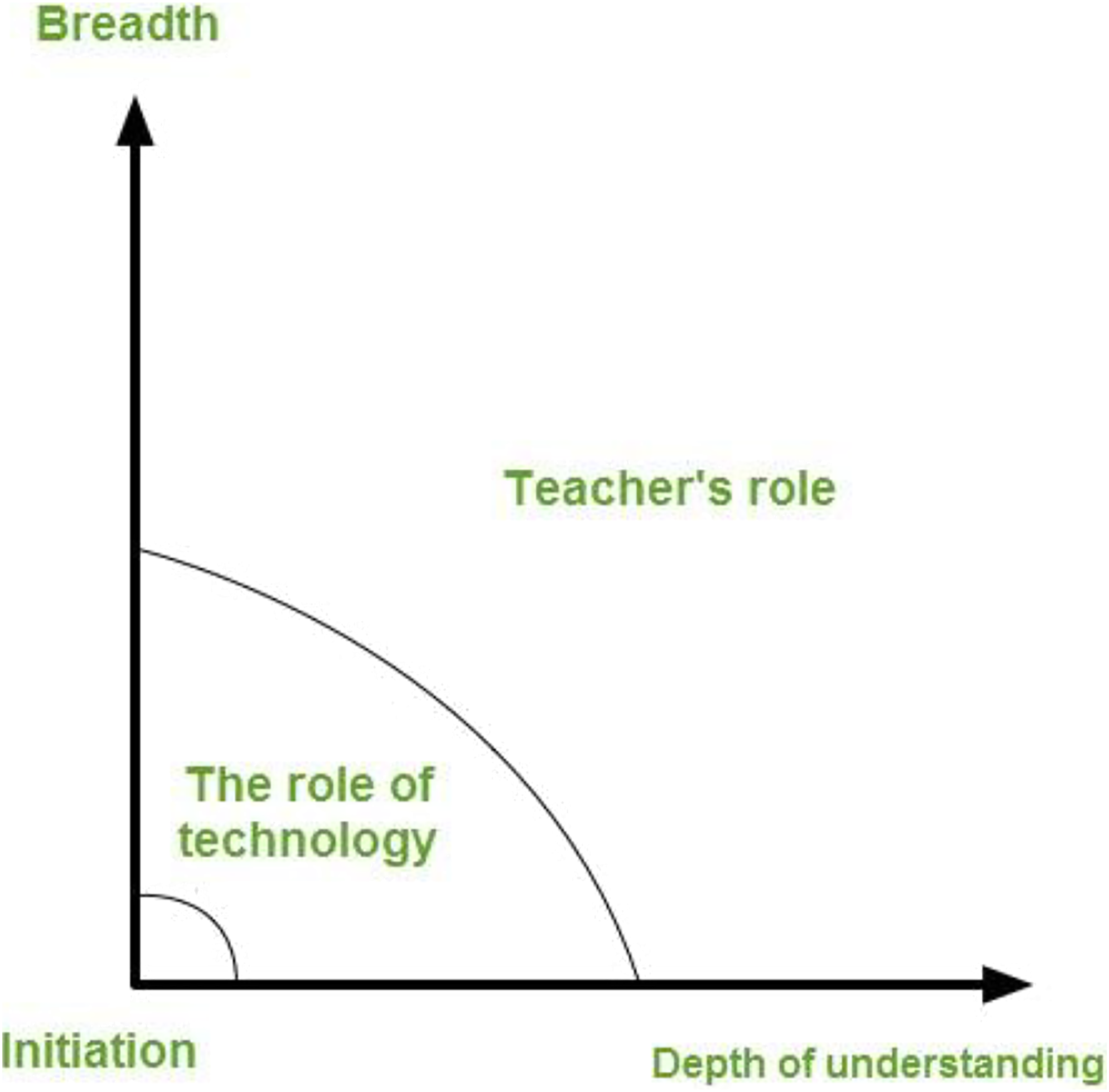
Helping students to make sense of the content and helping them apply what they learn to new contexts should be one of the primary goals for both face-to-face and synchronous online learning. Therefore, the concern should be on investing teachers’ time with students by focusing on executive functioning: the higher order thinking skills and creativity. Despite the importance of all levels of Bloom’s Taxonomy, its higher levels, including application, analysis, synthesis, evaluation, and creativity, are where the teacher’s role is fundamentally distinguished from the role of technology (Khan, 2012). Thus, confining the instructor’s role to lecturing, during face-to-face and online meetings, can deprive students from higher level achievements in their learning as they might be consumed by the “Banking System” model of education (Bybee, 2020), where the ultimate goal is information transfer as a “gift bestowed” by teachers, who have the knowledge upon students, who are considered to know nothing (Freire, 2014). The shift is now toward the problem-solving approach (Hwang et al., 2014; Nagel, 1996) and emphasizes on activating students' role in the learning process. This can give teachers enough time and effort to design online or in-class learning environments and activities that foster and support students to develop skills and performance based on the content they receive.
Of course, this focus on higher order thought also provides a great context for modeling skills and showing their relevance for success. As mentioned previously, for skills to be developed, they must be exercised. Traditionally, we have relied on the assignments; we ask our students to perform to provide a context in which they work with, and build upon, the information they have learned in their classes. When well-designed, these assignments require students to think critically and creatively and to communicate their original ideas. Group projects leverage communication and collaboration skills especially (Oliveira et al., 2011) and thus provide great contexts for exercising those skills. In thinking about our convertible learning system, we need to think deeply about how best to provide this kind of skills exercise in both online and traditional contexts.
To this end, we will argue for a complementary approach to the foundational development and “humanization” of skills across online and face-to-face contexts, respectively. To make our argument most clear, let us consider a critical event in every student’s life, the point in time when they are being interviewed for a career position they want badly. The interviewer asks questions like “Imagine a customer calls and tells you our application website is malfunctioning in some way and they’re quite upset about it. What do you do?” To impress the interviewer, the student must think critically about the problem, think creatively about how to solve it, and then express their answer in a clear and articulate way to the interviewer, all the while displaying a sense of confidence, intelligence, and likeability. How does the student learn these skills?
We will argue that the online domain can play a major role in terms of helping students develop a “skills foundation.” This foundation may be critical to the further honing of the skill, but it is not enough on its own. That is, the interview is a real-time, in-the-flesh, human-to-human interaction. In order to effectively interact with other humans, we, and our students, need practice in such situations. Thus, the foundation that can be developed online should then be “humanized” via real-time human interactions, and this later aspect can become the focus when we are able to bring students together (i.e., when the sun is out).
Specific examples may go a long way to supporting this point. An educational technology called peerScholar purports to provide an evidence-based approach (Cho & Schunn, 2007; Patchan et al., 2009) to the formal development of critical transferable skills (i.e., critical thought, creative thought, and effective communication), and it does so in a completely online manner (Joordens et al., 2019a, 2019b). Briefly, within the peerScholar process, students first create some form of digital composition in accordance with instructions provided by faculty. Once submitted though, they then engage in a process of peer-review (Topping, 1998). That is, they see a randomly selected subset of their peers’ submissions, each anonymously presented, and they are asked to give both positive and constructive feedback to each piece.
This feedback-giving process can be scaffolded along the way, and the questions they are asked to answer about each piece can be crafted specifically to promote certain kinds of cognitive exercise. For example, imagine a student is asked the following “Read this peer’s composition, then identify the one thing that, if improved, would make the largest positive impact on the quality of the composition in general. Communicate to the peer what this thing is, and then give them some specific actionable advice about how best to improve this aspect.” In order to do this, the student must think critically to identify the primary issue that needs to be addressed, they must think creatively about how to best address it, and they must expressively communicate this all to the peer in question. They then answer any additional questions, and then they do it all again for the next peer, and the next peer, etc. That is, they are gaining repeated structured practice using these skills, all the while they are interacting with content and ideas in a deep way.
The peerScholar process does not stop there. There is also a third phase in which students see the feedback applied (by peers) to their work, analyze that feedback, and then use it to formatively guide a revision (Bennett, 2011). Once again, by answering a set of tailored questions, they are provoked to think critically and creatively about each piece of feedback. For example, they may be asked something as simple as the following: “This peer suggested a way in which your work could be improved. If you did what they suggest, how much better do you think your work would be?” Perhaps they are to answer on a 7-point Likert scale with anchors of “It Would Be Much Worse” to “It Would Be Much Better.” To answer this, the student must first engage in receptive communication, actively “listening” to the peer’s comments, they must think critically about them and they must think creatively about what their revised work would look like if they made the suggested changes. And again, they would answer this (and perhaps other) question(s) for each piece of peer feedback, getting yet more structured practice with these skills.
Note that the process described above can happen entirely online and driven almost completely by the students themselves. Moreover, as demonstrated by (Joordens et al., 2019), it is scalable to any class size, format, and subject matter. Thus, it generally provides a rich approach to giving students the exercise needed to develop these critical skills of success in a formal and structured way. When combined with the use of validated rubrics, it can even be used to provide an on-the-fly measurement of relevant skills as a direct byproduct of the learning process. For example, within a project-based model, students may be asked to produce a video project to illustrate and tackle an issue within the subject matter. Once ready, students upload the video to the peerScholar platform where the video is assigned to other peers to reflect upon, evaluate, and provide feedback. The student creator of the video then can use the feedback to improve his work before the final submission. Therefore, through this digital interaction, both students and their peers can benefit from the same project while reflecting and improving their own work.
The peerScholar example highlighted above is just one example of how an online experience can powerfully support the foundational development of skills. In fact, there is now considerable evidence that it does just that (Joordens et al., 2014) while also increasing students’ sense of community in large or online classes (Paré et al., 2015). These sorts of tools, tools that support the development of core skills in online contexts, should be identified and leveraged as an approach for laying the foundations of these skills, a task for which they appear well suited.
However, we also use the peerScholar example because of what it does not provide. Yes, students are interacting with one another, but they are not interacting in real time. That is, they can take as long as they like to think about and comment on a piece of peer work or peer feedback. In addition, the interaction is not fully human. That is, they are not seeing the person they are interacting with and, through non-verbal cues, sensing how they are thinking and feeling. Every true human interaction is a dance of both formal information exchange and a more primitive exchange of emotional states. This latter aspect is critical for winning the alluded to a job interview. To truly succeed in life, a student must learn how to use the skills they have developed within real-time human interactions which, of course, means they need to practice in just that context.
Now we return to an issue we left unresolved previously. If we no longer use our lecture halls for lecturing, what do we do when it is fine for students to gather face-to-face? Universities, such as the University of Calgary, in Alberta, Canada, are now moving on this concept of “fluid classroom,” allowing students to interact in vibrant decor, giant screens, and open spaces to infuse a change in energy. Students work with a free and positive mind and are more open to collaboration, thereby making technology adapt to their needs rather than they adapting to technology in closed rooms. The students can work in small groups or online mode. Simply a classroom, anywhere and everywhere. This method retains the human element while using the technology at its best.
Our contention is that yes, there is a very good reason for students to gather in our classrooms, when it is safe to do so, for the purpose of humanizing the skills they have been developing via online approaches. Our question is, if students gain access to content through well-crafted videos, is there any need for them to come to class at all, especially in content areas where “working on problems” may not be a natural part of what happened in traditional offerings of that course? This is perhaps where the greatest amount of re-imagination might be required. For example, let us imagine something like an Introduction to Psychology class, a breadth class that traditionally is about concept learning. That is, students learn about all the figures, ideas, phenomena, experiments, and theories across a wide range of different approaches to understanding humans. Typically, there are no problem sets to solve, no theorems to learn; it is primarily about learning information. How does one re-imagine classroom use in this context?
The first thing we would emphasize is that if explicit problem sets were not previously part of a traditional course, perhaps that was an oversight that now is in need of rectifying. There is strong literature on the power of problem-based learning (Littlejohn & Pegler, 2007; Wheeler et al., 2005). There is no reason we could not give students some form of problem that they must solve by applying the information they have learned. Why do some people not wear masks during a pandemic? Debates are also a great approach for encouraging human interaction. Are arranged marriages “wrong,” yes or no? Let us assign people into groups to argue the yes and no positions, respectively, and then let us have them put to use what they have learned while also bringing their skills to a human real-time interaction.
Class size may limit some of what we can do. Even in very large classes though, we could perhaps begin by having students experience some controversial talk or lecture (live or, say, TED) and use that as a basis to provoke thought and discussion. Using such things as response devices, we can allow even large groups of students to express themselves, and we can collate and present the views of groups immediately to provoke yet more thought and discussion (Woelk, 2008).
If we choose to see our face-to-face time together in this way, as THE time to be focusing on humanizing skills and provoking a deeper understanding of content in the process, then we can find different approaches for reaching these goals that suit any constraints we might face. Again, this portion of our suggestions may be the one that requires the most thought. We may have to employ our own critical and creative thought to the design of great learning experiences that allow our students to graduate with rich experience interacting, experiences that complement the structured skill exercise they regularly practice in our online learning activities. Such inclusive strategies for cooperative learning have been suggested by Mitchell (2008), and can carefully be recreated in online settings.
Experiential Learning as the Capstone
Throughout this paper, we have emphasized the importance of developing transversal skills throughout our programs as a core part of our re-imagined approach to education. We sincerely believe this is the best way to prepare our students for real-life interactions in their careers wherein these skills will support success and growth. Optimally, late in an undergraduate career, the “human” experiences we provide should come to more closely model the reality we are preparing students for. Specifically, experiential and work-integrated learning are approaches that directly connect students with real-world partners, having them apply their learning to solving real problems (Fenwick, 2000).
It could be argued that students could benefit from these experiences throughout their undergraduate experience; however, as Joordens (2018) argues, the success of these experiences often depends on the degree to which students can think critically and creatively, and the extent to which they can communicate and collaborate well. Thus, we should focus on developing these skills as much as possible in our institutions before connecting our students with external entities. In our view then, these experiences are best thought of as capstone, transitional experiences that move prepared students from the university to the workplace (Zhou, 2014).
A continual challenge with experiential learning is the task of matching students up with opportunities in a manner that will meet the scale of opportunities we would like to provide. Even at a small institution, and even if we restrict experiences to upper year students who are ready for them, the number of external partners needed can still be very high. If we restrict ourselves to more traditional approaches like co-op work placements, finding enough opportunities for our students might prove impossible.
Fortunately, more flexible, technology-based approaches to experiential learning now exist that may fit very well with a “Convertible Learning System” approach. For example, a technology called Riipen allows external entities to post challenges that they would like to work on with students (Piedra, 2020). Professors can select a company whose challenge or challenges align with the learning occurring in their class, and rather than giving a traditional project in their course, the project can involve student’s interaction with the external partner (often via online channels), learning more about their challenges, and helping them to solve current problems. Now students are practicing their professional communication skills in real professional situations, they are applying critical and creative thought to real problems (leadership situations, sustainability issues, healthcare decisions, etc.), and they are seeing the real value that good problem solvers bring to the world.
Given that these interactions are primarily occurring online, geography ceases to be an issue, and even during times of lockdown, a student can continue to work with the external entity. In fact, it could be argued that the future of work will largely be one of people coming together online to discuss and solve problems. For many of us, that future is now. So, in a very real way, we will be preparing students well for the future they will experience.
A Certainty for Uncertain Times
If COVID-19 has shown us anything, it has shown us that the value of flexibility in a world that will likely encounter repeated challenges that will regularly make traditional approaches to, well, almost anything difficult if not impossible. Our goal in this work was to concretely envision what a more flexible approach to education would look like. Throughout, we have emphasized the importance of skill development within our approach, and we have highlighted various approaches one could use to ensure students learn content deeply while also gaining regular structured practice with the skills that will support their eventual success. The key points of this approach are summarized in Figure 2 and explained further. 1. Our default approach for content transmission should be via well-crafted and engaging lectures or, perhaps better said, mini-lectures that present new information to students across a set of shorter videos containing only enough new information as students can realistically digest. 2. “Class Time” becomes a target of opportunity that is connected primarily with the “humanization” of skills whose foundation is being built via digital methods. That is, we preplan activities to allow students to work with the information they are learning in a “flipped” manner, and when face-to-face meetings are possible, we seize the opportunity and gather to think and learn together. This would become THE primary reason for on-campus learning, and, thus, learning spaces should be optimized to support active and highly interactive forms of learning. 3. Online activities are used to both deepen the content learning but are also used in a much more formal and deliberate way to develop and perhaps measure skills, skills like critical and creative thinking, expressive and receptive communication, collaboration in general, and personal metacognitive awareness. Thus, we favor activities where these skills may be practiced, preferably by allowing students to interact digitally in ways that support a community of learning and a digital form of human interaction. 4. Experiential learning—and work-integrated learning when possible—is used as the capstone experience, allowing students to practice their humanized transferable skills in authentic contexts by networking and bridging toward their post-university life. The convertible learning system.
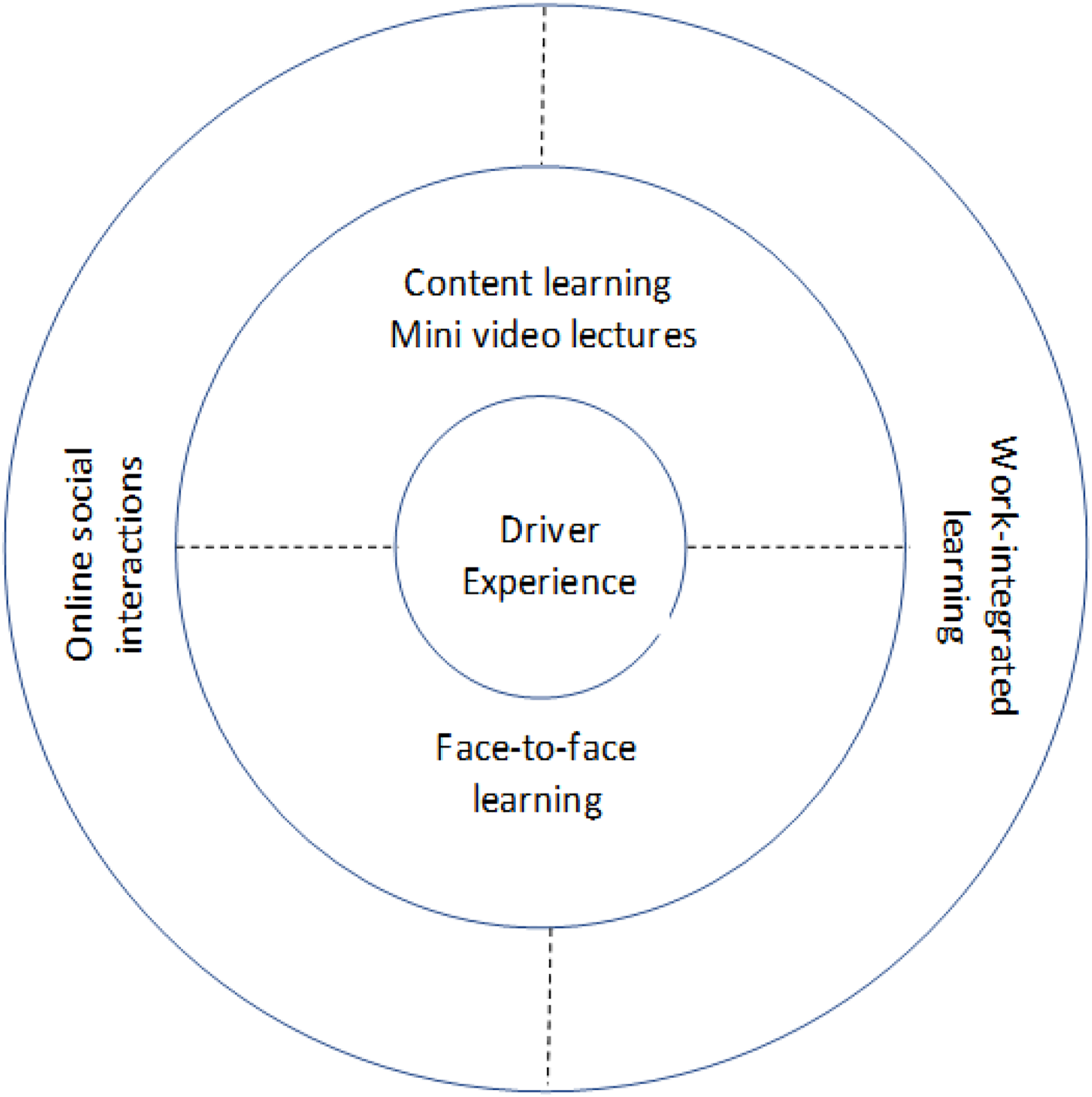
Pedagogically, the notion here is that at times, when face-to-face learning is difficult, students focus on concept learning and on developing transferable skills via online activities. When it becomes possible, face-to-face learning opportunities are used to humanize these skills and practice them in real time, but all within a safe university environment. The separating lines in Figure 1 are hence shown as the dash for flexibility. As students become more skilled and knowledgeable, experiential learning opportunities are used to transition the student and their skillset from an academic environment to a corporate environment, or whatever life the student chooses after graduation.
Critically, the approach we outline is flexible. Internet outages aside, this approach would allow learning to continue during any crises (via Points 1, 3, and perhaps 4). Face-to-face learning opportunities might be harder to schedule, but if activities are pre-planned and ready to go, then each student should encounter times when these experiences (Point 2) can be provided. As long as each student receives a number of such opportunities on a semi-regular basis, that should be sufficient to build upon the digital skill development that is otherwise occurring online.
This convertible learning system can be perceived as an e-learning ecology (Bozkurt & Hilbelink, 2019) where the non-living (online space) and living (face-to-face) components come together to enhance the learning experience. However, the secret to its success lies in maintaining the right balance between online content learning, online skill development, and face-to-face interactions, all under the protective shield of constructive online activities and opportunities for real work-integrated learning.
As it has been argued throughout the article, a flexible convertible system indeed can provide immunity to the education system, especially during times of change. The convertible car provides a driving environment that enables us to move toward the destination virtually uninterrupted whether the weather is bad or nice. Fueled by motivation, this is certainly an approach to ensure a rich learning experience for the driver, overcoming various hurdles on the way.
Footnotes
Declaration of Conflicting Interests
The author(s) declared no potential conflicts of interest with respect to the research, authorship, and/or publication of this article.
Funding
The author(s) received no financial support for the research, authorship, and/or publication of this article.
