




Abstract
Absolute ability/achievement does not explain gender differences in educational trajectories, but the role of comparative advantage (i.e., being better in one subject compared to another) has received much less attention. To study this, longitudinal data collected among 1,352 individuals (age 15-16) in upper secondary education in the Netherlands are used. Multinomial path analyses showed that compared to girls, boys are on average 15% more likely to enter the most male-typical trajectory and 16% less likely to enter the most female-typical trajectory. Although having a comparative advantage affects trajectory choices, it does not explain gender differences in trajectory choices in secondary education.
Keywords
Introduction
Boys and girls are still concentrated in different educational fields. Boys are more likely to enter gender-stereotypical masculine fields such as science or technology, whereas girls are more likely to enter gender-stereotypical feminine fields such as language or humanities (Organization for Economic Co-operation and Development [OECD], 2009a). This unequal distribution of boys and girls across educational fields leads to gendered occupational careers and contributes to gender differentials in earnings (Smyth & Steinmetz, 2008). These gender differences in the field of study choices are not only present when entering tertiary education (Mann & DiPrete, 2013) but also in early adolescence, with boys being more likely to choose male-dominated trajectories and girls more likely to choose female-dominated trajectories in secondary education (Van Langen et al., 2008; Van der Vleuten et al., 2016).
Ample research shows that gender differences in field of study choices are not explained by gender differences in absolute ability or achievement (Ceci & Williams, 2011; Hyde & Mertz, 2009; Riegle-Crumb et al., 2012). Girls are even outperforming boys in gender-stereotypical masculine fields such as mathematics in secondary education in many countries (OECD, 2009b). When assessed purely on ability or achievement, there should therefore be more girls in gender-stereotypical masculine trajectories. One reason why girls are still underrepresented in these fields could be because, even though girls score higher in subjects related to these fields (e.g., mathematics), they score equally well or even better in gender-typical feminine areas (e.g., languages), and therefore enter a trajectory that is consistent with their achievement profile. Similarly, the reason why boys choose gender-typical masculine fields is because they are relatively better in these fields compared to gender-typical feminine ones (Jonsson, 1999). Being better in one subject compared to another is referred to as a relative ability or comparative advantage (Barone, 2011). Although there are other factors important for field of study choices (Eccles, 2011; Van der Vleuten, 2018), this study specifically focuses on the role of previous ability, and having a comparative advantage specifically, for field of study choices. There are only few studies that explored how a comparative advantage might contribute to gender differences in educational choices (Mann & DiPrete, 2013). These limited number of studies remain inconclusive, with some suggesting it seems irrelevant for explaining the gender gap in fields of study (Riegle-Crumb et al., 2012; Van de Werfhorst et al., 2003), but others conclude it is not (Jonsson, 1999; Uerz et al., 2004). This study therefore addressed this lacuna by examining whether and to what extent a comparative advantage contributes to gender differences in trajectory choices in secondary education.
The focus of this study is on students in upper secondary education in the Netherlands. At the end of the third year of secondary education at age 15, Dutch students choose one of four educational trajectories that vary in math intensity and core subjects: Science & Technology with a focus on pure mathematics, physics, and chemistry; Science & Health with a focus on chemistry and biology; Economics & Society with a focus on economics and humanities; and Culture & Society with a focus on modern languages and humanities. Science & Technology is the most math intense, followed by Science & Health, Economics & Society, and Culture & Society. These trajectory choices have significant consequences for adolescents’ future educational career paths because they limit one’s field of study options after secondary education. For example, students are not able to study medicine if they did not complete the Science & Technology or Science & Health trajectory in secondary education. This highlights the need to study why boys and girls choose different educational trajectories at a young age.
To evaluate gender differences in trajectory choices, longitudinal data were used that were collected among adolescents in the Netherlands in 2010/2011 (15 years old) and 2011/2012 (16 years old), when the adolescents were in the third and fourth year of secondary education.
Theory
Rational choice theory explains that individuals weigh costs and benefits and choose the option that maximizes returns to their skills and benefits. Irrespective of gender, individuals consider the pros and cons of every educational alternative and choose the option that maximizes his or her utility (Jonsson, 1999). An important factor in weighing the pros and cons of an educational choice is the probability of success (Jonsson, 1999), which is highly determined by previous achievement or ability. If an individual performs well in a subject, it is more likely that he or she will be more successful in an (educational) career related to that subject. The probability of success therefore increases when a student’s ability in that subject increases. Traditionally, mathematics can be considered a masculine subject, whereas languages are typical feminine subjects (Martinot et al., 2012; Steffens & Jelenec, 2011). When students’ mathematics score is higher than their language scores, their probability of success will be higher for male-typical trajectories than for female-typical trajectories. This will subsequently lead students to enter more gender-stereotypical masculine trajectories. In other words, irrespective of students’ absolute mathematics or language achievement, having a comparative advantage in mathematics increases the likelihood of choosing a male-typical educational trajectory. This works similarly for students who have a comparative advantage in languages. When students’ language achievement is higher than their math achievement, the probability of success is higher if they enter a female-typical trajectory compared to a male-typical trajectory. To test whether students choose a trajectory based on their achievement profile, the hypothesis is formulated that having a higher comparative advantage in mathematics increases the likelihood that students choose a more male-typical trajectory and decreases the likelihood that students choose a female-typical trajectory and having a comparative advantage in languages increases the likelihood that students choose a more female-typical trajectory and decreases the likelihood that students choose a male-typical trajectory (Hypothesis 1).
Boys and girls might, however, have a different comparative advantage. In this study, math and language achievement are measured in terms of grades and studies that focus on grades show there is a female advantage in language grades (Heyder & Kessels, 2013; Voyer & Voyer, 2014). 1 This female advantage is small during primary education but medium in size in secondary education (Heyder & Kessels, 2013; Voyer & Voyer, 2014), which is the main focus of this study. This means that girls’ language achievement is higher for girls than for boys. With respect to math grades, girls also score higher than boys, but this advantage is much smaller for mathematics than for languages (Duckworth & Seligman, 2006; Ewert, 2010; Voyer & Voyer, 2014). This implies that the difference between students’ math and language grades is larger for boys than for girls. In other words, boys have a larger comparative advantage in mathematics than girls, which would make it more beneficial for boys than for girls to enter male-typical trajectories. Girls have a (small) comparative advantage in languages (i.e., score relatively higher in languages than in mathematics; Riegle-Crumb et al., 2012), which would make it more beneficial for them to choose female-typical trajectories. It is therefore hypothesized that a higher comparative advantage in mathematics increases the likelihood that boys choose a male-typical trajectory and decreases the likelihood to choose a female-typical trajectory, whereas a higher comparative advantage in languages increases the likelihood that girls choose a female-typical trajectory and decreases the likelihood that they choose a male-typical trajectory (Hypothesis 2).
Research varies in how big these gender differences in comparative advantage are. Riegle-Crumb et al. (2012) show that although men have a slightly higher comparative advantage in male-dominated areas and (most) women in female-dominated areas, this explains very little gender gap in physical science and engineering majors over time. Van de Werfhorst et al. (2003) concludes that having a comparative advantage was an important predictor of the fields of study students chose but that it explains little of the gender segregation across disciplines. Uerz et al. (2004) did find that a comparative advantage makes a relevant contribution in predicting differences between boys and girls in the number of science subjects in secondary education.
Methods
Educational System in the Netherlands
Secondary education in the Netherlands starts at the age of 12. Students enter one of the three possible levels of secondary education depending on their grades, test results, and teachers’ recommendation. The majority enter the vocational level (VMBO). This is a 4-year vocational program after which pupils continue in secondary vocational education (MBO). The general level (HAVO) and academic level (VWO) provide access to higher education. The general level is a 5-year program preparing students for universities of applied science (higher vocational education: HBO). The VWO, or academic level, is a 6-year program that prepares pupils for a research university.
The focus of this study is on trajectory choices in secondary education, which Dutch students at the vocational level make at the end of their second year of secondary education (14 years old) and students at the general or academic level at the end of their third year of secondary education (15 years old). The data used in this study were collected when the respondents were in the third (first wave) and fourth (second wave) year of secondary education. Therefore, students at the vocational level already made a trajectory choice in Wave 1 and were therefore excluded from this study. This study therefore focuses on students from higher education.
Data and Sample
Wave 1 (2010/2011) and Wave 2 (2011/2012) of data collected in the Netherlands as part of the Children of Immigrants Longitudinal Survey in Four European Countries (CILS4EU) are used. This project was set up to explore the structural, cultural, and social integration of immigrant and non-immigrant children in four European countries (Kalter et al., 2014, 2015, 2016a, 2016b). These two waves were collected when the students were in their third year of secondary education (Wave 1, age 15) and when they were in their fourth year of secondary education (Wave 2, age 16).
Schools were selected with a probability proportional to their size using the number of pupils in the relevant educational level. In addition, the sample is stratified on the number of immigrant children attending the school. The data will be weighted according to education level and immigrant status to generalize the results to the adolescent population in higher education in upper secondary education in the Netherlands. 2 If schools refused to participate, they were replaced with similar other schools within the same stratum (school participation rate after replacement: 91.7%). Within the schools, two classes participated (class participation rate: 94.5%) and all respondents in that classroom filled in a self-completion questionnaire (student participation rate 91.1%).
In total, 3,804 students participated in Wave 1 and Wave 2 of which 39% (n = 1.489) of the students are in the general and academic level, which are the students I focus on in this study. Of these students, 1.364 (92%) choose an educational trajectory. In total, 12 students were deleted because their gender were inconsistent across waves. The final analytical sample includes 1.352 students in 84 classes. This means that 90% of the students participating in Wave 1 and Wave 2 on the general and academic level remain in our sample.
Measures
The dependent variable—trajectory choice—is measured in Wave 2. Educational trajectory choice in upper secondary education in the Netherlands can be Science & Technology, Science & Health, Economics & Society, and Culture & Society. In total, there were 118 students who chose Science & Technology and Science & Health and 25 students who chose both Economics & Society and Culture & Society. This is possible because students are allowed to customize trajectories and take courses from other trajectories. A student who chose Science & Health can also choose to follow physics, which is part of the Science & Technology trajectory. Because the combination of Economics & Society and Culture & Society contains too few participants, these students were recoded to the more math-intense trajectory Economics & Society. 3
Table 1 shows the percentage of girls in each trajectory in 2011/2012 based on the sample and national statistics (Statistics Netherlands, 2014). Based on these statistics, Science & Technology can be considered the most masculine choice. The combination of Science & Technology and Science & Health as well as the Economics & Society trajectory can be considered gender-balanced given that they attract similar numbers of boys and girls. Given that Science & Health (62%) and Culture & Society (81%) are primarily female-dominated, they can be considered the more feminine options. Note that girls enter a relatively math-intense trajectory with a focus on science as they do opt for the Science & Health trajectory (with a focus on chemistry and biology). It is therefore relevant not only to look at the results in terms of male-dominated or female-dominated trajectories but also in terms of which trajectory is more math intense. It might be that a comparative advantage in mathematics leads girls to a more mathematics-orientated but female-typical trajectory (in this case Science & Health). Science & Technology is the most math intense, followed by the combination of Science & Health and Science and Technology, Science & Health, Economics & Society, and Culture & Society. However, although girls choose Science & Health in secondary education, they do not continue to choose a science career after secondary education (Van der Vleuten, Steinmetz & Van de Werfhorst, 2018). Understanding why girls choose a science trajectory in secondary education might therefore be particularly important, as it might increase our understanding of why they do not continue their educational career in science after secondary education.
Percentage of Girls in Trajectories in Secondary Education in 2011/2012 in the Sample Used and According to National Statistics from the Netherlands.
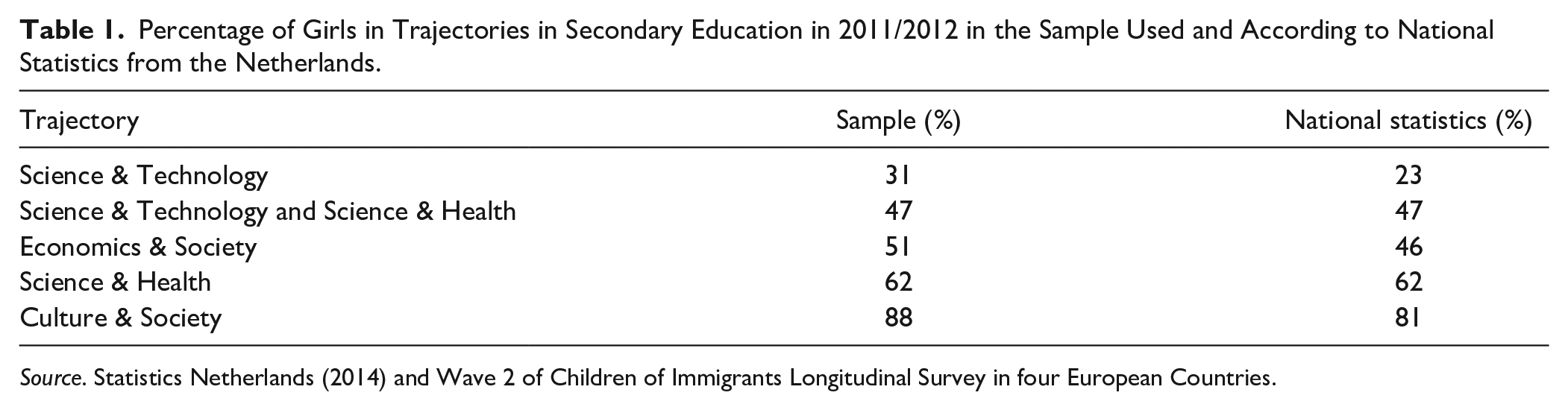
Source. Statistics Netherlands (2014) and Wave 2 of Children of Immigrants Longitudinal Survey in four European Countries.
Independent Variables
All independent variables are measured in Wave 1. Comparative advantage in mathematics indicates respondent’s relative achievement in mathematics and languages. Respondent’s math achievement refers to the math grade in his or her latest progress report (“What was your math grade in your latest progress report?”) and can vary between 1 (low achievement) and 10 (high achievement). Similarly, respondent’s language achievement was measured by taking the average of respondent’s English and Dutch grades in his or her latest progress report (“What was your [English / Dutch] grade in your latest progress report?,” r = 0.33; p < .001). Following other studies (Riegle-Crumb et al., 2012; Uerz et al., 2004; Van de Werfhorst et al., 2003), students’ language achievement was subtracted from their math achievement to obtain a comparative advantage score. Scores above 0 indicate that students have a higher math achievement than language achievement (i.e., a comparative advantage in mathematics). A score of 0 indicates that students have the same grade in mathematics and languages, and a score below 0 indicates that students have a higher language achievement than math achievement (i.e., a comparative advantage in languages). Table 2 shows descriptive statistics of all variables for all respondents and for boys and girls separately. Conform the expectations, boys have a comparative advantage in mathematics (M = 0.10, SD = 1.29), whereas girls have a comparative advantage in languages (M = -0.10, SD = 1.32), t(1,350) = 2.60, p < .05. The difference in math grades between boys and girls were nonsignificant, t(1,350) = 0.98, p = .98, whereas the difference between boys (M = 6.88, SD = .78) and girls (M = 7.08, SD =.80) language grades were significantly different, t(1,350) = 4.39, p < .001. 4
The variable sex (boys = 1) measures whether the respondents are boys (1) or girls (0).
Descriptive Statistics of all the Variables in the Analyses for all Respondents (N = 1,352) and for Boys (n = 610) and Girls (n = 742) Separately.
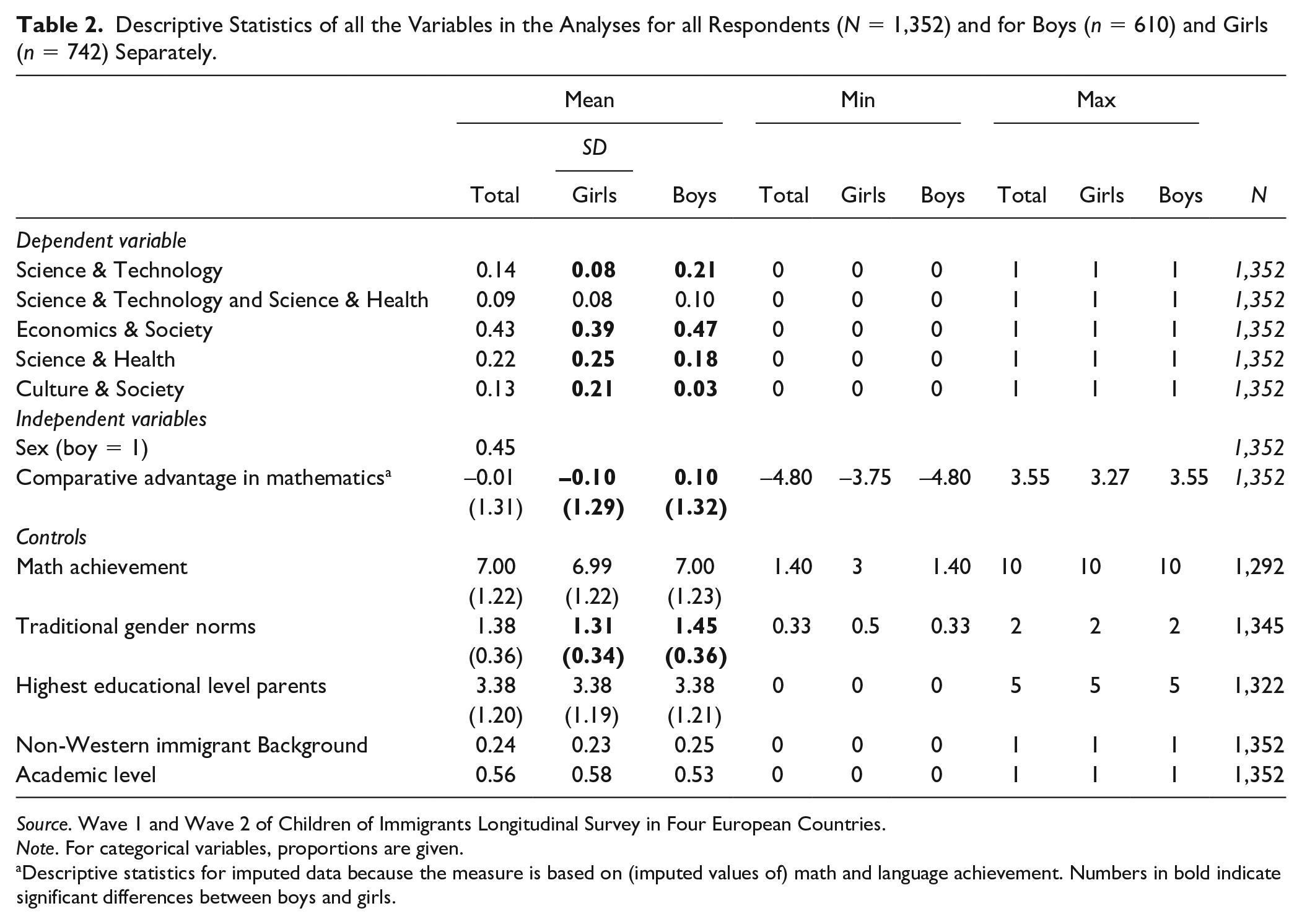
Source. Wave 1 and Wave 2 of Children of Immigrants Longitudinal Survey in Four European Countries.
Note. For categorical variables, proportions are given.
Descriptive statistics for imputed data because the measure is based on (imputed values of) math and language achievement. Numbers in bold indicate significant differences between boys and girls.
Controls
Math achievement (in term of grades) in Wave 1 is controlled for because students who are better in mathematics are more likely to choose more gender-stereotypical masculine trajectories. Moreover, the absolute achievement of boys and girls needs to be held constant as the main interest lies in their relative achievement (e.g., it is not how high students’ grades are, but how good their math grades are compared to their language grades).
Researchers also point to gender role socialization as an alternative explanation for the gender gap in fields of study (Eccles, 2011; Van der Vleuten et al., 2016; Van der Vleuten et al., 2018). Boys and girls are socialized with normative ideas about what is “appropriate” male and female gender role behavior. These so-called gender norms convey that math- or science-orientated subjects are more congruent with the male gender role behavior and languages or humanities are more congruent with the female gender role behavior (Martinot et al., 2012). If students internalize these gender norms and act conforms to them, students with more traditional gender norms enter more gender-stereotypical fields of study. Using the same data, Van der Vleuten and colleagues (2016) found that such gender norms play an important role in making educational choices in upper secondary education in the Netherlands, but they are unable to explain gender differences in field of study choices. Because this study is interested in the influence of relative ability, student’s gender norms are controlled for. To measure gender norms, respondents were asked who should bear more responsibility for the following tasks: “cook,” “take care of the children,” “clean the house,” and “earn money.” The answer categories were “mostly the man,” “both about the same,” and “mostly the woman.” For the first three tasks, respondents received a score of 2 when they stated that these tasks were the responsibility of “mostly the woman,” a score of 1 when they stated “both about the same,” and a score of 0 when they stated “mostly the man.” For the item who should bear more responsibility for earning money respondents received a score of 2 for “mostly the man,” a score of 1 for “both about the same,” and a score of 0 for “mostly the woman.” Averaging these items resulted in a scale (α = 0.67) that ranges from 0.33 to 2, with higher scores indicating more traditional gender norms.
Students from higher socioeconomic background families choose more prestigious fields of study than students from lower socioeconomic backgrounds (Van de Werfhorst et al., 2003). An indicator of socioeconomic background is the highest education level of parents. In Wave 1 and Wave 2, respondents were given a questionnaire for one of their parents to fill in at home. If parents did not respond, they were contacted by phone if possible (response rate wave 1: 74.7%; response rate wave 2: 42.8%). The parents were asked about their and their partners’ highest completed educational level. This resulted in a six-category scale: no education (0), primary education (1), secondary education (2), vocational education and training (3), higher vocational education (4), or university (5). As not all parents completed the questionnaire, the remaining missing values were replaced with the information provided by the adolescents who also answered questions about their parents’ highest obtained education level. However, adolescents reported this information specifically for their biological parents, and therefore, missing parental education level was only replaced if the respondent indicated that she or he lived with his or her biological parent(s) (n = 242). Assuming that parents’ highest education does not change much in 2 years, information from Wave 1 and Wave 2 was used to construct this variable.
Because the data contain an oversampling of respondents with a non-Western immigrant background, the analyses were not only weighted (see data and sample), but I also include a control that indicates whether one of the adolescent’s parents were (1) or were not (0) born in a non-Western country. Following the definition of Statistics Netherlands (CBS) which the CILS4EU sample was based on, Western societies are defined as Europe (excluding Turkey), North America, Oceania, Indonesia, and Japan (Indonesia and Japan are considered Western based on their sociocultural and socioeconomic position. Indonesia was also part of the former Dutch East Indies). Non-Western countries are Turkey, Morocco, Surinam, Dutch Antilles and Aruba, Africa, Asia (excluding Indonesia and Japan), and Latin America.
The variable academic level controls for differences between the two upper secondary educational levels in Wave 1. Students are either in the general level (0) or on the academic level (1). Descriptive statistics of all the variables in the analyses can be found in Table 2. 5
Analytical Strategy
The dependent variable consists of multiple categories, and therefore multinomial regression analyses will be used to test the hypotheses. Missing values (94 incomplete cases) were imputed into five datasets, with all of the outcome and predictor variables included in the imputation procedure. 6 Because students are nested in classes, standard errors are clustered at class level (Nclass = 84). Multinomial regression analyses produce results in terms of log odds. To facilitate interpretation, average marginal effects (AME) and predictive margins were calculated. AME give the average change in the probability of choosing trajectory by a one-unit change in an explanatory variable. Multiplied by 100, this is the average change in percentages. Predictive margins give the average chance that boys and girls choose a certain trajectory, given a value of an independent variable (in this case comparative advantage). Multiplied by 100 this is the average probability in percentages.
Three models that include control variables are estimated. Model 1 is the base model and includes control variables only. Models 2 includes having a comparative advantage and tests Hypothesis 1, whether having a comparative advantage increases or decreases the likelihood that adolescents choose more male-typical or female-typical trajectories. Model 3 includes an interaction between having a comparative advantage and the sex of the adolescent to test Hypothesis 2, that having a comparative advantage in mathematics increases the likelihood that boys choose a male-typical trajectory and decreases the likelihood that boys choose a female-typical trajectory, whereas having a comparative advantage in languages increases the likelihood that girls choose a female-typical trajectory and decreases the likelihood that girls choose a male-typical trajectory.
Table 3 shows the results in terms of AME. Predictive margins plots are used to describe the results of Model 3, as plots are the correct way to interpret interaction terms based on average marginal effects (Williams, 2012). However, to statistically test whether the interaction effects included in Model 3 are significant, results are also shown in terms of log odds in Table 4.
Results of Multinomial Logistic Regression Models that Test the Effect of Having a Comparative Advantage in Mathematics on Choosing a Science & Technology (ST), Science & Technology and Science & Health (STSH), Economics and Society (ES), Science & Health (SH), and Culture & Society Trajectory in Secondary Education (N = 1,352; Standard Errors Clustered by Class; N = 84).
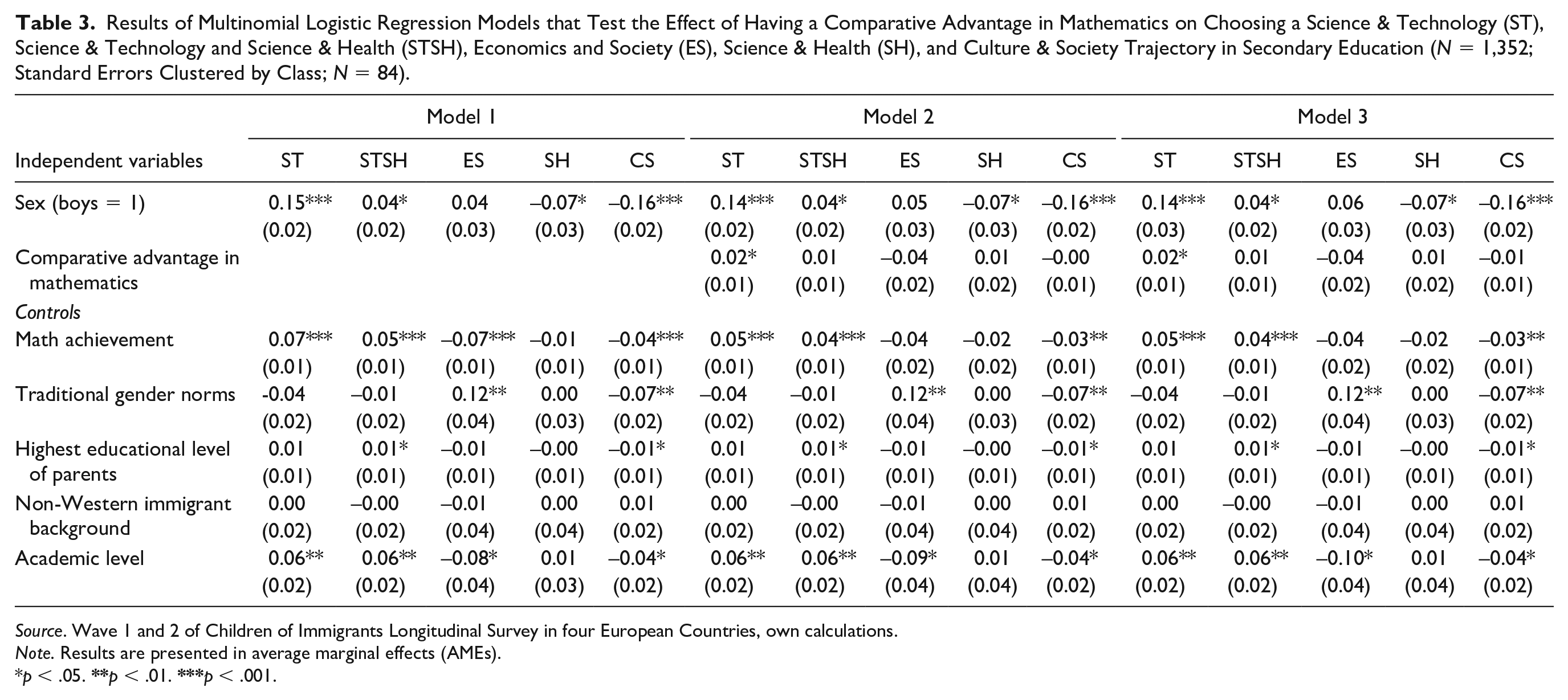
Source. Wave 1 and 2 of Children of Immigrants Longitudinal Survey in four European Countries, own calculations.
Note. Results are presented in average marginal effects (AMEs).
p < .05.
Results of Logit Regression (Log-Odds) Models that Test the Effect of Having a Comparative Advantage in Mathematics on Choosing a Science & Technology (ST), Science & Technology and Science & Health (STSH), Economics and Society (ES), Science & Health (SH), and Culture & Society Trajectory in Secondary Education (N = 1,352; Standard Errors Clustered by Class; N = 84).
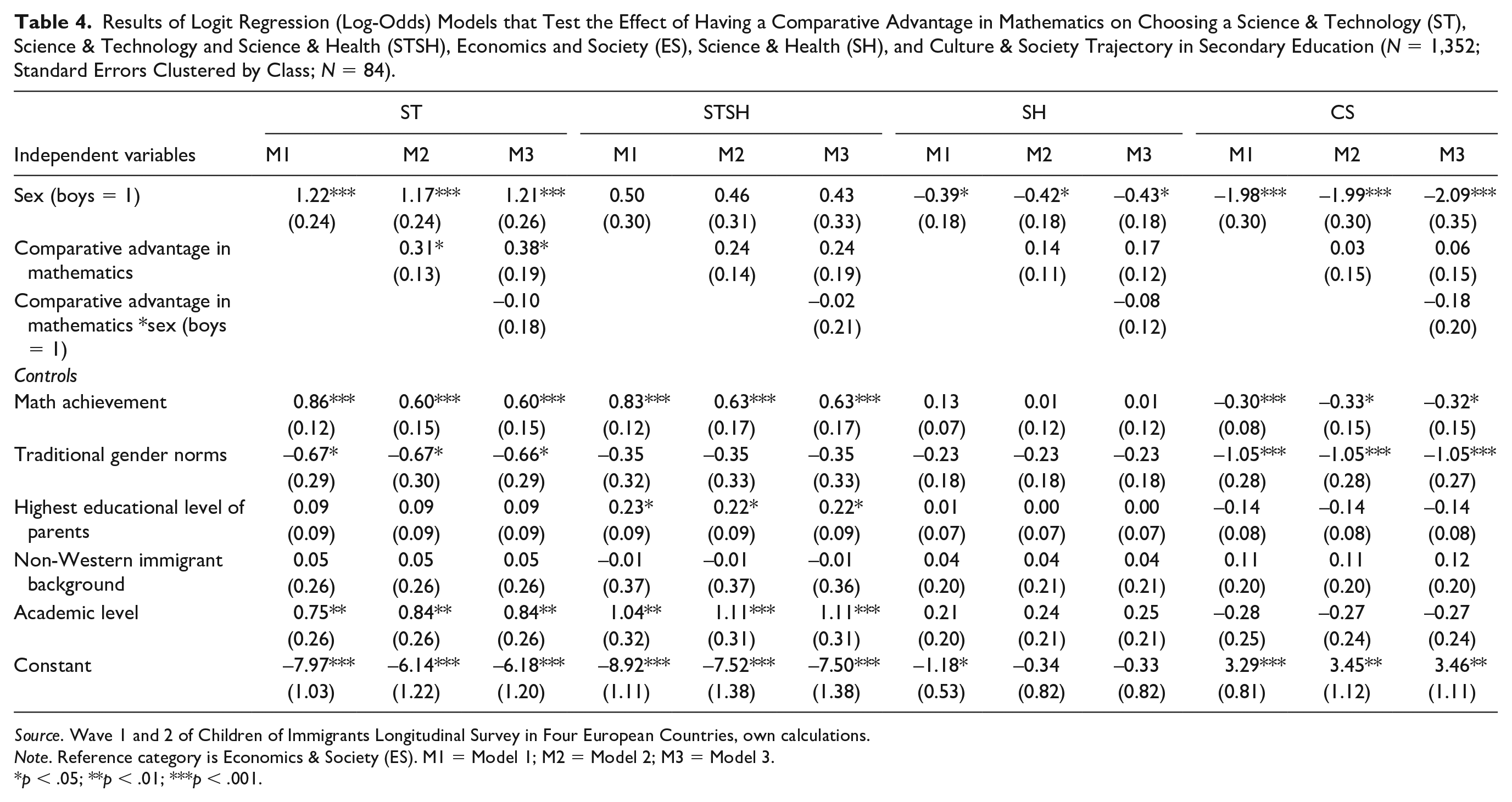
Source. Wave 1 and 2 of Children of Immigrants Longitudinal Survey in Four European Countries, own calculations.
Note. Reference category is Economics & Society (ES). M1 = Model 1; M2 = Model 2; M3 = Model 3.
p < .05; **p < .01; ***p < .001.
Results
Model 1 in Tables 3 and 4 shows that sex differences in trajectory choices are quite pronounced. These results are more comprehensible in AMEs (Table 3). Compared to girls, Model 1 in Table 3 shows that boys are on average 15% more likely to choose Science & Technology; 4% more likely to choose the combination of Science & Health and Science & Technology; 7% less likely to choose Science & Health; and 16% less likely to choose Culture & Society. Model 2 in Table 3 and 4 add the variable comparative advantage, which is not a significant contribution to the model, Model 2: Wald χ(4)2 = 1.87; p = .11. Model 2 in Table 3 shows that a 1-point increase (decrease) in the relative ability increases (decreases) the average likelihood of choosing Science & Technology with 2%. This means that the average likelihood of choosing Science & Technology for persons with the highest comparative advantage in languages (−4.8) is on average 17% lower than persons with the highest comparative advantage in mathematics (3.55). Overall, these results show partial support for Hypothesis 1 as having a higher comparative advantage in mathematics increases the likelihood that adolescents choose the more male-typical trajectory Science & Technology and having a comparative advantage in languages decreases the likelihood of choosing this trajectory. A comparative advantage, however, does not affect the average likelihood that students choose female-typical trajectories. Including comparative advantage in Model 2 also leads to no noteworthy reduction of the average marginal effect of sex (see Table 3). Gender differences in trajectories remain pronounced. In other words, comparative advantage explains next to nothing of the gender gap in trajectory choices in upper secondary education.
Figure 1A to E shows the results of Model 3 in terms of predictive margins for boys and girls for different values of relative ability. Figure 1B, C, and E shows no gender differences in how a higher comparative advantage is associated with the average likelihood of choosing the combination of Science & Technology and Science & Health (1B) or Economics & Society (1C) or Culture & Society (1E). Figure 1A shows that a larger comparative advantage in mathematics (or a larger comparative advantage in languages) increases (decreases) the average likelihood that boys and girls choose Science & Technology and—in line with Hypothesis 2—the association is stronger for boys than for girls. The difference in the average likelihood of choosing Science & Technology is significantly different for boys and girls for a comparative advantage score of −3 to 4. For a comparative advantage score of −3, the average probability of choosing Science & Technology is 2% for girls whereas it 11% for boys. When boys and girls have a comparative advantage score of 4 in mathematics (so they are better in math compared to languages), the average probability of choosing Science & Technology increased to 15% for girls and to 36% for boys. Figure 1D shows that having a larger comparative advantage in mathematics increases the average likelihood that girls choose Science & Health, but does not affect the average likelihood that boys choose Science & Health. This difference between boys and girls is only significant for a comparative advantage score between 0 and 2. However, Model 3 in Table 4 shows that none of the interaction effects are significant, meaning that a comparative advantage does not have a different effect for boys and girls, refuting Hypothesis 2. Moreover, adding an interaction in Model 3 is not a significant contribution to the model, Model 3: Wald χ(8)2 = 1.13; p = .34, and does not change the average marginal effect of sex (see model 3 Table 3). This also means that a comparative advantage is not an explanation for why girls choose the more female-typical but math-intense trajectory Science & Health. Overall, a comparative advantage explains very little of the gender gap in trajectory choices in secondary education.
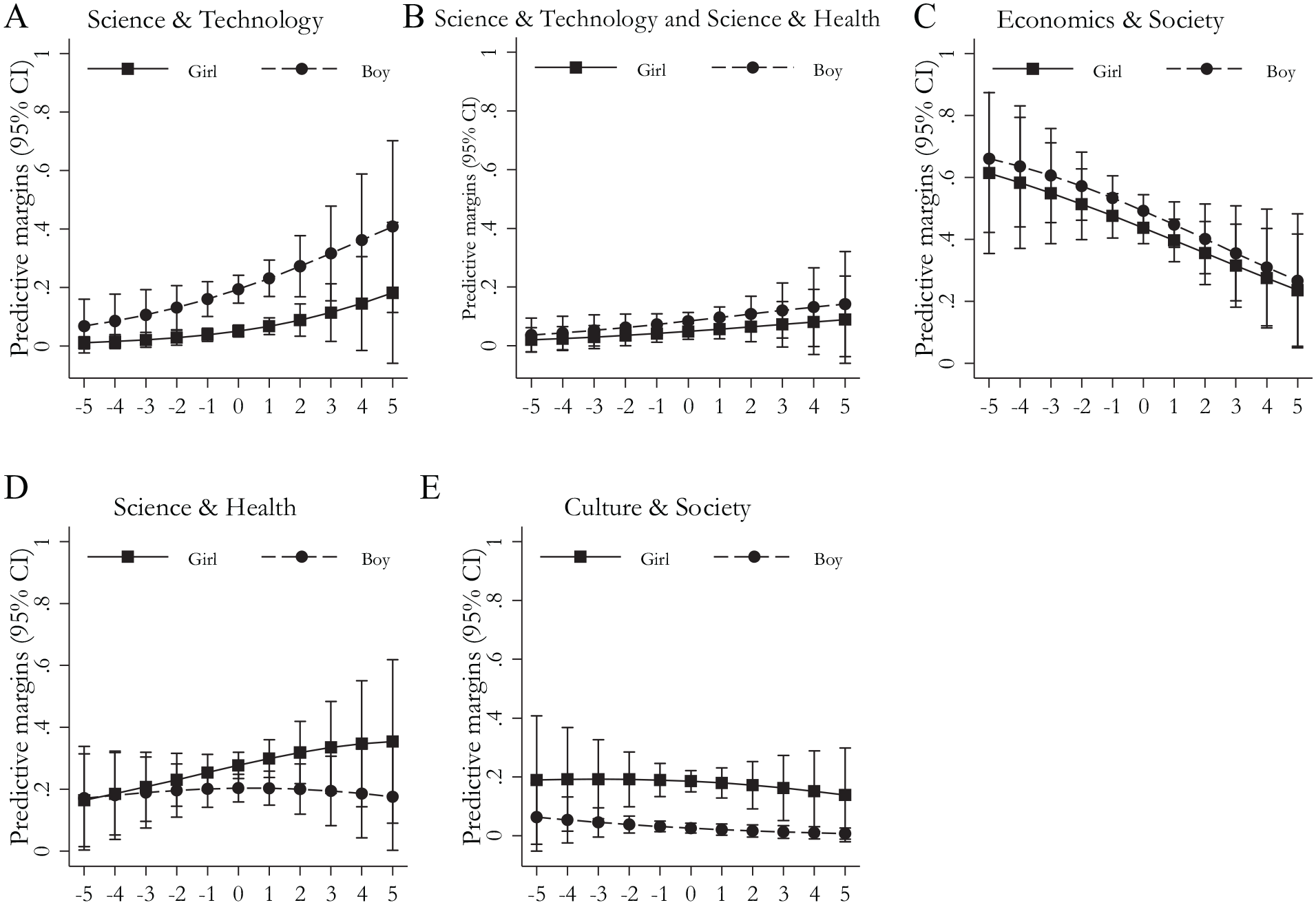
Predictive margins and confidence intervals (CI) of having a comparative advantage on choosing a trajectory for boys and girls. (A) Comparative advantage in mathematics. (B) Comparative advantage in mathematics. (C) Comparative advantage in mathematics. (D) Comparative advantage in mathematics. (E) Comparative advantage in mathematics.
With respect to the control variables, Model 3 in Table 3 shows that students with a higher math grade (by one point) are on average more likely to choose Science & Technology (by 5%) and the combination of Science & Technology and Science & Health (by 4%) but less likely to choose Culture & Society (by 3%). A 1-point increase in traditional gender norms increases the average likelihood that students choose Economics & Society by 12% and decreases the average likelihood that students choose Culture & Society by 7%. Students from a higher educated background (by one point) are more likely to choose the combination Science & Technology and Science & Health (by 1%) and less likely to choose Culture & Society (by 1%). Finally, compared to the general level, students on the academic level are on average 6% more likely to enter Science & Technology and the combination of Science & Technology and Science & Health and 10% and 4% less likely to enter Economics & Society and Culture & Society, respectively.
Additional Analyses: Higher Educated Families and Differences per Level
Studies show that ability or achievement might work differently for students from different educational backgrounds, which might also be the case for having a comparative advantage. This idea was tested by Van de Werfhorst et al. (2003) who showed that children from a higher social class have substantially higher scores on both reading and mathematics but concluded that social class was hardly related to a comparative advantage in mathematics. In the sample in this study, students from a higher educated background are more likely to have a higher comparative advantage in mathematics (r = .10; p < .01). This association was stronger for girls (r = .13; p <.01) and nonexistent for boys (r = .07; p =.12). Moreover, students in the general level have a comparative advantage in languages (M = −.08, SD= 1.27), whereas students on the academic level have a comparative advantage in mathematics (M = .05; SD = 1.34), although this difference was only significant at alpha of .10, t(1,350) = 1.89, p = .06. This association did not differ for boys or girls.
To see how students’ relative ability works for different social backgrounds or levels of secondary education, all analyses were run separately for (a) students from a lower/average educated background (highest educational level parents = no education, primary education, secondary education or vocational education and training); (b) students from a higher educated background (highest educational level parents = higher vocational education or university); (c) students in the general level; and (d) students on the academic level. Results are available on request. Overall, it can be concluded that a comparative advantage is slightly more important for students from lower/average educated backgrounds and students in the general level. Importantly, for all groups, a comparative advantage does not explain gender differences in educational trajectories in secondary education.
Discussion and Conclusion
This study evaluates the role of comparative advantage in gender differences in trajectory choices in upper secondary education in the Netherlands. It was argued that students are more likely to choose a male-typical trajectory when they have a comparative advantage in mathematics (i.e., score higher in mathematics than languages) and a female-typical trajectory when they have a comparative advantage in languages (i.e., score higher in mathematics than languages). Subsequently, it was argued that boys have a larger comparative advantage in mathematics than girls who have a larger comparative advantage in languages. Therefore, boys would be more likely to enter male-typical trajectories than girls, who should be more likely to enter female-typical trajectories. Using two waves of the CILS4EU data, 1,352 students in upper secondary education were analyzed using multinomial path analyses.
Gender differences in educational trajectories were pronounced. Compared to girls, boys are 15% more likely to enter the male-typical Science & Technology trajectory and 4% more likely to enter the combination of the more gender-balanced Science & Technology & Science & Health. Girls are around 16% more likely to enter the more female-typical Science & Health trajectory and 7% more likely to enter the most female-typical Culture & Society trajectory.
When students have a larger comparative advantage in mathematics, they are more likely to enter the male-typical Science & Technology trajectory. This association is similar for boys and girls. Boys in our sample do have a higher comparative advantage in mathematics compared to girls, but this advantage does not lead them to enter more male-typical trajectories. Similarly, although the girls in the data have a comparative advantage in languages, this does not explain why they are more likely to enter more female-typical trajectories. Note that girls are choosing a science- or math-intense trajectory, as they enter Science & Health (with a focus on mathematics, physics, and biology). This is congruent with findings, which show that within scientific fields, boys are more interested in physics and girls in biology (Baram-Tsabari & Yarden, 2008). However, this trajectory choice is not explained by having a comparative advantage. In line with other studies that focused on choices after secondary education (Riegle-Crumb et al., 2012; Van de Werfhorst et al., 2003), having a comparative advantage explains very little of the gender gap in trajectory choices in upper secondary education.
It was also examined whether having a comparative advantage in mathematics was more important for students from lower/average or higher educated families as well as students in different levels of secondary education. The results show weak evidence that having a comparative advantage is more important for students from lower/average educated families and for students from the general level of secondary education. Unfortunately, it was impossible to consider students on the vocational level because they make their trajectory choices earlier. Future research should study how the concept of relative ability works for these students, as the results from this study suggest that a comparative advantage becomes more important when the education level decreases. Overall, for all backgrounds and levels of secondary education, there is no evidence that having a comparative advantage explains gender differences in educational trajectory choices.
Although (relative) ability does not explain gender differences in trajectories in secondary education, it is important to study these early gender differences in adolescents educational careers because they are prominent; have large consequences for boys’ and girls’ future educational and occupational careers; and seem to produce sharper lines with respect to gender and socioeconomic background (Van Langen et al., 2008). There are many factors that contribute to gender differences in the field of study choices (Eccles, 2011), and one fruitful way for future research is to take a more integral approach that combines different explanations (educational background, parents, peers, and school context) to explain gender differences in trajectory choices (Gabay-Egozi et al., 2015; Van der Vleuten, 2018).
One possible limitation of the current study is that grades were used to measure comparative advantage instead of standardized test scores. For standardized tests, there is evidence that there is a larger male advantage in mathematics and science achievement (Lindberg et al., 2010), whereas females perform better than males on standardized tests in reading (Reilly et al., 2019). It could therefore be that gender differences in comparative advantage in standardized tests might be larger and therefore also explain more of the gender differentials in trajectory choices. However, previous studies that used standardized tests found no such evidence (Van de Werfhorst et al., 2003), and Riegle-Crumb et al. (2012) conclude that a comparative advantage in grades (i.e., GPA scores) was actually responsible for the largest reduction in gender differences in college major choices compared to other measures of relative ability. Grades capture—next to your performance in a subject—also the ability to do your homework, attend classes, and so on. They have been proven to be an important predictor of important life outcomes (Borghans et al., 2016). Future research should include both grades and standardized tests to evaluate their relative importance.
In sum, having a comparative advantage in mathematics is important when choosing the most math-intense male-typical trajectory (Science and Technology) in secondary education in the Netherlands but equally so for boys and girls. Although boys have a comparative advantage in mathematics and girls have a comparative advantage in languages, this explains very little of the gender gap in trajectory choices in secondary education in the Netherlands. This was found for students in both levels of secondary education and for students from different educational backgrounds.
Footnotes
Declaration of Conflicting Interests
The author(s) declared no potential conflicts of interest with respect to the research, authorship, and/or publication of this article.
Funding
The author(s) disclosed receipt of the following financial support for the research, authorship, and/or publication of this article: Financial support from the NORFACE research program on Migration in Europe—Social, Economic, Cultural and Policy Dynamics is acknowledged.
