




Abstract
In industrial design education, the curriculum should be structured to facilitate and advance student learning. The purpose of this work is to enhance the education by introducing mobile lectures and imbedded innovative approach to Bournemouth University (BU) Education, which will be employed by the lecturer in the years to come.
Introduction
The Design Interaction Module
In industrial design education, the curriculum should be structured to facilitate and advance student learning. The purpose of this work is to enhance the education by introducing mobile lectures and imbedded innovative approach to BU Education, which will be employed by the lecturer in the years to come.
The curriculum enhancement presented in this article concerns the module of design interaction, a 20 credits (New) unit taught to students of Industrial Design Master degrees level over the second semester of 2015/2016. In this model, the students were to evaluate the physical setting of an environment to improve its quality for the user based on an understanding of user’s perception and responses to such setting (hospital, workplace, residential, etc.). The aims of the Module are (a) to provide the candidate with a critical and analytical understanding of design interaction, environmental behavior, user’s responses, and ergonomics, through systematic study and (b) to provide the candidate with a critical and creative understanding of interaction and ergonomic design methods, through a structured process and methodology.
Industrial design program delivers this module; therefore, students have to present their work using technical drawing, free-hand sketching, and drawing, using computer-aided design (CAD), and some other form of representational techniques, and write an assignment of 4,000 words. The module was taught over a series of lectures, seminar, three-dimensional (3D) design, videos, in the glass room during 2014/15. The students were assessed on their chosen project, which they submitted after the completion.
The education enhancement presented in this report has to do with teaching approach (proposed for future teaching) taking advantage of technology available (mobile teaching approach). Design assessment of this module for enhancing critical thinking is also presented in this report.
The motivation for this report stemmed from the understanding that although design interaction module aims to improve the sensory experience of the designed environment, critical thinking, and enhances creativity, its teaching mostly takes place in the glass room or in the design studio (indoors), fully insulated from the real live environment experience.
Lectures usually use a variety of visual material such as images, plan, isometric, and 3D models to demonstrate current design approaches that are expected to provide a high-quality experience of the physical setting.
However, by being situated out of context in (indoor) environment, these lectures run the risk of imparting only a limited understanding of “the complex intersection of design interaction form and social interaction which designers should address as they shape the environment” (Strickland, 2006, p. 44).
Although most students are capable of applying taught behavior theory ergonomics design principles to the design of environmental areas, the project postulated that this may simply be a result of a direct transference of “accepted wisdom” imparted during lectures rather than a critical reflection and deeper understanding of the social interaction consequences of applied design principles.
This project propose that the move from a “recipient” approach to a “critical thinking” approach to learning in disciplines of the built environment could be facilitated if students were given the opportunity to appraise a real live environment design principles through a flexible situated experience where they are active participants rather than inactive recipients in the knowledge building process.
In this context, this report argued that an improved teaching and learning experience could be provided by developing a methodology that combines declarative knowledge gained from ‘what teachers declare in lectures’—and functioning knowledge—gained from the experience of the learner when “putting declarative knowledge to work” (Biggs & Tang, 2007, p. 72) or, in the case of design teaching, face-to-face lectures and the experience of the real live project (environment). The experience of the environment only takes place when persons are visiting a live designed place.
The author initial’s initial thinking pointed to mobile learning as a solution. Mobile learning is referred to all kinds of learning which happens when the learner is not at a fixed place (design studio or glass-room), scheduled location, or learning that happens when the learner takes advantage of the learning opportunities offered by mobile technologies learning (O’Malley et al., 2003, p. 6).
In the light with this, a mobile learning approach (m-learning) focused on encouraging students to take lectures with them while walking around a live environment (designed place) could potentially affect positively on the teaching and learning of design and skills and knowledge.
The objective of this study
The objective of this study is to propose an m-learning methodology, wherein students of industrial design will participate in lectures while walking around a designed place. This exercise will determine whether this process has the potential to positively impact teaching and learning.
Industrial design students will be instructed to work in pairs using iPod Touch and Mobile personal one, which will ensure their ability to engage with mobile teaching and learning. A mixture of mobile lectures, presentations, and seminars will be presented on My BU site of Bournemouth University (United Kingdom) for the exchange of knowledge among students, and between students and lecturers.
The design module was planned to encourage students to develop a critical understanding of industrial design using m-learning. The goal of this exercise is to improve student learning experience.
Background in Context of Design
The quality of design education programs is greatly determined by the successful students having learned the skills, knowledge, and values needed by society (Frantz et al., 1996, p. 41).
According to Makgato (1999, p. 40), the basic purpose of design education is to develop learners’ abilities to demonstrate their understanding of the following concepts and tasks creatively: (a) content knowledge from technical subjects; (b) technical knowledge and skills (practical techniques and processes); (c) designing; (d) making and modeling (practical skills); (e) evaluating solutions to design problems (Heads of Education Departments Committee, 1996, p. 10; Makgato, 1999, p. 40).
The concepts of “design” and “evaluate” require graphic knowledge and skills (Makgato, 2003, p. 2). Design education is fundamentally problem-based (Hill & Wicklein, 1999, p. 3; Gray; Makgato, 1999, p. 40). Design is a human activity of developing solutions to people’s needs using knowledge, skills, values, and resources by sensitively investigating, designing, developing, and evaluating social and environmental factors (Department of Education, 1997, p. 84, 2001, p. 14). The design lecture has an obvious role to play in the adult education by providing knowledge, skills that enhances the learning experience for Further Education and this is the main aim of the report.
Curriculum in Design Education
The concept of curriculum can be easily explained within the broad concept of education because the aim of education is achieved by curriculum (Walker et al., 1996, p. 1).
According to Zais (1976, p. 317), education is described mostly as the process of actualizing human potentials. This is a broader definition of education. The human potentials encompass living according to the culture of the society.
Gardner and Hill (1999, p. 134) identified the aims of education, which should be satisfied by an “educated” man and transformed these to the seven essential outcomes for education, namely: (a) to communicate effectively; (b) to solve problems and make responsible decisions using critical and creative thinking; (in context of design); (c) to use technology effectively (in this case, the use of mobile learning aiming to implement technology effectively; (d) to demonstrate an understanding of the world as a set of related system;(e) to apply the skills needed to work and get along with other people trough social-design interaction; (f) to explore educational and career opportunities; (g) to apply aesthetic judgment in everyday life (Makgato, 2003, p. 2). The above points are carefully considered during the planning of this work. In other words, when designing a module, we need to think about what we want students to learn (Heather et al., 2009, p. 134).
Curriculum Enhancement
The concept of curriculum is as old as the education system (Carl, 1995, p. 26). Ndlovu (1997, p. 12) points out that the concept of curriculum is in itself broad and comprehensive; hence it lends itself to varied interpretations. Educators interpret curriculum in different ways, partly because of their own different perceptions and contexts in which they experience it.
It is not the purpose of this report to discuss all the versions that have been advanced over the past years because it would be a massive undertaking. However, it would be scholarly important and economical to categories major conceptions of curriculum which related to the aim of this report.
According to Schubert (1986, pp. 26–34), the major categories of curriculum concepts are curriculum as subject matter; curriculum as a program of planned activities (see attached delivery plan for the unit); curriculum emphasizes specific learning results; curriculum is the cultural reproduction of a community reflecting the relevant culture; curriculum is experienced, in other words, specific activities and experiences lead to learning; curriculum sets out tasks and concepts which must be achieved, or a predetermined (see attached assignment brief) purpose which leads to the mastery of a new task or an improvement of a previous task; curriculum is an instrument for social reconstruction where values ad skills are acquired which may help to improve the community. The curriculum is currere, which means the running of the race, that is, being responsible for self-learning so that self-discovery may take place (Makgato, 2003, p. 18).
Technology Education Enhancement—Mobile Learning (M-T-Learning)
Technology is fundamentally changing how we teach and learn, as education struggles to reshape itself in response to the perceived challenges of the early 21st century. Certainly, “too many educational institutions still lack serious leadership engagement with the innovative application of digital technologies” (Laurillard, 2007).
A project aimed at improving learning in further education in the United Kingdom concluded, “The most effective way to improve learning is to change learning cultures” (Hodkinson et al., 2005, p. 1); this meant recognizing that “what works” is often context specific.
Due to the advancement of technology, some educators have quickly adopted the prevalent wireless handheld devices to build learning environments for students to not only extend their learning experience to outside the classroom, but also to enhance their thinking abilities (Hwang et al., 2011).
This report argue the recent developments in the cultural move toward a more learner-centered education and discusses the implications for the adoption of mobile technologies and design for learning, noting the effects of widespread mobile technology use and the directions in which this is taking us and how we may use this for the propose of education enhancement (Kukulska-Hulme, 2010).
Learner-Centered Education
Although learner-centered education is not new (Brandes & Ginnis, 1986; Pulist, 2001), in some of its earlier interpretations teachers were the true focus of attention rather than learners. In his book on the learner-centered curriculum, Nunan (1988) writes that the curriculum is “what teachers actually do” (p. 1). He goes on to advise that the first step in the curriculum process should be the collection of information about learners, but notes that “the most valuable learner data can usually only be obtained in an informal way after relationships have been established between teachers and learners” (Nunan, 1988, p. 5).
The teaching approach proposed in this study seen as potentially encouraging students to develop a critical understanding of their discipline (Industrial design) by being given the opportunity to evaluate a designed place through experiencing the significances of their application on the environment using digital media (mobile approach).
By combining the experiential and instructional learning modes, it would also provide students with more opportunities in understanding how design impacts on user of an environment.
This is a new module, and its construction and timetable were designed to incorporate the mobile learning approach by the lecturer alongside traditional teaching resources—lectures and design studios sessions.
Implementation and Adoption of Mobile Learning
The mobile learning is the most suitable approach for teaching design interaction module because most of sessions will take a place out door to enhance the learning experience of student. This chooses based on wide investigation on how to create the situated flexible experience. The two teaching methods considered as positive in teaching design interaction are
“face-to-face lectures” and “learning by experience.” Such an approach makes use of the portability and versatility of mobile technology, for example, using mobile phones and iPad to promote “a pedagogical shift from didactic teacher-centered to participatory student-centered learning” (Looi et al., 2010, p.156).
From a teaching perspective, it is useful as it allowed the lecturer to refer to students’ experiences when discussing topics that were in the content of the mobile lectures. This was especially constructive when discussing students’ design decisions in studio design sessions (Laura, 2011, p. 41).
The above plan designed to develop knowledge to encourage students to develop a critical understanding of the discipline resulting in an improved learning experience. Next is discussion about mobile lecture learning and how the lecturer will implement this technique.
Teaching Style, Activities, and Critical Thinking in Design Context
Students will be instructed to work in pairs and each pair using iPod Touch and Mobile personal one. The iPad teaching will ensure that all students are able to engage with the mobile teaching that is part of the module. Developing critical thinking in relation to industrial design and becoming independent learners is the main educational goals for the module. A mixture of mobile lectures, presentations, seminars will be presented on My BU for knowledge exchange among students, between students and lecturers, and this will help achieve teaching goals.
These activities is part of a larger learning and teaching construction, planned to provide a variety of techniques and locations for students to develop their knowledge and skills. This teaching construction consisted of a combination of lectures, seminars, design studio sessions, and mobile lectures. The keys lectures are about introducing environmental behavior, ergonomics, design interaction model, and qualities in built environment design. The lecture focusing on design creativity, the design process of the physical setting, the user interaction within environment also significant, and appropriate to understanding how designers develop and express their ideas. These activities consisted of evaluation skills, hand drawing, computer 3D modeling, and an animation video for some location for analysis and communication of design ideas.
The Mobile Lectures
Aligning mobile lectures with studio face-to-face lectures
The lecture will be delivered over a 2-week block, five mobile lectures defined as the minimum number required for impacting on students’ learning experience as their content would complement the content of the four main face-to-face lectures scheduled in the module timetable and be aligned with the module’s learning outcome (Laura, 2011). First lecture designed to explain basic principles on interaction design, focused on Man and place (Environmental Psychology), and also about the use of mobile teaching. See scheduled plan Appendix A.
The initial intention is for all mobile lectures, which enhance the learning experience, this include video to encourage students to reflect critically on their experience against principles of Ergonomics and interactions as well as deep understanding of the behaviors theory within the context of design, that reflect on topic discussed in the lecture.
The rest of the lectures produced by the module leader (author) include video of real site, 3D design model, floor plan, perspective, and isometric of the design as well as some sketches. The development of the plan involved three stages dedicated to mobile lectures: Preparing 3D video, presentation, animation, and real video recorded on site. For all aspects related to the mobile lectures a great degree of effort and independent learning is require by lecturers and students. Those are explained below.
Video lectures
The module leader will make use of video recording equipment for the recording of the mobile lectures. This video will be used for seminar in the glass. This material will be uploaded to My BU and be available for students to view on iPad Touch during the mobile lecturer.
The iPad Touch is considered being an easy device to use. Students will receive instructions of how to view the video material on My BU information online, from video to written tutorials and which will help them. No one apart the module leader will involve in any of the mobile lecture planed. Part of this educational experience the students have the responsibility of using the video coursework presented online to contribute mobile lectures to the design interaction module. Form this example on My BU student will be required to produce their own videos, the shift from learners to teachers is to enhance the level of interaction which to impact on student engagement with the subject. All videos, which produced by students will be peer reviewed during the design studio/Glass work (Laura, 2011).
Those videos should comply with the module-learning outcomes and tasks schedule. The best work then will be selected and uploaded to My BU website. In this new learning, student will be required to submit one video and one cooperative work which combines written text, videos, and other 3D visuals image, which at the end uploaded to the website.
The process of creating of 3D designs
The design process and design thinking are at the root of what and how students and designers think (Vaikla-Poldma, 2007). In exploring and evaluation ideas about Interaction design, the students ask questions. This to understand people’s preferred design on 3D through their own lived experiences about preferred design.
Currently, the design process consists fundamentally of two layers: the creative process and the design development process. The iD student should apply this process during the evaluation of an environment. This is a brief overview of each step taken to be considered during the video recording experience and design sketches the data collection.
The creative process
First, the creative process is the one most emphasized in designing, where the student explore the aesthetics of interior space, based on a consultation session with the video-recording experience using an iPad, mobile learning. Human elements play an important, if not primary, role in meshing creative ideas to social activities in space (Vaikla, 2003). This is where a playful, artistic sense encourages the discovery of new ideas, of alternative possibilities. From this creative process, there evolves a design concept (Vaikla, 2003, cited in Gashoot, 2012).
The design development process
Second, the design is developed into a concept that exists in the real world, within certain parameters that are concrete and real (Vaikla, 2003). Design interaction is about the evaluation, develop, and designing a space set within a larger space or building, which acts as the framework for human activities. Design student look at space from the inside out, and from an internal personal perspective. These design acts are often intertwined with complex aspects of physical design including pragmatic and psychological aspects that affect human perception and sensory experiences of room design (Vaikla, 2003).
Steps in Preparing for the Design Activities—Critical Thinking in Design
This section attempts to explain “how designers design” and what expected of design students. As far back as the 1960s, psychologists used a method of introspection, where the subject was encouraged to give a coherent verbal report of their own cognitive process (Someren et al., 1994). Then, innovative methods for analyzing the verbal report of problem-solving was used (Ericsson & Simon, 1993; Newell & Simon, 1972).
Analysis of the formalized intuitive aspect of design has been the basis of design cognition (Zafer & Halime, 2002). Sketches, being an important part of design, store the design solutions (Akin, 1978). Sketches are used for revising and refining ideas, generating concepts, and facilitating problem-solving (Akin, 1978). Most design studies based on design procedure have used free-hand sketches to analyze design activity. Apart from the mobile learning, the students in this report have to use free-hand sketching, then transfer the work into digital visual analysis for better understanding of the form, as a way of support for visual and critical thinking.
Marx (2000) supported this idea by pointing out that intensive visualization in computer media influenced the designer to generate imaging in mind more often than free-hand.
The following section attempts to explain ‘how the process of design works which considered for the mobile learning’; and how the student may use the CAD software step by step. Detailed below are segmentation activities adapted to the design of a space and place (Bilda & Demirkan, 2003; Gashoot, 2012).
1. Mentioning the space only or draw the space component (Figure 1).
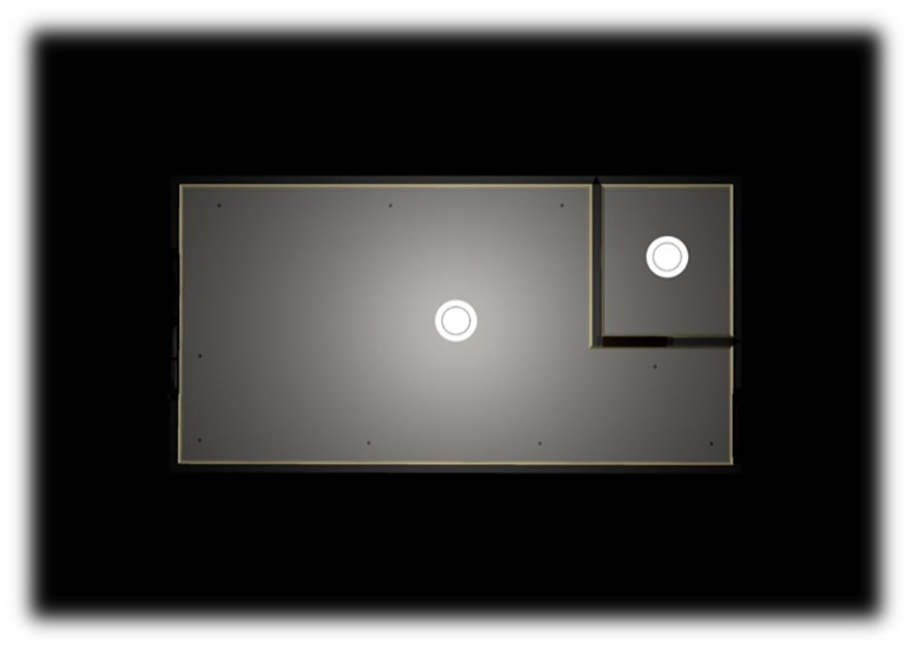
CAD design by the Author.
2. Put things/objects into the space component, which includes drawing spatial elements (doors and windows). Drawing furniture (bed, table, and sofa), see Figure 2 below.
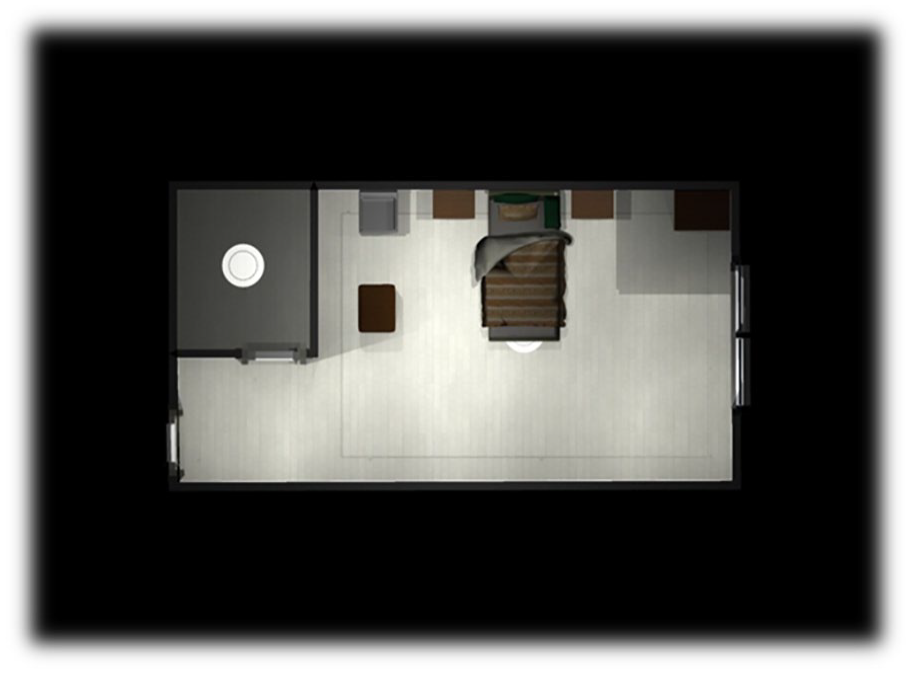
CAD design by the Author.
3. Transformation of a space component. See Figure 3 below.
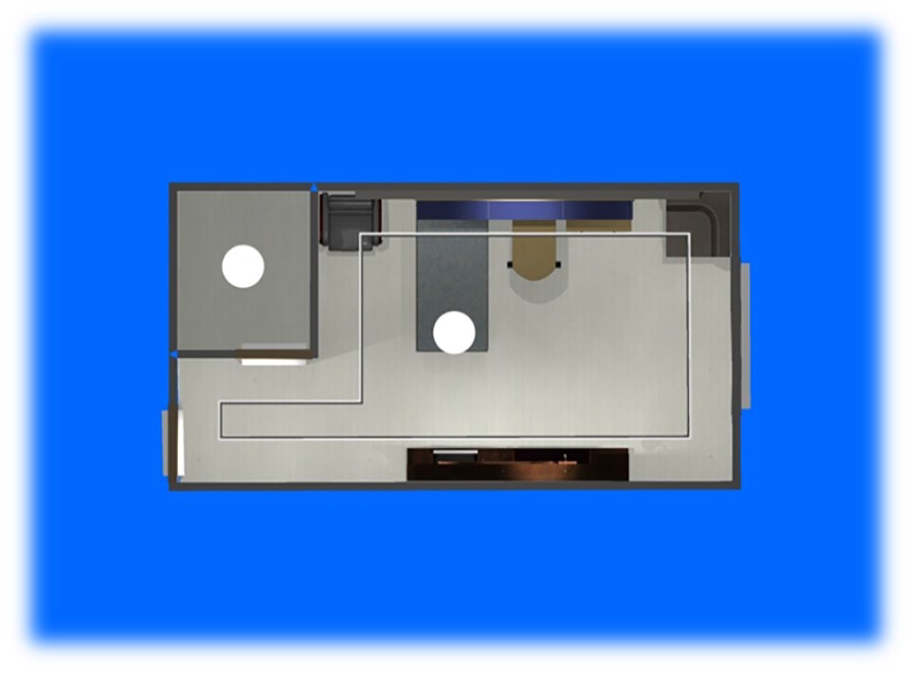
CAD design by the Author.
From the above discussion, students are expected to provide this kind of critical thinking to complete their task.
Assessments in the Design Studio Sessions
According to Brookhart’s (1997) model, students’ perceptions of the classroom assessment environment influence their achievement motivational beliefs (cited in Hussain, 2008).
Feedback is an integral feature of effective and efficient teaching and learning’ (Irwin et al., 2013)
The assessment in design studio sessions will take place individually and will be centered on the presentation of work, which proposed by students. These will be used to collect feedback from the lecturer.
The mobile learning is part of the module contained in the use of videos, presentation that could be downloaded in My BU to help students to experience the design concepts of the built environment discussed in the studio out there in the real site.
In addition to these teaching activities, student task is to a find a topic for the learning exercises this to help the critical thinking and evaluate their learning development. This consist of one design project focusing on (a) evaluating, (b) designing an environment (residential, workplace, etc.), and (c) a series of exercises which included a critical engagement in providing formative feedback to peers during the design studio sessions, reflective exercises based on the use of the mobile lectures and a critical reflection on students’ own personal and academic development from the overall module experience. The design interaction module on My BU will contain all details of the module, including delivery plan, timetable, location for visiting, learning outcomes, and detailed description of all lectures includes mobile and face to face.
The module leader, author of this report, is responsible for developing and implementing the lecturing indoors and out. The module will be delivered next on February 2, 2016, which will be based on the development and implementation of a mobile approach to enhance education at BU.
Purposes of Assessment
The QAA revised code of practice for the assessment of students determines four main purposes:
Pedagogy: promoting student learning by providing the student with feedback, normally to help improve his/her performance (but also to determine what and how students learn). In the field of design, promoting the learning by critically advising the learner on the best design skills is vital (Quality Assurance Agency for Higher Education [QAA], 2006, p. 4. Cited in Heather et al., 2009, p. 134).
Measurement: evaluating student knowledge, understanding, abilities, or skills, this evaluation could be done trough following-up on student development.
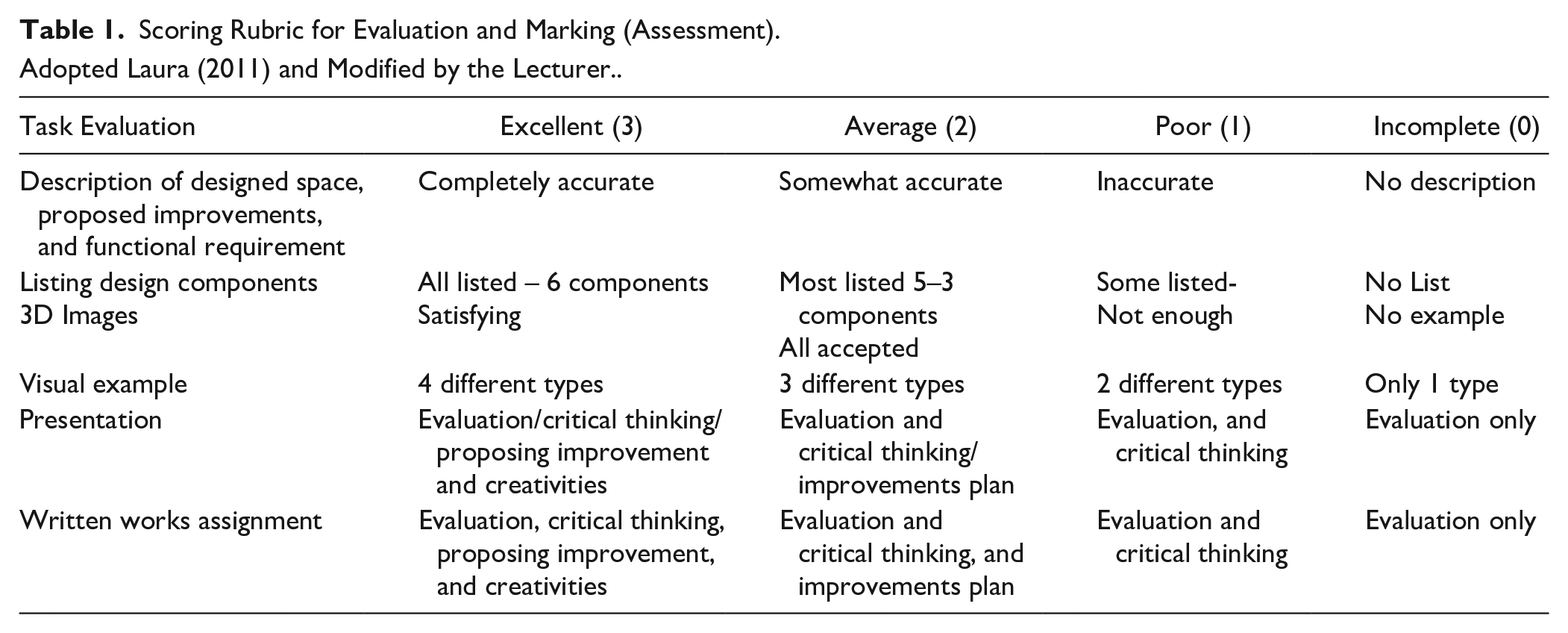
Standardization: providing a mark or grade that enables a student’s performance to be established. The mark or grade may also be used to make progress decisions (Table 1).
Scoring Rubric for Evaluation and Marking (Assessment).
Adopted Laura (2011) and Modified by the Lecturer..
Certification: enabling the employers and higher education providers to know that an individual has attained an appropriate level of achievement (academic standards). This may include demonstrating fitness to practice or meeting other professional requirements (QAA, 2006, p. 4. Cited in Heather et al., 2009, p. 134).
Assessment Methods
“Assessing the performance of students is one of the most important activities educators undertake.”
Choosing an appropriate task is not easy, which is why the most commonly used assessment tasks still tend to be the essay (Heather et al., 2009; Race, 2001). According to Heather et al. (2009), the best advice is to make sure that the method chosen is relevant to the learning outcome. For example, if we want to test students’ ability to construct a coherent and reasoned argument, then the essay would be appropriate, but if we were more concerned with science students’ laboratory skills and design, an observed performance assessment scheme might be more appropriate. Design-based assessment is increasingly being used to motivate students to think in creative way, enable them to practice disciplinary skills and abilities, broaden the range of knowledge assessed, and increase opportunities for feedback (Bull & McKenna, 2004).
Assessment in the visual design is usually accomplished through the presentation and examination of a collection of student work in a portfolio that contains evidence of the project process, research, drawings, samples, sketches, thoughts, development alideas, and finished products (Heather et al., 2009).
In order for students to understand the assessment process and develop the capacity for effective self-evaluation and development, opportunities must be provided for them to understand assessment practices through formal explication and through social learning, as happens for tutors (Drew & Shreeve, 2006). This can enable students to benefit and learn from assessment rather than seeing it as something that is “done to them” (Shreeve et al., 2004) see Table 1.
It is now widely accepted that assessment tends to shape much of the learning that students do (Brown et al., 1997), so if we want to change the way our students learn and the content of what they learn, the most effective way is to change the way we assess them (Heather et al., 2009, p. 134). In the case of m-learning, the assessment of the work is designed to evaluate visual work (Table 1).
The assessment of student’s project will be based on the following criteria: (a) description of the designed space, proposed improvements, and functional requirement. The evaluation based on a score between 3 and 1 (excellent, average, or poor) according to the quality of it and 0 for incomplete (Demirbas, 2003); (b) listing the design components 3D images, the assessments of this will be more focused on the products than the process; (c) visual example, floor plan, sections, elevation, and isometric; (d) presentation of the chosen topic; (e) written works, assignment. A “scoring heading” was designed. See table above and Appendix for each category.
Description of the designed space, proposed improvements, and functional requirement
In the student report (assignment, design, and course work), it expected that the evaluation of a place description and evaluation would be done clearly, this should include the layout, circulation, furniture, lighting color of all elements, the components of the design also presented with some visual examples of different environment (Laura, 2011).
Listing the design components 3D Images: scales of all components should be presented passed on the principle of ergonomics.
Visual example: those should include the production of the layout design features, and technical drawing rules and features and presentation quality (artistic features). Each item will be assessed over some subitems for each drawing work such as first plan, second plan, third plan and section (Laura, 2011)
Presentation: The presentation quality of the assignment report itself is an important factor in considering the performance outcomes of this work that will be assessed (Laura, 2011).
Written works, assignment: Evaluation, Critical thinking, proposing improvement, and creativities
On the base of a score table that is given in (Appendix B) between 3 and 1 (excellent, average, or poor) and 0 for incomplete or not presenting (Laura, 2011).
End of the Module Evaluation (M-Learning)
The evaluation strategy will focus on the assessment of mobile teaching and whether the use of mobile technologies help in improving the learning experience in the subject of design interaction will take place by the end of the model. This will address by critical assessment to improve the learning experience of student in learning design interaction and other different elements involved in the mobile approach.
This module is new, there will be no previous work to compare to be used for the first time within BU, this evaluation plan will be to ask students to reflect critically on their learning. Whether the uses of mobile lectures and experiencing design interaction “out there in the real world” through the mobile lectures make them easier to understand and apply the principle of ergonomics.
Conclusion
m-learning is the most suitable approach for teaching design interaction module because most sessions will take place outdoors to enhance the student’s learning experience. The two flexible and positive methods for teaching design interaction are “face-to-face lectures” and “learning by experience.” These methods use the portability and versatility of mobile technology, for example, using mobile phones and iPad to promote “a pedagogical shift from didactic teacher-centered to participatory student-centered learning” (Looi et al., 2010, p. 156). From a teaching perspective, mobile technology is useful as it allowed the lecturer to refer to students’ experiences when discussing topics in the mobile lectures. This was especially constructive when discussing decisions taken during the studio design sessions (Laura, 2011, p. 41).
Mobile learning (m-learning) has witnessed great demand in higher education with exponential development of mobile devices and technologies. Particularly in the field of industrial design, teaching using mobile devices is an inevitable fallout of the need to keep pace with changes in consumer preference. As m-learning allows students to be engaged in ubiquitous formal and informal learning environments, this mode will satisfy the need to align design studio education with the student’s skills needed in designing spaces. It is deemed ideal to restructure the industrial design studio education to prepare industrial design students as product designers.
Footnotes
Appendix A
School of Design, Engineering & Design
MA Industrial Design
2015/2016
Unit: Design Interaction
3–7 February
Aims
Learning outcomes
Monday February 3: 09.30 – 16:00
09.30 Introductions to mobile learning (site visiting)
10.30 A contribution to the Interior Design and Décor Features in Single Occupancy Hospital Room.
12.00 Discussion
13.00 Lunch
14.00 Theoretical framework for Design Interaction and Environmental Behavior—User Relationships in the built environment (site visiting)
15.00 Tea Break
15.15 Discussion
16.30 Close
Tuesday 4th Feb: 09.30 – 16.00
09.30 The process of creating designs—beyond design as an aesthetic act
11.00 Schematic Design and decision-making processes (Floor plan Traffic analysis-Circulation) (site visiting)
14.00 Workshops, Sketches, Design Concepts, and Drawings, Discussion—Micro—Design activity (site visiting)
13:00 Tea Break
16.00 Close
Wednesday 5th Feb: 09.30 – 16.00
09.30 Sensing the Place (hearing, smell, sight, touch and taste)
12.00 Lunch
13.00 Micro—Design Activity
14.00 Discussion
16.00 Close
Thursday 6th Feb: 09.30 – 16.00
09.30 Discussions the Initial plan for assignment
11.00 Literature Review, Reading, and preparing for short presentation
Friday 7th Feb: 09.30 – 13.00
09.30 Student will give a short presentation about their plan for the Unit of Interaction Design course work
12.30 Feedback and evaluation of the course
13.00 Close
Program organizer: Dr. M Gashoot
Appendix B
Declaration of Conflicting Interests
The author(s) declared no potential conflicts of interest with respect to the research, authorship, and/or publication of this article.
Funding
The author(s) received no financial support for the research, authorship, and/or publication of this article.
