




Abstract
Evidence suggests that individuals affected by problematic heroin use can desist at various points in their drug-using career. Drawing on a doctoral study that developed a non-linear four-stage model of desistance from heroin careers within the Maltese context, this paper focuses on exploring the contingencies that are in place during the initial pre-desistance stage. The study adopted an evolved grounded theory methodology. Semi-structured interviews were conducted with twenty-two participants, fourteen identifying as male and eight as female, who had desisted from heroin careers for a minimum of five years. Findings show that a series of setbacks encountered after committing to a heroin career can create profound ambivalence, leading to pivotal reckoning moments that prompt individuals to consider change. Importantly, the emergence of hope that desistance is possible appears to play an instrumental role in initiating the desistance process.
Introduction and Background
While addiction is often portrayed as a chronic, relapsing condition, research on heroin careers indicates a more dynamic trajectory in which many individuals eventually cease use and achieve long-term desistance (Best et al., 2008; Biernacki, 1986; Connolly et al., 2013; Dennis et al., 2005; Faupel, 1991; Heyman, 2009; Klingemann et al., 2001). However, desistance is rarely linear, often involving repeated lapses before cessation, highlighting the importance of early change processes (Laudet & White, 2010; Maruna, 2001; Prochaska & DiClemente, 1986). Desistance from addiction careers has been extensively examined in predominantly urban, Anglophone settings (Best et al., 2017; Erickson, 2018; Klingemann et al., 2001), yet far less is known about how it unfolds in small, tightly knit Mediterranean contexts such as Malta. Addressing this gap, this paper draws on a doctoral grounded theory study (Gellel, 2024) that proposes a four-stage non-linear model of desistance from heroin careers. The analysis focuses on the first stage, pre-desistance, defined as the period in which heroin use continues but is increasingly questioned.
Recent data highlight the continued relevance of focusing on heroin careers in Malta. In 2021, half of those in treatment on the island sought support for heroin use (Gellel et al., 2022). Although heroin use has declined across Europe, it remains the most common opioid among treatment entrants and is associated with significant health and social harms (EMCDDA, 2023). In Malta, previous downward trends have also reversed, with increases in heroin-related hospital admissions and first-time treatment seekers in 2022 (Gellel et al., 2023). These findings underline the need to better understand desistance pathways to inform policy and intervention responses. Malta offers a distinctive context for desistance as a small island society marked by dense social networks, high visibility and limited anonymity. Reputations linked to past heroin use may remain publicly known long after cessation, while social identities can be harder to reconstruct than in larger urban settings. At the same time, strong kinship and community ties may both hinder and support change by generating stigma and surveillance, while also providing practical and emotional support. Desistance from heroin careers in Malta therefore occurs within a context where small size, honour and shame, community reputation and enduring social ties shape opportunities for change and barriers to reintegration (Clark, 2012).
Addiction Careers and the Path to Desistance
This paper adopts a career approach. It conceptualises engagement in heroin use as a dynamic and non-linear process. While broad stages such as initiation, commitment and desistance can be identified, movement through these is neither fixed nor sequential and may involve reversals or pauses. Borderlines between different stages are also porous. The literature supports using both the language of desistance and the career model when examining transitions out of chronic heroin use (Best et al., 2008, 2010; Bachman et al., 2016; Stone, 2016). This approach allows researchers to capture not just cessation but also the complex interplay between personal motivation, social context, practical support, identity transformation and broader life-course dynamics. While recovery language remains dominant in substance use fields, the explicit application of career models popular in criminology, has the potential to enrich our understanding by emphasising agency, narrative change, turning points and structural facilitators and barriers.
The term desistance offers several advantages over the term recovery, particularly when examining heroin careers. Unlike recovery, which is often associated with clinical or normative assumptions about health, desistance is more conceptually neutral and does not privilege a specific pathway for change (Gellel, 2024). It also aligns closely with a career perspective by emphasising process and transition over time. This makes it especially useful for capturing the varied and often fragmented ways in which heroin careers come to an end, without imposing expectations of adherence to treatment frameworks.
While some individuals experiment with substances without developing an addiction, others may become dependent (NIDA, 2014). Only a subset of the population develops an addiction career, engaging in addictive behaviours at varying levels of intensity throughout their trajectory (Faupel, 1991). The career model highlights how both subjective experiences and external social factors shape the progression of substance use, as well as the process of desistance (Carnwath & Smith, 2002; Gellel, 2024). Rather than following a linear path, addiction careers are often characterised by movement in and out of problematic use, relapse and periods of stability (Dennis et al., 2005; Clark, 2011; Faupel, 1991). Long-term desistance from addiction appears to follow a similarly gradual and non-linear trajectory, involving identity transformation and the formation of new social associations (Carter & Marony, 2018; Stryker, 2007). Individuals reconstruct their identities through interaction with others, often moving away from an “addict” identity towards one that supports social reintegration (McNeill et al., 2014). This process is facilitated through participation in new social groups and the adoption of alternative social roles, which provide fresh narratives, expectations, and sources of meaning (Paternoster & Bushway, 2009).
Theories of desistance emphasise the internalisation of a “redemption script,” through which past drug use is reframed as a catalyst for personal growth and future change (Maruna, 2001). In constructing these narratives, individuals resist stigmatising labels and reinterpret their biographies in more positive and agentic terms. Such narratives are strengthened through supportive social relationships that help individuals see themselves differently and sustain new scripts for action (Best, 2019). This narrative work is a key mechanism in moving away from addiction, underscoring the socially constructed and interactional nature of desistance processes (Chouhy et al., 2020).
Effective policy and practice therefore require an understanding of desistance from heroin careers as a multifaceted, evolving, highly individualised process (Carter & Marony, 2018). It is shaped by numerous contingencies and turning points across the addiction career, rather than by any singular or static event.
Methodology
This study draws on data from a PhD project that employed a qualitative research design, using in-depth, semi-structured interviews with individuals who had extensive heroin careers and have successfully desisted (Gellel, 2024). The primary aim of the PhD was to develop a substantive-level grounded theory of the desistance process from heroin careers within the Maltese context. This paper focuses specifically on the initial stage of that proposed theory, which explores the shifts in motivation preceding active desistance. The study adopted an evolved grounded theory approach as outlined by Strauss and Corbin (2015). Situated within an interpretivist paradigm, the research frames human experiences as subjective and context-dependent, acknowledging that the researcher’s worldview inherently influences data interpretation (Denzin & Lincoln, 2005; Levers, 2013). The study is underpinned by a relativist ontology. The epistemological orientation of contextual constructivism recognises that knowledge is co-constructed through interaction between the researcher and participants in a specific context. A purposive sampling strategy resulted in the recruitment of twenty-two participants (fourteen men and eight women) with lived experience of heroin use spanning from two to twenty-three years and who had desisted for at least 5 years. Initial recruitment was conducted through treatment programmes and self-help groups, with the sample further expanded using snowball sampling. As with most qualitative studies of desistance, the purposive sampling strategy was designed to recruit information-rich participants rather than to achieve statistical representativeness. Participants were selected because they had extensive heroin careers and had maintained sustained desistance, making them particularly well placed to reflect on processes of change. Recruitment occurred through multiple pathways, including treatment services, self-help groups and snowball referrals, to access individuals with varied recovery trajectories and to reduce reliance on any single institutional source. Nevertheless, the sample may reflect some selection bias. Because many participants were initially accessed through treatment and recovery networks, individuals who had some level of service engagement or social connection to treatment communities were more likely to be included. Only one participant had no contact with any form of treatment provider or self-help group. Those who desisted without formal support, those more socially isolated or those disconnected from treatment and self-help networks were therefore underrepresented. This limitation is common in desistance research, as individuals who have successfully exited heroin use outside visible support structures can be difficult to identify and recruit.
Attention was also given to avoiding in-group homogeneity. Recruitment through several channels, combined with iterative theoretical sampling, sought variation in gender, age, treatment history, duration of heroin careers and years since desistance. The final sample included both men and women, participants with heroin careers ranging from two to twenty-three years and varying experiences of treatment involvement, including one participant with no treatment history. Participants also differed in age and in the length of time they had sustained desistance. The aim was to generate an empirically grounded explanation of desistance processes in the Maltese context, while recognising that pathways among less visible or non-service-engaged populations may differ. Interviews were audio-recorded and transcribed verbatim. Data analysis followed the constant comparative method, involving a systematic and rigorous coding process consisting of open, axial and core coding (Levers, 2013). After twenty-two interviews, theoretical saturation was judged to have been reached. In line with grounded theory methodology, data collection and analysis proceeded concurrently using the constant comparative method, allowing emerging categories to be continually tested, refined, and elaborated as new interviews were completed. By the later stages of recruitment, interviews were no longer generating substantively new properties, dimensions or relationships within the core categories, but were instead confirming and deepening patterns already identified. The final interviews largely provided redundancy rather than novel conceptual insight. At that stage, the categories were considered sufficiently developed in terms of variation and explanatory power to support the evolving substantive theory and subsequent writing. As with all qualitative claims of saturation, this judgement is interpretive rather than absolute. Saturation does not imply that no new account could ever emerge, but that further data collection was unlikely to make a meaningful contribution to the theoretical framework under development within the scope of this study.
This research was granted ethical approval by the University of Malta Research Ethics Committee (SWB 282/2017). All procedures were conducted in accordance with ethical research principles, ensuring confidentiality, anonymity, informed consent and participant well-being. Pseudonyms were used to ensure anonymity. Methodological rigour and a clear audit trail linking data to theory was adopted. Credibility was enhanced through constant comparison, memo writing, theoretical sampling and reflexivity (Charmaz, 2006; Corbin & Strauss, 2015). Transparency in coding and analysis, along with participant validation through follow-up interviews and thick description, further strengthened the findings (Guba & Lincoln, 1989). Ensuring theoretical sensitivity and clearly documenting analytic decisions avoided imposing preconceived ideas on the data.
Findings
The analysis generated a four-stage model to explain desistance from heroin careers in the Maltese context. Through participants’ narratives, the study identified four analytically distinct, though non-linear, stages of desistance: (1) pre-desistance, characterised by accumulated losses, shame and the initial contemplation of change; (2) initial ambivalent desistance, marked by uncertainty and fluctuating commitment to a drug-free life; (3) embracing desistance, involving identity transformation and the establishment of a non-using self; and (4) belonging and long-term desistance, in which participants consolidated desistance through reintegration into conventional social roles and relationships.
Although the four-stage model is presented sequentially for analytic clarity, it should not be interpreted as a fixed, linear deterministic pathway through which all individuals necessarily progress. Consistent with grounded theory methodology, the model is intended as a conceptual abstraction of recurring processes identified across participants’ narratives rather than a chronological template. Participants’ accounts demonstrated considerable variation in pace, sequence, intensity and outcome. Some moved back and forth between stages, some remained in ambivalence for prolonged periods some revisited earlier struggles after relapse and others experienced overlapping processes simultaneously. Similarly, the concepts represented in the diagram (e.g., loss, stigma, shame, reckoning moments and hope) are not discrete steps that mechanically lead from one to another, but interacting contingencies whose significance depends on how they are subjectively interpreted within particular social contexts. For example, for some participants, stigma deepened entrenchment in heroin use; for others, it contributed to reflection and motivation for change. The model should therefore be read as dynamic and iterative rather than linear. Multiple possible pathways exist through and beyond desistance.
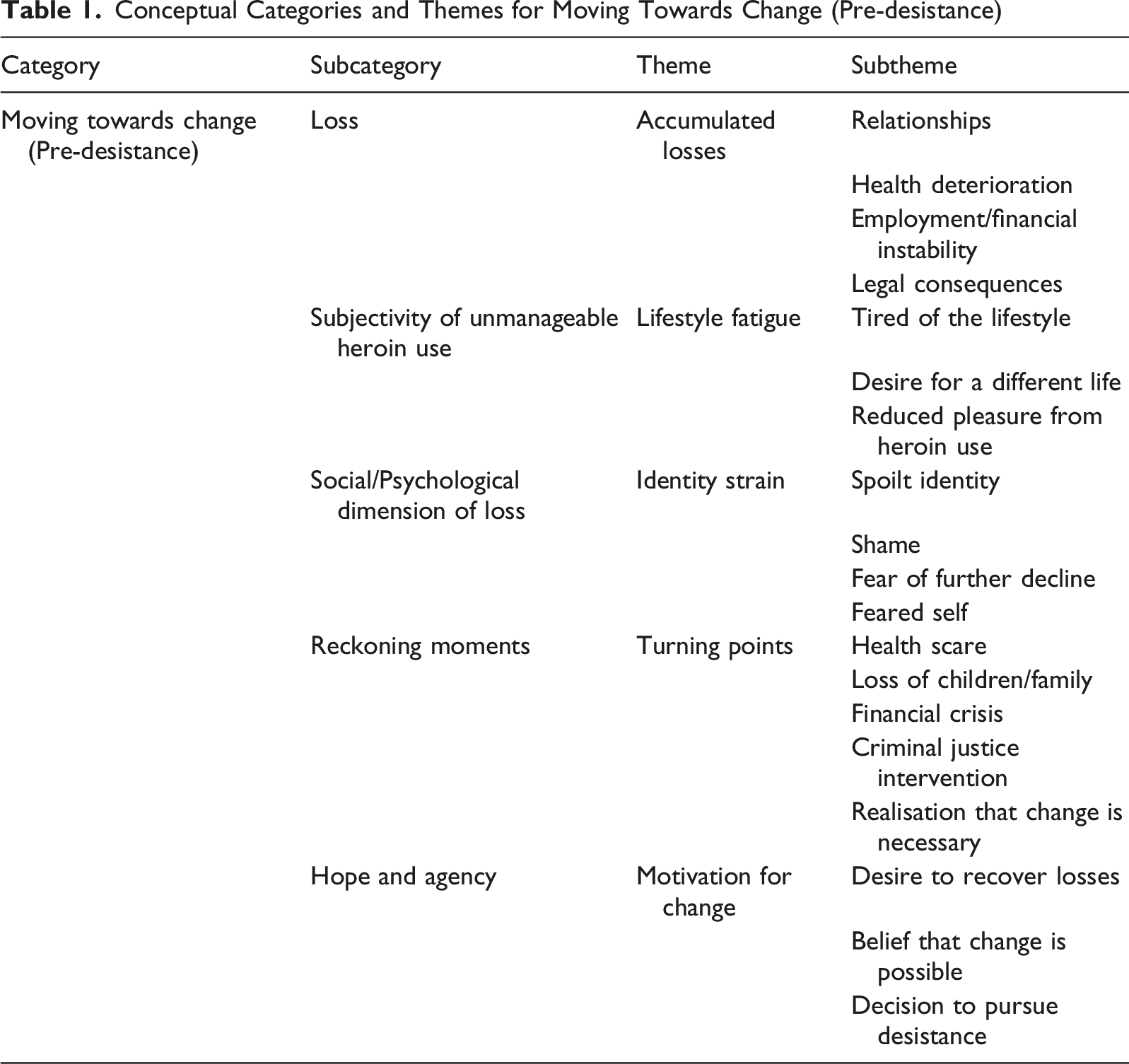
Conceptual Categories and Themes for Moving Towards Change (Pre-desistance)

Pre-desistance: Critical losses and initial contemplation
According to the developed theory, the pre-desistance stage occurs while individuals remain actively involved in problematic heroin use but begin to re-evaluate their continued commitment to the heroin career. In this study, this movement toward change developed through the interplay of several processes: accumulated loss, the subjective experience of unmanageable heroin use, the psychological consequences of identity strain and shame, reckoning moments and the emergence of hope and agency.
The findings indicate that the initial movement toward desistance was shaped by an accumulation of losses that gradually fostered ambivalence toward continued use. Simultaneously, exclusion from conventional social life, the erosion of trust, and experiences of stigma deepened feelings of shame and reinforced an “addict” identity that many struggled to relinquish. Recognition of a feared future self, marked by irreversible deterioration, imprisonment, abandonment or death, acted as a powerful motivator for change. Participants did not usually describe a singular, universally recognisable “rock bottom.” Instead, they narrated what this study conceptualises as reckoning moments: critical junctures in which accumulated losses could no longer be ignored and participants were compelled to confront the trajectory of their lives. Crucially, the emergence of hope characterised those who moved toward desistance, as belief in a future beyond addiction appeared necessary for movement from contemplation to action.
Accumulated Loss
The concept of perceived accumulated loss emerged as a key explanatory theme in the pre-desistance stage. Participants’ accounts indicate that the lived experience of multiple, compounding losses was central because it contributed to the sense that heroin use had become unmanageable. These losses unfolded across health, relationships, finances, legal status, social participation and personal dignity. Participants described a shift from what they retrospectively interpreted as a more manageable period of heroin use to a later stage in which the consequences of use became overwhelming. Peter recounted: “that is when…if before …I mean I had retained my job, I would have money to get by… the issue ended up unmanageable… until I eventually crashed.”
Similarly, Carl stated: “My life had become unmanageable; I would not leave my house.”
Steve emphasised the erosion of autonomy: “Am I not my own person?”
Such accounts suggest that movement toward desistance was linked not simply to heroin use itself, but to the perception that continued use was no longer manageable within the terms participants had previously used to justify or sustain it.
A major aspect of accumulated loss concerned deterioration in physical and mental health. Participants narrated severe pain, depression, exhaustion and awareness of bodily decline. Steve reflected: “That is when I realised I was in pain. In pain both mentally and physically… And my mind started to see reason.”
Joseph similarly described a gradual awakening prompted by physical decline: “I came to a point in my life when my body started to die. A lot of warnings from doctors, ‘beware because your veins are clogging’. I paid no attention! When depression kicked in that is when I sort of became conscious.”
Loss also extended to valued relationships and social connectedness. Chris described profound isolation: “Socialising with no one you know, I had become so alone…when I was young, I knew how to mingle with friends and talk and stuff, but it had overcome me (heroin) to the point that I did not want to live, because sometimes I spent two months alone in a room and nothing.”
For some, isolation intensified immersion in heroin use; for others, it contributed to a growing desire to reconnect with family, friends and community.
Financial hardship was another recurring theme. Participants described losing employment, struggling to fund heroin use and, in some cases, engaging in acquisitive crime: “I ended up stealing because I had no money…, and it led me to have cases with the police because of theft, because of heroin. I ended up with a three-year probation.” (Henna) “Obviously, financially every time you need to see from where you are going to get the funds to…to keep the habit…I lost my work!” (Chris)
Among mothers, financial hardship was often intertwined with parenting responsibilities: “Lots of stress. They had even cut off my electricity. And then I had the little ones. I had twins…” (Jean) “I had to decide whether to buy food or cigarettes…for the household, for myself and the children!” (Ella)
Legal consequences also formed part of accumulated loss. Chris stated: “The cases started to pile up… there was a point when I said I could not continue going like this.”
Taken together, these narratives indicate that accumulated loss was not a single event but a gradual process through which heroin careers became increasingly difficult to sustain and increasingly difficult to justify.
Tired of the Lifestyle: The Subjectivity of Unmanageable Heroin Use
Accumulated losses contributed to what participants described as becoming tired of the lifestyle. This referred not only to physical fatigue, but to deeper disillusionment with the routines, identity and emotional burdens of heroin use. Chris stated:
“In reality, I grew tired… I became fed up, and I wanted to try and do something that brought me to the point of stopping.”
Ella similarly explained: “I started to plan so that maybe I might get social housing so that I could start a new life because I was fed up and I was tired.”
Joseph described extreme exhaustion: “There were many moments when I had decided that I would end my life. Because I was tired.”
These accounts indicate that unmanageability was subjectively experienced. Participants differed in what they could tolerate and in when they came to view heroin use as no longer worth continuing.
Accumulated loss and lifestyle fatigue gave rise to growing ambivalence toward continued heroin use. Participants had not yet fully committed to desistance, but they had begun to question whether heroin use remained rational, desirable or bearable. Kyle reflected this ambivalence:
“When things start going wrong…you start saying, it’s better to be clean.”
Similarly, Clive stated: “But I came to a point where I lost everything.”
This ambivalence is analytically significant because it marks an early shift in orientation: heroin use was no longer accepted unquestioningly as the preferred course of action.
Social/Psychological Dimension: Identity Strain, Shame and the Feared Self
A further major finding concerned the social psychological consequences of heroin careers, particularly spoilt identity, shame, fear of further decline and the emergence of a feared self. Participants described heroin use as highly stigmatised and as producing an “addict” identity that overshadowed other aspects of selfhood.
Shame operated in complex ways. For some participants, shame deepened withdrawal, self-loathing and continued heroin use. For others, it became a catalyst for reflection and a desire to reclaim dignity and relationships. Chris described a moment of shame linked to his father’s suffering:
“I saw my dad crying on a bench, and I had never seen him cry before. That was my turning point.”
Steve similarly reflected: “I started noticing people’s words. They hurt… That’s what made me stop.”
Participants’ narratives also highlighted the feared future self. They imagined becoming dead, imprisoned, permanently excluded or remembered only through addiction. Joseph explained: “A friend of mine overdosed, and I didn’t want my kids to say, ‘My father died of an overdose.’”
Thus, participants were motivated not only by present suffering, but by fear of who they were becoming.
Reckoning Moments
Although losses accumulated gradually, participants commonly identified a more immediate event that crystallised the need for change. These reckoning moments varied across participants but shared a common function: they transformed growing unease into urgent recognition that something had to change. For Peter, police intervention was pivotal:
“I had come to a situation that I created myself. I took responsibility for it and when I started assuming responsibility, I could move forward…”
For Joseph, abandonment by family marked the turning point: “I found nothing, not my wife nor my kids. They left… I entered the programme.”
Carl described confrontation by his father: “He told me ‘It's up to you now’. And that was like a wake-up bell in my mind.”
For Sander, the turning point was a diagnosis of Hepatitis C: “And I said I am going to stop.”
For Jean, fear of losing her daughter was decisive: “My daughter and drugs don’t mix… I had to stop.”
In some narratives, suicidality marked the extreme edge of the reckoning moment. Martha stated: “I said I was either going to live or die.”
Peter described this in symbolic terms: “That Peter died… The death of an identity sort of. And the birth of a new one.”
These findings indicate that reckoning moments were not necessarily the worst objective events participants had experienced, but rather events subjectively interpreted as decisive and no longer ignorable.
Hope and Agency
A final category in the pre-desistance stage was hope. Fear and loss alone did not generate movement toward desistance. Participants also needed some belief that change was possible and that a better future might still be available to them. Hope emerged through several pathways, including support from family, professionals and peers who had already achieved desistance. Rachel explained: “He told me that there were people who used heroin the way that I did and who managed to find a way out… it’s hope.”
Ella similarly highlighted peer modelling: “A person seeing that you have been clean ten years, ‘Look she did it! So, I can do it too.’ You give them hope.”
These accounts suggest that hope functioned as a bridge between contemplation and action. Participants moved toward desistance not only because they feared continued heroin use, but because they could imagine another future and began to believe it was attainable.
Discussion
This study developed a grounded theory of desistance from heroin careers in the Maltese context and, in this paper, focused specifically on the first stage: pre-desistance. The findings suggest that movement toward desistance begins not with a single decision, but with a gradual reappraisal of the heroin career shaped by accumulated losses, subjective unmanageability, shame, feared future selves, reckoning moments and hope. The developed theory therefore conceptualises pre-desistance as an interactive and meaning-laden process through which continued heroin use becomes increasingly untenable and change becomes thinkable.
A central contribution of the theory is the explanatory role of accumulated loss. Participants’ narratives indicate that losses across health, relationships, finance, parenting and legal status gradually destabilised commitment to heroin use. This supports prior work showing that adverse consequences may prompt individuals to re-evaluate addictive lifestyles (Fotopoulou, 2014), but the present study adds that these losses are not merely objective events. Their significance lies in how they are interpreted by the individual. Desistance became more likely when losses were no longer normalised, denied or absorbed into the logic of the heroin career, but instead came to be understood as evidence that life had become unmanageable (Paternoster & Bushway, 2009).
The findings also extend previous work on the idea of being tired of the lifestyle (Best et al., 2008). Participants did not simply describe heroin use as harmful; they described becoming disenchanted with the routines and emotional burdens associated with it. This suggests that pre-desistance entails an affective and existential exhaustion with the heroin career, consistent with the view that desistance emerges when the perceived rewards of continued use are outweighed by its cumulative costs.
Another important contribution concerns the role of shame. The findings support a differentiated understanding of shame as both constraining and potentially transformative. In Malta, where small size, high social visibility, dense social networks and concerns with reputation may intensify stigma, shame can deepen detachment and reinforce an addict identity. Yet the findings also show that shame can become mobilising when linked to valued relationships, moral self-appraisal and the possibility of restoration. Shame therefore does not operate uniformly; its effects depend on whether participants can imagine reintegration and a viable alternative self.
Relatedly, the theory highlights the importance of the feared self. Participants contemplated desistance not only because they disliked their present circumstances, but because they feared who they were becoming: someone dead, imprisoned, abandoned or permanently reduced to the status of “addict.” This aligns with identity-based understandings of desistance and suggests that movement toward change is catalysed when the anticipated future self becomes intolerable (Paternoster & Bushway, 2009). Yet fear alone was insufficient. The feared self had to be counterbalanced by some image of a possible or desired self.
This is where hope becomes theoretically central. One of the strongest distinctions between continued entrenchment and movement toward desistance was whether participants could imagine that change was possible. Hope emerged not simply as an internal trait, but as socially mediated. Family members, professionals, and especially peers who successfully acted as carriers of possibility. Through them, participants encountered examples of lives beyond heroin use. Hope in this sense was relational and socially produced rather than purely individual.
The concept of reckoning moments also refines dominant “rock bottom” narratives. Participants often described pivotal events, but the data do not support a simple model in which extreme suffering automatically produces desistance. Rather, reckoning moments were significant because they condensed prior losses into a moment of clarity. They made action feel urgent. Change is therefore better understood as arising from the interaction between cumulative deterioration and a subjectively powerful trigger (Monterosso & Ainslie, 2007), not from “bottoming out” alone.
Taken together, the findings support a grounded theory account in which pre-desistance is socially embedded, psychologically complex as well as temporally extended. It is socially embedded because it unfolds in relation to stigma, family ties, peer networks, and culturally specific meanings of shame and reputation. It is psychologically complex because it involves identity strain, ambivalence, fear, and hope. It is temporally extended because the decision to move toward desistance emerges gradually, even when participants later narrate it through a decisive turning point.
For the Maltese context, the findings underscore that desistance from heroin careers cannot be understood outside the social environment in which addiction is lived. In a small island society marked by high visibility and dense interpersonal networks, both stigma and support may be intensified. Desistance pathways may therefore be shaped not only by treatment access, but also by whether individuals encounter reintegrative responses that allow hope, recognition and new identities to emerge.
Final Note
Overall, the developed theory suggests that the beginnings of desistance lie in a shift from enduring heroin-related losses to reinterpreting them as intolerable, meaningful and reversible. This reinterpretation is strengthened when a reckoning moment confronts the individual with the trajectory of continued use, and when hope makes an alternative future imaginable. The pre-desistance stage is therefore best understood not as a passive background to change, but as the crucial period in which the possibility of desistance first becomes psychologically and socially real
Footnotes

Funding
The authors received no financial support for the research, authorship, and/or publication of this article.
Declaration of conflicting interests
The authors declared no potential conflicts of interest with respect to the research, authorship, and/or publication of this article.
Data Availability Statement
Data is not available due to confidentiality.