



Abstract
International travel by emerging adults is increasingly recognized as a context for experimentation with illicit drugs. This longitudinal study examined predictors of drug use trajectories among 249 young adults traveling to South America or Southeast Asia. Participants completed assessments before departure and after their return. Latent profile analysis identified three use trajectories: Stable Low (48.4%), Experimental Increasing (28.4%), and Consistently High (23.2%). Use of illicit substances such as cocaine and LSD increased markedly during travel in the Consistently High group. Higher novelty seeking and lower commitment to developmental goals predicted membership in this group, while elevated depressive symptoms predicted membership in the Experimental Increasing group, which showed a temporary escalation. These findings highlight the role of personality, motivation, and emotional vulnerability in shaping responses to permissive environments. This study contributes to international drug research by identifying at-risk youth and informing targeted prevention strategies in youth health, and public drug policy.
Introduction
Backpacking has become a common experience for emerging adults over the last few decades, often motivated by a desire to explore new experiences, gain independence, and engage in self-discovery (Arnett, 2007). In some cultural contexts, it has even evolved into a normative transitional experience in early adulthood, with many young people traveling to destinations such as South America or Southeast Asia for extended periods (European Monitoring Centre for Drugs and Drug Addiction (EMCDDA), 2012; Shulman et al., 2006). Studies indicate that a substantial proportion of backpackers engage in drug use during their travels, with prevalence estimates ranging from 30% to 55% (Bellis et al., 2007; Maoz, 2007). The consequences of this behaviour extend beyond individual travelers. Countries of origin may face increased public health burdens upon return, including heightened risks of substance use disorders, neuropsychiatric issues, and blood-borne infections (Bonny-Noach, 2018; Bonny-Noach & Sagiv-Alayoff, 2017; Vivancos et al., 2010). Host countries, particularly popular backpacking destinations, may experience increased policing needs due to antisocial or criminal behavior and greater emergency room use related to medical complications of drug side (Charoensakulchai et al., 2024; European Monitoring Centre for Drugs and Drug Addiction (EMCDDA), 2012).
Existing research has documented the prevalence of substance use among travelers and associated harms, including accidents, violence, and violations of local laws (Bellis et al., 2007; Charoensakulchai et al., 2024; European Monitoring Centre for Drugs and Drug Addiction (EMCDDA), 2012). Beyond prevalence, studies highlight individual-level predictors of substance use. Personality traits such as novelty seeking and harm avoidance are linked to risk-taking and drug use (Cloninger, 1987; Lannoy et al., 2020). Mental health factors, including depressive symptoms, have been associated with self-medication and increased substance use during stressful or permissive contexts (Pacek et al., 2020; Vorspan et al., 2015). Developmental motivation, such as the importance placed on long-term goals, has been proposed as a protective factor against risky behaviors (Heckhausen et al., 2010; Shulman & Nurmi, 2010).
Variability in drug use during travel aligns with contemporary models in psychopathology research, which emphasize the role of personality in shaping how individuals respond to environmental influences (Durbin & Hicks, 2014). For example, novelty seeking, a trait characterized by impulsiveness, curiosity, and a preference for new experiences, is strongly associated with drug and alcohol use (Cloninger, 1987; Foulds, Boden, Newton-Howes, Mulder, & Horwood, 2017Foulds et al., 2017; Lannoy et al., 2020). Novelty seeking has been shown to predict engagement in high-adrenaline activities during travel, such as whitewater rafting or scuba diving (Lee & Tseng, 2015). In a permissive drug environment, individuals high in novelty seeking may be particularly prone to drug experimentation and escalation (Wang et al., 2015). Another trait in Cloninger’s personality model is harm avoidance, which reflects a tendency toward caution, fear of uncertainty, and sensitivity to negative stimuli. While it may be assumed that high harm avoidance reduces risky behaviour, Cloninger (1987) also posited that individuals high in this trait may use drugs to cope with chronic worry or distress. This duality is supported by studies linking harm avoidance to drug use, smoking, and mood disorders (Etter, 2010; Nevid, Gordon, Barris, Sperber, & Haggerty, 2019Nevid et al., 2019).
Mental health factors such as depression may also influence drug use during travel. The self-medication hypothesis suggests that individuals may use drugs to relieve psychological distress (Spring, Riley, & McChargue, 2008). Epidemiological studies have confirmed associations between depression and cannabis use in both general and youth populations (Pacek, Weinberger, Zhu, & Goodwin, 2020Pacek et al., 2020; Weinberger et al., 2020). In unfamiliar or stressful settings, such as during travel, this tendency may be amplified (Vorspan et al., 2015).
Conversely, developmental regulation theory offers insight into protective factors. This theory posits that individuals actively shape their own developmental paths by setting and committing to life goals (Heckhausen et al., 2010). Commitment to goals such as career advancement or romantic development has been linked to greater well-being and lower engagement in maladaptive behaviours (Shulman & Nurmi, 2010). Young adults focused on such goals may be less inclined to use drugs, instead channeling their energy into internal exploration and planning. These theoretical frameworks suggest that the backpacking experience, characterized by increased autonomy and a permissive drug culture, may amplify existing tendencies rather than uniformly influence all travelers. For some, the trip may be a catalyst for increased drug use; for others, it may represent a period of growth and boundary testing without drug involvement.
Despite this knowledge, several gaps remain. Most studies describe prevalence or outcomes of drug use during travel but do not examine variability in use over time. Less is known about which young adults remain abstinent, which experiment temporarily, and which escalate their use. Moreover, the relative contribution of personality, mental health, and developmental motivation to different trajectories of substance use remains unclear. Understanding these patterns is critical for informing public health policy, tailoring pre-departure interventions, and implementing harm reduction strategies in both sending and receiving countries.
The current study addresses these gaps by examining illicit drug use among emerging adults traveling to South America and Southeast Asia using a longitudinal design. Specifically, our objectives were to identify distinct trajectories of drug use before, during, and after travel; and test predictors of trajectory membership, including novelty seeking, harm avoidance, depressive symptoms, and developmental goals.
Methods
Participants and Procedure
The current study included 249 emerging adults (129 men), aged 21–27 (M = 24.27 years, SD = 1.05), from Israel, who planned to travel to South America or Southeast Asia for an extended period of 6 to 12 months (M = 9.24 months, SD = 2.13). Participants were recruited in-person by study staff at pre-travel health centers and travel retail outlets. After providing written informed consent, they completed baseline questionnaires online. Each participant was assigned a unique identification number to ensure anonymity during data entry and analysis.
At baseline, participants reported their drug use in the past month and completed questionnaires assessing depressive symptoms, novelty seeking, harm avoidance, developmental goals, peer support, and self-efficacy. All participants, except one, had completed high school. Parental education levels were also recorded, with mean years of schooling for mothers at 14.48 (SD = 3.05) and for fathers at 14.56 (SD = 3.34). Participants came from a range of socioeconomic backgrounds, from lower to upper-middle class.
Fifty-two percent of participants reported traveling in South America, and approximately 40% traveled in Southeast Asia, primarily India and Nepal. After returning from the journey, participants completed an online follow-up assessment in which they reported their drug use during the last month of travel and the first month following their return home. They also completed the same battery of questionnaires as at baseline. Participants who could not be contacted after three attempts post-journey were classified as lost to follow-up. Participants received approximately 35 USD for their participation at each time point. The study was approved by the Institutional Review Board of Bar-Ilan University, Ramat Gan, Israel.
Measures
Demographic Characteristics
Before departure, participants reported their gender, age, and years of schooling completed by each parent, along with the highest level of parental education attained.
Drug Use
At each wave, participants were given a chart and asked to report the frequency of use of various illicit drugs, including cannabis, amphetamines, heroin, cocaine, LSD, ecstasy, drug cocktails, sleeping pills, and other drugs. Responses were based on usage in the past month and during an average month while on the trip. The frequency of each substance was aggregated into a single index score for overall substance use, rated as follows: 0 = never; 1 = only once; 2 = 2–5 times; 3 = 5–10 times; 4 = 11–20 times; 5 = more than 20 times.
Depressive Symptoms
Depressive symptoms were assessed using the 6-item depression subscale from the Brief Symptom Inventory (BSI; Derogatis & Fitzpatrick, 2004). Participants responded to items such as “How often did you feel hopeless about the future during the last month?” Cronbach’s alpha values indicated high internal consistency at both time points (α = .89 at baseline; α = .92 at follow-up).
Novelty Seeking and Harm Avoidance
Participants completed the Temperament and Character Inventory-Revised (TCI-R; Cloninger et al., 1991) at baseline. Twenty items assessed novelty seeking (e.g., “I like to try new ways of doing things”), and an additional twenty items assessed harm avoidance (e.g., “I usually prefer to stay a little distant and detached from other people”). Internal consistency was satisfactory for both scales (α = .84 for novelty seeking; α = .79 for harm avoidance).
Developmental Goals
A modified version of Little’s Personal Project Analysis (Little, 1983) was used to assess the importance of and commitment to career and romantic development goals. Participants rated each goal using a 7-point Likert scale (1 = low, 7 = high). Example items included “To what extent is the project important to you?” (goal importance) and “To what extent are you committed to realizing this project?” (goal commitment). For the purposes of this study, a composite score of goal importance across both domains was calculated. Internal consistency for the scale was high (α = .86).
Results
Of the 249 (129 men) participants, 194 (101 men) completed the follow-up assessment. Follow up assessments were conducted approximately three to six months after participants returned from their travels (M = 4.48 months, SD = 1.18), Independent samples t-tests were conducted to compare those who participated in the follow-up and those who did not. There were no significant differences in pre-journey drug use, t (247) = 0.29, p = .77 (retained: M = 1.08, SD = 1.37; dropped out: M = 1.02, SD = 1.37), or in paternal education, t (247) = −0.42, p = .13 (retained: M = 14.56, SD = 3.33; dropped out: M = 14.31, SD = 3.44).
Types of Drugs Used During the Journey
Descriptive Statistics and Correlations Between Drug Use at Three Time Points and Baseline Predictors
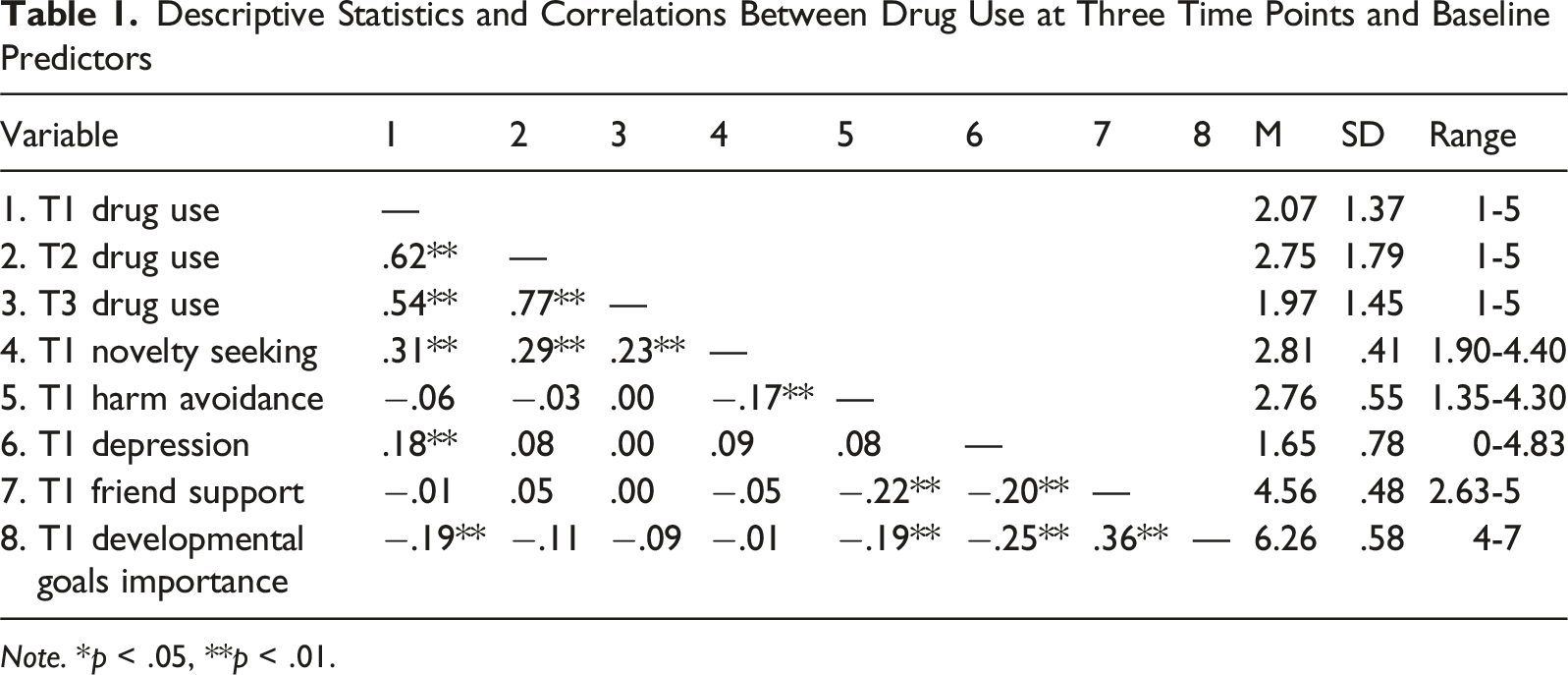
Note. *p < .05, **p < .01.
Trajectories of Drug Use
To explore patterns of change in drug use over time, we conducted a series of mixture analyses in Mplus to identify latent trajectories of use. Due to sample size limitations, we tested two-, three-, and four-class solutions. While models with more classes often yield better statistical fit, we prioritized parsimony and interpretability. Model selection was guided by the Vuong-Lo-Mendell-Rubin likelihood ratio test (VLMR-LRT) and the Lo-Mendell-Rubin adjusted likelihood ratio test (LMR-LRT), which assess whether a model with k classes fits better than a model with k – 1 classes.
Model Fit Indices for Latent Class Solutions of Drug Use before, During, and after Travel

The first class, termed “Stable Low”, represented approximately half of the sample (n = 94; 48.4%) and included participants with consistently low levels of drug use across all three time points (MT1 = 0.38, MT2 = 0.52, MT3 = 0.17). The second class, labeled “Experimental Increasing”, included about one-quarter of the sample (n = 55; 28.4%) and showed a transient spike in drug use during the trip (MT1 = 1.15, MT2 = 2.02, MT3 = 0.77), with levels returning to near-baseline post-trip. The third class, called “Consistently High”, comprised the remaining participants (n = 45; 23.2%) and showed elevated levels of drug use throughout the study period, with a notable increase during the trip (MT1 = 2.52, MT2 = 4.25, MT3 = 2.64). These trajectories are illustrated in Figure 1. Substance Use Trajectory Groups Identified Through Latent Class Analysis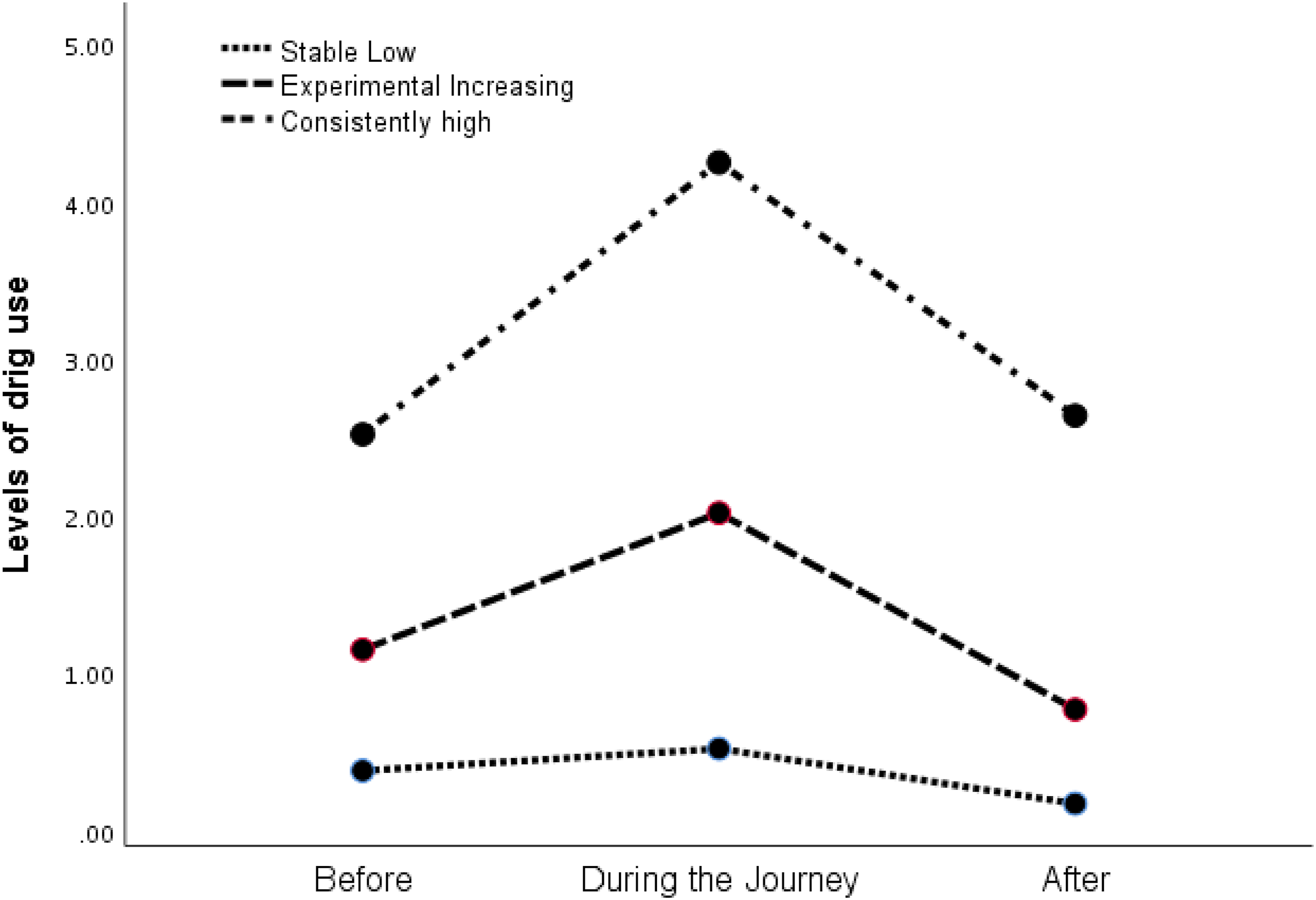
Although the rise in drug use during the trip was primarily attributable to increased cannabis use, the Consistently High group also showed increased use of other drugs. Compared to participants in the other trajectories, those in the Consistently High group significantly increased their use of cocaine during the trip, χ2 (8, N = 195) = 29.03, p < .001. They also demonstrated a marginally significant increase in LSD use (p = .059). Cross-tabulations indicated no significant differences in trajectory affiliation by travel destination (South America vs. Southeast Asia).
Antecedents of Drug Use Trajectories
To identify predictors of trajectory membership, a multinomial regression analysis was conducted, comparing each trajectory to the Stable Low reference group. Predictor variables included baseline levels of novelty seeking, harm avoidance, depressive symptoms, and importance assigned to developmental goals. Given the known influence of peer dynamics on drug use, friend support was entered as a control variable.
Predictors of Substance Use Trajectory Membership: Multinomial Regression Results (Relative to the Stable Low Group)
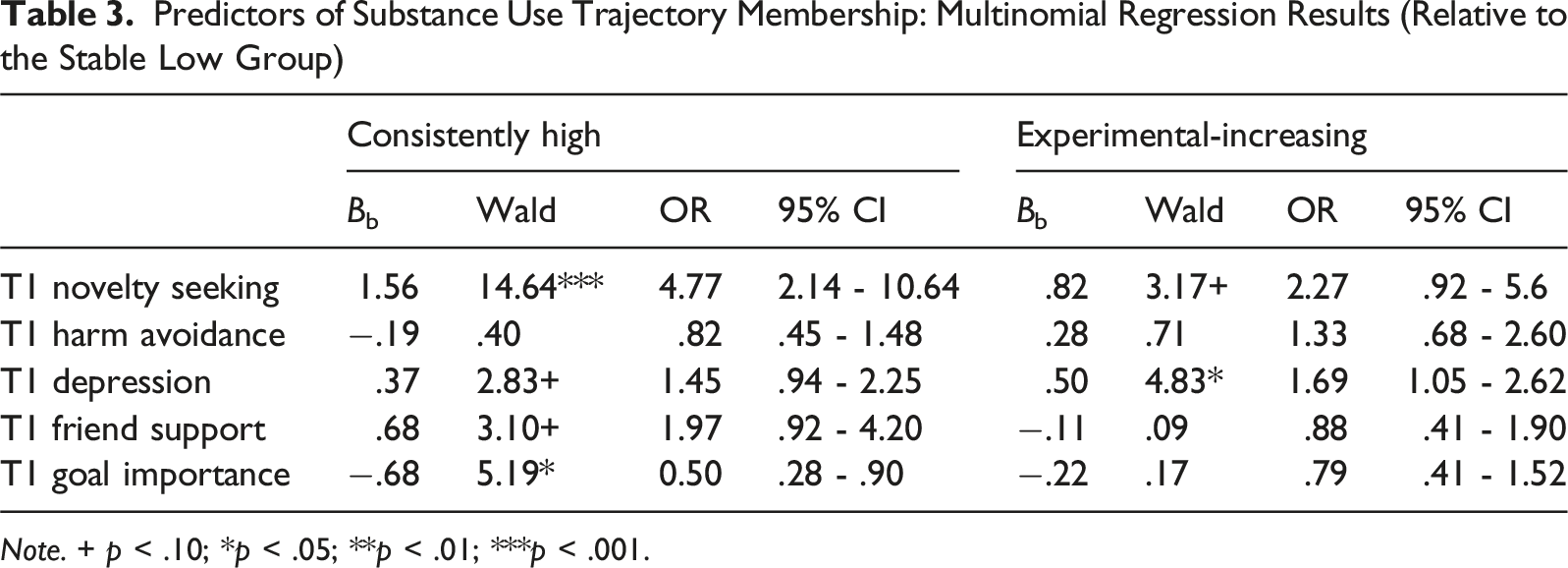
Note. + p < .10; *p < .05; **p < .01; ***p < .001.
Discussion
The backpacking experience for young adults has often been seen as a time for both adventure and risk-taking (Bellis et al., 2007; Bonny-Noach, 2018; Elsrud, 2001), as well as a time for positive exploration and preparation for future development (Hellum, 2010; Maoz, 2007). However, beyond its personal significance, backpacking must also be recognized as a context of concern: a setting marked by limited regulatory oversight, high drug availability, and minimal social accountability, particularly in travel to popular low- and middle-income countries. It remains unclear for whom the extended journey (Shulman et al., 2006) may involve a significant increase in drug use, with potential continuation after returning home. The current study followed young backpack travellers before, during, and after their journeys and found substantial variation in responses related to drug use.
Three distinct trajectories emerged. Approximately half of the participants reported minimal drug use prior to departure, and this remained consistent during and after the trip, forming the Stable Low trajectory. Another group showed low pre-journey drug use, a rise in use during the journey, and a return to low levels upon returning, referred to as the Experimental Increasing group. A third trajectory, labeled Consistently High, consisted of individuals who reported higher levels of drug use before the journey and who showed a significant increase in drug use during travel. Earlier studies have reported cannabis use trajectories in adolescents and young adults in both community and clinical samples (Kosty et al., 2017; Scholes-Balog et al., 2016; Walton et al., 2017). Scholes-Balog et al. (2016), in a longitudinal study of Australian youth from adolescence into young adulthood, found three trajectories resembling those in the current study: abstainers, late-onset moderate users, and early-onset high users. Although the patterns and proportions are similar, it is important to note the differences. Scholes-Balog et al. (2016) followed adolescents aged 12 to 19, capturing developmental changes within a familiar environment. In contrast, the current study focused on responses to a time-limited exposure to a permissive and unfamiliar drug environment and assessed changes within approximately one year.
Transitions such as entering college show similar trends. The college setting often involves increased access to peers and drugs, with drug use frequently normalized (Arria et al., 2013). Derefinko et al. (2016) described three main trajectories in their study of drug use from adolescence through college: abstainers, experimenters who increased and then decreased use, and consistent heavy users who escalated further. Across contexts, exposure to drug-permissive environments tends to yield these three broad patterns. The majority remain abstinent, unaffected by the context. In contrast, individuals already engaging in drug use are likely to increase use when exposed to permissive settings. A third group may begin experimenting during exposure but reduce use upon returning to a less permissive environment. These findings contribute to a broader understanding of how environmental contexts influence drug use during emerging adulthood.
The current study also explored factors that help explain affiliation with each trajectory. As hypothesized, drug use trajectories were linked to personality traits, emotional state, and developmental motivation. Individuals in the Consistently High group reported higher novelty seeking and lower commitment to age-relevant developmental goals. This suggests that individuals with higher impulsivity and limited internal direction may be more susceptible to increasing drug use when it becomes available. This group also reported use of illicit drugs that were less common in the cohort, such as cocaine, in addition to cannabis. The Experimental Increasing group followed a different path. These individuals reported little drug use prior to travel but elevated depressive symptoms. The temporary increase in drug use during travel may reflect an effort to manage emotional discomfort in an unfamiliar setting, consistent with the self-medication hypothesis (Audrain-McGovern et al., 2009). Once the journey ended and individuals returned to their routines, drug use declined. This emphasizes the influence of the travel environment in triggering, but not necessarily sustaining, drug use (Derefinko et al., 2016). The largest group, Stable Low, maintained low levels of drug use across all time points. This aligns with findings from Howard et al. (2010), who showed that not all emerging adults engage in risky behaviours, even during periods of transition. This group may represent individuals whose travel experience is oriented toward exploration and enrichment that does not involve drug use. Their personal growth occurs without reliance on external stimulation or drugs.
Contrary to expectations, harm avoidance was not related to trajectory affiliation. This differs from earlier findings suggesting that high harm avoidance might reduce or increase risk behaviour depending on context (Etter, 2010). The developmental stage of emerging adulthood may involve reduced levels of cautiousness. Additionally, the “holiday” atmosphere associated with backpacking may suppress typical harm-avoidant tendencies (Wills et al., 1994). Future studies should examine the role of harm avoidance in different settings and cultures.
These findings carry implications for both public health policy and harm reduction efforts. Travel clinics and pre-departure programs should consider incorporating substance use risk screening and brief psychoeducation, particularly for individuals with high novelty seeking or emotional vulnerability (Angelo et al., 2024). Outreach initiatives could also partner with youth-serving organizations to develop materials specific to backpacking and long-term travel contexts. Sending countries should prepare for reintegration challenges among returning travelers, including the possibility of sustained drug use and related mental health needs (Bonny-Noach & Sagiv-Alayoff, 2017). Receiving countries, meanwhile, bear the immediate burden of increased emergency medical visits, enforcement challenges, and community disruption linked to tourist drug use (European Monitoring Centre for Drugs and Drug Addiction EMCDDA, 2012). Bilateral collaboration around harm reduction messaging, monitoring, and legal alignment could help protect young travelers’ health and reduce medical and social burdens.
Despite several strengths, this study has limitations. First, backpacking is a specific and culturally bounded experience, and the findings may not generalize to other transitions such as college entry or job training. Because the sample consisted of Israeli young adults with a relatively homogenous background, we were unable to examine potential differences in drug use trajectories by characteristics such as age, race/ethnicity, or cultural context. Future studies should examine whether these trajectories differ across more diverse populations, where demographic and identity characteristics may play a greater role in shaping drug use experiences during travel. Second, drug use during the trip was reported retrospectively. Limited internet access during travel made real-time reporting difficult and may have introduced recall bias. Third, although the study described the permissive drug environment of backpacking destinations, it did not include direct measures of peer influence. Future studies could benefit from tracking real-time social influences, such as group dynamics, group norms, and travel companionship, which can significantly influence drug-related decisions while traveling. Additionally, the use of qualitative methods could enrich our understanding of the travel experience. Despite these limitations, the findings highlight that emerging adults respond differently to new and permissive environments. For some, drug use remains minimal regardless of context. Others may escalate use depending on internal tendencies such as novelty seeking or emotional vulnerabilities such as depression.
Conclusion
This study highlights the diverse ways emerging adults respond to the backpacking experience in terms of drug use. Three distinct trajectories, Stable Low, Experimental Increasing, and Consistently High, reflect the influence of individual traits and motivations on illicit drug use patterns in permissive environments. While many young adults maintain low levels of drug use throughout their journey, others are more vulnerable to increases due to higher novelty seeking, elevated depressive symptoms, or weaker developmental goal orientation. These findings underscore the need to consider personality and emotional factors when assessing risk for drug use during transitional life experiences. They also emphasize the temporary nature of increased use for some individuals, pointing to the role of environmental context. Prevention and intervention strategies targeting young adults should account for these variations, offering support tailored to personal risk profiles and emotional needs, especially during periods of increased freedom, exploration, and exposure to permissive norms.
Footnotes

Consent to Participate
All participants provided written informed consent prior to enrollment in the study, in accordance with the ethical regulations approved by the Institutional Review Board of Bar-Ilan University.
Funding
The authors disclosed receipt of the following financial support for the research, authorship, and/or publication of this article: This research was supported by a grant from the Israel Anti-Drug and Alcohol Authority.
Declaration of Conflicting Interests
The authors declared no potential conflicts of interest with respect to the research, authorship, and/or publication of this article.
Data Availability Statement
Due to restrictions imposed by the Institutional Review Board, the data underlying this study cannot be made publicly available. However, data may be made available upon reasonable request to the corresponding author, subject to ethical approval.