



Abstract
Introduction
There is a gap in knowledge regarding how contextual or cultural factors (e.g., immigration stress) might influence alcohol consumption among high-risk populations such as Latinos. Of the various cultural factors to consider when understanding alcohol use among US-born Latinos, immigration-related stressors may distinctly influence alcohol use and its consequences. US-born Latinos with immigrant relatives in the US may be exposed to specific types of immigration stressors (e.g., stress stemming from having a parent or family member deported) that increase their likelihood of developing problematic drinking behaviors. For example, a recent study conducted by Pinedo et al. (2022) found that, among US-born Latinos, having a parent deported when they were a minor significantly increased odds of engaging in hazardous drinking (i.e., quantity or pattern of alcohol consumption that places patients at risk for adverse health events), as compared to US-born Latinos who were never separated from their parents as minors because of immigration issues. Parental and family deportations may also be drivers of alcohol-related racial/ethnic disparities (Pinedo, 2020).
While the prevalence of alcohol use among adult Latino populations may be similar to the national average, national surveys indicate that Latino 12th graders (17–18 years) report higher rates of daily alcohol use and binge drinking compared to non-Latino Whites (Miech et al., 2023). This is particularly important among Latinos as early initiation of alcohol use is a critical precursor to developing alcoholism during adulthood (DeWit et al., 2000; Liang & Chikritzhs, 2015; Marel et al., 2019; McGue & Iacono, 2005; Newton-Howes & Boden, 2016). Further, research has indicated that, when compared to other racial/ethnic groups, Latinos are disproportionally impacted by alcohol problems (Vaeth et al., 2017), less likely to seek treatment services (Pinedo, 2019), and at greater risk for high-volume drinking, negative social and legal consequences of drinking (Mulia et al., 2009; Witbrodt et al., 2014), alcohol-related injuries and accidents (Mulia & Zemore, 2012), and alcohol-related morbidity and mortality (Chartier & Caetano, 2010). The health disparity regarding access to treatment among Latinos makes it crucial to study how patterns of alcohol use may have been exacerbated during the COVID-19 pandemic to inform future prevention and treatment efforts. In a study conducted among a sample of young adults who utilized primary care, the pre-and post-COVID-19 onset periods found that the prevalence of unhealthy alcohol use increased among Latino patients by 7% (Metz et al., 2022). Furthermore, another study conducted by Barbosa et al. (2021) found that, during the pandemic, among US-born Latino participants, (a) the total number of drinks, (b) the proportion who exceeded drinking guidelines, and (c) the proportions who engaged in binge drinking significantly increased within a two-month period (between February and April 2020). Despite recent efforts to comprehend patterns of alcohol use during the pandemic, more information is needed to understand compounding effects regarding stressors and motives on alcohol use among Latinos who drink and engage in such behavior, particularly long-term impacts of COVID-19 on drinking.
Research studies have linked drinking motives as one of the most robust and proximal determinants of alcohol use and misuse (Cooper et al., 2016). Current conceptualizations of motivations to drink come from distinct motives (a) drinking for enhancement (i.e., positive valence and internal source), and (b) drinking to cope (i.e., negative valence and internal source). Recent studies have examined drinking motives during the pandemic and found associations between coping motivations with frequency and increases in past-30-day alcohol use (Prestigiacomo et al., 2021). However, there is a lack of evidence on how drinking motives are associated with alcohol use behaviors among US-born Latinos, and how stressors, such as the COVID-19 pandemic, in addition to immigration stress might interact with this association. To better understand this association, our research group studied US-born Latino populations in terms of (a) their documented liberal attitudes toward alcohol use–mainly in Mexican Americans (Caetano, 1988), and (b) their high levels of experienced stress before, during and after the COVID-19 pandemic due to the loss of family members and reduction of income and work (Keeney et al., 2022). Exploring the social, political and individual determinants of alcohol use and misuse in high-risk subgroups (i.e., drinkers and hazardous drinkers) could help to elucidate the most indispensable prevention and treatment strategies to reverse the growing alcohol-attributable burden after the pandemic that might be coming in the following years in terms of premature death and disability (Stockwell et al., 2021).
Syndemic Theory
To further explore the social, political, and individual determinants of alcohol use among US-born Latinos we apply a syndemic framework to guide the present study. Proposed by Singer (2000), the theory of syndemics describes groups of epidemics that arise from, and interact with, harmful social conditions (e.g., interaction between alcohol use and stressors), drawing attention to the mechanisms of such interactions (Rudd et al., 2022). Using a syndemic framework can improve our understanding of complex factors associated with severe health conditions within a specific population during a very stressful time period. For example, the relationship between COVID-19 stress and immigration-related stress for US-born Latinos, and increased alcohol use presents considerations of a syndemic scenario. The relationship between alcohol use among US-born Latinos and various stressors is multifaceted, and factors such as the COVID-19 pandemic, immigration stress, sociodemographic conditions, and drinking motives all contribute and may compound the negative effects of alcohol use within this population.
The Present Study
The present study aimed to investigate factors associated with increased alcohol use during the COVID-19 pandemic among US-born Latino adults, including both drinkers and hazardous drinkers. This population, comprising self-identified Latino adults born in the US, faces significant challenges influenced by cultural and sociocultural factors (Gallo et al., 2009, 2014; Mendoza, 2009). These challenges contribute to elevated rates of alcohol use, including hazardous drinking behaviors that may have origins in increased alcohol use (De La Rosa et al., 2012). Economic instability and limited access to healthcare services, compounded by immigration-related stress, further exacerbate these disparities (Castañeda et al., 2019). Conducted in 2021, the study utilized a cross-sectional design to examine the pandemic’s impact on alcohol consumption one year into the crisis, addressing the following primary research questions: 1. Among a sample of US-born Latinos adult drinkers and hazardous drinkers living in the US, what is the adverse COVID-19-related impact on increased alcohol use during the pandemic? 2. Are selected sociodemographic characteristics, motivations to drink (i.e., drinking for enhancement and drinking to cope) and immigration-related stressors associated with increased alcohol use during the pandemic among US-born Latinos? 3. Does the relation between increased alcohol use during the pandemic and motivations to drink differ in terms of levels of adverse COVID-19-related impacts?
Methods
Study Design & Participants
Data for this study were collected through a nationally representative online survey conducted in September 2021, targeting U.S.-born Latino adults for participation in a structured questionnaire. Participants were recruited through Qualtrics web-panel, which is comprised of participants who have already agreed to take part in survey research. The inclusion criteria for this study included: (1) self-identifying as Latino; (2) being born in the US; and (3) being 18 years or older. Initially, interested individuals completed a brief self-administered screening questionnaire (∼1 minute) to determine eligibility. This screening assessed characteristics including biological sex, age, race/ethnicity, and U.S. birthplace. Those who met the eligibility criteria were then invited to complete the full online structured survey. The structured survey (∼10–15 minutes) included questions regarding socio-demographics, adverse COVID-19 impact, immigration-related stressors, motivations for drinking (i.e., enhancement and coping), and increased alcohol use during the pandemic.
A total of 3482 participants completed the screener questionnaire, and 1784 participants were eligible and completed the online questionnaire. The analytic sample for this study was limited to 1040 participants who reported using alcohol prior to the pandemic. Participants received $5 for their participation in the online survey. All study protocols were approved by The University of Texas at Austin’s Institutional Review Board before the study began.
Measures
Socio-Demographic Characteristics
The overall analysis included and controlled for the following seven socio-demographic variables: age in years, biological sex (male = 1; female = 0), family country of origin (e.g., Mexican, Puerto Rican, Cuban, etc.), having at least one immigrant parent (yes = 1; no = 0), employment status (unemployed = 0; employed = 1), educational attainment (less than high school = 0; graduated high school = 1; some college = 2; graduated college or higher = 3), and total annual household income (less than $20,000 = 0, $20,000–$34,999 = 1; $35,000–$49,999 = 2; $50,000–74,999 = 3; $75,000–$99,999 = 4; $100,000 or above = 5).
Immigration- Related Stressors
Immigration-related questions included a total of 14 check list items on diverse topics. Our research team developed these questions, which were informed by past qualitative work identifying specific immigration-related stressors linked to poor mental health and substance misuse among US-born Latinos (Pinedo et al., 2021). Participants were asked about different topic areas such as immigration-related fears (e.g., being detained for immigration reasons or having a parent deported), perception of state policies (e.g., participants’ policies perception as hostile or unfavorable towards immigrants), and anti-immigration experiences (such as being told to “go back to your country”). All response options were coded 1 (yes) and 0 (no). We created an immigration-related stressor index by creating an ordinal variable to account for how many immigration-related stressors participants reported experiencing (None = 0; 1–2 = 1; 3–4 = 3; 5–6; = 4; 7–8 = 5; and 9 or more = 6. This variable was constructed to assess the extent to which experiencing a greater number of immigration-related stressors is associated with increased likelihood of substance misuse and has been previously associated with alcohol misuse (Pinedo et al., 2022). Since the immigration-related questions were structured as binary checklist items (1 = yes, 0 = no), there was no need to calculate Cronbach’s alpha. This type of measure assesses individual responses rather than evaluating internal consistency across multiple items, as typically done with scales comprising multiple Likert-type items.
COVID-19 Impact
We assessed participants COVID-19 related impact by asking participants eight items referring to what extent the ongoing COVID-19 pandemic had negatively impacted their (1) emotional and mental health, (2) ability to access healthy food, (3) ability to pay for medical care, including prescriptions, (4) use of alcohol or drug treatment services, (5) transportation needs, (6) ability to maintain their job, (7) ability to pay bills, and (8) ability to pay their rent or mortgage. All items represented objective and potentially verifiable experiences. Participants rated their perception of the impact of COVID-19 on a 4-point scale (e.g., not at all = 1; just a little = 2; some = 3; a lot = 4). The Cronbach’s alpha for this measure was .92 prior to creating latent classes.
Drinking Motives
To assess motivations to drink we used an adapted and shorten version of the Drinking Motive Questionnaire Revised (DMQ–R; Cooper, 1994). Participants were given a list of 11 items representing common reasons people might be inclined to drink alcoholic beverages (e.g., “to forget your worries”). We introduced a new item (i.e., item 11) to understand drinking motives specifically associated to the COVID pandemic (e.g., “to cope with stress and/or anxiety related to COVID”). Participants were asked to rate their drinking motives on a 4-point scale (never or almost never = 1; some of the time = 2; half of the time = 3, and always or almost always = 4). A factorial analysis was conducted on these items, which resulted in two factors. Items were included in the factor if their loading on the factor exceeded 1. Factor 1 included items 1–8, and 10 and was called “enhancement drinking motivation” (alpha = .91) while Factor 2 involved items 9 and 11 and was called “coping drinking motivation” (alpha = .77).
Increased Alcohol Use During the Pandemic
For the dependent variable, we assessed increases in alcohol use during the pandemic by asking participants a question regarding changes in their consumption (e.g., “since the COVID-19 pandemic, how has your drinking changed?”). Participants were provided five different response options from which they identified and chose the one that better represented their change in alcohol use (No change = 1; I drink a little more = 2; I drink a lot more = 3; I drink a little less = 4; I drink a lot less = 5). Response options representing an increase in alcohol use were recoded as 1 (yes), while response options representing no changes or decreases in alcohol use were recoded as 0 (no).
Data Analysis
A latent profile analysis (LPA) was conducted to determine COVID-19 related impact groups or clusters of participants as defined by emotional, economical and health-related situations (e.g., “to what extent do you feel the ongoing COVID-19 pandemic has negatively impacted your emotional and mental health?”). As a first step, we conducted a series of LPAs and identified models consisting of between 1 and 6 classes using Mplus Version 8 (Muthén & Muthén, 2011). Entropy, Bayesian Information Criteria (BIC), and sample size adjusted BIC (SSABIC) values; and the sample size-adjusted Lo-Mendell-Rubin likelihood ratio test (LMR-LRT; Lo et al., 2001) and bootstrap likelihood ratio test (BLRT; Nylund et al., 2007) were used to select the best fitting model across the varying number of classes. Entropy values of at least .80, lower BIC and SSABIC values, and statistically significant (p < .001) LMR-LRT and BLRT results are all indicative of better model fit to the data (Nylund et al., 2007; Ram & Grimm, 2009). Plots of factor mean estimates for each profile solution were also assessed for interpretability. Importantly, in addition to these quantitative criteria, we also considered parsimony and substantive interpretability of each latent class solution as key criteria for selecting the final class model. After conducting a latent profile analysis, participants were characterized into three classes (i.e., groups) related to negative COVID-19 impact: (1) low, (2) medium, and (3) high (See Table S1 for more information about the different class solutions fit indices and participants’ distributions).
Our primary analysis consisted in a five-stage hierarchical multiple logistic regression with increased alcohol use as the outcome variable using STATA 17 (Statacorp, 2021). We analyzed the association between increased alcohol use during the pandemic and COVID-19 related impact, while gradually controlling for a series of key variables. As a first step, we fitted a logistic regression by including only the socio-demographic variables as covariates (i.e., Model 1). Second, in addition to the control variables added in Model 1, we included our COVID-19 impact variable (i.e., Model 2). Third, we added the immigration stress variable (i.e., Model 3). Drinking motives (i.e., drinking for enhancement and drinking to cope) were included as part of our fourth step (i.e., Model 4). We finally explored the interaction between COVID-19 impact and drinking motives as the final step (i.e., Model 5). As an exploratory analysis, we examined the same associations evaluated in the more saturated model (i.e., Model 5) among hazardous drinkers only (i.e., Model 6–10). We identified hazardous drinkers using the Alcohol Use Disorder Identification Test-Concise (AUDIT-C; Bush et al., 1998). We used three items to assess the past year (1) frequency of drinking, (2) quantity of drinks consumed on a typical day when they drink, and (3) how often they consume six or more drinks in one occasion. We scored and summed all items’ response options (total score range from 0 to 12). Females with a score of 3 or more and males with a score of 4 or more were considered hazardous drinkers or at risk of drinking (n = 752) and were included as a subgroup for our exploratory analysis (Frank et al., 2008). We report adjusted odds ratios (AOR) and 95% confidence intervals (95% CI) from the logistic regression results.
Results
Descriptive Statistics for Study Variables (N = 1040).
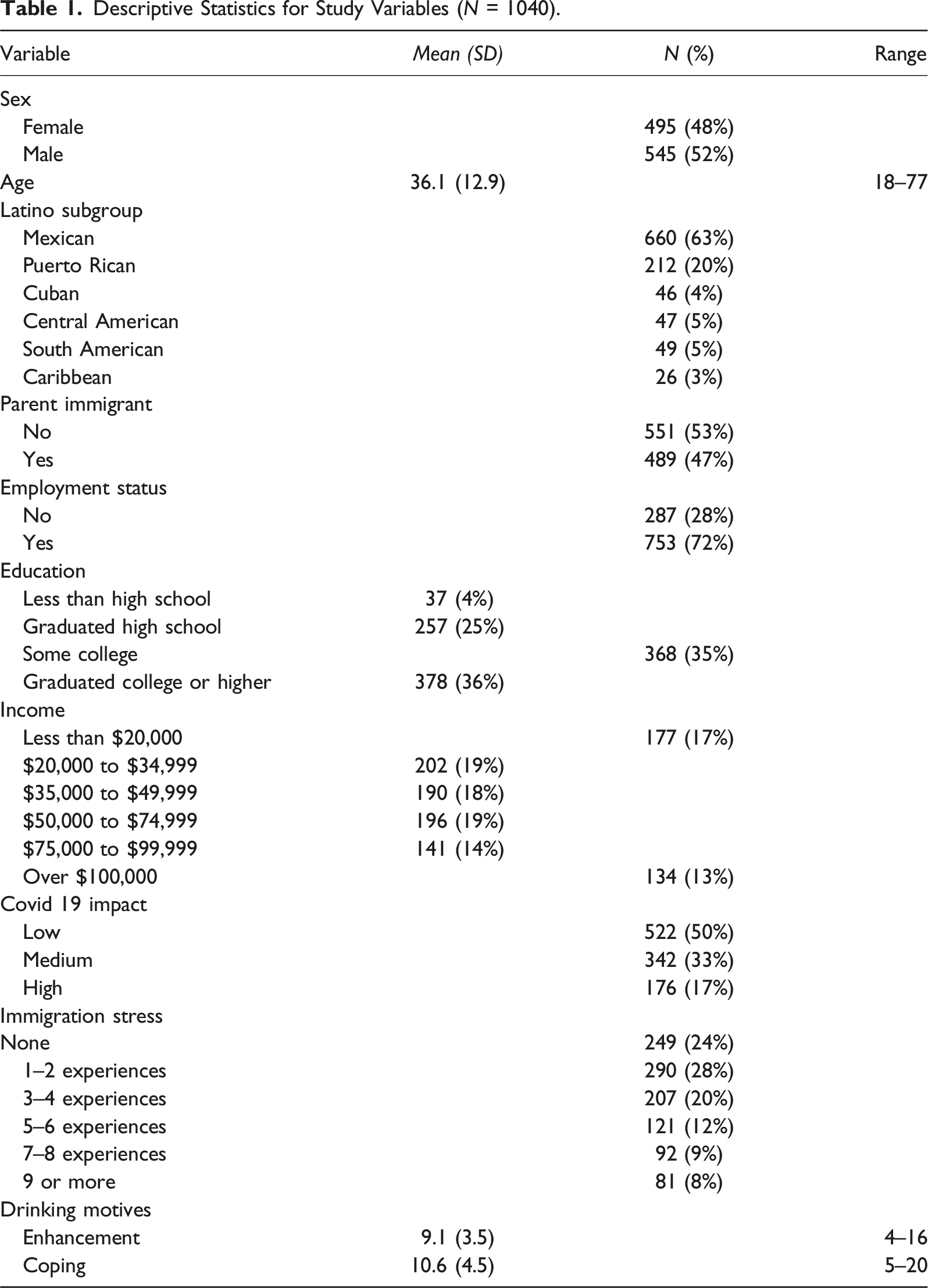
On average, respondents were 36 years old, more than half were employed (72%), about half of the sample reported having at least one immigrant parent (47%), and 96% had at least a high school education. Only a small percentage (17%) reported earning less than $20,000 annual household income. Within the context of COVID-19 impact, 17% were highly impacted (n = 176) or mediumly impacted (33%, n = 342) by COVID-19, whereas the remaining half experienced low impact (50%, n = 522) from COVID-19. Within the context of immigration-related stress, the majority of the sample (28%, n = 290) reported having 1–2 experiences. (20%, n = 207) reported having 3–4 experiences related to immigration stress, (12%, n = 121) reported having 5–6 experiences, (9%, n = 92) reported having 7–8 experiences, and (8%, n = 81) had 9 or more experiences related to immigration stress. With regard to drinking motives, the mean drinking for enhancement score for participants was 9.1 (standard deviation [SD]: 3.5, Range: 4–16) and the mean drinking to cope score for participants was 10.6 (SD: 4.55; Range: 5–20).
Primary Analysis–Factors Associated With Increased Alcohol Use
Hierarchical Logistic Regression for Changes in Alcohol Consumption (N = 1040).
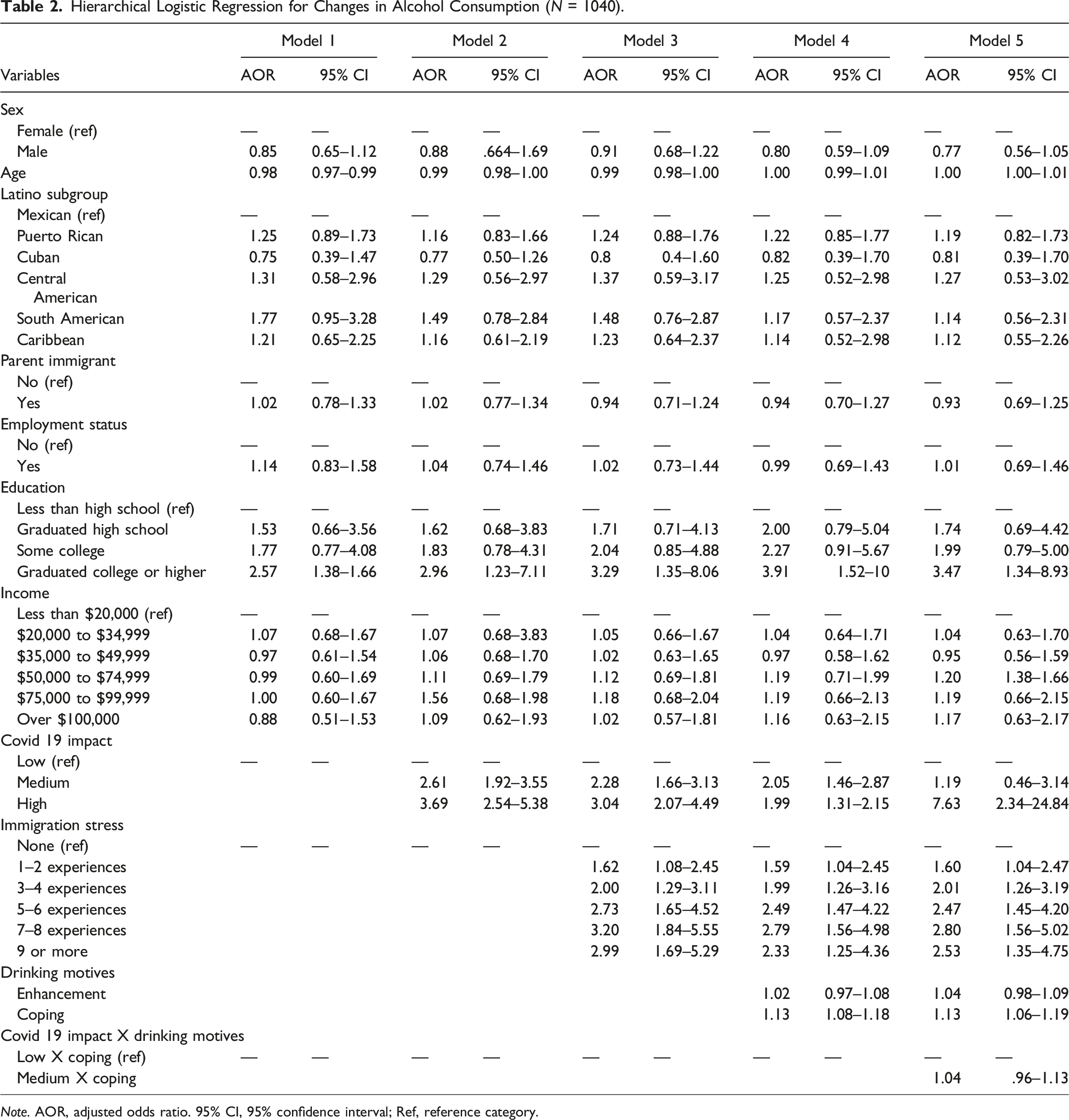
Note. AOR, adjusted odds ratio. 95% CI, 95% confidence interval; Ref, reference category.
Regarding our drinking motives variable, the full model suggests that drinking to cope was significantly associated with increased alcohol use (AOR: 1.13, 95 % CI: 1.06–1.19), but drinking for enhancement was not. Finally, results from Model 5 of the analysis, which included the interaction between our COVID-19 impact and drinking motives variables, increased alcohol use was 10% less among individuals that were highly impacted by COVID-19 and drinking to cope at the same time (AOR: 0.90, 95% CI: 0.82–0.98). Increased alcohol use was not found significant for individuals that were moderately impacted and who expressed an enhancement motivation to drink. Notably, drinking to cope, immigration stress, and individuals who reported graduating from college or higher remained significantly associated with alcohol use throughout all models.
Secondary Analysis– Hazardous Drinkers Only
A secondary analysis was conducted among hazardous drinkers only based on the most saturated model fitted for the entire sample (i.e., Model 5). Table S2 displays the results of the regression analysis in four models (Models 6–10). Similarly, among hazardous drinkers, the odds of reporting an increase in alcohol use in the pandemic were about four times greater among participants with a college degree compared to those who did not graduate from high school (AOR: 4.09, 95% CI: 1.44–11.65). Further, the likelihood of reporting an increase on alcohol use among hazardous drinkers was greater among participants who (a) were highly impacted by COVID-19 (AOR: 6.40, 95% CI: 1.53–26.77), (b) (d) participants who drank to cope (AOR: 1.09, 95% CI: 1.03.–1.15). However, we did not find any significant interaction between COVID-19 impact and drinking to cope. Finally, no significant associations were found among other socio-demographics and individuals who reported drinking for enhancement.
Discussion
The present study investigated factors associated with increased alcohol use among a sample of US-born Latino drinkers and hazardous drinkers. Overall, findings suggest that: (1) participants who reported being highly impacted by COVID-19 were more likely to report increases in alcohol use, (2) participants who reported experiencing a greater number of immigration-related stressors showed greater odds of increased alcohol use during the pandemic, and (3) drinking to cope appeared to be positively associated with increased alcohol use among Latinos. Finally, results suggest that among those participants who use alcohol to manage stress, COVID-19 impact does not moderate their drinking habits except in hazardous drinkers, who experienced a small buffering effect when the pandemic impact was perceived as high. Our findings indicate that alcohol use among Latinos varies by factors such as level of education, income, immigration-related stress, COVID-19 related stress, and drinking motives.
Alcohol use is consistently higher among second-generation Latinos than among their first-generation counterparts (Wahl & Eitle, 2010). More research, with enough statistical power, contrasting specific Latino subgroups (e.g., Cubans or Venezuelans) against Mexican-origin Latinos should be conducted to understand patterns of alcohol use during human eco-developmental disruptions such as pandemics and or natural disasters. Regarding educational levels, we found that participants who reported having a college degree or more, were more likely to report increasing their alcohol use during the pandemic than those who never graduated from high school. This may be the result of greater access to alcohol due to higher income that allowed participants to order alcohol-related products online during the lockdown. The significant effect we observed when comparing participants with salaries between $50,000–$75,000 per year to those with less than $20,000 per year could support this hypothesis and opens the door to conduct more research in specific socioeconomic subgroups of the population that might be more vulnerable in such highly stressful situations.
Our findings on immigration-related stress indicated that participants who reported having greater amounts of stressful experiences were more likely to increase their alcohol use during the pandemic. These results are consistent with previous studies which found that immigration-related stress is strongly associated with various substance use behaviors. For example, in a study conducted by Cano et al. (2017), researchers discovered that among a sample of Latinos residing in Miami-Dade County, immigration-related stress was significantly associated with increased severity of alcohol use. Other research on cultural stressors and alcohol use among Latinos have shown that Latino men with are at increased risk for unhealthy alcohol use and related consequences due to social stressors associated with immigration (Torres et al., 2022). Our findings raise intriguing questions regarding the future implications of the adverse impact of immigration-related stress and drinking behaviors among Latinos. Although we did not find any gender effects, more research should be conducted to understand how gender and immigration-stressors effect alcohol use in the context of severe public health conditions.
Participants in the medium and high adverse COVID-19 impact classes reported higher odds of increasing their alcohol use. This could be because the pandemic has presented serious problems for individuals and consequently, caused a lot of stress. In a study conducted by Kyaw Hla et al. (2022) the authors described that several studies have found that people often resort to harmful coping mechanisms during an acute stressful period, notably by increasing alcohol and other drug use. Additionally, our findings align with previous research on alcohol consumption during the COVID-19 pandemic among drinkers (Biddle et al., 2020; Chodkiewicz et al., 2020; Kilian et al., 2022; Koopmann et al., 2020). However, since these studies were conducted in Europe, there is a clear need for further research to compare our results with future studies involving U.S.-born Latino drinkers.
Our drinking to cope variable indicated significant associations with increased alcohol use throughout all stages of the analysis. A possible explanation for these results might be that drinking to cope is related to how one may manage immigration-related stressors. Another possible explanation for this might be that individuals endorsed drinking to cope to manage stressors stemming from adverse consequences resulting from the pandemic. There is limited knowledge on drinking motivations among Latino populations during COVID-19 and in the context of other severe public health conditions. Other studies have found differences in unhealthy drinking patterns between non-Latino Whites and Latinos (Ríos-Bedoya & Freile-Salinas, 2014).
When analyzing the interaction between our COVID-19 impact and drinking motives variables, the likelihood of increased alcohol use decreased among individuals that were highly impacted by COVID-19 and drinking to cope at the same time. In contrast to the findings of our primary analysis, we did not find any significant interaction between COVID-19 impact and drinking to cope among our hazardous drinkers’ sample. A possible explanation for this finding is that participants in this sample were already regular drinkers, therefore their drinking might not have been affected substantially by the pandemic.
There are some limitations in this study. First, participants were recruited through online web-panels, which may have introduced sampling bias. The online nature of the study may have required higher levels of reading and digital proficiency, resulting in the overrepresentation of higher educated participants. Furthermore, our sample of US-born Latinos reported higher educational attainment than the general US-born Latino population: 29% of participants reported graduating from college compared to 20% in the general population. Thus, findings may be biased towards higher educated US-born Latinos (Pinedo et al., 2022). In addition to this, findings may not be generalizable to individuals who do not have access to the Internet and/or who lack digital literacy. Furthermore, the study may contain potential biases. For example, due to the cross-sectional nature of the study, it is subject to temporal bias. Our findings therefore cannot indicate a causal relationship between immigration-related stressors and alcohol use among this population because the study reflects a snapshot in time. Future research may profit from exploring association between the main factors described in this study and increased alcohol use among US-born Latinos over time. Future research should explore how protective factors might moderate the relationships found in the current study, as the omission of protective factors is part of the limitations of the current study.
An additional limitation of the study is that we recruited participants in 2021, which for some might not take into account other periods of the COVID-19 pandemic. However, it’s worth noting that a year into the pandemic was sufficient time to observe significant differences in drinking patterns, as various studies have shown notable changes in alcohol consumption behaviors within similar timeframes during pandemic conditions (Barbosa et al., 2023; Killian et al., 2022; Houston et al., 2024). Additionally, data was gathered from various geographical regions (but not enough power to include as a variable in the study), and certain hotspots across the country may have led to varying experiences with COVID-19. It’s also important to note that some respondents may have underreported their drinking due to poor recall or because they didn’t want to appear like they have a drinking problem, which makes this study subject to recall bias and/or social desirability bias. Despite these limitations, the survey in this study was anonymous and self-administered online, which likely reduced these biases.
Conclusion
This study can be seen as a step towards developing insight into potential risk factors for alcohol abuse among U.S.-born Latinos. Future research on alcohol use behaviors among US-born Latinos presents both challenges and opportunities with data limitations. Research opportunities might focus on alcohol-related disparities between Latino subgroups. It’s important to understand these disparities in order to provide a deeper knowledge of trends in drinking patterns among different groups. The present study enhances our understanding of the relationship between alcohol use, immigration-related stressors, and coping motives among US-born Latinos.
Supplemental Material
Supplemental Material - The Association Between Immigration-Related Stress, COVID-19 Impact, and Drinking Motives Among US-Born Latinos During the Pandemic
Supplemental Material for The Association Between Immigration-Related Stress, COVID-19 Impact, and Drinking Motives Among US-Born Latinos During the Pandemic by Gabrielle Scott, Pablo Montero-Zamora, Christian E. Vazquez, and Miguel Pinedo in Journal of Drug Issues
Footnotes
Author Contributions
Conceptualization, GS, PMZ, CV and MP; methodology, MP, PMZ and GS; validation, MP; formal analysis, GS and PMZ; investigation, MP; resources, MP; data curation, CEV, PMZ, and MP; writing—original draft preparation, CEV, GS, and PMZ; writing—review and editing, CEV and MP; supervision, PMZ, CEV and MP; project administration, MP; funding acquisition, MP. All authors have read and agreed to the published version of the manuscript.
Declaration of Conflicting Interests
The author(s) declared no potential conflicts of interest with respect to the research, authorship, and/or publication of this article.
Funding
The author(s) disclosed receipt of the following financial support for the research, authorship, and/or publication of this article: This work was supported in part by the National Institute of Alcohol Abuse and Alcoholism under grant (R01AA027767). The content is solely the responsibility of the authors and does not necessarily represent the official views of the National Institutes of Health.
Correction (October 2024):
This article has been updated to correct the captions for Table 2 and the online supplemental material Table S2 since the original publication.

Supplemental Material
Supplemental material for this article is available online.
Author Biographies
References
Supplementary Material
Please find the following supplemental material available below.
For Open Access articles published under a Creative Commons License, all supplemental material carries the same license as the article it is associated with.
For non-Open Access articles published, all supplemental material carries a non-exclusive license, and permission requests for re-use of supplemental material or any part of supplemental material shall be sent directly to the copyright owner as specified in the copyright notice associated with the article.
