




Abstract
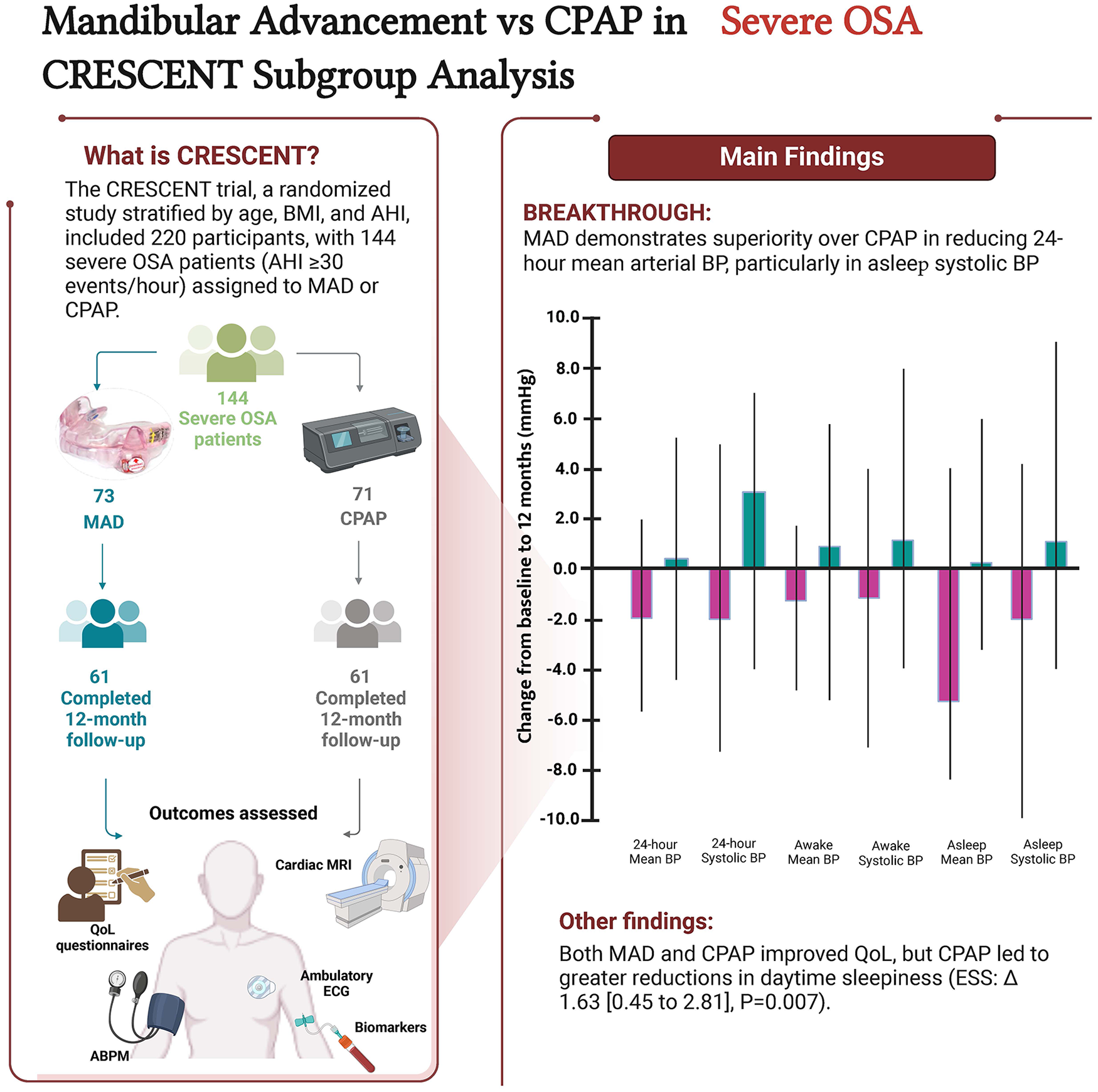
Severe obstructive sleep apnea (OSA) is linked to adverse cardiovascular outcomes. While continuous positive airway pressure (CPAP) is the standard treatment, mandibular advancement devices (MADs) offer an alternative. This substudy of a randomized trial compared the effectiveness of MADs versus CPAP on 24-h ambulatory blood pressure (BP), sleep-related quality of life, myocardial remodeling, ambulatory heart rhythm, and biomarkers in severe OSA. A total of 144 participants were randomized to MAD (n = 73) or CPAP (n = 71) for 12 mo. Median nightly usage was 5.4 (2.9–6.5) h for the MAD group (≥6 h/night: 56.1%) and 4.9 (4.0–6.0) h for the CPAP group (≥6 h/night: 28.3%). The apnea-hypopnea index at baseline and 6 mo was 44.0 (37.6–59.2) and 20.9 (11.7–31.9) events/h in the MAD group and 50.7 (40.7–59.8) and 2.1 (1.2–3.4) events/h in the CPAP group, respectively. MAD treatment reduced asleep mean BP (−4.7 mm Hg, 95% confidence interval [CI]: −8.3 to −4.0, P = 0.015), asleep systolic BP (−2.0 mm Hg, 95% CI: −10.0 to −4.0, P = 0.047), and asleep diastolic BP (−4.0 mm Hg, 95% CI: −9.0 to −3.0, P = 0.007), whereas CPAP showed no significant changes. The between-group differences favored MAD in asleep mean BP (−3.70 mm Hg, 95% CI: −7.40 to 0.00, P = 0.050) and asleep systolic BP (−4.78 mm Hg, 95% CI: −9.51 to 0.04, P = 0.048). Both improved sleep-related quality of life, although CPAP had a slightly greater effect on the Epworth Sleepiness Scale (Δ1.63, 95% CI: 0.45 to 2.81, P = 0.007). No significant changes were observed in cardiac magnetic resonance imaging parameters, ambulatory heart rhythm, or biomarkers. Adverse effects included jaw pain (14.8%) and teeth discomfort (8.2%) with MAD, whereas CPAP users reported dry mouth (50.8%), nasal congestion (23.0%), and air leakage (29.5%). In conclusion, these findings suggested MAD could be an acceptable and effective treatment for patients with severe OSA and hypertension. The study was registered at Clinicaltrials.gov (NCT04119999).
Keywords
Get full access to this article
View all access options for this article.
References
Supplementary Material
Please find the following supplemental material available below.
For Open Access articles published under a Creative Commons License, all supplemental material carries the same license as the article it is associated with.
For non-Open Access articles published, all supplemental material carries a non-exclusive license, and permission requests for re-use of supplemental material or any part of supplemental material shall be sent directly to the copyright owner as specified in the copyright notice associated with the article.
