




Abstract
This article highlights the transformative initiatives of the Global Consortium of Oral Health Birth Cohort Studies (GLOBICS) as a key response to the call for a global overhaul of the oral health agenda. Recognizing the critical role of birth cohort studies in public health, particularly in understanding the interplay between oral health, noncommunicable diseases (NCDs), and social inequalities, GLOBICS is spearheading efforts that are research driven and focused on translational pathways. GLOBICS is advancing an International Research Agenda with 8 key priorities aimed at addressing the most pressing questions in oral health research. These priorities shall guide pooled analyses from oral health birth cohort studies (OHBCS) spread across the globe, enabling the consortium to generate robust evidence answering core research questions. One of the major efforts of GLOBICS is data harmonization, which involves standardizing and integrating data from multiple sources to ensure consistency and comparability. This process is vital for generating reliable global insights and fostering collaborations with new research partners. GLOBICS also emphasizes the nurturing of the next generation of OHBCS researchers, ensuring that the field continues to grow and innovate. The consortium’s commitment to disseminating and translating its findings is central to its mission. By supporting the development of clinical practice guidelines, policies, and public health information tailored to the specific contexts of its collaborators, GLOBICS is making strides toward tangible improvements in global oral health. This work is a testament to the power of collaborative research and an invitation for further contributions to this global effort.
How Did the Collaboration Come about?
The Lancet’s series on oral health challenged the traditional model of dentistry, highlighting its shortcomings in tackling the burden of oral diseases and their socioeconomic causes and implications. The series advocated for a comprehensive overhaul of the global oral health agenda, emphasizing the need for collaborative efforts to prevent noncommunicable diseases (NCDs) and combat social inequalities. It provided compelling arguments for prioritizing oral health as a critical component of overall health initiatives (Peres et al. 2019; Watt et al. 2019).
The Lancet series framework emphasizes the significance of early-life exposures in shaping long-term health outcomes (Wagner et al. 2024), particularly NCDs such as oral diseases (Agostini et al. 2019; Manohar et al. 2020). Birth cohort studies, which track individuals from before or shortly after birth throughout their lives, are essential for exploring these effects. They provide unique insights into life course epidemiology by examining how social, biological, behavioral, and psychological factors interact over time to influence disease development and prevention strategies (Lawlor et al. 2009).
More than 120 birth cohort studies with oral health data (OHBCS) from 34 countries across all 6 continents have been documented (Peres et al. 2022). While individual OHBCS have provided critical insights into the causes (Curtis et al. 2018), progression (Broadbent et al. 2006), and prevention (Feldens, Petracco, et al. 2023) of oral diseases, combining data from multiple cohorts offers immense potential to address unresolved research questions. This approach allows for a comprehensive analysis of the interplay between social, environmental, behavioral, psychological, biological, and genetic factors, paving the way for significant advancements in oral health research and the development of strategies to reduce the global burden of oral disease.
In 2019, more than 15 coordinators of the longest-running OHBCS gathered in Bangkok, Thailand, to discuss forming an enduring international collaborative research group (Peres et al. 2020). Establishing a consortium of OHBCS, formalized with the launch of the Global Consortium of OHBCS (GLOBICS) in 2023, marked a strategic step toward advancing the objectives outlined during the Bangkok meeting. This collaboration facilitates rapid, cost-effective progress while maintaining scientific rigor, leveraging existing longitudinal data to drive impactful health outcomes. This article aims to outline the evolution, current initiatives, and future directions of GLOBICS.
Who Is in the Consortium of OHBCS—GLOBICS
In early 2021, Singapore Health Services (SingHealth), the National Dental Research Institute Singapore (the research arm of the National Dental Centre Singapore), Duke-NUS Medical School through its Oral Health Academic Clinical Programme in Singapore, and The Borrow Foundation in the United Kingdom joined forces in a funding agreement to establish GLOBICS. A small group of experienced researchers (Executive Committee) was assembled to guide the project’s development. This committee comprises individuals who are involved in diverse multidisciplinary cohorts and other consortia beyond oral health, a representative of The Borrow Foundation to ensure alignment with the foundation’s objectives and researchers with extensive expertise in statistical and epidemiological methods (Peres et al. 2020). This marked the start of GLOBICS Consortium.
The initial success of the consortium has attracted additional financial support from the National Medical Research Council, Singapore, thus enabling the collaborative network to expand. Figure 1 depicts an overview of the current participating cohorts, featuring renowned OHBCS strategically and geographically distributed, namely, the 2004 Pelotas Birth Cohort Study in Brazil (Tovo-Rodrigues et al. 2024); 2015 Pelotas Birth Cohort Study in Brazil (Hallal et al. 2018; Murray et al. 2024); BRISA São Luís cohorts (newborn and pregnant women cohorts) in Brazil (da Silva et al. 2014); Cambodia Health and Nutrition Monitoring Study (CAHENMS) in Cambodia (Turton et al. 2019); Etude Longitudinale Française depuis l’Enfance Study (ELFE) in France (Charles et al. 2020); German Birth Cohort Study in Germany (Wagner and Heinrich-Weltzien 2017); Iowa Fluoride Study (IFS) in the United States (Levy et al. 2001; Marshall et al. 2003); Maternal and Child Health and Nutrition in Acre, Brazil Birth Cohort Study (MINA–Brazil) in Brazil (Cardoso et al. 2020); Porto Alegre Early Life Nutrition and Health Study in Brazil (Feldens et al. 2021); Promoting infant health and nutrition in Sub-Saharan Africa: Safety and efficacy- Exclusive Breast-Feeding Study (PROMISE-EBF) in Uganda (Birungi et al. 2015); Prospective Cohort Study of Thai Children (PCTC) in Thailand (Nirunsittirat et al. 2016); São Leopoldo Birth Cohort Study in Brazil (Feldens, Braga, et al. 2023); Splash! in Australia (de Silva-Sanigorski et al. 2011); The Generation R Study in the Netherlands (van Meijeren-van Lunteren et al. 2023); and The VicGeneration Study (VicGen) in Australia (Johnson et al. 2017) (Fig. 1).
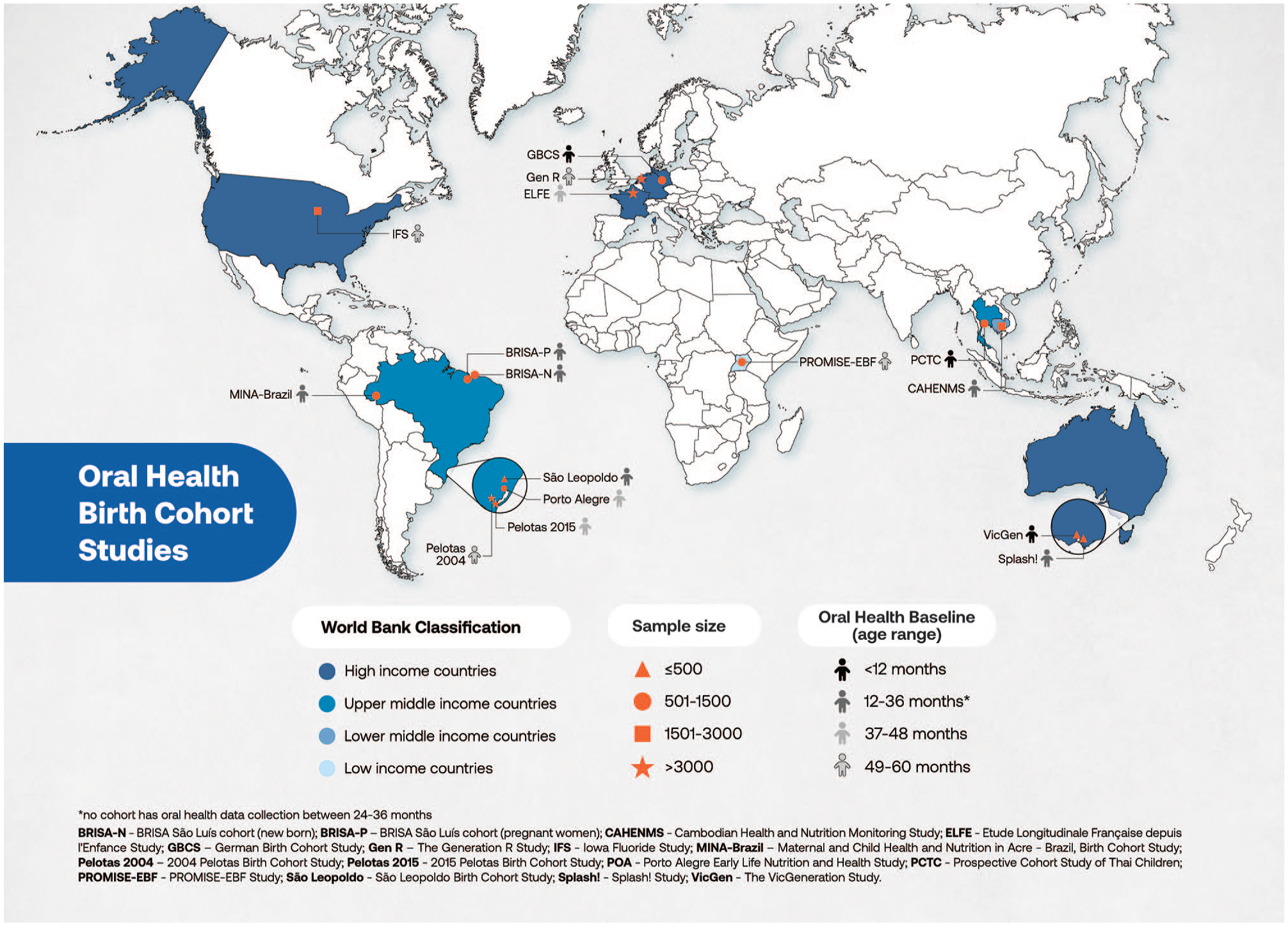
Worldwide map representing GLOBICS collaborators.
What Does the Collaboration Cover?
The work within GLOBICS is strongly research driven, with a clear focus on translational pathways. GLOBICS aspires to incorporate diverse health care expertise to guide OHBCS, address evidence gaps, and advance knowledge. GLOBICS uses OHBCS to study dental disease’s “natural history” with large sample sizes. Its theoretical framework integrates epidemiological principles and developmental health models to examine oral health through a life course perspective, addressing individual biological, behavioral, and socioeconomic factors and macro-level determinants. Advanced tools are applied to test theories such as biological programming, critical periods, accumulation of risk, and chain of risk, enabling a nuanced understanding of exposure-outcome relationships over time (Nicolau et al. 2007). By moving beyond reliance on a single theoretical model, this framework fosters a deeper understanding of oral health trajectories (Fig. 2).
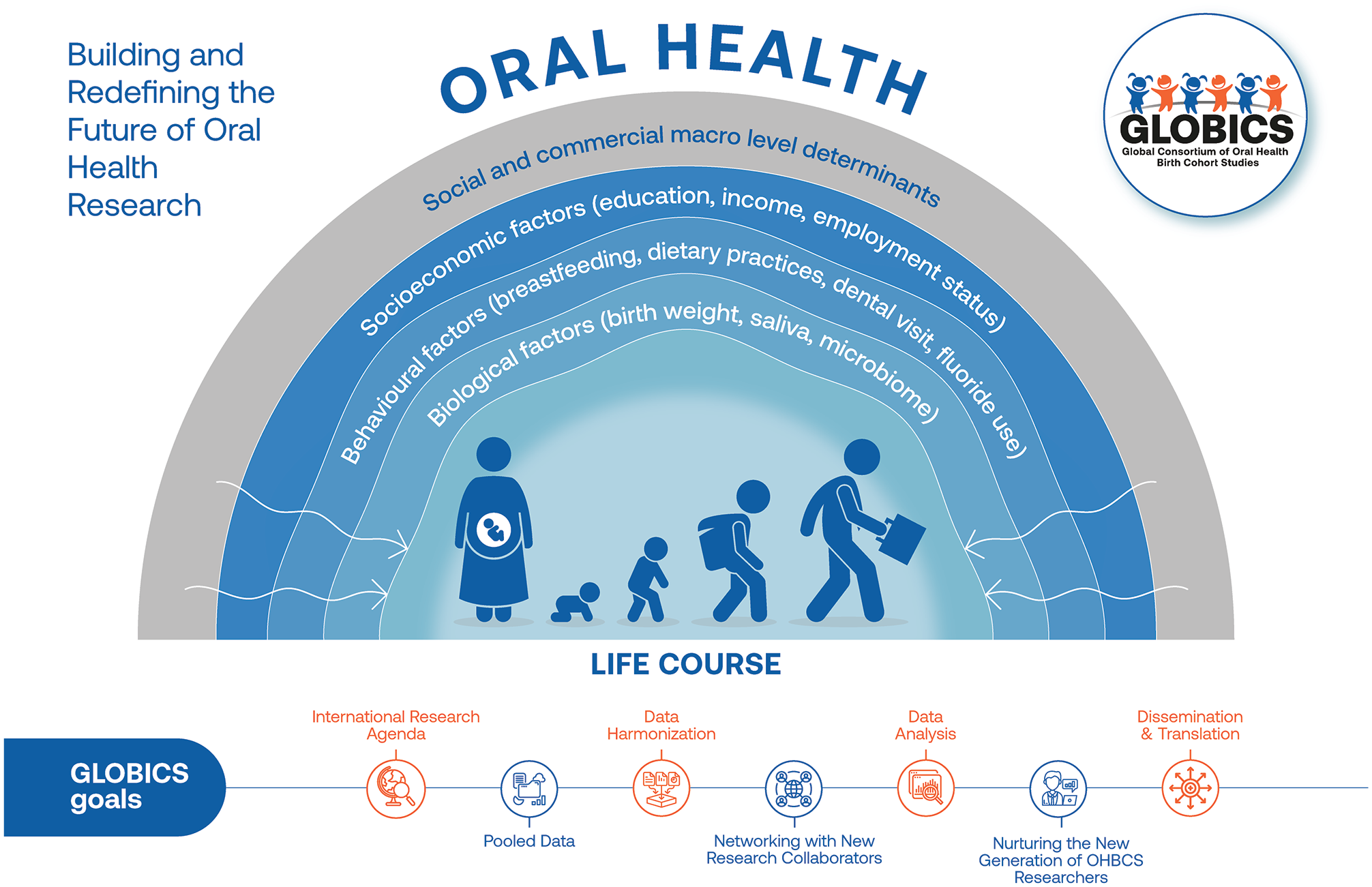
Oral health research in Oral Health Birth Cohort Studies (OHBCS).
International Research Agenda
The group established an international research agenda for OHBCS through a Delphi study, identifying 8 key priorities, including early childhood dental visits, sugar consumption, infant growth, and fluoride impact on oral health (Peres et al. 2024). It also supports studies on environmental and genetic factors and oral health’s role in growth and development.
Pooled Analyses
GLOBICS’ second initiative pooled data from 16 OHBCS, involving more than 26,000 participants, to analyze the controversial relationship between breastfeeding and early childhood caries (Peres et al. 2017; Devenish et al. 2020; Chiao et al. 2021; Nakayama and Ohnishi 2022), identifying when it shifts from protective to potentially risky after a robust analysis.
Ethics, data storage, and sharing are critical aspects of pooled analysis research. GLOBICS strives to strictly adhere to Singaporean and international laws and ethical guidelines (Personal Data Protection Commission 2024). As GLOBICS pools data from OHBCS worldwide, a tailored approach to meet data-sharing agreements for each cohort is used. These measures protect participant confidentiality by anonymizing identifiable information and ensuring legal and ethical compliance across countries. GLOBICS ensures transparent, consent-based data sharing and is establishing a secure data cloud platform for collaborators (Yeo et al. 2019). Future discussions will ensure compliance with the legal requirements of each OHBCS.
Data Harmonization
Data harmonization is crucial to standardizing and integrating data from multiple sources in GLOBICS to ensure consistency across diverse OHBCS, enabling accurate comparisons and valid conclusions. Aligning coding practices and variable definitions avoids bias and ensures meaningful findings, particularly for key variables such as dental caries, feeding practices, and socioeconomic factors.
To address these challenges, GLOBICS employs rigorous data harmonization protocols, including the use of standardized data collection instruments where possible, development of common coding schemes, and promotion of interresearcher discussions. In the first GLOBICS pooled analysis initiative, for instance, high and low levels of education were compared, as defined by each cohort. However, harmonizing socioeconomic variables (SES) in multicenter studies such as GLOBICS is challenging due to variations in socioeconomic contexts and data collection methods across cohorts. A feasible solution is to create a relative SES indicator using principal component analysis, which incorporates contextually relevant SES variables from each cohort. This approach respects cultural and contextual differences while generating a comparable metric. These discussions involve close collaboration with each cohort team to respect the original study design and the scope of the declarations of consent, accounting for regional variation while aligning them with broader GLOBICS research objectives. This provides consistency between the origin and meaning of the data collected in each context and the final harmonized data set.
Ultimately, data harmonization within GLOBICS enhances the potential for meaningful global comparisons. By ensuring that data from different regions and contexts can be effectively integrated and analyzed, GLOBICS contributes to a more comprehensive understanding of oral health outcomes across diverse populations, thereby helping to address global health inequalities more effectively. Furthermore, the harmonization efforts within GLOBICS can inspire newer cohorts to adopt consistent and standardized data collection methods, fostering a harmonized approach across future studies.
Networking with New Research Collaborators
GLOBICS offers invaluable networking opportunities for researchers involved in OHBCS and those interested in contributing to the consortium. This collaborative platform enables researchers to pool resources, share data, and exchange expertise, leading to more comprehensive and impactful studies. By connecting researchers globally, GLOBICS facilitates joint grant applications, which are particularly beneficial in regions with scarce funding, such as low- and middle-income countries. The collaborations boost local research capabilities and ensure globally relevant findings, helping to address oral health inequalities. In addition, GLOBICS conducts workshops on data analysis and methodological discussions, which serve as networking platforms and skill development opportunities. These workshops promote the implementation of best practices in oral health research, further strengthening research capabilities, particularly in underresourced regions.
Data Analysis
The GLOBICS team comprises biostatisticians and epidemiologists who use cutting-edge analytical methods to manage longitudinal data. While collaborators are expected to have some expertise in data analysis, the GLOBICS team strives to provide analytical support in the latest causal inference. Data analysis can be conducted through various methods, such as sharing raw anonymized data via a virtual cloud for data merging, obtaining anonymized data locally for workshops or seminars, and meta-analyzing individual study-level data when other methods are not feasible. Notably, while certain studies within GLOBICS may have restrictions, all GLOBICS publications are and will remain open access.
The GLOBICS team is willing to find out the best strategy for data harmonization and analysis, given the legal regulations of the country in which the OHBCS is based.
Nurturing the New Generation of OHBCS Researchers
Under the GLOBICS framework, mentoring and training initiatives include establishing mentorship programs where experienced researchers guide early-career researchers, especially in low- and middle-income countries. This approach can involve one-on-one mentoring, group mentoring, and peer support networks. GLOBICS has already provided feedback for a new OHBCS in Uganda (Mbarara district) as part of this approach. Regular workshops and seminars on data analysis, research methodology, and leveraging existing data to address research questions are planned, offering practical learning and direct engagement with experts. For instance, GLOBICS organized several workshops in 2023 and 2024 to advance data harmonization and foster collaboration. These included a meeting in Thailand on sugar intake data harmonization, one in Brazil focused on statistical strategies, and another in Germany discussing breastfeeding and caries and planned future collaborations. At the New Orleans International Association for Dental Research conference, GLOBICS hosted a workshop to engage the scientific community, share its research agenda on OHBCS, and promote interdisciplinary collaboration. (https://www.ndcs.com.sg/research-innovation/NDRIS/GLOBICS/Pages/Home.aspx). These efforts aim to strengthen relationships for future joint research and grant applications. GLOBICS supports collaborative research by pairing researchers from high-resource and low-resource settings, fostering skill transfer and capacity building. This approach increases the chances of successful grant applications covering diverse countries. In addition, short-term exchange programs, including visits to the GLOBICS Headquarters in Singapore, offer hands-on experience and training in specific techniques or methodologies and incentivise discussions on future research projects. These initiatives aim to enhance research capabilities worldwide, particularly in low- and middle-income countries, and cultivate a new generation of OHBCS researchers. Ultimately, GLOBICS seeks to create a more inclusive, effective international research community.
Dissemination and Translation
GLOBICS facilitates collaboration among cohort investigators to refine strategies and ideas, benefiting study participants in the future, even though it cannot directly involve them. By working across the 5 continents, the GLOBICS team and its collaborators aim to provide accurate information to support the development of clinical practice guidelines, policies, and public health information tailored to the context of each country. The scientific findings from GLOBICS are anticipated to drive more effective preventive and interventionist strategies, resulting in more effective and inclusive oral health policies.
To engage the clinical community, GLOBICS members will contribute abstracts and summaries of published findings to journals with wide professional readership. This will enable cross-setting comparisons, such as assessing whether risk factors for dental caries are consistent across diverse populations or if specific practices have similar impacts. These insights will help clinicians identify key differences among their patients. In addition, concise, actionable messages will be shared to support health professionals in discussing risks and benefits with patients, ultimately promoting better oral health.
As a long-term goal, GLOBICS plans to work closely with policy makers and health professionals worldwide to influence changes in the promotion, prevention, and treatment of oral diseases informed by research. For instance, GLOBICS initiatives seek to identify the optimal timing for breastfeeding and how best to mitigate added dietary sugar to prevent dental caries in children. This is particularly relevant for understanding common risk and protective factors for dental caries. Findings from a consortium such as GLOBICS may influence discussions on nutrition and dietary practices, including the early intake of sugar-sweetened beverages and their connection with changes in the microbiome, as well as early dental hygiene advice or fluoride exposure and their impact on oral health outcomes across the life course (Fig. 2). This collective effort will support the development of more comprehensive global health promotion strategies.
The Future: How Do We Work Together? Can I Take Leadership in a Research Question?
GLOBICS is an open consortium that welcomes contributors to join at any time. While GLOBICS organizes and facilitates data collection, storage, and sharing, any contributor can propose and lead a research question, following ethical and data security guidelines. Future initiatives include the development of a data ecosystem for visualizing data and supporting new GLOBICS research projects.
To lead a research question within GLOBICS, you must be a GLOBICS contributor. You can join the consortium by expressing your interest to our team members, who will provide more details. Once you become a member, you can propose a research question, which will be evaluated by the executive committee for its scientific merit and the proposer’s qualifications. Researchers will then be introduced to the ethical guidelines and data security procedures and will assume formal leadership, coordinating all aspects of the proposed research with the GLOBICS team.
Contributors providing data for a specific research question and actively preparing the manuscript according to the journal requirements will be considered coauthors, with participation typically involving 2 members per OHBCS participating. Other active researchers from the GLOBICS team involved in any stage of the study—such as conception, design, analysis, interpretation, and drafting—will be included in the authors’ list. Those contributing data only will be acknowledged as “GLOBICS Collaborators,” following conventions from medical consortia (GBD 2021 Forecasting Collaborators 2024; GBD 2021 Risk Factors Collaborators 2024). Authorship and order will be determined at the study’s commencement and will be upheld unless otherwise agreed upon by all involved authors.
Where Can I Find More?
We are actively seeking partners and collaborators. To learn more about GLOBICS, visit our web page (https://www.ndcs.com.sg/research-innovation/ndris/globics/pages/home.aspx) or reach out to the GLOBICS team via email (
Author Contributions
K.G. Peres, G.G. Nascimento, contributed to conception and design data interpretation, drafted and critically revised the manuscript; S. Sarawagi, K. Gambetta-Tessini, A.C. Kalhan, H. Li, A. Rugg-Gunn, M.A. Peres, contributed to conception and design data interpretation, critically revised the manuscript; C.A. Feldens, B.W. Chaffee, A.J.D. Barros, contributed to conception and design data acquisition and interpretation, critically revised the manuscript; A.N. Åstrøm, J. Abanto, N. Birungi, M.A. Cardoso, MA. Charles, M.B Correa, S. Dashper, F.F. Demarco, A. Germa, P.C. Hallal, C. Jacobs, L. Kragt, P.F, Kramer, S. Levy, T.A. Marshall, A. Nirunsittirat, W. Pitiphat, C.C.C. Ribeiro, C. Sieng, E.B.A.F. Thomaz, B. Turton, M.R. Vitolo, Y. Wagner, contributed to data acquisition and interpretation, critically revised the manuscript. All authors gave final approval and agree to be accountable for all aspects of the work.
Footnotes
Declaration of Conflicting Interests
The authors declared no potential conflicts of interest with respect to the research, authorship, and/or publication of this article.
Funding
The authors disclosed receipt of the following financial support for the research, authorship, and/or publication of this article: We thank the National Medical Research Council Singapore (PHRGOC22Jul-0021), The Borrow Foundation (2021-2024), and The Global Duke-NUS Medical School Program Grant Award, for funding the research, authorship, and publication of this article.
*
GLOBICS Group: A.N. Åstrøm7, J. Abanto8, N. Birungi9, M.A. Cardoso10, M.A. Charles11, M.B. Correa12, S. Dashper13, F.F. Demarco12, A. Germa14, P.C. Hallal15, C. Jacobs16, L. Kragt17, P.F. Kramer18, S. Levy19, T.A. Marshall19, A. Nirunsittirat20, W. Pitiphat21, C.C.C. Ribeiro22, C. Sieng23, E.B.A.F. Thomaz24, B. Turton25, M.R. Vitolo26, and Y. Wagner27
