




Abstract
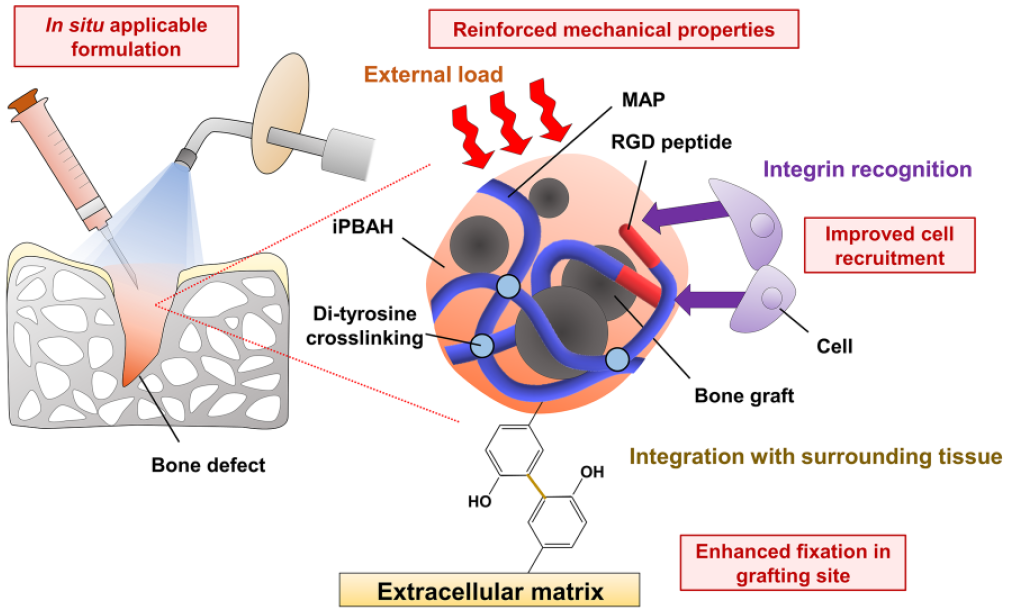
Bone grafting is a fundamental dental surgery procedure widely used for implant placement and periodontal disease management treatments. Despite its broad applications, vertical bone augmentation presents unique challenges, including the risk of graft displacement due to gravitational and masticatory forces. Traditional physical stabilization methods introduce additional complexities and risks, underscoring the need for innovative fixation technologies. This study aimed to develop an in situ photo-crosslinkable bioadhesive hydrogel (iPBAH) as a multifunctional bone graft binder to enhance the process of bone reconstruction. The bioadhesive is composed of mussel-derived adhesive protein (MAP) fused with the cell-adhesive peptide RGD. The numerous tyrosine residues in MAP facilitate rapid photo-crosslinking, enabling efficient hydrogel formation using visible blue light. Subsequently, iPBAH underwent comprehensive characterization to evaluate its suitability as a multifunctional bone graft binder. iPBAH efficiently underwent in situ crosslinking through harmless exposure to visible light within minutes and displayed several exceptional properties, including a microporous structure, underwater adhesion, extended durability, high compressive strength, and biocompatibility. In vivo assessments, using male Sprague-Dawley rats, demonstrated that iPBAH binder significantly enhanced bone regeneration in a rat calvarial bone defect model. The in situ crosslinking of the iPBAH binder during bone graft transplantation can effectively fill irregular and complex defect shapes while simultaneously preventing graft material leakage. The improved physical attributes of the bound graft material can enhance its resistance to external forces, thereby ensuring sustained retention over time. Moreover, the interaction between iPBAH and surrounding tissues promotes adhesion and integration of the graft material with host tissues in the defect area. In addition, the included RGD peptide in iPBAH can augment inherent cell recruitment, adhesion, and growth, consequently expediting osteogenesis.
Keywords
Get full access to this article
View all access options for this article.
References
Supplementary Material
Please find the following supplemental material available below.
For Open Access articles published under a Creative Commons License, all supplemental material carries the same license as the article it is associated with.
For non-Open Access articles published, all supplemental material carries a non-exclusive license, and permission requests for re-use of supplemental material or any part of supplemental material shall be sent directly to the copyright owner as specified in the copyright notice associated with the article.
