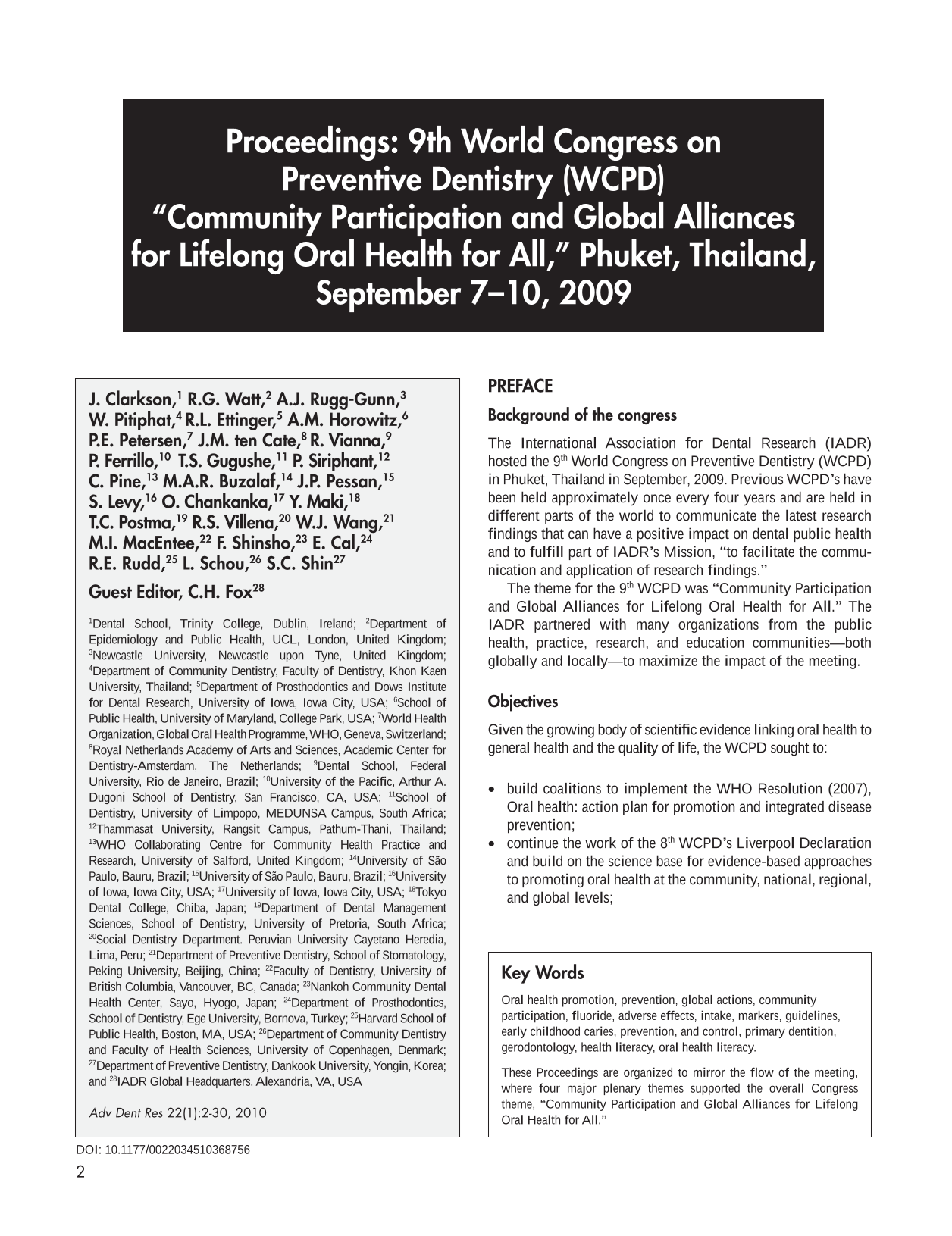
Proceedings: 9th World Congress on Preventive Dentistry (WCPD) “Community Participation and Global Alliances for Lifelong Oral Health for All,” Phuket,Thailand,September 7—10,2009
Restricted accessResearch articleFirst published online January, 2010
Proceedings: 9th World Congress on Preventive Dentistry (WCPD) “Community Participation and Global Alliances for Lifelong Oral Health for All,” Phuket,Thailand,September 7—10,2009
Ahacic K., Thorslund M. ( 2008). Changes in dental status and dental care utilization in the Swedish population over three decades: age, period, or cohort effects?Community Dent Oral Epidemiol36:118-127.
2.
American Public Health Association (2008). Community water fluoridation in the United States. Policy Statement Database . Washington, DC, USA: APHA.
3.
Armellini D., von Fraunhofer JA ( 2004). The shortened dental arch: a review of the literature . J Prosthet Dent92:531-535.
Berkey DB, Ela KM, Berg RG ( 1993) Advances in Portable and Mobile EquipmentSystems Int Dent J43:455-465.
6.
Berkman ND, DeWalt DA, Pignone MP, Sheridan SL, Lohr KN, Lux L., et al. (2004). Literacy and health outcomes. Evidence report/technology assessment No. 87 (prepared by RTI International, University of North Carolina Evidence-based Practice Center under Contract No. 90-02- 0016). Found at URL: http://www.ncbi.nlm.nih.gov/bookshelf/br.fcgi?book=hserta&part=A128577 (accessed 02/09/2010)
7.
Bian JY, Zhang BX, Rong WS ( 1995). Evaluating the social impact and effectiveness of four-year "Love Teeth Day" campaign in China. Adv Dent Res9:130-133.
8.
Bian JY, Wang WJ, Rong WSH, Jun Q., Wa WC, Bartizek RD, et al. (2002). Caries prevention in Chinese children with sodium fluoride dentifrice delivered through a kindergarten-based oral health program in China. J Clin Dent13:179-184.
9.
Boyer E. ( 1996). The scholarship of engagement. J Public Service Outreach1:11-20.
10.
Bratthall D. ( 2000). Introducing the Significant Caries Index together with a proposal for a new global oral health goal for 12-year-olds. Int Dent J50:378-384.
11.
Bureau of Technical and International Cooperation, Secretariat-General of the the Administrative Court (2007). Constitution of the Kingdom of Thailand, B.E. 2550 (unofficial translation).
12.
Buzalaf MA, Pessan JP, Alves KM ( 2006). Influence of growth rate and length on fluoride detection in human nails. Caries Res40:231-238.
13.
Buzalaf MA, Vilhena FV, Iano FG, Grizzo L., Pessan JP, Sampaio FC, et al. (2009). The effect of different fluoride concentrations and pH of dentifrices on plaque and nail fluoride levels in young children. Caries Res43:142-146.
14.
Cao J., Zhao Y., Liu J. ( 1997). Brick tea consumption as the cause of dental fluorosis among children from Mongol, Kasak and Yugu populations in China. Food Chem Toxocol35:827-833.
15.
Carlsson GE ( 2009). Critical review of some dogmas in prosthodontics . J Prosthodont Res53:3-10.
16.
Carvalho JG, Leite AL, Yan D., Everett ET, Whitford GM, Buzalaf MA ( 2009). Influence of genetic background on fluoride metabolism in mice. J Dent Res88:1054-1058.
17.
Chinese Ministry of Health (2008). The third national oral health survey in China. Beijing : People’s Health Publishing House.
18.
Cleaton-Jones PE, Hargreaves JA, Roberts G., Williams SD, Leidal TI ( 1989). The dmfs and dmft of young South African children . Community Dent Oral Epidemiol17:38-40.
19.
Crocombe LA, Slade GD ( 2007). Decline of the edentulism epidemic in Australia . Aust Dent J52:154-156.
20.
Curnow MM, Pine CM, Burnside G., Nicholson JA, Chesters RK, Huntington E. ( 2002). A randomized controlled trial of the efficacy of supervised toothbrushing in high-caries-risk children. Caries Res36:294-300.
21.
Czarnowski W., Krechniak J. ( 1990). Fluoride in the urine, hair, and nails of phosphate fertiliser workers. Br J Ind Med47:349-351.
22.
de Almeida BS, da Silva Cardoso VE, Buzalaf MA ( 2007). Fluoride ingestion from toothpaste and diet in 1-3-year-old Brazilian children. Community Dent Oral Epidemiol35:53-63.
23.
Dean HT, Elvove E. ( 1936). Some epidemiological aspects of chronic endemic dental fluorosis. Am J Publ Health26:567-575.
24.
Department of Health (UK) (1994). Report on Health and Social Subjects 41: United Kingdom. London, UK: HMSO.
25.
Douglass CW, Watson AJ ( 2002). Future needs for fixed and removable dentures in the United States. J Prosthet Dent87:9-14.
26.
Drury TF, Horowitz AM, Ismail AI, Maertens MP, Rozier RG, Selwitz RH ( 1999). Diagnosing and reporting early childhood caries for research purposes. A report of a workshop sponsored by the National Institute of Dental and Craniofacial Research, the Health Resources and Services Administration, and the Health Care Financing Administration. J Public Health Dent59:192-197.
27.
Dye BA, Tan S., Smith V., Lewis BG, Barker LK, Thornton-Evans G., et al. (2007). Trends in oral health status: United States, 1988-1994 and 1999-2004. National Center for Health Statistics. Vital Health Stat11:1-92.
28.
Editorial (2009). Oral health: prevention is key. Lancet373:1.
29.
Ettinger RL ( 1993a). Cohort differences among aging populations: a challenge for the dental profession. Spec Care Dentist13:19-26.
30.
Ettinger RL ( 1993b). Demography and dental needs, an international perspective . Gerodontology10:3-9.
31.
Ettinger RL ( 2007). Rural dentistry-lessons from other countries [editorial] . Spec Care Dentist27:219-221.
32.
Evans RW, Darvell BW ( 1995). Refining the estimate of the critical period for susceptibility to enamel fluorosis in human maxillary central incisors. J Public Health Dent55:238-249.
33.
Everett ET, McHenry MA, Reynolds N., Eggertsson H., Sullivan J., Kantmann C., et al. (2002). Dental fluorosis: variability among different inbred mouse strains. J Dent Res81:794-798.
34.
Eyler J., Giles DE ( 1999). Where’s the learning in service-learning?San Francisco, CA, USA: Jossey-Bass Publishers.
35.
Fan H., Fan YF, Wang WH ( 2008). Comprehensive modality for prevention of ECC in Taiyuan kindergartens. Chinese Remedies & Clinics8:789- 791 [article in Chinese].
36.
Fawell J., Bailey K., Chilton J., Dahi E., Fewtrell L., Magara Y. ( 2006). Fluoride in drinking-water. World Health Organization Drinking Water Quality Series. London, UK: IWA Publishing.
37.
FDI (2009). Global Caries Initiative . Available from: http://www.fdiworldental.org/resources/gci.html (accessed 02/09/2010).
38.
Franco AM, Saldarriaga A., Martignon S., González MC, Villa AE ( 2005a). Fluoride intake and fractional urinary fluoride excretion of Colombian preschool children. Community Dent Health22:272-278.
39.
Franco AM, Martignon S., Saldarriaga A., González MC, Arbeláez MI, Ocampo A., et al. (2005b). Total fluoride intake in children aged 22-35 months in four Colombian cities. Community Dent Oral Epidemiol33:1-8.
40.
Fukushima R., Rigolizzo DS, Maia LP, Sampaio FC, Lauris JR, Buzalaf MA ( 2009). Environmental and individual factors associated with nail fluoride concentration. Caries Res43:147-54.
41.
Global Congress on Dental Education (2008). Proceedings. Eur J Dent Educ12(Suppl 1):1-197.
42.
Gokalp S., Guciz-Dogan B., Tekcicek M., Berberoglu A., Unluer S. ( 2007). The oral health profile of adults and elderly, Turkey-2004 . Hacettepe Dishekimligi Fakultesi Dergisi31:11-18.
43.
Golder DT, Brennan KA ( 2000). Practicing dentistry in the age of telemedicine . J Am Dent Assoc131:734-744.
44.
Gong DA, Lee JY, Rozier RG, Pahel BT, Richman JA, Vann WF Jr ( 2007). Development and testing of the test of functional health literacy in dentistry (TOFHLiD). J Public Health Dent67:105-112.
45.
Gotfredsen K., Walls AWG ( 2007). What dentition assures oral function? Clin Oral Implants Res18(Suppl 3):34-45.
46.
Government of Ireland (2002). Forum on fluoridation. Dublin: Stationery Office, Government Publications.
47.
Grindefjord M., Dahllöf G., Nilsson B., Modéer T. ( 1995). Prediction of dental caries development in 1-year-old children. Caries Res29:343-348.
48.
Guha-Chowdhury N., Drummond BK, Smillie AC ( 1996). Total fluoride intake in children aged 3 to 4 years-a longitudinal study. J Dent Res75:1451-1457.
49.
Haftenberger M., Viergutz G., Neumeister V., Hetzer G. ( 2001). Total fluoride intake and urinary excretion in German children aged 3-6 years. Caries Res35:451-457.
50.
Hammond G., Rootman I., Frankish J., Niks M., Middleton S., Monro M. ( 2005). Working together on literacy and health research. National Summer Institute Report. Vancouver, BC, Canada. http://library.nald.ca/item/6123 (accessed 02/09/2010) or http://www.nald.ca/library/research/2005nat/cover.htm (accessed 2/22/2010).
51.
Harris R., Nicoll AD, Adair PM, Pine CM ( 2004). Risk factors for dental caries in young children: a systematic review of the literature. Community Dent Health21(1 Suppl):71S-85S.
52.
Health and Welfare Statistics Association ( 2009). Dynamic statistics by cause of death in Japan. JPN J Health and Welfare Statistics56; 394- 411 (In Japanese)
53.
Helgerson MJ, Smith BJ ( 1996). Dental care in nursing homes: guidelines for mobile and on-site care. Spec Care Dentist16:153-164.
54.
Holm-Pedersen P., Vigild M., Nitschke I., Berkey DB ( 2005). Dental care for aging populations in Denmark, Sweden, Norway, United Kingdom, and Germany. J Dent Educ69:987-997.
55.
Hong L., Levy SM, Broffitt B., Warren JJ, Kanellis MJ, Wefel JS, et al. (2006). Timing of fluoride intake in relation to development of fluorosis on maxillary central incisors. Community Dent Oral Epidemiol34:299-309.
56.
Horowitz AM, Kleinman DV ( 2008). Oral health literacy: the new imperative to better oral health. Dent Clin N Am52:333-344.
57.
Ismail AI, Sohn W. ( 1999). A systematic review of clinical diagnostic criteria of early childhood caries. J Public Health Dent59:171-191.
58.
Jiang H., Tai BJ, Du MQ, Huang W., Guo Y. ( 2007). [A two-year randomized clinical trial of 1.23% fluoride foam on dental caries increment in primary teeth]. Zhonghua Kou Qiang Yi Xue Za Zhi42:456-459 [article in Chinese].
59.
Kawai Y., Murakami H., Shariati B., Klemetti E., Blomfield JV, Billette L., et al. (2005). Do traditional techniques produce better conventional complete dentures than simplified techniques? J Dent33:659-668.
60.
Kay EJ, Locker D. ( 1996). Is dental health education effective? A systematic review of current evidence. Community Dent Oral Epidemiol24: 231-235.
61.
Käyser AF ( 1981). Shortened dental arches and oral function. J Oral Rehabil8:457-462.
62.
Kinsella K., Wan H. ( 2009). An aging world: 2008. US Census Bureau, International Population Reports. Washington, DC, USA: US Government Printing Office, pp. 10-18. www.census.gov/prod/2009pubs/p95-09-1.pdf (accessed 02/09/2010)
Lee EE, Thomas CA, Vu T. ( 2001). Mobile and portable dentistry: alternative treatment services for the elderly. Spec Care Dentist21:153-155.
65.
Lee JY, Rozier RG, Lee SY, Bender D., Ruiz RE ( 2007). Development of a word recognition instrument to test health literacy in dentistry: the REALD-30-A brief communication. J Public Health Dent67:94-98.
66.
Levy FM, Bastos JRM, Buzalaf MA ( 2004). Nails as biomarkers of fluoride in children of fluoridated communities. J Dent Child71:121-125.
67.
Levy SM, Warren JJ, Davis CS, Kirchner HL, Kanellis MJ, Wefel JS ( 2001). Patterns of fluoride intake from birth to 36 months . J Public Health Dent61:70-77.
68.
Levy SM, Warren JJ, Broffitt B. ( 2003). Patterns of fluoride intake from 36 to 72 months of age . J Public Health Dent63:211-220.
69.
Li SM, Fan X., Zou J. ( 2005). 2-year clinic effect of fluoride drop on dental caries prevention of primary teeth. Hua Xi Kou Qiang Yi Xue Za Zhi23:136-137 [article in Chinese].
70.
Lutz W., Sanderson W., Scherbov S. ( 2008). The coming acceleration of global population ageing . Nature451:716-719.
71.
Mabelya L., van Palenstein Helderman WH, van’t Hof MA, König KG ( 1997). Dental fluorosis and the use of a high fluoride-containing trona tenderizer (magadi). Community Dent Oral Epidemiol25:170-176.
72.
MacEntee MI ( 2006). An existential model of oral health from evolving views on health, function and disability. Community Dent Health23:5-14.
73.
MacEntee MI, Hill PM, Wong G., Mojon P., Berkowitz J., Glick N. ( 1991). Predicting concerns for oral health among institutionalized elders. J Public Health Dent51:82-90.
74.
MacEntee MI, Hole R., Stolar E. ( 1997). The significance of the mouth in old age. Soc Sci Med45:1449-1458.
75.
MacKeown JM, Faber M. ( 2002). Urbanisation and cariogenic food habits among 4-24-month-old black South African children in rural and urban areas. Public Health Nutr5:719-726.
76.
Maguire A., Zohouri FV, Hindmarch PN, Hatts J., Moynihan PJ ( 2007). Fluoride intake and urinary excretion in 6- to 7-year-old children living in optimally, sub-optimally and non-fluoridated areas. Community Dent Oral Epidemiol35:479-488.
77.
Marmot M., Wilkinson R. ( 2006). Social determinants of health. 2nd ed. Oxford, UK: Oxford University Press.
78.
Marthaler TM ( 1999). Monitoring of renal fluoride excretion in community preventive programmes on oral health. Geneva: WHO.
79.
Martínez-Mier EA, Soto-Rojas AE, Ureña-Cirett JL, Stookey GK, Dunipace AJ ( 2003). Fluoride intake from foods, beverages and dentifrice by children in Mexico. Community Dent Oral Epidemiol31:221-230.
80.
Mattos-Graner Rde O., Rontani RM, Gaviao MB, Bocatto HA ( 1996). Caries prevalence in 6-36-month-old Brazilian children . Community Dent Health13:96-98.
81.
McGrath C., Broder H., Wilson-Genderson M. ( 2004). Assessing the impact of oral health on the life quality of children: implications for research and practice. Community Dent Oral Epidemiol32:81-85.
82.
McKinlay JB ( 1993). The promotion of health through planned socio-political change: challenges for research and policy. Soc Sci Med36:109-117.
83.
Milnes AR ( 1996). Description and epidemiology of nursing caries . J Public Health Dent56:38-50.
84.
Ministry of Health and Welfare (2000). Healthy Japan 21 [in Japanese]. Tokyo: The Japan Health Promotion and Fitness Foundation.
85.
Miyatake K. ( 1991). 8020 movement. J Jpn Dent Assoc45:15-24 [article in Japanese].
86.
Miziara AP, Philippi ST, Levy FM, Buzalaf MA ( 2009). Fluoride ingestion from food items and dentifrice in 2-6-year-old Brazilian children living in a fluoridated area using a semiquantitative food frequency questionnaire. Community Dent Oral Epidemiol37:305-315.
87.
Mofidi M., Strauss R., Pitner LL, Sandler ES ( 2003). Dental students on their community-based experiences: the use of critical incidents. J Dent Educ67:515-523.
88.
Møller IJ, Poulsen S. ( 1975). A study of dental mottling in children in Khouribga, Morocco. Arch Oral Biol20:601-607.
89.
MRC (2002). Water fluoridation and health. London: Working Group Report, Medical Research Council.
90.
Murakami T., Narita N., Nakagaki H., Shibata T., Robinson C. ( 2002). Fluoride intake in Japanese children aged 3-5 years by the duplicate-diet technique. Caries Res36:386-390.
91.
Narayan D. ( 2002). Empowerment and poverty reduction: a sourcebook . Washington, DC, USA: World Bank Publications.
92.
National Institute of Health and Clinical Excellence (NICE) (2008). Community engagement to improve health. NICE public health guidance 9. London: National Institute of Health and Clinical Excellence.
93.
National Research Council (2006). Fluoride in drinking water: a scientific review of EPA’s standards. Committee on Fluoride in Drinking Water, Board on Environmental Studies and Toxicology, National Research Council. Washington, DC, USA: National Academies Press.
94.
Nhmrc (2005). Nutrient reference values for Australia and New Zealand, http://www.moh.govt.nz/moh.nsf/pagesmh/4678 (accessed 02/22/2010).
95.
Nhmrc (2007). A systematic review of the efficacy and safety of fluoridation. Canberra: National Health and Medical Research Council, Australian Government .
96.
Nhscrd (2000). A systematic review of water fluoridation. York, UK: NHS Centre for Reviews and Dissemination, University of York.
97.
Nidcr, NIH, Usphs, Dhhs ( 2005). The invisible barrier: literacy and its relationship with oral health. J Public Health Dent65:174-182.
98.
Nielsen-Bohlman L, Panzer AM, Kindig DA, editors ( 2004). Health literacy: a prescription to end confusion . Washington, DC, USA: National Academies Press. http://www.nap.edu/openbook.php?isbn=0309091179 (accessed 02/09/2010).
99.
Nohno K., Sakuma S., Koga H., Nishimuta M., Yagi M., Miyazaki H. ( 2006). Fluoride intake from food and liquid in Japanese children living in two areas with different fluoride concentrations in the water supply . Caries Res40:487-493.
100.
Oliveira LB, Sheiham A., Bönecker M. ( 2008). Exploring the association of dental caries with social factors and nutritional status in Brazilian preschool children. Eur J Oral Sci116:37-43.
101.
Omena LM, Silva MF, Pinheiro CC, Cavalcante JC, Sampãio FC ( 2006). Fluoride intake from drinking water and dentifrice by children living in a tropical area of Brazil. J Appl Oral Sci14:382-387.
102.
Ophaug RH, Singer L., Harland BF ( 1985). Dietary fluoride intake of 6-month and 2-year-old children in four dietary regions of the United States. Am J Clin Nutr42:701-707.
103.
Ottawa Charter for Health Promotion (1986). First International Conference on Health Promotion, Ottawa. WHO/HPR/HEP/95.1. http://www.who.int/hpr/NPH/docs/ottawa_charter_hp.pdf (accessed 02/09/2010)
104.
Owen PC ( 2004). Appropriatech: prosthodontics for the many, not just for the few. Int J Prosthodont17:261-262.
105.
Paiva SM, Lima YB, Cury JA ( 2003). Fluoride intake by Brazilian children from two communities with fluoridated water. Community Dent Oral Epidemiol31:184-191.
106.
Peltzer K., Ramlagan S. ( 2009). Alcohol use trends in South Africa. J Soc Sci18:1-12.
107.
Peres MA, de Oliveira Latorre Mdo R., Sheiham A., Peres KG, Barros FC, Hernandez PG, et al. (2005). Social and biological early life influences on severity of dental caries in children aged 6 years. Community Dent Oral Epidemiol33:53-63.
108.
Pessan JP, Pin ML, Martinhon CC, de Silva SM, Granjeiro JM, Buzalaf MA ( 2005). Analysis of fingernails and urine as biomarkers of fluoride exposure from dentifrice and varnish in 4- to 7-year-old children . Caries Res39:363-370.
109.
Petersen PE ( 2003). The World Oral Health Report 2003: continuous improvement of oral health in the 21st century-the approach of the WHO Global Oral Health Programme. Community Dent Oral Epidemiol31(Suppl 1):3-24.
110.
Petersen PE ( 2005a). Sociobehavioural risk factors in dental caries- international perspectives. Community Dent Oral Epidemiol33:274-279.
111.
Petersen PE ( 2005b). Priorities for research for oral health in the 21st Century-the approach of the WHO Global Oral Health Programme. Community Dent Health22:71-74.
112.
Petersen PE ( 2005c). Global research challenges for oral health. Global Forum Update on Res Health2:181-184.
113.
Petersen PE ( 2008a). Oral health. In: International encyclopedia of public health. Vol. 4. Heggenhougen K, Quah S, editors. St. Louis, MO: Academic Press, pp. 677-685.
114.
Petersen PE ( 2008b). World Health Organization global policy for improvement of oral health-World Health Assembly 2007. Int Dent J58:115-121.
115.
Petersen PE ( 2009a). The World Health Survey-the global burden of oral disease . Geneva: WHO.
116.
Petersen PE ( 2009b). Global policy for improvement of oral health in the 21st century-implications to oral health research of World Health Assembly 2007, World Health Organization. Community Dent Oral Epidemiol37:1-8.
117.
Pickin C., Popay J., Staely K., Bruce N., Jones C., Gowman N. ( 2002).Developing a model to enhance the capacity of statutory organizations to engage with lay communities. J Health Serv Res Policy7:34-42.
118.
Pine C., Burnside G., Craven R. ( 2003). Inequalities in dental health in the north-west of England . Community Dent Health20:55-56.
119.
Pine CM, Curnow MM, Burnside G., Nicholson JA, Roberts AJ ( 2007). Caries prevalence four years after the end of a randomised controlled trial. Caries Res41:431-436.
120.
Pitts NB ( 2004). Are we ready to move from operative to non-operative/preventive treatment of dental caries in clinical practice? Caries Res38:294-304.
121.
Pitts NB, Boyles J., Nugent ZJ, Thomas N., Pine CM ( 2007). The dental caries experience of 5-year-old children in Great Britain (2005/6). Surveys co-ordinated by the British Association for the Study of Community Dentistry. Community Dent Health24:59-63.
122.
Popay J. ( 2006). Community engagement for health improvement: questions of definition, outcomes and evaluation. A background paper prepared for U .K. National Institute for Health and Clinical Excellence by Professor Jennie Popay et al. March 1, 2006.
123.
Popay J. ( 2010). Community empowerment and health improvement. In: Health Assets in a Global Context. Morgan A, Davies M, Ziglio E, editors. New York, USA: Springer Science+Business Media (in press).
124.
Postma TC, Ayo-Yusuf OA, van Wyk PJ ( 2008). Socio-demographic correlates of early childhood caries prevalence and severity in a developing country-South Africa. Int Dent J58:91-97.
125.
Proceedings (2006). Proceedings of the Surgeon General’s workshop on improving health literacy, Bethesda, MD: NIH, http://www.surgeongeneral.gov/topics/healthliteracy/toc.html (accessed 02/04/2010).
126.
Ratzan SC, Parker RM ( 2000). Introduction. In: National Library of Medicine: health literacy. Selden CR , Zorn M, Ratzan C, editors. NLM pub no. CBM 2000-1. Bethesda, MD: National Institutes of Health, US Department of Health and Human Services .
127.
Reisine ST, Psoter W. ( 2001). Socioeconomic status and selected behavioral determinants as risk factors for dental caries. J Dent Educ65:1009-1016.
128.
Richman JA, Lee JY, Rozier RG, Gong DA, Pahel BT, Vann WF Jr ( 2007). Evaluation of a word recognition instrument to test health literacy in dentistry: the REALD-99. J Public Health Dent67:99-104.
129.
Robertson A. ( 2006). Chronic conditions in children. In: South African National Health Review. Durban, South Africa: Health Systems Trust.
130.
Rodrigues MH, Bastos JR, Buzalaf MA ( 2004). Fingernails and toenails as biomarkers of subchronic exposure to fluoride from dentifrice in 2- to 3-year-old children. Caries Res38:109-114.
131.
Rodrigues MH, Leite AL, Arana A., Villena RS, Forte FD, Sampaio FC, et al. (2009). Dietary fluoride intake by children receiving different sources of systemic fluoride. J Dent Res88:142-145.
132.
Rojas-Sanchez F., Kelly SA, Drake KM, Eckert GJ, Stookey GK, Dunipace AJ ( 1999). Fluoride intake from foods, beverages and dentifrice by young children in communities with negligibly and optimally fluoridated water: a pilot study. Community Dent Oral Epidemiol27:288-297.
133.
Rosenoer LM, Sheiham A. ( 1995). Dental impacts on daily life and satisfaction with teeth in relation to dental status in adults. J Oral Rehabil22:469-480.
134.
Rudd RE ( 2007). Health literacy skills of U.S. adults. Am J Health Behav31(Suppl 1):8-18.
135.
Sabbah W., Tsakos G., Chandola T., Sheiham A., Watt RG ( 2007). Social gradients in oral and general health. J Dent Res86:992-996.
136.
Sarita PT, Witter DJ, Kreulen CM, Van’t Hof MA, Creugers NH ( 2003). Chewing ability of subjects with shortened dental arches . Community Dent Oral Epidemiol31:328-334.
137.
Schamschula RG, Sugár E, Un PS, Tóth K, Barmes DE, Adkins BL (1985). Physiological indicators of fluoride exposure and utilization: an epidemiological study. Community Dent Oral Epidemiol13:104-107.
138.
Schmidt CW, Leuschke W. ( 1990). Fluoride content in finger nails of individuals with and without chronic fluoride exposure. Fluoride23:79-82.
139.
Schou L., Wight C. ( 1994). Does dental health education affect inequalities in dental health? Community Dent Health11:97-100.
140.
Schwartzberg JG, Cowett A., VanGeest J., Wolff MS ( 2007). Communication techniques for patients with low health literacy: a survey of physicians, nurses, and pharmacists. Am J Health Behav31(Suppl 1):96-104.
141.
Shaw D., Macpherson L., Conway D. ( 2009). Tackling socially determined dental inequalities: ethical aspects of Childsmile, the national child oral health demonstration programme in Scotland. Bioethics23:131-139.
142.
Sheiham A. ( 2006). Dental caries affects body weight, growth and quality of life in pre-school children. Br Dent J201:625-626.
143.
Sheiham A. ( 2008). Setting priorities in dental research in developing countries; reducing the "10/90" gap in research funding. The Jairam Reddy dedication lecture 2008S Afr Dent J63:494, 496-499.
144.
Shinsho F., Berkey DB ( 1998). Community dental care and decision-making of the elderly patient. J JPN Prosthodont Soc42:201-206.
145.
Shinsho F., Fiske J. ( 1998). Community dentistry and health services for disabled and elderly people-dental health services as a part of the community care . Emerg Care Dent Pract19:5-15 [article in Japanese].
146.
Shinsho F., Fukuda H., Tatakara K. ( 1992). Factors related to needs of dental treatments for house-bound elderly. Jpn J Gerodontol6:116-120.
147.
Spate VL, Morris JS, Baskett CK, Mason MM, Reams CL, Hunter D., et al. (1994). Determination of fluoride in human nails via cyclic instrumental neutron activation analysis. J Radioanalyt Nucl Chem79:27-33.
148.
Sprod A., Anderson R., Treasure E. ( 1996). Effective oral health promotion. Literature review. Technical Report #20. Cardiff, Wales: Health Promotion Wales.
149.
Statistics Analysis Committee on the Survey of Dental Diseases (2007). Comprehensive Guide to the Survey of Dental Diseases 2005. Tokyo: Kohku-Kyokai. (In Japanese).
150.
Statistics Bureau Home Page (2005). Population Census. Director-General for Policy Planning (Statistical Standards) & Statistical Research and Training Institute. http://www.stat.go.jp/english/ (accessed 02/09/2010).
151.
Statistics South Africa (2007a). Midyear population estimates. Statistical release P0302. Pretoria: Statistics South Africa.
152.
Statistics South Africa (2007b). Income and expenditure of households 2005/2006. Statistical release P0100 . Pretoria: Statistics South Africa .
Thorstensson H., Johansson B. ( 2009). Does oral health say anything about survival in later life? Findings in a Swedish cohort of 80+ years at baseline. Community Dent Oral Epidemiol37:325-332.
155.
Tomori T., Koga H., Maki Y., Takaesu Y. ( 2004). Fluoride analysis of foods for infants and estimation of daily fluoride intake. Bull Tokyo Dent Coll45:19-32.
156.
United Nations (2002). World population ageing: 1950-2050. New York, NY, USA: United Nations Dept of Economic and Social Affairs, Population Division.
157.
United Nations Population Division (2003). World population prospects: the 2000 revision. New York, NY, USA: United Nations.
158.
US Department of Health and Human Services ( 2000a). Oral health in America: a report of the Surgeon General. National Institute of Dental and Craniofacial Research, National Institutes of Health. Rockville, MD, USA: US Government Printing Office.
159.
US Department of Health and Human Services (2000b). Healthy People 2010. 2nd ed. With understanding and improving health and objectives for improving health. 2 vols. Washington, DC, USA: US Government Printing Office.
160.
US Department of Health and Human Services ( 2003a). Communicating health: priorities and strategies for progress. Washington, DC, USA: Office of Disease Prevention and Health Promotion.
161.
US Department of Health and Human Services ( 2003b). National call to action to promote oral health. NIH Publication No. 03-5303. Rockville, MD, USA: US Department of Health and Human Services, US Public Health Service, National Institutes of Health, National Institute of Dental and Craniofacial Research .
162.
US Public Health Service (1995). MMWR 44 (No. RR-13):1-40. http://www.cdc.gov/mmwr/preview/ind1995_rr.html (accessed 02/22/2010).
163.
van Walbeek C. ( 2002). Recent trends in smoking prevalence in South Africa-some evidence from AMPS data. S Afr Med J92:468-472.
164.
Vargas CM, Ronzio CR ( 2006). Disparities in early childhood caries. BMC Oral Health6(Suppl 1):3.
165.
Villa A., Anabalón M., Cabezas L. ( 2000). The fractional urinary fluoride excretion in young children under stable fluoride intake conditions. Community Dent Oral Epidemiol28:344-355.
166.
Villa A., Cabezas L., Anabalón M., Garza E. ( 2004). The fractional urinary fluoride excretion of adolescents and adults under customary fluoride intake conditions, in a community with 0.6-mg F/L in its drinking water. Community Dent Health21:11-18.
167.
Villa A., Anabalón M., Cabezas L., Rugg-Gunn A. ( 2008). Fractional urinary fluoride excretion of young female adults during the diurnal and nocturnal periods. Caries Res42:275-281.
168.
Vlassof C. ( 2009). PAHO-Millennium development goals. PAHO/WHO- OPS/OMS. Web. 18 Nov. 2009. http://www.paho.org/english/mdg/cpo_meta6.asp (accessed 02/09/2010).
169.
Wang HY, Petersen PE, Bian JY, Zhang BX ( 2002). The second national survey of oral health status of children and adults in China. Int Dent J52:283-290.
170.
Watt RG ( 2007). From victim blaming to upstream action: tackling the social determinants of oral health inequalities. Community Dent Oral Epidemiol35:1-11.
Whitford GM, Sampãio FC, Arneberg P., von der Fehr R. ( 1999). Fingernail fluoride: a method for monitoring fluoride exposure. Caries Res33:462-467.
173.
World Health Organization (1978). Primary health care, Alma-Ata. Health for All Series No. 1. Geneva, Switzerland: WHO.
174.
World Health Organization (1986). The Ottawa Charter for Health Promotion. Health Promotion 1. i-v. Geneva, Switzerland: WHO.
175.
World Health Organization (1992). Recent advances in oral health. Report of a WHO Expert Committee. WHO Technical Series No. 826:1-37. Geneva, Switzerland: WHO.
176.
World Health Organization (1994). Fluorides and oral health. Technical Report Series 846. Geneva, Switzerland: WHO.
177.
World Health Organization (1998). Health promotion glossary. Geneva, Switzerland: WHO
178.
World Health Organization (2001). International Classification of Functioning, Disability and Health. Geneva: World Health Organization. Resolution WHA54.21. http://www.who.int/classifications/icf/en/ (accessed on 02/04/2010).
179.
World Health Organization (2002). Community participation in local health and sustainable development: approaches and techniques. Copenhagen, Denmark: WHO, Regional Office for Europe.
180.
World Health Organization (2005). The Bangkok Charter for Health Promotion in a Globalized World. The sixth global conference on health promotion, Bangkok. Geneva, Switzerland: WHO.
181.
World Health Organization (2008). Closing the gap in a generation: health equity through action on the social determinants of health. Geneva, Switzerland: WHO.
182.
Yoder KM ( 2006). A framework for service-learning in dental education . J Dent Educ70:115-123.
183.
Yoneyama T., Yoshida M., Ohrui T., Mukaiyama H., Okamoto H., Hoshiba K., et al. (2002). Oral care reduces pneumonia in older patients in nursing homes. J Am Geriatr Soc50:430-433.
184.
Wyne AH ( 1999). Early childhood caries: nomenclature and case definition . Community Dent Oral Epidemiol27:313-315.
185.
Zeng X., Sheiham A., Bernabé E., Tsakos G. ( 2009). Relationship between dental status and Oral Impacts on Daily Performances in older Southern Chinese people. J Public Health Dent [Epub ahead of print], Sept. 23, 2009. DOI: 10.1111/j.1752-7325.2009.00149.x
186.
Zohouri FV, Rugg-Gunn AJ ( 2000). Total fluoride intake and urinary excretion in 4-year-old Iranian children residing in low-fluoride areas. Br J Nutr83:15-25.