



Abstract
Intercultural exchange in diglossic societies, where languages coexist in an asymmetrical position, poses challenges for linguistic acculturation, determined by identity and power dynamics. This research examines how subaltern and global identification influences host culture members’ expectations of immigrants’ linguistic acculturation, specifically the adoption of the local minoritized language in diglossic contexts and the maintenance of the original languages of immigrant communities. We explore the mediating roles of perceived linguistic threat and deprovincialization. Using two quasi-representative samples (N = 589 in the Basque Country and N = 526 in Catalonia) and correlational analysis, results showed: (1) a positive relationship between subaltern identification and expectations of adopting the local minoritized language, mediated by linguistic threat in the Basque Country, but not in Catalonia; (2) a positive relationship between subaltern identification and expectations of linguistic maintenance, mediated by deprovincialization in the Basque Country, but not in Catalonia; (3) a positive association between global identification and expectations of linguistic maintenance through deprovincialization. Our findings contribute to the theoretical debate on identity, power, and acculturation, while providing insights for developing policies that promote linguistic inclusion and address concerns about language preservation in bilingual societies.
Keywords
Introduction
The arrival of immigrant communities often introduces linguistic diversity, creating unique challenges for both immigrant and host cultures in terms of linguistic acculturation. These challenges can become particularly complex in diglossic environments, that is, contexts where two languages coexist within the same society but with unequal status and power. This setting raises specific questions about linguistic acculturation from the perspective of the host culture: on the one hand, there is generally a clear imperative for immigrants to learn the dominant language, as this increases, for example, their socioeconomic opportunities and broader social access (Verdía-Varela et al., 2020). On the other hand, there may be cultural or political pressure from the host culture for immigrants to learn the less dominant local language (Montaruli et al., 2011). Additionally, there may also be expectations regarding whether immigrant communities should maintain their native languages, whether they should do so only in private spaces such as their homes, or if it is acceptable for their languages to be present in public spaces as well.
Language is deeply tied to identity, and in communities that have experienced linguistic and cultural oppression or discrimination, this connection tends to be especially pronounced. In such societies, the group that speaks or identifies with the less dominant language, typically a minoritized group, often occupies a subordinate position in society. Social psychology research has shown that strong identification with one’s ingroup predicts less favorable attitudes toward immigrants (Pehrson et al., 2009; Piontkowski et al., 2000) and more assimilationist acculturation expectations (Montaruli et al., 2011; Montreuil & Bourhis, 2001). However, this link between identification and linguistic expectations may become more complex when examining subaltern groups—those who lack access to hegemonic power and whose history and identity are fragmented (Spivak, 2004). While the literature has associated strong national identification with more assimilationist attitudes (Montaruli et al., 2011), some studies conducted in bilingual contexts suggest that subaltern identifications may be linked to more inclusive perspectives (García et al., 2017; Sáenz-Hernández et al., 2020). At the opposite end of the spectrum, global identification emphasizes openness to a broader community that transcends geographical and cultural boundaries (Sparkman & Eidelman, 2018) and has been associated with more positive attitudes toward acculturation and multiculturalism (Kunst et al., 2023).
Until now, national identification has been mainly related to hostile attitudes toward immigration, while global identification has been associated with greater openness to diversity. The current research seeks to challenge this dichotomy and explore whether there might be similarities between subaltern identifications and global identifications in linguistic acculturation expectations. In bilingual diglossic contexts, research has often focused on comparing subaltern identities—those linked to the minoritized language—and hegemonic identities—those linked to the dominant language. These studies have examined how each type of identification relates to cultural acculturation expectations (Montaruli et al., 2011; Piontkowski et al., 2000) and linguistic acculturation (García et al., 2017; Lapresta-Rey, Huguet, Petreñas, & Ianos, 2019; Sáenz-Hernández et al., 2020). However, comparisons between subaltern and global identities remain largely unexplored. To our knowledge, no previous study has jointly examined subaltern and global identifications within the same analytical framework. By exploring global identification in diglossic contexts, our study makes it possible to ask whether subaltern identifications operate in ways like global ones in promoting positive attitudes toward the maintenance of immigrants’ languages, despite being rooted in a localized linguistic minority. This approach brings together theoretical perspectives on identity and suggests that subaltern and global identifications may share common mechanisms in shaping attitudes toward linguistic acculturation, even under conditions of asymmetric power relations between languages. Although our findings reveal a certain tension between these two forms of identification, previous research and sociolinguistic evidence suggest that they can also coexist. In bilingual and globalized societies, individuals may simultaneously maintain strong attachments to local minority identities while embracing broader, cosmopolitan identifications (e.g., Arnett, 2002). In previous research (Amenabar-Larrañaga et al., 2023), conducted in the same diglossic context as the present study, it was found that the relationship between the host culture’s narratives of linguistic victimization and its members’ attitudes toward linguistic acculturation was positive. That is, they showed a willingness to learn the languages of immigrant communities and a clear support for multilingual policies. This finding suggests that subaltern identifications, constructed based on the subalternity derived from perceived linguistic discrimination, may bear some similarity to global identifications, in contrast to the opposition that has traditionally been observed between national and global identities.
In this research, our goal was to expand the study of host cultures’ attitudes toward linguistic acculturation in bilingual diglossic contexts by adding a new dimension to the acculturation process and focusing on linguistic acculturation expectations. Specifically, we examined the link between subaltern and global identification and linguistic expectations, particularly the adoption of the locally minoritized language and the maintenance of immigrant languages. Additionally, we analyzed the role of perceived linguistic threat and deprovincialization as potential underlying processes in these links. Based on previous studies indicating favorable attitudes toward linguistic diversity and support for immigrant languages in bilingual diglossic communities (Amenabar-Larrañaga et al., 2023), we expect the relationship between subaltern national identification and linguistic acculturation expectations in these communities to be positive, both in terms of adopting the local language and maintaining immigrants’ native languages. Likewise, we anticipate a positive relationship between global identification and expectations regarding the linguistic maintenance of immigrant communities.
Host Culture Members’ Expectations Toward Immigrants’ Linguistic Acculturation
Acculturation refers to the social, psychological, and cultural transformations that occur as a result of continuous interaction and adaptation between cultural groups (Berry, 1990; Sabatier & Berry, 1996). In the context of migration, this process affects both migrants and the host culture. From the latter’s perspective, acculturation manifests itself through expectations about how immigrants should integrate, including the desired degree of intercultural interaction and patterns of coexistence (Bourhis et al., 1997). Host expectations operate along two fundamental dimensions (Berry, 2005). The adoption dimension focuses on the assimilation of norms and customs of the host culture. The cultural maintenance dimension emphasizes the preservation of immigrants’ original traditions, customs, and languages, allowing them to maintain their cultural identity in both private spaces (such as the home or family) and public spaces (such as work or education). Language plays a key role among diverse acculturation dimensions, particularly being relevant for social integration and fostering a sense of community belonging (Extramiana & Van Avermaet, 2011). From the perspective of the host culture and in bilingual diglossic contexts, research has been conducted on the linguistic acculturation attitudes of the host culture regarding the willingness to learn the languages of linguistic communities (Amenabar-Larrañaga et al., 2023). Research on linguistic acculturation expectations has primarily focused on the educational field (Hinostroza-Castillo et al., 2024; Sáenz-Hernández et al., 2025) and on the adoption of both dominant and minoritized local languages. In monolingual societies, there are no studies on expectations regarding the adoption of the local language. This may be because, in diglossic bilingual contexts, the need to adopt the minoritized language requires greater justification, whereas in monolingual societies, it is assumed that newcomers will adopt the majority language. Moreover, in bilingual and diglossic contexts, although some studies exist (Montaruli et al., 2011; Sáenz-Hernández et al., 2022), gaps remain in understanding the factors influencing linguistic acculturation expectations from the perspective of host cultures, particularly from a community-oriented perspective, highlighting the need for further research in this area. Additionally, the dynamics of linguistic expectations in bilingual contexts may differ substantially from those in monolingual settings, as members of the host curture must navigate complex power relations between dominant and minoritized languages within their own community, which may shape their linguistic expectations toward immigrants.
Moreover, existing research in both monolingual and bilingual contexts has predominantly focused on expectations regarding immigrants’ adoption of local languages (whether dominant or minority), while paying less attention to expectations toward heritage language maintenance (Sáenz-Hernández et al., 2022). In addition, previous research has not always distinguished between different domains of acculturation: private spaces (such as the home or family environment) and public spaces (such as school or work; Florack et al., 2003; Navas et al., 2007). In this regard, the Relative Acculturation Extended Model (RAEM) provides a relevant theoretical framework by proposing that there is no single or general acculturation attitude. The model understands the adaptation process as complex—since different options can be adopted and preferred at the same time—and relative, as the same strategies are not usually employed nor the same options preferred across all contexts (for example, in peripheral domains such as work versus central domains such as family relationships, religion, or values; Navas et al., 2004, 2005). Furthermore, few studies have examined the acculturation expectations of host cultures across different domains (Arends-Tóth & Van de Vijver, 2003; Grigoryev & van de Vijver, 2018; Navas et al., 2007). Distinguishing between private and public spheres in research methods offers a new way to present integration strategies and invites reflection on what integration really means. Classically, integration is defined as the syncretic preservation of the original culture and the adoption of the host culture in all spheres, both private and public. However, integration can also take other forms. For example, it may involve adopting the host culture in the private domain while preserving the original culture in the public domain (public assimilation). Conversely, it may involve adopting the host culture in the public domain while preserving the original culture in the private domain (public separation; Navas et al., 2007). Some research suggests that host cultures often have acculturation expectations that favor cultural adoption in all spheres of life, both private and public (Arends-Tóth & Van de Vijver, 2003). However, other studies indicate that in public spaces, such as work or education, frequent interaction with members of the host culture increases the expectation to adopt local languages, which can make it more difficult to maintain home languages (Berry, 1997). This imbalanced focus creates a significant gap in our understanding of how host cultures view the complete spectrum of linguistic acculturation, particularly in contexts where language preservation is already a salient social issue.
Subaltern National Identification Versus Global Identification and Acculturation Expectations
Language serves as a fundamental marker of identity, deeply intertwined with how individuals and communities understand themselves and relate to others. This connection becomes particularly significant in contexts where language often functions as a core element of cultural distinctiveness and group belonging. In societies with diverse groups, minority communities often identify not only with the nation but also with their specific ethnocultural group. When members of these groups live in a particular territory but lack access to hegemonic power, and their history and identity appear minoritized, they are referred to as subaltern groups (Spivak, 2004). These groups traditionally known as stateless nations, possess distinct cultural, linguistic, or historical characteristics but lack full sovereignty or international recognition as independent states (see Azkune, 2021). Consequently, within the framework of subaltern statehoods, subaltern identification can be identified. Subaltern national identification develops in specific local contexts and is deeply linked to minority linguistic communities. Its primary characteristic is a strong emphasis on the preservation of cultural, linguistic, and identity-related elements within a larger dominant territory. For example, Catalans and Basques in the Spanish state have historically prioritized protecting their unique cultural and linguistic heritage and asserting their distinctiveness within the broader national framework (Azkune, 2021).
Given this emphasis on language preservation, individuals with stronger subaltern national identification, compared to those with lower levels, may hold higher expectations regarding immigrants’ adoption of their minoritized language. This aligns with a large body of research showing that strong identity linked to specific ethnic, cultural, or linguistic groups often fosters assimilationist expectations (Montaruli et al., 2011; Montreuil & Bourhis, 2001). Research has shown that national identification is a key predictor of attitudes toward outgroups (Brewer & Pierce, 2005; Huff et al., 2017) and immigration (Pehrson et al., 2009; Piontkowski et al., 2000), as well as acculturation expectations, both cultural (Montaruli et al., 2011; Piontkowski et al., 2000) and linguistic (García et al., 2017; Lapresta-Rey, Huguet, Petreñas, & Ianos, 2019; Sáenz-Hernández et al., 2020). However, unlike those with dominant national identifications, individuals with subaltern identities tend to develop more inclusive and open attitudes toward immigration (García et al., 2017; Sáenz-Hernández et al., 2020). This occurs because individuals with subaltern identities tend to form alliances with other marginalized groups, including immigrants (Goikoetxea, 2015). Thus, it could be expected that stronger subaltern identification would be associated with greater support for immigrants maintaining their language, as it reflects a shared commitment to linguistic and cultural preservation.
In this context, the theory of linguistic convergence and divergence strategies (Beebe & Giles, 1984) is particularly useful for understanding expectations of linguistic acculturation in bilingual and diglossic societies. In general terms, convergence is understood as the adoption of majority or vehicular languages to facilitate intergroup communication (expectations of linguistic assimilation), while divergence involves maintaining one’s own language (expectations of maintenance). However, in contexts where the autochthonous language is a minority language and has historically been relegated or perceived as low status (Giles et al., 1977), this framework takes on a particular nuance. In such cases, people with a strong subaltern identification may shift the expectation of convergence not toward the majority state language, but toward the local minority language, demanding that immigrants adopt it as a means of integration. In this way, convergence takes on a new meaning: instead of implying assimilation into a dominant language, it comes to be understood as assimilation into the minority language of the territory, which can be read as a specific form of linguistic assimilationism (Montaruli et al., 2011). Such attitudes are understandable in communities with a history of linguistic repression, such as the Basque and Catalan communities, as they reinforce the uniqueness of the group and its identity (Lambert, 1967). However, the solidarity characteristic of subaltern identities can also give rise to expectations that legitimize the preservation of immigrants’ languages, reflecting a broader divergence toward linguistic diversity and shared cultural preservation.
Relatedly, a sense of belonging to a broader community that transcends national and cultural boundaries can be described in terms of global identification. Research has shown that identification with supranational categories is associated with favorable attitudes toward ethnic minorities and immigration (Kende et al., 2019; Konings et al., 2023). Additionally, individuals with high global identification tend to have more positive attitudes toward cultural diversity and greater openness to intercultural experiences (Hasbún López et al., 2019; Reese et al., 2019; Sparkman & Hamer, 2020). They are also less prejudiced toward other social groups (Roccas & Brewer, 2002), including immigrants (Ariely, 2017), tend to be more flexible and adaptable to different cultural contexts, thus coping better in globalized environments (Sparkman & Eidelman, 2018). Individuals with high global identification also show acculturation attitudes that favor the maintenance of the majority group’s own culture, as well as the cultural adoption of immigrant communities in the receiving culture (Kunst et al., 2023). Given these results, we expect that high global identification would also be linked to support for linguistic maintenance of immigrants’ native languages. Furthermore, due to its consistent link with cultural diversity across contexts, we anticipate that the link between global identification and language maintenance would be evident in both private and public domains. However, we do not expect global identification to be related to the adoption of the minoritized language of the bilingual territory. Given that global identification is associated with a broader perspective and less focused on territorial particularisms, it is unlikely to generate a specific preference for the adoption of a local minoritized language.
Explanatory Processes: Perceived Linguistic Threat and Deprovincialization
The perceived linguistic threat posed by the arrival of immigrants can play an important role in shaping acculturation expectations toward immigrant communities (Stephan et al., 2005; Tip et al., 2012). This type of threat can be understood within the framework of symbolic threat (Stephan & Stephan, 2013), where immigrants are seen as a danger to the cultural, including, linguistic, traditions of a territory. Consequently, such perceived threats can provoke hostility toward outgroups (Obaidi et al., 2018), hostile attitudes toward immigrants (Florack et al., 2003), predict assimilationist acculturation orientations (Florack et al., 2003; Vezzali & Giovannini, 2010), and generate less support for multiculturalism (Velasco González et al., 2008). Several studies have pointed out that self-identification is particularly responsive to indications of possible risks that may affect the group (Bizman & Yinon, 2001; Verkuyten, 2009). This sensitivity increases the tendency to perceive threat, and this perception may be particularly pronounced in societies with minoritized languages that are already facing a decline in the number of speakers; changes in demographic composition are crucial, as they can alter the linguistic and political balance (Joppke & Seidle, 2012). In such contexts, subaltern communities constructed in a diglossic bilingual context, may perceive the arrival of immigrants as a threat to their minoritized language and potentially develop negative attitudes toward these new groups. Furthermore, in the context of linguistic acculturation processes, when a dominant language exists that facilitates immediate integration, and it is known that migrants tend to adopt dominant cultural elements, including the hegemonic language (Kymlicka, 2001), the perception of linguistic threat activates expectations for the adoption of the local minoritized language (Montaruli et al., 2011). Therefore, we expect that individuals’ subaltern national identification would be related to higher perception of linguistic threat that would consequently be linked to higher expectations of linguistic adoption of their minority local language.
Deprovincialization represents a psychological process that involves two interconnected facets: a more nuanced and less ethnocentric view of one’s ingroup, and greater openness and acceptance of outgroups (Pettigrew, 2011). Research shows that deprovincialization has significant positive effects on intergroup relations (Pettigrew, 1998). Individuals with higher levels of deprovincialization exhibit greater recognition of discrimination against immigrants and a higher willingness to protest it (Verkuyten & Martinovic, 2015), more positive attitudes toward cultural diversity and multilingualism, and a more inclusive understanding of national community (Cárdenas & Verkuyten, 2021; Mepham & Martinovic, 2018). These results suggest that deprovincialization would likely promote support for the maintenance of immigrants’ heritage languages, as it reflects a broader acceptance of cultural diversity and recognition of minority rights. Deprovincialization may be influenced by different forms of identification. Global identification, characterized by openness to intercultural experiences, naturally aligns with deprovincialization’s emphasis on broadening one’s worldview. Similarly, although not directly studied, subaltern identifications may facilitate deprovincialization through their tendency to form alliances with other subordinated groups and their inherent understanding of cultural preservation needs. Given these relationships, deprovincialization likely functions as a mediating mechanism between both types of identification (subaltern and global) and support for immigrants’ linguistic maintenance. This idea follows from previous research suggesting that deprovincialization may act as a mediating mechanism between national identity and tolerance toward outgroups (Verkuyten, 2021), creating a positive association between them (Verkuyten et al., 2022). Therefore, we expect that stronger identification (both subaltern and global) would lead to greater deprovincialization, which in turn would promote support for the maintenance of immigrants’ heritage languages in both private and public domains.
Research Context
Our research focuses on analyzing linguistic acculturation expectations in diglossic bilingual contexts, where an asymmetry exists between the two local languages. Specifically, we examine the Basque Country and Catalonia, bilingual territories within the Spanish State.
These territories are characterized by strong and long-standing cultural and political identities, which differentiate them from the hegemonic Spanish identity. A significant proportion of the population in each territory primarily identifies as Basque or Catalan, often perceiving their ingroup identity in opposition to the Spanish majority (Azkune, 2021). This group identification is closely tied to the use, status, and preservation of their respective minority languages—Basque and Catalan—which serve as central symbols of collective identity and political autonomy movements.
From a social psychological perspective, this deeply rooted minority identity, combined with historical experiences of political marginalization and ongoing efforts to revitalize and defend their languages, positions the Basque and Catalan communities as subaltern groups within the Spanish State. These contexts are therefore particularly relevant for studying how subaltern identification influences attitudes toward immigrant integration and linguistic acculturation, as immigrants enter a sociolinguistic landscape in which language serves as a key marker of group boundaries and power dynamics.
In both the Basque Country and Catalonia, language has been a central element in the construction of their respective identities. In both cases, the close relationship between language and identity reflects the theory of mutual coexistence, according to which a language not only represents a culture, but also strengthens it and transmits its values, traditions and perspectives (Heller, 2008). In the case of the Basque Country, three official or co-official languages are spoken (Basque, Spanish and French), each with a different legal status depending on the administrative territories. In the research context (the provinces of Alava, Bizkaia and Gipuzkoa), knowledge of Spanish is compulsory, while Basque is co-official but not compulsory. Similarly, in Catalonia, the 1979 Statute of Autonomy recognized Catalan as the territory’s own language and declared it co-official alongside Spanish.
Regarding the knowledge and use of autochthonous and allophone languages, in the Basque Country, 7.4% of the population has greater proficiency in Basque than in Spanish. Meanwhile, 84.2% of speakers are more proficient in Spanish or French, with a predominantly monolingual population (Iurrebaso, 2022). Regarding the use of Basque in public spaces, 12.6% of the population uses it as their habitual language in daily life (Altuna Zumeta et al., 2022). In Catalonia, according to the latest linguistic usage survey (2018), 94.4% of the population understands Catalan, and 81.2% can speak it. However, in terms of social use, Catalan is the primary language for 36.1% of people living in Catalonia (a decline of more than 10% points since 2003), while Spanish is the primary language for 48.6% (Generalitat de Catalunya, 2019).
In addition to the native linguistic communities, there are also minority linguistic communities of foreign origin (allophone communities). In The Basque Country 11.5% of the population are migrants from outside Spanish state (Ikuspegi, 2022), originating from 170 different countries, with an estimated 120 languages spoken (Aierdi et al., 2021). However, in daily use, only 2.8% of the population communicates in a language other than Basque or Spanish (Altuna Zumeta et al., 2022). In Catalonia, it is estimated that more than 300 languages coexist, and 13% of the immigrant population does not use either of the two official languages as their primary language (IDESCAT, 2018).
In this context, Basque and Catalan, minority languages native to the territory, are seen as fundamental demands, while the dominant official language is more frequently learned (Kymlicka, 2001; Lapresta-Rey, Caballé Morera, Huguet, & Janés i Carulla, 2019; Verdía-Varela et al., 2020), which renders the territory’s linguistic situation invisible and directs acculturation toward monolingual forms (Baranova & Fedorova, 2019).
This linguistic and identity landscape reveals significant richness at the peripheries of political power. These languages, both autochthonous and allophone, often marginalized in political and social discourse, are fundamental expressions of cultural identity and are essential for the linguistic diversity of our evolving communities. The safeguarding of all languages is closely linked to the dignity and human rights of linguistic individuals and communities, ensuring their respect and protection (Ruiz Vieytez, 2010).
Current Research
In two correlational studies conducted in distinct diglossic linguistic territories—the Basque Country and Catalonia—we examined the link between subaltern national identification and global identification and language acculturation expectations. We hypothesized that subaltern national identification would be associated with higher expectations for immigrants to adopt the local minoritized language (H1a) and support for linguistic maintenance in both private and public spaces (H1b). Additionally, we hypothesized that global identification would also be associated with support for linguistic maintenance in both private and public spaces (H1c).
We further hypothesized that the perceived linguistic threat to the local minoritized language due to the arrival of immigrants would mediate the relationship between subaltern national identification and expectations for immigrants to adopt the local minority language (H2). Finally, we hypothesized that deprovincialization would mediate the link between both subaltern (H3a) and global identification (H3b), and expectations of linguistic maintenance in both private and public spaces. We expected that the effects would hold equivalent across both groups.
Method
Participants and Procedure
The data for this research are part of a larger survey conducted in the Basque Country and Catalonia. Netquest, a agency specializing in online data collection, was commissioned to conduct the surveys. To ensure representativeness, the samples were stratified according to the distribution of key demographic variables including gender, age, province, municipality, and population size. After excluding participants who were born outside the Basque Country (88) or Catalonia (76), the final sample sizes comprised 589 participants in the Basque Country (318 who identified as women, 271 as men; non-binary options were not offered; M age = 47.60; 323 non-university, 266 university educated) and 526 participants in Catalonia (263 identified as women, 263 as men; non-binary options were not offered; M age = 49.40; 295 non-university, 231 university educated). The samples were designed to be representative of each territory and stratified by key sociodemographic variables such as gender, age, province, and type of municipality (towns and cities of different population sizes). More detailed information can be found in Table 2 of the Supplemental Material.
Sample size adequacy was evaluated following methodological recommendations for structural equation modeling (SEM). Specifically, a minimum ratio of 10 participants per estimated parameter or observed indicator has been suggested to ensure reliable estimation and model stability (Hair et al., 2019; Kline, 2016). The proposed model included five latent constructs—two predictors (subaltern national and global identification), two mediators (perceived linguistic threat and deprovincialization), and one outcome (expectations of linguistic adoption)—as well as two observed outcome variables (expectations of immigrants’ maintenance of their native language in private and public spaces), resulting in a total of 20 observed indicators. The sample sizes for both the Basque Country (N = 589) and Catalonia (N = 526) clearly exceeded the recommended minimum for SEM analyses, providing adequate statistical power for model estimation, multigroup comparisons, and the testing of indirect effects.
All questionnaires were administered in the respective local minoritized language (Basque and Catalan), in addition to Spanish, and informed consent was obtained from all participants. Both the sequence of measures and the order of questions within each measure were randomized. The Ethics Committee of the University of the Basque Country has approved the research. The databases, database codes, the questionnaires used, and the complete syntax code of the model analyses and supplemental analyses are available on the OSF project website [https://osf.io/7gpsz/?view_only=4cfa46bd003d471d89b638240a123c38]. 1
Measures
This study is part of a broader research path on the linguistic acculturation attitudes and linguistic acculturation expectations of host cultures in diglossic bilingual contexts, such as the Basque Country and Catalonia, in which a range of other variables 2 have been measured. All items were presented on a Likert-type scale ranging from 1 (completely disagree) to 7 (completely agree) unless indicated otherwise. The internal consistency of all measures was satisfactory, with reliability statistics for both studies presented in Table 1.
Reliability Coefficients.
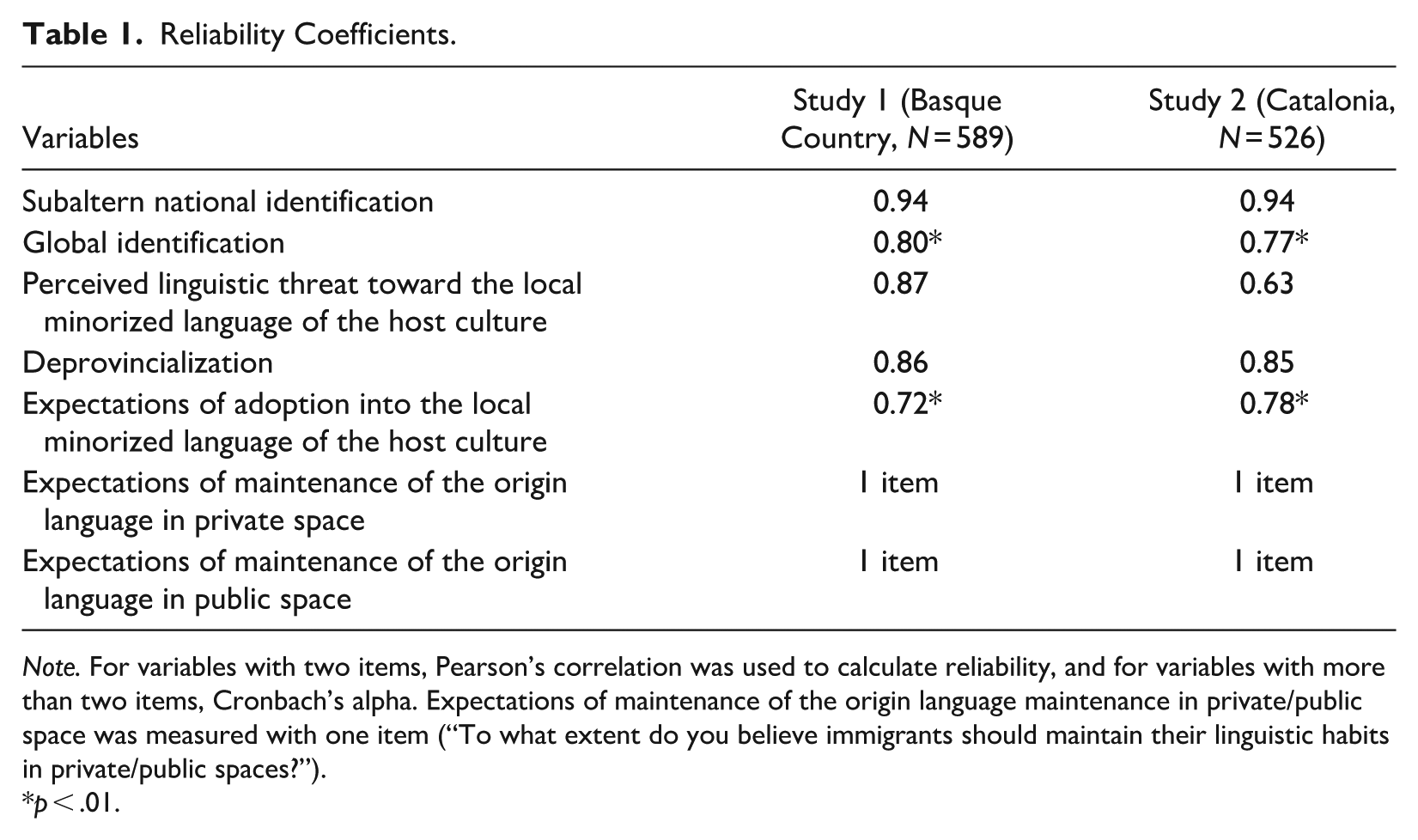
Note. For variables with two items, Pearson’s correlation was used to calculate reliability, and for variables with more than two items, Cronbach’s alpha. Expectations of maintenance of the origin language maintenance in private/public space was measured with one item (“To what extent do you believe immigrants should maintain their linguistic habits in private/public spaces?”).
p < .01.
To control for potential confounding effects, we tested our hypotheses by controlling for potential cofounding variables: age, gender, political and educational level. 3
Subaltern National Identification
Subaltern national identification in both samples was measured with six items, for example, “I feel a bond with Basque/Catalan people” (adapted from Verkuyten, 2009).
Global Identification
Global identification was assessed using three items, for example, “I feel like I’m from all over the world” (adapted from Der-Karabetian & Ruiz, 1997).
Perceived Linguistic Threat
The perceived linguistic threat toward the minoritized language of the host culture was measured using four items, for example, “The arrival of immigrants jeopardizes the use of Basque/Catalan language in Basque/Catalan society” (developed based on from the Out-group Threat Perception Scale, OTPS, Navas et al., 2012).
Deprovincialization
Deprovincialization was measured with three items, for example, “One should always try to take a broader perspective than just the perspective of one’s own national group” (adapted from Martinovic & Verkuyten, 2013).
Expectations of Linguistic Adoption into the Minoritized Language of the Host Culture
Two ad hoc items were created to measure expectations of linguistic adoption of the minoritized language in the territories, “Immigrants should make an effort to learn Basque/Catalan” and “Immigrants should speak Basque/Catalan whenever they have the opportunity.”
Expectations of Immigrants’ Maintenance of the Native Language in Private and Public Spaces
Expectations regarding immigrants’ maintenance of their native language in both private and public spaces were measured with one item each adapted from Taylor and Lambert (1996), respectively: “To what extent do you believe immigrants should maintain their linguistic habits in private space (at home, with one’s own people)?” and “To what extent do you believe immigrants should maintain their linguistic habits in public space (in the street, at leisure, at work, etc.)?.”
Analytical Strategy
We conducted all analyses using RStudio (RStudio Team, 2021) and employed the following packages: haven (Wickham et al., 2023) for importing SPSS files; psych (Revelle, 2018) for computing reliability estimates; apaTables (version 2.0.8, Stanley, 2021) for generating tables of correlations in APA format; lavaan (Rosseel, 2012) for confirmatory factor analysis and structural equation modeling; semTools (version 0.5.6, Jorgensen et al., 2022) for testing measurement invariance; and officer (version 0.4.0., Gohel, 2021b) and flextable (version 0.6.8, Gohel, 2021a) for exporting and formatting tables in Word documents. Additionally, we used base R functions for data manipulation and descriptive statistics.
In the analysis where model fit was evaluated, we used conventional goodness-of-fit criteria, with acceptable fit indicated by a Comparative Fit Index (CFI) of at least 0.90 and a Root Mean Square Error of Approximation (RMSEA) close to 0.06 (see Hu & Bentler, 1999).
Results
To test the main hypotheses, we conducted multi-group structural equation modeling (SEM) across two diglossic linguistic territories: the Basque Country and Catalonia. The model included subaltern national identification and global identification as latent predictor variables, perceived linguistic threat and deprovincialization as latent mediating variables, and three outcome variables: expectations of linguistic adoption in the minority language (latent variable) and expectations of heritage language maintenance in private and public domains (manifest variables, measured by single items). The mediating variables were allowed to correlate in the model. To assess indirect effects, we employed bias-corrected bootstrapping with 10,000 resamples to obtain confidence intervals.
As preliminary results, descriptive statistics and sample characteristics are reported in Table 2.
Means, Standard Deviations, and Correlations With Confidence Intervals in Study 1 (Basque Country, N = 589) and Study 2 (Catalonia, N = 526).
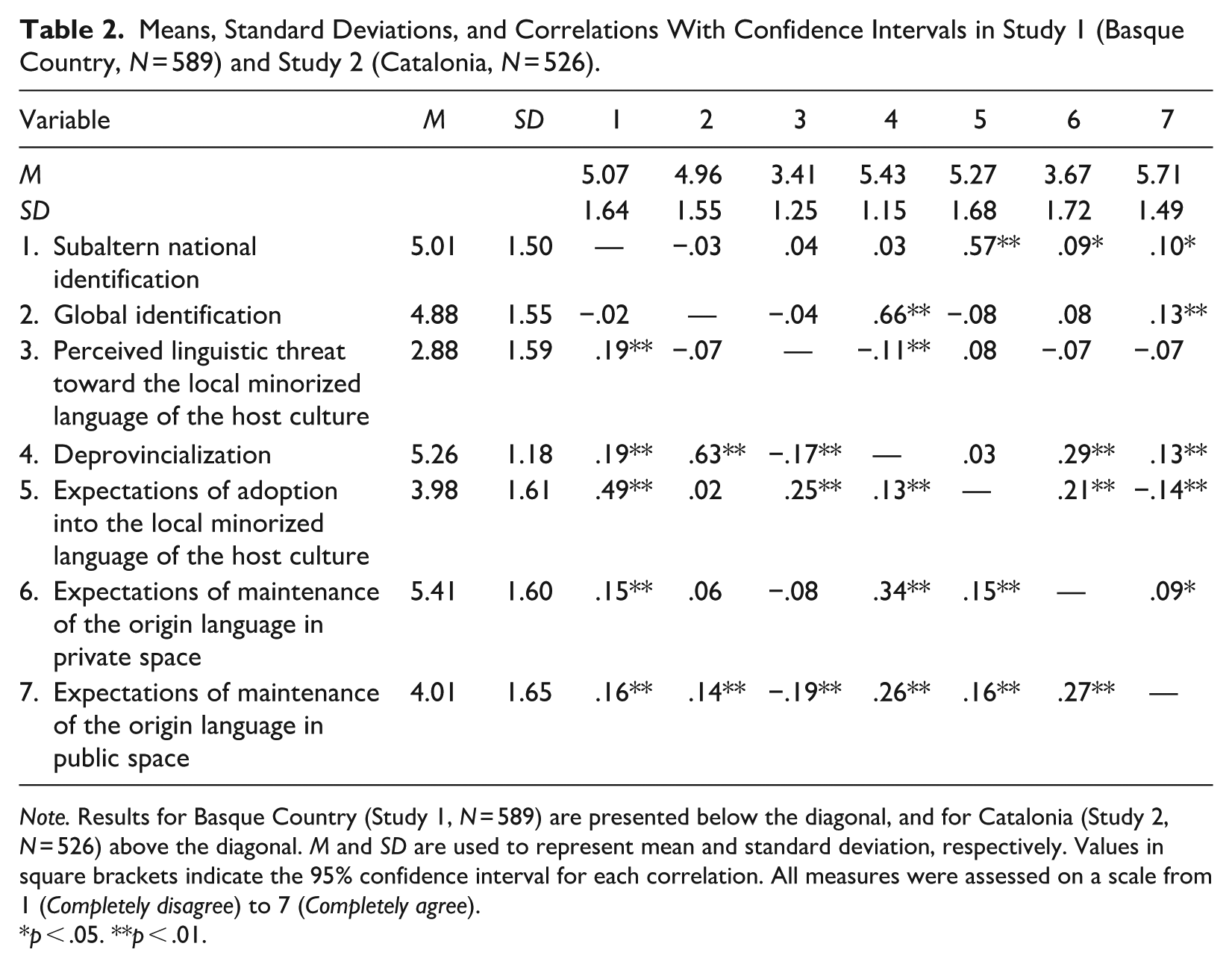
Note. Results for Basque Country (Study 1, N = 589) are presented below the diagonal, and for Catalonia (Study 2, N = 526) above the diagonal. M and SD are used to represent mean and standard deviation, respectively. Values in square brackets indicate the 95% confidence interval for each correlation. All measures were assessed on a scale from 1 (Completely disagree) to 7 (Completely agree).
p < .05. **p < .01.
The Measurement Model Invariance
To allow for comparisons between groups, we first investigated the equivalence of the measures used in both samples. We evaluated configural invariance (χ2(306) = 13,097.07, p < .001, CFI = 0.97, TLI = 0.97, RMSEA = 0.05, 90% CI [0.04, 0.05], SRMR = 0.04), obtaining an acceptable model fit (see Hu & Bentler, 1999). Subsequently, we evaluated the metric model, which included the restriction of factor loadings to be equal across the two samples. This model showed adequate fit (χ2(306) = 13,097.07, p < .001, CFI = 0.96, TLI = 0.96, RMSEA = 0.06, 90% CI [0.05, 0.06], SRMR = 0.05). To establish measurement invariance, we compared configural and metric invariance in the two samples using the thresholds of ΔCFI < −0.010; ΔRMSEA < 0.015; and ΔSRMR < 0.030 (Byrne & Stewart, 2006; Cheung & Rensvold, 2002) and the chi-squared difference test (Δχ2, p < .001). There was a significant difference between the metric and configural models, suggesting that at least one of the factor loadings was not invariant across the two samples.
Upon examining the item weights, we identified a discrepancy in standardized factor loadings for one item measuring perceived linguistic threat in two samples: (“The arrival of immigrants poses a threat to the survival of Basque/Catalan language”; λ = .890 in the Basque Country and λ = −.185 in Catalonia). We decided to eliminate this item, as its divergence could be linked to the more common use of Catalan in daily life in Catalonia in comparison to Basque Country. In other words, in these two contexts, language concerns about survival may operate independently from general linguistic threats.
After eliminating the problematic item, we re-evaluated the metric invariance of the revised model. The model demonstrated a satisfactory fit (χ2(272) = 12,273.82, p < .001, CFI = 0.98, TLI = 0.97, RMSEA = 0.05, 90% CI [0.04, 0.05], SRMR = 0.03). Comparison between the configural model and the adjusted metric model showed no significant differences (Δχ2 = 13.82, df = 12, p = .312; ΔCFI = −0.003, ΔRMSEA = 0.000, ΔSRMR = 0.006; Byrne & Stewart, 2006; Cheung & Rensvold, 2002). These findings support measurement equivalence between the samples from the Basque Country and Catalonia, ensuring that the evaluated measures are invariant and that structural trajectories in both populations can be validly compared.
Regression Path Invariance
To evaluate whether the regression paths between variables were invariant across groups, we defined and compared two models: one where all paths were freely estimated and another where all paths were constrained to be equal across groups. The chi-squared difference test revealed significant differences between these models (Δχ2=31.49, df = 11, p < .001), indicating that some regression paths were not invariant between the groups. Specifically, this suggests that certain relationships differed in strength or direction across the groups.
We then conducted a stepwise process to identify and release specific non-invariant paths. First, we released the path between perceived linguistic threat and subaltern national identification. While this partial model showed improvement, comparison with the unconstrained model still revealed significant differences (Δχ2 = 22.98, df = 10, p = .011). Subsequently, we released the regression path between deprovincialization and subaltern national identification. The comparison between this revised partial model and the unconstrained model yielded non-significant differences (Δχ2 = 8.64, df = 9, p = .471), indicating adequate model fit. This final model demonstrated partial invariance, where most paths remained invariant across groups except for the two released paths involving subaltern national identification.
With the release of the two specific paths (deprovincialization—subaltern national identification and perceived linguistic threat—subaltern national identification), the revised model showed a satisfactory fit (χ2(342) = 12,701.17, p < .001, CFI = 0.97, TLI = 0.97, RMSEA = 0.05, 90% CI [0.04, 0.05]). This adjustment allowed us to examine the direct, indirect, and total relationships between the variables in the Basque Country and Catalonia using standardized coefficients. 4
Total Effects
There was a significant positive effect of subaltern national identification on expectations of linguistic adoption of the minority language of the host culture in both territories (H1a supported). Subaltern national identification was positively associated with expectations regarding the maintenance of the language of origin in both public and private spaces in both territories, but not in private spaces (H1b supported). The relationship between global identification and expectations of linguistic maintenance in both private and public spaces was statistically significant in both territories (H1c supported; Table 3; Figure 1).
Multigroup SEM Analysis: Direct, Indirect and Total Effects Across Studies 1 (Basque Country, N = 589) and 2 (Catalonia, N = 526).
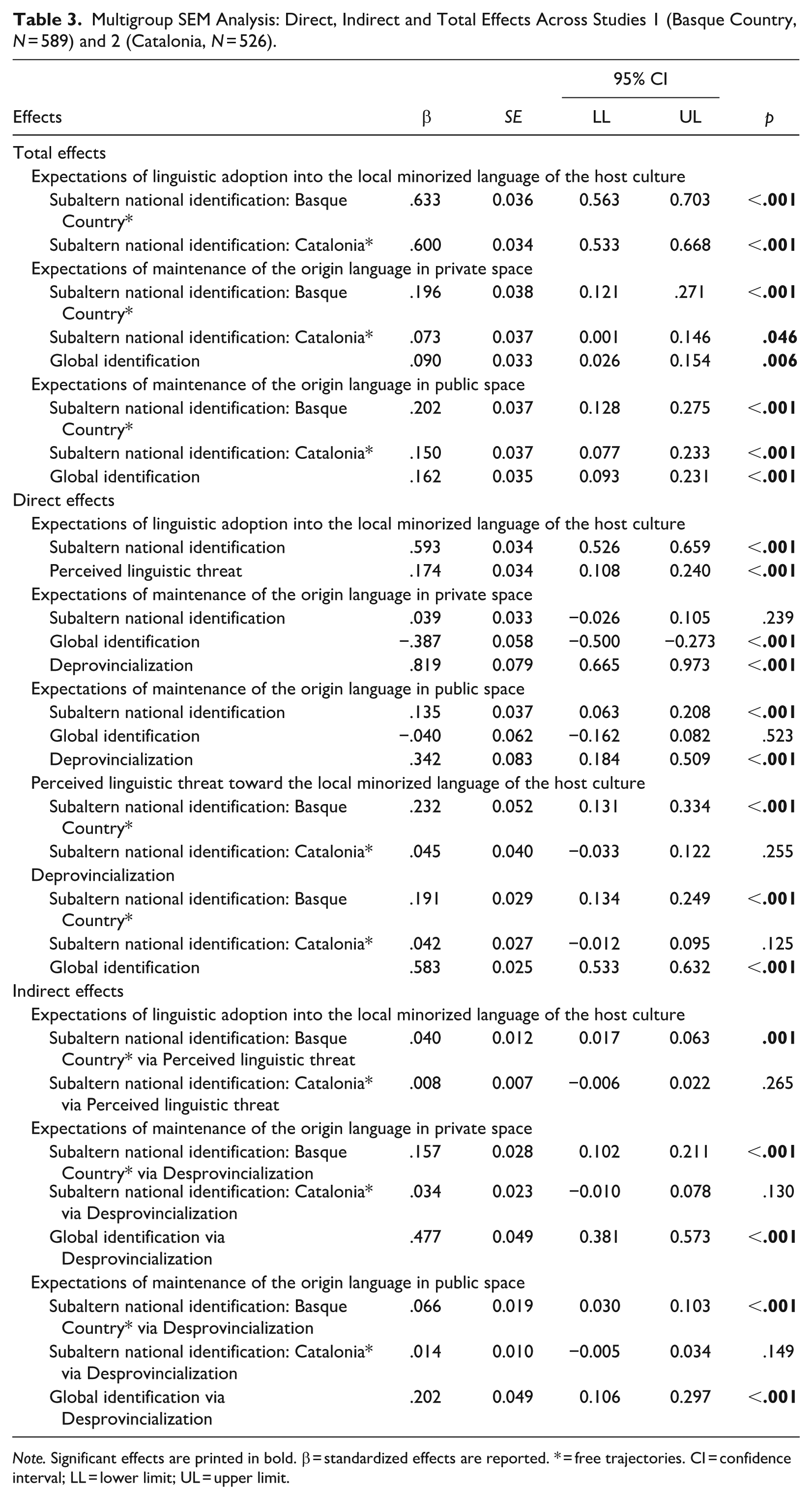
Note. Significant effects are printed in bold. β = standardized effects are reported. * = free trajectories. CI = confidence interval; LL = lower limit; UL = upper limit.
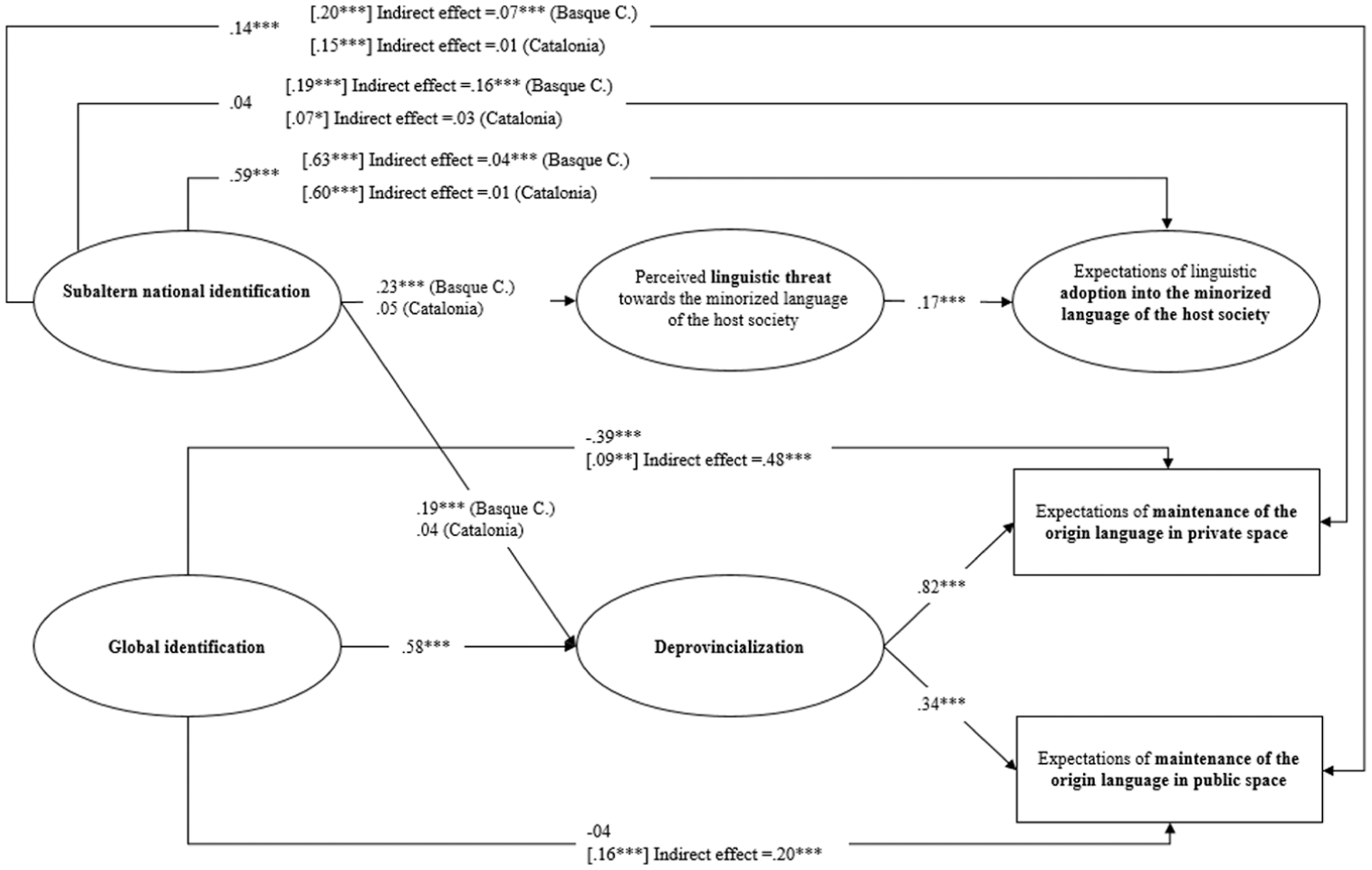
Multigroup SEM analysis: Direct, indirect and total effects across studies 1 (Basque Country, N = 589) and 2 (Catalonia, N = 526).
Indirect Effects
The indirect effect between subaltern national identification and linguistic adoption expectations toward the minority language of the receiving culture through perceived linguistic threat was positive in the Basque Country, but not statistically significant indirect effects were found in Catalonia (H2 partially supported). Regarding the relationship between subaltern national identification and expectations of maintaining the original language in the private space and public space, there were positive indirect effects through deprovincialization in the Basque Country, but not in Catalonia (H3a partially supported). The indirect effects between global identification and expectations of linguistic maintenance in private and public spaces were positive in both territories (H3b supported) 5 (Table 3; Figure 1).
Discussion
In immigration contexts, understanding the acculturation expectations of host communities is essential for building plural and diverse societies. In bilingual diglossic contexts, it is crucial to understand the identities that emerge around the structural, political, and relational power dynamics affecting coexisting linguistic communities and languages use. These dynamics not only affect how people express their identities and languages use but also play a key role in preserving the ethnocultural and linguistic vitality of both native and immigrant cultures. Our results revealed consistent patterns regarding the relationship between identifications and linguistic expectations in host cultures. Specifically, stronger subaltern national identification was associated with higher expectations for migrants to adopt the minority language of the host culture, while simultaneously supporting the preservation of migrants’ heritage languages. However, these effects differed in strength per context. Similarly, global identification emerged as a positive, and consistent strength across territories, a predictor of linguistic maintenance expectations. Notably, the mediating effects varied between the two contexts, with perceived linguistic threat and deprovincialization processes being significant only in the Basque Country (Study 1), but not in Catalonia (Study 2). These findings suggest that while certain patterns of linguistic expectations derived from the strength of group identifications may be consistent across bilingual societies, the underlying mechanisms can vary depending on the specific sociolinguistic context.
Localism and Globalization in Expectations Toward Linguistic Acculturation
The literature has shown that national identities are often linked to expectations of linguistic assimilation (Montaruli et al., 2011; Montreuil & Bourhis, 2004). In diglossic contexts, expectations regarding the adoption of the local minority language have sometimes been interpreted as an assimilationist demand, accusing subaltern national identities of identity closure and of imposing an exclusionary linguistic requirement for community integration. The adoption of the dominant local language is perceived as more effective at an instrumental level for accessing employment, education, and social and cultural participation (Kymlicka, 2001; Lapresta-Rey, Caballé Morera, Huguet, & Janés i Carulla, 2019; Verdía-Varela et al., 2020). As a result, the subaltern language is often relegated to a secondary position, where learning it becomes a decision motivated more by intrinsic reasons than by necessity (Uranga et al., 2023).
Our results indicate that the total effects of subaltern national identification on expectations regarding the adoption of the minoritized local language and the maintenance of heritage languages were positive. These findings align with previous studies suggesting that subaltern identity is not limited to demanding the adoption of the local minority language in a homogeneous and exclusionary manner, that is, as an assimilationist acculturation expectation (Montaruli et al., 2011). On the contrary, subaltern identities can combine the expectation of learning the local language with the promotion and recognition of the allophone languages spoken by immigrant communities. However, in the case of Catalonia, the observed means were not particularly high: maintenance scores are slightly above the midpoint of the scale, indicating that, although there is general support for linguistic integration and the maintenance of the heritage language, the trend is neither strong nor uniform. This suggests that the results should be interpreted with caution and that expectations toward the local minority language and immigrants’ languages of origin reflect hierarchies of importance rather than a clear pattern of integration. From this perspective, linguistic pluralism is perceived as a value that enriches both the immigrant community and the host culture.
Nevertheless, our results suggest that, in Catalonia, individuals with a strong subaltern national identification show strong support for the maintenance of the heritage language in both spheres, with a descriptively stronger association in the case of support of language maintenance in the public sphere. This trend can be interpreted in light of the Catalan sociopolitical context, in which language has historically been a central axis of political mobilization, collective identity, and the defense of rights (Pujolar, 2007; Woolard, 2016). The public sphere is configured as the space where languages are made visible, negotiated, and legitimized, and where social pressure for their recognition is greater. In this sense, language maintenance is not conceived merely as a communicative practice, but also as an act of identity affirmation and the defense of collective rights (May, 2012). By contrast, in the private sphere, language use is often perceived as a matter of individual choice, less regulated and carrying less normative weight. Both society and academic research tend to avoid issuing prescriptive judgments about linguistic practices within the family or intimate domain, which may explain the weaker emphasis on maintenance expectations in this space. The comparison with the Basque case adds an interesting nuance: there, the social vitality of Basque in everyday life is more limited (Altuna Zumeta et al., 2022; Cenoz & Gorter, 2006), which may encourage stronger expectations of language maintenance in the private sphere, understood as a refuge or a more protected space for intergenerational transmission. In this way, territorial differences suggest that the relative weight of the public and the private in maintenance expectations depends not only on individual factors, but also on the sociopolitical status of the minority language and its degree of institutionalization (Heller, 2008).
Nonetheless, in the context of linguistic acculturation expectations for integration, the adoption of the minoritized local language holds greater importance for host cultures in diglossic settings. These expectations may be rooted in the desire to ensure the survival of the minoritized local language and are combined with expectations of inclusion and integration that align with attitudes of alliance and solidarity among subaltern groups (Goikoetxea, 2015), including acculturation processes (García et al., 2017; Sáenz-Hernández et al., 2020).
Regarding the relationship between global identification and expectations of language maintenance, previous literature has shown that people with strong global identification tend to adopt favorable attitudes toward cultural diversity and are more open to intercultural experiences (Reese et al., 2019; Sparkman & Hamer, 2020). Our research further extends this literature by showing that global identification was linked with support of the maintenance of allophonic languages in both public and private spheres, although additional mechanisms are required for this openness to materialize.
Our findings therefore suggest that there might be similarities between local identities, such as subaltern ones, and global identities. Both forms of identification share a disposition toward integration of immigrant language communities, albeit with different emphases and mechanisms. Individuals with stronger subaltern identification tend to hold expectations of linguistic integration: they are more supportive of immigrants adopting the local minority language, and they also show support for, although to a lesser extent, creating spaces for the openness to the recognition and visibility of allophonic languages. This dual approach appears to be the most consistent with Berry’s (2005) theoretical framework and his bidirectional model.
Role of Perceived Linguistic Threat Toward the Local Minority Language of the Host Culture and Deprovincialization
Previous studies have demonstrated that perceived linguistic threat (Stephan et al., 2005; Tip et al., 2012) and deprovincialization (Cárdenas & Verkuyten, 2021; Mepham & Martinovic, 2018) play a crucial role in shaping acculturation expectations toward immigrant communities. Linguistic threat has been linked to assimilationist acculturation orientations (Florack et al., 2003; Vezzali & Giovannini, 2010), as well as leading to lower support for multiculturalism (Velasco González et al., 2008). Deprovincialization has been associated with greater openness and acceptance of outgroups (Pettigrew, 2011) and with positive attitudes toward cultural diversity and multilingualism (Cárdenas & Verkuyten, 2021; Mepham & Martinovic, 2018). In our studies, the indirect effects of each mechanism varied in each diglossic bilingual context. This divergence highlights how territorial sociolinguistic dynamics influence the psychological mechanisms underlying the relationship between identifications and linguistic acculturation expectations.
The results revealed clear territorial differences in the mediating mechanisms linking subaltern identification and acculturation expectations. In the Basque Country (Study 1), both perceived linguistic threat and deprovincialization emerged as significant mediating mechanisms, whereas in Catalonia (Study 2), these mechanisms were not significant. These differences can be understood considering the distinct levels of ethnolinguistic vitality and institutional status of the minoritized languages in each territory. In the Basque Country, a territory characterized by low ethnolinguistic vitality (Altuna Zumeta et al., 2022), the local linguistic community is particularly vulnerable to sociodemographic changes that may affect subaltern national identities and minoritized languages, generating imbalances across linguistic, social, and political dimensions (Joppke & Seidle, 2012). In fact, the European Language Equality Network (ELEN), in its 2024 General Assembly, declared that Basque and the Basque-speaking community are currently in a situation of linguistic emergency, exacerbated by globalization, mobility, and the increasing digitalization and commodification of everyday life (Euskalgintzaren Kontseilua, 2025). In this context, it is reasonable to expect that perceptions of linguistic threat among Basque speakers translate into defensive or resistant attitudes, including stronger acculturation expectations regarding the adoption of the local minoritized language. In Catalonia, by contrast, perceived linguistic threat did not emerge as a significant mediator, likely due to the more normalized use of Catalan and its strong institutional presence (Generalitat de Catalunya, 2019). Although habitual use of Catalan has declined among the general population (32.6% compared to 36.1% in 2018), particularly among individuals born outside Catalonia (8.6% regular use), Catalan continues to be widely understood (93.4%), habitually spoken (80.4%), read (84.1%), and written (65.6%; Generalitat de Catalunya, 2019, 2023). Moreover, the implementation of active language policies, such as the National Language Pact with a budget of 255 million euros through 2030 (Generalitat de Catalunya, 2025), together with the strong institutionalization of Catalan in education and public administration, provides the local linguistic community with the capacity to demand its use as a criterion for integration, thereby attenuating the role of perceived linguistic threat as a mechanism linking subaltern national identification and expectations of adopting the minoritized language.
Our findings highlight how the role of linguistic threat varies across sociolinguistic contexts. While in the Basque Country linguistic threat is positively associated with defensive attitudes in favor of the adoption of the local language, in Catalonia the association is smaller. Importantly, multigroup SEM analyses indicated that these correlations are statistically equivalent across the two contexts, meaning the difference in the strength of these effects is not significant (even though the correlation in the Basque Country reached statistical significance and the one in Catalonia did not). Both correlations are positive, though small, which underscores that statistical significance in one context but not another does not imply the absence of a relationship. This pattern suggests that the mediating effect of perceived linguistic threat is context-dependent: where the vitality of the minority language is fragile, threat may act as a mobilizing factor, whereas in contexts where the language is strongly normalized and institutionally supported, other factors—such as everyday practices and institutional policies—may play a more central role, reducing the relative influence of perceived threat. The mediating effect of deprovincialization between subaltern identification and expectations of linguistic acculturation through maintenance also varies by territory. In the Basque Country, the mediating effects of deprovincialization (again, relatively small in sizes, so needed to be interpreted with caution) could be possibly explained by a process of constructing a subaltern Basque identity closely tied to internationalist solidarity and the convergence of struggles for the preservation of the cultural and linguistic rights of minorities both inside and outside the Basque Country. This perspective aligns with studies suggesting that subalternity fosters alliances with other subaltern groups (Goikoetxea, 2015). Linguistic fragility, combined with historical marginalization, fostered a form of national identification more aligned with solidarity with other minority struggles, thus explaining why deprovincialization serves as an important mediating mechanism between Basque identity and attitudes. In the Catalan case, deprovincialization did not prove to be a significant mediator, reinforcing the idea that the ways in which national identity is constructed in a given territory, arising from a position of cultural and linguistic strength, as well as its sociopolitical context, may not sufficiently broaden the perspective to seek alliances with other subaltern groups, since Catalan identity already enjoys a position of prominence within the territorial sociopolitical context. Exploring the level of intergroup contact (Pettigrew, 1998) and the KOF index of globalization (Dreher et al., 2008) in each territory could offer valuable insights. Investigating these variables would provide a more comprehensive view of the dynamics shaping the relationships between identities and expectations of linguistic acculturation, specifically, they could reveal how frequent interactions between different linguistic groups influence expectations regarding the maintenance of allophone minority languages.
Regarding global identity, our study confirms the role of deprovincialization in expectations for the maintenance of minority languages. Without the mediating effect of deprovincialization, global identities do not seem to be able to predict support for language maintenance expectations, as the indirect effect of deprovincialization suppresses the direct negative effect on expectations for maintaining immigrants’ languages of origin and turns it into a positive total effect. Although Ariely (2017) shows that global identity is associated with lower levels of xenophobia, he also shows that its intensity varies depending on the degree of globalization of a territory (Dreher et al., 2008). In our study, in the specific case of expectations for language maintenance in the private sphere, they have contrary expectations toward linguistic integration. Although we had hypothesized that global identification would favor positive attitudes toward language maintenance—in line with previous studies linking it to favorable attitudes toward cultural diversity (Hasbún López et al., 2019; Reese et al., 2019; Sparkman & Hamer, 2020) and studies that, in terms of acculturation, had shown that they lead to assimilation into the majority group, but also to favorable attitudes toward adopting cultural elements from others in the host culture (Kunst et al., 2023)—our results would qualify these findings. Specifically, in the research by Kunst et al. (2023), they showed that greater global identification predicts more inclusive attitudes in terms of acculturation, reflected in greater political support for migration and greater adherence to multiculturalism from the perspective of host cultures. In our study, however, when the mediating effect of deprovincialization is not considered, global identification is associated with a lower willingness to support the maintenance of cultural and linguistic practices of immigrant groups. In other words, without the indirect effect of deprovincialization, global identity seems to favor forms of integration that involve changes in majority groups (Kunst et al., 2023) but not necessarily attitudes of recognition of minority rights. In this sense, integration promoted from global identity is not understood as the parallel preservation of multiple singularities, but as a process of mutual rapprochement that tends to reduce intergroup distances. On the linguistic level, this can translate into a preference for shared vehicular languages and, consequently, a lower inclination to support the maintenance of minority languages. In other words, global identity promotes inclusive and open attitudes, but under a logic of linguistic and cultural homogenization, which can render the cultural and linguistic rights of minorities invisible. It is through the effect of deprovincialization that these linguistic differences are recognized and supported.
Limitations and Future Research
One of the main limitations of this study is that the data obtained is correlational in nature, meaning that causal relationships between the analyzed variables cannot be established. To overcome this limitation, future studies could employ experimental or longitudinal designs that allow for the observation of changes over time or the manipulation of certain variables to examine their direct effects. Moreover, some scales consisted of a small number of items or even relied on single-item indicators. This poses potential methodological and psychometric limitations, as such instruments may not fully ensure reliability or capture the multidimensional nature of the constructs examined. Future research should aim to develop and validate more robust measurement tools to strengthen the methodological rigor of studies in this field. Another significant limitation is that expectations regarding language maintenance were measured using only one item for each space, that is, one for the public space and another for the private space. This simple measurement does not capture the complexity and nuances of linguistic expectations in each context. A more detailed and multidimensional measure of language maintenance expectations in both spaces could have provided a more comprehensive and accurate view of attitudes toward the preservation of allophonic languages. Finally, the measure of expectations regarding the adoption of the local minority language did not differentiate between public and private contexts. The adoption of a language in the public sphere is often influenced by factors such as functionality, social utility and official regulations, whereas in the private sphere, language-use decisions may be more related to identity, a sense of belonging, and cultural preservation. By not distinguishing between these two spaces, the complexity of linguistic adoption expectations cannot be fully captured.
Finally, future research should consider taking into consideration factors such as beliefs about ethno-linguistic vitality (Azurmendi & Bourhis, 1998), the instrumental value or perceived usefulness of language as a tool for cultural inclusion (Davis, 1989), linguistic identity (Azurmendi & Bourhis, 1998), and social norms could provide a clearer view of how different elements shape expectations regarding the adoption of the minoritized local language. These factors would help to better understand the social and structural beliefs of each individual and how they interact to shape expectations toward linguistic acculturation in each specific context.
Practical Implications
In societies where different cultural and linguistic communities coexist, with multiple identities and asymmetric relationships among them, safeguarding minority languages—both autochthonous and allophonic—is a complex task. Language policies must address two complementary dimensions: the adoption of minority languages by new inhabitants and the maintenance of allophonic languages within immigrant communities, fostering true linguistic integration tailored to each sociolinguistic reality. This includes access to free courses in different minority languages, the creation of initiatives that promote their use, and the adoption of measures to ensure their presence in the media and public spaces. Additionally, it is essential to eliminate exclusionary educational structures where there are barely any intergroup relationships between the linguistic community of local minoritized languages and immigrant communities, as is the case in some charter or private schools, among other actions. Additionally, it is important to analyze possible synergies and alliances between subaltern identities and communities (both autochthonous and allophonic) and create spaces where they can mutually recognize each other, as subaltern identifications have shown approaches to linguistic integration. Creating spaces for these alliances involves recognizing the existing power and privilege dynamics, as well as the position held by each identity or subaltern group. It is not just about being aware of who is disadvantaged within the power structure but also about allowing that awareness to guide us in building genuine and respectful relationships with others. Recognizing discomfort in this process is a sign of understanding how the dominant system imposes forms of oppression and privilege. The potential of these sensations lies in their transformative power.
Conclusions
Subaltern identities are associated with a greater expectation that migrants will adopt local minoritized languages while also maintaining their origin languages in the host context. In this process, the perception of linguistic threat and deprovincialization may function (in some contexts) as explanatory mechanisms for this relationship. Meanwhile, global identification also supports the preservation of migrants’ origin languages, although in this case, deprovincialization is the main mechanism explaining this relationship.
Footnotes
Acknowledgements
This research was carried out in collaboration with the NGO SOS Racism-Gipuzkoa, an organization dedicated to promoting the expansion of rights for immigrants and fighting against racism and discrimination in host societies. In particular, we acknowledge the financial support provided by the Provincial Council of Gipuzkoa and the Basque Government to cover the data collection through the panel surveys conducted. Likewise, we would like to express our gratitude for the funding received from the University of the Basque Country (UPV/EHU) through the predoctoral scholarship awarded to the first author (Grant Number: PIF21/13). Magdalena Bobowik was funded by the Ramón y Cajal Program (Grant Number: RYC2021-032887-I), financed by MCIN/AEI/10.13039/501100011033 and the European Union Program NextGenerationEU/PRTR, and participated in this research as a member of the Consolidated Research Group “Culture, Cognition, and Emotion” (Grant Numbers: IT1187-19 and IT1598-22) supported by the Basque Government.
Author Contributions
Leire Amenabar-Larrañaga (https://orcid.org/0000-0003-2776-5700): Conceptualized and designed the study, led the study’s overall execution, including data collection and analysis, and wrote the initial draft and final manuscript. Additionally, she was responsible for the critical revisions and integration of feedback throughout the writing process. Maitane Arnoso-Martínez (https://orcid.org/0000-0001-8606-749X): Conceptualized and designed the study, contributed to data collection, wrote several sections of the manuscript, including the discussion, and critically revised the manuscript. Mirjana Rupar (https://orcid.org/0000-0003-0240-7886): Supervised the statistical analyses, assisted the first author in the analysis process, wrote several sections of the manuscript, and critically revised the manuscript. Magdalena Bobowik ( ): Collaborated in the conceptualization and the design of the study, contributed to the discussion, wrote several sections of the manuscript, and critically revised the manuscript.
Declaration of Conflicting Interests
The authors declared no potential conflicts of interest with respect to the research, authorship, and/or publication of this article.
Funding
The authors received no financial support for the research, authorship, and/or publication of this article.
Ethical Considerations
This research was conducted with the approval of the Ethics Committee for Research on Human Subjects (CEISH) of the University of the Basque Country (UPV/EHU; Report Number: M10/2020/162). We confirm that the research reported in this manuscript has been conducted in accordance with the APA Code of Conduct and the University of the Basque Country Research Ethics Committee.
Consent to Participate
All participants consented to their participation in the study, in accordance with the provisions of the General Data Protection Regulation (EU-2016/679).