



Abstract
At 2 years of age, children around the world are eager to help adults. Later, however, children’s helping motivations take different developmental paths: Whereas Western children often resist contributing to housework, in many Indigenous Latin American societies older children contribute on their own initiative. To better understand the early origins of these cross-cultural differences, we video-taped and analyzed 2.5-year-olds’ (N = 69) helping and maternal structuring during mealtime preparation in Kichwa Indigenous (KI) families in an Andean rural context (Cotacachi, Ecuador) and in Münster middle-class (MMC) families, an urban Western context in Germany. Unexpectedly, MMC children showed more helping than KI children, who participated more by observing. MMC mothers provided more structuring, including more requests, that were also more likely to be formulated as questions and in a less assertive manner, and they were more controlling while children helped than KI mothers. Furthermore, although acknowledging children’s helping to similar degrees, KI mothers more often thanked children and used relational praise (emphasizing children’s sense of community), while MMC mothers more often used autonomous praise (emphasizing children’s capacities). Overall, these findings suggest that children’s eagerness to help is transformed through the culture-specific ways in which helping opportunities are structured.
Keywords
Toddlers all over the world are eager to help adults and participate in their activities, as has been found in lab studies (Callaghan et al., 2011; Giner Torréns & Kärtner, 2017; Köster et al., 2016; Rheingold, 1982; Warneken & Tomasello, 2006), as well as ethnographic records (Lancy, 2020; Rogoff, 2003; Whiting & Whiting, 1975). Around 2 to 3 years of age, children are at a seemingly universal developmental stage that is characterized by eagerness to get involved and cooperate in mature activities going on around them, which Lancy (2020) calls the helper stage. By middle or late childhood, however, children’s helping motivations seem to take different developmental paths, depending on the cultural context in which they grow up: Whereas in many small-scale non-Western societies older children contribute to housework on their own initiative and feel fulfilled when doing so (for a review, see Lancy, 2020), research with Western families has shown that children often resist contributing to housework, which often represents a source of friction among family members (Alcalá et al., 2014; Coppens & Rogoff, 2021; Klein & Goodwin, 2013; Lancy, 2020). This developmental puzzle leads to the inquiry: What cultural differences explain the differential development of children’s motivations to help? To address this question and further understand the early origins of the mentioned divergent culture-specific developmental pathways, the focus of the current study is on children’s helping behaviors and maternal structuring of children’s experience and behavior at the helper stage, in two different cultural contexts: Cotacachi (Ecuador), an Andean Indigenous rural context, and middle-class families in Münster (Germany), an urban Western context.
Ethnographic record suggests that Kichwa children, both girls and boys, help with all types of housework, including cooking, sweeping, washing clothes, caring for younger siblings, taking care of crop fields, or feeding animals (del Pozo, 2003; Rindstedt, 2000; Terán Maigua, 2014). This is in line with researchers’ observations in further Andean Indigenous (Bolin, 2006; Mezzenzana, 2020; Ochs & Izquierdo, 2009) and Mayan-heritage Indigenous communities (Rogoff, 2003) in Latin America. In a series of studies, sociocultural researchers studying ecological questions on children’s development of helping analyzed the differences in children’s contributions at home among Indigenous-heritage families and Western (or Western influenced) families. For instance, Alcalá and colleagues (2014) found that 6- to 8-year-old Indigenous children from a Mexican community were more likely to do housework without being requested than children from a cosmopolitan Mexican community, in which families had extensive experience with Western schooling. Furthermore, Indigenous-heritage children engaged in more complex tasks, and they did so for the benefit of the whole family (e.g., sweeping the floor, washing dishes) versus for their own benefit (e.g., cleaning one’s own room). In another study, when asked about their contributions at home, 9- and 10-year-old Latin American Indigenous children reported that they wanted to help at home and viewed housework as a “shared responsibility of everyone in the family” (Coppens et al., 2014, p. 116; see also Bolin, 2006). By contrast, children at the same age in Western societies seldomly wanted to contribute to family housework, often resisting their parents’ requests (Klein & Goodwin, 2013; Lancy, 2020). This is as well the case in Germany, as shown by a study by Zeiher and Zeiher (1994) conducted in West Berlin, in which they examined 10-year-old children’s daily activities, in the course of 7 days, and found that they were almost never engaged in housework. Moreover, in 2000, Hengst and Zeiher reported a historical decline in children’s contributions to family housework in Germany, explained in part by the changes in parents’ socialization agenda, that intently pursues the promotion of school-based learning (even in informal settings) at the expense of children’s contributions at home.
It is well known that children’s (pro-)social development is informed by the experiences made during social interaction (Carpendale et al., 2013; Kärtner et al., 2020), with their primary caregivers playing a key role in the first years of life. In line with the ecocultural model of child development (Keller & Kärtner, 2013), culture-specific parental socialization goals have an influence on parental behaviors that, in turn, influence children’s daily life experiences, and thus, their behaviors and motivations. Accordingly, we assume that culture-specific social experiences progressively build and shape children’s prosocial behavior and motivation, which explains the aforementioned culture-specific patterns in older children. In order to comprehend the early origins of these divergent culture-specific patterns, in the current study, we analyzed parents’ culture-specific structuring at the core of the helper stage (2–3 years), since children’s attempts to contribute are particularly sensitive to social influences at the age of emergence (Kärtner et al., 2021).
In the following section, we examine the culture-specific values and expectations attached to children’s collaboration in housework in the two cultural contexts of interest, as understanding them is crucial to gain a broader understanding of culture-specific parental structuring of children’s contributions.
Cultural Differences in Values and Expectations on Children’s Collaboration in Housework
In many Indigenous communities of Latin America, work is attached to a sense of pride and dignity (Bolin, 2006) and seems not to be viewed as an onerous obligation. As reported by Cardoso Jiménez (2015), even when conducting heavy work, Indigenous people show the ability of creating an agreeable atmosphere of joy, coexistence, and social harmony (see also Bolin, 2006). This seems to be a characteristic manner of approaching work, since in a study by Terán Maigua (2014), Kichwa elders reported to expect children to learn to work with joy. For Kichwa people, cooperation within housework represents a moral good, as is reflected in many traditional fables that highlight the dangers of refusing to fulfill one’s household duties (Miles, 1994). Furthermore, shared work represents a way of belonging and binding to the community (Coppens et al., 2014), where the fundamental principles of the Andean philosophy of relationality (i.e., every living being or thing is interconnected to something; thus, no entity exists on its own) and reciprocity (i.e., a universal principle of justice indicating that contributions ought to be made as all are able to the shared, collective endeavors that support families and communities) become tangible (Bolin, 2006; Cardoso Jiménez, 2015; Estermann, 2015). Consequently, children are expected not only to contribute to chore completion with initiative and autonomy but also to internalize traditional cultural values through their participation in collaborative work (Terán Maigua, 2014). Regarding the expectations that elders have concerning the tasks and the age at which children should help, Terán Maigua (2014) found that Kichwa elders expect children from very early to help adults when necessary—with household chores, running errands, taking care of the crops, or participating in mingas (i.e., communal work).
By contrast, housework does not seem to have a positive connotation in Western societies. As Zelizer (1985) pointed out, in the Western culture, there is a general conflict between labor and doing something “for love.” In her historical review of the United States, Zelizer (1985) argued that during the 1930s the image of childhood shifted from being associated with work and profit to sentimentality, affection, and education, which caused that young children become seldomly expected to engage in housework. Indeed, in a more current study by Alcalá and colleagues (2014), mothers from Westernized communities often talked about housework as an undesirable task and not the responsibility of their children. Further research showed that Western parents do not expect children to do regular contributions at home until middle or late childhood (Alcalá et al., 2014; Köhne, 2003). In a 2020 national German survey (Institut für Demoskopie Allensbach, 2020), parents set the age at which children should start beginning to contribute to household chores at 6.5 years on average. In addition, when it becomes time for parents to expect their children to contribute at home, children are expected to contribute to self-care chores in opposition to chores that benefit other family members (Alcalá et al., 2014; Klein & Goodwin, 2013; Ochs & Izquierdo, 2009), since expecting children to do work caused by others is often considered unfair (Coppens et al., 2016). Overall, it seems that, in Western cultural contexts, housework is regarded as the antithesis of a desirable activity, and not as a space that provides the opportunity to exchange and connect with others, as in many Indigenous communities (see Cardoso Jiménez, 2015).
Two Ways of Viewing Children’s Autonomy When Contributing to Housework
Children’s autonomy is strongly valued and promoted in both Andean Indigenous communities (García, 2015) and German families (Keller, 2007). However, it is important to note that the understanding underlying the concept of children’s autonomy differs across both cultural contexts. The Andean Indigenous concept of autonomy is understood as “progressively wielding more and more capabilities of agency aimed at well-being and a good life for one’s family and oneself” (García, 2015, p. 143). Thus, gaining autonomy is inextricably attached to serving one’s family or community (e.g., contributing to housework or community work) and can entirely coexist with being cooperative with whatever elders expect. Indeed, children’s cooperation and autonomous motivation, directed toward understanding when and how to best help and advance shared goals and endeavors, are highly expected in the Kichwa culture (Terán Maigua, 2014). This strongly contradicts Western conceptions of autonomy as pursuing own personal interests and being independent from others. In Germany, the promotion of children’s autonomy is strongly emphasized by a historical-political and philosophical tradition (Schroedter, 2007) and is tightly associated with the capacity of critical thinking and freedom of choice, which is expressed as the antithesis of being obedient and submissive. This antithesis is corroborated by empirical findings that showed that children’s autonomy and obedience are often positioned as opposite poles by German parents (Köhne, 2003).
In line with these thoughts, housework for the benefit of the whole family is viewed as a sign of autonomy and maturity in Indigenous communities, where children are welcome and integrated in all sorts of adults’ endeavors in a collaborative way (Coppens et al., 2014), and where children are expected to be acomedidos (comedidos in Ecuador), that is, to be alert to whenever help is needed and to take initiative to help without being asked (Rogoff & Coppens, 2022). In contrast, in many Western cultural contexts, children are expected to contribute with self-care chores, engaging in solo-activities, in opposition to chores that benefit the whole family (Alcalá et al., 2014; Klein & Goodwin, 2013; Ochs & Izquierdo, 2009), since expecting children to contribute to work that benefits others is often considered unfair (Coppens et al., 2016).
Cultural Differences in Parental Socialization Practices
Learning by Observing and Pitching In and Assembly Line Instruction Learning Paradigms
Rogoff (2014) uses the contrasting concepts of LOPI (learning by observing and pitching in) and ALI (assembly line instruction) to explain the different learning paradigms of many Mayan Indigenous-heritage communities in comparison to many middle-class U.S.-American communities (and Mexican communities with extensive Western schooling), respectively. LOPI is characterized by a learning approach in which children at all ages are integrated in shared community endeavors, where their learning is based on active observation and children’s spontaneous contributions are welcome and acknowledged. Elders’ behavior is characterized by trusting children’s initiatives and showing less verbal controlling guidance; evaluation occurs rather through success or correction of the contribution than through praise. Contingent rewards are seldomly used in order to foster children’s helping actions; however, children might be praised for their contribution in a more indirect way by using encouraging comments or rewards (e.g., see domingos, Coppens & Alcalá, 2015) to acknowledge the role of the child as a contributor within the family or community (see relational praise below). On the contrary, ALI is characterized by a learning approach where children do not just join in the endeavor, but elders organize children’s initiatives and control their attention and behaviors by using step-by-step explanations and, overall, greater controlling guidance. Praise is often used in order to keep children on task and motivated, and thus, it is not only used to build up children’s self-esteem but also to keep children engaged in the task at hand (see also P. J. Miller & Cho, 2018). Based on Lancy (2017, 2020), this indeed represents a prototypical parental strategy in Western societies, where parents tend to constantly recognize all sorts of children’s small accomplishments. Regarding the use of spoken language, whereas ALI strongly relies on language, because learning is organized through elders’ explanations, requests, warnings, etc. (see also Lancy, 2020), LOPI relies more on nonverbal interaction (indeed, Sánchez-Parga [2010, p. 123] described KI people as “quiet, everyone knows what s/he should do.”).
Interestingly, García (2005) indicated that the word yachay for “learning” in Quechua (and Kichwa) mirrors the Indigenous understanding of these two learning paradigms. In his interview study with Quechua elders in a village in Peru, García found that the interviewees used the word yachay (i.e., a learning based on observation without the intervention of a teacher—equivalent to LOPI) when talking about children’s learning in the community (cooking, singing, weaving, etc.) and the word yachachi (meaning literally “making someone learn” or teaching—equivalent to ALI) when talking about children’s learning processes at school. This is a clear indication that children’s traditional learning at home—in which children are considered the active agent in the learning process—is viewed and experienced differently as the learning in (Western-influenced) schools—in which children are considered passive learners, and the active role is held by the teacher. 1
Culture-Specific Parental Structuring of Children’s Contributions
Concerning the structuring practices typically used in Latin American Indigenous communities to promote children’s contributions, many authors have observed that, although children’s engagement in housework is strongly expected and enhanced, parents do not put much effort in requesting or (verbally) teaching children how to contribute (for a review, see Lancy, 2020). In line with the aforementioned, parents’ strategies when promoting children’s contributions involve providing children with the opportunity to get involved in adult tasks via observation, and when children participate, delivering minimal verbal directives, allowing their prosocial tendencies to bloom. Indeed, Andean Indigenous parents seem to presume that children will naturally take the initiative and help out, as suggested by an interview study by Callaghan et al. (2011), where rural Peruvian mothers reported that children’s helping is a human inherent behavior that simply emerges naturally, so that parental intervention in the form of a developmental course correction is not necessary.
Whereas young children’s attempts to engage in household chores are welcome—even when unsuccessful—in Andean Indigenous communities (Bolin, 2006; Miles, 1994), U.S.-American parents often view small children’s helping initiatives as an interfering burden (Hammond, 2014). Indeed, U.S.-American parents reported that they tend to redirect children’s helping attempts to other more playful activities (Lancy, 2020; Rogoff & Coppens, 2022) or do housework when children are sleeping (Rheingold, 1982), since allowing children to get involved requires more work or provokes disputes (Klein & Goodwin, 2013; Ochs & Izquierdo, 2009).
Regarding those situations, in which children are expected to get involved in housework, in an interview study by Alcalá and colleagues (2014), mothers of 6- to 8-year-old children in a Mexican community, who were less familiar with Indigenous practices, reported to make greater use of requests to get children to help, whereas mothers from an Indigenous-heritage community reported to just use attentional prompts (e.g., simply letting children know that they would start doing a chore) to activate children’s own helping initiatives. In addition, Lancy (2020, p. 60) stated that, in those situations in which young children are engaged in housework, Western children “are not generally engaged deeply enough in the task to be able to, eventually, take it over” due to their parents’ controlling approach, and because parents tend to avoid any potential risk (Lancy, 2017).
Concerning the cross-cultural differences in the ways mothers request children to help, a study by Köster et al. (2016) found that Münster mothers’ emphasis on toddlers’ autonomy and personal choice was reflected in their use of questions, pleads, and explanations to get their 1- to 2-year-old children to help, whereas Indigenous mothers from rural villages around Belém, Brazil, followed more assertive strategies when prompted to assign tasks to their children. Rindstedt’s (2000) ethnographic observations suggest that KI mothers are more likely to be assertive and concise in their requests as well. Concerning the use of praise, a study by Giner Torréns and Kärtner (2017) showed that mothers from Münster reported more praise (see above, ALI instructional approach) to promote 18-month-old children’s helping, in comparison to mothers from Delhi (India).
Study’s Main Goals
To the best of our knowledge, there is no systematic and naturalistic observational study that analyzes cross-cultural similarities and differences in maternal and child behavior during everyday homework routines. To fill this gap, we observed mothers’ and children’s behaviors during mealtime preparation at their homes in Kichwa Indigenous (KI) families in an Andean rural context (Cotacachi, Ecuador), and in Münster middle-class (MMC) families, an urban Western context in Germany, 2 and used a standardized coding procedure for analysis.
We chose food preparation for cross-cultural comparison because it represents a societal constant and is an ancient human activity, similar and related to hunting, where human cooperation had the chance to emerge and develop through evolution (Tomasello, 2009). Furthermore, mealtime preparation represents a uniquely human everyday cooperative activity that, based on a sense of shared intentionality, creates mutual expectations and social norms, that children in every cultural context are expected to learn (Bohn et al., 2024; Köster et al., 2022; Tomasello, 2009), representing the perfect scenario to analyze children’s culture-specific socialization and make ecologically valid comparisons (Rogoff et al., 2018; Whiting & Whiting, 1975). Although there is a long anthropological tradition of analyzing commensality and food preparation in order to better understand culture and group identities (Almerico, 2014; Mintz & Du Bois, 2002), most of the research on mealtime preparation has been based solely on ethnographical methodologies. The current study makes an important contribution since it complements ethnographic approaches by an ethnographically informed cultural comparison based on a systematic observational approach.
Research Hypotheses
Based on the literature reviewed above, it is difficult to specify a hypothesis concerning cross-cultural differences in the frequency of maternal requests: While Andean Indigenous mothers seem to value toddlers’ engagement in household work more strongly, which may lead to more requests in KI mothers than in MMC mothers, they, at the same time, may prefer less explicit ways of structuring children’s experience and behavior, which may lead to less requests in KI mothers and more attentional prompts to promote or activate children’s helping (see Alcalá et al., 2014). When requesting, we expected KI mothers to be more assertive than MMC mothers, who were expected to use more questions. We expected MMC mothers to use an instructional approach similar to ALI (Rogoff, 2014), and thus, use more controlling prompts and more positive reinforcement (e.g., praise) than KI mothers. Regarding culture-specific ways of praising, and based on the socialization goals and values attached to housework in each context, we expected KI mothers to use more relational praise (i.e., a strategy that emphasizes the child’s sense of community), and MMC mothers to use more autonomous praise (i.e., a strategy that emphasizes the child’s capacities or performance). Regarding children’s participation during the mealtime preparation, we expected KI children to be more likely involved via observation. Based on the Kichwa principle of relationality, as well as the Indigenous belief that children internalize the community values by taking part in the community and family daily activities, we expected KI children to be more likely to be present during adults’ housework than MMC children, where parents might prefer to finish housework when children are not present, to increase their effectiveness. In line with previous ethnographic observations of older children, we expected KI children to help more than MMC children, and to do so spontaneously, i.e., without maternal requests. However, taking into consideration that children in our samples were 2.5 years old, and thus, at the heart of the helper stage, we recognized the possibility of finding no significant differences across cultures. Furthermore, we expected KI children to be involved with more complex and risky tasks than MMC children, as well as to more often help with tasks that benefit the whole family, in opposite to self-care tasks.
Method
Description of Cultural Contexts
Kichwa Indigenous (KI) Families 3
We visited 12 rural villages (800–5,000 inhabitants) situated in the regions of Cotacachi and Otavalo, at a height of 2,500 to 3,000 m, in the province of Imbabura, in the northern Andes of Ecuador. Specifically, the villages were Calera, Cercado, El Batán, Imantag, Quitugo, San Ignacio, San Miguel, San Pedro, and Tunibamba (in the region of Cotacachi) and Azama, Ilumán, and Pucará de Velásquez (in the region of Otavalo). Kichwa villages are usually organized around a central plaza, with concrete-block or adobe houses. Villages are usually settlements of several families that grew bigger throughout the years, so that extended family groups are quite common, and anonymity within the villages is very rare. Concerning the division of labor, work on the crop fields or at the market is shared by everyone, including children. Traditionally, men work outside the home, whereas women often make handicrafts that are sold at the market, take care of children and household, however, alloparenting (i.e., care giving from grandparents and siblings) is quite common (Meisch, 2010). The families that participated in the study were of low socioeconomic status.
Münster Middle-Class (MMC) Families
Münster is a city in North-Rhine-Westphalia (Germany), with a population of around 310,000. Münster is particularly renowned for being a university town, with science and arts as the city’s largest employers. Families and household sizes are usually small (about 50% with one and 35% with 2 children) and consist mostly of nuclear families. Men and women have equal right; however, during the children’s first years of life, there is a traditional division of labor with women taking the lead on child care (full- or part-time) and men working full-time outside the home (see also Keller, 2007). The families that participated in the study were of middle to high socioeconomic status.
Study Participants
A total of 32 KI families and 36 MMC families with 2-year-olds (i.e., 2 years and 0 months to 2 years and 11 months) participated in the study. Note that one KI family had twins, so the KI sample consisted of 33 children. Six additional KI families participated in the study but were excluded because children were above the expected age range (n = 3), because families failed to record the mealtime preparation (n = 1), because the mother was not present (n = 1), or due to the involvement of too many people not belonging to the nuclear family group (n = 1). Socio-demographic data are displayed in Table 1. In order to ensure equivalence in the family structure across cultural contexts, recruited families had either only one 2–3-year-old child (n = 58) or one further child that was either the same age (nKI = 1), under 1 year (nKI = 3; nMMC = 6), or over 20 years old (nKI = 1). This sampling strategy was based on the assumption that the presence of a much younger or much older sibling should not interfere with the target children’s participation during mealtime preparation.
Description of the Two Cultural Contexts.
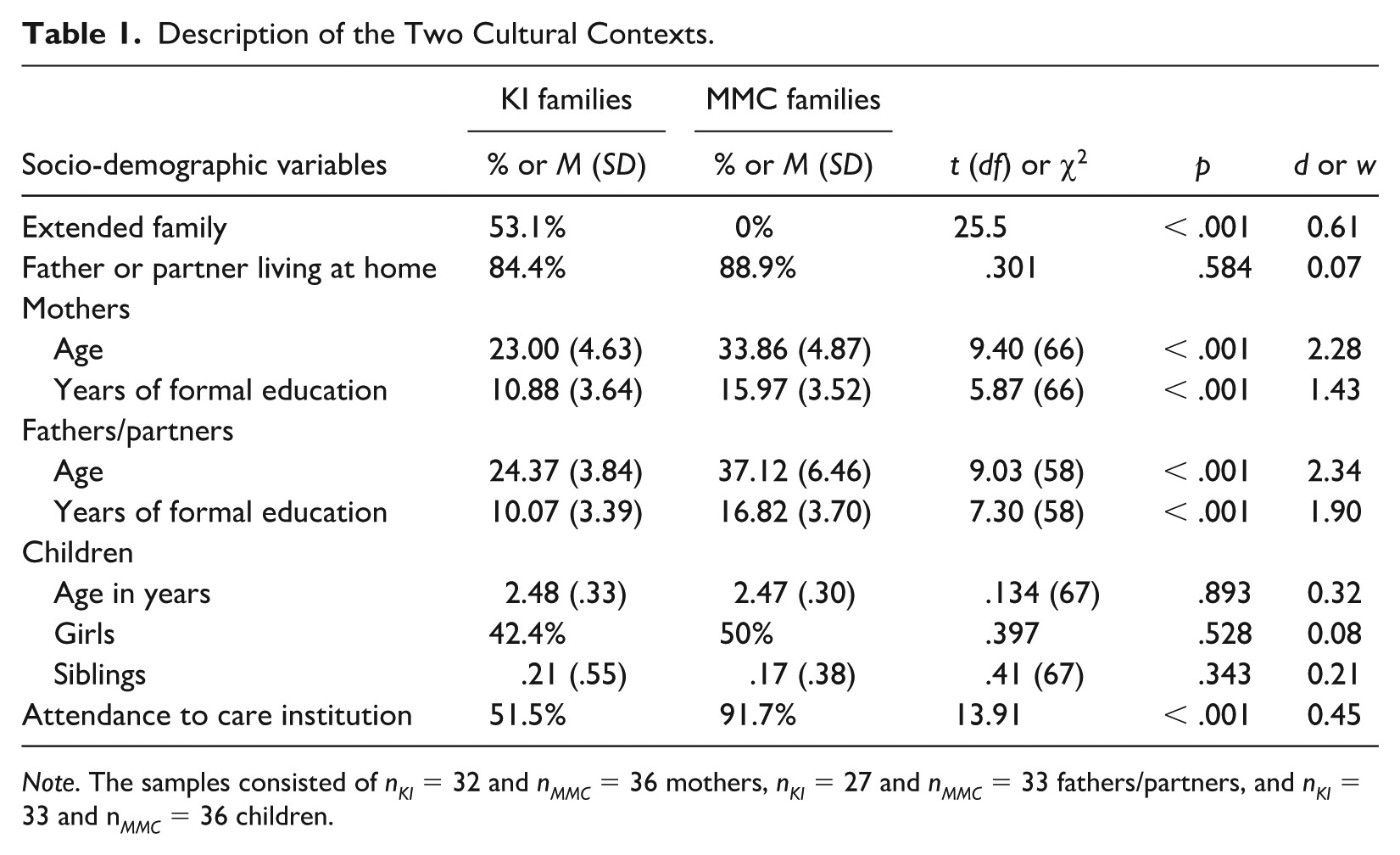
Note. The samples consisted of nKI = 32 and nMMC = 36 mothers, nKI = 27 and nMMC = 33 fathers/partners, and nKI = 33 and n MMC = 36 children.
Data Collection
The data collected consisted of two mealtime episodes (including the preparation, mealtime, and cleaning-up) that the families recorded themselves at their home. This setting was chosen because it represents a daily routine that takes place on a regular basis in both cultural contexts. This allowed us to (a) use a standardized coding approach in order to compare the mealtime episodes across cultural contexts and (b) overcome possible method biases due to cultural differences that might emerge in, for example, standardized lab studies (He & van de Vijver, 2012; Rogoff et al., 2018).
A research assistant visited each family twice. During the first visit, she explained the general goal (learning about children’s daily lives across cultures) and the procedure, without disclosing the specific focus on children’s collaboration and parental structuring during the preparation phase to avoid bias. A video-camera was installed at a fixed place (mostly in the kitchen), and parents were instructed on how to operate it. Importantly, no researcher was present while recording in order to maximize the ecological validity of observations. After recording two dinner episodes (there were four KI families that recorded only one episode), the research assistant visited the family for a second time and informed them about the study’s specific goals. Between the two visits, 1 to 4 days passed (M = 1.29, SD = 0.71) in KI families and 0 to 23 days passed (M = 3.97, SD = 4.55) in MMC families [t(62) = 3.09, p = .003]. Note that almost all KI families communicated in Spanish; those few sequences in which mothers talked Kichwa were transcribed and translated into Spanish by a KI assistant. For further information on the recruitment procedure and families’ compensation, the researcher positionality and reflexivity statement, as well as the study’s ethics statement, see the Supplemental Appendix.
Coding Procedure and Categories
For coding maternal structuring and toddlers’ contributions to household routines associated with mealtime preparations, we focused on the mealtime preparation episodes. Episodes began as soon as any person performed a task related to mealtime preparation (e.g., cooking, setting the table) and ended when the target child began to eat. Behavior was coded off the video (i.e., based directly on the visual and audio content of the video recordings), with a 10-second interval-coding approach using the Mangold Interact. A window of 10s was chosen based on previous observational studies on helping in mother–child interactions (Kärtner et al., 2021). The set of categories that were coded are defined in Table 2.
Coding Categories and Definitions.
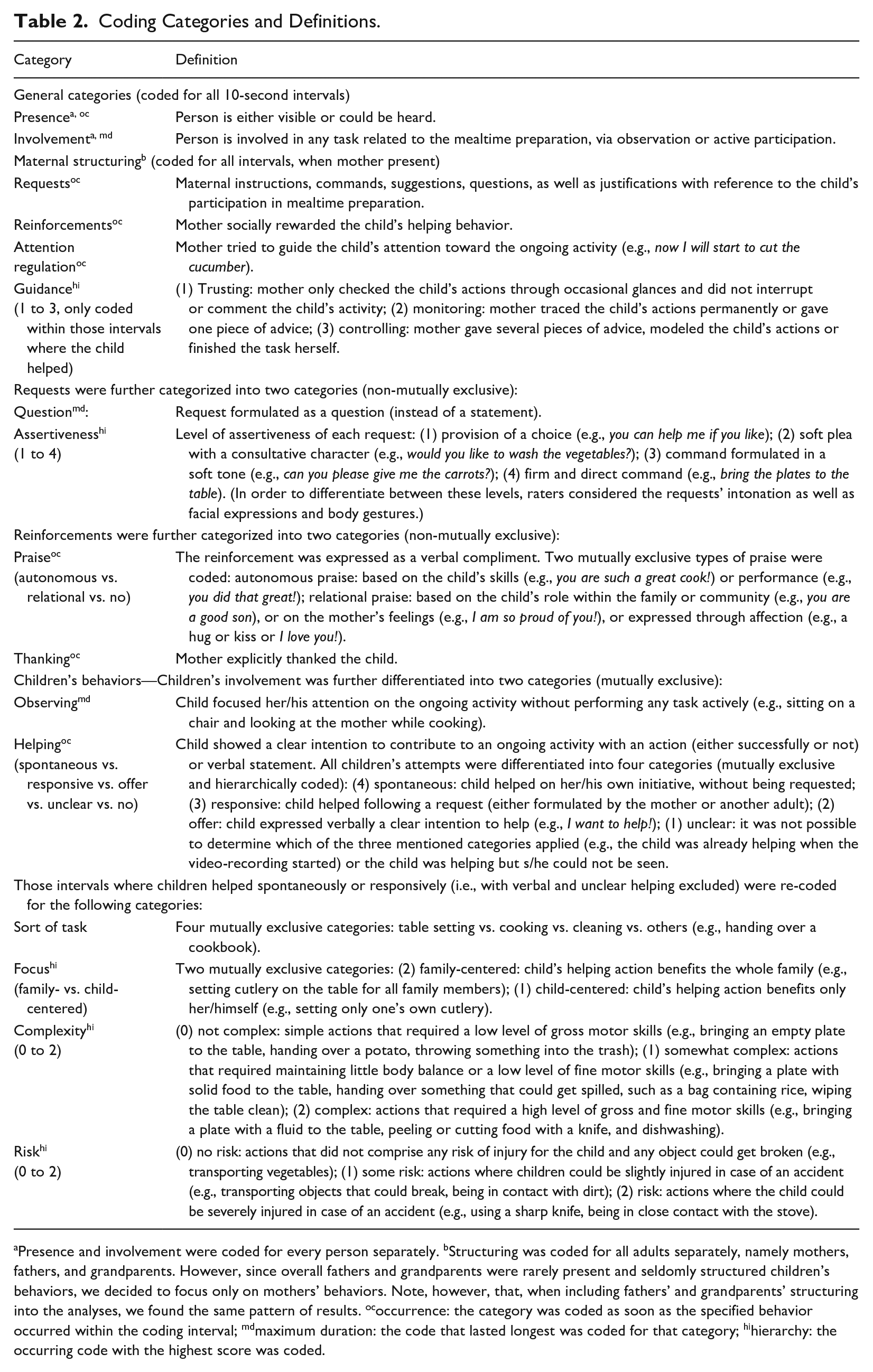
Presence and involvement were coded for every person separately. bStructuring was coded for all adults separately, namely mothers, fathers, and grandparents. However, since overall fathers and grandparents were rarely present and seldomly structured children’s behaviors, we decided to focus only on mothers’ behaviors. Note, however, that, when including fathers’ and grandparents’ structuring into the analyses, we found the same pattern of results. ococcurrence: the category was coded as soon as the specified behavior occurred within the coding interval; mdmaximum duration: the code that lasted longest was coded for that category; hihierarchy: the occurring code with the highest score was coded.
Inter-Rater Reliability
A German student assistant coded the data from MMC families, and a Spanish student assistant coded the data from KI families. To test for inter-rater reliability, the first author (Iberian Spanish native speaker and near-native speaker in German) double-coded 30% of all data from MMC and KI families. The first author’s coding served as a standard, i.e., inter-rater reliabilities were calculated by comparing the two assistants’ codings to the standard provided by the first author. Raters showed medium to high inter-rater agreement. All Cohen’s κs (for nominal categories) and weighted κs (for ordinal categories) were above .60. More specifically, κ scores were satisfactory (i.e., between .60 and .70) for three categories and good (i.e., between .70 and .99) for the remaining 37 out of 40 categories.
Data Preparation and Analyses
Based on the 10-second interval-coding approach and the coding categories described in Table 2, we computed the scores for the final analyses across the 10-second intervals from the two recorded mealtime sessions. To do so, we computed relative frequencies of the nominal categories and mean scores of the ordinal categories that were then compared between cultures by t-tests or Mann–Whitney U-tests, depending on the remaining sample size, namely n > 30 or n < 30, respectively. Details concerning the aggregation of scores used to compute the final analysis scores are provided in Table A in the Supplemental Appendix.
Results
Description of the Mealtime Preparation’s Setting Across Cultural Contexts
Duration of Mealtime Preparation and Type of Mealtime Preparation
The duration of a mealtime preparation was on average 28.57 minutes (SD = 25.46, range = [1–110] minutes) in KI families and 10.32 minutes (SD = 8.78, range = [1–40] minutes) in MMC families, being significantly longer in KI families [t(131) = 5.70, p < .001]. Typically, KI families cooked warm meals that required more food processing (peeling, cutting, cooking, etc.) and a longer cooking time (74.2%), than in MMC families, where families typically cooked for shorter periods of time, less elaborated meals (e.g., pasta) or ate Abendbrot, which is a typical German dinner, consisting of bread, sliced meat, cheese, and pickles or raw vegetables (52.8%) (χ2 = 15.43, p < .001).
Presence and Involvement
In most cases, mother, child, and father were present during the mealtime preparation in MMC families, whereas only mother and child were present during the mealtime preparation in the majority of cases in KI families (see Figure 1A). Results showed that, during the mealtime preparation, MMC children and fathers were present for longer than in KI families [t(67) = 4.98, p < .001 and t(66) = 5.15, p < .001, respectively]. However, in absolute terms, KI children were present for longer periods of time (14.6 minutes; SD = 7.31) than MMC children (8.22 minutes; SD = 7.31) [t(129) = 3.18, p < .001]. There was no significant difference in mothers’ presence across cultural contexts [t(66) = .48, p = .634].
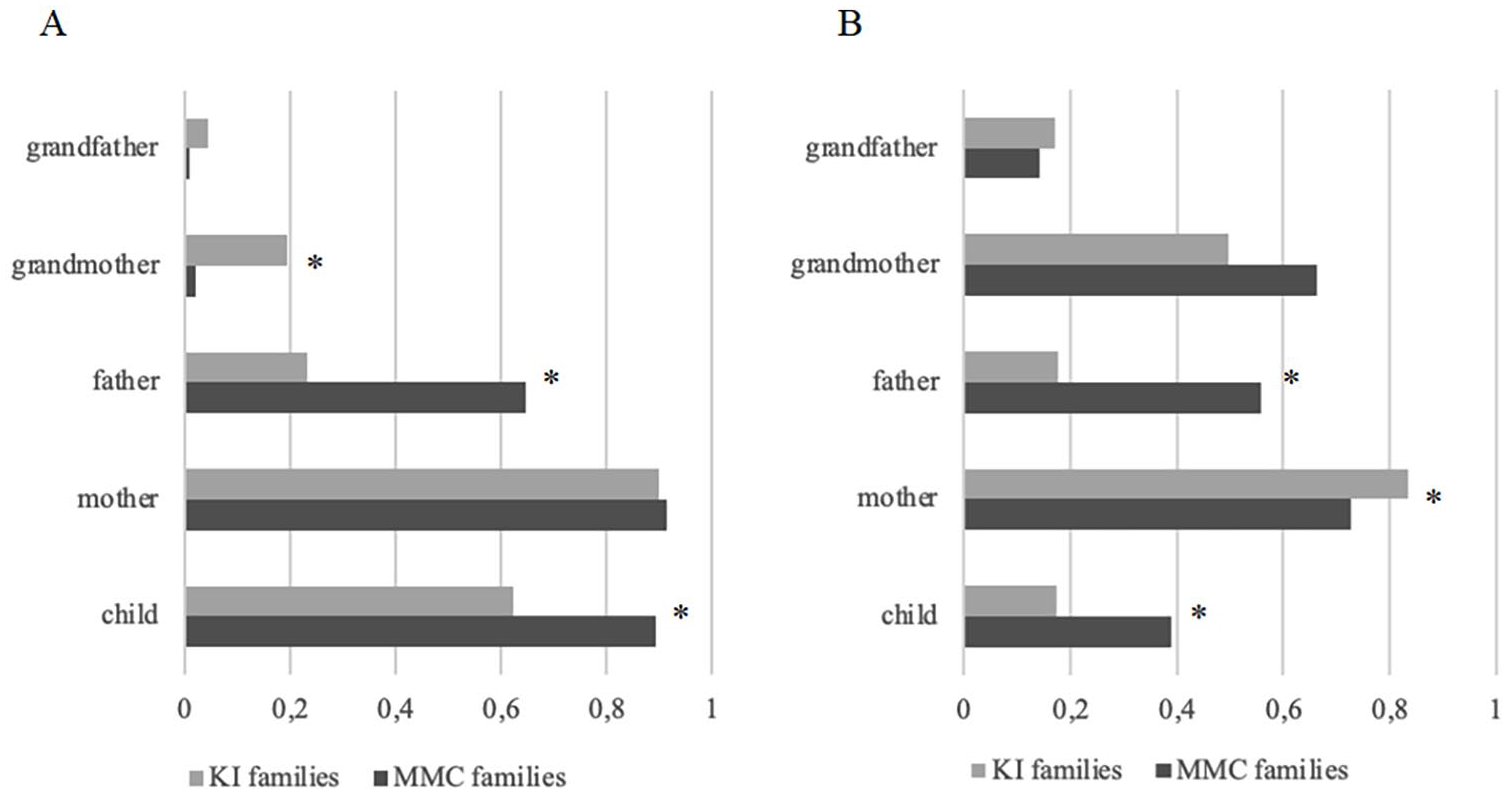
Presence (A) and Involvement (B) in the Mealtime Preparation.
Concerning grandparents, KI grandmothers were present during the mealtime preparation for longer than MMC grandmothers [t(66) = 2.96, p = .004]; grandfathers were rarely present in both samples, with no significant differences across samples [t(66) = 1.17, p = .245]. In 12% and 1% of the cases in KI and MMC families, respectively, other family members (aunt, cousin, etc.) or friends were sporadically present during the mealtime preparation. However, this fact seemed not to interfere with the natural sequence of events.
In both samples, mothers’ involvement while present was the highest, followed by grandmothers and then by fathers (see Figure 1B). There were significant differences in the involvement of mothers, fathers, and children across samples: KI mothers were more likely to be involved than MMC mothers [t(66) = 2.64, p = .01], MMC fathers were more likely to be involved than KI fathers [t(50) = 4.91, p < .001], and MMC children were more likely to be involved than KI children [t(67) = 3.64, p < .001]. Note that children’s involvement implies either helping or observing the ongoing activity. There were no significant differences in the involvement of grandmothers (U = 1, p = .637) and grandfathers (U = 11, p = .732) across cultures.
Maternal Structuring Across Cultural Contexts
Preliminary analyses showed that maternal structuring was not influenced by children’s gender. Overall structuring represents the sum of the mother’s requests, reinforcement, or attention regulation, in those intervals where the mother was involved in the activity and the child was present (see Table A in the Supplemental Appendix). Overall, we found that MMC mothers (M = .14, SD = .12) were more likely to structure children’s behaviors than KI mothers (M = .04, SD = .06), t(66) = 4.44, p < .001.
Different Aspects of Maternal Structuring
When structuring children’s task involvement, MMC mothers more often requested children to get involved in the activity than KI mothers. When doing so, these requests were more often formulated as questions in MMC families, while requests were more assertive in KI than in MMC families. There were no cross-cultural differences in the overall level of positive reinforcement; however, mothers differed in the ways in which they reinforced their children. We found that, when praising, MMC mothers were more likely to use autonomous praise than KI mothers, who were more likely to use relational praise. Furthermore, when reinforcing, KI mothers were more likely to thank children than MMC mothers. There were no significant differences in the use of attention regulation across cultural contexts. Finally, concerning the instructional approach in those sequences where children were helping, we found that MMC mothers used a higher degree of guidance than KI mothers. That is, they had a more controlling way of structuring children’s helping behaviors and attention. See Table A in the Supplemental Appendix for details on how the scores were aggregated and Table 3 for the results.
Different Aspects of Maternal Structuring Across Cultural Contexts.
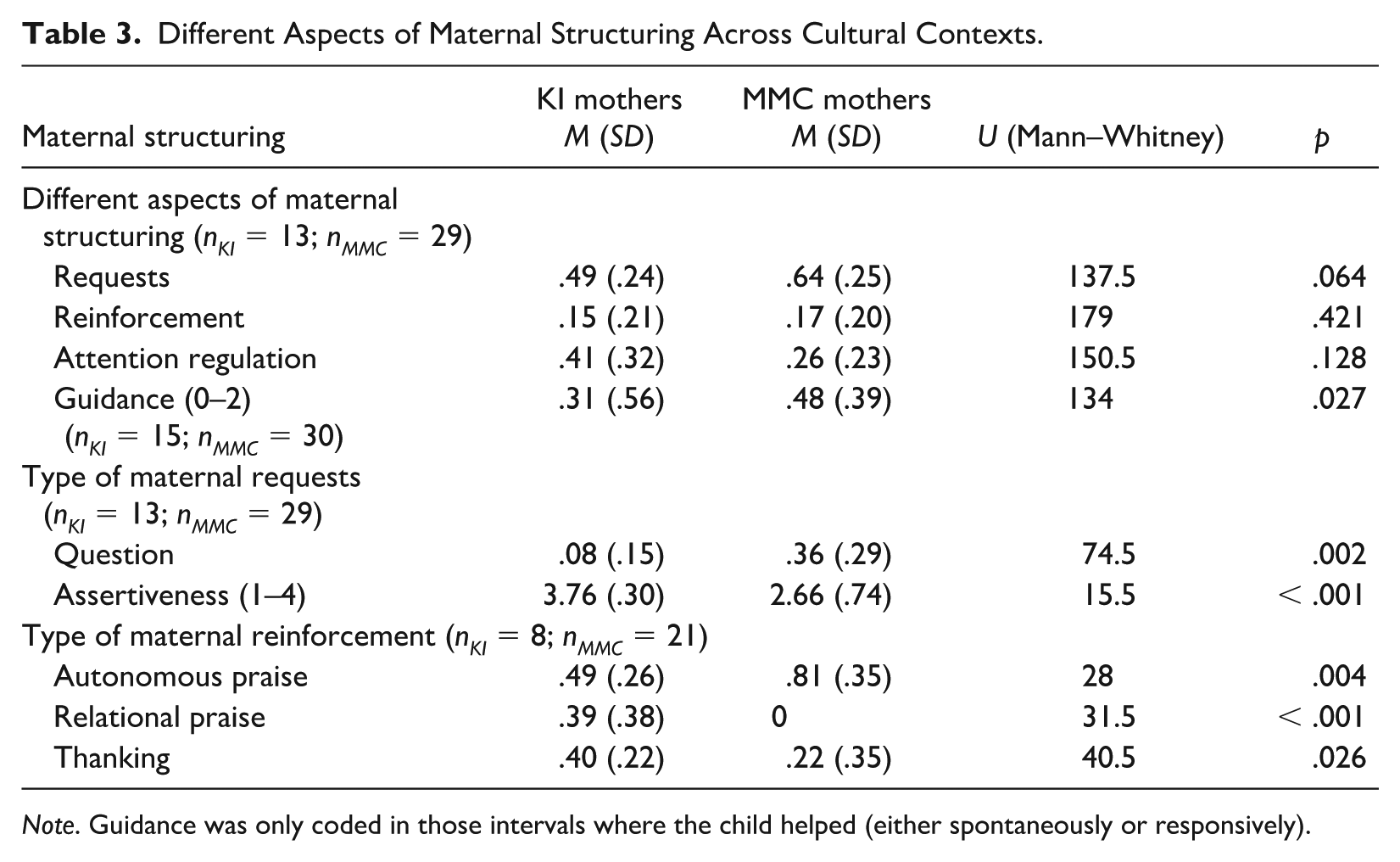
Note. Guidance was only coded in those intervals where the child helped (either spontaneously or responsively).
Children’s Behaviors Across Cultural Contexts
Preliminary analyses showed that there were no significant gender differences in children’s presence, involvement, and helping behavior. As described above, MMC children were involved significantly more often than KI children, namely, in 39% and 17% of all 10-second intervals, respectively (see also Figure 1B). More specifically, children could be involved in two different ways, namely either by observing or by helping. Results showed that KI children were significantly more likely to be involved via observation than MMC children (see Table 4), whereas MMC children were more often involved via helping in comparison to KI children. Comparing the different ways of getting involved within cultural contexts, we found that KI children were more often involved in the mealtime preparation via observation than via helping [t(25) = 6.20, p < .001], whereas MMC children were involved via observation or helping to the same degree [t(32) = .32, p = .748].
Children’s Behaviors Across Cultural Contexts.
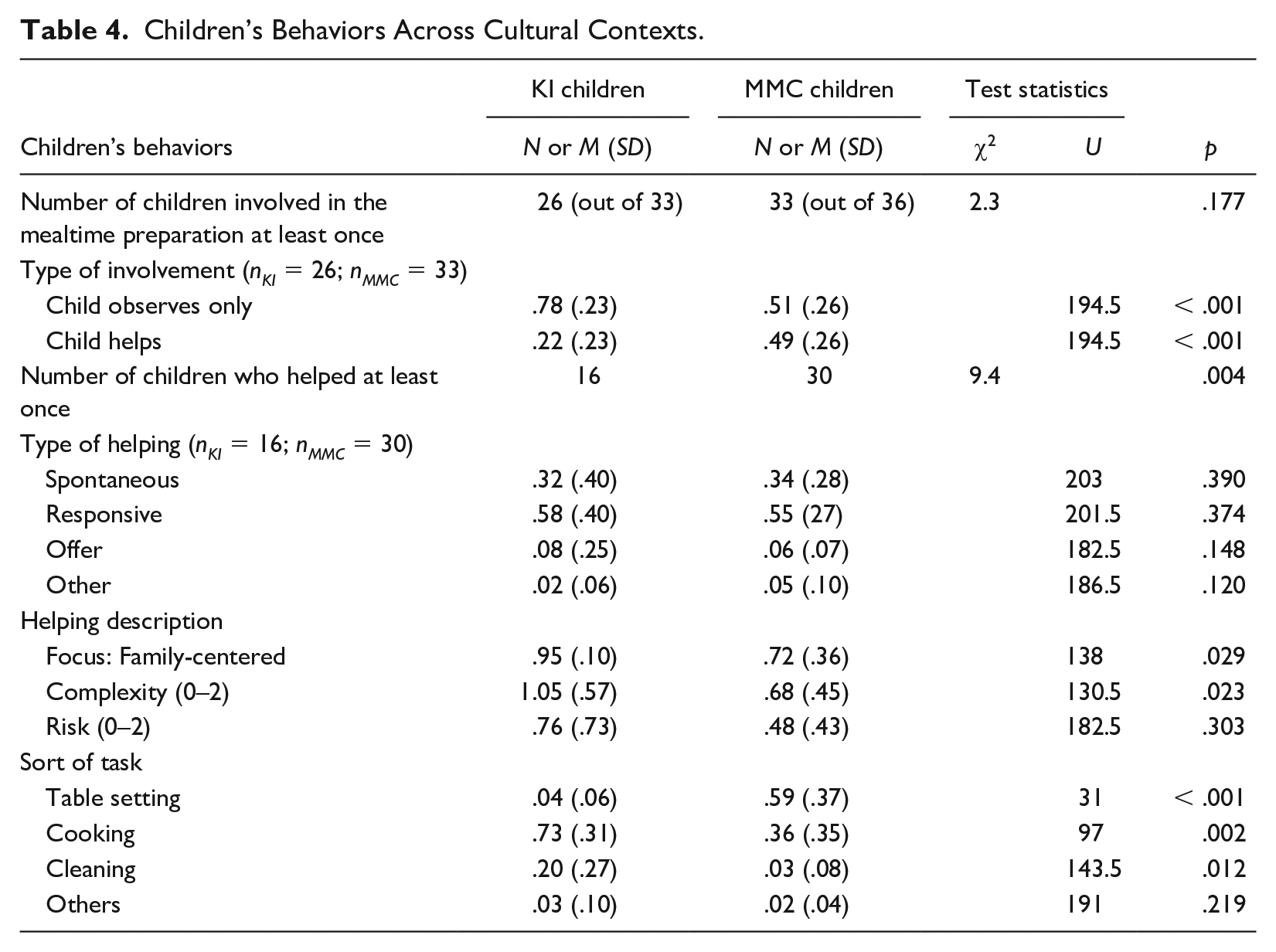
Concerning the number of children who helped at least once, results showed that significantly more MMC children helped in comparison to KI children. Regarding the type of helping (spontaneous, responsive, or offer), we found no significant cross-cultural differences and, in both cultures, responsive helping occurred most often. KI children’s helping was significantly more likely to be family-centered and entailed a higher degree of complexity in comparison to MMC children’s helping. Results showed no significant cross-cultural difference in the degree of risk entailed in the tasks that children helped with. Finally, concerning the tasks that children helped with, KI children were primarily involved in cooking, followed by cleaning, table setting, and others, whereas MMC children were primarily involved in table setting, followed by cooking, cleaning and others, leading to significant cross-cultural differences in cooking and cleaning (that occurred more often in KI families) and table setting (that occurred more often in MMC families).
Discussion
Consistent with our hypotheses, maternal structuring of children’s experience and behavior during mealtime preparations differed between cultural contexts. Unexpectedly, MMC children were more likely to be involved in the mealtime preparation than KI children. In the following, the cross-cultural differences in maternal structuring and children’s behaviors will be further examined and interpreted.
Maternal Structuring in KI Families: Promoting Children’s Relational Sense of Autonomy
Overall, KI mothers provided less structuring than MMC mothers. When structuring, KI mothers used marginally significant fewer requests than MMC mothers, and, although the cross-cultural difference in maternal attention regulation was not significant, the results showed the expected pattern. When requesting, KI mothers did so in a more assertive manner and used questions only very rarely. While children were helping, KI mothers were controlling and informing children’s behaviors and attention to lower degrees than MMC mothers. Thus, although children’s contributions in housework are greatly valued in the Kichwa culture, KI mothers did not put strong efforts in getting children to help. Rather, they simply informed or prompted children when their help was needed, and they did so in a clear, concise, and seemingly more authoritarian manner than MMC mothers. This behavioral pattern is in line with Lancy’s (2020) observations when suggesting that Indigenous parents only lightly scaffold young children’s engagement in helping and rather provide space for children to engage autonomously in ongoing activities. KI mothers used low levels of reinforcement after children helped; however, when reinforcing, they were more likely to thank children than MMC mothers, showing children that their contributions were acknowledged and highly appreciated. Moreover, KI mothers were more likely to use relational praise, a strategy that emphasizes the child’s sense of community, highlighting the child’s role as a contributing member within the family, most probably triggering children’s sense of belonging (Baumeister & Leary, 1995).
Overall, the Kichwa structuring pattern seems to foster the development of children’s relational sense of autonomy by accepting, rather than requesting or controlling, their helping initiatives. Furthermore, the Kichwa approach promotes values such as obedience (by expecting children to fulfill clear and concise requests) and relationality (by enhancing children’s affiliative feelings). Over time, these values will become progressively attached to children’s collaborative behaviors. This structuring pattern could be one plausible explanation for why housework continues to be associated with positive feelings in many Indigenous cultures in Latin America and children still want to contribute once they have outgrown the helper stage, as children learn that contributing to housework provides them with a positive feeling of joy and belongingness due to: the fulfillment of their own intrinsic motivation to participate—since their initiatives are not strongly controlled, the fulfillment of a positive sense of normative obligation (Kärtner, 2023), and the positive and affiliative reactions of their mothers.
Maternal Structuring in MMC Families: Promoting Children’s Individual Sense of Autonomy
MMC mothers were more likely to request children for help than KI mothers. Thus, contrary to previous studies, where U.S.-American mothers reported to usually prevent children from helping or to try to transform children’s helping attempts into more playful activities, MMC mothers welcome children’s participation, inviting them to get engaged. Note, however, that they used a typically Western instructional approach based on a higher number of requests and controlling children’s behaviors and attention (see ALI instructional approach). At first glance, this controlling instructional approach may seem contradictory, since previous research showed that MMC mothers strongly emphasize and promote children’s autonomy (Giner Torréns & Kärtner, 2017; Köster et al., 2016). However, MMC mothers lavishly provided children with the opportunity of making choices about what to cook, which tools to use, etc., and they did so, explicitly asking children to express their preferences. Thus, children’s autonomy was, indeed, strongly promoted during the mealtime preparation, but rather than focusing on children’s action autonomy (i.e., planning and performing an action for the good of the community/family), MMC mothers were more likely to focus on children’s psychological autonomy (i.e., reflecting and expressing own preferences and wishes; Keller, 2012; Keller & Kärtner, 2013).
In addition, mothers’ efforts to encourage children’s psychological autonomy further manifested in the types of requests that MMC mothers made. Different from KI mothers, MMC mothers were more likely to formulate their requests as questions (e.g., “Are you feeling like helping?”) in a less assertive manner. Thus, MMC mothers invited children to get engaged, highlighting that it was up to the children to participate. This way of requesting denotes the maternal efforts of promoting and respecting children’s individual sense of autonomy, viewed as the opposite of being obedient or submissive. In line with previous research by Miller et al. (2017), helping in Western cultures is often viewed as a matter of personal choice, in opposition to helping viewed as a matter of duty in, for example, some Hindu Indian cultural communities. Consequently, it is plausible that MMC mothers viewed children’s helping as a matter of personal choice, and thus, formulated their requests accordingly.
In line with the culture-specific patterns described above, MMC mothers’ praise was characterized by acknowledging the child’s capacities or performance (autonomous praise). It is remarkable that there was no single MMC mother that explicitly acknowledged her child for making a contribution to the family or commended the child’s contribution showing physical affection (relational praise). Based on these findings, it stands to reason, that MMC mothers (as U.S.-American mothers in an interview study by Coppens et al., 2020) might not have interpreted children’s participation as motivated by their will to contribute, but rather as an activity that children performed for their own joy or benefit, or driven by a mastery motivation, and not for the benefit of the family. Therefore, MMC mothers praised children for their accomplishments, but did not thank them as often, because probably they did not understand children’s behavior as a contribution to the family.
Same Setting, but Different Culturally Patterned Views and Structuring
Overall, KI and MMC families seem similar in some ways and different in others. Considering the differences, the two communities appear to contrast in a deeper sense, in terms of broad cultural paradigms (see Coppens et al., 2016). Our findings suggest that mothers viewed, and thus, framed children’s involvement differently, depending on their cultural background, even though the setting (a mealtime preparation) was the same across cultural contexts. On one hand, KI mothers might have viewed children’s engagement as real contributions driven by an inherent motivation to help (see also Callaghan et al., 2011; Coppens et al., 2020), and framed the mealtime preparation as an opportunity to connect with and help each other, where children’s joy is supposed to emanate from binding and reciprocating. On the other hand, MMC mothers might have viewed children’s engagement as actions driven by their interest in the activity itself and framed the mealtime preparation as an activity, where children’s joy is supposed to emanate from choosing and performing the activity itself, which children were allowed to lead here and then probably in order to increase their joy. Thus, rather than presenting children with the opportunity to internalize their potential family responsibilities as a duty (Miller, 1994), MMC mothers might have framed the situation as an opportunity to increase children’s joy in mastering a (solo-)activity. This interpretation is further corroborated by the findings that MMC children were more likely to complete tasks for their own benefit in comparison to KI children (see coding category Focus), who were more likely to complete chores for the benefit of the whole family. However, further empirical research is needed in order to assure these interpretations. For instance, maternal interviews would help in order to learn more about mothers’ views on children’s helping motivations, as well as mothers’ intentions when structuring them.
Cross-Cultural Differences in Children’s Helping During Mealtime Preparation
Concerning the overall number of children involved in the mealtime preparation, we found that almost all children with no significant differences across cultures were involved (via helping or observing) at least once, with no cross-cultural differences in children’s spontaneity. These findings further corroborate the idea that children’s earliest eagerness to help is universal (Lancy, 2020). However, and contrary to our expectations, MMC children were involved in helping for longer periods of time in comparison to KI children. This unexpected finding might be a consequence of MMC maternal structuring (including more requests than KI mothers). Furthermore, part of this difference may be related to the culture-specific nature of the mealtime preparation setting. In MMC families, the preparation of a typical Abendbrot consisted mainly of setting the table—removing food items from the fridge and placing them on the table—rather than long cooking periods. In contrast, mealtime preparation in KI families typically involved extended cooking. Moreover, in KI families, serving the food traditionally follows a protocol in which the food is first dished onto the plate (usually by the oldest woman at home, which was also the case in 96% of the episodes analyzed here) and then passed to the diners (Weismantel, 2001). Additionally, whereas MMC families used several cutlery tools, in KI families usually only a tablespoon was used as cutlery (97% of the episodes analyzed here). In sum, setting the table was one of the most prominent tasks during mealtime preparation in MMC families, whereas cooking at the stove was the prominent task in KI families. Because table setting entailed a higher number of simple tasks that 2.5-year-old children could carry out easily, MMC children probably had more opportunities to help during mealtime preparation than KI children. This observation is further supported by the finding that showed that MMC children were primarily involved in setting the table, whereas KI children were primarily involved in cooking and performed overall more complex tasks than MMC children. Concerning the time children spent present during the mealtime preparation, MMC children were more likely to be present than KI children, contrary to our expectations. However, it is noteworthy that, in absolute terms, KI children almost doubled the time that MMC children were present. Contrary to previous anthropological findings (Lancy, 2016), there were no cross-cultural differences in the degree of risk implied in the tasks that children performed. Taking into consideration that the risk level of children’s helping was rated low (on average, 0.6 out of 2 for both samples), a plausible explanation for this unexpected result is that the current generation of Kichwa mothers, in comparison to previous generations, was more likely to prevent children from doing risky tasks (such as using knives or standing near to the stove), as was emphasized during our interviews conducted with Kichwa mothers (unpublished data). Finally, it is important to acknowledge that the current study primarily focuses on quantitative differences in children’s prosocial contributions across cultures. This approach may overlook the rich qualitative variations in prosocial behaviors that cannot be captured through quantitative measures alone. Future research should therefore explore cross-cultural differences in children’s and mothers’ behaviors and interactions using qualitative methodologies.
Cultural Meaning Systems Related to Mealtime
Preparing a mealtime represents a societal constant which is useful to compare different cultural contexts; however, it is important to acknowledge the contextual variation in the mealtime preparation setting and its meaning. KI families usually cooked more elaborated dishes, which is in line with the literature that suggests that dinner in the Kichwa community is one of the most abundant meals of the day (Weismantel, 2001). Instead, MMC families cooked quicker, or prepared cold dishes, which is typical for German households where the dinner is a light meal, consisting of less elaborated warm dishes or Abendbrot. There is indeed a German colloquialism that says “Frühstücken wie ein Kaiser, Mittagessen wie ein Fürst, Abendessen wie ein Bettelmann” [Breakfast like an emperor, lunch like a prince, dinner like a pauper] (Dorn & Wagner, 2012). The duration and elaboration of meals might be related to the significance of a mealtime preparation in each context, which seems to differ across contexts. As a Kichwa informant described, the mealtime preparation is viewed as a time where family members (especially mothers and children) come together to share their day’s experiences. Accordingly, the preparation of the meal seems to represent an opportunity to connect to each other. This seems not to be the case in many Western households, where the focus is rather on minimizing the time spent in preparation, and the mealtime itself represents the time for binding (Klein & Goodwin, 2013).
The Study’s Methodological Approach
It is a particular strength of the current study that—based on its naturalistic approach—its ecological validity is high (Coppens & Coppinger, 2023), which is especially important in studies that aim to document everyday routines that inform child development in different cultural contexts. A naturalistic approach helps to overcome potential biases of standardized experimental lab-based studies, such as the lack of culture-equivalent lab settings or divergent stimulus familiarity (He & van de Vijver, 2012). Furthermore, it is important to note that this study belonged to a broader data collection, in which we followed a mixed-method approach: In addition to the reported naturalistic observation, we assessed questionnaire data and conducted unstructured and semi-structured individual interviews, as well as focus-group interviews. These additional data are not reported in the current paper; however, they facilitated the interpretation of the results. In addition, in order to avoid possible ethnocentric bias (Matsumoto & Jones, 2009), we discussed the interpretation of our findings with two experts on Kichwa culture and conducted three additional semi-structured interviews with KI mothers, in which we presented them with the results and asked them for their views (see the Supplemental Appendix).
At the same time, however, it is important to acknowledge the limitations of the current naturalistic approach. As mentioned above, the mealtime preparation setting presented culture-specific characteristics that had consequences for the opportunities that children had to contribute, which made the comparability across cultural contexts challenging. However, we took this challenge in stride, since we view the cultural specificity in the mealtime preparation as representing further valuable information about each culture, instead of methodological “noise” that should be avoided or eliminated. Furthermore, it is important to mention that the setting of a mealtime preparation represents only one housework activity within a wide range of possible household chores that children might pitch in (or not) on a daily basis. Future research should examine whether our findings can be generalized to further housework activities in both contexts. For instance, in line with previous research that showed that Western parents tend to do housework when children are absent (Hammond, 2014; Rheingold, 1982), it is plausible that, even though MMC children presented higher rates of helping during the mealtime preparation, they might be less likely to be present and participate in other household tasks than KI children.
Conclusion
Our findings support the idea of a sociocultural calibration of prosocial motives across childhood (Kärtner, 2023). Specifically, culture-specific structuring—shaped by mothers’ culture-specific socialization goals, as well as interpretations of everyday situations and children’s behaviors—influence children’s prosocial engagements. This process channels children’s intrinsic prosocial motivations into future culture-aligned motivations. Whereas children’s participation in shared housework in MMC families seemed to be viewed, and thus, progressively transformed into an activity where children’s behaviors were controlled, and their individual sense of autonomy was promoted via provision of choices and via autonomous praise (i.e., emphasizing children’s capacities), children’s participation in KI families seemed to be viewed, and thus, progressively transformed into a collaborative and reciprocal activity, where children’s initiatives were not controlled, but rather included as helping contributions, where the shared experience of working together and the sense of belonging were paramount.
Overall, the current study contributes to cross-cultural developmental psychology, providing further evidence on how enculturation shapes the development of human motivation. The cross-cultural differences found in mothers’ structuring of children’s first helping initiatives further illuminate the processes implied in the internalization of children’s culture-specific helping motives, and thus, help us to further understand why children at older ages experience and view their contribution at home in such different ways across the world. More specifically, our findings—in combination with previous research that argues that Indigenous children kept their motivation to help once they have outgrown the helper stage—suggest that structuring shared work building on children’s eagerness to affiliate and truly contribute is an effective practice in fostering their future motivation to engage in collaborative work.
In sum, the current findings provide further evidence for the differential influence of culture-specific socialization on child development, suggesting that prosocial motivations are patterned by children’s culture-specific experiences (Kärtner et al., 2020). Thus, children’s eagerness to help gets sustained not only through the provision of opportunities to engage in collaborative work but also by the culture-specific ways in which these opportunities are structured.
Supplemental Material
sj-pdf-1-jcc-10.1177_00220221251364754 – Supplemental material for It’s Mealtime! Maternal Structuring of Toddlers’ Prosocial Contributions in Kichwa Indigenous and Urban German Families
Supplemental material, sj-pdf-1-jcc-10.1177_00220221251364754 for It’s Mealtime! Maternal Structuring of Toddlers’ Prosocial Contributions in Kichwa Indigenous and Urban German Families by Marta Giner Torréns, Andrew D. Coppens, Jorge D. Mantilla Salgado and Joscha Kärtner in Journal of Cross-Cultural Psychology
Footnotes
Acknowledgements
The authors thank Ledys Hernández Chacón, Johanna Tontaquimba, Cristian Saranchi, Marco Guandinango, Nancy Iza, Ruth Baumann, Ulrike Wilde, Kristin Dreizler, Shruty Kumarnathan, Katharina Bader, Silvia Scholz, Sofía Moreno Gata, and Alba Martín Garrido, who were involved in recruiting families, data collection, and behavioral coding. The authors specially thank the families who contributed with their time and effort in this study.
Declaration of Conflicting Interests
The author(s) declared no potential conflicts of interest with respect to the research, authorship, and/or publication of this article.
Funding
The author(s) received no financial support for the research, authorship, and/or publication of this article.

Supplemental Material
Supplemental material for this article is available online.
Notes
References
Supplementary Material
Please find the following supplemental material available below.
For Open Access articles published under a Creative Commons License, all supplemental material carries the same license as the article it is associated with.
For non-Open Access articles published, all supplemental material carries a non-exclusive license, and permission requests for re-use of supplemental material or any part of supplemental material shall be sent directly to the copyright owner as specified in the copyright notice associated with the article.
