



Abstract
This study examines the changes in Schwartz’s higher-order-value dimensions in Lithuanians over time. We analyze cross-sectional repeated survey data, with a sample of 11,199 respondents from six waves of the European Social Survey (ESS) during the years 2010–2020. Time-lag and cross-sectional analyses revealed age and period effects on self-enhancement and self-transcendence, and age, period, and cohort effects on openness to change and conservation. A comparison of political generations shows that the youngest cohort (independent EU generation) is more conservative, more self-transcending, less open to change, and less self-enhancing over time, in contrast to other generations. The Soviet legacy generations follow a different trajectory of openness to change and conservation than the Stalin and Independent EU generations, suggesting that historical context and current period effects are strong, and that the youngest political generation is particularly sensitive to societal-level disruptions. It is plausible that forces related to rapid societal change, for example, a decline in the working-age population after the collapse of the Soviet Union and, more recently, during the period of the study due to mass emigration, have left a generation trapped between scarcity and modernity.
Introduction
This study contributes to the ongoing theoretical conversation about value change in rapidly transforming societies. Extensive research has explored the stability of values in long-established democracies, yet there is a significant gap in understanding how values evolve in countries that have experienced acute political and socioeconomic disruptions. We aim to fill this gap by examining value change in Lithuania, a country that has undergone dramatic transition since regaining independence from the Soviet Union in 1990.
Recent global developments, such as economic advancement, technological innovation, and increased migration have challenged the notion that values are slow to change (e.g., Hofstede, 2001), leading scholars to question the stability of cultural values in modern societies. Empirical evidence points to both enduring cultural values and value change. For example, Inglehart’s (2007) analysis of World Values Survey (WVS) and European Values Survey (EVS) data demonstrated simultaneous large-scale cultural change and the endurance of traditional cultural values. Value change has been linked to socioeconomic development; postindustrial, high-income countries have undergone a “modernization” of values (Greenfield, 2009; Grossmann & Varnum, 2015; Hamamura, 2012; Inglehart & Baker, 2000; Santos et al., 2017). Meta-analytic research has revealed that the magnitude and pace of value change differ from country to country, with the greatest changes observed in countries that experienced major political and economic disruption, such as those of the former Soviet Union that have long struggled to preserve their cultural heritage hidden under the guise of Soviet values, and the least amount of change in established democracies (Taras et al., 2012). Yet according to Chromková Manea and Rabušic (2021), the post-communist countries of Central and Eastern Europe have remained more traditional in values than Western European countries since the early 1990s. Against this backdrop, we focus our study on identifying changes in values that have taken place in Lithuania since the collapse of the Soviet Union, during a period of rapid modernization. We query whether Lithuanian values have responded to socioeconomic and sociopolitical change and seek to reveal patterns in value change. We focus our attention on the drivers of change.
To our knowledge, this is the first empirical examination into whether and how values have evolved over time. Prior research on Lithuanian values has been cross-sectional (e.g., Liubinienė, 1999; Minelgaite Snaebjornsson et al., 2017; Mockaitis, 2002a, 2002b), limiting our understanding about individual-level values. In cross-national comparative research, Lithuanians have been labeled as both highly conservative (Tulviste et al., 2017) and as prioritizing openness to change more than other societal groups (Ralston et al., 2011). In a society that has experienced rapid modernization but also has deeply embedded historical legacies, a duality of value priorities is a possibility. It is important to test assumptions put forth by modernization theorists that dichotomize tradition and modernity, including that change in people’s worldviews is largely predictable (Inglehart, 1997; Inglehart & Welzel, 2005).
Our key contribution lies in the search for the causes of value change. We argue that values are driven by and reflect societal transformations but that these reflections manifest in different ways. It is important to separate socioeconomic factors from individual factors, as these effects are often confounded. We distinguish among age, period, and cohort (APC) effects on the four higher-order value dimensions of Schwartz (openness to change, conservation, self-transcendence, and self-enhancement) through a repeated cross-sectional design with representative samples over a 10-year period. APC analysis is not without criticism, specifically, that the three effects cannot be separated from one another due to identifiability problem, that is, any of these variables can be determined by the others if birth year is used as a proxy for cohort (Yang & Land, 2013). To overcome this issue, we apply four more broadly delineated generations that capture the political period in which individuals were socialized, as a proxy for cohort. We labeled these political generations the Stalin, Soviet, late-Soviet, and Independent EU generations. We contend that value differences between these political generations (i.e., a cohort effect) may offer support for the socialization hypothesis (e.g., Inglehart & Welzel, 2005; Inglehart, 2018), whereby values reflect the socioeconomic conditions of one’s formative years (e.g., growing up in the Union of Soviet Socialist Republics [USSR] versus the EU era). In stable societies, these generational differences may persist, reflecting value stability. However, in rapidly transforming societies, new experiences later in life can result in a shift in perspective (Mishler & Rose, 2007) and reassessment of values. Such transformations can be revealed by examining period effects. Values can also change as part of the natural aging process and as people cycle through the life course (Gouveia et al., 2015; Pew Research Center, 2015). We apply time-lag and cross-sectional analyses to distinguish among these effects. This research not only contributes to understanding the relative influences of APC effects on value change in Lithuania but also adds to the broader literature on cultural evolution in societies undergoing rapid change.
Theoretical Background
Perspectives on Value Change
The current study applies the higher-order value dimensions of Schwartz (1992, 2006a, 2006b, 2012): openness to change (comprised of the values hedonism, stimulation, and self-direction) versus conservation (comprised of security, conformity, and tradition) and self-enhancement (comprised of power and achievement) versus self-transcendence (comprised of benevolence and universalism). 1 Values are enduring “concepts or beliefs about desirable end-states or behaviors that transcend specific situations, guide selection or evaluation of behavior and events, and are ordered by relative importance” (Schwartz & Bilsky, 1987, p. 551). They “are influenced by individual experience during individual development in a sociocultural context” (Trommsdorff et al., 2004, p. 160) and by people’s interactions with others and with their environment (Trommsdorff et al., 2004). Although there is general agreement about what values are, there is enduring debate about how and when values change.
It has long been held that values are stable throughout an individual’s lifetime (e.g., Rokeach, 1973), that values are formed during the impressionable years in youth (Alwin & Krosnick, 1991), and that values acquired through socialization during youth remain stable throughout adulthood (Mannheim, 1953). Values are deeply embedded in the self as cognitive schemas that are resistant to change (see Bardi & Goodwin, 2011). However, scholars also argue that individual values change throughout the life course and are influenced by life experiences (Schwartz & Bardi, 1997). These experiences can be unplanned, such as life-altering catastrophes, or a part of the normal life cycle, such as entering or retiring from the workforce or becoming a parent or grandparent (Vecchione et al., 2016).
Modernization theorists argue that value change follows a predictable path. A rise in economic development promotes a shift in values from traditional to self-expression, and economic hardship promotes a shift toward traditional values at the societal level (Inglehart & Baker, 2000). The theory argues that individuals with different cultural backgrounds will converge in response to the modernization of social and economic structures (Kafka & Kostis, 2021).
Recent empirical evidence points to changes in individual values as a consequence of significant life events (Bardi et al., 2009, 2014; Lönnqvist et al., 2011), period effects (Tormos, 2012), aging (e.g., Borg, 2021; Gouveia et al., 2015; Jaspers & Pieters, 2016; Lersch, 2023; Robinson, 2013), and cohort (Abramson & Inglehart, 1992; Dobewall et al., 2017; Jaspers & Pieters, 2016; Marcus et al., 2017). Studies that have compared different influences on values have found that some have stronger effects than others, for example, life-changing events had a stronger effect on value change than age in a study by Bardi et al. (2009), and age versus cohort effects were found by Dobewall et al. (2017) to depend on the value dimension studied. Schwartz (2005) highlighted that age differences can also emerge as a result of something that has affected a cohort at a period in time (e.g., historical events) and are thus a reflection of cohort differences. The age effect is often confounded with change over time. The difficulty lies in disentangling these effects; differences can be due to any of these, or their combined effects.
APC Analysis
Recent methodological advances have tried to overcome the dilemma of separating APC effects. The challenge lies in that any one factor (age, period, or cohort) is defined by the other two (e.g., age = period – cohort). Traditional research designs only hold constant one of the three effects. Measuring APC effects are not possible in cross-sectional studies as period effects are not present, and in longitudinal studies, age and time vary (Schaie, 1965). Repeated cross-sectional studies do not follow individuals over time; unique respondents are nested within time periods and cohorts. To overcome these issues, recent advancements, such as the use of cross-classified hierarchical linear models (HLMs) to account for the simultaneous (random) nesting of individuals in periods and cohorts, have been introduced (for a review and application, see the study by Fosse & Winship, 2019). However, with few cohort and period groupings (as in our study), a combination of approaches is likely to be more parsimonious. Time-lag analysis compares individuals of the same age at different points in time. To ascertain whether period or cohort effects are present, we can supplement time-lag analysis with cross-sectional analyses, which hold either one of time period or cohort constant to test for the effects of the other variables. By combining these techniques, we can distinguish APC effects on values.
Age-Related Value Change
Schwartz (2005) discerned three types of age-related effects on values: changes associated with the life cycle, effects associated with biological aging, and generation or cohort effects. Life course development models (e.g., Erikson, 1980) posit that at each stage of life (young adulthood, middle adulthood, and old age), people will adapt to different biological and social challenges and reassess their life goals to prioritize different roles and tasks (Baltes, 1987) associated with each stage (Mockaitis et al., 2022). Personal values change with age as people adapt to changes throughout the lifespan (Heckhausen et al., 2010). For example, early adulthood is associated with milestones such as the attainment of employment or starting a family. During this stage, individuals might prioritize achievement values. According to Schwartz (2005), openness to change and self-enhancement reflect the values of youth and decline in importance as people grow older (especially as they approach retirement) and as their personalities become more stable (Roberts et al., 2006). In mid-life and beyond, as people settle into their family and work routines, the focus shifts toward others (Erikson, 1980), and self-transcendence values are prioritized. Values in the latter stages of life become more past-focused, tied to traditions and institutions (Robinson, 2013). As people age, they also value security over novelty, prioritizing conservation values (Schwartz, 2005).
Studies have revealed positive relationships between age and conservation and self-transcendence (Robinson, 2013; Vecchione et al., 2016), and negative relationships between age and self-enhancement (Robinson, 2013; Vecchione et al., 2016) and openness to change (Fung et al., 2016; Robinson, 2013; Schwartz, 2005; Smallenbroek et al., 2023). In a 29-country study, Borg (2021) found that traditional values become more important, and power, achievement, and hedonism decline in importance with age. In a study comparing age cohorts in six European countries and Russia, Tulviste et al. (2017) found significant differences between younger and older respondents on all four dimensions of Schwartz. And in Turkey, millennials were more self-enhancing and less conservative and self-transcending than older respondents (Marcus et al., 2017).
Values Across Generations
A cohort is generally defined as a group of individuals within a delineated population that has experienced the same significant event(s) within a given period of time. People hold different beliefs and exhibit different behaviors in different life stages (Baltes & Baltes, 1990; Mockaitis et al., 2022). In contrast to life stage (Baltes, 1987), generation subculture theory holds that age groups differ in their beliefs and values; generation effects remain intact and reflect the broader socialization of groups. The socialization (Inglehart, 1997, 2018), “formative years” (Inglehart & Welzel, 2005), and “impressionable years” (Krosnick & Alwin, 1989) hypotheses have been developed around the notion that individuals acquire values that reflect the socioeconomic conditions existing during their early years. As different generations are socialized under different historical, social, and economic conditions, their belief systems should reflect these differences. Each generation is replaced by successive generations carrying new values (generational, or cohort, replacement; Abramson & Inglehart, 1992); this replacement accounts for observed changes in values.
While Abramson and Inglehart (1992) argue that generational replacement is a slow and gradual process, other scholars question the impressionable years hypothesis (Tormos, 2012), arguing that values can change throughout the life course as people adapt to changing circumstances, whether these are personal or experienced by entire societies. For example, in societies that undergo turbulent periods of economic or political upheaval, differences between generations or age cohorts may be quite vast, but institutional learning may also occur whereby adults are re-socialized into new political attitudes and behaviors influenced by later life experiences (Mishler & Rose, 2007).
Generations Shaped by Political Ideology
“Lithuania has had to deal with a disorientating influx of external influences of various kinds” (McLaughlin & Juceviciene, 1997, p. 31). Generations in post-Soviet countries have distinct experiences of war and occupation, political regimes and oppression, inefficiencies and scarcity, followed by democratic change. These are dramatically different from the experiences shaping Western generations. 2 Individuals who were born during the Stalin era (up to 1944) witnessed the annexation of Lithuania by the Soviet Union, as well as Nazi rule, extreme cultural trauma, and resistance, followed by a period of adjustment to the Soviet system. Older members of this generation experienced Stalin’s reign of terror, deportations, and persecution, while younger members were socialized into the aftermath of the war, experiencing extreme economic hardship (Mishler & Rose, 2007). There was a duality of public and private life, whereby people upheld Lithuanian traditions and pre-Soviet values only in private; in public, they behaved in ways mandated by the rules and norms of Soviet society (Žilinskienė & Ilic, 2020). McLaughlin and Juceviciene (1997) call this the “double-life” syndrome of this generation.
For the generation who were born and came of age during the Soviet era (1945–1969), often referred to as the Soviet generation (Kraniauskienė, 2016), life was based on Soviet ideology, and indoctrination was intense. Individuals in this political generation witnessed sovietization of the Eastern European bloc (Mishler & Rose, 2007), implemented through the education system and via institutional pressures; family values conformed to Soviet norms. Individuals with negative attitudes toward the Soviet system maintained a low profile. Individuals born in the latter years in this cohort broadly held a passive attitude toward societal norms, the past and the present.
The generation born in the 1970s, described as the last Soviet generation by Žilinskienė and Ilic (2020), experienced change and upheaval as they adapted to the demise of the Soviet Union, perestroika and glasnost in 1985, and soon after, the collapse of the USSR and Lithuanian declaration of independence in 1990. This period was marked by Soviet modernization (Žilinskienė and Ilic, 2020) but also extreme economic and political turmoil. Between 1990 and 1991, the economy collapsed, food and goods shortages were rampant, as were corruption and crime. It required from many a shift from a parochial to an outward-looking mindset and a re-evaluation of personal goals and values.
The generation born in the 1990s and beyond has no memory of the USSR’s collapse. This generation experienced economic growth and downturn, and westernization, marked most notably by Lithuanian membership in the European Union. We label this the Independent EU generation.
The distinctions among political generations are important for understanding differences in personal values among members of those generations today. During the Soviet era, there was little reward for personal achievement and excellence, and mediocrity was the norm (Schwartz & Bardi, 1997). Conforming to the status quo, hierarchical structures, and paternalistic norms ensured the provision of basic necessities, a degree of security, and reinforced conservatism values. Beugelsdijk and Welzel (2018) analyzed value change across societies and birth cohorts during the 1990s. They classified societies into advanced postindustrial democracies, former Soviet satellites, the former Soviet Union, developing societies, and low-income countries. The Soviet satellite group exhibited lower levels of individualism than advanced democracies but higher levels than the other groups. Individualism increased from the 1920–1939 cohort to the 1960–1979 cohort but decreased for the youngest cohort (1980–1999). It is noteworthy that the decline occurred in a cohort whose primary socialization happened during the period of independence and democratization.
Period Effects
Period effects reflect short-term fluctuations in the economic environment that affect all age groups in the same way. Inglehart and Welzel (2005) argue that these fluctuations coincide with inflation rates (linked to a decrease in post-materialist values) and that period effects disappear when economic conditions stabilize. However, Lithuania experienced “double transition” (Vilpišauskas, 2014) since the 1990s as it regained independence, established a democracy, weathered political and economic upheaval, adopted two new currencies (the litas and the euro), and joined the European Union; the fluctuations are not limited to inflation rates.
The context of our study is two decades after the collapse of the Soviet Union. These two decades marked a rebuilding of democracy and the economy. But the period after Lithuania joining the EU in 2004 was characterized by instability, with GDP per capital among the lowest in the EU (European Commission, 2024). The global financial crisis (GFC; 2007–2009) led to a further sharp decline in Lithuania’s economy. The unemployment rate rose to 17.8% in 2010 as a result of the GFC (OECD.org, n.d.). This was coupled with low wages and labor shortages as a large proportion of the younger, skilled working population emigrated. A total of 1.1 million people emigrated from the country between 1990 and 2020 (Statistics Lithuania, 2024), and the population declined by an estimated 24% (Organisation for Economic Co-operation and Development [OECD], 2024). The working-age population (15–64 year olds) declined by 26% during this period (OECD, 2024), and the median population age increased from 31.5 (1990) to 43.2 (2020; Worldometer, 2024). During this period, Lithuanian youth were particularly affected. In 2010, the unemployment rate for 15- to 24-year-olds peaked at 35% (OECD, 2016). The year 2015 marked the adoption of the Euro, again leading to moderate fluctuations in inflation (World Bank, 2024). Finally, in 2020, Lithuania was affected by the COVID-19 pandemic.
Thus, the period 2010–2020 was defined by high economic uncertainty. Various exogenous shocks could have affected changes to individuals’ values. Inglehart’s (1990, 1997) “scarcity hypothesis” states that people will prioritize that which is in short supply in the socioeconomic environment, placing the greatest importance on values that reflect their most urgent needs at the time. The scarcity hypothesis would suggest that these economic shocks could lead to a prioritization of survival and security values. However, it also presupposes that individuals born in an era of prosperity will hold more modern values than individuals born during periods of lower levels of material wealth (e.g., the Soviet era). We note that while the entire population was affected by major events since the 1990s, the working-age population, and of this, the youngest cohort, were most affected by economic uncertainty in the post-Soviet era.
Research Questions
We expect there to be cohort effects, that is, differences in values across political generations, given the different historical environments into which individuals were socialized. We use political generations as a proxy for cohort, as the historical periods in which individuals have spent their formative years are sufficiently distinct (Grasso, 2014). We have also identified potential period effects during the 2010–2020 decade of our study. Period effects, expressed through significant economic shocks, or threats to material security, such as through increased unemployment or inflation at certain points in time, can prompt a re-evaluation of value priorities and can be as strong as cohort effects (Tormos, 2020; Tsai & Peng, 2025). We also expect values to reflect changes over the life course, or age effects (Glenn, 2005). As this is the first study to examine APC effects on values in Lithuania, we ask the following research questions:
Method
Database and Sample
We conducted a repeated cross-sectional analysis of data from six waves (waves 5–10) of the European Social Survey (ESS, 2020) over a 10-year period (2010–2020). The ESS (2021) survey, launched in 2001, is a biennial survey that measures the attitudes, beliefs, and behavior patterns of representative national populations across Europe and includes 38 countries to date. Data for the ESS are collected via in-person interviews with respondents aged 15 years and over. Data in Lithuania have been included in the ESS since 2010 (Wave 5).
A total of 11,652 respondents were included in the ESS Lithuanian data subset. To ensure that we included only Lithuanian nationals, we removed respondents who were born outside of Lithuania and who were not Lithuanian citizens (N = 37). We also removed respondents who did not provide their age or birth year (N = 59), as well as respondents older than 90 years and respondents who were under 18 years of age at the time of the survey (N = 357) due to small sample numbers in these age ranges compared to adults between the ages of 20 and 90 years. Table 1 shows the demographic characteristics of the final sample (N = 11,199). Across all survey waves, there was a greater proportion of females (62.5%) than males (37.5%). The average age of respondents across waves was 52.19 years (SD = 17.83), with birth years ranging from 1921 to 2003 (mode = 1960). The average number of years of full-time education completed was 12.73 (SD = 3.30).
Demographic Characteristics of the Sample.

p < .05, **p < .01, ***p < .001.
Measures
Individual-Level Value Dimensions
The Portrait Values Questionnaire (PVQ) section of the ESS survey is a core questionnaire included in all survey waves. Respondents were asked to evaluate 21 statements developed by Schwartz (2003) per instructions as follows:
Here, we briefly describe some people. Please read each description and think about how much each person is or is not like you. Tick the box to the right that shows how much the person in the description is like you.
The items are rated on a scale where 1 = very much like me and 6 = not like me at all. The scale items represent the portraits of individuals and their aspirations in which the importance of values is implicit. A sample item is, “He or she strongly believes that people should care for nature. Looking after the environment is important to him or her,” and “It is very important to him or her to show his or her abilities. He or she wants people to admire what he or she does.” Gender pronouns were matched to the respondent’s gender.
The 21 PVQ items comprise 10 sub-dimensions of values that are used to form the four higher-order-value dimensions. We focus on the four higher-order dimensions in this study. The mean response of items or portraits comprising the higher-order dimensions reflects the importance score for that dimension. To ease interpretation, we reverse-coded scale items so that a higher value means that an item is more important.
Groups for Comparisons
Our variable for comparing time periods and measuring period effects was the ESS wave (rounds 5–10). The six waves are indicated by year and round as follows: 2010 (5), 2012 (6), 2014 (7), 2016 (8), 2018 (9), and 2020 (10). Four political generations represent cohorts: the Stalin generation (born before 1945); the Soviet generation (born 1945–1969); the late-Soviet generation (born 1970–1989); and the Independent EU generation (born after 1989). Similar cohorts have been identified in post-Soviet countries (Turkina & Surzhko-Harned, 2014; Žilinskienė & Ilic, 2020). The terms political generation and cohort are used interchangeably herein.
Demographic Variables
We included four variables to account for differences in demographic characteristics. Gender was coded as 0 = male and 1 = female. Education was represented by the number of years of completed full-time education. As religion and values are associated (Schwartz & Huismans, 1995), we accounted for differences in religiosity by including the question “How religious are you?” measured on a scale from 0 = not at all religious to 10 = very religious. Age was included as a continuous variable, as well as grouped into fifteen 5-year intervals, from <20 to 86–90.
Analysis and Results
For each higher-order value dimension, we report the within-person centered mean scores and scale reliabilities (Cronbach’s α) by ESS wave. We applied the ipsatization procedure in this study, as recommended by Schwartz (n.d.). For each respondent, the overall mean for all PVQ items was calculated and subtracted from an individual’s score on each of the 10 value sub-dimensions. This centers the score for the respondent around that respondent’s overall mean. The resulting score represents the relative importance of a sub-dimension and higher-order dimension around the mean (zero) across variables. Although there is debate in the literature as to whether within-person centering adjusts for response-style bias (He & van de Vijver, 2015; Rudnev, 2021), response style has been found to be associated with values (He & van de Vijver, 2013), and non-ipsatization has been found to introduce bias in the measurement of values. Moreover, this procedure has been widely applied in research on values (Roccas et al., 2017).
Across all years of the survey, the average scale reliabilities were acceptable and ranged from α = .78 to α = .87 for openness to change, α = .70 to α = .81 for conservation, α = .70 to α = .79 for self-enhancement, and α = .72 to α = .81 for self-transcendence.
We inferred period, cohort, and age effects by employing various statistical techniques. First, we conducted a multivariate analysis of covariance (MANCOVA) with the multivariate GLM procedure in SPSS to plot marginal means of political generations across ESS waves to visualize group differences over time. Gender, age, education, and religiosity were included as covariates in all models. As each wave consisted of cross-sectional data, the Sidak adjustment for multiple comparisons was applied. We conducted time-lagged and cross-sectional group comparisons to estimate age, cohort, and time effects. We conducted t-tests to compare age groups (delineated by 5-year intervals) between time periods to reveal age effects (time-lag design) and sequential age groups within time periods (cross-sectional design) to reveal any period or cohort effects. In the time-lag analysis, we compared age groups at 2010 and 2020; we allowed time and cohort to vary while holding age constant (Twenge et al., 2017). These analyses allowed us to better understand which (period, age, or cohort) effects were present for each value dimension. For example, an age effect is present if the time-lag analysis reveals no significant differences across time periods, while cross-sectional results show similar age-related changes within time periods. On the other hand, significant time-lag differences suggest a period or cohort effect; no changes in cross-sectional results indicate a period effect, and fluctuations in cross-sectional results that coincide with time-lag differences indicate a cohort effect (Masche & Van Dulmen, 2004). Combinations of APC effects are possible.
Changes in High-Order Value Dimensions Across Political Generations Over Time
Figure 1 depicts marginal means of political generations across time (with survey year on the X-axis and value dimension scores on the Y-axis) for each of the value dimensions. The ANOVA models tested the effect of time, cohort, and age; the effect sizes are compared using partial eta squared (
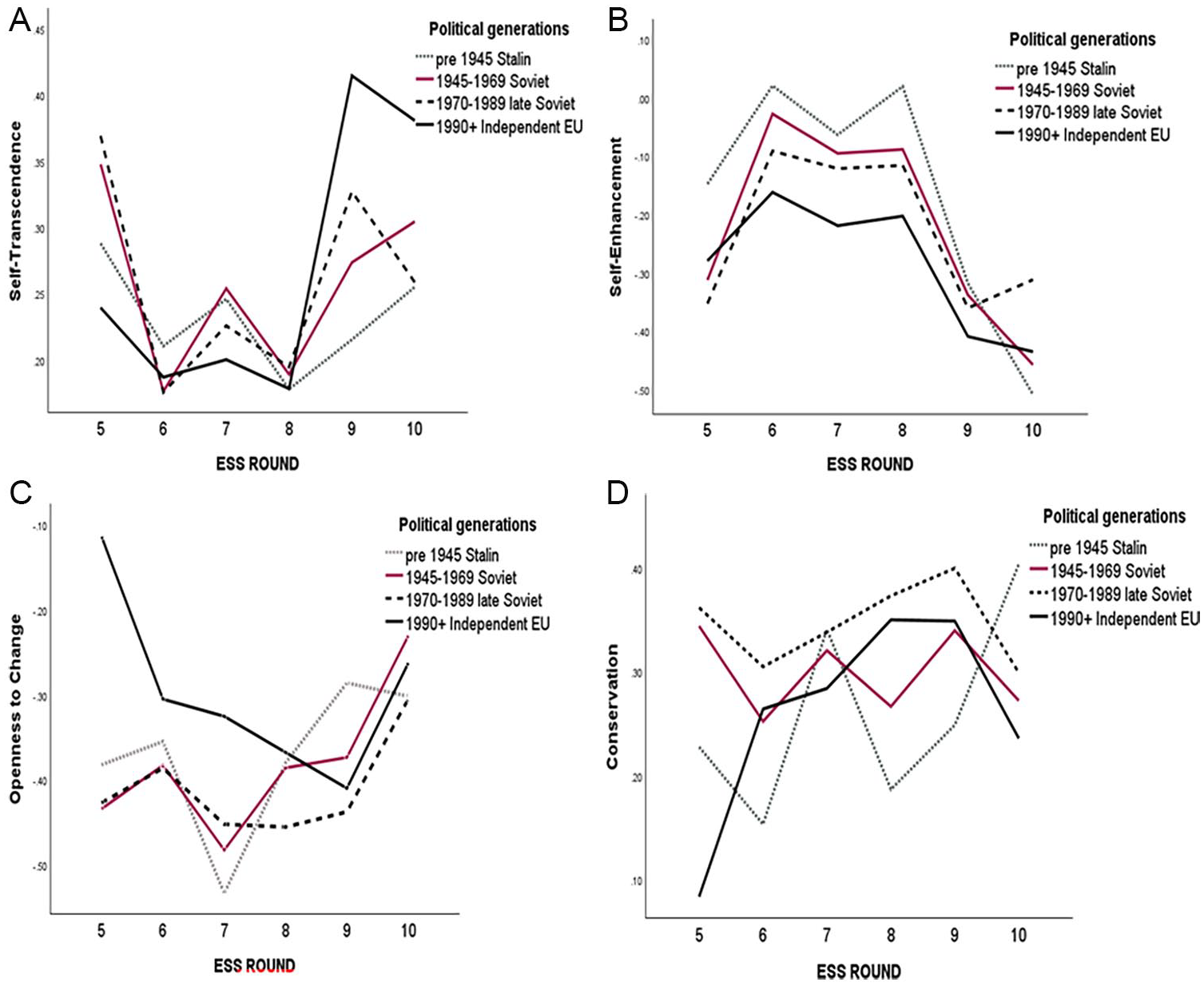
Differences Between Political Generations Over Time.
Self-transcendence showed a significant effect of time (F = 18.18, p < .001,
For self-enhancement, the effects of time (F = 69.96, p < .001,
Openness to change had effects of time (F = 10.99, p < .001,
Conservation had effects of time (F = 5.29, p < .001,
The effect sizes for time, political generation, and age suggest that the variance accounted for by age is large in all value dimensions. Period effects are strongest for self-enhancement, weaker for self-transcendence and openness to change, and weakest for conservation. Cohort effects are present in openness to change and conservation. Figure 1 enables a visualization of period and cohort effects. Figure 1A and 1B show similar trajectories over time across political generations (cohorts) on self-transcendence and self-enhancement. Both dimensions show similar fluctuations over the survey periods with a few exceptions. Figure 1A shows an overall decline in self-transcendence in all cohorts over time, except the Independent EU generation, which increases sharply after 2016. Figure 1B shows a slight deviation from the pattern of change over time at Survey Round 9 (2018) in the late-Soviet and Independent EU political generations. Figures 1C and 1D show that over time, the political generations exhibit different patterns on both dimensions. In openness to change (1c) the period effect is apparent until Survey Round 7 (2014), after which the cohort differences are more apparent. The Independent EU generation, however, shows a different pattern in that openness to change decreases overall, compared to an increase in the other cohorts. On the conservation dimension (1d), the Soviet and late-Soviet generations depict a slight overall decrease over time, while the Stalin and Independent EU generations, an increase.
In addition, of the covariates, the effect of gender was larger than religiosity or education on self-transcendence and self-enhancement, while gender, education, and religiosity effects were all large on openness to change and conservation. In the main, age accounted for more of the variance than the other variables.
Time-Lag Analysis
The time-lag analysis (Table 2) depicts age and period or cohort differences. As age is held constant, significant t-test results between the survey years 2010 and 2020 suggest period or cohort effects; no significant differences suggest the presence of age effects. Openness to change shows significant differences across almost all age groups; mean scores are significantly lower in 2010 than those in 2020. On self-enhancement, differences are found in the oldest age groups beginning with the 61–65 age group (10) and were significantly higher in 2010 (positive mean differences). The significant differences on these two value dimensions suggest the presence of cohort or period effects when age is held constant. Self-transcendence and conservation show fewer significant differences, suggesting the presence of age effects.
Differences in Higher Order Dimensions by Time Period (2010 and 2020) and Age, Time-Lag Design.

p < .05, **p < .01, ***p < .001.
Cross-sectional comparisons can help identify whether cohort effects are present. Conceptually, a cohort effect is a period effect that is experienced differently by different groups. Some age groups belong to adjacent political cohorts across the two periods, for example, the 66–70 age group belongs to the Stalin political generation in 2010 (born 1940–1944) and to the Soviet generation in 2020 (born 1950–1954). Significant time-lag and cross-sectional differences between age groups would suggest a cohort effect, while nonsignificant cross-sectional comparisons suggest a time effect. Cross-sectional results are depicted in Table 3. In the cross-sectional results, age groups are compared with the next higher group (read across the rows), and significant t-test results are indicated in the table.
Differences in Higher-Order Dimensions by Age Group and Year, Cross-Sectional Analysis, t-tests.
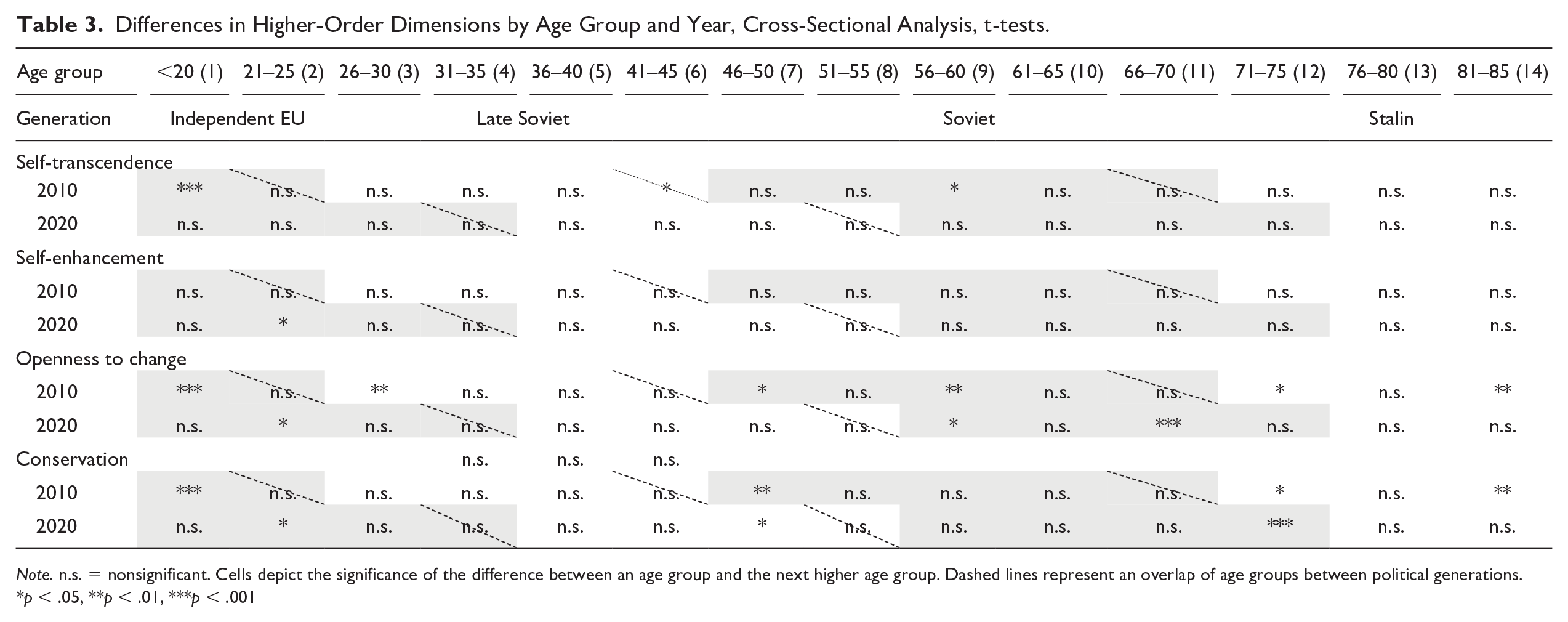
Note. n.s. = nonsignificant. Cells depict the significance of the difference between an age group and the next higher age group. Dashed lines represent an overlap of age groups between political generations.
p < .05, **p < .01, ***p < .001
We plotted the trajectory of each of the value dimensions in 2010 and 2020 across age groups to visualize the results of the time-lag and cross-sectional analyses. Figure 2 depicts the results for each of the value dimensions. The significant time-lag differences are represented by gaps between the lines. Where cross-sectional within-period comparisons (Table 3) revealed no significant differences between adjacent age groups, the line in Figure 2 is flat (horizontal) and suggests time effects. Where cross-sectional differences in Table 3 are significant, this is visually depicted as a sloping line between age groups in Figure 2.
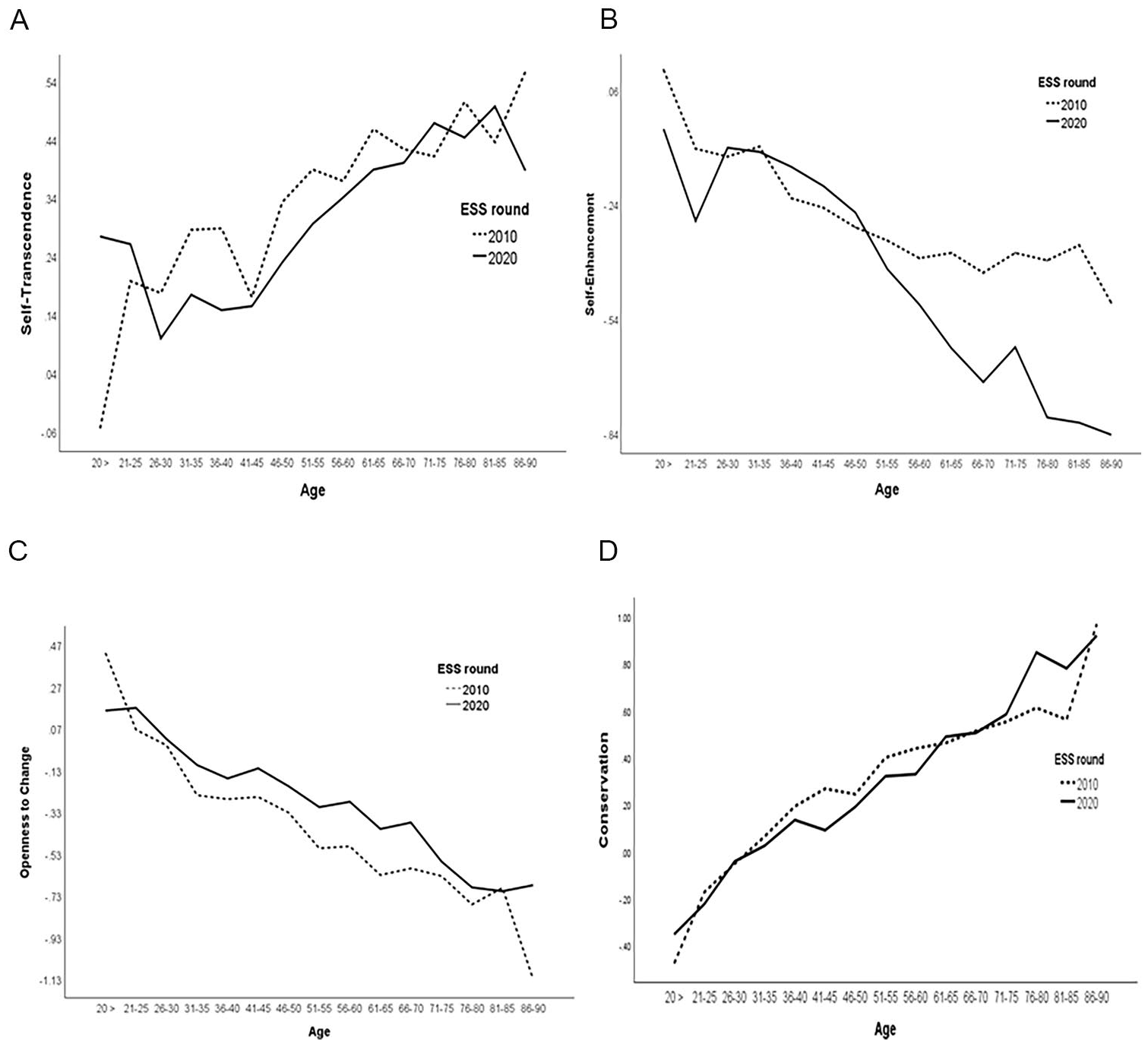
Higher-Order Dimensions Across the Lifespan.
Figure 2A shows the upward trajectory of self-transcendence over the lifespan, with the lines for 2010 and 2020 largely following a similar pattern, suggesting age effects in the main. In Table 2, t-test results were significant for Age Groups 1 (under 20), 5 (36–40), 7 (46–50), and 8 (51–55). The cross-sectional comparisons show a significant difference between age groups only in 2010 for the under 20 group. The significant t-test in 2010 (diff. = −.26, t(177) = −3.38, p < .001) suggests a cohort effect, while the nonsignificant results in subsequent years suggest period effects. The significant time-lag effect for Age Groups 5 and 8 in Table 2 suggests a period effect (age + period), as the cross-sectional t-test results between adjacent age groups are not significant.
In Figure 2B, the pattern of self-enhancement follows the time-lag effects in Table 2. That is, age effects, depicted as parallel lines, are apparent from the 26–30 to the 51–55 age groups comprising the late-Soviet generation; after this, the gap between survey periods begins to widen over the remaining groups. This pattern can also be seen in Figure 1B depicted as similar patterns across political generations until 2018. The cross-sectional analysis (Table 3) found only one significant difference between Age Froups 2 and 3 (diff. = −.20, t(178) = −1.93, p = .046), suggesting a cohort effect. Cross-sectional sequential comparisons of age groups within the Soviet and Stalin generations revealed no significant differences in 2010 and 2020, suggesting period effects.
Significant time-lag effects were found on openness to change. Figure 1C shows that openness to change declines in the Independent EU generation from 2010 and increases between 2018 and 2020. Within the other three generations, openness to change dips in 2014 and increases thereafter. The stepwise downward sloping pattern in Figure 2C shows that openness to change declines over the lifespan but increases over time. The flat parallel lines are indicative of a time effect (where t-tests between successive age groups are nonsignificant), while significant differences between groups suggest cohort effects. For example, there are significant cross-sectional differences between Groups 1–2 (2010: diff. = .37, t(177) = 4.16, p < .001), Groups 2–3 (2020: diff. = .20, t(175) = 2.60, p = .01), Groups 7–8 (2010: diff. = .19, t(258) = 2.48, p = .01), Groups 9–10 (2010: diff. = .20, t(250) = 2.87, p = .004; 2020: diff. = .16, t(319) = 2.02, p = .04), and Groups 11–12 (2020: diff. = .23, t(247) = 3.19, p < .001).
Finally, the time-lag analysis revealed age effects for conservation. Significant differences between time periods were present only for three age groups: 6, 8, and 9. The cross-sectional analysis in Table 3 shows no significant differences between Age Group 6 (41–45) and adjacent age groups in either 2010 or 2020, suggesting period effects. For Age Group 7 (46–50), there is a significant difference compared to Group 8 (51–55) in both 2010 (diff. = .19, t(258) = 2.89, p = .004) and 2020 (diff. = .15, t(300) = 2.40, p = .02), suggesting a cohort effect. No significant differences between Age Groups 9 and 10 suggest that period effects are the most prudent explanation. In addition to age effects, there are significant cross-sectional differences in 2010 between Groups 1–2, 12–13, and 14–15, and in 2020 between Groups 2–3 and 12–13. These differences suggest that there are also cohort effects (age + cohort) and correspond to the gaps in Figure 2D.
To summarize our findings from the time-lag and cross-sectional analyses, we find age and period effects on self-transcendence; an increase over the lifespan is accompanied by a decrease over time. Cohort effects were found in the Independent EU generation, indicating a change in self-transcendence that is dissimilar from other political generations. Self-enhancement exhibited a cohort effect for the Independent EU generation, age (late-Soviet generation), and period effects (Soviet and Stalin generations). For the Independent EU, Soviet, and Stalin generations self-enhancement declined with time, while the late-Soviet generation exhibited an increase but a gradual decline across the lifespan. Openness to change declines in a stepwise pattern across the lifespan but increases within most age groups over time. The patterns in openness to change were attributed to period and cohort effects, with a different trajectory for the Independent EU generation (a decline over time) relative to the other political generations. Period and cohort effects are present within all political generations. Finally, conservation shows a clear age effect, increasing over the lifespan. Age and period effects account for the steadier trajectory within the late-Soviet and Soviet political generations, while age and cohort effects explain the differences between the Independent EU and Stalin generations relative to others—an increase over time and across age. A summary of the findings is shown in Table 4.
Summary of Age, Period, and Cohort Effects on Higher-Order Dimensions.

Discussion
In this study, we disentangled the APC effects on contemporary Lithuanian values based on 10 years of ESS data. We found evidence of value change in the Lithuanian population; APC effects were present in different combinations on the higher-order dimensions. Some of our findings, importantly, diverge from theories of value change and warrant further discussion; we reflect on them below.
Our findings point to cohort effects in the openness to change and conservation dimensions. Abramson and Inglehart (1998) revealed that in some generations, values undergo modernization, particularly in countries that experienced economic growth. They reason that younger cohorts were raised in an environment that offers them more security than older cohorts had in their formative years, resulting in modernization of values. Egri and Ralston (2004), too, found that younger generations of Chinese ethnicity exhibited more modern values, consistent with Chinese political and economic reforms. However, we did not find evidence of cohort replacement; rather, the two Soviet era generations—the Soviet and late-Soviet cohorts—had similar trajectories and overall little change over time on openness to change and conservation, whereas the oldest and youngest generations exhibited more change.
Inglehart and Baker (2000) demonstrated that Lithuanian societal values experienced a shift toward survival values (i.e., conservative) after the collapse of the Soviet Union as it, along with other ex-Soviet countries, went through a period of economic decline, despite widespread exposure to Western cultural forces. They argue that the lack of security during the transition period was a driver of security values (Inglehart & Baker, 2000). Arguably, the post-Soviet transition period was more dramatic than the economic fluctuations in the period just prior to and during our 2010–2020 study. This offers an explanation as to why the Soviet and late-Soviet political generations experienced little overall change in conservation values.
The most interesting and paradoxical finding of our study is an increase in the importance placed on conservation values and a decrease in openness to change values in the youngest—Independent EU—generation during the period of our study. At the same time, this generation exhibited lower levels of self-enhancement than others and a sharp rise in self-transcendence during the latter years of the study. These findings are the reverse of what we would expect according to modernization theories (Inglehart, 1997).
Period effects are variations over time that simultaneously affect all respondent groups regardless of age (Altman, 2015). We identified period effects on all higher-order dimensions; they were weakest on conservation. On all the higher-order dimensions, the Soviet legacy generations fluctuated in very similar ways. This again signals support for the socialization hypothesis; the two generations were socialized during a similar period in history (with limited freedoms and relative economic stability until the 1990s), exhibit similar trajectories in their values, and appear to be less sensitive to period fluctuations than the other political generations. In our view, this reflects their socialization during a period in history that was unique to these generations. The trajectory for the value dimensions changes over the life course in predictable ways and in support of theory; however, period effects are present within each. What is striking is that the Independent EU generation was the most sensitive to period effects.
What can explain the anomalous reactions by the Independent EU generation over a period of time during Lithuania’s history that has been relatively stable? A possible explanation is that the period during our study, which included economic disruptions, impacts the older generations less than the Independent EU generation. All generations born before the mid-1970s will have experienced economic scarcity and oppression of personal freedoms; conservation values were entrenched as societal norms. The collapse of the Soviet Union brought about life-altering economic, political, and social change for the Soviet legacy generations, and the modernization of society has brought relative economic prosperity and freedoms not previously enjoyed. For the EU generation, the economic uncertainty prevailing in the 1990s and early 2000s, lasting into the period of our study, is personal. These different socialization experiences inform the reactions to the fluctuations during the 2010–2020 period. Individuals’ experiences in their formative years shape their values; adolescents are shaped by experiences and institutions that enforce their value hierarchies (Sagiv et al., 2017). Although scholars argue that relative economic prosperity will lead to the modernization of values in younger generations, Vecchione et al. (2016) reason that values of young adults in their early career stages may decline over time if situational constraints, such as high unemployment and a lack of job prospects, interfere with the pursuit of their goals. In the Independent EU generation, this also helps to explain the relatively low importance placed on self-enhancement, compared to other generations. Such situational constraints were present in Lithuania prior to and during the period of our study, and the decline in self-enhancement and openness to change and increase in conservation values reflect this context.
The working-age population in Lithuania changed significantly during the period of our study. Until 1989, when Lithuania was still under Soviet rule, net migration was positive, as there was an influx of immigrants from other Soviet Republics (United Nations, 2024). But since independence, net migration has been negative; only since 2019 has immigration exceeded emigration (European Migration Network, 2023). Overall, from 1990 to 2022, the Lithuanian population decreased from 3.7 to 2.8 million (European Migration Network, 2022). Over the 10-year period of the ESS, the population decreased by 348,000 (Statistics Lithuania, 2023). During the period of our study, the working-age population in Lithuania declined by more than 10% (Statistics Lithuania, 2023). Kumpikaitė-Valiūnienė et al. (2023) found a significant positive relationship between self-enhancement values and a significant negative relationship between conservation values and intentions to emigrate in a study of 1,250 Lithuanians. The decrease in self-enhancement values over time across cohorts could be a reflection of the loss of almost a quarter of the population, many of whom may have migrated in search of better opportunities for self-enhancement. This is corroborated by Kumpikaitė-Valiūnienė (2019), who found that migrants highlighted personal growth and career advancement as key reasons for selecting a host country destination. The emigration effect is a plausible explanation for these observed changes in values. The loss of a large proportion of the Independent EU generation over a short period of time may have led individuals to reassess their values. Alternatively, individuals who place higher importance on self-enhancement and openness to change have emigrated.
Youth generations also experience significant life changes. Whereas middle-aged individuals enjoy relative career stability, the generation in early adulthood is attaining higher education, entering employment, and starting families. This generation may be more sensitive to disruptions to their life and career pursuits. A post-pandemic study by Mockaitis et al. (2022) revealed that the millennial generation, compared to generations before them, had the most difficulty coping with the pandemic. A 2010 study by the Pew Research Center comparing attitudes among age cohorts in post-Soviet societies revealed that in 2009, economic uncertainty was high among Lithuanian respondents aged 18–39 years. Younger respondents also expressed more pessimism about democratic processes. The recent literature suggests that youth generations are more sensitive to economic hardship than generations before them.
A few studies that link human value responses to economic hardship and economic change lend support to our findings. In a study by Laaker (2024), young adults were more susceptible to exogenous shocks than older generations, as their core beliefs are still being formed. Laaker’s (2024) study demonstrates that economic recession causes negative attitudes that persist and increase throughout the life cycle. A study by Reeskens and Vandecasteele (2016) on youth values and attitudes in 24 European countries found that youth unemployment rates (2008–2014) had a negative effect on self-enhancement and a positive effect on self-transcendence. Thus, historical events matter in the formation of attitudes and values during the impressionable years.
Our findings contradict the thesis that higher socioeconomic development and democratization of society will lead to “modernizing” of values, as claimed by Inglehart (1990, 1997), as the higher-order values of self-enhancement, openness to change, and conservation have shown a different trajectory over time, while levels of self-enhancement were lower for the youngest generations. Although Lithuania did experience a shift toward more conservative values in the 1990s on the societal level in the WVS, Inglehart and Baker (2000) argue that this shift was a result of economic collapse in ex-Soviet societies; this post-Soviet period was marked by dramatic political, economic, and social changes and high uncertainty in the country’s progress toward democratization. It appears that the generation born during this period of “modernization” is trapped between scarcity and modernity. Whether this reflects a temporary syndrome or a more prominent evolution of conservatism remains to be seen.
Limitations and Future Research Directions
A limitation of this study is the repeated cross-sectional nature of our data. We examined patterns in value change within cohorts across time periods; however, we were not able to trace changes in values for individuals over time, as would be possible with a longitudinal repeated-measures study. The use of secondary data also prevented the examination of personal values as predictors of attitudes or behaviors. Although not focal to our study, gender and education effects were strong, and future research that delves further into the changes in values uncovered here as more period data become available is encouraged.
Our study was limited to a single country. A comparison of the personal values of other countries in the former Soviet bloc to assess the extent to which generation cohort subcultures are based on the ideological norms dominant in the political eras of the generations would provide further insight into the impact of sociopolitical events on the formation of values. Additionally, during the period of our study, the economic situation, especially for youths aged 18–24 years, fluctuated dramatically, with rising unemployment rates and decreasing wages. Neighboring Baltic countries (Latvia and Estonia) experienced similar labor market trends (European Commission, 2024). A comparison of the values across the three countries, especially EU generation values, would shed understanding on whether youth values are responding to economic hardship as purported by the scarcity hypothesis.
A third limitation is that the composition of the Lithuanian sample from year to year, although representative of individuals residing in the country, has changed dramatically due to the emigration of a large percentage of the working-age population. Thus, studies that compare the values of Lithuanian nationals in situ with those of recent emigrants (e.g., Mockaitis & Zander, 2023) may shed some light on the reasons for the changes in certain higher-order values over a relatively short period of time.
Finally, we must raise a caveat about the measurement and interpretation of values within and across groups. A limitation of studies on values involving different cohorts is the assumption that personal values have a stable meaning across subgroups. However, interpretations (and priorities) can vary based on the historical contexts in which individuals were socialized (Inglehart, 2018). For example, the value of security may be understood differently depending on whether one associates it with economic stability, migration, or war. Such differences complicate comparisons of mean ratings, as subgroups may not be evaluating the same underlying concept. Variability in the meaning of a given value can lead to systematic differences in the structure of PVS items across groups. 3 Although we did not examine such differences in this study, we recommend that future studies address such issues by more closely examining the structure of values in different cohorts and applying mixed-methods approaches.
Conclusion
Our aim in this study was to uncover the extent of value change in a post-Soviet EU member society that has undergone rapid change in recent decades. We found evidence of value change and distinguished effects of APC. A surprising and somewhat counterintuitive finding is that despite the modernization of society since the 1990s, Lithuanians have placed increasing importance on security, conformity, and traditional values and less value on achievement, success, and power over time, over and above the affects of aging. That the trajectory of change in these values is more pronounced in the youngest cohort opens various avenues for investigating changing values in countries that have similar historical legacies and for revisiting theories of value change.
Footnotes
Declaration of Conflicting Interests
The author(s) declared no potential conflicts of interest with respect to the research, authorship, and/or publication of this article.
Funding
The author(s) disclosed receipt of the following financial support for the research, authorship, and/or publication of this article: This study was funded by the Lithuanian Research Council, grant no. S-MIP-23-115.
