




Abstract
This study investigated the role of individualism and collectivism—as an individual trait—in conflict management strategies (i.e., forcing, problem-solving, avoiding, compromising, and yielding) while also considering the mediating role of instrumental concerns (e.g., self-, mutual-, and other-concerns) in conflict. A time-lagged study (ensuring temporal separation of study measures) was conducted encompassing samples from three different countries. The total sample (N = 608) comprised 237 Greek (73.4% females, Mage = 37.13, SD = 12.03), 167 Dutch (79% females, Mage = 19.41, SD = 1.86), and 204 U.S. (52.0% females, Mage = 36.68, SD = 11.62) respondents. The results showed that self-instrumental concerns (i.e., concerns about benefits or outcomes directly affecting oneself) mediated the positive relationship between vertical individualism and forcing. Moreover, other-instrumental concerns (i.e., concerns about benefits or outcomes primarily affecting others) mediated the positive relationship between vertical collectivism and yielding. Finally, mutual-instrumental concerns (i.e., concerns about benefits or outcomes that affect both oneself and others) mediated the positive relationship between horizontal collectivism and problem-solving. Emphasizing instrumental concerns as a key mechanism underlying the relationship between cultural orientation on the one hand and conflict management on the contrary can help develop targeted interventions and improve interpersonal communication and collaboration among people with different cultural values.
Keywords
Cultural values significantly shape people’s attitudes, guiding their decisions and behaviors in various aspects of life. These deeply rooted beliefs and values influence various aspects of human interaction ranging from communication styles and social relationships (Ting-Toomey & Dorjee, 2018) to work habits and ethical standards (Fousiani & Van Prooijen, 2023). Cultural values play a significant role in shaping how individuals approach conflicts and the strategies they use to resolve them (Holt & DeVore, 2005; Oetzel & Ting-Toomey, 2003; Yamini et al., 2023). Collectivistic values, emphasizing harmony and relationship maintenance, relate to more indirect communication and a collaborative approach to conflict, as opposed to individualistic values, which emphasize direct and confrontational approaches to conflict (Merkin, 2015; Pierre-Louis, 2016).
So far, the most widely studied cultural dimension in conflict management is individualism-collectivism. However, this dimension alone provides an incomplete picture of the role of culture in conflict management as it can be further distinguished into horizontal and vertical individualism/collectivism. Overlooking these cultural sub-types neglects critical variations, such as the focus on equality versus hierarchy, which can significantly influence conflict management strategies and outcomes. In addition, previous research on culture and conflict management has primarily viewed culture at the broader/national level rather than at the individual one (Autio et al., 2013; Hollebeek, 2018). This has given room for criticism as this approach overlooks the variations within a single culture, potentially leading to oversimplified conclusions (Smith & Bond, 2019).
Moreover, while the role of cultural values in conflict management strategies is well documented in the literature (Croucher, 2013; Khakimova, 2008; Ting-Toomey, 2017), less attention has been given to the underlying mechanisms driving these effects (Oetzel & Ting-Toomey, 2003; Ting-Toomey et al., 1991). Among these mechanisms, instrumental goals, such as achieving monetary benefits or other tangible outcomes (Wilson & Putnam, 1990), have been argued to play a critical role in conflict situations. Despite their importance, the contribution of instrumental concerns as a potential mediating factor between culture and conflict management strategies remains unexplored.
To address these limitations, the current study takes a more fine-grained approach to the role of culture in conflict management in several ways. First, the study explores the influence of culture on conflict management by reconceptualizing individualism and collectivism into four cultural dimensions (Hofstede, 1980) instead of the traditional bipolar conceptualization (individualism-collectivism). More specifically, the study differentiates between (a) horizontal individualism—a cultural pattern where people prioritize an autonomous self and equality within a group; (b) vertical individualism—a pattern where individuals prioritize autonomy alongside accepting inequality; (c) horizontal collectivism –characterized by individuals feeling connected to their in-group members and valuing equality; and (d) vertical collectivism—characterized by the acceptance of inequalities within a collective while still feeling connected to group members (Singelis et al., 1995; Triandis & Gelfand, 1998). By incorporating horizontal (i.e., emphasizing equality and harmonious relationships) and vertical (i.e., emphasizing hierarchy and competition) aspects of individualism (independence is prioritized) and collectivism (interdependence is prioritized) into the cultural mix, this study addresses previously overlooked characteristics of these cultural dimensions in conflict management.
Second, this study investigates culture as an individual-level rather than a nation-level variable, recognizing that people form cultural values through personal experiences with family, peers, friends, and broader social networks (Schwartz, 1994, 2008). This approach leads to a more detailed and nuanced assessment of cultural influences on conflict management strategies as it reflects the diverse ways in which people experience and express their cultural backgrounds (Leung et al., 2008; Markus & Kitayama, 1991).
Finally, this study aims to explain why culture influences conflict management strategies with a particular emphasis on the role of instrumental concerns in conflict. Although previous research has investigated the explanatory role of face concerns (e.g., concerns about one’s identity and reputation) in the relationship between culture and conflict management (Oetzel & Ting-Toomey, 2003; Q. Zhang et al., 2014; for a meta-analysis, see Yamini et al., 2023) the role of instrumental concerns in this relationship remains largely uninvestigated. Given that conflicts often revolve around tangible outcomes and gains (e.g., money, tasks, opportunities, etc.; Wilson & Putnam, 1990), a focus on the role of instrumental concerns is warranted. The present study draws upon the dual concern theory (De Dreu et al., 2001), and distinguished self, other, and mutual-instrumental concerns in conflict as key mechanisms explaining the relationship between culture and conflict management strategies.
Investigating vertical and horizontal collectivism and individualism as predictors of conflict management strategies, along with the mediating role of instrumental concerns, is important for various theoretical and practical reasons. First, by considering the vertical and horizontal subdimensions of collectivism and individualism at the individual level, the literature gains a better understanding of how different cultural orientations impact conflict management strategies, acknowledging cultural complexities and avoiding oversimplification of the construct of culture (Smith & Bond, 2019). Second, understanding how individuals with diverse cultural values prioritize tangible outcomes and gains (e.g., self-, mutual-, and other-instrumental concerns) provides insights into the mechanisms through which culture influences conflict management. Such insights can enhance psychological interventions and optimize business negotiations globally. Indeed, understanding these cultural dynamics provides actionable insights for fostering harmonious relationships and effective conflict resolution across various contexts.
Culture: Vertical and Horizontal Individualism and Collectivism
Culture is defined as a learned system of meanings that are related to norms, beliefs, knowledge, morals, and values (Hofstede, 1980; Triandis, 1990). Research has found that individuals communicate, process information, and behave based on the cultural values that they have internalized (Gudykunst & Kim, 2003; Guirdham & Guirdham, 2017; Ting-Toomey & Dorjee, 2018). Among the various cultural dimensions that influence people’s attitudes and behavior (e.g., power distance, masculinity/femininity and uncertainty avoidance; Hofstede, 1984), the bipolar conceptualization of individualism-collectivism dimension has been the most extensively studied (X. Chen et al., 2015; Kaushal & Kwantes, 2006; Oetzel et al., 2001). Individualism emphasizes self-reliance, agency, independence, and prioritization of individual goals, while collectivism emphasizes other-reliance, interdependence, group cohesion and prioritization of collective goals (Triandis, 1995). Of the various cultural dimensions, individualism/collectivism (Hofstede, 1980; Triandis, 1990) has also received the most attention in the conflict management literature (e.g., Van der Zee & Hofhuis, 2018; Y. Zhang et al., 2017). Research has demonstrated that individualism is positively related to direct and assertive approaches in conflict such as forcing. In contrast, collectivism is positively related to more cooperative strategies such as problem-solving, compromising, and avoiding (Ting-Toomey, 2005, 2017; Ting-Toomey et al., 1991).
Although previous studies have profoundly developed the field, the dichotomy of individualism-collectivism has been critiqued as overly broad and simplistic for explaining behavior in conflict situations (LeFebvre & Franke, 2013; Schwartz, 1990). A more nuanced approach, incorporating power distance as a critical cultural dimension alongside individualism and collectivism, was introduced (also see Gelfand et al., 1996; Singelis et al., 1995; Triandis, 1995). This led to the formulation of four distinct typologies: Horizontal collectivism (i.e., low power-distance collectivism) emphasizes equality, cooperation, and interdependence, with strong social cohesion and connection to in-groups. Vertical collectivism (i.e., high power-distance collectivism) accepts social hierarchies and submission and obedience to authority figures. Horizontal individualism (i.e., low power-distance individualism) prioritizes individuals’ independence and autonomy alongside acceptance of equality. Finally, vertical individualism (i.e., high power-distance individualism) fosters competition and personal achievement alongside acceptance of inequality. To give an example of how these cultural dimensions would play in a sports context, individuals scoring high on horizontal collectivism would prefer non-competitive activities that take place in the group context and are performed while socializing with others (like synchronized swimming). In contrast, individuals scoring high on vertical collectivism would prefer small-group activities focusing on harmony where one participant takes the lead, and others follow (such as dancing or yoga). Individuals with a horizontal individualism orientation would be attracted to non-directly competitive sports, focusing on personal progress (such as fitness) while individuals with a vertical individualism orientation would prefer competitive person-versus-person sports (e.g., golf, tennis; Meyers-Levy, 2006).
Importantly, these cultural dimensions shape interpersonal interactions and relationship dynamics (Marks et al., 2018; Nezlek & Humphrey, 2023; Singelis et al., 1995). On the one hand, horizontal collectivism encourages collaboration and consensus-building in social interactions promoting collective well-being (Y. Zhang et al., 2022), while vertical collectivism emphasizes loyalty and obedience to powerful others in decision-making processes (Chirkov et al., 2003). On the other hand, horizontal individualism promotes mutual respect and open communication (Realo et al., 2002; Wilczewski et al., 2017), whereas vertical individualism values direct communication, assertiveness, and competitiveness in interpersonal relationships (Triandis & Gelfand, 1998).
To date, and to the best of our knowledge, only three studies have investigated how these cultural typologies influence conflict management strategies (Bobbio & Sarrica, 2009; Kaushal & Kwantes, 2006; Komarraju et al., 2008). Komarraju and colleagues (2008), in a study conducted in the United States, found that both horizontal and vertical individualism were positively related to forcing. In contrast, horizontal and vertical collectivism were positively related to problem-solving while horizontal collectivism was also positively related to yielding. Contrary to these findings, Kaushal and Kwantes (2006), in a study conducted in Canada, found that vertical individualism and vertical collectivism were positively associated with forcing while vertical collectivism was also related to yielding. In a study carried out in Italy, Bobbio and Sarrica (2009) found that individuals from vertical individualistic cultures were more were more inclined to use forcing strategies, whereas those from both vertical and horizontal collectivistic cultures tended to favor problem-solving and yielding approaches. Taken together, these studies yield inconsistent findings and thus do not fully clarify the role of culture in conflict management strategies. Importantly, these studies have primarily focused on culture at the national rather than the individual level of analysis. Given these inconsistencies, investigating the relationships between Horizontal and Vertical Individualism and Collectivism (HVIC) and conflict management strategies seems warranted.
The current study proffers that these four cultural patterns are tied to distinct social concerns, influencing individuals’ priorities in interactions, including conflicts. Indeed, Wilson and Putnam (1990) have identified two primary concerns (or goals) in conflict: Instrumental concerns, which refer to one’s willingness to maximize material profit and gain access to resources (Rogan & Hammer, 2002; Wilson & Putnam, 1990), and face concerns (or symbolic and relational concerns), which center on managing one’s own or the other party’s face, image and status. The Face Negotiation Theory (Ting-Toomey, 2017; Ting-Toomey & Kurogi, 1998) has already investigated the role of face concerns in conflict situations but the role of instrumental concerns has been largely disregarded. According to realistic conflict theory (Sherif & Sherif, 1969), people value monetary gains and tangible outcomes at least equally to their image and relationships (Teixeira et al., 2011; Wilson & Putnam, 1990). Instrumental concerns, therefore, often predominate in conflict situations. The current study suggests that individuals’ perceptions and priorities regarding instrumental concerns in conflict may vary based on their cultural background. Specifically, each of the four cultural dimensions may relate differently to instrumental concerns during conflict. Importantly, culture is expected to shape individuals’ conflict management strategies through these instrumental concerns, which may focus on oneself, others, or all parties involved.
The Role of Culture in Instrumental Concerns in Conflict Situations
The dual concern theory (De Dreu et al., 2001) categorizes conflict-related concerns into three distinct types: self, mutual, and other concerns. Concern for self represents the degree to which one wants to accomplish one’s own goals or maximize one's own benefits. Concern for others is more relational in nature and captures the degree to which one wants the other party to accomplish their goals or to provide the other party with some benefits. Mutual concern refers to the extent to which people care about both their own goals and the goals of the other party, with a desire to achieve both. Accordingly, self-instrumental concerns are defined as one’s concern for one’s own material and tangible outcomes when involved in conflict. Other-instrumental concerns are the concerns for another party’s tangible and monetary outcomes, and mutual-instrumental concerns are the concerns for both parties’ material and tangible outcomes.
Cultural factors influence the degree to which people endorse instrumental concerns, with people from cultures emphasizing individual achievement tending to value them more than those from cultures that prioritize collectives and group harmony (Fousiani & Van Prooijen, 2023). In other words, when individuals perceive themselves as independent of collectives and prioritize their individual goals over others, instrumental concerns and material outcomes take precedence. If individuals view themselves as part of one or more collectives and prioritize the goals of these collectives over their own, face concerns—rather than instrumental concerns—become more prominent (Desrayaud & Hurley, 2023; Fousiani & Van Prooijen, 2023; Ting-Toomey, 2005). Nevertheless, all people value tangible and material outcomes in their lives, including those who are more collectivistic in orientation (Godey et al., 2013; Kilbourne et al., 2005).
In the current study, we hypothesize that individuals with a stronger collectivistic value orientation prioritize mutual- or other-instrumental concerns rather than self-instrumental concerns as a reflection of their focus on the group’s needs and the well-being of the group over individual interests (Locke et al., 2014; Triandis, 2001). On the contrary, people with stronger individualistic values tend to prioritize self-concerns and interests rather than mutual- or other-instrumental concerns. Thus, individuals with individualistic values are more likely to have self-instrumental concerns to maximize personal material profit and gain access to resources than those with stronger collectivistic values (Hofstede, 1980; Hofstede et al., 2010; Triandis, 1995).
To date, no research has explored the relationship between the four sub-types of individualism and collectivism and self-, mutual-, and other-instrumental concerns in conflict situations. Yet, general theory on culture can help us to arrive at hypotheses (Singelis et al., 1995; Triandis, 1995). Vertical individualism, emphasizing self, status, competition, and unequal resource distribution (Nelson & Shavitt, 2002; Singelis et al., 1995; Torelli & Shavitt, 2010), is most closely related to a focus on own benefits and can therefore be expected to be positively related to self-instrumental concerns. Using a similar reasoning, horizontal individualism, emphasizing egalitarianism, collaboration, and relationship equality (Mesman et al., 2016; Torelli & Shavitt, 2010), will be positively associated to mutual-instrumental concerns. Given its emphasis on oneself and personal outcomes in social interactions (Markus & Kitayama, 1991; Oyserman et al., 2002; Triandis, 1995), we do not expect either horizontal or vertical individualism to relate to other-instrumental concerns.
Given the focus of vertical collectivism on loyalty to the group, sense of duty to others, and adherence to established social norms (Khatri & Tsang, 2016; Roccas et al., 2006), we hypothesize a positive relationship between vertical collectivism and other-instrumental concerns. This is because such goals contribute to maintaining social order and ensuring the smooth functioning of the collective. Conversely, horizontal collectivism, emphasizing reciprocity, mutual support, consensus, and inclusive decision-making processes (Walker et al., 2008), will be positively related to mutual-instrumental concerns, which enable individuals to achieve harmonious and egalitarian interactions, benefiting all parties involved. Given their focus on others and the maintenance of relationships with the group (He et al., 2004; Sawitri & Creed, 2017), we do not expect either horizontal or vertical collectivism to relate to self-instrumental concerns. In sum, we hypothesize:
Instrumental Concerns as a Mediator in the Relationship Between Culture and Conflict Management Strategies
The conflict management literature (De Dreu et al., 2001; see also dual concern theory; Pruitt & Rubin, 1986) identifies five conflict management strategies that individuals may display in conflict situations based on the degree of their concern for self, concern for others, or both (Blake & Mouton, 1964; Deutsch, 1973). Individuals demonstrating a high concern for themselves and low concern for others in a conflict situation may opt for a forcing strategy, prioritizing their own interests at the expense of their counterparts. Individuals with low concern for both self and others might lean toward an avoiding strategy, diminishing the significance of issues and evading confrontation. A high concern for both self and others could drive a problem-solving strategy, integrating the needs and goals of all parties. Similarly, an intermediate level of concern for self and others might lead to a compromising strategy, seeking balanced resolutions. Finally, individuals with low concern for themselves and high concern for others may choose a yielding strategy, acknowledging and endorsing the perspectives and desires of others (De Dreu et al., 2001).
This study categorizes instrumental concerns in conflict as self, mutual, and other. Self-instrumental concerns may prompt one to prioritize one’s own material outcomes and goals as it reflects an individual’s focus on achieving personal material objectives and access to resources (Deci & Ryan, 2000; Grant & Schwartz, 2011). Accordingly, self-instrumental concerns are more likely to be linked to force. Mutual-instrumental concerns focus on achieving personal material goals while also considering the material benefit of others (Batson & Powell, 2003; Dovidio et al., 2006). As a result, these concerns typically align with problem-solving and compromising strategies (Van de Vliert & Hordijk, 1989; Verma, 1998). Other-instrumental concerns focus on achieving tangible outcomes and needs of others in conflict situations. These concerns are often linked to yielding strategies, where the individual prioritizes the well-being and outcomes of others over their own (Davis et al., 2009; Lewicki et al., 2020). Due to the ambiguous nature of the avoiding strategy, which involves low levels of both other-oriented and self-oriented concerns (see Beitler et al., 2018) and the inconsistent literature regarding the role of culture in avoiding (Boroş et al., 2010; Komarraju et al., 2008), no hypotheses about avoiding were stated. Based on the above, the following hypotheses were formulated:
We propose that instrumental concerns act as a key mechanism explaining the link between culture and conflict management strategies. Specifically, vertical individualism is expected to positively influence the use of forcing strategies in conflict, as this cultural orientation emphasizes strong self-instrumental concerns, such as achieving personal goals or benefits, and these in turn foster the use of forcing. Furthermore, both horizontal individualism and collectivism will be positively related to problem-solving and compromising strategies through the increased mutual-instrumental concerns that they both promote. Finally, vertical collectivism will be positively related to yielding, through the other-instrumental concerns that it promotes. Accordingly, the following hypotheses were stated:
Overview of the Present Research
To increase the generalizability of the results to different cultural contexts, data were collected across three different countries: Greece, the Netherlands, and the United States. According to Hofstede et al. (2010), Greece scores relatively low on the individualism index (35) and relatively high on the power-distance index (60). In contrast, the United States ranks very high in individualism (91) and relatively low in power distance (40). Similarly, the Netherlands also scores high on individualism (80) and low in power distance (38). Although the primary goal of this study was to investigate the role of culture in conflict management at the individual level, combining data from different counties with varying cultural orientations allows for a more comprehensive understanding of cultural influences and how they interact to shape conflict strategies. Taken together, this study examines how individualism and collectivism, along with their vertical and horizontal dimensions, influence conflict management strategies at the individual level. The study also investigates how self, mutual, and other-instrumental concerns mediate the relationship between culture and conflict management. The hypothesized model is depicted in Figure 1.
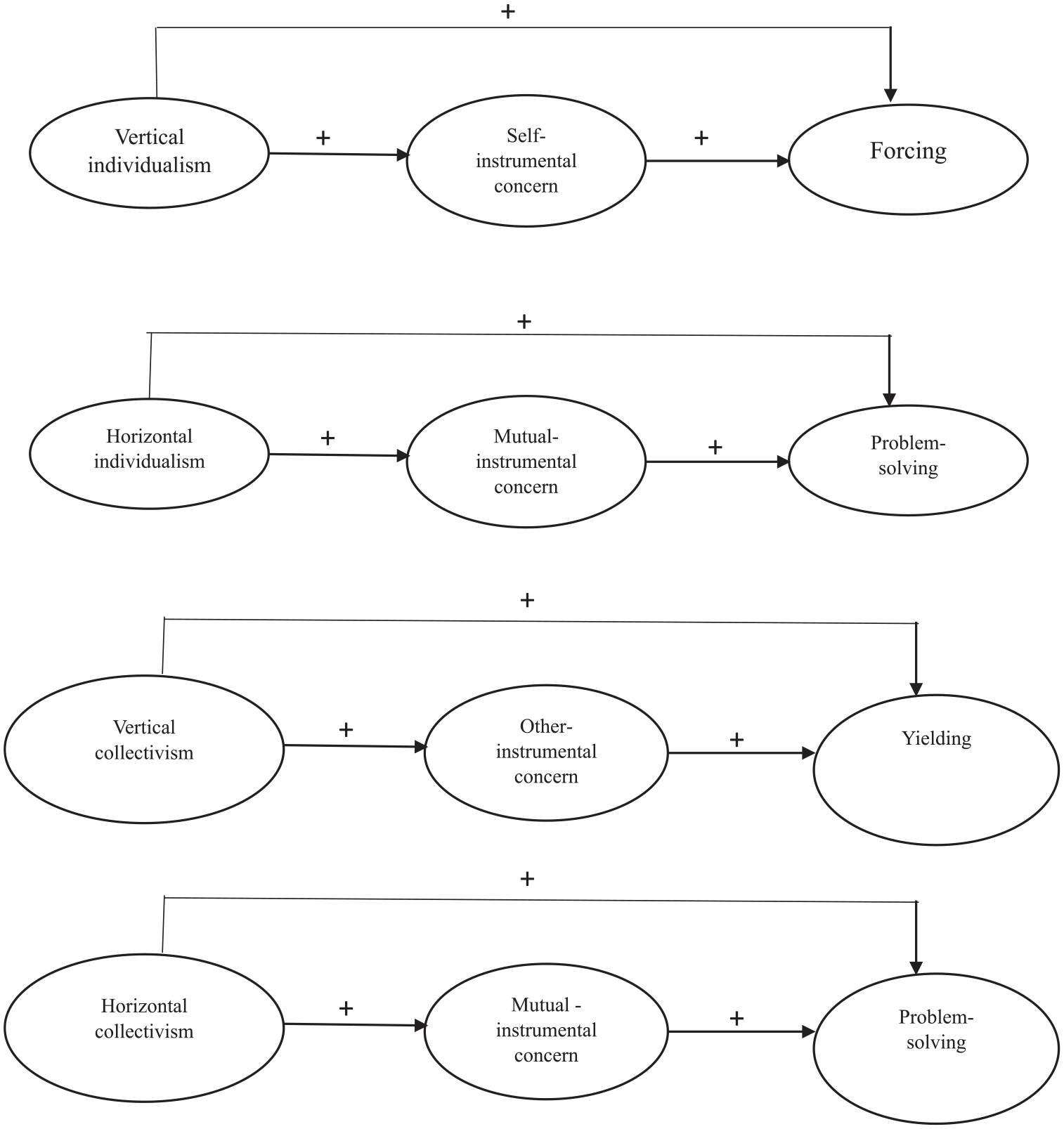
Hypothesized Model
Method
Participants
The total sample of the study comprised 237 Greek, 167 Dutch, and 204 U.S. respondents. The Greek sample included 73.4% females (Mage = 37.13, SD = 12.03), 24.1% were students, 18.1% indicated a high school diploma as their highest education level, while 79.7% indicated having completed (the equivalent of) a bachelor’s (46.4 %) or master’s (33.3 %) degree. The Dutch sample involved 79% females, (Mage = 19.41, SD = 1.86), all the participants were students. In this sample, 91.0% indicated a high school diploma as their highest education level, while 8.4% indicated having completed (the equivalent of) a bachelor’s or master’s degree. The American sample included 52.0% females (Mage = 36.68, SD = 11.62). In this sample, 18.1% were students, 36.3% indicated a high school diploma as their highest education level, while 54.0% indicated having completed (the equivalent of) a bachelor’s (42.2 %) or master’s (11.8 %) degree. Table 1 presents participants’ demographic characteristics per country in more detail.
Demographic Characteristics of Respondents Per Country.

Inclusion and Exclusion Criteria
This study is part of a larger project and was preregistered in Open Science Framework (https://osf.io/kzr4v/?view_only=edd2b021714c4ca583c634dcfa960e8b). Participants were at least 18 years or older, fluent in the primary languages of the target countries, and residing there during data collection. They also needed to have experienced conflict at least 6 months before the study. Participants who did not complete the surveys in both Time 1 and Time 2 were excluded from the analysis. No other exclusion criteria were implemented.
Procedure
To ensure temporal distance between the mediating variable and the dependent variable and mitigate common-method bias we used a time-lagged design (Podsakoff et al., 2003). At Time 1, we measured participants’ cultural values as well as their self-, mutual-, and other-instrumental concerns in conflict. Conflict management strategies were measured at Time 2.
Respondents filled in all measures in their mother language. For the Greek sample, except for the measure assessing cultural values, which was already available in Greek (Fousiani & Van Prooijen, 2023), all measures were translated and back-translated by native speakers from English into Greek. For the Dutch sample, the measure assessing conflict management strategies was available in Dutch (De Dreu et al., 2001), and therefore no translation was required. The measure of cultural values and instrumental concerns were translated and back-translated by native speakers from English into Dutch. As all measures were available in English, no translations were required for the American sample. All respondents, from all three countries, filled in a questionnaire online via Qualtrics. The exact procedure varied per country. Greek respondents were approached by our research assistants. Research assistants were university students (living in Greece) who collected data for course credits. Greek respondents were contacted via several channels including personal networks, LinkedIn, and Facebook, and they were not paid. American respondents were recruited via Prolific and were compensated US$1.09 for their participation. Dutch respondents were university students and were recruited through their university’s online survey manager. They received course credits for their participation in the study.
To increase the realism and ecological validity of the study, the critical incident technique was applied (Butterfield et al., 2005; Flanagan, 1954). More specifically, at Time 1, respondents filled in measures assessing their cultural values and were asked to recall a conflict or intense disagreement that they had over the last 6 months with another person close to them. They were asked to indicate with whom they had the conflict (e.g., a parent, sibling, friend, neighbor, and other), whether the conflict had been resolved or it was an ongoing conflict, and -if the conflict was resolved- the extent to which respondents were satisfied with the way the conflict ended (1= not at all; 7 = to a great extent). Respondents were also asked about how they were feeling about their relationship with that person (1 = not good at all; 7 = very good). They were then asked to bring to mind the conflict with the other person and to answer several questions pertaining to their instrumental concerns about that conflict. Finally, participants were asked to provide demographic information, particularly their chronological age (in years), gender (1 = female, 2 = male, 3 = other), nationality (for American participants: 1 = American, 2 = other; for Dutch participants: 1 = Dutch, 2 = other; for Greek participants: 1 = Greek, 2 = other.), educational level (1 = primary school, 2 = high school or equivalent, 3 = bachelor’s degree, 4 = graduate or professional degree, 5 = master’s degree, 6 = PhD), and student status (1 = student, 2 = not a student). The questionnaire took about 15 min to complete.
At Time 2, which was 2 to 3 weeks later, the respondents were reapproached and asked to bring to mind the same conflict and complete a much shorter questionnaire about the conflict management strategies that they used during that conflict. The second part of the study lasted approximately 3 to 5 min. Responses were given on a seven-point Likert-type scale for each of the study variables, ranging from (1) strongly disagree to (7) strongly agree for both Time 1 and Time 2.
Ethics approval was obtained prior to the data collection. Moreover, participation in the study was anonymous and all respondents gave their informed consent before participating in the study.
Measures
Cultural Value Orientation
Cultural value orientation was assessed with the 16-item scale of Triandis and Gelfand (1998). The scale consists of four subscales measuring all four cultural dimensions, namely: (a) Horizontal Individualism (4 items; e.g., “I’d rather depend on myself than others”; α= .66 for the total sample), (b) Vertical Individualism (4 items; e.g., “It is important that I do my job better than others”; α = .71), (c) Horizontal Collectivism (4 items; e.g., “To me, pleasure is spending time with others”; α = .68), and (d) Vertical Collectivism (VC; 4 items; e.g., “Parents and children must stay together as much as possible”; α = .66). Please see supplementary materials for details per country.
Instrumental Concerns
Instrumental concerns were assessed with an 11-item measure developed by Wilson and Putnam (1990). The scale was adapted to include the three subscales of instrumental concerns, namely, self, other, and mutual-instrumental concerns. Examples for each subscale are: (a) self-instrumental concerns (4 items; e.g., In this conflict. . . “I wanted to be in a better position compared to the other person”; α = .88), (b) other-instrumental concerns (4 items; e.g., “I wanted the other person to be in a better position than me”; α = .94), and (c) mutual-instrumental concerns (3 items; e.g., “I wanted to maximize the total benefit for both myself and the other person”; α = .83).
Conflict Management Strategies
Conflict management strategies were assessed using the 20-item Dutch Test for Conflict Handling of De Dreu et al. (2001). The scale measures forcing, problem-solving, avoiding, compromising, and yielding. Each of the five conflict strategies was assessed with four items: forcing (e.g., In this conflict, “I did everything to win”; α = .81), problem-solving (e.g.; “I worked with the other person to find a mutually optimal solution”; α = .88), avoiding (e.g., “I tried to avoid a confrontation with the other person”; α = .88), compromising (e.g., “I proposed a middle ground to solve the problem”; α = .91), and yielding (e.g., “I tried to satisfy the other person’s needs and expectations”; α = .82).
Control Variables
Age and gender have been systematically found to influence people’s conflict management strategies (Fousiani et al., 2022; Rahim & Katz, 2020). Accordingly, we controlled both age and gender. Moreover, we wanted to account for individual differences in conflict management and emotional states, which may influence the results. As such, we controlled for satisfaction with how the conflict ended (measured with: “To what extent are you satisfied with the way the conflict ended?”; 1 = not at all, 7 = to a great extent) and current emotional attitude toward the relationship (measured with: “How do you feel about this relationship now?”; 1 = not good at all, 7 = very good).
Plan of Analysis
Descriptive statistics and correlations were computed for the main variables of interest. Following this, we conducted an Exploratory Factor Analysis (EFA) to explore the underlying structure among the variables and identify how they cluster. The EFA allowed us to detect common patterns and address potential cross-loadings between items, ensuring more accurate measurements (Fabrigar & Wegener, 2011). The Kaiser–Meyer–Olkin (KMO) value was .799, and Bartlett’s Test of Sphericity yielded a result of 3165.64 (p < .01), indicating that the data were suitable for factor analysis (Kaiser, 1974).
Next, confirmatory factor analysis (CFA) was performed to assess the construct validity of the scales and confirm that the measures were distinct. Model fit was evaluated using several criteria, including: a non-significant model χ², a comparative fit index (CFI) >.90, and a root mean square error of approximation (RMSEA) <.08 (Hu & Bentler, 1999).
Given that our sample consisted of participants from multiple cultural groups using different language versions of the scales, measurement invariance was tested. This included tests for configural, metric, and scalar invariance across the groups. Metric and scalar invariance were evaluated using the thresholds ΔCFI < .010 and ΔTLI < .010 (F. F. Chen, 2007).
Finally, the hypothesized model was tested using Structural Equation Modeling (SEM) with maximum likelihood estimation to obtain direct and indirect effects. Control variables were included in the model to account for potential confounding effects. All analyses were conducted on the entire sample, which included participants from three different countries.
Results
Preliminary Analyses
Descriptive statistics and correlations between the study variables for the total sample are provided in Table 2 (for more information on the separate countries, please see the supplementary materials).
Correlations Between Study Variables.
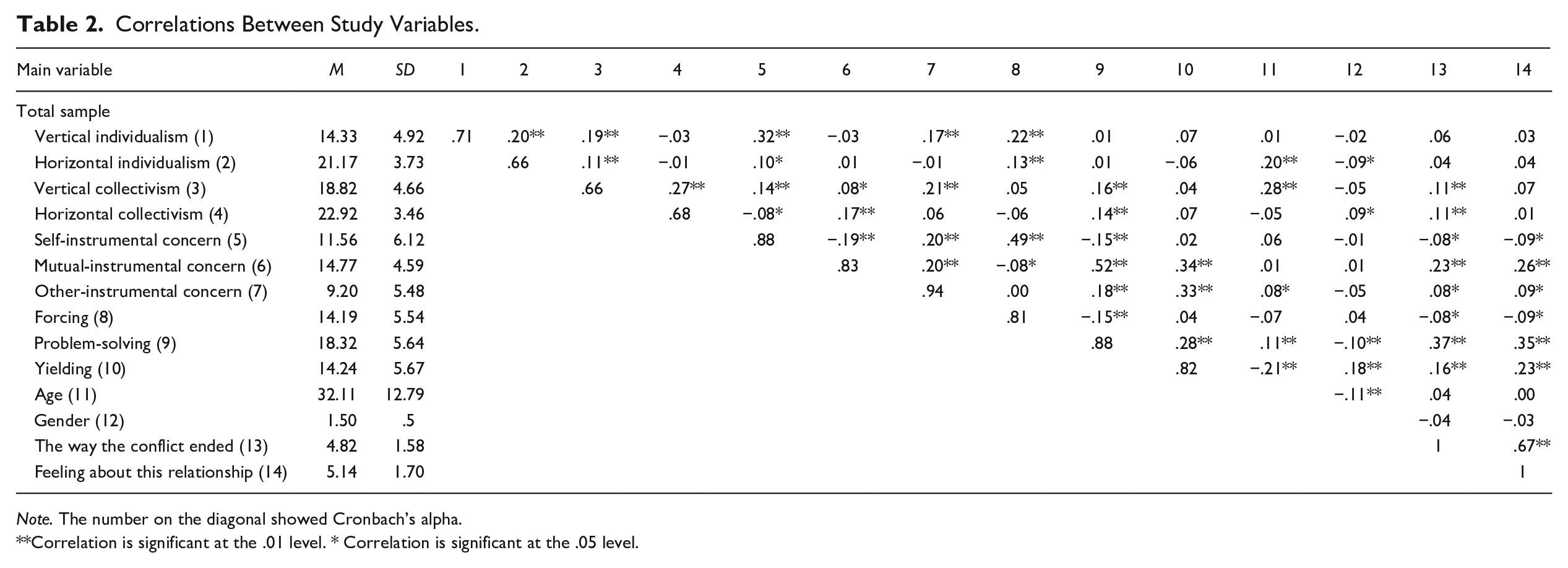
Note. The number on the diagonal showed Cronbach’s alpha.
Correlation is significant at the .01 level. * Correlation is significant at the .05 level.
The results of the EFA indicated that the yielding and forcing strategies loaded on two distinct factors, as expected. However, the problem-solving and compromising strategy items loaded together on a single factor, suggesting that these two strategies were not perceived as distinct by respondents. This finding is consistent with Pruitt and Rubin’s (1986) argument that compromising and problem-solving are often similar and may not always emerge as separate factors. To avoid confusion, we excluded all items assessing compromising from further analysis, retaining only the problem-solving items, as they clearly reflect the pursuit of win-win solutions. In addition, as avoiding was not part of our hypotheses, it was excluded from further analysis.
Next, the CFA results demonstrated that the measurement model had a good fit to the data: χ²(df = 805) = 2,086.45, χ²/df = 2.59, p < .05, CFI = .90, TLI = .89, RMSEA = .05, with 95% confidence intervals for RMSEA ranging from .048 to .054, and SRMR = .06. The hypothesized measurement model included all relevant constructs: vertical and horizontal individualism, vertical and horizontal collectivism, self-, other-, and mutual-instrumental concerns, as well as forcing, problem-solving, and yielding strategies.
To account for the diversity of cultural groups in the sample, measurement invariance was tested across groups. Metric invariance, which constrains factor loadings to be equal across cultural samples, did not deviate significantly from the configural model (ΔCFI = .005, ΔTLI = .002). This indicates that the factor structure was comparable across groups. However, the scalar invariance model, which further constrains item intercepts to be equal across groups, deviated from the metric model (ΔCFI = .075, ΔTLI = .077, p < .001). This suggests that the relationships between variables may differ across cultural contexts, indicating potential cultural differences in how these constructs are interpreted.
Hypothesis Testing
Cultural Values in Instrumental Concerns
Hypothesis 1a predicted that vertical individualism would have a positive relationship with self-instrumental concerns. The results indicated that vertical individualism has, indeed, a positive relationship with self-instrumental concern (β = .42, p ≤ .05). Therefore, Hypothesis 1a was supported.
Hypothesis 1b predicted that horizontal individualism has a positive relationship with mutual-instrumental concerns. However, no significant relationship was found between horizontal individualism and mutual-instrumental concerns. Hypothesis 1b was therefore not supported.
Furthermore, Hypothesis 1c predicted that vertical collectivism would have a positive relationship with other-instrumental concerns. The results showed that indeed, vertical collectivism had a positive relationship with other- instrumental concerns (β = .28, p ≤ .05) providing support for Hypothesis 1c.
Hypothesis 1d predicted that horizontal collectivism would have a positive relationship with mutual-instrumental concern. Horizontal collectivism had indeed a positive relationship with mutual-instrumental concern (β = .24, p ≤ .05) providing thus support for Hypothesis 1d (see Table 3; Figure 2).
Path Coefficients of Direct Effects.
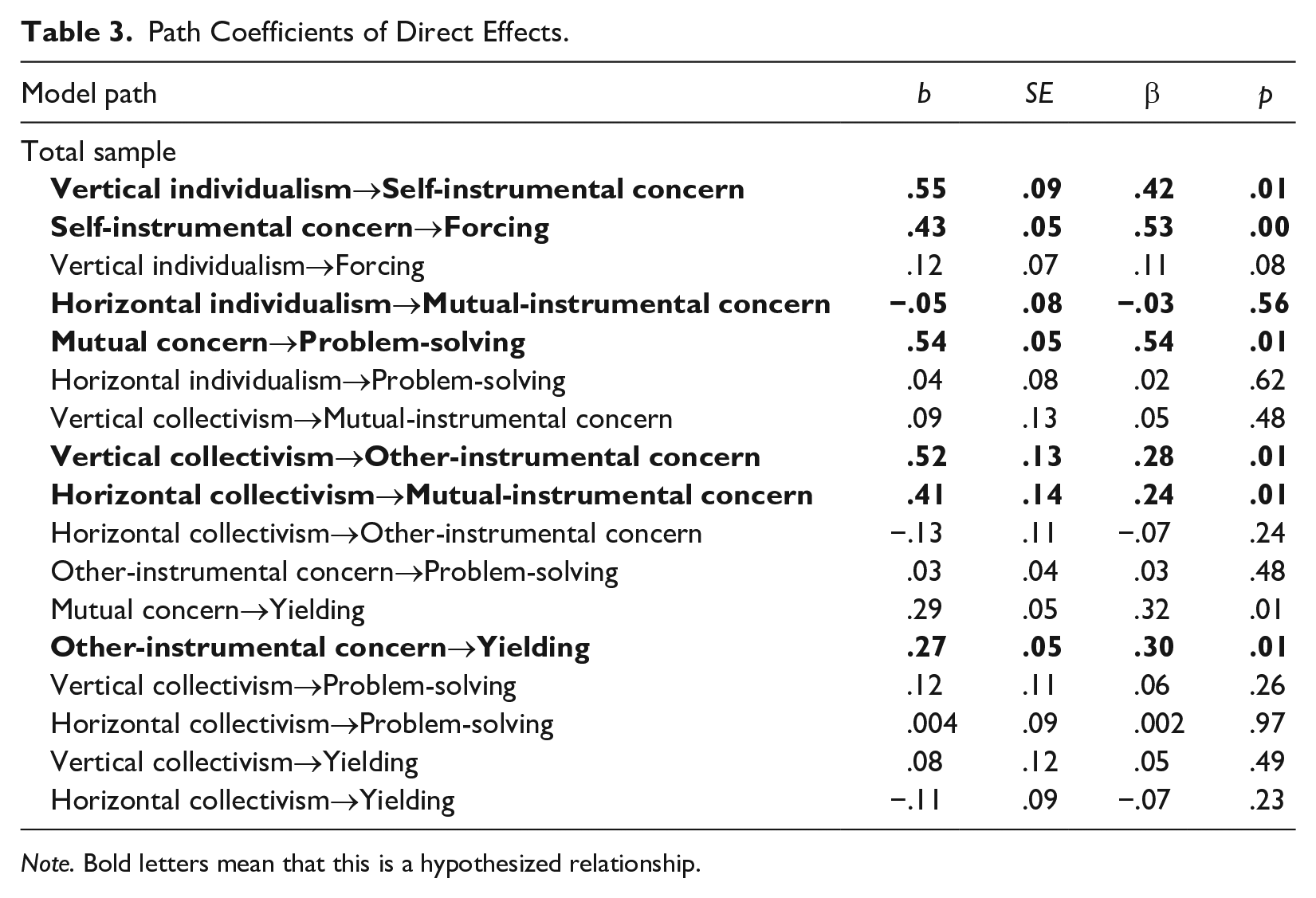
Note. Bold letters mean that this is a hypothesized relationship.
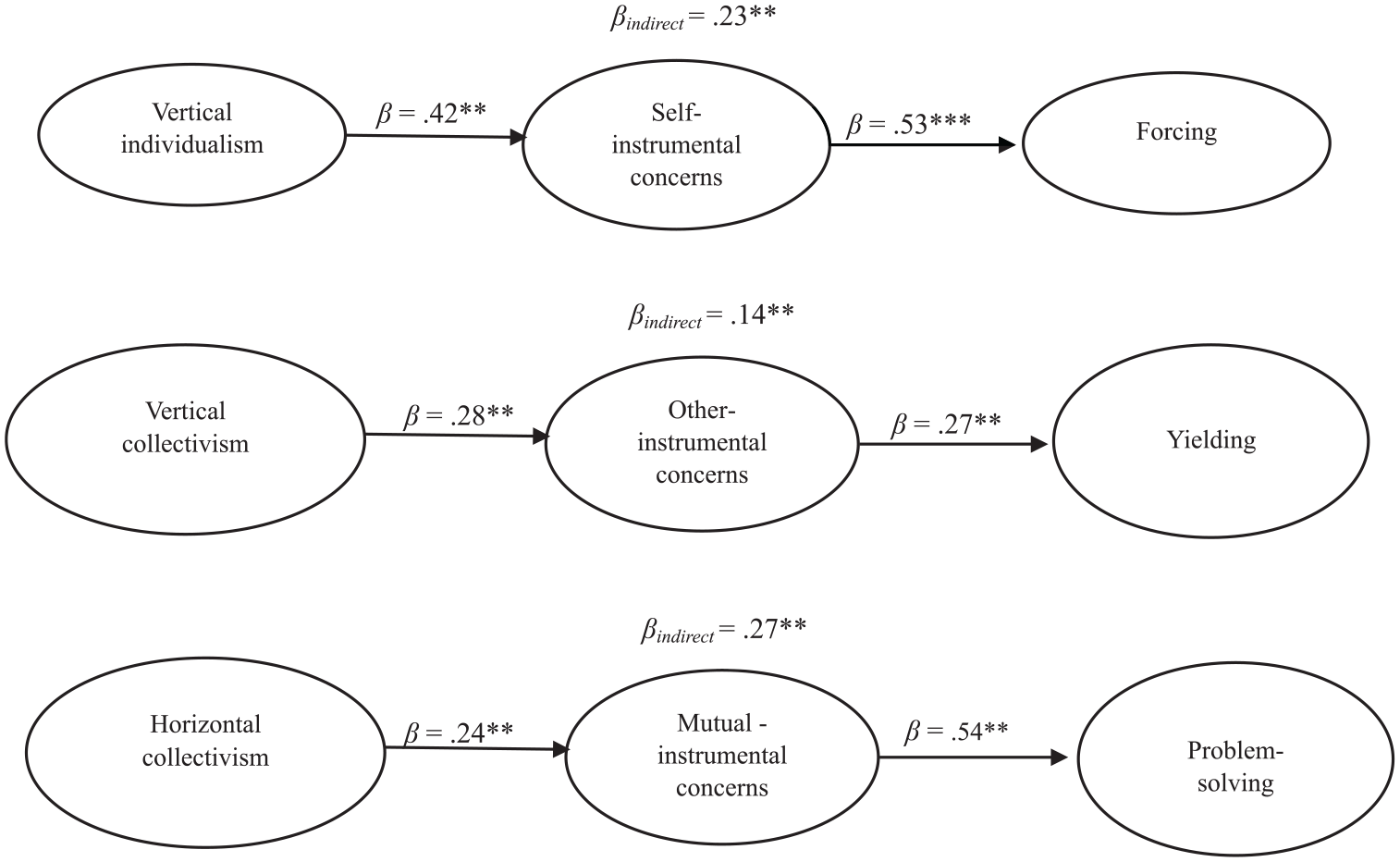
Relationship Between Cultural Values and Conflict Management Strategies Through Instrumental Concerns
Instrumental Concerns on Conflict Management Strategies
Hypothesis 2a predicted that self-instrumental concerns would have a positive relationship with forcing and our results indeed showed that self-instrumental concerns predicted forcing (β = .53, p ≤ .05). We also expected (Hypothesis 2b) that mutual-instrumental concerns would be positively related to the use of problem-solving, which is what we found (β = .54, p ≤ .05). We also hypothesized (Hypothesis 2c) that other-instrumental concerns would be positively related to the use of yielding strategies. The results revealed that other-instrumental concerns had a positive relationship with yielding strategy (β = .3, p ≤ .05). Therefore, Hypotheses 2a, 2b, and 2c were all supported (see Table 3 for the relevant statistics; see also Figure 2).
Mediating Role of Instrumental Concerns
Hypothesis 3a predicted that the positive effect of vertical individualism on forcing would be mediated by self-instrumental concerns. As indicated in the previous, we found that vertical individualism predicted self-instrumental concern and that self-instrumental concerns predicted forcing. The direct effect of vertical individualism on forcing was not significant (p > .05). However, we did find an indirect effect showing that vertical individualism predicts forcing through self-instrumental concerns (β indirect = .23, p ≤ .05). Based on the findings, Hypothesis 3a was supported. Hypothesis 3b indicated that the positive effect of horizontal individualism on problem-solving would be mediated by mutual-instrumental concerns. However, this hypothesis was not supported.
Hypothesis 3c stated that mutual-instrumental concerns would mediate the positive effect of horizontal collectivism on problem-solving. The results showed that horizontal collectivism positively predicted mutual-instrumental concerns and also that mutual-instrumental concerns positively predicted problem-solving (β = .54, p ≤ .05). However, the direct effect of horizontal collectivism on problem-solving was not significant (p > .05). In fact, horizontal collectivism predicted problem-solving positively only through mutual-instrumental concern (β indirect effect = .27, p ≤ .05). Accordingly, Hypothesis 3c was supported.
Finally, Hypothesis 3d suggested that other-instrumental concerns would mediate the positive relationship between vertical collectivism and yielding. As indicated in the above, the results showed that vertical collectivism predicted positively other-instrumental concerns and other-instrumental concerns had a positive relationship with yielding. The direct effect of vertical collectivism on yielding did not prove to be significant (p > .05). Instead, vertical collectivism only had an indirect effect on yielding through other-instrumental concern (total sample: β indirect effect = .14, p ≤ .05). Therefore, Hypothesis 3d was also supported. Also see Tables 3 and 4 and Figure 2. 1
Bootstrap Analysis of Indirect Effects of Culture on Conflict Management Strategies Through Instrumental Concern.
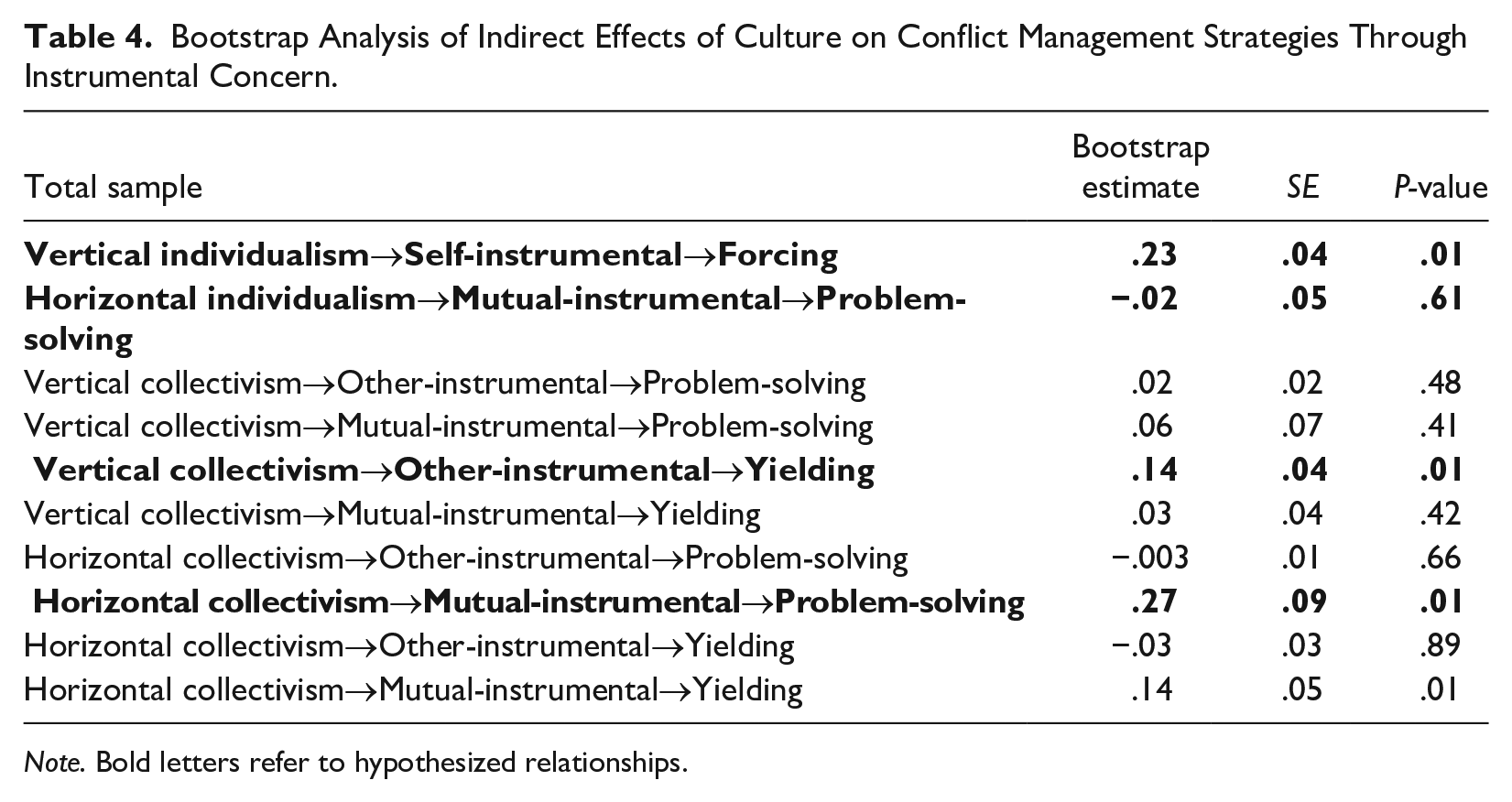
Note. Bold letters refer to hypothesized relationships.
Discussion
Culture is a significant factor influencing how people manage interpersonal conflicts (Holt & DeVore, 2005; Oetzel & Ting-Toomey, 2003). However, the mechanisms underlying the relationship between culture and conflict management remain largely unexplored, and the existing literature on the role of culture on conflict management strategies is inconclusive (Cardon & Okoro, 2010; Holt & DeVore, 2005). The current study aimed to shed light on how HVIC influences conflict management strategies while investigating the mediating role of self-, mutual-, and other-instrumental concerns.
As expected, the results revealed a positive association between vertical individualism and self-instrumental concerns (Hypothesis 1a). These findings align with the work of Triandis (1995) and Triandis and Gelfand (1998) which suggests that individuals with vertical individualistic values—who prioritize personal success, competition, and hierarchical structures—are more likely to focus on their own material gains. This emphasis on self-interest helps explain their preference for assertive conflict resolution strategies (see also Cukur et al., 2004; Vargas & Kemmelmeier, 2013). However, the relationship between horizontal individualism and mutual-instrumental concerns was not significant (Hypothesis 1b), which may suggest that while individuals with horizontal individualistic values appreciate equality and autonomy (Triandis, 1995), these cultural values may not translate into mutual concerns in conflict situations. Moreover, vertical collectivism was positively associated with other-instrumental concerns (Hypothesis 1c). That is, individuals with vertical collectivistic values, who appreciate loyalty and social harmony within hierarchical settings (Germani et al., 2020; Moon et al., 2018), are more inclined to prioritize others’ gains, even at the cost of their own, reflecting deep-rooted cultural values that promote group cohesion and stability (Komarraju et al., 2008; Vargas & Kemmelmeier, 2013). Finally, horizontal collectivism was positively associated with mutual-instrumental concerns (Hypothesis 1d), which suggests that individuals with horizontal collectivistic values while focused on collective well-being, still pursue their own goals and seek collaborative solutions that benefit both parties (Basadur et al., 2000; Jordan & Troth, 2021). These results align with prior research indicating that such individuals are more likely to adopt cooperative strategies in conflict resolution situations (Torelli & Shavitt, 2010).
The results also showed a positive association between self-instrumental concerns and forcing (Hypothesis 2a), with individuals prioritizing their own interests using assertive conflict strategies (Maner & Mead, 2010; Tinsley & Brodt, 2004). In addition, individuals with high mutual-instrumental concerns were more likely to engage in problem-solving (Hypothesis 2b; Ca Leeds, 2003; Rupčić et al., 2022), aiming for collaborative outcomes. Finally, a positive relationship between other-instrumental concerns and yielding (Hypothesis 2c) indicated that individuals focused on others’ outcomes are more likely to concede in conflicts (Davis et al., 2009; Lewicki et al., 2020). These results underscore how instrumental concerns shape individuals’ approaches to conflict, with assertiveness more common among those focused on personal gains and cooperation more typical among those balancing their own and others’ goals.
Finally, the present study examined whether the relationship between the various cultural dimensions and conflict management strategies is mediated by self-, mutual-, and other-instrumental concerns and we found support for the majority of our hypotheses (namely Hypotheses 3a, 3c, and 3d). First, we found that self-instrumental concerns mediate the relationship between vertical individualism and forcing (Hypothesis 3a). Individuals who see themselves as distinct from others and independent and at the same time experience hierarchical and power-asymmetric relationships tend to place more weight on self-instrumental goals, which, in turn, increases the likelihood that they employ forcing in conflict situations (see also Fousiani, 2020; Fousiani et al., 2021). Second, we also predicted that mutual-instrumental concerns would mediate the relationship between horizontal individualism and problem-solving (Hypothesis 3b). However, mutual-instrumental concerns did not significantly mediate this relationship. Third, in line with our hypothesis (Hypothesis 3c) mutual-instrumental concerns mediated the relationship between horizontal collectivism and problem-solving. That is, individuals who emphasize cooperation, egalitarianism, and relational connectedness with others within a group are more likely to use problem-solving through the experience of stronger mutual-instrumental concerns that focus on coming up with solutions that meet the tangible goals of the individual as well as those of others as much as possible. Finally, results provided support for Hypothesis 3d, showing that other-instrumental concerns mediate the relationship between vertical collectivism and yielding. That is, individuals who emphasize group cohesion, cooperation and relational connectedness and at the same time experience relationships as hierarchical and power-asymmetric are more likely to use yielding through the experience of stronger instrumental concerns for others (Davis et al., 2009; Lewicki et al., 2020).
Theoretical and Practical Implications
The theoretical implications of these findings are multifaceted. First and foremost, these findings underscore the nuanced nature of conflict behavior, as delineated by the dual concern theory (Pruitt & Rubin, 1986). By revealing that specific cultural orientations can be linked to distinct concerns—self-, mutual-, or other-instrumental concerns—these findings put forward the idea that conflicts involve a complex interplay of motivations and priorities. This nuance is crucial for developing a more comprehensive framework for understanding and predicting conflict dynamics across diverse cultural contexts. Prior research has mainly focused on the role of face concerns (concerns about one’s identity and reputation) as the mediator in the relationship between culture and conflict management strategy (Oetzel & Ting-Toomey, 2003; Yamini et al., 2023). To our knowledge, there is no previous research on how instrumental concerns (i.e., self, other, and mutual) influence these relationships, despite their importance in conflict (Wilson & Putnam, 1990). This study is the first to investigate the mediational role of instrumental concerns in the relationship between cultural orientation and conflict management strategies. The findings indicate that conflict management strategies are indirectly influenced by individuals’ cultural orientation via instrumental concerns. The current study shows that focusing on instrumental concerns is crucial given that such concerns provide a clear perspective on the tangible and specific objectives individuals or groups aim to achieve in a conflict (Davis et al., 2009; Lewicki et al., 2020), whether they are personal gains, benefits for the other party, or mutual advantages.
Moreover, in line with previous research (Ting-Toomey et al., 2001; Walsh et al., 2003; Yamini et al., 2023), this study underscores the need to focus on cultural dimensions at the individual rather than the national level (Fousiani & Van Prooijen, 2023) as main antecedents of conflict management strategies. Indeed, examining culture at the individual level captures the nuances and variations within cultural groups, leading to more precise insights and effective interventions tailored to individual behaviors and attitudes. Indeed, previous research suggests that “country is often a poor proxy for culture” (Taras et al., 2016) and thus culture at the national level is not a reliable way to conceptualize culture. Finally, the current findings reveal that the different sub-types of individualism and collectivism—namely, vertical and horizontal individualism and collectivism—interact to shape people’s instrumental concerns and, consequently, their conflict management strategies (Singelis et al., 1995). By adopting a more nuanced approach to cultural dimensions, we can gain a deeper understanding of how cultures influence conflict management strategies.
This study has various practical implications as well. In the context of escalating global interconnectedness and cultural diversity within organizations, resulting in a rise in conflicts, practitioners must skillfully navigate and manage conflicts to optimize workplace productivity. To achieve this, it is essential to take into account individuals’ tangible goals (instrumental concerns) as influenced by their cultural orientation when determining preferred conflict management strategies. In the realm of cross-cultural negotiations, the findings suggest that negotiators should tailor their approaches to align with individuals’ cultural orientation and instrumental concerns of the other party. This could enhance the likelihood of successful outcomes while simultaneously minimizing conflicts. In essence, the current study provides actionable insights for practitioners to navigate and proactively manage conflicts in diverse cultural settings, fostering more harmonious and productive working environments.
Understanding how instrumental goals influence conflict management strategies offers clear practical benefits. That is, if we know whether parties are motivated by self-, other-, or mutual-instrumental concerns, we may predict their choice of conflict management strategies. Conflict resolution approaches can be customized based on the dominant instrumental concerns. Mediators or negotiators can tailor their approaches to resonate with the parties’ objectives and concerns (for instance, by bringing the tangible and specific objectives to the forefront). Moreover, understanding and focusing on instrumental concerns can be used as a basis for training and developing negotiation skills, helping individuals or groups to navigate conflicts more effectively. Thus, by including instrumental concern, a nuanced and objective understanding of the conflict’s nature and the parties’ priorities is facilitated, enabling the application of effective and strategic conflict management approaches.
Limitations and Strengths
The current results need to be interpreted considering the study’s limitations, which provides further direction for future research. One limitation of this study lies in its exclusive focus on Western countries. This cultural narrowness limits our capacity to generalize findings across a broader spectrum of cultural landscapes. Indeed, by solely examining Western countries, this study overlooks the diversity in conflict management strategies that may be prevalent in non-Western contexts. Furthermore, some findings deviated from established theoretical frameworks; for example, Greece scored relatively high in individualism, contrary to Hofstede’s (1980) expectations of high collectivism. This shift may reflect recent trends in formerly collectivistic societies toward individualism (Chatrakul Na Ayudhya et al., 2019; Santos et al., 2017), emphasizing the need to consider individual-level variations in cross-cultural research. Future studies should explore these trends with updated national data and longitudinal approaches.
Methodological limitations also exist, including variability in data collection procedures across countries. Greek data were collected via assistants, Dutch data through an online survey manager, and American data via a crowdsourcing platform, potentially affecting data reliability and generalizability. Future research should use standardized protocols to enhance reliability and validity. In addition, the demographic differences among samples—particularly the younger Dutch sample compared to the older Greek and U.S. samples—could introduce variability in conflict management strategies. Future research should aim for more demographically similar samples to improve the robustness of findings. Furthermore, the modest to low Cronbach’s alpha values for some HVIC scales in non-U.S. samples indicate a need for further refinement of cultural measures.
Finally, findings showed that our measures have metric but not scalar invariance across different countries. Therefore, group differences should be interpreted with caution, and efforts should be made to refine measurement instruments for cross-cultural research to ensure their accuracy. Ensuring valid and fair comparisons across diverse national contexts, addressing this limitation is essential.
Apart from these limitations, the current study had several strengths. First, the study identified the mediating processes that explain the relationship between vertical and horizontal individualism and collectivism and conflict management strategies. Second, to mitigate common-method bias (Nandi et al., 2009), a time-lagged design with two time points was employed. This allowed us to temporarily separate the mediating variables from conflict management strategies, thereby enhancing the reliability of the results. Third, to achieve a more realistic conflict setting, we used the critical incident technique (Butterfield et al., 2005). This method enables the capture of real-life conflict scenarios, providing richer and more reliable data for analysis. By using this approach, we could better understand how individuals navigate conflicts enhancing the ecological validity of these findings. Finally, we collected data from three distinct national samples with varying cultural values, potentially enhancing the generalizability of the findings.
Directions for Future Research
As this study focused solely on specific variables of interest, future research could expand its scope to include additional factors that may influence the relationship between culture and conflict management. For instance, considering the significant role of personality traits in conflict dynamics (Aliakbari & Amiri, 2016; Ayub et al., 2017; Macintosh & Stevens, 2013), future research could investigate the potential moderating effect of personality characteristics on the relationship between culture and conflict. Furthermore, considering that conflict is a complex and emotionally charged phenomenon (Guerrero & La Valley, 2006; Wu & Zhang, 2019) and acknowledging the significant influence of culture on individuals’ emotional responses to conflict (Q. Zhang et al., 2014), exploring emotional reactions as an alternative mediating variable could provide valuable insights into how different cultural dimensions impact conflict management strategies (see also Van Kleef et al., 2006; Q. Zhang et al., 2014).
Incorporating these additional variables would enrich our insights and offer a more nuanced perspective on the dynamics of cultural influences on conflict management strategies. Moreover, future research could expand beyond the exclusive focus on Western countries evident in the current study. Exploring conflict management strategies in non-Western contexts, such as Asian, African, or Middle Eastern countries, could provide alternative perspectives shaped by distinct historical, social, and religious influences. Finally, to improve the scale’s reliability, future studies should focus on validating translations of the scales in non-English samples. This entails not only linguistic translation but also cultural adaptation to ensure the items are contextually relevant and comprehensible to the target population.
Conclusion
In conclusion, this study provides valuable insights into the relationship between cultural dimensions and the strategies individuals employ in managing conflicts. Essentially, this research contributes to a deeper understanding of how cultural orientations influence not only the preferences for specific conflict management strategies but also the underlying mechanisms driving these preferences. Recognizing the role of culture and instrumental concerns plays an important role in developing more effective cross-cultural conflict management strategies and fostering better intercultural communication.
Supplemental Material
sj-pdf-1-jcc-10.1177_00220221241312414 – Supplemental material for Culture and Conflict Management Strategy: The Mediating Role of Instrumental Concerns
Supplemental material, sj-pdf-1-jcc-10.1177_00220221241312414 for Culture and Conflict Management Strategy: The Mediating Role of Instrumental Concerns by Sara Yamini, Kyriaki Fousiani, Hossein Dabiriyan Tehrani and Barbara Wisse in Journal of Cross-Cultural Psychology
Footnotes
Declaration of Conflicting Interests
The author(s) declared no potential conflicts of interest with respect to the research, authorship, and/or publication of this article.
Funding
The author(s) received no financial support for the research, authorship, and/or publication of this article.

Supplemental Material
Supplemental material for this article is available online.
Notes
References
Supplementary Material
Please find the following supplemental material available below.
For Open Access articles published under a Creative Commons License, all supplemental material carries the same license as the article it is associated with.
For non-Open Access articles published, all supplemental material carries a non-exclusive license, and permission requests for re-use of supplemental material or any part of supplemental material shall be sent directly to the copyright owner as specified in the copyright notice associated with the article.
