




Abstract
Prosocial behavior is essential for human species such that it is expected in every culture. One way to sustain this positive behavior is through successful transfer where the later generation maintains prosociality as cultural information relevant to prosocial behavior. Informed by the cultural dynamics perspective, the current study focused on the microlevel phenomena and examined the mechanism of vertical transmission of prosociality from parent to children. A total of 208 Indonesian parent-young adult dyads completed the survey designed to examine the five models of vertical transmission focusing on values as the context of transmission of prosociality in Indonesia. Statistically significant support was found for the model that prosociality was transferred from parents to their young adult children moderated through the zeitgeist values (i.e., value climate that the mainstream society constructed). Specifically, the transmission of prosociality from Indonesian parents to their young adult children was more likely to occur in the presence of stronger zeitgeist values in social focus (i.e., universalism, benevolence, tradition, conformity, and security-societal) and lower zeitgeist values in personal focus (i.e., self-direction, stimulation, hedonism, achievement, power, and security-personal). This finding contributes to our understanding of cultural transmission through the lens of cultural dynamics, particularly from the non-Western perspective, which is currently underexplored.
Introduction
Prosocial behavior refers to a broad category of actions generally labeled by society as benefiting other people (Dovidio et al., 2017). This definition implies two components. The first component is that prosocial behavior is an interpersonal act involving one party as the benefactor and the other party as the target recipient(s). The latter component emphasizes the changing nature of prosociality and implies the active contributions of the society in perceiving given actions as prosocial. In line with this notion, a previous scoping review study reported that prosocial behavior was studied in Indonesian and Australian literature with different emphases on the level of analysis and using a broad range of definitions (Septarini, 2023). The finding indicates that prosociality had been examined using different facets and conceptualizations between these two cultures. Populations characterized by different sociocultural attributes may differ in labeling certain behaviors as prosocial. Therefore, what constitutes prosocial behavior is not universal and may be guided by a range of desirable behaviors based on societal judgments within a particular timeframe (Schroeder & Graziano, 2015) such that understanding prosocial behavior requires an understanding of the context in which it is enacted.
The importance of prosocial behavior to our society is undeniable. Prosocial behavior is encouraged in every culture because it reflects an individual’s, group’s, and society’s adaptive values for survival (Dovidio et al., 2017) such that it is “vital to the social system” (Twenge et al., 2007, p. 56). For Schroeder and Graziano (2018), prosocial behavior is the core of psychological functioning that defines the essence of humanity. Prosocial behavior is positively valued and considered functional to group survival (Eisenberg, 2003; Twenge et al., 2007). If prosocial behavior is fundamental for the human species, it is important to understand how it sustains across time within culturally changing societies. In attempts to explain generational and cultural variations in prosocial behavior, we previously conducted a focus group study involving participants from different cultures and generations in Indonesia and Australia. The qualitative study revealed that generational differences were evident in Indonesian but not in Australian participants, suggesting that larger generational differences were found in Indonesia (Septarini, 2023).
One framework that may explain the changing nature of prosociality across cultures and generations is through the perspective of cultural dynamics. This perspective considers the dynamic nature of cultural information over time within a society such that transformations and/or maintenance of a cultural element, like prosocial behavior, can be better understood (Kashima, 2014). Cultural dynamics is an investigation of how a culture is “formed, maintained, and transformed over time” (p. 1). According to Kashima (2016), a culture is a set of existing nongenetic information that is transferable within a society. At the microlevel mechanism, cultural transmission is “at the heart” (p. 93) of cultural dynamics that explain the social distribution of cultural information from one person to another. Cavalli-Sforza et al. (1982) asserted that cultural transmissions might occur vertically (from parent to child), horizontally (between peers), and obliquely (from teacher/social leader/mass media to student/younger generation). According to Schönpflug and Bilz (2009), vertical transmission is “the ground for continuity” (p. 212) of cultural information that allows both novelty and stability such that the maintenance of prosociality within society might occur through the mechanism of intergenerational transmission from parents to their children.
In the literature, research on vertical transmission has predominantly focused on congruence between parent and offspring as the outcome of the transmission (Albert et al., 2009; Knafo-Noam et al., 2020; Schönpflug & Bilz, 2009; Tam, 2015). To better explain the transmission mechanism, Trommsdorff (2009) suggested the ecocultural model which considers the components that affect the process and outcomes of transmission: the persons (i.e., parents and children), their relationship (e.g., parent and child relation), the contents (i.e., cultural information subject to transmission), and the context (e.g., socioeconomic and cultural changes) involved in the transmission. Thus, the intergenerational transmission of cultural transmission should not be limited to simply estimating the similarity of scores on transmission contents between parents and children. Rather, the transmission mechanism should be explained using a framework that considers how transmission may occur.
There has been discussion in the literature to explain how intergenerational transmission between parent and child may occur (Boehnke, 2015; Hadjar et al., 2012; Knafo-Noam et al., 2020). For example, work examining the transmission of values has four mechanisms: (1) parental influence on children through socialization, (2) children’s influence on parents, (3) both parents and children share an overlapping social environment, and (4) parents and children share a genetic co-disposition (Boehnke, 2015; Hadjar et al., 2012; Knafo-Noam et al., 2020). In addition, Boehnke (2015) extended that the four mechanisms may not be limited to the transmission of values, but applicable to other psychological processes. With respect to the pathway where parents and children live in a similar social environment, Boehnke (2015) used the term “zeitgeist” (p. 3000). Zeitgeist (a German term for the spirit of the times) refers to the prevalent value climate taken by most people in a given society (Boehnke et al., 2009). Zeitgeist provides an explanation toward the context of the transmission since it captures the way society perceives the dominant values, ideas, and facts in a given time (Hadjar et al., 2012). The role of zeitgeist in explaining the intergenerational transmission of self-interest as the main characteristic of contemporary German societies was extensively explored by Boehnke et al. (2007, 2009). They suggested that because transmission did not occur in isolated environments, zeitgeist influences individual value preferences and therefore affects value congruence between parents and children. Stronger transmissions were found for families with atypical values with the mainstream society than for families holding similar values with the dominant culture. One explanation for this was that parents were more likely to frequently communicate values less preferred by society toward their children such that the transmissions were attenuated.
There is a plethora of research investigating the cultural transmission of psychological phenomena mostly in European and the United States contexts (Schönpflug, 2009). Given that much of the available literature on vertical transmission focuses on European and Western societies, the applicability of such models of cultural transmission to non-Western societies needs further examination. One notable framework that explains the context of intergenerational value transmission in Asia is the intersubjective model from the work of Tam et al. (2012) conducted in Hong Kong. As such, whether vertical transmission of prosociality can be explained using a framework developed in Western research and applied in a socioculturally changing non-Western cultural context deserves a further explanation.
Models of Vertical Transmission
The current study contributes to the existing literature by exploring mechanisms of intergenerational transmission of prosociality in the Indonesian context, specifically we examined five models of vertical transmission.
Model 1 (Recipient Shapes Transmission)
This model examines the role of young adults’ personal values in facilitating the intergenerational transmission of prosociality. This model follows the work of Six et al. (2009) who examined the moderating role of personal values on the vertical transmission of xenophobia by considering the “dualism of values” (p. 373) where values have two differing roles: to facilitate/inhibit the vertical transmission of xenophobia. Findings from their study confirmed that adolescents’ values of achievement, security, and tradition moderated the vertical transmission of xenophobia. In relation to prosocial behavior, Schwartz (2010) indicated that prosocial behavior was motivated by collectivistic values (humanism, universalism, traditionalism, security, and conformism) rather than individualistic values (power, self-direction, stimulating life, and hedonism). As such, it is anticipated that vertical transmission of prosociality is facilitated by young adults’ collectivistic values.
Model 2 (Congruence Shapes Transmission)
This model postulates that vertical transmission of prosociality is moderated through value congruences between parents and children. A stronger value congruence between parents and children may indicate that these values had been clearly communicated by parents to their children (Schönpflug & Bilz, 2009). A stronger congruence may also indicate that low disagreement and misinterpretation occur within a family. This congruence, according to Hadjar et al. (2012), is a fundamental facilitator of “behavioural confirmation” (p. 56) that enhances the production of expected behavior among children. In contrast, weaker congruences may indicate weaker parental influences toward the children (Knafo & Schwartz, 2008). Therefore, it follows that parents’ and children’s similarity in values may facilitate the transfer of cultural information relevant to prosociality. In short, this model proposes the moderating role of parent–child value congruence in the vertical transmission of prosociality.
Model 3 (Socialization Focus Shapes Transmission)
This model postulates that parental socialization values facilitate the transmission of prosociality from parents to their young adult children. Parental socialization value refers to values that parents expect their children to have (Knafo & Schwartz, 2008). This model follows the traditional perspective of socialization which focuses on the “fax model” (p. 1042), where children fully accept those values their parents wanted to socialize (Tam et al., 2012). The fax model postulates the unidirectional influence of parents on children, and it does not emphasize the active role of the child in selecting which values they want to internalize (this is the effect examined in Model 1). Nevertheless, since parents are the primary transmitters of cultural ideas to their children, values that parents wish to socialize are important to consider. For this reason, this model postulates the moderating role of parents’ socialization values in the vertical transmission of prosociality.
Model 4 (Perceived Parental Value Shapes Transmission)
This model focuses on the role of young adults’ perceived parental value endorsement in the vertical transmission of prosociality. Trommsdorff (2009) noted that children actively process parental socialization by understanding, selecting, and deciding whether to accept or reject cultural information endorsed by their parents. Perspectives from developmental psychology view that young adults, who gain increased autonomy and greater exposure to values beyond their family, may misinterpret the values that parents want to socialize with children (Carlo & Randall, 2002; Eisenberg et al., 2002). Thus, contrary to the “fax model” assumption, this model posits that discrepancy may occur as young adults perceive parental value endorsement differently from the values parents wish to socialize. Children may also perceive parental value endorsement accurately which may facilitate vertical transmission (Knafo & Schwartz, 2008). Based on these possibilities, this model postulates the role of young adults’ perceived parental value endorsement in moderating the intergenerational transmission of prosociality.
Model 5 (Zeitgeist Shapes Transmission)
This model postulates the role of zeitgeist values in influencing the vertical transmission of prosociality. Parents and children are likely exposed to a similar value climate that the mainstream society embraces to the extent that they share the overlapping social environment (Boehnke et al., 2007). Transmission from parent to children is not direct, it is rather shaped by the norms and values of society at large that construct the mainstream culture (Knafo-Noam et al., 2020). This implies that the context of intrafamilial transmission may be determined by the dominant culture of a particular society. Boehnke et al. (2009) referred to the values dominant in mainstream culture as zeitgeist values and argued that zeitgeist influences cultural transmission. Although the zeitgeist represents preferences toward certain values held by most people in a particular society, individuals may perceive or accept the zeitgeist variably. Boehnke et al. (2009) suggested that one way to estimate the zeitgeist’s influence on the transmission process is by including the variable as the moderator on the transmission model. Accordingly, in this model, we postulate that the vertical transmission of prosociality occurs through zeitgeist values.
The Indonesian Context
Indonesia is experiencing accelerated sociocultural changes. Previously, Indonesian societies shared collectivistic values (Irwin, 2009). For Indonesian older generations, family integrity and interdependence were valued as highly important, whereas self-reliance and hedonism were placed in the lowest priority (Triandis et al., 1986). Obedience, harmony, and conformity were essential socialization goals for parents (Albert et al., 2009). Following the global trend of increased individualism (Greenfield, 2016; Santos et al., 2017), it appears that Indonesia is currently transitioning from a collectivistic to an individualistic social environment. The increased importance of friends over family, parental socialization of independence values, and self-expression values reported in current society indicate that individualism values are more strongly adopted in Indonesia (Santos et al., 2017). This suggests that parents who belong to older generations in Indonesia may hold stronger collectivistic values because they may be exposed to a collectivistic sociocultural environment cherished by the previous society. Compared to their parents, the current younger generation may increasingly adopt individualistic values from their sociocultural environment that may differ from what their parents hold.
Increased individualism may partially explain how prosocial behavior remains constant or changes across generations in Indonesia for at least two reasons. First, collectivistic cultures tend to more strongly endorse social norms that encourage empathy and interdependence with others compared to individualistic cultures (Chiao et al., 2012). At the individual level, Schwartz (2010) posits that collectivist values such as benevolence and universalism motivate prosocial acts. On the contrary, individualistic values such as hedonism and power may deter prosociality. This suggests that individualism–collectivism at the cultural and individual levels can be linked to the diminishment or maintenance of prosociality. Second, the distribution of cultural information depends on environmental stability and change. Kashima (2014) noted that in a stable environment, cultural information that emphasizes social integration, such as collectivist values, is more likely to transmit vertically than individualist values. Conversely, with the environment changing rapidly, collectivist values are less likely to transmit, and individualist values are more likely to transmit. If—following the global trends of increased individualism—the Indonesian generations have become more individualists, how would this transformation affect the vertical transmission of prosociality?
Prior studies on this topic yielded mixed patterns. For Hong Kong Chinese immigrant parents who presumably experienced a changing sociocultural context, values they wish to socialize with their children were more strongly predicted by perceived normative values than personal values (Tam et al., 2012). This finding suggests that cultural transmission should consider not only parents’ personal values but also values that the parents perceive as important within a society. In a similar vein, Boehnke (2001) found that in the context of changing East German societies from communist to industrialist, within-family transmission in individualism values (i.e., openness and self-enhancement values) occurred more effectively than collectivism values. It appears that values endorsed by the community at a given time were more likely transmitted from parents to the children than parental value preferences. Findings from Schönpflug and Bilz (2009) yielded a different pattern. In their study, both communities that experienced cultural discontinuity (Turkish immigrants living in Berlin and Southern Germany) and cultural continuity (Turkish people living in Istanbul) showed more vertical transmission of collectivistic values (i.e., humanism, universalism, security, traditionalism, and conformism) than individualistic values (i.e., stimulation, hedonism, and power). They argued that collectivistic values were generally transmitted within the context of highly empathetic parenting and less authoritarian parenting styles regardless of changing sociocultural contexts. Despite reporting different results, findings from Boehnke (2001) and Schönpflug and Bilz (2009) confirmed the effect of sociocultural dynamics to elucidate mechanisms of cultural transmission. Whether stability or changes in the sociocultural environment may explain the pattern of vertical transmission has not been tested in Indonesia.
The Present Study
The current study examined the parent-to-child transmission of prosociality in Indonesia. Vertical transmission of prosociality was examined through the degree of congruence between the persons involved in the transmission process (i.e., parent and children). The study examined five pathways of vertical transmission drawn from the literature, focusing on five possible pathways through which values exert influence on vertical transmission.
Method
Procedures and Participants
Research ethics approval for this project was granted by the authors’ university. Participants were recruited from three major cities in Java, Indonesia. Five volunteer research assistants assisted with in-person data collection: two were assigned in Surabaya, one in Yogyakarta, and two in Jakarta. They provided interested participants with a survey kit containing the information sheet, measures, and a sealable envelope. After providing written informed consent, participants returned the completed measures and consent form in a sealed envelope to the research assistants, who posted it to the researcher’s office in Indonesia. The data was collected from July 15 to December 31, 2019. At the end of the survey, participants were asked to include the nominating family member (parent or young adult children) by providing the researcher with the email for further contact. After completing the survey, participants were given the option to win one of ten shopping vouchers equal to IDR 300,000 (AUD 30).
We recruited young adults aged between 17 to 26 years (Eisenberg et al., 2002). This age range was targeted due to our focus on early adulthood. Within early adulthood, individuals have greater autonomy to engage in various prosocial activities (Carlo & Randall, 2002; Knafo & Schwartz, 2008). Other inclusion criteria were Indonesian citizens living in Indonesia and willing to nominate one of their parents for this survey. A total of 548 (young adult group n = 312, older group n = 236) responses were collected. To enable young adult and parent dyads identification, we asked the participants to provide the gender and date of birth of a nominating family member. As a result, 416 responses or 208 young adult-parent dyads were matched. Responses unable to be matched (young adult group, n = 55, older group, n = 15) were excluded. Also excluded were responses not meeting the young adult age criteria (below 17, n = 18, above 26, n = 2), and not completing one or more sections of the questionnaire (young adult group, n = 29, older group, n = 13).
All young adults were living in Indonesia for life long and predominantly from urban areas (63.9%). More than half of the young adults have high school completion (62.5%) and some university qualifications (28.4%). The parent group aged from 31 to 68 years (73.6% female, Mage = 49.57). All parents have been living in Indonesia since birth and are mostly from urban areas (60.1%). In terms of educational background, parents reported having university qualifications (47.1 %), high school completion (36.1%), partial completion of secondary school (9.1%), and primary school completion (7.7%).
Measures
Prosociality
We used the Prosocial Tendencies Measure or PTM (Carlo & Randall, 2002) to assess participants’ tendencies toward six types of prosocial behavior. All participants, parents, and young adults completed this scale. Participants indicated the extent to which each statement describes them with scales from 1 (does not describe me at all) to 5 (describes me greatly). At the time of the current project planning, there was no report that the PTM had been used in Indonesia. As such, the PTM scale was translated using the back-translation procedure for our pilot study. We subsequently identified a study with the PTM with an Indonesian sample. This study by Vaughan et al. (2008) reported satisfactory reliabilities for the aggregated PTM score (Cronbach’s αs T1 = .78 and T2 = .82) and an adequate concurrent validity (correlation with empathy-related responding measures, r = .53, p < .01). The PTM scale consists of 23 items designed to assess six types of prosocial behavior: altruism (e.g., “I think that one of the best things about helping others is that it makes me look good (reversed item)”), compliant (e.g., “When people ask me to help them, I don’t hesitate”), emotional (e.g., “Emotional situations make me want to help needy others”), dire (e.g., “It is easy for me to help others when they are in a dire situation”), public (e.g., “I can help others best when people are watching me”), and anonymous (e.g., “Most of the time, I help others when they do not know who helped them”). For ease of interpretation, the current study examines the single aggregated score. Descriptive statistics for the PTM subscales are reported in the Supplementary Materials, and the de-identified data, analysis script, and translation are available on the OSF page (https://osf.io/phcdu/).
Values
We used the PVQ5X (Schwartz et al., 2012) which consists of 48 items to assess ten basic values. The ten basic values are: self-direction (e.g., “It is important to him [or her] to form his own opinions and have original ideas”), stimulation (e.g., “Excitement in life is important to her”), hedonism (e.g., “Enjoying life’s pleasures is important to him”), achievement (e.g., “Being very successful is important to him”), power (e.g., “It is important to him to be the one who tells others what to do”), security (e.g., “Her personal security is extremely important to her”), conformity (e.g., “It is important to him to follow rules even when no one is watching”), tradition (e.g., “She strongly values the traditional practices of her culture”), benevolence (e.g., “It’s very important to him to help the people dear to him”), and universalism (e.g., “She strongly believes that she] should care for nature”). For scoring, we grouped the 10 values from PVQ5X into two categories: personal and social focus, following Schwartz et al. (2012). The social focus value category was obtained by averaging responses to 26 items on security (items for societal), tradition, conformity (items for rules and interpersonal), humility, benevolence (items for dependability and caring), and universalism (items for concern, nature, and tolerance). The personal focus value category was calculated by averaging responses to 22 items on the PVQ5X, including measures of self-direction (items for thought and action), stimulation, hedonism, achievement, power (items for resources and dominance), face, and security (items for personal).
In the current study, each participant responded to the PVQ5X in two ways. Child participants responded to the scale to indicate their personal value and their perception of parental value (i.e., “how would your parent want you to respond to each item?” (Knafo & Schwartz, 2008). Parent participants responded to the scale to indicate their personal value and their socialization value. For socialization values, parents were asked to indicate how much they want to socialize each value to their children.
The PVQ5X has been widely used with satisfactory reliabilities and acceptable construct validity across countries (Schwartz et al., 2012). In the literature, the use of an earlier version of the PVQ5X (PVQ40) in Indonesia has been reported with adequate construct validity (Liem et al., 2011). However, PVQ5X differs from PVQ40 with the items included. As such, the PVQ5X was translated via the back-translation procedure (Werner & Campbell, 1970) for our pilot study.
Demographic Variables
Participants reported date of birth, gender, duration of stay in Indonesia, area of stay (rural/urban), educational background, and the nominating family’s date of birth and gender.
Pilot Data
Because the items were newly translated, we conducted a pilot study involving 30 participants (Mage = 33.29, 46.7% female, 46.7% undergraduate qualification, 80% employee) to check the internal consistency of the measures. The measures in the pilot sample were internally consistent (Cronbach’s α of .80 for the PTM scale and .94 for the PVQ5X Value Survey items).
Results
Missing Values Analysis Assumptions
Before analyzing the data, missing values were scrutinized. There were three cases with one missing value which were substituted by mean values for a particular item scale. Assumptions were checked before conducting each analysis. Histogram observation indicated that each variable in the regression was normally distributed. Inspection of the normal probability plot of standardized residuals and the scatterplot of standardized residuals against standardized predicted values indicated no violation of the assumptions of linearity, normality, and homoscedasticity of residuals. The VIF values were well below 10 and the tolerance statistics were all above 0.2, suggesting that multicollinearity was not a concern in the data (Field, 2017).
Data Analysis Plan
To examine the five models of vertical transmission, five sets of multiple regression analyses were conducted. In all models, the outcome variable was young adults’ prosociality predicted from parents’ prosociality. The corresponding regression coefficient indicates vertical transmission of prosociality. This analytic approach follows prior studies (Knafo & Schwartz, 2008; Schönpflug & Bilz, 2009). Difference processes of vertical transmission are postulated in the five models as summarized in Table 1 and illustrated in Figure 1. In all models, value-related variables were computed separately for value items that focus on personal and social issues. As the analyses focused on the degree to which each value-related variable moderated vertical transmission (i.e., two-way interactions between parents’ prosociality and either personal or social focused values), we did not examine the three-way interactions (i.e., between parents’ prosociality and personal focused values and social focused values). Table 2 reports correlations among the variables examined.
Summary of Five Regression Models.
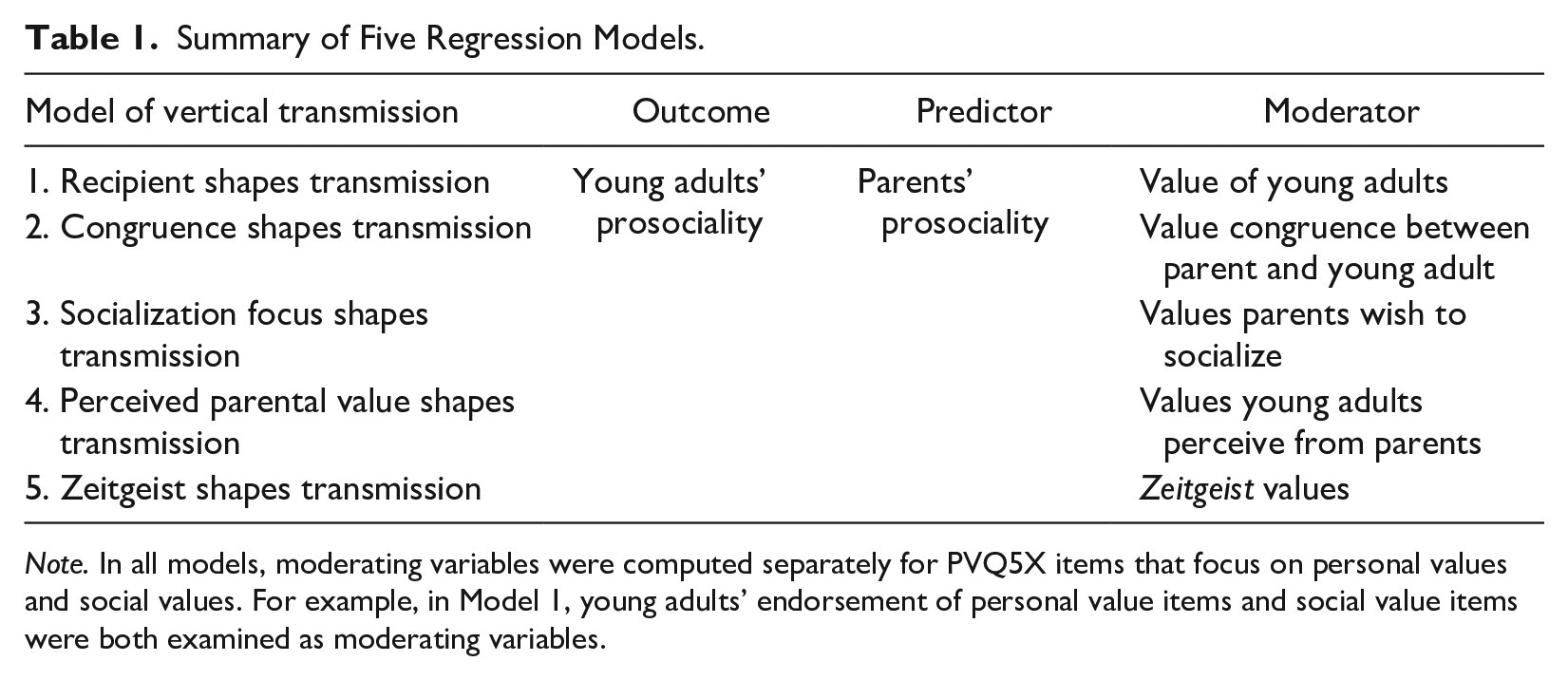
Note. In all models, moderating variables were computed separately for PVQ5X items that focus on personal values and social values. For example, in Model 1, young adults’ endorsement of personal value items and social value items were both examined as moderating variables.
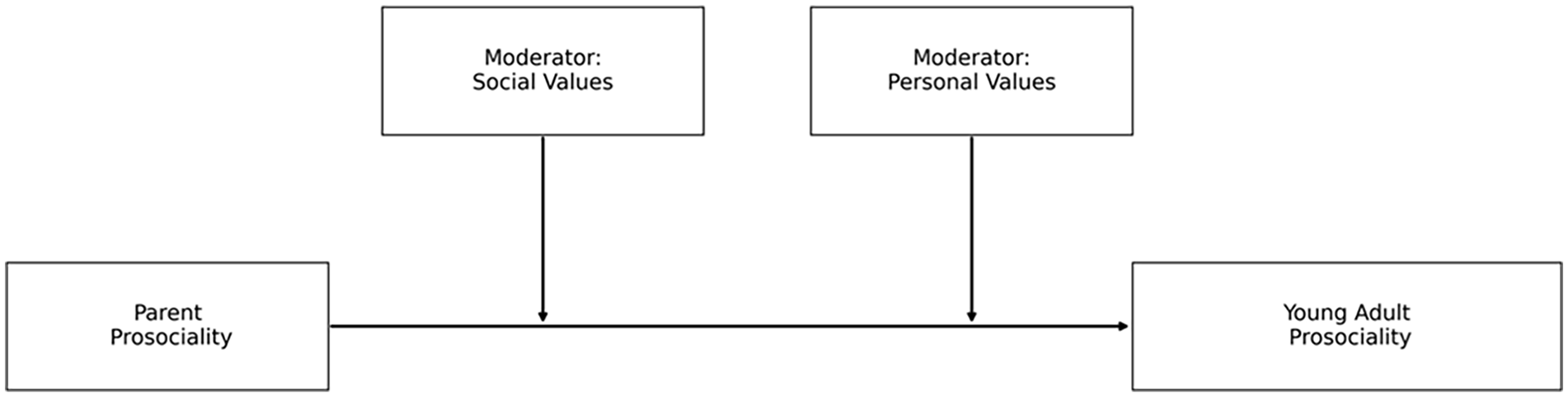
A Diagram of the Five Moderation Models Examined.
Pearson’s Bivariate Correlations Between All Variables.
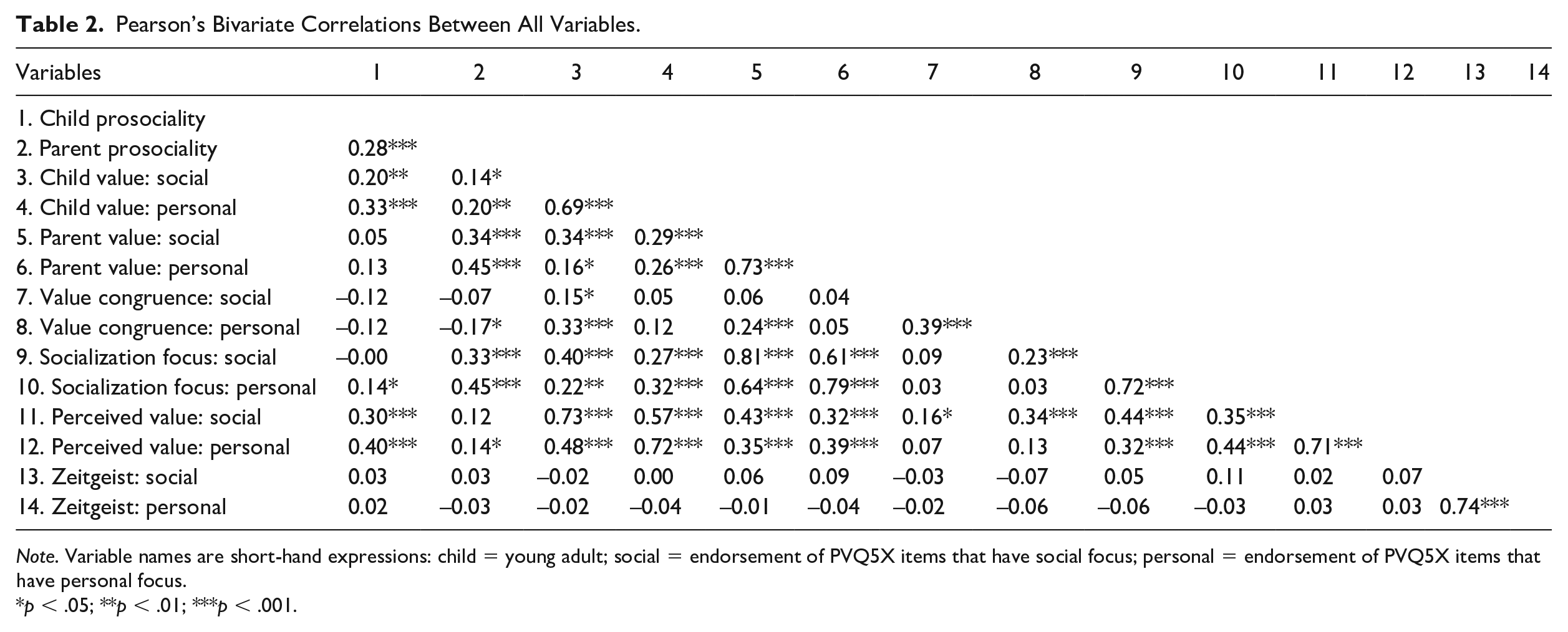
Note. Variable names are short-hand expressions: child = young adult; social = endorsement of PVQ5X items that have social focus; personal = endorsement of PVQ5X items that have personal focus.
p < .05; **p < .01; ***p < .001.
Model 5 entered zeitgeist values as moderators. Following Boehnke et al. (2009), we conceptualized zeitgeist as the dominant value that mainstream society constructed and assigned the family data set as the case (i) and subsequently calculated zeitgeist values by (1) creating random scores (i-1) from the distribution of parents’ personal values responses; (2) creating random scores (i-2) from the distribution of young adults’ personal values responses; and (3) averaging scores obtained from step (1) and (2) to obtain zeitgeist values score on a particular value category (see Figure 2).
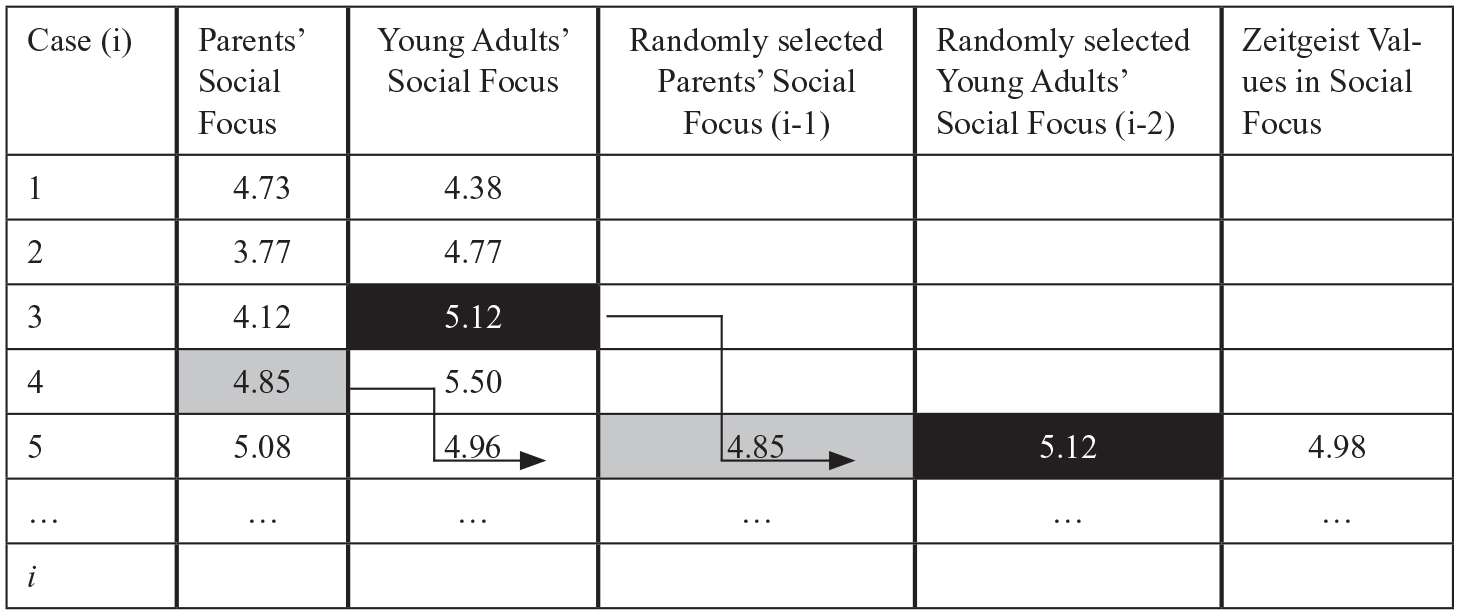
Illustration of Calculating Zeitgeist Values in Social Focus.
Model 1 (Recipient Shapes Transmission)
Table 3 summarizes results from all regression analyses. Model 1 accounted for 16% of the variability of young adults’ prosociality, R2 = .16. Evidencing vertical transmission, in all models, young adults’ prosociality was significantly related to their parents’ prosociality. Young adults’ value in personal focus, b = 0.311, 95% CI [0.13, 0.49], t = 3.378, p < .001 was also a significant predictor, but not young adults’ value in social focus. These findings indicate that young adults’ self-focused value is a positive predictor of their prosociality. No significant moderation was evident, not providing support to Model 1.
Results Summary of the Five Models.
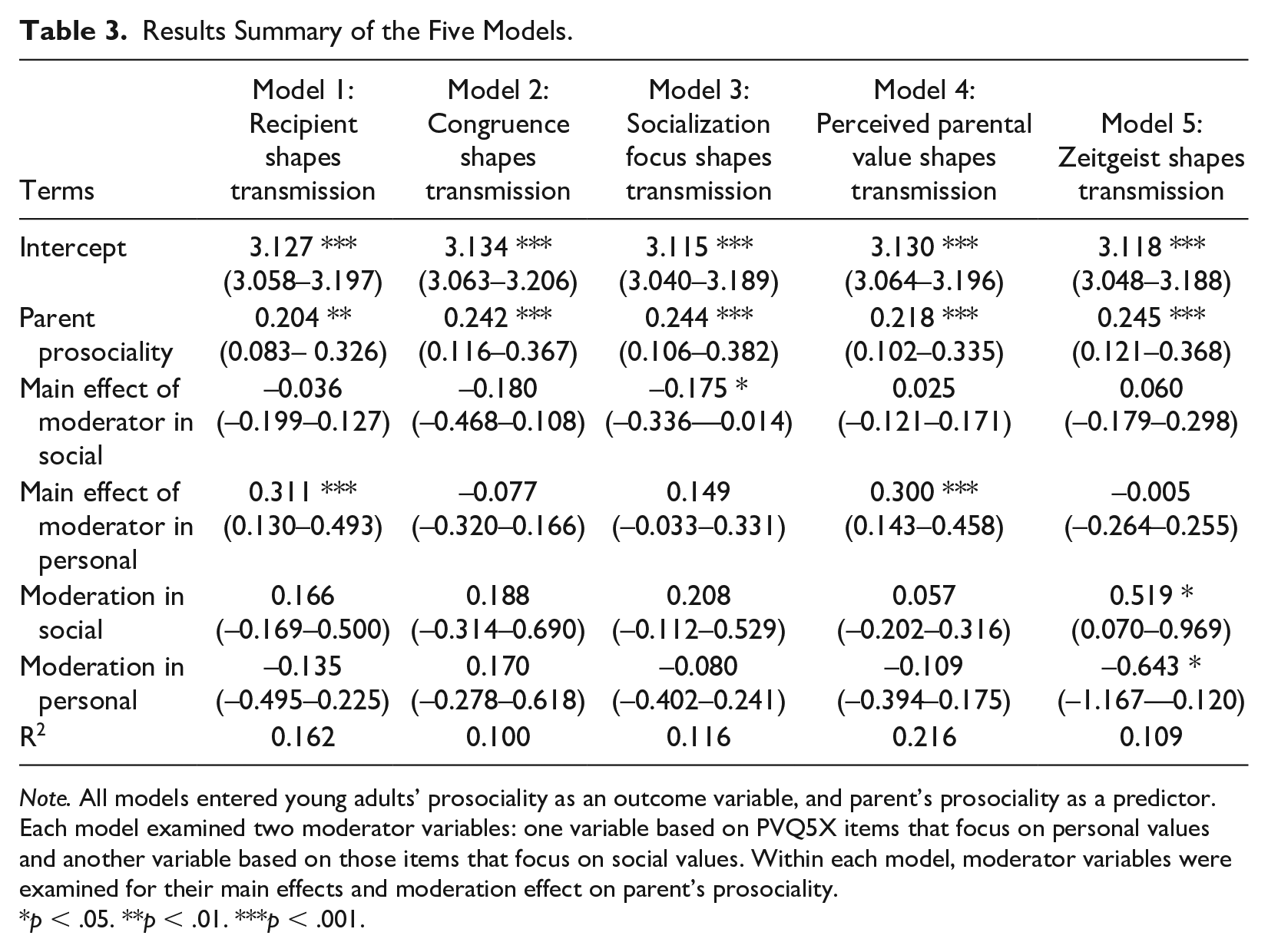
Note. All models entered young adults’ prosociality as an outcome variable, and parent’s prosociality as a predictor. Each model examined two moderator variables: one variable based on PVQ5X items that focus on personal values and another variable based on those items that focus on social values. Within each model, moderator variables were examined for their main effects and moderation effect on parent’s prosociality.
p < .05. **p < .01. ***p < .001.
Model 2 (Congruence Shapes Transmission)
This model accounted for 10% of the variability of young adults’ prosociality. While the vertical transmission was evident, neither value congruence in social focus nor in personal focus was significant. Moreover, no significant moderations were found. These findings do not support Model 2.
Model 3 (Socialization Focus Shapes Transmission)
The model accounted for 12% of the variability of young adults’ prosociality. Parental socialization value in social focus, b = −0.175, 95% CI [–0.34, −0.01], t = −2.141, p = .034 was a significant predictor of young adults’ prosociality score. No significant moderations were found, hence not supporting Model 3.
Model 4 (Perceived Parental Value Shapes Transmission)
The model accounted for 22% of the variability of young adults’ prosociality. The perceived endorsement in personal focus, b = 0.300, 95% CI [0.14, 0.46], t = 3.762, p < .001 accounted for significant variance in the young adults’ prosociality score. No significant moderations were found. These results do not support Model 4.
Model 5 (Zeitgeist Shapes Transmission)
The model accounted for 11% of the variability of young adults’ prosociality. Vertical transmission was evident in this model too (b = 0.245, 95% CI [0.12, 0.37], t = 3.901, p < .001). Moreover, the two interactions examined were both significant. The significant moderation effects were probed through a simple slope analysis (Figure 3A and 3B). Figure 3A shows the moderation of zeitgeist values on social focus. As depicted in the figure, while parents’ prosociality was predictive of their children’s prosociality (indicating vertical transmission), the extent of transmission differed depending on zeitgeist values on social focus. Specifically, the slope for vertical transmission was steeper with stronger zeitgeist values on social focus, suggesting that the higher the mainstream society endorsed the social focus value category, the more likely vertical transmission of prosociality to occur.

Parent Prosociality Is Correlated With Child Prosociality (i.e., Vertical Transmission), but This Correlation Is Moderated by Zeitgeist for Social Values (Panel A) and Personal Values (Panel B)
Figure 3B shows the moderation of zeitgeist values on personal focus. This figure again depicts vertical transmission, or that parents’ prosociality was predictive of their children’s prosociality. The extent of vertical transmission differed depending on zeitgeist values on personal focus. Specifically, the slope for vertical transmission was steeper with weaker zeitgeist values on personal focus. This means that the lower the mainstream society endorsed the personal focus value category, the more likely the vertical transmission of prosociality.
Discussion
This study considers generational change/maintenance of prosociality among Indonesian parent–child dyads through the perspective of cultural dynamics (Kashima, 2014).
Specifically, with the observation of accelerated sociocultural changes in Indonesia and the assumed transition from a collectivistic to an individualistic social environment, this study examined how prosociality, an integral component of the social fabric, may be vertically transmitted. This study through its examination of five models of vertical transmission identified from the literature is one of the first attempts to systematically examine vertical transmission processes in a non-Western context.
Our results indicated evidence of vertical transmission of prosociality, indicated by a moderate correlation between the prosociality of parents and their child (r = .28). This pattern was evident across five out of six types of prosociality examined in the PTM scale (see Supplementary Material Table 1). Interestingly, there was no evidence of vertical transmission of “emotional” prosociality. However, this needs to be interpreted cautiously as four of the six PTM subscales, including emotion, had relatively low Cronbach’s alphas, in the range of .520 to .660.
Evidence of prosociality’s vertical transmission found through the full-scale of PTM warranted explorations of how vertical transmission occurs. Of the five models examined in the study, the results did not support Models 1 to 4. That is, there was no evidence for the idea that vertical transmission is shaped by children’s values (Model 1), value congruence between parent and child (Model 2), values that parents wish to socialize (Model 3), or children’s perception of their parents’ values (Model 4). These findings differ from the results reported in prior research. We submit two factors that may account for the difference. The first factor is the study’s focus on prosociality as the content of the transmission process. Given its essential nature for group functions, prosociality may transmit from one generation to another more robustly and this process may be less affected by characteristics of parent–child dynamics. This idea is consistent with Kashima (2014) who noted that cultural characteristic subject for vertical transmission that has the function of serving group maintenance is transmitted more effectively.
The second factor is the context of Indonesian societies where the transmission occurs. Prior research suggests that performing prosocial acts is linked more to social obligation than personal values, given the importance of prosocial acts in fulfill societal expectations (Lönnqvist et al., 2006; Schwartz, 2010). This pattern may be especially pronounced in Indonesia. Previous research reported that Indonesian parents emphasized interpersonal harmony and adherence to social norms as the goal of socialization (Vaughan et al., 2008). In relation to prosociality, norms may have a stronger influence than personal values in the Indonesian context, and this may be the reason why the moderating role of value differently conceptualized in Models 1 to 4 was not evident, and the moderating role of social norms as conceptualized zeitgeist in Model 5 was evident. In short, the current findings may indicate the importance of social norms, rather than values, in shaping the vertical transmission of processes that are essential to group functions such as prosociality in the Indonesian context. It would be important to examine whether this pattern extends beyond the transmission of prosociality or extends beyond Indonesia, for example, within other societies in Southeast Asia.
Findings for Model 5, showing the moderating effect of zeitgeist values in facilitating the transmission of prosociality, were also consistent with those of Boehnke et al. (2007) who reported the role of zeitgeist values affecting the transmission of self-interest values in Germany. Interestingly, in the current study the moderating effect of zeitgeist differed between values pertaining to social issues and those pertaining to personal issues in that vertical transmission was more likely when zeitgeist endorsement of social values was stronger; but less likely when zeitgeist endorsement of personal values was stronger. We speculate that the way zeitgeist values affect the vertical transmission may reflect the importance of societal norms in Indonesia such that prosociality is transmitted more robustly in an environment of stronger social values. However, these findings need to be interpreted with caution. As Kashima (2014) noted, the zeitgeist method provides “indirect evidence” (p. 7) since randomizing the case to obtain the zeitgeist values does not allow direct estimation of who the transmitter is and to whom the cultural information is being transferred. Although Boehnke (2015) used the label zeitgeist to refer to the overlapping of the social environment, Kashima et al. (2018) argued that, in the context of dyadic interaction, shared reality needs to be verified through mutual recognition for further dissemination. The extent to which mutual recognition toward certain values between parents and their adult children was not observed in this study.
The current study’s focus on Indonesia, with its rapidly changing socioeconomic environment, contributes fresh empirical insights to the literature on vertical transmission and cultural dynamics, currently consisting of a large number of studies conducted in Western contexts. Nevertheless, findings from this study are restricted to a single cultural context at a single time point, and cross-cultural and cross-temporal analyses are needed to explore a broader pattern. One useful, also ambitious and resource demanding, approach is to conduct a cross-cultural study of parents and children as a prospective study. More generally, future studies investigating intergenerational transmission should consider the use of longitudinal design involving more than two generations from different cultures to better estimate historic changes in a cross-cultural context. This study’s reliance on self-reported responses is another limitation. Alternative measures of prosocial behavior such as behavioral observation or parental reports on young adults’ prosocial behavior may be used in future studies. In collecting self-reported responses from parents, this study for an administrative reason only allowed responses from one parent with typical responses from mothers. It is suggested that future studies involving parental responses should include both parents’ participation to better explain the influence of both parents on their children.
Finally, while this study focused on the moderating effect of values, the transmission process may also be influenced by other variables, like parenting styles, marital quality, and sociodemographic variables such as parents’ education, developmental stages of the children, and birth order (Schönpflug & Bilz, 2009; Trommsdorff (2009). Relatedly, Tam et al. (2012) through their investigation of vertical transmission in Hong Kong argued that vertical transmission in societies going through rapid socioeconomic changes is influenced by parents’ perception of values that are important in their society. Tam et al. (2012) postulated that parents in Hong Kong may be pressured to socialize values that comply with the mainstream cultural environment and help their children to meet societal expectations. Results from the current study resonate with this observation in suggesting the role of factors like zeitgeist are more influential factors of vertical transmission in societies like Indonesia that are going through rapid socioeconomic changes. Future research should explore these variables to further illuminate processes of vertical transmission.
Supplemental Material
sj-pdf-1-jcc-10.1177_00220221241311213 – Supplemental material for Vertical Transmission of Prosociality: Basic Human Values and the Context of Intergenerational Transmission in Indonesia
Supplemental material, sj-pdf-1-jcc-10.1177_00220221241311213 for Vertical Transmission of Prosociality: Basic Human Values and the Context of Intergenerational Transmission in Indonesia by Berlian G. Septarini, Takeshi Hamamura and Lauren J. Breen in Journal of Cross-Cultural Psychology
Footnotes
Authors’ Note
This research was conducted as part of the Australian Award Scholarship (ST000PU64) provided to Berlian Gressy Septarini.
Declaration of Conflicting Interests
The author(s) declared no potential conflicts of interest with respect to the research, authorship, and/or publication of this article.
Funding
The author(s) received financial support from the Australian Award Scholarship (ST000PU64) provided to Berlian Gressy Septarini for the research, authorship, and/or publication of this article.

Supplemental Material
Supplemental material for this article is available online.
References
Supplementary Material
Please find the following supplemental material available below.
For Open Access articles published under a Creative Commons License, all supplemental material carries the same license as the article it is associated with.
For non-Open Access articles published, all supplemental material carries a non-exclusive license, and permission requests for re-use of supplemental material or any part of supplemental material shall be sent directly to the copyright owner as specified in the copyright notice associated with the article.
