




Abstract
Differences in emotion regulation strategies usage between Western and East-Asian individuals have been shown to exist. In this systematic review and meta-analysis, we aimed to synthesize differences and similarities of the spontaneous use frequency of nine emotion regulation strategies (suppression, reappraisal, acceptance, avoidance, rumination, mindfulness, distraction, expression, and self-compassion), in Western and East-Asian individuals. Quantitative comparison studies were identified through systematic and snowball searches. Meta-analysis was undertaken with the meta package from R. Nineteen articles involving 21 studies were included in the systematic review and 20 studies were included in the meta-analysis. These articles were published from 2002 to 2023. The results showed that East-Asian individuals use more suppression (d = −0.29) and avoidance (d = −0.57) compared with Western individuals, with a medium effect size. No significant difference was observed in reappraisal, rumination, and expression usage. Future comparison studies across Western and East-Asian cultures should consider focusing on the use of self-compassion, acceptance, distraction, and mindfulness, which are understudied in the field of emotion regulation. Moreover, to improve the methodology, address inadequacies in analyzing cultural measurement invariance, distinguishing between emotional valences, and reporting the ethnicity of participants.
Emotion regulation refers to all the processes that modify which emotions we have, when we have them, and how we experience or express these emotions (Gross, 2015). One commonly used framework for studying emotion regulation strategies is the process model of emotion regulation (Gross, 1998). The model predicts that the use of emotion regulation strategies will have different consequences for how a person feels, thinks, and acts, both immediate and long term (Gross, 2015; Quoidbach et al., 2015). Nine emotion regulation strategies that are frequently studied within this framework are suppression, reappraisal, acceptance, avoidance, rumination, mindfulness, distraction, expression, and self-compassion (Table 1). These strategies have a substantial body of research supporting their definitions and use in emotion regulation. In the present systematic review and meta-analysis, we synthesized differences and similarities of the spontaneous use frequency of these nine emotion regulation strategies in Western and East-Asian cultures.
Definitions of the Nine Emotion Regulation Strategies in the Review.

Emotion Regulation Strategies in Western and East-Asian Cultures
Decades of research explored the use frequency and effectiveness of different emotion regulation strategies (Joormann & Stanton, 2016). Although existing research has mainly been conducted with Western samples, some studies have documented similarities and/or differences among participants from other cultures in the use of these strategies. In the present systematic review and meta-analysis, we focus on the comparison between East-Asian and Western individuals because it has dominated the literature on emotion regulation, cross-culturally (Ford & Mauss, 2015; Hampton & Varnum, 2018). For the present study, we followed the suggestion of Matsumoto and Juang (2007) to define culture as a dynamic yet relatively stable system of attitudes, values, beliefs, norms, and behaviors that emerge within groups and are typically transmitted across generations. In addition, as another concept for being a part of the inclusion/exclusion criteria in the present study, ethnicity was defined as sharing a common descent and national or cultural tradition according to the Oxford English Dictionary (2023). In all included studies of the present work, ethnicity was determined through self-report.
Existing evidence suggests that East-Asian and Western individuals may differ in their individualism/collectivism orientations, which may be associated with their emotion regulation choice (Butler et al., 2007; Cheung & Park, 2010; Ford & Mauss, 2015; Hofstede et al., 2010; Matsumoto et al., 2008). Western Individuals with individualistic orientations are expected to be independent and demonstrate the values of individuality, uniqueness, autonomy, and self-expression; whereas East-Asian individuals with collectivistic orientations are encouraged to be interdependent and demonstrate the values self-effacement and self-criticism, and they tend to connect themselves to others and prioritize their interpersonal relationships (Kim & Sherman, 2007; Markus & Kitayama, 1991). The emotion regulation strategy that is adaptive under a particular cultural context might be used more frequently because it is encouraged and rewarded, whereas an emotion regulation strategy under the same cultural context would be used less because it is socially discouraged. For example, previous research indicated that East-Asian individuals tend to use fewer emotional expressions than Western individuals (Kang et al., 2003). This difference may exist because of the inhibitory “display rules” (Ekman & Friesen, 1969) encouraged by East-Asian culture and not because East-Asians experience less emotion than Westerners (Mesquita & Frijda, 1992).
Differences and similarities in the spontaneous use frequency of specific emotion regulation strategies in Western and East-Asian individuals have been observed in previous studies. East-Asian individuals are more likely to use suppression (Gross & John, 2003; Han et al., 2022; Matsumoto, 2006; Nozaki, 2018; Orkibi et al., 2021; Schunk et al., 2021, 2022; Soto et al., 2011; Su et al., 2014; Zhou et al., 2022), avoidance (Nishiguchi et al., 2022; O’Connor & Shimizu, 2002; Su et al., 2014) compared with Western individuals. However, Germans are more likely to use acceptance, compared with Japanese people (Schunk et al., 2022). Moreover, Chinese individuals reported using more mindfulness than European Americans (Kahn et al., 2017; Rich et al., 2022). The research from Rich et al. (2022) also suggested that Chinese individuals are more likely to use self-compassion than European Americans. East-Asians are less likely to use expression compared with Westerners (Kahn et al., 2017; Kang et al., 2003; Wei et al., 2013); although there is a study suggesting East-Asians use more expression than Westerners for negative emotions (Krys et al., 2022). According to a study by Schunk et al. (2022), Japanese use more distraction than Germans when facing positive emotions, but they are similar when distracting from negative emotions. There are inconsistent findings in the use of reappraisal and rumination. Some research did not find significant cultural differences in the frequency of using reappraisal between East-Asians and Westerners (Matsumoto, 2006; Schunk et al., 2021, 2022; Soto et al., 2011), whereas inconsistent results emerged that East-Asians are less likely (Nozaki, 2018) or more likely (Matsumoto, 2006; O’Connor & Shimizu, 2002) to use reappraisal compared with Westerners. East-Asians reported more rumination usage than Westerners, in some studies (Maxwell et al., 2005; Schunk et al., 2022), but less than Westerners in the study from Schunk et al. (2021).
Once the process of emotion regulation is underway, one’s cultural context may influence the adaptiveness of using a specific emotion regulation strategy based on its consistency with society-specific expectations. For instance, suppression might be an adaptive emotion regulation strategy in East-Asian culture because it is consistent with the values of interdependence and relationship harmony, which is to avoid direct confrontations, and thus be beneficial for preserving relationships; whereas suppression might be a socially discouraged emotion regulation strategy in Western culture because it conflicts with the high value placed on self-expression, seen as characteristic of authenticity, and thus lead to more perceptions of hostility and social withdrawal in interpersonal relationships (Butler et al., 2007).
Current Systematic Review and Meta-Analysis
Currently, comparisons between Western and East-Asian individuals have dominated the literature on emotion regulation and culture. However, a comprehensive review of the effects of culture on the spontaneous use frequency of specific emotion regulation strategies is necessary to estimate the presence and strength of the effects, particularly given the sometimes-contradictory trends between studies.
A recent systematic review reported on cultural differences in the use frequency of emotion regulation strategies (Weiss et al., 2022). However, it focused on the comparison of ethnic majorities to ethnic minorities in a single country: they compared Westerners and migrants who are living in the same country. To avoid the overlap of the comparison objects and to reduce the influence of cultural exposure, the present study has clear criteria for both participants’ ethnicity and country of residence. Specifically, the present systematic review only focuses on the comparison between Westerners, whose country of residence and ethnicity are both Western and East-Asians, whose country of residence and ethnicity are both East-Asian. In addition, there is a meta-analysis involving a broad range of emotion regulation strategies to examine how different emotion regulation strategies are structurally related to one another (see Naragon-Gainey et al., 2017), but it did not examine the use frequency of these strategies or consider their cultural influences.
The present work moves beyond previous reviews, and includes the most extensive emotion regulation search strategy, considering the potential influences of culture and minimizing the influence of cultural exposure. Specifically, we aimed to identify research gaps in comparison studies across Western and East-Asian cultures on nine common emotion regulation strategies (suppression, reappraisal, acceptance, avoidance, rumination, mindfulness, distraction, expression, and self-compassion) and then synthesized the similarities and differences of spontaneously using these strategies in Western and East-Asian cultures.
Method
Information Sources
Systematic searches were conducted on PsycINFO, Web of Science, PubMed, and Scopus. Gray literature was searched in ProQuest Dissertations and Theses Global. These electronic databases were searched for studies published from their inception until December 16, 2023. Furthermore, snowball searching was conducted by searching the reference list of relevant studies to identify additional publications not captured by the computerized search. The authors of relevant studies were contacted for any missing information (e.g., ethnicity of participants or means and standard deviations of the results).
Search Strategy
The following search terms that were used to capture three concepts, namely, emotion regulation, emotion regulation strategy, and cross-culture, along with the appropriate Boolean operators: (“emotion regulat*” OR “emotional regulat*” OR “affect regulat*” OR “affective regulat*” OR “emotion dysregulat*” OR “emotional dysregulat*” OR “affect dysregulat*” OR “affective dysregulat*”) AND (suppression OR reappraisal OR acceptance OR avoidance OR rumination OR mindfulness OR distraction OR express* OR “self-compassion” OR strateg*) AND (“different cultur*” OR “cross cultur*” OR “across cultur*” OR “cultural variation*” OR “cultural difference*” OR “culturally different” OR “culturally diverse” OR “cross ethnic” OR “ethnic difference*” OR “racial difference*” OR “cross national*” OR “national difference*” OR “cultural context*” OR “cultural background*” OR “cultural norm*” OR “cultural value*” OR “cultural orientation” OR “cultural dimension*” OR “cultural group*” OR “culturally relevant” OR “cultural perspective” OR “culture specific” OR “cultural specificity” OR international OR multinational OR transcultur* OR multicultur*). For PsycINFO and Scopus, the search terms (including Index terms in PsycINFO) were entered into the title, abstract, and keyword fields; for Web of Science, the terms were entered into the topic field; for PubMed, the terms (including Mesh terms), were entered into the title and abstract fields; for ProQuest Dissertations and Theses Global, the terms were entered into the abstract field. Only “Language: English” was applied as a filter in the database searches, with no restrictions based on the year of publication. The search strategy of databases is shown in Supplemental Material 1.
Inclusion and Exclusion Criteria
Studies were included if they met the following criteria: (a) quantitative studies that have an English language version; (b) studies comparing Westerners and East-Asian samples. These are defined as Western samples are those whose country of residence and ethnicity are both Western (the United States, Canada, Australia, New Zealand, and countries in Europe) but not “ex-Communist” countries (such as Poland, Croatia, and the Czech Republic), as Inglehart (2006) has pointed out, these countries differ significantly on a range of cultural variables from the rest of Europe. East-Asians samples are those whose country of residence and ethnicity are both East-Asian countries and regions (China, Taiwan, Hong Kong, Macau, Japan, South Korea, North Korea, and Mongolia). Furthermore, we noticed that ethnic diversity has been brought about by globalization, especially in Western countries, we therefore applied relatively strict inclusion criteria for the ethnicity in the target countries to minimize the impact of ethnic diversity to ensure cultural homogeneity. Specifically, we only included studies that reported at least 80% of the sample shared the ethnicity that we focus on to ensure relatively low ethnic diversity in each sample (e.g., reported 80% European American in the U.S. sample); (c) studies examining either of suppression, reappraisal, acceptance, avoidance, rumination, mindfulness, distraction, expression, and self-compassion as an explicit emotion regulation strategy, and also described means, standard deviations, and sample sizes for the emotion regulation strategy; and (d) studies that only include adults aged 18 and over as participants. Meta-analysis was conducted when three or more studies contained the same emotion regulation strategy.
Studies were excluded if they: (a) manipulated emotion regulation strategies (experimentally or therapeutically) rather than measuring the spontaneous use of them; (b) compared Westerners and East-Asians who live in a single country; and (c) were qualitative studies, reviews, book chapters, meta-analyses, study protocols, and conference abstracts. We excluded one study focused on migraine patients because their spontaneous use of emotion regulation strategies may be more affected by headache symptoms and therapy, than culture (Wolf et al., 2020). We also excluded one study that focused on psychotherapists because they may adjust their emotions to achieve therapeutic goals, even though their use of emotion regulation strategies is often spontaneous (Chui & Liu, 2021). In addition, given that measurement invariance is a condition for conducting meaningful group comparisons, we excluded three studies in which measurement invariance was not observed in the compared cultural groups (Burghart et al., 2023; Hao et al., 2019; Tamir et al., 2023).
Study Selection
Duplicates were removed using the Mendeley software. Then, studies were selected via a two-step process. The first step involved screening the titles and abstracts in terms of the eligibility criteria. The second step involved reviewing the full texts of the articles identified in the first step to decide on which papers would be included in the final review. Two reviewers independently assessed whether the studies were eligible for inclusion in both steps. Consensus in both steps was reached between two of the authors. The inter-reliability ratings in both stages were determined using the Prevalence and Bias-Adjusted Kappa (PABAK; Byrt et al., 1993). At the title and abstract stage, the inter-rater reliability was excellent (PABAK = 0.9487). For the full-text stage, the rate of reliability was 100%.
Risk of Bias in Individual Studies
The risk of bias in the included studies was assessed with the Crowe Critical Appraisal Tool, version 1.4 (Crowe, 2013). This tool consists of eight categories, including: (a) preliminaries, (b) introduction, (c) research design, (d) sampling, (e) ethical matters, (f) data collection, (g) results, and (h) discussion. Each category was scored from 0 = no evidence to 5 = highest evidence and summed to provide a total article score that was presented as a percentage. Based on criteria from a previous study (Sznitman & Taubman, 2016), the total score for each study was considered as “high quality” (if ≥ 75%), “moderate quality” (if 51%-74%), and “poor quality” (if ≤ 50%). Scoring was undertaken by the first author and cross-checked by the other authors.
Data Extraction
The required information was extracted and compiled into tables by the first author and checked by the remaining authors. Three authors of relevant studies were contacted for means and standard deviations of the results, with two responding. Another three authors were contacted for the ethnicity of participants but did not respond, so that, they were not included in the systematic review.
Information extracted from each study included:
Demographics of participants. Ethnicity, sample size, age (if specified), and percentage of female participants (if specified).
Emotion variables. Valence of emotion (if specified), emotion regulation strategy and measurement used, means, and standard deviations of the use frequency of emotion regulation strategies.
Cultural measurement invariance. Method and results (if tested).
Synthesis Methods
The systematic review was performed with all eligible studies. When the number of studies investigating a particular emotion regulation strategy was sufficient (K ≥ 3), meta-analysis was performed to evaluate the associations between culture and the spontaneous use frequency of emotion regulation strategies. The remaining strategies that have been studied cross-culturally were synthesized narratively.
The meta package (Balduzzi et al., 2019) was used in R v.4.3.0 (R Core Team, 2023) to conduct meta-analysis and exploratory analysis. Cohen’s d was used to summarize the effect size: small (d ≤ 0.20), medium (0.20 < d < 0.80), and large (d ≥ 0.80) (Cohen, 1988). The effect size was calculated using means, standard deviations, and sample sizes of the included studies. We added sample sizes together, created weighted means and pooled standard deviations, for the study that has more than one Western country/region or East-Asian country/region before conducting a meta-analysis. Knapp–Hartung adjustments (Knapp & Hartung, 2003) were used to calculate the confidence interval around the pooled effect. The restricted maximum likelihood estimator was used because the effect sizes in this meta-analysis were based on continuous outcome data. In addition, the variation between the studies for a specific strategy was visualized with a dot-and-whisker plot when these studies (K ≥ 3) used the same scale.
The chi-square (chi2) tests that are quantified by I2 statistics were used to assess the heterogeneity of the studies. Following the guide of the Cochrane Handbook (Higgins et al., 2019), a score of 0% to 40%, 30% to 60%, 50% to 90%, and 75% to 100% indicated low, moderate, substantial, and considerable heterogeneity, respectively. Considering that participants were drawn from different countries, a random-effects model was used since heterogeneity between studies was anticipated (Harrer et al., 2021).
Reporting Bias Assessment
Publication bias was checked for strategies where the studies ≥ 10 (Sterne et al., 2011), using the Begg funnel plots and Egger’s regression test (Egger et al., 1997). The effect was plotted by the inverse of its standard error for each study, and both graphical and statistical evaluations were used. The existence of publication bias was considered if the asymmetry of the funnel plot, and/or p < .05 from the Egger test were found. Finally, Rücker’s limit meta-analysis method was used to adjust for small-study effects to attain a corrected effect estimate. However, publication bias was not tested when fewer than 10 studies were considered for the analysis, since the statistical power of the analysis was too low in this case (Higgins et al., 2019; Sterne et al., 2011).
Transparency and Openness
We adhered to the MARS (Meta-Analysis Reporting Standards) guidelines (American Psychological Association Publications and Communications Board Working Group on Journal Article Reporting Standards, 2008) and the PRISMA (Preferred Reporting Items for Systematic Reviews and Meta-Analyses) 2020 guidelines (Page et al., 2021) for systematic reviews and meta-analysis. Data were analyzed using R v.4.3.0 (R Core Team, 2023) and the meta package, version 5.5-0 (Balduzzi et al., 2019). All meta-analytic data and analysis code have been made publicly available on the Open Science Framework and can be accessed at (https://osf.io/pkvjb/?view_only=baab564508504a56a7c3e4e44847c52b). The protocol for this review was pre-registered on PROSPERO. As it is a systematic review with meta-analysis, published aggregated data rather than raw data were used, and this study did not require ethical approval.
Results
Study Selection
A total of 19 articles involving 21 studies were identified for inclusion in the systematic review. Figure 1 presents the study selection process according to the PRISMA 2020 Statement. After title and abstract screening, we identified 70 relevant full-text articles, of which 16 involving 18 studies were found to meet the eligibility criteria. In addition, three articles with three studies that met the criteria for inclusion were identified by checking the reference list of the included papers.
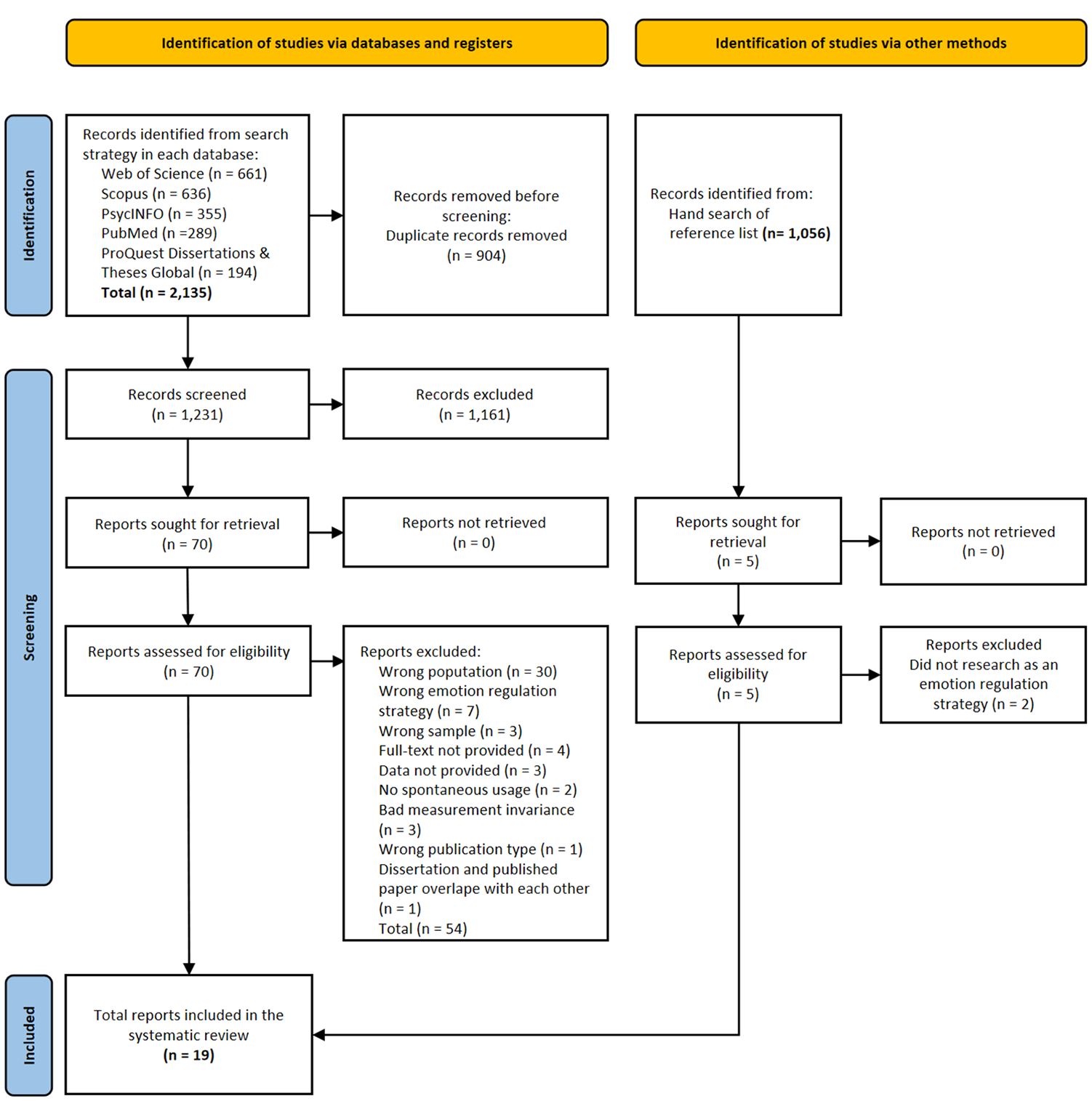
PRISMA 2020 Flow Diagram of the Articles in the Review.
The meta-analysis included 20 of the 21 studies, with one being excluded as it did not examine any strategies that appeared in at least two other papers (Rich et al., 2022). Fourteen studies evaluated suppression, 11 studies evaluated reappraisal, four studies evaluated rumination, four studies evaluated expression, and three studies evaluated avoidance. The remaining strategies that are acceptance, mindfulness, distraction, and self-compassion, were synthesized narratively. One full-text dissertation that met our inclusion criteria (He, 2020), however, this thesis had also been published as a journal article, therefore, we included the article instead (He et al., 2021). Thus, no unique unpublished study was included in this systematic review and meta-analysis.
Study Characteristics and Risk of Bias of the Included Studies
The characteristics of eligible studies are shown in Supplemental Material 2. These articles were published from 2002 to 2023. The 21 studies include data from 37,882 participants. Of these, 17,044 (44.99%) were from 16 Western countries, and 20,838 (55.01%) were from five East-Asian countries and regions. The specific countries and regions included in each of the studies can be found in Supplemental Material 3.
Ten of the included 21 studies had a relatively balanced sex characteristic, between 40% and 60%; 11 studies had an imbalanced sex characteristic, which is less than 40% or over 60% of the sample. These 21 studies had a mean age from 18.69 to 54.4 years, representing a wide age range within each of the samples. All participants reported the spontaneous use frequency of at least one of the nine emotion regulation strategies. Most included studies evaluated suppression (k = 14), with the most commonly used measure being the Emotion Regulation Questionnaire (ERQ, k = 13, Gross & John, 2003); one study used the Positive and Negative Affect Schedule (PANAS, k = 1, Watson et al., 1988) to examine how frequently people suppress expressing a broad range of positive and negative emotions when interacting with others, even though this instrument was designed to measure the frequency of emotional experiences in previous studies. Reappraisal was evaluated in 11 studies, with the most commonly used measure being the ERQ (k = 10, Gross & John, 2003); another study used the modified version of the Ways of Coping Questionnaire (WCQ, k = 1, Folkman et al., 2000). Rumination was evaluated in four studies, three of them used the Perseverative Thinking Questionnaire (PTQ, k = 3, Ehring et al., 2011); another study used the Anger Rumination Scale (ARS, k = 1, Sukhodolsky et al., 2001). Expression was evaluated in four studies, two of them used the Distress Disclosure Index (DDI, k = 2, Kahn & Hessling, 2001); one of them used the Emotional Expressiveness Questionnaire (EEQ, k = 1, King & Emmons, 1990); another one used the Affect Valuation Index (AVI, k = 1, Tsai et al., 2006) to capture the frequency of expressing positive and negative emotions, even though this instrument was designed to explore the difference between ideal affect and actual affect. Avoidance was evaluated in three studies, with the modified version of the WCQ (k = 1, Folkman et al., 2000), the Acceptance and Action Questionnaire-II (AAQ-II, k = 1, Bond et al., 2011), and the Maladaptive and Adaptive Coping Style Questionnaire (MAX, k = 1, Moritz et al., 2016). Distraction and acceptance were evaluated in one study, with the Emotion Regulation Inventory (ERI, k = 1, König, 2011). Mindfulness was evaluated in two comparison studies, with one study using the Mindful Attention Awareness Scale (MAAS, k = 1, Brown & Ryan, 2003); and another study using the items of Contemplative Practice Behavior (CPB) created by Rich et al. (2022; k = 1), and self-compassion usage was also evaluated by these items in the same study (k = 1).
Nine of the included 21 studies specified emotional valence in the assessment of emotion regulation strategies. Two articles involving three studies distinguished between emotional valence when assessing suppression, three studies when assessing expression, one study assessed reappraisal, one study assessed distraction, one study assessed acceptance, and four studies assessed rumination given that the definition of rumination focuses on negative emotions.
Eleven of the 21 studies tested cultural measurement invariance. Two of them conducted both confirmatory factor analysis (CFA) and exploratory factor analysis (EFA), three of them conducted CFA only, three studies reported they conducted factor analyses, two studies tested congruence coefficients (Tucker’s phi), and one study conducted analyses of mean and covariance structures (MACS). In these 11 studies, comparable structures of the measurements were demonstrated in eight studies without adjustment, and three studies removed non-invariant items to achieve comparable structures.
The quality of the 21 eligible studies was evaluated using the Crowe Critical Appraisal Tool. The total percentage score for each study and the score for each category is detailed in Supplemental Material 4. All the studies were included as they were all rated as high quality, with the total score for each study equal to or more than 75%.
Effects of Culture on the Spontaneous Use Frequency of Emotion Regulation Strategies
The meta-analysis evaluated five of the nine strategies because they appeared in three or more studies: suppression, expression, reappraisal, rumination, and avoidance. Data were pooled from 20 of the 21 studies because they identified at least one of these five strategies. We followed Harrer et al. (2021) in our approach to conducting meta-analysis in R. The remaining four strategies: acceptance, mindfulness, distraction, and self-compassion; appeared in less than three studies thus were included in the narrative synthesis.
There was no evidence of publication bias for suppression and reappraisal. However, due to the small number of studies, we could not conduct the publication bias analysis for avoidance, rumination, and expression.
Suppression
The effect of culture on the spontaneous use frequency of suppression, as an emotion regulation strategy, was evaluated in 12 papers involving 14 studies (Han et al., 2022; He et al., 2021; Matsumoto et al., 2008; Nozaki, 2018; Orkibi et al., 2021; Schunk et al., 2021, 2022,2023; Soto et al., 2011; Su et al., 2014; Wei et al., 2013; Zhou et al., 2022). The pooled data suggest that East-Asian culture was associated with greater use of suppression, with a medium effect size (see Figure 2A; Cohen’s d = −0.29, 95% CI −0.41 to −0.17). Heterogeneity was significant (p < .01, I2 = 87%). Figure 3A shows that there was no significant publication bias in the included studies according to the funnel plot and Egger’s regression test (t = −0.002,p = 1.00).
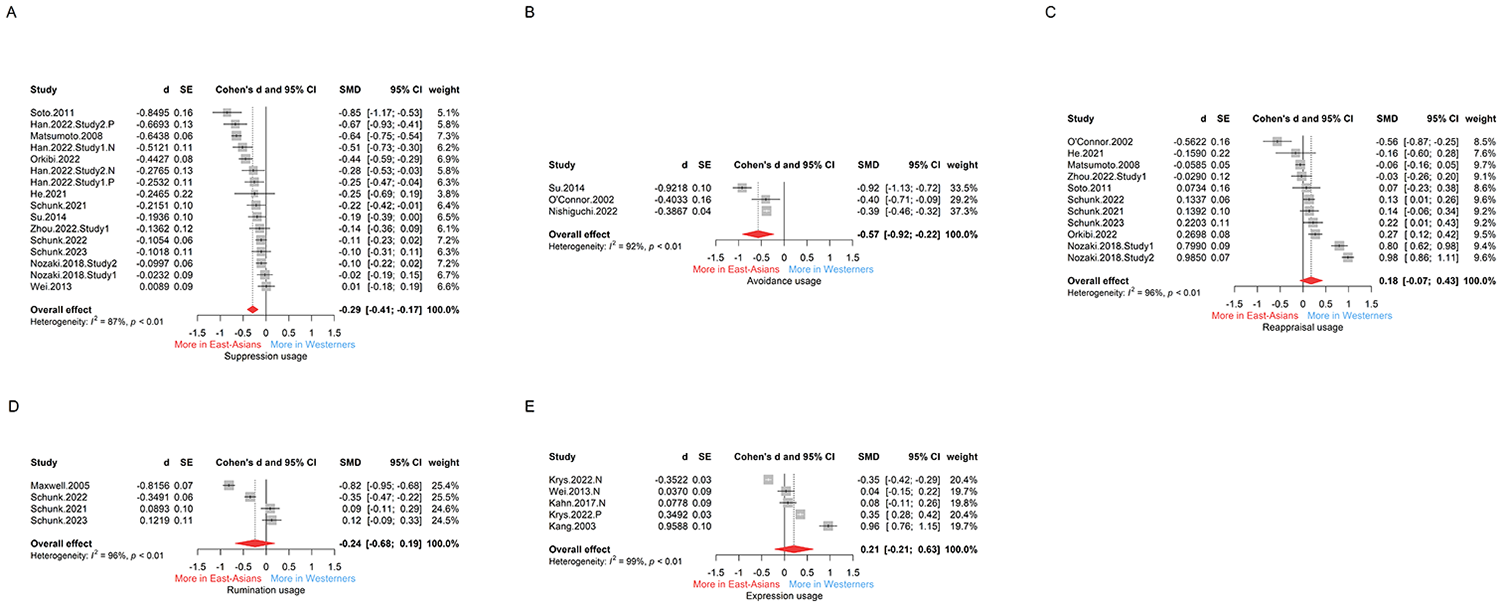
Overall Effects of Culture on the Spontaneous Use Frequency of Emotion Regulation Strategies.
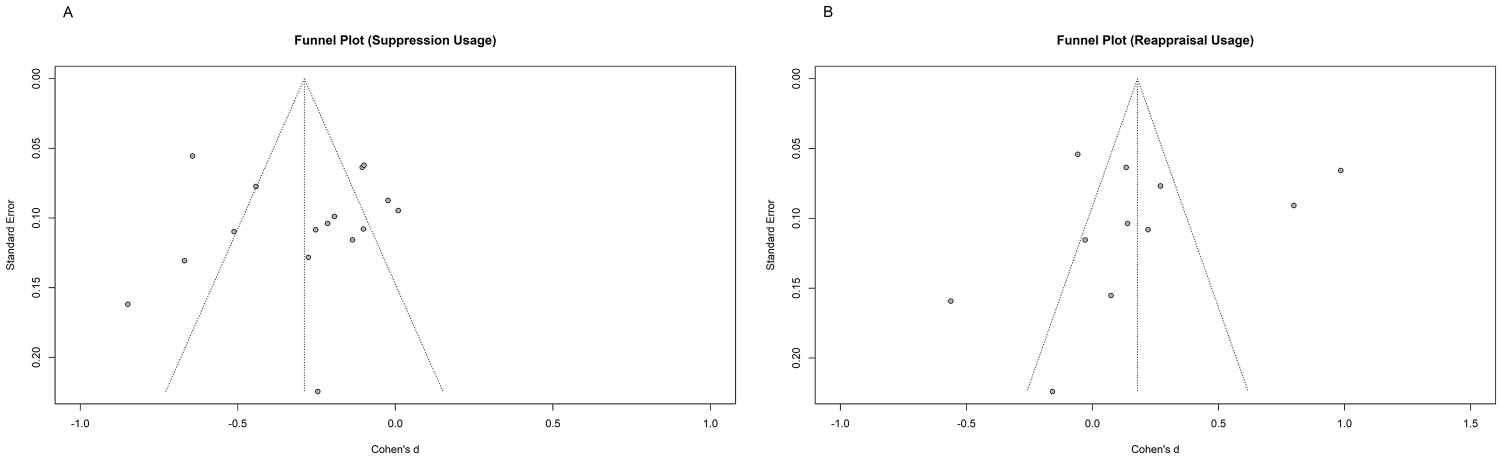
Publication Bias for the Effects of Culture on the Spontaneous Use Frequency of Emotion Regulation Strategies.
In studies that used the same scale, the ERQ (Gross & John, 2003), a comparison was made using a dot-and-whisker plot. This was limited to those 13 studies that did not distinguish emotional valence in the assessment of suppression (see Supplemental Material 5). The results were generally consistent with the overall effect, but there were more exceptions in the data on Western culture than in the data on East-Asian culture, which may reflect greater variance in the frequency of suppression use across Western individuals.
Avoidance
The effect of culture on the spontaneous use frequency of avoidance was examined in three papers involving three studies (Nishiguchi et al., 2022; O’Connor & Shimizu, 2002; Su et al., 2014). The pooled data suggest that East-Asian culture was associated with greater use of avoidance, with a medium effect size (see Figure 2B; Cohen’s d = −0.57, 95% CI −0.92 to −0.22). Heterogeneity was significant (p < .01, I2 = 92%).
Reappraisal
The effect of culture on the spontaneous use frequency of reappraisal was examined in 10 papers involving 11 studies (He et al., 2021; Matsumoto et al., 2008; Nozaki, 2018; O’Connor & Shimizu, 2002; Orkibi et al., 2021; Schunk et al., 2021, 2022, 2023; Soto et al., 2011; Zhou et al., 2022). The pooled effect size for the spontaneous use of reappraisal was non-significant (see Figure 2C; Cohen’s d = 0.18, 95% CI −0.07 to 0.43). Heterogeneity was significant (p < .01, I2 = 96%). Figure 3B shows that there was no significant publication bias in the included studies according to the funnel plot and Egger’s regression test (t = −0.64, p = .54).
In studies that shared the same scale, the ERQ (Gross & John, 2003), a comparison was made using a dot-and-whisker plot (see Supplemental Material 5). Among 11 studies assessing reappraisal, 10 studies used the ERQ. The results were consistent with the overall effects shown in the forest plot.
Rumination
The effect of culture on the spontaneous use frequency of rumination was examined in four papers involving four studies (Maxwell et al., 2005; Schunk et al., 2021, 2022, 2023). Meta-analysis suggested a non-significant pooled difference in rumination usage between Western and East-Asian individuals (see Figure 2D; Cohen’s d = −0.24, 95% CI −0.68 to 0.19). Heterogeneity was significant (p < .01, I2 = 96%).
Expression
The effect of culture on the spontaneous use frequency of expression was examined in four papers involving four studies (Kahn et al., 2017; Kang et al., 2003; Krys et al., 2022; Wei et al., 2013). Meta-analysis suggested a non-significant pooled difference in the use of expression between Western and East-Asian individuals (see Figure 2E; Cohen’s d = 0.21, 95% CI −0.21 to 0.63). Heterogeneity was significant (p < .01, I2 = 99%).
Narrative Synthesis
Kahn et al. (2017) found that Chinese (Taiwan) use more mindfulness than European Americans with a small effect size (Cohen’s d = −0.2). A study with a large sample size found similar results in European Americans and Chinese (Rich et al., 2022; Cohen’s d = −0.14). Within the same sample, this study also found that Chinese individuals use more self-compassion than European Americans (Cohen’s d = −0.39). Schunk et al. (2022) found that Germans use more acceptance than Japanese (Cohen’s d = 0.31). Notably, the effect of culture on the spontaneous use frequency of distraction was examined in the same study, with an interesting finding in the case of distinguishing between emotional valences. Japanese reported more use of distraction for positive emotions compared with Germans, with a large effect size (Cohen’s d = −0.89), but they are similar in the distraction usage for negative emotions (Cohen’s d = 0.17).
Discussion
This systematic review and meta-analysis examined the effect of Western and East-Asian cultures on the spontaneous use frequency of nine emotion regulation strategies. There is an outstanding need for a thorough synthesis of cross-cultural evidence in the field of emotion regulation strategy usage. Data were pooled from 21 comparison studies across Western and East-Asian cultures, and only cross-sectional data were included. Overall, our meta-analysis and narrative synthesis support the claim that culture affects the spontaneous use frequency of some emotion regulation strategies, but differences can be observed across strategies.
Impact of Western and East-Asian Cultures on the Use of Emotion Regulation Strategies
Our results showed that East-Asian culture was associated with greater use of suppression, which is consistent with the findings from a previous systematic review (Weiss et al., 2022). This finding is also supported by the experimental results of previous studies that the degree of suppression usage for Chinese was still higher than for British during a laboratory study (He et al., 2021). In addition, we found that East-Asian culture was associated with greater use of avoidance compared with Western culture. This is not surprising since a strong positive association between avoidance and suppression has been found in previous research (Kashdan et al., 2006; Su et al., 2014). Individuals who use more avoidance may minimize and suppress their emotions more frequently (Campbell-Sills et al., 2006; Hayes et al., 1996).
It is noteworthy that our results of the difference in the use of suppression in Westerners and East-Asians are consistent with the results from a recent systematic review that focused on the comparison of ethnic majorities to ethnic minorities in specific countries (Weiss et al., 2022). This indicates that East-Asian migrants resemble East-Asians much more than European Americans. The possible explanation for this finding is that East-Asian migrants and East-Asians valued low-arousal positive affective states (e.g., calm and peacefulness) more than did Westerners, whereas Westerners valued more high-arousal positive states (e.g., excitement and enthusiasm; Tsai, 2007; Tsai et al., 2006). Tsai (2007) further found that Chinese Americans valued low-arousal positive affective states more than did Chinese, also, Chinese Americans were more interdependent and more likely to suppress the self to adjust to others. Notably, the preference of migrants might depend on the extent to which they engage in and identify with both cultures (Tsai et al., 2000). Therefore, it would be beneficial if future studies could include individual-level measures to explore specific factors contributing to the similarities and differences, rather than oversimplifying migrants as being in the middle of two cultures.
Cultural differences in the use of reappraisal, rumination, and expression were not observed in the present meta-analysis, given that the findings of individual studies were mixed. It would be beneficial if future studies could investigate these strategies further. It is worth noting that, while expression was viewed as an outcome of emotion regulation in some research (Fischer et al., 2004; McDuff et al., 2021), some studies treat emotional expression as an emotion regulation strategy. For instance, Pennebaker and Smyth (2016) argue that putting our emotional experiences into language and words can help people understand and deal with emotional upheavals to promote positive emotion regulation. In addition, although cultural differences in the use of rumination were not observed by our synthesized results, existing studies indicated that rumination is more likely to predict maladaptive outcomes in Western individuals than in East-Asian individuals, such as worse mental health and lower life satisfaction (Chang et al., 2010; Schunk et al., 2022) and less social support (Kitayama et al., 1997; Schunk et al., 2021).
The narrative synthesis highlights that East-Asian culture is associated with greater spontaneous use of mindfulness and self-compassion, but less acceptance, yet are supported by only one or two studies each; although the evidence of mindfulness and self-compassion is based on a large overall sample size (n ≥ 6,442). However, given the limited number of studies examining these strategies cross-culturally, the conclusion we can draw on these strategies is tentative, and caution is needed in drawing generalizations. Hence, more studies are needed in the future for the synthetical evidence of these strategies. It is worth noting that, quite different patterns in distraction emerged when differentiating between valences of emotion, even though it was measured in only one study. Given that the relatively less evidence for interpreting the use of distraction for positive and negative emotions in Western and East-Asian individuals, further exploration in the future would be beneficial.
How Culture Shapes Emotion Regulation
Culture shapes emotion regulation through cultural values and socialization practices, influencing the spontaneous use of emotion regulation strategies. First, Westerners and East-Asians may diverge in the degree of interdependent and independent self-construal (Kraus & Kitayama, 2019; Markus & Kitayama, 1991; Tsai & Lu, 2018). Specifically, interdependent self-construal that is encouraged in the collectivistic cultural contexts (e.g., East-Asia) values connecting themselves with others and controlling/minimizing emotions of the self to preserve group harmony (Ramzan & Amjad, 2017; Tsai et al., 2006). Instead, independent self-construal that is encouraged in the individualistic cultural contexts (e.g., the West) values individual goals over group goals and encourages asserting authentic emotions of the self, while suppressing/minimizing emotions may lead to the lack of consistency between the emotional experience and response (Markus & Kitayama, 1991; Ramzan & Amjad, 2017; Soto et al., 2005; Tsai & Lu, 2018). In addition, Western cultures may encourage people to enhance positive emotions and minimize negative emotions, whereas East-Asian cultures may expect people to seek a balance between positive and negative emotions (Kitayama et al., 2000; Miyamoto & Ma, 2011). Accordingly, East-Asian individuals are more likely to use suppression and distraction than Western individuals. Moreover, culture shapes emotion regulation by transmitting cultural norms through socialization practices. For instance, in cultures that emphasize suppression as the “display rule” (e.g., East-Asia), rather than expression (e.g., the West), suppression may have relatively lower costs for East-Asian individuals on social function (Butler et al., 2007; Schunk et al., 2021), and may even benefit them on interpersonal harmony (Wei et al., 2013). These potential consequences may further lead to more frequent use of suppression in East-Asian individuals.
Based on the findings of the present study, it is possible that the differences in the use of emotion regulation strategies between Western and East-Asian cultures have become less obvious. Culture is defined as an everchanging system, which means cultural values and norms may change over time to adapt to current social contexts, thereby influencing how individuals regulate their emotions. For example, Zeng and Greenfield (2015) observed a declining tendency in collectivistic cultural values in China, by reviewing the Chinese corpus to summarize the frequency of words related to collectivism (e.g., “sacrifice” and “obedience”) from 1970 to 2008. Similarly, the perceived importance of collectivism-related folk beliefs was found to decline in China relative to the past (Xu & Hamamura, 2014). The lack of longitudinal comparison studies across Western and East-Asian cultures on the use of emotion regulation strategies, however, makes it difficult to observe how cultural influences on emotion regulation evolve over time. Therefore, future longitudinal cross-cultural comparison studies would be valuable in understanding the dynamic nature of these processes.
Furthermore, existing studies have examined how culture shapes the neural mechanisms of emotion regulation processes (see reviews, Hampton & Varnum, 2018; S. Han & Ma, 2014). For instance, European Americans showed increased activation in the ventrolateral prefrontal cortex (VLPFC) during cognitive reappraisal, while Chinese participants showed decreased VLPFC activation (Qu & Telzer, 2017). Moreover, during suppression, increased skin conductance levels are more likely to emerge in Western participants, but not in East-Asian participants (Soto et al., 2016). However, cultural differences between Western and East-Asian participants were not observed in the late positive potential (LPP) responses by previous studies that examined suppression using electroencephalography (EEG), although East-Asian participants self-reported more suppression usage compared with Western participants (Hampton et al., 2021; Varnum & Hampton, 2017). This shows that self-reported emotion regulation strategy usage does not always match the emotional reaction at the neural level (Hampton et al., 2021; Soto et al., 2016; Varnum & Hampton, 2017). Furthermore, differences in the patterns of neural activity have also been linked with cultural values (see S. Han & Ma, 2014, for a review). Previous studies indicated that participants with higher levels of interdependent self-construal beliefs (e.g., East-Asians) showed greater activated temporoparietal junction (TPJ) and less activity in the medial prefrontal cortex (mPFC) compared with those with higher levels of independent self-construal (e.g., Westerners), using functional magnetic resonance imaging (fMRI), with the interpretation that the activation of TPJ involves understanding others and the preference of connecting self to others whereas the activation of mPFC is associated with self-relevant information (Chiao et al., 2009; S. Han & Ma, 2014; Macrae, 2004). Apart from brain activity, researchers also observed the possible influence of gene-culture interaction on emotion regulation processes, with the findings that oxytocin receptor polymorphism (OXTR) rs53576 is associated with collectivistic cultural orientation and the tendency to regulate emotions (Kim et al., 2011; Luo & Han, 2014), although Ishii et al. (2021) found OXTR rs53576 did not moderate cultural differences in emotional expression. Notably, we did not have a chance to include neural relevant studies in the present systematic review since such studies are often conducted in a single country (e.g., Roberts et al., 2008) or did not provide relevant data (e.g., Kim et al., 2011), which did not meet the inclusion criteria of the current study. Therefore, it would be beneficial if the neuro-culture interaction on the use of emotion regulation strategies could be synthesized in future studies.
Methodology of the Included Studies
This review has identified a significant gap in the cross-cultural emotion regulation literature. Four emotion regulation strategies were absent from the meta-analyses: mindfulness, acceptance, distraction, and self-compassion; due to the lack of comparison studies across Western and East-Asian cultures on these emotion regulation strategies. Future cross-cultural comparison studies could focus on these strategies.
The current systematic review and meta-analysis only included cross-sectional studies since our focus is the spontaneous use of these emotion regulation strategies. However, it is important to mention that the validity of comparing mean scores across cultural groups with self-report measures has been questioned for decades due to methodological confounds, such as divergent response styles that the midpoint a scale is possible to be answered by individuals from one culture than those from another culture (Chen et al., 1995; Harzing, 2006), translation quality issues (Behr, 2017; Brislin, 1970), and the reference-group effect that the understanding of oneself might be influenced by context-relevant confounds, which are to compare self with others around (Heine et al., 2002). Cross-cultural comparative research is becoming increasingly popular and researchers should be aware that the prerequisite of observing true cultural differences is to confirm the instrument has the same measurement properties across cultural samples, for instance, conducting CFA and/or EFA to test cultural measurement invariance (Boer et al., 2018; Fischer & Karl, 2019). Notably, the current study shows that the analysis of cultural measurement invariance is ignored in approximately half of the included studies, which increases the risk of yielding meaningless results when comparing individuals from different cultures. Therefore, future studies should conduct invariance analyses to minimize the risk of misleading interpretations of cross-cultural comparative results.
More than half of the included studies did not distinguish between the emotional valences in the examination of emotion regulation strategies. It is a possibility that differences in strategy usage could emerge, depending on the valence of the emotion being controlled, in both East-Asians and the Westerners (Kitayama et al., 2000; Miyamoto & Ma, 2011; Sang et al., 2014). Therefore, it would be beneficial if future emotion regulation research could distinguish between emotional valences when examining the impact of culture on emotion regulation strategy usage.
While significant differences emerged between East-Asian and Western individuals in relation to emotion regulation strategy usage, we acknowledge there are likely to be differences between countries/regions within East-Asia or/and the West, and it is one of the risks of conducting large scale cross-cultural comparison research. Therefore, future research could investigate the potential cultural differences between countries/regions within either East-Asia or the West in emotion regulation strategy usage, to further elucidate differences that may have been lost in the aggregation across regions.
The present systematic review and meta-analysis move far beyond previous reviews, by conducting a cross-cultural synthesis on the most extensive emotion regulation strategies studied to date. The findings of five emotion regulation strategies (suppression, avoidance, reappraisal, rumination, and expression) offer theoretical insights into how culture shapes specific emotion regulation practices. Moreover, this study identified significant research gaps in the cross-cultural examination of four emotion regulation strategies (mindfulness, acceptance, distraction, and self-compassion), which is a powerful resource to inform the most needed new primary-level research in the field of emotion regulation and cross-culture. Furthermore, our work provided methodological suggestions for future cross-cultural comparison studies in the aspects of analyzing cultural measurement invariance, distinguishing between emotional valences, and more clearly reporting the ethnicity of participants, thereby contributing to more robust and rigorous approaches in this field. In addition, all data, along with detailed R code in our work have been made publicly available online for greater transparency and replicability. By offering a comprehensive and clear framework for conducting relevant analyses in R, our code can contribute to the consistency and comparability of analytical techniques in cross-cultural research, thereby enhancing methodological rigor in this field.
Limitations
This study has several limitations. First, the studies that examined emotion regulation strategies in a single culture were not included, so that, it is possible that contrary data exist in studies designed with homogeneous samples. However, these studies rarely make explicit reference to the participants’ culture in the title, abstract, or keywords, which makes searching for such studies difficult in systematic reviews. Second, the studies that did not clarify the ethnic composition of American participants were excluded because the ethnic diversity in the American sample might affect the reliability of the results.
Conclusion
The present study that systematically reviewed extensive emotion regulation strategies contributes to identifying research gaps for four emotion regulation strategies (mindfulness, acceptance, distraction, and self-compassion). In addition, the synthetical evidence indicates that culture has a medium effect size with East-Asian individuals using more suppression and avoidance compared with Western individuals, while no significant differences emerged in the use of reappraisal, rumination, and expression. Moreover, we suggest future cross-cultural comparison studies to improve the methodology inadequacies in the aspects of analyzing cultural measurement invariance, distinguishing between emotional valences, and reporting the ethnicity of participants more clearly.
Supplemental Material
sj-pdf-1-jcc-10.1177_00220221241285006 – Supplemental material for Differences and Similarities in the Use of Nine Emotion Regulation Strategies in Western and East-Asian Cultures: Systematic Review and Meta-Analysis
Supplemental material, sj-pdf-1-jcc-10.1177_00220221241285006 for Differences and Similarities in the Use of Nine Emotion Regulation Strategies in Western and East-Asian Cultures: Systematic Review and Meta-Analysis by Hongru Song, Jason S. Chan and Christian Ryan in Journal of Cross-Cultural Psychology
Footnotes
Authors’ Note
This research was presented as a poster at the International Convention of Psychological Science (ICPS) in March 2023.
Data Availability Statement
The protocol for this review has been pre-registered on PROSPERO (https://www.crd.york.ac.uk/prospero/display_record.php?RecordID=336010). We adhered to the MARS and the PRISMA 2020 guidelines for the final report. All data and analysis scripts have been made publicly available on the Open Science Framework and can be accessed at:  .
.
Declaration of Conflicting Interests
The author(s) declared no potential conflicts of interest with respect to the research, authorship, and/or publication of this article.
Funding
The author(s) received no financial support for the research, authorship, and/or publication of this article.
Supplemental Material
Supplemental material for this article is available online.
References
Supplementary Material
Please find the following supplemental material available below.
For Open Access articles published under a Creative Commons License, all supplemental material carries the same license as the article it is associated with.
For non-Open Access articles published, all supplemental material carries a non-exclusive license, and permission requests for re-use of supplemental material or any part of supplemental material shall be sent directly to the copyright owner as specified in the copyright notice associated with the article.
