




Abstract
Developing cultural identity can be a complex journey in culturally diverse spaces within Australia, where approximately half of the population is either born overseas or has one parent who was. We reflexively and thematically analyzed 45 semi-structured interviews with culturally and demographically diverse Australian residents to gain a deeper understanding of this complex process. Our approach was primarily inductive and data-driven. To explore how identity experiences are tied to societal assumptions about cultural diversity, we shared with participants the notions of multiculturalism and polyculturalism during interviews to facilitate discussion. Five themes were generated: (1) varied identification with heritage culture, (2) questioning Australian identity: what it means to be Australian, (3) being a product of many influences, (4) learning, bridging, and blending cultural influences, and (5) the importance of meaningful social group identities. These themes reflected an array of identity experiences concerning heritage and inclusivity but also appreciation and integration of diverse cultural influences as part of self, including values and worldviews shared within non-heritage social groups. Cultural identity experiences in a pluralistic society may be better seen as a process of active transformations where culture’s influence on the person is partial and plural, consistent with the polyculturalism paradigm rather than general and enduring, as seen in the multiculturalism paradigm.
Keywords
In the cultural psychology literature, cultural identity has been approached from a bicultural perspective in the past few decades, aiming to understand how people under the influences of two cultures, often stemming from their ancestral and non-ancestral roots, try to manage them (Berry, 2008; LaFromboise et al., 1993; A. M. D. Nguyen & Benet-Martínez, 2010; Ryder et al., 2000). For instance, research into bicultural identity integration has found that the degree to which bicultural individuals perceive their dual cultural identities as integrated (blended and harmonious) versus unintegrated (compartmentalized or conflicting) is associated with behavioral reactions to cultural cues and psychological adjustment (e.g., Benet-Martínez et al., 2021; Benet-Martínez & Haritatos, 2005; Chen et al., 2013). Two ways of achieving integration of dual identities, the hybrid style entailing the fusion of cultural identities and the alternating style involving changing identities across contexts, have also been linked with distinct motivations and demographic factors (e.g., Ward, Ng Tseung-Wong, et al., 2018). Despite the enriched understanding of cultural identity provided by this line of research (Ward & Szabo, 2023), as societies become increasingly interconnected and culturally complex through globalization and international migration, it is important to consider the influence of more than two cultural influences on individuals and how they integrate them into their cultural identity (Doucerain et al., 2022; Li, 2021; Ozer & Schwartz, 2016; West et al., 2017; Yampolsky et al., 2013, 2016). The present research endeavors to address this general question.
To deeply understand cultural identity experiences in a culturally complex society, it may be beneficial to consider implicit assumptions about culture (“lay theory of culture,” Bernardo et al., 2016; Levy et al., 2006) and intercultural relationships (“diversity ideology,” Rattan & Ambady, 2013) made by laypeople and researchers alike. Multiculturalism is a prominent example of such a paradigm; polyculturalism is another, although relatively new (Morris et al., 2015). The multiculturalism paradigm regards culture as a collection of essential traits attributed to a specific group; cultural influence on individuals as all or none, pervasive and enduring; and boundaries of culture as fixed. In contrast, the polyculturalism paradigm regards culture as a flexible collection of attributes loosely associated with a specific group and transmitted between groups through social interactions; cultural influence on individuals as partial, multifaceted, and dynamic; and boundaries of culture as flexible (Rosenthal & Levy, 2010, 2012). In the face of increased intercultural contacts, multiculturalism promotes the maintenance of fixed cultural group boundaries, whereas polyculturalism may discourage the use of culture to divide people (Grigoryev & Berry, 2021).
Interplays of lay cultural theories and diversity ideologies encompass a broad spectrum of implicit and explicit expectations about navigating group boundaries in intercultural interactions (Morris et al., 2015; Ward, Gale, et al., 2018) and can provide normative frameworks for individuals’ cultural identity experiences (e.g., Rosenthal et al., 2011; Watters et al., 2020). On one hand, multiculturalism, assuming fixed group boundaries, expects individuals to fully acquire all essential cultural traits when constructing their cultural identity (Morris et al., 2015); for instance, an in-depth understanding of Japanese culture and its unique experiences makes the person an expert and representative of Japanese cultural heritage. On the other hand, assuming flexible group boundaries, polyculturalism expects individuals to partially acquire some attributes associated with the cultural group, as well as attributes from other cultural groups of mutual influences, when constructing their cultural identity (e.g., Cruz et al., 2021; Hsu, 2022; Oh, 2017). Rather than an in-depth understanding of Japanese culture, aspects of multiple cultures that interact with Japanese culture may provide sources of cultural identity.
As research in this area is still in its infancy (e.g., Nguyen-Phuong-Mai, 2021), a limited understanding of how these partial and plural influences contribute to an individual’s cultural identity is available. A study from Australia found that embracing polyculturalism is associated with a decreased clarity of cultural identity (Virgona & Kashima, 2021). Another Australian study found that perceived polyculturalism norms correlate with a hybrid identity style—a fusion of multiple identities—which correlates with a positive bicultural identity (Ng Tseung-Wong et al., 2022). Although involving subtle methodological differences, such as the measure of polyculturalism, these studies seemingly suggest that mixing cultural influences may be a key part of embracing polyculturalism in the migrant society. Inquiring how polyculturalism guides identity construction is significant because evidence suggests greater potential benefits of embracing polyculturalism (agreeing with, e.g., “There are many connections between different cultures,” “Different cultural groups impact one another, even if members of those groups are not completely aware of the impact”; Rosenthal & Levy, 2012), relative to multiculturalism (agreeing with, e.g., “There are boundaries between different cultural groups because of the differences between cultures,” “Each ethnic group has its own strengths that can be identified” Rosenthal & Levy, 2012): for instance, more positive intergroup attitudes (e.g., Bernardo et al., 2013; Healy et al., 2017), higher-quality intergroup interactions (Rosenthal & Levy, 2016; Virgona & Kashima, 2021), higher cognitive empathy (Salanga & Bernardo, 2019), and increased psychological flourishing (Virgona & Kashima, 2021).
The Present Research: Overview and Context
The present research initiated a qualitative exploration of Australians’ cultural identities via semi-structured interviews. We aimed to investigate how participants experienced their cultural identity when polyculturalism and multiculturalism were presented as alternate frameworks to view themselves and society. At the outset, the interviewer explained both paradigms of polyculturalism and multiculturalism based on Rosenthal and Levy’s (2012) conceptualizations, which were reflected in their measures of polyculturalism and multiculturalism developed through qualitative investigation in the United States. These measures were previously used in Australian studies (e.g., Healy et al., 2017; Menadue et al., 2021), attesting to their relevance in our context. We first invited participants to explore their views on polyculturalism, encouraging them to ground their responses in personal experiences involving their cultural group/s and the Australian culture and to speculate the possible impacts of polyculturalism on Australian society and national identity. The discussion was likewise extended to multiculturalism. A personalized and nuanced dialogue was sought throughout by probing alternate perspectives.
Notably, we did not ask participants to explicitly reflect on their cultural identity experiences per se; we aimed to identify cultural identity experiences from their spontaneous and comprehensive responses made throughout the interview. Neither did we seek to contrast cultural identities under situations emphasizing multiculturalism versus polyculturalism. Instead, our goal was to uncover evidence, or lack thereof, of cultural identities reflecting the features understandable as polyculturalism by adopting a bottom-up procedure: Braun and Clarke’s (2020, 2021b) reflexive thematic analysis. This analysis employed an interpretivist-constructivist perspective, recognizing that meaning is deeply intertwined with individuals’ experiences and cannot be separated from the context (Schwandt, 1994). Considering the nuanced nature of identity experience and Australia’s unique context (see below), it was deemed most suitable for in-depth analysis (Braun & Clarke, 2020, 2021b).
Two concepts that characterize modern Australia are multiculturalism and super-diversity. Following WWII, in response to the influx of migrants from around the globe, Australia adopted a multiculturalism ideology through the Racial Discrimination Act of 1975, which emphasizes the respect for and appreciation of diverse cultural traditions and advocates equitable participation of all groups (e.g., Kloeth, 2010). This ideology has taken deep roots in Australian society (Australian Government, 2017; Dandy & Pe-Pua, 2010), as evidenced by recent reports that show 89% of Australians perceive multiculturalism as beneficial for the nation, and 85% believe that immigrants enrich Australian society (Scanlon Foundation Research Institute, 2023, pp. 67–68). Rapid and ongoing migration, increasing by 10% from the 1980s to 2021 (Australian Bureau of Statistics [ABS], 2022a), has given rise to several super-diverse metropolitan cities (O’Donnell & Evans, 2022). In these urban centers, the average person has at least one parent born overseas, and a substantial proportion of them use a language other than English at home—34.1% in Melbourne and 37.4% in Sydney in 2021 (ABS, 2022b, 2022d). Such strong multiculturalism and super-diversity in urban areas set an expectation that a polycultural framework would be relevant for constructing a cultural identity for individuals who occupy this space. 1
We had additional thoughts about how people might discuss cultural identities when using a polycultural framework to view their experiences. We briefly outline a few that could influence our research findings. First, we anticipated that people would refer to the processes involved in identity negotiation rather than the structural relationship between relevant identities when they were using a polycultural framework. Second, past research discusses changes in self-perceptions (e.g., Benet-Martínez et al., 2006), attitudes, beliefs, and social cognitions (Chiu & Cheng, 2007) during cultural contacts, and effects of multiple cultural influences on individuals such as frame-switching (Hong et al., 2000), blending (i.e., mixing and combining; West et al., 2017), hybridizing (i.e., fusing cultural elements to create a new form; Doucerain et al., 2013) and integrating cultural influences (i.e., recognizing similarities and connections, abstracting; Amiot et al., 2007). They might form part of how cultural identities are experienced using this framework. Finally, we contemplated the significance of comparing experiences between majorities and minorities. While recognizing the value of such comparisons in gaining insights (e.g., as shown by Dandy et al., 2018), our objective was to uncover as diverse cultural identity experiences as possible among Australians of various backgrounds, most of whom are direct descendants of recent migrants or themselves migrants and are exposed to multiple cultural influences. These individuals may not easily fit into predefined majority or minority categories. We contend that systematic comparisons would be better suited for future quantitative investigations.
Our current investigation into cultural identity is part of a larger project addressing the question, “What are Australians’ assumptions about cultural diversity?.” Cultural identity is defined as an individual’s identification with a cultural tradition, comprised of meanings like values, ideals, and worldviews as well as practices (Triandis, 1979). Shared experiences that sustain meanings and practices in groups in the name of cultural traditions also help individuals internalize them as an integral part of the self (Kashima & Hitokoto, 2009). Cultural traditions can also be the foundations of ethnic and national identities (Phinney, 1990; Sussman, 2000) and group attachment (Berry, 1994; Hong et al., 2013; Schwartz et al., 2008). We share a view with others that it is important to conceptually distinguish cultural identity and group identity (e.g., Brewer & Yuki, 2014; Hong et al., 2008) and contend that cultural identity emphasizes shared knowledge while group identity emphasizes shared membership (Brewer & Yuki, 2014). Based on this distinction, the present research was primarily about cultural identity. Nevertheless, as the project advanced, we recognized both the usefulness and limitation of this distinction in understanding Australians’ cultural identity experiences, as we will elaborate at the end of the paper. Throughout the paper, we often use the term “identity” to refer specifically to “cultural identity” while reserving group or social identity where a distinction is needed. 2
Methods
Participants
Recruitment occurred through social media sites (e.g., Facebook, Twitter, and Instagram), academic platforms (e.g., Prolific), email databases of the University community, and non-profit organizations across Australia (e.g., National Indigenous Times, Reconciliation Australia), using purposive, convenience, and snowball sampling. Participants were advised that the study, approved by the University’s research ethics board, involved discussing personal experiences and opinions about cultural groups and their relationships. They were also told that they might be invited to participate in an interview after the initial questionnaire. Over 400 volunteers completed the screening questionnaire after reading the statement explaining the study procedure and inclusion criteria: that is, age over 18 years, an Australian citizen or permanent resident who has lived in Australia for over 5 years and can complete a survey in English.
To ensure a socioculturally representative sample of Australians, we compared participants’ characteristics to published Australian characteristics using the screening questionnaire, including demographic (e.g., educational attainment, cultural background, and age) and attitudinal questions (e.g., political orientation). For instance, 63% of Australians have an above-high school qualification (ABS, 2022c), 29.5% are born overseas (ABS, 2022a), and the median age is 38.3 years (Australian Institute of Health and Welfare [AIHW], 2023b). Data collection was initiated with volunteers on a first come, first served basis; however, volunteers from some backgrounds had to be declined at a later stage of recruitment. Recruitment ceased when sample characteristics were satisfactory. Although roughly 33% reported speaking a language other than English at home, higher than a reported 23% in the current population (AIHW, 2023a), they still constituted a minority, suggesting that the current investigation is not limited to the experiences of multi-lingual Australians.
Forty-five people (Mage= 40.27 years, median age 36 years, range 18-79 years) participated in an interview via Zoom or over the phone (n = 3) between October 2020 and April 2021. During this period, COVID-19 lockdown restrictions were in place across Australia. As participants were in lockdown and rates of reported racism and discrimination were heightening (e.g., Human Rights Watch, 2020; Kamp et al., 2022), cultural identity may have been salient for some participants. The interviewer noticed that it may have influenced participants’ answers or their personal narratives. No prior relationships existed between researchers and participants. One participant who was contacted for an interview declined. Self-identified cultural backgrounds were taken from the screener question “What cultural background or cultural group/s do you identify with?” and were used for in-text references. Table 1 summarizes sample characteristics. See Appendix A for the authors’ positional statements.
Participant Profile.
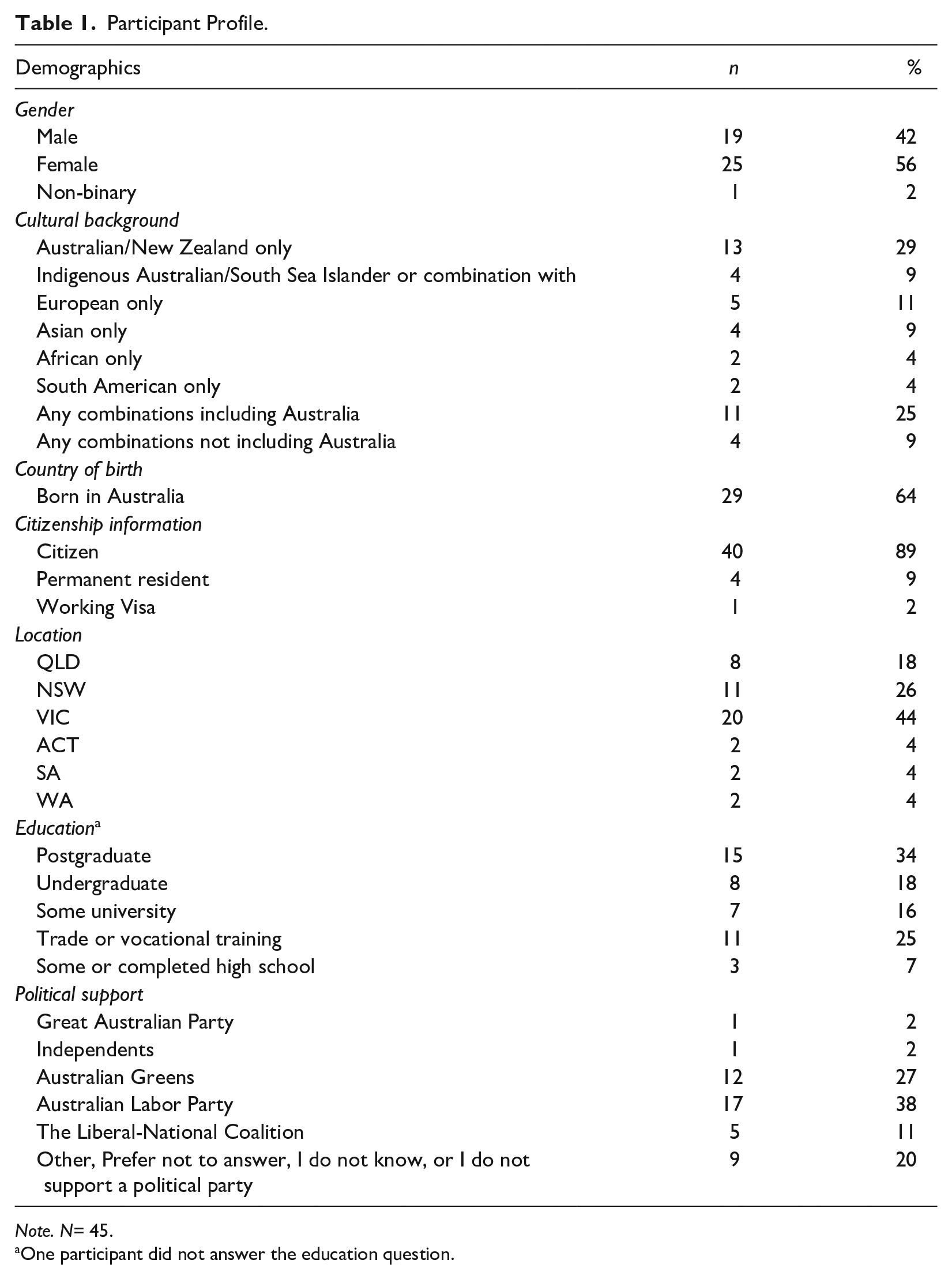
Note. N= 45.
One participant did not answer the education question.
All interviews were conducted by the first author using the interview protocol designed by the team and pretested. Participants were asked to expand on their thoughts after each question. The length of the interviews ranged from 30 to 105 minutes, with an average of approximately 50 minutes.
Materials and Procedure
The initial questions probed participant’s perceptions of “polyculturalism” and “multiculturalism” to gauge their familiarity with the concepts (e.g., “When you hear the word polyculturalism, what do you think this means?,” “Are they different?”). The interviewer then read an adapted definition of polyculturalism from Rosenthal and Levy (2010), highlighting its main features and potential values to society (e.g., “polyculturalism focuses on the commonalities shared amongst people as a product of historical and modern interactions” and “proposes that understanding this sharedness will improve people’s appreciation and respect for, as well as attitudes towards, other cultural groups”).
Participants were then asked a few open-ended questions: for example, “What comes to mind when you think about how your culture(s) has/have influenced other cultures?” and “What comes to mind when you think about [the person’s heritage culture] and Australian culture in Australian society? Have they influenced each other in some ways?” These questions, used by Rosenthal and Levy in developing their polyculturalism scale in 2012 and supplied by the lead author, encouraged participants to apply the notion of polyculturalism to their personal lives and share their views on polyculturalism. Questions then turned to one’s societal views—how polyculturalism might be viewed by people in society. Several probes were provided, including “What would our national identity look like if we focused on the values of polyculturalism in dominant discussions, such as in classrooms and politics?” Finally, the interviewer read aloud the five-item polyculturalism scale from Rosenthal and Levy (2012), and participants answered their level of agreement. Discussions followed in which participants elaborated on their personal views.
We then used a definition of multiculturalism adapted from Rosenthal and Levy (2010) to probe participants’ personal and societal views. Two questions were asked (“What are your experiences of multiculturalism in Australia?” and “Do you think multiculturalism has been effective at creating a cohesive society in Australia? Why/ why not?”), followed by Rosenthal and Levy’s (2012) multiculturalism scale, which the interviewer read aloud, and participants answered their level of agreement. Discussions followed for participants to elaborate on their personal views.
Data Analysis
The audio from the 45 interviews was transcribed verbatim and edited via Otter.ai (2022; otter.ai). Transcripts were coded through NVivo 12 (2022; www.qsrinternational.com) software and checked back to the data before theme generation.
The first author conducted the reflexive thematic analysis (Braun & Clarke, 2006, 2019, 2020, 2021a, 2021b), which allowed her to consider her positionality and engage with participant experiences in an evolving way as the understanding of the data and the research questions developed. Braun and Clarke (2021a) suggest that “a research team” to check the validity and reliability of coding and analysis “is not required or even desired for quality” in reflexive thematic analysis, compared to other thematic analysis methods (e.g., codebook analysis, p. 333). The inductive approach meant that coding was a discovery, data-driven, and guided by the breadth of participant experiences (Braun & Clarke, 2021b). It was considered suitable for this research to understand how contemporary Australians construct their cultural identity. At the same time, the process was also theory-driven, guided by the prominent conceptual models of multiculturalism and polyculturalism in the literature (e.g., Morris et al., 2015; Rosenthal & Levy, 2012).
The six phases of reflexive thematic analysis were followed (Braun & Clarke, 2006, 2021b). First, the first author took a step to familiarize herself and actively engage with the dataset by reading the transcripts and notes and reflecting on the interviews. Then, initial coding began in the second phase, where entire audio transcripts, not divided by reflection on multiculturalism and polyculturalism, were segmented into single-meaning statements or paragraphs. Each segment was given a semantic code label (e.g., polyculturalism expands our knowledge) to allow an overview of the main concepts and phrases, and some were tagged with multiple unique labels to distinguish the different meanings of the data. In collaboration with the second author, 392 codes in NVivo were printed and manually sorted into related content categories using a “tabletop” method (Saldaña, 2021, p. 249; see Appendix B Figure B1). Subsequently, the first author scrutinized the mapping between the codes and the generated categories and explored alternative grouping through verbal articulation. Over several cycles of critical observation in this way, independently by the first author and in conference with the second, analytic direction and focus were developed.
The third (generating initial themes), fourth (developing and reviewing themes), and fifth (refining, defining, and naming themes) phases in this analysis occur iteratively. The initial candidate themes generated from the “tabletop method” were refined by checking back to the relevant codes and were grouped in a PowerPoint presentation using overarching themes to organize similar candidate themes into groups. After several rounds of checking the codes and adjustment, the candidate themes were transferred to mind maps in NVivo to assess the connection between and within overarching theme groupings. Themes were then transferred to Excel and were expanded or collapsed by checking back to the relevant data, and labels were clarified. The write-up of theme summaries assisted this process by using the set of relevant quotes to identify each theme’s story and how it fits into the overall narrative of the dataset. In this process of “code-weaving” (Saldaña, 2021), a more latent approach to theme generation was utilized to help draw out further nuance in participant responses. Memos recorded during coding were consulted to assist with developing these narratives.
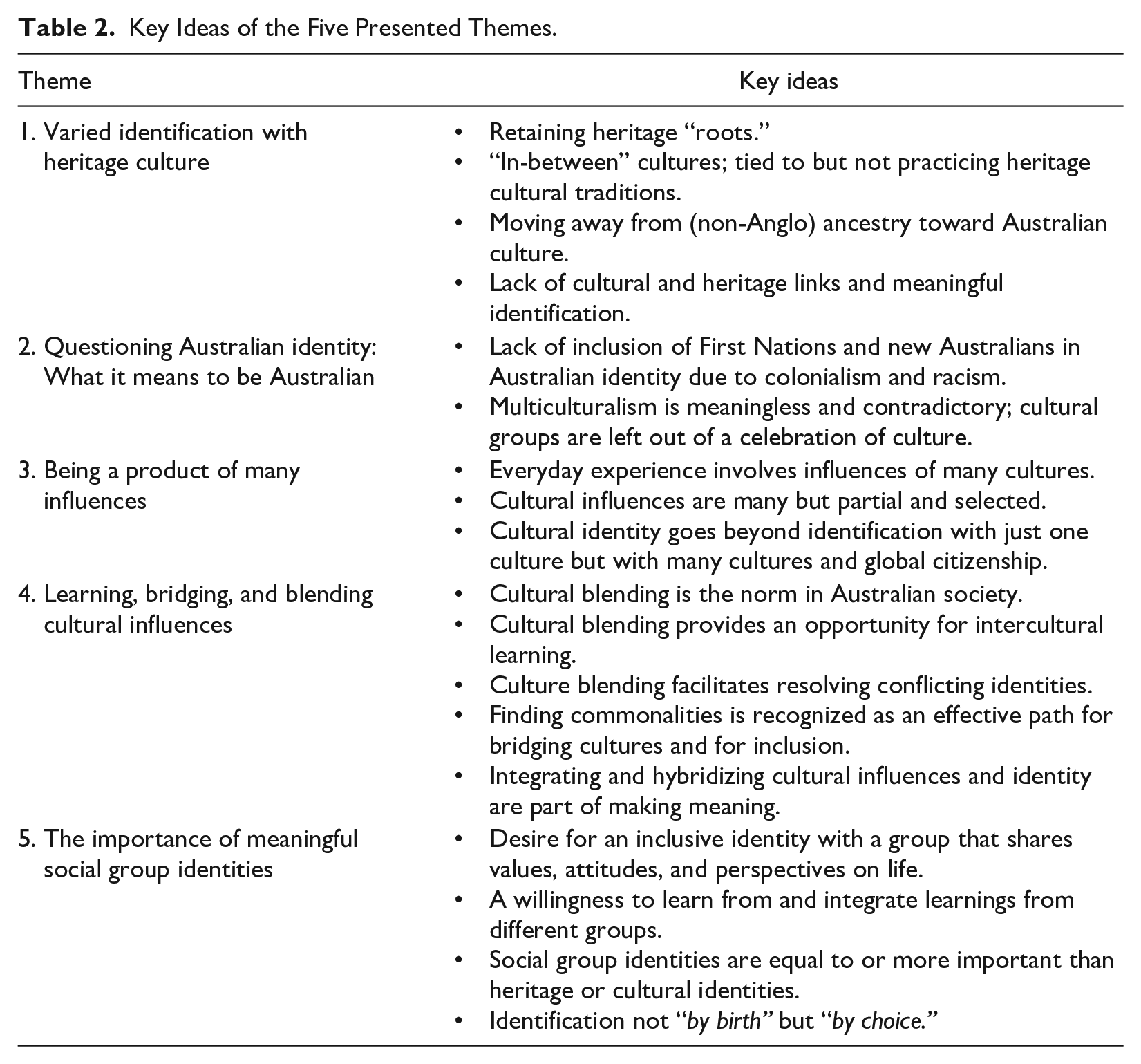
This process was applied to the theme generation of extracts allocated to the code “identity integration,” which captured discussion on aspects of multiple identifications: formation, negotiation, and development. Extracts were recoded, codes were thematically grouped, checked back to the original data, and iteratively refined, along with theme labels. All themes continued to be defined, refined, and named during the writing-up process. Throughout the analysis process outlined, the research question of “How are Australian cultural identities experienced and formed?” evolved in specificity while observing the patterns across data and revising the themes. In the sixth step, we wrote them in the current manuscript. The final five themes represented central, prominent, and distinct concepts that captured diverse individuals’ experiences of cultural identities, intertwined with justification heavily grounded in their recounts and diverse voices. This was typical in the interpretivist-constructivist approach and methodological quality practices (Braun & Clarke, 2021a; Levitt et al., 2018). Refer to Appendix B for quality criteria and reflexivity discussion. Table 2 outlines the key ideas of each theme.
Key Ideas of the Five Presented Themes.
Results
Theme 1: Varied Identification With Heritage Culture
Two generally contrasting views around identification and attachment to one’s heritage culture(s) were evident: retaining strong heritage ties and a lack thereof. However, various unique experiences filled the meaning space between the two.
Many participants said they retained strong heritage ties, speaking of being “proud” of their culture (Claire, 33 years old, Sri Lankan, Female, VIC; Mary, 34, New Zealander, Female, VIC; James, Indigenous Australian, 53, Male, VIC), even at the expense of Australian identification. For example, Claire mentioned that she does not want to “say that I am Australian” but instead “say that I am Sri Lankan.” Frank (Indigenous Australian, Male, VIC) shows a strong heritage identity when he talks about his responsibility around the “continuation of culture” through teaching “cultural law” and “helping community members.”
Sharing that he is “very passionate about” his culture that has “always been there,” James talked about the difficulty transitioning out of school into higher education because his Aboriginal identity was questioned; “it’s like all of a sudden, I wasn’t.” Other participants reflected on attachment to their heritage “roots” (Yusuf, Pakistani-Arab, 18, Male, ACT) through language retention and practice, “embracing what I used to take for granted” before migrating to Australia (Samantha, Malaysian-Singaporean-Chinese, 33, Female, VIC) or eating and sharing food, embracing values, like education attainment, family, religious practices or active participation in the community. Existing without your “culture, your religion or anything” was seen as “living without sort of any meaning” (Yusuf), reinforcing how significant cultural identity is for some participants. Likewise, Craig (European-Australian, 47, Male, QLD) showed a strong preference to preserve Australian culture “like it was when [his father] was a boy,” saying “we’ve lost our identity in Australia.”
Conversely, a lack of attachment to heritage was also observed, expressed in various ways. Participants spoke about a feeling of being in-between two cultures, like Aisha (Indian-Australian, 28, Female, NSW), who says she does not “fully associate myself with being Indian or Australian” or Amelia (Māori-Scottish, 44, Female, NSW) who says she never felt “dark enough” to be Māori or “white enough” to be “Anglo-Saxon.” Adam (Silesian-Czech-Australian, 34, Male, VIC) echoes this when he says that he does not see himself as “embodying” the “beliefs and values” of Czech, Polish and Silesian groups but appreciates the influences these “roots” have had on his life; “I really don’t feel like I belong to any of those groups. . .but at the same time, to an extent, I see myself as part of all those cultures.”
Some Anglo-Australian participants spoke about a disconnection from their “standard White Australian” culture, as it felt like it was a “blank canvas” with “nothing to grip onto” (Kaitlyn, North-Western European, 33, Female, NSW) with no “particular affection” for their ancestry either; “it’s more just a fact” and “it’s not something I really care about” (Paul, English-Scottish, 46, Male, VIC). With this, Bec (Australian, 19, Female, VIC) also said that connection to her ancestry is not “a big thing” in her life, and Meg (Anglo-Australian, 21, Female, VIC) feels she does not have a “national identity” and that she would “love to have a stronger cultural identity,” denoting weak or limited identification.
Similarly, participants also spoke about moving away from their (non-Anglo) heritage to embrace the Australian culture; for example, Aidan (South African-Australian, 19, Male, NSW) finds his connection “with Australia” to be “very naturally integrated” into his identity and not his South African ancestry, being the only one “actually born in Australia” in his family. By comparison, Emily (Australian, 29, Female, VIC) summaries her experience of heritage identity disconnection when she says she does not “have any of those historical links” as she is not German because she has “no traditions” from her German heritage and does not feel that she is Australian, as the “definition of that doesn’t feel clear either.”
Together, these accounts suggest varying degrees of attachment to traditional cultural or ancestral group memberships, highlighting diversity in which participants derive their sense of meaning and who they are.
Theme 2: Questioning Australian Identity: What It Means to Be Australian
Although participants saw cultural diversity and multiculturalism as central to Australian society, there were mixed perceptions of what it means to be Australian. Participants spoke about a lack of inclusion (or representativeness) of “First Nations” and “all cultures that have come here” in the identity of Australia (Amelia), which led to questioning the “legitimacy” of the identity and the “narrative” around it (Amelia; Alexia, Australian-German, 54, Female, VIC). Some spoke explicitly about the “colonial system” (Amelia) or the “colonisation mindset” in society and the workplace (Brianna, Indigenous Australian-South Sea Islander, 43, Female, NSW). Australia was perceived not to have “moved on from our colonial past,” reflected in the “level of racism in Australian society that obviously has been quite heightened this year” (Anne, Australian, 63, Female, NSW). Mark (Greek-Indigenous Australian, 45, Male, NSW) echoes these sentiments when he says, “the biggest” issue for Australia is “understanding and recognising Aboriginal cultural history” and to “embrace the identity of Australia, you need to acknowledge all of” its “heritage and history.” The same view was reinforced by participants who spoke about their active engagement in Indigenous cultural awareness education in organizations (James) and the wider community (Frank).
Recent migrants also spoke to this, expressing dissatisfaction based on perceived cultural exclusion, like when Joseph (Congolese, 32, Male, QLD) says the “minority ethnic group has to fit in line with whatever the dominant culture is.” Unpacking this further, embodying and practicing culture was said not to be enough to “ever feel properly Australian” (Maddy, Indian-Canadian, 21, Female, VIC), restricted by skin color (Aidan; Joseph) or physical appearance (Kelvin, Chinese-Australian, 75, Male, ACT); “I am an outsider even though I’ve lived here for most of my adult life” (Maria, South American, 34, Female, QLD). This is summarized when Joseph said:
“. . .[it] doesn’t matter how much I sound like an Australian or how long I’ve lived here; the amount that I can identify with being Australian is always going to be up to a certain point. Because somewhere in the conversation, it always pops up, but where are you from? So, in my 30s, now I’ve realized . . . this is something that it doesn’t matter how long I’m here because the biggest identity people see is my features—the color of my skin.”
Consistent with this, multiculturalism (a celebration of diversity) was described as “superficial” (Maria), and “meaningless” (Emma, Anglo-Australian, 79, Female, VIC), due to its inability in current times to account for and bring together diverse cultural groups; “we outgrew” it (Apollo, Jewish-Australian-Israeli, 31, Male, VIC). Claire speaks to this when she says that multiculturalism does not always feel inclusive to all cultures; “sometimes we [Sri Lankans] don’t feel included” (Sri Lankan, 33, Female, VIC). June (Chinese-Australian, 50, Female, NSW) discusses this sense of contradiction tied to multicultural Australia when she says that when she hears the word “multiculturalism,” she “immediately thinks of all other cultures” but not “White culture.”
Anglo-Australians also expressed dissatisfaction with the modern Australian identity and what it means to be Australian, describing it as “a void” due to the lack of practices and traditions to engage with in everyday life that seem to align with participant’s expectations (Michael, 45, non-binary, VIC); “I don’t know that there’s a lot really that we can collectively say is our culture” (Kaitlyn; Paul). Molly (Australian, 36, Female, SA) reaffirms this when she says that “to be Australian. . .it’s pretty boring. . . there’s nothing exciting about being Australian. . .there’s no food or clothing, for example, that’s traditional to be Australian.” Some explained this was also because Anglo-Australian culture is seen as the “default,” and “everyone else is culture” (June; Michael), making it somewhat non-existent and “hidden.” At the same time, some participants expressed their “struggle with the [Australian] identity” (Emily) because it was not something that they were “proud of” (Jarrah, Australian, 30, Male, VIC; Kaitlyn) and were left wondering, “What does national identity mean?” (Noah, Australian, 32, Male, QLD) and essentially, where do I fit? (Bec).
Together, this theme suggests that as participants question the inclusivity of the national identity and what it means to be Australian, given the contradictory definition, many share weak identification with this group.
Theme 3: Being a Product of Many Influences
The Australian experience was also commonly seen as a product of many cultural influences. It was spoken to be “very expansive and embraces a lot of difference” (Emma) and a “mishmash of other cultures . . .a sum of other different cultures from a bunch of different countries” (Bec). The partial and “bitza culture” that has been influenced by “migrants from all corners of the world” (Sam, Indigenous Sami, 47, Male, NSW) was also represented in participants’ responses that depicted public spaces as highly intercultural; “people from different cultural backgrounds all living in the same community together,” (Kaitlyn), “intermingling” (Paul), with “some overlapping” (Carlos, Latin American, Brazilian, 47, Male, VIC).
Within this landscape, participants also spoke about their cultural identity or the shared meaning inside being the product of many influences and its effect to “perceive the world through a lens that is coloured by all the different people who have come into [their] life, and all the different experiences that” they have had (Maddy; Joseph; Aisha; Apollo). The sense of carrying partial influences of different cultures was also reflected in first-generation migrant and Anglo-Australian responses; for instance, Yusuf spoke about retaining his heritage culture (Pakistani-Arab) through “language, through family, and just through connections” among the influences of his time growing up in the USA and Argentina. Brent (Australian, 36, Male, QLD) shared how he has been influenced by a multitude of cultures he has interacted with in different settings (e.g., the Korean community at work); Anne said, “I decided some years ago that my soul was Greek,” despite having British ancestry because of her long years of work with migrant communities. This also implies partial (rather than complete) influences from cultures due to an openness to culture and personal selection of elements through experiences; “if I like something about someone else’s culture, I don’t see a reason why I can’t take that on board and make it part of my lifestyle” (Aisha, Indian-Australian, 28, Female, NSW). Joseph, another example of this, embraces his ethnic influences and traditions like “eating Congolese food” and “going to certain Congolese events in Australia” but also influences from other social and cultural groups like his “passion for African American rap” and Japanese “streetwear,” highlighting how his “influences have varied.” Samantha further speaks of such partial influences from many cultures when migrating to Australian society:
“I honestly don’t feel like we have any problems integrating. . . we are able to preserve our cultural heritage, what’s supposedly native to us, like the Chinese and the Malaysian stuff, and then at the same time embracing what is practiced and supposedly cherished here, like the values.”
The perspective of being a product of many influences may also come from within a cultural group, like when Frank says, “being an Aboriginal person . . . there’s lots of elements to that, it’s not one thing.”
From another point of view, participants used the terms “world” (Aisha) or “global” (Renee, Global Citizen, 55, Female, WA) “citizen” when they spoke about how they drew their identities from a multitude of sources from “different places in the world” in reflection of what “our society is becoming” (Aisha). It also suggests that participants seek identities superordinate to ethnic and national identities for self-definition. Some participants also shared that being born into a particular culture does not confine the person’s cultural beliefs, practices, and identity to that one culture; quite the contrary, people can accumulate elements of diverse cultures over their lifetime, permitting them to say, “we’re all from Earth” and “we can be a bit of everything in this world,” as Roberto (Italian, 57, Male, VIC) said. Denying cultural essentialism, which assumes cultural influence is fixed, permanent, and unchangeable (Bernardo et al., 2016; Chao et al., 2007), these participants’ views allow them to see their cultural identity as malleable and like society, influenced by “not just one thing” (Emily), while simultaneously acknowledging cultural differences, diversity, and engaging in effortful intercultural learning (Bennett, 2017).
Theme 4: “Learning,” “Bridging,” and “Blending” Cultural Influences
As “culture didn’t end 250 years ago, it continues today” (Frank), the “intertwining of different cultures” (Emily) and “blending” was seen as the “norm” of “what’s happening” now (Yusuf; Brent). Some expressed this view as “we’re not all living with, we’re actually sharing our cultures” (Brianna; Gabriel, Filipino, 39, Female, QLD). Teresa (Australian-European, 52, Female, NSW) said she finds “working, interacting, and living within a society that has influences” from many cultures to be a catalyst for her learning about others, and this “makes you more open-minded,” reflected in other participant responses that discuss the workplace or school environment as places for intercultural “learning” (Brianna, Molly, Paul). The relevance and importance of learning were also made salient when participants talked about being “curious” in intercultural interactions (James; Brent; Roberto) and when Freya (Anglo-Australian, 42, Female, WA) described her identity journey; “I’ve made a point of trying to go out and learn new things and meet new people. . .get exposures that I haven’t previously.”
A process of “blending” was discussed about personal cultural identities, specifically reconciling conflicting identities. For instance, some participants spoke of being able to “blend” identities compartmentalized in different everyday contexts as a process of understanding these influences and “the differences” between them, accepting the past and that some cultural elements cannot be changed, and blending “the best of what I know and have learned from each side into who I am” (Sulu, Samoan-Australian, 32, Female, QLD; Amelia, Māori-Scottish, 44, Female, NSW). From a different viewpoint, some also mentioned that, in comparison to other countries, Australians have “the freedom” to be “anything” and still “say . . .I am Australian” (Jean, African, 30, Male, QLD), which makes it “possible to be, say, Australian while having different” conflicting identities (Samantha).
Another typical process used by participants to bridge or merge different identity aspects was looking for commonalities between them. Participants aimed to see the “commonality in religious messages” (Renee) and religious practices (Carlos), between ethnic identification and “love for your country” (Samantha), ethnic culture and Australian cultural norms (Gabriel), Indigenous and Greek cultures (Mark), and Australian and Italian value systems (Roberto) in an attempt to merge these influences into the conceptual and the behavioral parts of themselves. A participant also offered her view that the “newer” cultures in society are “integrated” when Australians “learned to find the sameness” between the new and old cultures (Helen, Australian, 54, Female, SA). Freya reinforced this when she said “as a society we could go a long way in kind of trying to learn more” about other cultures, together suggesting that actively learning and finding connections is an effective method for cultural inclusion.
Overall, it was common among participants to describe how they integrated cultural influences and created a new identity (hybridization). Gabriel spoke of her experience of identity creation as the “embrace of the culture of Australia” and the “blend in our own way” of “our own culture.” Mila (Macedonian, 26, Female, VIC) spoke of it as “integrating” “elements” of her cultural background with the “Australian culture” to “flourish in an Australian multicultural society.” More specific examples of cultural hybridization included the influence of “Western culture” on Indian culture in shaping familial dynamics and the merging of “hip-hop” dance with “Bollywood dancing” to create a new style of dance (Aisha). Participants also spoke of how they used hybridization and integration as organizing frameworks to create cohesion between disparate influences. Samantha mentioned viewing identity as “fluid and unique at the same time” to adjust to the range of “valuable” learnings from migration experiences. Roberto spoke of actively engaging with the Australian culture—“learn it to be able to live it,” and Apollo perceived his diverse influences as “bridging and inclusive.”
Identity negotiation was thus described as a dynamic process in response to new contexts, cultural experiences, and understandings. This suggests that “learning,” “blending,” and “bridging” are ongoing, facilitated by a sense of identity openness and fortified by the influence of perceived cultural norms.
Theme 5: The Importance of Meaningful Social Group Identities
Sharing “values,” “ideals,” and a perspective on life with group members was said to be a strong motivating factor for group engagement and identification (Renee; Jarrah). Similarly, group identification was spoken of as a conscious choice (Apollo; Renee; Roberto), like when Jean explained how he “slowly pulled back” from his ethnic and religious influences when migrating to Australia and “made” his “own circles,” as he “started to explore [his] identity as an individual” and “make this place home.” Emily taps into this when she says, “you don’t take on everything as part of a culture when you’re moving to a new one. . . . there are things that are accepted and others that aren’t.”
Moreover, participants described not only a willingness to learn from and integrate different learnings about their cultural ancestry but also a willingness to learn from and be influenced by the “culture and experiences” of groups from which they share no direct ancestry but are connected via group membership (Aisha; Paul; Brent; Anne; Jarrah; Roberto; Kaitlyn). In line with this, some participants perceived their memberships in (non-ethnic) social groups to be equal to or more important than the memberships in (ethnic) cultural groups; “people who don’t have. . .strong cultural ties still feel the need for those ties” (Renee). Kaitlyn summaries the importance of social group identities in the absence of meaningful cultural group membership when she says:
“I think humans have a completely naturally evolved urge to feel part of like a group or a tribe. . .I think we are built to seek that out and to feel belonging in a community. . .And so, if we feel like we lack that, as I say, we go looking for it somewhere.”
Specific social groups that participants identified with included “Hari Krishnas” (Renee), “citizens of the universe” (Kaitlyn), the online “gaming” community (Jarrah), or “skateboarders” (Noah). For example, Renee talks about her adoption of the Hindu faith “as an adult” so she can better understand the world “through their philosophy” as opposed to what she was “taught” growing up and reflected on the “strength” in this conscious choice. In the same way, the strong identification with her current town of residence was also said to stem from a lack of “strong [cultural] ties elsewhere.” Kaitlyn describes her culture as a “citizen of the universe kind of culture,” given that she does not have an active ethnic identity, is “not religious” and views the word through “a secular scientific lens.” Turning away from Australian culture, Jarrah spoke about “creating” his identity not out of his ethnic or national culture, as “he’s not exactly proud of it.” Instead, he talks about the inclusivity of the gaming community where “it doesn’t matter. . .where you’re from,” which aligns more with his values. Being part of a group that “you relate more to” and “influences you more” than traditional ethnic groups, like the “culture of English or the culture of being Australian,” also meant that Noah felt he had “more in common with a skateboarder from Japan” than with “the Australian social worker sitting in the next room.”
Together, this theme suggests that non-traditional social groups become a source of meaningful group identification. In contrast, ethnic identification becomes less central to the lives of some Australians, reinforcing the diversity of sources and influences on Australians’ identity.
Discussion
The current reflexive thematic analysis of 45 interviews with demographically diverse Australian residents explored how cultural identity is subjectively experienced and negotiated in contemporary Australian contexts, the first of its kind. Five central themes were generated using an inductive and predominately data-driven approach. Although voices varied within themes, and this variance was often explicitly highlighted, the themes linked and developed in complexity to bring forward a narrative depicting diverse sources and processes of identification within the emerging Australian cultural landscape.
The first theme, “Varied identification with heritage culture,” depicted individuals’ identification with diverse cultures. To varying degrees, different individuals mentioned Australia and various other cultures as sources of meaning and identity. Some spoke about experiences that suggest they robustly maintain their heritage roots and attachment, whereas others spoke about non-attachment toward any heritage culture to draw meaning and identity. Others shared the feeling of existing “in-between” two or more cultures. These experiences varied, however: some refer to not embodying heritage, while others refer to a weak sense of belonging and attachment. Still, others spoke explicitly about a self-perception that they are transitioning from their ancestral culture to Australian culture or from Australian heritage to others. This varied sense of heritage identity has been well documented. For example, Forrest et al. (2020) reported that heritage identity retention from the first through third generations varies across ethnic immigrant groups in Sydney. Lui (2015) referred to physical appearance, as did Chiro (2008) about parents’ age at migration and formal study of the heritage language as factors.
The second theme, “Questioning Australian identity: What it means to be Australian,” highlighted the sense of doubt and dissatisfaction around the legitimacy and representativeness of the Australian identity, as reflected in Jupp’s (2007) writings. The questioning has apparent implications for one’s inclusion versus exclusion as part of Australian society, although few participants were explicit about it. Participants mentioned that embodying and practicing culture was not enough to be considered Australian, overshadowed by physical attributes like appearance and accent, as Lui (2015) has also found. Moreover, some participants in the current study shared their views about First Nations people and new Australians being excluded by highlighting colonialism and racism. The absence of Indigenous culture in Australia’s sense of cultural identity was also discussed. Such enduring perception of exclusion for these groups is corroborated by Austin and Fozdar (2018), who examined the changing Australian identity across studies published over two decades.
Other participants also voiced that multiculturalism is seen as “meaningless” and contradictory. Some voiced feeling a lack of a historical link to the Anglo-Australian tradition and being left out of a celebration of their culture in the multicultural society. These voices echo the sentiment of Australia as “ethnocultural and multicultural,” as documented by Nunn (2017, p. 220), which taps into that contradiction surrounding multiculturalism—inclusive of diversity for some yet exclusionary of diversity for others.
While the above two themes are consistent with the cultural identity experiences documented in previous research based on the multiculturalism paradigm, the additional three themes identified in the present data were more novel. A dominant sentiment captured by the third theme, “Being a product of many influences,” was indicative of the current state of Australian society, “sharing each other’s cultures,” at least for some. They discussed procuring partial and plural cultural influences from various sources, unlike cultural emersion, where one is fully embedded in a particular culture’s context to absorb its whole. Through exposure to such diverse influences, cultural identity can be experienced as something different from one based squarely on a distinct and whole cultural tradition, as some suggested. While the literature on partial and plural cultural influences is still scanty, emerging scholarship does acknowledge the nuanced intersection of gender, family, place, history, and majority–minority dynamics for Australian youth (Wright & Xiao, 2023) and multicultural identity configurations of Third Culture Kids who navigate multiple, yet incomplete, cultural influences in their youth due to the mobility of their parents (e.g., Mosanya & Kwiatkowska, 2023a, 2023b).
The fourth theme, “Learning, blending, and bridging cultural influences,” reflected participants’ implicit assumption that culture (or ethnicity) is not fixed or permanent but relatively malleable and dynamic. Such an assumption enables individuals to curate meaningful identities through bridging distinct cultures by finding commonalities, learning about others and the self, and thus blending fragmented identities into a coherent sense of “who I am.” The concepts of multiple and fluid identity attachments have been discussed in previous studies with Australian young men (Noble, 2009) and transnational migrants (Bradatan et al., 2010), capturing the temporal nature of identification and the perception of self-identification as a continuum, as emphasized in this theme.
The fifth theme was “The importance of meaningful social group identities.” Many participants expressed their desire to share values, attitudes, and perspectives on life with others and a willingness to learn from and integrate those learnings from different people. However, they tend to expect that sharing values and learnings could be achieved not necessarily through one’s heritage group into which one would have to be born; it could be achieved through identifying with a more open and thus inclusive identity group. Therefore, these participants reported that social groups by choice (i.e., achieved identities; e.g., J. Nguyen & Ferguson, 2019) were equal to or more important than cultural groups by birth (i.e., ascribed identities). Previous research has shown the importance of differentiating ascribed and achieved identities (McGlone & Aronson, 2006) and their distinct implications involving self-concepts and social cognition (Palmer, 2007); therefore, this distinction may be central for understanding identity negotiation.
Thematic Findings and Polyculturalism
Drawing all these together, our study reveals that participants viewed the negotiation of their identities as a transformative process (West et al., 2017), echoing the polyculturalism paradigm, as described by Rosenthal and Levy (2010). A sense of continuous meaning-making and creative reconstruction of cultural identity based on experiences across contexts, which Gamsakhurdia (2018, 2019) called proculturalism, is captured when participants speak about adapting their self-identities to the “values” and learnings from living in different countries (Samantha). This recognition and active engagement with partial and plural influences—expressed by some participants who would willingly “take that on board and make it part of my lifestyle” “if I like something about someone else’s culture” (Aisha)— alongside highly flexible boundaries of culture (“fluid and unique at the same time,” Samantha; “bridging and inclusive,” Apollo) are also consistent with the polyculturalism paradigm (Kelley, 1999; Morris et al., 2015; Prashad, 2001). It is also in line with previous findings (Bernardo et al., 2016) that a more robust endorsement of polyculturalism (vs. multiculturalism) is associated with lower cultural essentialism through a flexible understanding of cultural group boundaries and the assertion that all cultures have and will continue to be influenced by one another throughout history (Kelley, 1999; Prashad, 2001).
A polycultural view lends attention to intergroup similarities and interconnections, evident when participants actively discussed finding the similarities between different groups (e.g., religious or cultural) and between groups in society (Helen). Next, participants’ recounts of culture mixing and fusion (Cho et al., 2017; Hao et al., 2016), as Gabriel said, “embrace of the Australian culture” and “blend in our own way,” and creativity through the openness to embrace foreign cultural elements (Cho et al., 2018) into the self-concept, are indicative of a polycultural mind-set where intercultural interactions are seen as opportunities for learning (Rissanen et al., 2023). Threaded throughout the themes was the notion of cultural comfortability; participants did not seem threatened by cultural diversity (Osborn et al., 2020) but instead embraced a “sharing” of cultures. Kelley’s (1999) seminal writings speak directly to this; we are “products of different cultures . . . these cultures live in and through us every day.” It was evident that many participants were also accepting of changing traditions (Rosenthal et al., 2014) and the advancement of cultural knowledge and practices, found explicitly in responses about actively navigating (i.e., hybridizing or finding similarities between identities) or consciously choosing group identification. This links to a core feature of polyculturalism—that culture changes via intercultural interactions over time. Given the general comfortability of participants with cultural change, Tjipto and Bernardo’s (2019) mixed-methods study suggested that a polycultural framework may also be more relevant to Australia than elsewhere, like Indonesia, due to Australia’s heterogeneity.
Cultural and Social Identity Distinctions
As mentioned in the introduction, cultural identity and social identity are often conflated. By assuming the relative importance of shared knowledge in cultural identity compared to shared membership in social identity (Brewer & Yuki, 2014), we have explored how identification with knowledge tradition is developed and negotiated in a pluralistic society. We found that contemporary Australians do not necessarily recognize the personal relevance of their ancestral groups’ knowledge and practices. Throughout the interviews, these individuals revealed that they did not actively think about their heritage culture as such, given its negligible relevance in their lives. Still, they understood they were part of social networks of friends, family, and workplace community, in “flux,” from which they derived a sense of shared membership and meaning. Compounded by the lack of ties to a heritage cultural group or opportunities to celebrate their tradition, social groups were spoken of in a way that stretches beyond membership and into the realm of culture, that is, as providers of shared meanings and practices. This is known to be a social identity function, as hinted in the Social Identity Theory tradition, although yet to be elaborated (see Robertson & Grant, 2023). In short, experientially, contemporary Australians may not differentiate between social and cultural identification when both groups provide and maintain shared knowledge. However, the distinction between the terms remains necessary to further understand sources of meanings and identity in our society because not all social groups give rich meaning beyond membership.
Limitations and Future Directions
This study involved several limitations. First, the study did not sample data to saturation, which is often considered the best practice for qualitative research (e.g., Levitt et al., 2018). Although recent scholarship has challenged this criterion (Braun & Clarke, 2021c), and our participant sample included Australian residents from diverse backgrounds, they were a convenient sample of volunteers. These individuals are presumed to have already an interest in culture and a good understanding or articulation of their identity experiences. Also, the participants’ political orientation was skewed, involving Greens and Labor in the main (more liberal and progressive), and participants from a Middle Eastern cultural background were missing, despite efforts to recruit. These and other factors may have played a role in the current results.
Second, our participants only took part in one interview. Sequential interviews could allow more in-depth responses from participants by familiarizing them with the interviewer and the complex topics of cultural identity and polyculturalism, a novel concept for many.
Third, our primary focus was not to make comparisons based on pre-determined categories of people, such as migrants versus non-migrants, Anglos versus non-Anglos, dominant versus non-dominant, or monocultural versus multicultural. Using interview questions that presuppose and encourage participants to view and talk about their experience along certain category lines, participants would have drawn links between their identity experiences and the contrasted categories of people, articulating or exaggerating category boundaries, which is antithetical to a polycultural view. While categorizing participants in this way might not have fundamentally altered the core meaning of each theme or the themes themselves, our interpretation and discussion of these themes could have taken a different path. Our analytical approach was fundamentally bottom-up, allowing us to explore participants’ experiences of their identities, encompassing elements of choice, shifts, and hybridity, while leaving comparison of experiences open for potential exploration in future research (e.g., Dandy et al., 2018). Categorizing interviewees into these predefined categories would also have presented substantial challenges. Most of our participants are immigrants, making it complex to determine generational differences when considering the age of arrival and parents from varying generations. Furthermore, the categorization of “Anglo” lacks clarity from a genealogical and subjective standpoint. Similarly, the distinctions between the majority and minority categories are multifaceted, with contested criteria and perspectives to prioritize.
Finally, the generalizability of the findings of the qualitative interviews is limited, which reduces the ability to infer that these experiences are representative of all Australians. Yet, we anticipate that these findings hold relevance for settler societies, as suggested by prior evidence (Grigoryev & Berry, 2021). Previous research has indicated that the ideology of polyculturalism may be perceived differently in more homogeneous settings (e.g., Bernardo et al., 2019). Therefore, a fruitful avenue for future research could involve comparing these results with those obtained in different contexts, such as newly independent or post-colonial states (Grigoryev & Berry, 2021). The findings of our current study also suggest the need to develop a new scale that can capture the transformative aspects of cultural identity in future quantitative research. This new scale, aligning with the views of polyculturalism, would encompass increased flexibility in accepting diverse cultural influences, blending, bridging, and integrating these influences, as well as prioritizing shared values, perspectives, and attitudes over specific heritages. With such a scale, we can deepen our understanding of how individuals organize and synthesize the breadth of raw, often fragmented, and conflicting, information they encounter into meaningful self-knowledge. This will provide valuable insights into the dynamics of cultural identity and its evolution in diverse societies.
Conclusion
Set within the context of contemporary Australian society, this study aimed to gain insights into how Australians navigate their cultural identity experiences. Participant responses shed light on the nature of cultural identity in this diverse and pluralistic society, suggesting that it is better understood as the active transformation of cultural influences consistent with the polyculturalism paradigm. The generated themes brought together a multitude of participant voices, illustrating that individuals in this society are engaged in the nuanced process of navigating and integrating partial and plural influences from various cultural sources. Rather than adhering strictly to the conventions of single or dual cultural groups, Australians are actively constructing their identities by drawing from a wide array of influences. The findings of this study make a valuable contribution to our understanding of the identity experiences of contemporary Australians with diverse backgrounds, a perspective often overlooked in research that predominantly focuses on migrants and minority groups (e.g., Benet-Martínez et al., 2021; J. Nguyen & Ferguson, 2020; Udah & Singh, 2019) or the majority groups’ perceptions of acculturation strategies (e.g., Hindriks et al., 2015; Kosic et al., 2005). Notably, this study represents one of the first qualitative investigations into polyculturalism (Tjipto & Bernardo, 2019) and is the first to be conducted in an Australian context while specifically examining identity experiences. Future research is needed to explore how individuals create meaningful identities from a perspective that appreciates the intricate interplay of partial and plural influences originating from diverse cultural sources. Understanding this process will enrich our comprehension of the evolving nature of cultural identity in societies characterized by cultural diversity and pluralism.
Footnotes
Appendix A
Appendix B
Acknowledgements
The authors would like to acknowledge Dr. Matthew Ruby for his contributions toward the development of the protocol. They also thank the participants who generously shared their stories and perspectives with them.
Contributions
This work constitutes part of the first author’s PhD project, supervised by the second author.
Declaration of Conflicting Interests
The author(s) declared no potential conflicts of interest with respect to the research, authorship, and/or publication of this article.
Funding
The author(s) disclosed receipt of the following financial support for the research, authorship, and/or publication of this article: This research was financially supported by an internal grant for PhD students from the School of Psychology and Public Health at La Trobe University.
