




Abstract
Positivity resonance, defined as a co-experienced kind-hearted positive emotion, is commonly observed to strengthen relationships in the United States. However, it is unclear whether levels of positivity resonance differ across cultures. Prior research suggests that in cultures that are perceived as offering more freedom and choice in social ties (defined as high relational mobility cultures), individuals more frequently engage in adaptive strategies to build relationships. We hypothesized that positivity resonance, achieved via such adaptive strategies, might be similarly linked to cultural variation in relational mobility. Across two studies (N = 5,711) we found supportive evidence for our prediction that, compared with European American participants, East Asian participants showed lower levels of positivity resonance with strong social ties. Such differences were in part explained by lower levels of perceived relational mobility among East Asian participants. Comparable effects were not present for weak social ties. Implications for theories of culture and emotion are discussed.
Humans are wired for social connection because cooperation is often necessary for survival (Baumeister & Leary, 1995; Coan et al., 2006). Although social relationships are ubiquitous across cultures, peoples’ approaches to forming and maintaining them vary (Thomson et al., 2018). Previous research has also made a distinction between the various categories of people we interact with: those we are more familiar with and close to (i.e., strong social ties) or those we are less familiar with or not related (i.e., weak social ties; Granovetter, 1973; Sundararajan, 2020). A recent study on cultural differences in daily social interactions discovered that compared to participants in China, participants in the United States reported more positive social interactions with in-group members (which include romantic partner, friend, classmate, and coworker) and fewer negative interactions with strangers (i.e., weak ties; Liu et al., 2021). Such differences have been attributed to relational mobility, the levels of freedom and choices in people’s perception of social relationships within each culture (Yuki & Schug, 2012).
Prior research, particularly in the Western samples, suggests that flourishing relationships are characterized and fostered by interpersonal processes related more to the presence of positive emotions than to the lack of negative emotions (Algoe, 2019; Berry & Hansen, 1996; Fredrickson, 2016; Ramsey & Gentzler, 2015). Yet cultural differences may lie in what types of affective features are more instrumental for forming and maintaining social bonds. The goal of the current study is to examine whether there are cultural differences in how frequently positive emotions resonate in social interactions and whether such differences can be explained by perceptions of the social ecology, namely, relational mobility. This exclusive focus on positive emotions aligns with the empirical tradition of studying the functions of positive emotions as independent from those of negative emotions.
East-West Differences in Positive Emotions
Among Western 1 samples, positive emotions are critical elements in sustaining positive social interactions (Algoe, 2019). This work has shown that frequent experiences of positive emotions with strong ties strengthen bonding and contribute to more satisfying relationships (Algoe, 2019; Ramsey & Gentzler, 2015). Similarly, prior research has found that positive emotions experienced during social encounters with weak ties encourage more social engagement, enhance perceived closeness, and thus increase willingness for future contact (Lyubomirsky et al., 2005; Mehl et al., 2010; Waugh & Fredrickson, 2006). However, in East Asian cultures, positive emotions are not experienced and expressed as frequently nor valued in social relationships as much as in Western samples (Kitayama et al., 2006; Miyamoto et al., 2017). People in East Asian cultures are more likely to experience positive and negative emotions at the same time, whereas these positive and negative experiences are more mutually exclusive for those in Western cultures. For example, after conversations that were designed to elicit feelings of love, Asian American couples reported more mixed emotions (both negative and positive) compared with their European American counterparts who exclusively reported love and related positive emotions (Shiota et al., 2010). A similar pattern has been shown for the valuation of emotion systems. For instance, samples from East Asian cultures consider nonpositive or even negative elements such as social disruption (e.g., envy or jealousy) and transcendental reappraisal (e.g., avoidance) as features of happiness (Uchida & Kitayama, 2009). Also consistent is research showing that compared with Belgian couples, in Japanese couples, the positive-to-negative affect ratio is a weaker indicator of relationship satisfaction (Kirchner-Häusler et al., 2022). Similar patterns also emerged in recent work on interactions with weak ties. Thai participants reported less increase in relationship closeness after receiving a gift from a distant friend (a weak tie) compared with American counterparts (Pusaksrikit & Chinchanachokchai, 2023). Likewise, compared with American participants, Chinese participants exhibited significantly lower positive affect after being kind to a stranger (a weak tie; Shin et al., 2021).
Co-Experienced Kind-Hearted Positive Emotions in the West and the East
Despite growing evidence from cross-cultural comparisons of emotional experiences in social contexts, few studies have directly examined collective affect across cultural contexts. Collective affect is defined as emotions shared with a person, a group, or a community, which can include distinctive processes such as empathy, affect contagion, and co-experienced emotion. Past studies that compare cultural differences in collective effect have been largely focused on affect contagion (Hatfield et al., 2018; Xie et al., 2023), empathy (Cassels, 2010), or abilities to recognize collective affect (Yang et al., 2019).
No prior studies, to our knowledge, have directly examined cultural variations in co-experienced positive emotion during daily social interactions. The type of co-experienced positive emotion central to the present work is co-experienced kind-hearted positive emotion, also known as positivity resonance. Although evidence supports the existence of specific facets of positivity resonance (i.e., synchrony in caring non-verbal behavior as well as in biological responses, K.-H. Chen et al., 2021; Wells et al., 2022), the current study centers on holistic perceptions of positivity resonance, and therefore, we define the construct here as co-experienced kind-hearted positive emotion. Positivity Resonance Theory suggests that moments of positivity resonance are fundamental elements for building and strengthening social bonds with weak and strong ties (Fredrickson, 2016). Positivity resonance is considered a subtype of co-experienced positive emotion, distinguished from other co-experienced positive emotions by the presence of mutual warmth (a.k.a., kind-heartedness). One example of positivity resonance is romantic couples’ simultaneous open-mouth laughter that conveys affection (Otero et al., 2020).
Positivity resonance is believed to be more impactful in fortifying social connections compared with other forms of simultaneously experienced positive emotions (Brown & Fredrickson, 2021). For example, intergroup schadenfreude, a collective positive emotion directed at the misfortune of those outside the group, can result in collective aggression (Cikara, 2015). This form of co-experienced positive emotion lacks mutual warmth and hence does not contribute to fostering healthy social ties. Moreover, previous research comparing positivity resonance with other concurrently expressed positive emotions has indicated that positivity resonance, with its mutual warmth, is a stronger predictor of marital satisfaction compared with co-expressed positive emotions observationally coded without reference to mutual warmth (Otero et al., 2019). Presumably, positivity resonance may have a stronger effect than more general co-experienced positive emotions because the latter does not always encapsulate kind-heartedness.
Focusing on simultaneously occurring positive emotions between people, positivity resonance stands apart from concepts like empathy, affect contagion, and emotional convergence. All these experiences (except positivity resonance) involve the transmission of emotions from one individual to another. Empathy involves understanding another person’s experiences, whether positive or negative, and can inspire offers of support (Preckel et al., 2018; Zaki, 2014). Affect contagion refers to one person adopting or mimicking the emotions of another (Herrando & Constantinides, 2021; Schachter & Singer, 1962), again whether positive or negative. Both empathy and affect contagion imply a sequence in which one person experiences an emotion first, followed by the other person. In contrast, positivity resonance emphasizes that positive emotional experiences can be collaborative, arising nearly simultaneously across individuals. Furthermore, positivity resonance also differs from emotional convergence which is defined as the process by which two people’s emotional responses become more similar over time (Anderson et al., 2003). Emotional convergence describes a phenomenon that gradually emerges over a longer time scale (e.g., over weeks) in the context of strong ties whereas positivity resonance occurs over a shorter time scale (e.g., over seconds) within either strong or weak ties. Similarly, although positivity resonance and socially engaged emotions are each other-focused affective constructs, only positivity resonance requires an interpersonal context and perceived mutuality. For instance, friendly feelings (an exemplary socially engaged emotion; Kitayama et al., 2006) may occur as an individual recalls a pleasant conversation with a friend and therefore the emotion is not reciprocated in real time. If a socially engaged positive emotion arises in an interpersonal context and is experienced collectively, in real-time, across interactants, then this becomes an instance of positivity resonance. In addition, socially engaged emotions include various discrete emotions, both positive and negative (e.g., sympathy and guilt), whereas positivity resonance does not require this level of specificity in collective affect and is exclusively positively valenced. Each of these phenomena, although conceptually distinct from positivity resonance, can fuel instances of positivity resonance.
Prior work with U.S. samples shows that positivity resonance is consequential for individual, relational, and community flourishing. More frequent experiences of positivity resonance are associated with greater resilience and mental health, better health and longevity, higher relationship quality among long-term married couples, and higher levels of prosocial tendencies toward people in the community (Brown et al., 2022; Major et al., 2018; Otero et al., 2020; Prinzing et al., 2022; Wells et al., 2022; Zhou et al., 2022). Based on the research indicating that East Asians tend to have more balanced emotional experiences, it is possible that positivity resonance, similar to all other positive emotions, will occur less frequently in East Asian cultures compared with Western cultures.
Alternatively, it may be possible that East Asian individuals may experience and express positivity only when it aligns with their cultural values, for example, if the positivity results from social engagement (Kitayama et al., 1995, 2000). Prior research on cultural differences suggests that compared with Western cultures which value independence and uniqueness, East Asian cultures value interdependence and social harmony (Kitayama et al., 2022; Markus & Kitayama, 1991). Consistent with the idea that Japanese individuals are more interdependent than European American individuals, Japanese participants reported more intense socially engaging positive emotions including sympathy and friendly feelings compared with European American counterparts (De Almeida et al., 2022; Kitayama et al., 2006). Hence, positivity resonance, similar to socially engaging positive emotions that emphasize interpersonal connections, may occur more frequently in East Asian cultures than in Western cultures.
Therefore, considering that positivity resonance is both positively valenced and socially oriented, it is difficult to predict, based on prior literature on East-West comparisons, whether positivity resonance will be experienced more frequently by European American individuals (because it is positively valenced) or by East Asian individuals (because it is socially oriented). The current research aims to test these two opposing predictions by introducing a more recent theoretical framework centered on the concept of relational mobility (Yuki & Schug, 2020).
Relational Mobility
Rather than positing that cultural differences lie solely in variation in values and beliefs (e.g., interdependence, social harmony), the relational mobility account suggests that cultural differences are driven by differences in social environments or how social relationships are structured in a given place (Yuki & Schug, 2020). Differences in social environments are in part captured by relational mobility, the community-level tendency to be open to strangers and freely choose friends. In high relational mobility societies (e.g., United States), people are granted abundant freedom to choose their social networks whereas people from low relational mobility societies (e.g., Japan) find their social networks mostly ascribed (Yuki & Schug, 2020).
Relational mobility implies freedom of choice to end undesirable social ties. Past findings showed whereas preference for forming relationships with similar others did not differ by cultures, Japanese participants are less likely to end close friendships with dissimilar others than U.S. participants (Schug et al., 2009). Relational mobility is also linked to greater motivation to maintain desirable relationships. Hence, individuals in high relational mobility cultures tend to adopt adaptive strategies that can optimize their attractiveness to their present partners (i.e., strong ties) while also attending to more desirable alternatives (i.e., current weak ties; Kito et al., 2017; Schug et al., 2010). Consistent with this relationship maintenance goal, researchers have found that relative to participants of East Asian descent (whether in Asia or the United States), European Americans are more likely to provide social support to maintain social bonds (J. M. Chen et al., 2012; Kim et al., 2008; Taylor et al., 2007). Other types of adaptive strategies, such as self-disclosure and expressed passion, demonstrated to strengthen social bonds in U.S. samples (e.g., Finkenauer et al., 2004; Rubin & Campbell, 2012) also vary by levels of relational mobility. Relative to Japanese participants (who tend to be lower in relational mobility), American participants (who tend to be higher in relational mobility) reported higher levels of passion toward a romantic partner (Schug et al., 2010) and higher levels of self-disclosure to close friends and family members (Yamada et al., 2017).
Societies high in relational mobility also provide an “open marketplace” for the acquisition of relationships (Schug et al., 2010). Yet relatively few studies have directly examined the role of relational mobility in interactions with strangers. One cross-national survey finds societies with higher relational mobility to report higher levels of generalized trust toward strangers (Thomson et al., 2018). Generalized trust is conceptually similar to perceived safety, which is theorized to be conducive to positivity resonance (Fredrickson, 2016; West et al., under review). Generalized trust is an adaptive strategy that liberates individuals from exclusive relationships when new opportunities for more beneficial relationships arise (Yamagishi, 1994) and boosts people’s confidence to initiate new interactions. Despite the lack of direct evidence, some empirical evidence indirectly implies higher openness to weak-tie interaction in the U.S. context, which can ultimately lead to more opportunities to experience positivity resonance with weak ties. For instance, Americans showed various types of adaptive strategies such as maintaining a larger number of acquaintances (Tsuji, 2002), relocating residences more frequently (Long, 1991), and exhibiting a higher propensity to participate in voluntary organizations (Curtis et al., 2001).
In addition, recent studies by Niedenthal and colleagues show that societies vary in the degree to which they express their emotions, particularly positive emotions as expressed by laughter and smiles (Niedenthal et al., 2018, 2019). Specifically, they found that societies with historically higher degrees of racial or ethnic heterogeneity tend to use nonverbal behaviors to communicate their feelings and thoughts more explicitly, presumably as an adaptive strategy in response to the historical environment with no shared language. In addition, historically heterogeneous societies are also characterized by higher levels of relational mobility, which makes building new connections easier (Thomson et al., 2018). People from societies with these features thus tend to be more emotionally expressive, which can facilitate the establishment of trust (Rychlowska et al., 2015) as well as the emergence of positivity resonance, especially among strangers.
Whereas prior work established the link between relational mobility and adaptive strategies in the context of strong and weak ties, few studies have examined whether these adaptive strategies achieve desired social outcomes. A recent study on relational mobility found that higher relational mobility is associated with greater intimacy with strong social ties (B. Park et al., 2022). We consider positivity resonance, a collective experience indicative of high-quality social interactions and strengthening social bonds, as another desired social outcome of these adaptive strategies. Aligned with Positivity Resonance Theory, adaptive strategies such as self-disclosure that conveys authenticity and openness (Zhou & Fredrickson, 2023), trust (West et al., under review), and emotion expressivity can facilitate the emergence of positivity resonance (Fredrickson, 2016). We predict that members of higher relational mobility societies, like the United States (who presumably use these adaptive strategies more frequently), will experience greater positivity resonance compared with members of lower relational mobility societies, such as South Korea and Japan. If so, positivity resonance would come to signal socially desirable traits and function to both foster new friendships and maintain existing ones.
Although the evidence above suggests the same pattern for positivity resonance with both strong and weak ties, positivity resonance with strong versus weak may emerge at different frequencies and intensities and serve distinct social functions (Eagle et al., 2009; Fu, 2005; Granovetter, 1973). We, therefore, examine positivity resonance with strong and weak ties separately within each culture.
The Current Research
We test these predictions using a cross-sectional survey administered across two studies with four samples, comparing European American respondents to Korean and Japanese respondents, respectively. In each sample, we assessed perceived relational mobility and perceived positivity resonance in English, Korean, and Japanese, respectively. Based on prior work on relational mobility (Thomson et al., 2018), we expected to replicate the past finding that perceived relational mobility will be lower in each East Asian country relative to the United States. Our primary goal in both studies was to test two novel hypotheses:
For Study 2, we also included measures of interdependent self-construals in English and Japanese to serve as a covariate. Past findings suggest that different types of self-construals also contribute to cultural variation in emotional and social experiences (e.g., Kafetsios, 2019; Kraus & Kitayama, 2019).
Method
Study 1 Participants
European American Sample 1
Participants were recruited through a Qualtrics Panel survey between September and October 2020 (N = 3,942). To be eligible, participants had to be fluent in English, at least 18 years old, and spend at least a few hours in public spaces at least once a week. 2 Since data were collected during the first year of the COVID-19 pandemic, this last criterion allowed us to exclude those who may not be leaving the home and were thus unlikely to have weak tie interactions. Participants were then asked to complete their survey on a day in which they were usually out in public places to increase the likelihood that they interacted with both strong and weak ties. Only participants who identified as White or European American were included in data analysis to better match past research on East-West comparisons. Moreover, Americans from other racial backgrounds (e.g., East Asian Americans) may differ in interdependence and relational mobility (e.g., Lewis et al., 2008). Of the initial sample, 1,312 did not meet ethnicity criteria, leaving 2,630 European Americans (1,581 men, 1,044 women, and 5 other). Participants ranged from 18-92 years of age (M = 51.26, SD = 16.89). Most European Americans reported not working from home (n = 1,894), with a smaller number saying they currently (n = 677) or always (n = 57) worked from home. On average, they were slightly conservative (M = 3.48, SD = 1.72) on a political orientation scale ranging from 1 = very conservative to 7 = very liberal. Overall, they were educated (M = 5.28, the equivalent of an associate’s degree, SD = 1.80). The majority lived in a suburban (54.7%) region, followed by an urban (23.7%), or rural region (21.6%). They were mostly middle income (M = 7.38, SD = 3.98) making on average between 70,000 and 79,999 USD annually and perceived themselves as slightly higher than average relative to others in their society (M = 6.15, SD = 1.86) on a ladder where 1 = the bottom of society and 10 = the top.
South Korean Sample
Participants were recruited in Fall 2020 from the online research company EMBRAIN (N = 999), one of the most widely used online survey platforms in Korea (for other published studies using this platform, see Ku et al., 2023; and Kang and Grol-Prokopczyk, 2020). The current study included 566 men and 433 women who ranged from 20 to 69 years of age (M = 44.82, SD = 14.38). Participants received online credit, equivalent to 1 USD, which could be converted to cash from EMBRAIN. Most Koreans reported not working from home (n = 834), with a smaller number saying they currently or always worked from home (n = 138 and 27, respectively). They were moderate (M = 4.09, SD = 1.14) on a 1 = very conservative to 7 = very liberal scale. Overall, they were educated (M = 4.60, SD = 1.14) on average having some college education. They mostly lived in an urban (87.5%) rather than suburban (8.2%) or rural region (4.3%). They were lower income (M = 4.19, SD = 2.57) making on average between 40,000 and 49,999 USD annually, and perceived themselves as average relative to others in their society (M = 4.76, SD = 1.66) on a ladder where 1 = the bottom of society and 10 = the top. Given the participants’ average educational attainment (above college level), the questionnaire’s difficulty level (easy to moderate), and a low missing rate (less than 1%), we infer that the comprehension level and completeness are satisfactory to ensure data quality.
G*power (Faul et al., 2007, 2009) calculations suggested that a sample size of 311 participants could detect small effect sizes in our planned mediation analyses with a power of at least 80%. As the U.S. samples were part of larger studies (additional measures were collected for multiple purposes and see Online Supplementary Materials Section 5 for more details), and sample sizes of other countries were targeted to match the U.S. sample sizes, the final sample size is much larger than the suggested number from the power analyses. The power calculations remain the same for the second study. These data are available at the Open Science Framework (https://osf.io/vbq42/?view_only=392f59258d8246898a499ff4b746e247). No studies in this manuscript were preregistered.
Study 2 Participants
European American Sample 2
Participants were recruited in March 2021 from Amazon’s Mechanical Turk via CloudResarch to match the sample size collected in Japan and to participate in a study on daily experiences during COVID-19. Similar to Study 1, to be eligible, participants had to be fluent in English, at least 18 years old and, to increase the likelihood of having recent strong and weak tie interactions, must have spent time in a public place in the last 24 hr. A total of 903 participants took the survey, of those, 262 did not meet the ethnicity criterion for data analysis, leaving 641 European American participants (267 men, 368 women, and 6 other). They ranged from 18 to 75 years of age (M = 39.50, SD = 12.78). On average, they were moderate (M = 4.29, SD = 1.80) on a 1 = very conservative to 7 = very liberal scale. Overall, they were educated (M = 5.31, SD = 1.52), on average with the equivalent of an associate’s degree. They mostly lived in a suburban (53%) region, followed by urban (22.8%), and rural (24.2%). They were mostly middle-income (M = 6.42, SD = 3.56) making on average between 60,000 and 69,999 USD annually, and perceived themselves as slightly higher than average relative to others in their society (M = 5.23, SD = 1.60) on a ladder where 1 = the bottom of society and 10 = the top.
Japanese Sample
Participants were recruited in Spring 2021 from the online research company NEO MARKETING (for another published study using this platform, see Hitokoto & Adeclas, 2022). A total of 1,443 Japanese took part in the study (721 men, 712 women, and 9 others). Participants were compensated with 0.70 USD of cash for their responses. They ranged from 18 to 71 years of age (M = 50.15, SD = 11.8). The sample was slightly conservative on average (M = 3.66, SD = 1.10) on a 1 = very conservative to 7 = very liberal scale. Overall, they were educated (M = 3.38, SD = 1.07), on average with the equivalent of a vocational degree. They mostly lived in suburban (47.5%) and urban (41.4%) regions, with fewer living in rural areas (11.1%). They were middle income (M = 4.44, SD = 2.87) making on average between 40,000 and 49,999 USD annually, and perceived themselves as slightly higher than average relative to others in their society (M = 4.87, SD = 1.90) on a ladder where 1 = the bottom of society and 10 = the top. Given the participants’ average educational attainment (above college level), and the questionnaire’s difficulty level (easy to moderate), we infer that the comprehension level and completeness are satisfactory to ensure data quality.
Measures
Perceived Relational Mobility
To measure perceived relational mobility, participants indicated the extent to which they felt 12 statements accurately described people in their immediate society in which they live (e.g., friends and acquaintances, colleagues in their workplace, and people in their neighborhood). Participants made their judgments on a scale from 1 (strongly disagree) to 6 (strongly agree). The scale consists of two subscales: opportunities to meet new people (e.g., “It is common for these people to have a conversation with someone they have never met before.”) and freedom of choice in relationships (e.g., “Even if these people were not satisfied in their current relationships, they would often have no choice but to stay with them.”). The relational mobility scale has been translated and cross-culturally validated across 39 countries (Thomson et al., 2018). Cronbach’s alpha (European American Sample 1 = .79; Korean Sample = .70; European American Sample 2 = .86; Japanese Sample = .58).
Perceived Positivity Resonance
Following past work (Prinzing et al., 2022; West et al., 2021), we assessed positivity resonance with an abbreviated two-item Perceived Positivity Resonance Scale (Major et al., 2018). These assessments followed the Event Reconstruction Method (ERM), which has been empirically established to reduce reporting biases (relative to trait or global reports) by relying on episodic memory (Robinson & Clore, 2002; Schwarz et al., 2009). For positivity resonance with strong ties, participants were first asked: “Did you interact in person with any more familiar others (e.g., a romantic partner, family or close friends) today?” If they had, they were next instructed:
Think of all your interactions today with more familiar others as a whole. Take a moment to recall and mentally relive these interactions. Across all these interactions, what proportion of the time (0-100): Did you experience a mutual sense of warmth and concern toward another? Did you feel ‘in sync’ with the other(s)?
The same approach was used for positivity resonance with weak ties, yet concerning “less familiar others (e.g., strangers, coworkers, acquaintances, neighbors, store clerks).” The standardized Cronbach’s alphas, as used for two-item measures (Eisinga et al., 2013), were: European American Sample 1: Strong ties = .86, Weak ties = .90; Korean Sample: Strong ties = .81, Weak ties =.82; European American Sample 2: Strong ties = .84, Weak ties = .87; Japanese Sample: Strong ties = .91, Weak ties =.9.
Interdependent Self-Construal
In the European American Sample 2 and Japanese Sample, interdependent self-construal was assessed, following previous work (J. Park & Kitayama, 2014). Participants reported the extent to which they believed statements were characteristic of them on a scale from 1 (strongly disagree) to 7 (strongly agree). Items include “I avoid having conflicts with members of my group” and “I feel my fate is intertwined with the fate of those around me.” Cronbach’s alpha: European American Sample 2 =.733, Japanese Sample = .836.
Analytic Plan
In Study 1, we report the analysis of the parallel surveys administered in South Korea and the United States in 2020. In Study 2, we report the analysis of the parallel surveys administered in Japan and the United States in 2021. For ease of interpretation, in a subsequent combined analysis, we combined the two U.S. samples and the two East Asian samples. In each of the studies, we first analyzed cultural differences in the key constructs of interest, namely, perceived positivity resonance, perceived relational mobility, and for Study 2 only, interdependent self-construal. To test cultural differences, we conducted a series of univariate analyses of variance with culture as the independent variable and the construct of interest (i.e., perceived relational mobility, perceived positivity resonance, or interdependent self-construal) as the dependent variable. We followed up with mediation analyses using PROCESS (Hayes, 2017) to formally test whether perceived relational mobility (controlling for interdependent self-construal in Study 2) mediated any observed cultural difference in perceived positivity resonance with 10,000 bootstrapped samples.
Results
Study 1
Assumption tests of regression were conducted (see OSM Section 1). First-order correlations for study variables and relevant demographic variables are presented in Supplemental Table S1 (see OSM Section 2). First, we examined whether there were cultural differences in perceived positivity resonance with strong ties. As shown in Table 1, Korean participants reported significantly lower perceived positivity resonance with strong ties than European American participants, F (1,2580) = 45.56, p < .001, η2p = .018.
Cultural Differences in the Variables of Interest for Study 1.
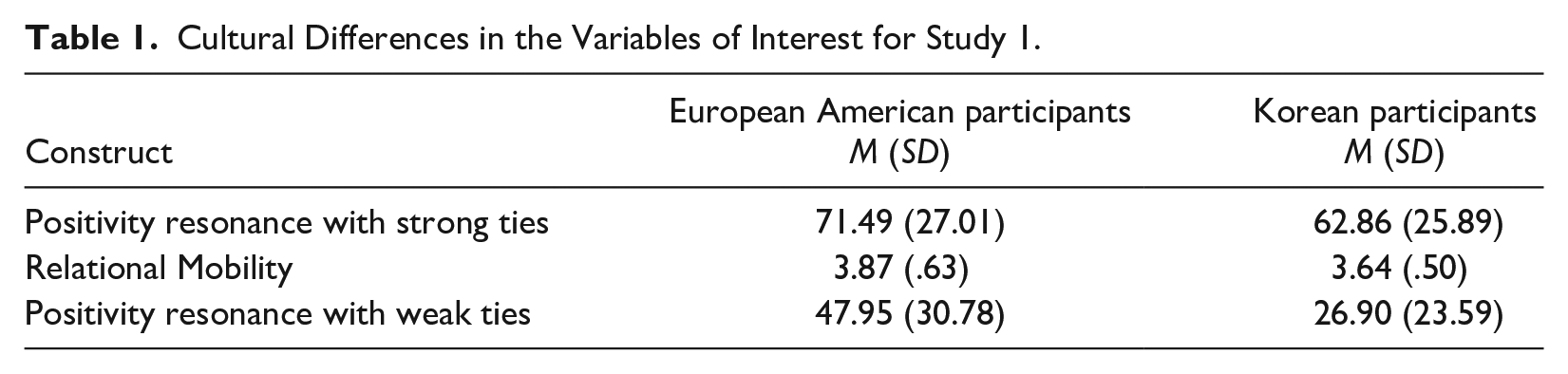
Next, replicating past work by Thomson and colleagues (2018), we observed a significant main effect of culture on perceived relational mobility, F (1,3624) = 102.62, p < .001, η2p = .028. Korean participants perceived their communities to be lower in relational mobility than did European American participants (Table 1).
To formally test whether perceived relational mobility explained the observed cultural difference in perceived positivity resonance with strong ties, we ran a mediation model with 10,000 bootstrapped samples. As shown in Figure 1A, European American participants tended to have higher levels of relational mobility compared with Korean participants, t(2581) = 8.10, p < .001, and relational mobility predicted positivity resonance with strong ties across the two cultural groups, t(2581) = 10.91, p < .001. The direct effect of culture on positivity resonance with strong ties remained significant, t(2581) = 5.31, p < .001, and the indirect effect was also significant (indirect effect = .078, 95% confidence interval [CI] = [.057,.10]). This suggests that perceived relational mobility in part explains the cultural difference in perceived positivity resonance with strong ties with a small effect size.
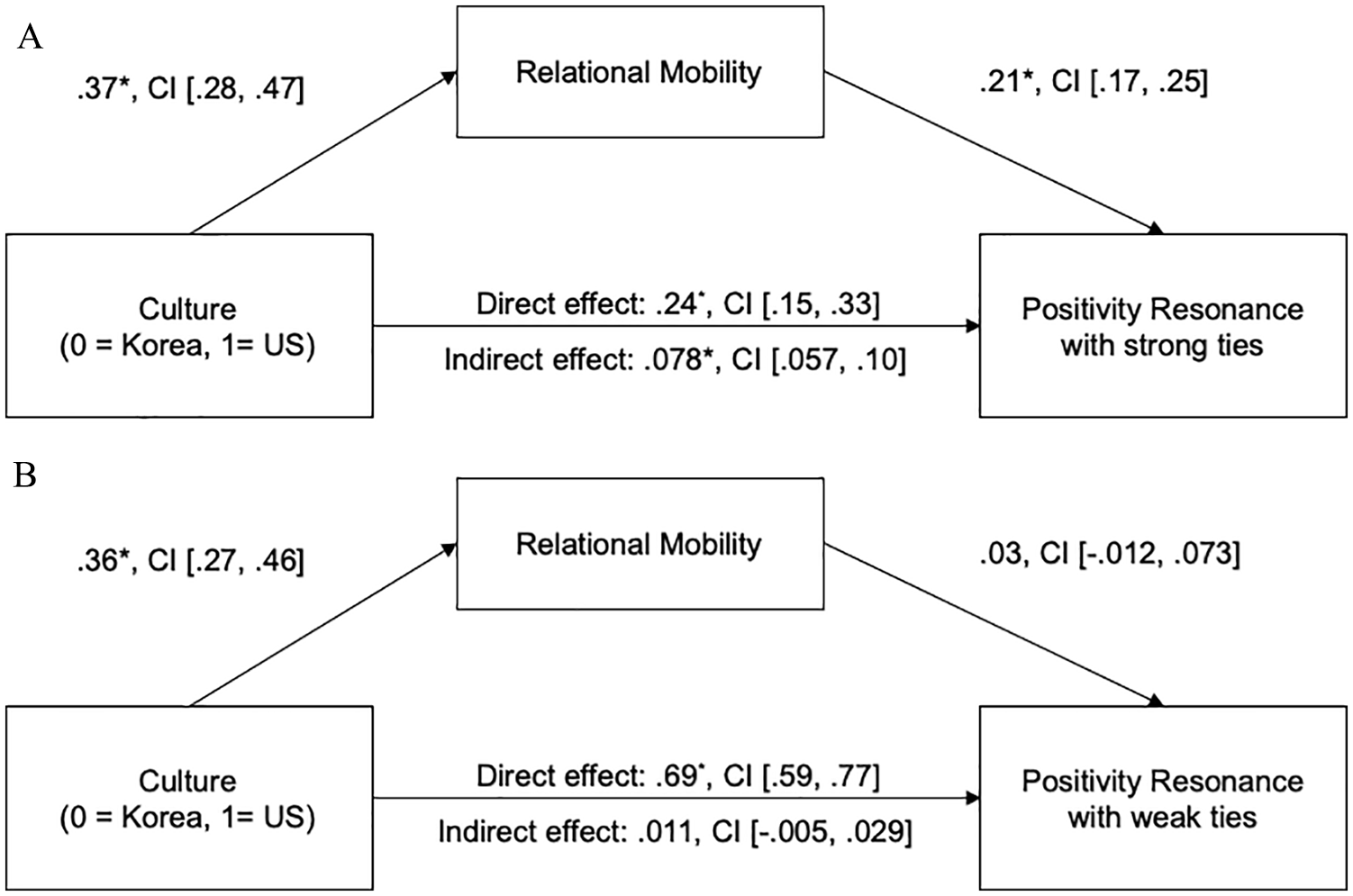
A Mediation Analysis Examining the Effect of Relational Mobility on the Cultural Difference in Positivity Resonance With Strong (Panel A) and Weak (Panel B) Ties in Study 1
Finally, we tested whether there were cultural differences in positivity resonance with weak ties. Korean participants reported significantly lower positivity resonance with weak ties than European American participants, F (1,1946) = 229.08, p < .001, η2p = .105 (Table 1). This result is similar to what we observed for strong ties. To test whether relational mobility explained the cultural difference in positivity resonance with weak ties, as it did with strong ties, we ran the same mediation model with 10,000 bootstrapped samples as in Figure 1A. As shown in Figure 1B, Culture (0 = Korea, 1 = United States) predicted relational mobility, t(1948) = 7.54, p < .001. However, relational mobility did not significantly predict positivity resonance with weak ties, t(1948) = 1.42, p = .16. The indirect effect was also not significant, suggesting that relational mobility does not explain the cultural difference in positivity resonance with weak ties. Consistent with Table 1, the direct effect of culture on positivity resonance with weak ties was significant, t(1948) = 14.68, p < .001.
Study 2
Assumption tests of regression were conducted (see OSM Section 1). First-order correlations for study variables and relevant demographic variables are presented in Supplemental Table S1 (see OSM Section 2). Replicating the findings from Study 1, our East Asian group, Japanese respondents, reported significantly lower positivity resonance with strong ties relative to European American participants (Table 2), F (1, 1540) = 8.24, p = .004, η2p = .005.
Cultural Differences in the Variables of Interest for Study 2.
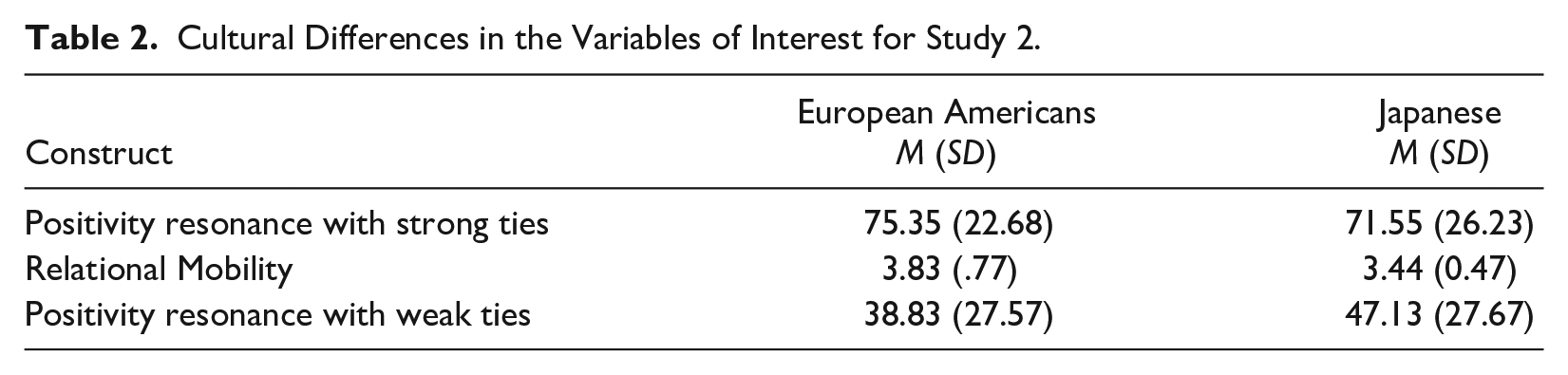
As in Study 1 and past work, we found that Japanese respondents perceived their communities to be lower in relational mobility than European American respondents (Table 2), F (1, 2082) = 198.48, p < .001, η2p = .087.
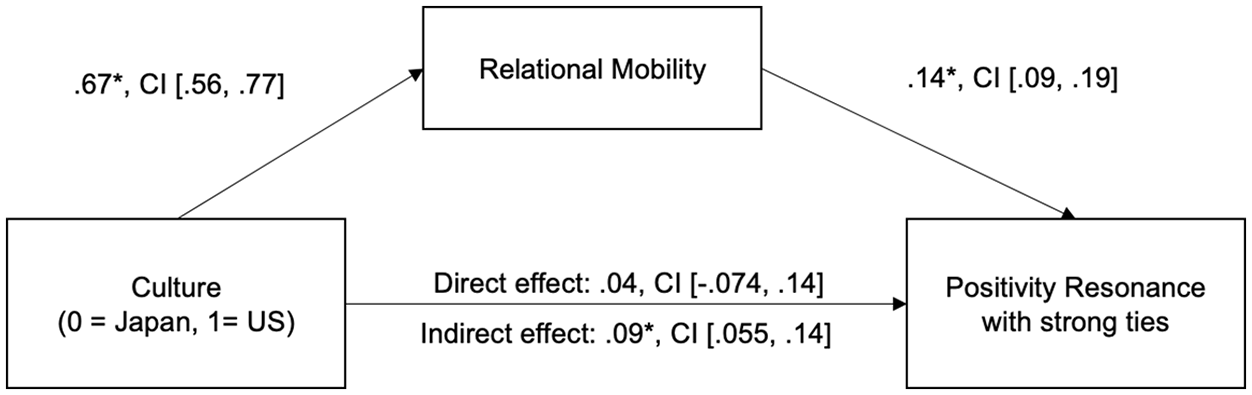
To formally test whether relational mobility explained the cultural difference in positivity resonance with strong ties as in Study 1, we ran a mediation model with 10,000 bootstrapped samples. As shown in Figure 2, European American respondents reported higher perceived relational mobility than Japanese respondents, t(1542) = 12.63, p < .001, and relational mobility predicted positivity resonance with strong ties, t(1542) = 5.25, p < .001. The indirect effect was also significant (indirect effect= .09, 95%CI = [.053,.13]). Once relational mobility was entered into the model, the direct effect of Culture on strong-tie positivity resonance was no longer significant, t(1542) = 1.14, p = .25. These findings suggest that relational mobility explains the cultural difference in positivity resonance with a small effect size.
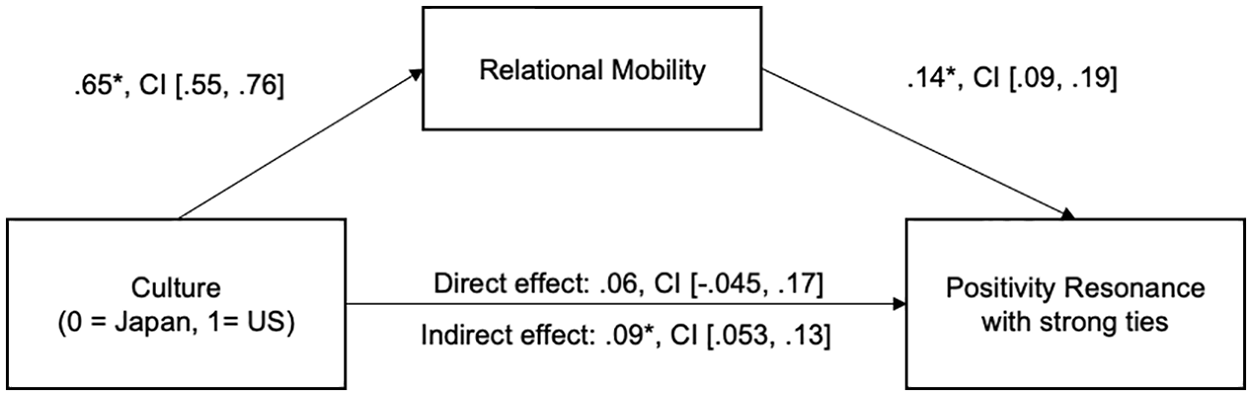
A Mediation Analysis Examining the Effect of Relational Mobility on the Cultural Difference in Positivity Resonance With Strong Ties in Study 2
Unlike Study 1, the opposite pattern was present for weak-tie positivity resonance. Japanese respondents reported significantly higher positivity resonance with weak ties than European American respondents, F (1, 1173) = 25.94, p < .001, η2p = .022. Since the findings on positivity resonance with weak ties failed to align with our predictions, we did not further test the mediating effect of relational mobility.
Robustness Check
We reran the mediation model for strong ties and added interdependence as a covariate. The indirect effect of relational mobility remained significant. These findings suggest that relational mobility predicts cultural differences in positivity resonance with strong ties independent of the effects of interdependent self-construal. The results are summarized in Figure 3.
A Mediation Analysis Examining the Effect of Relational Mobility on the Cultural Difference in Positivity Resonance With Strong Ties in Study 2, After Controlling for Interdependence
Combined Analysis
When we combined both European American samples and both East Asian samples, consistent patterns emerged for positivity resonance with strong ties and relational mobility. European American participants reported higher levels of positivity resonance with strong ties and higher levels of relational mobility than East Asian participants. Replicating the findings from Studies 1 and 2, relational mobility explained the cultural differences in positivity resonance with strong ties (for statistical details, see OSM Section 3).
Moderated Mediation
We also examined the different patterns in positivity resonance between strong and weak ties using a moderated mediation model for each study to formally test social targets as the moderator of the primary mediation analyses tested earlier. We found supportive evidence, in both studies, that social targets significantly moderated the indirect effects of cultures on positivity resonance via relational mobility (for statistical details, see OSM Section 4).
Discussion
Co-experienced kind-hearted positive emotions predict human flourishing and meaning in life (Major et al., 2018; Prinzing et al., 2023), yet this work has largely been conducted in US cultural contexts. Here, we found that there is substantial cultural variation in this consequential collective affective phenomenon, also termed positivity resonance. Korean participants perceived significantly lower levels of positivity resonance with both strong and weak social ties compared with European American participants (Study 1). The cultural differences in positivity resonance for strong ties were in part explained by Korean participants’ tendency to perceive their social environment to be less open, or lower in relational mobility. A comparable pattern of mediation was not present for weak social ties. These findings were largely replicated in Study 2, which compared Japanese participants with European American participants. Similar to Korean participants, Japanese participants perceived lower levels of positivity resonance with strong ties compared with their European American counterparts (Study 2). Here, the cultural differences in positivity resonance with strong ties were fully explained by cultural differences in relational mobility. Specifically, relative to their European American counterparts, lower levels of perceived relational mobility among Japanese participants accounted for their lower levels of positivity resonance with strong ties. Unexpectedly, Japanese participants reported significantly higher levels of positivity resonance with weak ties compared with European Americans. Study 2 also expanded on Study 1 by including a measure of interdependent self-construal as a covariate. Relational mobility remained a significant predictor of perceived positivity resonance with strong ties even when accounting for participants’ interdependent self-construal.
Finally, when we combined the two East Asian samples, we observed the same pattern of results as reported for Study 1: relative to their European American counterparts, East Asian participants reported lower levels of relational mobility, which in turn predicted lower levels of perceived positivity resonance with strong social ties.
Theoretical Implications
Taken together, the findings here support the claim that perceptions of relational mobility can function as a mechanism that shapes people’s social behaviors and outcomes. In areas of high relational mobility (such as the United States), social relationships are more fragile and require active engagement to maintain (Kito et al., 2017). On the contrary, in areas of low relational mobility (such as South Korea and Japan), social relationships, especially strong social ties, are prescribed by circumstances and therefore relatively fixed and long-lasting. People thus do not perceive abundant freedom to end their social ties based on their preferences (Kito et al., 2017). In contexts in which social relationships lack malleability and are therefore less fragile, adaptive strategies to safeguard relationships such as self-disclosure may be less frequently adopted (Thomson et al., 2018). Hence, a desired social outcome that may be facilitated by these adaptive strategies, such as positivity resonance, may emerge less frequently. Additional research is needed to examine whether different social outcomes are desired and called forth in societies with low relational mobility. The findings contribute to the existing literature on relational mobility by suggesting that high relational mobility contexts may also be characterized by greater positivity resonance with strong ties in addition to higher self-disclosure, generalized trust, and social support (J. M. Chen et al., 2012; Schug et al., 2010; Thomson et al., 2018).
Our findings that East Asians are lower in perceived positivity resonance may also be explained by prior work on culture and emotional balance. For instance, East Asians such as Japanese individuals tend to feel more ambivalent about positive emotions and value more balance in emotional experiences in relationships compared with European Americans (Kirchner-Häusler et al., 2022; Miyamoto et al., 2017). However, future research is needed as to whether and how emotional balance may account for the observed link between relational mobility and positivity resonance.
Unlike our results for strong ties, we did not find consistent results for weak ties. In Study 1, Korean participants perceived lower positivity resonance with weak ties than European American participants. In contrast, in Study 2, Japanese participants perceived higher positivity resonance with weak ties than did European American participants. Furthermore, although the expected cultural patterns in positivity resonance with weak ties emerged in Study 1, relational mobility did not mediate this cultural difference. We approach the interpretation of the observed patterns for weak social ties with caution, considering both theoretical perspectives and methodological limitations (the latter reviewed in the next section). A prior worldwide study showed that out of all human motivations, people across cultures value family (a strong tie) the most, as strong social ties are fundamental to human survival and well-being (Ko et al., 2020). Hence, whether individuals perceive a weak-tie interaction as a stepping stone for establishing strong ties (or as a single occurrence) may impact the prominence of the effects of relational mobility on positivity resonance with weak ties. Due to the varying types of motivation that people may have for connecting with weak ties, a series of other factors may influence whether or not people are willing to share positive emotions with less familiar others or strangers. For instance, past evidence suggests that even in societies that tend to be high in relational mobility (e.g., the United States), people are often unlikely to initiate conversations with strangers due to miscalibrated expectations that talking to strangers will not be pleasant and the strangers they interact with may not like them (Epley et al., 2022; Sandstrom & Boothby, 2021; Schroeder et al., 2022). Therefore, positivity resonance with weak ties may fluctuate and be more susceptible to a mix of individual differences and situational factors (e.g., miscalibrated expectations, pathogen concern, political climate). Likewise, the incentive to form and maintain weak social ties may also vary greatly within a culture. In addition, a recent study (West et al., submitted manuscript) observed significantly higher levels of this positivity resonance experienced with acquaintances versus strangers, each classified as weak ties. We suspect such variability across subtypes of weak ties may also vary by culture.
Of note, the different patterns in positivity resonance with strong and weak social ties eliminate the possibility that the cultural variations observed here are simply due to cultural differences in response style. Albeit past findings demonstrated that response styles vary by cultural values and thinking styles (Hamamura et al., 2008), European American participants in the current study did not show consistently higher scores in all variables compared with the East Asian participants (if so, it would raise a concern about response style as a confounding variable). According to Cohen (2019), demonstrating an effect in one area but not in another can help differentiate between a cultural distinction and a mere difference caused by response bias. This is supported by our findings here such that we observed a robust and reliable association between relational mobility and positivity resonance with strong ties across two studies but not with weak ties.
Methodological Strengths and Limitations
The current study is the first to examine the cultural variation in the collective emotion of positivity resonance. Importantly, we also examined the mechanism for cultural differences in perceived positivity resonance by testing the role of relational mobility. The work is made stronger by the robustness check in which we statistically control for variation in interdependent self-construal. Another strength of the current work is that by using online research platforms, the samples from each country were relatively large and representative.
While we did find evidence that lower relational mobility in part explained why East Asians exhibited lower levels of positivity resonance than European Americans, it is important to note that tests of statistical mediation have limitations (Fiedler et al., 2018). One limitation of mediation, as tested here using cross-sectional data, is that we cannot infer causal claims from the findings. Future studies using experimental designs that manipulate perceptions of relational mobility are needed to fill this gap. Another limitation is that mediation may also operate in the opposite direction (e.g., positivity resonance could promote relational mobility in a culture). Future longitudinal work is needed to unpack the directionality and magnitude of these effects.
Another methodological limitation is that data collection coincided with the prolonged COVID-19 pandemic and the 2020 U.S. presidential election and its aftermath. This methodological limitation contributes to our hesitancy to interpret the patterns observed for weak ties because during this time social interactions (particularly with weak ties) in certain geographical regions and for some individuals may have been altered by social distancing, mask mandates as well as by the political climate. Compared with interactions with strong ties (less influenced by COVID-19), concerns about contracting the virus may have hindered the experience of positivity resonance, particularly with weak ties, which may involve greater risks of infection (Salvador et al., 2020). In addition, following the presidential election of November 2020, perceived political and affect polarization surged in the U.S. context, which culminated in the Capitol Riot on January 6, 2021 (Kerr et al., 2021). Experiences of positivity resonance with weak ties may have been hindered by the decreasing levels of generalized trust due to rising political polarization (Lee, 2022) as trust is considered a “social lubricant” that allows more positive interactions to occur with weak ties (Igarashi et al., 2008; Yamagishi, 2001). This may account for the unexpected pattern in the European American sample in Study 2 (March 2021), which showed lower positivity resonance with weak ties compared with the European American sample in Study 1 (Fall 2020).
We note that the current study conceptualizes all variables of interest as participants’ perceptions (i.e., as gathered via explicit self-report scales). To complement this approach, future research could incorporate alternative indicators of the variables of interest. For example, observer-coded behavioral indicators of positivity resonance can be used to better capture momentary dynamics within dyads (Otero et al., 2020) and to investigate whether the findings reported here are consistent across measurement approaches. Future research is also needed to examine the collective emotion of positivity resonance across cultures using an intensive longitudinal approach during times when opportunities to connect with strong and weak ties are not thwarted.
Because the research to date on positivity resonance has relied exclusively on the U.S. samples, emic or bottom-up approaches to examine how people in different cultures co-experience emotions are also needed. Similarly, the current research applies the same categorizations for strong versus weak ties for both European American and East Asian participants. Future research could allow participants to specify with whom they interacted. This additional information could help discern whether cultures vary in how they represent and categorize strong versus weak ties. In addition, this information may also help evaluate whether social situations influence people’s motivation to value positive emotions. For instance, interactions with strangers in the context of the service industry can be more positive in any given culture due to professional norms and expectations rather than due to goals of forming social ties. With the emerging evidence that the levels of positivity resonance with acquaintances and strangers may differ, we also suggest that future researchers examine features of social interactions with these two classes of social targets separately. Although we observed differences in perceived positivity resonance (a desired social outcome) across countries, it will be worthwhile to test for sequential mediation via which relational mobility explains cultural differences in adaptive strategies such as emotion expressiveness, which in turn predict downstream desired social outcomes such as positivity resonance. As prior research has suggested that cultural variations in the quality of relationships with strong social ties contribute to differing levels of well-being (B. Park et al., 2022), it is also essential to investigate potential cultural differences in the extent to which the effects of co-experienced kind-hearted positive emotions cascade toward relational, mental, and physical well-being.
Conclusion
The current findings suggest that culture shapes how frequently individuals co-experience kind-hearted positive emotions depending on the level of perceived freedom and choices of social relationships. As positivity resonance blurs self-other boundaries and strengthens social bonds, our data suggest that people who believe their relationships can be easily formed and broken may make more efforts to cultivate shared positivity.
Supplemental Material
sj-docx-1-jcc-10.1177_00220221241235926 – Supplemental material for Do People From Different Cultures Vary in How Much Positive Emotions Resonate in Day-to-Day Social Interactions?: Examining the Role of Relational Mobility
Supplemental material, sj-docx-1-jcc-10.1177_00220221241235926 for Do People From Different Cultures Vary in How Much Positive Emotions Resonate in Day-to-Day Social Interactions?: Examining the Role of Relational Mobility by Jieni Zhou, Taylor N. West, Sung-Ha Lee, Incheol Choi, Hidefumi Hitokoto, Keiko Otake, Barbara L. Fredrickson and Cristina E. Salvador in Journal of Cross-Cultural Psychology
Footnotes
Acknowledgements
The authors thank Catherine Berman for her helpful comments on early manuscript drafts, and Natalie Tunistra and Maddie Fan for proofreading the manuscript drafts.
Declaration of Conflicting Interests
The author(s) declared no potential conflicts of interest with respect to the research, authorship, and/or publication of this article.
Funding
The author(s) disclosed receipt of the following financial support for the research, authorship, and/or publication of this article: The US sample collection in Study 1 was supported by the North Carolina Collaboratory at The University of North Carolina at Chapel Hill with funding appropriated by the North Carolina General Assembly. The funding agency had no role in the design, implementation, analyses, or reporting of this research. The US sample collection in Study 2 was supported by the Kenan Distinguished Profesorship Fund awarded to Barbara L. Fredrickson. The collection of the Korean sample was supported by the Center for Happiness Studies via the Center for Social Sciences at Seoul National University. The collection of the Japanese sample was supported by two JSPS KAENHI Grants (Grant number 19H01766 & Grant Number 18K03027).

Supplemental Material
Supplemental material for this article is available online.
Notes
References
Supplementary Material
Please find the following supplemental material available below.
For Open Access articles published under a Creative Commons License, all supplemental material carries the same license as the article it is associated with.
For non-Open Access articles published, all supplemental material carries a non-exclusive license, and permission requests for re-use of supplemental material or any part of supplemental material shall be sent directly to the copyright owner as specified in the copyright notice associated with the article.
