




Abstract
To facilitate a much greater understanding of work–family conflict (WFC) in the cross-cultural context, work–family research begins to investigate the critical role of acculturation in WFC. The purpose of this study is to expand understanding of the role of acculturation in a more nuanced way by investigating how two important facets of acculturation (i.e., language proficiency and cultural identity), jointly influence WFC among immigrant workers. We conducted a polynomial regression with response surface analysis using two-wave longitudinal data from Chinese immigrants in New Zealand (N = 264). The results showed that the congruence of language proficiency and cultural identity led to lower levels of interpersonal conflict at work (ICW). However, the congruence between them at high levels did not lead to lower levels of ICW compared to congruence at low levels. In addition, ICW fully mediated the combined effects of immigrant workers’ language proficiency and cultural identity on their WFC. Our results suggest that benefits are associated with language proficiency and cultural identity congruence and the findings provide insight into the role of acculturation in WFC.
Keywords
Introduction
Despite the fact that there are nearly 272 million immigrants in today’s global workforce, immigrant work–family conflict (WFC) issues have received less attention (Grzywacz et al., 2018). WFC research has been primarily conducted among individuals who are only influenced by a single culture (Grzywacz et al., 2007, 2018). Recent research has begun to investigate the acculturative basis for WFC among immigrant workers who navigate multiple cultures. This is important because some evidence suggests that the meaning and experience of WFC may differ for individuals exposed to multiple cultures compared to those influenced by a single culture (e.g., Grzywacz et al., 2007; Olson et al., 2013; Shang et al., 2018). As such, scholars have argued that it is crucial to expand the focus of interest to include immigrant populations in work–family research and explore how acculturation impacts their WFC (Grzywacz et al., 2007, 2018; Lin & Lin, 2021) to advance our understanding of the WFC experience in the cross-cultural context (Powell et al., 2018).
Recent research indicates that the process of acculturation, which refers to the cultural adaptation of immigrants to the norms of their host culture after relocation (Sam & Berry, 2006), plays a crucial role in the experience of WFC among immigrant workers by shaping their expectations of work and family roles (e.g., Grzywacz et al., 2007; Olson et al., 2013; Shang et al., 2018). However, previous studies examining the relationship between acculturation and WFC have either overlooked the multifaceted nature of acculturation (e.g., Liebkind, 2006; Shang et al., 2018) or have studied different facets in isolation, ignoring their interrelationships and joint effects on WFC (e.g., Olson et al., 2013), despite evidence of their interrelatedness (Chen et al., 2008; Tong & Cheung, 2011). Thus, this article seeks to expand current understandings of the role of acculturation in WFC in a novel way by investigating how two essential aspects of acculturation, namely host language proficiency and host cultural identity, jointly impact WFC among immigrant workers.
While acknowledging the biculturalism perspective of acculturation, which recognizes that immigrants’ acculturation may involve both their culture of origin and the host culture in relation to their language, values, beliefs, or identity (Flannery et al., 2001; Nguyen & Benet-Martínez, 2013), this study is specifically centered on exploring immigrants’ host cultural orientations of immigrants. Acculturation research has suggested that first-generation immigrants need to adopt certain aspects of host culture to function effectively within it (e.g., Tsai et al., 2000), particularly within workplace cultures that are largely influenced by the host national culture (Hofstede et al., 2010; Liu et al., 2021). Therefore, by focusing on the particular aspects of host culture (including host language proficiency and host cultural identity 1 ), we are able to gain a nuanced comprehension of how the host culture can impact an employee’s work–family experiences in a workplace that is mainly dominated by the host culture.
Within the acculturation literature, language proficiency and cultural identity are considered distinct dimensions of acculturation, representing cognitive and behavioral aspects, respectively (Cuellar et al., 1980; Sam & Berry, 2010). These dimensions are conceptually interdependent, as evidenced by research linking improved language proficiency to increased identification with the host culture and cultural identity to language acquisition and proficiency (Chen et al., 2008; Smolicz, 1981; Tong & Cheung, 2011). Despite this interconnectedness, existing studies have tended to treat these dimensions as standalone (e.g., Olson et al., 2013) or as a composite concept (e.g., Liebkind, 2006; Shang et al., 2018), rather than examining their joint effects on WFC in immigrant workers. However, this approach is problematic because recent research has demonstrated that the congruence between different facets of acculturation affects the success of immigrant workers in the labor market (Lee et al., 2019). To address this gap, we propose that examining the congruence between language proficiency and cultural identity would be more beneficial in predicting WFC than considering them separately.
Furthermore, several studies of language proficiency and cultural identity have indicated that each variable affects the degree to which immigrant workers feel comfortable interacting with their co-workers (Nguyen & Benet-Martínez, 2013; Ting-Toomey et al., 1991). Feelings of discomfort may manifest into interpersonal conflict at work (ICW) (Nguyen & Benet-Martínez, 2013; Ting-Toomey et al., 1991), which influences immigrant workers’ ability to function and obtain social support in their new work environments. We argue that WFC is not driven by acculturation alone but by their experience of ICW that arises from the process of acculturation. We therefore seek to examine the congruence effect of language proficiency and cultural identity on WFC through the manifestation of ICW among immigrant workers (see Figure 1).
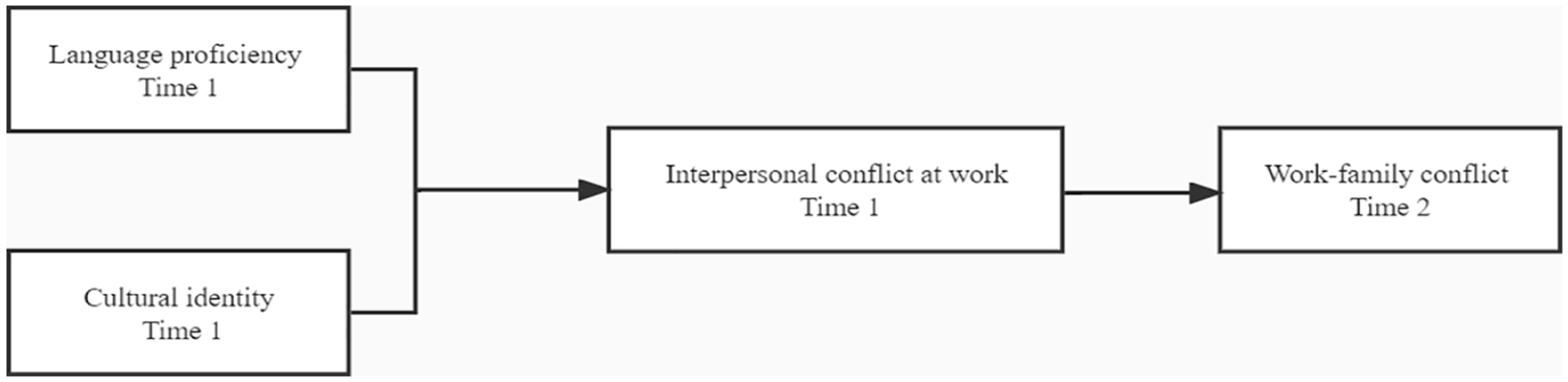
Hypothesized Model for the Current Study
Our research makes three notable contributions. First, we expand the existing literature on acculturation and WFC by disentangling the role of acculturation in WFC and specifying how various dimensions of acculturation, namely language proficiency and cultural identity, work in conjunction to influence WFC. In this study, we explicitly incorporate both language proficiency and cultural identity into the model by integrating the acculturation literature and the work–family literature. We not only examine the congruence effects of the two variables but also compare such effects with incongruence effects (i.e., when the levels of language proficiency are either higher or lower than the levels of cultural identity). Therefore, measuring acculturation congruence enables a more nuanced understanding of the role of acculturation in immigrant workers’ WFC in host countries. In doing so, this study contributes to the work–family literature by examining whether it is crucial for immigrants to develop both dimensions of acculturation concurrently in order to fit into the workplace and alleviate their WFC in the host country.
Second, this research broadens the existing literature on ICW by examining congruence/incongruence between language proficiency and cultural identity as antecedents of the quality of interpersonal relationships in the workplace. Previous studies on the antecedents of ICW have tended to overlook the effects of congruence between language proficiency and cultural identity or have focussed on the similarity in cultural identities between immigrants and host country nationals (e.g., Mao & Shen, 2015). Our study adds to research on interpersonal relationships by examining the impact of two specific elements of acculturation on ICW.
Finally, this study also offers some recommendations for organizations seeking to manage immigrant workers’ WFC in a diverse working environment, support their work adjustment, and manage potential interpersonal conflict stemming from cultural differences in the workplace. By being more conscious of what is required to ensure the needs and wellbeing of their immigrant employees, such organizations will be better placed to retain these employees.
Theoretical Groundings and Hypotheses Development
When immigrants move to a new country, they go through a complicated process of adjusting to a new culture and society, as noted by Berry (2005). This process is referred to as acculturation (Berry, 2005). Acculturation pertains to the changes in cultural and psychological aspects that occur as a consequence of intercultural encounters (Sam & Berry, 2010). Within the acculturation literature, language proficiency and cultural identity are considered distinct dimensions of acculturation. Language proficiency is a behavioral component of acculturation (Cuellar et al., 1980) because learning or acquiring the host language is regarded as an essential culture-specific behavioral skill that is necessary for them to engage the new culture (Masgoret & Ward, 2006). Cultural identity represents the cognitive component of acculturation (Cuellar et al., 1980), as cultural identity pertains to an individual’s cognitive processes of perceiving and thinking about themselves and others in intercultural interactions, particularly in terms of how they process information about their own group (ingroup) and other groups (outgroups) according to social identity theory (Sam & Berry, 2010; Tajfel & Turner, 1986).
To anchor our arguments on the interaction effect of language proficiency and cultural identity on WFC via ICW, we adopt social identity theory as a guiding framework. Social identity theory is a useful framework to guide our model that links the two facets of acculturation (i.e., language proficiency and cultural identity) and WFC. First, social identity theory provides rich explanation on an individual’s identity associated with the roles and values that guide their work and family life (Burke & Stets, 2009). According to social identity theory, an individual observes the values and behaviors of others and compares them with their own (Burke & Stets, 2009). Through these observations and comparisons, individuals categorize themselves in particular ways in relation to other social groups (Burke & Stets, 2009; Fitzsimmons, 2013). Through this process of categorization, immigrant workers gradually reform their identity (Fitzsimmons, 2013; Stets & Burke, 2000). Some immigrants may integrate their home cultural identity with aspects of the host cultural identity, while others may keep the two identities separated (Fitzsimmons, 2013). The re-developed identity leads to an adjustment of work and family role expectations in response to cultural cues (Brannen & Thomas, 2010). The role adjustments result from the cultural norms of the host country and what is considered appropriate behavior for specific roles (e.g., colleague, parent). Second, social identity theory suggests that the re-developed cultural identity of immigrants is associated with the formation of social networks in the host country (Mao & Shen, 2015), which provides insights into immigrants’ interaction with locals. Therefore, social identity theory can assist in investigating the mediating role of ICW in the relationship between acculturation and WFC. In fact, social identity theory is very commonly used by scholars to interpret immigrants’ performances in the new environment (e.g., Olson et al., 2013).
Language Proficiency and Cultural Identity Congruence and ICW
Acculturation literature has consistently demonstrated that successful acculturation is associated with various benefits, such as psychological satisfaction and increased work performance (e.g., Liebkind, 2006; Ward, 1996). Acculturation synchrony, 2 defined by Lee et al. (2019) as “the coordination of acculturation processes across different dimensions and domains” (pp. 15), may aid understanding about patterns of adaptation within a given immigrant’s acculturation process. Different dimensions of acculturation may or may not develop in a synchronous fashion (Lee et al., 2019). In this study, language proficiency and cultural identity are two key components of acculturation that immigrants rely on to connect with and interpret their new environment (Sam & Berry, 2006).
Language skills are embodied within an individual, and immigrants are assumed to deliberately learn the local language once they arrive in the new country (van Tubergen & Kalmijn, 2005). Language proficiency is an essential factor in contributing to the success of immigrants in the workplace (Lu et al., 2016; Mahmud et al., 2008). Immigrants with high language proficiency are more likely to absorb the cultural nuances of the host country and have a sophisticated chance of interacting with locals, broadening their social network, contributing to their ability to understand locals, and accessing the resources embedded within the social network (Lu et al., 2016; Olson et al., 2013). In contrast, immigrants with limited language proficiency are inclined to suffer higher levels of miscommunication (Mui et al., 2007). Therefore, language proficiency provides immigrants with the foundation of communication, demonstrating a possibility for the communication.
Cultural identity refers to the extent to which an immigrant perceives that they identify with locals during the process of acculturation (Schwartz et al., 2010). Researchers agree that individuals likely reconfigure their identities during acculturation to facilitate the process of making sense of a new environment (Fitzsimmons, 2013; Mao & Shen, 2015), such as how to perform at work and home. Immigrant workers who identify with locals are more likely to understand their values and behaviors when interacting with them, whereas immigrants who feel a disconnect with the mainstream cultural identity are likely to encounter more misunderstandings with local colleagues in the workplace. In this sense, cultural identity determines the effectiveness of communication between immigrant workers and local colleagues.
According to the above, we suggest that both language proficiency and cultural identity are equally critical for interaction with locals, and together, will determine the quality of an immigrant’s social network in the workplace, of which ICW is an indicator. ICW ranges from minor disagreements to physical assaults among co-workers (Spector & Jex, 1998). Previous studies have shown that interpersonal conflict can make work more stressful, and high levels of interpersonal conflict are associated with exhaustion and job burnout (e.g., Frone et al., 1997). Social identity theory suggests that ICW can be triggered by social categorization. Groups tend to form due to common interests, identities, and affiliations, whereas those who feel a disconnect with these tend to be on the outer (Stets & Burke, 2000). Immigrants with high language proficiency and high cultural identity (i.e., congruence at high levels) are more likely to be considered part of the group because they can communicate easily with locals to discuss work issues and even share their personal life with local colleagues. Moreover, they integrate the local cultural identity within their individuality and can understand the rationale behind the behaviors, rituals, and activities conducted by local colleagues, reducing the likelihood of misinterpretation or misunderstanding (Fitzsimmons, 2013).
Immigrant workers who have low language proficiency and cultural identity, indicated by low congruence levels, are likely to face outsider treatment in the workplace. This is because they may not be aware of value differences and may lack culturally appropriate behavioral strategies to deal with differences (Masgoret & Ward, 2006). As noted by Masgoret and Ward (2006), such workers are at a disadvantage and may struggle to fit in with their colleagues. As a result, they may need to actively modify their behavior and mask emotions to interact with insiders, or reduce their engagement with local colleagues to avoid the risk of experiencing ICW. According to recent research by Leigh and Melwani (2022), people tend to engage in avoidant work behaviors when faced with potential threats at work. For example, some workplaces may witness people of similar cultural backgrounds sticking together, displaying a lack of interaction with colleagues of other cultures.
However, the development of language proficiency and cultural identity is likely to occur at a different pace, as acculturation processes are not always evenly synchronized across dimensions and domains (Lee et al., 2019). For example, some immigrants may adopt the accent and idioms of the host culture despite remaining committed to the values and cognitive orientations related to their home identity (e.g., Pooyan, 1984). Therefore, immigrant workers’ levels of language proficiency and cultural identity might be incongruent. With either low language proficiency or low cultural identity, they may either struggle to communicate with local colleagues or feel uncomfortable about the workplace’s customs and practices. This discomfort can lead to misunderstandings and increase the likelihood of the workers being perceived as outsiders. According to social identity theory, discrimination, competition, and favoritism toward one’s own group can give rise to ICW (Stets & Burke, 2000). We propose that if there is a better match between language proficiency and cultural identity, there will be less ICW in the workplace.
While the congruence between language proficiency and cultural identity at either high or low levels will cause low levels of ICW, we anticipate that ICW will be even less among immigrant workers with high congruence (i.e., high language proficiency and high cultural identity). First, immigrant workers with high congruence can effectively communicate with local colleagues, which aids them in performing well in their tasks or in teamwork situations, leading to stronger collegiality with their colleagues (Lazarova et al., 2010). Second, such immigrants are usually well adjusted to the norms of the host country. Being well adjusted allows immigrant workers to be more open to other colleagues, empathize with their perspectives and be fully integrated within a social network (Lazarova et al., 2010). This generally provides the foundations for smooth, regular interactions between immigrant workers and their local colleagues, resulting in a stable and enduring relationship (Reich & Hershcovis, 2011). Immigrant workers with high congruence have a high chance of building a harmonious relationship with their local colleagues, leading to more habitual workplace interactions (Leigh & Melwani, 2022). Therefore, immigrant workers with high congruence between language proficiency and cultural identity will have less ICW.
To succeed in the workplace, individuals must be able to work both independently and collaboratively with others. Even though immigrant workers with low language proficiency and cultural identity (i.e., low congruence) may attempt to avoid interactions with local colleagues, there will still be situations where communication and collaboration are necessary. Congruence at low levels indicates a low level of adjustment. Immigrant workers who are ill-adjusted tend to lack a sense of collegiality, connection, and integration, leading to more misunderstandings and less-effective communication with local colleagues (Laravora et al., 2010). This then leads to relatively more ICW compared to immigrant workers with high language proficiency and cultural identity. Thus, we propose the following hypothesis.
Language Proficiency and Cultural Identity Congruence and WFC
WFC occurs when the demands of work or family role make it difficult to fulfill demands in the alternative role (Greenhaus & Beutell, 1985). WFC consists of clashes involving two directions: work interference with family and family interference with work (e.g., O’Driscoll et al., 2004). In the work–family literature, WFC is regarded as resource-sensitive, that is, individuals have a fixed amount of psychological and physiological resources, and juggling multiple roles inevitably exhausts the total resources and leads to poor role function (Edwards & Rothbard, 2000). In this study, we adopt a widely accepted perspective in the WFC literature that work-related antecedents tend to impact the resource expenditure in the work domain, which further resulting in a decrease/increase in available resources for fulfilling family role demands (Byron, 2005; French et al., 2018; Michel et al., 2011). As we are interested in how workplace conflicts experienced by immigrants impact on their work–family experiences, this study focuses on work interference with family only.
The resource perspective of WFC is compatible with social identity theory. Social identity theory holds that social capital (i.e., resources) is naturally embedded in social networks and it is a central component in identity processes (Stets & Burke, 2000). The meaningful behaviors and activities within a role prescribed by a social identity revolve around the control of resources (Stets & Burke, 2000). The levels of ICW indicate the quality of social relationship in the workplace. With low ICW, it is possible for immigrant workers to establish rapport with co-workers in the workplace and feel more connected to the in-group. Therefore, they are likely seen as insiders, as a group is a collective of similar people, all of whom identify with each other, see themselves and each other in similar ways, and all hold similar views (Stets & Burke, 2000). Immigrant workers who are treated as insiders will find it easier to access to resources in the workplace, such as information, social support, and opportunities for advancement (e.g., Rosander & Blomberg, 2022). Furthermore, their co-workers may be more likely to support them and advocate for their needs in the workplace to help immigrant workers succeed in their jobs (e.g., Rosander & Blomberg, 2022). For example, when immigrant workers are viewed positively by their co-workers and are included in work-related discussions and decision-making processes, they may have more access to information about available resources and be more likely to receive support from their colleagues. Such resources generated in the process of social identity formation could help to cope with the stress of working in the host country, leading to more resources for them to fulfill family demands (Dierdorff & Ellington, 2008; Mao & Shen, 2015).
In contrast, if immigrant workers experience high ICW, such negative experiences can increase the salience of cultural differences between in-group and out-group, leading host employees to have more negative attitudes and emotions toward immigrant workers (e.g., Rosander & Blomberg, 2022). Consequently, they may feel isolated from the in-group and face additional challenges in accessing resources in the workplace. Lacking work-related resources can make it more difficult for immigrant workers to fulfill their work demands successfully, and subsequently they will devote more resources to work demands, causing poor function in family domain (Dierdorff & Ellington, 2008).
When considered jointly, Hypotheses 1 and 2, in conjunction with the argument of the positive relationship between ICW and WFC, suggest that language proficiency and cultural identity can jointly determine the levels of immigrant workers’ ICW, which further influence their WFC. Therefore, we hypothesize the following:
Methods
Participants and Procedures
To examine the proposed effect, we contextualized our study in New Zealand and focussed on the first-generation Chinese immigrants—one of the fastest-growing ethnic groups in New Zealand (New Zealand Census Statistics, 2018). In 2018, Chinese people accounted for 5.3% of the total population of New Zealand, with 86% of people in this category born overseas (New Zealand Census Statistics, 2018). Chinese people represent an important part of the current and future labor market (Badkar & Tuya, 2010; New Zealand Census Statistics, 2018). The rationale for choosing this sample was to ensure acculturation is salient, as the larger the differences between two cultures, the more prominent the acculturation (Demes & Geeraert, 2014). Specifically, Chinese immigrants were generally brought up in an Eastern Confucian culture, whereas they are now living and working in a predominantly Western Anglo-Saxon culture. The high cultural contrasts between the East (i.e., China) and the West (i.e., New Zealand) mean that Chinese immigrants likely have a significant acculturation experience.
Data were collected from universities, Chinese companies, Chinese associations, and Chinese churches in New Zealand. The study was approved by the Human Research Ethics Committee at the primary author’s affiliated university. Participants completed two confidential questionnaires administered at a 6-month interval, with 577 Chinese immigrants responding to the Time-1 questionnaire. The second questionnaire was emailed to all respondents of the Time-1 questionnaire (n = 577). Of these, 264 (45.8%) completed the second survey. Participants represented an array of industries, including agriculture, education, wholesale, financial, and service industries. Demographic-wise, 51.9% of the final sample were male (n = 137), the average age was 39.55 years (SD = 10.7, range from 20 to 65 years), and 71.6% indicated that they had dependents at home. The average length of residency in New Zealand was 10.99 years (SD = 6.07), the average job tenure was 5.20 years (SD = 4.64), and 60.98% had educational experience in New Zealand (n = 161). In terms of education, 77.7% had a university bachelor’s degree, with a further 32.2% having a higher tertiary qualification. In addition, we applied Goodman and Blum’s (1996) approach to examine whether there was nonrandom sampling in our study. A multiple logistic regression model was constructed with all focal and control variables as predictors (see Table 1). Our findings indicate that none of the predictive variables were statistically significant (p > .10 for all), suggesting that the data were missing at random, and there is no indication of bias caused by participant attrition.
Logistic Regression: Stayers Versus Leavers.
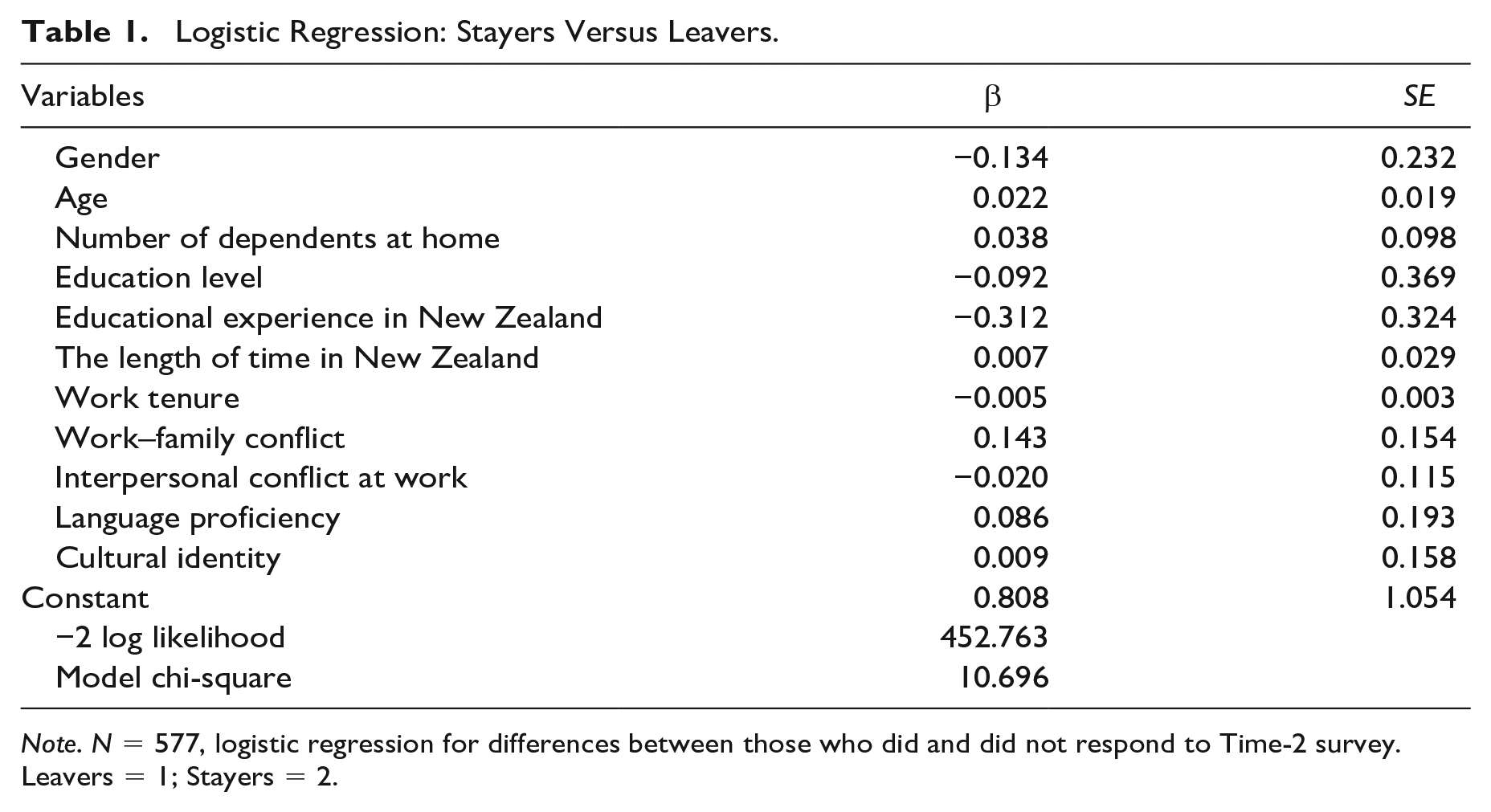
Note. N = 577, logistic regression for differences between those who did and did not respond to Time-2 survey. Leavers = 1; Stayers = 2.
Measures
Using Brislin’s (1970) method, all survey items were translated into Chinese and back translated into English to verify semantic equivalence. The same measures were used in both Time 1 and 2.
WFC was assessed by six items developed by Carlson et al. (2000). Sample items include “My work keeps me from my family activities more than I would like.” Response options ranged from 1 (Strongly disagree) to 5 (Strongly agree). The Cronbach’s alpha was .85 at Time 1, and .83 at Time 2.
ICW was measured using a 5-item scale by Cox (1998). Sample items include “The atmosphere here is often charged with hostility.” Response options ranged from 1 (Strongly disagree) to 7 (Strongly agree). The Cronbach’s alpha was .90 at Time 1, and .94 at Time 2.
Language proficiency and cultural identity were measured using a modified version of the acculturation scale developed by Gim Chung et al. (2004) to assess language proficiency and cultural identity. Language proficiency was measured using three items, including “How well do I speak the language of English?.” Five items were used to measure cultural identity, including “How proud am I to be part of mainstream New Zealanders?.” Response options ranged from 1 (Not very much) to 5 (Very much). The Cronbach’s alpha for language proficiency was .95 at Time 1, and .96 at Time 2. The Cronbach’s alpha for cultural identity was .85 at Time 1, and .85 at Time 2.
Control Variables
We controlled for gender, age, number of dependents at home, education level, educational experience in New Zealand, the length of time in New Zealand, and work tenure in this study. Previous studies have indicated that gender, age, and number of dependents at home are likely to influence individuals’ experiences of WFC (Michel et al., 2011). Furthermore, research has also suggested that education level, seeking education in host countries, the length of time spent in host countries, and work tenure would potentially impact immigrants’ acculturation (Lazarova et al., 2010).
Analysis Strategy
To test our hypotheses, we used polynomial regression combined with response surface analysis, which is a powerful technique that can provide a detailed understanding of the relationships of the combination of two predictor variables with an outcome variable (Edwards & Parry, 1993). By graphing the results of polynomial regression analysis in a three-dimensional space, response surface analysis allows us to determine the degree and direction of congruence between LA and CI with respect to ICW, offering greater explanatory potential than traditional moderated regression analysis. Specifically, we can identify the levels of ICW associated with higher LA than CI, lower LA than CI, and similar levels of LA and CI. In addition, response surface analysis enables us to generate a three-dimensional space that accurately displays the relationship between the combinations of LA and CI with ICW. Edwards and Parry (1993) provide further details on this methodology, which is widely used in research.
As we had two waves of data, we included Time-1 scores for the exogenous variables (predictors and mediators), along with Time-2 scores for the endogenous variables (outcomes). Therefore, language proficiency at Time-1 (LP), cultural identity at Time-1 (CI), ICW at Time-1, and WFC at Time-2 were included in the analysis. To test the congruence/incongruence effects of language proficiency and cultural identity (Hypotheses 1–3), we used a polynomial regression with response surface analysis (Edwards & Parry, 1993). We regressed ICW (the mediator) on the control variables and five polynomial terms: LP, CI, LP2, CI2, and LP × CI. The final equation is listed below (control variables are omitted):

where Z represents ICW, and e represents the random disturbance term. We centered language proficiency and cultural identity at the midpoint of the scales (i.e., 3). All control variables were also converted into dummy variables. After polynomial regressions were conducted, we used three-dimensional response surface graphs with regression coefficients to visually present the polynomial regression results.
As suggested by Edwards and Parry (1993), we chose two key features of the polynomial regression model and plotted response surfaces to test Hypothesis 1 (i.e., the congruence effect of language proficiency and cultural identity). First, the coefficients of the three second-order polynomial terms (LP2, LP × CI, CI2) were jointly significant in the polynomial regression model (Edwards & Parry, 1993). Second, there was evidence of a congruence effect when curvature along the incongruence line was significantly positive (i.e., a U-shape) (Edwards & Cable, 2009), such that ICW increased when the levels of an immigrant’s language proficiency and cultural identity differed from each other. Using procedures recommended by Edwards and Parry (1993), the curvature along the incongruence line was calculated and tested as b3 − b4 + b5.
To examine Hypothesis 2, we tested whether the slope along the congruence line (i.e., LP = CI) was significantly negative. This represents that ICW decreases when an immigrant worker’s language proficiency is congruent with their cultural identity from at low levels toward at high levels. We examined the significance of the congruence line (LP = CI) slope (b1 + b2) using procedures for testing linear combinations of regression coefficients (Edwards & Parry, 1993). In addition, we evaluated curvature along the line of incongruence (b3 + b4 + b5) to ensure the effect was linear as opposed to nonlinear.
To test Hypothesis 3 (i.e., the indirect effects of congruence/incongruence between language proficiency and cultural identity on WFC via ICW), we used the block variable approach recommended by Edwards and Cable (2009). Specifically, to obtain a single coefficient representing the joint effect (i.e., congruence and incongruence effects) of the five polynomial terms (LP, CI, LP2, LP × CI, and CI2), we combined the five terms into a block variable, which was a weighted linear composite. The respective weights were the estimated regression coefficients in the polynomial regression. After constructing the block variable, we performed the polynomial regression again and obtained the standardized regression coefficient for the block variable as the path coefficient for the mediation analysis. The indirect effect of congruence/incongruence on WFC through ICW can be calculated as a product of the coefficient of the block variable predicting ICW and the coefficient of ICW predicting the outcome variable. We tested the significance of the indirect effects using bootstrapping. We estimated bias-corrected confidence intervals for the indirect effects by bootstrapping 5,000 samples. As Edwards and Cable (2009) contended, using a block variable can greatly facilitate the assessment of the direct and indirect effects of a congruence/incongruence effect for a mediation model.
Results
Table 2 illustrates the means, standard deviations, and correlation coefficients for the focal variables. Prior to our hypotheses testing, we employed confirmatory factor analysis (CFA) procedures to assess the distinctiveness of the focal variables in our study: language proficiency, cultural identity, ICW, and WFC (see Table 3). We established a nested set of three alternative models to compare with the baseline four-factor model. Specifically, the alternative Model 1 is a three-factor model in which we combined ICW and WFC. The alternative Model 2 is a two-factor model in which we combined ICW and WFC into one factor, and also combined language proficiency and culture identity into one factor. The alternative Model 3 is a one-factor model in which we combined all items into one factor. The results suggest that the baseline four-factor model fit the data well, compared with Model 1, Model 2, and Model 3. Moreover, the results show that all indicators’ standardized loadings in the four-factor model were significant at the .01 level.
Means, Standard Deviations, and Correlations Among Study Variables.
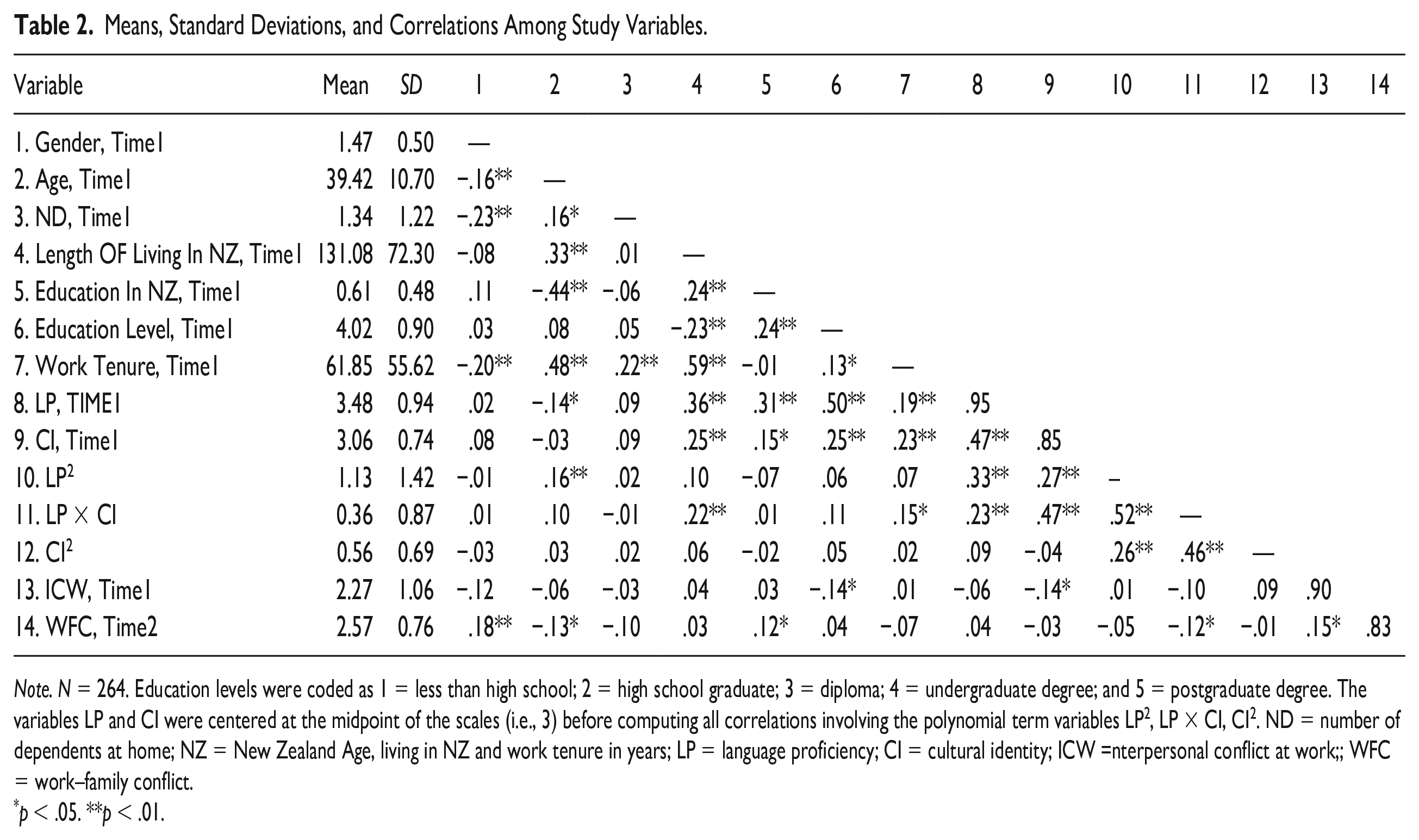
Note. N = 264. Education levels were coded as 1 = less than high school; 2 = high school graduate; 3 = diploma; 4 = undergraduate degree; and 5 = postgraduate degree. The variables LP and CI were centered at the midpoint of the scales (i.e., 3) before computing all correlations involving the polynomial term variables LP2, LP × CI, CI2. ND = number of dependents at home; NZ = New Zealand Age, living in NZ and work tenure in years; LP = language proficiency; CI = cultural identity; ICW =nterpersonal conflict at work;; WFC = work–family conflict.
p < .05. **p < .01.
Results of Confirmatory Factor Analysis.
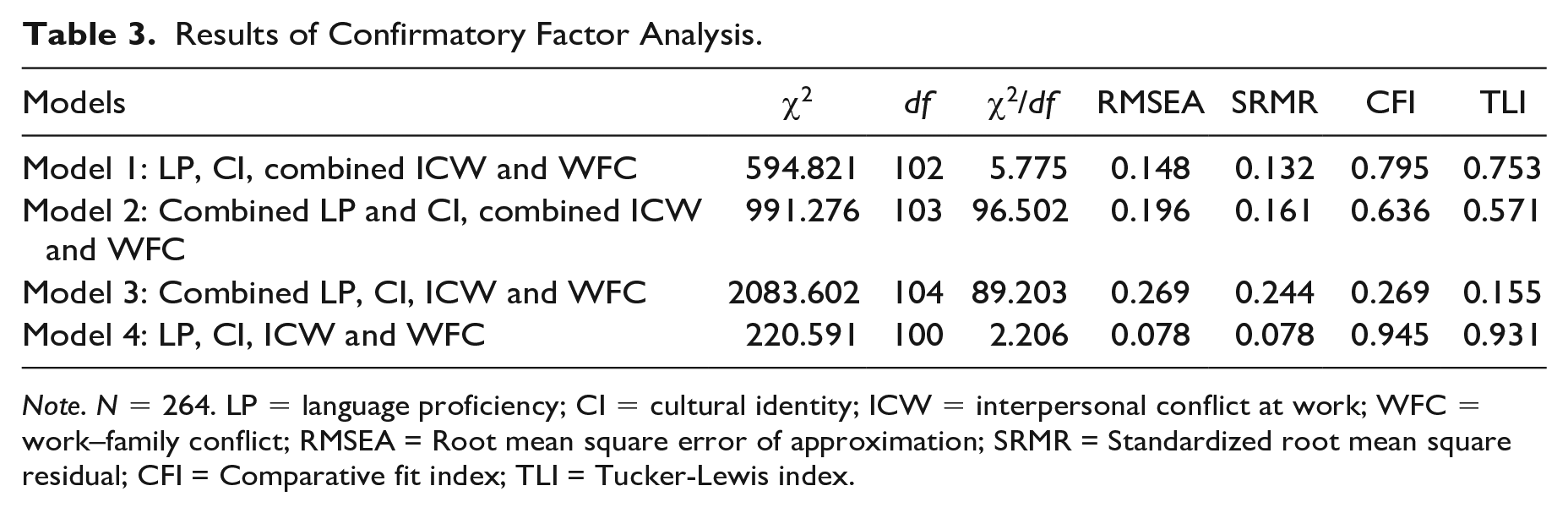
Note. N = 264. LP = language proficiency; CI = cultural identity; ICW = interpersonal conflict at work; WFC = work–family conflict; RMSEA = Root mean square error of approximation; SRMR = Standardized root mean square residual; CFI = Comparative fit index; TLI = Tucker-Lewis index.
Furthermore, we undertook several procedures recommended by Podsakoff et al. (2003) to assess the influence of potential common method bias in our study. First, we conducted Harman’s one-factor test on all the items, extracting six distinct factors that accounted for 76.869% of the total variance, with the first factor explaining 37.413% (lower than the conventional threshold of 40%). Thus, no single factor emerged, nor did one factor account for most of the variance. Second, we combined all items into one factor (see alternative Model 3) in CFA, and the indices of fit demonstrate that the structure of the one-factor model was unreasonable. Third, we adopted a single-common-method approach and loaded all the items onto their theoretically assigned latent variables, as well as onto a latent common methods variance factor. The results suggest that the model did not fit the data well (χ2 = 386.655, df = 93, RMSEA = 0.120, CFI = 0.876, TLI = 0.838, SRMR = 0.228) when compared with the baseline four-factor model. Adding a common methods variance factor did not significantly improve the model fit (Δχ2 = 166.064, Δdf = 7, Δχ2/Δdf = 23.723, p < .001). These analyses collectively show that common method bias is not a factor of concern in our study.
Hypothesis Testing
Hypothesis 1 proposes that the more congruent an immigrant worker’s levels of language proficiency and cultural identity is, the lower the levels of ICW experienced by the worker. Table 4 presents the estimated coefficients as well as the slopes and curvatures along congruence and incongruence lines for the polynomial regressions in predicting ICW. As shown in Model 2 of Table 4, the three second-order polynomial terms were jointly significant (F=2.267, p<.05), indicating that the congruence of immigrant workers’ language proficiency and cultural identity had a non-linear relationship with their ICW. Moreover, the results in Model 2 also illustrate that the surface along the incongruence line significantly curved upward (curvature=0.63, p<.05). To interpret these results, we plotted the whole response surface using coefficient estimated in the polynomial regression (see Figure 2). Figure 2 indicates that the congruence effect of immigrant workers’ language proficiency and cultural identity on ICW was U-shaped along the incongruence line. The convex curvature along the LP = -CI line demonstrates that immigrant workers’ ICW decreased as the level of language proficiency and cultural identity converged (Edwards & Cable, 2009). Thus, Hypothesis 1 was supported.
Polynomial Regression of ICW on Congruence/Incongruence between Cultural Identity (CI) and Language Proficiency (LP).
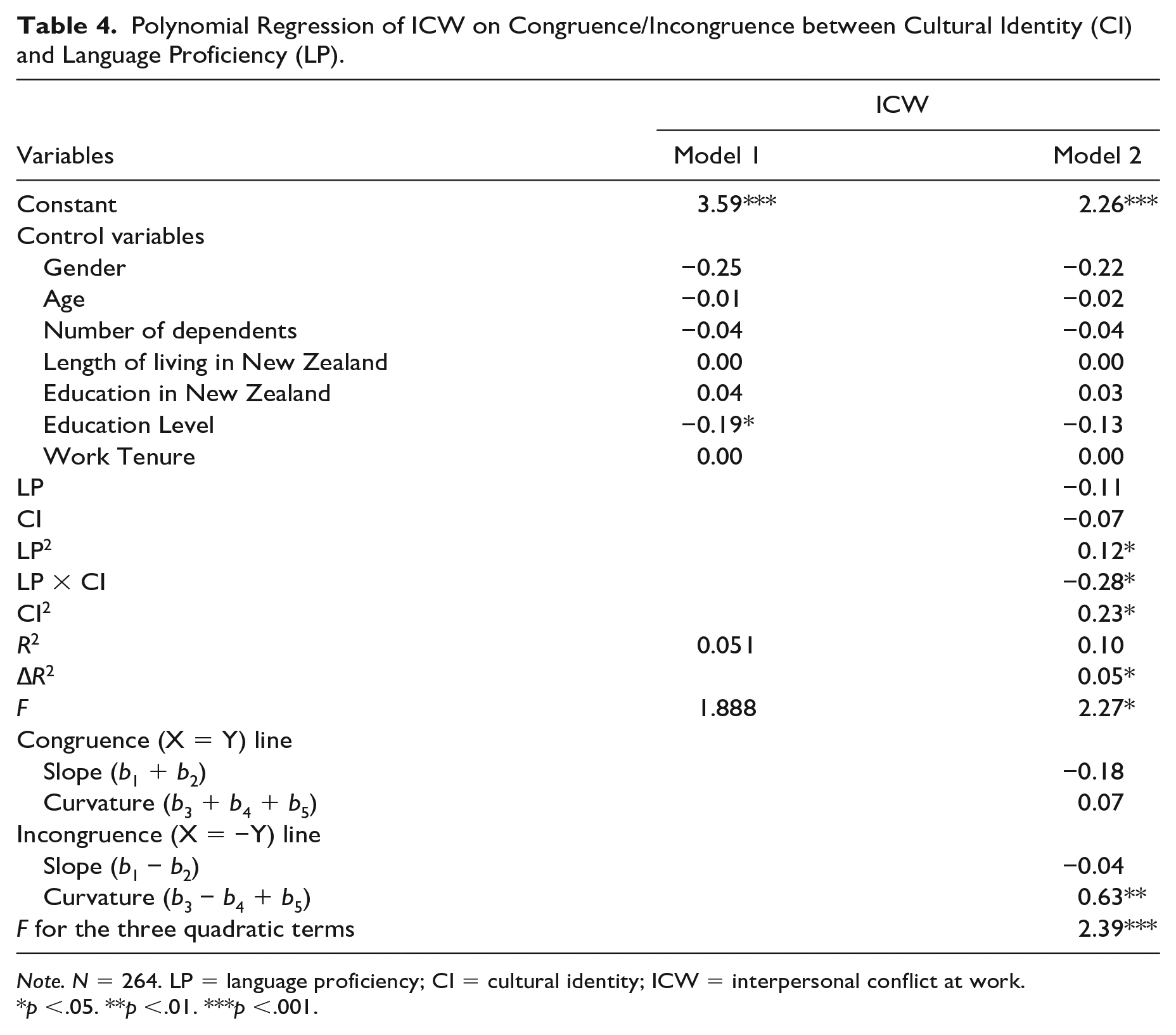
Note. N = 264. LP = language proficiency; CI = cultural identity; ICW = interpersonal conflict at work.
p <.05. **p <.01. ***p <.001.
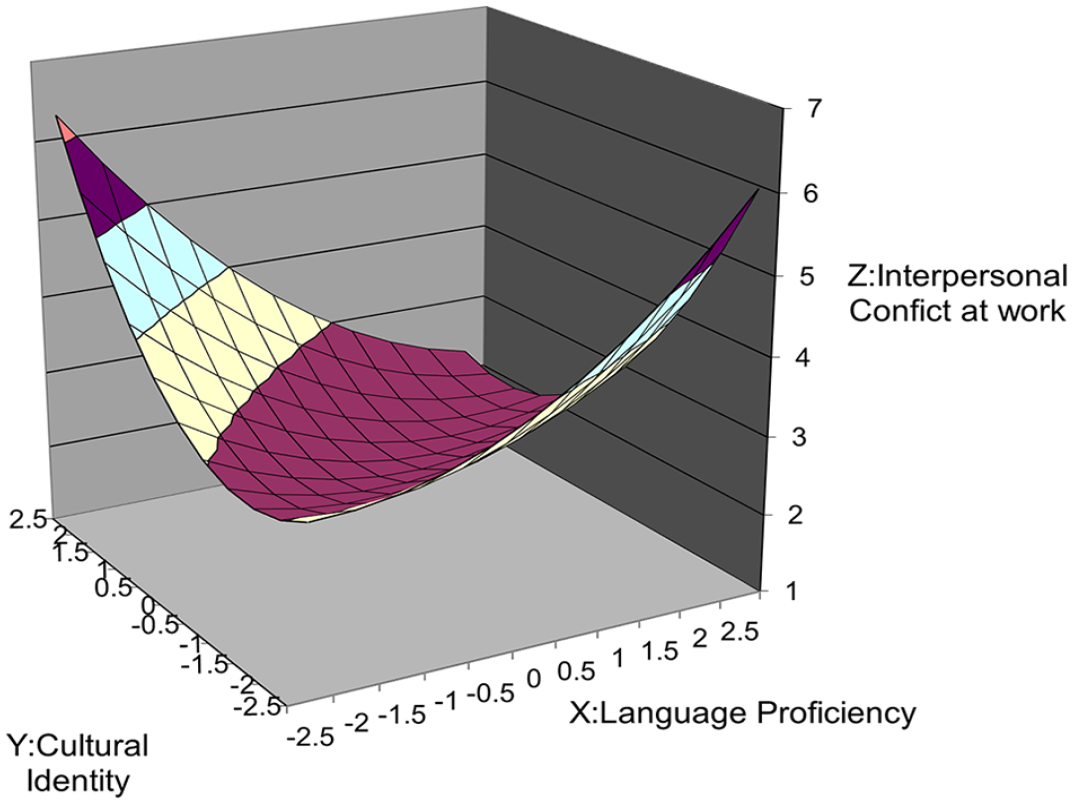
Congruence and Incongruence Effects of Immigrant Workers’ Language Proficiency and Cultural Identity on Interpersonal Conflict at Work
Hypothesis 2 suggests that ICW is reduced when the language proficiency of immigrant workers is congruent with their cultural identity at high levels rather than when they are congruent at low levels. As shown in Model 2 of Table 4, the slope along the congruence (LP = CI) line was insignificant (slop = −0.18, ns), indicating that congruence between language proficiency and cultural identity at high levels was not better than congruence at low levels. Furthermore, the results reveal that the curvature of the surface along the congruence line was insignificant (curvature = 0.07, ns), indicating that the relationship was linear. That is, both types of congruence between language proficiency and cultural identity lead to similar levels of ICW. This effect is illustrated in Figure 2, as the front corner of (congruence between language proficiency and cultural identity at low levels) was not significantly higher than the back corner (congruence between language proficiency and cultural identity at high levels). Thus, Hypothesis 2 was not supported.
Hypothesis 3 suggests that ICW mediates the relationships of congruence/incongruence between language proficiency and cultural identity with WFC. Based on the recommendations of Edwards and Cable (2009), we used the estimated coefficients for the five polynomial terms reported in Model 2 (see Table 4) to generate the block variables for the combined effects of immigrant worker’s language proficiency and cultural identity on the outcomes (i.e., ICW and WFC), before testing the mediating effect. We then employed Baron and Kenny’s (1986) approach to examining the mediating effect of ICW. We first examined the path linking language proficiency-cultural identity congruence and ICW by using the block variable to predict WFC after controlling for various control variables. We then examined both the direct and indirect effects by using the block variable as well as ICW to predict WFC. As shown in Table 5, the results indicating the effect of block variables on ICW was significant (b = 0.261, 95% CI = [0.019, 0.502]). This coefficient represents the path linking the independent block variable to the mediator and was used in calculating the indirect effects in mediation analysis. Furthermore, the direct effect of congruence/incongruence in language proficiency and cultural identity on WFC was not significant (b = 0.101, 95% CI = [−0.072, 0.27]), but the indirect effects of congruence/incongruence through ICW were significant (b = 0.032, 95% CI = [0.001, 0.079]). When both the direct and indirect effects were taken into consideration, they showed that ICW fully mediated the combined effects of immigrant worker’s language proficiency and cultural identity on their WFC. Thus, Hypothesis 3 was supported.
Results From Tests of Direct and Indirect Effects of Congruence/Incongruence in Cultural Identity (CI) and Language Proficiency (LP) on WFC.
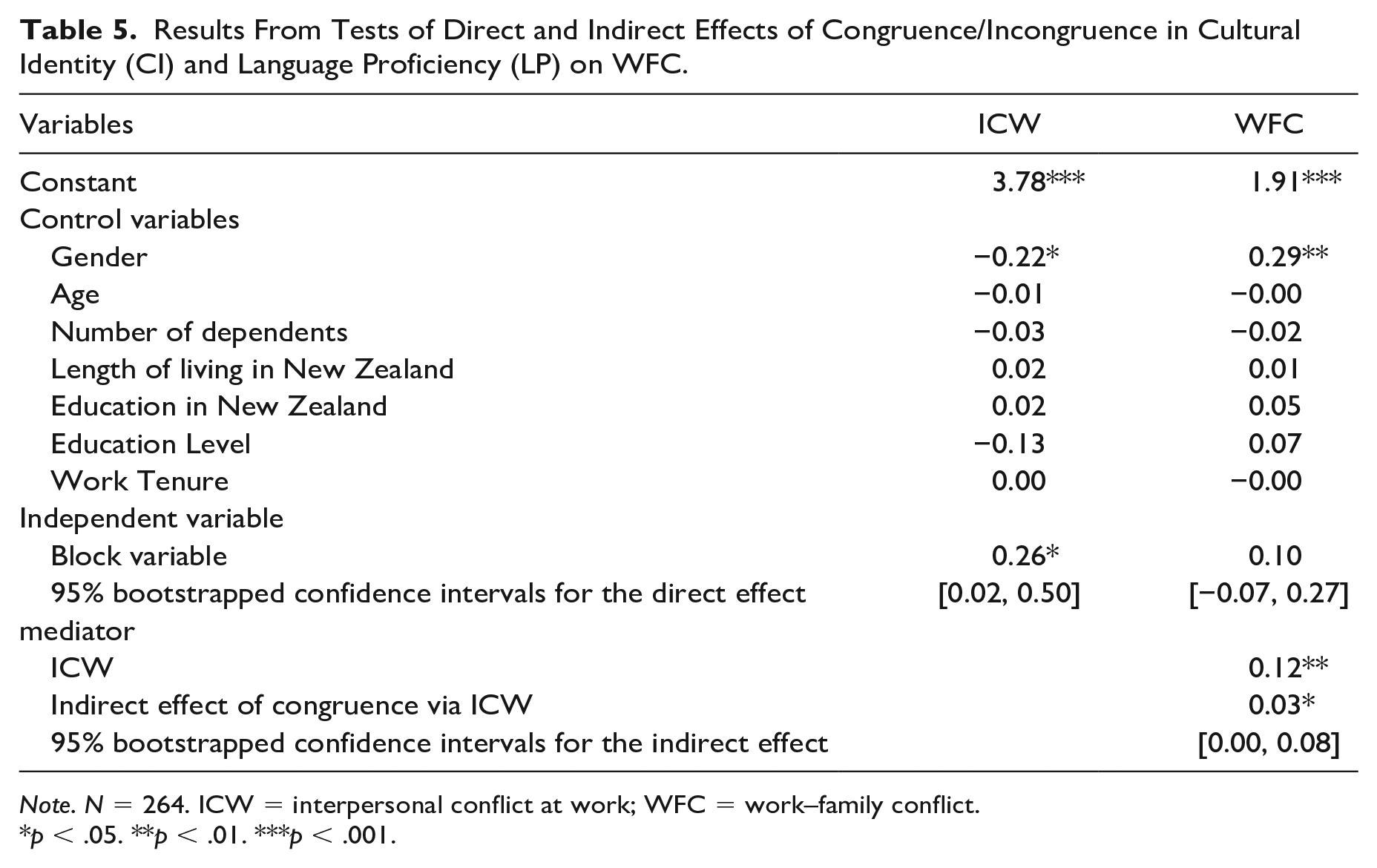
Note. N = 264. ICW = interpersonal conflict at work; WFC = work–family conflict.
p < .05. **p < .01. ***p < .001.
Discussion
This study illustrates that immigrant workers’ experiences of ICW are influenced by the alignment of their cognitive acculturation (i.e., cultural identity) and behavioral acculturation (i.e., language proficiency), which then dictate their personal experiences of WFC.
Theoretical Implications
Our Hypotheses 1 and 2 focus on the joint impact of language proficiency and cultural identity on ICW. Specifically, supporting Hypothesis 1, we found that the congruence of language proficiency and cultural identity led to lower levels of ICW. In the contrast, immigrants whose language proficiency and cultural identity are ill-matched are likely to have difficulties in communicating with local colleagues. This is likely to position them as outsiders within the workplace, potentially resulting in more interpersonal conflict. Although Hypothesis 2 is not supported by our results, a counterintuitive, yet interesting, finding is that immigrant workers with high congruence (i.e., high language proficiency and high cultural identity) experienced similar levels of ICW compared with those with low congruence (i.e., low language proficiency and low cultural identity). A possible reason for this may be that an immigrant with high congruence is well positioned to communicate effectively with and understand the action and behaviors of local colleagues, leading to less ICW. However, if an immigrant’s language proficiency and cultural identity are equally low, they may be less willing to communicate and interact with local colleagues in-depth (Mendenhall & Oddou, 1985). Moreover, an intriguing discovery, not initially part of the hypotheses, is that, according to Table 1, both language proficiency and cultural identity exhibit an inverted-U curve relationship with ICW. In simpler terms, when Chinese immigrants achieve moderate levels of language proficiency or cultural identity, they experience high levels of ICW. The possible reason behind this phenomenon could be that with moderate levels, they find themselves in a position of balancing between maintaining their cultural background and integrating into the new cultural context of the workplace. According to social identity theory, this balance may lead to their confusion in identifying with either the host or home groups, resulting in interpersonal conflict with both groups in the workplace. Nevertheless, this curvilinear relationship between language proficiency/cultural identity and ICW warrants further research and exploration.
Hypothesis 3 was supported and revealed that ICW fully mediated the combined effects of immigrant worker’s language proficiency and cultural identity on their WFC. A lack of congruence between language ability and cultural identity can be detrimental to the quality of their social network, leading to fewer resources available for immigrant workers to reconcile any conflicts that may emerge between work and family. Our findings illustrate that immigrant experiences of conflict, wherein work interferes with family life are reduced when their language proficiency and cultural identity are congruent compared to when the two components of acculturation are ill-matched. We contend that immigrants’ WFC experiences are shaped by the extent to which their language proficiency and cultural identity are compatible.
Our findings provide two main important theoretical contributions to research on WFC, acculturation and ICW. First, this study takes a more nuanced approach to understanding the antecedents of WFC in the context of acculturation. Although Grzywacz et al. (2007) called for more research to investigate the role of acculturation in the work–family model, only a handful of studies have begun to address this. For example, Shang et al. (2018) treated acculturation as a composite variable to predict WFC. Olson et al. (2013) investigated how language and socialization (two components of acculturation) independently predict WFC. To date, little attention has been given to the simultaneous effects of different components of acculturation on the work–family experiences of immigrants. This is despite language proficiency and cultural identity being acknowledged as two critical components of acculturation that are intertwined with each other to facilitate an immigrant’s cultural adjustment to the host country (Chen et al., 2008; Tong & Cheung, 2011); thus, having a huge influence on their work–family experiences (Lazarova et al., 2010). The mechanisms that represent this acculturative evaluation process have been minimally investigated. Our study is an attempt to address this gap, and by using social identity theory as our theoretical framework, we suggest that immigrant workers can capitalize on their language ability and cultural identity to build social network in the workplace.
Second, this study extends acculturation and ICW literature by illustrating the importance of the joint effects of different facets of acculturation when evaluating the impact of acculturation on immigrants’ working experiences. Schwartz et al. (2010) suggested that acculturation is not a composite or aggregated variable, and each component of acculturation may or may not change in tandem, making it inappropriate to describe an immigrant as “more acculturated” or “less acculturated.” Hence, measuring acculturation congruence among different components is critical while assessing the effect of acculturation (Lee et al., 2019). Our study demonstrates that investigating congruence between language proficiency and cultural identity is more informative than assessing either of them alone to uncover the subtle influences of acculturation on immigrants’ interpersonal relationships in the workplace and on their WFC experiences. Our findings suggest the importance of incorporating the different components of acculturation simultaneously into theoretical frameworks when one seeks to comprehend the outcomes of acculturation. Such an approach offers a fuller and richer lens for understanding the impact of the interaction between different dimensions of acculturation on immigrant workers’ social network in their host country. Such an approach offers a fuller and richer lens for understanding the impact of the interaction between different dimensions of acculturation on immigrant workers’ social network in their host country.
Practical Implications
Numerous organizations have developed their own family-friendly policies to help employees reduce their experiences of WFC. Evidence suggests that such policies can substantially enhance the balance struck between work and family, leading to positive outcomes for both employers and employees (Lapierre et al., 2018). Our findings highlight new avenues for organizations that hire immigrants as far as their work–family experiences are concerned. First, it is critical to recognize that immigrant workers high in either behavioral acculturation (e.g., language proficiency) or cognitive acculturation (e.g., cultural identity) do not necessarily have reduced WFC. Our findings reveal the importance of finding viable ways to improve the acculturation of immigrant workers. Organizations that seek to reduce immigrant workers’ WFC should incorporate relevant mechanisms into their family-friendly policies to ensure that such workers are able to adjust to their new workplace behaviourally and cognitively. A possibility is to assign suitable local colleagues to serve as a “buddy” or mentor to immigrant workers, so that they have a ready source of support, advice, and information when navigating through the complexities of a new culture. This will then promote their language and cultural identity in tandem. This strategy may also pre-empt inadvertent cultural faux pas that give rise to conflict at work, which then impact the immigrant’s family life. In addition, organizations are encouraged to provide culture-related events and activities to facilitate cross-cultural interactions within their workforce (Kuo & Roysircar, 2004) in a bid to increase immigrant workers’ understanding of the local cultural values and norms related to cultural identity while they are improving their language proficiency.
Finally, organizations would do well to recognize that acculturation is a multidimensional phenomenon and that different dimensions can jointly determine an immigrant’s acculturative status. With this recognition, it would be beneficial for organizations to explicitly evaluate immigrant workers’ acculturation and orient them in each of the dimensions of acculturation (e.g., Mendenhall & Oddou, 1985).
Limitations and Future Research
Several limitations are associated with this study. First, the data were collected from Chinese immigrant employees working in New Zealand, limiting the Generalizability of the results to other immigrant populations or Chinese immigrants residing in other countries. Many factors might potentially influence the congruence between dimensions of acculturation, such as the similarity between immigrants’ home and host cultures, and the overall tolerance of immigrants in host countries. Future research could address this limitation by comparing findings based on samples from different cultures (e.g., host countries with high or low similarities to the home culture of immigrants).
Second, this study focused on immigrant workers’ adaptation of host cultural orientation, did not account for how their own heritage cultural orientation affects their experience of WFC, from a biculturalism perspective. Biculturalism suggests that immigrants undergoing acculturation may not necessarily completely assimilate to the host culture’s characteristics, but instead, they may hold onto their heritage cultural values and beliefs (Flannery et al., 2001; Nguyen & Benet-Martínez, 2013). The acculturation of immigrants is thus considered to be bi-directional, and they may be involved in both, either, or neither of their cultures with regards to language, values, beliefs, or identity (Flannery et al., 2001; Nguyen & Benet-Martínez, 2013). Therefore, one potential avenue for future research is to investigate the impact of retaining one’s heritage culture on the acculturation process for immigrant workers, which could, in turn, affect their experience of WFC including both directions, WFC and family-to-work conflict. By exploring this relationship, we could gain a more thorough understanding of the role of acculturation in WFC.
Third, this study was not conducted with an experimental design; thus, limiting the conclusions about causality. Although the CFA results, ad hoc common method bias testing, and longitudinal design could alleviate this concern to some extent, it would be much more beneficial if future studies assessed key variables from a variety of information sources. For example, it would be prudent to have co-workers to report immigrant colleagues’ personal conflict with them, as well as use objective data to assess the language proficiency of immigrants to further strengthen the conclusions from this study.
Fourth, the use of control variables might raise concern with the analytical results. In this study, we controlled some demographic variables (i.e., length of time in New Zealand, work tenure, education, gender, age, and number of dependents), which are common in acculturation and work–family research. However, WFC is very complex and influenced by both personal factors and environmental factors, such as personal coping strategies, and personality. We recommend that future studies include additional personal and environmental factors to strengthen the research findings. For example, a previous study indicated that levels of WFC may be significantly reduced when individuals invest effort in developing personal coping strategies and organizations provide sufficient support (Somech & Drach-Zahavy, 2012).
Conclusion
Immigrant workers’ human capital and talent are recognized as a source of competitive advantage to organizations and the host country (Farashah et al., 2023); therefore, organizations should ideally be committed to improving and ensuring immigrant workers’ well-being (e.g., reducing their WFC). This study identified an important joint effect of immigrant workers’ language proficiency and cultural identity on WFC via ICW. Our findings suggest that it is critical to examine the congruence between language proficiency and cultural identity, rather than either of them alone, in predicting immigrant workers’ experiences of interpersonal relationship in the workplace and work–family interface. Organizations could benefit from improving immigrant workers’ well-being by recognizing the multidimensional characteristic of acculturation and committing to a comprehensive improvement of immigrant workers’ acculturation.
Footnotes
Declaration of Conflicting Interests
The author(s) declared no potential conflicts of interest with respect to the research, authorship, and/or publication of this article.
Funding
The author(s) received no financial support for the research, authorship, and/or publication of this article.
