



Abstract
The use of pseudonyms in qualitative research is common and aims to preserve the anonymity of the participants. However, there is a lack of consensus on how pseudonyms should be chosen in qualitative research among ethnic populations. The present study examines how transferring the decision as to the choice of the pseudonym to the participants themselves can illuminate aspects of their identity. The study is based on semi-structured in-depth interviews conducted with 36 young Israeli-Ethiopians. Two main themes emerged from the data which we felt were relevant to the issue of pseudonym choice: The first concerned the declarations of identity (Ethiopian, Israeli, and integrated) of the young people in the study, and the second concerned their choice of pseudonyms (in Hebrew or Amharic). Most participants chose Hebrew pseudonyms. The discussion suggests two identity profiles—Reactive and Agency—that correspond to the relationship between the identity declaration and the pseudonym chosen.
Names, language, clothing, and even flags are key symbols of identity. Yet, according to Allport (1961, p. 117), our name is the most significant anchorage to our self-identity throughout life. A name often reflects personal qualities and characteristics and evokes specific images associated with its bearer and his or her community history (Aksholakova, 2013, p. 468). We do not choose our names; they are usually given to us by our parents at birth. It is interesting to think about what would happen if we were given the opportunity to change our names as adults. Would we choose a different name? In the current research, we gave the participants that opportunity by allowing them to choose their pseudonyms. The current article examines how pseudonyms can represent the personal and social identity of the participants through a case study of Ethiopian immigrants in Israel.
Names and Identity Formation
Elias (1991) claims that there is a clear connection between names and identity, in which forenames are significant in self-identity formation, whereas surnames are crucial for social identity. Our name serves as an identification badge, allowing others to recognize us. They also serve a critical dual purpose of being both individual and collective (Krogseth, 2012), because naming constitutes an important role in building a nation, by creating collective identification (Windt-Val, 2012). According to research, certain first names are distinctive to specific racial or ethnic groupings, while surnames are commonly utilized as essential identifiers in creating an individual’s personal, ethical, and national identity (Khosravi, 2012; Pilcher, 2016; Rom & Benjamin, 2011). Yet, despite increased diversity, cultural names continue to be stigmatized (L. L. Moore et al., 2020). Given the stereotypes associated with ethnic names, names can become potential causes of prejudice (Peterson et al., 2015). Gaddis (2017) highlighted three name qualities that may affect an individual’s sense of race as a result of their name: (a) the racial status of a first name in the population; (b) the socioeconomic status of a first name in the population; and (c) the racial status of a surname in the population.
Ethnic groups are often required to negotiate their identity by deciding to adopt or reject the names chosen for them by the dominant group (Franco et al., 2001; Gerrig & Banaji, 1991; Neal, 2001). Wykes (2015) found that when choosing a child’s name, multiracial parents tend to be confronted with “juxtaposing concerns: a fear of potential discrimination faced by the children based on them bearing a ‘foreign name’ and a desire to reflect the children’s multiracial and/or ethnic heritage” (p. 1). Findings regarding Black names show that men with stereotypically “Black names” were portrayed as larger and more aggressive (Holbrook et al., 2016). Another study, supporting the researchers claim, showed that as their neighborhood earnings grow, White, Latino, and African American women are less likely to pick unusual names that represent cultural distinct for their children (Oliver et al., 2016).
Research shows that people with unique names suffer from low adjustment abilities and other social difficulties (Busse & Seraydarian, 1978, 1979; Garwood, 1976; Zweigenhaft, 1977). However, findings show that those who declare loving their name report higher scores of well-being (Gist & Wright, 1973; Kang, 1971; Walsh & Yakhnich, 2020). Names can also signify ethnic identity (Alia, 1994; Lieberson, 2000; Lieberson & Bell, 1992; Mateos, 2007; Miller, 1996). Alia (2007) argues that names are not simply a tag or label but an important site to construct boundaries of belonging, have “politics,” and may assist or complicate individual or group relationships and the capacity to integrate into society.
The idea of a connection between names and identity can lead to understanding that “renaming is remaking” (Suarez, 1997, p. 237). In other words, giving a person a new name can in some way be considered as creating a new identity. Khosravi (2012, p. 65) argues that understanding a person’s affiliation to a specific group begins by understanding the unique ethnic connotation of their name. The issue of name changing is complex and sensitive, and has often been the manifestation of cultural hegemony of a majority group, especially following immigration (Fermaglich, 2018). Name changing can involve the coercion of a minority or immigrant group to assimilate within the majority cultural and the giving of a name by the dominant culture can be considered a form of rejection of the cultural origins of the minority group (Tummala-Narra, 2016; Walsh & Yakhnich, 2020). Yet interestingly, although much qualitative research involves the interviewing of minority or vulnerable populations by a member of the more dominant, powerful population (e.g., researchers), the issue of pseudonyms has been little addressed within the perspective of cultural power relations.
Pseudonyms in Qualitative Research
Throughout the history of research, researchers have assigned pseudonyms, believing that this practice is for the protection of the research participants (Tilley & Woodthorpe, 2011). Taking active efforts to conceal participants’ identities is all about anonymity—as a form of confidentiality (Saunders et al., 2015). Anonymization in qualitative research refers to “removing or obscuring the names of participants or research sites, and not including information that might lead participants or research sites to be identified” (Tilley & Woodthorpe, 2011, p. 198).
Zabeeh (1968) connects naming and power by saying that the act of naming says a lot about the relationship between the person giving the name and the one who receives it. The literature reveals two main perspectives regarding the use of pseudonyms among researchers. On one hand, researchers highlight the psychological importance of choosing pseudonyms that mean something to their participants (Allen & Wiles, 2016), and some researchers (e.g., Lahman et al., 2015) suggest it is appropriate to allow the research participants to choose their pseudonyms. For example, Scarth (2015) emphasized the psychological difficulty of using pseudonyms for grieving participants. The participants emphasized the importance of immortalizing their loved ones in the research, preserving ownership of their words, and maintaining a public connection to their unique identity. One can argue that using pseudonyms is not meant to protect the participants but serves as a “marginalized eraser” (Brear, 2018; Moore, 2012). As such, according to Brear (2018), White researchers have historically exploited marginalized populations due to race, and the idea that pseudonyms should be employed to protect privacy might be seen as paternalistic and cause harm to a person or group (see, for example, Svalastog & Eriksson, 2010). The naming issue deserves more attention. Because names carry so much power, the decision to use or change them may also be considered to be an act of power. In particular, scholars working beyond positivist, objective social science must address the problem of naming and weighing the rights and aspirations of participants’ ethical commitment, personal values, commitment to analytical rigor, and dissemination of accurate representation of our research findings (Guenther, 2009). Hurst (2008, p. 346) presents her concerns about the power given to the researcher in re-naming the participants and states that “personal names do matter.”
A cultural anthropological approach views language as an essential element of culture, in which a person’s identity is formed as part of a distinct and diverse group (Geertz, 1983). Therefore, language is one of the cultural control mechanisms for humans to understand and order the world (Geertz, 1990). Language makes a person a member of a particular culture different from other cultures, and according to this approach, culture is not a means of transmitting or disseminating identity but identity itself (Lomsky-Feder et al., 2007). In this context, the languages of immigrants are seen as expressions of nation-states and the construction of relations between ethnic groups, as well as central tools of identity politics (Clifford, 1994). On one hand, this means that language has the power to dominate hegemonic politics and create a social hierarchy. On the other hand, it can also be a tool to promote the unique identity of ethnic minorities and their identity politics. In this situation, the qualitative researcher, often a member of the dominant majority group examining the ethnic minority population, enters a cultural arena in which intergroup power relations may be reflected in the names chosen for the participants. Through a lack of knowledge or cultural sensitivity, a researcher may choose pseudonyms that will impose a colonialist and hegemonic opinion and represent the judgmental and cultural superiority of the majority group.
On the contrary, researchers, such as Vainio (2012), are concerned that allowing participants to choose their pseudonyms may damage the delicate power relations between the researcher and the participants because, eventually, the researcher is the one who decides how the empirical material should be treated. Edwards (2020) claims that when the researchers choose a pseudonym, they try to give the readers a sense of closeness to those particular participants. However, despite the debates around the ethics and politics of pseudonym choice, scarce research has tried to examine how pseudonym choice may add to the depth of our research and teach us something additional about the experience and identity of the people we are researching. Specifically, as relates to this study, little research has examined how the participants’ choice of a pseudonym can teach us something about identity processes. This issue is particularly salient in the case of immigrant participants, many of whom may have experienced name change following immigration (Walsh & Yakhnich, 2020).
Ethiopian Names
It has been over 30 years since Ethiopian Jews began to immigrate to Israel. At the end of 2021, the Ethiopian community in Israel numbered about 164,400 people, the majority of whom (90,600) were born in Ethiopia and the rest in Israel (Central Bureau of Statistics, 2022). It is important to understand the ethic-racial climate in Israel as regards the integration of the Ethiopian community. In 2015, a video of a police officer beating an Ethiopian uniformed soldier went viral, sparking a wave of mass protests. The protests were the expression of a grassroots movement aspiring to the promotion of equality and full integration of Ethiopian origin Israelis into Israeli society (Lamont et al., 2017). In July 2019, an 18-year-old Ethiopian-Israeli man was shot dead by police, sparking another wave of nationwide protests against police violence. This protest was heavily influenced by the African American “Black Lives Matter” movement ((Hermann, 2020).
Immigration from Ethiopia brought about a fundamental cultural change and was accompanied by integration crises in all areas of life. In the process, cultural, family, economic, and religious norms, and values that Ethiopian Jews had been accustomed to for many generations were severed (Weil, 2004). Ethiopian immigrants experienced the transition from village life to urban society, including gaps in education and employment (Kurman & Ronen-Eilon, 2004; Offer, 2007; Tannenbaum, 2008), racial discrimination and minority status (Fenster, 1998), and residence in low socioeconomic neighborhoods with inadequate social resources (Weil, 2004). Most Ethiopian Israelis demonstrate a sense of national belonging and a strong identification with the Israeli-Jewish polity (Lamont et al., 2017). However, as Lachover (2022) points out, they are aware of the stigma of “Ethiopianness” (being Ethiopian) in Israeli society, which leads the younger generation to develop forms of resistance to racism. Often young Ethiopian Israelis claim to a hybrid identity which synthesizes feelings of being Israeli, Jewish, and Black (Zawdu, 2016).
Ethiopian immigrants were often exposed to a coercive integration process at the airport when approached by an official of the Jewish Agency. The latter change their Ethiopian names to new Israeli-Jewish ones (Ben-Eliezer, 2004). The official argument was that the immigrants were being “normalized” to enter the Israeli culture by erasing characteristics that connect them to their culture of origin (Morrell-Norwood, 1998). Berhanu (2005) suggest that the assignment of Hebrew names is one of the major problems in the Ethiopian community integration in Israel. The authorities appeared unaware of the significance of names in the Ethiopian culture and the meaningfulness invested in choosing a name. A recent study examining the connection between changing Ethiopian immigrant names and identity formation indicated that the aftermath of the name change resulted in individuals feeling compelled to erase their culture, original identity, beliefs, and norms. For members of Israel’s Ethiopian community, the name change is a symbol of cultural disappearance, of an attempt to create a melting pot within Jewish society (Davidovitch & Aylin, 2020). Most Ethiopian names contain meanings that reflect the child’s birth circumstances and socioeconomic or political imperatives that influenced the immigrant family and the wider system (Anteby, 1999; Walsh & Yakhnich, 2020).
In Israel, people use their first and last names differently than in Ethiopia. To understand how deep the crisis was regarding the issue of changing names among Ethiopian immigrants to Israel, it is essential to recognize the meaning of the Ethiopian names. Three elements usually form part of an Ethiopian name—a personal name (father’s name or given name), attributes, and titles (e.g., Ato=Mr, Woizero=Mrs) (Giorgis, 2007). Biblical names, names connected to nature, names of departed family members, and names that expressed the well-being that the parents hoped for their children were among the common Ethiopian names (Museum of Jewish People, 2022). The primary principle in Ethiopia is that each person is known by his first name, which identifies him and his biological father’s first name. The same is for men and women, even if she is married (Bodovsky, 2022). To identify families and their registration as acceptable in Israel, families needed to adopt a single last name. The basic principle used was to determine the first name of the last person in the dynasty who is still alive as the last name.
Despite the literature focusing on the ways to ensure anonymity in qualitative research by using pseudonyms (Saunders et al., 2015; Tilley & Woodthorpe, 2011) and what we know about how to represent marginalized populations in research (Brear, 2018; Moore, 2012), there is a lack of studies that bring together those two aspects regarding immigrant participants. This study aimed to develop an understanding of the link between the pseudonym chosen by qualitative research participants to their identity declaration among first- and second-generation immigrants. The research addressed the following questions: How do young immigrants, first and second generation, perceive their identity as reflecting the degree of sense of belonging to the Israeli society? How do participants explain the choice of a pseudonym? How can the choice of pseudonym inform us something about identity processes among young immigrant adults? Focusing on young Ethiopian immigrants in Israel, we seek to deepen our understanding of the interplay between identity and naming in qualitative research. Theoretically, the study aims to explore the extent to which the choice of a pseudonym may relate to the way participants relate to their identity.
Method
The qualitative grounded theory framework (Glaser & Strauss, 2017) was utilized to explore how participants’ choice of pseudonyms may reflect or help us to understand something about their identity. This approach was employed because it allows the researchers to perceive the meaning of social reality from the participants’ perspective (Higgins, 2009; Spector-Mersel, 2010). It enables moving beyond description and generating a theoretical explanation (Corbin & Strauss, 2007).
Participants
This study was part of a larger research project examining Ethiopian emerging adults in the context of their military service, their risk factors, and resilience resources leading them to drop out or finish full military service (Itzik, 2022; Itzik & Walsh, 2023). Thirty-six Ethiopian Israelis (15 women and 21 men), aged 21 to 26, participated in the study. Thirty-seven percent immigrated from Ethiopia as children, and 63% were born in Israel to immigrant parents. Thirty-five percent were first-born, and all participants were single. Researchers used their judgment to recruit participants based on a purposive sample (Gideon, 2019). A “snowball method” (Heckathorn, 2011) enabled us to find new participants with previous participants’ help because it was challenging to locate further participants.
Interviews
The first author carried out in-depth semi-structured interviews. This structure allowed us to cover the main content areas concerning the declarations of identity while allowing the interviewer to have the freedom to focus on their unique narrative (Josselson, 2013). At the beginning of the interview, participants were asked to describe their military service, relationships with their commanding officers, and the challenges of military service. The interview continued with questions about the experience of racism and discrimination in and outside of the army, their parent’s personal familial immigration story, growing up in Israel as an immigrant or the child of immigrants, and how their personal experiences were expressed in their sense of identity and their connection to Israel and Ethiopia. At the end of the interview, participants were asked to choose their pseudonyms and asked about their choice.
Procedure
Each participant was interviewed once. Interviews lasted 45 to 90 min, were conducted in Hebrew, audio-taped, and transcribed using pseudonyms. The participants chose the places to conduct the interviews. Generally, they took place in a small cafe, at the request of the participants. Interviews began by giving the participants an explanation regarding the study’s aim and its voluntary nature, in addition to assurances of anonymity. All participants filled in a consent form and gave their permission to record the interview. Participants were able to withdraw from the study at any time. The criterion for completing the sampling process was determined by “categorical saturation” (Saunders et al., 2018), meaning no more themes emerged. The chosen quotes were translated and then back translated by native speakers during the writing process to ensure that the original content was preserved as much as possible. Participation was voluntary, and the study received ethical approval from the Institutional Review Board of the second author. There was no external or institutional funding for the study.
Data Analysis and Trustworthiness
Thematic coding (Clarke & Braun, 2021) was used to analyze the interviews. Analysis began by reading the interviews repeatedly until researchers felt intellectual involvement with the texts and understood the participants’ perceptions of identity. The data were divided into meaning units, which became the base for the categories and themes. A reduction of dimensions led to the establishment of main content units, forming the main categories. The data were organized in a table containing the categories, themes, and quotations that support them. Finally, researchers made the connection between the categories. At this stage, the data were conceptualized according to the categories and previous theories from the literature. To increase the study’s trustworthiness, researchers presented the main findings to key figures in the Ethiopian community in Israel. We presented the findings, and they shared their perspectives regarding their sense of the feelings of the young Ethiopian generation and their identity status, and the vast majority felt that the analysis resonated with how they saw the younger Ethiopian generation. Their responses confirmed the analytic themes and conclusions presented in this paper.
Reflexivity
The first author is an Israeli-born rehabilitation criminologist, and the second is an immigrant clinical psychologist. While both authors have extensive experience in practice and research with the Ethiopian community, neither is Ethiopian. Consequently, presenting the findings to members of the Ethiopian community ensured that our understandings were congruent with the Ethiopian community’s perceptions. The first author documented the research experience in a research journal to raise awareness of personal biases. Maintaining the documentation allowed observation of the process she went through and gained a supervised and critical perspective.
Results
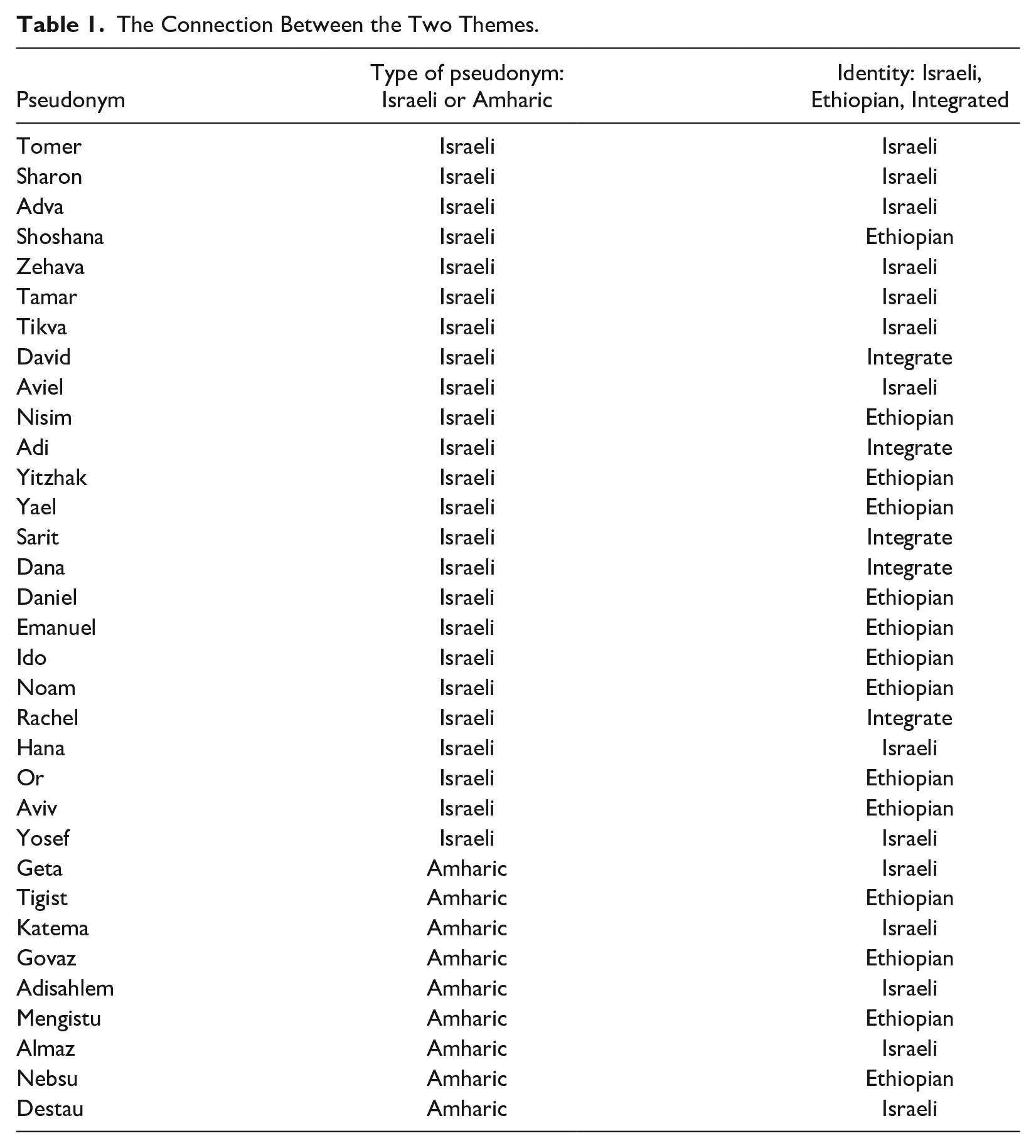
Two main themes emerged from the interviews, which were relevant to the current analysis: The first refers to the identity declaration expressed by the participants as Ethiopian, Israeli, and Ethiopian-Israeli. The second includes the name chosen by participants as an Israeli or Amharic name. Both themes represent identity and names’ unique and reciprocal influence on each other (see Table 1).
The Connection Between the Two Themes.
Identity Statement
When the question of identity arose during the interviews, participants divided naturally into three groups: The first identity statement was Ethiopian, the second was Israeli, and the third integrated both.
The Ethiopian Identity Statement: “You Do Not Want Me Here.” (14 Participants)
Participants who expressed an Ethiopian identity mainly explained their statement in light of racism and discrimination against the Ethiopian community in Israel. In their eyes, they and their families are treated first and foremost by their skin color. For example, most participants had at least one story related to an over-policing experience. Aviv’s story is one of them: Everyone I know has had an unpleasant situation with cops. And the sad thing is that I am not talking about one situation but dozens of situations. If you are an Ethiopian, a police officer will ask you what you are doing at any time, day or night, or ask you to show him an ID. It is like you are a walking target.
A racist experience was also described in various daily events, such as going to the shopping mall or entering a dance club. Those events occurred while other people were watching, which increased the participants’ embarrassment. Govaz said, “I once went with a friend who is white to a cell phone company. There was a guard at the entrance, and as he saw me, he told me not to make trouble. I was so ashamed.”
According to the young people in this category, those negative experiences leave them with a sense of alienation and lead them to adopt an Ethiopian identity and reject their Israeli identity. From the stories told by the participants, it seemed that they did not want to abandon an Israeli identity but did so as an act of protest and self-preservation. Emanuel explains his difficulty in facing the suffering his parents went through and their experiences of racism from the Israeli society throughout the years of their acclimatization in the country: The problem of young Ethiopians is that they have no sense of belonging to Israeli society. The state and the government hurt the most important thing, my parents. Treated them as inferior, as ignorant, which is why I am the most Ethiopian you will find.
Emanuel, like other participants, refers to the acculturation process their parents went through and left them with a sense of inferiority. Another way to explain the declaration of Ethiopian identity was through personal experience and unsuccessful attempts to approach Israeli identity. As a result, an Israeli identity could not be adopted. Itzhak said, “I am closer to my Ethiopian identity because Israeli identity is sealed for me. It is like you are always outside.” Participants described discrimination as not allowing them to enter clubs, police officers harassing them while sitting in a park close to home at night, or not being hired for specific jobs. The sense of alienation intensified as time passed, leaving them with a solid Ethiopian identity.
The Israeli Identity Statement: “I Am All Israeli” (14 Participants)
On the contrary, participants who defined themselves as having an Israeli identity emphasized that they speak Hebrew and are involved in Israeli society. For many, their military service in the Israel Defense Forces defines them as Israelis. Those participants hold their Israeli identity even in a situation of non-acceptance and racism. The fact that their families did everything in their power to immigrate to Israel empowers their identity declaration. In other words, it is not a default, but a choice reserved for those who sacrifice a lot to become part of Israeli society. Zehava explains, I am proud to be in my country. Here is the place my grandparents dreamed of, which everyone was waiting to immigrate to. It does not matter if people tell me that I do not belong. I know who I am. I am an Israeli.
Some participants expressed having an Israeli identity since they naturally moved away from the Ethiopian culture because they do not connect with the customs, know the history, or even speak the language. Those born in Israel know the family immigration stories, but many do not emotionally connect to the experience. Tamar said, “There are many things that I do not know about Ethiopian history, the Jewish community in Ethiopia, I do not even speak Amharic.” Sharon adds, “There is no other option for me. I am an Israeli, and I do not know how to be someone else.” Tikva adds, “I speak Hebrew, the language that is most comfortable to me, the language in which I know how to express myself best.” Aviel explains, “I do not hold an Ethiopian identity. I grew up in Israel, and that is my culture. I am like everyone else, even if I have a different skin color.”
Interestingly, when they experience discrimination, unlike those who report having an Ethiopian identity, they decide to rise above the situation and not let it define them or undermine their identity. Adva shared her story and said, In first grade, when I acclimatized to Israel, I experienced a lot of racism. I was the only Ethiopian in the classroom, and everyone would shout at me, “samba negro.” I realized that I would accept every human being from that on, and I would not reject anyone. That is the greatest gift I have taken from racism.
The Ethiopian-Israeli Identity Statement: “I Can Enjoy Both Worlds.” (8 Participants)
Some participants explained that their combined identities, Ethiopian and Israeli, are mainly due to the desire to enjoy them both. They seem to adopt an Israeli identity in their everyday life while maintaining Ethiopian values and traditions at home. As David described, “I combine, I do something new. This is my parent’s language and tradition, and there are also things I can learn from the society around me, so why not take it all.” Dana adds, “I am Israeli, and I have more Israeli friends than Ethiopians. But that does not mean I am not Ethiopian as well in terms of food and customs.” Sarit shares, “I am in the middle, right in the middle. I do not feel connected more to the Israeli or the Ethiopian parts in me.”
From the participants’ narrative, they behave differently when visiting their parents’ homes. They allowed themselves to connect to the Ethiopian parts of their identity freely, and when at work or with non-Ethiopian friends, they related more to the Israeli identity. These participants have a wide circle of friends, including Ethiopian and non-Ethiopians, often searching for a non-Ethiopian intimate partner. Also, describing their lives as existing above skin color, they do not see their skin color as an issue. Adi said, I do not differentiate myself from others. I go out with my friends from work and have an Israeli attitude, but I am more relaxed and respectful at home. You will not see me look in my dad’s eyes when he talks, even today, because that is the way my parents raised me.
Chosen Pseudonym
At the end of the interview, the participants were asked to choose their pseudonyms. Of 36 participants, 24 chose Israeli names, nine chose Amharic names, and three selected international names (e.g., Soul, De Vinci, Lucas). The focus of the current theme is the Israeli and Amharic names. Most participants chose an Israeli-Hebrew name, and we explore how they explain the choice in the current section.
Israeli-Hebrew Names
Most of the participants chose an Israeli name. However, there were differences in the reasons for choosing those names, in line with how the young people experienced their identities. The first group who chose Israeli names were those who declared an Israeli or an integrated identity. They did not hesitate, and it looked like no other option occurred to them. They described how their sense of acceptance in Israeli society relates to a self-confident identity. Tikva (pseudonym-hope in Hebrew) explains, “I think I clearly have an Israeli identity and I am proud to be Israeli. My pseudonym should represent that there is hope in the process we went through as immigrants.” David adds, “What can be more Israeli than the biblical name of King David.”
However, there were also those who declared Ethiopian identity, but who chose an Israeli name out of a desire to feel connected, even in a symbolic way, to Israeli society. They felt the lack of belonging stemming from discrimination experiences and yet noted those friends who had accepted them and helped them to feel connected. Several chose an Israeli non-Ethiopian friend’s name. Yael said she chose the name of a friend from the military service. Ido, Or, and Daniel chose the name of their best friends from high school. They all chose a non-Ethiopian friend who allowed them to be who they are while ignoring their skin color, and who became their model of integration. As Ido said, “I will give my friend’s name. This is a friend I grew up with who shaped who I am and has always been by my side. He made me feel like I was one of the guys.”
Some of them chose their Israeli pseudonym out of disgust at the educators’ attitude in kindergarten and elementary school. A name-change narrative related to the teacher’s difficulty in pronouncing their Amharic name came up repeatedly during the interviews. Participants described continuing anger over the years related to teachers’ contempt for the Ethiopian heritage regarding naming. They also described the act of changing their names as traumatic for them and their families. That led them to choose these names sarcastically (i.e., the name they had been given by their teachers but had subsequently changed). Shoshana, who has today “reclaimed” her original Amharit name, tells her story: I was once called Shoshana. When I was in first grade, the teacher had a tough time with my name, so she told me, “We will call you Shoshana.” So, the children also called me that way. It was only at the end of high school that I started to be proud of my real name, and even though it was hard to say my name, I decided to fight for it. My mother gave me that name, and it has a story and meaning.
“They changed my name because of the kindergarten teacher. It could be that the story is about a country that wanted to make us Israelis and quickly.”
Amharic Names
On the contrary, some participants chose an Amharic name to tell the story about the lack of belonging that the Ethiopian community feels in Israel but also the pride they feel in their community struggle and history: Pride in their cultural and family values, in the way that children are taught to respect adults, with the basic respect for individuals, regardless of their origin. This also included pride in the parent’s long journey until they immigrated to Israel. They did not feel they wanted to take an Israeli name due to the Israeli society’s strong sense of rejection. By choosing an Amharic name, they announce aloud to themselves and others the identity they have adopted.
Govaz explains why he chose that name: It means “hero.” It is like someone told you, “Well done.” In more than one way, I feel that we are the heroes of our story. The Ethiopian community has suffered from discrimination and racism and still wants to be a part of Israeli society.
“The name means tolerance. Because I am so sorry that the Israelis are intolerant of us, Ethiopian immigrants, and our heritage.”
Discussion
The current study examined how pseudonym decisions among qualitative research participants, in this case, young Ethiopian Israelis, are intricately entwined with their identity experience and can teach us much about how the participant positions himself or herself in society. The findings of the current study showed that most of the participants chose an Israeli pseudonym. However, listening to the explanations given by the participants showed that the choice of an Israeli pseudonym can be connected to both Israeli and Ethiopian (and integrated) identities but from a different motivation. The chosen Israeli name presented a narrative of connection to Israeli society and identity ownership among those expressing an Israeli identity. Yet interestingly there were also young people who expressed an Ethiopian identity and who chose an Israeli pseudonym. The choice came from very diverse reasons. On one hand were those young people who chose the actual name of a non-Ethiopian friend who had accepted and helped them to integrate, despite the discrimination that the young person felt in the wider society. This choice was possibly a means of acknowledging their wish to be accepted and to fit into the wider society and the warmth they felt for those individuals who tried to help them do this. For others, the choice of an Israeli name, often that which had been given by a teacher who could not express their actual name, was sarcastic or scornful, accentuating the anger they feel toward Israeli society.
Empirical publications report very briefly, if at all, on the reasoning and mechanics of choosing pseudonyms (Guenther, 2009). Pseudonyms are typically just mentioned in a methodology section that simply notes the fact for using them throughout the research. Heaton (2022, p. 123) reported that in some cases, more details are available on the subject, especially those that reflect on the difficulties researchers faced when masking data for specific studies (see, for example, Allen & Wiles, 2016; Brear, 2018; Lahman et al., 2015; Saunders et al., 2015). Using pseudonyms requires replacing the participant’s name with a false one, which can lead to a false self-definition, changing how the person is recognized. The main problem with forming false names is their ability to communicate thoughts about ethnicity, age, gender, and other identifiers and serve as indicators in societal contexts (Heaton, 2022, p. 127). The current study’s findings emphasize the importance of the participation of the study participants in the research processes when choosing their pseudonyms. It allows ownership, even partially, of how the study is written and about the findings by the possibility of preserving their identity.
One of the main arguments of the present study is that when transferring responsibility to the study participants regarding the choice of the pseudonyms, it is important to ask the question “why?” Why did the participant choose this specific pseudonym? The information stored in answer to this innocent question can shed new light on the phenomenon under investigation and refine the participant’s remarks. The answer can empower the personal narrative, the connection to identity, the participant’s connection to the research itself, and what message she or he wants to convey as a research participant by choosing the pseudonym. If, as researchers, we do not ask the question of “why?” we may miss valuable information and a very important part of our participant’s story—the choice of a pseudonym can stem from a narrative of anger, gratitude, reflecting acceptance and connection or disconnection and so on.
In our study, the Israeli pseudonyms were the most chosen. When the “why?” question was asked, one of the main narratives to emerge was concerning the young participant’s discrimination experience. Race-based discrimination is ubiquitous, resulting in injustices such as a greater risk of imprisonment, a lower chance of employment, and poorer health care (Mellor, 2003). Perceived discrimination is the experience of a person who feels discriminated against; it is a cognitive process that takes place within a sociocultural and historical context and presents itself through discourse (Tawa et al., 2012). Studies have shown repeatedly that perceived discrimination is associated with negative feelings toward oneself and low self-esteem (Pascoe & Smart Richman, 2009; Schmitt et al., 2014), as well as substance use (alcohol, cigarettes, and cannabis) (Walsh, Kolobov, & Harel-Fisch, 2018; Walsh, Kolobov, Raiz, et al., 2018). In relation to the first name, Tuppat and Gerhards (2021) argue that immigrants with uncommon first names report higher discrimination rates. Our findings support that argument by showing that most of those who report discrimination experiences had an Amharic name but chose an Israeli pseudonym. In the context of our study, when giving them the opportunity to interact with the place they want to be in—the sense of acceptance in the Israeli society—participants took that opportunity and choose an Israeli name.
Immigrants change their names or surname (or have them changed) to become similar to people from their host country. By doing so, they reduce their difference from the majority (Pilcher, 2016). Moreover, according to Watzlawik et al. (2012), drawing on the semiotic prism model, a person’s name has a dynamic meaning that allows him to re-negotiate his identity at any point in life. Walsh and Yakhnich (2020, p. 891) suggest that names bridge cultures and identities. In the current study, the desire to become one with the new society and gain a sense of belonging led many of the participants to choose an Israeli pseudonym: a name they can sympathize with and re-negotiate to refine their identity declaration in the research context.
However, literature also shows that individuals boost their connection to the in-group in the face of prejudice to maintain high self-esteem and a sense of belonging (Giamo et al., 2012; Uma᷉na-Taylor, 2016). The current study supports those findings regarding why the participants declared an Ethiopian identity and adds that while the identity declaration was of rejection, the internal feeling was about the ambition of the connection. That desire is the base for the Israeli pseudonym. From a different point of view, the chosen Amharic names came mainly when the Israeli identity remain blocked, and the pseudonym reflects the desire to hold on to an Ethiopian identity and to use the pseudonym to express their feelings about the immigration experience.
According to Guenther (2009, p. 412), “the act of naming is an act of power.” Whether we are talking about parents naming their children or the institution or society (re-) naming. In research, naming is a complex task, as it frequently requires open dialogue between the researcher, the participants, the research aims and methods, as well as ethics guidelines (Guenther, 2009). Scholars such as Kelly (2009) refer to pseudonyms as one of the main recommendations to ensure anonymity in qualitative research. The current study aims to deal with the issue of “power,” which rests in the researcher’s hands regarding the best cultural representation of the participants. In contrast, Saunders et al. (2015) suggest a choice of pseudonyms that will not reveal the ethnic and cultural backgrounds of the participants. By returning the power to the participants’ hands, we allowed the pseudonyms to be as close to cultural reality and identity as possible.
Based on the data and findings and reflecting Grounded Theory methodology (Glaser & Strauss, 2017), we suggest two new theoretical concepts—two new identity profiles—highlighting the chosen pseudonym among young Ethiopian Israelis. The first, the Reactive profile, describes the story of a lack of belonging and rejection that some of the young participants feel on the part of Israeli society. These young people described their subjective identity as Ethiopian and the lack of a wish to be a part of a society that did not accept them. The choice of Israeli pseudonym for this group presented the longing for a sense of belonging that is preserved despite the strong feeling of rejection and the choice of Amharic names tells the story of rejection from a place of vulnerability as well as a sense of insult by Israeli society. The second, the Agency profile, represents a sense of belonging, acceptance, and self-worth. These young people described their subjective identity as an Israeli identity that belongs to them by right and for which they feel great pride. For this group, the Israeli pseudonym came as a matter of course and in the light of the sense of belonging that cannot be challenged. As such, the chosen pseudonym expresses the strong bond between the identity declaration and the participant narrative. This bond could not be told if we, as researchers, were the ones who chose the pseudonyms. From a theoretical point of view, we think that when dealing with identity issues in qualitative research, especially among marginalized populations, it is essential to step carefully—listening to the participant, on one hand, and maintaining the ethics guidelines. That approach will allow the researcher to enter the research field, not from a “knowing” perspective, and that is the reason we recommend using the “why?” method.
Limitations and Further Research
The current study, as part of a larger study that dealt with the military service experience of young Israeli-Ethiopians, sought to examine their identity statement through their selection of pseudonyms. However, participants were asked to choose a pseudonym at the end of the interview, after having discussed sensitive topics around their military service, identity, racism, and discrimination. The researchers are aware that the discourse surrounding the experiences of military service, which sometimes included discourse on incarceration in a military prison, could have biased the participants’ choice of a pseudonym, as well as the meaning they attributed to the choice As such, it may be preferable to ask participants to choose a pseudonym at the beginning of the research, or even to choose at the beginning and be allowed the option to change at the end. A second important concern is that the interviewer was not of Ethiopian origin and we cannot know whether the responses of the participants may have been different if interviewed by a member of the community. Interestingly, at the end of each interview, the participants were asked how they felt having been interviewed by a non-Ethiopian Israeli. Most responded that they felt comfortable particularly because the interviewer was not Ethiopian as they felt less judged or compelled to answer in a particular way, as they might if interviewed by a fellow Ethiopian Israeli.
Lincoln and Guba (1985) claim that the term “external validity” should not be used in qualitative studies but more subtle terms such as “transferability” and credibility or trustworthiness. To deal with this issue, the researchers enriched the findings chapter to include many quotes from the research participants, such that the reader himself or herself can assess the credibility of the themes. At the same time, it is possible that a triangulation approach, using additional research tools, would have helped to increase the trustworthiness.
Conclusion
Naming, name change, and reclaiming a name are heavily situated in a web of cultural power relations within a society (Walsh & Yakhnich, 2020). Name change has been associated with the oppression of minority immigrant and cultural groups and has been seen as an attempt by the cultural majority to impose a cultural agenda on the minority group. Yet, the issue of name change in qualitative research has been little addressed. Interviews in qualitative research encourage the creation of biographical stories and involve self-presentation procedures (Whitaker & Atkinson, 2019). In response, we as researchers have the obligation, ethically and morally, to present those identities faithfully. In this article, we have suggested that researchers must pay attention to pseudonyms. Saunders et al. (2015, p. 621) point out that the pseudonym is a widely discussed form of anonymization in the literature. In their research, some participants wanted to stay with their and their relative’s real name and not change it since they felt that changing names would strip the identity and voice of their relative. It seems the literature regarding the way to use a pseudonym in qualitative research is divided between the need to maintain the methodology clean from prejudice and, at the same time, presenting the participant’s identity as accurately as possible. However, it may be that due to the nature of the cultural power relations regarding names and naming, it is impossible to really remain neutral and prejudice free. We suggest that by letting the participants choose their pseudonyms, we manage to address both issues. Regarding minority groups in qualitative research, we believe that this practice is essential because naming is an integral part of their identity and part of intergroup cultural politics.
Footnotes
Declaration of Conflicting Interests
The author(s) declared no potential conflicts of interest with respect to the research, authorship, and/or publication of this article.
Funding
The author(s) disclosed receipt of the following financial support for the research, authorship, and/or publication of this article: The article was based on a doctoral research that was funded by the Israel Scholarship Education Foundation (ISEF).
