



Abstract
Western theories of modernization and cultural change suppose that socioeconomic development fosters support for freedom and equality in all societies. Cultural relativism and “Asian Values” thesis challenge such theories of universal human development by arguing that East Asian societies’ cultural legacies predispose them to a distinct pathway of cultural and societal development. This study uses nationally representative data from the World Values Survey and European Values Study to test whether East Asian and hystorically Protestant Western societies hold six domains of freedom aspirations as strongly as their level of socioeconomic development predicts. Protestant Western nations score consistently high on all freedom aspirations, while East Asia’s scores are higher than predicted for personal autonomy and secular identity but lower for the other four domains: individual freedom, gender equality, political liberalism, and ethnic tolerance. Multidimensional scaling reveals clearly distinguishable Protestant Western and East Asian cultural models. The dimensions these models are depicted by are associated with various salient societal outcomes. East Asia’s emphasis on personal autonomy and secular identity is compatible with good physical and mental health, low crime, competitive economy, and educational achievements. Protestant West’s support for other aspects of freedom is associated with high subjective well-being, demographic sustainability, human rights and rule of law, democratic institutions, and gender equality. Convergence in cultural and societal development may not be expected in the foreseeable future.
If Europe and Asia were situated in two parallel universes unaware of each other’s existence, and they received sufficient (although not necessarily equal) time to attain the same level of socioeconomic development, would their populations aspire for freedom to the same degree? If not, would differences in their values affect these societies’ quality of life and prospects for further development? Two fundamentally opposed theoretical camps have debated these contentious questions.
Human development theory claims that societies follow a universal pathway of development, viewing economic development, emancipative (freedom and equality) values, and liberal democracy as three pillars of the human empowerment process, which fulfills an intrinsic desire for more individual freedoms in every society (Inglehart & Welzel, 2005; Welzel, 2013; Welzel et al., 2003). Although the West underwent this process first, all societies are supposedly bound to follow the same path irrespective of their cultural heritage. Similarly, institutional isomorphism and world society theories state that innovative institutional and cultural practices that offer evolutionary advantages diffuse to other cultures as they foster competitiveness (Meyer et al., 1997). Meanwhile, culturally conservative societies that reject Western-type modernization are predicted to suffer and decline (Chirot, 2001). As Schmidt (2010) asserts, “one cannot become modern and catch up with the West without establishing a basic structure of society that resembles that of the West, because this structure is the very condition of the West’s success” (p. 517).
Cultural relativism and multiple modernities theories (Eisenstadt, 2000) reject these ideas as culturally imperialist. Similarly, Huntington (1996) insists that societies can modernize without necessarily embracing the Western model of development, but instead they can—and do—reconcile modernity with their own cultures. The “Asian Values” thesis resonates with Huntington in arguing that Asia’s unique cultural characteristics deserve preservation and constitute sources of strength (Inoguchi & Newman, 1997). From a normative standpoint, universal human development theories are contested as naïve and arrogant attempts by the West to assert its superiority. The Asian Values thesis has been similarly criticized as an endeavor to legitimize authoritarian practices by rejecting liberal values and democracy as Western imports that are allegedly incompatible with Asian culture (Welzel, 2011).
Evidently, “Eastern” and “Western” societies have not developed in parallel, and the earlier onset of economic and technological advancements in the West boosted the credibility of its cultural and sociopolitical model. The Asian Values thesis has fluctuated in popularity alongside changes in the Asian economy (Sen, 2014). The present moment may be the beginning of a historical shift of economic power from the West to Asia. This economic transformation calls for a reevaluation of human development theories within a culturally sensitive framework (Krys et al., 2020) to potentially accommodate a broader and less Western-centric conceptualization of cultural and societal development. A rethinking that leaves cultural biases and political predispositions aside could facilitate creating a more objective framework for studying culture and development.
A comparison of the West and East Asia, understood as cultural, rather than geographical entities, is warranted. Western and affluent East Asian (i.e., Japan, South Korea, Hong Kong, and Taiwan) societies are among the most successful societies worldwide, each scoring among the highest on the Human Development Index (HDI; United Nations Development Program, 2022). In recent studies, Western (especially North European, historically Protestant) nations represent the most pronouncedly individualistic and egalitarian cultures in the world. Therefore, I focus on Protestant nations as exemplary of the Western cultural model. Evidently, East Asian societies also share many cultural traits and stand out on another crucial cultural dimension: monumentalism versus flexibility (Minkov et al., 2018; Minkov & Kaasa, 2021). This dimension contrasts cultures by their emphasis on humility, flexibility, harmony, and self-improvement via hard work and education (Minkov et al., 2018). The two cultural regions may represent distinct cultural models of development that embody their own comparative advantages. Thus, East Asia and the West’s similarity in socioeconomic development alongside their questionable cultural similarity constitute an ideal setup for this study.
Previous Research
The so-called “Asian Values debate” has remained primarily ideological, pitting authoritarian-leaning Asian political circles against dissidents and Western representatives insisting on the implementation of universal standards for human rights (Chang et al., 2019; Thompson, 2001; Welzel, 2011). Empirical investigations have examined the nature of Asian values, the degree to which they are supported (e.g., Chang et al., 2019; Huang & Chang, 2017), and their distinction from Western values (Kim, 2010). Extensive research has explored differences between the “East” and the “West” (e.g., Japan and the United States, respectively), particularly with regard to constructs such as independence-interdependence and individualism-collectivism (Hamamura, 2012; Markus & Kitayama, 1991; Nisbett, 2004), and some have challenged the simplistic Asia/collectivist versus West/individualist dichotomy (Oyserman et al., 2002; Takano & Sogon, 2008; Vignoles et al., 2016). Landmark global studies have also indirectly addressed the cultural distinction between East Asia and the West by grouping them into separate cultural clusters, although the West has been further subdivided in all cases (Inglehart & Baker, 2000; Minkov, 2018; Schwartz, 2006; Welzel, 2013).
Few studies have explicitly considered whether socioeconomic development leads to the same cultural transition toward freedom aspirations in East Asia and the West. Although the theory of human development is global in scope, Welzel and colleagues test for its cross-cultural applicability (Welzel et al., 2003) and explicitly confirm that East Asia is no exception to the pattern (Welzel, 2011). Bomhoff and Gu (2012b), in turn, claim that the proposed emancipative sequence—from economic development to self-expression values and, finally, to democracy—applies to the West and possibly elsewhere, yet “East Asia remains different” (title). The authors define East Asia’s distinction in its successful economic modernization and transition to democracy but without acquiring the liberal democratic values that, according to Inglehart and Welzel, are essential for democracy. Bomhoff and Gu demonstrate that, in East Asian societies, certain values do not change in the expected direction or lack the internal structure of that in Western societies. In response, Welzel (2012) shows that when one analyzes the newly operationalized emancipative values, instead of the previously used self-expression values (see Supplemental Appendix, Part A for their operationalization), there is nothing exceptional about East Asia and the strength of values and democracy are approximately as expected based on their socioeconomic development and cognitive mobilization. In a rejoinder, Bomhoff and Gu (2012a) further disagree with the validity of these claims in East Asia. Welzel and Dalton (2016) then provide more evidence, including data from wave six of the World Values Survey (WVS), that an “assertive” political culture, including the values of freedom, equality, and democracy, has been rising globally, including in East Asia. This contradicting evidence suggests that the answers to the questions this study poses might be sensitive to the study design and the operationalization choices one makes, which warrants a reexamination in a systematic and more comprehensive way. A particular shortcoming of previous research is that they do not test explicitly the hypothesis that East Asia deviates from the patterns in the rest of the world, while Welzel and Inglehart’s examinations may have overlooked differences on specific aspects of emancipation by analyzing only composite indices.
Aims of the Study
To complement this literature, this study aims to make a two-fold contribution. First, following previous research, I focus explicitly on the cultural emphases expected to change with socioeconomic development, which I call freedom aspirations, but I also disentangle their individual components. This way, I search for distinct Western and East Asian cultural models in the composition rather than only in the composite score of freedom aspirations. I acknowledge the conceptual integrity of freedom-oriented values as argued by Welzel et al. (2021), but as the literature suggests that specific aspects of cultural change may not coincide in every society (e.g., Hamamura, 2012), I analyze cultural domains related to socioeconomic development in six separate domains.
Second, I aim to contribute to broader theoretical discussions on the nature of human development—specifically, whether it is a universal phenomenon in its culture-society link, as modernization theorists have argued, or whether multiple developmental roads exist. Thus, I test how freedom aspirations—in their totality and in their composition in different cultural zones of the world—are associated with theoretically linked societal outcomes. If individual freedoms are hindered in some regards, then it is worth examining whether this is accompanied by certain consequences for societies. In this study, I relate to a large literature on culture’s consequences (Hofstede, 1991; Inglehart, 1997; Inglehart et al., 2008; Minkov & Kaasa, 2021) and thus explore the link between freedom aspirations and a wide selection of societal outcomes in the realms of subjective well-being, health, crime, demography, governance, economy, institutional gender equality, and education.
Theoretical Framework
Two main theoretical positions exist in the literature: developmental universalism and cultural relativism (Kim, 2010; Welzel, 2011). Approaches under the umbrella term developmental universalism frame culture as a product of socioeconomic development. The notion of “universal” does not suppose that a uniform human culture exists but rather that development induces cultural change identically across societies. Modernization theory was founded on the works of early sociologists, such as Émile Durkheim, and, to some degree, Max Weber (Eisenstadt, 2000). The theory was revived primarily by Inglehart in his revised modernization theory (Inglehart, 1977, 1990, 1997; Inglehart & Baker, 2000), and later collaboration with Welzel on the human development (empowerment) theory (Inglehart & Welzel, 2005; Welzel & Inglehart, 2010; Welzel et al., 2003). In earlier scholarship, Inglehart and Baker (2000) describe the process of modernization in two stages: (a) from agriculture to industry, leading to a change from traditional to secular-rational values, and (b) from industry to service economy, resulting in a change from survival to self-expression values. Inglehart and Baker (2000) also consider the legacies of cultural heritage which place societies on a path-dependent trajectory of cultural change. Later, Inglehart and Welzel focus more exclusively on the unidimensional cultural change that results from socioeconomic development, namely from authoritarian (obedient) to emancipative values. The perspective that socioeconomic development leads to individual freedom (individualism, autonomy) is supported in other popular cultural theories, including those of Hofstede (1991) and Schwartz (2006), as well as by empirical investigations of change in individualism (e.g., Hamamura, 2012; Santos et al., 2017).
Human development theory maintains that all societies experience an emancipatory cultural shift as they develop regardless of their historical background (Inglehart & Welzel, 2005; Welzel, 2012; Welzel et al., 2003). This is due to a supposedly inherent human desire to utilize one’s full potential by shedding restraining and potentially dysfunctional social norms. As Inglehart has noted, “[v]irtually everyone aspires to freedom and autonomy, but people tend to place highest value to the most pressing needs” (2008, p. 131). These theories ground the shifting nature of values in Maslow’s pyramid of human needs, whereby higher order needs, such as freedom, are only activated after satisfying lower level needs, such as existential security (Maslow, 1954; Welzel et al., 2003; Welzel & Inglehart, 2010). From this perspective, the only obstacle to freedom is the preoccupation with pressing material needs. Accordingly, as societies become more economically prosperous, healthy, and secure, they aspire toward freedom (Inglehart & Welzel, 2005; Welzel, 2013). As such a process is supposedly rooted in our universal human nature, the shift from a mindset deprived by scarcity to a freedom-oriented one is likewise culturally universal (Welzel, 2012a, 2013). Following this theoretical tradition, one could expect that East Asian and Western societies aspire to freedom at a comparable level for their socioeconomic development.
The second tradition, cultural relativism, features theories such as multiple modernities (Eisenstadt, 2000), the “Clash of Civilizations” (Huntington, 1996), the Asian Values thesis (Inoguchi & Newman, 1997), and indirectly subsistence and climatic theories (Glowacki & Molleman, 2017; Van de Vliert, 2008). These theories posit that culture is rooted in history or ecology rather than development (Huntington, 1996). Huntington argues that non-Western civilizations will continue modernizing without becoming “Western” because Western culture offers no competitive advantage to other societies; instead, it triggers resistance and revitalization of traditional values. Respectively, these theories maintain that multiple and equally viable pathways to development exist, while some authors even outright reject common notions of development by claiming that all societies are already equally modern (Eisenstadt, 2000).
The Asian Values (or “Asian exceptionalism”) thesis adopts the cultural relativist position by pointing out that Asian societies are different because of their unique historical background, often linked to Confucianism (Kim, 2010). Credibility is drawn from claims that Asian economies are highly competitive despite not fully embracing “Western values,” such as freedom and equality (Bomhoff & Gu, 2012a). The Asian Values thesis finds proponents among Asian political elites who defend deviations from liberal democratic practices promoted as universal by the West (Inoguchi & Newman, 1997; Thompson, 2001).
Developmental universalism is also contested at the individual level as Maslow’s pyramid of needs may be culturally variant, and freedom may not be the ultimate goal of individuals in Asian societies, even after fully satisfying their basic needs. An empirical test of Maslow’s theory reveals that, in China, “the basic need is belonging, self-esteem is eliminated, and self-actualization is attained in terms of meeting societal development needs” (Gambrel & Cianci, 2003, p. 143). Similarly, Heine et al. (1999) refute the universality of the need for positive self-regard in the Japanese context, deeming it a culturally variant concept. Hofstede (1991) also argues that Maslow’s personality theory is based on Western thinking and is not culturally universal. By illustrating the Western bias of Maslow’s theory and questioning its applicability to non-Western contexts, these authors undermine the foundation of universal theories of human development.
Climato-ecological and subsistence theories could serve as another justification of the Asian Values thesis. Subsistence theories state that the traditional type of agriculture (e.g., rice or wheat) of a society’s ancestors underlies its present-day psychological characteristics (Talhelm & English, 2020; Talhelm & Oishi, 2018; Uchida et al., 2020). East Asian societies have historically practiced rice-based agriculture (except Northern China), while the West favored wheat and dairy; thus, they may differ in the very foundations of societal organization originating in the historically predominant subsistence style. Such historical differences, while temporally distant, may have placed societies on divergent developmental trajectories, especially regarding concepts of freedom. Rice cultivation required suppression of individual desires in favor of harmony and cooperation to collectively secure subsistence (Talhelm & English, 2020). Conversely, subsistence in Northwestern Europe was historically based on independent farming, which permitted more autonomy and equality (Welzel, 2013). Zhang et al. (2021) demonstrate an emphasis on individualist values among high-status individuals in historically wheat-based agricultural areas in China, which resembles the Western perspective, but not in Chinese regions that cultivate rice. These findings undermine the validity of Maslow’s theory specifically in predominantly rice-based East Asian cultures.
The subsistence style is ultimately related to the climatic suitability for certain crops and organization of agricultural production. Other arguments in favor of differential development of freedoms come from the climato-economic theory of Van de Vliert. This theory depicts an interaction between economic development and the favorability of the climatic conditions: development toward freedom is the strongest among rich countries that also exhibit demanding climate such as Northwestern Europe, but weaker in more moderate climates (Van de Vliert, 2008). Furthermore, climate is also related to the prevalence of contagious diseases, which according to parasite stress theory leads to stronger collectivism in the form of in-group closure and distrust of out-groups (Fincher et al., 2008). As East Asian countries are located in warmer climates than Northwestern European countries, the historically higher prevalence of contagious diseases may have predisposed them to a lower emphasis on freedom even if contemporary level of development is close to than in Western countries and diseases are relatively rare in both regions. It should be noted that none of these alternative sources of cultural diversity need to exist and serve any functional role today to continue exerting an influence on societies’ cultural development. Once established, cultural patterns may take a life on their own and continue reproducing even if the original conditions that triggered them are no longer present—a so-called “functional autonomy” (Hamamura, 2012). If these arguments are correct, we would expect East Asian societies to differ from the West with regard to at least some aspects of freedom aspirations, even controlling for socioeconomic differences.
Finding that East Asian and Western societies do not converge culturally would be only half of the assessment of the universal human development theory. Both cultural groups may stumble while transitioning in certain aspects of their cultural development. This could be due to a range of historical and environmental factors that moderate the impact of socioeconomic development due to culture’s functional autonomy. However, following modernization theory’s logic, any cultural deviation from full support for freedom would reflect in differences in societal outcomes. If societal culture indeed influences these outcomes, then different cultural models may predispose societies to a non-universal trajectory of societal development. For example, societies that value freedom, diversity, and equality may allow more of their members to contribute and to realize their potential, thus enhancing psychological well-being, institutional fairness, and economic vitality (Inglehart et al., 2008; Welzel, 2013), but other aspects of freedom may also harm these populations’ mental and physical health (Akaliyski et al., 2022; Li et al., 2021). Studies have frequently considered societal outcomes as consequences of culture because societal institutions are founded in the underlying cultural values (Schwartz, 2014; Welzel, 2013) or, as Minkov and Kaasa (2021) have demonstrated, subjective culture (psychological constructs like freedom aspirations) and objective culture (societal outcomes, such as institutions, and other measurable indicators) form “mirror images.” Human development theory, specifically, regards liberal democracy, institutional quality, transparency, and accountability as outcomes of emancipative societal culture (Inglehart & Welzel, 2005). Subjective indicators, such as life satisfaction, are also perceived as consequences of a cultural shift toward freedom (Inglehart et al., 2008; Welzel & Inglehart, 2010). Such arguments suggest that deviations from the supposedly universal emphasis on all domains of freedom aspirations may be associated with respective societal outcomes.
The above-elaborated theoretical positions are evaluated in a series of empirical analyses. In the section below, I first present the data source for the main outcome of interest, namely freedom aspirations, and I define the two groups of countries to be compared. Then, I describe all variables to be used in the analyses—freedom aspirations, variables measuring socioeconomic development, and variables measuring societal outcomes. Finally, I outline the methodological procedures, before proceeding with the empirical analysis.
Data and Methods
Data and Sample
Data on freedom aspirations are derived from the latest WVS and European Values Study (EVS) Integrated dataset, conducted between 2017 and 2022 (EVS, 2020; Haerpfer et al., 2020). Seven countries were surveyed by both studies and their data were merged. The dataset consists of nationally representative surveys with typically at least 1,000 respondents per country. The latest update of the survey contains 83 countries from all inhabited continents with valid data on the variables selected for this study. Table A1 in the Supplemental Appendix, Part B, presents all countries and their scores on freedom aspirations.
The literature lacks full agreement on the composition of East Asia and the West as cultural regions. I followed the tradition of Inglehart and Welzel in identifying cultural zones based on historical legacies, resembling Huntington’s civilizations. As historically Protestant countries have been classified as the most emancipated branch of Western civilization, I designated these countries as representatives of the West and in the remainder of the study, I refer to them as “Protestant West.” Countries with valid data include Australia, Canada, Denmark, Finland, Germany, Iceland, the Netherlands, New Zealand, Norway, Sweden, Switzerland, the United Kingdom, and the United States. East Asia is often labeled “Confucian” or “Sinic East” and defined as consisting of all Chinese-speaking countries and regions in addition to Japan and South Korea. Although mainland China is significantly less developed than the rest, I kept it in the sample as analyses allowed controlling for socioeconomic development. The countries/regions in my sample are China, Hong Kong SAR, Japan, Macau SAR, South Korea, and Taiwan. As robustness checks, I also repeated the analysis using more widely defined culture zones. For the West, that meant including Western European historically Catholic countries, namely Andorra, Austria, France, Italy, Portugal, and Spain. For East Asia, I added other countries that may be considered influenced by Confucianism: Mongolia, Vietnam, and Singapore.
Variables
Freedom Aspirations
To operationalize freedom aspirations, I selected items from the WVS-EVS dataset that conceptually relate to the overarching theme of human emancipation. The items were grouped into six domains based on their conceptual similarity using a formative logic for scale construction (Welzel, 2013; Welzel et al., 2021). Figure 1 shows the items comprising each of the six freedom aspiration domains (full item wording is presented in the Supplemental Appendix, Part C).
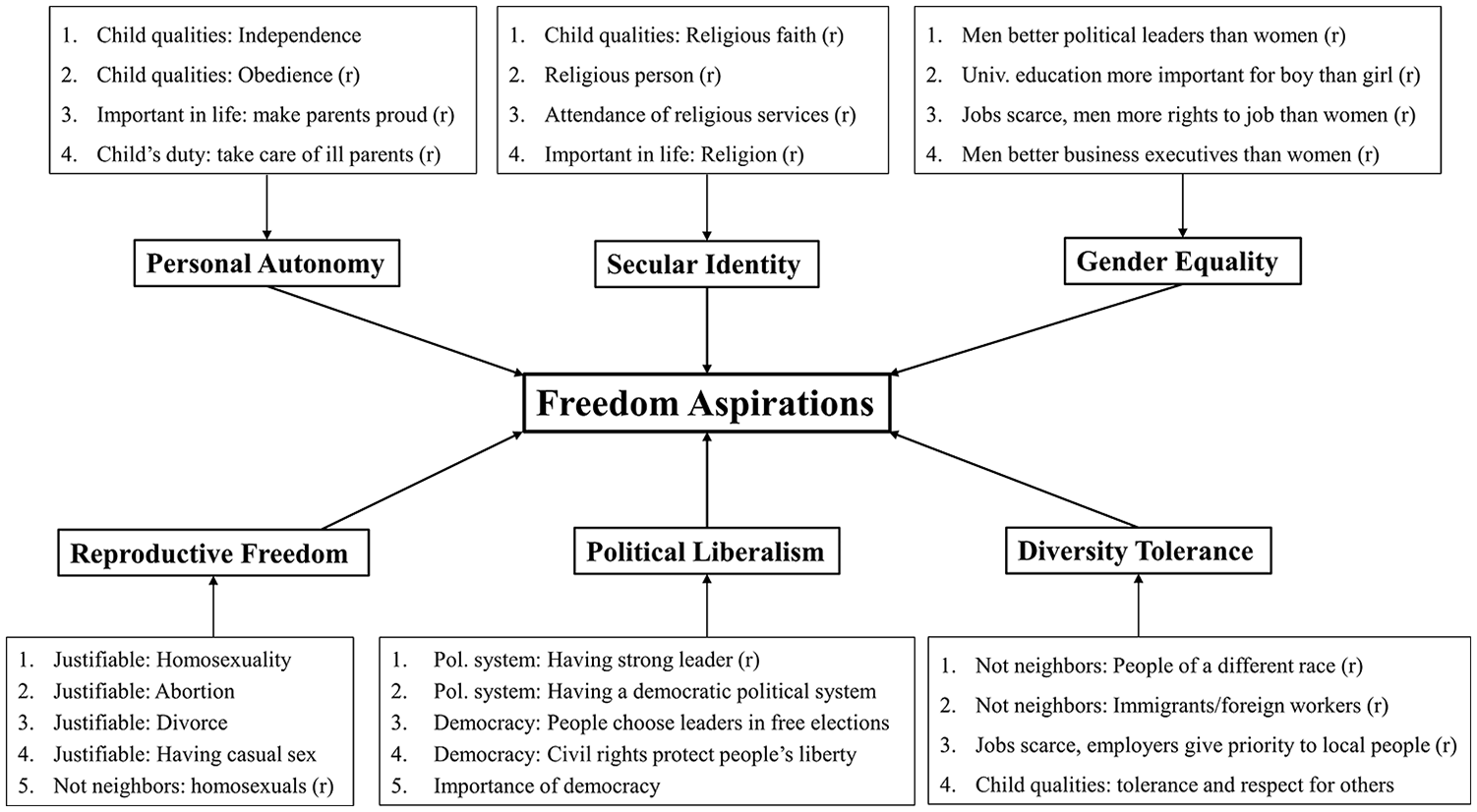
Composition of Freedom Aspirations.
The item list comprises an expanded version of Welzel’s (2013) emancipative values, which denote individual freedom and equality of opportunity. These two concepts—freedom and equality—should be regarded as two sides of the same coin: a society can truly achieve freedom for everyone only if everyone is treated equally. If women, ethnic minorities, immigrants, and individuals with diverse lifestyles and sexual orientation are in any sense not treated equally (hence, being discriminated), then their freedom is inevitably hindered. Therefore, the equality aspect of this construct does not simply relate to the freedoms of the groups in question (women, immigrants, people with different sexual orientation, single mothers, political minorities, etc.), but are indicative of the way societies perceive individual freedoms as a whole.
The individual domains include three of Welzel’s emancipative values, namely, autonomy, equality, and choice, in this study labeled as personal autonomy, gender equality, and reproductive freedom, respectively, to which I include one or two additional items with the aim to enhance their reliability. I expand the number of domains with three constructs which are also related to freedom and equality. The secular identity (the opposite of religiosity) domain denotes freedom from traditional sources of authority, which has also been part of Minkov’s (2018) individualism-collectivism and of Schwartz’ (2006) embeddedness versus autonomy values. Political liberalism captures the popular attitudes toward liberal democratic versus autocratic governance, which has also been a concern in Welzel’s scholarship as an aspect of human emancipation (e.g., Kirsch & Welzel, 2019). Finally, ethnic tolerance captures the degree to which foreigners and ethnic/racial minorities are treated as equal members of society, which has also been a central feature of Inglehart and Welzel’s theory of cultural change. Therefore, the so constructed freedom aspirations index keeps the same focus on freedom and equality as emancipative and self-expression values do, while broadening their composition.
The constructs were built following Inglehart and Welzel’s methodology and most specifically that of emancipative values. First, all items were recoded from their original binary or ordinal scale to an identical scale. To ease comparability and intuition of numerical interpretation, I rescaled all items to vary between a theoretical minimum of 0 and a maximum of 100. Then, all items were mean averaged at the national level and each of the six domains was created as the mean of their comprising items. Finally, all domains were mean averaged to produce a freedom aspirations index, also ranging between theoretical bounds of 0 and 100. 1
As with Welzel and Inglehart’s cultural dimensions, the analyses focus on the country means on these constructs as indicators of the central cultural gravity center in a society, which aligns with the conceptualization of culture as a group-level phenomenon (Akaliyski et al., 2021). Akaliyski and colleagues demonstrate with regard to emancipative values that nations are meaningful units of analysis for cross-cultural research as they capture the bulk of the explainable variation in individual-level values, while various intra-national groups gravitate around the nation’s central cultural point. Therefore, this is an ecological level analysis that follows an “eco-logic,” which may differ from that of individuals within societies (Leung & Bond, 2015). It has been disputed whether measurement invariance tests are a necessary and adequate procedures for confirming the cross-cultural comparability of such constructs (see, e.g., Fischer et al., 2022; Meuleman et al., 2022; Welzel et al., 2021). Supplemental Appendix, Part D, discusses the issue of measurement invariance.
For descriptive purposes, I tested to what extent the freedom aspirations index and its comprising domains are reflective in character at the country level. To that end, I performed a principal component analysis (PCA) on the items of each of the six domains, which in all cases indicated the presence of a single component with Eigenvalue higher than 1 and explaining between 69% and 92% of the whole variation, while the second one accounting for only between 5% and 14% of the variation (output of PCA are presented in the Supplemental Appendix, Part F). The composite freedom aspirations index also comprised a single component with 69% explained variance and each of the six domains loading highly—between 0.73 and 0.93.
Socioeconomic Development and Existential Security
To test for the potential impact of socioeconomic development and existential security on freedom aspirations, I include one indicator for each of three domains: economy, health, and safety/security. Gross domestic product (GDP) per capita in purchasing power parity (World Bank, 2021) was used to indicate the level of economic development. Life expectancy at birth (World Health Organization, 2022) represents health in relation to existential security. The Safety and Security Index (Institute for Economics & Peace, 2022) was employed to measure societal safety and security with respect to various domains, such as crime, violence, conflict with neighboring countries, and political stability. The scores on this index for Hong Kong and Macau were missing, but given the low number of cases from East Asia, it was important to retain as many as possible. The data for these two regions were therefore imputed as the mean of the other East Asian countries, which all had similar scores.
As a variety of developmental indicators have been used in previous literature as predictors of Inglehart-Welzel’s cultural dimensions, and neither of them can be considered as a 100% exogenous to culture, my choice of predictors may in any case be somewhat arbitrary. Therefore, as robustness checks, I rerun the analyses with five alternative sets of predictors and presented them in the Supplemental Appendix, Part H. These modifications included (a) replacing Safety and Security with average years of schooling (Barro & Lee, 2013), (b) replacing all three variables with the HDI (United Nations Development Program, 2022), (c) adding Safety and Security to HDI, (d) including HDI and the share of the labor force employed in industry and services (World Bank, 2021) as proposed by Inglehart and Baker (2000), and (e) including GDP per capita (log) and the share of the labor force employed in industry and services, which most closely replicates Inglehart and Baker’s empirical model. When these variables served as predictors of freedom aspirations, they were calculated as the mean of all available data points from 2010 to 2016, to reduce random measurement error and temporary shocks. In the analyses where these variables were used as control variables, they were averaged for the years from 2016 to 2020.
Societal Indicators
To test for the freedom aspirations’ nomological network, I included 23 societal indicators divided into eight domains (see list below). The full description of the variables and their justification for inclusion are described in detail in the Supplemental Appendix, Part G. Noteworthy, these indicators should be best perceived as depicting societal differences rather than as universally desirable societal outcomes. The reason is that societies vary in their developmental goals depending on their level of modernization and historical-cultural legacies (Krys et al., 2020). All data were obtained from the Quality of Government Institute (Teorell et al., 2021), unless otherwise stated. All societal indicators were calculated as the mean of all available time points within the period between 2017 and 2020, corresponding to the time of WVS/EVS’s data collection.
The indicators were as follows: 1. Subjective well-being: 1.1. Average subjective well-being score; 1.2. Life satisfaction (meta factor) (Krys et al., 2019). 2. Health: 2.1. Mental disorder (share of the population) (IHME, 2018); 2.2. Child mortality (infant mortality rate per 1,000 live births); 2.3. Obesity rate (World Health Organization, 2022). 3. Crime: Homicide rate. 4. Demography: 4.1. Human Flight and Brain Drain Indicator; 4.2. Fertility rate; 4.3. Population growth (annual %). 5. Governance: 5.1. Government Integrity Index; 5.2. Liberal Democracy Index; 5.3. Voice and Accountability Index; 5.4. Human Rights and Rule of Law Indicator. 6. Economic Competitiveness: 6.1. Economic Decline Indicator; 6.2. Global Competitiveness Score; 6.3. Innovation Capability; 6.4. GDP per hour worked, labeled “Productivity per hour worked.” 7. Gender equality: 7.1. Global Gender Gap Index; 7.2. Women’s Political Empowerment; 7.3. Women Business, and the Law Index Score, re-labeled as “Women’s Economic Empowerment” as a more succinct and intuitive label. 8. Education: 8.1. Average programme for international student assessment (PISA) scores, which represent the mean scores for mathematics, science, and reading (World Bank, 2021); 8.2. Human Capital Index.
Empirical Strategy
The empirical analysis is divided into several stages. After creating the freedom aspirations index and its domains, I employ classical multidimensional scaling (MDS; Borg et al., 2013) and correlational analysis to identify the structure of freedom aspirations and to map countries on a two-dimensional space, which accounted for the bulk of the variation in the data (see details in the “Results” section). Then, I predict the cross-national variation in freedom aspirations using multivariate linear regressions and test whether East Asian and Protestant Western societies deviate from the global pattern.
Finally, I assess whether freedom aspirations and their components predict conceptually related societal outcomes, that is, I test for their nomological network, by comparing partial correlations between the dimensions obtained from the MDS analysis and these expected societal consequences. These models include GDP per capita, life expectancy, and safety and security as control variables to ensure that the associations between the dimensions and the societal outcomes are independent of the level of socioeconomic development.
Figure 2 summarizes the conceptual framework and empirical strategy of the study. Arrows 1 and 2 represent a version of the cultural universalism thesis in its three sequences and two links: (a) from socioeconomic development and existential security to freedom aspirations and (b) from freedom aspirations to societal outcomes. The goal of the empirical strategy is to determine (c) whether the East Asian and Protestant Western cultural heritage has an independent effect on freedom aspirations and as a result also lead to different societal outcomes in East Asia and the Protestant West.
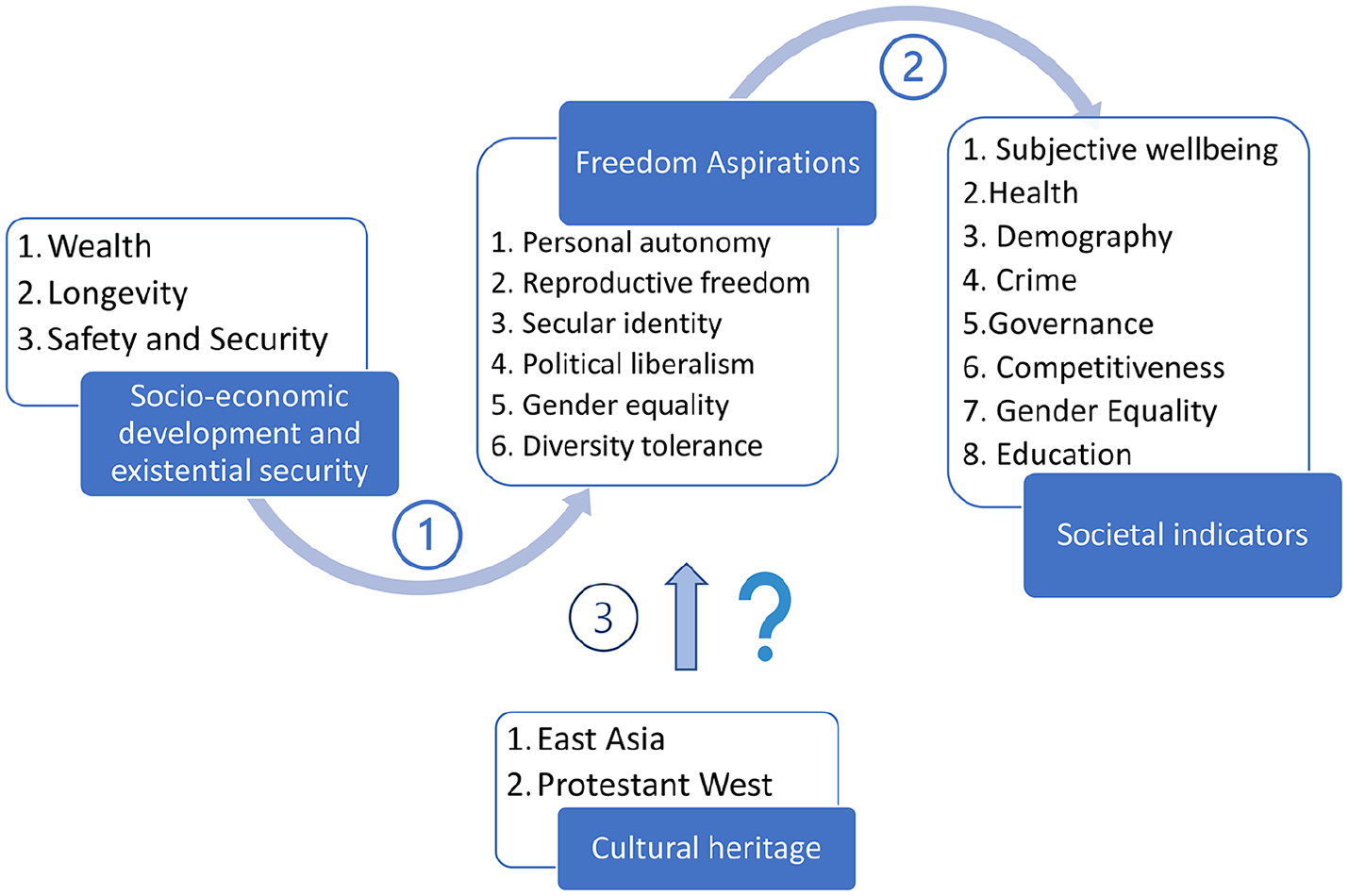
Conceptual and Empirical Framework With Operationalization of the Main Constructs.
Results
The Structure of Freedom Aspirations
Figure 3 presents a MDS plot that incorporates data on all six domains and positions the countries in a two-dimensional space based on the dissimilarity between them. The Eigenvalues indicated that the two dimensions account for 87.9% of the variation, of which 72.9% by the first and 15% by the second. East Asian and Protestant countries are easily distinguishable on the cultural map, and each cultural zone representative clusters closely with the rest. This constellation indicates a distinct emphasis on aspects of freedom between the two cultural groups. As both of them are the most extreme representatives of these dimensions, I label them as Protestant Western and East Asian dimensions, respectively. However, they, and especially the East Asian one, should not be thought of as traditional dimensions of culture whereby each of them can be conceptualized as representing a continuum of a linear degree of emphasis on a certain cultural trait but rather as archetypes which represent distinct constellations of such traits (Beugelsdijk et al., 2022; Cutler & Breiman, 1994).
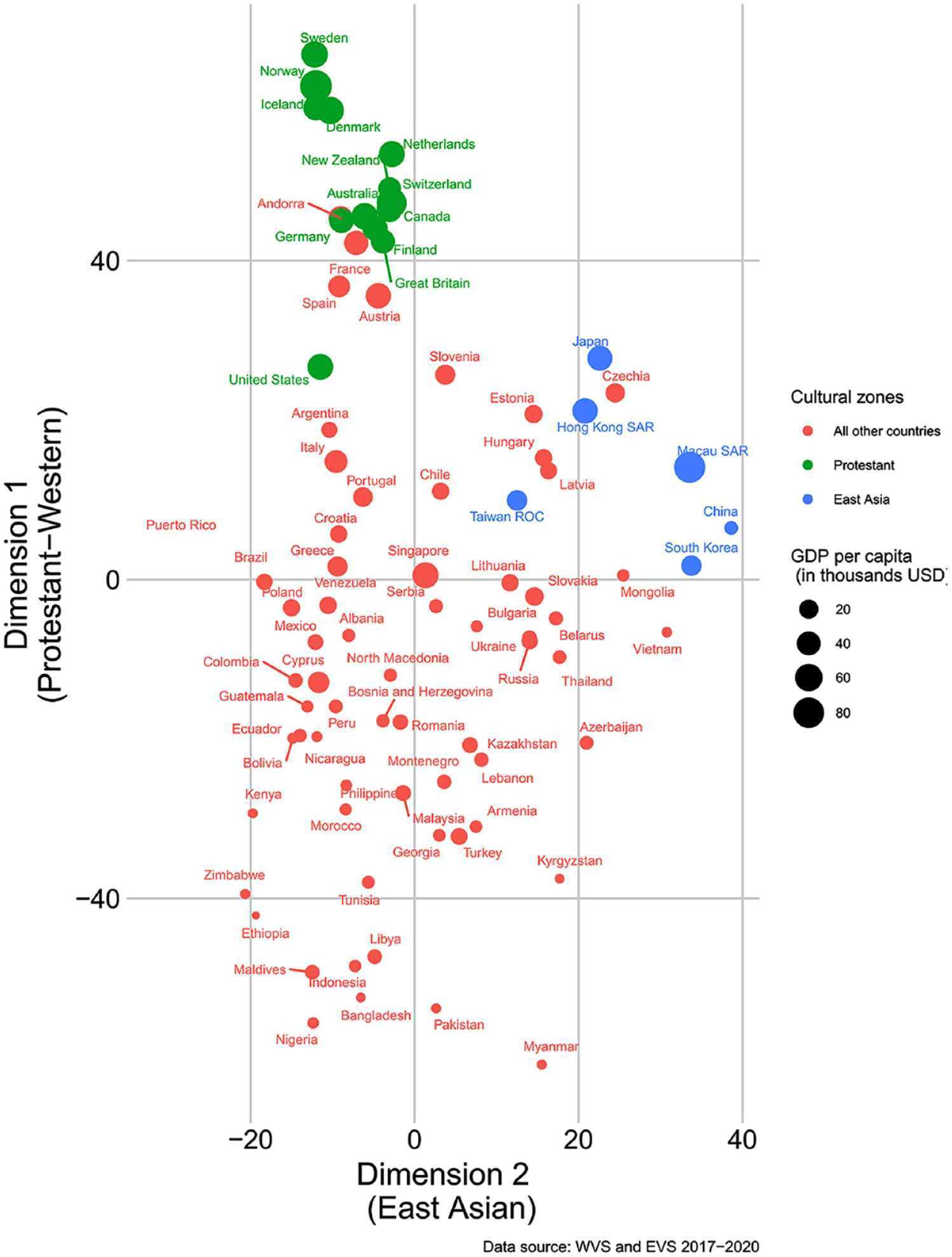
Multidimensional Scaling Plot With Six Domains of Freedom Aspirations (N = 83).
The correlation matrix in Table 1 reveals that Dimension 1 is practically identical to the combined freedom aspirations index (r = .99), and it correlates strongly with each domain as well as with GDP per capita. Dimension 2 is completely uncorrelated with Dimension 1 (r = .06), which indicates some limitations of using a unified measure of freedom aspirations. For example, while Japan and the United States score almost equally on the combined freedom aspirations scale, they are far from culturally identical in their emphasis on freedom as they embrace largely different aspects of freedom. 2 Dimension 2 is correlated positively with personal autonomy and secular identity but negatively with political liberalism, gender equality, and especially ethnic tolerance. The high scores of East Asian societies on this dimension, regardless of their level of development, imply a distinct structure of freedom aspirations in these cultures, wherein autonomy and secularity are strong but tolerance, political liberalism, and gender equality are not prominent issues of emancipation. The structure of freedom aspirations in East Asia is apparently distinct from that in the Protestant West.
Correlation Matrix Between Domains of Freedom Aspirations, Dimensions From Multidimensional Scaling Analysis, and GDP per Capita (N = 83).
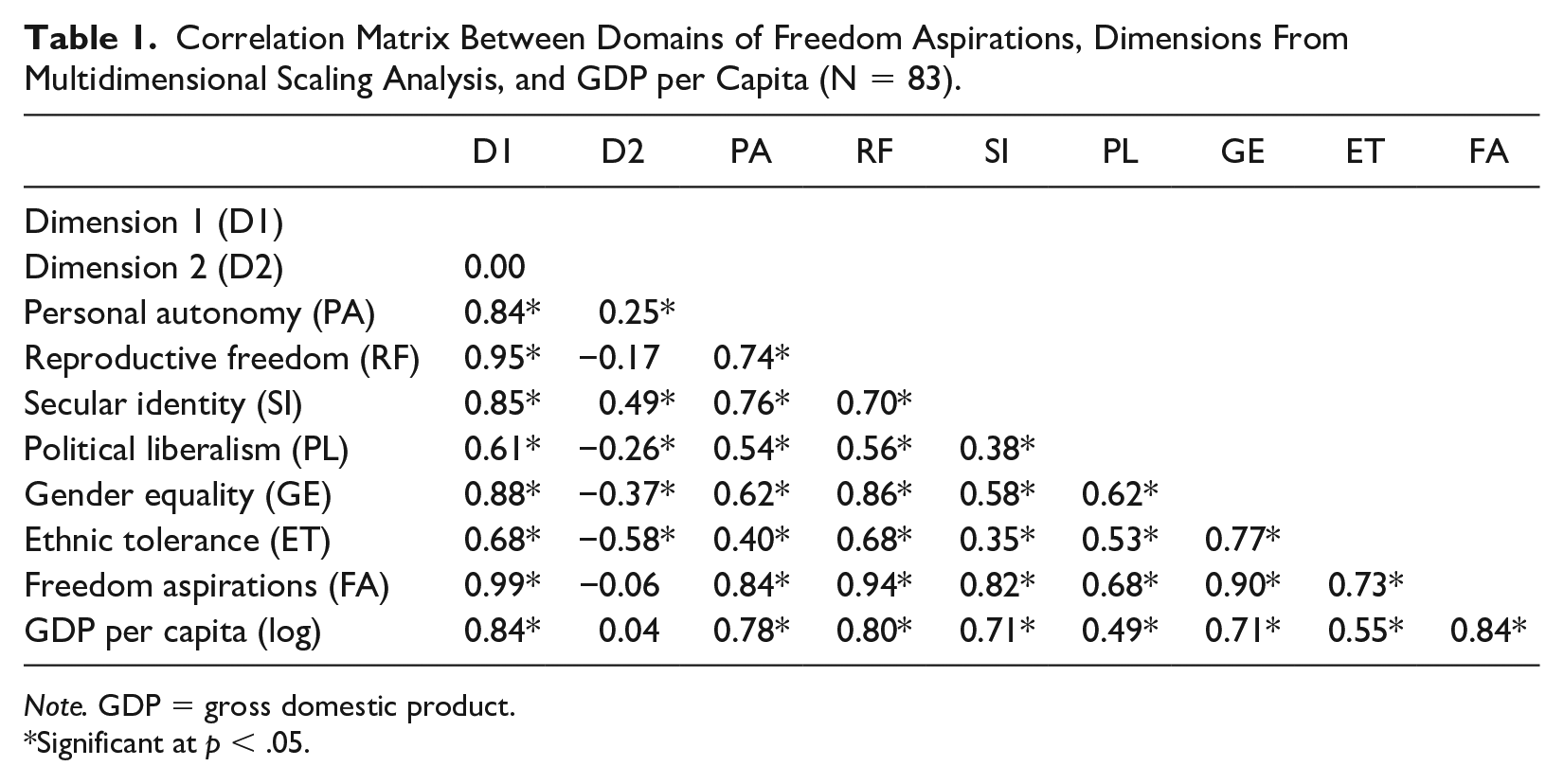
Note. GDP = gross domestic product.
Significant at p < .05.
Differences in Freedom Aspirations
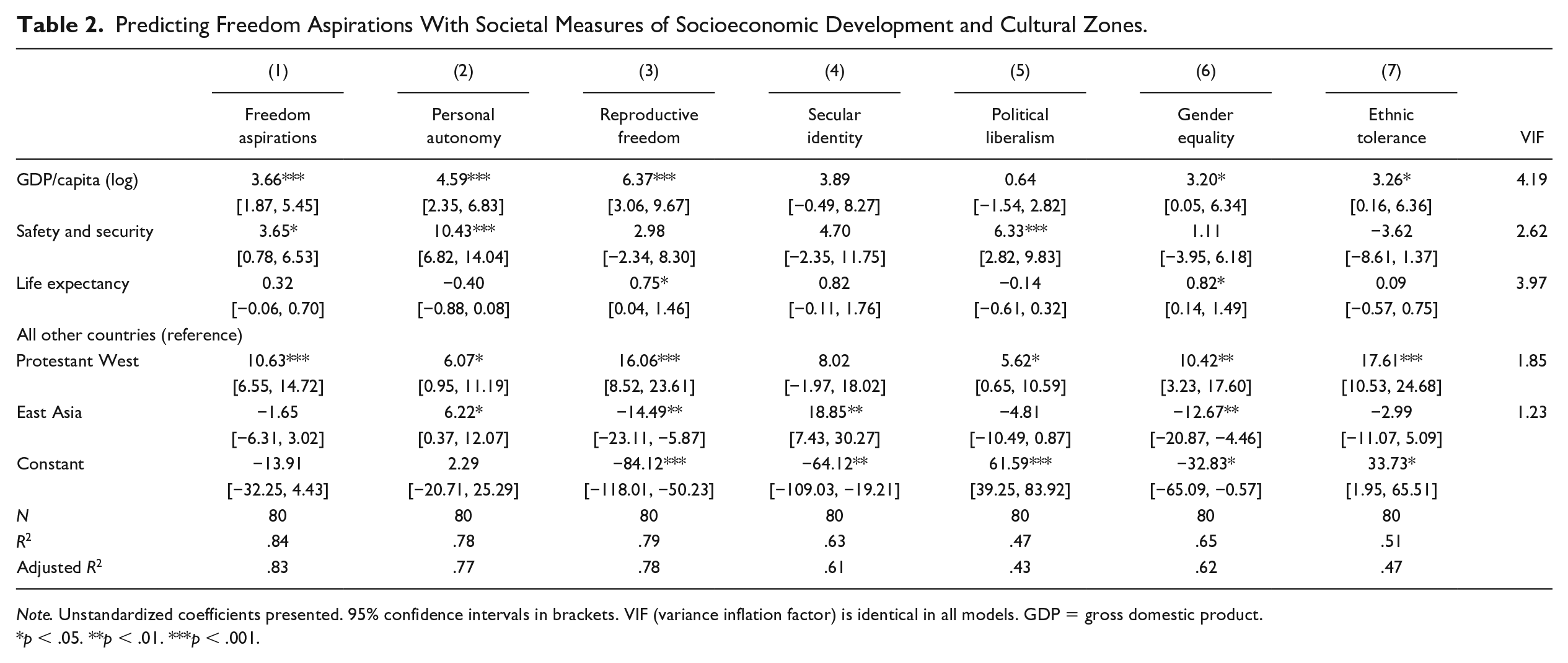
Next, I examine whether the two cultural zones remain distinct in their emphasis on freedom aspirations after controlling for measures of socioeconomic development. Table 2 introduces three developmental indicators supposedly conducive to freedom aspirations. GDP per capita is statistically significant in five, Safety and Security in three, and life expectancy in two of the seven models. These predictors along with the three cultural zone categories explain a variance of between 43% (diversity tolerance) and 83% (freedom aspirations).
Predicting Freedom Aspirations With Societal Measures of Socioeconomic Development and Cultural Zones.
Note. Unstandardized coefficients presented. 95% confidence intervals in brackets. VIF (variance inflation factor) is identical in all models. GDP = gross domestic product.
p < .05. **p < .01. ***p < .001.
The two cultural zones remain distinct in most models, as indicated by the statistically significant coefficients of the Protestant and East Asian dummies. Protestant countries embrace all domains of freedom to a greater extent than other countries, even when accounting for their (high) level of societal development, as all coefficients aside from that of secular identity are statistically significant. 3 The freedom aspirations score for East Asia is close to the prediction based on its level of development (Model 1). However, East Asia is distinct in particular domains: Relative to its development level, it supports personal autonomy and secular identity more strongly than predicted, but it scores lower than expected on reproductive freedom, and gender equality, while approaching statistical significance on political liberalism. These observations align with the distinct position of East Asia on the MDS plot but now also accounting for differences in socioeconomic development. Tables A2 to A6 in Supplemental Appendix, Part H, offer robustness analyses with alternative predictors of freedom aspirations, which all demonstrate similar patterns of distinction between East Asia and the Protestant West. Most importantly, Supplemental Tables A5 and A6 rule out industrialization and the service economy as explanations of the cultural distinction of East Asia and the Protestant West, which were proposed by the Inglehart and Baker’s (2000) revised modernization theory. Table A7 in the Supplemental Appendix documents the results with more widely defined Western and East Asian culture zones. The main difference compared to the narrower grouping is that the personal autonomy coefficient is no longer statistically significant for either zone, indicating that this feature is most prominent among the core countries of these zones.
Analysis of Freedom Aspirations’ Nomological Network
Turning to the examination of freedom aspirations’ nomological network, Figure 4 presents partial correlations of the two cultural archetypes as predictors of 23 societal indicators while controlling for economic development, life expectancy, and safety and security. Evidently, models of freedom aspirations are associated with various societal outcomes in distinct, often opposite, ways.
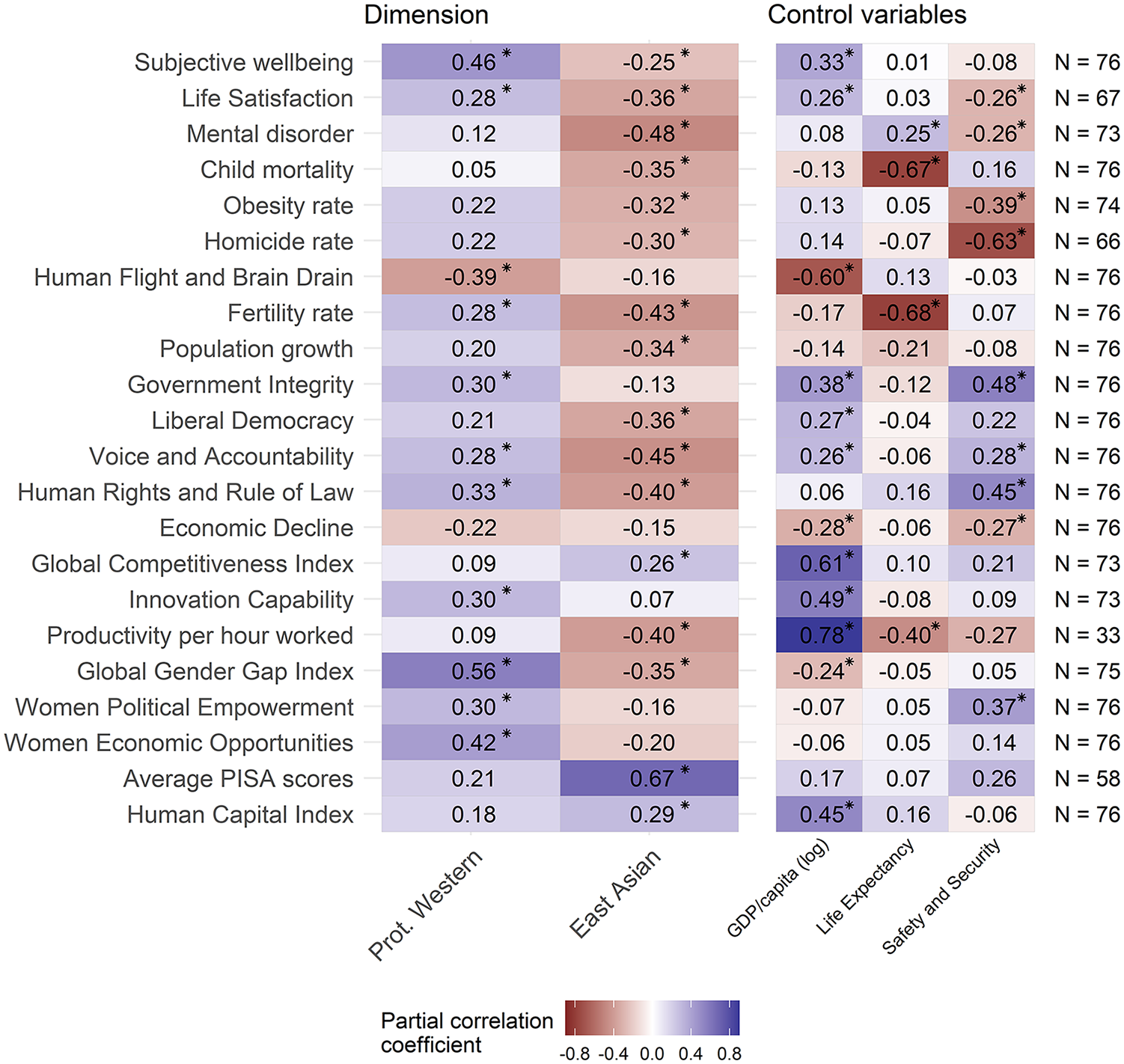
Partial Correlation Matrix Between Dimensions of Cultural Archetypes and Societal Indicators.
The Protestant Western cultural model is positively related to many societal outcomes that may be perceived as desirable such as subjective well-being, demographic sustainability, democratic institutions, innovation capability, and institutional gender equality. On the contrary, this cultural model correlates positively with some outcomes that may be universally regarded as negative such as adverse health indicators and homicide rate, although neither of these correlations is statistically significant at the 95% confidence level.
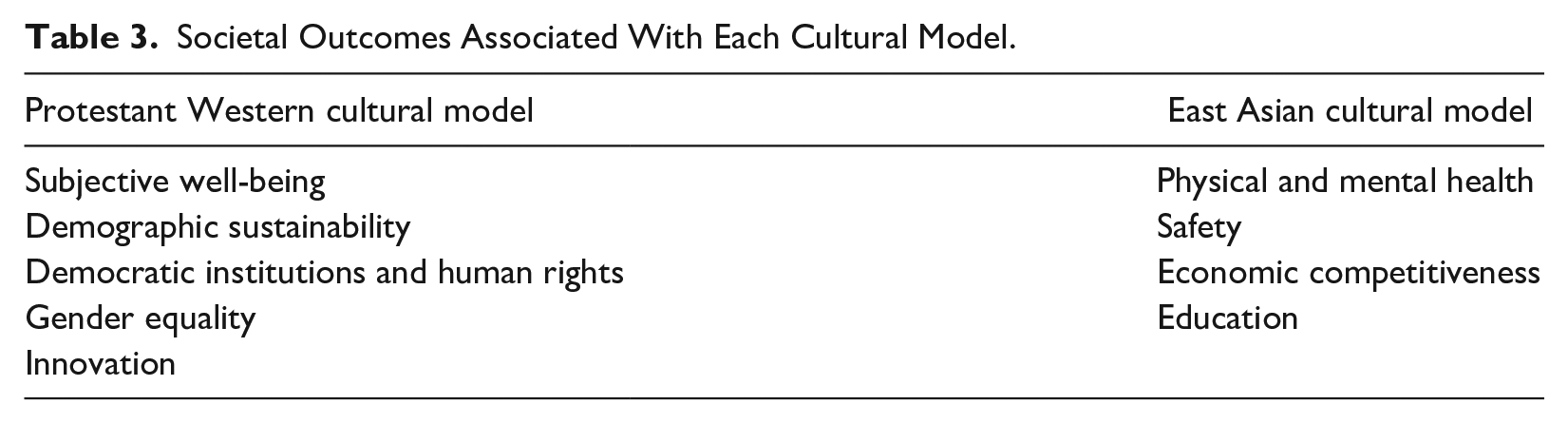
In contrast, the East Asian cultural model is negatively associated with adverse health indicators and homicide rates and positively with economic competitiveness and educational achievements. However, the East Asian dimension shows negative association with subjective well-being and life satisfaction; it is especially conducive to low fertility rates and consequently with a population decline, also to lower performance on democratic governance and individual freedoms, lower economic productivity, and lower scores on institutional gender equality. Table 3 summarized the societal emphases in each of the two cultural models.
Societal Outcomes Associated With Each Cultural Model.
Noteworthy, all East Asian cultures score higher than average on the Protestant Western dimension, while all Protestant Western cultures score lower than average on the East Asian dimension. This means that some associations may get attenuated or enhanced by the country’s positioning on the other dimension. For example, the Protestant Western model is not statistically significantly associated with obesity rates, but they have far greater prevalence (mean of 23.7%) than East Asian countries (mean of 5.7%) as these scores reflect the combined strength of the associations with both dimensions.
These findings relate to questions about the external validity of freedom aspirations. Welzel et al. (2021) have argued that individual components of a value construct are less consequential for conceptually related outcomes compared to the combined construct (in their case, emancipative values). If individual domains of freedom have less explanatory power than freedom aspirations as a whole, then East Asia’s deviation from the Protestant Western value structure would be unrelated to its societal indicators. The results indicate that freedom aspirations scale’s external linkages tend to be strong, as indicated by the correlations obtained for the Protestant Western model, but the deviations from the Protestant Western structure of freedom aspirations in East Asian countries also appear consequential for their societal outcomes, often in the opposite direction. Therefore, even if societies score equally on freedom aspirations, as do Japan and the United States, the scale’s composition may be associated with vastly different societal outcomes.
Discussion
This study enriches ongoing debates regarding pathways of societal development. It employs theories of modernization, human development, multiple modernities, and cultural relativism, to test some of their assumptions and synthesize their insights. The findings align with middle-ground theories (e.g., Inglehart & Baker, 2000) in concluding that socioeconomic development is related to a cultural mindset that emphasizes freedom and equality, but the unique historical legacies of cultural zones situate societies on a path-dependent trajectory that precludes convergence.
This study clarifies this point with an emphasis on the structure of freedom-related values in two of the safest and most prosperous groups of countries in the world. Despite comparable levels of socioeconomic development, these societies diverge in their support for specific aspects of freedom. Moreover, they are even distinct from the global patterns. All notions of freedom are embraced vigorously in Protestant Western societies. In terms of human emancipation, Nordic societies lead the world in cultural development—even more strongly than expected by their level of socioeconomic development. Hence, their historical background, which could be rooted in a unique subsistence style, disease security (Welzel, 2013), and harsh climate (Van de Vliert, 2008) or presently their strong Western cultural identity (Akaliyski & Welzel, 2020) may further enhance support for freedom.
In contrast, East Asia displays a particular pattern of support for freedom that distinguishes its cultural model from that of the Protestant West. East Asian societies support strongly personal autonomy and freedom from religion, but have lower affinity for other individual freedoms and for equality between genders. These peculiarities define East Asia as a unique cultural region, as recent studies have reported (Fog, 2020; Minkov, 2018; Minkov & Kaasa, 2021), although there is close similarity with some East European countries and other Asian countries that have also been influenced by Confucianism such as Mongolia and Vietnam. These findings support the Asian Values thesis in its claim that Asian societies share unique cultural traditions that defy Western theories of development (Bomhoff & Gu, 2012b; Inoguchi & Newman, 1997).
These conclusions, however, receive a major qualification in discovering how the freedom mindset relates to societal outcomes. The empirical analysis suggests that freedom aspirations and their specific constellation are associated with distinct societal markers. Hence, this work reintroduces culture not only as an outcome of development but also as a predictor of societies’ distinct features, as previously supported by Inglehart (1997) and, in terms of democratic development and subjective well-being, by Welzel (2013) and Welzel and Inglehart (2010). Thus, this study proposes a more comprehensive account of societal development that includes cultural values as an integral component that is not solely a consequence of development but is also potentially impactful in its own regard.
Ultimately, this qualification renders the Asian Values thesis’s claims inadequate if societal outcomes, such as subjective well-being, health, economic productivity, liberal democracy, rule of law, accountable institutions, equal opportunities, sustainable demographic development, and innovation capability, are considered universally meaningful markers of societal well-being. Asian societies indeed develop along a unique trajectory, albeit ostensibly with the associated consequences of not following the “universal” pathway of development.
The successful economic modernization in East Asia is arguably due to its mode of socialization, which stresses autonomy, the acquisition of secular knowledge, and industriousness—factors toward which the East Asian mindset gravitates. These qualities may continue to grant Asian economies a competitive edge. Such reflections may further energize supporters of the Asian Values thesis—even more so by illustrating that the Asian model is associated with higher global competitiveness, superior population health, and educational achievements. However, the lack of freedom in other domains as well as the inequality of opportunities for everyone in a society may obstruct other aspects of societal development, especially in a post-industrial economy that prioritizes creativity, freedom of thought, equality, and the advantages diversity offers (Welzel, 2012). In disregarding other societal indicators such as productivity, quality of life, demographic sustainability, innovation, individual liberties, and opportunities, the Asian Values thesis proponents fail to provide a comprehensive account of East Asia’s developmental trajectory in comparison to the West.
Limitations and Future Research
Several limitations of this study can inspire further research. First, the root causes to the Asian exceptionalism can be further elaborated and tested. In defiance of developmental universalism, the cause for East Asia’s deviance is not in its deficient levels of material and existential security, neither in the stage of economic development—industrialization and post-industrialization—as Inglehart and Baker (2000) have famously claimed. I speculate that the reasons could be traced back to these societies’ historical subsistence style and relatedly to the non-universality of Maslow’s individual-level theory of human needs. Although the findings are compatible with such an interpretation, further research should focus on identifying and testing more specific mechanisms for the distinct developmental trajectories.
Second, the societal indicators used to compare societies were selected based on their theoretical link with a freedom mindset and salience in previous research, but they may resonate more strongly as desirable end states in the West than in other cultures. The analysis indicates that East Asia “lags behind” the West on some societal indicators, but this may be due to non-Western societies assigning lower value to these goals than to other outcomes that elude the operationalization efforts of scholars who tend to regard Western perspectives on development as universal. For example, while personal well-being may be universally relevant, other types of happiness might take priority in non-Western cultures (Hitokoto & Uchida, 2015; Krys et al., 2021). Therefore, the current study could be expanded to include a wider selection of societal indicators. Such widening of the scope would certainly enrich the discussion and may even change some of the conclusions reached in this study as to the comparative advantages of the two cultural models. The list of meaningful societal indicators is not only vast but also the salience of each indicator changes over time. For example, at the beginning of 2020, practically nobody could predict that East Asian culture would become an asset in saving lives in a forthcoming pandemic (Li et al., 2022; Talhelm et al., 2022). Similarly, few can predict with certainty what future challenges societies will face and which cultures will be best equipped to face them.
Third, the analysis reveals differences in societal and cultural indicators between East Asia and the Protestant West. However, the direction of causality between them (i.e., that development causes a cultural emphasis on freedom, which in turn affects societal outcomes) was assumed based only on theoretical perspectives from previous research. Reverse causality and confounding could be ruled out by adopting a research design that specifically targets this goal.
Finally, this study focuses exclusively on East Asian and Protestant Western countries, speculating that they may be the first to mature to models of sociocultural development. However, societies from other cultural regions are also on the road or have already reached a high level of socioeconomic development. The oil-rich Middle Eastern countries, whose GDP per capita surpasses that of most Protestant Western countries, for example, are excellent candidates for exploring the impact of development in another cultural-historical contexts.
Conclusion
Socioeconomic development is evidently related to a freedom-oriented mindset, as stated by numerous studies within the developmental universalist tradition. In Asia, this process assumes a specific form that defies certain universalist claims of prominent developmental theories. The connection of socioeconomic development and existential security to a freedom mindset fully manifests only in the West. Although East Asia is fairly freedom-oriented, its points of distinction may further societal development in particular directions while impeding it in others, thus ultimately continuing an autonomous developmental path that is unlikely to converge with that in the West in the near future.
Supplemental Material
sj-docx-1-jcc-10.1177_00220221221143320 – Supplemental material for Distinct Conceptions of Freedom in East Asia and the Protestant West Underpin Unique Pathways of Societal Development
Supplemental material, sj-docx-1-jcc-10.1177_00220221221143320 for Distinct Conceptions of Freedom in East Asia and the Protestant West Underpin Unique Pathways of Societal Development by Plamen Akaliyski in Journal of Cross-Cultural Psychology
Footnotes
Acknowledgements
I thank Michael Harris Bond, Juan Diez Medrano, Stefan Gehrig, Mary Man-Li Gu, James Liu, Michael Minkov, Joonha Park, Naoko Taniguchi, Christian Welzel, the guest editor, Kuba Krys, and four anonymous reviewers for valuable feedback and inspiration.
Declaration of Conflicting Interests
The author(s) declared no potential conflicts of interest with respect to the research, authorship, and/or publication of this article.
Funding
The author(s) received no financial support for the research, authorship, and/or publication of this article.

Notes
References
Supplementary Material
Please find the following supplemental material available below.
For Open Access articles published under a Creative Commons License, all supplemental material carries the same license as the article it is associated with.
For non-Open Access articles published, all supplemental material carries a non-exclusive license, and permission requests for re-use of supplemental material or any part of supplemental material shall be sent directly to the copyright owner as specified in the copyright notice associated with the article.
