




Abstract
Previous studies suggest that people from the Western hemisphere tend to explain others’ behavior based on a person’s traits and dispositions, while participants from non-Western cultural settings more likely refer to situational factors. From a developmental perspective, it has been suggested that culture-specific modes of explaining behavior gradually emerge during late childhood and adolescence. The present study explored whether traces of a corresponding culture-specific development can be found at earlier ages when using simplified assessments. In total, 438 children between 4 and 9 years old from Münster (urban Germany), Kyoto (urban Japan), and Cotacachi (rural Ecuador), were asked to explain positive and deviant behaviors of children depicted in simple picture-based vignettes. While more internal attributions were given in Münster than in Kyoto and Cotacachi children at 4 to 5 years old, these cultural differences disappeared as internal attributions significantly increased with age in Kyoto and Cotacachi but not Münster children. Analyzing children’s explanations on a level of subcategories revealed more subtle cultural specificities. For example, when giving internal explanations, Cotacachi children focused on stable traits, while Münster children emphasized individual desires and Kyoto children highlighted more volatile aspects. Cross-cultural differences in children’s social explanations could partially be explained by mothers’ preference for autonomy-related socialization goals. Taken together, this study provides evidence for an earlier onset of internal explanations when they are culturally accentuated and further calls for a more nuanced approach to capture culture-specific meaning systems reflected in everyday social explanations.
Humans constantly make sense of and explain the behavior of the people surrounding them. How the layperson explains social events—or attributes causes to behavioral outcomes (Kelley, 1973)—has been of great interest for researchers in the last decades. In this context, it is of particular interest whether and how modes of explaining others’ behavior differ between cultures and how these differences develop in childhood. The present study focuses on the development of culture-specific modes of explaining others’ behavior. More specifically, we compared the way 4- to 9-year-old children explain others’ behavior in three cultural contexts, namely Münster in urban Germany, Kyoto in urban Japan, and Cotacachi in rural Ecuador. These contexts can be characterized by different socio-cultural orientations with culture-specific patterns of socialization goals, which presumably influence the way children learn to make sense of others’ behavior (Keller & Kärtner, 2013). Thus, we also examined to what extent children’s attribution mode can be explained by caregivers’ socialization goals.
Laying the foundations for extensive research on attribution processes, Heider (1958) first distinguished between two main reference sources to make sense of another person’s behavior: internal and external factors. Whereas internal factors refer to reasons that are located within an actor, such as personality, intentions, or abilities, external causes are considered to be factors outside the actor reflecting the context of an event, such as situational conditions, normative obligations, or other persons (Heider, 1958). Several studies found that adults from the Western hemisphere preferably tend to explain others’ behavior in terms of a person’s dispositions or other internal attributes while underestimating situational constraints. This tendency to focus on internal factors and to assume that a person’s behavior mirrors their inner life has been referred to as “fundamental attribution error” or “correspondence bias” (Gilbert & Malone, 1995; Ross & Anderson, 1982; Ross & Nisbett, 1991).
However, various cross-cultural studies found that this bias seems to be less fundamental than often assumed. More specifically, non-Western participants, mainly from the East Asian hemisphere, are more likely than European or European-American participants to infer that behaviors are influenced by the situation, such that they seem to be far less prone to the fundamental attribution error (Al-Zahrani & Kaplowitz, 1993; Morris & Peng, 1994; Norenzayan et al., 2002).
Concerning the underlying mechanisms of these differential patterns, researchers have proposed that culturally variable models of the self and other persons may provide an interpretive framework explaining human behavior (Markus & Kitayama, 1991; Miller, 1984). Highlighting the influence of self-construals on sociocognitive functions, Markus and Kitayama (1991) described Western cultures, such as the US and Western Europe, to hold a self-conception that is characterized as autonomous and independent from others and emphasize one’s unique attributes (i.e., independent self-construal). In contrast, many non-Western cultures tend to see themselves as connected to others and the social context (i.e., interdependent self-construal). These culturally varying views of the self lead to different ways of processing, organizing, and retrieving information about the self and other persons resulting in different emphases in the attribution process: While individuals from cultures holding an independent self-construal are mainly primed to focus on a person’s internal attributes as potential causes for behavior, members of interdependent-oriented cultures are more sensitive to situational and social forces as further factors that influence behavior (Fiske et al., 1998; Markus & Kitayama, 1991).
The Development of Explanation Modes
Considering the pattern of results found in adults, it is of special interest to look closely at the emergence of attributional tendencies. Upon investigating children’s cognitive capacities, researchers have shown that toddlers are capable of making inferences based on traits and mental states (Baillargeon et al., 2016). At the age of four, children understand that others’ behavior is motivated by desires and subjective beliefs (Bartsch & Wellman, 1995). Besides this belief-desire psychology (i.e., representing typical internal aspects), recent theoretical frameworks point out another informational source for children to make sense of the social world, namely normative considerations (i.e., representing typical external aspects) (Rhodes & Wellman, 2017; Tomasello, 2019; Wellman & Miller, 2008). There are indications that around the age of three, children have developed a general understanding of social norms and obligations (Rakoczy et al., 2008) and recognize obligations and social relationships as potential motivational aspects underlying others’ behaviors (Rhodes, 2014; Rhodes & Wellman, 2017).
While Hickling and Wellman (2001) reported that 2- to 5-year-old children tend to explain others’ behavior with reference to both social expectations and psychological states in their everyday conversations, it has been suggested that with increasing age children become more sensitive to internal causes (Flapan, 1968; Kalish & Shiverick, 2004; Ruble et al., 1979). For example, Kalish and Shiverick (2004) explored 5-and 8-year-olds reliance on preferences versus rules in their social judgments. They found that younger children more likely considered rules to explain future behavior, while older children were more sensitive to preferences (Kalish & Shiverick, 2004). However, most of these studies relied on Western—predominantly US-American—samples.
Evidence suggests that mentalistic as well as deontic reasoning also develops early in non-Western cultures (see Wellman & Miller, 2008 for an overview). While Wellman and Miller (2008) assume the existence of universals and common patterns in basic conceptions concerning mentalistic-deontic reasoning, they argue that culturally variable developmental changes may exist in folk psychological understandings (Wellman & Miller, 2008). More specifically, as children participate in culturally patterned social practices and interactions, such as provided by primary caregivers, they gradually internalize local cultural meaning systems into their own repertoires of thinking and, thus, prioritize certain aspects over others to make sense of the world around them (Kärtner & Schuhmacher, 2014; Miller et al., 2018; Wang, 2004). Various cross-cultural studies have demonstrated culture-specific variations in children’s mentalistic-deontic understanding (Chernyak et al., 2019; Chiu Loke et al., 2014; Heyman et al., 2011; Zhao & Kushnir, 2019). For example, Chernyak et al. (2019) found that 4- to 11-year-old US-American children were more likely to endorse the freedom to act against norms and more often explained this possibility to act in independent terms (e.g., by referencing to internal psychological states or traits) than children from Singapore. Already evident at the age of four, these cultural differences further increased with age (Chernyak et al., 2019).
In the context of spontaneous behavior explanations, Miller (1984) provided the first cross-cultural evidence demonstrating that culturally divergent modes of everyday social explanations gradually emerge over development. More specifically, she asked children and adolescents at the ages of 8, 11, and 15, as well as adults from Mysore, India, and Chicago, US, to provide examples of prosocial and deviant behaviors and to explain why the persons acted as they did. Results indicated that at the age of eight, children from both cultural groups preferred contextual (e.g., aspects of persons other than the agent or social norms) over dispositional explanations (e.g., the agent’s personality or preferences). However, this changed gradually with age, as the proportion of references to the agent’s general disposition increased in US-American but not Hindu participants, until reaching the cultural difference found in the adults’ social explanations also reported in other studies. These findings imply that culture-specific variabilities in explaining others’ behavior are low in early and middle childhood and do not become established before early adolescence.
However, considering the gradual increase of internal attributions in children between 4 and 9 years of age that has been reported in previous research conducted in Western cultural contexts (Kalish & Shiverick, 2004; Ruble et al., 1979)—where this presumably reflects the culturally dominant interpretative framework (Kärtner & Schuhmacher, 2014; Lillard, 1998)—the onset of development toward culture-specific endpoints might also be suspected earlier in childhood. This assumption is also supported by cross-cultural studies investigating children’s self-descriptions and autobiographical memories (Wang, 2004, 2016; Wang & Leichtman, 2000). For example, 4- to 7-year-old US-American children tend to talk about their own preferences, inner traits and dispositions, while Chinese children of the same age emphasized social roles and overt behaviors (Wang, 2004). Moreover, based on 3- to 4-year-old Japanese and US-American children’s verbal trait evaluations of an agent behaving in prosocial or deviant ways, Shimizu et al. (2021) suggested that moral trait labeling might emerge at an earlier age in the US compared to Japan and that cultural variations in verbal attribution might already be prevalent in the preschool years (Shimizu et al., 2021).
Relating these results to the results reported by Miller (1984), an important aspect that might be worth considering are the different methodological approaches used across studies investigating spontaneous behavior attributions. Though Miller’s interview technique assessed explanation modes in a culturally sensitive way, as participants provided examples from their own experience, it also puts comparably high demands on children’s linguistic competencies. Using a simplified method, Lillard (2006, study 2) asked 7- to 11-year-old US-American children from urban and rural areas to explain an actor’s behavior in two prosocial and two deviant vignettes (e.g., “a girl helped another girl with her schoolwork,” “a girl broke another girl’s necklace”). She found that rural children made more external attributions than urban children did. Moreover, she replicated the results from her preceding study (Lillard, 2006, study 1) using the more demanding method as performed by Miller (1984), in which she found the same rural-urban differences in the US and in Taiwan, in that more external attributions were made by rural children than urban children from both respective cultures, though there were no cross-cultural differences (Lillard, 2006).
It remains an open question whether culture-specific tendencies in everyday social explanations can be detected earlier in development when using more age-appropriate methods. Therefore, the present study aimed to reveal early cross-cultural differences and similarities in social attribution and investigates the developmental course in younger children’s, namely 4- to 9-year-olds, open-ended narrations (Han et al., 1998; Wang, 2004; Zhao & Kushnir, 2019) using a vignette-based approach. Following the approach in Lillard’s (2006) second study, we created predefined everyday situations of either prosocial or deviant behaviors depicted in picture-based vignettes, which we presented to children from Münster in urban Germany, Kyoto in urban Japan, and Cotacachi in rural Ecuador. Thus, this study has the potential to trace earlier antecedents of culture-specific styles when explaining prosocial and deviant behaviors in younger ages, and to extend previous findings to further cultural contexts.
In most previous studies, the valence of a behavior (i.e., prosocial or deviant) also influenced the pattern of results. More specifically, there are indications that across different cultural contexts, internal aspects are generally used more often when explaining deviant than prosocial behaviors (Lillard, 2006; Miller, 1986). Thus, we would expect children to use more internal explanations when confronted with deviant as compared to prosocial vignettes. Furthermore, some cross-cultural studies found that this main effect of valence was further qualified by an interaction of culture and valence, as cultural differences were more marked in the way that negative—compared to positive—social events are explained (Miller, 1984; Wang et al., 2010).
Furthermore, Miller (1984) argued for children’s gradual incorporation of cultural interpretative frameworks that are stressed in the respective contexts and inform cultural views of the person. Thus, the value and meaning systems set by primary caregivers might be of special importance for the development of culture-specific explanation modes (Kärtner & Schuhmacher, 2014; Miller et al., 2018; Wang, 2004). In order to approach these cultural interpretation frameworks, we assessed maternal socialization goals as they reflect the developmental domains highlighted by primary caregivers. More specifically, we focused on mother’s autonomy-support, since this should be associated with a more independent concept of the person primarily constructed in terms of individual desires, abilities, preferences and personal traits (i.e., internal aspects) (Kärtner et al., 2007). This is manifested in socialization practices, for instance during joint reminiscing or conversations about individual needs and inner states (Keller & Kärtner, 2013). Thus, capturing mothers’ autonomy-support allows us to examine to what extent cultural differences in children’s everyday explanations can be accounted for by maternal emphasis on autonomous socialization goals.
The Cultural Contexts in Urban Germany, Urban Japan, and Rural Ecuador
Extending the scope of previously investigated cultural contexts, we included children from Münster, Germany, representing an urban Western context, children from an urban East Asian context living in Kyoto, Japan, and a sample outside of this East-West dichotomy that has not yet been considered in this line of research, namely Indigenous-heritage Kichwa children from Cotacachi, rural Ecuador.
The sample that we assessed in Münster, a medium-sized city in North Rhine-Westphalia, Germany, represents a German middle-class sample (Kärtner et al., 2012), which has often been characterized as a cultural context embracing independence (Markus & Kitayama, 1991) and psychological autonomy (Keller, 2012; Keller & Kärtner, 2013). This is reflected in parental socialization goals and strategies that aim to foster the development of children’s personal interests, making choices independently and the expression of their own desires and preferences (Kärtner, 2015). For example, mothers from Western middle-class families, such as in Münster, tend to verbalize a child’s individual wishes, intentions, emotions and cognitions reflecting the child’s internal states, which fosters the development of an independent, autonomous sense of the self (Keller & Kärtner, 2013). Looking at attributional biases in US-American, Western European—more specifically German and British—and Japanese adults, Kitayama et al. (2009) found an equally strong dispositional bias in the three Western cultural contexts that differed only from the Japanese sample, which preferred dispositional attribution significantly less (Kitayama et al., 2009).
Kyoto, administrative seat of the prefecture of the same name and considered the cultural center of Japan (Sosnoski, 2014), represents an urban East Asian sample. Non-Western middle-class families have been assumed to embrace both psychological autonomy as well as social obligations and hierarchies (Keller, 2012). Similar to Markus and Kitayama (1991), who prototypically attributed an interdependent self-construal to Japanese participants, Sugimura and Mizokami (2012) described the “relational nature of the self” (p. 125) as traditionally being fundamental to Japanese identity. In this view, in Japanese culture relationships are considered to be a precondition for the emergence of self; the self is defined by the relationships and the specific situation in which it is embedded (Hamaguchi, 1985; Sugimura & Mizokami, 2012). Belongingness, aligning with other people’s feelings and expectations and maintaining harmonious relationships are attributed a high level of importance (Lebra, 1976; Sugimura & Mizokami, 2012). These cultural framings are also reflected in the socialization of Japanese children. For example, a strong sense of interdependence can be found in the Japanese concept of amae (Doi, 1973), which is used to describe the symbiotic character of mutual dependency in close relationships in Japan, finding its roots in the mother-child relationship (Rothbaum et al., 2000; Yamaguchi, 2004). Japanese children are socialized to attune to other people’s feelings and expectations from early on (Azuma, 1994; Rothbaum et al., 2000). The cultivation of omoiyari—a rough equivalent of empathy—plays an important role in education, as children are constantly made aware of the consequences of their behavior for the feelings of others (Lebra, 1994). At the same time, individualism and autonomy are increasingly emphasized (Matsumoto, 2003; Sugimura & Mizokami, 2012). For example, Shimizu et al. (2014) assessed ethnotheories in Japanese mothers and found that 67% of the mothers in their study at least partly expressed autonomy-related values assigning also importance to independence and personal choice (Shimizu et al., 2014). The attribution literature often refers to an “East-West split in causal attributions” (Choi et al., 1999), arguing that members of East Asian cultures, such as Japan, are less prone to the correspondence bias. For example, there is evidence that Japanese more often consider that aspects of another person can influence the behavior of agents (Hamilton & Sanders, 1992).
The ethnic group of the Kichwa people represents the largest Indigenous group in Ecuador, mainly based in the northern Andes of Ecuador in rural villages—so-called comunidades—around the cities of Otavalo and Cotacachi in the province of Imbabura (Lattrich, 2006). In general, Latin American communities have been considered to have interdependent structures (Markus & Kitayama, 1991) and a holistic worldview (Corral-Verdugo & Pinheiro, 2009). This is reflected in the Andean worldview (cosmovisión) framing the Indigenous groups in the Andes, the Kichwa group being one of them. This worldview is based on the interconnectedness and harmonic relationship between all living beings and their foundation Pachamama (Mother earth) (Terán Maigua, 2014). Important cultural values that lay the foundations for living together, in Andean contexts in general and Kichwa villages specifically, are respect for Pachamama and all her beings, communal support, solidarity, and reciprocity (La Torre Amaguaña & Sandoval Peralta, 2004; Terán Maigua, 2014). In this context, Terán Maigua (2014) stated: “Kichwa Indigenous Peoples from Ecuador are always aware of the needs of their family and community. The president of the community is responsible for knowing all the families and their circumstances. [. . .] This is why we also practice economic relationships of solidarity to care for one another and to sustain the lives of our families and communities.” (p. 57). This is reflected in cultural practices that are still maintained today, such as the minga, regular communal work aimed at accomplishing a collective benefit. These cultural values also play an important role for the socialization of Kichwa children. Children actively participate in communal activities, such as the minga, from early on (Terán Maigua, 2014). Socialization focuses on integrating social relations, both in the family and in the village community, and taking on responsibilities to contribute to the community’s well-being that come with social roles (Terán Maigua, 2014).
Zooming into Internal and External Explanations
So far, most studies on attributional processes relied on discriminating between internal (or dispositional) and external (or situational) causes of behavior. However, this dichotomous classification may be prone to overlook complexities and more subtle cultural framings. Support for this assumption comes from the study by Lillard (2006): while she did not find any difference in the proportional use of internal explanations between US-American and Taiwanese children in her first study, she noted qualitative differences in the expression of references to internal states. While US-American children often referred to desires and preferences when reasoning in internal terms, Taiwanese children more often considered mental states concerning what someone might “think” or “know” in their explanations. Both kinds of references were coded as internal explanations, but they could indicate cultural differences in the way children think about someone’s intentions and mind (Lillard, 2006). Therefore, in addition to examining the proportion of internal explanations, in this study we explored children’s reasoning on a more fine-grained level by analyzing cross-cultural similarities and differences concerning specific aspects within the internal and external responses given.
Based on the results by Lillard (2006) and considering the stronger focus on one’s individual needs in socialization practices in Münster (Keller, 2012; Keller & Kärtner, 2013), we expected an increased tendency to explain behavior referring to desires and preferences in this context. In contrast, children in Kyoto might refer more often to cognitive states. Besides that, stable dispositions have played a central role in previous studies investigating behavior explanations and predictions (Choi et al., 1999; Miller, 1984). This focus on dispositions in particular has led to discussions of a prevailing dispositionism in Western- compared to Eastern-oriented cultural contexts (Choi et al., 1999). However, so far we do not know which relative role dispositions play in different contexts compared to other internal explanations.
With regard to external explanations, Lillard (1998)—based on data from adults from different cultures—identified several external sources to explain behavior, such as situational causes and social causes (i.e., references to other persons and relationships) that may be emphasized to different degrees in different cultural contexts. For example, one might suspect that social causes, such as references to other persons and their relationships to each other, are more prominent in more interdependent cultures, such as Kyoto and Cotacachi (Markus & Kitayama, 1991). Thus, approaching culture in a more nuanced way might provide better insights into culturally based concepts and meaning systems (Miller, 2002).
Summary and Hypotheses
Taken together, in this study, we aimed to examine the development of everyday social explanations given by 4- to 9-year-old children from Münster, Germany, Kyoto, Japan, and Cotacachi, Ecuador. To facilitate the procedure for younger children, we used predefined prosocial and deviant situations displayed in picture-based vignettes and assessed children’s explanations of behavior in an open-ended response format. Following previous studies (Lillard, 2006; Miller, 1984, 1986), we examined the proportion of internal attributions in children’s spontaneously generated explanations across cultural contexts, age, and behavior valence. Based on presumed culturally variable understandings of the self and other persons and the value assigned to social relationships and responsibilities versus individual needs and independence, we hypothesized that children from Münster provide a higher proportion of internal references in their attributions than children from Kyoto and Cotacachi. Due to the increasing importance of autonomy and individuality in Kyoto (Matsumoto, 2003), it would furthermore be plausible to assume that greater attention is paid to internal aspects in Kyoto than in Cotacachi. Moreover, as with age children increasingly internalize and apply culture-specific models (Wang, 2004; Wellman & Miller, 2008), we expected cultural specifications in social attribution to become more pronounced from age 4 to 9.
Finally, the more fine-grained analyses enabled us to explore the cultural commonalities and differences in the way other people and their behavior is interpreted beyond the dichotomy of internal versus external aspects. Based on the description of cultures given above, we assumed that caregivers in Münster more strongly value autonomy and independence in their socialization than caregivers in Cotacachi with caregivers from Kyoto scoring in between. Assuming that culturally-patterned frameworks provided by primary caregivers play an important role in shaping children’s cultural view of the person, we expected that cross-cultural differences in children’s attribution modes can—at least partly—be explained by caregivers’ emphasis on autonomy-related socialization goals.
Methods
Participants
The final sample of this study consisted of 161 children from Münster, 124 children from Kyoto, and 153 children from the broader area of Cotacachi. Data from an additional 20 children have been assessed but were not included in the final analyses. This was because, first, they did not respond to at least four of the eight vignettes and to at least one vignette of each valence type in a codable way (n = 1 in Münster, n = 6 in Kyoto, n = 12 in Cotacachi), or, second, they did not belong to the cultural group we aimed to investigate (n = 1 in Cotacachi).
In Germany, the study took place in the Developmental Psychology Lab at the University of Münster. Families were contacted via the local database of the University. In Japan, we conducted the study in the Psychology Lab at Kyoto University. Families were recruited via the local database and by word of mouth. In Ecuador, we conducted the study in cooperation with the University of Otavalo. After receiving approval by the Union of Farmer and Indigenous Organizations of Cotacachi (UNORCAC), a local research assistant visited the villages in the surroundings of Cotacachi to introduce the project to the respective heads of the villages. Once approved by the head of the village as well, a local assistant went door to door to inform families about the project and invited them to participate. In this process, we only selected families who identified themselves as Kichwa Indígenas. Appointments took place in the communal centers of each village. At each site, the project was approved by the Internal Review Board of the respective University. Children were accompanied by their caregivers—in most cases their mother—who provided written informed consent for their children’s participation, and children gave informed assent.
The present study was part of a larger cross-cultural project consisting of several tasks, of which the attribution task was always the first. For the whole assessment, which took about 2 hours, families in Münster received a 15€ voucher for a local toy store. Families in Kyoto received a compensation of 4,000¥. Families in Cotacachi received a compensation of 5$, a present for the child, as well as food and drinks (considering that offering food is an important element of reciprocity in Kichwa culture). The type and amount of compensation were discussed with local assistants to determine a locally appropriate compensation for the time spent.
The gender distribution of the children that participated in the study did not systematically differ between cultural contexts (46.0% females in Münster, 47.6% females in Kyoto; 52.3% females in Cotacachi, χ²(2) = 1.333, p = .514). Their ages ranged between 4 and 9 years, and there was no significant age difference between cultures (M = 6.77, SD = 1.67 in Münster; M = 6.91, SD = 1.70 in Kyoto; M = 6.70, SD = 1.60 in Cotacachi, F(2, 438) = 0.785, p = .457, η² = .004). For the final analyses, children were grouped in three age groups. These groups were 4- to 5-year-olds (n = 60 in Münster, M = 4.91, SD = 0.41; n = 45 in Kyoto, M = 5.12, SD = 0.60; n = 46 in Cotacachi, M = 5.11, SD = 0.66), 6- to 7-year-olds (n = 46 in Münster, M = 6.92, SD = 0.55; n = 39 in Kyoto, M = 6.82, SD = 0.51; n = 54 in Cotacachi, M = 6.87, SD = 0.59) and 8- to 9-year-olds (n = 55 in Münster, M = 8.67, SD = 0.53; n = 40 in Kyoto, M = 9.01, SD = 0.48; n = 53 in Cotacachi, M = 8.77, SD = 0.53).
Parameters of children’s family contexts are summarized in Table 1. In Cotacachi, children had significantly more siblings than in Münster and Kyoto. Furthermore, mothers as well as fathers were significantly younger in Cotacachi than in Münster and Kyoto. Most of the children in all three cultural contexts visited a local school or daycare center.
M, SD, and Results of ANOVAs for Number of Siblings, People in Household, Age of Mother, and Age of Father Across Cultural Contexts.
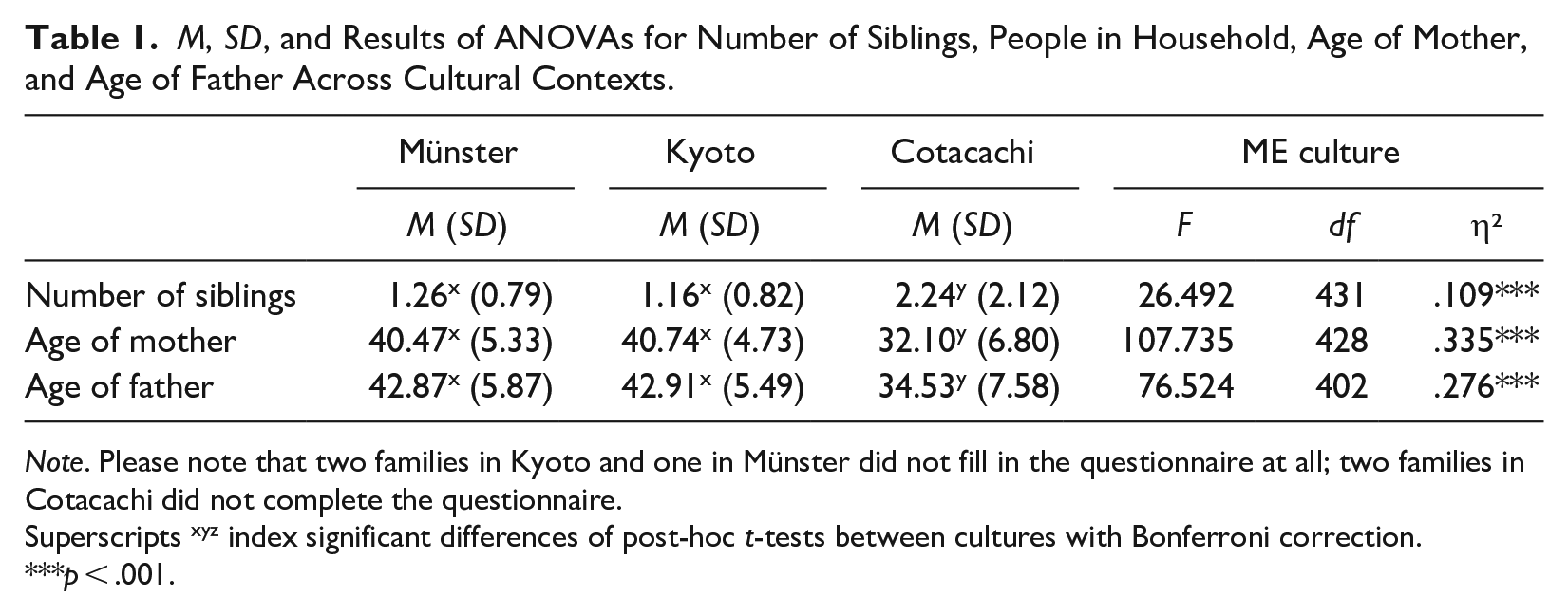
Note. Please note that two families in Kyoto and one in Münster did not fill in the questionnaire at all; two families in Cotacachi did not complete the questionnaire.
Superscripts xyz index significant differences of post-hoc t-tests between cultures with Bonferroni correction.
p < .001.
Furthermore, we asked about languages that are spoken at home. A majority of the children in Münster (93.1%) only spoke German at home. The remaining 6.9% were raised bilingual with German and another language (e.g., English). In Kyoto, all families indicated to speak exclusively Japanese at home. In Cotacachi, a majority of families (62.1%) spoke Spanish as well as Kichwa at home, while 18.3% spoke only Spanish, and 13.7% spoke only Kichwa. The remaining 5.9% did not make any specification about languages spoken at home.
The majority of mothers (74.6%) and fathers (72.8%) in Münster held a university or postgraduate degree as their highest formal educational qualification. The same applied to mothers (80.7%) and fathers (79.5%) in Kyoto. In Cotacachi, most parents finished primary school (mothers: 18.4%, fathers: 21.9%), secondary school (mothers: 46.7%, fathers: 50.4%) or high school (mothers: 27.6%, fathers: 21.9%) as the highest formal educational qualification. The most mentioned professions by mothers in Münster were in the educational (26.3%), health (23.8%), administrative or service sector (27.5%). Most fathers in Münster worked in administration or finance (26.9%) or held professions in IT (13.1%) or education (11.9%). In Kyoto, many mothers were at home working as homemakers (27.0%), while others stated to be company employees (18.0%). Most fathers were company employees (37.7%) or worked in administration or service (21.1%). In Cotacachi, many mothers indicated to be at home taking care of children as homemakers (39.9%). Furthermore, most mentioned professions among mothers in Cotacachi were in agriculture (13.1%), in the fabrication of ethnic handicrafts (11.1%) or in the service sector (17.0%). Most fathers in Cotacachi worked in the construction industry (47.1%) or in agriculture (13.1%).
Materials and Procedure
To assess children’s explanations of behavior, we created eight picture-based vignettes depicting either prosocial or deviant situations (four examples each), which were presented in a booklet. The booklet always started with the four vignettes depicting prosocial behavior followed by the four vignettes showing deviant behavior. The reason we always started with prosocial situations was that during piloting, it became apparent that children felt more comfortable to begin the task by talking about positive events. There were two versions of the booklet with reversed orders of the vignettes within the prosocial and deviant situations. In each vignette, there was a child, in the following referred to as the agent, and another person toward whom the agent behaved in a prosocial (e.g., the child shares their cookies with another child) or deviant manner (e.g., the child steals a ball from another child). The situations were compiled to represent everyday examples of social situations in each cultural context. They were presented in one or two simple illustrations not containing any contextual and culture-specific information. The content as well as the graphic illustrations of the vignettes were discussed with experts from all three cultures and piloted with children in the respective cultural contexts to ensure that they are familiar and common in each context. Please see Supplement A for descriptions and illustrations of all presented vignettes.
Each child was interviewed once, which took 10 to 15 minutes. The interviews were conducted by local native speakers (i.e., in German, Japanese or Spanish). There was a warm-up phase of approximately 5 minutes, in which the child and the assistant completed a jigsaw puzzle suitable for the child’s respective age until the child felt relaxed and comfortable enough to talk. Furthermore, the interviewer asked the child to tell a warm-up story about the last thing they really enjoyed and to explain why they enjoyed it. This procedure served to familiarize the child with the task format and answering why-questions. After the warm-up phase, the interviewer told the child that they were going to talk about some picture stories and that they would be interested in the child’s opinion about the stories. In each vignette, the interviewer started by introducing the actor and the other person involved in the situation, for example, “Look, this is [agent’s name] and this is [other person’s name]” and describing what happens in the vignette, “[agent’s name] has a package of cookies, which he/she shares with [other person’s name].” The interviewer then asked the child why the agent acted as they did in the story: “What do you think, why did [agent’s name] share his/her cookies with [other person’s name]?” If the child did not provide any reason, the interviewer was allowed to encourage the child to think of something by assuring that there are no right or wrong answers. If needed, the interviewer repeated the description of the vignette and asked the child again.
While the child participated in the attribution task, mothers completed the questionnaire on sociodemographic data and socialization goals. To assess maternal socialization goals, mothers evaluated a list of 11 qualities that children can be encouraged to learn at home. This list was taken from the World Value Survey Wave 6 (Inglehart et al., 2014). The German version of this list of items was translated into Spanish and Japanese and back translated into German by native or advanced speakers of the respective languages. Additionally, translations have been discussed with native speakers of the respective cultural contexts to guarantee equivalent meaning across cultures (van de Vijver & Tanzer, 2004). The list included the following characteristics: (1) independence, (2) hard work, (3) feeling of responsibility, (4) imagination, (5) tolerance and respect for other people, (6) thrift, saving money and things, (7) determination, perseverance, (8) religious faith, (9) unselfishness, (10) obedience, and (11) self-expression. Mothers were asked to choose up to five qualities that they consider especially important. To compare caregivers’ relative focus on autonomy-related goals, we calculated an autonomy index suggested by Inglehart and Welzel (2012). Four qualities are considered in this index, namely independence, determination, religious faith, and obedience. While the first two reflect autonomy-related goals, the latter two are associated with a lower sense of autonomy. To calculate the index the answers scores (1 if chosen, 0 if not chosen) of religious faith and obedience are subtracted from the answers on independence and determination, resulting in a score ranging from −2 to 2.
Coding
The interview session was audio-recorded and children’s responses to the open-ended questions were transcribed. Coding was performed in the original languages by native speakers. Since the majority of the children provided one explanation per vignette, we only coded the first explanation children generated (see Supplement B for further details on the number of explanations children provided). The following responses were classified as non-codable: (i) utterances that only described the scenario without providing further input (e.g., “Because he hides behind the tree and then he steals the ball”), (ii) judgments of the depicted behaviors (e.g., “It is very bad to not help someone”), (iii) information expanding the content of the depicted stories without providing an explanation (e.g., “Afterward the child is going to cry”), and (iv) providing no answer (e.g., “I don’t know”). The proportion of non-codable utterances ranged between 1.2% in Münster, 4.5% in Kyoto, and 7.4% in Cotacachi, F(2, 435) = 17.321, p < .001, η² = .074 being significantly different between all cultures, ts(275–312) > 2.096, ps < .035, ds > .075. Each explanation was assigned to one of the 10 subcategories that could either be part of an internal (i.e., referring to aspects located within the agent’s mind) or external (i.e., referring to aspects outside the agent) explanatory framework (see Table 2 for definitions and examples of subcategories). These subcategories were defined based on previous research (Lillard, 1998, 2006; Miller, 1984) and further aspects that children in our study frequently referred to (e.g., emotions).
Definitions and Examples for Subcategories Within Internal and External Explanations.
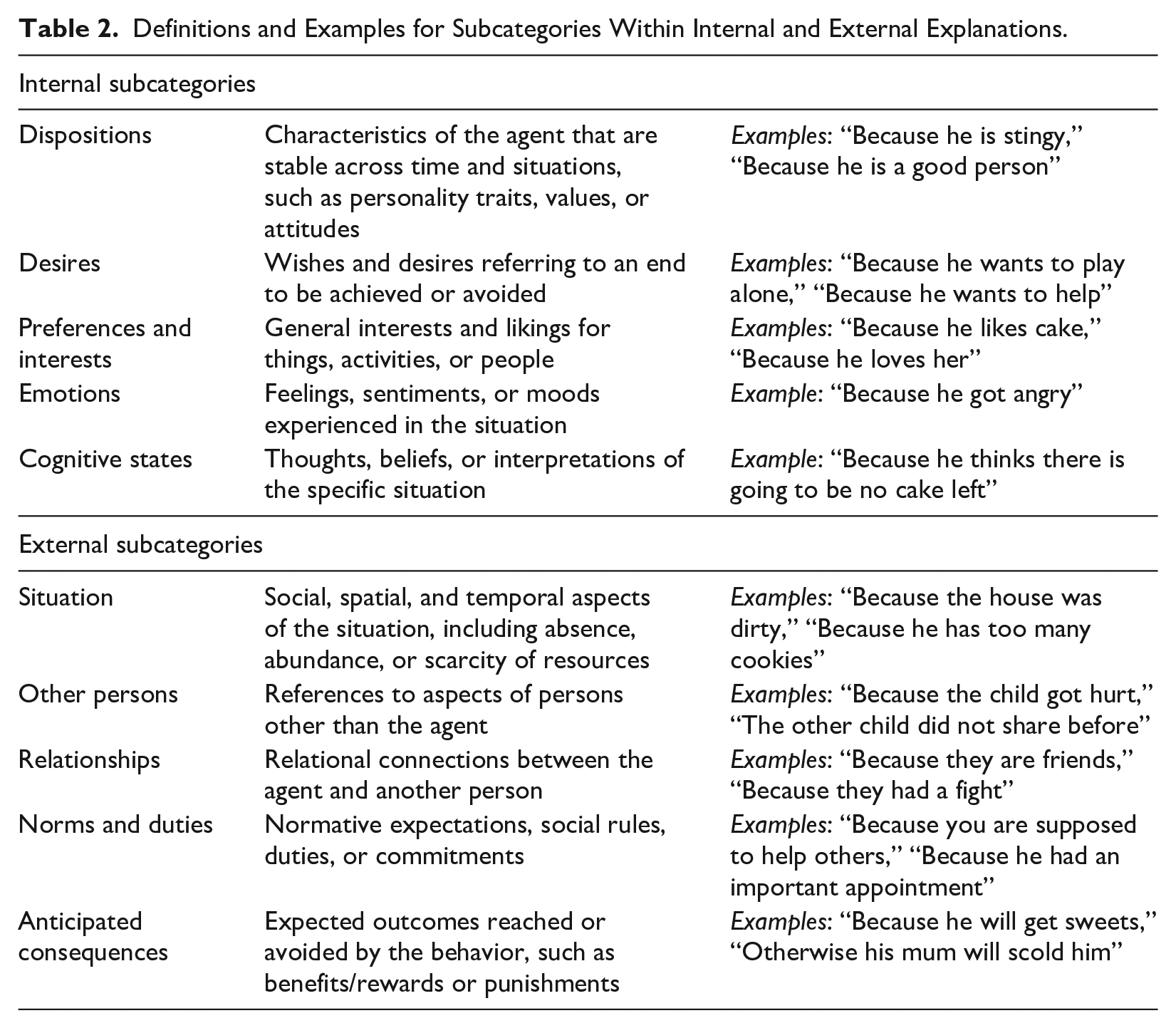
References that could not be clearly assigned to internal or external aspects were coded as agent-other combinations if attributions were made simultaneously to contextual aspects and the agent (e.g., “Because they like a clean house”) or to other explanations if references were not clearly assignable (e.g., “For fun”).
Reliability
For each cultural setting, two assistants, of whom at least one was a native speaker and the other fluent in the respective language, coded the children’s explanations. To ensure intra-cultural reliability, we assessed the agreement of these two assistants for at least 15% of the transcripts from each cultural context. Cohen’s kappa was κ = .86 for transcripts from Münster, κ = .81 for transcripts from Kyoto, and κ = .73 for transcripts from Cotacachi. Moreover, at least one bilingual assistant (i.e., Spanish-German, Japanese-German) was involved in the coding of the Japanese and Ecuadorian material, which allowed us to control for inter-cultural reliability by having these assistants also code at least 15% of the German material. The reliability was κ = .76 between German and Japanese transcripts and κ = .81 between German and Ecuadorian transcripts. During coding, uncertainties were resolved by discussion between the coders and the first author.
Results
To investigate cross-cultural similarities and differences in the development of children’s social attribution and the influence of caregivers’ socialization goals, the analysis was performed in several steps. First, the results on caregivers’ socialization goals and relative focus on autonomy are reported. Second, we examined whether the proportion of internal attributions of all explanations varied across culture, age and valence. Furthermore, we looked more closely at which subcategories children drew on in their internal and external explanations, and how this varied across cultural contexts (see Supplement D for the same analyses considering valence as a further factor and the syntax for the same analyses including valence and age). Analyses revealing significant effects of culture were followed by additional analyses including mothers’ autonomy index as a covariate in order to examine to what extent cultural differences can be accounted for by maternal socialization goals (van de Vijver & Leung, 2021).
Maternal Socialization Goals and Autonomy Index
To assess socialization goals, mothers chose 5 out 11 qualities that they considered especially important. While responsibility and tolerance were of high importance in all three cultures, the largest differences pertained to independence and determination, which were chosen far more often in Münster and Kyoto, as well as to hard work, unselfishness and obedience, which were chosen far more often in Cotacachi (see Table 3).
Proportion of Mothers Across Cultural Contexts Considering the Respective Quality to be Among the Five Most Important.
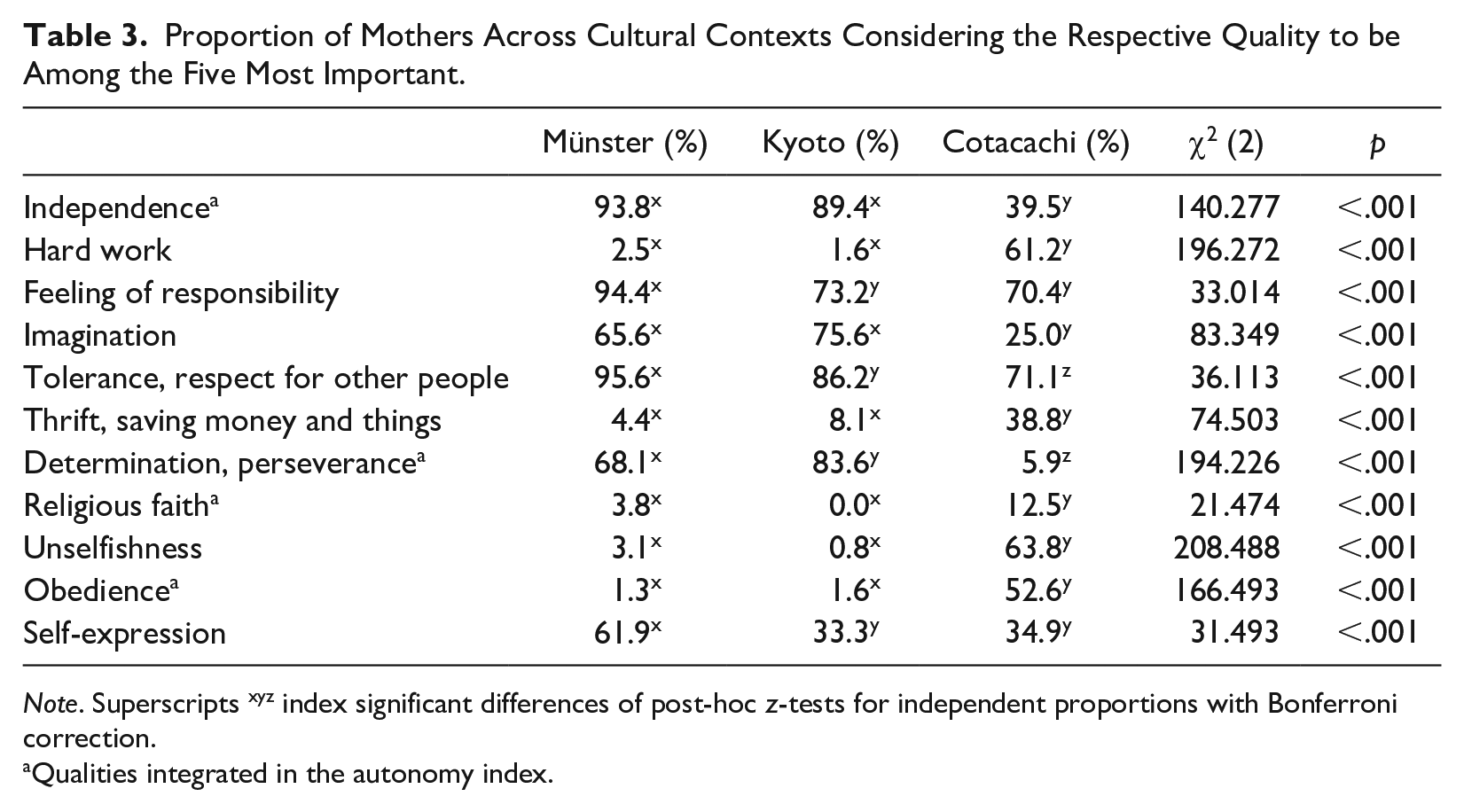
Note. Superscripts xyz index significant differences of post-hoc z-tests for independent proportions with Bonferroni correction.
Qualities integrated in the autonomy index.
Comparing the autonomy index across cultures reveals significant different orientations toward autonomy, F(2, 431) = 322.462, p < .001, η² = .599. As indicated by Bonferroni-corrected post-hoc t-tests mothers in Cotacachi (M = −0.20, SD = 0.94) assign less importance to autonomy-related goals than mothers in Münster (M = 1.57, SD = 0.57) and Kyoto (M = 1.70, SD = 0.56), ts(272–310) > −19.827, ps < .001, ds > .769.
Proportion of Internal Attributions of All Explanations
To determine the proportion of internal explanations across cultures and age groups, we divided the sum of all internal attributions by the sum of all valid attributions (i.e., internal explanations, external explanations, combinations, and other explanations), separate for the prosocial and deviant scenarios.
This score was entered in a mixed ANOVA with valence of the vignettes (prosocial vs. deviant) as within-subjects factor and culture (Münster vs. Kyoto vs. Cotacachi) and age (4–5 years vs. 6–7 years vs. 8–9 years) as between-subjects factors. The proportions of internal attributions across behavior valence, culture and age groups are shown in Figure 1.
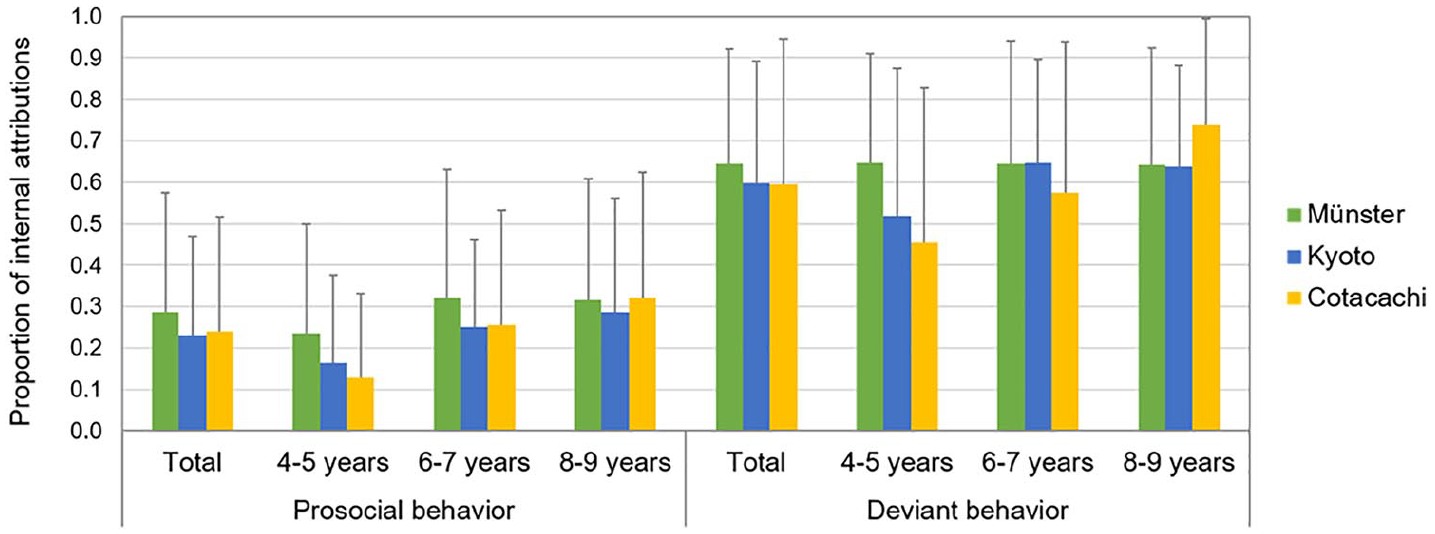
Mean proportion of internal attributions across behavior valence, culture, and age.
There was a significant effect of valence, F(1, 429) = 412.357, p < .001, η² = .490, with no further significant interactions. Children used more internal attributions when confronted with deviant situations (M = 0.61, SD = 0.31), compared to prosocial situations (M = 0.25, SD = 0.27). Moreover, there was a marginally significant main effect of culture, F(2, 429) = 2.958, p = .053, η² = .014, though Bonferroni-corrected post-hoc t-tests did not indicate significant differences between cultural contexts. There was a main effect of age group, F(2, 429) = 14.096, p < .001, η² = .062, for which Bonferroni-corrected post hoc t-tests revealed significant differences between the youngest age group and the other two age groups: 4- to 5-year-olds used significantly fewer internal explanations than 6- to 7-year-olds and 8- to 9-year-olds, ts(288–297) > −3.085, ps < .005, ds > .363 (see Table 4).
Proportion of Internal Attributions (M, SE) Separate for Culture and Age Groups.
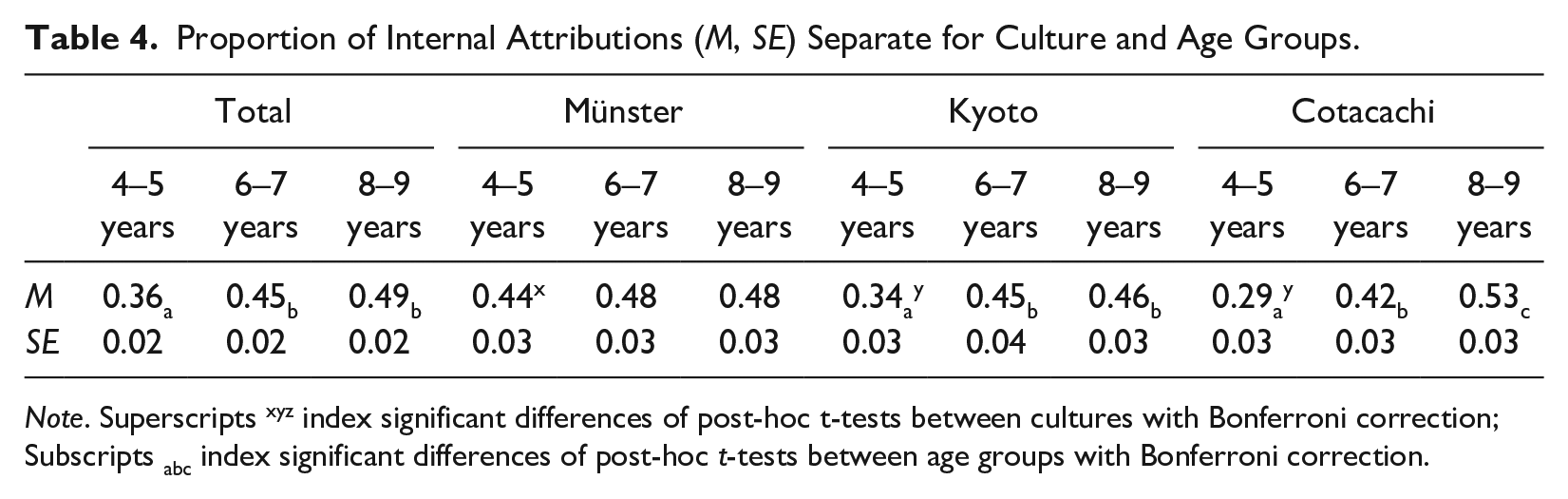
Note. Superscripts xyz index significant differences of post-hoc t-tests between cultures with Bonferroni correction; Subscripts abc index significant differences of post-hoc t-tests between age groups with Bonferroni correction.
Moreover, we found a Culture × Age interaction effect, F(4, 429) = 2.984, p = .019, η² = .027. To determine this interaction, we calculated mixed ANOVAs with valence as the within-subjects factor separately for, first, culture, and, second, age groups. When looking at the age effect in each cultural context separately, we found that there were significant age effects for Kyoto, F(2, 121) = 4.907, p = .009, η² = .075, and Cotacachi, F(2, 150) = 12.864, p < .001, η² = .146, but not Münster children, F(2, 158) = 0.606, p = .547, η² = .008. More specifically, in Kyoto there was a significant increase of internal explanations in 6- to 7-year-olds and 8- to 9-year-olds compared to 4- to 5-year-olds, ts(82–83) > −2.443, p < .041, ds > .534. In Cotacachi, we found significant differences between all age groups, with 4- to 5-year-olds having the smallest and 8- to 9-year-olds the highest proportion of internal attributions, ts(98–105) > 2.556, p < .036, ds > .494. When looking at the effect of culture for each age group separately, there was only a significant difference between cultural contexts in the youngest age group, F(2, 148) = 6.666, p = .002, η² = .083. More specifically, there was a marginally significant difference between Kyoto and Münster, t(103) = 2.461, p = .059, d = .485, and a significant difference between Münster and Cotacachi, t(105) = −3.679, p = .002, d = .717, with a higher proportion of internal explanations in the Münster sample. The analyses of the proportion of external explanations showed a complementary decrease across age, but no culture-specific accentuation for the youngest age group (see Supplement C for further details).
Relating cultural differences to socialization goals
Moreover, we aimed to examine whether cultural difference found in 4- to 5-year-olds’ attribution tendencies could, at least in part, be explained by differences in the importance mothers assign to autonomy-related values in socialization. To shed light on this issue, we calculated a one-factorial (culture) ANCOVA on the proportion of internal explanations with autonomy index as covariate. As suggested by van de Vijver and Leung (2021), the change in η² for culture between the ANOVA and the ANCOVA gives us an indication of the extent to which differences in mothers’ autonomy-orientation explain the cross-cultural differences in children’s emphasis of internal aspects (see also Kärtner et al., 2010; Matsumoto et al., 1998). After entering the autonomy index as covariate, the effect of culture on children’s proportion of internal explanations was still significant, F(2, 144) = 3.847, p = .024, η² = .051, but η² was reduced by 38.6%. Thus, autonomy-related socialization goals accounted for more than 30% of the effect of culture.
Exploring Internal and External Explanations
To get a more nuanced picture of how children explained others’ behavior when referring to internal or external aspects, we further analyzed (i) the proportion of each internal subcategory relative to all internal explanations (see Figure 2A) and (ii) the proportion of each external subcategory relative to all external explanations (see Figure 2B) made by the child. For each subcategory, this score was entered in an ANOVA with culture as the between-subjects factor, followed by Bonferroni-corrected post-hoc t-tests. To be included in the analysis, children needed to have attributed internally or externally, respectively, in at least two of the eight examples.
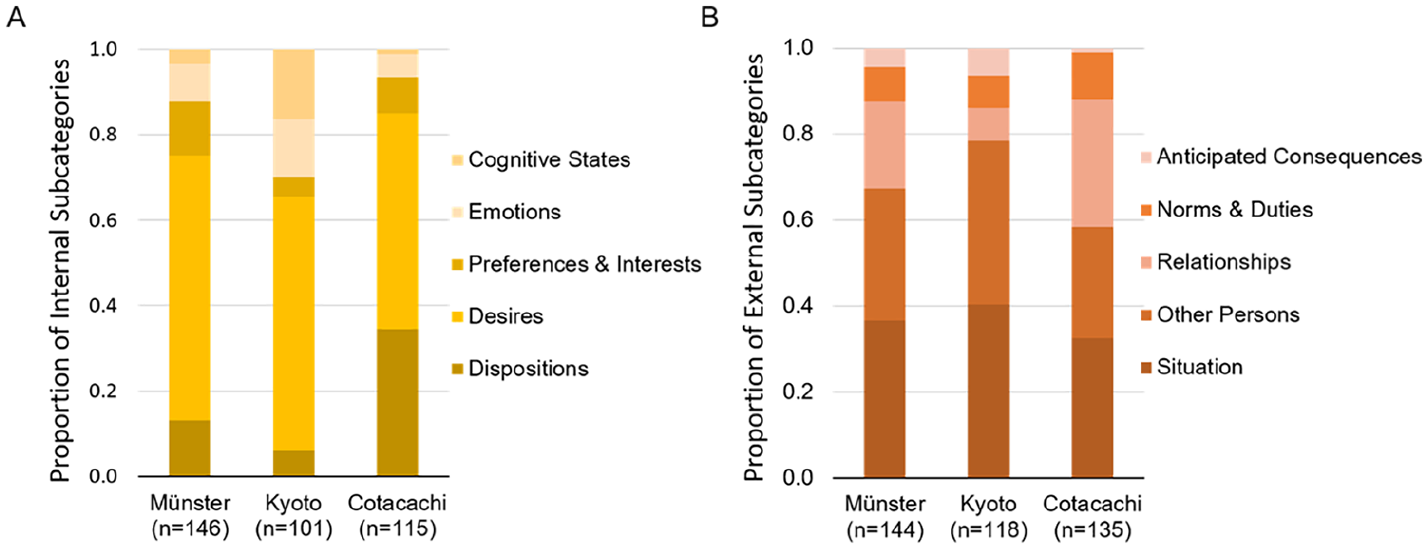
Proportion of subcategories in (A) internal and (B) external explanations across culture.
For each internal subcategory, there was a significant main effect for culture (see Table 5 for an overview of significant effects). There was a significantly higher proportion of dispositions in Cotacachi (M = 0.34, SD = 0.32) compared to Münster (M = 0.13, SD = 0.23) and Kyoto children (M = 0.06, SD = 0.15), ts(214–259) > 6.211, ps < .001, ds < .257. Investigating the proportion of desires, children in Münster (M = 0.62, SD = 0.28) more often referred to the agent’s desires than did children in Cotacachi (M = 0.51, SD = 0.33), t(259) = −3.002, p = .009, d = .303, while children in Kyoto (M = 0.59, SD = 0.31) were in between. Looking at preferences, children in Münster (M = 0.13, SD = 0.20) more often referred to this subcategory than children in Kyoto (M = 0.05, SD = 0.11), t(245) = −3.615, p = .001, d = .169, while the proportion in Cotacachi (M = 0.08, SD = 0.17) was in between. When looking at the proportion of cognitive states, children in Kyoto (M = 0.16, SD = 0.22) referred more often to cognitive states than children in Münster (M = 0.04, SD = 0.11) and Cotacachi (M = 0.01, SD = 0.05), ts(214–245) > 6.157, ps < .001, ds > .153. For emotional states, we found that children in Kyoto (M = 0.14, SD = 0.20) referred more often to emotions than children in Cotacachi (M = 0.05, SD = 0.13), t(214) = −3.573, p = .001, d = .166, with children in Münster (M = 0.09, SD = 0.16) lying in between.
Main Effect of Culture on the Proportion of Subcategories Without (Left) and With (Right) Autonomy Index as Covariate Including Proportional Reduction of Effect Size.
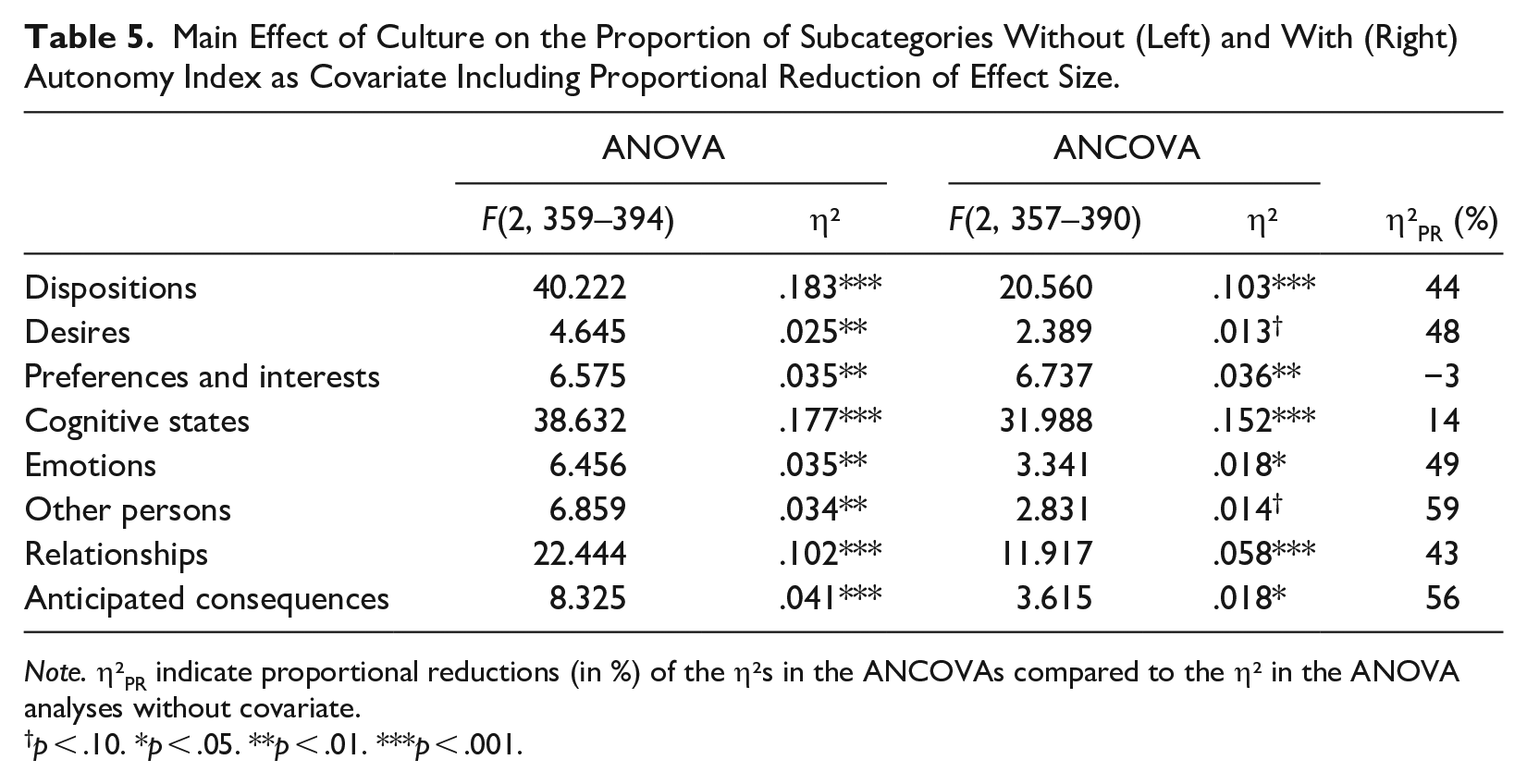
Note. η²PR indicate proportional reductions (in %) of the η²s in the ANCOVAs compared to the η² in the ANOVA analyses without covariate.
p < .10. *p < .05. **p < .01. ***p < .001.
With regards to the external subcategories, there were no significant differences concerning references to situational factors between Münster (M = 0.37, SD = 0.27), Kyoto (M = 0.40, SD = 0.27), and Cotacachi (M = 0.33, SD = 0.28), F(2, 394) = 2.674, p = .070, η² = .013. For references made to aspects of persons other than the agent, we found a significant main effect of culture. More specifically, children in Kyoto (M = 0.38, SD = 0.28) referred more often to other persons than children in Cotacachi (M = 0.26, SD = 0.24), t(251) = −3.726, p = .001, d = .259, with children in Münster (M = 0.31, SD = 0.27) lying in between. When looking at the proportion of references to relationships, there were significant differences between all cultures, with the highest proportion of references to relationships in Cotacachi (M = 0.30, SD = 0.33) followed by Münster (M = 0.20, SD = 0.26) and then Kyoto children (M = 0.08, SD = 0.16), ts(251–280) > −2.688, ps < .008, ds > .218. We did not find a significant effect of culture for norms and duties, F(2, 394) = 1.260, p = .285, η² = .006. Children in Münster (M = 0.08, SD = 0.17), Kyoto (M = 0.08, SD = 0.14), and Cotacachi (M = 0.11, SD = 0.22) explained behavior equally often in terms of norms and duties. In the case of anticipated consequences, children in Münster (M = 0.04, SD = 0.11) and Kyoto (M = 0.06, SD = 0.14) relied more often on anticipated consequences to explain behavior than did children in Cotacachi (M = 0.01, SD = 0.05), ts(251–280) > 3.148, ps < .023, ds < .090.
Relating cultural differences to socialization goals
To investigate the relation between cultural differences in attribution to mothers’ socialization goals, we followed the same approach of calculating an ANCOVA with the autonomy index as covariate (see Table 5 for F- and η²-values of the main effect of culture in the ANOVA and ANCOVA). The results show that the F-value for the effect of culture is no longer significant for two of the subcategories, namely desires and other persons. Thus, the greater reliance on desires in Münster children and other persons in Kyoto children could be traced back to a greater orientation toward autonomy-related socialization goals in mothers. Though the effect of culture is still significant after controlling for differences in the autonomy indices in the other subcategories, η²s of the main effect of culture are reduced for most of the subcategories, indicating that cross-cultural differences can partly be accounted for by differences in mothers’ autonomous socialization goals. More specifically, while mother’s autonomy-support hardly seems to have an effect on children’s use of preferences and interests, as well as cognitive states, the effect sizes of culture are reduced by more than 40% for the other subcategories, namely dispositions, emotions, relationships, and anticipated consequences.
Discussion
In this study, we analyzed the development of everyday social explanations by children between 4 and 9 years of age from three cultural contexts, namely Münster (urban Germany), Kyoto (urban Japan), and Cotacachi (rural Ecuador). Presenting picture-based vignettes, we used a simplified assessment method to extend the findings of previous studies to younger age groups and analyzed children’s open responses with regard to (i) the overall proportion of internal explanations children gave and (ii) the subcategories children used when giving internal and external explanations. As expected, children from Münster referred more to internal explanations, but only at the youngest age. Furthermore, there were culture-specific emphases on the different facets of internal and external explanations that could, at least in part, be explained by culture-specific emphases on autonomous socialization goals.
Development and Cultural Differences of Weighting Internal Explanations
First, when looking at the proportion of internal explanations when considering all explanations given, we found that, across all cultural contexts and age groups, children more often referred to internal aspects when explaining deviant than prosocial behavior. This is in line with previous cross-cultural research on adults’ predictions of behavior (Norenzayan et al., 1998 as cited in Choi et al., 1999), children’s everyday social explanations (Lillard, 2006; Miller, 1986), as well as studies investigating spontaneous trait inferences (Shimizu 2012, 2017). All these studies indicate that, regardless of the specific cultural context and the children’s age, greater weight is given to the agent’s internal states or dispositions when dealing with negative behavior than when dealing with neutral or positive behavior. In this context, it has been assumed that if someone behaves in deviant ways despite the existing social norms, this might be considered a reliable way to judge a specific person and, thus, might likely serve as a basis for attributing corresponding internal states and dispositions (Reeder & Brewer, 1979; Shimizu, 2017). The data from our study show that children as young as 4 years of age already make valence-specific differences in their interpretation of others’ behavior and perceive deviant behavior as more informative of a person’s internal attributes, regardless of the cultural context.
One of our central hypotheses was that using simplified assessment methods would allow us to map culture-specific developmental patterns at an earlier age than in previous studies (Miller, 1984). Indeed, we found cross-cultural differences already in 4- to 5-year-olds, with children in Münster referring more often to internal aspects of the agent than children in Kyoto and Cotacachi. We assumed that the more autonomy-centered socialization and accentuation of individual needs in Münster (Kärtner et al., 2007; Keller, 2012) causes children as early as 4 years of age to refer to people’s internal states to make sense of observed behavior. As an autonomous orientation is associated with a higher degree of individual-centered socialization practices (Keller & Kärtner, 2013), we expected that children whose mothers value autonomy in socialization would be more attuned to the agent’s internal states. Indeed, we found that mothers in Münster embrace autonomy-related socialization goals to a higher degree than mothers in Cotacachi. However, there was no difference between the autonomy-support in Münster and Kyoto. This is in line with recent studies suggesting that, while maintaining harmony and fulfilling social expectations are still assigned high importance (Sugimura & Mizokami, 2012), autonomy and individualism play an increasing role in modern Japan (Matsumoto, 2003; Shimizu et al., 2014; Sugimura & Mizokami, 2012). Accordingly, how much mothers value—and probably encourage—autonomy-related qualities in their children only partially accounts for differences in the weighting of internal explanations for 4- to 5-year-olds from Münster on the one hand and Kyoto and Cotacachi on the other. Thus, there are further dimensions driving the cross-cultural difference in younger children’s attribution style.
Different than we expected, we found that this difference evens out with age, as the proportion of internal explanations increased significantly with age in both Kyoto and Cotacachi, while it stayed at the same level in Münster. Consequently, we found no culture-specific differences in the proportion of internal explanations from age 6 onward. Thus, older children from Kyoto and Cotacachi increasingly appreciate internal states, although only at later ages when compared to their German counterparts. This finding aligns with cross-cultural studies on the development of children’s theory of mind that have shown that also false-belief understanding emerged at later ages in Japanese 5- to 6-year-olds (Liu et al., 2008; Wellman et al., 2001) and 4- to 8-year-old Quechua-speaking children from the Andean region of Peru (Vinden, 1996), who share important historical roots and cultural concepts with the Kichwa group. Along these lines, the findings presented indicate that the cross-cultural differences reported are due to differences in children’s competence (i.e., ability to refer to internal states, that has emerged by age 6 the latest), while the findings of Miller (1984) on cross-cultural differences that emerge later in development rather refer to differences in performance (i.e., preference to refer to internal states that further diverges across age).
Alternatively, the different findings may be related to differences in the methodological approach. Since the scenarios used in our study were very simple, this could have put a comparatively large focus on the acting agents, whereas more contextual details are known when reminiscing own experiences (Miller 1984, 1986). However, this would not explain the higher emphasis of 4- to 5-year-olds on internal explanations in Münster. To address this issue, future studies should cover a broader age range from childhood to early adulthood using the same methods. This would allow to evaluate whether the point reached at the age of 9 in our study represents an endpoint of social explanation modes across cultures or whether children’s tendencies start to diverge again.
Moreover, it is notable that most studies were conducted in different cultural contexts and it remains an open question as to the extent we can expect similar developmental trends among the children in our study compared to children in the US and India or Taiwan (Lillard, 2006; Miller, 1984). For example, while Münster and the US both serve as representatives of a Western cultural context, there are also indications that Germans tend to score lower on independence than US Americans (Kitayama et al., 2009). Thus, everyday social explanations of behavior might follow different developmental pathways depending on the specific cultural contexts and meaning systems that contribute to different accentuations in behavioral attribution.
How do Children Reason When Explaining in Internal or External Terms?
Upon investigating how exactly children reason when explaining behavior in internal terms, we found quite interesting patterns. First, compared to Kyoto, the patterns between Münster and Cotacachi were actually more similar with regard to the preferred subcategories in general. The main difference was that children in Cotacachi more often considered the agent’s stable, enduring characteristics, while children in Münster preferably centered on the individual desires of the agent. In Kyoto, on the other hand, children more often relied on more volatile internal justifications that were specific to the situation being described.
While we expected that dispositions would play only a minor role in Kyoto children’s explanations (Kitayama et al., 2009; Morris & Peng, 1994), it was rather surprising that dispositions were especially pronounced in Cotacachi, where the proportion was even more than twice as high as in Münster. Children used generalizing statements like “Because he is good” (Cotacachi, 6 years, vignette B) or “Because she is a thief” (Cotacachi, 7 years, vignette H) to make sense of other children’s behavior in dispositional ways. It is an open question whether there might be differing assumptions underlying dispositional statements in Cotacachi, as the cultural underpinnings of how dispositions are understood can be quite different (e.g., see Lockhart et al., 2009 on cultural perceptions on stability of dispositions). Seen in the relation to the Andean worldview highlighting the embeddedness of the individual within the community and broader environment (Terán Maigua, 2014), these dispositional statements might also reflect a broader evaluation of the agent as a member of the community. In this context “because he is good/bad” could mean “because he is a good/bad member of the community.” Unfortunately, our data do not allow us to further contextualize children’s statements in these ways.
When looking at the relative proportion of preferences and interests as well as desires in internal attributions, these two subcategories were especially pronounced in Münster. This reflects principles that have been considered central in Western cultural contexts in general, and in Münster specifically, which represents an urban German middle-class sample. Such principles involve, for example, emphasizing personal preferences, desires and wishes fostering an independent, self-reflective way of being; these principles are encouraged even in young children (Keller & Kärtner, 2013). Supporting this assumption, the differences in prioritizing desires to explain behavior is no longer significant when controlling for mothers’ autonomy-support. Thus, how much importance mothers assign to autonomy seems to play an essential role in how much children emphasize others’ desires and needs.
Looking more closely at references to the agent’s cognitive and emotional states, these subcategories were especially pronounced in Kyoto compared to Münster and Cotacachi children. This corresponds with the assumption that cognitive processes of perspective taking, empathy and anticipation of others’ needs is of high value in Japanese culture and in the socialization of children (Lebra, 1994; Rothbaum et al., 2000) as it plays a central role in establishing and structuring relationships in everyday life (Matsumoto, 1990, 2003; Uchida et al., 2009). Thus, there might also be a relational component underlying Kyoto children’s relatively high proportion of references to cognitive and emotional states.
While a fairly consistent pattern emerged with respect to the culture-specific use of internal subcategories, the picture was less clear regarding the proportion of subcategories within external explanations. Two subcategories of external explanations were equally embraced by all cultural contexts; these were, first, situational factors, which made up around one-third of external explanations in all three cultures, and second, norms and duties, but this subcategory played only a minor role in explaining the agent’s behavior in all three contexts (around 10%). However, when looking at the concrete statements of children from Münster, Kyoto, and Cotacachi, it is noticeable that they seem to be framed in quite different ways, especially regarding their level of commitment. While children in Münster formulated normative statements in a more optional-appearing way, such as “Because sharing is nice” (Münster, 9 years, vignette A), children from Kyoto were especially occupied with what would be fair in relation to the other person, such as “Because it would be unfair if she would be the only one eating” (Kyoto, 9 years, vignette A), and children from Cotacachi more often emphasized the obligation to act prosocially in an explicit and general manner, such as “Because one has to share.” (Cotacachi, 8 years, vignette A). Therefore, it seems that children in Münster, Kyoto, and Cotacachi tend to show different qualitative tendencies in their understanding of norms.
References to other persons were especially pronounced in Kyoto. Interestingly, this cross-cultural difference is no longer significant when considering mothers’ preference toward autonomy-related socialization goals. Since this category also encompasses internal states, such as individual needs and desires of a person other than the agent, it could be that the emphasis on autonomy in the socialization of Japanese children is thus reflected in the anticipation of mental processes in other persons not being the agent. Surprisingly, children in Kyoto referred less often to relationships that the agent might be involved in, as compared to children from Münster and Cotacachi. The most common answers in Münster and Cotacachi coded in this subcategory were “Because they are friends/not friends” indicating that in both contexts friendship/non-friendship is accompanied with specific expectations on how to behave. This was especially pronounced in Cotacachi, where relationship constellations were among the most often presumed reasons for the depicted behaviors. This reflects the importance assigned to connections and hierarchies for living together in an Indigenous Andean context (La Torre Amaguaña & Sandoval Peralta, 2004; Terán Maigua, 2014). We can only speculate why children in Kyoto less often considered relational aspects to guide the agent’s behavior. Possibly, helping someone explicitly because the other person is a friend would be considered inappropriate in Kyoto, as it might—for example—imply that not helping when someone is not a friend would be more acceptable.
Limitations and Future Directions
Exploring the subcategories within internal and external explanations sheds further light on culture-specific nuances and emphases that would have remained hidden by merely examining the proportion of internal explanations. In this context, we found correspondences that reflect the respective cultural socialization context. However, upon taking a closer look at some explanations, it is also noticeable that some of the central constructs that we aimed to display in the coding system might be conceptualized differently in the respective cultural contexts. For example, especially in the internal explanations given by Japanese children, we observed explanations that, though they referred to internal aspects of the agent, also pointed to an increased awareness of the agent as embedded in the social context. This was shown in responses such as “She is not the kind of person who thinks of others’ feelings” (Kyoto, 7 years, vignette E, coded as disposition) or “Because he wanted to share his feelings with others” (Kyoto, 6 years, vignette A, coded as desire). In Cotacachi, too, many formulations implied an enhanced social orientation, such as “Because he wanted to play together [with the other child]” (Cotacachi, 5 years, vignette D, coded as desire). Related to this, Choi et al. (1999) stated that East Asian cultural contexts might rather be characterized by emphasizing an interactionist approach. In this sense, the individual and their internal states and dispositions are considered to be shaped by and interwoven with the external environment (Choi et al., 1999; Lillard, 1998). In this context, there is already evidence that in more interdependent contexts, adapting to others’ expectations and fulfilling duties is internalized to a higher degree, helping to build an integral aspect of the self-construal, and, thus, is experienced as more intrinsically chosen (Hernandez & Iyengar, 2001; Miller et al., 2017). For our study, this might mean that the dualistic separation between “internal” and “external” is not necessarily equally conclusive everywhere.
Moreover, upon looking at the proportion of utterances that could not be analyzed as valid explanations as well as the number of children that needed to be excluded from the final analyses, we found that children from Kyoto and especially Cotacachi produced more non-codable responses. Though the situations were evaluated in advance as common in all cultural contexts, the format of asking explicit questions might have been less familiar to children in Cotacachi (Rogoff et al., 2015). In this respect, taking into account the actual real-life settings in which children reflect on reasons for the behavior of others could provide more ecologically valid and culturally sensitive insight into how the cultural context and the development of social attribution interact (Miller & Aloise-Young, 2018).
As reported above, mothers’ autonomous socialization goals help explain some of the cross-cultural variation found in meaningful ways. At the same time, there is a good proportion of cross-cultural variation that is unaccounted for. Thus, future studies should take into account further aspects that help explain the cross-cultural differences reported. For example, cultural contexts might vary in how much they emphasize relatedness in socialization—a dimension that is considered to be independent of autonomy (Keller, 2012). As a consequence, the nature and function of social relationships might differ across different cultural contexts (Kärtner et al., 2007). Thus, while psychological autonomy is as much valued in Kyoto as in Münster, social relationships might be more marked by the fulfillment of social responsibilities, maintenance of hierarchies and conformity expectations in Kyoto compared to Münster (Keller, 2012; Rothbaum et al., 2000). This could be reflected in how children make sense of others’ behavior (e.g., in the use of socially-embedded references). Furthermore, future research could also shed light on the concrete proximal mechanisms underlying children’s cultural variations in social explanations. For example, it would be of particular interest how caregivers’ socialization goals are reflected in the way how they attribute their children’s behavior (Dix, 1993) or talk about agents of social behavior (Shimizu et al., 2018) and how this affects their children’s evaluations.
Conclusion
The present study used a vignette-based approach to explore commonalities and differences in the development of social explanations in 4- to 9-year-old children from three cultural contexts. While there were similar proportions of internal explanations across cultures in the late preschool years, we also identified culturally variable developmental pathways that indicate an earlier onset of development toward specific endpoints in social explanation modes than previously suspected. Furthermore, a more nuanced look at the emphases on the different facets of internal and external explanations revealed subtle cultural differences that, at least in part, could be related to culture-specific preferences for autonomy-related socialization goals. Overall, this builds an important foundation for future research to focus on how cultural meaning systems interact with basic social cognitions, such as social attribution, and how enculturation takes place in this process.
Supplemental Material
sj-doc-1-jcc-10.1177_00220221221098423 – Supplemental material for Cultural Similarities and Differences in Explaining Others’ Behavior in 4- to 9-Year-Old Children From Three Cultural Contexts
Supplemental material, sj-doc-1-jcc-10.1177_00220221221098423 for Cultural Similarities and Differences in Explaining Others’ Behavior in 4- to 9-Year-Old Children From Three Cultural Contexts by Solveig Jurkat, Nancy Beatriz Iza Simba, Ledys Hernández Chacón, Shoji Itakura and Joscha Kärtner in Journal of Cross-Cultural Psychology
Supplemental Material
sj-sps-2-jcc-10.1177_00220221221098423 – Supplemental material for Cultural Similarities and Differences in Explaining Others’ Behavior in 4- to 9-Year-Old Children From Three Cultural Contexts
Supplemental material, sj-sps-2-jcc-10.1177_00220221221098423 for Cultural Similarities and Differences in Explaining Others’ Behavior in 4- to 9-Year-Old Children From Three Cultural Contexts by Solveig Jurkat, Nancy Beatriz Iza Simba, Ledys Hernández Chacón, Shoji Itakura and Joscha Kärtner in Journal of Cross-Cultural Psychology
Supplemental Material
sj-sps-3-jcc-10.1177_00220221221098423 – Supplemental material for Cultural Similarities and Differences in Explaining Others’ Behavior in 4- to 9-Year-Old Children From Three Cultural Contexts
Supplemental material, sj-sps-3-jcc-10.1177_00220221221098423 for Cultural Similarities and Differences in Explaining Others’ Behavior in 4- to 9-Year-Old Children From Three Cultural Contexts by Solveig Jurkat, Nancy Beatriz Iza Simba, Ledys Hernández Chacón, Shoji Itakura and Joscha Kärtner in Journal of Cross-Cultural Psychology
Footnotes
Acknowledgements
We thank all families for their participation. Special thanks go to Svenja Zierott for bringing to life the vignettes used in this study; to Amelie Gutknecht-Stöhr, Paula Küppers, Laura Ellermann, Lea Sophie Westhues, and Nina Grabowski for supporting data assessments in Münster; to Reiko Sawada, Koichiro Inada, Mei Yanagita, Kanon Fujimoto, Masaki Omori, Ayano Yamano, Maren Friedrich, and Anneliese Skrobanek for their contributions to data assessments in Kyoto; to Johanna Estefanía Tambaco Tambaco, Nataly Andrea Villalobos, Yuri Guandinango, Isabel Marhold, Franziska Rarey, and Michelle Cherrez Chica for realizing data assessments in Cotacachi; to Akiko Utsumi-Borgert, Julia Minami, Saiwa Sisa Quimbo Yacelga, Aitana Navia López, and Chisato Fukuda for transcribing, coding, and translation. Thanks to Celeste Brennecka from the Science Writing Support of the University of Münster for proofreading the manuscript.
Declaration of Conflicting Interests
The author(s) declared no potential conflicts of interest with respect to the research, authorship, and/or publication of this article.
Funding
The author(s) disclosed receipt of the following financial support for the research, authorship, and/or publication of this article: The research reported in this study was conducted as part of a project supported by the German Research Foundation [grant number DFG KA 3451/6-1].

Supplemental Material
Supplemental material for this article is available online.
References
Supplementary Material
Please find the following supplemental material available below.
For Open Access articles published under a Creative Commons License, all supplemental material carries the same license as the article it is associated with.
For non-Open Access articles published, all supplemental material carries a non-exclusive license, and permission requests for re-use of supplemental material or any part of supplemental material shall be sent directly to the copyright owner as specified in the copyright notice associated with the article.
