




Abstract
Accumulating evidence suggests that ethnotheories about ideal states of infant affect and activity vary across cultures in important ways. However, most previous studies have not directly identified such ethnotheories but rather inferred them from observational studies on mother-infant interaction. To fill this research gap, we interviewed mothers from two cultural milieus—mothers from Münster (urban Germany) and mothers who identify themselves as Kichwas (rural Ecuador), as these contexts presumably offer different construals of the self—to determine their ideal states of infant affect and activity and their self-reported co-regulation tendencies. The interview was based on short video clips of a German and an Ecuadorian infant displaying different combinations of affect (neutral, low-arousal positive or high-arousal positive affect) and activity (low or high). As expected, mothers in Münster preferred higher levels of positive affect than Kichwa mothers. Regarding co-regulation tendencies, we found cultural similarities and differences: Across samples, mothers tended to stimulate affect, and activity, especially when infants were neutral or inactive, but differed in their modality of co-regulation. More specifically, Münster mothers advocated more distal co-regulation modalities than did the Kichwa mothers. Taken together, the present study is the first to provide explicit evidence that maternal ethnotheories about infants’ ideal affect vary across cultures. The cross-cultural differences in ideal affect were not accompanied by differences in self-reported co-regulation of affect, suggesting an indirect link between ideals and (self-reported) parenting behavior.
A child’s emotions and activity level represent two basic and strongly interwoven aspects of human experience which, like other temperamental dimensions, are a joint product of biological predispositions as well as of infants’ social environment (Goldsmith et al., 1987). Similarly, affect and activity have been described as two psychological domains that are central to infants’ experience and behavior and that strongly depend on the regulatory support of the mother (Papoušek, 2004; Papoušek & Papoušek, 1979). More specifically, maternal co-regulation allows infants to integrate new experiences, thereby balancing infant affect and activity and preventing them from dysregulation (Papoušek, 2004; Papoušek & Papoušek, 1979).
In their original work, Papoušek and Papoušek (1979) stated that “the mother evaluates the infant’s behavioral state, tries to maintain it at the optimal level, and makes decisions” (p. 195), but they highlight that she is “seldom aware of her reasons for making these decisions” (p. 195). In that sense, they proposed that maternal co-regulation is part of an intuitive parenting program that is universally uniform and that has evolved to complement infants’ need for co-regulation.
However, mothers also act as cultural mediators (Keller & Kärtner, 2013; Super & Harkness, 1986). As such, culture-specific ethnotheories, the shared and abstract mental schemas that organize parental behavior (Harkness et al., 2007), should not only affect how mothers co-regulate their infants’ states, but they should also have implications for infant and child development (Sameroff, 2010). Thus, we would like to qualify the theory of Papoušek and Papoušek (1979) by proposing that optimal levels of affect and activity are not universally uniform, but that mothers’ ethnotheories vary across cultures in important ways.
To gain a better understanding of infants’ developmental niche (Kärtner et al., 2013; Super & Harkness, 1986)–more precisely, of an elementary part of the niche which parents are often unaware of (Papoušek & Papoušek, 1979)–this study aimed to assess cross-cultural similarities and differences in maternal ethnotheories about ideal states of infant affect and activity when their infants were 7 weeks old.
Emotional Development from a Culture-Sensitive Viewpoint
According to Markus and Kitayama (1991), the expression and experience of certain emotions differs according to the nature of one’s self-system (or self-construal), where some people may have a more independent self-construal while others have a more interdependent self-construal. For those with an interdependent self-construal, the primary unit of consciousness lies in relationships, more specifically in the reciprocal interdependence between them and other actors rather than in one’s inner self. By contrast, for persons with an independent self-construal, personal attributes, traits, and motives are the property of the individual, who is the primary unit of consciousness. Following the argument by Markus and Kitayama (1991), individuals with an interdependent self-construal should be experts in so-called other-focused emotions, such as sympathy, feelings of interpersonal communion, and shame. Conversely, individuals with an independent self-construal should more frequently and more intensely experience ego-centric emotions, such as joy, anger, frustration, and pride.
Whereas Markus and Kitayama (1991) linked cultural differences in self-construals to cultural differences in emotional experience, or actual affect, Tsai (2007) demonstrated the importance of studying ideal affect, or affective states that people “value, prefer, and ideally want to feel” (p. 242). Basing her observations on US-American and Chinese middle-class samples, she proposed that cultures differ in their valuation of high-arousal positive affective states (e.g., excitement and enthusiasm) and low-arousal positive affective states (e.g., calm, peacefulness). Extending Tsai’s theory, Gentzler et al. (2018) found that European-American mothers of 7- to 12-year-olds desired similar levels of positive affect for themselves as they did for their children. Moreover, mothers’ ideal positive affect (IPA) predicted specific types of socialization responses: For example, mothers’ high-arousal IPA predicted greater encouragement of their child to celebrate his or her positive affect, whereas mothers’ low-arousal IPA predicted encouragement of affectionate responses in their child (e.g., hugging).
Ethnotheories about ideal infant affect and activity
Concerning cross-cultural studies in infancy, maternal ethnotheories about ideal infant affect have often not been addressed directly but instead have been inferred from behavioral and observational studies on mother-infant interaction. Taking a closer look at the development of infant smiling from postnatal weeks 6 to 12, Wörmann et al. (2012, 2014) found that—contrasting educated urban middle-class families from Münster, Germany, with families living in subsistence-based farming ecologies in rural Cameroon—mothers from Münster smiled significantly longer during mutual gazing episodes with their infants. Moreover, only the Münster sample showed a parallel increase in the duration of infant and maternal smiling during the 2-month shift (i.e., between postnatal weeks 6 and 8). A mechanism that supported the age-related increase of smiling in Münster was reciprocal imitation of smiling.
In another observational study, LeVine (LeVine, 1990; LeVine et al., 1994) contrasted early mother-infant interactions of the Gusii people, who inhabit the southwestern corner of the Kenya highlands, with US-American white middle-class mothers. While the latter arouse positive emotional responses in infants, Gusii mothers “try to keep their babies calm, avoiding positive or negative arousal states preventing or dampening excitement” (LeVine et al., 1994, p. 201). Consequently, bouts of positive emotional excitement were longer and more frequent among US-American than among Gusii infants.
In both studies, mothers from cultures associated with an independent self-construal socialized their infants toward positive affect, which led to longer and more frequent bouts of positive arousal in infants. Overall, the findings from LeVine (LeVine, 1990; LeVine et al., 1994) extend Tsai’s (2007) theory and the findings by Gentzler et al. (2018) by suggesting that, in contrast to cultures with an independent self-construal, other cultures may consider the ideal affect of infants to be emotional inexpressivity (see also Keller & Otto, 2009).
Following the definition of Goldsmith et al. (1987), activity includes the intensity, vigor, and pace of movement. As in the case of affect, maternal ethnotheories about ideal activity have often not been addressed explicitly. Nonetheless, interesting observations were made in LeVine’s aforementioned study: Contrasting Gusii and US-American mother-child dyads, LeVine (1990) described “patterns of excitement” (p. 463) typically found in US-American infants that were not only characterized by emotional but also by motoric arousal. US-American mothers elicited those motoric responses in the context of mock conversations and other play routines. The author treated this kind of interaction as “one pole” (p. 463) and the diminution of excitement by Gusii mothers as the other pole, leading to states of comfort, reduced alertness, and sleep in Gusii infants. These observations point to cross-cultural variations in maternal co-regulation of infant activity, which might promote culturally divergent developmental paths with respect to activity. Given the lack of a theoretical foundation and additional empirical findings on ideal activity or co-regulation of infant activity, specific predictions on associations between cultural milieus and preferred levels of activity cannot be made.
Analogous to the idea introduced by Tsai (2007) and Gentzler et al. (2018), we assume that caregivers hold ethnotheories about ideal states of infant affect and activity. 1 In line with their work and that of others (Halberstadt et al., 2013; Harkness et al., 2007), we propose that it is important to assess those ethnotheories more directly in order to disentangle parental ideals from parenting behavior and to answer the following questions in a culture-sensitive way: Which ideal do caregivers hold with respect to infants’ affect and activity? With respect to affect, do they desire emotional neutrality, low-arousal, or high-arousal positive affective states? With respect to activity, do they prefer low or high levels of activity?
Ethnotheories About Ideal Infant Affect and Activity in Urban Germany and Rural Ecuador
To answer these questions, we compared maternal ethnotheories in two cultural milieus with presumably different self-construals (Markus & Kitayama, 1991), namely mothers living in Münster (~311,000 inhabitants; urban Germany) and mothers who identify themselves as Kichwas 2 and who live in Comunidades 3 around the neighboring cities of Otavalo (~31,000 inhabitants) and Cotacachi (~7,500 inhabitants; rural Ecuador).
Münster is a middle-sized city in North-Western Germany and—with its 65,000 students—it is considered a city of science (City of Münster - Department of Urban Planning, 2019). Germany is an immigration country: The proportion of people with a migration background in Münster amounts to 23.14% (Stadt Münster - Stadtplanungsamt, 2020). In accordance with previous studies (Wörmann et al., 2012, 2014) and with Markus and Kitayama (1991), who attributed the independent view of the self to a large proportion of European cultures, we expect families in Münster to emphasize the developmental goal of independence. For instance, this becomes explicit in socialization goals such as “develop personal interests and talents” and “express own preferences very clearly,” which were rated as being more important for child development by mothers from urban Germany than by rural Indian mothers and mothers living in rural Cameroon (Kärtner et al., 2012). Building on empirical findings based on a sample from Münster (Wörmann et al., 2012, 2014), we expect mothers to value and promote high-arousal positive affect in infants, socializing them toward displaying ego-focused emotions (Markus & Kitayama, 1991).
About 60,000 people who identify themselves as Kichwas live in communities in the cantons of Otavalo and Cotacachi, which are located in the northern Andes of Ecuador at a height of 2,500 to 3,000 m (Lattrich, 2006). Otavalo and Cotacachi both pride themselves as the heart and center of the indigenous intellectuals in Ecuador and the Kichwas in both cantons are characterized by an ethnic identity that is connoted very positively (Lalander, 2010; Lattrich, 2006); nevertheless, Indigenous people in Ecuador are still disadvantaged with respect to schooling, healthcare, and career opportunities (Masala & Monni, 2019). As proposed by Markus and Kitayama (1991), many Latin-American cultures take an interdependent view of the self, and this view closely resembles the concept of reciprocity, a cultural value that lays the foundation for communal life in Indigenous communities across the Andean region, like the communities we focused on in our study (De la Torre Amaguaña & Sandoval Peralta, 2004; Tousignant & Maldonado, 1989). Tousignant and Maldonado (1989) tied the value of reciprocity closely to emotional display rules within Indigenous communities that give special importance to emotions underlying a sense of communality. This idea is in line with the favoring of other-focused emotions in interdependent contexts (Markus & Kitayama, 1991). With respect to the socialization of positive affect, we expect mothers from this cultural milieu to value and promote low-arousal positive affective states in infants.
Given the narrow theoretical and empirical basis, our research questions regarding maternal ethnotheories about infant activity in rural Ecuador and urban Germany are explorative: Do mothers from the two cultural milieus differ in their preference for low or high levels of activity? Moreover, do samples differ in the promotion of a specific level of activity?
From Implicit to Explicit: Assessing Maternal Ethnotheories
Inspired by video-based vignette studies (Keller et al., 2005; see also Tobin et al., 1989) and in line with Gentzler et al. (2018), who not only assessed maternal ideals but also their transmission through socialization responses, we developed the Target State Interview based on short video clips of a German and an Ecuadorian infant displaying different combinations of affect and activity. By means of the interview, we assessed (1) maternal ideals (ideal states of infant affect and activity) and (2) self-reported co-regulation tendencies, encompassing the intention to stimulate or inhibit the infant state of affect and/or activity. Beyond mothers’ intention to stimulate or inhibit a certain infant state, we were also interested in the self-reported parenting strategies to achieve this goal. As elaborated below, we were furthermore interested in the modality of co-regulation.
Self-reported parenting strategies
Cross-cultural variability in parenting styles has been documented in a number of studies (Kärtner et al., 2010; LeVine, 1990) and has been attributed to cultural differences in socio-cultural orientations (Keller & Kärtner, 2013; Keller et al., 2004). Addressing the first half year of an infant’s life, Keller and Kärtner (2013) introduced the component model of parenting, which differentiates six universal parenting systems, namely primary care (e.g., food and hygiene), body contact (e.g., holding and carrying), body stimulation (e.g., touch), narrative envelope (i.e., use of language), face-to-face exchange, and object stimulation. For the purpose of this paper and in accordance with Keller et al. (2004), we differentiated the distal parenting style, encompassing object-stimulation and face-to-face interaction, from the proximal parenting style, consisting of body contact and body stimulation.
Based on the psychological functions that they serve, Keller and Kärtner (2013) relate the face-to-face system and the object stimulation system to independent cultural orientations: Object stimulation favors extradyadic attentional processes and cognitive growth, serving to disengage the infant from dependency in social relationships, while face-to-face exchanges sensitize infants for their own psychological states and support infants’ awareness through facial imitation and visually contingent responses (Kärtner et al., 2013). In line with this, we expected that when interviewed about intuitive co-regulation tendencies, mothers from Münster would report more distal parenting strategies than would Kichwa mothers.
Hypotheses
To summarize, regarding ideal affect we hypothesized that mothers in the Münster sample would express a stronger preference for high levels of positive affect compared to mothers from the Kichwa sample. Concerning self-reported co-regulation tendencies, we expected that the mothers from Münster would tend to stimulate infants’ positive affect to a greater extent than would Kichwa mothers. Regarding activity, we explored whether there is a cultural difference with respect to the preferred level of activity and the extent to which mothers stimulate infants’ activity. With respect to the modality caregivers state that they use to co-regulate infant affect and activity, we expected mothers from the Münster sample to name more distal parenting strategies than Kichwa mothers.
Methods
General Procedures
The present study was part of a larger cross-cultural project on early mother-infant interaction, and data assessment took place from 2017 to 2018. In Ecuador, we conducted the study in cooperation with the University of Otavalo and the Union of Farmer and Indigenous Organizations of Cotacachi (UNORCAC). The project was approved by the scientific commission of the University of Otavalo. Research processes such as timing of the first data assessment, arrangement of contact to the families, and sharing of the research findings with the community were subject to discussion with the Ecuadorian research team during the piloting phase and were adapted to local customs. Local research assistants also contributed to the development of a semi-standardized interview that included questions about the families’ demographic contexts, daily routines, time budgets, inherited customs of childcare, and other transmission paths of childcare practices. This interview was developed in order to gain a better understanding of the families’ broader cultural niches. For the main data collection of the present study, we selected mothers who identified themselves as Kichwas, who lived in communities in the larger surroundings of Cotacachi or Otavalo and who gave birth no more than 6 weeks ago. The hospitals of Cotacachi and Otavalo provided us with information about newborn children. A local research assistant visited the families, informed them about the study and invited the mothers to participate. In the overall project, families received aliments (sugar, rice) during every visit, a monetary refund as a compensation for their loss of income, and a collection of the videotaped mother-child interactions at the end of the data assessment.
In Germany, we included mothers who lived in the city of Münster and who recently gave birth. Mothers who had migrated to Münster from abroad were also included. We contacted families by post after receiving their contact information from the local registration office or invited them personally during prenatal classes. Families in Münster received a copy of the mother-infant interactions and a little present for the infant.
Participants
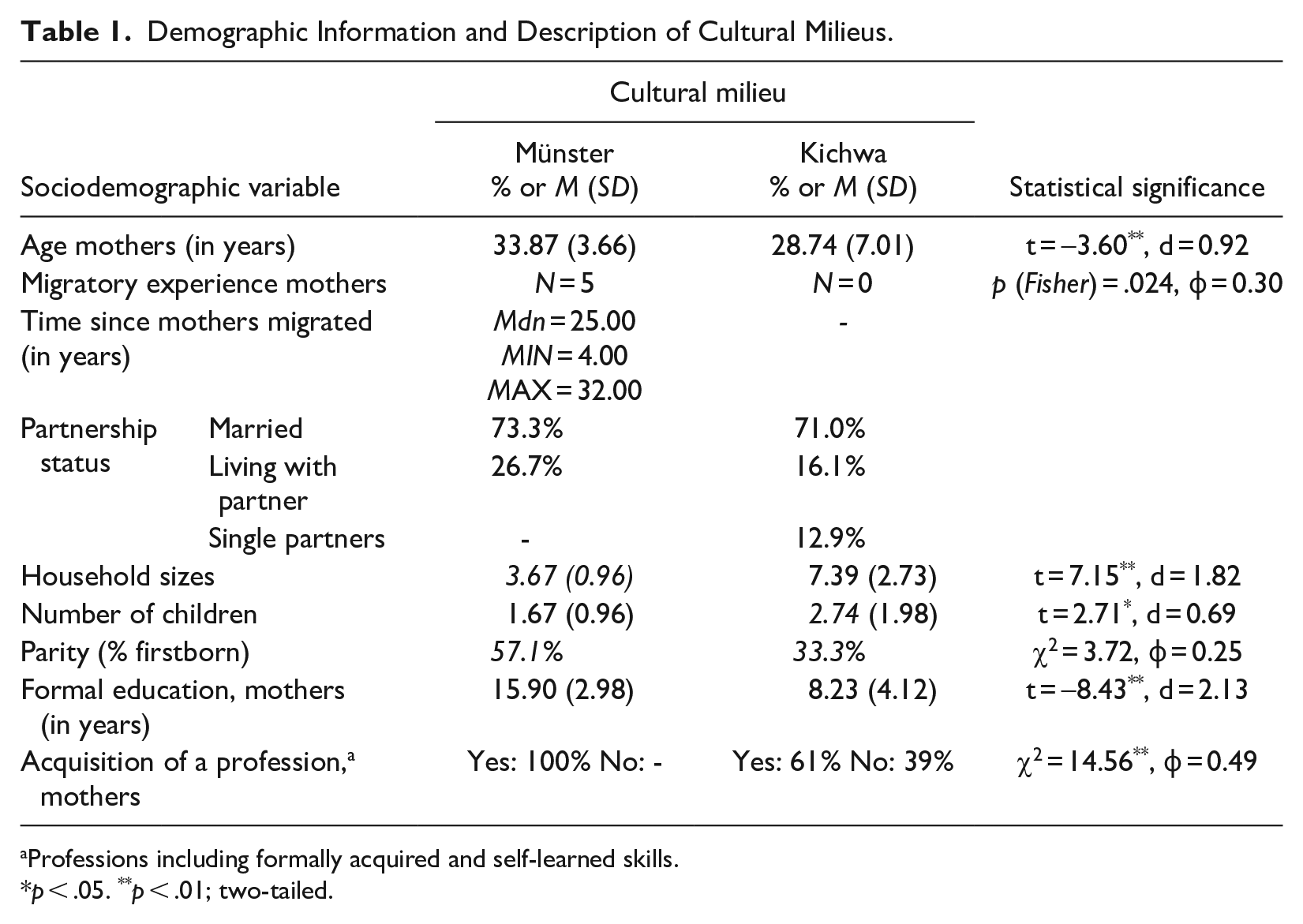
A total of 30 mothers from urban Germany and 31 mothers from rural Ecuador participated in the study. Two interviews in Münster were excluded due to technical problems; one interview from rural Ecuador was excluded because of an error in data storage. Of these mothers, 41% were first-time mothers (Münster, 53%; Kichwa, 29%) and 52.5% had girls (Münster, 43.3%; Kichwa, 61.3%). Demographic information about the two samples is presented in more detail in Table 1.
Demographic Information and Description of Cultural Milieus.
Professions including formally acquired and self-learned skills.
p < .05. **p < .01; two-tailed.
Demographics and description of cultural milieus
Mothers from Münster were significantly older than Kichwa parents. Five mothers living in Münster had migrated from abroad (from Kazakhstan, Sri Lanka, Russia, Upper Silesia, or Hungary), whereas none of the Kichwa mothers had. The majority of mothers in both samples were married. Household sizes were significantly larger in the Kichwa sample compared to the Münster sample and Kichwa mothers had significantly more children than mothers from Münster. We also asked mothers whether their youngest child is their first-born child and mothers did not differ significantly with regard to parity. The mothers’ years of formal education differed significantly across cultures: Mothers in Münster received more years of formal education than Kichwa mothers. Of the mothers from rural Ecuador, 61% had acquired a profession (including formally acquired and self-learned skills), while 100% of the participants from Münster had acquired a profession. Typical professions amongst Kichwa mothers were agriculture (16.1%), fabrication of ethnic handicrafts (16.1%) and textile manufacture (12.9%). For mothers from Münster, the most frequent professions were teachers (16.7%), workers in healthcare (e.g., physiotherapist, 10.0%), academics in the humanities (10.0%), business administrators (10.0%), and psychologists (10.0%). We were also interested in whom mothers consulted most often if they had questions about pregnancy, birth, or the development of their child: Kichwa mothers named a person within the family environment (48.4%) or the doctor (32.3%) first, whereas the majority of mothers from Münster named their midwife first (86.7%). Customs associated with pregnancy and/or child rearing traditions inherited from earlier generations were practiced by 83.9% of Kichwa mothers but by only 23.3% of mothers from Münster, χ2(1) = 22.50, p = .000, ɸ = 0.61. More specifically, the following traditions were frequently practiced by Kichwa mothers (multiple answers possible): swaddling the infant (practiced by 64.5% of mothers), practices used for avoiding el mal de ojo (the evil eye) like not leaving the laundry outside (64.5%) and putting a red bracelet on the infant (29.0%), traditional alimentation during pregnancy (35.5%), and to distribute fume around the infant when he/she is crying (25.8%). For mothers from Münster, the only practice that was mentioned by more than one mother was swaddling the infant (practiced by 6.7% of mothers). As an open question, we asked mothers about their daily routines (e.g., activities, daily chores) during a typical day: The majority of mothers from Münster (80%) named exclusively household chores and taking care of the children, whereas 16.7% also named leisure activities (sport, meeting friends) and one mother additionally reported that she is occasionally working as a lecturer. About half (51.6%) of the participating Kichwa mothers were exclusively dedicated to household chores and childcare, while the remaining mothers (48.4%) also named additional activities that form part of their daily routines, namely handicrafts and textile manufacture (22.6%), agriculture (12.9%), working as a vendor (6.5%), and leisure activities (6.5%). We also asked mothers where their youngest child is located while they follow their daily routines and categorized their free responses (mainly distant; mainly in body contact; both positions equally). Mothers from the two cultures differed significantly, χ2(2) = 11.44, p = .003, ɸ = 0.43: While 70.0% of infants from Münster were most frequently located in bodily distance to the mother (e.g., lying in front/next to the mother, in baby carriage), 6.7% were in direct body contact (e.g., carrying, holding) and 23.3% experienced both positions equally. In the Kichwa sample, only 29.0% of the infants were most frequently located in bodily distance, while 32.3% were mainly in direct body contact and 38.7% of infants experienced bodily proximity and bodily distance equally often.
Based on these profiles, mothers from Münster can be characterized as a highly educated Western urban middle-class sample, which Keller and Kärtner (2013) refer to as the autonomous cultural context that is associated with an independent sense of self, and Kichwa mothers as a sample with low levels of formal education living in a rural, agrarian society that is associated with a more relational and interdependent sense of self.
Interview on Maternal Ethnotheories
We conducted a two-part tablet-PC interview based on short video clips of German and Ecuadorian infants: The first part was a semi-standardized interview that assessed self-reported co-regulation tendencies; the second part was a pairwise comparison assessing maternal ideals. In the following, we describe the interview construction process.
Selection of stimulus material
For developing the video vignettes, we filmed a 4-month-old Ecuadorian infant (from the Kichwa ethnic group) and a German infant of the same age. At this age, infants are already capable of expressing a larger variability of positive emotions, ranging from neutrality to high intensity smiles. We systematically selected five 10- to 16-second clips per infant that showed specific combinations of infant affect (neutral affect, low-arousal positive affect, or high-arousal positive affect, as indicated by facial expressions/smile) and activity (low or high, as indicated by body movements and body tension). For each infant, five video clips were composed: (1) low-arousal positive affect and low activity (infant lying quietly on his/her back with a slight smile); (2) low-arousal positive affect and high activity (infant lifting or kicking his/her legs and smiling slightly); (3) emotional neutrality and low activity (infant lying quietly on his/her back with a neutral expression); (4) high-arousal positive affect and high activity (infant lifting or kicking his/her legs and smiling brightly), and (5) emotional neutrality and high activity (infant lifting or kicking his/her legs with a neutral expression).
To reassure reliable classification, these clips were coded on affect and activity by six independent coders (psychology students of the University of Münster) and yielded the following results: ICC (model: two-way random, absolute agreement) = 0.89 for affect (95% CI [0.74, 0.97]), and ICC = 1 for activity, which can be interpreted as good to excellent reliabilities. While we used the full 10 to 16 seconds for the first part of the interview on co-regulation tendencies, we focused on the most representative 5 seconds of each video in the second part of the interview on maternal ideals, where mothers chose one of two videos (further details below). The interview was programed with Visual Studio Express 2016 (Microsoft, 2016).
Interview on maternal co-regulation tendencies
The participating families were informed about the data protection policy and signed an informed consent before the first data assessment. Local research assistants interviewed mothers 7 weeks after the birth of their child. We chose this point in time because intercultural differences in the expression of positive emotions more likely emerge around the 2-month shift, that is, around postnatal week 8 (Wörmann et al., 2012, 2014). Thus, scheduling the interview 7 weeks after birth implies that mothers’ evaluations of the clips are unbiased by actual differences in infant smiling intensities as infant smiling is only about to emerge at that age. With mothers from Münster, interviews were conducted in German. Four Kichwa mothers (12.9%) chose to do the interview in Kichwa, the majority (87.1%) preferred Spanish. In both parts of the interview, mothers saw the videos of the infant from their own culture first (familiar stimuli), followed by the videos of the infant from the other culture (unfamiliar stimuli).
At the start of this semi-standardized interview, mothers received the following information: “I will show you video clips of infants who are about 4 months old and who differ with respect to how emotional and how active they are. Please imagine that you would be taking care of the infant: The infant is healthy, fed and rested. Please imagine that you had finished all of your tasks for the moment and that you are now interacting with the child. You will see one videotape after the other. Please keep on paying special attention to how emotional and active the infant is at the moment.” The mother would then put on headphones and start watching the first clip by tapping on the screen. After each clip (10 clips in total), the interviewer asked the mother (i) whether she would like to change the infant’s state and (ii) if yes, whether she would change the infant’s affect or activity. Finally, the interviewer asked the mother for specific parenting behavior, namely (iii) what she would do in order to change the infant’s state. After completing the semi-standardized interview for all 10 clips, mothers could take a short rest before proceeding to the second part.
Coding and reliabilities
The interviews on maternal co-regulation tendencies were recorded and transcribed in Spanish and German (interviews in Kichwa were translated and transcribed in Spanish) in line with the GAT 2 transcription system (Selting et al., 2009) using the software F4 (version 7). The coding system was primarily developed deductively (Mayring, 2015) in accordance with the interview guideline and our research questions. The categories with respect to mothers’ specific parenting behavior were derived from the component model of parenting (Keller & Kärtner, 2013). The common coding unit was one statement; the only exceptions were parenting strategies, where the smallest coding unit could be one word, and unclear answers, where the coding unit comprised the entirety of statements on each stimulus. Answers to questions (i) to (iii) were coded with MaxQDA 2018 (VERBI Software, 2018) as follows: With respect to question (i) we coded whether mothers expressed the desire to change the state of the infant (yes/no/unclear). For example, we coded yes if participants explicitly said so, if they evaluated the infant state negatively (e.g., “feeling bored”), or if they named parenting behavior that clearly aimed at changing infant affect or activity (as addressed in question (ii)). Answers were coded as unclear if mothers remained ambiguous about whether they wanted to change the infant state or if they named parenting behavior that could not be coded as a clear answer to question (ii). This step was coded once for every video clip. If mothers deliberately named reasons for their decision to change or not to change the infant states, those reasons were also coded as such (reason for desire to change/reason for desire not to change) for explorative analyses, but they were not used for hypothesis testing. In case of a positive answer to question (i), we proceeded with the codings concerning question (ii): We coded—separately for affect and activity—whether mothers wanted to change the state of the infant (yes/no/unclear) and, in the case of a positive answer, whether they wanted to stimulate (yes/no/unclear) or inhibit (yes/no/unclear) the state of the infant. The interview guideline did not include a question about the direction of change (stimulation/inhibition). Nevertheless, this step was successfully coded if participants explicitly said so, used verbs indicating a clear direction (e.g., “make her laugh”) or justified their desire to change by referencing low levels of affect and activity (e.g., she looks “apathetic”). Parenting strategies, as addressed in question (iii), were coded independent of previous answers. That is, each occurrence of the following codes was coded: face-to-face interaction was coded for the desire to establish a contact involving mutual gaze and/or mirroring of facial expressions; object stimulation was chosen for stimulation with objects or toys and encouragement to explore the physical environment; body contact was coded if the mother wanted to establish body contact with the infant (e.g., “give proximity”); body stimulation was coded if the mother wanted to stimulate the infant or provide motor challenges by means of touch or movement; narrative envelope included suggestions like singing, talking, reading out loud, and making sounds; play was the only category that was added inductively for the explicit suggestion to play with the infant. If the behavioral suggestion did not fit into any of the six categories, we coded other parenting strategies (e.g., “not leave her alone”; “animate her”; “play music”; “swaddle the infant”; “keep her busy”).
Of the interviews, 20% were coded by two coders in order to calculate inter-rater reliabilities; socio-cultural milieus were equally distributed within this subset. The Kappa coefficients (Brennan & Prediger, 1981) for the coding categories were good to excellent, based on an overlap of at least 20% per code: desire to change κ = 0.91; differentiation between the desire to change affect and/or activity κ = 0.83; direction of change (stimulation/inhibition) κ = 0.80; identification of parenting strategies κ = 0.85.
Dependent variables: Co-regulation and parenting strategies
For each video clip, mothers received a score for the co-regulation of affect and activity based on their answers to questions (i) and (ii): Because none of the mothers expressed the desire to inhibit the infant state of affect or activity, the two scores took the value of 1 if the mother desired to stimulate, the value of 0 if she did not want to change the infant’s affect/activity, or a missing value if the answers to questions (i) and (ii) were unclear. Co-regulation of affect could be coded for 7.90 out of 10 clips on average (SD = 2.14) for mothers from Münster and 9.39 clips (SD = 0.88) for Kichwa mothers. Co-regulation of activity was coded for 8.07 clips on average (SD = 1.86) for mothers from Münster and 9.58 clips (SD = 0.67) for Kichwa mothers. We computed mean stimulation of affect scores separately for the different levels of current affect (CAff) of the stimuli (emotional neutrality, low-arousal positive, and high-arousal positive). Mean stimulation of activity scores were also calculated separately for the levels of current activity (CAct) of the stimuli (low, high).
For each of the seven categories of parenting strategies, we calculated a sum score per interview, which was subsequently divided by the overall sum of parenting strategies (relative frequencies). To test for cultural differences in distal parenting (see Keller et al., 2004), we obtained the Distal Parenting Score by dividing the sum of object stimulation and face-to-face interaction by the sum of object stimulation, face-to-face interaction, body contact, and body stimulation.
Interview on maternal ideals
In the second part of the interview, mothers saw 10 pairs of video clips and decided which one of the two videos they preferred. Overall, there were five pairwise comparisons with the infant from Ecuador and five with the infant from Germany. Mothers started with the stimuli from their own culture (familiar stimuli) and proceeded with stimuli from the other culture (unfamiliar stimuli). The composition and sequence of the five pairs were identical (see Table 2): In each set, there were two pairwise comparisons in which one stimulus was higher on affect but identical on infants’ activity as compared to the other stimulus (comparisons 2, 3, 7, and 8), one pair in which infants’ affect was identical but activity differed (comparisons 5 and 10), and two pairs in which both activity and affect varied (comparisons 1, 4, 6, and 9). Mothers were instructed as follows: “Please pay attention to the affective display and the activity of the baby in each of the two videos. Which state would you prefer?” After seeing one clip after the other, mothers chose the preferred video by tapping on the screen. Figure 1 illustrates the initial screen of the pairwise comparison.
Composition of Video Clips for the Pairwise Comparisons.
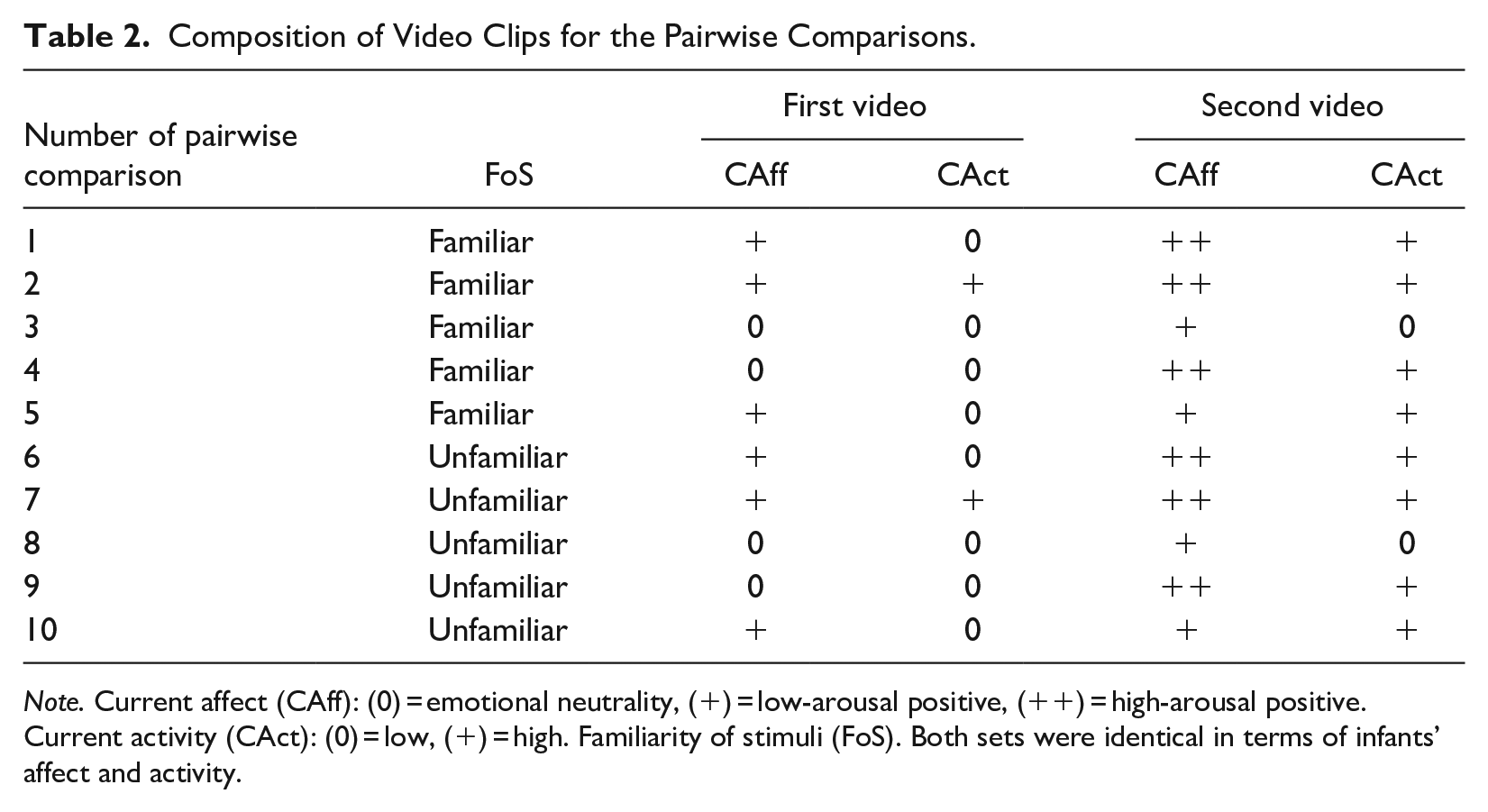
Note. Current affect (CAff): (0) = emotional neutrality, (+) = low-arousal positive, (++) = high-arousal positive. Current activity (CAct): (0) = low, (+) = high. Familiarity of stimuli (FoS). Both sets were identical in terms of infants’ affect and activity.
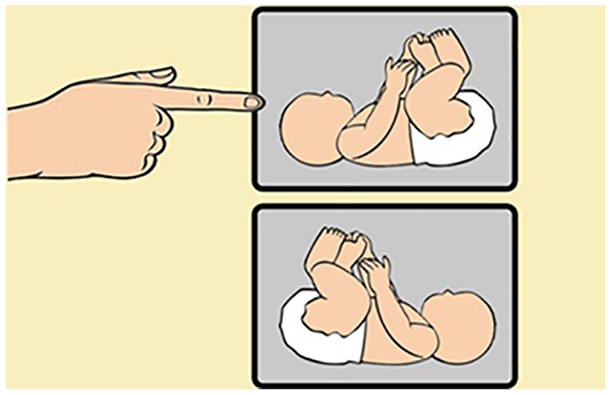
Initial screen of the pairwise comparison.
Dependent variables: maternal ideals
Based on the pairwise comparisons, we computed ideal affect scores and ideal activity scores, separately for the German and the Ecuadorian infant. For the ideal affect score based on familiar stimuli, we included the pairwise comparisons 2 and 3. Scores ranged between 0 and 2, with a score of 2 if mothers preferred the stimulus with a higher degree of positivity in both cases. The ideal activity score for familiar stimuli was based on comparison 5, and mothers got a score of 1 (vs. 0) if they preferred the stimulus that displayed a higher degree of activity. For the ideal affect and ideal activity scores based on unfamiliar stimuli, we considered the respective pairwise comparisons, namely comparisons 7, 8, and 10.
Because the correlations were low to medium for the two ideal affect scores (Münster: rs = .42, p = .020; Kichwa: rs = .06, p = .735) and the two ideal activity scores (Münster: rs = .18, p = .350; Kichwa: rs = .27, p = .138), scores were analyzed separately for the familiar and unfamiliar stimuli.
Results
Cross-Cultural Similarities and Differences in Maternal Ideals
We used SPSS (version 26) for the analysis of maternal ideals. We conducted two mixed analyses of variance (ANOVA) to test the differences in ideal affect and ideal activity between cultural groups, with familiarity (familiar vs. unfamiliar stimuli) as a within-subject factor and participants’ cultural milieu (Münster vs. Kichwa) as the between-subject factor. With respect to ideal affect, mothers in the Münster sample expressed a significantly stronger preference for positive affectivity compared to mothers from the Kichwa sample, F(1,59) = 5.68, p = .020, η² = 0.09. The ANOVA yielded no significant main effect of stimuli familiarity, F(1,59) = 0.27, p = .602, η² = .01, nor a significant interaction of cultural milieu × familiarity, F(1,59) = 0.27, p = .602, η² = .01. Means and standard deviations for ideal affect scores are reported in Table 3.
Means and Standard Deviations for Ideal Affect and Ideal Activity Score (Pairwise Comparison).
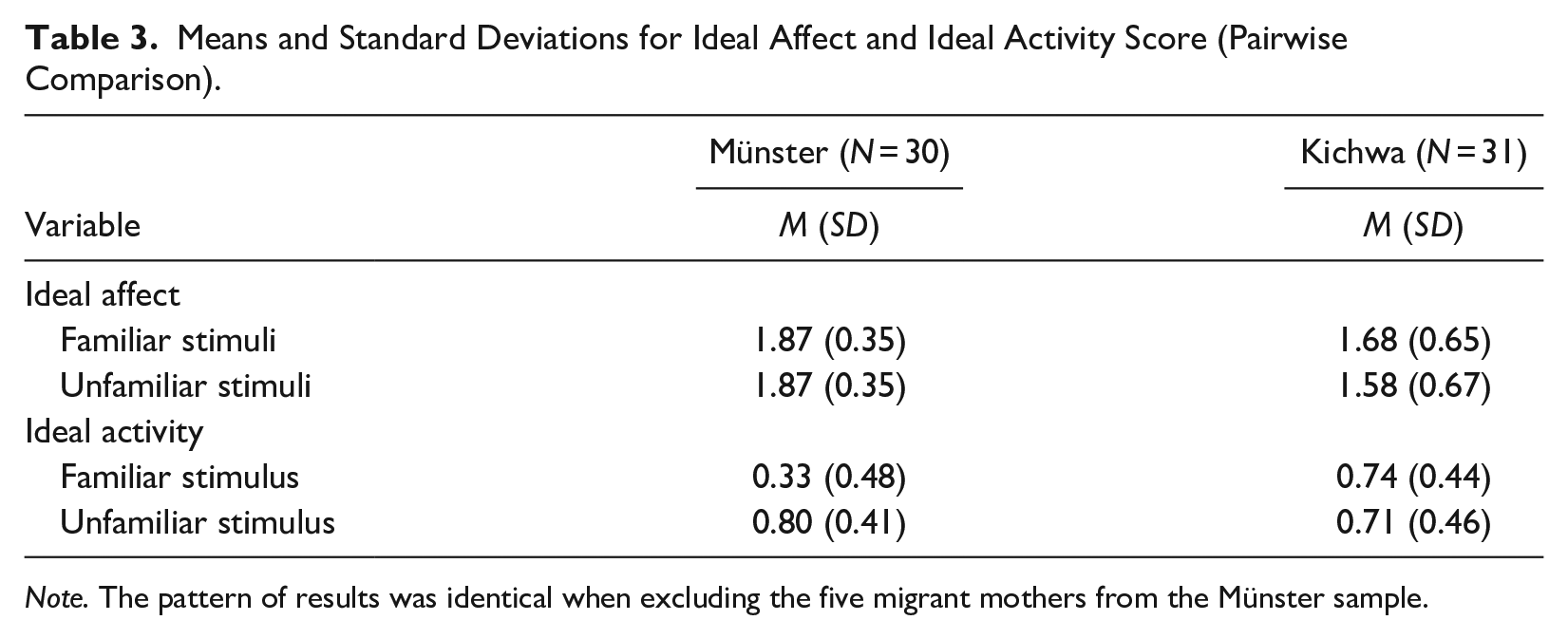
Note. The pattern of results was identical when excluding the five migrant mothers from the Münster sample.
Concerning ideal activity, the main effect of cultural milieu, F(1,59) = 3.13, p = .082, η² = .05, was marginally significant. The main effect of familiarity, F(1,59) = 9.21, p = .004, η² = .14, was significant, and so was the interaction of cultural milieu × familiarity, F(1,59) = 12.15, p = .001, η² = .17. Looking separately at familiar and unfamiliar stimuli, post hoc t tests indicated that the effect of cultural milieu became significant only for preferences based on familiar stimuli, t(59) = 3.45, p = .001, d = −0.89, pointing toward a stronger preference for high activity in Kichwa mothers (see Table 3). However, there was no significant difference between samples in ideal activity scores based on unfamiliar stimuli, t(59) = −0.81, p = .421, d = 0.21. Comparing ideal activity scores for familiar and unfamiliar stimuli within samples, post hoc t tests yielded a significant effect in the Münster sample, t(29) = −4.47, p < .001, d = 0.82, indicating higher scores for the unfamiliar stimulus, but not in the Kichwa sample, t(30) = 0.33, p = .745, d = 0.06. To summarize, there was a cultural difference concerning the preferred level of activity only for familiar stimuli.
Cross-Cultural Similarities and Differences in Mothers’ Self-Reported Co-Regulation Tendencies
Overall, response behavior differed between samples: Responses of Kichwa mothers were shorter (number of words per interview: M = 220.13, SD = 219.15) in comparison to responses of mothers from Münster (M = 453.07, SD = 239.35), t(59) = −3.97, p < .001, d = 1.02, who explained in more detail how they would interact intuitively and why they opted for not changing the infant state. Table 4 presents mean stimulation of affect scores for the infant’s current affect and the mean stimulation of activity scores for the infant’s current activity: The tendency to stimulate affect was descriptively highest in both samples for the video clips that displayed emotional neutrality. Likewise, the tendency to stimulate activity was descriptively higher in both samples for the video clips that displayed a low level of activity compared to those displaying a high level of activity.
Mean Stimulation of Affect Scores and Mean Stimulation of Activity Scores (Semi-Standardized Interview).
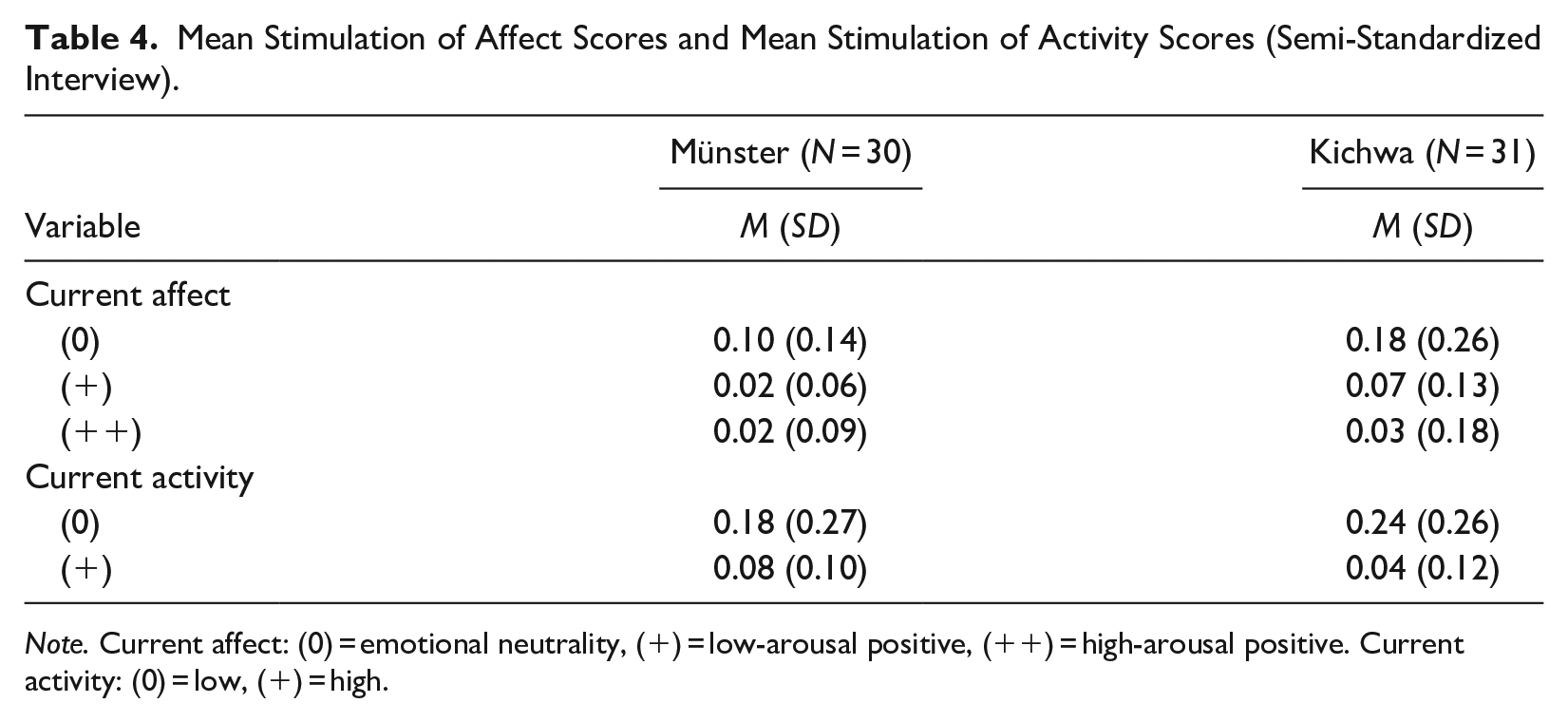
Note. Current affect: (0) = emotional neutrality, (+) = low-arousal positive, (++) = high-arousal positive. Current activity: (0) = low, (+) = high.
To investigate maternal co-regulation tendencies, we conducted two multilevel logistic regressions for binomially distributed outcomes (Finch et al., 2014) based on mothers’ responses to the individual stimuli (repeated-measures design) using RStudio (Version 1.2.1335) and the package lme4 (Bates et al., 2015). The regressions, having a two-level hierarchy in which stimuli (level 1) are nested within participants (level 2), predicted the probability that a mother would stimulate the infants’ affect (yes or no) and/or activity (yes or no), where affect and activity were analyzed in separate regressions. The same set of predictors were included in both models as fixed coefficients: cultural milieu of the participant: Kichwa (0) or Münster (1); current affect of the infant as displayed in the clip: emotional neutrality (0), low-arousal positive (0.5) or high-arousal positive (1); current activity of the infant: low (0) or high (1), and culture of stimulus: Kichwa (0) or Münster (1). We used a random intercept model in order to account for interpersonal differences in response behavior that cannot be explained by fixed effects. For the plotting of (marginally) significant interactions, we used the effects package (Fox & Weisberg, 2019).
Regarding stimulation of affect, our hypothesis predicted a main effect of cultural milieu, whereby mothers from Münster would be more likely to stimulate affect, and an interaction between cultural milieu and current affect; that is, we expected the probability of mothers from Münster to stimulate affect to be higher, especially when current affect of the infant was low. Analogously, we looked at the effect of cultural milieu and the interaction between cultural milieu and current activity to explore potential cultural differences in self-reported tendencies to stimulate activity. In addition to those effects used for hypothesis testing, we took the following potential effects into account: The effect of current activity on co-regulation of affect and, likewise, the effect of current affect on the co-regulation of activity; the effect of the culture of stimulus and the interaction term of culture of stimulus with cultural milieu.
Prior to hypothesis testing, we reassured that the fit of the multilevel logistic regression models with random intercept was superior to that of the multilevel logistic models without random intercept (Field et al., 2012; see Appendix).
An estimation of the overall model fit is not provided within the lme4 package (Bates et al., 2015). We report b-estimates, p-values and r as effect sizes of fixed and random coefficients of the two multilevel logistic regressions with random intercepts (for the computation of r from z-values see Rosenthal & DiMatteo, 2001, p. 72).
Stimulation of affect
The estimate of cultural milieu was not significant, b = −0.64, p = .306, r = −.13. The interaction between cultural milieu and the different levels of current affect was not significant either, namely the interaction with low-arousal positive affect, b = − 0.71, p = .439, r = −.10, nor with high-arousal positive affect, b = 0.13, p = .920, r = .01. From the other predictors, the coefficient of low-arousal positive affect, b = − 1.45, p = .002, r = −.39, was negative and significant: As indicated in Figure 2, mothers across samples were less likely to stimulate affect when the infant displayed low-arousal positive affect (vs. emotionally neutral affect). The coefficient of current activity, b = −1.36, p < .001, r = −.46, was also negative and significant, implying that mothers across samples were less likely to stimulate affect when their current activity was high. The estimate of high-arousal positive affect was negative and marginally significant, b = − 1.49, p = .068, r = −.23. There was no significant relationship between culture of stimulus and the outcome variable, b = −0.11, p = .783, r = −.04. The interaction of cultural milieu with culture of stimulus was not significant either, b = 0.09, p = .897, r = .02; that is, culture of stimulus did not influence response behavior. The random intercept was significant, b = − 0.95, p = .022, r = −.29, indicating that there were interpersonal differences in the tendency to stimulate affect that could not be explained by fixed coefficients. A summary of the model is displayed in Table 5.
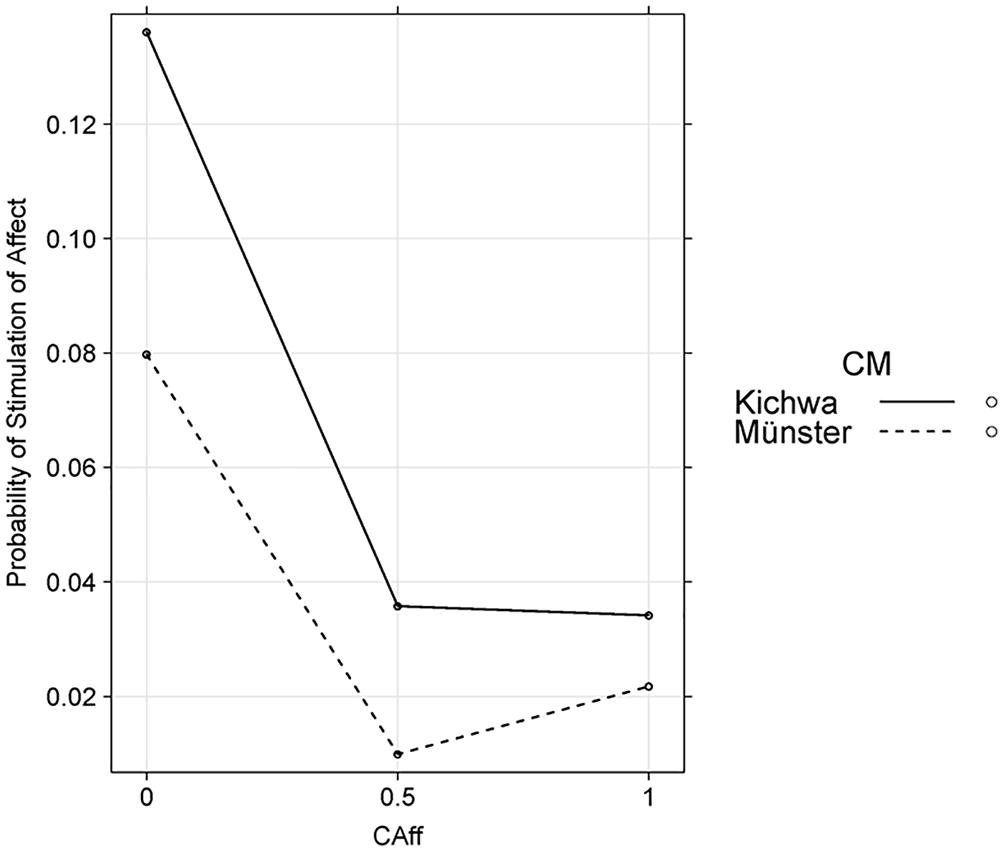
Plot of the effect of current affect on stimulation of affect.
Summary of the Multilevel Logistic Regression Predicting Self-Reported Stimulation of Affect (Semi-Standardized Interview).
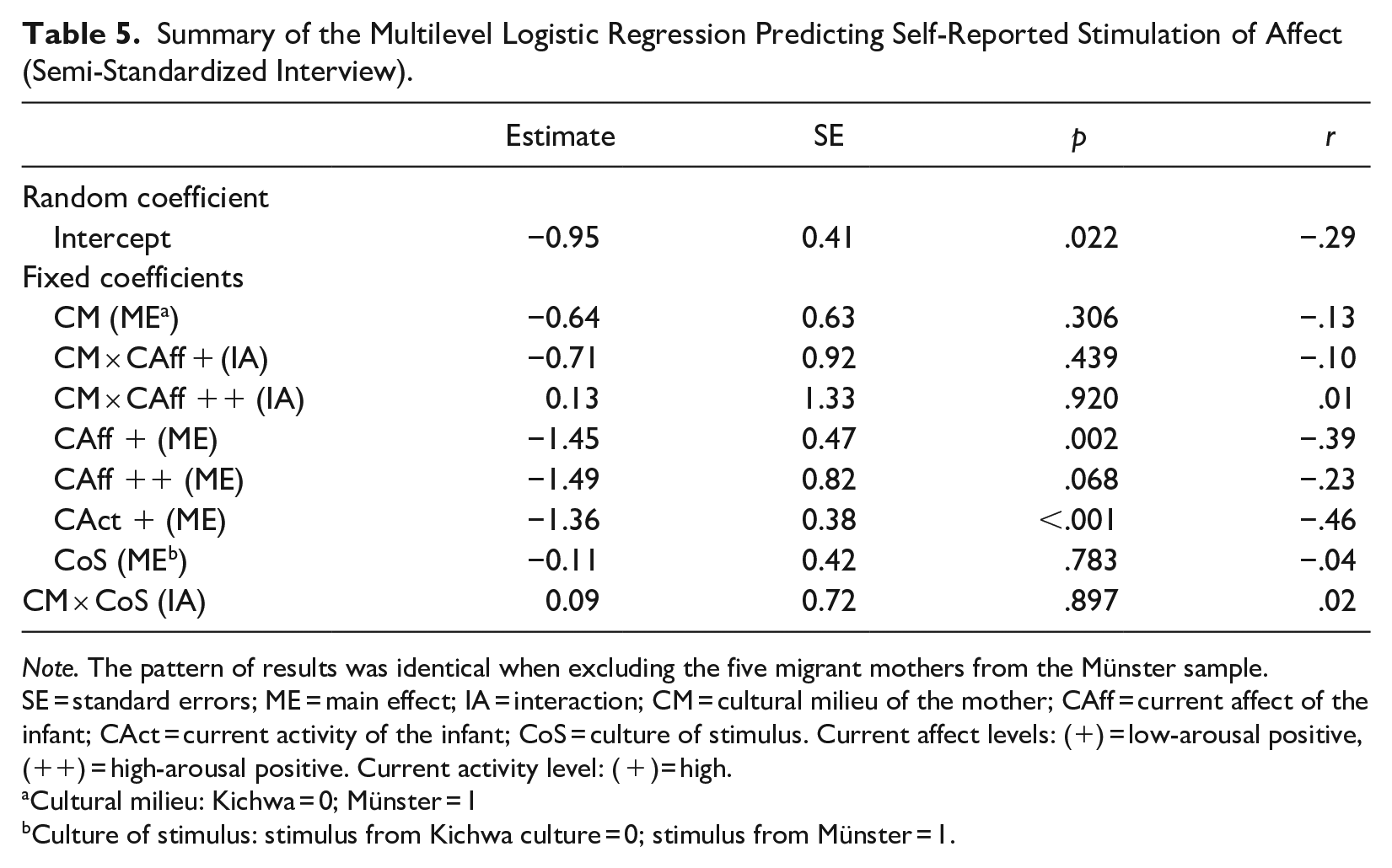
Note. The pattern of results was identical when excluding the five migrant mothers from the Münster sample. SE = standard errors; ME = main effect; IA = interaction; CM = cultural milieu of the mother; CAff = current affect of the infant; CAct = current activity of the infant; CoS = culture of stimulus. Current affect levels: (+) = low-arousal positive, (++) = high-arousal positive. Current activity level: ( + )= high.
Cultural milieu: Kichwa = 0; Münster = 1
Culture of stimulus: stimulus from Kichwa culture = 0; stimulus from Münster = 1.
Stimulation of activity
The model predicting the self-reported tendency of mothers to stimulate activity yielded the following results: The effect of cultural milieu was not significant, b = 0.30, p = .554, r = .08. The interaction between cultural milieu and current activity was positive and marginally significant, b = 1.05, p = .078, r = .23. The plotted variables in Figure 3 indicate that the effect of current activity on the probability to stimulate activity varied with cultural milieu: When the degree of current activity was low, Kichwa mothers were descriptively more likely to stimulate activity. In turn, when the degree of current activity was high, mothers in the Münster sample were more likely to stimulate activity. Independent of mothers’ cultural milieu, the main effect of current activity became significant, b = −1.95, p = <.001, r = −.55, meaning that mothers were more likely to stimulate activity when current activity was low. Furthermore, the mothers’ stimulation of activity did not depend on the current level of affect (see non-significant effects of low-arousal and high-arousal positive affect in Table 6). The main effect of culture of stimulus was not significant, b = −0.11, p = .772, r = −.04, but the interaction of cultural milieu with culture of stimulus had a marginally significant effect, b = −1.08, p = .058, r = −.24: Figure 4 indicates that mothers from Münster were more likely to stimulate activity when presented with stimuli from the Kichwa culture than when presented with stimuli from Münster. Culture of stimulus did not affect response behavior of Kichwa mothers. Finally, the random intercept was significant, b = −1.22, p = .002, r = −.40, indicating that there were interpersonal differences in mothers’ tendencies to stimulate activity that could not be explained by fixed coefficients. A summary of the model is displayed in Table 6.
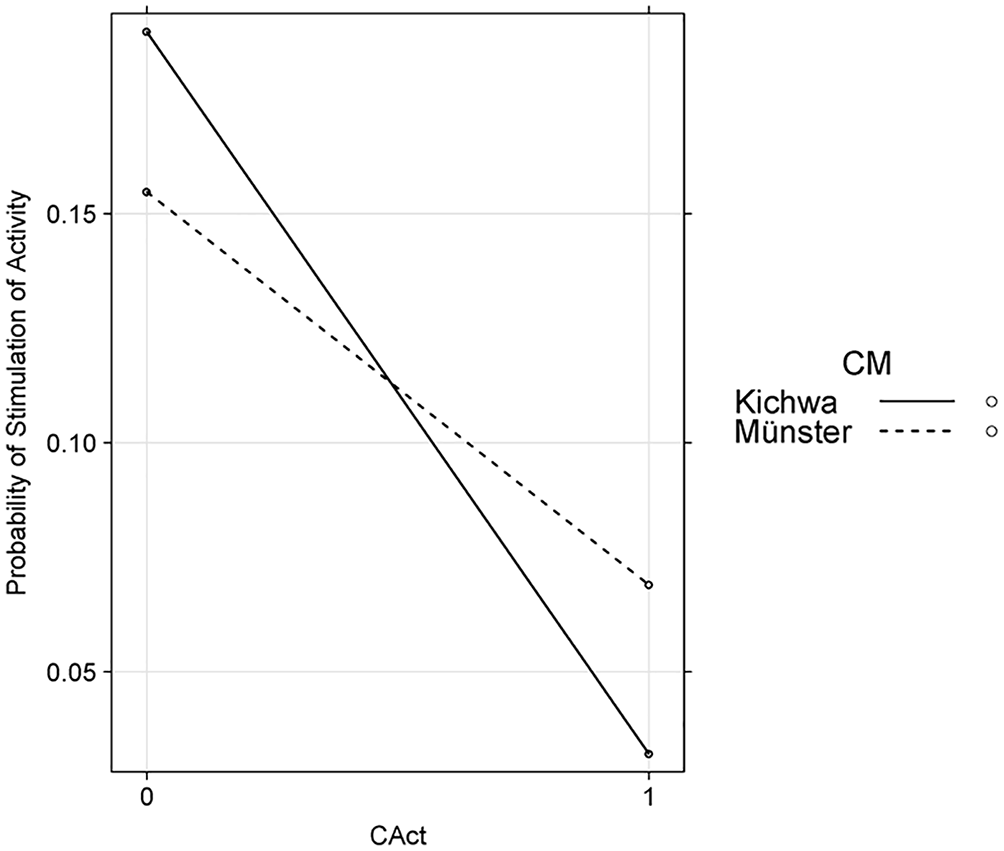
Plot of the interaction of cultural milieu and current activity on stimulation of activity.
Summary of the Multilevel Logistic Regression Predicting Self-Reported Stimulation of Activity.
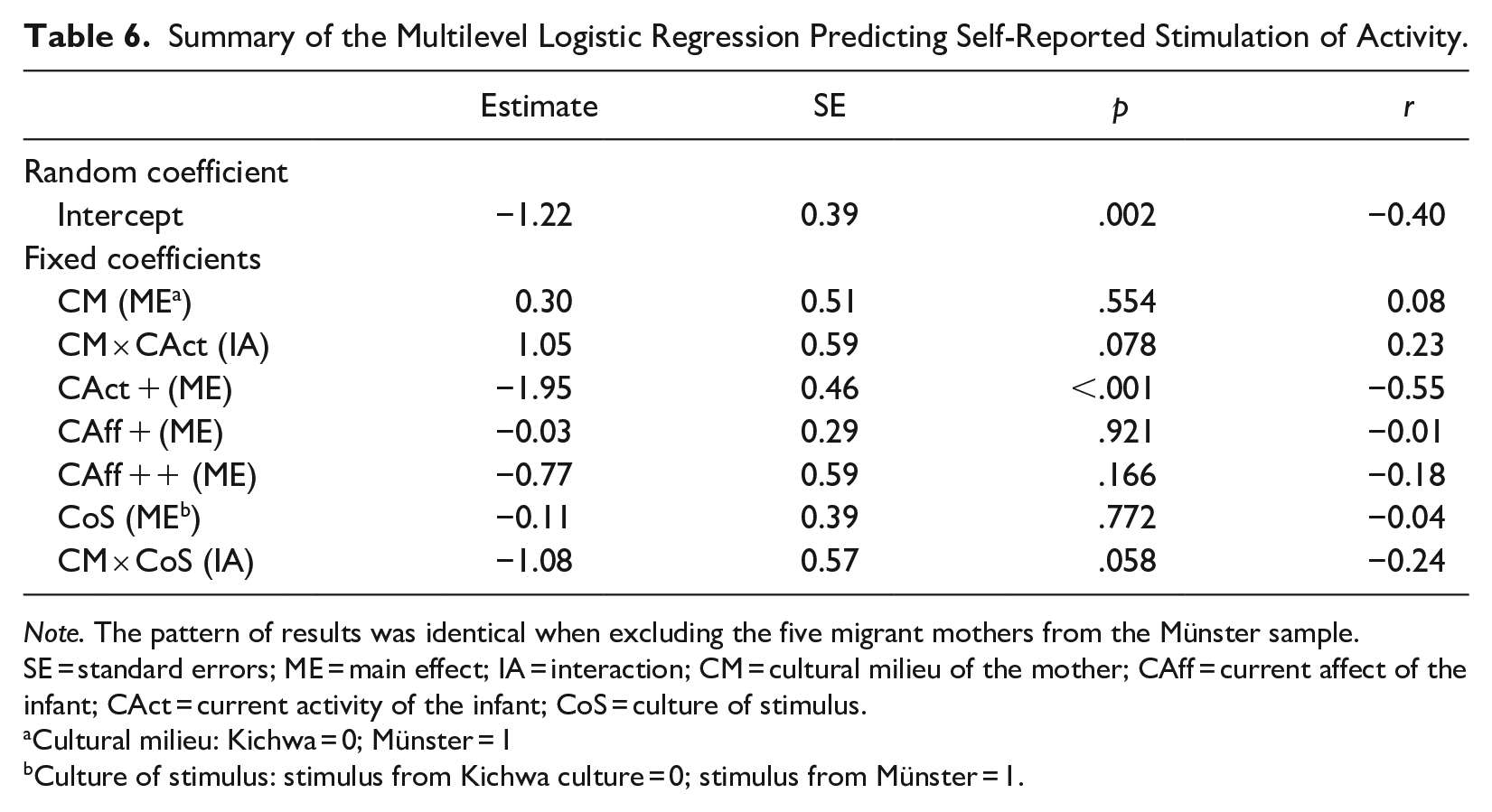
Note. The pattern of results was identical when excluding the five migrant mothers from the Münster sample. SE = standard errors; ME = main effect; IA = interaction; CM = cultural milieu of the mother; CAff = current affect of the infant; CAct = current activity of the infant; CoS = culture of stimulus.
Cultural milieu: Kichwa = 0; Münster = 1
Culture of stimulus: stimulus from Kichwa culture = 0; stimulus from Münster = 1.
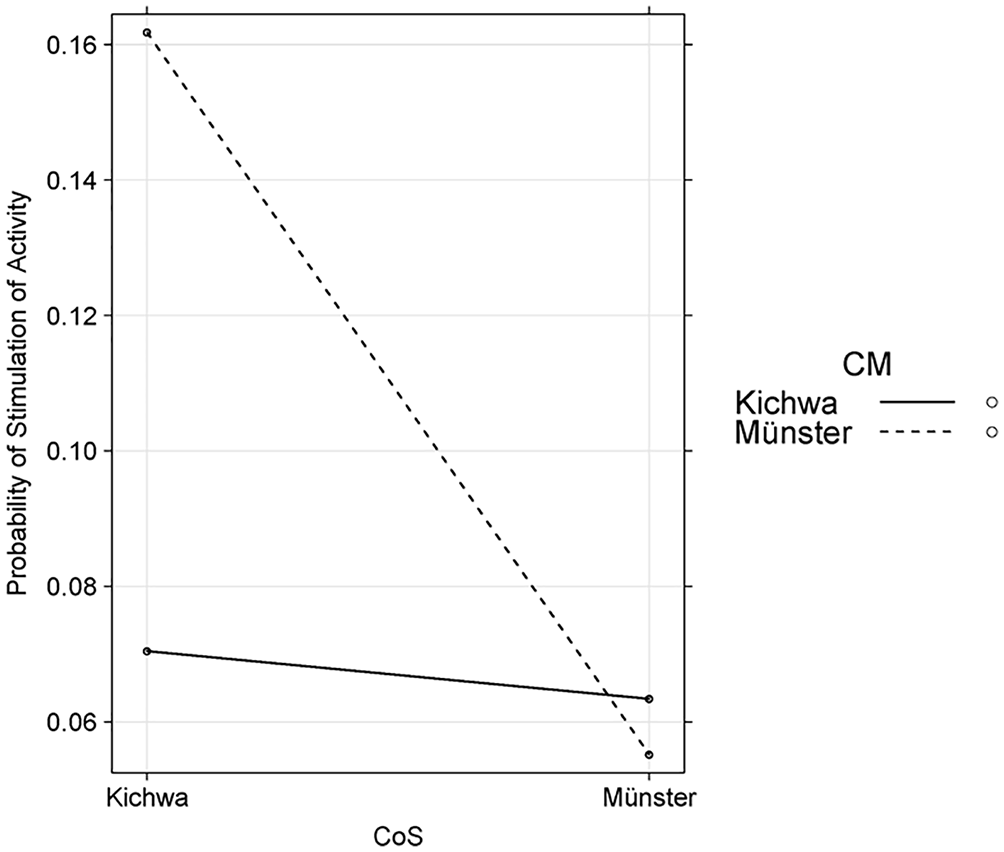
Plot of the interaction of cultural milieu and culture of stimulus on stimulation of activity.
Cross-cultural differences in self-reported parenting strategies
Parenting strategies were analyzed using SPSS (version 26). On average, mothers from Münster reported 7.70 (SD = 4.67) and Kichwa mothers 6.55 (SD = 5.42) parenting strategies per interview. Of all mothers, n = 27 from the Kichwa sample and n = 29 from the Münster sample mentioned at least one parenting strategy, and 26 mothers from each cultural milieu mentioned at least one proximal (body contact or body stimulation) or distal (face-to-face context or object stimulation) parenting strategy (see Table 7). Mothers from Münster named object stimulation significantly more often than Kichwa mothers, t(54) = −4.15, p < .001, d = 0.93, who tended to name body contact more often, t(54) = 1.75, p = .085, d = 0.44. Face-to-face interaction was rarely mentioned in both samples. Thus, samples did not differ with regard to face-to-face interaction, nor did they differ with regard to body stimulation. Mothers from Münster named object stimulation exactly as often as body stimulation.
Relative Frequencies, Standard Deviations, and Two-Sample t-Test Statistics for Parenting Strategies (Semi-Standardized Interview).
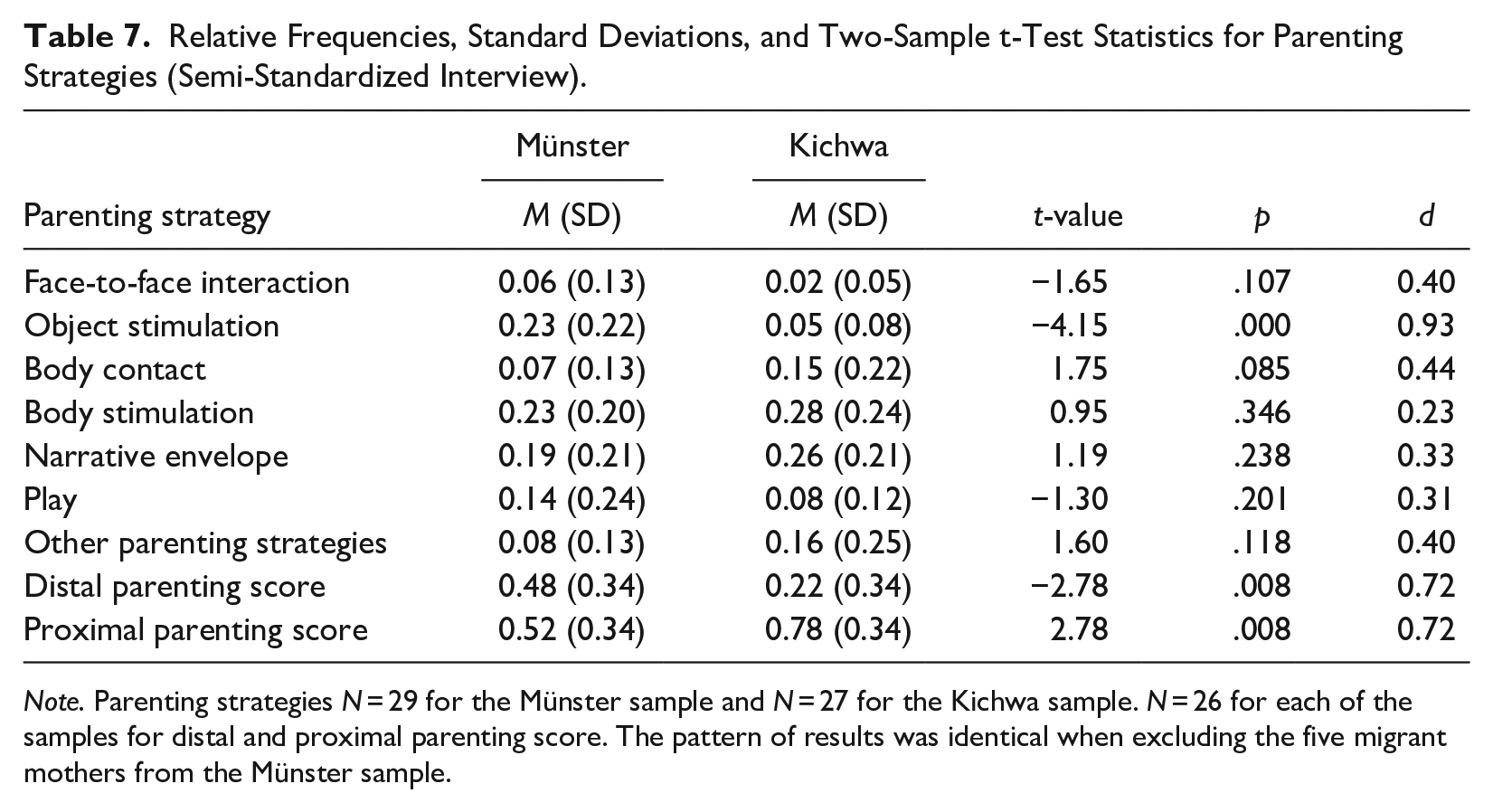
Note. Parenting strategies N = 29 for the Münster sample and N = 27 for the Kichwa sample. N = 26 for each of the samples for distal and proximal parenting score. The pattern of results was identical when excluding the five migrant mothers from the Münster sample.
We conducted a t-test, to test the differences in the proportions of self-reported distal parenting strategies (of both distal and proximal strategies) across cultures. As predicted, there was a statistically significant difference in distal parenting strategies between both samples, t(50) = −2.78, p = .008, d = 0.72, indicating that mothers from the Münster sample named more distal parenting strategies than did Kichwa mothers.
Discussion
The aim of this study was to explore maternal ethnotheories about infant affect and activity in two different cultural milieus. Overall, the findings show that mothers in Münster preferred higher levels of positive affect than Kichwa mothers, although there were no cross-cultural differences in the reported tendencies to actively stimulate positive affect during interaction. Concerning infants’ activity, mothers from both urban Germany and rural Ecuador preferred active infants—although Kichwa mothers preferred the more active state for the pairwise comparison based on the familiar stimulus—and reported similar tendencies as Münster mothers to stimulate infants’ activity during interaction. Regarding specific parenting strategies for co-regulating infant affect or activity, mothers in Münster reported significantly more distal co-regulation strategies than did Kichwa mothers.
Cross-cultural similarities and differences in ideal affect and activity
Our finding that there was a stronger preference for higher levels of positive affect in a culture associated with an independent self-construal is in line with Tsai’s theory (Tsai, 2007) and the study by Gentzler et al. (2018), but our findings also integrate and extend their work: Beyond cross-cultural differences in the level of positive affect that adults value and prefer for themselves (Tsai, 2007), we also found support for cross-cultural differences in maternal ethnotheories about ideal infant affect. Cross-cultural differences in socialization of positive affect, as documented in behavioral and observational studies, nourished our hypothesis that there exist culturally divergent ethnotheories about infant affect. Taking into account our results on ideal affect, a more complete picture of the links between ethnotheories and parent-child interactions emerges: Mothers with an independent self-concept perceive high levels of positive affect as the “optimal level” (Papoušek & Papoušek, 1979, p. 195) and promote the expression of those ego-focused emotions (Markus & Kitayama, 1991) through stimulating behavior such as mock conversations (LeVine, 1990) and affect mirroring (Wörmann et al., 2012, 2014).
Considering potential threats to internal validity, the correlations between the two ideal affect scores were low in the Kichwa sample, impeding the formation of an integrated score. The question remains as to why—at the individual level—the preferences of Kichwa mothers did not lead to a stable response behavior across German and Ecuadorian stimuli. One option is that stereotypes on foreigners may have affected the evaluation of familiar and unfamiliar infants. In any case, we did include familiarity of stimulus into the analysis and found that the cultural differences in ideal affect were independent of this factor, thereby justifying the interpretation of there being actual differences between samples. However, the cross-cultural differences in ideal affect were not paralleled by differences in self-reported co-regulation of affect, an issue we discuss in the following section.
The finding that the ideal activity scores depended on the stimuli familiarity impedes a clear answer to the question of whether Kichwa mothers and mothers from Münster differed in their preferred level of infant activity.
Cross-Cultural Similarities in Self-Reported Co-Regulation of Affect and Activity
Why was it that Münster mothers did emphasize positive infant affect more than Kichwa mothers when asked which infant state they preferred but then did not differ in the degree to which they stimulated positive infant affect when asked whether they wanted to? We address this question by taking a closer look at mothers’ responses in the semi-standardized interview, especially the reasons that mothers from Münster gave for not changing the infant state.
“I think he will say by himself what he wants to do and I would just watch him for now.” As exemplified in this quote, mothers from Münster repeatedly opted for not changing the infant state, because—seeing the infant as an autonomous individual (Keller & Otto, 2009)—they instead decided to be responsive to the infants’ preferences. Another competing ethnotheory that is also associated with promoting individual autonomy and that has resulted in non-interference is the parental belief that children need to spend time on their own (Keller & Kärtner, 2013): “It seems to me that she is doing well on her own, that she does not want to be disturbed.” In contrast, we would expect Kichwa mothers to take the leading role during mother-infant interactions, drawing on an apprenticeship model rather than an equality model, whereby the apprenticeship model is typical for cultures associated with an interdependent view of the self (Keller, 2003). As a Kichwa mother puts it: “She [the infant] should keep on changing and growing, it’s about teaching her new things—emotionally and also how to be active.”
Overall, the process of evaluating the infant’s state and deciding what to do about it is an intuitive and complex one. In the case of mothers from Münster, we suggest that—despite their valuation of high-arousal positive affect—other ethnotheories led to decreased tendencies to stimulate infant affect. This idea is in line with Harkness et al. (2007), who proposed that beliefs are “linked indirectly although powerfully to behavior” (p. 9). As mediating factors, the authors define “child characteristics, situational variables, and competing cultural models and their related practices” (p. 9).
When looking at the stimulation of both infant affect and activity, there were no differences between the two cultural milieus. More specifically, mothers in neither culture expressed the desire to inhibit either infant affect or activity and, across cultures, the tendency to stimulate the infant was generally higher when current affect or activity was low. Additionally, mothers from both samples were more likely to stimulate affect when current activity was low, which points to the interdependence of those psychological dimension during natural mother-child interactions: If an infant’s current state in one dimension, such as activity, falls below the “optimal level” (Papoušek & Papoušek, 1979, p. 195), mothers may co-regulate by addressing another dimension, such as infant affect.
Taking a closer look at the interviews, mothers from both cultural milieus backed up their co-regulation tendencies by referring to the practices and advice given by their midwives and doctors. That is, as stimulation of body movement might have become an elementary component of early intervention programs in both cultural milieus, mothers from both samples might associate high levels of activity with health. For example, a Kichwa mother justified her tendency to stimulate activity by saying “The doctors in the hospitals make some steps with them, massage their feet, and make them move all those parts of the body.” Generally, health professionals play an important role in transmitting and changing (cultural) norms with respect to co-regulation of infant activity.
Reflecting on the internal validity of the semi-standardized interview in general, we would hold that—despite standardization—interview situations might have differed between samples. For example, mothers from Münster were more familiar with technical devices such as tablets. Moreover, expectancy effects might especially have influenced the responses of Kichwa mothers because the research team, including the interviewer, belonged to a different (sub-)culture than the participating mothers: The interviewer came from the same ethnic group but had received more years of formal education. Contact with tourists and the consumption of media from the U.S.A. and Europe might also have built up an expectation in Kichwa mothers about right and wrong parenting behavior in the eyes of foreigners, such as the necessity to promote infant development by means of stimulation.
When comparing the two parts of the interview, namely self-reported co-regulation strategies and the pairwise comparisons, we contend that competing ethnotheories (e.g., being responsive and not “disturbing” the infant) as well as potential expectancy effects would not substantially influence the pairwise comparisons, qualifying the latter as the more valid indicator of maternal ethnotheories. As a consequence, the overall pattern of findings points toward a cultural difference in the ideal state of infant affect. Furthermore, this finding is more in line with the results reported by Tsai (2007), namely culture-specific preference for different intensities of positive affect than with the findings from research on rural subsistence-based cultural communities from Sub-Saharan Africa that report a preference for infant neutrality (Keller & Otto, 2009; LeVine, 1990; LeVine et al., 1994).
Cross-Cultural Differences in Parenting Strategies
In line with previous studies, mothers living in cultural milieus associated with an independent view of the self may feel inclined to use more distal parenting strategies than mothers associated with the interdependent view (Keller et al., 2004). Looking at our samples, mothers from Münster have high levels of education and are in professions that mainly require cognitive and interpersonal skills. By means of containment and mirroring of (emotional) cues during face-to-face interaction, and by stimulating the infant with objects, mothers promote psychological functions in infants that play a fundamental role in this particular developmental niche (Kärtner et al., 2013; Keller & Greenfield, 2000; Keller & Kärtner, 2013; Stern, 2010; Super & Harkness, 1986) and form the basis for developing an independent self (Markus & Kitayama, 1991).
The complementary finding that mothers from interdependent milieus would intuitively use more proximal parenting strategies is also very compatible with previous research (Kärtner et al., 2010; Keller & Kärtner, 2013). As the following quote by a Kichwa mother and the data on the location of the infant during everyday routines indicate, there are more Kichwa than Münster mothers that emphasize body contact and proximity, a parenting practice that seems to be closely tied to the idea of togetherness: “We need to carry her and not leave her alone, we need to be close to the baby.”
Limitations and Future Perspectives
In the present study, we used a two-part interview to assess maternal ethnotheories about infant affect and activity. The question regarding which measure (pairwise comparison or semi-standardized interview) serves as a better predictor for maternal co-regulation of infant states and for developmental outcomes, such as infant affect displays under standardized conditions, should be addressed in future studies. Moreover, both parts of the interview need to be developed further: In the semi-standardized interview on stimulation or inhibition of infant affect or activity, future studies should use a larger spectrum of infant states, including unrestrained positive affect to increase the variance of maternal responses. With respect to the pairwise comparison, more comparisons for each dimension of interest should be included, which will allow for a more robust scale formation. Concerning co-regulation tendencies, future studies would benefit from a diversification of the interview guideline, which should allow flexibility concerning the exploration of novel themes, such as different ethnotheories, and also be complemented by more specific questions (e.g., questions about direction of change; i.e., stimulation/inhibition) and, at the same time, more in-depths questions (e.g., reasons for not changing the infant state; further inquiring in case of ambiguous answers). For the purpose of a deeper analysis of parenting strategies, we recommend being open toward the formation of further culture-specific, inductive categories and to testing each strategy separately. Extensive intercultural collaborations lay the foundation for this development process. For example, a priori selection and classification of stimuli and coding of the interviews could best be accomplished by intercultural teams of researchers. Furthermore, it would be promising to apply the interview in different cultural milieus, which would allow for a better understanding of the organization of early parenting across cultures. The idea of using culture-specific video clips showing specific combinations of infant affect for the assessment of parental co-regulation tendencies could be applied to different emotions, for example to cultural differences and similarities in co-regulation of anger. Future studies should include more direct measures of key socialization goals and parenting strategies that are associated with the concepts of independence and interdependence. Moreover, ethnographic methods, such as participant observations, can provide insights into what daily life is like for these mothers (e.g., demands of their own activities) that go beyond the information gained in the semi-standardized interview that we developed for this study.
Conclusion
The present interview study is the first to provide direct evidence that maternal ethnotheories about infants’ ideal affect vary across cultures: Mothers from Münster (urban Germany), for whom we assume independent self-construals, have stronger preferences for higher levels of positive affectivity in comparison to Kichwa mothers (rural Ecuador) with assumedly interdependent self-construals. We propose that ethnotheories about ideal affect function as target states during parent-infant interaction that caregivers seek to establish and maintain. Thus, cultural differences in the preferred level of positive affect should inform parenting behavior that has direct implications for infant experience and behavior and long-term effects on infants’ emotional development. Furthermore, we agree with Harkness et al. (2007) in proposing an indirect link of ideals to (self-reported) parenting behavior. Beyond ethnotheories about ideal states, there are other ethnotheories and child characteristics (e.g., level and focus of attention) that are linked to parenting behavior, as demonstrated by the culture-specific modality patterns (i.e., proximal and distal ways of co-regulation) that mothers reported. Overall, caregivers’ ethnotheories should be considered as one important part of infants’ cultural niches, when describing the developmental system of infant affect and activity.
Footnotes
Appendix
Acknowledgements
Special thanks go to Nancy Iza, Lilo Deckner, Sonja Duhe, Mira Schwick, Hanna Krabbe, Sophia Nedderman, Laura Burbach, Karina Lüdemann, and Marius Gruber who were involved in interview development, data collection, and transcription or coding. We wish to thank the families who contributed with their time and effort in this study.
Declaration of Conflicting Interests
The author(s) declared no potential conflicts of interest with respect to the research, authorship, and/or publication of this article.
Funding
The author(s) received no financial support for the research, authorship, and/or publication of this article.
