



Abstract
Cross-cultural psychology has employed the concept of the “field” in two ways. First, as articulated by Lewin, it is the larger context in which all individuals develop their behaviors and now express them; it is a conceptual space within which to situate human behavior. Second, it refers to the cultures and communities in which anthropologists have usually worked, making observations of daily life, and then describing the cultures of the people; it is a physical and symbolic space in which human activity takes place. These two meanings share common features: they both consider that all human behavior develops and is exhibited in contexts; and that these contexts need to be studied and described before human activity can be understood and interpreted. I argue that it is essential for cross-cultural psychology to use and study both meanings of the field concept if we are to make valid interpretations of the origins (roots) and the influences (routes) on behaviors that we observe and assess in our research and practice. Starting over 100 years ago, collaboration between anthropologists and psychologists established the field of cross-cultural psychology. This collaboration continued for many years, but has diminished in recent times. I argue for the necessity to return to the field in both senses in order for our field to advance. This paper examines these two meanings in the disciplines of anthropology and psychology, and presents some elaborations of them, using the ecocultural framework as a general guide, and an arc framework as a specific exposition of it. Examples of fieldwork in psychology and anthropology are presented to provide substance to these frameworks. The claim is made that our discipline has largely abandoned the concept of the field, and proposes a way to correct this error.
Keywords
Introduction
In the beginning was the insight that psychology and anthropology were intimately connected: “ I had long realised that no investigation of a people was complete that did not embrace a study of their psychology, and being aware of the paucity of our knowledge of the comparative physiology and psychology of primitive peoples, I determined that this branch should be well represented. I was able to secure Dr. W.H.R. Rivers as a colleague. . .. We obtained the cooperation of Messrs C.S. Myers and W. McDougall who undertook special branches of experimental psychology”. A.C. Haddon, Leader of the Cambridge Anthropological Expedition to the Torres Straits Islands, 1888-1889. (In Preface to Rivers, 1901; see also Haddon, 1898).
His colleague Rivers (1911, p.1), emphasized that psychological assessment was the way to reap the fruits of this collaboration: “The work described in this volume of the Reports of the Cambridge Anthropological Expedition is the result of an attempt to study the mental characteristics of the Natives of the Torres Straits and the Fly River districts of British New Guinea by the methods of experimental psychology”
As noted by Haddon, any knowledge of human psychology can only be understood when examined in their contexts. And as noted by Rivers, the methods of experimental psychology are appropriate for this task. This collaboration of anthropological and psychological researchers set the stage for the emergence of the field of cross-cultural psychology. Such cooperation is important because all human behavior is developed and expressed in specific contexts; and, further, all these contexts are embedded within a broader ecosystem.
For many years, I have been exploring the sequence of phenomena from ecological context to cultural adaptations to the development and expression of individual behavior. This sequence has guided my research agenda in order to understand the roots (origins) and routes (processes) of human behavior and its development. This has been organized into an Ecocultural Framework (Berry, 1975, 1976, 1979, 1980, 1983a, 1983b, 2006, 2017, 2018). The articles by Smith and Bond, and by Dasen in this special issue portray this framework in general terms. In the present article, I dig deeper into this framework by tracing this sequence of phenomena, using a related “Arc framework” derived from the insights of Brunswik (1956) and Lewin (1936). I then illustrate it with examples of some of my collaborative fieldwork in various parts of the world.
The concept of the “field” has entered into our work as cross-cultural psychologists from two sources. From psychology, we take the broadest possible view from Lewin (1936) and consider the field to be “the situation as a whole”; this constitutes a conceptual space with experiences that supply the affordances (opportunities) and limitations (constraints) for the development and expression of human behavior. From anthropology, we take the concept of the field to be the actual place where human beings engage their natural and social habitats during their daily lives. These two meanings present us with the challenge to observe, describe, and interpret the contexts within which human cultures and behaviors develop and are expressed. Without an understanding of these contexts, we would be unable to understand the behaviors that we study. In this paper, I contend that, unfortunately, the study of the field, in both senses, has been largely forgotten in the recent history of cross-cultural psychology.
In general psychology, the most comprehensive conceptualization of the field has been employed for many years in Gestalt, social, developmental, and environmental psychology (e.g., Barker, 1968; Bronfenbrenner, 1979; Brunswik, 1956; Lewin, 1936). The famous formula proposed by Lewin [B = f (P, E)] captures this overall conceptualization: Behavior (B) was broadly construed to include action, thinking, and valuing (which encompasses the classic tripartite division in psychology among cognition, affect, and performance). The Person (P) was the functioning organism, which is the locus of basic psychological processes and capacities. The Environment (E) was the all-encompassing ecosystem in which all human behavior is developed and is displayed.
In more recent times, there have been some extensions in general psychology of the original concept of the field that was proposed by Lewin. For example, MacLachlan and McVeigh (2020) have proposed understanding the field in terms of a macropsychology, which seeks to return us to a consideration of the broad contextual nature of human behavior (see also Berry, 2020). Bond (2013) has developed a model to account for individual social behavior based on Lewin’s formula. He considers that two components of the field are particularly relevant in a person’s environment: the “affordances” that permits and supports a behavior, and the “normative pressure” to engage in a behavior. These two components provide the “strength” of a situation for the enactment of a particular behavior. Most recently, there has been a call for advancing a “field social psychology” (Power & Velez, 2021) that seeks to explain psychological phenomena at multiple levels of analysis, including the individual (thoughts, feeling, and actions) over time, and as they can be examined in ecologically valid settings (rather than in artificially constrained experimental ones). These recent proposals are generally consistent with arguments being advanced in the present paper, and are useful for advancing the field of cross-cultural psychology.
In cross-cultural psychology, the core notion of the field has also come from the discipline of anthropology. In this second usage, the field refers to the day-to-day contexts in which people live. These are experienced, studied, described, and interpreted during periods of “fieldwork” (e.g., Goodenough, 1980; Lonner & Berry, 1986; Munroe & Munroe, 1986, 2016). The goal is to “attempt to understand, by close and direct contact, how a living community works and what the beliefs, norms and values by which they live are” (Firth, 1972, p. 10). This activity has been termed “thick description” by Geertz (1973). Early in anthropological research, these fields were mainly remote and exotic, such as the communities of Indigenous Peoples in many parts of the world. They were often carried out in the wake of (and in the service of) colonization. More recently, they also include local and mundane settings, such as schools and community organizations in one’s hometown. The challenges of carrying out field studies in cross-cultural psychology have been describe by Mishra et al. (1999). Such studies require much time, effort, and permissions, both for being absent from the home institution, and for being in the field community. Fieldwork is also often carried out in difficult physical, political, and social circumstances, which presents barriers to easy access to populations of interest. Of particular importance for career development is the length of time required for younger researchers to prepare and carry out a project in the field. In contrast, research in the lab or clinic, usually located nearby, is relatively less demanding. Collaboration with an anthropologist is one way to reduce these barriers because they are often established in the field area where one wants to work (Dasen, 2017).
Despite these difficulties of working in the field, my claim in this essay is that, as cross-cultural psychologists, we cannot understand or interpret any human behavior without attending to the field, in both these disciplinary traditions. That is, whether the field is our specific research setting (such as a lab, clinic, classroom, or community), or a far-away cultural group, we need to fully-understand these contexts in order to obtain the information that is needed to fully-understand the behaviors that we observe. Without this contextual information, we can only guess (usually post-hoc) at what background factors may be responsible for the behaviors that we observe.
Two areas of psychology have attended to these contexts as core issues. One is cross-cultural developmental psychology. The emphasis here is on the range of contexts in which individuals experience their primary enculturation, and in which their behaviors develop (Super & Harkness, 1980; Whiting & Whiting, 1975; see also Dasen, 2003 and article in this special issue). These primary contexts need to be examined in order to understand the sources of human behavioral development, and the routes of transmission from the cultural context to the individual. Included in this process are the cultural practices of child socialization, economic, and sex role inculcation, and incorporation into the social and political structures of ones society.
The second research area is in intercultural psychology (Berry, 2006), where two or more cultural contexts impinge on individuals following intercultural contact, who then change their cultures and behaviors through the process of acculturation (Sam & Berry, 2016). In these contact settings, multiple contexts need to be examined in order to understand the interacting and competing influences on an individual and their behavior. Such settings are sometimes experienced at the same time as an individual’s primary development (enculturation); and they also usually continue in later life. Included in this process are the experiences of contact with members of other cultural groups, the often difficult decision regarding maintenance or shedding ones heritage culture, and the experience of challenging and stressful encounters. Disentangling the relative roles of enculturation and acculturation during development is a difficult task (Oppedal & Toppelberg, 2016). These two processes of enculturation and acculturation serve as the routes or vehicles that transmit the contextual elements and experiences of ones heritage and contact cultures to individuals, and thereby become incorporated into their behavioral repertoires.
The Ecocultural Framework
A general framework was developed to conceptualize, examine, and measure the links among ecological and sociopolitical contexts, the cultural and biological adaptations of populations to these contexts, and then to the behaviors of individuals in them. This ecocultural framework has been developed and expanded over the years (Berry, 1975, 1976, 1979, 1980, 1983a, 1983b, 2006, 2017, 2018). It is intended as a general guide to the main classes of variables that we need to include in any cross-cultural study of behavior. This framework has been presented in Figure 1 (Smith and Bond, 2022). They note that this framework and its components “are pitched at a general level requiring practitioners to position concepts of interest within the components of the model and then to theorize about the relationships among their chosen concepts.” They list many studies that have accomplished this specification of variables and have operationalized them. Similarly, Dasen (2022) has incorporated the ecocultural framework into a developmental framework, that draws on the work of Bronfenbrenner’s three levels and the perspectives of Whiting (1977) and Georgas (1988). Since this ecocultural framework is presented elsewhere in this Special Issue, it need not be repeated here.
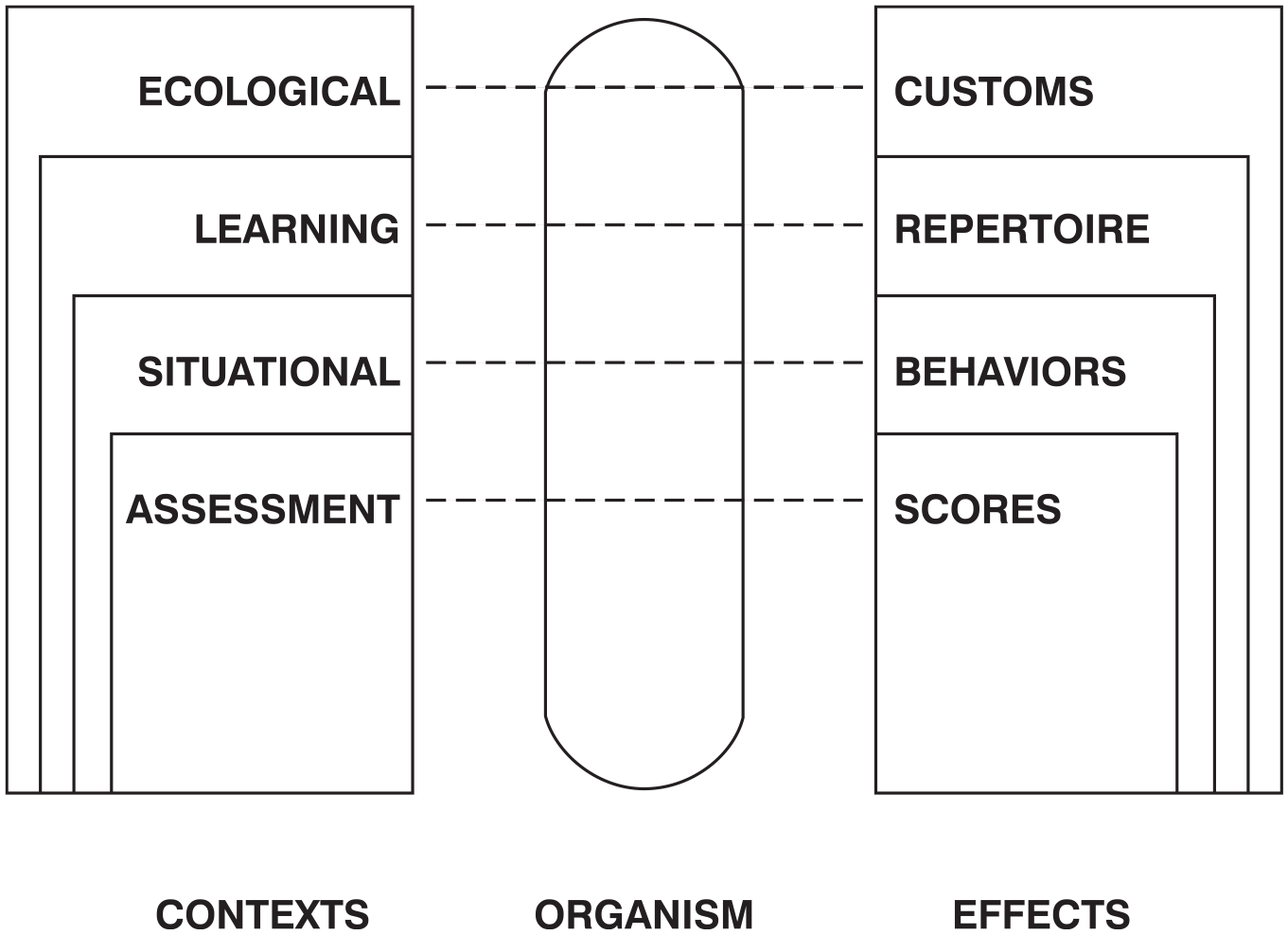
A multi-level Arc model linking contexts to behaviors.
In summary, the ecocultural approach combines the ecological and the cultural ways of understanding the development and display of human behavior. The ecological approach examines phenomena in their natural contexts, and attempts to identify relationships between the phenomena and these contexts. Ecological contexts include such features as temperature and the availability of water that permit (or limit) certain forms of economic activity The cultural approach examines behaviors in the cultural contexts in which they develop and are displayed and shared through the process of enculturation. Cultural features include such practices as child socialization values and practices and social and political institutions. When the examinations of these contexts and practices are carried out comparatively, the cross-cultural approach results.
In addition to this ecological and cultural line of thinking about enculturation (where local features of ecology and culture are used to predict individual behavior) there is a second line of thinking that originates from contact with other cultures. This second source of influence is the sociopolitical context that brings about contact with other cultures, which in turn shapes both the original culture, the biology, and the behavior of a group and its individual members through the process of acculturation. With this general framework as background, I now turn to an “Arc Model” that seeks to identify the specific features of the contexts and behavioral outcomes that populate the more general ecocultural framework.
The Field as Nested Contexts
A multi-level “Arc Model” (Berry, 1979, 1980, 1983a) was proposed as way to specify the main contexts and the psychological outcomes identified in the general ecocultural framework. This Arc Model was based on the ideas of Brunswik (1956). The goal of the model was to identify various contexts and to show how they give rise to different effects in groups and individuals (see Figure 1). Each context (on the left) is “nested” within the more comprehensive one that is immediately above it. The effects (on the right) are also “nested,” with each behavioral phenomenon being a sub-set of the one immediately above it.
This model displays the various contexts and outcomes for groups and individuals. Following Lewin’s formula, the contexts on the left are the “E,” which need to be examined as antecedents of behavioral development and expression. On the right are the collective and individual consequences of developing and acting in these contexts; these are the “B” in Lewin’s formula. In the middle is the organism that represents the “P” (the person’s processes and capacities) in Lewin’s formula. Each context is linked to an effect through an “arc,” as proposed by Brunswik (1956). Linking these contexts to the effects are four levels, each with an “arc.” These “arcs” serve to link contexts (E) to effects on collective and individual and behaviors (B) through the individual organism (P).These are arranged in a hierarchy, with each level “nested” in the one immediately above it.
Four Levels of Arcs
The most comprehensive level is the upper arc (termed the molar arc by Brunswik); this is concerned with linking people’s “life situations as a whole” (in the phrasing of Lewin) in their ecological context or habitat with their overall life outcomes (such as the customs of a society, or an individual’s accomplishments). The second level is the learning arc that examines the particular experiences that an individual has engaged in within the whole ecological context, and that can be linked to the development of their repertoire of behaviors (such as their abilities, attitudes, or profile of traits). The third is the performance arc, which considers the specific setting (such as a family role, work situation, or socialization practices) that may promote (affordances) or hinder (constraints) the development and performance of a specific behavior that is appropriate for that setting. The fourth level is the assessment arc, within which an individual is induced by a test, experimental procedure, or questionnaire to produce a particular act (such as an ability score, answer to a question, or response to a stimulus).
Four Levels of Contexts
On the context side of the framework, we need to examine the broad features of the field in which the group operates, in order to understand the more specific contextual features of the group that influence behavioral development and expression. This examination allows us to identify the particular distal and proximal experiences that have an impact on our customs and behaviors:
- The ecological context is the comprehensive habitat that provides the broadest set of opportunities and constraints for the group and individual to develop. These contexts have been described as the ecological and sociocultural inputs in the ecocultural framework.
- The learning context is the subset of experiences that individuals are exposed to as a result of their engagement with some specific features of the ecological and sociocultural contexts (due to their age, gender, or class, or resulting from their socialization or experience of formal schooling).
- The situations are the specific settings that promote (afford) or limit (constrain) the expression of a particular behavior because of roles, norms, or other forms of social control. These prime the individual to engage in behaviors that are appropriate for a particular situation.
- The assessment context includes the research or clinical instruments that are used to stimulate or elicit, and then observe actions by the individual. These contexts are studied by the common tools used in ethnographic fieldwork and psychological research and practice work with individuals, such as observation, interviewing key informants, participant observation, formal assessment, and testing.
Four Levels of Effects
On the effects side, we need to examine and come to understand:
- The customs of the cultural group to identify the range of activities and routines that are expressed in daily life. While these are collective effects, they are also part of the field and serve as contexts for the psychological development of individuals
- The repertoire is a subset of these activities that is learned by an individual as a result of the experiences that are available to them in their particular roles in the community.
- The behaviors that are actually expressed are a further subset of the repertoire that has been acquired; not all behaviors in a person’s repertoire are appropriate to be enacted in all settings.
- The scores are those specific behaviors that are expressed in contexts that are created to meet specific research or assessment needs. If these scores are not already present in the cultural practices of the group (at the top) or part of in the behavioral repertoire of the individual, then there can be no valid assessment of them.
All these effects are studied using the common qualitative and quantitative tools of psychology (such as interviews, observations, and tests/tasks). However, these need to be rendered culturally appropriate by adapting them using the findings from the background ethnographic work.
This framework draws our attention to the perennial question in general psychology that challenges us to say anything about the origins of a “score” on a test (at the lower right), when so little is studied or understood about the higher-level contexts in which they have developed, or the more comprehensive cultural and behavioral effects in which they are embedded. This problem may be illustrated by the long-standing neglect of “culture” as a variable in general psychology, in preference for attending to such mundane features of a context as an experimental manipulation.
My contention is that much of the data and findings obtained in general psychology lack ecological validity because the ecological, learning, and situational contexts are so little studied. As a result, they are minimally understood, and not available for interpreting psychological data. Similarly, the effects that are higher up in the framework (customs, repertoire, and behaviors) are often not examined to learn whether they provide a valid basis for eliciting a score from an individual. In short, the essential fieldwork (in either sense of the term) has usually not been carried out, and hence the background factors that may be responsible for a particular behavior or score can only be guessed at, and made post hoc. Ideally, these field studies should be carried out prior to engaging in the assessment of any behavior.
Even more ideally, these field studies should be used as the basis for predicting the similarities and differences in behaviors and scores across the ecological and cultural contexts that are being examined in the study. That is, we should be able to say that in ecological, experiential, and situational contexts, X, we expect to find evidence for the presence of customs, repertoires, and behaviors, A; and when we use assessment instruments embedded in contexts, X, we predict that we will find scores that are embedded in A. Cross-culturally, when we work in two different contexts, X and Y, we expect to find different scores A and B that should be theoretically and plausibly linked to the differences in contexts, X and Y.
Fieldwork in Anthropology
Although I argue that fieldwork is essential in order to provide the background information needed to carry out culturally appropriate psychological research, it is also the case that the practice of fieldwork is now controversial. This is because fieldwork has its roots in the colonial era of exploration and exploitation, which facilitated both early anthropological research and colonial domination.
Discussions of how to engage in fieldwork have emphasized the role of the “outsider” in the study of “native” peoples (McGlinchey, 2015). Nevertheless, the term and practice continue in contemporary usage to refer to the way ethnographers carry out an intense examination of people in their everyday lives in their communities (Robben & Sluka, 2012). Some of the most relevant descriptions of this kind of work available for psychologists are by Ember et al. (2015), Munroe and Munroe (2016), and Whiting and Whiting (1973). These show how psychologists have worked in the anthropological tradition of fieldwork. Drawing on this fieldwork tradition, Lonner and Berry (1986) assembled a set of chapters explicitly designed to provide guidance for psychologists to carry out fieldwork.
The outcome of this anthropological research tradition is a massive ethnographic literature, covering almost all cultural groups in the world. Much of this work has been assembled and codified in the Human Relations Area Files (Murdock, 1975; see also Barry, 1980). This archive provides evidence of variations in cultural practices around the world. For ease of use, many numerical codes have been produced so that each researcher does not have to convert verbal descriptions of a custom to a score each time a cultural activity is employed. A massive set of codes is available in A Cross-Cultural Summary (Textor, 1967). Many of these materials are now available online: http://ehrafWorldCultures.yale.edu. This site has indices for over 700 cultural topics drawn from the Outline of Cultural Materials (Murdock, 1975). A basic guide to using these files in cross-cultural research has been compiled by Ember and Ember (2021).
One important use of these files in cross-cultural psychology is to locate cultural groups that will allow for the examination of a particular research question. However, it is necessary to look closely (perhaps with a preliminary visit) to determine if the HRAF information is still current and valid. As mentioned previously, it is ideal to select cultures where certain practices (contexts) are likely to induce certain behaviors (effects). This allows for the prediction of similarities and differences in behaviors across cultures. And if a sufficiently large range of world cultures is included in a study, it may be possible to generate cultural and psychological universals. For example, if the researcher is interested in the role of matriarchy, or social stratification, in bringing about a certain value, belief, attitude, or behavior, then the researcher can peruse the HRAF for appropriate cultural groups in which to do the research.
While the early focus of fieldwork in anthropology was primarily on the customs and structures of cultural groups (at the upper left of the arc model), following the work of Rivers (1901) there was a transitioning to psychological questions in the practice of fieldwork by Boas (1911) and many of his students. Some of them espoused psychological theories and methods to study various cultural groups, often making comparisons across them. Perhaps best known are Benedict (1934), Hallowell (1955), and Mead (1928). At about the same time, other anthropologists were carrying out psychology-informed research in the field, such as Nadel (1937) in Africa. Following Haddon (1898), they sought to convince their colleagues in anthropology about the importance of taking ideas and practices from psychology; they also sought to convince colleagues in psychology about the need to take cultural factors into consideration. These works have been recognized as precursors to the growth of cross-cultural psychology in the following decades (see Jahoda, 1982; Klineberg, 1980 for overviews).
Fieldwork in Cross-Cultural and Intercultural Psychology
Much of the earlier research in psychology on the relationships between culture and human behavior around the turn of the 20th century depended on these ethnographic accounts from fieldwork (Jahoda & Krewer, 1997; Klineberg, 1980). Information from the field served as the basic source of ideas and evidence about human behavior, drawn largely from these anthropological sources. Some psychologists used this information remotely. For example, Freud and Wundt read widely in the available anthropological literature, but did not do fieldwork themselves. Wundt (1904, summarized in English in 1913) in his Volkerpsychologie (see also Berry, 1983b) drew on numerous ethnographic reports available to him in many European languages. Similarly, Freud (1928) was able to find concepts and to construct theories about “abnormal behavior” largely from these sources. Visits to their two museums in Leipzig and Vienna reveal vast collections of ethnographic writings by anthropologists, explorers, and colonizers, whose work informed the views of these two influential scholars.
As noted above, at about the same time, some psychologists engaged in fieldwork themselves, notably by those on the Cambridge Anthropological Expedition to Torres Straits in 1898 (Haddon, 1898). This team included a number of psychologists, Rivers (1901), McDougall (1908), and Myers (1904). In many ways, these writings have served as a model for simultaneously carrying out anthropological field work while gathering individual-level psychological data. These early field studies were soon followed by research by Bartlett (1932) in Africa, Beaglehole (1932) in Polynesia, and by Luria (1931) in Central Asia. These stand out as early examples of psychologists who carried out fieldwork in remote places.
Emulating this anthropological tradition of working in the field, many cross-cultural psychologists sought to experience first-hand the specific contexts of the behaviors they were studying. This enterprise has been made accessible by the presentations of Campbell (1961), Campbell and Levine (1973), and Munroe and Munroe (1986), who outline various fieldwork procedures, such as entry to the field, the use of key informants, translators, and assistants, and ethical issues during and after the work has been completed.
Starting in the mid-20th Century, many of us who identified as cross-cultural psychologists carried out fieldwork, similar to (and sometimes in collaboration with) anthropologists. We went to communities in many parts of the world, immersed ourselves in the daily life there, made observations, carried out interviews and administered tests and tasks. These two kinds of activities constitute the “cultural” and the “psychology” aspects of our field respectively. Such studies were sometimes repeated in other societies, and comparisons made (adding the “cross” part to our field). Many of the researchers in cross-cultural psychology in this early period were included in the Directory of Cross-Cultural Psychological Research (Berry, 1968, 1969; Berry & Lonner, 1970, and as described in the Introduction to this Special Issue). An examination of the names and topics in those directories shows that many of them were engaged in fieldwork at that time. The challenges of carrying out field studies in cross-cultural psychology have been described by Mishra et al. (1999) and Mishra and Dasen (2007). Since then, many have continued to carry out fieldwork (see Dasen, this volume for an account of some of these projects). In addition, Whiting and Whiting (1975) included teams of anthropologists and psychologists working together in six societies (India, Japan, Kenya, Mexico, the Philippines, and the USA). They employed a common set of ideas to examine and compare the development of children and related this development to the ecological, and cultural-socialization practices of mothers. Related to this enterprise is the concept of the developmental niche (Super & Harkness, 1986) who carried out fieldwork examining the specific experiences of children that serve as “settings” for their development. Greenfield carried out early Piagetian research in Senegal and later in a Zinacantec Maya community in Mexico over a period of 21 years since then (Greenfield et al., 2003).
Pierre Dasen has a continuous record of innovative fieldwork beginning with a series of studies of child development in the Piagetian tradition with Arunta children in central Australia. He continued this work with Inuit in Canada, and in various societies in Africa (Cote d’Ivoire, Kenya), culminating in an overview of this program of research (Dasen, 1972). He has also carried out fieldwork in New Guinea on counting systems (Wassmann & Dasen, 1994) and on spatial cognition in Bali, India, and Nepal (Dasen & Mishra, 2010). His essay on working collaboratively with an anthropologist (Dasen, 2017) is informative and helpful when carrying out interdisciplinary research in the field.
Using the Arc Model in Fieldwork
The Arc Model can serve as a guide to examples of fieldwork carried out by psychologists. As noted above, the Arc Model is a way of identifying the specific contexts that serve as the two main contexts in the Ecocultural Framework: (ecological and sociopolitical) and the main outcomes (customs, repertoire, behaviors, and scores).
First, at the top level (the Molar arc), we can identify which societies can be taken as appropriate sites to examine a particular psychological question. The HRAF has been useful in making such selections. It is possible to determine which societies exhibit the ecological features and cultural practices that are likely to be antecedent to the behaviors of interest. If there are contrasts available in these features between societies, then predictions in differential behavioral outcomes can be made. At the second level (the Learning arc) fieldwork allows observations to be made, or interviews to be conducted, of what experiences are promoted during development that provide opportunities to acquire the behaviors of interest. At the third level (the Performance arc) observations of situations and behaviors in daily life can reveal whether the behavior of interest is likely to be a part of the individual’s repertoire. At the fourth level (the Assessment arc), the specific test or task can be created to ensure that the materials or questions are within the previous experience of the individual to be assessed, and whether the response expected is within the repertoire of the individual and can provide a valid “score.”
The two meanings of the field discussed so far can be illustrated by linking the various components of the Arc Framework to the practice of field work in cross-cultural psychology studies. All the four contexts (on the left) serve as examples of “the field” in both senses. Some of these contexts may be seen as examples of the “ecology” context (upper) line in the ecocultural framework, where existing features of the context need to be examined, and used as a basis for interpreting the outcomes (on the right). Other contexts are part of the “sociopolitical” context (lower) line in the ecocultural framework, where new features are introduced through contact with outside cultures.
Both the ecology and sociopolitical contexts shown in the Ecocultural Framework provide lines through the framework to influence psychological outcomes. Features of both contexts can be used to illustrate the ways in which fieldwork may be carried out. Following are some examples of my own studies in cross-cultural and intercultural psychology that have been guided by the ecocultural framework, and the arc model.
Cross-Cultural Field Studies
Cross-cultural studies of cognitive style began in the 1960’s (Berry, 1966; Witkin & Berry, 1975) and has continued (e.g., Dasen & Mishra, 2010). Over time, this enterprise has included studies in the Arctic with Inuit and Cree samples in Canada, in Australia with Aborigines, in New Guinea with highland peoples (Berry, 1976), with Biaka and Bangandu samples in the Central African Republic (Berry et al., 1986), and with Adivasi children in India (Mishra & Berry, 2017; Mishra et al., 1996).
In more detail, my first studies examining the cognitive style development and expression examined hunter-gatherer peoples and contrasted them with agriculturalists living in a number of societies around the world (Berry, 1976). All these studies included ethnographic work with descriptions of the ecological and cultural contexts. A subsequent project was carried out in the Central African Republic in the early 1980s under the direction of Hy Witkin. It used the ecocultural framework to examine the cognitive style of two groups living side by side on the edge of the forest (Berry et al., 1986). One group was the Biaka (“Pygmy” hunters and gatherers); the other was the Bagandu (farmers). The two groups were in contact with each other, but who maintained their economic social and cultural distinctiveness.
The project took place over 3 years, with the first year being devoted to anthropological fieldwork to assess the ecosystem and cultural characteristics of each group in order to determine whether they were suitable for evaluating the hypothesis of differential cognitive style development. This first year was also used by our anthropology colleagues (Serge Bahuchet and Claude Senechal) to learn the two languages. In the second and third years, psychologists came to the field Bob Annis, Mary Stewart van Leeuwen, and Jan van de Koppel), set up a research center, developed interviews and test materials, and selected samples from the two groups. This sequence of work allowed the ecological cultural contexts to be understood first, and then used as a basis for the later psychological research. Both the anthropologists and psychologists then engaged in the interpretation of the findings and in the writing of the book.
The most recent projects dealing with the development of cognitive style (Mishra & Berry, 2017; Mishra et al., 1996) was carried out both internationally across countries (in Canada, China, Ghana, and India) among adults who are engaged in hunting, agriculture, and industrial activities, and with samples of Adivasi (Indigenous) children in India, across that same ecological range. The ecocultural framework was used to guide both the international research, and also among Adivasi children. In the international study (carried out in collaboration with the anthropologist, JoAnne Bennett), we sampled adults: Birhor hunters/gatherers in India; Oji-Cree Hunters in Northern Canada; Vagala Hunters and Wala farmers in Ghana; Han farmers in China; Hindu farmers in India; and urban European-origin residents of a mid-sized city in Canada. The international study was carried out by collaborators who were members of the community. They used ethnographic methods to identify the ecological and cultural characteristics of the population, and then collected the psychological data.
In the Adivasi study in the State of Bihar (India), we worked with a recent psychology doctoral graduate (Azaria Hans) who was a member of the local community. He assisted in the development of the study, and introduced us to leaders of the community. He then continued as the main field supervisor, training the assistants, and ensuring the accuracy of the ecological, cultural, and psychological data being collected, and the interpretations offered in our books.
The many ways to enter the field has been described (Cohen et al., 1970). My studies reviewed above were mainly in rural communities that could be sampled rather easily after gaining entry and agreement from the local leaders. More difficult is carrying out fieldwork in urban settings. Two examples of urban research provide ways of working in such settings. See Berry (1966) for more details describing these ways of working.
During my doctoral research in Sierra Leone, I worked in a town (Port Loko). On arrival. I went to a bar to ask if there was a place to stay. I knew from a colleague that most towns had compins, which were social clubs that served as gathering places for clan members, and which usually met at a particular bar. I introduced myself to the head of the compin, and asked if I could interview their members after work, preferably before they began their drinking! I was given a room to stay in and granted permission to approach members to participate in my research.
In Scotland, our local greengrocer was a member of the Clan Mackenzie in Edinburgh. He invited me to come to their ceidlhis. Clan members varied by age, education, and occupation, thus providing the possibility of gaining a diverse urban sample. After I had been a frequent guest at their events, I asked the head of the clan if I could interview some of its members. As a result, all my participants had the same surname.
Intercultural Field Studies
Turning to the sociopolitical context line, my research on intercultural issues has made the distinction between research on acculturation and intercultural relations. All these studies have included preliminary ethnographic work with descriptions of the sociopolitical contexts.
In the field of acculturation, we have carried out a number of studies in various parts of the world with Indigenous and immigrant samples. An early one was with Aborigines in an Australian town (Berry, 1970). Entry to the field was facilitated by a friend (Faith Bandler) who was the leader of the Federal Association for the Advancement of Aboriginal Peoples. She telephoned the head of the community, vouched for me, and explained my intentions to study acculturation. She provided a letter of introduction for me to use on my arrival. After I settled into the community, I worked with the local leaders to invite individual members of the community to participate in the study. The history and current intercultural context were studied in collaboration with local informants, who provided a wealth of details about the impact on the population of intercultural contact.
Another example of acculturation field research was linked to the experience of formal schooling which had been introduced by Euro Canadian authorities. This project was carried out among the Cree people of Northern Ontario in collaboration with the anthropologist JoAnne Bennett. The first study (Berry & Bennett, 1989, 1991) examined the cognitive consequences of being literate in the Cree Syllabic script, which had been introduced by Christian missionaries a century earlier to provide access to the scriptures. This study compared Cree individuals living in the Attawapiskat First Nation who had some formal schooling and those who had not attended school.
The Cree gained knowledge and use of a syllabic script by informally learning it from each other in the community. The script is learned easily, outside of any experience of formal schooling and is widely used in daily life. This study was a replication of the one examining the same issue by Scribner and Cole (1981) with the Vai people in Liberia. The cultural context of the Cree script (including the history and methods of learning it) was examined during initial collaborative field work, and was then used to inform the development of cognitive and academic tasks for use in research with samples of those who had been schooled and those who had not.
The second project with the Cree was also carried out in collaboration with the anthropologist, JoAnne Bennett (Berry & Bennett, 1992). The Cree School Board in the Big Trout Lake First Nation asked us to help them define the “competent Cree”; that is, one who is fully developed as a functioning and contributing Cree member of the community. They were concerned that the introduced Euro Canadian school education was not serving them well. With the help of elders, we created a list of Cree terms that were either synonyms or antonyms of terms that referred to being “competent” (in English). These terms were written in Syllabics on cards, and participants were asked to sort them into piles that had terms with similar meanings. Multidimensional scaling of the co-occurrence of terms in the piles revealed two dimensions. These results were then discussed with the elders and others in the community to arrive at a culturally-appropriate interpretation of what a competent Cree person was like. These results were then provided to the School Board for their use in curriculum development.
Beyond these studies of acculturation with Indigenous Peoples, we have carried out an international study of the acculturation and adaptation of immigrant youth settled in 13 countries (ICSEY; Berry et al., 2006) in collaboration with researchers in each country. In this project, we asked each collaborator to provide ecological and cultural descriptions of their samples, as a basis for interpreting the acculturation data they obtained. The psychological findings were interpreted in the light of the specific cultural contexts of the samples.
Intercultural relations research started with a large national survey in Canada (Berry et al., 1977) in which we developed the concept of Multicultural Ideology and a measure for it. This scale is currently being revised and extended to include the examination of issues that have arisen since the original scale was developed (Stogianni et al., 2021). Our major study of intercultural relations is the Mutual Intercultural Relations in Plural Societies project (MIRIPS; Berry, 2017), carried out in 20 societies. We evaluated three hypotheses that were derived from Canadian Multiculturalism policy: the Multiculturalism hypothesis, the Contact hypothesis and the Integration hypothesis. The eventual goal was to achieve evidence for the universality of these three basic principles. In each society, both dominant and non-dominant samples were included. Each collaborator examined and reported on the context of intercultural relations among the groups, including their history, population, group, and individual contacts and cultural characteristics.
Fieldwork at a Distance
In addition to going into the field oneself, collaboration with other researchers who are already in their own field sites has become a common way of carrying out cross-cultural and intercultural research. In these cases, researchers rely on colleagues in the many other societies to report on the ecological, cultural, and intercultural aspects, and to collect the psychological data requested by the researcher.
In some cases, attempts were made to obtain contextual data, such as in the study of visual illusions by Segall et al. (1966) who asked their collaborators to describe the “visual ecology” of the samples to which they showed the illusions. However, this information was not routinely collected, which made it difficult to find systematic links between the contextual settings and the illusion susceptibility. Other cross-cultural research made it a point to ask collaborators to write chapter-length accounts of their field, describing the ecological, social, and cultural features of the 30 societies from which they collected data (e.g., Georgas et al., 2006). In this case, it was possible to discern systematic links between features of the society, and the psychological variables of interest. When full chapters are not provided, other researchers have asked each collaborator to describe the context of the sample from which they had collected their data. The basic point is that even when the actual fieldwork is not done by the lead researchers themselves, it is still possible to obtain some contextual information from the worker in the field as a basis for interpreting the behavioral data.
Abandoning the Field
Rooted in the ethnographic research traditions of the early1900s, and continuing into our beginnings in the 1960s, many of us did fieldwork that included the examination of the specific community contexts of individual behavioral development and expression. This emergence of cross-cultural psychology in the past five decades has been an attempt to “situate” individual behaviors and scores in these broader contexts. However, much of the more recent research published in cross-cultural psychology has spent very little time or effort on describing the ecological, cultural, learning, or situational contexts of the psychological data obtained in surveys or experiments. There has been a shift toward large-scale, pan-cultural studies in which the lead researcher does not carry out the cultural work, or have first-hand experience in, or knowledge of, the cultural context. Instead, a country is often simply named, or an ethnic group is labeled; even worse, such blanket terms as “minority” or “immigrant” are used. If cross-cultural psychology is a search for culture-behavior links, then surely we need to spend equal time examining the cultural contexts and the behaviors.
Moreover, the recent move toward using archived data has led to de contextualized research, such as the World Values Survey (2021) or national indicators, such as the migrant integration (MIPEX, 2020) or country happiness scores (Helliwell, 2021). Even though these data are collected afresh from individuals in various societies, the eventual users of the data do not engage with the people in their contexts. Further decontextualized are studies using “big data,” such as the OECD Program for International Student Assessment (PISA, 2018), and the international surveys on various issues by PEW (2021) and (Gallup, 2021). In these cases, the researchers have only a distant connection to the contexts that provide the data. This practice makes it very difficult to make any valid links between contexts and behaviors. When the contexts (the roots) are little understood, it is difficult to specify the ways (the routes) in which an effect can come about.
My conclusion is that, compared to the early days of Haddon and Rivers, and continuing to the period around the founding of IACCP and JCCP in the 1970s, attention to context in general, and the use of the ethnographic field study, have diminished.
The Way Ahead
What should be done to change the way we study and interpret human behavior?
I believe that we need to re-engage the concept of the field, in both senses outlined in this article. Guided by the framework in Figure 1, we should first view all human behavior as embedded in a complex set of nested contexts. This would move us toward the notion of a “macropsychology” as articulated by MacLachlan and McVeigh (2020; see also Berry, 2020) and a “field social psychology” as proposed by Power and Velez (2021). This would re-establish the assertion of Barker (1968), who saw all human behavior as being enmeshed in a broad set of contexts, ranging from the natural environment down to the level of the community, family, and individual.
Second, in our research, we should involve ourselves in the day-to-day realities of the individuals we study, using the ethnographic methods termed “thick description” by Geertz (1973). Only by having a first-hand experience of the situations in which individuals develop and operate, and the forces that promote or constrain their behaviors, will we be able to know the full meaning of the individual behaviors observed.
Third, publications in cross-cultural and intercultural psychology should make room for contextual information, going well beyond the usual naming of a cultural or ethnocultural group, even calling them simply a “minority,” implying that they have no substantial culture. This should include a brief ethnographic account of the group, the specific ecological, cultural, and intercultural features that are theoretically linked to the behavior of interest, and the indigenous meaning of the findings. At one time, IACCP published some Monographs in Cross-Cultural Psychology that were intended to provide sufficient space for accounts of these contextual features that were not being accepted into journals. However, these monographs were discontinued, and we are left with a paucity of contextual knowledge that is necessary to understand and interpret the behavioral findings.
Given the central importance of studying and understanding the contexts of individual behavior as outlined in this article, we need to return to the field in order for behavior to be appropriately interpreted. My hope is that we will succeed in this multidisciplinary endeavor, but the current structure of the disciplines of psychology and anthropology, with their current institutional boundaries, make this return difficult. However, evidence of the current flourishing of IACCP and JCCP (Lonner, 2018), after 50 years of growth and success, bode well for this possibility.
Footnotes
Declaration of Conflicting Interests
The author declared no potential conflicts of interest with respect to the research, authorship, and/or publication of this article.
Funding
The author received no financial support for the research, authorship, and/or publication of this article.
