



Abstract
The superordinate social category “citizen of the world” is used by laypeople and scholars to embody several constructs (e.g., cosmopolitanism; global identity and citizenship), and prior research suggests that the concept is better represented as a prototype rather than having a clear-cut definition. This research aims to systematically examine the prototypical meaning of this social category, and how it is cognitively processed. Relying on a prototype approach, six studies (n = 448) showed that certain attributes of this category were communicated more frequently and were regarded as more central (e.g., multiculturalism), and that central (vs. peripheral) attributes were more quickly identified, more often remembered, and more appropriate to identify a group member, as well as the self, as a “citizen of the world.” These results systematically demonstrated that this category has a prototypical structure and there is a differentiated cognitive automatic processing for central and peripheral attributes. We propose that the specific content activated by the attributes regarded as central to the prototype of “citizens of the world” (e.g., intercultural contact; diversity), and the fact that these are more accessible in memory to form a mental representation, are important aspects to understand identity processes and their impact on intergroup outcomes.
Keywords
“We want young people like you to be global citizens [. . .] We want you to know what’s happening not just in your neighborhood [. . .], but [. . .] what’s going on around the world [. . .] remember that you don’t have to get on a plane to be a citizen of the world.” (Obama, 2015) “[. . .] today, too many people in positions of power behave as though they have more in common with international elites than with the people down the road [. . .] but if you believe you’re a citizen of the world, you’re a citizen of nowhere. You don’t understand what the very word ‘citizenship’ means.” (May, 2016)
The idea of becoming a “citizen of the world” has been hailed by scholars and laypeople as a way to improve interconnectedness and intergroup relations around the globe (Goren & Yemini, 2017; Kleingeld & Brown, 2019). Analyzing the use of the term citizen of the world in different contexts, it becomes clear that it may refer to several constructs (e.g., cosmopolitanism, Pichler, 2012; global identity and citizenship, Goren & Yemini, 2017). Since its earliest reference in the ancient Greek writings of Socrates and Diogenes, its meaning has evolved throughout history (for a review, see Kleingeld & Brown, 2019). Yet its definition is still a subject of debate. The above quotes illustrate the malleable lay interpretation of the term. Whereas the first illustrates a metaphorical interpretation (i.e., being a “citizen” implies awareness and connection with others, expanding the boundaries of national citizenship’ scope), the latter illustrates a more literal understanding (i.e., being a “citizen” implies a relation between a person and a specific state, i.e., awareness and connection within national citizenship’ scope).
Although citizen of the world is widely used by scholars in the fields of social psychology, intergroup relations, intercultural communication, and educational science, there is no clear-cut and consensual scholarly definition of the term. In general, it has been conceptualized as a characteristic of people who endorse cosmopolitanism (e.g., someone influenced by various cultures; who is a member of a global community of human beings toward whom has responsibilities; Brock, 2015; Türken & Rudmin, 2013) and also a global membership (e.g., someone who can navigate the complexities of modern globalized societies, Goren & Yemini, 2017; Pichler, 2009). In social psychology, citizen of the world is both envisioned as an individual trait (e.g., McFarland et al., 2012) and, often, as a superordinate social category (e.g., world citizenship, International Social Survey Programme [ISSP], 2015; Inglehart et al., 2014). According to the social identity approach (Tajfel & Turner, 1979; Turner et al., 1987), which is the framework of reference for the present research, citizen of the world may be conceived as one of the broadest exemplars of recategorization into a common identity that encompasses everyone. Other superordinate categories may be conceived in the same way, such as those focused on common humanity (e.g., all humanity, Barth et al., 2015), on the belongingness to a worldwide collection of people (e.g., people all over the world, McFarland et al., 2012; world population, Reese et al., 2016), or a worldwide collection of citizens (e.g., global citizens, Reysen & Katzarska-Miller, 2013). In the present work, we focus on the lay meaning of the category citizen of the world. Any other category could have been selected, however, citizens of the world seemed particularly relevant and representative considering that it has been used on the largest cross-national surveys (e.g., World Values Survey; International Social Survey Programme; Eurobarometer). Also, citizen of the world is certainly a socially relevant and frequent form of social identification around the world (WVS; Inglehart et al., 2014), that inspires several educational programs focused on worldwide applications of the notion of citizenship (e.g., Goren & Yemini, 2017; UNESCO, 2020), as well as social movements (e.g., Global Citizen, 2021).
The present work aims to bring a socio-cognitive approach to the field of all-inclusive identities, focusing specifically on the structure of superordinate social categories, that is, how the information about a category, or its content, is represented. Our main tenet is that the way people cognitively categorize, process, organize, and use the information of their social environment is an important aspect to consider as it has a profound impact on identity and intergroup processes (Gaertner et al., 2015; Tajfel, 1969; Wenzel et al., 2016). Indeed, most research has been mainly focused on explaining the mechanisms and consequences of endorsing all-inclusive identities (for a review see McFarland et al., 2019), however, their lay representations have been in part neglected. As such, gaining a greater understanding of the structure of citizens of the world (as a representative example of all-inclusive superordinate categories) and how it is cognitively processed, is an important contribution for research aiming to understand how the lay conceptions affect intergroup relations.
Recent research examining the spontaneous meanings that laypeople give to all-inclusive superordinate categories suggested that instead of having a single clear-cut definition, they are represented as a complex, fuzzy, and fluid collection of different characteristics or attributes. As such, these categories (e.g., all humans, citizens of the world, world community) might be better represented as prototypes, which differ in their core prototypical meaning (Carmona et al., 2020). In line with prototype theory, a prototypical structure implies that, once a category is salient, some attributes are more central to its meaning, and more easily accessible in memory, than others, which might influence how individuals react in a social environment (Fehr, 1988). Building on this, in this paper, we examine the lay meaning of citizen of the world relying on a prototype approach, that is, a well-developed set of studies designed to test if a category displays a prototypical structure and its impact on lay people’ cognitive processing (e.g., Fehr, 1988; Hepper et al., 2012; Lambert et al., 2009). This systematic examination of the superordinate social category citizen of the world is a important step to theory development and hypothesis testing, specifically regarding the impact of this social category on intergroup relations.
Lay Meanings of “Citizen of the World”
Results of the World Value Survey (WVS; Inglehart et al., 2014) revealed that, across 60 countries (n = 88,724), 71.3% of participants agreed with the statement “I see myself as a world citizen,” highlighting the importance and prevalence of this form of identification. A cross-national study using WVS data showed that global identities were significantly more often found in less globalized, less developed, less free, and less cosmopolitan societies (Pichler, 2012). In this sense, one might ask: what exactly did “world citizen” (or citizen of the world) mean to participants across the globe? What did individuals identify themselves with? Researchers suggest that there might be cross-national variability in self-views as citizen of the world, explained by differences in social meanings and translation issues (Pichler, 2012). For example, in the U.S., the English term “world citizen” is often associated with proactive citizenship, whereas in Germany, the German term “weltbürger” means a more passive attitude and mostly refers to knowledge about the world (McFarland, 2017).
Considering the widespread use of the label, some studies examined the lay meaning of citizen of the world. A study, conducted in 24 countries, identified the 15 more prevalent characteristics used to describe global and cosmopolitan identities (e.g., respect and acceptance of cultural differences; open-minded; speak several languages; identification with a world community; knowledge about different cultures; Türken & Rudmin, 2013). Another study conducted in six countries, showed a match between laypeople and scholars’ characterization of cosmopolitan behaviors and attitudes (Braun et al., 2018), such as transnational experiences, openness (i.e., curiosity for transnational experiences and tolerance toward other people), globalization (i.e., global interests, global responsibility, and care), common sharing (i.e., similarities and common goals). However, this research also highlighted some conceptual mismatch, given that many respondents indicated characteristics that are not included in scholarly conceptualizations, such as the mere fact of “living on this planet” (Braun et al., 2018). Recent research, conducted in a single country, identified the lay meaning of the labels “citizen of the world,” “global citizens,” and “members of the world community” as conceptually similar (Carmona et al., 2020). Specifically, these labels were described mostly by attitudinal (e.g., mobility; cosmopolitanism; openness) and intellectual aspects (e.g., learning and knowledge) that people share as members of a common global political community of citizens, superseding political (i.e., mainly national) divisions.
Other studies analyzed the content and meaning of all-inclusive identities, however, their strategy relied on examining their correlates. For instance, Reysen et al. (2013) examined whether global citizenship identification (compared to other identities, e.g., humans) uniquely predicted prosocial values and behaviors that were hypothesized to encompass the content of the identity. To our understanding, an analytical strategy to examine identities’ meanings that is focused on hypothesized correlations fails at informing about the spontaneous meanings that people themselves attribute to all-inclusive superordinate categories.
In sum, research suggests that the lay meaning of citizen of the world, when envisioned as a superordinate social category, seems to reflect a complex, fuzzy, and fluid collection of attributes. For this reason, it might be better represented as a prototype (i.e., as holding a prototypical structure). However, the lay representations have been in part neglected in most research on this topic. The prototypical structure of citizen of the world was never systematically tested, and it is still not clear how people cognitively process the different attributes of the prototype, depending on how central they are to its meaning. This study, examined, for the first time, its prototypical structure and cognitive processing, relying on conventional methods of prototype approach (Fehr, 1988; Kinsella et al., 2015).
A Prototype Approach to Social Categories
Prototype theory (Rosch, 1973, 1978) proposes that some categories do not conform to a classical definition of concepts. Specifically, classic work on categorization proposed that the members of a social category are identified when they reunite the necessary and sufficient conditions, which means that a case either is or is not a category member, and that all members are equally representative of the category (Bruner et al., 1956; Crisp & Turner, 2020). For this classical definition to be rigorous, it should be clear and easy to manipulate and measure (Kinsella et al., 2015). However, this is not the case for more abstract, fuzzy, and less clearly defined superordinate categories. Prototypically structured superordinate categories are represented by a fuzzy collection of more or less representative attributes, and category membership is determined by the possession of many central attributes of the prototype (Fehr, 1988; Kinsella et al., 2015; Rosch, 1978). When a concept holds a prototypical structure, an automatic cognitive information-processing occurs, in terms of speed of processing, memory, or interpretation. For instance, the more representative attributes of the concept are more quickly and strongly activated than the less representative ones (Fehr, 1988; Kinsella et al., 2015).
The way people cognitively process information about social categories is an important aspect to consider as it impacts intergroup categorization and prototypicality biases (e.g., ingroup projection), particularly under conditions that elicit heuristic processing (Gaertner et al., 2015; Tajfel, 1969; Wenzel et al., 2016). Indeed, this is consistent with Self-Categorization Theory’s (Turner et al., 1987) proposal that, when categorizing people and the self into ingroups, outgroups, or superordinate groups, people cognitively represent social groups (e.g., a nation) using category prototypes—that is, fuzzy sets of meaningfully related attributes (e.g., physical, emotional, attitudinal, behavioral) that describe ideal, rather than typical, ingroup members (Hogg & Smith, 2007). The categorization process implies viewing individuals “through the lens of the group prototype, assigning prototypical attributes to them" (Hogg & Smith, 2007, p. 96), capturing within-group similarities and between-group differences (Turner & Reynolds, 2012). As such, when a category is salient, its prototypical representation is salient as well, and, based on that, individuals compare themselves and others in terms of the group prototype, and behave accordingly (Trepte & Loy, 2017; Turner & Reynolds, 2012). People process more deeply and have better memory for information about ingroups, whereas retain less positive information about outgroups (e.g., Howard & Rothbart, 1980; Van Bavel et al., 2008). Similarly, positive information about ingroups and negative information about outgroups is stored and represented as stable attributes describing the group prototype (i.e., prototype-based representations), whereas negative information about ingroups and positive information about outgroups is stored as individual episodes and exemplars (i.e., exemplar-based representations) (Machunsky & Meiser, 2014). In certain circumstances, people are also likely to use characteristics from their ingroups and familiar prototypical groups (partially because this information is more readily accessible) to represent superordinate groups, as a reasonable heuristic for inference, with detrimental effects for intergroup relations (e.g., ingroup projection; Machunsky & Meiser, 2014; Wenzel et al., 2016). Overall, research shows that a category holding a prototypical structure impacts cognitive information processing, categorization, and ultimately intergroup relations. Thus, one can ask, if the superordinate category citizen of the world is better represented as a prototype, which are the most representative attributes of the group prototype? Are these attributes more readily available in terms of cognitive processing? We examine these questions for the first time, using a prototype approach, and discuss how intergroup relations might be affected by the cognitive processing of its prototypical content.
Relevance of a Prototype Approach to “Citizen of the World”
Prototype approach has been used to analyze lay conceptions of relevant psychological concepts, such as emotions (e.g., Fehr, 1988; Hepper et al., 2012; Lambert et al., 2009), traits (e.g., Shi et al., 2021), but also social categories (Kinsella et al., 2015). This approach fits our purpose of analyzing lay conceptions that people have of citizens of the world. A prototype approach involves a set of sequential and replicable studies to examine if a category is prototypically organized. This is confirmed when two conditions are met: [1] certain attributes of the concept are communicated more frequently than others, and thus regarded as more central (vs. peripheral) to the concept; and [2] the prototypical structure affects cognition, that is central attributes cognitively activate the concept more quickly and strongly than peripheral ones (Lambert et al., 2009).
Expanding the knowledge about which attributes are more central and more readily activated, in this case for the prototype of citizens of the world, via a prototype approach, is important for theoretical, methodological, and societal reasons. Theoretically, it may demonstrate that individuals not only can identify specific content for all-inclusive superordinate categories, which are commonly deemed as too abstract and hard to define, but can also differentiate those attributes in terms of how central they are to their meaning. Consequently, it may provide evidence about the conceptual dimensions that are cognitively more or less readily available for use in social comparison and identification processes, in a given context. Moreover, the study of the specific case of the category citizens of the world might create awareness about the relevance of examining, and comparing, the central-peripheral prototypical structure of other all-inclusive superordinate categories. Methodologically, it may allow researchers to rely less on participants’ implicit interpretations, offering a more accurate understanding of past and future research carried on comparable cultural contexts; ultimately helping to refine existing measurements, as well as providing useful information when designing manipulation scenarios. Moreover, considering the cross-cultural variability in lay meanings, it may create awareness about the need to replicate this analysis in different countries, languages, and contexts to make sense of what people think of when answering questions in cross-national surveys involving all-inclusive superordinate categories, and, in this case, the category citizens of the world (e.g., World Values Survey; International Social Survey Programme). Societally, this approach might be useful to develop or refine educational and social programs and policies involving identification with all-inclusive superordinate categories (e.g., UNESCO’s Global Citizenship Education Programs). Ultimately, we propose that the specific content activated by this all-inclusive superordinate category (e.g., multiculturalism; cosmopolitanism; globalization), and how it is cognitively processed by laypeople, should be taken into account when considering its impact on intergroup phenomena.
Overview of the Present Research
The goal of the current research is to understand the conceptions that laypeople have about the superordinate social category citizens of the world, by examining its prototypical content and structure, and its cognitive processing. We present six studies, 1 replicating the conventional design and methods of a prototype approach (e.g., Fehr, 1988; Hepper et al., 2012; Kinsella et al., 2015; Lambert et al., 2009).
In Study 1 we reanalyzed data from previous research (Carmona et al., 2020), in which the prototypical attributes of citizens of the world were identified in the Portuguese context (“cidadão do mundo” in Portuguese), examining whether certain attributes were communicated more frequently than others. Studies 2 to 6 advance previous research by demonstrating how prototypical attributes of citizens of the world are cognitively processed. These consecutive studies were also carried in Portugal to guarantee consistency in social meaning.
Next, in line with prior conventions (Fehr, 1988), study 2 tested the hypothesis that certain attributes are regarded as more central to the concept of citizen of the world, and others are more peripheral. Studies 3 to 6 tested the hypothesis that a prototypical structure affects cognition, such that central attributes activated the concept of citizen of the world more quickly and strongly than peripheral attributes. Specifically, Studies 3 and 4 examined automatic information-processing of central versus peripheral attributes (i.e., reaction times and memory tasks, respectively). Studies 5 and 6 examined the prototype in the context of perceptions (i.e., priming paradigms).
We expect that, collectively, these studies provide evidence that the lay meaning of citizen of the world is not fully captured by a consensual and clear-cut (classic) definition, and instead holds a prototypical structure, which affects cognitive processing.
We have complied with the American Psychological Association’s (APA) Ethical Principles of Psychologists and Code of Conduct. At the time of data collection, only studies involving vulnerable populations or deception were evaluated by the first author institution’s Ethics Committee; that was not the case for any of the studies. All participants were older than 18 years old; informed consent was requested, and participants were debriefed.
Study 1: Compilation of “Citizen of the World” Attributes
By convention, the first step in prototype analyses is to compile a list of attributes of the concept (e.g., Kinsella et al., 2015) and analyze the frequency with which laypeople use them to describe the concept. The first hypothesis is that some attributes are mentioned more frequently than others. To do so, we used an existing list of attributes of citizen of the world (generated according to Fehr’s, 1988, guidelines for a prototype approach), and respective data, from a previously published study (Carmona et al., 2020). The data perfectly fit our purpose and offered an adequate source to test the first hypothesis. A detailed description of the procedure, materials, data, and methodological limitations of Carmona et al. (2020) is available in the Supplemental Material. In the current paper, we report only the frequency of participants who mentioned, at least once, each attribute of citizens of the world. Descriptive analysis and frequencies are reported in Table 1.
Attributes of “Citizen of the World,” Frequencies Generated in Study 1, and Centrality/Positivity Ratings in Study 2.
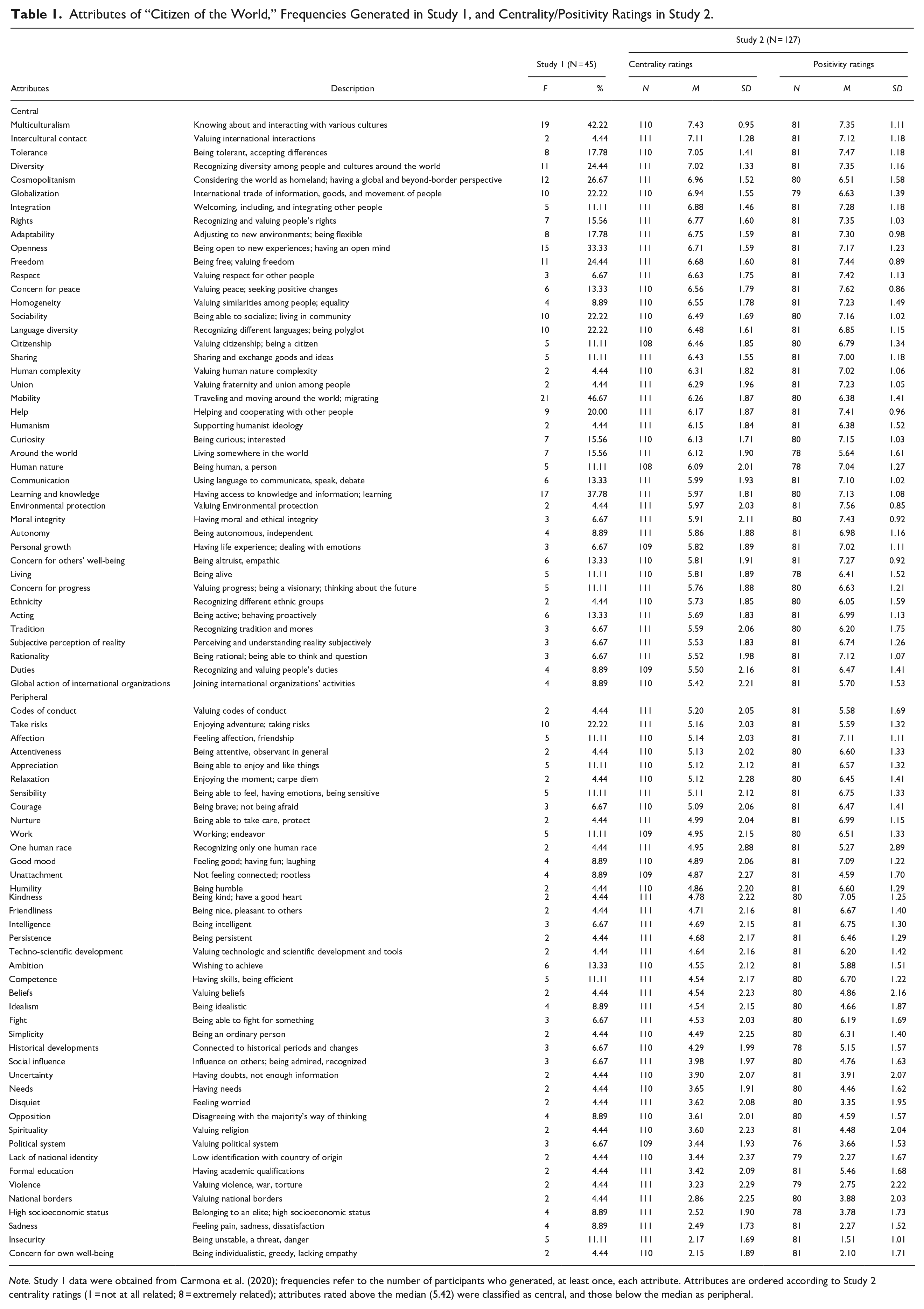
Note. Study 1 data were obtained from Carmona et al. (2020); frequencies refer to the number of participants who generated, at least once, each attribute. Attributes are ordered according to Study 2 centrality ratings (1 = not at all related; 8 = extremely related); attributes rated above the median (5.42) were classified as central, and those below the median as peripheral.
Participants from Carmona et al. (2020) study wrote, in a free-response format, characteristics that came to their minds when they thought about citizens of the world. 2 After applying coding procedures following the guidelines of a prototype approach, an initial list of 557 coding units was grouped into a final list of 108 macro-categories, designated as attributes. Twenty-five out of the 108 attributes were discarded given that were mentioned by only one participant, leaving a total of 83 prototypical attributes (see Table 1). Participants described citizens of the world as people who move abroad (46.67%), who know about and/or interact with various cultures (42.22%), who have access to knowledge and learning (37.78%), have an open mind (33.33%), who have a beyond-border perspective of the world (26.67%), who recognize diversity among people and cultures around the world (24.44%), who value freedom (24.44%) and the international trade of information, goods, and movement of people (22.22%), who can socialize and live in community (22.22%), who recognize and/or speak different languages (22.22%), who enjoy to take risks (22.22%) and to help other people (20%). These attributes are consistent with descriptions of global and cosmopolitan identities (e.g., Türken & Rudmin, 2013), particularly with the notion that they represent an appreciation and understanding of cultural contexts beyond one’s local community or nation.
Overall, our analyses of Carmona et al. (2020) data demonstrate that citizen of the world has not a consensual and clear-cut (classic) definition shared by all participants (no single attribute was mentioned by every participant, or even by more than a half of participants) and support the first hypothesis of a prototype approach that some attributes are mentioned more frequently than others.
Study 2: Distinction of Central Versus Peripheral Attributes
Prototype studies showed that, for a category to be prototypically organized, people must be “able to identify features of the concept and be able to rate their centrality to the concept reliably” (Lambert et al., 2009, p. 1195). Study 2 outlines the representativeness of attributes gathered in Study 1, by asking an independent sample to rate to what extent they are related to the concept (i.e., centrality), as well as their positivity. Raters should substantially agree in their centrality ratings. In line with similar studies, it was hypothesized that some attributes would be consistently rated as more related to the concept (central attributes) than others (peripheral attributes).
Method
Participants
One hundred twenty-seven adults consented to participate and completed the task, of which 24 did not provide demographic information. The mean age was 39.05 (SD = 12.01; age range: 18–67), and 73.8% were female (1.9% preferred not to answer); 83.3% had higher education, 16.7% had secondary education; 69.9% were employed; 98.1% were Portuguese citizens, and 1.9% were non-Portuguese living in Portugal. Participants were recruited through online advertisements in social networks (e.g., ads and posts in community groups on Facebook), in April 2018, using the Qualtrics platform, and informed consent was required. Participants were given the opportunity to participate in a lottery to win a 20€ voucher, as compensation for their participation.
Materials and procedure
Participants were presented with the list of 83 attributes obtained in Study 1 (in random order), followed by a short description in brackets. As a measure of centrality to the concept, they were then asked to rate the degree to which each attribute related to the concept of citizen of the world, on a Likert scale ranging from 1 (not at all related) to 8 (extremely related to the concept). To differentiate central and peripheral attributes, we used the standard and common procedure in prototype analyses, that is, a median-split (e.g., Hepper et al., 2012; Kinsella et al., 2015). Central attributes are those rated as more related to the concept, that is, mean ratings equal or higher than the median value of this measure. Peripheral attributes are those rated as less related to the concept, that is, mean ratings lower than the median value.
An attention check question was added to check for forged responses. Participants who failed to respond correctly were excluded from the subsequent analysis (n = 16).
Next, as a measure of positivity, participants were asked to rate the same attributes in terms of positivity, using a Likert scale ranging from 1 (not at all positive) to 8 (extremely positive). Given the length of the survey, participants were given, at this point, the opportunity to finish the survey. A total of 81 participants accepted to answer this second section of the survey. They then answered demographic questions and were thanked and debriefed.
Results and discussion
First, we analyzed centrality ratings (i.e., the degree to which each prototypical attribute related to the concept of citizen of the world). Overall, participants’ centrality ratings were extremely reliable (ICC = 0.98, 95% confidence interval = 0.97–0.98). 3 Mean centrality ratings ranged from the lowest 2.15 (concern for own well-being) to the highest 7.43 (multiculturalism). The median was 5.42; as such the median-split identified 42 central attributes (mean ratings equal to or higher than 5.42) and 41 peripheral attributes (mean ratings lower than 5.42; Table 1).
The central attributes of the social category citizens of the world described social-relational and cultural dynamics (e.g., multiculturalism, intercultural contact, globalization, integration), values (e.g., tolerance, diversity, rights, freedom, respect, concern for peace), attitudinal traits (e.g., cosmopolitanism, adaptability, openness, sharing, mobility, humanism, help, curiosity), and, to a lesser extent, intellectual traits (e.g., language diversity, learning, and knowledge). Interestingly, some attributes, which were not mentioned by many Study 1’ participants, were rated as highly related to the concept by Study 2′ participants (e.g., homogeneity, citizenship, human complexity, environmental protection, moral integrity, autonomy, concern for others wellbeing, concern for progress). Interestingly, participants also highlighted the centrality of attributes such as “being human,” “living around the world,” “being alive,” or “using language to communicate,” which is in line with Braun et al. (2018), who found that many respondents justified feeling as citizen of the world by reasons which scholars would not regard as valid, such as “live on this planet.”
The peripheral attributes of citizens of the world described emotional aspects (e.g., affection, relaxation), as well as intellectual traits (e.g., attentiveness, intelligence, competence). Noteworthy, attributes such as lack of national identity, formal education, high socioeconomic status, and concern for own well-being were peripheral attributes and were, on average, rated below the midpoint of the scale.
Second, we analyzed positivity ratings (i.e., the degree to which each prototypical attribute was evaluated as positive). Mean positivity ratings for central attributes ranged from 5.64 (around the world) to 7.62 (concern for peace), and for peripheral attributes ranged from 1.51 (insecurity) to 7.11 (affection). Ten peripheral attributes (out of 83) were rated below the midpoint of the positivity scale (uncertainty, national borders, high socioeconomic status, political system, disquiet, violence, sadness, lack of national identity, concern for own well-being, insecurity).
These results examined the representativeness of attributes gathered in Study 1 by Carmona et al. (2020) and strengthen the representation of citizen of the world as an appreciation and understanding of contexts and cultures beyond one’s local community or nation. As predicted, some attributes were consistently rated as more related to the concept (central attributes) than others (peripheral attributes). Central attributes might activate someone’s schema of a citizen of the world more easily than peripheral attributes, however, they must be considered altogether to capture the full spectrum of lay conceptualizations of citizen of the world.
Overall, studies 1 and 2 supported the first condition for a category to be prototypically organized, that is, “people must be able to identify features of the concept and be able to rate their centrality to the concept reliably” (Lambert et al., 2009, p. 1195).
Study 3: Reaction Time to Central Versus Peripheral Attributes
After establishing the distinction between central and peripheral attributes, the next step in the prototype approach is to examine whether, when a prototype is activated, people are quick to recognize and classify central (vs. peripheral) attributes as related to the concept (e.g., Kinsella et al., 2015). As such, Study 3 tested whether the central attributes of citizens of the world (as determined in Study 2) are more quickly identified than peripheral attributes in a reaction time task. In line with similar studies, we hypothesized that participants displayed a lower reaction time when identifying central (vs. peripheral) attributes.
Method
Participants
Fifty-three adults consented to participate and completed the task. The mean age was 21.98 years (SDage = 4.72; age range: 18–42; n = 52) and 84.9% were female. 4 Participants were recruited via a university pool of Psychology students in Portugal, in return for course credit. Data were collected in group sessions in May 2018, using E-Prime software on desktop computers in a lab room. All sessions occurred without interruptions, and informed consent was required. Participants were given the same compensation for their participation as in Study 2.
Materials and procedure
Based on Hepper et al. (2012, Study 4) and Kinsella et al. (2015, Study 3), participants learned that they would classify a series of words on-screen based on whether they are attributes of the concept citizen of the world. Three types of words were included, namely (a) 42 central and (b) 41 peripheral attributes of citizen of the world (obtained in Study 2), and (c) 83 unrelated words or phrases (e.g., “washing machine”). 5 The 166 attributes were randomly presented together with the question: “Is this an attribute of the concept CITIZEN OF THE WORLD?.” Participants were instructed to click “M” on the keyboard to indicate “Yes” or click “Z” to indicate “No,” and to respond as quickly and accurately as possible. Each response, and speed (in milliseconds), was recorded. To reduce learning effects, respondents first completed five neutral practice trials.
Results and discussion
First, we compared the frequency with which central attributes vs. peripheral attributes vs. control words were classified as an attribute of citizen of the world (i.e., percentage of “yes” responses) (Table 2). Nonparametric tests revealed a significant effect of words type (Friedman χ2(2) = 101.72, p < .001). Post hoc analysis 6 revealed that central attributes were significantly more often classified as an attribute (Mdn = 92.86) than peripheral attributes (Mdn = 73.17, p < .001) and control words (Mdn = 18.07, p < .001). Peripheral attributes were also more often classified as attributes than control words (p < .001).
Percentage and Mean Reaction Time of Words Classification, by Type, in Study 3.
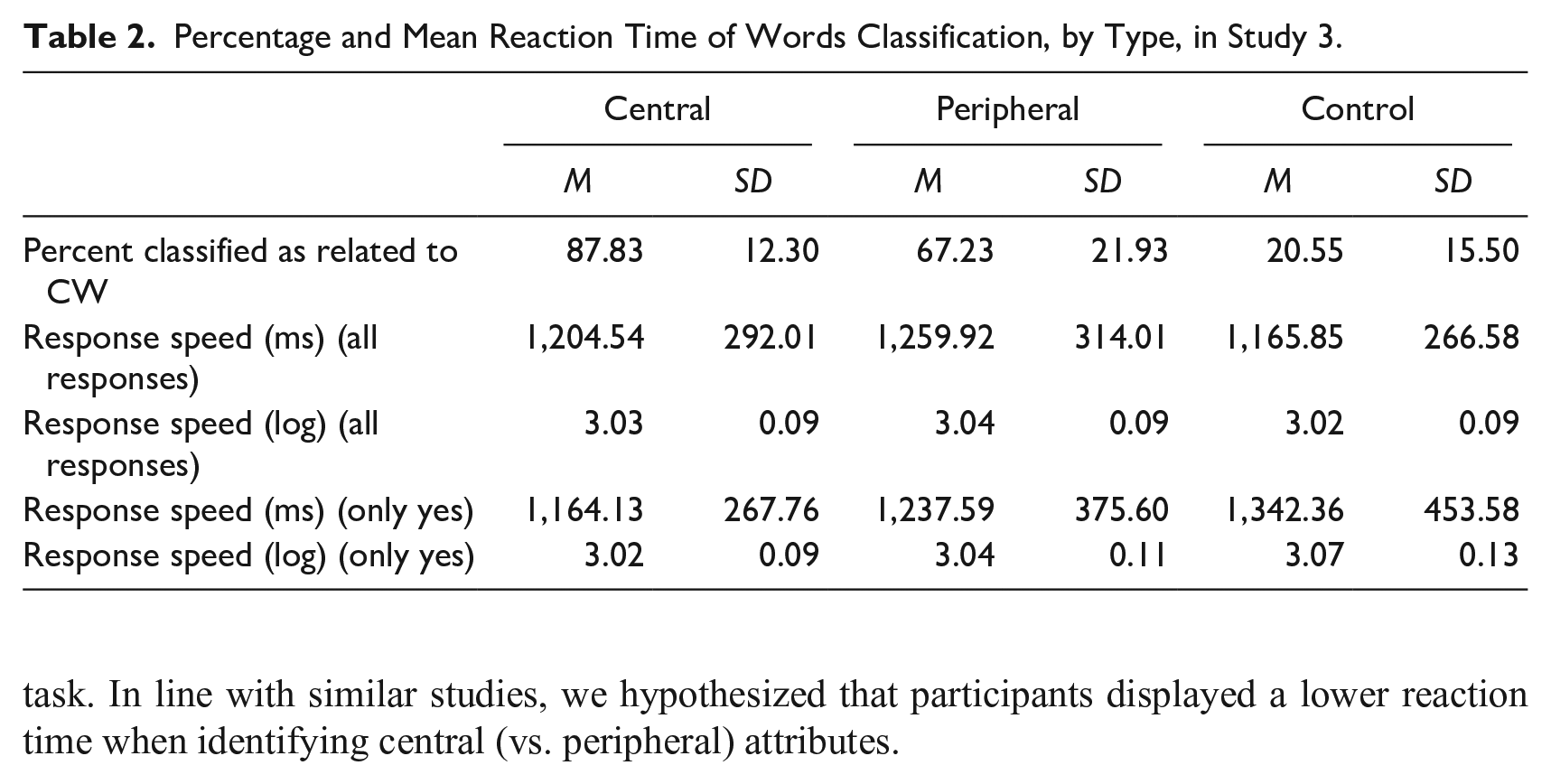
Second, we compared the reaction time (i.e., in milliseconds) to identify central attributes vs. peripheral attributes vs. control words. In line with conventional procedure (Greenwald et al., 2003), extremely fast (>300 ms) and slow (<3,000 ms) responses were recoded to 300 and 3,000 ms respectively, and a logarithmic transformation was applied (Table 2). Considering only the attributes classified as attributes of citizens of the world (i.e., only “yes” responses), a one-way repeated measures ANOVA, with a Greenhouse-Geisser correction, revealed a significant effect of words type on reaction time, F(1.551, 80.676) = 15.034, p = .000, partial η2 = .22. Post hoc analysis with a Bonferroni adjustment revealed that participants were quicker to classify central attributes (M = 3.02, SD = 0.09), than peripheral (M = 3.04, SD = 0.11, 95% CI [−0.04, −0.00], p < .05), and, than control words (M = 3.07, SD = 0.13, 95% CI [−0.09, −0.03], p < .001). Peripheral attributes were significantly more quickly classified than control words (95% CI [−0.07, −0.01], p < .05).
Overall, as predicted, under conditions that elicit heuristic processing (e.g., in a reaction time task) participants classified central attributes as attributes of citizen of the world more often and quickly (i.e., lower reaction time) than peripheral attributes, as well as peripheral attributes comparatively to control words. This pattern suggests that central and peripheral attributes should be both regarded as part of the prototype and supported the hypothesis that a prototypical structure affects cognition, as showed by their different automatic information-processing.
Study 4: Memorization of Central Versus Peripheral Attributes
In parallel with Study 3, additional evidence of automatic information-processing is needed to demonstrate that prototypical structure affects cognition, specifically working memory performance. Prototype studies showed that central attributes of a concept (vs. peripheral) are better encoded, and are therefore more accessible in memory (e.g., Hepper et al., 2012; Kinsella et al., 2015; Lambert et al., 2009). Study 4 tested whether participants remembered more central (vs. peripheral) attributes of citizen of the world. In line with similar studies, it was hypothesized that participants show better recall and recognition (correct and incorrect) of central (vs. peripheral) attributes, as a result of their centrality to the concept of citizen of the world.
Method
Participants
Sixty-four adults consented to participate and completed the task (four did not provide demographic information). The mean age was 34.22 years (SD = 9.94; age range: 18–68; n = 59); 76.7% were female; 66.7% had higher education, 33.3% had secondary education; 66.7% were employed; 95% were Portuguese citizens, and 5% were non-Portuguese. The recruitment strategy was the same used in Study 2 and data were collected in June 2018. The compensation value, in this case, was higher (75€ voucher). 7
Materials and procedure
Adapting from Hepper et al. (2012, Study 3), Kinsella et al. (2015, Study 4), and Lambert et al. (2009, Study 4), the protocol was divided into four tasks, namely, a reading task, an interference task, a recall task, and a recognition task.
Participants engaged in a reading task, in which they were exposed to a set of central and peripheral attributes (obtained in Study 2). We randomly selected 20 out of 42 central attributes, and 20 out of 41 peripheral attributes (using https://www.randomizer.org/). Following a between-subjects design, two sets were designed (i.e., each set containing 10 central attributes and 10 peripheral attributes). Participants viewed either set 1 or set 2. The mean centralities for set 1’s central attributes (multiculturalism; cosmopolitanism; adaptability; concern for peace; sharing; mobility; moral integrity; openness; globalization; global action of international organizations) was 6.54 and for peripheral attributes (humility; courage; good mood; kindness; persistence; ambition; uncertainty; idealism; formal education; high socioeconomic status) was 4.32. The mean centralities for set 2’s central attributes (diversity; integration; respect; homogeneity; citizenship; union; help; concern for progress; tolerance; concern for others’ well-being) was 6.46 and for peripheral attributes (sensibility; nurture; unattachment; intelligence; technoscientific development; competence; simplicity; opposition; lack of national identity; concern for own well-being) was 4.25. During the task, each attribute appeared on the screen for 4-seconds, in a random order, below the sentence “Words describing how citizens of the world are”:
During the interference task, participants were asked to write names of places using all the alphabet letters, for 5-minutes.
During the recall task, they were asked to recall and write down, for 3-minutes, as many words as possible from those previously seen (i.e., during the reading task).
Finally, in a recognition task, participants were given a list of all 40 attributes and were instructed to select (instead of writing) those that they had seen earlier.
We calculated the percentages of recall 8 (from the number of attributes correctly recalled, i.e., written), correct recognition (from the number of attributes correctly recognized, i.e., selected from the list when were previously seen), and false recognition (from the number of attributes incorrectly recognized, i.e., selected from the list when were not previously seen) of central and peripheral attributes.
Results and discussion
Paired-samples t-tests were used to determine whether there was a statistically significant mean difference between the percentage of central vs. peripheral attributes recalled, correctly recognized, and incorrectly recognized.
Recall percentage was uniformly low, that is, on average participants only wrote 28.50% (SD = 22.08) of the 10 central attributes previously seen in the reading task, and 26% (SD = 21.80) of the 10 peripheral; in addition, 23.89% (of 20 possible) answers were not valid. Participants recalled more central than peripheral attributes, however, the mean difference was not significant, t(59) = 1.02, p = .31.
Recognition percentage was good, that is, in average, participants correctly selected 70.62% (SD = 26.54) of the 10 central attributes previously seen, and 57.50% (SD = 27.37) of the 10 peripheral. As predicted, participants correctly recognized more central than peripheral attributes (t(63) = 4.55, p < .001, d = 0.57, 95% CI [7.36, 18.89]). Additionally, participants selected, in average, 25.47% (SD = 25.44) of central attributes which they had not previously seen, and 13.13% (SD = 15.62) peripheral. As predicted, participants also incorrectly recognized more central than peripheral (t(63) = 4.59, p < .001, d = 0.57, 95% CI [6.97, 17.72]) attributes.
Overall, these results provided additional evidence of different automatic information-processing of central vs. peripheral attributes, specifically in terms of their accessibility in working memory, as a result of their centrality to the concept of citizen of the world.
Study 5: Target Group Perception Based on Central Versus Peripheral Attributes
Further evidence of the effect of a concept’s prototypical structure on cognition stems from the analysis of perceptions, specifically how attributes influence the identification of citizens of the world. Prototype studies showed that representative attributes used to describe a target lead to the impression that the target fits the concept, even if the exact word is not used (e.g., Hepper et al., 2012; Kinsella et al., 2015; Lambert et al., 2009). Study 5 tested whether prototypical attributes (i.e., central and peripheral) of citizens of the world, when used to describe unidentified targets, would lead to the perception that those targets are citizens of the world, using a group perception task. In line with similar studies, we hypothesized that targets described by central attributes would be more strongly perceived as citizens of the world (vs. when described by peripheral or non-related attributes).
Method
Participants
Ninety-seven adults consented to participate and completed the task (nine did not provide demographic information). The mean age was 31.08 years (SD = 10.45; age range: 18–69); 75% were female (2.3% preferred not to answer); 61.4% had higher education, 34.1% had secondary education; 4.5% had basic education; 60.2% were employed; 95.5% were Portuguese; all living in Portugal. The recruitment strategy was the same used in Study 4.
Materials and procedure
Adapting from Kinsella et al. (2015, Study 5), the prototypicality of citizens of the world varied across three vignettes. Each vignette described a target character, and participants were asked to carefully read the descriptions about two target groups: a central target (using the same 20 central attributes from Study 4); a peripheral target (using the same 20 peripheral attributes from Study 4); a neutral target (20 positive, but not related attributes; some were created, and some were identical to those used by Kinsella et al., 2015, Study 5). All descriptions were formulated in a gender-neutral format, and targets were left unidentified. The term “citizen of the world” was never used.
Following a within-subjects design, each participant read two vignettes in randomized order, resulting in three assigned conditions: central vs. peripheral target (n = 31; 31.96%); central vs. neutral target (n = 34; 35.05%); peripheral vs. neutral target (n = 32; 32.99%). For each vignette, participants were asked to think about the described target and rate on the 7-point Likert scale how much they agree with 11 statements (1 = strongly disagree to 7 = strongly agree).
Adapting from Kinsella et al. (2015), four citizen of the world-related items were included (e.g., “Are the people described true citizens of the world?”); three non-related positive items were included (e.g., “Are the people described likable?”); and, four national-related items were adapted, and presented separately (e.g., “Are the people described Portuguese?”). The items were computed (as a sum) to form three scales: citizen of the world-related scale (four items; maximum score = 28); non-related positive scale (three items; maximum score = 21); and national-related scale (four items; maximum score = 28).
Results and discussion
Paired-samples t-tests were used to determine whether there was a statistically significant mean difference within the pairs of targets of each condition (Table 3). Regarding the citizen of the world-related scale, in the central-peripheral condition, participants rated the central target significantly higher (M = 21.31, SD = 5.40) than the peripheral target (M = 18.76, SD = 5.83; t(28) = 2.406, p < .05, d = 0.45, 95% CI [0.38, 4.72]). The same pattern was observed in the central-neutral condition (MCENTRAL = 22.87, SD = 3.39; MNEUTRAL = 19.40, SD = 4.78; t(29) = 3.315, p < .05, d = 0.61, 95% CI [1.05, 5.61]). Regarding the peripheral-neutral condition, there was no significant difference between participants’ ratings. No significant score differences were observed in participants’ ratings on the non-related positive scale and national-related scale, in any condition.
Results from Paired Samples t-Tests on dependent measures, in Study 5.
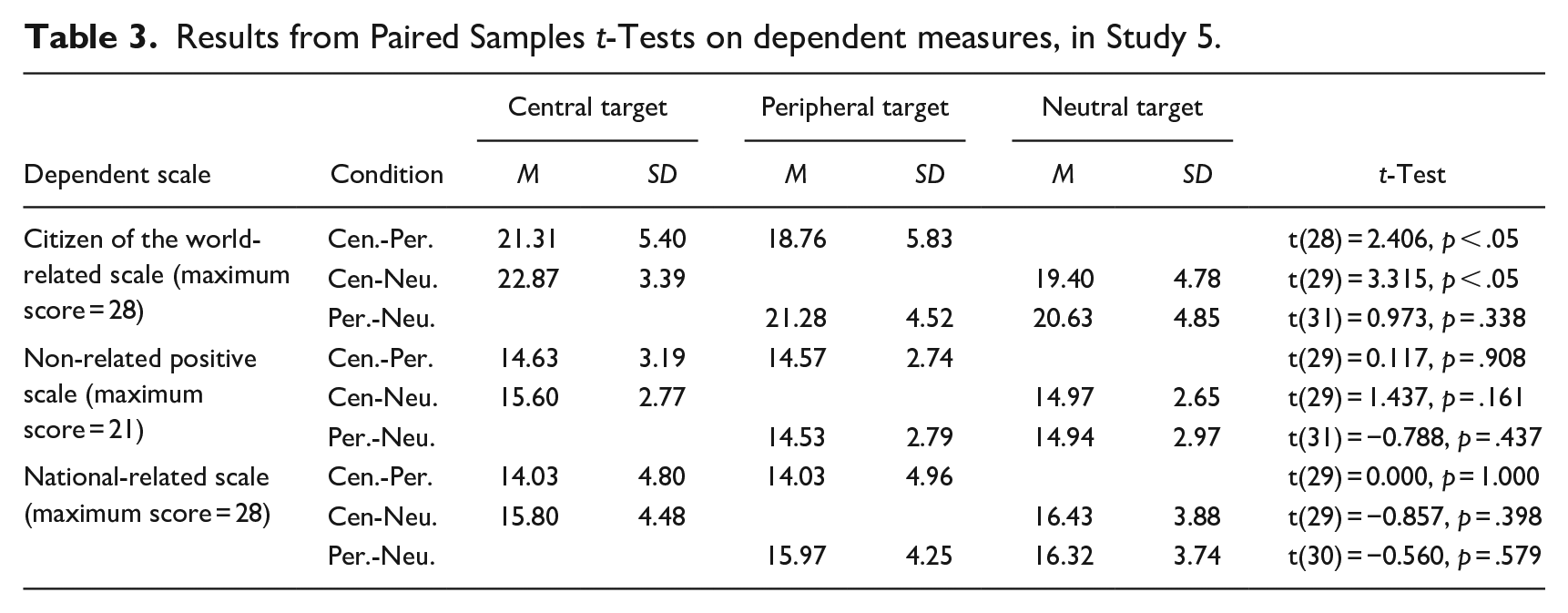
Overall, these results show that central (vs. peripheral) attributes influenced differently the identification of citizens of the world. As predicted, there was a stronger identification of citizens of the world when central (vs. peripheral, or vs. control) attributes were used to describe an unidentified target. This pattern supported the hypothesis that a prototypical structure impacts the way people think about the concept, not only in terms of information processing but also in terms of perceptions.
Study 6: Self-Perception Based on Central Versus Peripheral Attributes
Additional evidence is needed to demonstrate that the prototypical structure affects cognition, specifically perceptions. Prototype studies showed that, if central attributes reflect the core meaning of a concept, then people’s self-perceptions and experiences should be better characterized by central than peripheral attributes (e.g., Hepper et al., 2012; Lambert et al., 2009). Study 6 examined if participants’ self-perceptions as citizens of the world were better characterized by central (vs. peripheral) attributes, and if central attributes were more characteristic of a self-description as a citizen of the world than of other group representations, such as national citizen. It was hypothesized that central attributes would be more related with a self-description as a citizen of the world than peripheral attributes, and more related with a self-description as a citizen of the world than as a national citizen.
Method
Participants
Sixty-two adults consented to participate and completed the task (five did not provide demographic information). The mean age was 32.35 years (SD = 9.60; age range: 18–64); 63.2% were female (1.8% preferred not to answer); 59.6% had higher education, 31.6% had secondary education; 8.8% had basic education; 61.4% were employed; 96.5% were Portuguese citizens, and 3.5% were non-Portuguese. The recruitment strategy was the same used in Study 4.
Materials and procedure
Adapting from Hepper et al. (2012, Study 6), participants were randomly assigned to one of two conditions, in which they were asked to think about themselves as a citizen of the world (condition 1; n = 31) versus as a Portuguese citizen (condition 2; n = 31). After a few minutes, they were asked to write three words to describe themselves accordingly. Next, all participants were presented with a list of 40 prototypical attributes of a citizen of the world (i.e., 20 central and 20 peripheral attributes; the same used in Study 4). Participants were asked to rate each attribute from 1 (not at all related) to 8 (extremely related to the way I see myself as a [citizen of the world/Portuguese citizen, respectively]). We computed average ratings for central attributes and peripheral attributes.
Results and discussion
A paired-samples t-test was conducted to determine whether there was a statistically significant difference in mean ratings given to central vs. peripheral attributes, in condition 1 (Table 4). When asked to think about themselves as citizens of the world, participants rated central attributes (M = 6.52, SD = 0.98) significantly higher than peripheral attributes (M = 5.43, SD = 1.15; t(30) = 5.712, p < .001, d = 1.03, 95% CI [0.70, 1.47]). This result showed that self-perceptions as citizen of the world were better characterized by central (vs. peripheral) attributes.
Attributes Ratings for Central and Peripheral Attributes by Condition, in Study 6.
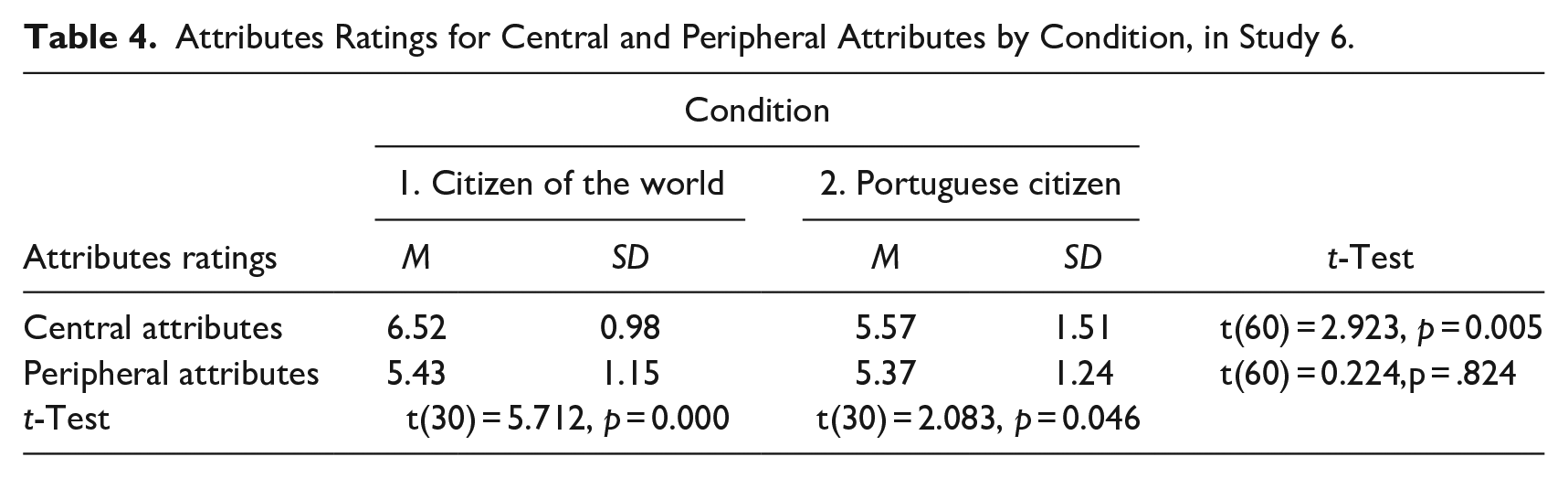
An independent-samples t-test was run to determine whether there was a statistically significant difference in mean ratings given to central attributes in condition 1 vs. condition 2. When asked to think about themselves as citizens of the world, participants rated central attributes (M = 6.52, SD = 0.98) significantly higher than when asked to think about themselves as Portuguese citizens (M = 5.57, SD = 1.51, t(60) = 2.923, p < .05, d = 0.74, 95% CI [0.30, 1.60]). This result showed that central attributes are more characteristic of a self-perception as citizen of the world than as a Portuguese citizen.
Overall, these findings showed that central attributes (vs. peripheral) are reliable to describe citizens of the world, and, more importantly, provided additional support to the hypothesis that a prototypical structure affects the way people think about the concept.
General Discussion
This research examined, for the first time, the conceptions that laypeople have about the superordinate social category citizen of the world by replicating the conventional methods of a prototype approach. Our findings extended previous work in three ways: by systematically demonstrating that the lay meaning of citizen of the world is indeed represented as a prototype, by identifying which attributes are more central to its meaning, and by analyzing the impact of this prototypical structure on cognitive processing.
Specifically, Studies 1 and 2 confirmed one of the two necessary conditions for a concept to hold a prototypical structure, that is, showed that certain attributes are communicated more frequently (Study 1) and are regarded as more central (vs. peripheral) to the concept (Study 2). Citizens of the world were described as individuals influenced by various cultures (e.g., participants frequently listed, and rated as central, attributes such as multiculturalism, intercultural contact, diversity); who belong to a community of human beings beyond their nation or culture (e.g., cosmopolitanism, globalization), who have responsibilities toward others (e.g., integration, union, sharing, help, concern for other’s well-being), and who are prepared to navigate in a globalized world (e.g., mobility, language diversity, adaptability, openness, global action of international organizations). It is worth noting that this conception of citizens of the world might reflect the worldviews of the western socio-cultural context in which the research was carried out. Indeed, according to Rosenmann et al. (2016), positive global identities (e.g., world citizenship) prioritize some universalistic-humanist elements of the globalized Western culture, such as the transnational identification, the tolerance, and value of human diversity (instead of cultural homogenization), as well as the global sphere of moral sensibility and concern, as reflected in this description.
Studies 3 to 6 confirmed the second necessary condition, that is, showed that a prototypical structure affects cognition, in terms of information-processing. Central (vs. peripheral) attributes of citizens of the world were more quickly identified (Study 3), more often remembered (Study 4), and more appropriate to identify a group member (Study 5), as well as the self (Study 6), as a citizen of the world. These findings showed there is a differentiated cognitive automatic processing for central and peripheral attributes.
Our findings are in line with previous research (Carmona et al., 2020) suggesting that the meaning of citizen of the world is fluid and malleable. Indeed, the major novelty of the present work lies in the evidence regarding the prototypical structure and content of this superordinate social category, as well as its impact on cognitive processing. We propose that the specific content activated by the attributes regarded as central to the prototype of citizens of the world (e.g., multiculturalism; intercultural contact; tolerance; diversity), and the fact that these are more readily accessible in memory to form a mental representation, are important to understand identity processes, and ultimately their impact on intergroup relations. Next, we discuss three of these potential impacts on identity processes and intergroup relations: inclusion versus exclusion criteria for category membership; the strategic motivations for inclusiveness versus exclusiveness; and prototype-based social comparisons.
Contributions for Theory Development and Intergroup Relations
The prototype content determines who is included versus excluded from the category membership, thus it is a crucial aspect for social identification processes (Turner & Reynolds, 2012). The malleability of the prototype content of citizen of the world might then influence the inclusion versus exclusion criteria used for that category membership. A tempting interpretation is that, when laypeople disagree on what it means to be (or who is considered to be) a citizen of the world, this might not reflect a misconception of its definition, but might rather suggest that people are considering different attributes (central or peripheral) of the prototype, or different collections of attributes to justify the category membership. For instance, whereas in some circumstances people might describe citizens of the world through a collection of generic central attributes (e.g., being a citizen; living somewhere), in other circumstances people might rely on a collection of specific central attributes related to attitudes (e.g., openness), values (e.g., tolerance) or socio-relational dynamics (e.g., intercultural contact). One can speculate that the salience of a category prototype consisting mainly of a collection of specific attitudinal attributes or values might justify the exclusion of those who do not display those specific attitudes or values, more so than a prototype consisting mainly of generic attributes. This interpretation is in line with research showing that prototypicality judgments are strategically used to promote the ingroup’s goals and interests (Sindic & Reicher, 2008). Thus, future research could explore to what extent might the salience of different attributes be context-dependent, or even reflect individual strategic motivations.
Indeed, recent research is giving growing attention to the exclusiveness potential of common inclusive ingroup identities in a given context. For instance, European identification works as an inclusive category in some contexts (e.g., promoting pluralism and the acceptance of newcomers), whereas in others it can work as an exclusive category (e.g., continent boundaries are used to exclude newcomers), depending on how the meaning of belonging to the European community is affected by contextual socio-political motives (López et al., 2019). Similarly, one can speculate if the malleable meaning of belonging to a global community as a citizen of the world, might also be affected by contextual socio-political factors, that affect its inclusiveness potential. Some important questions might then be drawn: Do laypeople believe that “we are all citizens of the world” at the same inclusiveness level as “we are all humans”? Or being a citizen of the world means to belong to a more exclusive group of people (i.e., a lower order superordinate category relative to human category), who display specific traits, such as endorsement of multiculturalism? This perspective is in line with Rosenmann et al.’s (2016) argument that a globalized identity that mirrors western views may enclose an exclusionary potential, given that it might conflict with other ways of life.
Finally, the malleability of the prototype content might also affect prototype-based social comparisons (Kim & Wiesenfeld, 2017). One can speculate that central attributes of citizen of the world might be the content more readily available for within- and between-group comparisons. That is, when comparing two subgroups within this superordinate category, individuals might judge which group better fits the endorsement of its central attributes (e.g., multiculturalism, intercultural contact, diversity). This process of attributing prototypical characteristics of a superordinate category to a lower-level ingroup category is conceptualized by the ingroup projection model as an introjective/deductive process of claiming ingroup prototypicality (Wenzel et al., 2016). Whereas the detrimental consequences of claiming ingroup prototypicality through the reverse projective/inductive process (i.e., the representation of the higher-order category is infused by that of the lower-level ingroup) are well-known, the consequences of claiming prototypicality through introjective/deductive processes are less known (Wenzel et al., 2016). Our findings illustrating the specific content of the superordinate category citizens of the world offer new insights for future research focusing on the potential consequences of introjective/deductive processes of claiming ingroup prototypicality. Overall, one can ask: Which subgroups (if any in particular) better fit the prototype content of the superordinate category of citizens of the world?
Scholar and Lay Meanings of “Citizen of the World”
Besides the important contributions to theory development and hypothesis testing, our findings also offer researchers the opportunity to confront lay and scholar conceptualizations of citizen of the world. The attributes used by laypeople generally overlap scholars’ descriptions of people who endorse cosmopolitan and global memberships (e.g., appreciation and understanding of contexts and cultures beyond one’s local community or nation, Brock, 2015; Pichler, 2009; Reysen & Katzarska-Miller, 2013; Skrbis, 2014; Türken & Rudmin, 2013). However, a mismatch in two particular aspects is worth noting. From a lay view, being a citizen of the world did not strongly and spontaneously mean a lack of national identity (i.e., this was rarely mentioned and was rated as peripheral). This result might be important to rethink measures that force a dichotomized perspective of global versus national forms of identification (e.g., measures that include items such as “I feel more like a citizen of the world than of any country,” ISSP Research Group, 2015). Similarly, citizens of the world were not described as someone who feels deep care for all human beings equally (i.e., this attribute did not emerge clearly). Indeed, a few attributes were mentioned that are general characteristics of all people (e.g., living somewhere in the world; being a citizen; being alive). These findings seem in line with the proposal that world citizenship (measured by the single item “I see myself as a world citizen”; e.g., Inglehart et al., 2014; Pichler, 2012) reflects a more passive sense of identification, that does not necessarily encompass caring for all human beings (e.g., McFarland & Hornsby, 2015). Nevertheless, some attributes emerged that were related to caring for others, such as tolerance, respect, or humanism.
Limitations and Conclusions
An important limitation should be mentioned, that relates to the potential different social meanings of all-inclusive labels in different languages (Carmona et al., 2020; McFarland, 2017). The qualitative data (Study 1) relied on a homogeneous national sample (Portuguese). For this reason, the subsequent results might well be particular to the Portuguese population or language, or the population of a Western country. As noted, words may carry different connotations in different languages and different social meanings in different countries (McFarland, 2017). Thus, although a potential limitation for the generalizability of our findings, the choice of keeping the language and cultural context consistent across the set of studies guaranteed consistency in social meaning and avoided potential biases related to language and culture. The attributes listed by participants of the current study largely overlap descriptions obtained with heterogeneous populations (e.g., Braun et al., 2018; Türken & Rudmin, 2013). This approach should then create awareness about the need to replicate this analysis in different countries, languages, and cultural contexts, and even with different labels, to make sense of what people think of when answering questions in cross-national surveys involving all-inclusive superordinate categories.
In conclusion, our research contributes to bringing clarity and deepness over the debate of “what it means to be a citizen of the world,” by providing novel evidence in terms of how its prototypical content is cognitively processed. It represents a step forward in understanding what and how people spontaneously think about an all-inclusive social category, which will certainly help in the endeavor of disentangling which type of content and meaning might consistently trigger positive intergroup outcomes. By doing so, our findings offer useful information to frame past and future research on intergroup relations, as well as refine existing and future measures. Nonetheless, as with all scientific work, these findings also raise new questions that could be addressed in future research. For example, it remains unclear under which conditions people are willing to identify with an all-inclusive superordinate category and how this willingness affects behavior toward global challenges. We hope our findings may inspire others to continue working on this topic. For instance, showing that “knowing about and interacting with various cultures” is one of the attributes that people more easily think of and use to describe citizens of the world might be important to examine whether a multiculturally framed identity is more effective in improving positive intercultural cooperation, comparing to other all-inclusive labels that do not enhance this feature so clearly (e.g., humans). Similarly, examining the role of other prototypical attributes such as “being active,” “joining international organizations’ activities,” or “helping and cooperating with other people” might help to understand whether a participatory framed identity might stimulate collective action toward global challenges (e.g., climate change). Finally, these findings also have the potential to inform and support the development of educational, social, or political projects on global citizenship and cosmopolitanism.
Supplemental Material
sj-docx-1-jcc-10.1177_00220221221088332 – Supplemental material for What Does It Mean to be a “Citizen of the World”: A Prototype Approach
Supplemental material, sj-docx-1-jcc-10.1177_00220221221088332 for What Does It Mean to be a “Citizen of the World”: A Prototype Approach by Margarida Carmona, Rita Guerra and Joep Hofhuis in Journal of Cross-Cultural Psychology
Footnotes
Acknowledgements
We would like to thank the participants in these studies for their time; and, Denis Sindic and Psychange Research Group for their suggestions and comments on earlier versions of this work, as well as the editorial team for their constructive comments.
Author’s Note

Declaration of Conflicting Interests
The author(s) declared the following potential conflicts of interest with respect to the research, authorship, and/or publication of this article: Authors declare that there is no conflict of interest’ and that this work complies with APA Code of Conduct and national ethics guidelines.
Funding
The author(s) disclosed receipt of the following financial support for the research, authorship, and/or publication of this article: This work was funded by Fundação para a Ciência e Tecnologia (FCT), with a grant/PhD studentship awarded to the first author (PD/BD/129601/2017).
Supplemental Material
Supplemental material for this article is available online.
Notes
References
Supplementary Material
Please find the following supplemental material available below.
For Open Access articles published under a Creative Commons License, all supplemental material carries the same license as the article it is associated with.
For non-Open Access articles published, all supplemental material carries a non-exclusive license, and permission requests for re-use of supplemental material or any part of supplemental material shall be sent directly to the copyright owner as specified in the copyright notice associated with the article.
