




Abstract
Satisfied couples in European-American cultural contexts experience higher ratios of positive to negative affect during interactions than their less satisfied counterparts. The current research tests the possibility that this finding is culture-bound. It compares proportions of positive to negative affect during couple interactions in two different cultural contexts: Belgium and Japan. Whereas Belgian relationship goals (e.g., mutual affirmation and self-esteem) call for the experience of positive affect, Japanese relationship goals (e.g., harmony and self-adjustment) call for the avoidance of negative affect. We propose that these differences result in different affect ratios in close relationships. To test this idea, we tracked positive and negative feelings during couple interactions. Fifty-eight Belgian and 80 Japanese romantic couples took part in a lab interaction study, in which they discussed a topic of disagreement. Using a video-mediated recall, participants rated their positive and negative feelings during the interaction; relationship satisfaction was assessed before the interaction. As expected, Belgian couples’ positive-to-negative affect ratios were more positive than those of Japanese couples. Furthermore, in both cultures relationship satisfaction was positively associated with more positive affect ratios, but this effect was significantly stronger for Belgian than Japanese couples. Finally, mediation analyses showed that higher affect ratios were achieved in culturally different and meaningful ways: satisfied Belgian couples showed higher ratios primarily through higher levels of positive feelings, whereas satisfied Japanese couples showed higher ratios primarily through lower levels of negative feelings.
Feelings matter in our relationships: how good or bad we feel in relationships reflects how our relationship with another person is going, whether we desire change, and if our current situation lives up to our relational ideals and goals (Gottman & Notarius, 2000; Mesquita, 2010). Research has repeatedly found that stable and satisfied, as compared to less stable and less satisfied relationships, are characterized by more positive and less negative feelings (Broderick & O’Leary, 1986; Gottman & Notarius, 2000; Gottman et al., 1998; Kirchler, 1988).
Specifically, the proportion of positive-to-negative feelings in close relationships (termed “affect ratio”) appears to be a reliable indicator of how well a relationship is going. For example, in his well-known couple research, Gottman (1993b) coded affective behaviors during standardized conflict interactions in the lab, and found that higher ratios of positive to negative affect reliably distinguished stable from unstable couples (i.e., couples who stayed together long-term vs. couples who broke up; Gottman, 1993b): Partners in stable couples showed on average a ratio of five positive for every one negative emotional episode (measured as speaker turns) during their interactions, which stood in sharp contrast to a ratio of roughly 1:1 of partners in unstable couples. Later studies supported the link between greater proportions of positive behaviors and better relationship stability and satisfaction in coded interactions of two samples of newlywed couples (Gottman et al., 1998; Kim et al., 2007).
Similar findings have also been reported when feelings were self-reported instead of inferred from behaviors. Studies relying on self-report measures of affect have provided further support for the idea that positive to negative affect ratios distinguish between couples who do well and couples who do poorly. For instance, in a 5-day diary study, the positive to negative affect ratios of non-distressed couples far exceeded those of distressed couples (29.66:1 vs. 4.30:1; Birchler et al., 1975). In a one-time questionnaire, partners of satisfied couples reported higher ratios of positive to negative affect “in their relationship” than those in either a group of couples who reported to be dissatisfied with their relationship or a group of couples in treatment (Bertoni & Bodenmann, 2010). Finally, in a nationally representative self-report questionnaire, couples who reported higher ratios of positive to negative affect “over the last month” also reported higher levels of both relationship satisfaction and spousal empathy than couples with lower affect ratios (Bradshaw, 2009).
In sum, evidence for the so-called “balance theory” of relationships appears robust. Balance theory assumes that positive feelings are beneficial and negative feelings potentially hazardous (Gottman, 1993a, 1993b), and that couples need sufficient positive feelings to offset the consequences of negative feelings. Or as Gottman et al. (1998, p. 8) phrase it: Couples maintain “[. . .] a set point of the ratio of positivity to negativity that is functional if it is high, or dysfunctional if it is low.” Indeed, regardless of the measures used to capture positive and negative affect (e.g., observed behavior, self-reported affect) and regardless of the measures of couple wellbeing (e.g., relationship satisfaction, relationship stability), proportions of positive and negative feelings have been found to distinguish between couples who feel and do well and couples who do not. There is one caveat, however: A vast majority of the studies centered around European-American (i.e., so-called “Western”) couples.
The current study revisits balance theory by expanding the cultural space. Based on a large body of cross-cultural research on cultural differences in positive and negative feelings (for an overview, see Miyamoto et al., 2017) the current research considers the possibility that a balance of positive and negative feelings may look differently in different cultures, as in some cultures positive feelings may fit central relationship goals less, while negative feelings may be considered less detrimental to close relationships. We explore the possibility that there are cultural differences in what it means for couples to strike a “healthy” balance.
More specifically, we hypothesize that the affect ratios in well-functioning relationships may differ according to cultural relationship goals. Our study sets out (a) to compare positive-to-negative affect ratios during conflict interactions of Belgian (i.e., “Western”) and Japanese (i.e., “East-Asian”) couples and (b) to examine the link of affect ratios with relational wellbeing (i.e., relationship satisfaction). In doing so, it extends previous findings on affective patterns in close relationships beyond the European-American cultural context.
Close Relationships and Affect Across Cultures
A high positive to negative affect ratio may be desirable and beneficial in the European-American context because it fits close relationships goals in this context. We consider the possibility that, given different relationships goals in Japanese (and other “East Asian”) cultural contexts, a high positive to negative affect ratio may be less desirable or reflective of good relationships (Kitayama & Markus, 2000; Rothbaum et al., 2000).
Affect and relationship goals in Belgian relationships
Most of the cross-cultural work on close relationships has compared U.S. cultural contexts to Japanese or other East-Asian cultural contexts (e.g., Chinese samples) and less relationship research has included other “Western” cultures, such as Belgium. However, when cross-cultural psychological research does include Western-European cultural contexts, the similarities between these Western cultures appear to be more pronounced than the differences among them (Boiger et al., 2013; Kitayama et al., 2009; Schwartz & Ros, 1995). Like studies conducted in U.S. contexts, studies in Western-European contexts show similar cultural goals of positive self-regard and individuality, and a similar focus on individual self-esteem and needs in relationships (Boiger et al., 2013; Kitayama et al., 2009). We will build on the available U.S. research to generate our hypotheses for the Belgian couples, and we suggest these couples will form a meaningful contrast to the Japanese couples (see also Schwartz & Ros, 1995).
We start from the idea that in Belgian cultural contexts (just like in U.S. contexts studied previously), close relationships are geared toward the happiness, self-esteem, and needs of the individual partners. (Yamagishi & Yamagishi, 1994). A successful relationship should meet the needs and preferences of partners and contribute to their positive self-image (Rothbaum et al., 2000; Yamagishi & Yamagishi, 1994). Therefore, close relationships often serve to positively discover, share, affirm, and enhance each other’s desirable traits (Markus & Kitayama, 1991; Schütz & Tice, 1997). By mutually affirming each other’s positive characteristics, partners foster each other’s self-esteem (Kitayama & Markus, 2000; Uchida & Oishi, 2016) and contribute to each other’s happiness. This cycle of mutual affirmation is an important relationship task, as the couple relationship is built on attraction and personal preference (Rothbaum et al., 2000).
Considering these goals, a cultural focus on positive over negative feelings appears fitting: Positive feelings arise from the affirmation of desirable features by close others, signal personal achievements or self-worth, and underline a relational arrangement that meets partners’ individual needs. Positive feelings may reflect the ideal relationship, marking that it both meets the individual partners’ needs and promotes a positive view of themselves. In contrast, negative feelings may signal that the relationship does not meet the individual partners’ needs and positive self-image, or even threatens them, for example, because there is no mutual positive affirmation, or because personal shortcomings are highlighted (Barr-Zisowitz, 2000; Watson et al., 2002). Therefore, negative feelings might reflect negatively on the relationship, signaling that the current relational arrangement does not contribute to, or even impede, individual wellbeing or needs. Compared to less satisfied relationships, well-functioning and satisfied relationships in Belgium (as in other “Western” cultural contexts) may thus be marked by increased levels of beneficial positive and decreased levels of detrimental negative feelings, mirroring a tendency to “maximize” positive and “minimize” negative feelings.
Affect and Relationship Goals in Japanese Relationships
Previous work has produced fewer insights into the affective dynamics of close relationships in non-Western cultures, such as Japan (but for exceptions see Hiew et al., 2016; Tsai & Levenson, 1997; Tsai et al., 2006). Yet, the existing research on relationship goals in Japanese (and some other “East Asian”) contexts suggest that these dynamics may differ from those in European-American contexts.
Relationships in Japanese culture primarily center around the smooth functioning of the couple as a unit and the maintenance of harmony in the relationship (Lebra, 1976; Rothbaum et al., 2000; for similar findings with Chinese couples, see Hiew et al., 2015). Important to achieving harmony is that individual partners monitor when they fall short of the needs and expectations of close others (Heine et al., 1999), and that they accommodate to these needs through self-adjustment and through a mindset of continuous self-improvement (Kim & Markus, 1999; Morling et al., 2002; Oishi & Koo, 2008). Partner’s individual happiness or self-esteem receive relatively less importance than in the U.S. or other “Western” cultural contexts, and the associated greater levels of positive feelings may thus be perceived as less desirable or essential to Japanese relationships. Positive feelings may even be considered harmful: Positive feelings can distract partners from paying attention to the shortcomings that they need to overcome, or likewise from attending to others’ needs and expectations by taking away the focus from the relationship (Uchida & Kitayama, 2009). In contrast, negative affect may be relatively less undesirable in Japanese relationships: For one, negative affect may alert an individual to areas that need improvement, such as when they fall short of others’ expectations, or to relational disruptions that need to be addressed (Uchida & Kitayama, 2009).
Taking the evidence together, we expect the preference of positive over negative feelings in Japanese relationships to be attenuated in comparison with Belgian relationships. Instead, we expect these relationships to be marked by relatively more balanced proportions of positive and negative feelings. Furthermore, the affective patterns that characterize particularly satisfied relationships may also be different for Japanese than Belgian couples. We would expect that, given the goals of relational maintenance and harmony, fulfilled Japanese couples may distinguish themselves from less fulfilled Japanese couples especially by how they deal with negative affect: Negative feelings may generally be more accepted to arise in Japanese than in Belgian relationships, and may be helpful to signal relational disruption and promote adjustment, but the persistence of negative feelings and said disruption may nonetheless endanger and threaten the relationship and connectedness (Uchida & Kitayama, 2009). Satisfied relationships should thus be marked by an effective resolution of negative affect, and consequently, by lower levels of negative feelings compared to less satisfied ones. In contrast, we expect positive feelings to be less distinctive of satisfied relationships, given the potential negative implications for adjustment, perspective taking, and thus relational harmony, and the lesser focus in Japanese relationships on individual happiness and self-worth.
Present Study: Cultural Differences in Affect Ratios
In the present study, we compare positive-to-negative affect ratios in couples from Belgium (a so-called “Western” cultural context) and Japan (a so-called “East-Asian” cultural context) during standardized interactions. In examining these affect ratios, we will focus on self-reported affect as reported via a video-mediated recall by couples. We will also explore cultural differences in the link between affect ratios and relational wellbeing (i.e., relationship satisfaction) using the same data.
Our first hypothesis concerns cultural differences in affect ratios. On the one hand, we expect that both Belgian and Japanese couples will show positive affect ratios (i.e., report more positive than negative feelings), because positive feelings by their very nature may be preferred over negative feelings. On the other hand, due to the presumed greater fit of positive feelings with Belgian than Japanese relationship goals, we expect more positive affect ratios in Belgian than in Japanese couples.
Our second hypothesis concerns cultural differences in the link between affect ratios and relationship satisfaction. As positive feelings better fit the relationship goals in Belgian than Japanese cultural contexts, we expect high positive-to-negative affect ratios to be more characteristic of fulfilled relationships in Belgian than in Japanese cultures. We expect more satisfied couples in Japan to experience a relatively greater balance of positive and negative feelings compared to satisfied Belgian relationships, due to the central relationship goals of social harmony and self-adjustment in Japanese relationships.
Finally, we explore whether the association between affect ratios and relationship satisfaction is differently constituted in Belgian and Japanese cultural contexts. If fulfilled relationships in Belgian couples are characterized by the couple’s ability and motivation to experience more desirable positive and less undesirable negative feelings in the relationship, this would mean that high positive-to-negative ratios in satisfied couples are likely achieved by higher proportions of positive and lower proportions of negative feelings compared to less satisfied couples. If, in contrast, high positive affect is less important to relationship satisfaction in Japanese couples, but excess negative feelings may disturb harmony and connectedness, this would mean that high positive-to-negative ratios in satisfied couples are likely achieved by lower levels of negative feelings; not by higher levels of positive feelings. Our final hypothesis seeks to “unpackage” couples’ affect ratios 1 and, in so doing, gain a better understanding of cultural difference in the ways more and less satisfied couples are distinguished from each other within each culture. We thus expect cultural differences in the ways that positive and negative feelings mediate the link between satisfaction and couple affect ratios.
Method
Participants
One-hundred thirty-eight heterosexual couples participated in a study on “Interactions in close relationships.” Belgian participants (N = 116) were recruited through online advertising and flyers in and around the city of Leuven, while Japanese participants (N = 160) were recruited from the greater Kyoto/Kansai area via the participant pool of a Japanese recruitment agency. We selected couples of which both partners (1) were between the age of 35 and 50 (small deviations were permitted), (2) were native speakers of Flemish-Dutch and Japanese, respectively, (3) had parents who were born in Belgium or Japan, respectively, and (4) had been co-habiting or married with each other for at least 2 years. Belgian couples received 60€ for their participation in the study, while Japanese couples received internal credit of comparable value from the recruitment agency. Although couples from both cultures were in their early forties on average (MBE = 41.22, SDBE = 5.15, MJP = 42.98, SDJP = 4.34), the age of the two samples was statistically different, F(1, 274) = 9.51, p = .002. There were no differences in the average duration of the relationship (MBE = 15.55, SDBE = 8.18, MJP = 14.97, SDJP = 7.18), F(1, 274) = 0.39, p = .535. In both cultures, the majority of couples considered themselves as middle-class (60.7% in Belgium; 64.4% in Japan); however, more Belgian than Japanese couples considered themselves as higher-middle class (30.4% in Belgium, 10.0% in Japan), whereas more Japanese than Belgian couples considered themselves as lower-middle class (6.0% in Belgium, 20.6% in Japan), U = 1310.5, p < .001.
Procedure
In order to test our hypotheses, we relied on a paradigm extensively used to examine affect in couple interactions (Gottman & Notarius, 2000; Roberts et al., 2007). The setup consisted of three different parts: a pre-lab online questionnaire, an interaction between partners in the laboratory, and a video-supported affect rating task. The choice for this paradigm was partly motivated by the fact it has been successfully used with couples of East-Asian origin (Hiew et al., 2016; Tsai & Levenson, 1997; Tsai et al., 2006). The present data was collected as part of a larger project on cultural differences in emotional interactions (see Boiger et al., 2020; Schouten et al., 2020).
In a first step, partners separately received a pre-visit online questionnaire that contained a variety of different measurements in preparation for couples’ visit. Central to the present article, partners indicated current areas of disagreement in the relationship and completed a measure of relationship satisfaction. The areas of disagreement were used to construct a list of conflict topics for the disagreement interaction during couple’s visit (for a list of topics please consult the Supplemental Materials); relationship satisfaction was used to test our second and third hypotheses. We instructed participants to complete the questionnaire no later than 3 days before their visit, and without consulting their partner. The questionnaire took about 25 minutes to complete.
In a next step, we invited couples to the lab to take part in a series of interaction tasks. Following the procedure of other conflict studies (Roberts et al., 2007), we first instructed couples to talk about a neutral topic (“any topic from your daily lives”). This conversation lasted 5 minutes and was intended to help the couples adjust to the lab setting. Next, we presented couples with the list of conflict topics based on their responses from the pre-visit questionnaire; we included any topic that had been indicated as an area of disagreement in the relationship by either partner. Couples selected one of these topics to discuss during the next 10 minutes (partners did not know ahead of time how long the respective discussions would last). The most frequently discussed topics in Belgian couples were Relations with in-laws, family, or neighbors (15.5%), Communication (13.8%), and Children (10.3%). The most frequently discussed topics in Japanese couples were Money or possessions relevant to your relationship (20%), Personal habits & characteristics (12.5%), and Health (12.5%). Finally, couples took part in a collaborative card-matching task (10 minutes). All interactions were videotaped using three synchronized cameras (capturing a frontal view of both participants, and an overview view of the couple).
Finally, after the interaction tasks were finished, partners separately took part in a video-mediated recall task (VMR; Gottman & Levenson, 1985). Video-mediated recall methods have been widely used in interaction research (Welsh & Dickson, 2005), and allow participants to physiologically “relive” their emotional experience (Gottman & Levenson, 1985). During the VMR, participants simultaneously watched a larger frontal video of their partner during the disagreement interaction (similar to the view they would have had during the interaction), as well as a smaller frontal video of themselves. While watching the video, they used a slider to continuously rate their own affect during the disagreement discussion (“While you are watching the video, use the slider below to indicate how you good or bad you were feeling during that conversation.”). 2
Measures
We compiled all questionnaires, instructions, and interaction scripts in English. The English originals were then translated to Dutch and Japanese by Dutch-English and Japanese-English bilinguals, and subsequently back-translated to English by a separate set of bilinguals (Brislin, 1970). A final check of the translations was then done by the third and last author who are fluent in English, and native speakers of Japanese and Dutch respectively. The latter resolved any inconsistencies raised by the back-translations.
Relationship satisfaction
The Couple Satisfaction Index (CSI-16; Funk & Rogge, 2007) was used to assess relationship satisfaction. The CSI combines several different response formats to assess couples’ perceptions of their relationship (e.g., I really feel like part of a team with my partner, How rewarding is your relationship with your partner?; 16 items total). Component analyses in each culture separately showed that the first item of the scale (Please indicate how you would judge the degree of happiness in your relationship) had poor scale fit for the Japanese participants (ΛBE = 0.84, ΛJP = 0.24). 3 After excluding this item from the scale, overall reliabilities in the two cultures were very high (Cronbach’s αBE = .96, αJP = .96). A single relationship satisfaction score was computed by adding up all item responses. A participant’s missing item responses were substituted by the mean of their other items if at least 75% of the other items had been completed (this was the case for all but three participants, one Belgian, and two Japanese). The couple’s relationship satisfaction score, then, averaged across the scores of the partners. The average levels of relationship satisfaction differed across cultural groups, with Belgian couples reporting higher relationship satisfaction than Japanese couples (MBE = 62.6, SDBE = 12.31, MJP = 54.62, SDJP = 12.05), F(1, 126) = 13.49, p < .001. In our main analyses, we therefore culture-mean-centered couples’ relationship satisfaction scores. This allowed us to identify the couples who were more or less satisfied within each culture, and controlled for any cultural differences in scale use (Hamamura et al., 2008).
Affect ratings
We analyzed self-reported affect for the disagreement discussion, as obtained by VMR. For our analyses, we excluded five Japanese couples and two Belgian couples, for whom the data of one partner was unavailable due to technical issues (two Belgian and four Japanese couples), or for whom the responses of one partner did not show any variance in the affect ratings (one Japanese couple). The remaining sample consisted of 131 couples (56 Belgian, 75 Japanese).
Participants rated affect continuously with a slider, ranging from negative affect (left side of the slider, or −100), neutral affect (middle part of the slider, or 0), to positive affect (right side of the slider, or +100). The average correlation between partners’ second-by-second affect measures was significant, r = .16, t(1, 130) = 6.67, p < .001, suggesting a certain level of interdependence between ratings of partners. Following previous research, we categorized each second of a participant’s affect ratings as positive, negative, or neutral (e.g., Tsai & Levenson, 1997). Participants’ scores were positive when they were equal or higher than 25, and negative when their score was equal or lower than −25. All scores in the middle were classified as neutral. 4 The raw cut-off scores correspond to the ones used in previous rating dial studies applied to the range of values in our interface (Tsai & Levenson, 1997). 5
Previous work has shown cultural differences in scale use, where East-Asian participants tend to use the middle part of response scales more than Western respondents, who in turn endorse extreme points more frequently (Chen et al., 1995). We checked for systematic response biases between our two cultural samples, but found little evidence of it: There were no cultural differences in the average standard deviation, MBE = 28.9, MJP = 30.3, SDBE = 10.97, SDJP = 13.98, t(1, 260) = 0.82, p = .368, suggesting similar use of the scale in the two cultures (for a similar method, see Tsai & Levenson, 1997). Furthermore, a visual inspection of the distribution of our data (Figure 1) did not yield more extreme scores for Belgian than Japanese partners. While Belgian partners used the positive regions of the affect scale more than Japanese, this was not just true for the extreme of the positive affect scale. Furthermore, Japanese partners actually showed a greater tendency for extreme negative ratings than Belgian partners did.
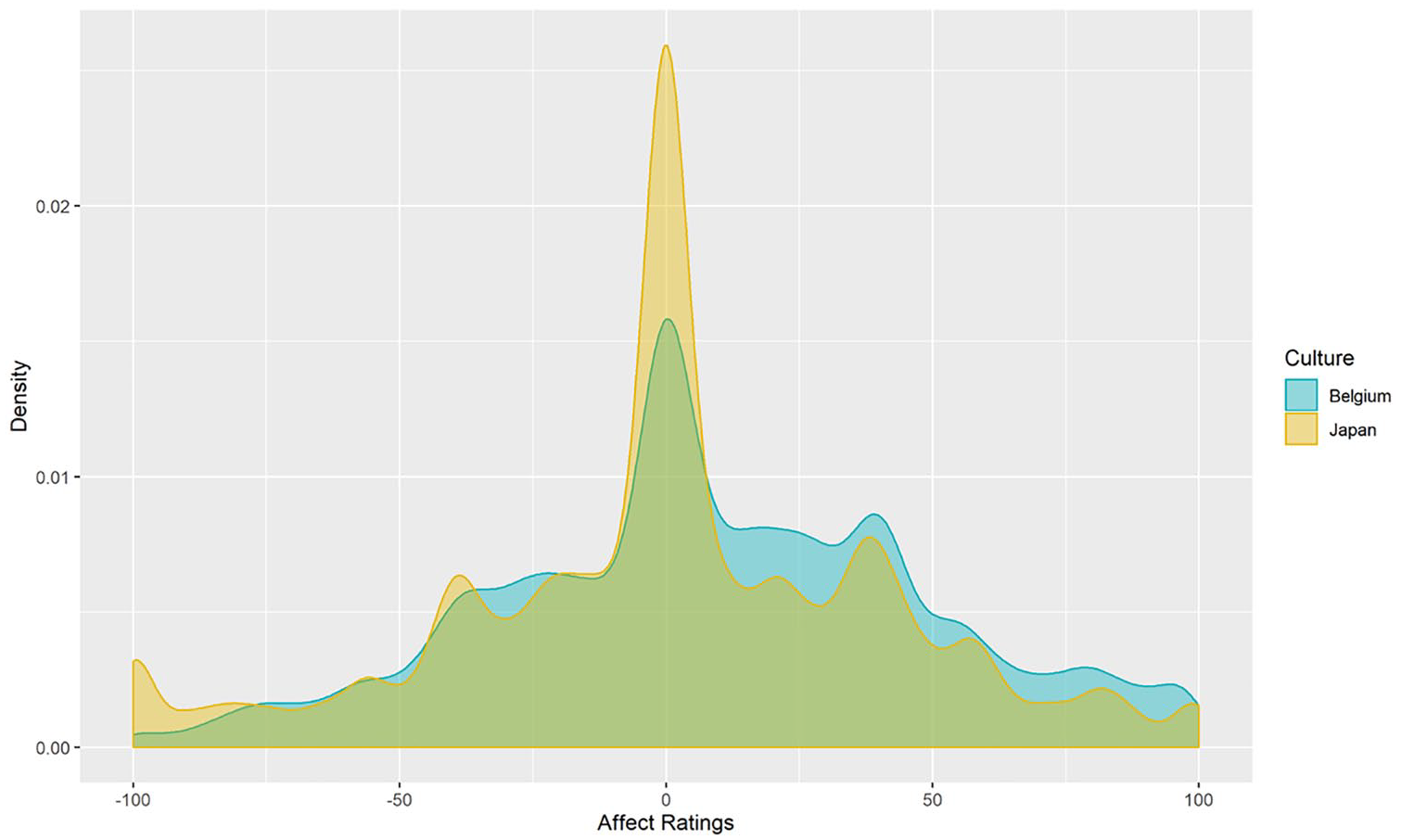
Density distribution of affect ratings in both cultures.
Analytic Strategy
Affect ratio
Following previous research, and in line with the ideas of balance theory, we calculated the affect ratio at the level of the couple (Birchler et al., 1975; Gottman, 1993b, 1994). For each couple, we calculated a sum score of positive affect by adding up the seconds of both partners’ positive affect, and separately, a sum score of negative affect by adding up the seconds of both partners’ negative affect. To calculate each couple’s affect ratio, we divided their sum score of positive affect by their sum score of negative affect. 6
Hypothesis testing
To test our first hypothesis of cultural differences in affect ratios, we used an independent samples t-test comparing affect ratios (DV) between cultural groups (IV). For our second hypothesis of cultural differences in the degree to which affect ratios predict relationship satisfaction, we used a moderation model: in a multi-group structural equation model, we first regressed couple affect ratios (DV) onto relationship satisfaction (IV) in each cultural group, and then defined contrasts between cultures in order to test cultural differences in both the regression estimates for the effect of relationship satisfaction and the intercepts for affect ratios. Finally, to test our third hypothesis for cultural differences in the extent to which positive and negative affect mediate the association between affect ratios and relationship satisfaction, we conducted three different models regressing affect ratios on relationship satisfaction: (1) a model including a single mediation path with positive affect, (2) a model including a single mediation path with negative affect, and (3) a full model including both mediation paths simultaneously. In order to draw comparisons in the strength of the mediation effects between the cultures, we used multi-group analysis: For each model separately, we constrained the respective indirect mediation effects to be equal in both cultures, and then compared the model fit for the constrained and unconstrained model (i.e., in which the strength of the indirect mediation path can differ in the two cultures). If the constrained model would fit significantly worse than the unconstrained model, we inferred that the strength of indirect effects was significantly different between cultures. In all our moderation and mediation analyses, we used bootstrapping (N = 10,000) and bias-corrected and accelerated bootstrap confidence intervals to obtain accurate estimates of our parameters. Statistical significance of parameter estimates at the level of p < .05 is indicted by 95% confidence intervals that exclude 0.
All analyses were conducted with R Studio, Version 1.2.5001 (R Studio Team Inc, 2018). Moderation and mediation analyses for H2 and H3 were conducted with the R package lavaan (Rosseel, 2012).
Results
Descriptive Analyses
Comparing the frequencies of the different affect types (see Figure 1 for the density distribution of all raw ratings scores in the two cultures), we found that the average frequency of positive affect was higher than that of negative affect in Belgian, t(55) = 2.88, p = .006, but not in Japanese couples, t(74) = 1.3, p = .198. Belgian couples reported more positive (MBE = 35%, MJP = 27%), as well as less negative (MBE = 21%, MJP = 23%) and neutral affect (MBE = 45%, MJP = 51%) than Japanese couples. However, only the differences in neutral, F(1, 129) = 3.98, p = .048, and positive affect, F(1, 129) = 5.86, p = .017, reached significance. Positive and negative affect were negatively correlated in both cultures, but the correlation was significantly smaller in Japan (rJP = −.33) than in Belgium (rBE = −.7), z = 3.01, p < .003.
Hypothesis 1: Cultural Differences in Affect Ratios
For our first hypothesis, we predicted that Belgian couples would show higher affect ratios compared to Japanese couples (H1). Confirming our prediction, we found a significant difference in average affect ratios between cultures: Belgian couples showed more positive affect ratios (MBE = 20.16, SDBE = 40.65) than Japanese couples (MJP = 4.00, SDJP = 9.84), t(59.8) = 2.91, p = .005.
Hypothesis 2: Cultural Differences in the Link Between Affect Ratios and Relationship Satisfaction
We also found support for our second hypothesis that relationship satisfaction would be positively related to affect ratios in both cultures, but that this link would be stronger in Belgian compared to Japanese couples (H2). Table 1 shows the results for our moderation model: for Belgian couples, we found a significant positive effect of relationship satisfaction on the affect ratios, bSample = 0.98, bootstrapped 95% CI [0.48, 1.67], suggesting that with increasing relationship satisfaction Belgian couples reported higher affect ratios. We found a significant effect for Japanese couples as well, b = 0.20, 95% CI [0.01, 0.47]. However, as predicted, the contrast of relationship satisfaction between cultural groups was also significant, b = −0.78, 95% CI [−1.48, −0.21], indicating that the effect of relationship satisfaction differed significantly in strength between cultures. Furthermore, the contrast between intercepts for affect ratios was also significant, indicating that couples with an average level of relationship satisfaction in Belgium showed higher affect ratios than their Japanese counterparts, b = −16.43, 95% CI [−28.11, −6.88]. 7
Model Estimates for Moderation Model (H2).
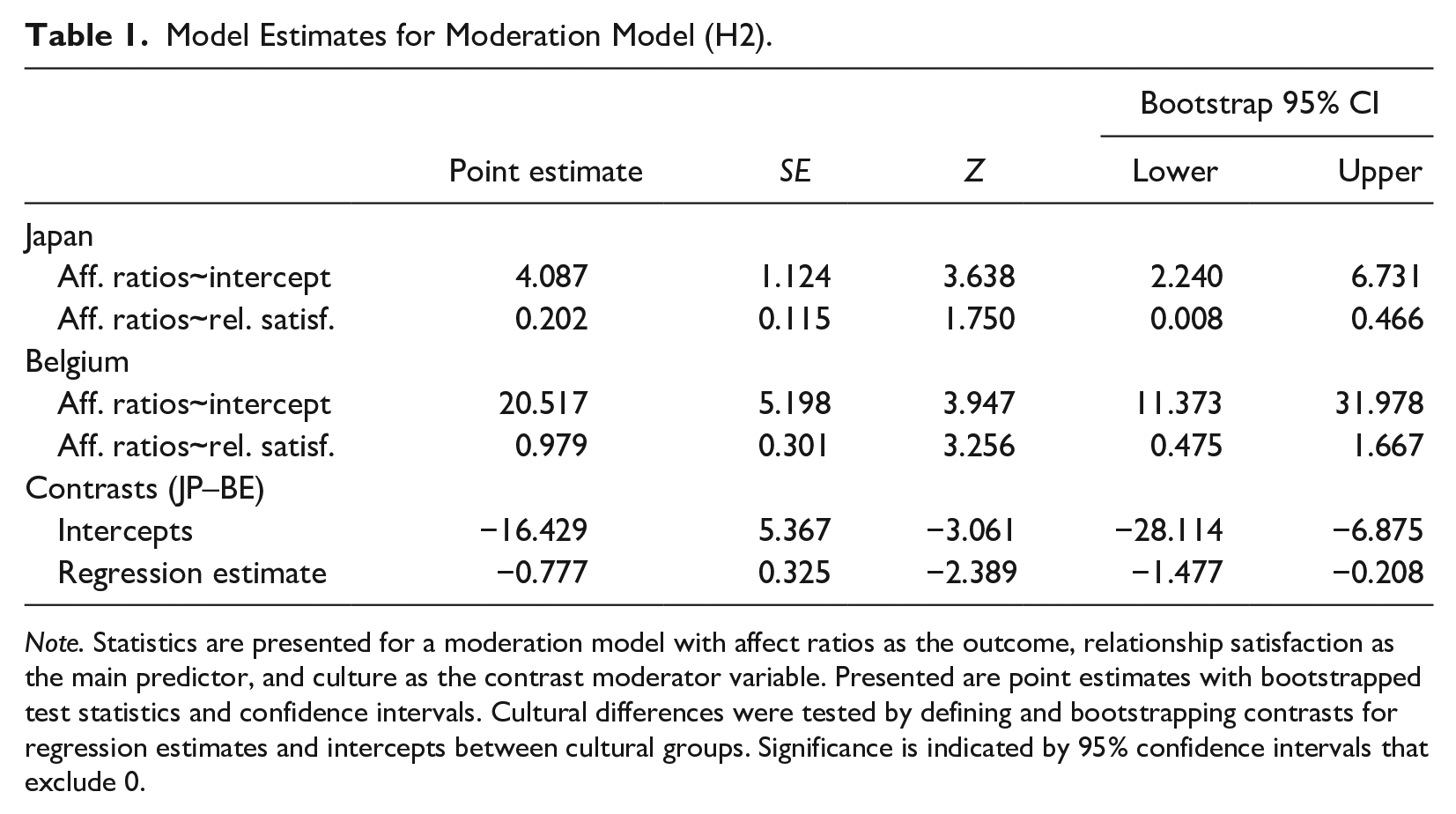
Note. Statistics are presented for a moderation model with affect ratios as the outcome, relationship satisfaction as the main predictor, and culture as the contrast moderator variable. Presented are point estimates with bootstrapped test statistics and confidence intervals. Cultural differences were tested by defining and bootstrapping contrasts for regression estimates and intercepts between cultural groups. Significance is indicated by 95% confidence intervals that exclude 0.
Follow-up analyses revealed that highly satisfied couples (+1 SD from respective culture mean) showed significantly higher affect ratios in Belgium, MBE = 32.57, than Japan, MJP = 6.52, b = −26.05, 95% CI [−44.34, −10.01]. This was the case, even for couples with low satisfaction (−1 SD from mean), MBE = 8.46, MJP = 1.65, b = −6.81, 95% CI [−14.36, −0.57]. In all, we confirmed our second hypothesis: Both cultures showed signs of increasing affect ratios with higher relationship satisfaction, but this association was significantly stronger for Belgian than for Japanese couples.
Hypothesis 3: Positive and Negative Affect as Mediators
Our final hypothesis predicted cultural differences in the extent to which positive and negative affect would mediate the link between relationship satisfaction and affect ratios. We expected that both positive and negative feelings would mediate this link for Belgian couples, but that only negative feelings would mediate it for Japanese couples (H3).
We again found support for our hypothesis. Tables 2 and 3 show the model estimates for the models model in the two cultures, respectively. As expected, Models 1 and 2 showed that the link between relationship satisfaction and affect ratios for
Belgium: Model Estimates for Mediation Models (H3).
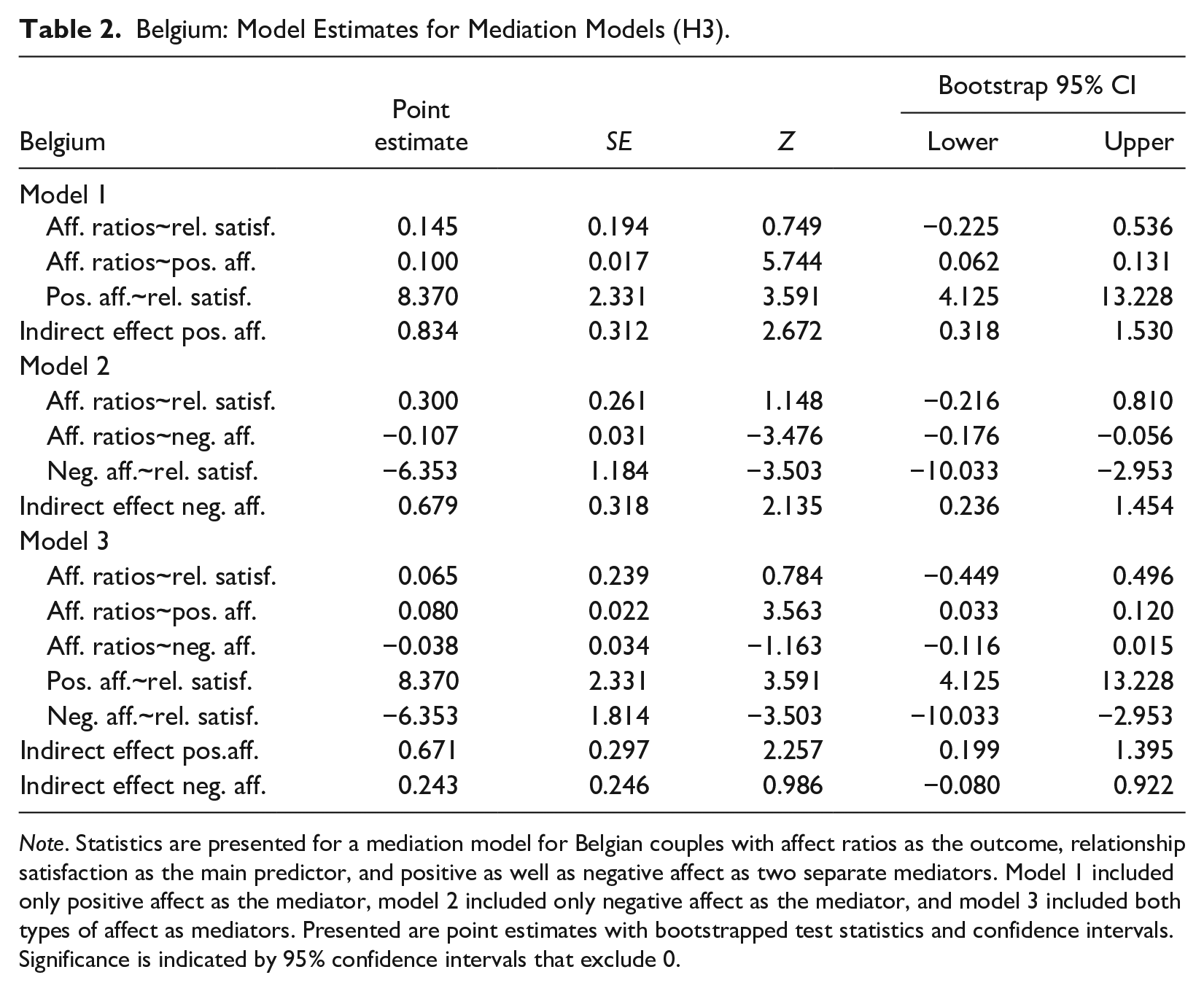
Note. Statistics are presented for a mediation model for Belgian couples with affect ratios as the outcome, relationship satisfaction as the main predictor, and positive as well as negative affect as two separate mediators. Model 1 included only positive affect as the mediator, model 2 included only negative affect as the mediator, and model 3 included both types of affect as mediators. Presented are point estimates with bootstrapped test statistics and confidence intervals. Significance is indicated by 95% confidence intervals that exclude 0.
Japan: Model Estimates for Mediation Models (H3).
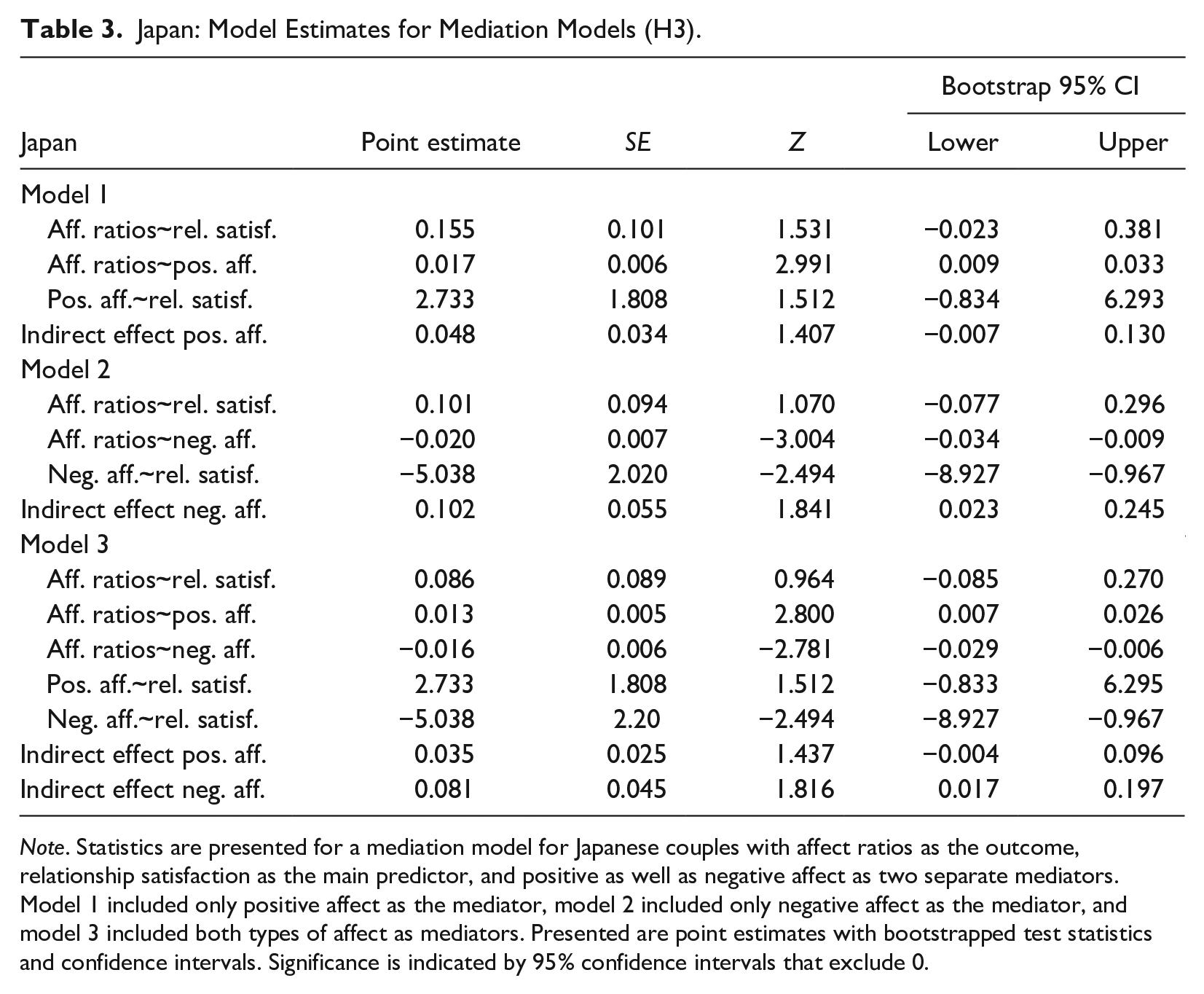
Note. Statistics are presented for a mediation model for Japanese couples with affect ratios as the outcome, relationship satisfaction as the main predictor, and positive as well as negative affect as two separate mediators. Model 1 included only positive affect as the mediator, model 2 included only negative affect as the mediator, and model 3 included both types of affect as mediators. Presented are point estimates with bootstrapped test statistics and confidence intervals. Significance is indicated by 95% confidence intervals that exclude 0.
Also consistent with our expectations, Models 1 and 2 indicated that the link between relationship satisfaction and affect ratios for
Differences also emerged between cultures: We found that constraining the indirect effects to be equal across cultures, significantly reduced the fit of all three models outlined above: Compared to the unconstrained models, chi-square fit scores were significantly reduced for the constrained model with only positive affect as a mediator (Model 1), χ (1) = 7.97, p = .005, for the constrained model with only negative affect as a mediator (Model 2), χ (1) = 6.12, p = .013, and for the constrained model with both positive and negative affect as mediators (Model 3), χ (2) = 14.92, p < .001. In other words, these findings suggest that the indirect pathways were significantly different in the two cultures, and thus that positive and negative affect mediated the link between satisfaction and affect ratios to different extents in the two cultures.
Taken together, the link between relationship satisfaction and affect ratios appears to be mediated differently in the two cultures: As predicted, compared to less satisfied couples, higher affect ratios in more satisfied couples in Belgium were mediated by higher levels of positive feelings (Models 1 and 3); only when examined in isolation there was an effect of negative feelings (Model 2). The full model thus suggests mediation through positive, but not through negative feelings. In contrast, and also as predicted, higher ratios in more satisfied couples in Japan were mediated through lower levels of negative feelings (Models 2 and 3), but not positive feelings (neither Model 1 nor 3).
Discussion
The current study set out to examine the role of culture for the experience of positive and negative feelings in close relationships. Given cultural differences in close relationship goals, we expected that Belgian relationships would be characterized by a relatively greater focus on positive affect compared to Japanese relationships. We tested our assumption by inviting couples from Belgium (considered a “Western” context) and Japan (considered an “East-Asian” context) to take part in a standardized disagreement interaction, and to rate their affect during their interaction through a video-mediated recall procedure. This approach allowed us to examine affective experiences as they occurred in actual interactions and relationships in different cultures, and as reported by the key actors themselves—the couples under study. As such, we (a) “conceptually replicated” (Crandall & Sherman, 2016) previous findings about couple affect ratios using a less-represented Western context (Belgium, rather than the United States) and different affect measures (continuous self-report rather than single retrospective self-report or coded behavior) and (b) extended previous findings by highlighting the role of culture in affective experiences in close relationships.
In our analyses, we focused on positive-to-negative affect ratios as an indicator of affective balance in couples’ relationships. We were particularly interested in the link between affect ratios and partners’ relationship satisfaction. As predicted, Belgian couples showed significantly more positive average ratios than Japanese couples, suggesting that Belgian couples generally experienced more positive relative to negative affect during their disagreement interactions than Japanese couples
Cultural Differences in Positive Versus Negative Affect
Overall, interactions of Belgian couples center more around positive feelings than those of Japanese couples: Belgian couples reported more positive feelings than their Japanese counterparts, and they also reported more positive feelings than they reported negative feelings. In contrast, Japanese couples reported positive and negative feelings to more similar extents. These cultural differences in couple affect during disagreement interactions parallel cultural differences in the general frequency or intensity of positive and negative feelings yielded by research comparing individuals from other Western and East-Asian contexts (Kitayama et al., 2000; Mesquita & Karasawa, 2002; Miyamoto & Ryff, 2011; Scollon et al., 2004; Suh et al., 1998; Tsai & Levenson, 1997). We also found cultural differences in the association between affect ratios and relationship satisfaction: While more satisfied couples from both cultures showed relatively higher affect ratios, this was more strongly the case for satisfied Belgian than Japanese couples. Again this findings is consistent with previous research showing that positive affect is tied more strongly to wellbeing in Western than in East-Asian cultures (Kuppens et al., 2008; Suh et al., 1998). This study thus expands research on cultural differences in affective valence beyond the level of the individual, and suggests that similarly meaningful differences in affect can be found at the level of couple interactions.
Affect and Relationship Goals
Previous work had suggested that well-functioning relationships of European-American couples seem to be characterized by positive affect ratios (Gottman, 1993b). The current study conceptually replicated the original studies with couples in Belgium, a less studied cultural context that we assumed is similarly characterized by individualist, Western values (Schwartz et al., 2001); the latter idea is further supported by our results which, similar to findings in the U.S., highlight the particular importance of positive affect for Belgian relationships. The emphasis on positive over negative affect in both countries may be understood from shared relationship goals of mutual affirmation, fostering each partner’s positive self-view, and being positively distinct from others (Rothbaum et al., 2000). To the extent that couples succeed in achieving these goals, they would be expected to experience relatively more positive feelings (Kim & Markus, 1999; Kitayama & Markus, 2000). Our mediation models further support the idea that positive affect (not negative) was the primary driving force behind higher positive-to-negative affect ratios in satisfied Belgian couples (compared to less satisfied Belgian couples).
In Japan, couple relationships were also marked by more positive relative to negative affect, and satisfied couples showed higher affect ratios than less satisfied ones. Yet, differences between satisfied and less satisfied couples were markedly smaller than those between their Belgian counterparts, a finding that fits previous work on the lesser importance of greater positivity for individual wellbeing across a range of East-Asian countries (Suh et al., 1998). Moreover, the differences in affect ratios between high and low satisfaction couples were primarily driven by the levels of negative (not positive) feelings. One way of interpreting this finding is that satisfied Japanese couples, consistent with the central tendency of avoiding disruptions of harmony (Elliot et al., 2001; Kitayama et al., 1997), are particularly motivated to avoid or quickly resolve higher levels of negative affect (even if negative affect may initially alert partners to adjust their behavior). That positive feelings do not play a bigger role in relationship satisfaction for Japanese couples is consistent with the Japanese belief that an excess of positive feelings is harmful to relationships (e.g., because it may reduce attentiveness to the needs of the partner or may disrupt harmony, Uchida & Kitayama, 2009), a belief that is shared by other East-Asian cultures (see e.g., Sims et al., 2015, for results with Chinese-origin samples).
Overall, the present work suggests that couple interactions in different cultures are marked by different affective experiences. More satisfied couples report affective patterns that appear more in line with the relationship practices in their respective cultures. This finding is consistent with previous research that has found that individuals who experience the normative emotions of their culture report higher wellbeing (De Leersnyder et al., 2014, 2015). Couples and clinical practitioners might benefit from the insight that relationship satisfaction takes a different shape in different cultures. Depending on the culture in which you ask, the question of what feelings characterize a good and fulfilled relationships may be answered differently. Future research should explicitly test what processes and behaviors between partners might give rise to culturally beneficial patterns of affect (e.g., Schoebi et al., 2010), and test the efficacy of culturally tailored interventions with couples from varied cultural backgrounds (Ibrahim & Schroeder, 1990).
Limitations and Future Directions
There are some limitations to take into account when interpreting our results. First, our analyses focused on partners’ self-reports of their affect during the interaction, assessed by a second-by-second video-mediated recall, and cannot speak to emotional behaviors. Some of the previous research on balance theory focused on coded behaviors. While video-mediated recall of affect has been found to correspond to emotional behaviors (Gottman & Levenson, 1985; Mauss et al., 2005), we cannot be sure that our results would replicate with behavioral measures. 8 We would expect that a study on affect ratios in emotional behaviors may show somewhat similar patterns as found with our self-report measure, but may also face particular cross-cultural challenges, such as differences in display rules or expressivity (see e.g., Safdar et al., 2009).
A second limitation of this study is that it only focused on one particular type of interaction, that is, discussions of a disagreement in the relationship. Decades of research with European-American couples have provided strong support for the validity of conflict interactions as a way to probe affective patterns and quality of relationships (Gottman & Notarius, 2000). However, the same may not be true for other cultures. While conflict is thought to be unavoidable in relationships in Western cultures, such as Belgium or the United States, and conflict resolution an important indicator of relationship quality, this may not be true in non-Western contexts, such as Japan (Rothbaum et al., 2000). It is possible that affective patterns during conflict interactions are less relevant to relationship satisfaction in Japanese couples. Future research should aim at expanding and comparing the findings of the present study to situational contexts that are more central to relationship practices in non-Western cultures (e.g., cooperation, perspective taking).
A third limitation of our study is that it focuses on cultural differences in affect during interactions, but fails to explain the types of processes that may underlie any differences. Research on conflict interactions has shown that contextual elements are extremely important to the (emotional) course of conflict between people. Examples of such contextual elements are the behavioral strategies to manage the early emergence of disagreements (e.g., attempts to avoid conflict either physically or mentally; Hample & Hample, 2020), the different ways that conflict may start between actors (e.g., jointly or unexpectedly; Hample et al., 2019), or conflict narratives (Lewiński et al., 2018); all of these elements may differ between cultures. Future research should aim to provide a detailed picture of how disagreement may emerge and unfold in different cultures, including a cross-cultural analysis of wider contextual variables that contribute to differential unfolding.
A fourth limitation relates to the affect ratios themselves. Discussions of the early findings on affective balance in relationship have often shown a tendency to “essentialize” the ratios established, referring to 5:1 as the “magic ratio” in relationships (e.g., Stillman, 2020). Similar tendencies have been found for ratio research in other fields (e.g., in the context of teaching; Sabey et al., 2019). It is important to point out that the ratios yielded by our research differed somewhat from those in previous work: Even less-satisfied Western couples in our study showed higher proportions (8.5:1) than the stable partners in the original article (5:1). This may have been due, in part, to the different approach taken, with a higher time resolution and slightly different criteria to categorize affect as positive or negative. More generally, we would caution against treating the ratios of our highly satisfied couples (32.57:1 in Belgium, 6.52:1 in Japan) as absolute standards or goals. The main goal of the current study was not to establish new, definite ratios for relationships in different cultures, but to highlight the important role that culture plays for emotions in close relationships—a domain of research that has traditionally been dominated by research and perspectives from Western cultural contexts. We see our results as an indication that the ratios of positive over negative feelings may be different for satisfied relationships across cultures, especially between Western and East-Asian cultures.
Finally, our work examines positive and negative affect as couple and interaction-level aggregates, but does not examine how these aggregates emerge dynamically during the interaction. For example, previous work in European-American couples has examined specific sequences of positive and negative patterns (e.g., reciprocity, contagion) in couple interactions and successfully linked them to relationship satisfaction (Gottman & Levenson, 1985; Margolin & Wampold, 1981). Our findings may be fruitfully followed up by analyses of the dynamic patterns that underlie different affect ratios in Belgian and Japanese couples. We expect that these patterns are not random, but will reveal some coordination between partners toward culture-specific desirable affect states (Boiger & Mesquita, 2012; Boiger et al., 2020). Zooming in on cultural differences in these interpersonal affect patterns could also offer more specific insights into what affective processes contribute to well-functioning relationships in different cultures, and which behaviors may be targets for interventions to increase satisfaction with one’s relationship.
Conclusion
How couples feel during a disagreement interaction is associated with their relationship satisfaction, and this appears to be the case for cultural contexts as different as Belgium and Japan. However, our results highlight the importance of considering the cultural background when studying close relationships: Affective patterns that characterize satisfied couples appear to differ cross-culturally in ways that are consistent with the cultural relationship goals. Disagreement interactions of satisfied Belgian couples were characterized by high proportions of positive to negative feelings, and the link between relationship satisfaction and affective ratios was mediated in different ways in the two cultures (by positive feelings in Belgian, and negative feelings in Japanese couples). Overall, the present results caution against general inferences of what constitutes “good relationships” from studies that have been conducted in European-American contexts (particularly, the U.S.) alone (Henrich et al., 2010), and highlight the importance of the cultural context when assessing affective indicators of close relationships in different cultures.
Supplemental Material
sj-doc-1-jcc-10.1177_00220221211051016 – Supplemental material for Relatively Happy: The Role of the Positive-to-Negative Affect Ratio in Japanese and Belgian Couples
Supplemental material, sj-doc-1-jcc-10.1177_00220221211051016 for Relatively Happy: The Role of the Positive-to-Negative Affect Ratio in Japanese and Belgian Couples by Alexander Kirchner-Häusler, Michael Boiger, Yukiko Uchida, Yoko Higuchi, Atsuhiko Uchida and Batja Mesquita in Journal of Cross-Cultural Psychology
Supplemental Material
sj-doc-2-jcc-10.1177_00220221211051016 – Supplemental material for Relatively Happy: The Role of the Positive-to-Negative Affect Ratio in Japanese and Belgian Couples
Supplemental material, sj-doc-2-jcc-10.1177_00220221211051016 for Relatively Happy: The Role of the Positive-to-Negative Affect Ratio in Japanese and Belgian Couples by Alexander Kirchner-Häusler, Michael Boiger, Yukiko Uchida, Yoko Higuchi, Atsuhiko Uchida and Batja Mesquita in Journal of Cross-Cultural Psychology
Footnotes
Authors’ Note
The work described in this article was conducted in collaboration between the University of Leuven, Leuven, Belgium, and Kyoto University, Kyoto, Japan.
Declaration of Conflicting Interests
The author(s) declared no potential conflicts of interest with respect to the research, authorship, and/or publication of this article.
Funding
The author(s) disclosed receipt of the following financial support for the research, authorship, and/or publication of this article: The research was supported by two grants from the University of Leuven Research Council to Batja Mesquita (OT/13/050, C14/17/048), and a postdoctoral fellowship by the Research Foundation Flanders (FWO) to Michael Boiger (12R3715N).

Supplemental Material
Supplemental material for this article is available online.
Notes
References
Supplementary Material
Please find the following supplemental material available below.
For Open Access articles published under a Creative Commons License, all supplemental material carries the same license as the article it is associated with.
For non-Open Access articles published, all supplemental material carries a non-exclusive license, and permission requests for re-use of supplemental material or any part of supplemental material shall be sent directly to the copyright owner as specified in the copyright notice associated with the article.
