




Abstract
Cross-societal differences in cooperation and trust among strangers in the provision of public goods may be key to understanding how societies are managing the COVID-19 pandemic. We report a survey conducted across 41 societies between March and May 2020 (N = 34,526), and test pre-registered hypotheses about how cross-societal differences in cooperation and trust relate to prosocial COVID-19 responses (e.g., social distancing), stringency of policies, and support for behavioral regulations (e.g., mandatory quarantine). We further tested whether cross-societal variation in institutions and ecologies theorized to impact cooperation were associated with prosocial COVID-19 responses, including institutional quality, religiosity, and historical prevalence of pathogens. We found substantial variation across societies in prosocial COVID-19 responses, stringency of policies, and support for behavioral regulations. However, we found no consistent evidence to support the idea that cross-societal variation in cooperation and trust among strangers is associated with these outcomes related to the COVID-19 pandemic. These results were replicated with another independent cross-cultural COVID-19 dataset (N = 112,136), and in both snowball and representative samples. We discuss implications of our results, including challenging the assumption that managing the COVID-19 pandemic across societies is best modeled as a public goods dilemma.
Introduction
The COVID-19 outbreak poses pressing challenges within and between nations to manage the spread of the disease. To address these challenges, several recent papers have drawn on social science principles in an effort to understand and change behavior. One common theme in this line of work is that managing the spread of the disease poses a social dilemma (e.g., a public goods dilemma; Johnson et al., 2020; Van Bavel et al., 2020), which is defined as a situation in which individuals experience a conflict between short-term self-interest and long-term interest of the collective. From this perspective, many of the behaviors required to successfully deal with the COVID-19 crisis—such as maintaining social distance, frequent hand washing, and self-imposed quarantine—involve a joint effort where individuals must pay a short-term cost to enhance the long-term collective good (e.g., health and safety of citizens, well-functioning health care institutions). Drawing on this line of thinking, recent research discusses a variety of social dilemmas people face when dealing with the COVID-19 crisis and suggests a number of policy interventions based on theory and research on cooperation in social dilemmas (e.g., detachment from non-cooperators, decentralized and centralized punishment systems; Johnson et al., 2020).
Although theory and research on social dilemmas have often been applied to understand a range of societal problems (e.g., provision of public goods, management of common resources, for reviews see Parks et al., 2013; Van Lange et al., 2013), some have cautioned against developing COVID-19 policy recommendations before first testing key assumptions about the relevance and applicability of social and behavioral science principles to the pandemic. In one intriguing critique, IJzerman et al. (2020) suggested that insights intended to inform COVID-19 policy recommendations should be evaluated within rocket science’s nine stages of Technology Risk Levels. At stage 1, for example, researchers have reliably observed a phenomenon within a controlled environment. At stage 2, resulting principles should be tested in applied settings. And by stage 9, a system (e.g., solution) should be effective in multiple applications within real-world settings. Viewed in this light, offering policy recommendations based on the assumption that responses to COVID-19 reflect a social dilemma is likely premature. Indeed, although a long tradition of research on social dilemmas has yielded useful insights into cooperation within controlled lab settings and several real-world settings (Joireman et al., 2004; Ostrom, 1990; Rustagi et al., 2010; Van Vugt & Samuelson, 1999), no published work has directly tested whether theory and research on social dilemmas represent a firm basis for advancing COVID-19 policy recommendations.
With this in mind, the present work examines the usefulness of theory and research on cross-societal differences in cooperation and trust for predicting early prosocial COVID-19 responses (e.g., social distancing)—a proxy for first-order cooperation in the dilemma—and support for behavioral regulation policies aimed at addressing the pandemic (e.g., mandatory quarantine)—akin to second-order cooperation to support an institution to solve the social dilemma. More specifically, as illustrated in Figure 1, we test a series of pre-registered hypotheses linking these COVID-19 responses to established cross-societal differences in cooperation and trust (among strangers) in social dilemmas (Gächter et al., 2010; Romano et al., 2017) as well as societal and ecological factors theorized to shape norms of cooperation in social dilemmas (Hruschka & Henrich, 2013). We evaluate these hypotheses with multi-level models, utilizing country-level data (for cooperation, trust, and societal factors) to predict individual-level data (for prosocial COVID-19 responses and support for behavioral regulation policies).
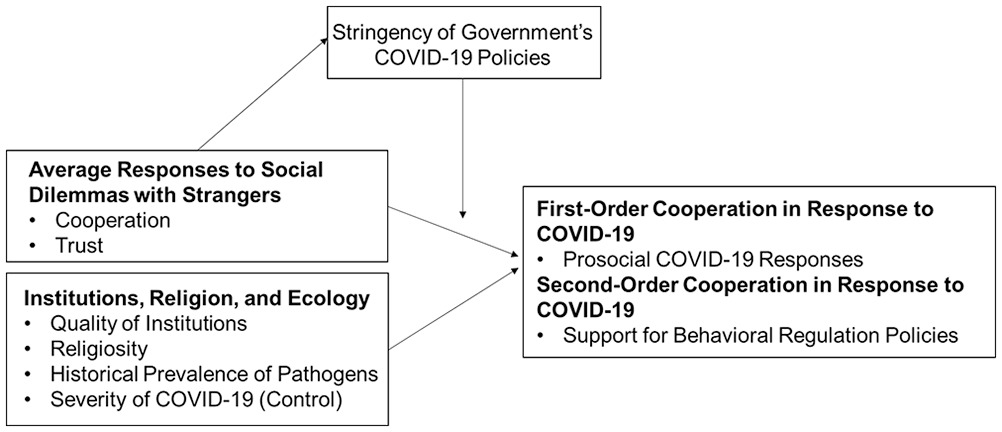
Conceptual model.
Cooperation, Trust, and Prosocial COVID-19 Responses Across Societies
Many of the actions people are asked to take to deal with COVID-19 involve cooperating with strangers: they impose a personal cost (e.g., social isolation) to benefit the collective (e.g., protecting vulnerable populations; i.e., a social dilemma). Thus, a society’s general tendency toward cooperation among strangers will likely be linked with specific levels of prosocial responses to COVID-19. People are also conditional cooperators (Fischbacher et al., 2001), basing their behavior on what they expect others will do; that is, the expectation that others will likewise cooperate with the requested actions (Balliet & Van Lange, 2013; Rousseau et al., 1998). Thus, assuming COVID-19 behaviors pose a social dilemma, prosocial COVID-19 responses should also be positively linked with cross-societal differences in trust. Previous research on individual trust in the United States of America (USA) found that trust was related to more self-reported precautionary and preventive behaviors (e.g., washing hands and social distancing; Aschwanden et al., 2020). Accordingly, in the present study, we tested the hypotheses that prosocial COVID-19 responses (e.g., willingness to donate to pandemic relevant charities, following guidance to avoid public spaces) would be positively related to country-level cooperation (H1a) and trust (H1b) among strangers.
We further tested whether several theories that explain cross-societal differences in cooperation among strangers can be applied to understand variation in prosocial COVID-19 responses (Balliet & Van Lange, 2013; Richerson et al., 2016). In particular, it has been proposed that higher levels of cooperation among strangers can be found in societies characterized by: (a) higher quality of institutions, both actual and perceived (e.g., rule of law, government effectiveness, and institutional trust; Hruschka et al., 2014; Hruschka & Henrich, 2013), (b) higher religiosity (e.g., church attendance, religious beliefs, and historical exposure to Western Church (i.e., the historical impact of the Western Church on social relations via kinship-regulating policies (e.g., banning cousin marriage) that encouraged social exchange beyond kin; Norenzayan et al., 2014; Schulz et al., 2019)), and (c) ecologies with low historical prevalence of pathogens (e.g., Fincher & Thornhill, 2012). Drawing on this work, we expect stronger prosocial COVID-19 responses in societies characterized by higher quality of institutions (H2), greater religiosity (H3), and lower historical prevalence of pathogens (H4).
Cooperation, Trust, and Support for COVID-19 Behavior Regulation Policies
As discussed, cross-societal differences in cooperation and trust are expected to predict more prosocial COVID-19 responses (e.g., washing hands, staying at home). Past interdisciplinary research has also proposed that there exist cross-societal differences in the way different cultures solve social dilemmas (Yamagishi, Cook, et al., 1998). For instance, societies with lower cooperation and trust among strangers are more likely to solve social dilemmas by supporting the implementation of sanctioning systems that impose costs on free-riders (Yamagishi, Cook, et al., 1998). In contrast, other societies solve social dilemmas with higher cooperation and trust among unrelated strangers, even in the absence of formal institutions, and therefore are less likely to support policies that monitor and sanction defectors (individualistic view of culture; Yamagishi, Cook, et al., 1998). Past research has tested these hypotheses in a limited set of countries (e.g., USA versus Japan) and found that societies with lower trust display more dramatic positive changes in cooperation and trust in the presence (versus absence) of regulations which monitor and sanction non-cooperative behaviors (institutional view of culture; Yamagishi, 1988; Yamagishi, Cook, et al., 1998; Yamagishi, Jin, et al., 1998).
Based on this work, we advanced two related hypotheses. First, given that low cooperation and low trust societies are more likely to rely upon formal sanctioning systems to solve social dilemmas, such societies should be more likely to support and implement centralized and decentralized behavioral regulation policies to address COVID-19 (e.g., support for mandatory quarantine of people exposed to the virus; H5a,b). Second, considering the larger positive impact of sanctioning systems in societies characterized by low cooperation and low trust (Yamagishi, 1988), the stringency of policies should have a stronger positive relation with prosocial COVID-19 responses in societies characterized by low (versus high) cooperation (H6a) and trust (H6b).
Methods
Prior to acquiring the data, the study proposal and analysis plan were pre-registered on OSF (https://tinyurl.com/y5yl7seo). 1 The research was approved by the Ethics Committees of the University of Groningen (PSY-1920-S-0390) and New York University Abu Dhabi (HRPP-2020-42). We used participant-level data collected from the PsyCorona Study, a large-scale cross-societal study on individual responses to COVID-19 (https://psycorona.org/). A recent published paper used similar outcome variables from the same dataset (i.e., prosocial COVID-19 responses, support for behavioral regulations) to address a different set of questions (see Jin et al., 2021).
Participants
Participants were recruited using a snowball sampling strategy. After providing their informed consent, participants completed the survey in one of 30 possible languages of their choice. The initial sample consisted of 36,702 participants across 115 societies during almost 2 months (from March 19th to May 11th 2020). Individuals’ careless responding was accounted for by removing participants based on overall time of completion (i.e., less than 5 minutes, and providing inconsistent responses on reverse-coded items in one of the scales administered in the broader survey). Societies with fewer than 100 observations were excluded, which resulted in a final sample of 34,526 participants (68% females) from 41 societies (see Table 1 for an overview).
Societies, Sample Sizes, Descriptive Statistics, and National Language Available to the Participants Included in the Analyses.

Note. N = Sample size for each society. National language indicates which language, among the 30 available languages, reflected participants’ national language. Percentages might not add up to 100% due to rounding and missing data in reporting age and gender.
Outcome Variables (Individual-Level)
Individual-level variables were obtained from a subset of variables measured in the Baseline Survey of the PsyCorona Study. We extracted three sets of items measuring prosocial motivations, prosocial behaviors, and support for behavioral regulations related to COVID-19 (see Supplemental Table S3). All scales measuring these variables were used in aggregate levels, with the mean of available items computed for each scale.
Prosocial COVID-19 responses
Motivation to engage in prosocial behaviors related to the pandemic were assessed using a set of four items where participants stated their agreement about their willingness to (1) help others, (2) make donations, (3) protect vulnerable groups, and (4) make sacrifices to deal with COVID-19 pandemic on a 7-point Likert scale from 1 (strongly disagree) to 7 (strongly agree), Cronbach’s α = 0.72.
Prosocial behaviors were measured with four items in which people were asked about their agreement on whether they engaged in two social distancing behaviors (i.e., self-isolation and avoidance of public spaces) and one health prevention behavior (i.e., washing hands) on a 7-point Likert scale from 1 (strongly disagree) to 7 (strongly agree), Cronbach’s α = 0.66. The fourth item was a self-report measure of the number of times the respondent went outside in the past week, answered on a 4-point scale from 1 (I did not leave my home) to 4 (four times or more). This was considered a separate variable related to prosocial behavior and reverse-scored for interpretability, with higher scores meaning greater staying at home behavior.
Support for behavioral regulations
We assessed people’s support for behavioral regulations aimed at curbing COVID-19 by aggregating responses to three items about whether participants would sign petitions to enforce compliance behaviors to reduce the spread of COVID-19 (i.e., support for mandatory vaccination, mandatory quarantine to people exposed to the virus, and reporting people who are suspected to be infected). Items were rated on a 7-point Likert scale from 1 (strongly disagree) to 7 (strongly agree), Cronbach’s α = 0.67.
Predictor Variables (Country-Level)
To operationalize country-level variables to be used as predictors in our model, we utilized data from previous cross-cultural studies (Falk et al., 2018; Romano et al., 2020) and open access cross-cultural databases (see Supplemental Table S4).
Cooperation
We operationalized country-level cooperation using a measure of cooperation from a recent online experiment run in December 2018 across 42 societies (N = 18,411, representative samples for gender, age, and income; Romano et al., 2020). Participants completed an online experiment, and were asked to make 12 independent one-shot decisions in a prisoner’s dilemma game (PD) according to a stranger matching protocol (being paired with a different partner for each decision, and without receiving any feedback). In the PD, participants were endowed with 10 Monetary Units (MUs) and could decide how many of them to keep for themselves and how many to give to their partner. They were instructed that each MU given to their partner was doubled, and that their partner also had the option to give any amount to them, and that this amount too would be doubled. To make decisions comparable across societies, participants learned that each MU was worth the equivalent of 2.5 minutes of the average hourly wage in their country. Cooperation was assessed by the amount of resources invested in the PD (0-10).
As a robustness check of our hypotheses concerning cooperation, we also used a measure of norms of civic cooperation, retrieved from wave 6 of the World Value Survey (WVS; Inglehart et al., 2014) and computed by averaging three items assessing the extent to which specific behaviors are justifiable (i.e., claiming government benefits that you are not entitled to, avoiding a fare on public transportation, and cheating on taxes if you have a chance). Items were answered on a 10-point scale from 1 (always justifiable) to 10 (never justifiable).
Trust
We retrieved trust data from the Global Preference Survey (GPS; Falk et al., 2018). This survey was based on answers from 80,000 participants across 76 societies, in which trust was measured by means of one item on an 11-point Likert scale (“I assume that people have only the best intentions”) from 0 (does not describe me at all) to 10 (describes me perfectly). This measure has been found to be predictive of behavior in the trust game (Falk et al., 2016). As a robustness check for our hypotheses concerning trust, we also used expectations of others’ cooperation in the PD as a proxy of trust (Balliet & Van Lange, 2013). Expectations were assessed as stated beliefs about the amount of resources expected to receive from the participant’s partner in a PD, using the same study reported above for the measure of cooperation (Romano et al., 2020).
Stringency of COVID-19 policies
Stringency of a country’s COVID-19 policies was operationalized as the maximum level of stringent measures a government has taken in response to the COVID-19 outbreak over a period of around 2 months, extracted from Oxford COVID-19 Government Response Tracker (OxCGRT; Hale et al., 2020). Maximum stringency captures the maximum level of restrictive policies applied by a society (e.g., school closing, workplace closing, restriction on internal travel) and ranges from 1 to 100, with higher scores indicating more stringent measures.
Quality of institutions
To operationalize the quality of institutions, we extracted two dimensions of governance from the World Bank (i.e., rule of law, government effectiveness; World Bank, 2011a, 2011b). Rule of law represents perceptions of the extent to which people have confidence in and abide by the rules of society. Government effectiveness captures perceptions of the quality of public services, the quality of the civil service and the degree of its independence from political pressures, the quality of policy formulation and implementation, and the credibility of the government’s commitment to such policies. Both estimates range from approximately –2.5 to 2.5, with higher scores reflecting higher quality of institutions.
Religiosity
We used three measures (i.e., importance of religion, religious attendance, historical exposure to Western Church) to test our hypotheses related to religiosity. Importance of religion was assessed on a 4-point scale item from 1 (not at all important) to 4 (very important) and religious attendance on a 7-point scale item assessing how often respondents attended religious services from 1 (never or practically never) to 7 (more than once a week). Both items were extracted from wave 6 of the WVS (Inglehart et al., 2014) and reverse-scored so that higher scores indicated greater religiosity. Exposure to Western Church was calculated as the number of centuries each country was under the sway of the Western Church prior to 1500 CE, adjusted for population movements (Schulz et al., 2018, 2019). A region’s Church exposure ranged from 0 to 1000, with higher scores implying a higher level of exposure to the Western Church.
Historical prevalence of pathogens
Historical prevalence of pathogens (e.g., leishmanias, schistosomes, trypanosomes) was extracted from Murray and Schaller (2010). This indicator rates prevalence of pathogens on a 4-point scale from 0 (completely absent or never reported) to 3 (present at severe levels or epidemic levels at least once), with higher scores revealing higher historical prevalence of pathogens.
Severity of the pandemic
We included severity of the pandemic as a control variable. We pre-registered severity of the pandemic as the number of deaths and cases per million within 14 days of the first death, using data from Center for Systems Science and Engineering (CSSE; Dong et al., 2020) Global Cases. However, since there were countries where the pandemic started late, it was not possible to compare all countries. Therefore, we deviated from our pre-registration and decided to retrieve severity as the total number of deaths per million to April 21st 2020 (European Center for Disease Prevention and Control; ECDC). Higher scores indicated a more severe pandemic.
Analytic Strategy
To test our hypotheses, we used mixed-effects models with societies (level-2) as a random factor. To examine the main effect of cooperation and trust on prosocial COVID-19 responses, we ran three sets of models to test our pre-registered hypotheses (H1a,b), each set with one predictor as a country-level fixed effect (i.e., cooperation and trust). In a second step, we added the interaction between stringency of policy and cooperation (trust; H6a,b). Moreover, we ran several independent models using quality of institutions, religiosity, and historical prevalence of pathogens (level-2) to predict prosocial COVID-19 responses, and support for behavioral regulations to address the pandemic (level-1; H2, H3, H4). Finally, to analyze the relation between cooperation, trust and stringency of actual COVID-19 policies, we used simple regressions (as all indicators are measured at the country level; H5a,b). All models included severity of the pandemic at the time of data collection as a control variable, and models using individual-level data additionally controlled for age and gender. All pre-registered hypotheses were tested using one-sided tests, whereas two-sided tests were used to perform robustness checks and analyses which were not pre-registered. We used all available data, without performing imputation of missing data. Importantly, as there is variation in the number of societies that overlap between different datasets, the actual number of societies included in each model may be different than the original number of societies collected in each dataset.
Results
Cooperation, Trust, and Prosocial COVID-19 Responses Across Societies
First, we tested whether societies characterized by higher levels of cooperation and trust among strangers reported more prosocial motivations and behaviors related to COVID-19 (H1a,b). An analysis of the intraclass correlation of the mixed-effects regression showed that there existed a substantial amount of between-society variation in prosocial motivations (ICC = 0.125) and behaviors (prosocial behaviors: ICC = 0.081; staying at home behavior: ICC = 0.142). In the mixed-effects regression (Table 2), counter to H1a,b, we found that cooperation (p = .725) and trust (p = .056) both had a non-significant relationship with prosocial motivations (Figure 2a and d).
Mixed-Effects Models of Cross-Societal Differences in Cooperation and Trust Predicting Individual-Level Prosocial COVID-19 Responses During the COVID-19 Pandemic.

Note. N = the number of societies included in the analyses.
Severity of the pandemic, gender, and age were included as a control in each model.
p-values are one-tailed.
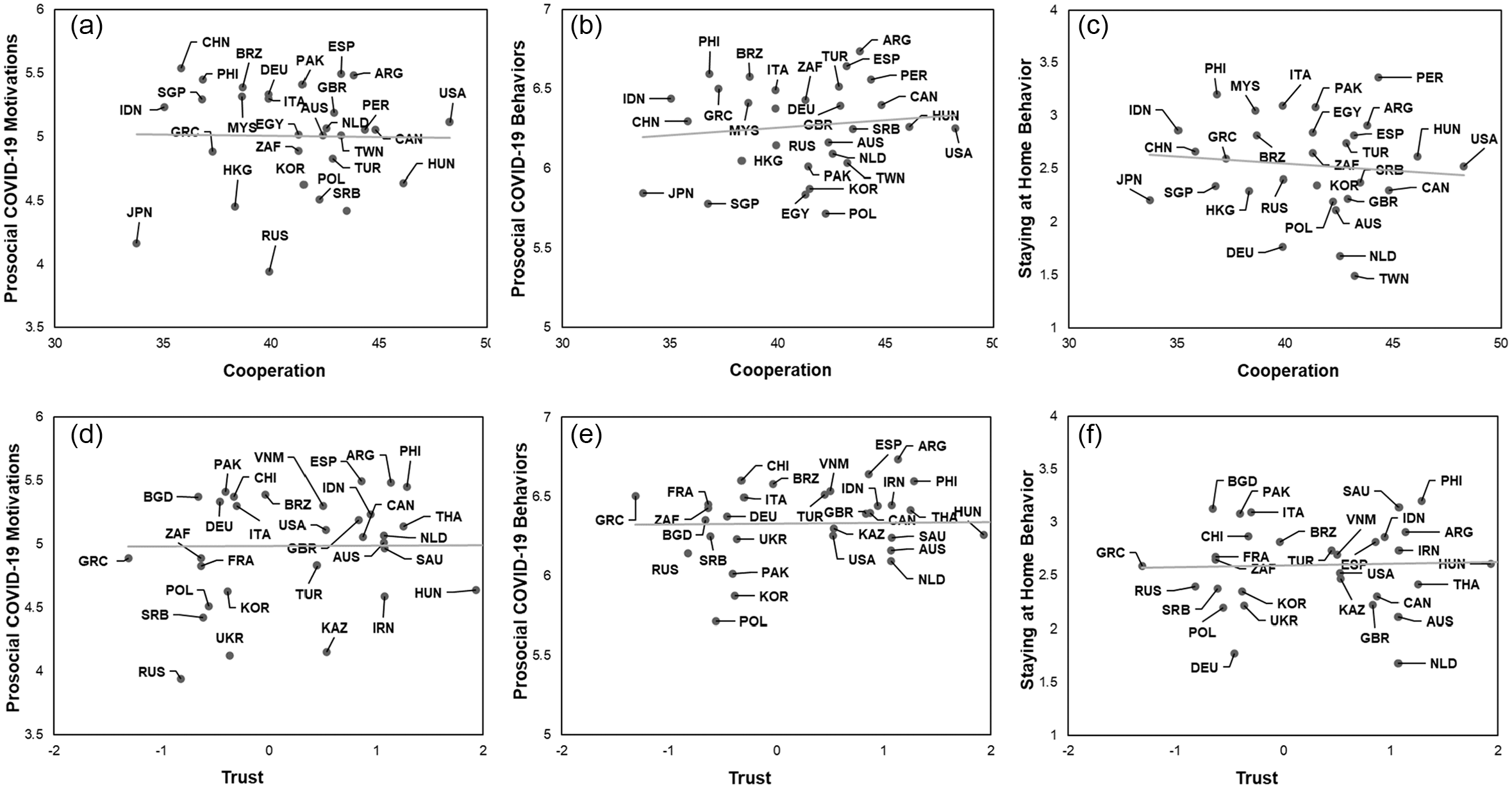
Pearson’s correlations between cooperation, trust, and COVID-19 responses.
Next, we tested our hypotheses on prosocial behaviors and staying at home behavior. We found that prosocial behaviors were not predicted by either cooperation (p = .494) or trust (p = .500; Figure 2b and c). Similarly, cooperation (p = .709) and trust (p = .444) had non-significant relationships with staying at home behavior (Figure 2c and f). In sum, results failed to support H1a and H1b. Men, compared to women, reported lower prosocial COVID-19 motivations, behaviors, and less staying at home behavior (see Table 2). There was no consistent association of age with prosocial COVID-19 responses (see Table 2, and for more details on age effects see Jin et al., 2020).
Finally, we tested whether individuals in societies characterized by higher levels of institutional quality and religiosity, and lower levels of historical prevalence of pathogens, reported more prosocial responses related to COVID-19 (H2, H3, H4). None of the cross-societal indicators (see Table 3) used to operationalize institutional quality, religiosity, or ecology were significantly related to prosocial motivations (p-values > .057). We only found that societies characterized by higher importance of religion reported higher likelihood of staying at home behavior (b = 0.235, p = .001). Also, societies characterized by higher degree of church attendance also reported higher likelihood of staying at home behavior (b = 0.209, p = .005).
Mixed-Effects Models of Cross-societal Indicators Predicting Individual-Level Prosocial COVID-19 Responses During the COVID-19 Pandemic.

Note. N = the number of societies included in the analyses.
Severity of the pandemic was included as a control in each model.
All p-values are one-tailed.
Cooperation, Trust, and COVID-19 Policies Across Societies
We next tested whether individuals in societies characterized by lower cooperation and trust would report more support for centralized and decentralized regulations related to COVID-19 (H5a,b). We tested these hypotheses using two different dependent variables: first by analyzing individual-level support for behavioral regulation policies, and then by whether countries actually implemented stricter policies. The intraclass correlation of the mixed-effects regression showed that there existed a substantial amount of between-society variation in support for behavioral regulations (ICC = 0.150). In a mixed-effects regression (Table 4), we did not find that trust or cooperation had a significant relationship with support for behavioral regulations (cooperation: p = .154, trust: p = .962). Men, compared to women, were associated with lower support for behavioral regulations (see Table 4).
Mixed-Effects Models of Cross-Societal Differences in Cooperation and Trust Predicting Individual-Level Support for Behavioral Regulations During the COVID-19 Pandemic.

Note. N = the number of societies included in the analyses.
Severity of the pandemic, age, and gender were included as a control in each model.
p-values are one-tailed.
Next, we regressed the stringency of measures taken by each society on cooperation and trust and found stringency was unrelated to both cooperation (p = .864) and trust (p = .227; Table 5).
Simple Regressions of Cross-Societal Differences in Cooperation and Trust Predicting Between Country Variation in the Stringency of Policies During the COVID-19 Pandemic.

Note. N = the number of societies included in the analyses.
Severity of the pandemic was included as a control in each model.
All p-values are one-tailed.
We then tested the hypothesis that cooperation and trust each interacted with stringency of policies to predict prosocial motivations (H6a,b). In a mixed-effects regression (Table 6), neither cooperation (p = .109) or trust (p = .744) significantly interacted with stringency of policies in predicting prosocial motivations. We then tested the hypothesis that cooperation (and trust) interacted with the stringency of policies to predict prosocial COVID-19 behaviors (H6a,b). We did not find support for an interaction between stringency of policies and cooperation (or trust) for either prosocial behavior (p-values > .534) or staying at home behavior (p-values > .334). See Table 7 for an overview of the hypotheses.
Mixed-Effect Models of Cross-Societal Differences in Cooperation, Trust, and Their Interaction With Stringency of Policies Predicting Individual-Level Prosocial COVID-19 Responses During the COVID-19 Pandemic.

Notes. N = the number of societies included in the analyses. × = interaction term.
Severity of the pandemic was included as a control in each model.
All p-values are one-tailed.
Overview of the Support for the Pre-Registered Hypotheses.

Note. 1Support for this hypothesis was found only with one of the two operationalizations of trust (i.e., expectations of others’ cooperation). Results are presented in detail in the SI.
Additional Analyses: Robustness Checks, Cross-Validations, and Generalizations
We ran several additional analyses to test whether our results were robust across different (1) operationalizations of cooperation and trust, (2) model specifications, and (3) samples. First, we ran models using a different measure of cooperation (norms of civic cooperation) and trust (expectations of others’ cooperation). We replicated most of our findings. Norms of civic cooperation had no statistically significant relations with COVID-19 responses or policies (p-values > .095; see SI). We found expectations of cooperation were weakly associated with some prosocial COVID-19 responses (see SI). However, replicating the findings reported above, expectations of cooperation were unrelated to, support for policies (p = .997), and stringency of policies (p = .634). Overall, these analyses support our conclusion that cooperation and trust among strangers do not have a robust and consistent link with COVID-19 behavioral responses and policies.
Secondly, we tested our pre-registered hypotheses using a less restrictive threshold to determine inclusion of societies in the analyses (N > 30). In this way, we could replicate the confirmatory analyses with a broader set of countries (N = 56). Again, the results of this robustness check yielded the same pattern of results, compared to findings obtained by the models including larger samples (N = 100; see SI).
As a further robustness check, we tested our hypotheses on additional data from the same survey which only included age-gender representative samples (N = 25,440 participants from 24 countries) collected between April 10th and May 11th 2020 by the PsyCorona team (see SI). This allowed us to test the same hypotheses with the same variables (both at the country and at the individual level) but with a different sampling strategy. Again, the results of this robustness check confirmed our findings and provided the same pattern of results obtained analyzing responses gained through snowball sampling (see SI).
Finally, we tested our hypotheses on a different global COVID-19 dataset including individual COVID-19 responses collected during a similar timeframe (between March 20th and April 5th 2020), recently released online as open access (Fetzer et al., 2020). The survey was based on answers to a questionnaire available in 69 languages from 112,136 participants across 170 societies, recruited through snowball sampling. We retrieved three items that measured similar prosocial COVID-19 behaviors (i.e., “I stayed at home,” “I washed my hands more frequently than the month before,” “I did not attend social gatherings”). Participants were asked the extent to which these three statements described their behavior in the past week from 0 (does not apply) to 100 (applies very much). Consistent with our main findings, cross-societal variation in cooperation and trust failed to significantly predict prosocial COVID-19 behaviors across societies (p-values > .108; see SI).
Discussion
Recent review papers have suggested that many behaviors required to tackle the COVID-19 pandemic (e.g., maintaining social distance, washing hands, self-imposed quarantine) can be construed as social dilemmas, involving a conflict between short-term immediate self-interests and long-term collective benefits (Johnson et al., 2020; Van Bavel et al., 2020). If the COVID-19 pandemic indeed creates a social dilemma, then research on cross-societal differences on cooperation and trust should help predict responses to COVID-19 and potentially offer insights into policies that could regulate behaviors in response to COVID-19 (Johnson et al., 2020).
To address this question, we utilized a survey across 41 societies linking country-level predictors (cooperation, trust, institutional quality, religion, historical prevalence of pathogens) with individual-level prosocial COVID-19 responses, behaviors, and support for behavioral regulations to address COVID-19. Results revealed substantial cross-societal variation in individuals’ self-reported willingness to engage in prosocial COVID-19 behaviors (e.g., social distancing, donating to charities), self-reported actual prosocial COVID-19 behaviors (e.g., hand washing, staying at home), and support for behavioral regulation policies (e.g., mandatory quarantine, vaccination). We applied theory and research on cooperation and trust across societies to predict these outcomes related to the COVID-19 pandemic. However, we did not find any consistent support for our pre-registered hypotheses that these cross-societal differences in prosocial COVID-19 responses and support for policies would be associated with country-level differences in cooperation or trust among strangers. These results were replicated using an additional dataset which included a larger sample of countries, and also when restricting the analyses in the present study to only include countries with age-gender representative samples of around 1,000 participants.
We also examined how several societal-level factors may play a role in responding to the pandemic. Several theories explain why societies differ in cooperation among strangers, emphasizing the quality of institutions (Hruschka & Henrich, 2013), religiosity (Norenzayan et al., 2014), and historical prevalence of pathogens (Fincher & Thornhill, 2012). The current results, however, revealed no consistent association between these cross-societal factors and prosocial COVID-19 responses. We also did not find consistent support for our hypotheses that societies characterized by lower levels of cooperation (and trust) would implement stricter government policies. Societies with lower cooperation and trust also did not display larger increases in prosocial COVID-19 responses in relation to more stringent rules. Taken together, the results of this study question the value of using cross-cultural research on social dilemmas to guide policy making in response to the pandemic.
Although the COVID-19 pandemic may still create a large-scale public goods dilemma among strangers, cross-societal differences in cooperation and trust among strangers may not be relevant to individual decision-making in response to an emerging pandemic. Instead, COVID-19 responses may be understood in light of (1) individual differences in tendencies to trust and cooperate with strangers (Aschwanden et al., 2020), (2) proself motivations instead of prosocial, that is, people may engage in costly self-sacrifices (e.g., social distancing) to benefit themselves, their families, co-habitants, co-workers, and/or neighbors (not anonymous strangers), (3) a psychology functionally specialized for disease avoidance (Schaller, 2011; Tybur et al., 2013) instead of cooperation, and/or (4) differences in information about the pandemic across societies, which might play a major role in shifting how people perceive this situation (independent of whether the situation is truly a social dilemma). Accordingly, people may not even recognize their mutual dependence with broader societal members, and could frame the situation entirely different than a public goods dilemma, such as total independence from others (i.e., own and others’ social distancing decisions don’t affect others’ outcomes) or as a situation with asymmetrical dependence (i.e., only the elderly benefit from one’s costly cooperation; Balliet et al., 2017; Gerpott et al., 2018).
Another possibility is that COVID-19 does not create a public goods dilemma, but instead creates a different interdependent situation, which would produce a different set of expectations for behavior. For example, social distancing during the dilemma may best be understood as a chicken game (Smith & Price, 1973), where the most favorable outcome for each person is doing the opposite of what others choose to do. In this frame, costly self-sacrifices may result in the best outcome for an individual when others are not engaging in costly self-sacrifices (e.g., social distancing), but when other people are engaging in these costly behaviors, then people would achieve the best outcome by not making the sacrifices. However, in this kind of situation, everyone would receive a better outcome if each person engages in social distancing, relative to when each person does not. If the COVID-19 pandemic represents a chicken game, this would question the relevance of cooperation and trust in public goods dilemmas to understand responses to the pandemic. Indeed, we tested a number of pre-registered hypotheses based on the assumption that cooperation in a public goods dilemma among strangers would be key to understand variation across societies in responses to the pandemic, but we failed to find consistent support for these hypotheses across different datasets. Therefore, researchers wanting to extend implications of cross-societal cooperation research to policy in response to the pandemic would be advised to follow along these lines of inquiry, and collect data to test their assumptions and theory prior to making policy recommendations.
One limitation of the present research is worth noting. We used country-level indicators of cooperation and trust. Although we found considerable between-country variation in responses to the pandemic, this variation was not explained by cross-societal differences in cooperation and trust. While cross-societal differences in cooperation and trust have been widely used in past research to predict individual behaviors across societies (e.g., Gächter & Schulz, 2016; Romano et al., 2017; Schulz et al., 2019), future research can measure individual differences in cooperation and trust, and then examine whether these measures are able to detect cross-societal variation in individual behaviors in response to the COVID-19 pandemic. Despite this limitation, the present study embodies several strengths, including (1) being guided by theory and pre-registered hypotheses about cooperation across societies, (2) utilizing a sample comprised of a large and varied set of societies, (3) revealing results which were robust across different operationalizations of the predictor variables (i.e., cooperation and trust) and outcome variables (i.e., motivations, behaviors), and (4) cross-validating the results with alternative datasets which comprised even larger number of societies and representative samples, addressing the possible concern that our results may be due to the sampling strategy and methods (see SI).
To conclude, we applied theory of human cooperation across societies to generate pre-registered hypotheses about prosocial COVID-19 responses across 41 societies and found no consistent support for these hypotheses. Previous papers have claimed that a social dilemma framework can guide policy making in response to the pandemic, without offering any empirical evidence about whether the pandemic actually poses a social dilemma, and whether theory and research from this domain apply to predict variation in behaviors in response to the pandemic. To guide evidence-based policies to address the pandemic, it is necessary to offer robust evidence that previous theory and research apply to this context. Cooperation may still be relevant to understanding responses to the pandemic, but the current findings strongly suggest the need to revisit fundamental assumptions about the nature of COVID-19 responses and do the relevant empirical research prior to making policy recommendations.
Supplemental Material
sj-doc-1-jcc-10.1177_0022022120988913 – Supplemental material for Cooperation and Trust Across Societies During the COVID-19 Pandemic
Supplemental material, sj-doc-1-jcc-10.1177_0022022120988913 for Cooperation and Trust Across Societies During the COVID-19 Pandemic by Angelo Romano, Giuliana Spadaro, Daniel Balliet, Jeff Joireman, Caspar Van Lissa, Shuxian Jin, Maximilian Agostini, Jocelyn J. Bélanger, Ben Gützkow, Jannis Kreienkamp and N. Pontus Leander in Journal of Cross-Cultural Psychology
Footnotes
Declaration of Conflicting Interests
The author(s) declared no potential conflicts of interest with respect to the research, authorship, and/or publication of this article.
Funding
The author(s) disclosed receipt of the following financial support for the research, authorship, and/or publication of this article: This research received support from the New York University Abu Dhabi (VCDSF/75-71015), the University of Groningen (Sustainable Society & Ubbo Emmius Fund), and the Instituto de Salud Carlos III (COV20/00086). Data are available upon request.
PsyCorona Collaboration

| Georgios Abakoumkin | University of Thessaly |
| Jamilah Hanum Abdul Khaiyom | International Islamic University Malaysia |
| Vjollca Ahmedi | Pristine University |
| Handan Akkas | Ankara Science University |
| Carlos A. Almenara | Universidad Peruana de Ciencias Aplicadas |
| Mohsin Atta | University of Sargodha |
| Sabahat Cigdem Bagci | Sabanci University |
| Sima Basel | New York University Abu Dhabi |
| Edona Berisha Kida | Pristine University |
| Nicholas R. Buttrick | University of Virginia |
| Phatthanakit Chobthamkit | Thammasat University |
| Hoon-Seok Choi | Sungkyunkwan University |
| Mioara Cristea | Heriot Watt University |
| Sára Csaba | ELTE Eötvös Loránd University, Budapest |
| Kaja Damnjanovic | University of Belgrade |
| Ivan Danyliuk | Taras Shevchenko National University of Kyiv |
| Arobindu Dash | Leuphana University of Luneburg |
| Daniela Di Santo | University “La Sapienza”, Rome |
| Karen M. Douglas | University of Kent |
| Violeta Enea | Alexandru Ioan Cuza University, Iasi |
| Daiane Gracieli Faller | New York University Abu Dhabi |
| Gavan Fitzsimons | Duke University |
| Alexandra Gheorghiu | Alexandru Ioan Cuza University |
| Ángel Gómez | Universidad Nacional de Educación a Distancia |
| Qing Han | University of Bristol |
| Mai Helmy | Menoufia University |
| Joevarian Hudiyana | Universitas Indonesia |
| Bertus F. Jeronimus | University of Groningen |
| Ding-Yu Jiang | National Chung-Cheng University |
| Veljko Jovanović | University of Novi Sad |
| Željka Kamenov | University of Zagreb |
| Anna Kende | ELTE Eötvös Loránd University, Budapest |
| Shian-Ling Keng | Yale-NUS College |
| Tra Thi Thanh Kieu | HCMC University of Education |
| Yasin Koc | University of Groningen |
| Kamila Kovyazina | Independent researcher, Kazakhstan |
| Inna Kozytska | Taras Shevchenko National University of Kyiv |
| Joshua Krause | University of Groningen |
| Arie W. Kruglanski | University of Maryland |
| Anton Kurapov | Taras Shevchenko National University of Kyiv |
| Maja Kutlaca | Durham University |
| Nóra Anna Lantos | ELTE Eötvös Loránd University, Budapest |
| Edward P. Lemay, Jr. | University of Maryland |
| Cokorda Bagus Jaya Lesmana | Udayana University |
| Winnifred R. Louis | University of Queensland |
| Adrian Lueders | Université Clermont-Auvergne |
| Najma Iqbal Malik | University of Sargodha |
| Anton Martinez | University of Sheffield |
| Kira O. McCabe | Vanderbilt University |
| Mirra Noor Milla | Universitas Indonesia |
| Jasmina Mehulić | University of Zagreb |
| Idris Mohammed | Usmanu Danfodiyo University Sokoto |
| Erica Molinario | University of Maryland |
| Manuel Moyano | University of Cordoba |
| Hayat Muhammad | University of Peshawar |
| Silvana Mula | University “La Sapienza”, Rome |
| Hamdi Muluk | Universitas Indonesia |
| Solomiia Myroniuk | University of Groningen |
| Reza Najafi | Islamic Azad University, Rasht Branch |
| Claudia F. Nisa | New York University Abu Dhabi |
| Boglárka Nyúl | ELTE Eötvös Loránd University, Budapest |
| Paul A. O’Keefe | Yale-NUS College |
| Jose Javier Olivas Osuna | National Distance Education University (UNED) |
| Evgeny N. Osin | National Research University Higher School of Economics |
| Joonha Park | NUCB Business School |
| Gennaro Pica | University of Camerino |
| Antonio Pierro | University “La Sapienza”, Rome |
| Jonas Rees | University of Bielefeld |
| Anne Margit Reitsema | University of Groningen |
| Elena Resta | University “La Sapienza”, Rome |
| Marika Rullo | University of Siena |
| Michelle K. Ryan | University of Exeter, University of Groningen |
| Adil Samekin | International Islamic Academy of Uzbekistan |
| Pekka Santtila | New York University Shanghai |
| Edyta Sasin | New York University Abu Dhabi |
| Birga M. Schumpe | New York University Abu Dhabi |
| Heyla A. Selim | King Saud University, Saudi Arabia, Riyadh |
| Michael Vicente Stanton | California State University, East Bay |
| Wolfgang Stroebe | University of Groningen |
| Samiah Sultana | University of Groningen |
| Robbie M. Sutton | University of Kent |
| Eleftheria Tseliou | University of Thessaly |
| Akira Utsugi | Nagoya University |
| Jolien Anne van Breen | Leiden University |
| Kees Van Veen | University of Groningen |
| Michelle R. vanDellen | University of Georgia |
| Alexandra Vázquez | Universidad Nacional de Educación a Distancia |
| Robin Wollast | Université Clermont-Auvergne |
| Victoria Wai-lan Yeung | Lingnan University |
| Somayeh Zand | Islamic Azad University, Rasht Branch |
| Iris Lav Žeželj | University of Belgrade |
| Bang Zheng | Imperial College London |
| Andreas Zick | University of Bielefeld |
| Claudia Zúñiga | Universidad de Chile |

Note. (a) Correlation between cooperation and prosocial COVID-19 motivations (b) Correlation between cooperation and prosocial COVID-19 behaviors (c) Correlation between cooperation and staying at home behavior (d) Correlation between trust and prosocial COVID-19 motivations (e) Correlation between trust and prosocial COVID-19 behaviors (f) Correlation between trust and staying at home behavior.
Supplemental Material
Supplemental material for this article is available online.
Notes
References
Supplementary Material
Please find the following supplemental material available below.
For Open Access articles published under a Creative Commons License, all supplemental material carries the same license as the article it is associated with.
For non-Open Access articles published, all supplemental material carries a non-exclusive license, and permission requests for re-use of supplemental material or any part of supplemental material shall be sent directly to the copyright owner as specified in the copyright notice associated with the article.
