



Abstract
Mother-infant interactions, including culturally specific features, have been found to predict child socio-emotional development (e.g., social communication and emotion regulation (ER)). However, research is lacking on the specific processes involved. We used a cross-cultural, longitudinal design, and a microanalytic coding approach to address this issue. Fifty-two mother-infant dyads were recruited from the UK (N = 21) and Italy (N = 31), representing Northern European and Mediterranean cultures, respectively. While these cultures share core features of parent-child relationships, their values about emotional expressiveness differ. We observed face-to-face mother-infant interactions at 2 months (T1), and coded infant socio-emotional behavior and maternal responses. Children were seen again at 2 years (T2), when their ER in the face of frustration, using the Barrier Task, was assessed, and the occurrence of different “mature” strategies (communicative and autonomous) coded. Results revealed common features of interactions at T1 (infant socio-emotional expressions, and maternal positive responses), but also cultural variation in the frequency of different infant cues (more pre-speech in UK infants, more smiles in Italians), and of maternal responses to them. While greater overall maternal responsiveness at T1 predicted more mature ER in general at T2, cultural differences in early responsiveness to specific infant behaviors predicted later group differences in children’s use of particular ER strategies, with UK children using more communicative strategies, and Italians more autonomous. Findings indicate that positive maternal behaviors that are common across cultures (e.g., responsiveness) promote overall successful child emotion regulation, while culturally specific features of interactions are associated with how child socio-emotional outcomes are expressed.
Keywords
Early Mother-Infant Interactions
Children’s interactions with their caregivers are the primary context through which their emotions are socialized, starting from early infancy (Eisenberg et al., 2010). From the first days of life, both infants and mothers contribute to these interactions (Lavelli & Fogel, 2005; Lavelli et al., 2019; Murray, 2014; Parsons et al., 2010). As seminal studies have shown, even newborns show a clear preference for faces (Bushnell, 2001; DeCasper & Fifer, 1980; Macfarlane, 1975; Turati et al., 2006), and the capacity both to express and discriminate different emotional expressions (Addabbo et al., 2018; Farroni et al., 2007). From 2 to 4 months of age, infants show sensitivity to variations in social and emotional stimulation (Cohn et al., 1990; Grossmann et al., 2008; Legerstee & Varghese, 2001; Murray & Trevarthen, 1985; Stormark & Braarud, 2004; Trevarthen, 2011), and can use communicative behaviors to maintain social contact and elicit re-engagement when it is temporarily lost (Bigelow et al., 2018; Bigelow & Walden, 2009). In turn, mothers are naturally predisposed to engage with their infants and to respond to their communications, a predisposition that is detectable both behaviorally and at a neuronal level (Papousek, 1987; Parsons et al., 2017; Stern, 1985).
The pattern of face-to-face communication between infants and caregivers in the first few weeks has been found to show a highly organized “functional architecture” (Murray et al., 2016) that fosters child socio-emotional development (Gergely & Watson, 1999; Lavelli & Fogel, 2013; Lavelli et al., 2019; Murray et al., 2016). For example, mothers selectively respond to specific infant socio-emotional cues (i.e., smiles, pre-speech, vocalizations) with mirroring and with “positive marking”—that is, the highlighting of certain infant expressions with clear ostensive cues such as eyebrow raising and smiles (Lavelli et al., 2019; Murray et al., 2016). These two forms of contingent maternal responses are particularly salient for infants (Gergely & Watson, 1999; Meltzoff, 2007), and not only facilitate further infant social communication during the interaction, but also support later socio-emotional skills (Bigelow et al., 2018; Gunning et al., 2004; Murray et al., 2016). Thus, they predict the later emergence of infant social expressiveness (Lavelli et al., 2019; Murray et al., 2016), neural responses to facial expressions of emotion at 9 months (Rayson et al., 2017), and infants’ attempts to socially re-engage their partner when the interaction is interrupted (Bigelow et al., 2018; Bigelow & Walden, 2009).
Although parental responsiveness to infant signals is regarded as universal, because it has been observed in both Western and non-Western populations (Broesch et al., 2016; Keller et al., 1988, 1992), cross-cultural research has also shown important variations in its manifestations (Bornstein et al., 1992; Fogel et al., 1988; Kärtner et al., 2010; Richman et al., 1992). For example, although African (Kenyan) and Asian (Fijian) mothers are particularly likely to respond to infants when they express distress, European or North American mothers do so when infants show positive communication (Broesch et al., 2016; Richman et al., 1988). A recent study comparing dyads from Italy and Africa (Cameroon, and immigrants from West Africa) highlighted differences in maternal responses to infant positive social behaviors (smiles, vocalizations) during interactions at 1 to3 months: Italians were more likely to respond with affectionate talking, whereas African mothers with tactile stimulation (Lavelli et al., 2019).
Even within Western populations, some studies have found differences in broad aspects of parental social interactions, such as levels of talking to or looking at the infant (Gunning et al., 2004; Keller et al., 1992; Richman et al, 1988). However, with regard to maternal responses to specific infant behaviors, the evidence regarding cultural differences is sparse. Nevertheless, a comparison of Italian and US mothers’ behavior with their 1 to 3 month old infants during feeding did reveal systematic variation: thus, although responsiveness to infant distress was similar across the two samples, Italian mothers spent more time than did the U.S. mothers in synchronous dyadic social exchanges with their infants (i.e., responding more to infant vocalizations and smiles—Hsu & Lavelli, 2005).
An important issue raised by findings of cultural variation is whether early differences in patterns of parental social responsiveness are associated with distinct child outcomes. In particular, the question arises of whether, even within broadly similar cultures, specific features of early interactions, including the responses parents make to infant social cues, are associated with later differences in child development—that is, do parents “sculpt” aspects of their children’s development via culturally-specific responses to certain child behaviors? Resolving this question would not only inform our understanding of cultural variations in parenting and development, but would also clarify the extent to which social communicative patterns are shared in common between different cultures, possibly reflecting universal features of the functional architecture of mother-infant communication.
Differences in Emotion Regulation
One aspect of child development that may be particularly likely to be affected by early social interactions is emotion regulation (ER). ER concerns the modulation of emotional experience, within specific contexts that call for distinct social rules and standards of behavior (Cole et al., 2004; Eisenberg & Spinrad, 2004; Friedlmeier et al., 2011; Gross, 2015; Thompson, 1994). As such, different ways of expressing and regulating emotion are key in marking out important cultural differences, and these may, in turn, have fundamental consequences for later social functioning and adjustment. Thus, the satisfactory development of ER necessitates both learning behavioral strategies to manage emotions and the social rules governing their expression. Just as poor early ER is associated with risk for negative child outcomes, such as behavior problems (Compas et al., 2017; Eisenberg et al., 2001; Halligan et al., 2013), so the successful regulation of emotions from an early age can have an important beneficial impact on psychological wellbeing in childhood and, even later, in adulthood (Cole et al., 1994; Denham et al., 2003; Eisenberg et al., 2010).
Research on the acquisition of the capacity for good ER shows that, in the first months, caregivers act as external regulators of child emotions, and then become co-regulators (Calkins & Hill, 2007; Sroufe, 1996). Subsequently, between the second and the third year, children become independent self-regulators (Kopp, 1982), and increasingly use what have been termed “mature and constructive” strategies (hereafter termed “mature”) (Calkins & Johnson, 1998; Feldman et al., 2011). Two, distinctive, mature types of strategy have been highlighted in the literature – social, and autonomous: thus, on the one hand, “well-regulated” children may use social, communicative strategies, marshalling external social support to help them resolve emotional challenges (Buss & Goldsmith, 1998; Calkins & Johnson, 1998) or, on the other hand, they may use autonomous, self-reliant, active coping strategies (i.e., distraction, or else directed attempts to manage challenging conditions) to reduce distress (Buss & Goldsmith, 1998; Calkins & Johnson, 1998; Feldman et al., 2011; Roque et al., 2013).
Research on the acquisition of social rules for the expression and suppression of emotions shows that ER is influenced by both wider cultural background and proximal social experiences (Jaramillo et al., 2017). For instance, it has been reported that mothers from contexts where the well-being of the social group and interdependence with others are prioritized (such as in African and Asian societies), mothers are likely to encourage their children to suppress both positive and negative emotional states to avoid disruption of group harmony; by contrast, in contexts where personal autonomy is highly valued (such as in Euro-American societies), the expression of a broad range of emotions is encouraged by parents as a positive sign of individuality (Diaz & Eisenberg, 2015; Keller & Otto, 2009; Lavelli et al., 2019; Trommsdorff, 2012). However, even within Western cultures, there are important variations in the acceptability of emotional expressiveness. For example, in northern European countries (e.g., Netherlands, UK, Germany) children are socialized to modulate high-intensity emotions (Super & Harkness, 1982; Zammuner & Fischer, 1995), whereas in southern European countries (e.g., Greece, Italy, Spain) children’s socialization allows, and indeed even encourages, the overt expression of intense emotional states (Halberstadt & Lozada, 2011; Lavelli et al., 2019; Scherer et al., 1986).
Although broad differences in the suppression and expression of emotions between distinct cultural settings are well established, little is known about the possible role of cultural background in children’s use of specific, culture-typical ER strategies to regulate emerging emotional states (see Bozicevic et al., 2016; Novin et al., 2011 for exceptions). Given the influence that culture has on the socialization of emotion, an important question is how different ER strategies are transmitted to children and are associated with aspects of their emotional development.
Influence of Early Maternal Responsiveness on Children’s Later Emotion Regulation
The literature on the early predictors of child ER has primarily focused on general maternal responsiveness, or sensitivity (defined as the caregiver’s ability to respond promptly and appropriately to infant communications and emotions (Ainsworth et al., 1974; Morris et al., 2007)). This is hypothesized to promote ER skills in two ways. The first is by regulating infant arousal, either by enhancing infant positive affect or reducing negative states (Feldman, 2003; Fogel, 1993; Gergely & Watson, 1999; Halberstadt & Lozada, 2011; Keller & Otto, 2009). When this regulatory function is deployed, particularly during positive interactions, it provides a sense of stability, or homeostatic balance to the infant (Harrist & Waugh, 2002; Mäntymaa et al., 2015), thereby helping them organize their emotional experience in a coherent way (Stern, 1985). In such regulated states, infants can more easily learn about themselves and their social world (Harrist & Waugh, 2002; Mäntymaa et al., 2015), and indeed, children who experience such positive early relationships are likely to embrace parental socialization goals, leading them toward positive developmental trajectories (Kochanska et al., 2019). The second function of responsiveness is the reinforcement of valued behaviors. Thus, infant behaviors that are considered acceptable and desirable by mothers receive positive responses, whereas unwanted behaviors are not, thereby shaping future child emotional reactions and their regulation (Diaz & Eisenberg, 2015; Malatesta & Haviland, 1982; Stern, 1985).
Despite the fact that both these possible mechanisms are deeply influenced by cultural values and beliefs, there is only limited research on cultural differences in maternal responses to specific kinds of infant cues. Further, whereas the literature does report cultural differences in maternal responses to children’s negative emotions, differences in responses to positive socio-emotional cues have been less often examined (Broesch et al., 2016; Halberstadt & Lozada, 2011; Lavelli et al., 2019) despite their importance: expressing and maintaining such positive states is central in Western societies, where it is one of the main parental socialization goals (Keller & Otto, 2009; Wörmann et al., 2012). Specifically, when considering positive mother-child social exchanges, evidence is lacking on cultural preferences for responding primarily to affective cues (e.g., smiles) versus communications (e.g., pre-speech). Learning about such maternal preferences could be important in predicting the acquisition of particular ER strategies which might be integrated in the children’s own future repertoire: for instance, responses to positive affective cues may promote a sense of well-being and self-autonomy, which could serve to promote the use of autonomous coping strategies, whereas responses embedded in communicative exchanges may promote more social, communicative regulatory strategies. In line with this hypothesis, a recent study comparing Italian and African dyads found that Italian mothers tended to encourage infant smiles during early interactions more than African ones, a pattern of responses that was suggested to promote independence and autonomy, both highly valued in Italian culture (Lavelli et al., 2019). However, because this study concerned emotional exchanges between mothers and infants in only the first 2 months, it is not clear whether the same pattern of responses could have specific effects on later child socio-emotional outcomes.
In sum, despite growing evidence that culture influences early social and emotional exchanges between mothers and their children, and that distinct patterns of maternal responsiveness foster child emotional development (Feldman et al., 2006), the specific processes linking early interactional patterns and later child socio-emotional outcomes are still poorly understood. Moreover, although research has highlighted striking differences between Western and Asian/African cultures in relation to the expression or suppression of emotions (Lavelli et al., 2019; Matsumoto, 2006; Matsumoto et al., 2008), it is unclear how cultural values regarding emotions and their regulation are transmitted and expressed within Western populations (specifically between Mediterranean and Northern European cultures, where variations in emotional expressiveness and processing have been documented—Halberstadt & Lozada, 2011; Molina et al., 2014; Super & Harkness, 1982). To address this gap three particular areas need further investigation. First, it has yet to be established which features of early mother-infant interactional patterns are shared or distinctive in Western populations. Second, there is a lack of research investigating whether, in these cultures, there are variations in the expression of emotion regulation. Finally, it is unclear how both common, and culturally-specific features of mother-infant communication influence ER acquisition.
The Current Research
The present study aims to add to the growing body of evidence on the development of emotion-regulation skills by studying two different Western cultures, UK and Italy, representative of Northern and Southern European cultures, respectively. Specifically, we examined the associations between early social interactions and later ER, assessed in a standard frustration task. Few studies have compared UK and Italian cultures in terms of child emotional development (although see Hughes et al., 2014; Lecce & Hughes, 2010, for exceptions). However, these two Western countries, while sharing important features of parent-child relationships, are also characterized by key differences.
With regard to similarities, mothers in both cultures are generally the primary caretakers of their infants during the early postnatal months, and they share the same broad interactional features of social contact with their infants typical of Western settings (e.g., distal forms of parenting, such as face-to-face contact, mutual gaze, proto-conversations, as well as affectionate talking) (Carra et al., 2013; Kärtner et al., 2010; Lavelli et al., 2019; Moscardino et al., 2011; Richman et al., 1988; Wörmann et al, 2012). Thus, in both cultures during mother-infant interactions, the expression of infant positive emotional states is encouraged, as it is considered a sign of autonomy and individuality (Keller & Otto, 2009; Lavelli et al., 2019). These values reflect the socialization goals of independence typical of Western urban middle-class populations (Atzaba-Poria & Pike, 2008; Keller & Otto, 2009; Markus & Kitayama, 1994; Mesquita, 2007).
With regard to differences, Italian mothers stand out from women from some other Western cultures, including the UK, in several ways. First, they attach particular importance to infant sociability and liveliness from an early age as sign of health and being “lovable” (Axia, 1998; Axia & Weisner, 2002; Moscardino et al., 2011). Second, they have high expectations of positive affective interactions with their infants (Carra et al., 2014; Hsu & Lavelli, 2005; Richman et al., 1988). Finally, Italians display high levels of overt emotional expressivity (Axia et al., 1992; Halberstadt & Lozada, 2011) which they perceive as advantageous in social interaction (as opposed to more muted emotional expression) and in fostering assertiveness (Harkness & Super, 2006). In comparison, UK mothers value politeness and a moderated expression of emotions (Kasper, 1990; Lecce & Hughes, 2010), and have been reported as engaging in verbal interactions with their toddlers more often than Italian caregivers (Tardif et al., 1997). Given these differences, we expected children from these two cultures to develop different emotion regulation strategies. Such differences stand to be particularly clearly elucidated in the context of challenging situations, such as when faced with a frustration, when both overt and self-assertive behaviors, as well as more quiet and socially oriented ones, may be deployed. Accordingly, we used a standard frustration task to explore cultural differences in children’s management of their heightened emotions.
Based on the reasoning outlined above, the aims of the present study were to examine:
whether UK and Italian mother-infant face-to-face interactions show common characteristics, or differ by culture;
whether, during a standard task to assess ER in response to frustration, the particular type of mature strategies adopted by UK and Italian children at 22 months differs;
whether general maternal positive responsiveness is associated with children’s later use of mature ER strategies in the face of frustration;
whether any cultural differences in maternal responding to specific infant behaviors during early interactions (a) are associated with infant later use of different mature strategies, and (b) mediate any national difference in ER strategy.
Methods
Participants
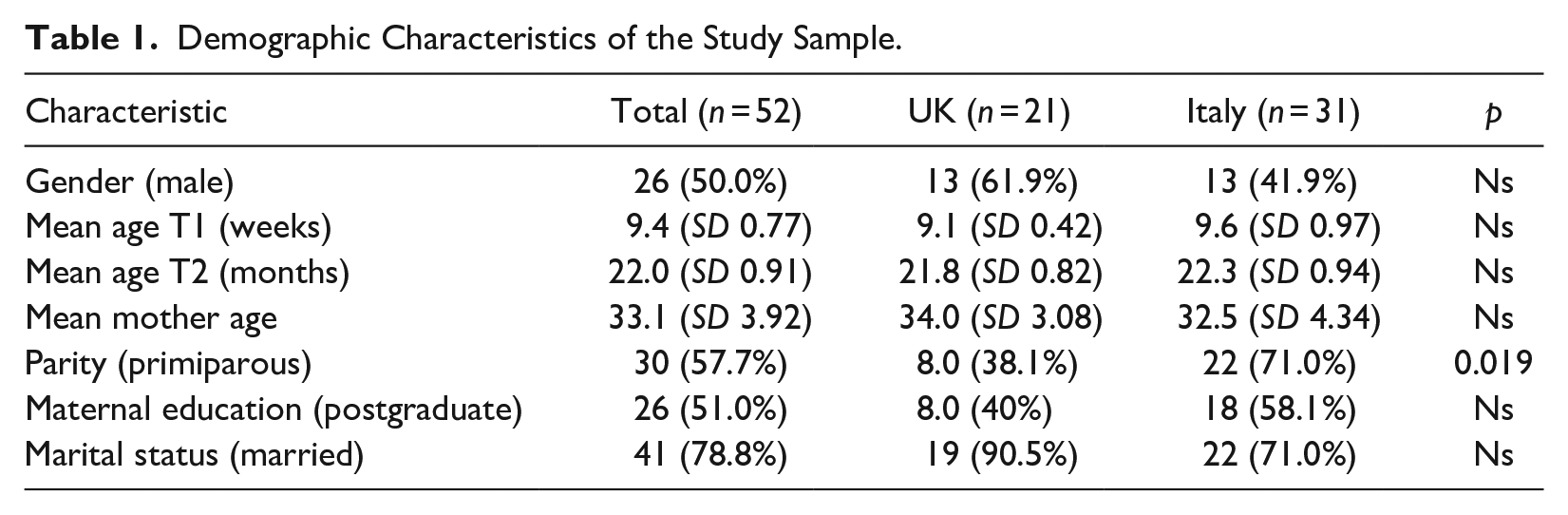
Fifty-two mother-infant dyads (21 from UK; 31 from Italy) participated in the study. Both populations were recruited from general community maternity hospitals: UK mothers were recruited on the postnatal ward of the Royal Berkshire Hospital, Reading (UK), and Italian mothers were recruited at the Pediatric Unit of the Sacra Famiglia Hospital, Erba (Como, Italy). Infant mean age was 9.4 weeks (SD = 0.77) at T1, and 22.0 months (SD = 0.91) at T2.
Socio-demographic information for infants and mothers are reported in Table 1. Apart from parity (a higher percentage of Italian women were primiparous), there were no demographic differences between the UK and Italian children or their mothers. Both samples were at low socio-economic risk, as mothers generally had a medium-high level of education, considered in many studies as the best indicator of social class (Table 1).
Demographic Characteristics of the Study Sample.
The study was conducted according to the British Psychological Society’s Code of Human Research Ethics, and approved by the Ethics Committee of the University of Reading (n. 11/45).
Procedure
When infants were 2-months old, female researchers visited participants’ homes, and mothers were asked to be filmed while interacting face-to-face with their infants for 3 min (for more information about the procedure, see Murray et al., 2016). Infants were then followed up at 22 months in research premises (at the University of Reading for the UK sample, and at the Scientific Institute, IRCCS Eugenio Medea (Bosisio Parini, Lecco, Italy) for the Italian sample), where emotion-regulation in the face of frustration was assessed.
To measure children’s ER behaviors, the Barrier Task of the Lab-Tab (Goldsmith & Rothbart, 1993) was administered. This is a widely used procedure to elicit child ER responses in the face of frustration. It involved the child being seated at a table in a highchair and given an attractive toy to play with that was removed after 30 s of play and placed in full view, but out of the child’s reach, behind a transparent screen for 1 min. Mothers were instructed to remain neutral and not to interact with their child.
Measures
Mother-infant interaction at 9 weeks postpartum (T1)
Videos of mother-infant interaction were coded on a 1-s time base for infant behaviors and maternal contingent responses, according to Murray et al. (2016) coding scheme. Infant and maternal behaviors were coded as mutually exclusive events.
Infant behaviors
Positive socio-emotional cues: pre-speech (i.e., tongue/lip protrusion and mouth openings directed at the mother), smiles, and vocalizations (positive and neutral).
Negative affect (i.e., negative vocalizations, cry face and negative mouth movements, such as pout and grimace).
Maternal sensitive responses
Contingent positive responses to each of the coded infant behaviors (i.e., responses within 2 s of the onset of the infant behavior) of similar valence and intensity as the original infant behavior were coded; responses were considered contingent if they happened in a 2-s time window from the beginning of the infant behaviour: this time frame was chosen based on seminal work in the field (Murray et al., 1996; Nicely et al., 1999; Stanley et al., 2004), on cross-cultural research carried out by Bornstein et al. (2015) in 11 Western and non-Western countries (including Italy), and on longitudinal studies on mother-infant interaction involving a British sample (Murray et al., 2016, 2018).
3. Mirroring: responses that are the exact matches of the infant’s behavior, or that match its principal features with some minor modification (e.g., infant shows a mouth opening and the mother does the same adding the sound “Ah”).
4. Positive marking: responses that single out and “mark” an infant behavior with smiles and “attention-attracting” cues, without mirroring it (e.g., infant vocalizes and the mother raises head and eyebrows, then nods and smiles, saying “That’s interesting!”).
These two forms of sensitive response have been shown to increase the occurrence of infants’ social expressions within the interaction itself and long term (Murray et al., 2016).
In the analyses we used: (a) overall responsiveness (i.e., percentage of infant behaviors receiving a response); and (b) percentages of all maternal positive responses that were dedicated to each specific infant behavior (pre-speech, smiles, vocalizations, and negative affect).
Emotion regulation at 22 months (T2)
Children’s behavior during the Barrier task was coded from video recordings using a coding scheme previously applied in a cross-cultural study including samples from the UK and South Africa (Bozicevic et al., 2016) and informed by previous research (e.g., Buss & Goldsmith, 1998; Crockenberg et al., 2008; Roque et al., 2013; Stifter & Braungart, 1995). Child mature regulation strategies employed during the 1 min of the toy removal episode were coded on a 1-s time base as mutually exclusive categories, resulting in a count for each strategy. The behaviors coded comprised social and autonomous ER strategies:
Communicative attempts to obtain the toy (social): the child attempts to get the toy back by asking for help either from the mother or the researcher (e.g., verbally asking for the toy, pointing at the toy while looking at the adult).
Distraction (autonomous): attending to or manipulating an object, other than the toy itself (e.g., highchair, own clothes).
Directed attempts to obtain the toy (autonomous): seeking to retrieve the toy themselves (e.g., trying to remove the barrier, leaning toward the toy to reach it).
Twenty percent of the videos were coded, independently, by two researchers. Cohen’s Kappa ranged from 0.80 to 0.95 for infant behaviors (T1), and from 0.80 to 0.90 for maternal responses (T1). Interclass correlations for ER strategies at T2 ranged from 0.71 to 0.95.
Data Analysis
Chi square and T-test analyses were used to explore group differences in demographic variables. Where significant, the variables were included as covariates in subsequent analyses. Covariates were retained in the model only when their effect was significantly related to the outcome, to enable the presentation of the most parsimonious models. Their inclusion is reported in the text concerning the relevant model.
To investigate group differences in infant behaviors during early interactions and in ER strategies we used Generalized Linear Models (GLMs), with a Poisson distribution and a Log link; although the standard mother-infant interaction and toy removal procedures were designed to last 3 and 1 min, respectively, there were some instances when the tasks had to be interrupted (e.g., because of prolonged infant distress). This resulted in shorter durations for a small number of tasks and an overall mean duration of 174.52 (SD = 15.76) seconds for mother-infant interactions and of 55.21 (SD = 9.11) seconds for toy removal episodes. To account for this variability, task duration was included as offset in GLMs investigating mother-infant interactions and toy removal episodes.
To investigate group differences in maternal responsiveness, both overall and in relation to the different infant behaviors, controlling for the base rate of the latter, we used Generalized Linear Mixed Models (GLMMs), with a Binomial distribution and Logit link, and infant behaviors as cases (in line with the modelling approach used in Murray et al., 2016).
To test the association between maternal responses at T1 and infant ER behaviors at T2 we used GLMs, with a Poisson distribution and a Log link, and toy removal episode duration as offset.
For all GLMs, the change in R squared due to the specific reported effects was calculated using Nagelkerke’s method (Nagelkerke, 1991). For all GLMMs, Nakagawa’s method (Nakagawa et al., 2017) was used.
To investigate the mediating effect of maternal responses to infant behavior on group differences in ER strategies, given the limited sample size, indirect effects were tested using the Sobel test, as opposed to bootstrap-based methods (Hayes, 2009), because of its greater conservativeness (Hayes, 2013). A p-value < .05 was considered significant.
Results
Group Differences in Mother-Infant Interaction at T1
Infant behaviors
No significant differences between the two groups emerged in the rate of infant positive socio-emotional cues (χ2(1) = 0.024, p = .877) (Figure 1a). There were, however, differences between the two samples in the specific positive socio-emotional cues expressed: compared to the Italian infants, the UK infants showed a higher rate of pre-speech (χ2(1) = 24.104, p < .001, R2 = 0.471) and a lower rate of smiles (χ2(1) = 47.458, p < .001, R2 = 0.726, controlling for Parity). No significant difference emerged between groups in vocalizations (χ2(1) = 0.0002, p = .990) (Figure 1b).
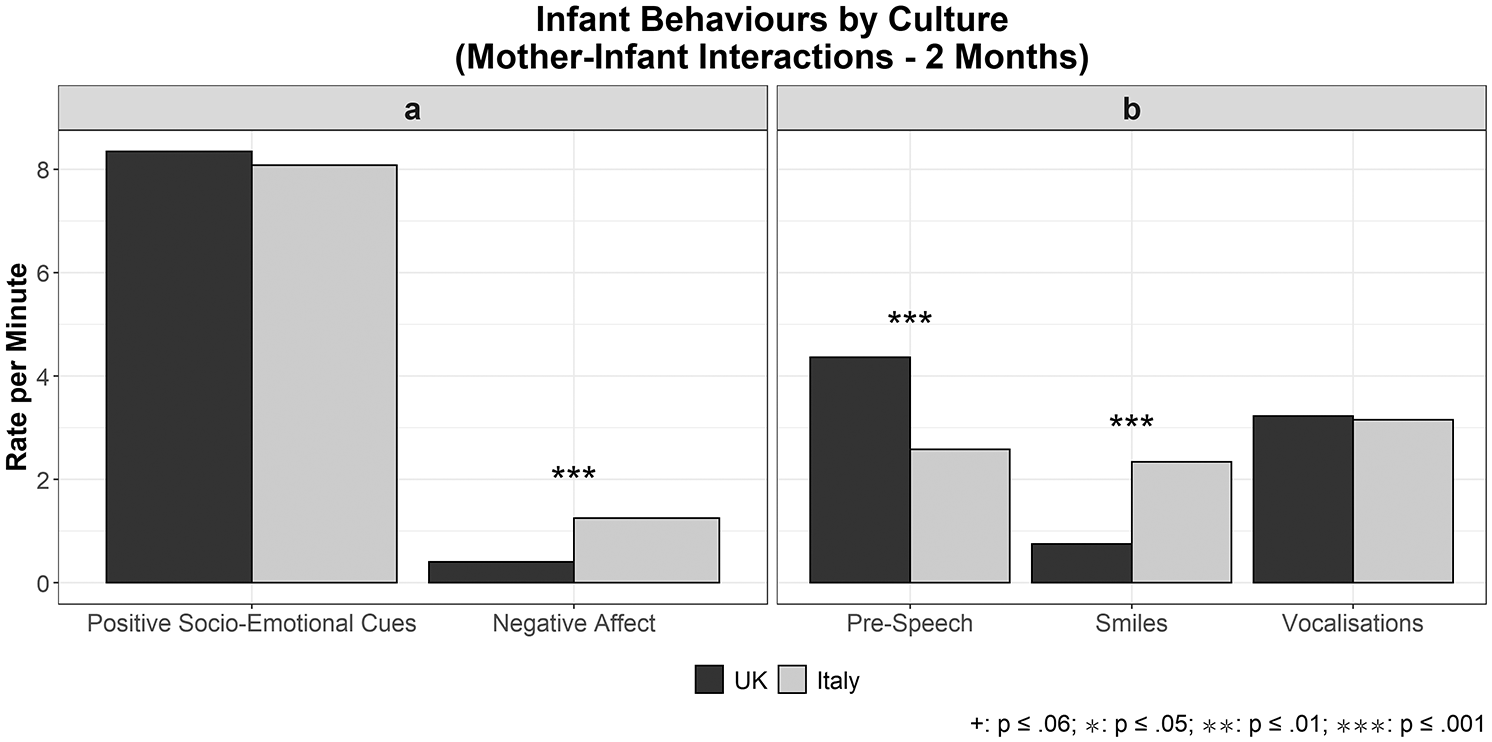
Group differences in the rate per minute of Infant behaviors.
Although a group difference was found in the rate of negative affect (χ2(1) = 22.621, p < .001, R2 = 0.499), with UK infants showing a lower rate compared to Italian infants, the absolute level of distress in both samples was very low (Figure 1a).
Maternal responses
No significant difference between the two groups emerged in overall positive maternal responsiveness (F(1, 1.033) = 0.311, p = .577). However, mothers’ responses to specific infant behaviors, controlling for the rate of each infant behavior, did differ between groups. Thus, compared to the Italian mothers, a higher proportion of UK mothers’ positive responses were to infant pre-speech (F(1, 291) = 4.735, p = .030, R2 = 0.055), and a correspondingly lower proportion of their responses compared to the Italian mothers’ were to infant smiles (F(1,291) = 6.102, p = .014, R2 = 0.078). No differences were found in the proportion of positive responses to vocalizations (F(1,291) = 1.181, p = .278) or to negative affect (F(1,291) = 0.010, p = .922) (Figure 2).
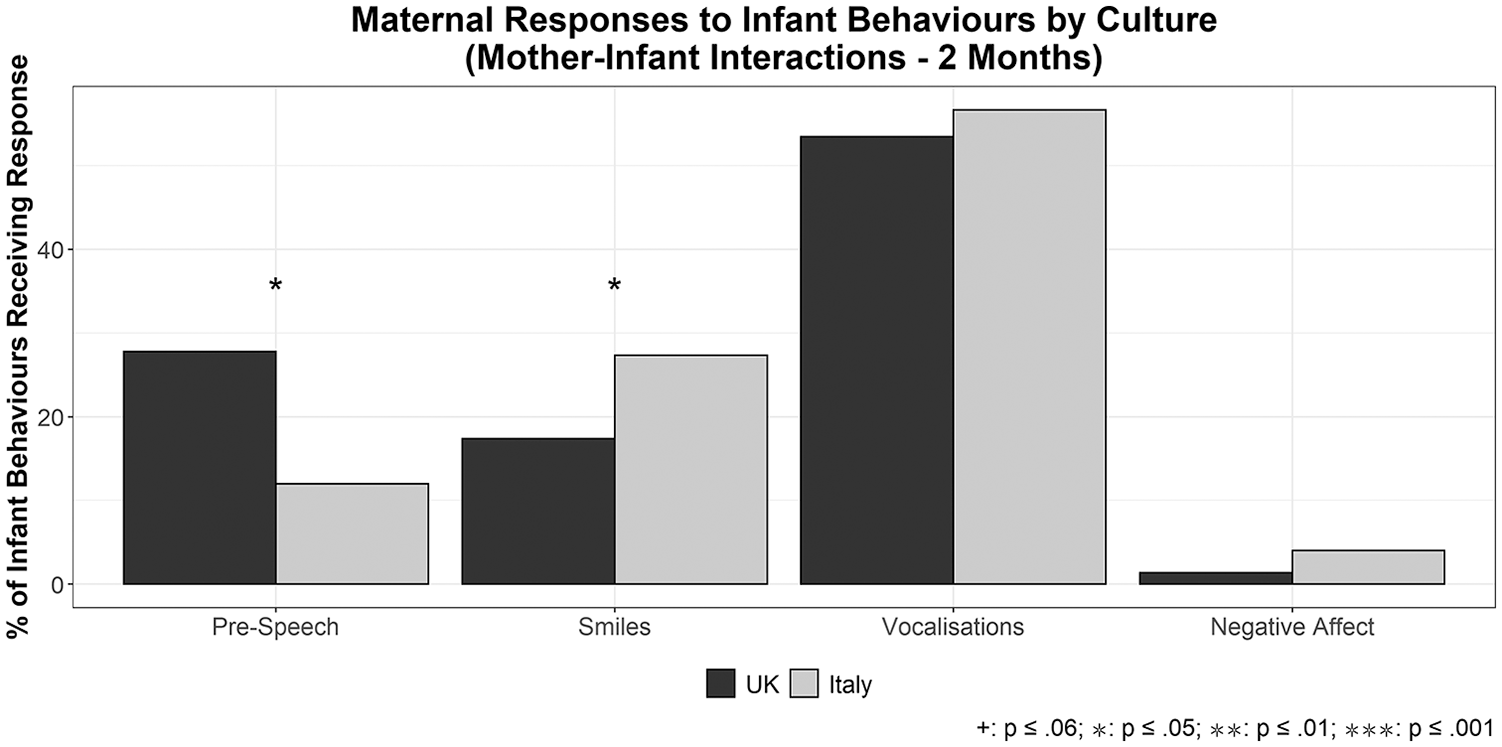
Group differences in the percentage of positive maternal response dedicated to each of the type of infant behavior, controlling for the rate of infant behavior.
Group Differences in Child Emotion Regulation at T2
The two groups of children did not differ significantly in their overall use of mature ER strategies (χ2(1) = 0.010, p = .919). However, the type of strategy did differ: compared to the Italian children, the UK children were more likely to make Communicative attempts to obtain the toy (χ2(1) = 27.169, p < .001, R2 = 0.568, controlling for Parity). In contrast, the Italian children used more autonomous strategies—they used more Distraction (χ2(1) = 4.299, p = .038, R2 = 0.114, controlling for Parity) and made more frequent Directed attempts to obtain the toy (χ2(1) = 3.702, p = .054, R2 = 0.063, controlling for Parity) (Figure 3).
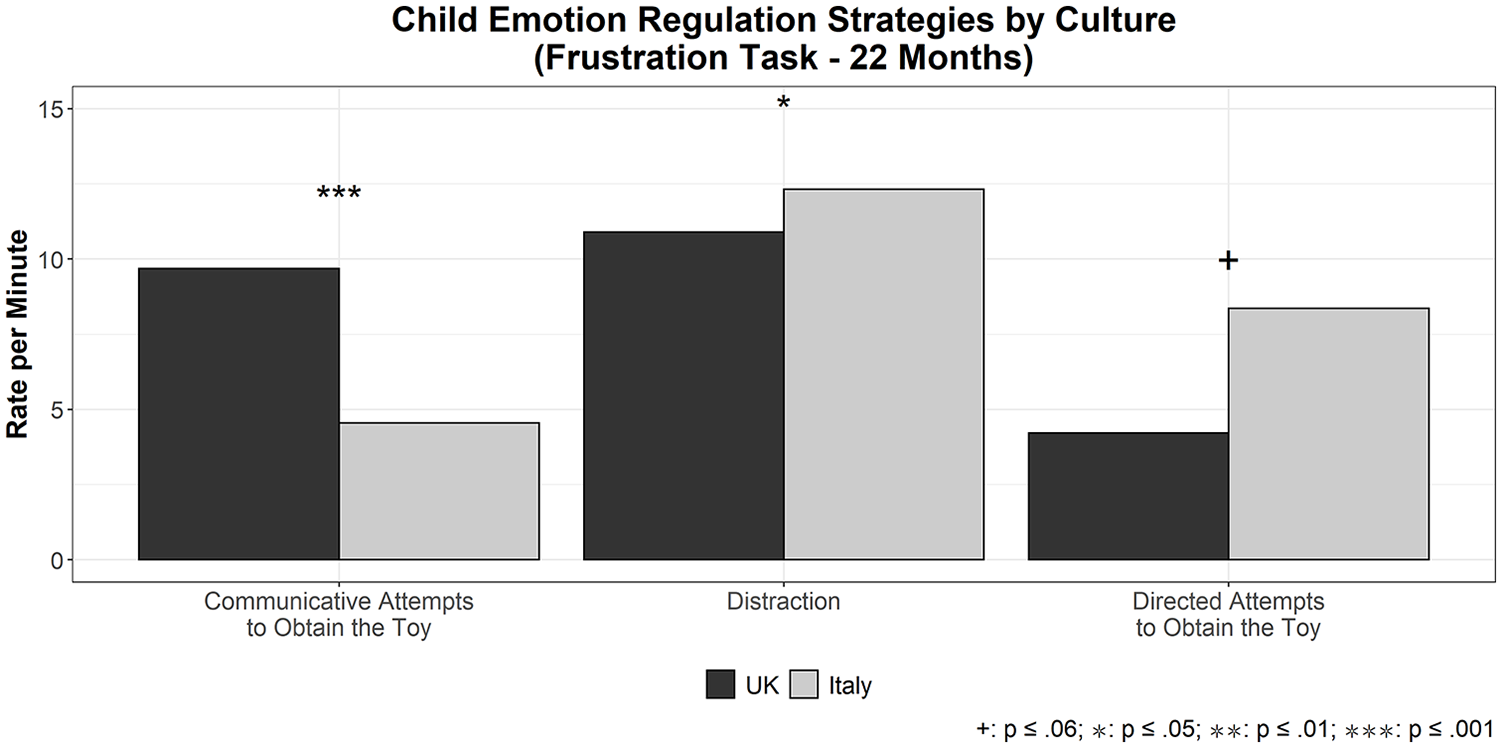
Group differences in the percentage of ER strategies.
Maternal Responses at T1 and Child ER at T2
Association between early maternal responses and later child ER strategies. To examine the possible relationship between early maternal responses and group differences in child ER strategies, we initially analyzed the association between maternal responses and ER strategies for the whole sample, first examining the association with overall positive responsiveness, and then with maternal responses to pre-speech and to smiles (i.e., the two infant behaviors for which maternal responsiveness differed between the groups). There were positive associations between all three maternal responsiveness measures and children’s use of mature strategies: for overall responsiveness (χ2(1) = 4.895, p = .027, R2 = 0.078, controlling for Parity), for responses to pre-speech (χ2(1) = 14.466, p < .001, R2 = 0.183, controlling for Parity), and for responses to smiles (χ2(1) = 5.890, p = .015, R2 = 0.091, controlling for Parity).
We then examined predictors of specific child ER strategies, and found maternal responses to pre-speech to be positively associated with Communicative attempts to obtain the toy (χ2(1) = 18.258, p < .001, R2 = 0.171, controlling for Parity), but not with the other two, autonomous, ER strategies; and we found maternal responses to smiles to be positively associated with Distraction (χ2(1) = 18.498, p < 0.001, R2 = 0.557) and Directed attempts to obtain the toy (χ2(1) = 5.498, p = .019, R2 = 0.050, controlling for Parity), but not with Communicative attempts.
The mediating role of maternal responses. We then tested whether the group differences in child ER were mediated by earlier maternal responsiveness. The increased rate in the UK of child Communicative attempts to obtain the toy was found to be mediated by maternal responses to infant pre-speech (indirect effect = −0.016, SE = 0.008, z = −2.132, p = 0.033)—that is, 55.65% of the effect of group on this ER strategy was explained by this indirect effect through early maternal responses, with group becoming non-significant once maternal responses to pre-speech were included in the model (Figure 4).
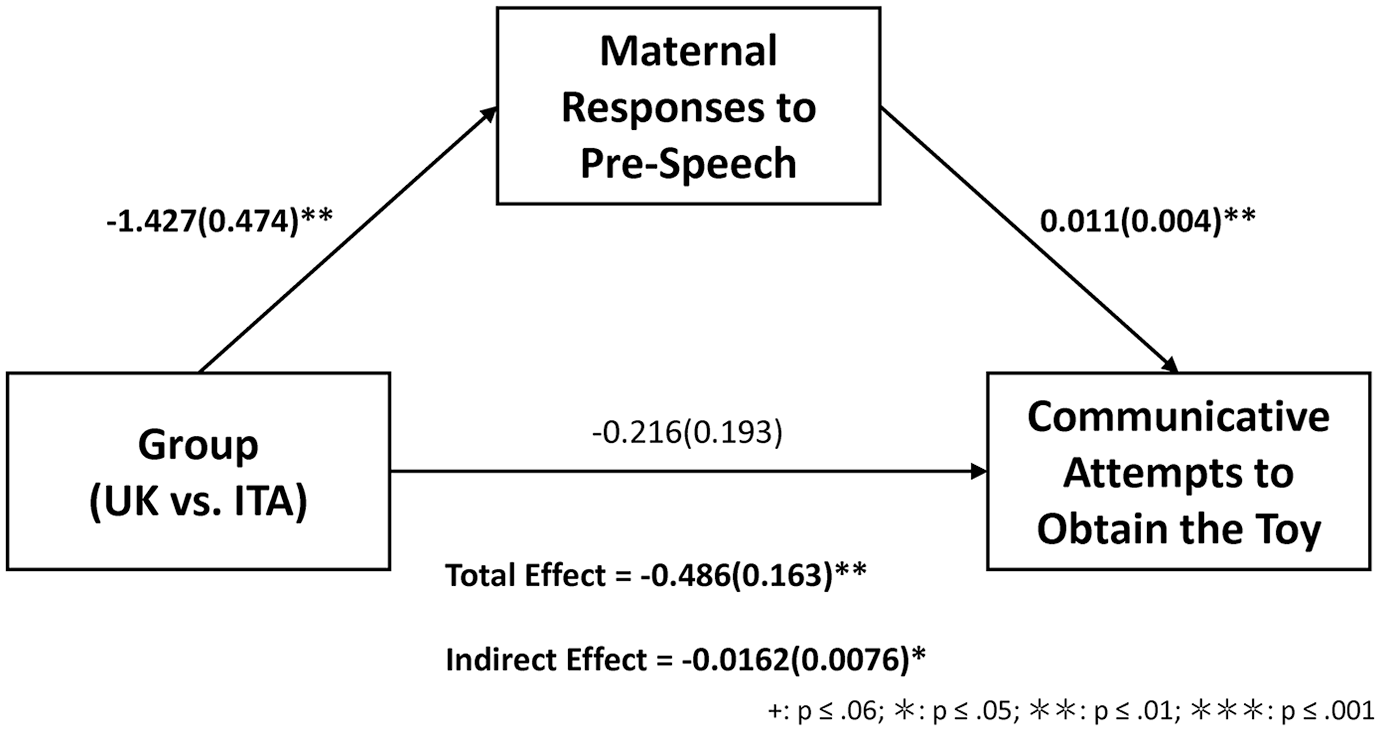
Mediation role of maternal responses to infant pre-speech to child communicative attempts to obtain the toy.
We could not test for the mediating role of maternal responses to smiles because the number of participants with data on early maternal responses to smiles and later ER strategies was reduced (to 33 (63.5%) of the sample), and the original group difference in maternal responses to infant smiles became non-significant.
Discussion
The present longitudinal study provides evidence of both early similarities and differences between two groups of low risk mothers from two distinct Western contexts—British and Italian—in features of mother-infant interactions that previous literature has highlighted as supporting later child socio-emotional development. Our results confirm the association between aspects of early maternal responsiveness and the development of later emotion regulation in the face of frustration, and they also further the understanding of how cultural differences in maternal responses are linked to the expression of child ER in the face of frustration.
Regarding commonalities during early social exchanges, mothers and infants in both British and Italian samples appeared predisposed to interact in analogous ways: infants showed similar rates of positive socio-emotional cues, and mothers dedicated similar proportions of their overall responsiveness both to these cues and to infant negative affect. In addition, the two samples of mothers responded to infant social cues using the same behavioral repertoire—that is, mirroring and positive marking behaviors.
Although the salient features of mother-infant engagement have long-been recognized in Western samples (Papousek, 1987; Stern, 1985; Trevarthen, 1979), and more recently noted in cross-cultural work (Broesch et al., 2016; Feldman et al., 2006; Kärtner et al, 2010; Lavelli et al., 2019), it is only in the last few years that the precise structure of face-to-face interactions has been systematically studied in fine detail (Beebe et al., 2016; Lavelli & Fogel, 2013; Lavelli et al., 2019; Murray et al., 2016, 2018). Thus, Murray et al. (2016), studying a normally developing sample, reported a highly organized “functional architecture” for parent-infant communication, in place from the first weeks of infant life, that supports the development of infant social expressiveness in the first 2 months. A recent study of mother-infant interactions in a clinical sample of infants born with a cleft lip found precisely the same characteristics to be in place (Murray et al., 2018). The findings of the current study of similarity between UK and Italian mother-infant dyads in the frequency of infant socio-emotional cues and of overall maternal responsiveness and its forms of expression, lend further support to this model of a fundamental functional architecture of infant affective and social communication, and maternal responsiveness. Nevertheless, given that our samples were both drawn from European cultures, where certain general styles of interactions may be particularly valued and encouraged, it is important that further cultural comparisons are conducted in order to understand the extent to which this set of behavioral features of mother-infant communicative exchanges can be said to characterize our species.
Aside from the common features of mother-infant interactions that we identified in our two samples, a key finding of our study was evidence of cultural differences, both in the types of positive infant socio-emotional cues that were predominantly expressed, and in maternal responses to them. UK infants showed a higher number of pre-speech behaviors compared to their Italian peers, whereas Italian infants smiled more often. (We also found that Italian children showed slightly higher levels of distress; however, the significance of this result is unclear, and it should be noted that the prevalence of negative infant cues was low.) With regard to maternal behavior, although both groups used mirroring and positive marking, the samples differed in when these responses were deployed: thus, taking account of the frequency of different infant behaviors, British mothers dedicated a higher proportion of their responses to infant communicative cues (pre-speech) compared to Italian mothers who, instead, responded more than British women to their infants’ positive affective cues (smiles).
The fact that British mothers responded relatively more than Italian woman to infants’ pre-speech is in line with research revealing that English mothers, from early in their children’s development, are more concerned about actively promoting aspects of child cognitive development, such as communicative skills, than mothers from other non-Western and some Western populations, including Italians (New, 1994; New & Richman, 1996; Pearson & Rao, 2003; Super & Harkness, 1982). Consequently, compared to Italian mothers, UK mothers spend more time talking to their children and asking them questions to support their language development (Tardif et al., 1997). In contrast, Italian mothers responded relatively more than UK mothers to infant smiles, and this finding may reflect a cultural preference for affective interaction with their children (Carra et al., 2014; Hsu & Lavelli, 2005); indeed, Italian mothers have been found to express more emotional warmth to their children than English mothers (Raudino et al., 2013). Italian mothers have also been reported to place particular value on emotionally expressive and sociable children over quiet and shy ones (Axia, 1998; Axia & Weisner, 2002; Halberstadt & Lozada, 2011).
With regard to infant development, there has been only limited research to date on cultural differences in children’s use of specific ER strategies (Bozicevic et al., 2016; Novin et al., 2011). In the current study we found that children from the two national groups, even though showing similar overall levels of mature strategies when faced with frustration, showed distinct patterns of response. English children were more likely than Italian children to use communicative strategies (i.e., signaling to the adult for help) to resolve the frustrating situation; and Italian children were more likely to use autonomous strategies (i.e., distraction and directed attempts to obtain the toy back by themselves). Each of these two types of child strategy can be argued to reflect the broad cultural stereotypes of child characteristics in the two countries: on the one hand, the emotionally self-controlled, “well-socialized,” British child (Dunn & Brown, 1991; Kasper, 1990; Super & Harkness, 1982), versus the more active, strong-willed and self-assertive Italian child, depicted in ethnographic observations and qualitative research (Axia & Weisner, 2002; Harkness & Super, 2006).
Importantly, the early culture-based differences in maternal responsiveness that we identified between UK and Italian mothers appeared to be the basis for the divergence in the two groups of infants’ later development of ER strategies in the face of frustration. Consistent with the well-established finding that early contingent responsiveness supports the acquisition of ER abilities (Feldman, 2003; Fogel, 1993; Gergely & Watson, 1999; Halberstadt & Lozada, 2011; Keller & Otto, 2009), we found that overall maternal responsiveness to early socio-emotional infant cues was positively associated with the use of mature ER strategies at 22 months. Critically, however, we found that specific maternal responses to infant behaviors during early interactions explained the differences found in the form of later ER strategies employed by British and Italian children when faced with frustration. Thus, maternal responsiveness to pre-speech, a particular feature of the UK mothers, was associated with the use of children’s communicative strategies to retrieve the toy that were typical of the UK sample; whereas responsiveness to smiles, a particular feature of the Italian mothers, was positively related to the use of the autonomous strategies typical of the Italian sample. Notably, maternal responses to infant pre-speech mediated the group difference found in later child communicative ER strategies. In sum, our findings support the idea that infants’ culturally different socio-emotional experiences during interactions with their mothers in the very first weeks are associated with how they later regulate their emotions.
The question arises of what the mechanisms are whereby culturally distinctive maternal responses during early interactions are related to children’s later ER strategies. Thus, while overall responsiveness appears generally beneficial for child socio-emotional development, specific aspects operate differently: on the one hand, as evident in the UK sample, relatively greater responsiveness to infant communicative behavior (i.e., pre-speech) might facilitate social and language competences that become expressed in the propensity to regulate emotions more socially, with the help of others (expressed in the present study in infants referring to the adult for help) (Harrist & Waugh, 2002). On the other hand, as in our Italian sample, relatively greater responsiveness to infant positive affective cues (i.e., smiles) might principally serve to promote well-being, reinforcing emotional self-expression and a sense of independence and individuality (Halberstadt & Lozada, 2011; Wörmann et al., 2012), and thereby increase infant autonomy and assertiveness (expressed in the present study in infant autonomous ER strategies, i.e., distraction and directed attempts to obtain the toy). One possible explanation for the relationship between maternal responses to smiles and the infant’s later use of autonomous strategies is related to Italian mothers’ preference for lively children over quiet ones: thus, Italian mothers might socialize their children to become highly aroused from early infancy, through early interactions characterized by smiley and excited exchange. As a consequence, children might learn to be lively and reactive, and therefore use more proactive and independent strategies when facing emotionally challenging situations. These explanations are in line with previous literature showing that British mothers value both language development, politeness, and self-control as central socialization goals (Kasper, 1990; Lecce & Hughes, 2010; Super & Harkness, 1982; Tardif et al., 1997), whereas Italian mothers tend to enhance children’s positive emotions and levels of arousal, as they consider lively and highly reactive children to be healthy (Axia & Weisner, 2002).
Study Strengths and Limitations
One of the main strengths of the current study is that it provides detailed data on the association between early features of mother-infant communication and child socio-emotional development using a longitudinal and cross-cultural design. Moreover, the micro-analytic coding utilized allowed us to tease apart specific components of the interaction and of ER expression, and to analyze which features of both might be consistent or variable across cultures.
With regard to limitations, although the two group of dyads are from two distinct countries, Italy and the UK, measures of culture were not directly assessed. Moreover, although the sample size was comparable with others from recent cross-cultural studies (e.g., Bozicevic et al., 2016; Broesch et al., 2016; Carra et al., 2014; Kärtner et al., 2010) and those of researches using micro-analytic coding (e.g., Bigelow et al., 2018; Lavelli & Fogel, 2013; Murray et al., 2016), its relatively small size precluded a comprehensive examination of gender differences, and possible mediating effects of some aspects of mother-infant interaction on later ER in response to frustration. A third limitation is that we do not know how far responses to the frustration task might generalize to other ER situations. Finally, parents participating in our study were all mothers and we did not assess children’s wider social environment, including the presence of other relatives involved in child-care. Thus, although mothers have been shown to play the central role in children’s socio-emotional development, future research should also include other caregivers (e.g., fathers, grandparents, nursery staff).
Conclusions and Implications for Future Research and Interventions
In line with previous studies on both developmentally typical and clinical samples, our findings offer further confirmation of the fundamental characteristics of the functional architecture of mother-infant communication. Nevertheless, although, as proposed for this architecture, matching was found between specific infant behaviors (i.e., positive socio-emotional cues) and specific kind of maternal responses (i.e., mirroring and affirmative marking), how mothers deploy the range of responses in reaction to infants’ behaviors seems to be expressed in culturally-specific ways.
Early mother-infant communication also provided a fostering environment for the acquisition of child socio-emotional competences; once again, although general positive features of these early exchanges were found to be related to overall better ER when facing frustration, the specifics of this association were elaborated differently according to cultural factors. We argue that these specific features reflect at least part of the mechanisms whereby the distinct socialization goals of each culture are realized in cultural differences in child development.
Future work should be conducted in different populations, including samples from different socio-economical backgrounds, and factoring in the gender of children to further understand how cultural models, socio-economic status and attitudes towards boys and girls influence the relationship between early communication and later socio-emotional development. Such a line of research could provide new insights for practitioners (e.g., community health workers, nurses and psychologists who support families) about culturally sensitive approaches to promote child socio-emotional development, and in turn improve their effectiveness. Finally, in order to identify the relationship between specific early features of the mother-infant interaction and different components of child socio-emotional development, future studies should include other emotion-eliciting tasks (e.g., unfamiliar social and non-social situations, physical restraint, and separation from mother, as well as pleasurable play) and different child outcomes (e.g., prosocial behaviors, empathy, compliance, etc.). Such research could further inform preventive and educational interventions.
Supplemental Material
JCCP_Supplementary_table_1 – Supplemental material for Sculpting Culture: Early Maternal Responsiveness and Child Emotion Regulation –A UK-Italy Comparison
Supplemental material, JCCP_Supplementary_table_1 for Sculpting Culture: Early Maternal Responsiveness and Child Emotion Regulation –A UK-Italy Comparison by Laura Bozicevic, Leonardo De Pascalis, Rosario Montirosso, Pier Francesco Ferrari, Lorenzo Giusti, Peter Jonathan Cooper and Lynne Murray in Journal of Cross-Cultural Psychology
Supplemental Material
JCCP_Supplementary_table_2 – Supplemental material for Sculpting Culture: Early Maternal Responsiveness and Child Emotion Regulation –A UK-Italy Comparison
Supplemental material, JCCP_Supplementary_table_2 for Sculpting Culture: Early Maternal Responsiveness and Child Emotion Regulation –A UK-Italy Comparison by Laura Bozicevic, Leonardo De Pascalis, Rosario Montirosso, Pier Francesco Ferrari, Lorenzo Giusti, Peter Jonathan Cooper and Lynne Murray in Journal of Cross-Cultural Psychology
Supplemental Material
JCCP_Supplementary_table_3 – Supplemental material for Sculpting Culture: Early Maternal Responsiveness and Child Emotion Regulation –A UK-Italy Comparison
Supplemental material, JCCP_Supplementary_table_3 for Sculpting Culture: Early Maternal Responsiveness and Child Emotion Regulation –A UK-Italy Comparison by Laura Bozicevic, Leonardo De Pascalis, Rosario Montirosso, Pier Francesco Ferrari, Lorenzo Giusti, Peter Jonathan Cooper and Lynne Murray in Journal of Cross-Cultural Psychology
Footnotes
Acknowledgements
We thank Francesco Morandi for assistance with recruitment of Italian dyads, and Sara Biloni for assistance with coding of Italian videos. Lastly, we are grateful to all the parents and infants who participated in this research.
Declaration of Conflicting Interests
The author(s) declared no potential conflicts of interest with respect to the research, authorship, and/or publication of this article.
Funding
The author(s) received no financial support for the research, authorship, and/or publication of this article.

Supplemental Material
Supplemental material for this article is available online.
References
Supplementary Material
Please find the following supplemental material available below.
For Open Access articles published under a Creative Commons License, all supplemental material carries the same license as the article it is associated with.
For non-Open Access articles published, all supplemental material carries a non-exclusive license, and permission requests for re-use of supplemental material or any part of supplemental material shall be sent directly to the copyright owner as specified in the copyright notice associated with the article.
