




Abstract
Interethnic prejudice in children has been studied mostly in the United States, but less often in Europe, where the public discourse is increasingly negative about ethnic minorities, especially the Muslim minority. This study examined in-group favoritism (White preference) and out-group rejection of children of Middle Eastern descent (representing the Muslim minority) among White children in the Netherlands. Social preference for and rejection of children of Middle Eastern descent are compared with preference for and rejection of Black children. Social preference and rejection were measured using a task in which participants were presented with pictures of children with different ethnic appearances, and asked to select who they wanted to (not) play with, (not) sit next to, and invite for their birthday party. In addition, maternal implicit prejudice against people of Middle Eastern descent and explicit attitudes toward their children’s interethnic contact were assessed. The study included 140 children aged 6 to 8 years (M = 7.26, SD = 0.77) and their mothers. The results reveal both in-group favoritism and out-group rejection. The Middle Eastern out-group was preferred less than the Black out-group. Reporting absolutely no reservations about children’s interethnic contact by mothers was associated with less rejection of children of Middle Eastern descent. Findings reveal that young children already show interethnic prejudice and that particularly people of Middle Eastern descent are devalued. The results show that maternal acceptance of child interethnic contact seems to play a role, and provide starting points for further investigation of the relation between parental and child interethnic attitudes.
Interethnic prejudice, in the form of out-group rejection (i.e., the negative bias toward members of an ethnic group other than own) and in-group favoritism (i.e., the positive bias toward members of one’s own ethnic group; Hewstone et al., 2002), forms the basis of one of the biggest societal challenges: racism. Even in young children, out-group rejection and in-group favoritism are present (Raabe & Beelmann, 2011). Most of the studies on interethnic prejudice in children have been conducted in the United States and have focused on the White ethnic majority’s attitudes toward the Black minority. There is a need for studies on interethnic prejudice in children in a European context, given that experiences of discrimination are prevalent among first- and second-generation immigrants in European countries (André et al., 2008). Differences in ethnic composition as well as cultural and historical differences between the United States and Europe limit the generalizability of U.S. findings to the European context (Zick et al., 2008), which requires a focus on the Middle Eastern minority group in addition to the Black minority group. Evidence from a study on Dutch White children suggests that prejudice might be strongest toward the Middle Eastern minority group, as Turks and Moroccans are placed at the bottom of the ethnic hierarchy (Verkuyten & Kinket, 2000).
The aim of the current study is to examine in-group favoritism (White preference as compared to Middle Eastern and Black preference) and out-group rejection of children of Middle Eastern descent among young White children in the Netherlands. To compare levels of interethnic prejudice, preference for and rejection of the Black out-group is also assessed. More specifically, the present study aims to examine whether the Middle Eastern out-group is preferred less and/or rejected more than the Black out-group, replicating the findings from Verkuyten and Kinket (2000) in younger children while distinguishing between preference and rejection. Furthermore, whereas meta-analytic evidence demonstrates a moderate association between parental and child interethnic prejudice (Degner & Dalege, 2013), little research has focused on various types of parental interethnic prejudice in relation to child interethnic prejudice simultaneously. Previous Dutch research does show an association between parental intergroup attitudes as perceived by children and child interethnic prejudice (Verkuyten, 2002). The present study adds to this knowledge by investigating the association between mothers’ implicit interethnic prejudice as well as a form of mother’s self-reported explicit interethnic attitudes, and child prejudice against people of Middle Eastern descent.
Interethnic Prejudice
Interethnic prejudice can be defined as a relative devaluation, so not necessarily a negative evaluation, of individuals perceived as belonging to a different ethnic group in terms of their racial, cultural, or religious characteristics (Eagly & Diekman, 2005). Interethnic prejudice can take many forms such as beliefs, likings, and behavioral predispositions (Dovidio et al., 2010). Given that interethnic prejudice is a relative devaluation, this means that both in-group favoritism and out-group rejection can be seen as interethnic prejudice. In-group favoritism entails a more positive evaluation of the in-group than of the out-group, independent of whether the evaluation of the out-group itself is positive or negative. Out-group rejection, on the contrary, inherently means a negative evaluation of an ethnic out-group. Therefore, differences in ethnic prejudice against various out-groups can be based either on a difference in positive evaluation (level of preference) or a difference in negative evaluations (level of rejection). In addition to these forms of interethnic prejudice, interethnic prejudice can be either implicit or explicit.
Implicit interethnic prejudice is defined as automatically and unconsciously activated associations with certain groups (Greenwald & Banaji, 1995), whereas explicit prejudice refers to conscious expressions or behaviors. Implicit and explicit prejudice are distinct constructs, as is shown by meta-analytic evidence that reveals only a weak correlation between the two (Hofmann et al., 2005), and the fact that the two types of prejudice predict different aspects of racial behavior (i.e., implicit prejudice is related to nonverbal friendliness in interracial interactions, whereas explicit prejudice is related to verbal friendliness; Dovidio et al., 2002).
Interethnic Prejudice in Children
Infants already show a preference for looking at faces from their own ethnic group over those from other ethnic groups (Bar-Haim et al., 2006; Kelly et al., 2005). At 6 months old, they are better at recognizing individual faces from their ethnic in-group than faces from an out-group (Kelly et al., 2007). Explicit interethnic prejudice is first observed in children of preschool and school age (Doyle & Aboud, 1995; Katz, 2003; Ramsey, 1991). Interethnic prejudice in general peaks at the age of 5 to 7 years old, slightly decreases at ages 8 to 10 years old, and remains fairly stable in adolescence (Raabe & Beelmann, 2011).
Explicit measures of child interethnic prejudice often use pictures of children with different ethnic backgrounds, and include questions such as “Who would you like to have as a friend?” and “Who would you not like to have as a friend?” (Cramer & Anderson, 2003; Katz, 2003; Kowalski & Lo, 2001; Ramsey, 1991). Studies using this type of measure have demonstrated in-group favoritism and out-group rejection in young White U.S. children (i.e., 3–6 years old; Katz, 2003; Ramsey, 1991). Doyle and Aboud (1995) in addition found that White Canadian kindergarten children aged 6 to 9 years old assigned more positive adjectives to same-race children than to other-race children (in-group favoritism), and assigned more negative adjectives to other-race children than to same-race children (out-group rejection). Studies comparing responses to various out-groups have shown that ratings of different ethnic out-groups by children can vary (Griffiths & Nesdale, 2006; Stokes-Guinan, 2011). Analyzing responses toward multiple racial out-groups can provide insight in whether out-group derogation is selective, to one out-group only, or generalized, to all racial out-groups (Clark & Tate, 2008). Furthermore, it can provide insight in levels of prejudice toward different out-groups, and therefore provide information regarding which ethnic groups are particularly at risk of experiencing ethnic prejudice.
The Dutch Context
As compared to studies conducted in U.S. samples, less research on child interethnic prejudice has been conducted in Europe, with some exceptions from the United Kingdom (e.g., Rutland, Cameron, Bennett, & Ferrell, 2005; Rutland, Cameron, Milne, & McGeorge, 2005). Other European studies focused on other dimensions than ethnicity (i.e., language; Angerer et al., 2016, 2017), or did not differentiate between attitudes toward different out-groups (Castelli et al., 2008, 2009; Pirchio et al., 2018). Without devaluating discriminatory experiences of Black (and other) minorities, there is a particular need for research focused on (predictors of) prejudice in young children against people of Middle Eastern descent in Europe in general, and in the Netherlands specifically.
Although Middle Eastern is an ethnic identity, the majority of the White Dutch population is likely to equate a Middle Eastern appearance with the religious identity of being Muslim. Muslim extremist incidents that have received extensive media coverage mostly involved people from Middle Eastern countries, stressing the association between a Middle Eastern appearance and Muslim identity. In the Netherlands, people of Turkish and Moroccan descent make up more than two third of the Muslim population (Huijnk, 2018). The large majority of people of Turkish and Moroccan descent in the Netherlands identifies as Muslim (i.e., 86% and 94%; Huijnk, 2018). The salience of prejudice against the Muslim minority is shown by results from a survey conducted in the Netherlands in 2013, which showed that half of the Turkish and Moroccan minorities report discrimination experiences based on their ethnicity, compared to about a third of Surinamese and Antillean (Black) minorities (Sociaal Cultureel Planbureau, 2014). The need for a focus on prejudice against people of Middle Eastern descent (as an ethnic proxy for Muslims) is furthermore highlighted by individual ethnic majority attitudes such as (a) half of surveyed Dutch people wanting to stop immigration from Muslim countries (De Hond, 2013), by (b) the fact that majority group contact with the Muslim minority group is lower than with other minority groups (Koops et al., 2017), and (c) the increasing amount of support for a political party with explicit anti-Islam attitudes (i.e., 10% of the votes during elections for the House of Representatives in 2012 and 13% of the votes in 2017; Kiesraad, 2012, 2017). This need is also highlighted by patterns in Dutch society such as (a) high levels of discrimination that people of Moroccan and Turkish descent experience on the labor market (Ramos et al., 2019; Thijssen et al., 2019), (b) an increasing number of attacks on Mosques since 2011 (Van der Valk & Törnberg, 2017), and (c) public discourse that is particularly hostile toward Muslims (Siebers & Dennissen, 2015).
Research on adolescent interethnic prejudice in the Netherlands has found evidence of anti-Muslim attitudes (Van der Noll et al., 2010; Velasco González et al., 2008) and ethnic in-group favoritism (e.g., Fortuin et al., 2014; Verkuyten, 2007). This type of preference is also evident in research on sequences of social distance among ethnic groups, referred to as ethnic hierarchy. White Dutch children aged 10 to 12 years old rated their ethnic in-group peers as being at the top of the ethnic hierarchy, Black children below that, and Muslim children (Turkish and Moroccan) at the bottom (Verkuyten & Kinket, 2000). According to the developmental path of interethnic prejudice as demonstrated by Raabe and Beelmann (2011), the level of prejudice in that age range has already decreased from its peak, and remains fairly stable from then on. Although it is expected that the total level of interethnic prejudice is higher in younger White Dutch children, it is unclear whether this prejudice presents itself in the same way against multiple ethnic out-groups, and thus whether the ethnic hierarchy is perceived the same. The abovementioned group-level findings on interethnic prejudice in the Netherlands coexist with substantial individual variation that is particularly interesting to examine in relation to predictors of prejudice. Potential predictors of child interethnic prejudice against people of Middle Eastern descent are parental implicit and explicit intergroup attitudes.
Previous research in the Dutch context demonstrated a significant association between parental ethnic in-group and out-group evaluations as perceived by children aged 10 to 12 years, and children’s own ethnic in-group and out-group evaluations (Verkuyten, 2002). The risk of using perceived parental attitudes, however, is that results might be a consequence of children’s projection. Previous studies outside the Netherlands have in addition examined parental implicit and self-reported explicit interethnic prejudice in relation to child interethnic prejudice, to avoid the association being based on the child’s beliefs of parental attitudes rather than the actual parental attitudes.
Association Between Parental and Child Interethnic Attitudes
A meta-analysis combining results of studies on parent–child similarity in intergroup attitudes demonstrated a corrected moderate association between parent and child interethnic prejudice of r = .31 (Degner & Dalege, 2013). Most research has focused on explicit forms of both parental and child interethnic prejudice, with studies on adolescents and their parents generally demonstrating a moderate positive relation (Dhont & Van Hiel, 2012; O’Bryan et al., 2004; Rodriguez-Garcia & Wagner, 2009). Research conducted in Costa Rica and the Netherlands suggests a unidirectional model from parent to child in adolescence (Rodriguez-Garcia & Wagner, 2009; Vollebergh et al., 2001). Other studies, however, discuss the possibility of projection of intergroup attitudes, implying that the projection of adolescents’ own attitudes on attitudes of their parents contributes to the association (Gniewosz et al., 2008). Studies among younger children (i.e., below 12 years old) found no significant association between explicit forms of parental and child interethnic prejudice (Aboud & Doyle, 1996; Castelli et al., 2009; Pirchio et al., 2018; Vittrup & Holden, 2011).
One form of explicit parental interethnic prejudice can be found in parental involvement in and attitudes toward child interethnic relations. Although some research has been conducted on this topic for parents of adolescent or grown-up children (e.g., Smith et al., 2015; Van Zantvliet et al., 2015), less is known about parental explicit attitudes toward their young children’s interethnic contact, and how these attitudes relate to child interethnic prejudice. Given that interethnic prejudice is especially high in young children (Raabe & Beelmann, 2011) and that parents can have a big impact on the social contacts of their children by, for instance, choosing their school, choosing a neighborhood to live in, and arranging playdates, the relation between the explicit parental measure on attitudes toward their children’s interethnic contact and child interethnic prejudice needs to be examined for younger children as well.
In contrast to forms of parental explicit interethnic prejudice studied previously, subtle and implicit forms of interethnic prejudice of adults do seem to be related to young children’s (3–6 years old) levels of interethnic prejudice (Castelli et al., 2008, 2009). Implicit forms of interethnic prejudice can be found in, for example, uneasiness in interethnic interactions (Castelli et al., 2008) or in automatic responses in accordance with stereotypical associations (Castelli et al., 2009). Nonverbal unease by adults seems to be picked up by children, who accordingly perceive the interaction partner and others of the same ethnicity more negatively, independent of the content of the verbal exchange (Castelli et al., 2008). In addition, parental automatic responses in accordance with stereotypical associations are related to higher levels of child interethnic prejudice (Castelli et al., 2009).
The Present Study
In sum, the current study aims to investigate 6- to 8-year-old White Dutch children’s attitudes toward White children and children of Middle Eastern descent (representing the Muslim minority), in terms of social preference and rejection, and examines potential parental predictors of child prejudice against children of Middle Eastern descent. For comparison purposes, attitudes toward Black children are also examined. The study contributes to the existing literature by measuring children’s prejudice toward two minority groups (of Middle Eastern descent and Black) in a European country simultaneously, by including children younger than 10 years, and by including different maternal predictors of child interethnic prejudice against people of Middle Eastern descent. More specifically, the study can add to previous research involving Dutch White children by (a) trying to replicate the previously found social hierarchy (Verkuyten & Kinket, 2000) in younger children, based on preference and rejection scores separately, and (b) examining the association between parental implicit and self-reported explicit interethnic attitudes (instead of perceived parental attitudes) and young child explicit interethnic prejudice. We test the following hypotheses: (a) Children will show a stronger social preference toward their own group than toward the out-groups (in-group favoritism); (b) children will show more social rejection of both out-groups than of their in-group (out-group rejection); (c) the Middle Eastern out-group is rejected more or preferred less than the Black out-group; and (d) implicit maternal interethnic prejudice against people of Middle Eastern descent is significantly related to explicit child interethnic prejudice against people of Middle Eastern descent. In addition, we will explore the role of maternal attitudes toward their children’s interethnic contact in predicting child interethnic prejudice against children of Middle Eastern descent.
Method
Sample
The sample consisted of 140 Dutch White children (60% girls) aged 6 to 8 years old (M = 7.26, SD = 0.77) and their mother. In 81% of the families, the mother had a high educational level (bachelor’s degree/higher vocational education or higher). In the general Dutch female population, this percentage lies around 28% (Centraal Bureau voor de Statistiek, 2018). All families were from the urban Western region of the Netherlands. This region was selected because of its relatively high degree of ethnic diversity as compared to other regions in the Netherlands. According to mother reports, 64% of the children attended a school with fewer than 10% ethnic minorities, and 11% attended a school with 50% ethnic minorities or more. In addition, according to mother reports 30% of the children lived in a neighborhood without any children of ethnic minorities and 44% of the children lived in a neighborhood with fewer than 10% ethnic minorities. Furthermore, most mothers reported that they were not religious (71%). None of the mothers reported to be Muslim, whereas 6% of the mothers reported to be Catholic and 14% of the mothers reported to be Protestants. In addition, 9% of the mothers chose the answer-option “Other.” These answers were specified as Mormon, Christian, Evangelical, and Apostolic.
Procedure
Families were recruited through social media. Using a research project–specific Facebook page, mothers could find information on the content and procedures of the study and leave their personal details if they were interested in participating. Mothers received an online questionnaire to be filled out prior to the home visit. After obtaining informed consent from both parents, families were visited at home by a student assistant who administered a standardized task to the child to measure their social preference for and rejection of different ethnicities. Of the original 148 participating families, eight cases were excluded because the parent who completed the questionnaire was not the same parent present at the home visit (n = 2), because data from the home visit were missing (n = 1), or because the participating parent was not the mother (n = 5). Mothers were asked to keep a low profile and not interfere while the task was being administered to the child. The child task was videotaped to allow for post hoc coding. Afterward, the mother performed a computerized task to measure implicit interethnic prejudice. At the end of the home visit, the child received a small gift. The study’s procedures and methods were approved by an ethics evaluation committee.
Measures
The child task and the computerized task for the mothers involved pictures of children and adults of three different ethnic groups (White, Black, and of Middle Eastern descent) taken from the Internet. Although we acknowledge that the children and adults of Middle Eastern descent in the pictures are not necessarily living in the Middle East, we will in the method and results section refer to them as “Middle Eastern”. The ethnic groups White and Black are easily identified by their skin colors, and the Middle Eastern group is identifiable by their North African/Middle Eastern features including a dark hair color, brown eyes, and a slightly colored skin tone, and by wearing headscarves for the selected females in the pictures. All groups are therefore ethno-racially distinguishable, yet the White Dutch majority in addition tends to equate a Middle Eastern appearance to a religious identity, Muslim. Consistent with the other race effect (Meissner & Brigham, 2001), the White Dutch majority generally has difficulty distinguishing between specific ethnic subgroups within the broader Middle Eastern category. The type and colors of the clothes, hair styles, and the background colors in the pictures were not standardized, but all children and adults in the pictures were facing the camera, visible from chest or shoulder height and smiling.
Child social preference and rejection
Children completed a social preference task, based on the work of Levy and colleagues (2005), in which they were presented with 12 pictures of children (two boys and two girls of each ethnic group: White, Black, and Middle Eastern) collected from the Internet. All the children in the pictures were about the same age as the participating children. A pilot study with 33 White Dutch adults aged 20 to 62 years (M = 35.09, SD = 15.46), of which 33% male, showed that the pictures were consistently classified in the correct ethnic target group. The four White children in the pictures were mostly classified as Dutch (97%–100% of the times). Other classifications included Scandinavian (n = 1) and Spanish (n = 1). The four children of Middle Eastern descent in the pictures were mostly classified as Turkish or Moroccan (82%–100% of the times). Other classifications included Middle Eastern (n = 2), Arab (n = 1), Iraqi (n = 1), Afghan (n = 1), Indonesian (n = 1), Caribbean (n = 1), African (n = 2), and Pakistani (n = 1). The four Black children in the pictures were mostly classified as Surinamese, Caribbean, or African (97%–100% of the times). Other classifications included Cape Verdean (n = 1).
In another pilot study, 16 White Dutch, 14 Turkish-Dutch, and 11 Afro-Dutch adults, aged 18 to 57 years (M = 29.68, SD = 11.78), 22% male, rated attractiveness, cuteness and positivity of facial expressions of the children in the pictures on scales ranging from 0 to 100. Results from this pilot study show that the Black children in the pictures (M = 83.80, SD = 11.06) were rated as more attractive than the Middle Eastern children, M = 76.79, SD = 12.57, t(40) = 4.99, p < .001, and the White children, M = 77.82, SD = 13.42, t(40) = 3.23, p = .003, while the difference between the Middle Eastern and White children was not significant, t(40) = −0.53, p = .600. A similar pattern was found for the positivity of the facial expression: The facial expression of the Black children in the pictures (M = 88.79, SD = 9.79) was rated as more positive than the expression of the Middle Eastern children, M = 83.89, SD = 12.89, t(40) = 4.38, p < .001, and the White children, M = 84.05, SD = 12.16, t(40) = 5.58, p < .001, while the difference between the Middle Eastern and White children was not significant, t(40) = −0.28, p = .786. In addition, the White children (M = 75.18, SD = 13.93) were rated as less cute than the Black children, M = 81.39, SD = 12.06, t(40) = 3.28, p = .002 and the Middle Eastern children, M = 80.09, SD = 12.69, t(40) = 2.61, p = .013, while the difference between the Black and Middle Eastern children was not significant, t(40) = 0.99, p = .328.
The 12 pictures were simultaneously presented to the participating children. Children were then asked five questions in a fixed order: (1) Who would you like to sit next to in class? (2) Who would you not like to sit next to in class? (3) Who would you like to invite for a play date at your house? (4) Who would you not like to invite for a play date at your house? (5) Who would you like to invite to your birthday party? For the first four questions, the children were instructed to point to just one of the children in the pictures. For the birthday question, children were allowed to pick as many or few children as they wanted. Because there was no limit on the number of children that could be chosen for their birthday party, it was not necessary to ask the participating children who they would not like to invite to their birthday party. From these five questions, preference and rejection scores were computed for each ethnic group. Preference scores were created by summing the number of times a child chose a child of a specific ethnicity to sit next to, play with, or invite to a birthday party, and could range between 0 and 6. Rejection scores were computed by summing the number of times a child chose a child of a specific ethnicity to not sit next to and not play with, and could range between 0 and 2. In this sample, White preference scores as compared to Black and Middle Eastern preference scores reflect in-group favoritism, whereas Black and Middle Eastern rejection scores as compared to White rejection scores reflect out-group rejection.
Maternal implicit interethnic prejudice against people of Middle Eastern descent
The Implicit Association Task (IAT) was used to measure implicit interethnic prejudice of mothers, similar to the Race Attitude IAT (Nosek et al., 2002). This computerized task was built with E-prime 2.0. In this task, participants were asked to classify faces of males and females as Middle Eastern or White, while classifying words as positive or negative on a laptop computer. Classifying faces or words was done by pressing either the Z or the M button. The task consisted of congruent and incongruent test blocks, each consisting of 40 trials. In the congruent blocks, positive words and White faces needed to be sorted on the one side and negative words and Middle Eastern faces needed to be sorted on the other side. In the incongruent blocks, negative words and White faces needed to be sorted on the one side and positive words and Middle Eastern faces needed to be sorted on the other side. For each trial the reaction time and accuracy were recorded. Scores were computed using the improved scoring algorithm by Greenwald et al. (2003). Higher positive scores reflected more difficulties to link positive words with Middle Eastern faces, and therefore stronger implicit racial stereotypical ideas. Negative scores, on the contrary, reflected contra-stereotypical ideas. The number of practice trials in the fifth and sixth block of the IAT procedure was increased, and two versions of the IAT were constructed to reduce possible order effects (Nosek et al., 2005). One version started with the congruent block, whereas the other started with the incongruent block. These versions were allocated randomly to the participants. No significant difference in level of implicit interethnic prejudice emerged between the two versions, t(138) = 0.68, p = .496.
Maternal attitudes toward their children’s interethnic contact
Prior to the home visit, mothers digitally completed four questions on their attitudes toward their children engaging with ethnic minorities, based on questions from the “Tolerantiebarometer” (Ipsos Belgium, 2009). Mothers were asked to indicate to what extent they agree with statements about having a problem with their child (a) becoming best friends with a child of non-Dutch ethnicity, (b) dating someone of non-Dutch ethnicity, (c) marrying someone of non-Dutch ethnicity, and (d) having children with someone of non-Dutch ethnicity. The items were scored on a 5-point Likert-type scale with answer options ranging from 1 (totally disagree) to 5 (totally agree), so that higher scores reflect more negative attitudes toward their children engaging with ethnic minorities. The sum of the four items was computed. The internal consistency of the scale was good (α = .92). Because 55% of the mothers received a total score of 4, meaning that they answered totally disagree to every question, the variable was dichotomized into a variable indicating whether participants reported absolutely no reservations about child interethnic relations (0 = yes, 1 = no). To illustrate, the original scores in the second group ranged from 5 to 19 (M = 8.62, SD = 2.63).
Sociodemographic variables
Mothers reported on sociodemographic characteristics of the family in the online questionnaire. Gender and age of the child, maternal level of education, and ethnic diversity of the school and neighborhood will be examined as potential covariates, because previous studies have shown a relation with interethnic prejudice (Ekehammar et al., 2003; Raabe & Beelmann, 2011; Wagner & Zick, 1995), or on theoretical grounds (contact hypothesis; Pettigrew & Tropp, 2006). For these sociodemographic variables, correlations with the dependent variables of the regression analyses are examined to see whether they should be included as covariates. Mothers reported on their highest level of education (1 = primary school, 2 = middle school, 3 = high school, 4 = bachelor’s degree/higher vocational education, 5 = master’s degree). In addition, mothers reported on the percentage of children with a non-Dutch ethnicity in the neighborhood and school (1 = none, 2 = <10%, 3 = 25%, 4 = 50%, 5 = >50%). As ethnic diversity in the neighborhood was positively skewed, a square root transformation was used. Level of education of the mother, on the contrary, was negatively skewed, and thus a power transformation was used.
Statistical Analyses
First, all variables were examined for possible outliers, defined as 3.29 SD above or below the mean (Field, 2005). Two outliers on main variables (one on Black preference scores and one on the maternal IAT score) were winsorized, that is, brought closer to the rest of the distribution while maintaining the same rank. Analyses were run before and after winsorizing, but results were similar. Therefore, results after winsorizing are reported. The associations between the main study variables were examined using bivariate correlations. Given that Middle Eastern preference (Zskew = 3.26) and White rejection (Zskew = 7.51) were positively skewed, Spearman correlations were used for these variables instead of Pearson’s correlations.
To examine whether children showed in-group favoritism and out-group rejection and to examine potential differences in preference for and rejection of the Middle Eastern and Black out-groups, Friedman tests were conducted to compare the preference and rejection scores for the three ethnicities of the children in the pictures. Post hoc analyses were conducted using Wilcoxon signed-rank tests. In addition, Wilcoxon signed-rank tests were conducted to examine effects of backgrounds or clothing differences in the pictures, and overall patterns of results are compared with the results from the pilot study on attractiveness, cuteness, and facial expression.
Of all computed preference and rejection scores, Middle Eastern rejection and Middle Eastern preference were of main interest. For these variables, multiple linear regression analyses were conducted to test whether maternal measures (implicit interethnic prejudice and attitudes toward children’s interethnic contact) play a role. Potential covariates (gender of the child, age of the child, education of the mother, ethnic diversity of the neighborhood, and ethnic diversity of the school) were included in the analysis in a first step, prior to adding the maternal measures, if they were significantly associated with the dependent variable.
Results
Preliminary Analyses
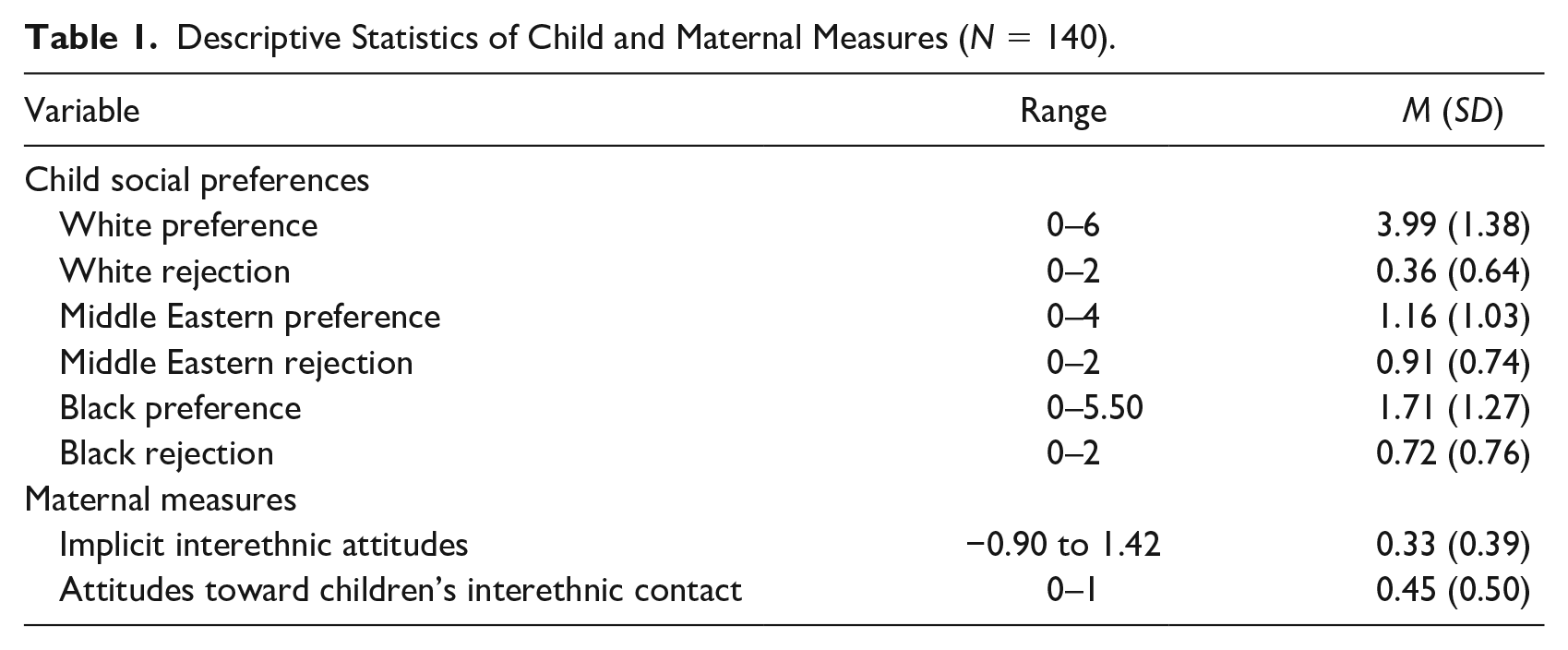
Table 1 presents the descriptive statistics of the main variables. Bivariate correlations between the main variables are presented in Table 2. Higher preference for one ethnic group was significantly associated with less rejection of the same group for all three ethnicities. Moreover, higher preference for the White group was significantly associated with lower preference for the other two ethnic groups. Higher preference for the Middle Eastern group was significantly associated with higher preference for the Black group as well. Furthermore, more rejection of one ethnic group was significantly associated with less rejection of the other two ethnic groups. More rejection of the White group, in addition, was associated with higher preference for the Middle Eastern and Black group. Bivariate correlations between the sociodemographic variables and dependent variables of the regression analyses are presented in Table 3. Because none of the sociodemographic variables was significantly associated with Middle Eastern preference or Middle Eastern rejection of the child, these variables are not included as covariates.
Descriptive Statistics of Child and Maternal Measures (N = 140).
Bivariate Correlates Between Child and Maternal Measures (N = 140).
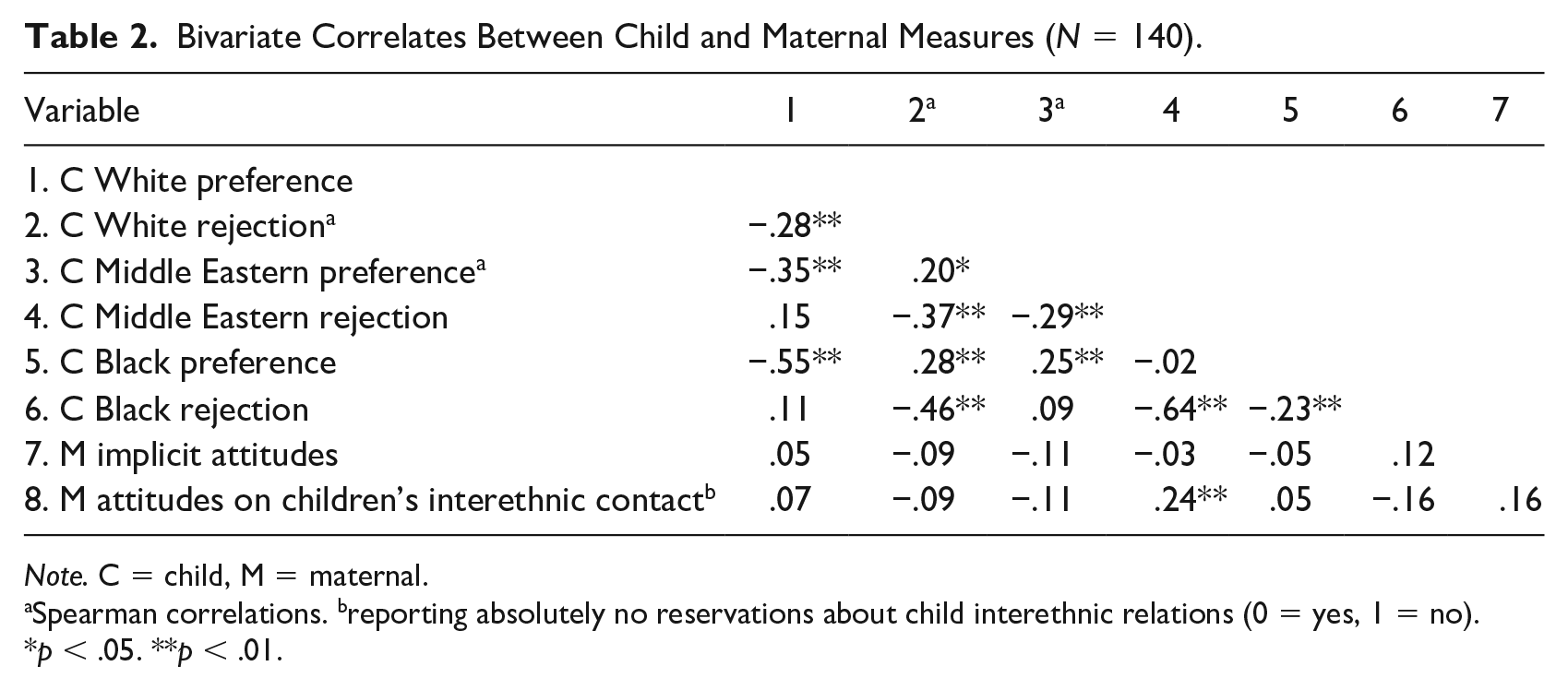
Note. C = child, M = maternal.
Spearman correlations. breporting absolutely no reservations about child interethnic relations (0 = yes, 1 = no).
p < .05. **p < .01.
Bivariate Correlates Between Dependent Variables and Sociodemographic Variables (N = 140).
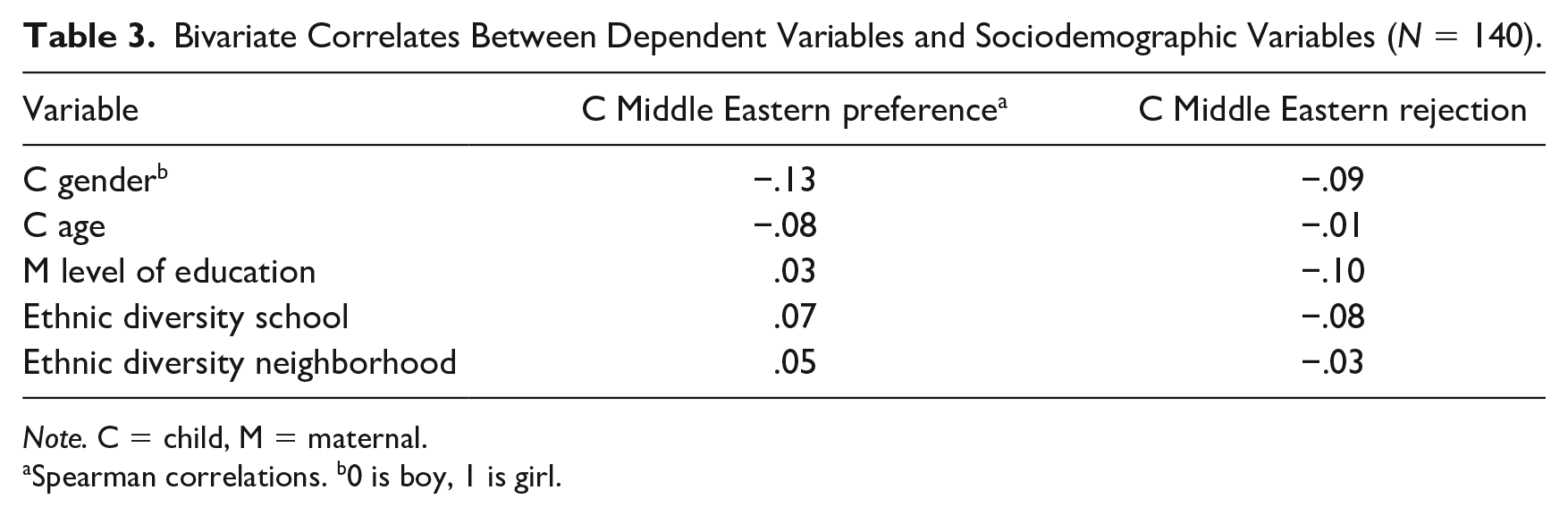
Note. C = child, M = maternal.
Spearman correlations. b0 is boy, 1 is girl.
Social Preference for and Rejection of Different Ethnic Groups in Children
A significant difference in both preference scores, χ2(2) = 136.15, p < .001, and rejection scores, χ2(2) = 34.51, p < .001, was found for the different ethnicities of the children in the pictures, as depicted in Figure 1. White preference scores were significantly higher than both Middle Eastern (Z = −9.50, p < .001, r = −.57) and Black (Z = −8.36, p < .001, r = −.50) preference scores, and Middle Eastern preference scores were significantly lower than Black preference scores (Z = −4.14, p < .001, r = −.25). Furthermore, White rejection scores were significantly lower than both Middle Eastern (Z = −4.65, p < .001, r = −.28) and Black (Z = −3.27, p < .001, r = −.20) rejection scores. There was no significant difference between Middle Eastern and Black rejection scores (Z = −1.31, p = .191, r = −.08).
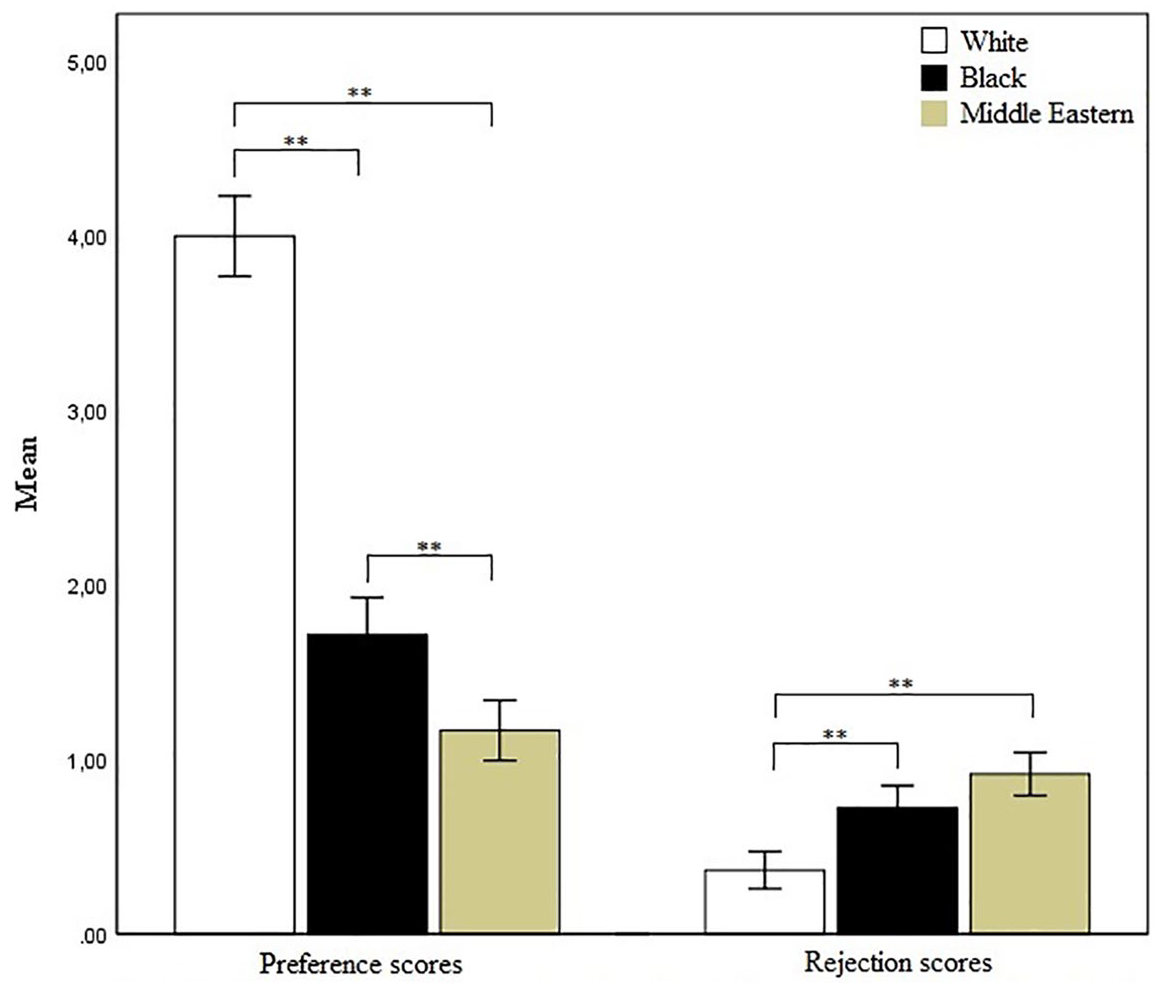
Comparison of preference and rejection scores.
We also examined whether there were differences between overall preference/rejection scores regarding Middle Eastern girls or boys, because the Middle Eastern girls were different to all other children in the pictures as they wore headscarves, but no such differences were found (ps > .05). In addition, because picture backgrounds were not standardized we examined whether these could have influenced the results by comparing responses to pictures of different ethnicities with the same background (a White girl and a Middle Eastern girl against a light gray background, and a Black girl and a Middle Eastern girl against a brown background). Results from both comparisons were consistent with the overall results, and in addition showed that the Middle Eastern girl was rejected more than the Black girl. Moreover, we compared the pattern of preference and rejection results with the patterns we found in our pilot study on attractiveness, cuteness, and facial expression. These patterns did not overlap: Although the White children were preferred most and rejected the least, they were not rated as the most attractive, the most cute, or having the most positive facial expression. This shows that the observed preference and rejection score patterns cannot be explained by the attractiveness, cuteness, and facial expressions of the children in the pictures.
Relation Between Parental and Child Outcomes
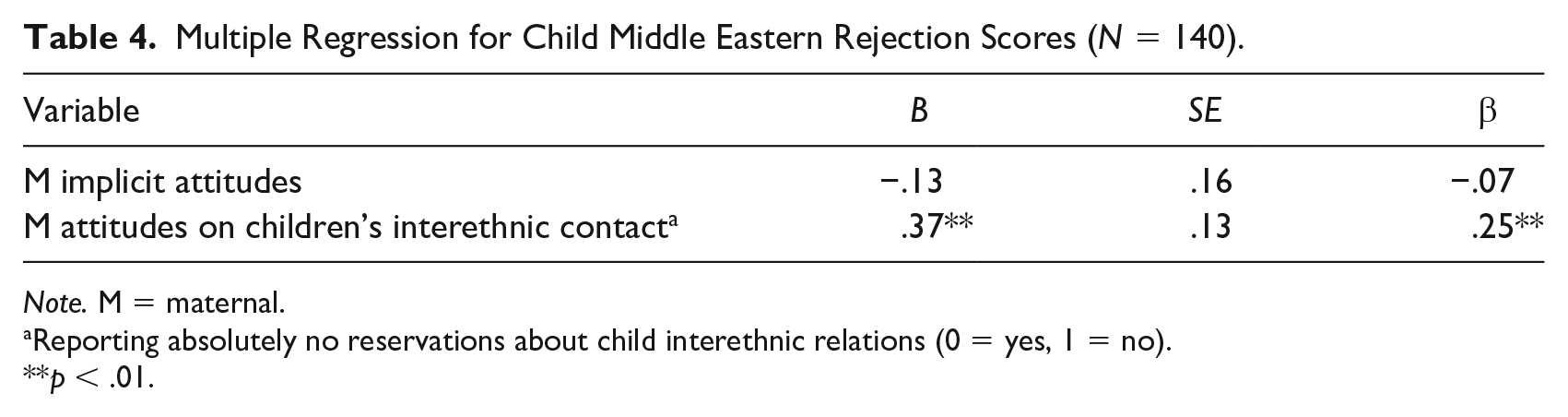
Finally, we examined the relation between the ethnic preference and rejection scores of interest (Middle Eastern rejection and Middle Eastern preference) and maternal measures (implicit interethnic prejudice and attitudes toward children’s interethnic contact). Initial correlation analyses showed that maternal implicit interethnic prejudice was not significantly associated with the child outcomes (see Table 2). Reporting absolutely no reservations about children’s interethnic contact by mothers was associated with less Middle Eastern rejection by children. In addition, we performed two multiple linear regression analyses with Middle Eastern rejection and Middle Eastern preference as dependent variables and the maternal measures (implicit interethnic prejudice and attitudes toward children’s interethnic contact) as independent variables, to control for confounding effects. One significant maternal predictor was found for Middle Eastern rejection, R2 = .06, F(2, 137) = 4.51, p = .013, namely attitudes toward children’s interethnic contact (see Table 4). Reporting absolutely no reservations about children’s interethnic contact was associated with less Middle Eastern rejection. For Middle Eastern preference, F(2, 137) = 2.30, p = .104, no significant predictors were found.
Multiple Regression for Child Middle Eastern Rejection Scores (N = 140).
Note. M = maternal.
Reporting absolutely no reservations about child interethnic relations (0 = yes, 1 = no).
p < .01.
Discussion
The results of the present study demonstrated interethnic prejudice in Dutch White children in the form of in-group favoritism as well as out-group rejection of children of Middle Eastern descent and Black children. In addition, overall preference scores for children of Middle Eastern descent were lower than overall preference scores for Black children. Furthermore, reporting absolutely no reservations about children’s interethnic contact was found to be associated with less child interethnic prejudice in the form of rejection of the Middle Eastern out-group. These findings give an insight in child interethnic prejudice in the European context, and how it relates to parental attitudes.
As expected, the White children in the present study had a stronger preference for White children in the pictures than for Black children and children of Middle Eastern descent, and showed more rejection of Black children and children of Middle Eastern descent in the pictures than of White children. These patterns were not consistent with the attractiveness, cuteness, and positivity of the facial expression of the children in the pictures, as rated by adults in our pilot. The results mirror earlier findings of in-group favoritism and out-group rejection among young White children in U.S. samples (Katz, 2003; Ramsey, 1991). The fact that interethnic prejudice is found is not surprising given the numerous theories that have explained the existence of interethnic prejudice by describing human social cognitive processes, such as the skill to rapidly place environmental cues in categories (Bigler & Liben, 2007), the desire to be a part of a group (Ellemers & Haslam, 2012), and the need to defend oneself against potential threat that might be caused by opposing worldviews of other groups (Greenberg & Arndt, 2012). Other scholars argue that apart from these social cognitive processes, the cultural world in which individuals live is essential for understanding racism (Salter et al., 2018). The Dutch culture is argued by some to show discursive and institutionalized racism (Weiner, 2014). More research on the association between everyday cultural processes, for instance representations of history in schools and media representations of non-White people, and interethnic prejudice in general as well as in the Dutch context is needed to gain a more comprehensive understanding of racism.
Although both out-groups were preferred less and rejected more than the in-group, suggesting a form of generalized out-group derogation (Clark & Tate, 2008), the results indicated a stronger ethnic prejudice against children of Middle Eastern descent than against Black children, as the preference scores for the children of Middle Eastern descent in the pictures were significantly lower than for the Black children in the pictures. Because there was no significant difference in the overall amount of rejection, this form of prejudice fits the definition of prejudice as a relative devaluation (i.e., not necessarily a negative, but a less positive evaluation; Eagly & Diekman, 2005). This finding replicates the ethnic hierarchy as rated by Dutch White children in previous research, where minorities of Middle Eastern descent were rated lower in the hierarchy than Black minority groups (Verkuyten & Kinket, 2000), in a younger sample, and illustrates that this difference in evaluation is due to a difference in preference rather than rejection. These results are also in accordance with studies on older Dutch children and adolescents that revealed explicit prejudice toward Muslims, a religious group associated with Middle Eastern ethnicity (Van der Noll et al., 2010; Velasco González et al., 2008).
Attitudes toward Muslims might be shaped by recent events covered widely in the media. Muslim extremism and the refugee crisis in Europe, which mostly involves people from Middle Eastern countries, have received extensive media coverage and public debate. It is therefore likely that children have been exposed to some images and discussions regarding these topics. Even if these images and discussions are not explicitly negative, the general sense that the people displayed are associated with problems and threat may influence children’s evaluations of children that look similar. Indeed, threat perception has been shown to exacerbate intergroup prejudice in children (Nesdale et al., 2005). Furthermore, the present study found some evidence for an association between parental and child interethnic prejudice.
Maternal attitudes toward their children’s interethnic contact were found to be associated with children’s Middle Eastern rejection in the present study. More specifically, reporting absolutely no reservations about children’s interethnic contact was associated with less Middle Eastern rejection by children. This finding suggests that not only perceived parental attitudes (Verkuyten, 2002), but also self-reported explicit parental interethnic attitudes are related to child interethnic attitudes in the Dutch context evaluating people of Middle Eastern descent. Even though the items mothers answered about child interethnic relations did not specify a certain out-group, rather the items referred to “someone with a non-Dutch ethnicity,” it may be that mothers mostly thought of Muslims, a religious group associated with an Middle Eastern appearance, when answering these questions, due to the often negative public discourse and media representation regarding the Muslim minority in the Netherlands. Future research will need to investigate parental attitudes toward child interethnic relations with persons of specific ethnic groups in relation to child interethnic prejudice. In contrast, no relation with Middle Eastern preference was found. Maternal attitudes were thus related to children’s responses to the negative questions but not to the positive questions. Possibly, the transfer of attitudes toward children’s interethnic contact is more often formulated negatively (i.e., who not to engage with) than positively (i.e., who to engage with instead). To investigate this proposition, future research will need to examine the socialization practices through which maternal attitudes are transferred.
Maternal implicit prejudice, unexpectedly, was not related to child interethnic prejudice against children of Middle Eastern descent in the current study. Previous research did find that implicit and subtle forms of prejudice of adults were related to explicit child interethnic prejudice (Castelli et al., 2008, 2009). One possible explanation for the discrepancy between our finding and the results of these studies is that the children in the present study are older (6–8 years) than the children in the previous studies (3–6 years; Castelli et al., 2008, 2009). Perhaps younger children are more sensitive toward parental implicit and nonverbal signals as they might be less proficient in explicit linguistic communication. Another possible explanation may be that the focus of previous studies was on the White ethnic majority’s attitudes toward Black people, instead of people of Middle Eastern descent or Muslims. The difference in appearance between the White in-group and the Black out-group might be more salient for young White children than the difference in physical appearance between the White in-group and the Middle Eastern out-group. Perhaps children are more sensitive to implicit and subtle prejudice by their parents toward an out-group whose physical appearance is more obviously different from that of the in-group (i.e., Black vs. White), than to implicit and subtle prejudice toward a less clearly distinct out-group such as the Middle Eastern out-group, in which people generally have a dark hair and eye color and a slightly darker skin tone, but sometimes also have a pale skin and light hair and eye color. Previous research, however, shows that White infants prefer White faces over Middle Eastern faces (Kelly et al., 2005), suggesting that they do see differences between these two ethnic groups. Therefore, future research will need to confirm our results and examine mechanisms through and contexts in which, especially concerning different ethnic out-groups, implicit forms of prejudice can be transferred from parent to child. To do so, future studies should collect data on implicit forms of prejudice against different ethnic out-groups and, in addition, also include measures of child implicit prejudice.
The study has some limitations. First of all, the child task used nonstandardized pictures. Nevertheless, additional comparisons of responses to children from different ethnicities pictured on similar backgrounds in general confirmed the overall results of the analyses. Furthermore, the patterns of responses were not in line with rankings of attractiveness, cuteness, or positivity of facial expressions. This suggests that ethnicity rather than other factors influenced children’s choices in this study. Yet, using completely standardized pictures would be preferable in future studies to rule out nonethnic effects on children’s choices. In addition, the girls of Middle Eastern descent in the pictures all wore headscarves, and earlier research demonstrated that implicit and explicit reactions toward Muslim women with headscarves are more negative than toward Muslim women without headscarves (Everett et al., 2015). Given that there were no significant differences in preference/rejection scores between the boys and girls of Middle Eastern descent in the pictures in this study, however, suggests that the overall pattern of prejudice toward children of Middle Eastern descent is not due to the headscarves only. Nonetheless, the fact that the females of Middle Eastern descent in the pictures wore a religious attire and the males did not may have confounded our results. Second, there are some limitations to the setup of the child task. There was no option to choose “nobody” in response to the social preference questions; thus children were forced to choose. Especially the level of out-group rejection might therefore be slightly overrated (Kowalski, 2003), but forced choice cannot explain the differences found between prejudice toward children of Middle Eastern descent and toward Black children. Future studies would ideally not use a forced-choice design, and measure finer gradations of social preferences.
In addition, the fact that the child task was administered at home with pictures limits the generalizability toward real-life social encounters, and the self-report maternal measures of attitudes toward child interethnic contact might have been influenced by social desirability. Finally, there are some limitations to the generalizability of the findings, because the sample in the present study was rather homogeneous in terms of interethnic contact and parental education level. Most children in the sample attended schools with very low percentages of ethnic minorities and lived in neighborhoods with very little ethnic diversity. Furthermore, most mothers were highly educated, as compared to the average Dutch population. The study’s recruitment method might have attracted especially highly educated mothers who are in general more interested in research. Previous research suggests that levels of prejudice are higher among people that have a lower level of education (e.g., Carvacho et al., 2013; Wagner & Zick, 1995). In addition, because ethnic diversity was mentioned in the advertisement we may have also attracted mothers with particularly egalitarian attitudes, as possibly mothers attracted by the social media ad had a special interest in ethnic diversity, making it difficult to detect relations between parents’ and children’s attitudes. Moreover, the present study included mothers only, while fathers might also play a role as socializing agent in the shaping of children’s interethnic attitudes, and has focused only on the urban region of the Netherlands. Future research in other, more rural, areas is needed to compare results and make generalizations about Dutch children.
The current study is the first to examine ethnic prejudice in the form of in-group favoritism and out-group rejection toward multiple out-groups in Dutch White young children, and found clear evidence for both social preference for White children and rejection of Black children and children of Middle Eastern descent. Comparing results for the two out-groups revealed that the children of Middle Eastern descent were preferred less than the Black children, replicating the social hierarchy as found in older Dutch White children (Verkuyten & Kinket, 2000), and indicating that this difference in evaluation is due to a difference in preference rather than rejection. In addition, reporting absolutely no reservations about children’s interethnic contact by mothers was related to less Middle Eastern rejection by children, suggesting that not only perceived parental attitudes are associated with child interethnic attitudes (Verkuyten, 2002), but that self-reported parental explicit interethnic attitudes also play a role. The study of children’s attitudes toward different ethnic groups in general and people of Middle Eastern descent (representing the Muslim minority) in particular deserves more research attention, especially in European countries, where the public discourse about Muslim immigration is increasingly negative. Interethnic prejudice potentially leads to discriminatory behaviors, and experiencing discrimination in turn can have detrimental consequences for stigmatized groups of children in terms of mental and physical health outcomes (Paradies et al., 2015). Future research will need to focus not only on the White ethnic majority’s attitudes but also on attitudes of ethnic minority groups regarding their own and other ethnic groups and their experiences of prejudice, to increase knowledge on the normative and/or group-specific aspects of child interethnic prejudice from multiple perspectives. In addition, longitudinal studies are needed to examine the developmental path of prejudice in children. Furthermore, a positive framework might be applied to the study of interethnic prejudice, examining factors that are related to the absence of prejudice. The present study gives an insight in child interethnic prejudice in the European context, particularly prejudice against people of Middle Eastern descent, and provides starting points from which to further disentangle the relations between parental interethnic attitudes and child interethnic prejudice in its various forms.
Footnotes
Acknowledgements
We thank all parents and children who participated in our study as well as students and assistants for helping during various phases of the study.
Declaration of Conflicting Interests
The author(s) declared no potential conflicts of interest with respect to the research, authorship, and/or publication of this article.
Funding
The author(s) received no financial support for the research, authorship, and/or publication of this article.
