




Abstract
This article presents the first comprehensive empirical study of Court of Appeal judgements concerning the operation and application of section 41 of the Youth Justice and Criminal Evidence Act 1999, which regulates the admissibility of sexual behaviour evidence (SBE) in England and Wales. In doing so, this study fills an empirical void by analysing 152 judgements in the Court of Appeal (Criminal Division) between 2001 and 2021. The research arrives at an important juncture following publication of the Law Commission's recommendations for reform as outlined in its Report on Evidence in Sexual Offence Prosecutions (2025). Although our recommendations were independently developed, they align, in a broad sense, with the Law Commission's proposals for a structured discretionary model as opposed to the extant law which determines the admissibility of SBE through a strict categories approach to whether the SBE satisfies any (or more) relevance ‘gateways’ and additional restrictions. The article makes three original and significant contributions: first it undertakes the largest empirical exercise of these Court of Appeal judgements; second, it reconceptualises the meaning of ‘sexual behaviour’ as defined in s.42(1)(c) and thirdly it recommends replacing the rigidity and complexity of the current statutory regime with a structured discretion, informed by the overriding objective of dealing with cases justly. We then outline how these empirically justified recommendations enhance the Law Commission's proposals for reform.
Keywords
Introduction
In 2021, the previous Government's ‘End to End Rape Review’ 1 revealed a significant decline in the number of charges and prosecutions, and hence convictions, for rape and other sexual offences. 2 These findings followed the introduction of a CPS initiative in 2020 – The Rape and Serious Sexual Offences (RASSO) Strategy – ‘to narrow the disparity between the number of offences reported to the police and cases going to court, as well as, encouraging more people to come forward and report with confidence’. 3 Five years on, the treatment of sexual offence complainants and delays in progressing cases to court remain as a significant cause of discontent within the criminal justice system. In December 2024, Rape Crisis England and Wales reported a 44.5% increase of sexual offence cases waiting to proceed to the Crown Court compared to the number of cases at the same stage in 2022. 4 Given such an irreconcilable increase with the overriding objective of dealing with cases expeditiously, 5 it is unsurprising that many complainants withdraw from the criminal justice process altogether. 6
Leaving aside perceived pre-trial failings and inefficiencies, significant evidential requirements must be satisfied so that a sexual offence allegation can proceed to prosecution. 7 In any adversarial system of criminal trial procedure, it is inevitable that the defence will rigorously test the merits of evidence tendered by all prosecution witnesses. This article examines those evidential issues arising at trial with a particular focus on the admissibility of evidence concerning the complainant's sexual behaviour on other occasions (hereafter SBE). In what is likely to culminate in Parliament's third attempt at regulating SBE, the Law Commission issued its final report on evidence in sexual offence proceedings in July 2025. 8 In line with its earlier consultation paper, 9 the final report recommended the redrafting of the section to include a ‘structured discretion’ approach. 10 Although the government does not always act on the Commission's recommendations, there appears to be widespread agreement that statutory revision of a notoriously problematic area of the law is needed.
This article presents the first comprehensive study of Court of Appeal judgements concerning the operation and application of section 41 of the Youth Justice and Criminal Evidence Act 1999, which regulates the admissibility of SBE in England and Wales. By analysing 152 judgements in the Court of Appeal (Criminal Division) between 2001 and 2021, the study not only fills an empirical void but it arrives at a critical juncture following publication of the Law Commission's recommendations for reform as outlined in its Report on Evidence in Sexual Offence Prosecutions (2025). Although the reform proposals advanced in this study were independently developed, they align, in a broad sense, with the Law Commission's proposals for a structured discretionary model as opposed to the extant law which determines the admissibility of SBE through a strict categories approach to whether the SBE satisfies one (or more) relevance exceptions or ‘gateways’ and additional restrictions.
The article makes three original and significant contributions: first it undertakes the largest empirical exercise of s.41 Court of Appeal judgements; second, it represents a paradigm shift by reconceptualising the meaning of ‘sexual behaviour’ as defined in s.42(1)(c) and thirdly it recommends replacing the rigidity and complexity of the current statutory regime with a structured discretion, informed by the overriding objective of dealing with cases justly. The article concludes by suggesting three, empirically justified, improvements to the Law Commission's reform proposals: first, we advocate a higher test of admissibility than that proposed by the Law Commission. Whereas the Law Commission proposes that the introduction of SBE must not ‘significantly prejudice’ the proper administration of justice, we recommend that SBE should not be introduced unless it is ‘necessary’ to give effect to the overriding objective of dealing with cases justly. We argue that the more austere requirement of ‘necessity’ creates a more demanding admissibility test and safeguards against potentially inconsistent interpretations of what is meant by ‘significant prejudice’. Secondly, we recommend that the test focusses on language that is more familiar to judges in terms of its everyday application when deciding case management issues – the ‘overriding objective of dealing with cases justly’ as prescribed by the Criminal Procedure Rules. Thirdly, while we acknowledge the Law Commission's preference for including within the new framework evidence of false allegations provided the evidence falls within the definition of SBE, we recommend that a broader range of the complainant's behaviours should be included – as provided for by our reconceptualisation of ‘sexual behaviour’ – to safeguard against rape myth perpetuation extending beyond false complaints. If these three empirically backed recommendations were adopted in the course of the legislative process, we assert that they would significantly improve the Law Commission's draft provisions.
The s.41 Problem
This article assumes that readers are aware of the longstanding controversy associated with the introduction of SBE. 11 At the heart of this debate, there is a clear need to protect sexual offence complainants from excessive and overly intrusive cross-examination – which potentially brings Article 8 ECHR privacy rights into play. This right, however, must be balanced with the need for the defence to be able to cross-examine the complainant concerning relevant matters and to be able to adduce cogent evidence as guaranteed by the right to a fair trial right under Article 6 ECHR.
Section 41 restricts the ability of the defendant in a sexual offence trial to ask questions or adduce SBE concerning a sexual offence complainant.
12
Exceptions, or admissibility ‘gateways’, to this prohibition allow the accused – in tightly drawn circumstances – to ask questions or adduce of SBE where:
the matter in issue at trial ‘is not issue an of consent’ (s.41(3)(a)). where the matter in issue is consent but the SBE to which the question or evidence relates took place ‘at or about the same time as the event forming the subject matter of the charge’ (s.41(3)(b)). the matter in issue is consent and the SBE occurred in circumstances that are so similar to the sexual behaviour which took place as part of the event,
13
or any other sexual behaviour which took place at or about the same time as that event
14
that the similarity cannot reasonably be explained as a coincidence (s.41(3)(c)). (5) the defence wishes to introduce SBE to rebut prosecution-led SBE (s.41(5)).
Section 41 applies only to evidence about the ‘sexual behaviour’ of the complainant; evidence which is not about sexual behaviour is not excluded by s.41. Sexual behaviour is defined in s.42(1)(c) as: any sexual behaviour or other sexual experience, whether or not involving any accused or other person, but excluding (except in section 41(3)(c)(i) and (5)(a)) anything alleged to have taken place as part of the event which is the subject matter of the charge against the accused.
Section 41 must also be read in light of the House of Lord's decision in A (No. 2) 17 in which it was recognised that the interpretation of the provision must achieve parity with the defendant's fair trial rights afforded by Article 6 ECHR. The test prescribed by Lord Steyn, applying s.3 of the Human Rights Act 1998, is thus: ‘whether the evidence […] is nevertheless so relevant to the issue of consent that to exclude it would endanger the fairness of the trial’. 18
Following the decision in Evans,
19
two notable empirical studies were commissioned to examine s.41's practical application.
20
These studies concluded that s.41 was generally working as intended. However, in their final report, the Law Commission opined that the law is in some cases too restrictive, in others not restrictive enough, and most importantly, too complex.
21
It proposed that SBE should only be admissible if ‘the evidence has substantial probative value in relation to a matter in issue of substantial importance’ (stage 1 of the test) and its admission ‘would not significantly prejudice the proper administration of justice’ (stage 2).
22
Decision-making at stage 1 would be guided by factors such as the nature and number of events, when the prior events were said to have occurred, and similarities between the prior conduct and the events alleged at trial.
23
Decision-making at stage 2 would be guided by the following three factors:
24
protection of the complainant's legal rights, including respect for the complainant's private life and dignity; the interests of justice including the defendant's right to a fair trial; and the risk of introducing or perpetuating myths or misconceptions.
25
The Law Commission reported that the majority of consultees agreed with the proposed model, though concerns were raised by some. 26 In response, the Law Commission developed the stage 1 guiding factors (which were absent in the first report), and the deletion of a fourth factor in stage 2 relating to the interest of encouraging victims to report. 27 The Law Commission's logic behind a structured discretion was that it best achieved the objective of addressing the risk of perpetuating rape myths and causing undue harm to complainants, and ensure that defendants can receive a fair trial. 28 We endorse the broad idea of a (sufficiently) structured discretion. This article seeks to improve the evidence-base of the calls to reform s.41 by evaluating how the section is interpreted in the Court of Appeal in appeals against conviction.
Analysis of the Study
All available s.41 Court of Appeal judgements in appeals against conviction, and renewed applications for permission to appeal, decided between 1 January 2001 and 31 December 2021 29 were analysed. Judgements were first examined to identify which appeals included a consideration of the application of s.41. We located 152 using this method 30 – 102 full appeals against conviction and 50 renewed applications for permission to appeal. Each case was coded into an SPSS (IBM SPSS Statistics 28, 2021) dataset. Each author independently read and coded half each of the dataset. Problematic judgements – in terms of their opaque treatment of s.41 as a ground of appeal – were jointly discussed to resolve any coding issues. Data collection focused on identifying key elements of the prosecution and defence cases. Variables were constructed pertaining to factual and demographic information disclosed in appeals (such as the offences of which the appellant was convicted, sentencing, the relationship between the complainant and defendant, the sex of complainant and appellant). By synthesising data provided by the judgements in this way, the decision-making process can be presented to inform an essential point of reference into the Court's approach on alleged misapplications of s.41.
This article focuses only on those appellants who have been convicted and decide to challenge that outcome or, more specifically, oppose the trial judge's decision regarding a s.41 application (if one was made). Accordingly, this study does not disclose what occurs in unappealed cases (whether the accused is convicted or acquitted). We acknowledge that no amount of analysis of Court of Appeal judgements can directly reveal how or whether the provision is consistently applied in the lower courts, but significant inferences can be drawn from this data set to determine whether the provision is fulfilling its intended purpose owing to the precedential effect of senior judicial rulings.
Section 41 in the Court of Appeal (Criminal Division)
The test for the Court of Appeal in appeals against conviction is whether the conviction is safe; if the conviction is unsafe the appeal must be allowed and the conviction quashed. 31 In accordance with procedural irregularity appeals in general, the Court is first required to assess whether the alleged irregularity occurred and then determine whether the conviction is unsafe. It determines that question by asking whether, had the irregularity not occurred, the only reasonable and proper verdict would have been one of guilty. 32 If the answer to that question is yes, the appeal will be dismissed (subject to any other grounds), otherwise it must be allowed.
The Court usually receives around 1000 applications for permission to appeal against conviction each year, hears around 200 appeals, and consistently allows approximately 30%–35% of the appeals heard. 33 As noted, we located 152 appeals concerning s.41 in the 20 year period between 2001 and 2021. We observed a spike in appeals and applications between the years 2003 and 2006, when s.41 was still a relatively new provision. A further spike was observed between 2010 to 2012. This may be attributed to the advent of social media and an increase in appeals on the question of whether evidence in the form of social media messages can satisfy the definition of ‘sexual behaviour’ (provided above) and thereby fall within s. 41's remit. In Ben-Rejab 34 and D, 35 the evidence was found to be inadmissible. In T, 36 the evidence was held to be admissible, but the case was adjourned and the appellant decided to abandon the appeal after further investigation. 37 Since 2012, there has been a decline in the number of s.41 appeals.
The dataset revealed 28 allowed appeals, 123 were dismissed/not granted permission to appeal and the remaining appeal was abandoned by the appellant. Seven appeals out of those allowed were allowed on grounds unrelated to s.41. 38 Accordingly, there were 21 successful appeals against conviction on alleged misapplications of s.41 across this sample period. All 50 renewed applications to appeal in the sample were refused. Eleven appeals were allowed during the spike period between 2001 and 2006, during which time the Court was, presumably, grappling with the interpretative boundaries of the section. Thus, earlier research on s.41's efficacy, conducted at a time when convictions were more likely to be quashed, 39 could provide a skewed interpretation of appeals before the proper scope of the section had been fully determined by the Court. Additionally, the SBE in four of the successful appeals took the form of fresh evidence, thereby placing the Court's focus on the admissibility of new material that had not been available at trial – not on whether SBE had initially been wrongly excluded by the trial judge. Evans in 2016 was the last successful appeal against conviction based on s.41 during the sample period.
Decision-Making in s.41 Appeals Against Conviction
The resounding message from the Court of Appeal in this sample of appeals is that trial judges usually (in the cases which appear before it) apply s.41 correctly and conclude that SBE is rarely relevant to the issues at trial. Nevertheless, we observed difficulties with its strict categories approach to relevance and accompanying restrictions, which have proved difficult to apply in practice. The Court concluded that the SBE proffered at appeal was inadmissible in 118 appeals (78%); and was admissible in 34 appeals (22%). We expand upon these findings below. Of the 34 appeals in which the Court decided that the SBE was admissible, 21 convictions were quashed, 12 were upheld and one abandoned after adjournment. This provides a success rate 61% when the Court finds that the evidence was in fact admissible.
Attention should be drawn to the 12 appeals that were dismissed despite the Court having first determined that the SBE should have been admitted. Even though SBE satisfied the requirements of s.41 the convictions were upheld because, despite the irregularity, the only reasonable and proper outcome was a guilty verdict. 40 An inference might be drawn from this that s.41 is too liberal given that the evidence was admissible, despite making little difference to the outcome of the case.
Grounds for Allowing the Appeal – Analysis
The following table outlines the reasons why the Court held SBE to be admissible, and the conviction subsequently quashed (Table 1).
Reasons given for allowing the appeal.
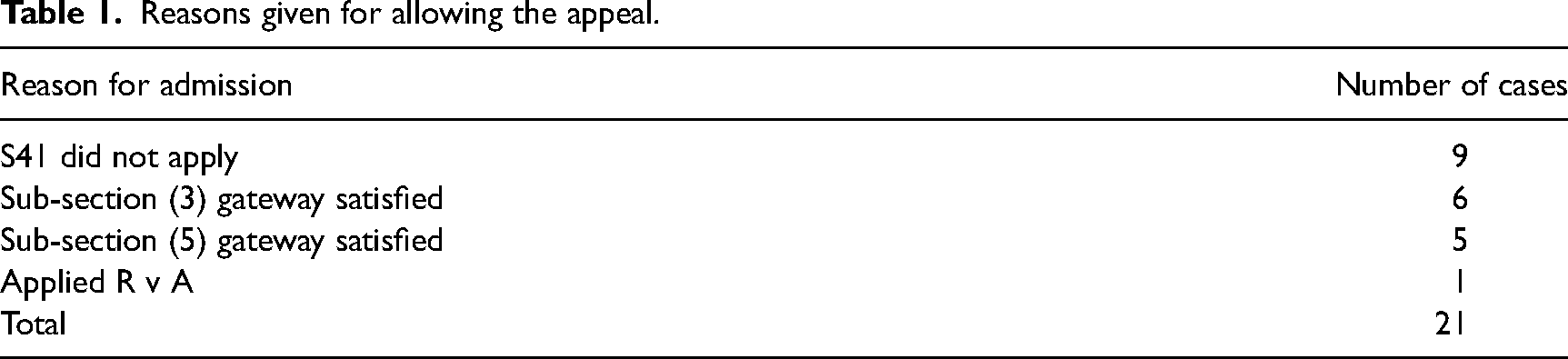
The main ground for a successful appeal in this sample was that the evidence did not constitute ‘sexual behaviour’ as defined under s.42 of the 1999 Act and so fell outside the ambit of s.41 meaning it was inadmissible. Where such evidence was placed before the trial judge who erroneously excluded it, the conviction was deemed unsafe. Most of these appeals were based on the conjoined interlocutory appeal of H; T, 41 which held that questions or evidence about a prior allegation made by the complainant which the defendant alleges was false, are not questions about ‘sexual behaviour’ for the purposes of s.41. To avoid the clutches of s.41/42, the appellant will need to produce a proper evidential foundation for the claim that the prior allegation was false, otherwise the evidence would fall foul of ‘the purpose restriction’ contained in s.41(4). 42 Where the evidence is found not to be SBE, admissibility is governed by the Criminal Justice Act 2003, s.100 – provided that the evidence satisfies the definition of ‘bad character’. 43 Seven of the nine appeals in this category succeeded on this basis. 44
In five appeals, the Court concluded that SBE was admissible as rebuttal evidence under s.41(5). 45 In one case, R, 46 the Court opined that the evidence would not have been admissible on a strict interpretation of the Act but instead the Court applied Lord Steyn's prescribed test and held that the evidence was so relevant to the issue of consent that its exclusion had deprived the appellant of a fair trial. 47 In these cases, the trial judge had been wrong to exclude/restrict the SBE and that irregularity led to the conviction being found unsafe. In the remaining six cases, the Court held that the proffered evidence would be admissible under a sub-section 3 gateway. The six cases were Mukadi, 48 T, 49 Ellis, 50 Harling, 51 Andrade 52 and Evans. 53 The gateways under which these appeals were allowed were, respectively: unclear but most plausibly: temporal, similarity; no obvious gateway provided 54 ; not an issue of consent; similarity and similarity.
Mukadi stands as one of the more controversial decisions. 55 Indeed, the Court was not entirely convinced that the evidence related to the complainant's ‘sexual behaviour’, which raises the question as to whether the evidence should have activated the SBE provisions. 56 We note that this was an early decision (2003) amidst a flurry of successful appeals which implies that the Court was still grappling with s.41's interpretative boundaries. However, what this review of successful appeals does show, is that the evidence rarely satisfied the requirements of s.41. Most appeals were allowed not because of a liberal interpretation of the gateways, but because the evidence did not satisfy the definition of SBE and therefore fell outside the scope of s.41. We consider below the issue of whether it is correct that this evidence should be excluded from the definition of SBE.
Grounds for Dismissing Appeals
The Court held that the evidence was not admissible in 118 appeals. We were able to categorise the reasons given by the Court as shown in the following table (Table 2):
Reasons for dismissed appeals/applications.
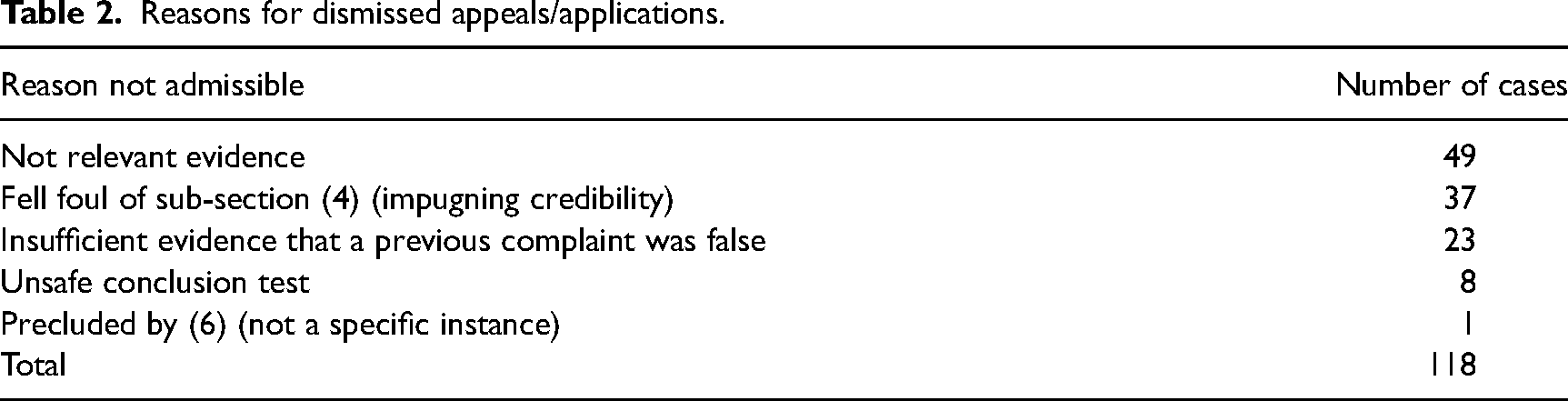
Irrelevance
Appeals were most frequently dismissed on grounds of ‘irrelevance’, with 49 being dismissed for this reason. 57 In these cases, the question of whether the SBE satisfied s.41 did not arise because the challenged material was not considered by the Court to be relevant evidence in the first place. Case examples include MH, 58 E 59 and Harrison. 60 Arguably, such appeals demonstrate either a lack of understanding of the section or an attempt to subvert it through trying to force SBE through a gateway. 61 Almost all appellants (95%) in the sample (including applications for permission to appeal) were legally represented. Thus, blame for such futile appeals cannot be attributed to an absence of legal advice. 62 Further, of the 49 appeals rejected for want of relevance, 19 were renewed applications and 30 were full appeals in which appellants had been granted permission to appeal. 63 The high proportion of full appeals provides clear indication that such appeals cannot be dismissed as being speculative applications. It may be that the meaning of relevance is poorly understood, or that it is understood but is being subverted, or perhaps there is an absence of clear meaning of relevance. One of the Law Commission's stated aims in their proposal was to ensure a proper interrogation of relevance in s.41 applications. 64 The evidence presented above would suggest that under the existing s. 41 framework these was indeed a lack of proper interrogation of relevance.
Section 41(4) – the ‘Purpose’ Restriction
The purpose restriction within section 41(4) was the next most common ground for excluding SBE. There is a strong interplay between this sub-section and the ‘not relevant evidence ground’ with the Court frequently referring to both (i.e., the SBE was either irrelevant or excluded by s.41(4)). Despite the perceived inadequacies of s.41, sub-section (4) is clear: SBE will not be admissible if the trial judge (or here, the Court of Appeal) considers that the purpose (or main purpose) for adducing the evidence is to impugn the credibility of the complainant as a witness. The Court's approach was that the proffered evidence would not be admissible if it thought it was adduced solely in breach of sub-section (4), and if the trial judge reached the same conclusion he/she was correct and the appeal would be dismissed.
Since s.41(4) expounds the primary reason for the existence of the prohibition in s.41, the large number of appeals falling at this hurdle could be attributed to a lack of understanding of the sub-section or defence evasion tactics. Again however, the Court appears mindful of spurious applications as demonstrated by the high number of rejected appeals on this basis. Our analysis confirms the significant role played by the purpose restriction and provides strong justification for the provision's retention but in a revised model for governing the admissibility of SBE.
Insufficient Evidence of Previous False Complaint
It will be recalled at Table 1 and the discussion following that if an appellant can provide a proper evidential foundation for suggesting that a previous complaint was false the evidence would not be excluded by s.41 as the evidence about the complaint would not constitute SBE and would instead potentially constitute non-defendant bad character requiring consideration of s100 of the Criminal Justice Act 2003. However, this is not an easy test to satisfy. To demonstrate, the Court has held that the failure by the police to pursue a previous allegation did not satisfy the evidential basis test, 65 and nor did the allegation resulting in an acquittal. 66
Cases such as MC 67 in which the defendant sought to establish the falsity of a prior complaint highlight the importance of the purpose restriction contained in s.41(4). Where the defendant does not have an evidential foundation for suggesting that a previous allegation was false, the proposed evidence or questioning will be regarded as an illegitimate attempt to adduce SBE and will therefore be excluded on the basis that ‘the purpose (or main purpose)’ for its introduction must be to impugn the complaint's credibility. However, the provision does not always apply neatly in every case heard under the s.41 strict categories framework. Evidence of alleged false statements concerning sexual behaviour may be admissible under s.100 of the Criminal Justice Act 2003 if constituting evidence of the complainant's bad character though the defence should seek a ruling from the judge that the questioning did not fall foul of s.41. 68 It cannot be automatically assumed that the real motive of a defendant who cannot prove the falsity of a previous complaint must be to introduce SBE by illegitimate means.
During the early years of s.41, Birch argued that s.41 is not the right mechanism for such cases, unless one would wish this ‘concrete evidence’ of falsity to be confined to cases where the defence are saying that the complainant in fact consented, rather than that she/he had invented the whole thing. 69 Obviously, if the allegation is that the complainant concocted events to which the (alleged) false complaint relates, there will be no SBE that can be adduced under s.41, because on the defendant's version events there was no sexual behaviour in the earlier allegation. Thus, it seems illogical to automatically assume that in every case, the real motive of a defendant who cannot prove the falsity of a previous complaint must be to introduce SBE by illegitimate means. This is why a more coherent test is needed to govern the admissibility of false complaints to replace the current one which adheres to a default application of s.41(4), where the defence cannot establish an evidential basis for suggesting that the previous complaint(s) is false. The Law Commission has concluded that the current combination of SBE and bad character provisions 70 adequately address the two forms of false allegation evidence referred to by Birch. 71 We recommend reconceptualising the definition of SBE so that both forms of false allegation evidence would now be brought under the remit of s.41's replacement. 72
The s.41(2)(b) ‘Unsafe Conclusion’ Test
There were 8 dismissed appeals on the basis that even if the evidence was admissible, its exclusion would not place the jury at risk of reaching an unsafe conclusion. 73 During the debates on the enactment of s.41, it appears that the government had the ‘unsafety test’ in mind when deciding to introduce an ‘unsafe conclusion’ test into the Bill. Lord Thomas was opposed to the adoption of the unsafe conclusion test on the basis that trial judges should not be entrusted with decisions relating to ‘unsafety’ – this is a question for the Court of Appeal. 74 The relationship between the ‘unsafety’ and ‘unsafe conclusion’ tests was discussed in Rooney. 75 Here, the defence hinted at an alleged inconsistency between a finding by the Court that a conviction could be ‘safe’ despite the exclusion of evidence at trial which may have had the effect of ‘rendering unsafe a conclusion of the jury’. Waller LJ concluded that the two tests are different by explaining that the language of section 41(2)(b) is the language of ‘might’ have the result, whereas the Court of Appeal is addressing the question in the light of all the evidence and the whole of the trial and is addressing the question whether the conviction is in fact unsafe. 76
Several judgements in the sample barely (if at all) mentioned any specific s.41 gateway. 77 This implies (a) the material forming the basis of a s.41 application was simply not relevant or (b) a more significant role is given to s.41(2)(b) as part of the Court's decision-making process than what has been previously suggested. 78 Cases from our sample supporting this proposition included Michael S in which the trial judge did not consider the specific application of the s.41 gateways but instead ‘adopted the spirit if not the language of sub-section (2)(b)’ 79 and McIver, in which consent was not an issue owing to the young age of the complainant, the trial judge did permit limited questioning under s.41(2)(b). 80
We concluded that there are a high number of appeals which, on any objective reading, did not have any prospect of success based on the s.41 criteria. While a convicted person has the right to appeal against conviction if they have proper grounds to appeal, we saw little evidence that trial judges routinely misapply the law. Some of the proffered SBE was so clearly inadmissible, in our view, that we could only conclude they were at best misapplications of s.41 or, at worst spurious attempts by defence teams to admit SBE when the circumstances did not appear to support any application. The Court often reached the same conclusion. 81 We echo Cowan and her colleagues’ sentiments that there is an apparent dissonance between guidance from the senior judiciary and legal practice. 82 Clearly, applications having little prospect of success waste time and resources and, as the above analysis suggests, it was not uncommon for defence teams to submit highly speculative applications especially during the early years of s.41's operation.
First- and Third-Party SBE
Section 42(1)(c) provides that ‘sexual behaviour’ means any sexual behaviour or other sexual experience whether or not involving any accused or other person. It thus does not discriminate between SBE concerning the complainant and defendant and SBE concerning the complainant and third parties (i.e., not the defendant). The fact that third-party SBE is not subject to a complete ban has attracted strong criticism to the effect that this type of evidence amplifies the twin myths: first, that a complainant who has been sexually active with others in the past is more likely to have consented on the occasion in question and secondly, is less deserving of belief. 83 The Law Commission considered arguments for the complete ban of third-party SBE but rejected this proposal. 84
We categorised SBE in the sampled appeals into first or third-party SBE and found that of the 152 appeals, 124 (82%) concerned third-party SBE. It might be inferred that trial judges are more likely to refuse applications to admit third-party SBE, given the greater number of defendants/appellants bringing appeals on this basis. We cross-tabulated whether the SBE took the form of first/third party against whether the Court concluded the evidence should have been admitted/not admitted. Of the 34 cases in which SBE was found admissible by the Court, 26 (76%) concerned third-party SBE. However, given that there were 124 appeals concerning third-party SBE in total, this converts to a success rate of 21%. Of the remaining 28 cases concerning first party SBE, the evidence was admitted on 8 occasions (28%). Thus, it can be observed that whilst third-party SBE appeals are made more frequently than first party SBE appeals, by proportion of cases decided, third-party SBE appeals are marginally less likely to succeed. Stephenson 85 gives credence to the suggestion that defendants will (usually) be met by a strict interpretation of s.41(3)(b) – the temporal gateway – where the evidence adduced concerns third parties. Here, the Court (again) agreeing with the trial judge, concluded that the complainant's behaviour earlier with other individuals was irrelevant in establishing whether the complainant would have consented to sexual intercourse with the defendant. In this respect, our findings align with Lord Steyn's proposition that third-party SBE is ‘much harder to justify’.
Acquaintance or Stranger SBE
We sought to determine whether the relationship between the complainant and defendant played any role in the types of submissions made and their reception by the Court. In 122 of 152 (80%), the complainant and accused were known to each other prior to the incident complained of. 22 of these appeals were allowed (18%). Of those who were previously strangers, 5 of 30 (16%) appeals were allowed – which includes Mukadi and Evans (referred to earlier). Appeals concerning complainants and appellants who were previously known to each other are tabulated as follows (Table 3):
Breakdown of relationship type.

The ‘known’ category refers to parties who were known to each other but not in the same context as family members or partners. This category typically included friends, friends of friends, school/work colleagues etc. The ‘misc’ category consisted of an appeal concerning a teacher and another concerning a GP. All categories, excluding the ‘misc..’ category, were cross-tabulated to identify whether the nature of the relationship had any impact on the admissibility of SBE. ‘Family’ and ‘known’ relationships exhibited very similar admission rates – 25% (9/34) and 24% (17/70) respectively – but only 12% (2/16) where the SBE involved ‘partners’. This implies that the Court is far less likely to admit SBE about a previous relationship between the parties. Of the 14 appeals in which the court concluded that the SBE was inadmissible, it did so on 12 occasions because the evidence fell foul of sub-section (4) or because it was not relevant.
Reform or Status Quo?
Despite its deficiencies, there is continued allegiance to s.41 stemming from a desire to improve its workability, rather than speculating on a new framework and potentially risk adding new problems to an already convoluted area of law. 86 Yet, despite significant improvements in judicial training, tightening of the Criminal Procedural Rules, Practice Directions, and the introduction of more efficacious jury directions during its 25 years of operation, it is difficult to pinpoint what further could be done to improve the utility of s.41 as it stands. Similar views have been expressed elsewhere regarding the operation of laws designed to restrict the use of SBE. 87
Notwithstanding the contrasting views about how well s.41 is applied in trial courts in England and Wales, 88 our analysis of Court of Appeal judgements suggests that SBE is tightly controlled as intended. Despite this, in agreement with the Law Commission, we have identified sufficient problems with the application of s. 41 that it ought to be rewritten in its entirety and we suggest reforms in that direction.
It became clear from the sample that although the A (No. 2) ‘gloss’ has not taken us back to the pre-1999 period – during which SBE was admitted too liberally – our analysis of the post A judgements confirms predictions that the ‘re-interpreted’ version of s.41 would generate inconsistency 89 with ‘different judges [arriving at] different conclusions on the same statute’. 90 Some appeals and applications for leave to appeal were admonished by the Court, indicating that such applications should not have been submitted at the outset. It is difficult to say whether these applications were made erroneously – because of a lack of understanding of the gateways – or whether they were submitted as insidious attempts to shoehorn SBE in by whichever gateway(s) provided the best opportunity for admission.
Several appeals in the sample confirm the existence of confusion with the gateways. For instance in A(I), 91 the issue was one of consent, but the defence erroneously applied to adduce SBE under the non-consent gateway in s.41(3)(a). In (M)R, 92 the Court embarked on an in-depth account of the purpose of s.41, implying that its admissibility requirements had not been fully understood, or at least fully considered by the defence when making its application.
Some judgements exhibited similar confusion in terms of their opaque treatment of specific s.41 requirements. In Ellis the Court seemed to ignore the test contained in s.41(2)(b) by suggesting the evidence would have been admitted provided the relevance gateways of s.41 were satisfied. 93 It then, curiously, concluded that the evidence should have been admitted by the trial judge ‘by whatever route the issues was reached’. 94 In Andrade, 95 the Court quashed the conviction, concluding that the trial judge was ‘obliged by the words of the statute alone’ 96 and thus did not fully consider the significance of A (No) 2.
These observations highlight a significant flaw concerning the practical application of s.41. It is far too complex, though simplification, per se, should not be the primary motivation for change. The enactment of a ‘simpler’ model could easily be achieved by methods having little to do with the pursuit of justice. Instead, the overriding objective of the Criminal Procedure Rules of dealing with cases justly 97 should underpin legal reform in this area to strike a more even balance between the competing interests of complainants and defendants than what is provided by the current manifestation of s.41. Given that rule 1 of the CPR lists the doing of justice, and the different aspects of doing justice in rule 1.1(2), as ‘overriding’, any legislative action in pursuit of an alternative objective undermines this principle. It is our suggestion, therefore, that a redrafting of the section by way of structured discretion framed around the overriding objective would be the most appropriate avenue for reform of s. 41.
Suggested Reform: An Evidence-Based Solution
We set out our recommendations for reforming s.41 below which, although predating the Law Commission's proposals, concurs with them in a broad sense after having examined over 150 Court of Appeal decisions. Proceeding on the basis that s.41 is amended such that the Law Commission's structured discretionary model is implemented, we suggest the following modified format. We draw particular attention to the aspects in italics.
Section 41: Admissibility of SBE
If at a trial a person is charged with a sexual offence, no evidence or questioning about any behaviour of a sexual offence complainant will be admissible unless it has substantial probative value in relation to a matter in issue in the case and its admission is necessary to give effect to the overriding objective of dealing with cases justly. When considering whether admission of evidence or questioning is necessary to further the overriding objective, the court must consider the following non-exhaustive factors:
The objective of convicting the guilty and acquitting the innocent; Dealing with prosecution and defence fairly and with respect, especially with regard to the rights of a defendant under Article 6 ECHR ; For the purposes of sub-section (2) no evidence or question shall be regarded as relating to a [matter in issue] in the case if it appears to the court to be reasonable to assume that the purpose (or main purpose) for which it would be adduced or asked is to establish or elicit material for impugning the credibility of the complainant as a witness. Where evidence or cross examination of a sexual offence complainant is allowed under this section, the court]
98
must, [notwithstanding the terms of its decision under sub-section (1) above] limit the extent of questioning to be allowed
99
to that which is necessary to comply with the requirements imposed by sub-section (2) above.
Rationale
We recommend important and significant re-conceptualisation of the law relating to SBE. It will be noted that recourse to the overriding objective takes a far more holistic approach to the admissibility of evidence than the narrow gateways and restrictions contained in s.41. The proposed reform is structured in this way to remind/reiterate to trial judges, and indeed prosecution and defence counsel, that the Criminal Procedure Rules already stipulate that there exists an ‘overriding objective’ of dealing with cases justly.
Accordingly, we propose a two-stage test for the admission of SBE, which, in a broad sense, concurs with the Law Commission's approach. Whereas the Law Commission recommend that (1) the evidence must meet the threshold of ‘substantial probative value’ and (2) that the evidence must not ‘significantly’ prejudice the proper administration of justice,’ we advocate a higher test for admissibility. Under our recommendations, evidence satisfying stage (1) of the would only be heard if ‘necessary’ to give effect to the overriding objective of dealing with cases justly’. We argue that this higher hurdle, framed in terms of the overriding objective – of which judges are more familiar in terms of its everyday application when deciding case management issues – will be more effective to guard against potentially inconsistent interpretations of what is meant by ‘significant’ when deciding if the proper administration of justice has been ‘prejudiced’. Both proposals are potentially vulnerable to the criticism that it is inconceivable that evidence having substantial probative value would never satisfy the second stage of the test, leaving it superfluous. However, as the Law Commission has clarified, evidence having substantive probative value could still ‘prejudice the proper administration of justice’. 100 Likewise, exclusion of such evidence might not jeopardise compliance with the ‘overriding objective’ of giving effect to the defendant's fair trial rights. 101 In cases where there are several instances of SBE, a similar approach might adopted analogous to that governing the admissibility of bad character evidence. In Phillips, 102 it was held that once evidence is admitted demonstrating propensity, the judge could exclude further evidence on the same issue because the probative value of the additional evidence is diminished. Assuming there are several instances of SBE, the court may adopt a similar practice and conclude that the admission of some but not all of the evidence would be ‘necessary’ to ensure that the overriding objective is complied with.
Reconceptualising the Definition of SBE
We interpreted the high percentage of dismissed appeals relating to ‘irrelevant’ evidence as indicating either a lack of understanding of or an attempt to subvert the strictures of the s.41 gateways. In terms of its complexity, the model upon which the extant law based – a pigeon-holing approach to admitting SBE via complicated and ambiguous gateways to admissibility – is clearly ill equipped to deal with the tensions arising in sexual offence trials. As part of informing a logical alternative, we recommend that the scope of ‘SBE’ be reconceptualised to include within the new framework a wider range of behaviour than is dealt with under the current regime. 103 We do this by restricting the use of ‘any behaviour of a sexual offence complainant’, rather than merely restricting ‘sexual behaviour’ as per the present s.41.
The inclusion of a wider range of the complainant's behaviours would not only bring evidence of the complainant's character within the ambit of the new framework, 104 but other types of conduct. This new type of conduct would require permission from the trial judge to adduce in line with the test in our reformed sub-section (1). As Burman notes, such material can be seized upon by the defence to categorise complainants as being of ‘good’ and ‘bad’ sexual character, and evinces generalised tendencies or reputation (for example, some (sic) who is ‘chaste’ or ‘promiscuous’). 105 The US State of Colorado's legislature has recently extended its rape shield laws to prohibit inferences of consent from the complainant's manner of dress or appearance. 106
CPS guidance in England and Wales discredits the myth that complainants may draw attention to themselves through their choice of clothing and, by implication, ‘deserve to be raped’. 107 This marks an improvement in attitudes on what was exhibited by the Court in Mukadi when it announced that the complainant wore ‘a short tight shirt, which in parts could be seen through, and a black vest top’. 108 The definition in our reformed sub-section (1) – ‘any behaviour of a sexual offence complainant’ – expands the meaning of SBE but such evidence will only be admissible if it possesses ‘substantial probative value in relation to a matter in issue in the case and its admission is necessary to give effect to the overriding objective of dealing with cases justly’.
We envisage that this test will foster a more cohesive understanding of the type of material that is/not relevant, preventing a similar surge of appeals we saw during the early years of s.41's application. The Law Commission has indicated that its concern is not the prevalence of rape myth acceptance in society but rather the extent to which myths and stereotypes influence criminal trials, 109 the true extent is hotly debated. 110 Nonetheless, the possibility of misguided jury assumptions arising from ‘rape myth acceptance’ has, at the very least, necessitated guidance 111 so that juries can distinguish perception – arising from the (possible) infiltration of myths and misconceptions into the trial process and reality requiring juries to the focus on the germane issues at trial.
Evidence of Previous False Complaints – A More Logical Admissibility Test?
In its consultation paper, the Law Commission proposed that evidence of previous false complaints and SBE should be subject to the same admissibility threshold. 112 Its reasoning was that the introduction of evidence concerning false allegations ‘risks introducing the rape myth that allegations of rape are commonly false’. 113 Our case analysis revealed over 30 appeals (23 unsuccessful) relating to evidence of false complaints but, as noted above, the default application of s.41(4) in every case in which where an evidential foundation for asserting the complaint is false cannot be satisfied remains problematic. No distinction is made between cases in which the basis of the accused's assertion that the complaint was false was that there was no previous sexual behaviour at all (and therefore it could not be the defendant's intention to adduce SBE) and those cases where the basis of the accused's assertion is that sexual conduct did occur, but was consensual, contrary to the allegedly false complaint.
Evidence of the type adduced in the first category of cases requires a more coherent exclusionary test than the current law which adheres to a default application of s.41(4) where the defence cannot establish an evidential basis for suggesting that the previous complaint(s) is false. Under our proposed wider definition of ‘sexual behaviour’, the admissibility of evidence consisting of alleged false complaints would be subject to the same admissibility test as any other ‘behaviour of the sexual offence complainant’. It follows that the purpose restriction retained in sub-section (3), which replicates the current sub-section (4) would not bite provided the requirements of ss.(1) and (2) are satisfied.
First- and Third-Party SBE
It will be recalled from the above analysis that although the overwhelming number of sampled cases concerned third-party SBE (124 (82%) of 152), by proportion of cases decided, they were less likely to succeed (21%) than first party SBE appeals (28). We noted no compelling evidence in the judgements to justify a complete prohibition on third-party SBE and – in agreement with the Law Commission – we made no recommendation for its exclusion in our recommended reform, not least to safeguard against potential challenge under Article 6 of the ECHR. 114
Excluding Relationship Evidence from the Ambit of s.41
We noted that out of the 16 appeals involving complainants and defendants who were in a relationship, the Court only found the SBE admissible in two. Nevertheless, we did not conceive of any justification for restricting evidence of a relationship between the defendant and complainant when that fact constitutes important background evidence. Such restrictions would likely cause Article 6 problems. The Bar Council asserts that relationship evidence is relevant to providing vital context which, if treated as SBE, should be admissible under its own ‘important explanatory evidence’ exception. 115 This provision would replicate the bad character explanatory evidence gateway through which evidence may be admitted for the purpose of enabling the jury to understand other evidence in the case. 116 Given our preference for a departure from s.41's narrow approach to SBE admissibility, we oppose the idea of additional gateways.
There are two alternative ways to exclude relationship evidence from the SBE provisions under our recommended reforms. The first is that relationship evidence is excluded from any reconceptualised definition of SBE and thus would not be required to satisfy the test imposed by the new framework. This may require an amendment to s.42(1)(c) of the 1999 Act (or its replacement) along the following lines: ‘any behaviour of a sexual offence complainant’ excludes (a) anything alleged to have taken place as part of the event which is the subject matter of the charge against the accused and (b) evidence of an existing relationship without which the court or jury would find it impossible or difficult properly to understand other evidence in the case’
Application of the New Framework to ‘Problematic’ s.41 Cases
We now focus on three controversial judgements from the sample and examine whether the data driven reforms proposed in this article would have led to different outcomes. The judgements are: Mukadi, Evans and A (No. 2) itself. There can be little question that the evidence adduced in Mukadi which consisted of the complainant exchanging telephone numbers with someone other than the defendant could have ‘substantial probative value’ in relation to the complainant's consent (or lack of) with the defendant later that day. Moreover, the Court's reticence to confirm whether the evidence fell within s.41's remit – owing to a lack of clarity regarding types of conduct that can amount to SBE – led to a fudged explanation as to why the evidence was admissible. The wider definition of SBE in the new provision avoids this problem because the behaviour sought to be adduced would amount to ‘any behaviour of a sexual offence complainant’. Thus, the primary focus of the Court would be on addressing two questions: (a) whether the evidence had substantial probative value in relation to a mater in issue and (b) if so, why its admission was necessary to further the overriding objective. It is difficult to see how such material could be admitted under the requirements imposed by the new framework.
Evidence of a recent relationship, such as that sought to be adduced in A (No. 2), would not be subject to the same artificial evidential constraints as imposed by the s.41(3)(c) similarity gateway. Rather, the ‘probative value’ of the relationship evidence derives from its explanatory, contextual value, not (necessarily) by any similarity(s) to the events in issue. 117 Thus, even where similarities exist between the previous instances of sexual behaviour and the events complained of this does not, necessarily, imply that the evidence will have ‘substantial probative value’. Given its explanatory value as background evidence, it is difficult to accept that exclusion of evidence arising in A (No. 2) would not be ‘unjust’ under the new provision.
Similarly the Evans decision might, as Thomason suggests, be better viewed as an ‘ECHR gloss case, rather than a similarity one. 118 By taking a more holistic approach to the evidence than that taken in accordance with the narrow s.41 gateways, our new proposed provision would ask two questions: (a) does the evidence consisting of ‘similar’ accounts proffered by two independent witnesses 119 have ‘substantial probative value in relation to a matter in issue’, and (b) if so, could the case be dealt with ‘justly’ if, notwithstanding the requirements imposed by sub-section (2) of the new provision, the evidence was excluded? Accordingly, we believe the evidence would have been admissible under the new proposed test.
In Guthrie – decided post-Evans – the Court was called on to determine the admissibility of evidence potentially falling within s.41(3)(c). The Court concluded that cross-examination about consensual intercourse – alleged by the appellant to have taken place one year before the events complained of and another instance occurring some weeks afterwards – ‘was not and would not have been truly probative’. 120 Whilst there is nothing controversial in the Court's decision to exclude evidence of sexual activity occurring one year before the alleged rape, the same cannot be said about a sexual encounter alleged to have occurred several weeks after the events complained of in Guthrie. 121 It is difficult to see how such evidence would not have ‘substantial probative value in relation to a matter in issue’ that is, why a sexual offence complainant would engage in consensual sexual activity with a person she had allegedly been raped by several weeks earlier. The question then to ask is: would cross-examination to this effect be ‘necessary to give effect to the overriding objective of dealing with cases justly?’ 122
Conclusion
Over 20 years have elapsed since Birch's prophetic proclamation that we would be ‘probably stuck with s.41 for the foreseeable future’. 123 In what will be Parliament's third attempt at regulating the admissibility of SBE, the message is clear: where SBE is in issue, recourse to neatly drawn – but complex – predetermined categories of relevance does not work. The Law Commission have concluded the same, recommending that the current manifestation of s.41 be redrafted in the form of a broad ‘structured discretion’. While we broadly support this recommendation, the analysis undertaken in this article reveals that more radical reform is needed to rectify the deficiencies of the current law.
This study advances three original and significant contributions to provide legislators with a robust foundation for evidence-based reform: first, this study has addressed an empirical lacuna by undertaking the first comprehensive analysis of s.41 judgements decided between 2001 and 2021 in the Court of Appeal, coming at a critical juncture given the Law Commission's recent recommendation for legislative change; secondly, it reconceptualises the meaning of SBE to include ‘any sexual behaviour of a sexual offence complainant’ and thirdly, while we endorse the Law Commission's preference that the current manifestation of s.41 be redrafted in the form of a broad ‘structured discretion’, we argue that an enhanced relevance test, ‘structured’ around the overriding objective of dealing with cases justly should be the key driver for legislative change.
Grounded in the empirical analysis of 152 Court of Appeal judgements, the significance of this study is that if its empirically backed recommendations are adopted in the course of the legislative process it improves upon the Law Commission's recommended replacement for s.41 in three respects: first, it advocates a higher admissibility threshold for SBE by requiring that the introduction of SBE is ‘necessary’ to comply with the overriding objective of dealing with cases justly. Far from amounting to pedantic change, this sets a more demanding admissibility standard than the potentially inconsistent interpretation of ‘significant prejudice’. Secondly, we advocate that the admissibility of SBE is underpinned by language that judges will routinely use in the context of day-to-day case management – the ‘overriding objective of dealing with cases justly’ as prescribed by the Criminal Procedure Rules; thirdly by broadening the range of complainant conduct to include ‘any behaviour of a sexual offence complainant’, rape myth perpetuation extending beyond that relating to ‘false allegation evidence’ can be avoided. Amidst recent claims that public confidence in the criminal justice system ‘is shot’, 124 the stakes could not be higher for both complainants and defendants. The proposed evidence-based reforms advanced in this article strike the correct balance between the interests of sexual offence complainants and defendants whilst legislating in accordance with the stated objective of the criminal trial process: to deal with cases justly.
Footnotes
Declaration of Conflicting Interests
The authors declared no potential conflicts of interest with respect to the research, authorship, and/or publication of this article.
Funding
The authors received no financial support for the research, authorship, and/or publication of this article.
