




Abstract
Following the introduction of specific non-fatal strangulation (NFS) offences into law in a number of other jurisdictions over the last 20 years, England and Wales introduced a new offence of Non-Fatal Strangulation as part of the Domestic Abuse Act (2021) in 2022. Drawing on data provided by 32 forces, this article examines how the offence has been used in the first 14 months of operation. Specifically, we explored the victim and suspect characteristics, relationships and case outcomes of recorded incidents by police and the pipeline between recorded crime and prosecution. Our findings support the limited evidence on NFS in England and Wales, and Australia in finding that most victims are female and most suspects are male, typically victims and suspects are young-middle-aged adults, and most NFS is domestic in nature. We also found Black victims and suspects to be overrepresented. Whilst the data indicates the new offence is being routinely used by police, and charge rates compare well to other crimes, around 90% of recorded incidents are not resulting in a prosecution or conviction. We consider the implications of these findings for research and practice.
Introduction
Over the last two decades, there has been mounting interest by academics, medics and lawyers about the prevalence and risks associated with strangulation in the context of intimate relationships. 1 The term strangulation, which includes asphyxiation, grabbing/holding of another's neck either by hands or in a headlock, pushing on the neck and choking, 2 ‘is a significant feature of coercion and control, assault, rape and the killing of women’. 3 Although this behaviour can happen outside of intimate relationships, it is more common in the context of domestic abuse and this has therefore been the primary focus of most recent research and campaigning around the behaviour.
Until fairly recently, most of the focus around strangulation was limited to fatal strangulation, with a particular concern around the use of claims of consent to strangulation as part of the defendant's case (the so-called ‘rough-sex defence’). 4 While this continues to occupy academics and campaign organisations, there has been increasing recognition of the seriousness of strangulation that does not result in death – non-fatal strangulation (NFS). As Edwards and Douglas 5 note, strangulation by men against their female partners is not in itself new, but it has only recently been considered worthy of study. There is limited research on NFS compared with other forms of violence and few studies have explored policing of NFS and the characteristics of cases that police handle.
In England and Wales, until recently NFS was not considered an offence in its own right. Instead, this behaviour would typically be captured by other more general violent offences (such as battery, actual bodily harm, or grievous bodily harm). In response to criticisms by academics, policy makers and campaigners that the use of these more general crimes was not capable of adequately reflecting the seriousness of NFS nor the risks associated with this behaviour, several jurisdictions have introduced specific NFS offences. England and Wales are the latest to do so, with a new non-fatal strangulation offence in the Domestic Abuse Act 2021 (which came into effect on 7 June 2022). Northern Ireland similarly introduced the offence in 2022. 6 In Scotland, there is no specific offence in relation to strangulation but can raise charges of serious assault or attempted murder. 7
This article presents an empirical analysis of how the new law has been used in its first year of operation in England and Wales, and the characteristics and features of incidents that are being recorded under this offence. We begin by offering a critical review of NFS and the introduction of the new offence in England and Wales, before moving on to look at how the new law is operating, the types of cases police are recording and the outcomes of those so far. We conclude with suggestions for future research and practice.
The Nature of NFS
Two themes are prominent in the contemporary literature on NFS. 8 The first, as stated in the introduction, is the increasing attention being given to NFS as a tool in domestic abuse and femicide. The second is prominence in pornography and contemporary sexual practices. It is certainly now common, with a study of American undergraduate students finding 64% of the women (and 45.5% of the men) sampled said they had been strangled in a sexual encounter. 9 This is reflected in studies in the UK finding extensive rates of NFS. A study for the BBC found that in a study of 2002 young women aged 18–39, 38% had experienced unwanted slapping, choking, gagging or spitting during otherwise consensual sex 10 and a similar proportion of men admit to choking or strangling a partner during sex without their consent. 11 Strangulation is a highly gendered activity. 12 There is clear evidence that in cases where the strangulation has required medical help, the vast majority of victims in such cases are women. In a survey of those attending a clinic for non-fatal strangulation, 96.6% of those attending the clinic after NFS were female and in 98% of cases the perpetrator was male. 13
This is part of a wider picture of ‘rough sex’ being normalised through pornography and being seen as not requiring consent. 14 Fitz et al. 15 undertook a study of 4009 opposite-sex scenes from two free pornographic websites and found that on one (Pornhub) 45% of scenes included at least one act of physical aggression, while on the other (Xvideos) 35% did. The most common activities were chocking, spanking, gagging, slapping, and hair pulling, and choking were the five most common forms of physical aggression. In 97% women were the ‘target’ of the aggression and they were nearly always presented as either enjoying or being neutral about the behaviour. Wright et al. 16 engaged in a major review of the impact of viewing pornography featuring strangulation and argued ‘consistent with the scripting premise that pornography's omission of affirmative consent depictions coupled with its portrayal of women as sex objects leads men to minimize the need for consent, the association between exposure to pornographic depictions of sexual choking and choking partners during sex was mediated by the disbelief that sexual choking requires consent’. 17
The Wrongs of NFS
Traditionally, legal systems have not regarded strangulation as a specific offence, but (at most) an aggravating feature of more general assault or harm offences. This is because criminal law has focussed on bodily injuries, but these are rarely found in strangulation. 18 It often leaves no visible injuries, or the injuries are considered minor. 19 A recent study found that in less than half of NFS cases, there is an attributable injury at the point of examination. 20
Feminist research has, however, changed the way strangulation has been perceived. We highlight four features in particular.
Listening to the Experiences of Strangulation
Several recent developments in criminal law have reflected work exploring the experience of women who have suffered male violence in various contexts. Most notably the offence of coercive control 21 is based on the accounts of victims of domestic abuse and seeks to fashion a criminal offence which reflects accurately the nature of the wrong they have suffered. Work on stalking, upskirting, and image-based sexual abuse has also emerged from listening to accounts of women and seeking to respond to those. There is a gradual move away from a ‘soldier’ model of harm, which restricts the understanding of harm to a male norm and how it might impact a solider, to recognising the importance of mental and emotional health and of relationships to our wellbeing. 22
Accounts of strangulation challenge the assumption that criminal wrongs must be connected to physical injuries.
23
The Court of Appeal in R v Cook
24
have emphasised why the law sees strangulation as wrong in and of itself, without needing to demonstrate any resulting harm: The act of strangulation inevitably creates a real and justified fear of death. The victim will be terrified and often will be unconscious within a relatively few seconds if pressure is maintained. There is real harm inherent in the act of strangulation.
Strangulation and Domestic Abuse
NFS is a common method of physical abuse in domestic abuse relationships and has been identified as an important tool for coercive control. 26 Scholars have argued that ‘when strangulation is used in context of DV it is essentially a live demonstration of power and control over another individual's life or death’. 27 The act itself is a symbolic demonstration that the perpetrator can exert significant harm and end the life of the victim whenever they choose. 28 It is particularly significant that because it does not require any particular tools or weapons, it can be carried out without preparation. The risk of strangulation is ever present and, therefore, a potent threat for the domestic abuser. This explains why is so commonly found by those seeking to exert coercive control over their partners. 29
A high proportion of strangulation victims had a history of domestic violence. 30 Although there is currently limited data on the prevalence of NFS, 31 several studies indicate it is common. A systematic review of academic studies, based predominantly on self-reported surveys, report that between 3% and 9.7% of women have been strangled by an intimate partner. 32 Studies using data from specialist domestic and/or sexual violence organisations suggest between 40% and 95% of women have been strangled by a partner or ex-partner. 33
Strangulation and Homicide
As Pritchard and colleagues note, research on NFS remains limited in relation to prevalence in the domestic violence context, but there is a much clearer link between DV and strangulation in the homicide literature. 34 One study showed that ‘the odds of becoming an attempted homicide increased by about seven-fold for women who had been strangled by their partner’. 35 Data from England and Wales shows strangulation is the cause of death in approximately a third of homicides of women by male intimate partners in England and Wales. 36 Indeed, in one of eight of all homicides of women strangulation of asphyxiation was the method of killing for the year ending March 2023. 37 In fact, strangulation (whether the cause of death or not) may often only be picked up during autopsies because the injuries are frequently invisible to the lay eye. 38
Looking specifically at domestic violence killings in the UK some of the best data comes from the survey of domestic homicide reviews undertaken by the Institute for Addressing Strangulation. 39 This examined 396 domestic homicide reviews in England and Wales and found that 19% included a history of NFS. A total of 81% of the victims who had suffered NFS in the sample were women, 99% of them being strangled by a male. Gwinn and Strack in their study conclude ‘Strangulation is, in fact, one of the most accurate predictors for the subsequent homicide of victims of domestic violence’. 40
Medical Risks
There are a wide range of risks and impacts associated with strangulation. Edwards and Douglas suggested these occur at two levels. At the first level, short- and long-term potential health impacts include loss of consciousness, loss of voice, difficulty in swallowing and/or breathing, bruising, redness, haemorrhages, headaches, depression, PTSD, suicidality
41
and death (including delayed death).
42
In R v BN it was declared that: the accepted timeline for strangulation is that at almost seven seconds the victim will lose consciousness. At 15 seconds bladder incontinence may occur. At 30 seconds bowel incontinence may occur. Cell death occurs between two and three minutes with brain death between four and five minutes.
43
Aside from being potentially fatal, research from strangulation within the context of intimate partner violence (IPV) and sexual assault has found that harms can encompass both short- and long-term physical and mental health issues, including loss of (or change in) voice, difficulty in swallowing or breathing, bruising around the neck, loss of consciousness, depression and anxiety, miscarriage, and problems with memory and concentration, many of which can occur weeks or months after the event.
44
Health practitioners have expressed concern about the growing rate of serious medical injuries resulting from strangulation. Helen Bichard, 45 a practicing psychologist, writes: ‘Erotic asphyxiation should be as much of an oxymoron as erotic brain damage, because brain damage is the potential result. … The law MUST send a strong signal that this is simply unacceptable’.
Legal Reform and the Introduction of NFS Offences Outside of the UK
We are, therefore, seeing growing evidence of the serious wrongs of strangulation. The accounts from victims highlight the emotional and experiential harms; the links between homicide and domestic abuse and strangulation are striking; and the medical harms of the practice are becoming more apparent.
Consequently, campaigners in several countries have argued for a specific offence to deal with this form of domestic violence, which have subsequently been introduced. 46 American states began introducing stand-alone offences in the early 2000s and by 2015, at least 43 states had enacted laws to address strangulation in some form. 47 Other parts of the world have also introduced NFS offences, including New Zealand, Australia and Canada.
Reviews of the operation of American strangulation offences have generally been positive, finding that the offences address a gap in the law, help to educate the community about the seriousness of strangulation and impact positively on the safety of victims. However, there is a wide variation in how the laws are structured, with some being clearer than others. 48 Figures on prosecutions in New Zealand showed that in the two and a half months after its introduction, around five people were charged with the offence every day.
However, scholars have also drawn attention to procedural concerns that are impacting the way NFS laws are being used in other jurisdictions. Official court data from Queensland indicates that only around half of NFS charges lodged at magistrate courts in Queensland result in conviction and sentence. 49 Similarly, Fitzgerald and colleagues 50 examined the prevalence and outcome of charges and convictions for the NFS offence in Queensland (introduced in 2016) using national prosecution data. Looking at 210 finalised case files between 2017 and 2020 they found that only 44% of charges were prosecuted. In just over a quarter of cases (n = 56, 27%) an alternative charge was prosecuted. The remaining cases were discontinued. They found that NFS was commonly charged as an alternative offence, typically an assault-related offence. They also found that for discontinued and alternative charge cases, over three-quarters of victims had withdrawn support for the case. They recommend, among other things, introducing the provision of target and individualised support to complainants to improve their engagement with the prosecution process. 51
The debate around the Domestic Abuse Bill gave the opportunity for serious consideration of the issue of strangulation. A review of charging by the Centre for Women's Justice indicated that battery is the most common charge for NFS. 52 As Pritchard and colleagues 53 note, the need for quality evidence that documents the requisite harm prevents more serious offences such as Grievous Bodily Harm (GBH) been used and, quite often, even the threshold for ABH could not be met due to a lack of physical injury. Yet, the significant risks associated with strangulation, the psychological impacts and the symbolic importance of NFS do not align with common assault offences which are designed to capture very minor harm and minimal associated risk.
The NFS Offence in England and Wales
On 1 March 2021, as a result of an amendment tabled by Baroness Newlove a new offence of ‘non-fatal strangulation or suffocation’ was inserted into the Domestic Abuse Bill. The Bill became the Domestic Abuse Act 2021 (DAA). Section 70(1) DAA inserted section 75A into Part 5 of the Serious Crime Act 2015 (SCA 2015) creating an offence of NFS (section 75A(1)(a)) and a separate offence of NFS (section 75A(1)(b)). The offence came into force on 7 June 2022.
The legislation states that a person commits an offence if: A person (‘A’) commits an offence if –
A intentionally strangles another person (‘B’), or
A does any other act to B that –
affects B's ability to breathe, and
constitutes battery of B.
There are special provisions which set out when consent can operate as a defence which we will explore shortly. The offence carries a maximum sentence on indictment of five-year imprisonment (which is the same as that for the actual bodily harm offence under section 47 or inflicting grievous bodily harm under section 20 of Offence Against the Person Act 1861. It is to be welcomed that the offence is not restricted to those in an intimate relationship but covers anyone. 54
There are two forms of the offence. The first involves strangulation and the second involves doing an act which affects the victim's ability to breathe and which constitutes a battery. The actus reus and mens rea elements of these two offences have been considered elsewhere. 55 However, it is worth briefly setting out the underpinning consent element to these offences here.
Section 75A(2) of 2015 provides a defence for A if they can show B consented to the strangulation or restriction of breathing. However, this is subject to two important caveats. First, the defendant must adduce sufficient evidence to raise the consent defence as an issue in the proceedings, and it will then be for the prosecution to prove beyond reasonable doubt that the victim did not so consent. Second, under 75A(2) the defence consent will not apply where B suffers serious harm and A either intended or was reckless as to whether A would suffer serious harm. Section 75A(6) defines serious harm to include actual bodily harm. 56
At first sight, this appears to severely limit the availability of consent as a defence. It might be thought that only very light strangulation will not involve actual bodily harm and so rarely will the defendant be able to use this defence. And even in cases of light strangulation, the defendant will bear the burden of introducing evidence of consent.
We are rather less sanguine about the consent provision. First, it should be emphasised that even if the defendant causes actual bodily harm or is more serious he will be able to use consent as s defence if he can argue that he did not intend or was reckless as to causing that much harm. In the case of strangulation, this might easily be argued. Because the act does not in its nature cause serious observable injury, and the harm is experiential or psychological, the defendant will easily be able to claim they did not intend or foresee a physical injury. 57 This is all the more so in the context of a sexual encounter when the defendant is likely to be able to claim that in the sexual excitement of the moment, he was not aware of the impact of his strangulation. 58 As mentioned above there is an assumption promoted by pornography that within a sexual context strangulation is pleasurable and the defendant is likely to be able to persuade that he misinterpreted any signs of resistance as indications of sexual pleasure.
Our second concern surrounds the burden of proof point. While the burden of proof is on the defendant to introduce of consent, in fact, this is a very low barrier. Even the defendant stating that the victim consented is likely to be seen as evidence of consent. Indeed, in some cases, it will be hard to see what other evidence the defendant could introduce. If, however, simply the say so of the defendant is enough to push the burden of proving no consent beyond reasonable doubt onto the prosecution this creates, in effect, a presumption there was consent. We know too from trials around sex and rape that requiring the prosecution to prove no consent puts victims on trial and often raises an impossible hurdle for the prosecution. The Women's Legal Service in Australia argued: The inclusion of [consent] … will provide a very effective defence to this proposed offence as many women will be mute or frozen at the time that the assault occurs or the strangulation occurs … We actually believe that to include it will pretty well nullify the effectiveness of the offence.
Fourth, the strangulation offence seems to imagine that it is possible for there to be strangulation at a level below actual bodily harm. It is at that point consent can be raised as a defence, regardless of the mens rea of the defendant. However, to be below the level of actual bodily harm the impact of the behaviour must be ‘transitory and trifling’. 60 We find it hard to imagine any strangulation could ever be described as ‘transitory and trifling’, especially bearing in mind the harms described above in section 3(d) of this article.
Finally, and most controversially, we question whether consent to strangulation can ever exist. There are three reasons why this might be so. First, there is extensive evidence that participants do not understand the serious medical risks attached to strangulation (see section 3(d) above). 61 This means any consent given is inadequately informed to constitute legally effective consent. 62 Second Shields and Hunsaker 63 have identified that ‘a fine line exists between the attainment of cerebral hypoxia for sexual pleasure and unconsciousness that may quickly ensue and lead to inevitable death’. Research has shown that the frequency of reported loss of consciousness resulting from strangulation has been reported to vary from 9% to 38% in cases of NFS. 64 Where someone has lost consciousness there cannot be ongoing consent to the strangulation. As the defendant cannot know when the consciousness will be lost, and with it the consent, the act will very often involve inevitably non-consensual activity. Third, it is important to appreciate the social context within which consent to strangulation occurs, particularly, the presentation of it in pornography and popular media. There is considerable social pressure to not be ‘vanilla’ in sexual practices and to be open to ‘spice things up’.
Laura Tarzia has written about the pressure women feel to consent to activities they do not want to do in order to sexually service men. 65 This is one part of wider evidence of women feeling they need to participate in unwanted sexual activities to be a ‘good girlfriend or parenter’. One study found that 59.6% of men were interested in ejaculating on a woman's face or mouth, but 12.15% of women were interested in having that done to them. Around 45.3% of men were interested in anal sex but only 8.1% of women were. When asked if they had engaged in any of these behaviours 66.7% of women and 62.1% of women had received the ejaculation on the face or mouth; 28.2% of men and 28.2% of women had engaged in anal sex. It seems clear from this study that women are complying to engage in behaviours they are not themselves interested in, particularly strangulation. 66
These points together make a strong case to question whether consent should be available as a defence to strangulation. We find the case for taking this line particularly strong once we should consider what the act is expressing. We have already seen that the act of strangulation is a dominant method of killing women and a very prominent tool in domestic abuse in exercising coercive control. This use of strangulation cannot be separated from the act, even where consensual.
Susan Edwards
67
argues: As to the question of erotic asphyxia there is no evidence that it heightens women's sexual libido but there is evidence that men routinely use strangulation as a method of assault, that it is a trope and a reality in pornography, that women die in the course of it and that it is part of the misogyny narratives.
Existing Studies on the New Strangulation Offence in England and Wales
The most significant work to date on the NFS offence in England and Wales has been carried out by the Institute for Addressing Strangulation (IAS). 70 Their study overlapped with ours, using similar data. Drawing on FoI requests looking at the use of the NFS June 2022–2023 the IAS found that, based on the data of the 33 police forces who replied, 23, 817 offences of NFS were recorded June 2022–June 2023 (the first year for which the legislation was in effect). They found that 81% of victims were female’ and 88% of the suspects were male. A total of 27% of the cases were recorded as intimate partners, 9% as family members or relatives and 64% recorded as ‘other’. Among those recorded as intimate partners 91% of the victims were female. In terms of the outcome, 13% of cases were a charge of summons while in 65% of cases evidential difficulties prevented a prosecution with over two-thirds of those cases being because the victim did not support a prosecution. That still left 20% of cases where the victim supported a prosecution, and the suspect had been identified, but there still remained evidential difficulties.
Our work expands on these findings in several ways. First, we look in more detail at the relationship between victim and suspect, using a larger number of categories. Second, we look at five-year rather than nine-year age groups, providing further insights into the age distribution of victims and suspects. We also offer an examination of our data in light of existing research in the UK and elsewhere, comparing and contrasting our findings with the literature on NFS and domestic abuse more broadly.
Study
The current study aimed to examine the way the new NFS offence introduced on 7 June 2023 was being used in the first 14 months of operation. Specifically, the research questions were:
How often has the NFS offence been used? What are the characteristics of victims and offenders in cases recorded by the police? What is the pipeline between recording, charging and conviction?
Data was collected on s75A(1)(a) offences recorded by police in England and Wales between 7 June 2023 and 14 August 2023. Freedom of Information (FOI) requests were sent to all 45 forces in England in Wales. FOI requests are increasingly being used in social research
71
including in socio-legal research. They provide a statutory entitlement to data held by public bodies within the scope of the FOI Act, and public bodies and organisations are required to respond to the request with data (unless they are able to rely on exemptions) within 20 working days of the request being received. This provides opportunities for citizens – and researchers – to quickly access data held by public bodies that has not been published elsewhere and is a much quicker process than engaging in research partnerships. However, the nature of the data that can be accessed is restricted by several exemptions contained within the FOI Act, which limit the quantity of data that should be provided (based on a cost/time threshold set out in Section 12) and also the scope of data. For example, data related to matters of national security, data that would identify living individuals and/or that relate to ongoing investigations are exempt from the FOI process.
72
One of the main disadvantages of using FOI requests in research is that the granularity of the data that can be collected is usually of a low level, with most of the data being aggregated. Nevertheless, for the purpose of our study, FOI requests allowed us to collect data from the majority of police forces in England and Wales, and the Ministry of Justice, to examine how the offence was being used in the first year of introduction.
In the remainder of this article, we provide a high-level descriptive analysis of the findings from 32 police forces who responded to the request with full or partial data. An Excel spreadsheet was used to collate the data before transporting it to SPSS v.29 for coding and analysis using cross tabs and statistical significance of complainant and suspect variables.
Findings
How Often is the New Offence of NFS Being Recorded?
We received responses from 32 police forces in England and Wales who had recorded 29,767 NFS offences between 7 June 2022 and 14 August 2023. This averages at around 2126 offences per month. These figures compare favourably to other recently introduced interpersonal offences, particularly some violence against women offences. For example, a new offence of upskirting was introduced in 2019, yet the Met recorded only around 250 per year between 2019 and 2023. 73 This indicates not only that NFS is commonly occurring, but also that it is being brought to police attention.
What Are the Characteristics of Complainants, Victims and Offences Being Recorded by the Police?
Data was provided related to non-live cases only. For victim sex, forces provided data relating to 25,866 victims. The majority of these were female (n = 20,954) accounting for 81%. There were 4697 male victims (18%) and the remainder were unknown.
Most suspects were male. Of the 15,947 suspects for which sex data was provided, 84% (13,468) were male and 2080 (13%) were female. The remainder were unknown.
Most victims were young adults. Data was provided by 29 forces relating to 21,728 victims. Excluding cases where the age was unknown (n = 84) left 21,644 victims where data was available. The majority were aged under 30 (40%). The most common age group was 16–24 where victims accounted for 2% of all cases. However, the age of victims ranged from under 16 to over 90, emphasising that this is a problem across the life course with a particular concentration in young-middle age (Figure 1).
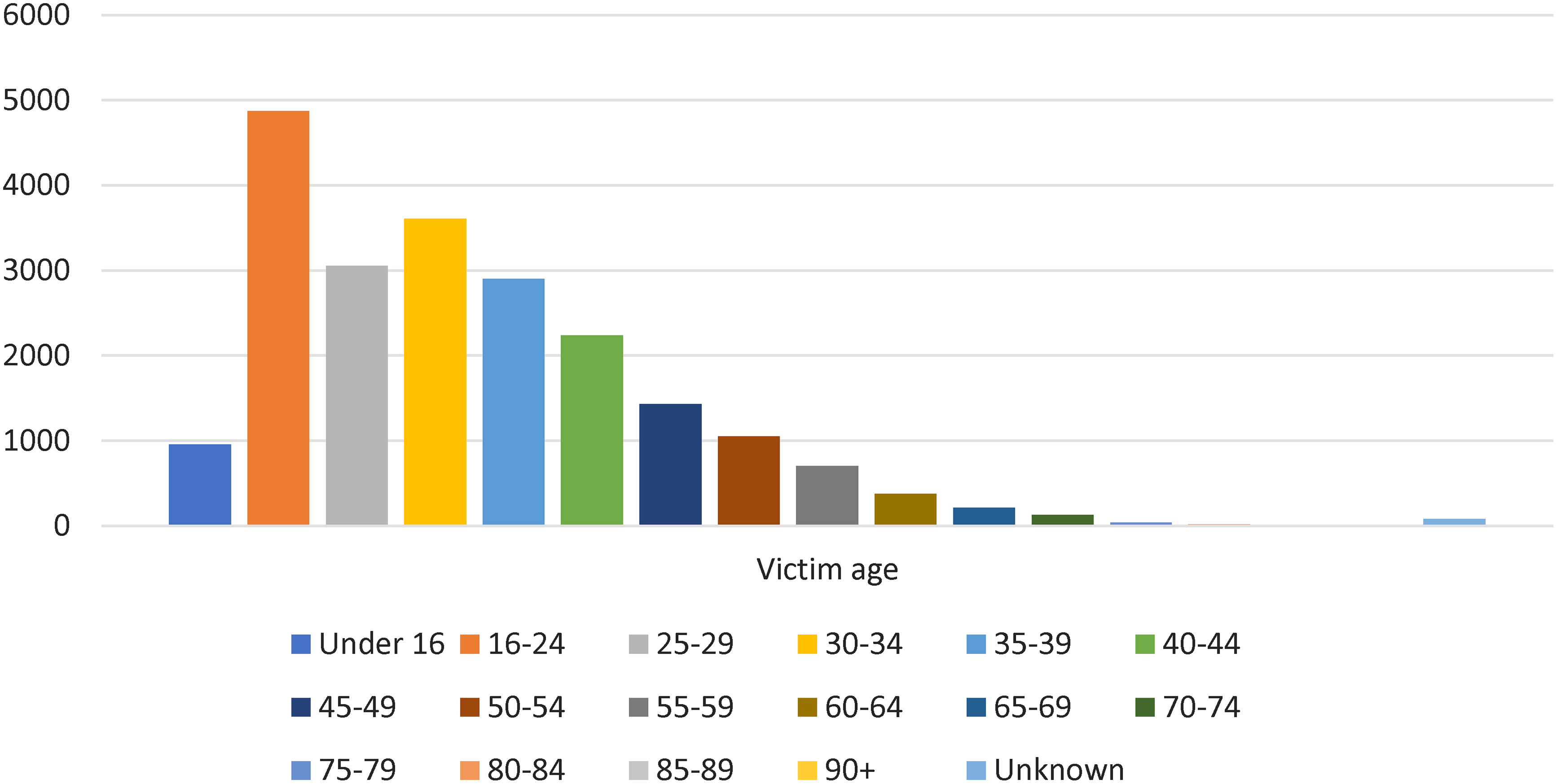
Victim age group.
In slight contrast, the suspects were slightly older than the victims (Figure 2). Data was provided by 28 forces, relating to 21,314 suspects. Excluding cases where the age was unknown (n = 789), data on age was available for 20,525 suspects. The majority were aged 30–34 (n = 3465, 17%) followed by 35–39 (n = 3261, 16%).
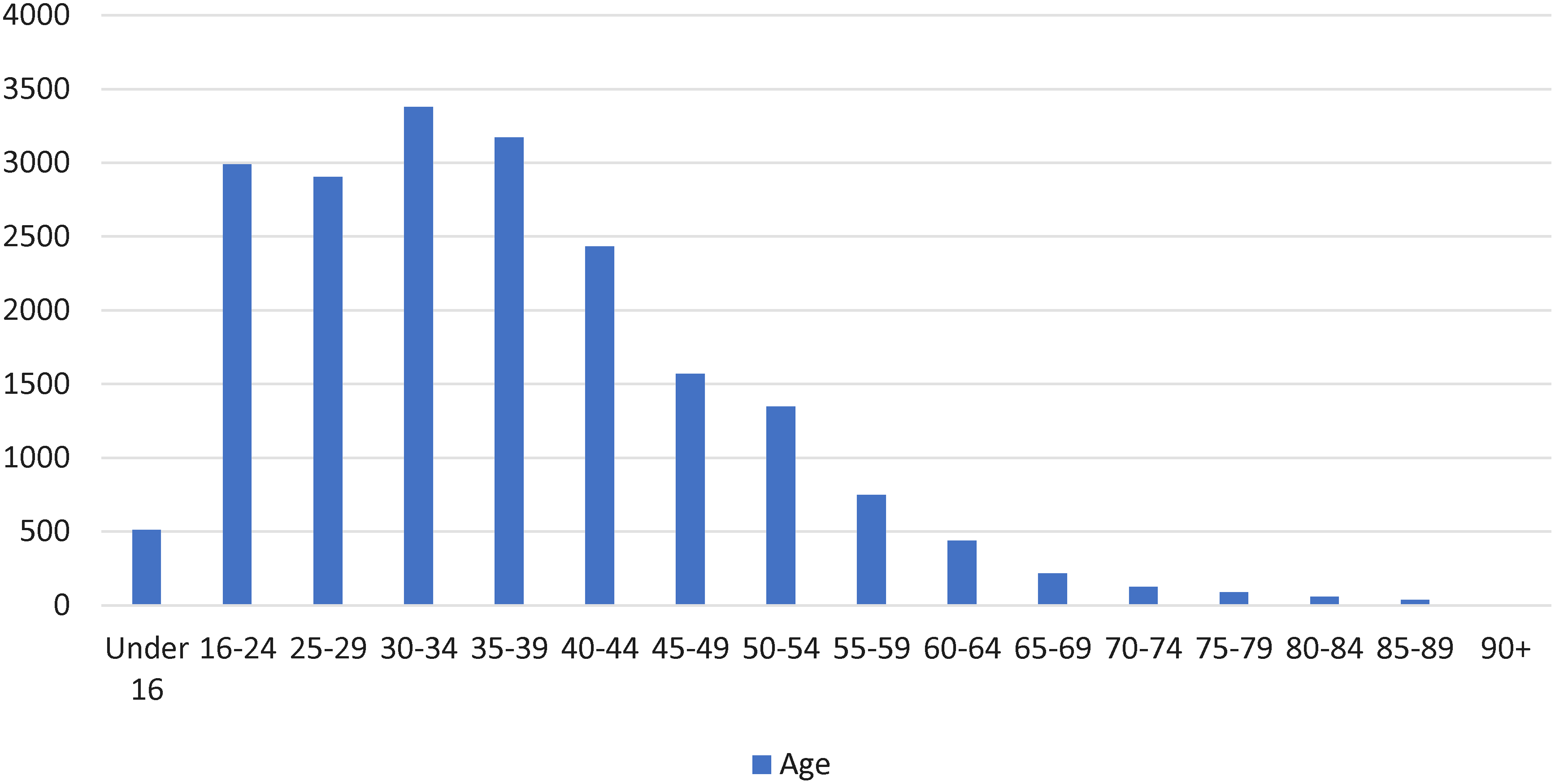
Suspect age.
Ethnicity data for victims and suspects was provided by some forces. For victims, data was provided by 22 forces concerning 16,824 victims, but of these 3999 had an ‘unknown’ ethnicity. Thus, excluding the unknown cases, data was available for 12,825 victims. The majority were White, accounting for 10,314 or 80%. The second largest group were Asian (n = 1127) and Black (n = 1102), both making up 9% of cases. Although White victims were the most commonly recorded, the proportion of Black victims is significantly higher than the population figure of 4% 74 and is, therefore, overrepresented in our analysis.
For suspects, data was provided by 21 forces relating to 15,963. Again, after removing the 3372 cases where ethnicity was unknown or not recorded, data on ethnicity was available for 12,591 suspects. Of these, the majority were White (n = 9928, 79%). The next largest group was Black (n = 1294, 10%) and Asian (n = 1111, 9%). Again, Black suspects were overrepresented in our analysis compared with the population profile.
Data on the relationship between victims and suspects was provided by 22 forces concerning 16,352 cases. Excluding cases where this was unknown (1493) left 14,859 cases for analysis (Figure 3). The bulk of suspects were recorded as spouses or partners (n = 5184, 35%) accounting for more than one in three. The next largest group were ex-partners or spouses, making up a further quarter (n = 3879, 26%) of cases. Non-intimate family members – namely parents, siblings, children or other family accounted for 2648 reports constituting just under one in five (18%) of recorded cases.
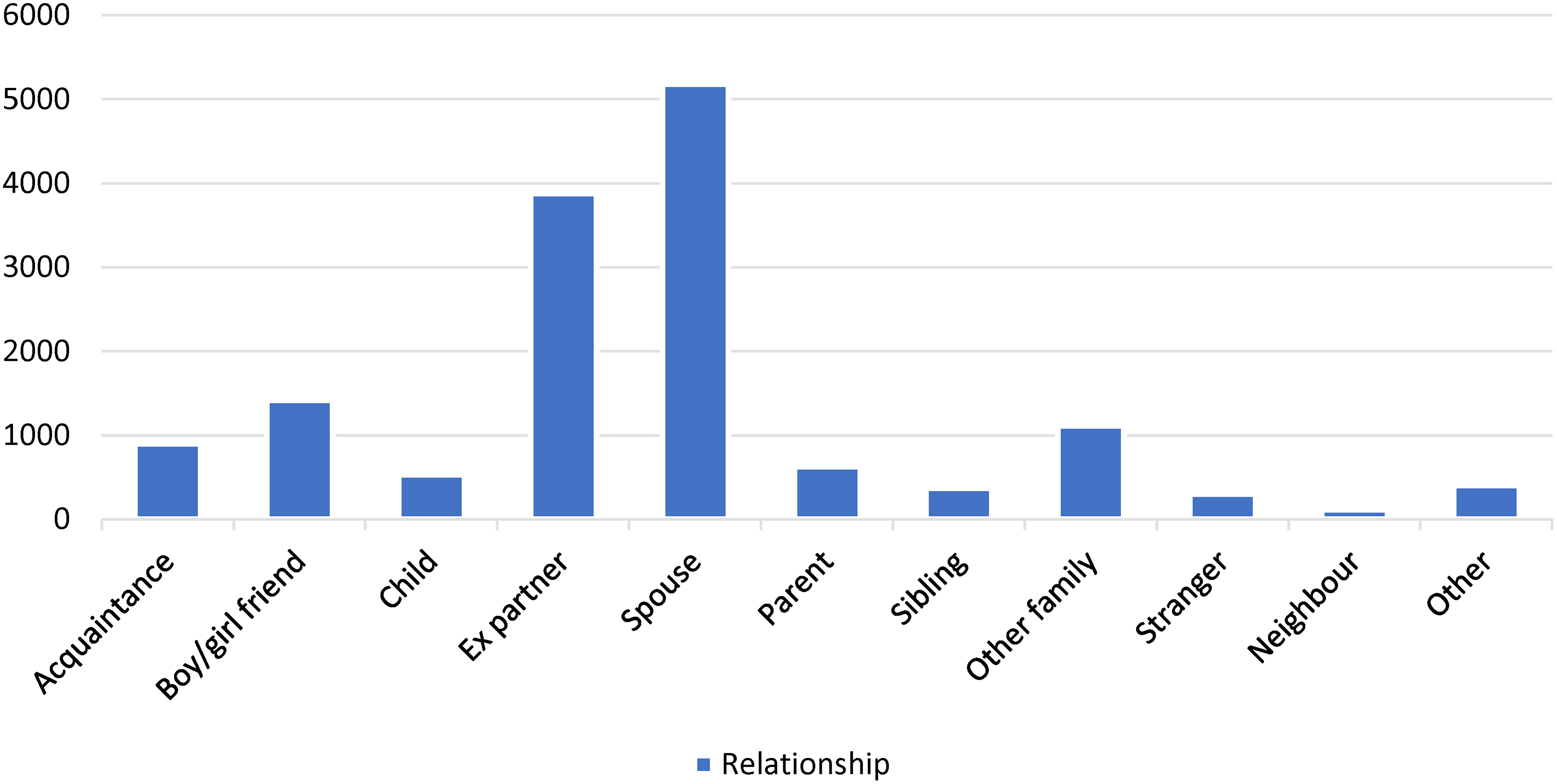
Relationship between suspect and victim.
What is the Pipeline Between Recording of the Crime, Charge and Conviction?
The Crown Prosecution Service (CPS) refused the FOI request on section 12 grounds but did confirm for the period June 2022 to April 2023, there were 1284 cases where offences under section 75A(1)(a) and (5) Serious Crime Act 2015 were charged.
A small number of forces provided outcome data; most refused the request on the grounds that data was not easily retrievable on a single system and would therefore exceed the s12 cost/time threshold.
Eight forces provided data pertaining to 8131 cases. Of those, 851 were charged (10%), although 184 were charged as an alternative offence (22%). Most cases did not proceed because the victim did not support the prosecution or withdrew support (n = 4388, 54%) or because of other evidential difficulties (but the victim supported the prosecution) (n = 1682, 21%). 75
Broadly, these figures look promising. Whilst low, they are higher than prosecutions secured for other recently introduced interpersonal offences. For example, there were only 313 offences of upskirting prosecuted between 2019 and 2022. 76 Furthermore, the charge rate for all crimes stands at 5.6% for the year 2021–2022 77 and for domestic abuse – which most NFS reported to the police appears to be from our analysis – the overall charge rate for 2022–2023 was 6.8%. Thus, whilst a charge rate of around 10% is not in and of itself something to be celebrating, it does it appear that this newly introduced offence is being used often by the police and is resulting in a charge comparably well.
Discussion and Conclusion
This article presents the findings from the first academic study to examine the new NFS offence in England and Wales. Drawing on data from 32 police forces, we found that the new offence is being used commonly. In the first 14 months of operation, 29,767 number of offences were recorded. Whilst this constitutes only a small proportion of overall recorded crimes in England and Wales during this period, the number of recorded NFS offences does indicate that the police are using this new offence to record incidents. This aligns with research on NFS offences in other jurisdictions which have reported the new offence is being routinely used by police. 78
We found that NFS cases are highly gendered, with women accounting for 81% of victims and men making up the majority of suspects, confirming previous analysis in Queensland 79 as well as the broader literature on NFS and domestic abuse more generally. We also that that most NFS are being perpetrated by intimate partners accounting for 71% of cases. However, of note is that ex-partners made up the second largest group of perpetrators, indicating that the risk of violence via NFS is not restricted to current relationships and echoing the well-established evidence that escalation and/or risk of violence is often highest at the point a relationship ends or shortly thereafter, 80 and is the second most common method of killing in female homicides (accounting for just under a third of all killings). 81
We also found that a large number of recorded offences involved family members outside of intimate relationships. Taken together, the evidence indicates that the majority of NFS is domestic abuse, perpetrated by current or former partners or other family members. However, risk assessments for capturing NFS among non-intimates may not currently identify these risks from family members; for example, the commonly used DASH risk assessment works less well at identifying risk for non-IPV domestic abuse, and although it includes questions on strangulation, the reliability of the tool to accurately assess risk has been repeatedly questioned. 82
We found that most victims were young – under the age of 30 – with 16–24 year olds forming the largest group. In contrast, suspects were slightly older, typically over the age of 30. This is in keeping with IPV and domestic homicide literature. 83 Although a small proportion, it is important to note that 4% involved under 16-year-olds as victims and 2% of suspects were aged under 16, illuminating that NFS – as with other forms of intimate violence – affects people (disproportionately women) across the life course and experiences of violence can occur at a very young (and very old) age.
In terms of ethnicity, we found that although White people made up the majority of victims and suspects, there was an over-representation of black people as both victims and suspects. Nationally, black people make up only 4% of the population but accounted for 9% of victims and 10% of suspects in cases recorded by the police. It is well known that black people are overrepresented as suspects and offenders within the criminal justice system, largely due to institutional and structural racism, 84 however, in general, we see the opposite for victimisation where black people are less trusting of the police and CJS and crimes – particularly domestic abuse – are chronically under-reported among these communities. 85 These findings chime with Douglas and Fitzgerald’s work which found aboriginal victims and suspects were overrepresented in their analysis. 86 On the one hand, the higher proportion of black victims in our analysis may point towards improved reporting of NFS victimisation among black people but further detailed analysis to understand this is required.
In terms of NFS outcomes, limited data was available from only eight forces. Nevertheless, we found a charging rate of around 12% among these forces, chiming with the findings of the IAS. This compares favourably, where the national charging rate for all crimes is around 6%. 87 However, when we looked at the breakdown of charging decisions provided by the forces who complied with the request, we saw that around one in five of the cases charged were charged as an alternative offence. Furthermore, whilst the CPS did not comply with our request for data, they did confirm that 1284 cases of NFS were taken forward by the CPS during the data period. There is thus clearly a leaky pipeline between the initial recording, charge and prosecution of NFS, and the data provided by the CPS would indicate a charge rate of < 10%. However, this is still better than the 6.8% charge rate for domestic abuse overall. 88 We do not have further detail on the victim, suspect and crime characteristics of cases that were prosecuted, and more detailed analysis is required to understand whether certain groups are more likely to get a prosecution than others. This is particularly important given the disparities in ethnicity that our analysis has revealed.
There are a number of limitations to our study. First, whilst we obtained data from a large number of forces, there were still around eight forces that did not comply with our request, meaning we do not have a full national picture. Second, the nature of the FOI request means there is a degree of human error likely in producing the requested data and/or counting or duplication issues within records that are not cleaned prior to data being provided. Moreover, we had limited data for charges and outcomes. Nevertheless, our analysis confirms the limited previous research findings on NFS in terms of victim and suspect profiles, relationships between suspects and victims, and NFS case outcomes. However, unlike previous studies, we found a higher proportion of Black victims and suspects, which warrants further examination. Whilst police appear to be routinely using the new law to record incidents of NFS, charges and prosecutions lag behind and many NFS-recorded crimes are being charged as an alternative offence. Further research which looks in more detail at policing and prosecution practice around the new law is needed, and the barriers to using the new law in order to inform guidelines and improve outcomes. However, for now, it appears that the new offence is having some positive impacts.
Footnotes
Declaration of Conflicting Interests
The author(s) declared no potential conflicts of interest with respect to the research, authorship, and/or publication of this article.
Funding
The author(s) received no financial support for the research, authorship, and/or publication of this article.