




Abstract
The Council of Europe Convention on Action Against Trafficking in Human Beings stipulates a ‘non-punishment principle’ which provides for the possibility of not imposing penalties on victims for crimes they were compelled to commit. This paper investigates the UK's iteration of this principle: the statutory defence provided by section 45 of the Modern Slavery Act. Drawing on extant literature and relevant case law, this paper investigates current understandings of the statutory defence and the insights these provide into broader understandings of criminal exploitation. It demonstrates that while practitioners understand the processes of the legislation surrounding the defence, they are less knowledgeable about the nuances of modern slavery which therefore impacts the use and effectiveness of the defence. This paper challenges the basis upon which criminal law is applied, and its analysis makes an original contribution to recognising how misunderstandings of criminal exploitation can affect fairness in the criminal justice system.
Introduction
The Modern Slavery Act (MSA) was introduced into UK legislation in March 2015 with the broad purpose of consolidating existing offences, improving support for victims, and ensuring that perpetrators receive suitable punishment. 1
Within the MSA, section 45 offers a statutory defence (referred to as the ‘statutory defence’ for the remainder of this article) for those who are faced with criminal liability for a criminal act that they committed due to their modern slavery or human trafficking experience. This article uses the statutory defence as a lens through which to assess professional understandings of the wider context of criminal exploitation as a form of modern slavery. 2
The statutory defence was developed to comply with the non-punishment principle of The Council of Europe Convention on Action Against Trafficking in Human Beings which states that: Each Party shall, in accordance with the basic principles of its legal system, provide for the possibility of not imposing penalties on victims for their involvement in unlawful activities, to the extent that they have been compelled to do so.
3
Early UK policy regarding human trafficking was developed in a context that saw limited understanding of the issue and associated it predominantly with sexual exploitation. 4 In the 8 years since the MSA reached royal assent, understandings of, and consequent policy responses to, different forms of modern slavery have broadened significantly, with situations of criminal or labour exploitation coming to constitute most referrals into the National Referral Mechanism (NRM). 5
Criminal exploitation involves the victim being exploited into committing criminal acts, from shop lifting and forced begging to cannabis cultivation and county lines. 6 The statutory defence offers recognition to such victims who are faced with criminal liability for a crime they were victimised into committing and is particularly important considering the prevalence of potential victims being identified who have been forced into criminality.
As Piotrowicz and Sorrentino assert, ‘The criminalisation of trafficked persons is an all too common practice across the globe’. 7 States fail to recognise the trafficking experience of victims, punishing them for crimes they were victimised into committing. Imprisonment for offences committed due to a trafficking or modern slavery situation can exacerbate trauma, vulnerability, and re-exploitation after release. It also serves to erode trust in authorities and reduce the likelihood that such victims will be willing to engage with authorities in the future. 8 As such, the statutory defence offered by the MSA is a hugely important piece of legislation that was developed in order to address this precise issue: to protect victims from being punished for offences they committed due only to their experience of extreme exploitation.
Under the MSA, if the defendant is aged 18 or over, then they may use the defence (section 45 (1)) if:
- They were compelled to commit the criminal act - that compulsion is attributable to their exploitative situation; and - a reasonable person in the same situation with relevant characteristics would have no realistic alternative to committing the act. - The criminal act was a direct consequence of their exploitation. - A reasonable person in the same situation with relevant characteristics would have also committed the act.
If the defendant is under 18 when they commit the act, they may use the defence (section 45 (4)) if:
The emphasis is added above in order to demonstrate the difference between adults and minors in the implementation of the defence: for adults there is a narrower remit for its use than for a child (under 18 years old) due to the general acceptance that children are inherently vulnerable.
This article examines relevant case law and extant academic literature to analyse how the statutory defence is understood and used in practice in the UK. It argues that despite the statutory defence having been operational for 8 years and designed for the needs of those who are victimised into undertaking criminal activities, the understandings of those implementing the legislation are not attuned to the nuances of criminal exploitation. These flaws are discussed below, firstly in terms of understandings of implementation, and secondly in terms of the remit of the defence.
Understandings of the Defence
The following section uses relevant examples of case law to discuss understandings of the use of the statutory defence and evidences how these reflect broader understandings of criminal exploitation. The examples discussed demonstrate how misinterpretations of criminal exploitation have led to successful appeals on the part of defendants who had been criminalised for an offence that they were victimised into committing. They also illustrate the reframing of interpretations of how the defence should be used, and offer recognition that poor understandings of criminal exploitation can lead to breaches of a person's human rights.
First, it is pertinent to outline some of the key practicalities surrounding the statutory defence. Its implementation has three stages. The first stage is to identify that the defendant is, or was, a victim of modern slavery or human trafficking. The second stage, once victimhood has been established, is to identify that the defendant committed the criminal act because they were compelled to do so as a consequence (or as a direct result when the defendant is a child) of being a victim of modern slavery or human trafficking. The third stage is to identify that a reasonable person with the relevant characteristics would have acted in the same way under similar circumstances. To overcome the defence, the Crown Prosecution Service (CPS) must disprove at least one of these stages.
The burden of proof is one of the very basic fundamental aspects of legal practice and its application in the statutory defence is a telling starting point in terms of representing how criminal exploitation has been poorly understood by legal experts. 9 The burden of proof is the requirement on a party to sufficiently justify their position. This can be a legal burden, whereby the standard is that proof should be provided beyond a reasonable doubt, or an evidential burden, where the requirement is to provide evidence to indicate that something is or is not fact. 10 The standard position for the burden of proof is that it lies with the prosecution; that is, should the prosecution look to charge a defendant, the responsibility is with the prosecution to prove the guilt of that defendant. However, the initial interpretation of the statutory defence went against the standard practice, therefore indicating from the outset that understandings of victims of criminal exploitation were being construed differently to victims of other crimes. 11
Burden of Proof
The MSA does not make explicit where the burden of proof lies in relation to the statutory defence. The CPS originally stated that there was an evidential burden on the defendant to indicate that they were a victim of trafficking or modern slavery. To counter this, the prosecution must disprove that claim beyond reasonable doubt. If the prosecution did not succeed in this, then the legal burden of proof fell back to the defendant to prove not only that they committed the criminal act due to their slavery experience but also to prove that a reasonable person in the same situation with relevant characteristics would have had no reasonable alternative to do so.
This goes against the standard formulation for the burden of proof which, in any other criminal offence, would lie with the prosecution rather than the defendant. 12 This reversed interpretation of the burden of proof highlights how, at the outset, the experiences of a defendant who needed to raise the statutory defence were understood differently to a defendant of any other crime. Once the defence is raised, the defendant comes to simultaneously occupy the position of both a victim (of modern slavery) and a perpetrator (of the crime for which they are raising the defence against), which does not correspond neatly with the reductive, linear logic of the standard processes in the criminal justice system in which a person is understood to be either a victim or a perpetrator. 13
Positively, this position on the burden of proof was challenged in 2018 with the case of MK v R. The trial judges held that the most appropriate approach would be the same as that initially stated by the CPS as summarised above. In their appeal, the applicant submitted that the trial judge misdirected the jury as to the burden and standard of proof. Some of the key arguments put forward for their appeal were that: iv. The finding that the burden ought to rest upon a trafficking victim because she/he is best placed to provide evidence of her/his personal situation rests on a fundamental misunderstanding of such situations.
v. Reversal of the burden of proof is contrary to the clear intention expressed in parliamentary debates. 14
Of particular note is point (iv) quoted above. The Crown had argued that the defendant should bear the legal burden in proving the link between the crime and the modern slavery or trafficking experience, and the legal burden in proving that a reasonable person would have had no alternative. This was based on the claim that: the defendant is best placed to identify the circumstances of his or her personal situation in order to bring himself or herself within an exception relying on the elements of compulsion (where required) and the direct link between the commission of the act and the defendant's current or former status as a victim of slavery or trafficking. He submits that it is far easier for a defendant to give evidence about these matters, being within his or her knowledge. By contrast, the prosecution would have real difficulty in disproving to the criminal standard the defendant's account.
15
Such a stance indicates a misunderstanding of the experiences of victims of modern slavery. First, by the very reason of their experiences, the resources that a victim of modern slavery or trafficking has to be able to support themselves to meet the legal burden are significantly less than that of the prosecution. Second, it can take years before a victim of modern slavery is ready to fully discuss their experiences, or even recognise themselves as a victim. 16 Third, this legal burden would not be expected of victims of other crimes.
The Court of Appeal found that in MK's case, the trial judge's interpretation of the statutory defence was incorrect. The court argued that the burden on the defendant should be evidential only; the defendant should evidence their victimhood, that the crime was committed through compulsion attributable to their modern slavery or human trafficking experience, and that a reasonable person in the same situation with relevant characteristics would have had no reasonable alternative. The legal burden then falls to the prosecution to disprove these elements beyond reasonable doubt.
This new formulation of the burden of proof serves to better recognise the experiences and meet the needs of victims of modern slavery and human trafficking by reducing the level of responsibility placed on them in proving their experiences and justifying the actions they took as a result of the exploitation and manipulation they experienced. This decision to change where the burden of proof lies brings the application of the statutory defence in line with the standard legal position. It also serves to work towards the goal of protecting victims of modern slavery, as opposed to criminalising them as was risked by the initial iteration.
International Standards
It is imperative that police, lawyers and the judiciary have a good understanding of the statutory defence in order to implement it effectively so that it can be used with its initial intention: not to prosecute those who committed crimes as a direct result of their modern slavery experience. However, it is evident that there is still confusion as to the applicability of the statutory defence. This can be illustrated by a ruling by the European Court of Human Rights in V.C.L. and A.N. v. the United Kingdom, where a conviction of two children believed to be victims of trafficking (VoTs) led to the determination that the UK had failed to protect these child trafficking victims.
This was a case of two applicants—both Vietnamese children—who were found by police to be working in cannabis factories and charged with drug-related offences. One of the defendants had received a Single Competent Authority (one of the competent authorities that makes NRM decisions) decision which determined that he was a victim of trafficking and the European Court of Human Rights deemed that there was credible suspicion to indicate that the other defendant had also been trafficked. The CPS disagreed with this information and pursued the prosecutions. Both defendants pled guilty, were convicted, and both later unsuccessfully appealed. In dismissing the appeals by both applicants the Court of Appeal made it clear that a defendant is provided with one opportunity to give his instructions to his legal advisers and that it would only be “in the most exceptional cases” that the court would consider it appropriate to allow the defendant to advance fresh instructions about the facts for the purposes of an appeal against conviction.
17
This is the first case where The European Court of Human Rights has considered the relationship between Article 4 of the European Convention on Human Rights (freedom from slavery and forced labour) and the prosecution of trafficking victims. The Court deemed that this case constituted a violation of both Article 4 and Article 6 (right to a fair trial) of the European Convention on Human Rights in relation to failure to investigate the applicants’ status as potential trafficking victims affecting overall fairness of criminal proceedings. It stated that by prosecuting despite credible suspicion the defendants were VoTs, the domestic authorities failed to take operational measures in line with international standards to protect minors and the UK government was ordered to pay €25,000 to each applicant in damages.
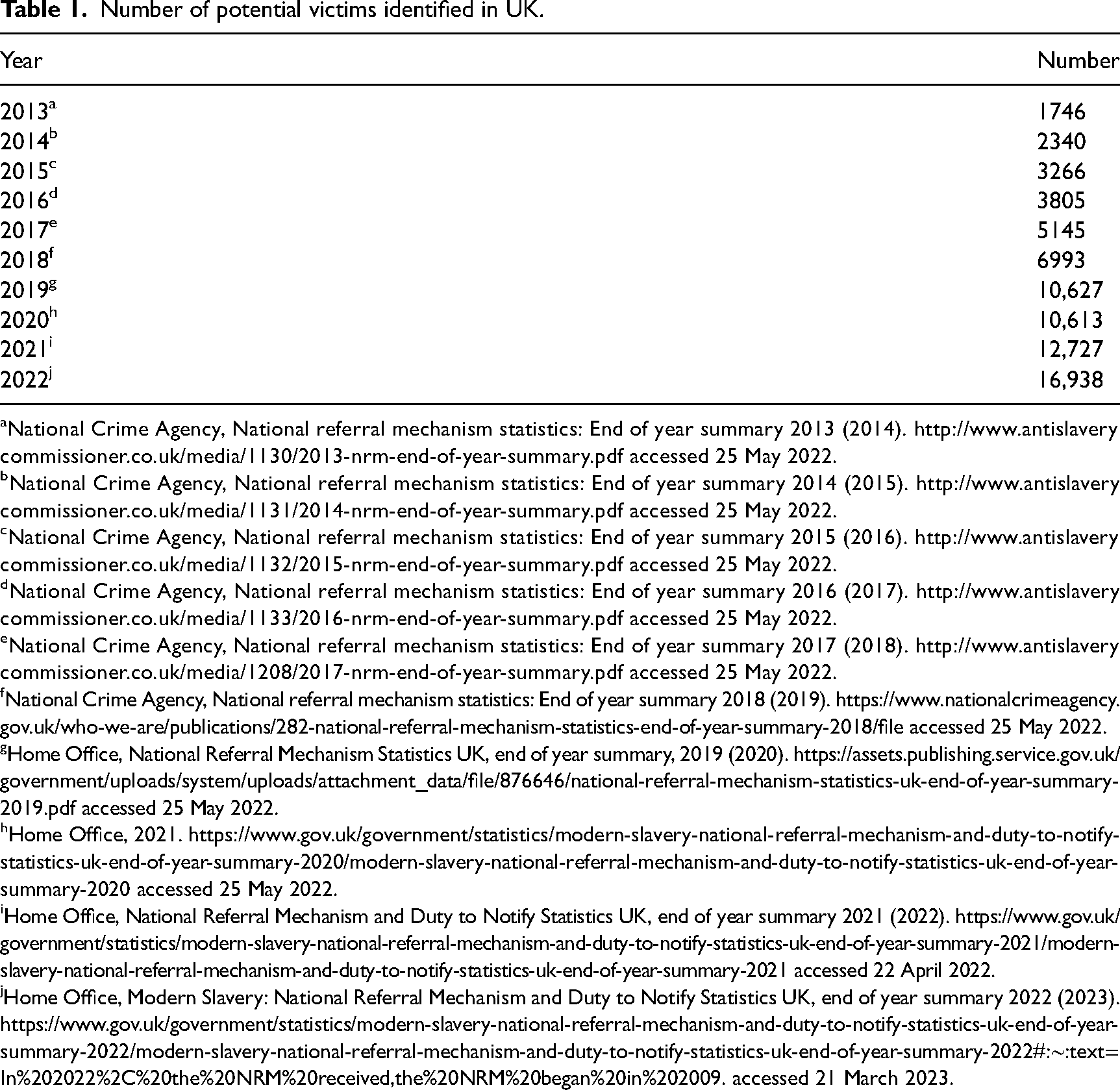
This case of pursuing a prosecution against two children without adequately investigating their exploitative situations is reflective of a poor appreciation of the conditions and circumstances in which victims of modern slavery may find themselves exploited and indicates a prosecutorial desire for results over justice. However, this push for criminalisation seems to stop at the criminalisation of the victims, without actually progressing to convictions of the perpetrators: those who forced the victims into criminality. The national picture in the UK shows a constant increase in people being identified as potential victims (Table 1). 18
Number of potential victims identified in UK.
National Crime Agency, National referral mechanism statistics: End of year summary 2013 (2014). http://www.antislaverycommissioner.co.uk/media/1130/2013-nrm-end-of-year-summary.pdf accessed 25 May 2022.
National Crime Agency, National referral mechanism statistics: End of year summary 2014 (2015). http://www.antislaverycommissioner.co.uk/media/1131/2014-nrm-end-of-year-summary.pdf accessed 25 May 2022.
National Crime Agency, National referral mechanism statistics: End of year summary 2015 (2016). http://www.antislaverycommissioner.co.uk/media/1132/2015-nrm-end-of-year-summary.pdf accessed 25 May 2022.
National Crime Agency, National referral mechanism statistics: End of year summary 2016 (2017). http://www.antislaverycommissioner.co.uk/media/1133/2016-nrm-end-of-year-summary.pdf accessed 25 May 2022.
National Crime Agency, National referral mechanism statistics: End of year summary 2017 (2018). http://www.antislaverycommissioner.co.uk/media/1208/2017-nrm-end-of-year-summary.pdf accessed 25 May 2022.
National Crime Agency, National referral mechanism statistics: End of year summary 2018 (2019). https://www.nationalcrimeagency.gov.uk/who-we-are/publications/282-national-referral-mechanism-statistics-end-of-year-summary-2018/file accessed 25 May 2022.
Home Office, National Referral Mechanism Statistics UK, end of year summary, 2019 (2020). https://assets.publishing.service.gov.uk/government/uploads/system/uploads/attachment_data/file/876646/national-referral-mechanism-statistics-uk-end-of-year-summary-2019.pdf accessed 25 May 2022.
Home Office, 2021. https://www.gov.uk/government/statistics/modern-slavery-national-referral-mechanism-and-duty-to-notify-statistics-uk-end-of-year-summary-2020/modern-slavery-national-referral-mechanism-and-duty-to-notify-statistics-uk-end-of-year-summary-2020 accessed 25 May 2022.
Home Office, National Referral Mechanism and Duty to Notify Statistics UK, end of year summary 2021 (2022). https://www.gov.uk/government/statistics/modern-slavery-national-referral-mechanism-and-duty-to-notify-statistics-uk-end-of-year-summary-2021/modern-slavery-national-referral-mechanism-and-duty-to-notify-statistics-uk-end-of-year-summary-2021 accessed 22 April 2022.
Home Office, Modern Slavery: National Referral Mechanism and Duty to Notify Statistics UK, end of year summary 2022 (2023). https://www.gov.uk/government/statistics/modern-slavery-national-referral-mechanism-and-duty-to-notify-statistics-uk-end-of-year-summary-2022/modern-slavery-national-referral-mechanism-and-duty-to-notify-statistics-uk-end-of-year-summary-2022#:∼:text=In%202022%2C%20the%20NRM%20received,the%20NRM%20began%20in%202009. accessed 21 March 2023.
However, against this background of constantly increasing numbers of potential victims, the rates of prosecutions and convictions of their exploiters remain woefully low. A 2022 report identified that in 2020 in the UK, the National Crime Agency estimated there to be between 6000 and 8000 offenders involved in modern slavery. The same year saw only 13 convictions where modern slavery was the principal offence. 19 These worrying statistics sit within a context where potential victims of criminal exploitation continue to be punished on a worrying scale for crimes they were forced to commit. 20
As is highlighted by the case of V.C.L and A.N., and reiterated by the Organization for Security and Co-operation in Europe (OSCE), ‘The criminalisation of trafficked victims may be tantamount to persecution of victims by the State’; 21 an issue which, when used correctly, and with the use of adequate investigation, the statutory defence should help to overcome.
This section of the paper has summarised the insights that case law provides into wider understandings of criminal exploitation. It highlights that the blurred lines of a defendant being simultaneously a victim and a perpetrator has led to interpretations of legislation that treat victims of criminal exploitation differently to any other crime. The following section situates these findings in academic literature to argue that current understandings of the remit of the statutory defence do not accurately correspond to the experiences of victims of criminal exploitation.
Remit
The application of the defence varies depending on whether the defendant is a child or an adult. If the person is aged 18 or over, then the defence is only applicable if they were compelled to commit the criminal act as a result of their modern slavery situation, and that a reasonable person in the same situation with relevant characteristics would have no realistic alternative to committing that act. The aspect of compulsion relates to the illicit means used to encourage the person into their exploitative situation, such as deception, coercion, or the abuse of a position of vulnerability. If the person is under 18, there is a broader remit. They may use the defence if the criminal act was a direct consequence of their exploitation and if a ‘reasonable person in the same situation with relevant characteristics would have also committed the act’.
The key differences here are between evidencing compulsion and there being no realistic alternative (for adults) as opposed to evidencing the direct consequence and that others would have taken the same action (for children). Muraszkiewicz notes that it is positive that the statutory defence does not require children to have been compelled to commit the crime, just that they were a victim, as this shows recognition that children may require a different level of protection to adults who commit crimes as part of their modern slavery experiences. 22 It is also pertinent to note that the MSA does not include ‘exploitation’ as a standalone offence, but has a descriptive definition in section 3 (6) relating to children and vulnerable adults, highlighting that they may be targeted precisely because they are a child or vulnerable adult and someone who was not a child or a person without the illness, disability, or family relationship, would be likely to refuse to be used for that purpose. We must also consider the reality that being a victim of modern slavery makes someone inherently vulnerable, more so than their age, which calls into question whether there is truly a need to differentiate between adults and children and the ‘realistic alternatives’ available to them.
In 2016, 12 months after the MSA was implemented, an independent review was undertaken by Caroline Haughey (now KC and OBE), a leading lawyer specialising in both the prosecution and defence of modern slavery cases. 23 Regarding the statutory defence, Haughey's review highlighted some key issues with the terminological choice of ‘direct consequence’. She noted that ‘The Act does not define the term “direct consequence” … nor is there any definition or guidance in the explanatory note. This may lead to difficulty in the future’. 24
Without this clarity as to what should be considered a ‘direct consequence’, the review highlights criticisms over the extent of the defence, with some claiming that it should be used as a blanket defence, applicable to any offence committed by a trafficked person, regardless of the proximity of the offence to their trafficking experience (as is the case in the Trinidad and Tobago Trafficking in Persons Act, for example, which offers an absolute defence for trafficking victims who commit offences due to their trafficking situation). On the other hand, others argue that the defence requires some limitations regarding which crimes should be defensible under the statutory defence and, particularly interestingly, the Human Trafficking and Exploitation (Scotland) Act 2015 does not include the statutory defence at all. Section 8 of this Act does, however, call for consideration around prosecuting victims of offences. It notes that the Lord Advocate must issue and publish instructions in such instances, which should include factors to be taken into account or steps to be taken by the prosecutor when deciding whether to prosecute a person who is, or appears to be, the victim of an offence of human trafficking or of slavery, servitude, forced or compulsory labour.
The lack of clarity surrounding what is meant by ‘direct consequence’ in relation to the statutory defence of the MSA gives rise to a discussion around the parameters of the defence and how closely linked the crime should be to the slavery experience to justify its use. This is further grounded by the requirement to show compulsion in cases where the defendants are adults. Both this ‘direct consequence’ and compulsion imply that the defence would only be applicable for a defendant who committed the crime whilst being exploited, that is, where the trafficker's intention was to benefit from their victims through the criminal acts they would commit.
This concept is picked up by Jordash who details two approaches to implementing the non-punishment principle (to which the statutory defence was developed to comply): the causation-based approach, and the compulsion-based approach. 25 The causation approach requires some form of link between the slavery or trafficking situation and the criminal act. The compulsion approach is much more boundaried and involves the victim being under such pressure to commit the criminal act that there was essentially no alternative. The compulsion model is emerging as the internationally accepted model for applying the non-punishment principle, however this model fails to properly understand the experiences of victims of modern slavery.
The following section engages with academic literature to argue that such applicability fails to fully grasp the nuances of modern slavery, where a criminal act could have been committed due to an individual's slavery or trafficking experience, but perhaps before the exploitation has occurred, or even after they have escaped it. The section concludes with a discussion of Schedule 4 of the MSA which lists the crimes that have been excluded from the statutory defence, and emphasises that this list evidences, again, a lack of understanding of the realities of modern slavery.
Crimes Committed Before Exploitation
Where children must show that the crime was a ‘direct consequence’ of their slavery experience, adults must show that they were compelled to commit the criminal act. This causes issues for those who have committed a criminal act in the process of being recruited into slavery but who have not yet been exploited, as the wording of compulsion implies that those in such a situation would not be entitled to the defence.
26
This is an issue also picked up by Jovanovic who identifies that: compulsion has to result from either the conduct that constitutes an offence of slavery, servitude or forced labour, or the conduct that constitutes ‘relevant exploitation’, resulting from an act of human trafficking. In both cases, it is clear that the MSA requires that a person has already been subject to exploitation, either in the form of slavery, servitude or forced labour, or in other forms of ‘relevant exploitation’ listed in section 3. This is a serious oversight of the MSA because, on its face, it prevents the application of the defence to victims who have been trafficked but not yet exploited.
27
Section 45 (1) (c) states that a person over 18 who uses the defence can only do so if the compulsion is attributable to slavery or to relevant exploitation. However, as Jovanovic alludes to, it is possible for a trafficking offence to be committed without the exploitative element being completed. 28 This is covered by section 4 of the MSA where a person can commit an offence if they commit an offence with the intention of committing a human trafficking offence.
By means of an illustrative example, if a person were to be trafficked across an international border and their trafficker's intention was that they were to be used in a situation of labour exploitation, but they were identified or escaped before the exploitation occurred, then they may have committed an immigration offence within the transportation part of their trafficking experience, and yet the exploitation element of the trafficking offence is incomplete and there was no compulsion to commit the crime.
Denying the defence to victims who have committed an offence in the process of being trafficked, but who have not yet experienced the intended exploitation, thus fails to properly engage with the experiences of victims, especially for those who are deceived into travelling, or whose position of vulnerability is being taken advantage of. Such individuals may appear to be consenting to this situation, but as the following section shows, this implied consent does not negate their experience of victimhood.
I argue that the defence should be applicable to such crimes where the unlawful activity was committed before the exploitative element of the trafficking crime was committed. This is especially true where the victim is a child and can raise the defence if the criminal act was a direct consequence of their exploitation, given that no definitional parameters are provided as to what is considered a ‘direct consequence’. However, in order to use the defence as the MSA intended, then the intentions and levels of agency of the victim of trafficking are likely to be considered.
To stick with the example of an immigration crime, if the victim had been abducted and there was no level of consent given to any part of the trafficker's intended movement or exploitation of them, then there is likely to be a higher degree of sympathy for the victim's situation: they committed a crime but had no agency to be able to avoid this. Where the lines become much more blurred is when other ‘means’ (as depicted by the Palermo Protocol) are used to gain the consent of the victim. The Palermo Protocol provides the most widely accepted definition of human trafficking and it breaks the crime into three elements: the act, the means and the purpose. The act refers to what is done – the recruitment, transfer, transportation, harbouring or receipt of a person. The means refers to how that is done – threat, force, coercion, abduction, fraud, deception, abuse of power or a position of vulnerability, or the giving or receiving of payments or benefits to achieve the consent of a person. The purpose is the form of exploitation that the trafficker intends to use the victim for.
As noted, where the means involves abduction, then it is evident that the victim did not intend to commit the crime, and nor did they have a strong enough degree of agency to be able to avoid committing the crime. It is the other forms of ‘means’ that require a pause for thought to consider whether or not their involvement reneges the applicability of the statutory defence. At the outset it appears that there is no generalisable, one-size-fits all answer to this conundrum. For example, if the victim appeared to have enough agency to be able to ask police for assistance, but their trafficker had threatened them with violence should they tell anyone of their situation then their experience is likely to be looked upon entirely differently than if the victim was deceived into their trafficking experience and consented to committing the immigration offence in the belief that they were committing this offence in order to achieve a better life for themselves.
However, a key element of the Palermo Protocol is its determination that ‘The consent of a victim of trafficking in persons to the intended exploitation … shall be irrelevant where any of the means … have been used’. 29 As such, while the Palermo Protocol's proposed application may not have been to situations where a trafficked person is unaware of the exploitation that the perpetrator intends, there is an argument that ‘intended exploitation’ should include acts where that intended exploitation is hidden, especially given that deception is one of the means outlined by the Palermo Protocol that traffickers may use to recruit their victims. To accept this would be to allow for victims who appeared to consent to any element of their trafficking situation to use the statutory defence. If they fit the definition of being a victim of trafficking, then any interpretation of them consenting to any aspect of the trafficking, or appearing to have an intention to commit a crime because of their trafficking experience, I argue, must not be used to deny their victimhood.
To deny a victim of trafficking the use of the statutory defence in such a situation would be to acknowledge that they have been duped by a trafficker (through one of the ‘means’ such as deception or abuse of a position of vulnerability) and accepted the trafficker's offers, but then would result in punishing them for committing a crime they would not have committed if it weren’t for the duplicitous actions of the trafficker. It would mean informing the victim that they had been misled by their trafficker and then punishing them for having fallen for that trafficker's bogus offers. Even if the victim had appeared to have consented to the travel and committing a crime in the process, they would not have consented to this if not for the wider contextual environment that the trafficker took advantage of. While this contextual environment is equally applicable to illegal migrants who have not been trafficked, the trafficking element means that there is an identifiable perpetrator who benefits or intends to benefit from the exploitation of the trafficked victim. This is corroborated by the UN General Assembly's call for governments to prevent VoTs from being prosecuted for illegal entry or residence as stated in the 2009 Resolution A/RES/63/156. 30
Similarly to Jordash (noted above), 31 Piotrowicz and Sorrentino refer to crimes committed in the process of a person being trafficked as ‘causation-based’ crimes. 32 They differentiate these from ‘duress-based’ crimes which are those a person may commit as part of their exploitative situation for the benefit of their exploiter (Jordash's compulsion-based approach). However, Piotrowicz and Sorrentino also suggest that the non-punishment principle should go further and cover offences committed by VoTs linked to their exploitation, even when the offence is not a direct consequence of the coercion they experienced by their traffickers, for example when a victim escapes but offends in the process or as a result. While this could be illustrated by a victim escaping their exploiter, finding themselves without money and, as a result, stealing food in order to eat, Piotrowicz and Sorrentino consider this a blurred line and question the acceptability of applying the non-punishment principle here. Despite the blurred line, this line of enquiry raises a valid consideration as to how closely related to the slavery/exploitation situation a crime must be in order for the statutory defence to be justified and what is really meant by ‘direct consequence’.
Crimes Committed After Exploitation
Jovanovic 33 expands on Piotrowicz and Sorrentino's discussion, 34 solidifying this suggestion that there are three different types of offences that may be committed by victims: status offences, purpose offences, and secondary offences. Status offences correspond to Piotrowicz and Sorrentino's causation-based offences, e.g., relating to violations of immigration law to facilitate trafficking. Purpose offences reflect Piotrowicz and Sorrentino's duress-based offences, e.g., those offences relating to the reason the person was trafficked, such as drug production or theft. Secondary offences are those which don’t appear to be related to the slavery situation but are still (perhaps more tenuously) a consequence. These could be crimes committed as the victim escapes their exploitation, or in an attempt to survive after escaping that they would not have committed if not for their exploitative experience.
These secondary offences would also include cycle of abuse issues, where the victim exploits others in order to ameliorate their own situation. 35 Jovanovic claims that there should be different rules around applying the defence to each of these groups of offences ‘since the compulsion and causal relationship between a victim's criminal behaviour and her trafficking experience or exploitation are inherently different.’ 36 This reflects the recommendations of the 2016 review of the MSA which advises that ‘consideration should be given to clarifying and/ or enhancing the term ‘direct consequence’, and to clarifying the process by which s45 is raised and applied’. 37 Without real clarity on these parameters, then there remain no steadfast rules on whether the defence can be applied to those committing offences before or after their exploitation. Yet both such offences could still be argued as being directly linked to the slavery/trafficking experience if the individuals would not have committed the crime if not for their exploitation (or intended exploitation).
Crimes Excluded from the Statutory Defence
While the statutory defence offered in section 45 of the MSA seeks to implement the non-punishment principle for those who committed a criminal offence because of a modern slavery experience, it is not a generic defence for anyone who has been a victim of modern slavery. Not only must there be a direct link between the offence committed and the experience of exploitation (though, as discussed above, this remains muddied), but there are over 100 offences listed in Schedule 4 of the MSA for which the defence cannot be used. The logic behind this decision to exclude a number of, mainly serious sexual and violent, offences was to avoid the creation of a loophole where serious criminals may look to exploit the statutory defence in order to escape prosecution. 38 While of course there may be concerns over the defence being taken advantage of, if the legislation is used properly then misuse of the defence would quickly fail when the defendant is unable to show that they had been a victim of modern slavery/human trafficking and compelled to commit the act. Yet this is not the only flaw with Schedule 4. Other concerns relate particularly to how several of the offences it excludes from the defence are offences that victims of modern slavery are vulnerable to committing (discussed further below). Further, just because the crime is a serious one does not exclude it from being a direct consequence of slavery, nor does it mean that the victim was not compelled to commit it. 39 Again, this reinforces that the statutory defence legislation has an incomplete comprehension of the complex nature of modern slavery and the types of crimes that victims of criminal exploitation may be victimised into committing.
The statutory defence in the MSA includes the points that, if the person is aged 18 or over, they may use the defence if ‘a reasonable person in the same situation as the person and having the person's relevant characteristics would have no realistic alternative to doing that act.’ (section 45(1)(d)). Or, if they are under 18 they may use the defence if ‘a reasonable person in the same situation as the person and having the person's relevant characteristics would do that act’ (section 45 (4)(c)). Schedule 4 destabilises these aspects of applying the statutory defence, because it undermines this reasonable-person-in-the-same-situation caveat, removing it from consideration in relation to certain crimes. Reflective of this, the Trinidad and Tobago Trafficking in Persons Act offers an absolute defence for trafficking victims who commit offences due to being trafficked. Similarly, the OSCE recommends that the non-punishment principle could apply to any offence where the link to trafficking can be established and references offences committed both ‘in the course’ of being trafficked, and ‘as a consequence’ of being trafficked, therefore indicating an openness to accepting the defence for crimes committed not only during the exploitation but also before or after. As there is no exhaustive list of offences that might be committed by victims of trafficking in the course of, or as a consequence of, being trafficked, and since new forms of exploitation may, and do, emerge, States should consider adopting an open-ended list of offences typically related to trafficking in human beings, with regard to the commission of which victims of trafficking shall be immune from punishment. It should be clearly stated that the list is not exclusive, and that the duty of non-punishment applies to any offence so long as the necessary link with trafficking is established.
40
There is a degree of merit in having a broader remit of offences for which the defence can be used, especially when some offences are commonly known to be committed by victims of modern slavery. An example of a Schedule 4 offence that is not eligible for the statutory defence, but which is crime victims of modern slavery are commonly understood to be coerced into committing is the possession of a firearm; this is particularly prevalent in situations of child criminal exploitation. 41 Another such crime would be modern slavery itself, where victims are promised favourable conditions by their exploiters if they agree to recruit or control others. 42 As Arthur and Down note, the crimes listed in Schedule 4 emphasise how the legislation fails to properly recognise the true pressures often imposed on victims of modern slavery. 43
Yet it is important to note that there may be instances where a victim of modern slavery presents having committed an offence that is excluded from the defence under Schedule 4, but where a prosecution is not pursued. This may be because the CPS does not see a public interest in prosecuting. The CPS must always consider whether it is in the public interest to prosecute, and even in serious crimes such as rape, they must ‘consider both the victim of the offence and position of the modern slavery victim when determining whether it is in the interest of justice, that a prosecution should proceed.’ 44 Equally, the CPS may choose not to pursue a case if they do not envisage a high chance of prosecution. This can be exemplified by a case from 2022 which saw a case dropped against a 16-year-old girl charged with terrorism offences after the Home Office determined that she was a victim of trafficking and the CPS resolved that there was not a realistic prospect of conviction. 45 While certain crimes listed in Schedule 4 highlight a poor understanding of the nuances of modern slavery experiences, the 2019 independent review of the MSA deemed that ‘The current safeguards of CPS discretion and consideration of the public interest test before bringing charges act as an appropriate safety net even if an offence falls within Schedule 4.’ 46 Unfortunately, in reality, these safeguards are not always used effectively.
An illustrative example highlighted by Mennim relates to two similar cases: R v O and R v N. 47 In both cases, the defendants had been identified as victims of human trafficking, but both had committed crimes: N was a Vietnamese national, and was arrested for an offence of producing class B drugs. He made it clear from the outset that he had been trafficked, but subsequently pleaded guilty and was sentenced to 16 months’ imprisonment. O was convicted and sentenced for conspiracy to control prostitution for gain. However, she did not raise her trafficking status until serving her custodial sentence of 5 years’ imprisonment. ‘N sought permission to appeal against conviction and O sought leave to appeal against conviction and sentence on the grounds that they had been VoTs and that the prosecution ought to have been discontinued or stayed as an abuse of process’. 48
The outcome of the case was that both defendants were accepted as having been victims of human trafficking, and N won his appeal but O was considered culpable for her offences of controlling prostitution for gain. ‘It was submitted that O's VoT [Victim of Trafficking] status had introduced an ‘inevitable grey line’ in determining whether sufficient nexus could be established between a VoT who had removed themselves from trafficking to become a perpetrator’. 49 As Gadd and Broad state, ‘the politics of modern slavery render it difficult for many to imagine offenders as anything other than the ‘evil’ nemesis of ‘innocent’ victims’, 50 which leads to blurred lines when considering victims who have gone on to exploit others in order to ameliorate their own situation. More information on O's situation shows that she had been subjected to a juju ritual and believed that she had no option but to be compliant for fear of the repercussions (and therefore compelled). However, her crimes were considered to outweigh the protection of the status of being a victim of trafficking, bringing us back once again to the difficult deliberation over whether the seriousness of a crime should outweigh the fact that the defendant was compelled to commit it.
Muraszkiewicz introduces Christie's ‘ideal victim’ theory into the discussion around whether or not a victim of modern slavery is culpable in any crimes they commit during their exploitation. 51 Christie's notion of the ‘ideal victim’ concludes that for society to recognise an individual as a victim, they must be blameless and weak and, at the time of victimisation, undertaking ‘respectable’ activities. This then causes problems in identifying as victims those whose activities are not considered respectable, such as those who have committed crimes. However, the perceived seriousness of these crimes can further impact the likelihood that the perpetrator's victimhood might be recognised. ‘Committing minor crimes may be tolerable but those listed in Schedule 4 interfere with our ability to accept someone as a victim’. 52 Having the capacity to undertake a serious offence like murder or rape questions the possibility that the victim is truly weak and passive, therefore undermining the likelihood that they might be deemed as a victim, and more likely to be understood – and prosecuted – as a perpetrator.
Burland also picks up on this issue of the ideal victim in relation to victims of modern slavery being compelled to commit crimes, and how this may be impacting the use of the statutory defence, even in relation to the precise crimes for which the defence was intended. 53 Burland argues that there is a dominant discourse that confines victims of human trafficking to a narrow stereotype, which destabilises the successful identification of people trafficked for crimes such as cannabis cultivation. 54 He references multiple examples of judges who describe the defendants as having been victims of modern slavery or exploitation, before passing down jail sentences to them. 55 The irony of such examples indicates a real lack of comprehension of the statutory defence amongst those who are responsible for implementing it, thereby reiterating the concerns of the reviews of the MSA that knowledge of the statutory defence amongst relevant practitioners is not of an adequate standard and this risks punishing the victims of modern slavery, while simultaneously failing to hold the true perpetrators to account. 56
Conclusion
Initial modern slavery policy in the UK was developed at a time when understandings of modern slavery focused on sexual exploitation. While recognition of different forms of modern slavery has broadened in the years since the development of the MSA, practice and policy have not kept pace. Criminal exploitation is now one of the most commonly identified forms of modern slavery in the UK, yet current practice indicates that the legislation designed to protect such victims is not always appropriately implemented, and that victims continue to be criminalised for crimes that they were victimised into committing.
This article uses examples from case law to argue that criminal exploitation needs to be better understood by those applying the statutory defence. It highlights that the blurred lines of a defendant occupying the simultaneous position of being both a victim and a perpetrator have led to interpretations of legislation that treat victims of criminal exploitation differently from victims of any other crime.
Further, the lack of clarity surrounding ‘direct consequence’ means that understandings of the applicability of the statutory defence are being reduced. In reality, victims of criminal exploitation could commit crimes before, during or after their exploitation has occurred, all purely as a result of their slavery/trafficking experience. However, in practice, the statutory defence is applied predominantly in cases relating to criminal activities conducted during the exploitation element of the slavery experience. While these are clearly situations in which the statutory defence is appropriate, they are just one type of situation in which criminal acts could be committed directly because of a situation of slavery/trafficking. Reducing the applicability of the statutory defence to just these compulsion-based crimes fails to properly engage with the real and complex experiences of victims of criminal exploitation.
Footnotes
Declaration of Conflicting Interests
The author(s) declared no potential conflicts of interest with respect to the research, authorship, and/or publication of this article.
Funding
The author(s) disclosed receipt of the following financial support for the research, authorship, and/or publication of this article: This work was supported by the Arts and Humanities Research Council (grant number AH/T012412/1).