




Abstract
The UK Government proposed in February 2020 that sentenced prisoner transfers with EU member states should continue after Brexit, but using a more ‘effective’ process than the existing CoE convention. The article analyses, with a particular focus on the Irish-UK CTA, the significance of continued UK human rights compliance for the achievement of this objective and the interrelationship of this issue with extradition/surrender (including the surrender of fugitive prisoners). It is concluded that Brexit has most probably raised the level of formal and institutional human rights compliance (including legal aid/assistance and the direct enforcement of prisoners’ rights in domestic courts) required from the UK for criminal justice cooperation with EU member states. Entering into such undertakings would not assist criminal impunity or the evasion of lawfully imposed penalties. Such undertakings, however, cannot help to resolve many problems inherent in prisoner transfer within the EU. The creation of a truly effective and rehabilitative transfer system would require (a) constructive UK Government participation in inter-governmental (including the UK devolved governments)/EU arrangements capable of incrementally resolving or effectively mitigating criminal justice cooperation problems and (b) acceptance at Westminster that this aspect of post-Brexit readjustment is likely to be intermittent and of long-duration.
Keywords
Introduction
The author of this article welcomes a UK Government policy objective and its public justification: continued access to prisoner transfer with EU member states to assist, in the relevant cases, with prisoner rehabilitation and resettlement. He has commented earlier on the importance of retaining transfer for foreign women prisoners, especially any with underlying physical and mental health problems. 1 This is qualified by concerns arising from research indicating that prisoner transfer in the EU has ‘a disruptive effect on the retribution, deterrence and rehabilitation functions of punishment’. 2 The UK Government’s proposal to build and improve on the existing CoE transfer convention could provide policy development opportunities to remove or mitigate some of the dysfunctionality within the current EU arrangements.
This item on the UK’s future criminal justice cooperation agenda can also be seen as a precautionary move. Maintaining effective cross-border criminal justice cooperation, including extradition and sentenced prisoner transfer, is critical politically should Brexit damage Northern Ireland’s fragile peace. 3 Yet such a seemingly pragmatic and constructive objective presents right-wing UK governments with an immediate dilemma. The AFSJ (Area of Freedom Security and Justice) model of criminal justice cooperation ‘rests on a bundle of rights and obligations from which it is not easy or in some cases possible to extricate certain instruments, especially from the outside’. 4 This sets clear legal parameters for future UK extradition and prisoner transfer cooperation with all EU member states, including Ireland. As will be seen, even the use of CoE Convention in its unimproved form cannot side-step this EU human rights baseline.
Past exaggeration (or misrepresentation) of the impact of human rights 5 means that the bundling of rights and safeguards into international cooperation arrangements presents a major presentational problem for the present or any successor UK Conservative Party government. Potential concerns within its support base could be lowered, however, by publicly recognising the likely modest impact of any formal and institutional human rights enforcement obligations required as a direct consequence of Brexit. Some human rights advocates also contribute to such misconceptions. Imagining ‘universal human rights trumping the world of politics,…supervised by powerful courts and individual judges à la Dworkin’s Hercules’, 6 does not encourage more balanced deliberations.
In analysing the role and significance of human rights in prisoner transfer, this article reflects on the fragility and weakness of human rights in the daily work of the courts and prison administrations. This is often disguised by how, when politicians (not only on the right 7 ) dislike a legal outcome, they may resort to claims about judges ‘lack of democratic legitimacy and public accountability’ instead of acknowledging the real origins of the problem. 8 More modest expectations of human rights law are, for example and in a way that is relevant to this article, consistent with assessments of the limited impact of human rights on Irish penal policies. Conclusions are generally pessimistic. 9 Though the comparatively recent emergence in Ireland of prison litigation, despite long-standing and objectively assessable problems of overcrowding and lack of in cell sanitation, may be significant in this respect. 10 Elsewhere in common law jurisdictions, a similar recognition of the limitations of judicial intervention can be seen in American studies. These focus instead on the damaging misconceptions in political discourse about penal issues and the need for the political reform of both penal policies and prosecution decision making. 11
The approach to human rights in this article, therefore, does not only look at the relevant law. It is also concerned with the politics of or discourse about human rights together with the organisational structures for building (necessarily incrementally) and improving on existing transfer instruments. It begins by examining the future EU-wide context for prisoner transfer with which Irish-UK arrangements—irrespective of whether the Article 50 process ends with a treaty—must be compliant. The second section looks at prisoner transfers within the Common Travel Area (CTA) in terms of its origins, current state and future options. The third section analyses the general approach of the courts—in terms of self-imposed high bars to impeding extradition/transfer and the margin of appreciation (ECtHR)/discretion (CJEU)—that restrict intervention. The fourth section examines human rights case law arising from prison conditions and prisoner treatment. That section is not a detailed commentary on the issues that may arise in an individual case or legislative/treaty review. Instead it suggests how understanding the principles and trends discernible in the relevant case law might (a) counter political misrepresentations about the interrelationship of human rights/’judicial activism’, criminal justice cooperation and Brexit, especially the potentially limited impact of human rights challenges, and (b) assist with the identification of the human rights issues that can only be addressed by policy development work on reformed transfer arrangements.
There is inevitably some overlap with Davies and Arnell’s article in this issue. They examine the history of extradition within the CTA and identify the policy options through which this could continue after Brexit. 12 This article, irrespective of the structure of the extradition process, seeks to encourage political, professional and academic deliberations about prison conditions and prisoner treatment issues arising from international in-custody transfers. The aim of which would be to contribute to the development of an efficient transfer process with more effective human rights safeguards and rehabilitative support.
The EU-Wide Context for Post-Brexit Prisoner Transfers
UK-EU member state extradition has been highly dependent on EU criminal justice cooperation and is a significant area of specialist legal activity, with, for example, 25 individuals surrendered from Ireland to the UK in 2017 and 28 travelling in the opposite direction. 13 Sentenced prisoner transfer data is less reliable, but appears to involve a similar number of individuals. 14
UK politicians value the EU way of doing extradition—MLR (mutual legal recognition) surrender (like many other measures in the AFJS acquis)—for its efficiency. 15 This applies to many aspects of the AFSJ acquis, with it being noted in The Law Society Gazette that the UK was ‘opting into as much as possible in the hope of seamless criminal cooperation after [leaving]’, with the membership of four additional or revised criminal justice cooperation measures just before or after the UK would have left the European Union under the original Article 50 timetable. 16
The UK relationship with the AFJS acquis has tended to be instrumental: ‘We do not want to be part of a European justice system, but we do want to be part of the fight against international crime’.
17
Having helped to shape the MLR approach that underlies how many of the legal instruments operate,
18
the UK
19
(also Ireland
20
) secured rights in the Lisbon Treaty, to cherry pick: [The]…exceptional status for the UK allowed it to benefit from a totally unusual pick and choose capacity, leading to risks of deep imbalances for the European criminal justice area.…Allowing some Member States to avoid a part of the acquis brings with it the risk of ending up with serious imbalances, compromising the establishment of a genuine European criminal justice area.
21
Such views gloss over, as noted earlier (and to be considered in the next section), systemic problems within the acquis itself. They also overlook the organisational skills and innovative thinking UK experts brought to acquis development. 23 This resulted in considerable mutual respect. The strength, consistency and Parliamentary impact of the professional and academic championing of the AFJS measures is reflected in the academic literature 24 and Parliamentary reports. 25 The ‘peculiar saga’ by which Denmark was legally enabled to remain part of Europol, in spite of the fact that a national referendum specifically decided it would not, is a reminder perhaps that ‘where there is a will it seems there may be well be a way’ 26 to prevent all access to cooperation being lost because of Brexit. Such mutual respect should at least provide good foundations for UK criminal justice professionals to engage with EU counterparts in developing improved prisoner transfer arrangements. Not that this would be without a political price (from a right-wing perspective). Early in the post–referendum stage of the Brexit process, it was foreseen that retaining any benefits from AFJS cooperation would require greater compliance with the acquis: a paradoxical outcome ‘with the UK having to accept more EU law than it currently does as an EU Member State’, including for the protection of human rights, ‘part of which it currently is at liberty to disregard under its opt-outs’. 27
The UK Government can do very little unilaterally. The Extradition (Provisional Arrest) Bill was announced in December 2019 in the Johnson Administration’s first Queen’s Speech. This is intended to extend arrest without warrant, currently permissible only in European Arrest Warrant (EAW) cases, to any person wanted under an Interpol red notice from specifically designated countries. If the UK were to have no access an EAW equivalent after 31 December 2020, any person identified from a red notice, or, unrealistically if access were to be retained, on the SIS II system 28 could still be arrested on behalf of an EU or EEA member state by designating (in secondary legislation) those countries. In practice such tinkering with extradition would never redress the loss of the more efficient MLR surrender procedure.
An incident during the scrutiny of the Bill illustrates how the interrelationship of human rights, criminal justice cooperation and Brexit could result in political misrepresentation about ‘judicial activism’. The Bill was amended in the House of Lords to introduce an effective political safeguard against the designation of countries with poor human rights records.
29
A minister argued (somewhat ironically, in view of the UK Internal Market Bill considered below) that the amendment was unnecessary: …there are countries in the world which do not respect the rule of law and a concern was raised that a future Government may seek to add such countries to this legislation…. even if the Government could get it through Parliament, the courts would throw it out.
30
The UK Government’s February 2020 negotiating mandate for the future EU-UK relationship acknowledged how EU-UK ‘law enforcement and judicial cooperation in criminal matters’ was in both parties’ interests’. 32 Two objectives directly relevant to this article were listed: (a) ‘fast-track extradition arrangements’ based on the EU (MLR facilitated) Surrender Agreement with Norway and Iceland 33 and (b) ‘effective’ (the emphasis is on trying to negotiate ‘time limited’) processes for ‘prisoners to be moved closer to home and be rehabilitated in the community to which they will be released’. This could ‘build and improve on’ the relevant CoE instrument. 34 The document was evasive, however, about Convention rights compliance 35 and, arguably, somewhat disingenuous about the role of the CJEU (the Court of Justice of the European Union) in such future cooperation. 36 The document referred to ‘…a separate agreement with its own appropriate and proportionate governance mechanism’ and rejected any role for the CJEU in resolving EU-UK disputes. 37
The small print, however, tells another story. Taking as an example the most recent third-country agreement cited as a possible precedent in the UK document—the Swiss Prüm (a criminal justice data sharing system) accession instrument 38 —this requires: (a) jurisprudential compliance through a uniform application and interpretation by the courts of the participating third country, entailing (i) the constant review of the development of CJEU and Swiss case law and (ii) scope for the Swiss Confederation to participate in the CJEU proceedings should an EU Member State seek a preliminary ruling relevant to the agreement 39 ; and (b) the concurrent transposition of future amendments of the EU Prüm instruments, with the Swiss Confederation given three months to decide whether to ‘independently’ transpose any amendments to the original EU instruments into its internal legal order, normally within two years or the agreement would automatically lapse. 40
The omission of MLR enforcement of alternatives to custody measures from the list of UK criminal justice objectives was consistent with an earlier opt-out, but in penal terms runs contrary to the rehabilitative stance of the prisoner transfer objective. The failure to include MLR financial penalty enforcement is surprising. This had been judged necessary by the Cameron Administration for ensuring that ‘any dissuasive effects of monetary penalties are not diminished’, 41 especially for reducing road traffic offences. Data is scarce, but it appears that the results of UK mutual enforcement have been modest. 42
The EU February 2020 negotiating mandate unambiguously sets out legal parameters for post-Brexit cooperation: (a) continued UK ECHR compliance conditionality,
43
including the ability of individuals to enforce Convention rights directly in the courts
44
and (b) recognition of the non-negotiable integrity of the EU legal order.
45
The necessary application of these two parameters (with the direct application of the CFREU (Charter of Fundamental Rights of the European Union) in place of the ECHR) for third country cooperation—with or without a future EU-UK agreement—became clearer two months later from I.N/ Ruska Federacija.
46
Having considered the significance for human rights protection of individual circumstances resulting from freedom of movement within the Single Market and the relationship of the EU legal order through a third-party MLR cooperation agreement with Iceland,
47
the CJEU held: …in the absence of an international convention on this subject between the European Union and the third State concerned,…the rules on extradition fall within the competence of the Member States. However, as is clear from the Court’s case-law, those same Member States are required to exercise that competence in accordance with EU law…
48
There is also a more recent political dimension to legal uncertainty about EU-UK criminal justice cooperation. Confidence in whether human rights will continue to be embedded in the legal systems of the three UK jurisdictions has been undermined by the UK Government’s behaviour during the 2020 negotiating period. This follows long standing combination of right-wing hostility to human rights and policy-making deferential to penal populism. 51 It is impossible for EU institutions, including CJEU to ignore, the admission by a UK Cabinet Minister that the Government would knowingly table legislation 52 that, if enacted, would ‘break international law’ by not honouring certain UK obligations under the BWA. 53 International trust in the unquestionably autonomous UK legal order was bound to be damaged when UK Ministers sought powers under the UK Internal Markets Bill 2020 to override in secondary legislation any conflicting UK laws, including primary legislation, and international obligations. 54 Similarly EU officials, together with lawyers and courts in EU in member states, will also be aware of misleading 55 and error prone 56 statements about the impact of human rights on the balance of powers within UK. This has often been coupled with headline seeking statements about greater punitiveness to deter terrorism and other serious crimes, 57 even talk of retrospective changes to current sentences. 58
The Irish record is mixed: as bad as the UK in opting-out of internationally enforceable AFJS legal aid/ assistance commitments and, in addition, poor prison physical conditions (especially with ‘slopping out’). 59 There is, nevertheless, some cautious optimism about the prospects of policy developments that could reduce the overuse of imprisonment. 60 Dialogue with Dublin about non-negotiable preconditions for criminal justice cooperation—by focusing on its political importance for protecting the GFA (Good Friday Agreement) and wider criminal justice/security issues within the CTA—might help the current or a future Conservative government to moderate its party’s populist rhetoric over human rights and penal policy.
The March 2020 EU draft treaty contains much that is helpful politically. The sections relevant to MLR surrender and prisoner transfer in surrender cases unambiguously maintain the fundamental rights aspects of the acquis and autonomy of the EU legal order, but in a way that respects the UK Government’s post-Brexit political sensitivities. The detail of what is envisaged in the March draft is described and contextualised in the online Supplementary Table. The salient points, however, are that the AFSJ acquis would be protected in cooperation arrangements with the UK jurisdictions by: requiring the UK jurisdictions and, as a consequence of this in the specific context of EU-UK cooperation, Ireland also, to enforce more fundamental rights than it accepted as an EU Member State (those relating to access to legal etc. assistance and legal aid), but only for those elements of the acquis offered to the UK (initially, for the purposes of this article, MLR based extradition and not sentenced prisoner transfer where conviction did not follow extradition); providing for dispute resolution under the auspices of a council structure co-chaired by the EU and UK, and with access to arbitration that is politically and legally neutral between the EU and UK; reserving the determination of questions of EU law to the CJEU, but—while not allowing any court within the UK jurisdictions to refer questions about the interpretation of EU law to CJEU—giving the UK Government an unequivocal right to have appropriate proceedings initiated at the Luxembourg court and to be represented directly in any proceedings related to the treaty.
The treaty, at least in the March draft, does not satisfy British ambitions (for example, it offers Prüm data sharing, but not, as foreseen for some time, SISII access rights). The lack of prisoner transfer beyond a right to post-conviction repatriation in extradition cases in the draft treaty could be explained by recognition in Brussels that (a) not all aspects of the AFSJ acquis are effectively functional or (b) there would be limits to what could be resolved in a possibly 11 month negotiating period. Hence, the importance of the proposed permanent, transparent and accountable structure offered in the draft treaty to extend and develop the operational scope of future EU-UK relationship though inter-jurisdictional (mainly but not exclusively EU and UK government and Parliament, there is also scope for civil society participation) policy development.
This proposed institutional structure for treaty review and amendment would be essential for the long-term success of EU-UK criminal justice cooperation. Initial and additional arrangements, such as prisoner transfer, need to remain consistent with interlinked but frequently evolving EU and UK criminal justice measures. The alternative to intermittent, but regular and structured post-Brexit readjustment that the treaty’s organisational structure offers, is the multiple reoccurrence of something like the 13 year saga to bring into operation the 2006 Norway and Iceland MLR Surrender Agreement, 61 and after that the separate but ad hoc and very one-sided adjustment processes required under that instrument.
Prisoner Transfer Between Ireland and the UK Jurisdictions in Context
In the absence on 1 January 2021 of new EU-UK criminal justice cooperation arrangements, the default position in Ireland would be to implement the extradition provisions of the Withdrawal of the United Kingdom from the European Union (Consequential Provisions) Act 2019 to ensure that the extradition of an Irish citizen 62 to another CTA jurisdiction would be lawful. This would be conditional on reciprocity (i.e. UK assurances that it intends to continue to extradite its citizens to Ireland post-Brexit), 63 but without any internationally enforceable conditionality over legal aid obligations, repatriation options and Convention/Charter rights after conviction. The omissions could result in successful legal challenges in Ireland or before the CJEU. Other causes of delays or absolute impediments might be encountered such as the absolute priority for an EAW issued for the surrender of the same person which could create impunity where the UK jurisdiction offence is much more serious. 64 This would be significant politically if the Article 50 negotiations end badly, or the outcome otherwise threatens Northern Ireland’s fragile peace.
Because of the Irish delay in transposing the EU prison transfer instrument, all CTA transfers at present must rely on Irish legislation implementing a CoE convention (hereafter PTC). 65 This, like extradition facilitated by the Act of 2019, is unsatisfactory from a human rights perspective and may, depending on the circumstances of the case, be contrary to Art 47 CFREU because of a similar absence of statutory human rights safeguards (including legal aid/ assistance) intrinsic to the transfer process. The PTC clearly falls well short of what is needed to facilitate the UK Government’s ambitions for ‘time limited’ prisoner repatriation, but are there other grounds for its dissatisfaction with this measure? A comparison with the AFJS instrument is helpful when considering this question.
Under the Convention, subject to physical or mental capacity and excluding where deportation has been ordered, repatriation is consensual. 66 Also, if the sentence is ‘by its nature or duration incompatible with the law of the administering State, or its law so requires’ the term may be altered judicially in the executing state to correspond to its own custodial tariffs. 67 (The exemption from consent in deportation cases is of limited effect within the CTA. Under English law Irish nationals with established residency 68 and, in most circumstances, EU citizens with similar (after 31 December 2020 BWA ‘preserved’) residency rights in the UK 69 cannot be deported, other than in exceptional circumstances. Deportation also requires cooperation by the destination state.)
The AFJS instrument differs materially from the Convention in several respects beyond being designed to facilitate quicker and often non-consensual transfers, 70 with (a) residency as well as nationality determining permissible transfer destinations, 71 (b) greater restrictions on the scope to impede transfer, 72 including a simpler approach to double criminality, 73 and (c) a more restricted approach to altering the custodial term: changes are (i) restricted to terms that in the executing state exceed the maximum penalty there and (ii) may not be reduced to less than the maximum penalty in that state for similar offences 74 ; and (iii) the two states may, on a case-by-case basis, negotiate how to adapt the custodial term provided this does not result in a more severe penalty. 75 The executing state has sole discretion about how to determine all the measures relating to serving the sentence, including the grounds for early or conditional release, 76 but in doing so may take account of the national law of the issuing state. 77
PTC transfers into Ireland have been modest. The introduction of this process met a pent-up demand for transfers within the CTA (93% of requested transfers into Ireland and 89% of outward applications). 78 An average of 19 prisoners returned to Ireland each year between 1997 and 2014, with, on 4 December 2018, 27 prisoners seeking repatriation (19 from UK prisons). 79 These arrangements stalled when a series of judgments, in the words of a former Minister for Justice and Equality ‘raised a number of complex issues about the legislation and its administration, indicating that legislative change is required’. 80
The first of these judgments 81 established that automatic release in England at the 50% point, with the balance of the sentence to be served on licence, could not be approximately replicated in Ireland. 82 In O’Farrell & ors 83 a majority of the Supreme Court found that the prisoner transfer process to Ireland was, in the words of one one of its members, ‘fundamentally defective’. 84 At least 10 UK prisoners transferred to Ireland to serve lengthy sentences, including for plotting a bombing campaign (the ‘Slovak three’ arrested after a MI5 arms sting in Slovakia 85 ) and drug smuggling had to be released. 86 A third case established two other bars to transfer: (a) the now abolished English sentence of indefinite imprisonment for public protection is, except for some overlap with the public protection element of life sentences, unknown in Irish law and (b), the incompatibility of the prospective transferee’s guilt denial with the rehabilitative/resettlement objectives of transfer. A systemic problem with the legislation noted in the third judgment was that the Minister’s consent to the proposed transfer is required before it can be definitively determined what the custodial period in Ireland would be. 87
These difficulties are not all necessarily Irish in origin, but the political background to the transposition of the PTC was certainly a contributory factor. It was noted in the O’Farrell & ors judgment how this had facilitated transfers to Ireland before all the potential legal problems issues had been resolved.
88
The problems considered in that case could ‘only be understood in its historical context’ in which the original legislation had been hastily revised in a way that provided a high level of political control over alterations to the custodial term. This had happened when the repatriation of prisoners held in the United Kingdom for terrorist offences [had become] an ‘emotive issue’ (emphases from the text of the judgment by MacMenamin J)
89
: [Amending legislation] was introduced in some haste, as paving the way in negotiations leading to the Good Friday Multi-Party Agreement in 1998.…[The original legislation] provided that, where a sentence was adapted, it should, as far as was practicable, correspond to the nature of the sentence imposed by the sentencing state, and should not, in any event, be: ‘(a) aggravated by its [The amended legislation provided that]…the High Court might adapt the legal nature, and the duration of the sentence; and that in considering a sentence, a court might adapt either or both, but only on application of the Minister.…any application to adapt legal nature or duration could only be made by the Minister, and no one else. The process of adaptation was, in a sense, to be ‘ring fenced’ for this purpose.
90
Even less hastily developed cooperation arrangements may prove to be sub-optimal. Research undertaken by Marguery and his colleagues focused on MLR transfers (both sentenced prisoner transfer and extradition) resulted in his comment that ‘mutual trust can have a disruptive effect on the retribution, deterrence and rehabilitation functions of punishment’. 91 It is clear from ECtHR case law (see the final section), however, that some the systemic problems identified by their research into the operation of the AFSJ acquis apply equally to the PTC and the CoE extradition convention.
This research identified concerns, such as, repatriation for budgetary rather than rehabilitative objectives 92 ; insufficient protection in the transfer instrument for the principle of speciality 93 ; and whether a prisoner’s interests can be adequately protected without ensuring legal assistance by a lawyer or oversight by a judge with sufficient specialist knowledge. 94 These conclusions were derived from empirical research undertaken in a representative cross-section of five EU member states with significant legal and socio-economic differences. 95 Some of the problems reported by Marguery and his colleagues had also been identified in research published seven years earlier by Vermeulen and others. 96 This highlighted risks arising from significant socio-economic disparities that might directly impact on justice, including access to effective advice for the suspect/accused person or prisoner to legal advice in the issuing and executing state, and highly material differences in prison conditions.
These research findings should not have surprised Commission officials. Three of the major prisoner transfer risks were anticipated in the 2011 EC Green Paper on MLR facilitated cooperation: (a) poor prison conditions (possibly not meeting the minimum standards of the CoE Prison Rules in some countries; (b) inadequate information for all the parties when transfer is being initiated; and (c) budget driven decisions (e.g. transfers initiated to reduce overcrowding). It acknowledged also that different early release or remission arrangements could result in the period of incarceration being materially extended following repatriation.
97
Also of direct relevance to the UK seeking to continue to cherry pick MLR surrender and a new form of prisoner transfer, but not alternative to custody measures, and relevant to Ireland’s record of infringement proceedings in respect of the latter instrument, it posed a question about the integrity of the AFJS acquis: The Framework Decision applies the principle of mutual recognition to many of these alternatives to custody and measures facilitating early release. Its correct application would imply that probation measures and alternatives to imprisonment would be available in all legal systems across the Union. These measures may then have to be promoted at Union level for a proper and efficient application of the rules by Member States.
98
How Courts Approach Prisoner Conditions and Prisoner Treatment Litigation
The massive backlog of applications before the ECtHR and non-executed judgments before the CoE Council of Ministers makes any assessment of Strasbourg jurisprudence on prisons conditions/prisoner treatment highly provisional. 99 Anagnostou and Skleparis have provided an invaluable survey of ECtHR prison judgments and their impact on prison conditions and prisoner treatment, but this comes with caveats about comprehensiveness and methodology. 100
In this and the next section the analysis will move frequently between ECtHR and CJEU case law because of their strong interrelationship or interdependency in the human rights law relevant to this article. This was not always (quite reasonably) thought to be likely: We should not expect the CJEU to become a fully-fledged fundamental rights court. A temptation to do so would provoke strong reactions in some states and their national courts.
101
There are three circumstances where the CJEU might directly become involved in the scrutiny of criminal justice cooperation within the CTA that results in the transfer of prisoners across the EU border: (a) over the legality of any EU act concerning EU/Member State cooperation with the UK; (b) at the request of an Irish court on the compatibility with EU law of any agreement on which extradition or repatriation is sought and (c), irrespective of whether an EU-UK agreement is in force, an Irish court submit a preliminary question to the CJEU. 107 Irrespective of CJEU proceedings, the Irish courts will still be required to scrutinise extradition/MLR surrender and prisoner transfer within the margin of discretion allowed to them under EU law when dealing with challenges to transfer or extradition based on human rights and/or other aspects of EU law.
This approach is influenced by ECtHR jurisprudence, but cannot offer the same flexibility to national courts and legislatures as the ‘large margin of appreciation’ allowed to Convention states.
108
That doctrine has been criticised—most notably in a famous dissenting opinion in an ECtHR judgment—for an implied relativism about universal values: …where human rights are concerned, there is no room for a margin of appreciation which would enable the States to decide what is acceptable and what is not.
109
In a markedly different legal order, with the emphasis on the primacy and direct effect in EU member states, the Luxembourg court’s margin of discretion will operate differently. For example, there is no freedom to discriminate between member state nationals and non-national residents ‘who have demonstrated a certain degree of integration in the society of that Member State’. 112 It is for the local court (echoing Aranyosi and Căldăraru and anticipating I.N/Ruska Federacij,), however, to assess extradition and transfer cases in the light of ‘the objective factors characterising the situation of the requested person’. 113
ECtHR has developed extensive case law about how national courts should assess whether Convention rights have been breached, or can be anticipated, in respect of poor prison conditions and treatment. Firstly, Soering 114 and Chahal 115 established the absolute nature of such protection, with no room for balancing the risk of ill-treatment against the reasons for extradition or expulsion. Though the threshold for what is eventually determined to be prohibited may still be relative to the circumstances of the case or the subjective characteristics of the applicant. 116 Secondly, engagement can occur with the anticipation of an infringement of Article 3 occurring. It does not need to await an actual infringement. From Soering onwards extradition and transfer could be challenged on the basis of the ‘suffering risked’. 117 Thirdly, Cahal drew attention to the need for confidence that the domestic legal order offered the means to enforce Convention rights in the destination state. 118 In principle EU law also holds that the prohibition of torture, inhuman or degrading conditions is absolute, 119 but goes further than Strasbourg jurisprudence, in some respects, in how the scope of this right is to be interpreted, 120 with Article 47 CFREU requiring legal aid/ assistance should be available to assist enforcement.
The Luxembourg court has offered guidance on how the objectivity envisaged in the text of the EAW and prisoner transfer instruments for a request to be rejected on specified human rights grounds can be established.
121
This is to be found initially in Aranyosi and Căldăraru in 2016, when it was offered as guidance for prison conditions and prisoner treatment litigation. It was subsequently reiterated and applied to a third country extradition case in I.N/Ruska Federacija: The competent authority of the requested Member State, such as the referring court, must rely, for the purposes of that verification, on information that is objective, reliable, specific and properly updated. That information may be obtained from, inter alia, judgments of international courts, such as judgments of the European Court of Human Rights, judgments of courts of the requesting third State, and also decisions, reports and other documents produced by bodies of the Council of Europe or under the aegis of the United Nations…
122
Both courts make it clear that applicants face a very high bar. This was stated in Strasbourg jurisprudence as a ‘serious and irreparable’ risk that Article 3 rights would not be safeguarded. 125 CJEU likewise has emphasised mutual trust in fundamental rights compliance 126 and the need to prevent impunity from criminal responsibility when domestic courts assess challenges to MLR surrender or, as in I.N/Ruska Federacija, extradition. 127
This high bar has been expressed in English national case law, notably (for extradition/ MLR surrender) in Celinski
128
and HH
129
: There is a very high presumption on ‘ensuring that extradition arrangements are honoured’, but the weight to be attached to it in the particular case varies according to the nature and seriousness of the crime or crimes involved.
130
Decisions are highly case specific, and precedents are proportionately relevant to the extent that the instant case fits the specific context of the reported case.
131
A balancing test is to be applied, particularly where there is interference with the Convention right to family life, but with considerable deference to the judgment of the adjudicatory tribunal in the executing state about the impact of any sentence.
132
Irish case law is broadly similar to English jurisprudence in the reliance on ECtHR on balancing the prevention of impunity with the protection of non-derogable article 3 rights, and specifically acknowledged in Damache and Celmer a common approach with a distinction between Article 3, which pivots on a ‘real risk’ of violation, and other Convention rights (including ‘fair trial’), where the test is the higher bar of ‘flagrant’ violation. 133 The point is also made in Celmer that this distinction applies also to violation of Irish constitutional rights litigation. 134
This reference to the Irish Constitution requires a caveat to the case analysis in the next section. The Irish European Convention on Human Rights Act 2003 ‘drew heavily on the text of the UK Human Rights Act 1998’, 135 but ‘the interpretive obligation is more qualified…’ 136 and constitutional issues have to be determined by the courts prior to ECHR compatibility issues. 137 Possibly Irish law is more unpredictable, at least that was how it appeared in 2006 138 and Irish legislators and policy makers will have learned to take this in their stride. 139 This may not be readily appreciated by London policy makers and their legal advisers who, in the past and contrary to their normal politic-legal stance against external pressure for legal harmonisation, have attempted to press for specific approaches, especially on extradition, to be adopted in Irish law. 140 This adds to the argument, even for cooperation restricted to the CTA, for (a) utilising expert deliberations to optimise the policy analysis underpinning new prisoner transfer measures and (b) permanent intuitional arrangements to anticipate, manage or mitigate potential problems (including ensuring effective interoperability with parallel cooperation instruments).
Prison Conditions and Prisoner Treatment: Human Rights Issues as Grounds for Legal Challenges or Matters for Policy Development When Devising New Prisoner Transfer Arrangements?
The high bar in international and national jurisprudence to impeding extradition or transfer, and the significance of the margin of appreciation/discretion considered in the previous section illustrate how the courts exercise considerable self-restraint over intervention in criminal justice cooperation. This section turns to an examination of the case law to identify for specific prison conditions and prisoner treatment issues: (a) the nature of the bar to judicial intervention in those circumstances and (b) how limitations in the potential scope for judicial intervention should be a spur for policy development.
It is clear from the parameters to the 2020 EU-UK negotiations and the legal analysis in the previous section that progress on a new transfer arrangement is unlikely unless ECHR compliance together with access to including legal aid/ assistance for enforcing Convention rights in UK courts is sufficiently guaranteed by London. Such a political failure would equally threaten PTC and extradition cooperation from 1 January 2021. On the other hand, UK compliance would resolve one of the problems identified by Marguery and his colleagues. Though ideally, as indicated by their research, assistance should be provided by penal specialists rather than more generalist criminal lawyers. What remains is categorised as five grounds for legal challenges relating to prison conditions and prisoner treatment that are potentially relevant to international custodial transfer between CTA jurisdictions: (a) physical conditions/overcrowding; (b) prison regime failures (e.g. health care failures and exposure to violence); (c) sentence equivalence; (d) rehabilitation/resettlement issues; and (e) non-custodial alternative disposals and discriminatory incarceration. There is obviously a degree of artificiality and overlap to this.
Physical Conditions/Overcrowding
Physical conditions/overcrowding cases—though with probably only a small number arising from challenges to extradition or transfer—give rise to the greatest number of adverse ECtHR findings in prison related litigation. 141 This is also the prison litigation category with the lowest rate of execution and closure in the CoE Council of Ministers. 142
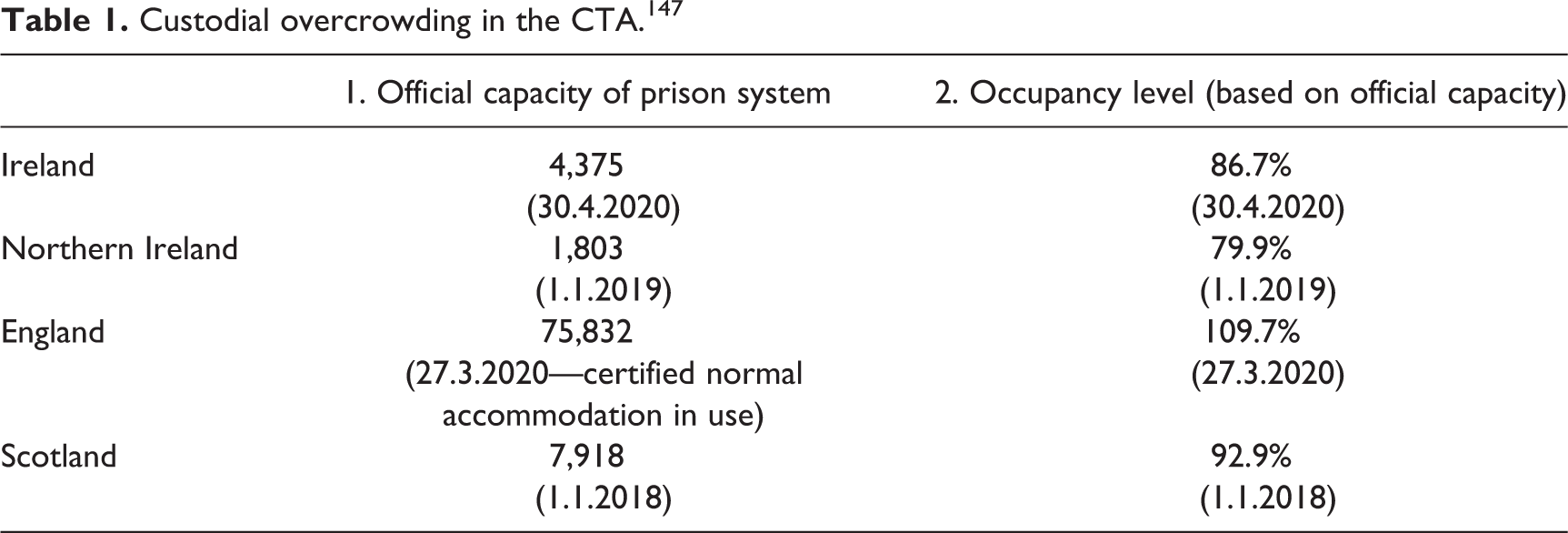
Superficially within the CTA, English prisons, as far as can be ascertained from available data (Table 1 above), appear to be most likely to give rise to judicial intervention to block inter-jurisdictional transfers. The risk of judicial intervention is probably low for CTA prison authorities. The offending and non-compliant states are mainly Eastern and Central European. 143 The Strasbourg court, as noted below, is very much aware of the high cost of prison building and modernisation projects. Even systemic and chronic dysfunctionality in Italian prisons, including the lack of hot water over lengthy periods and inadequate lighting and ventilation, was not held by ECtHR to amount, per se, to inhuman and degrading treatment. 144
Custodial overcrowding in the CTA. 147
The majority ECtHR judgment in Muršić 145 sought to avoid an over-formulaic approach, based on the square metres of living space allocated to each prisoner, in prison conditions cases, but settled on less than 3 sq m in a multi-occupied space to establish a rebuttable presumption (with reference to out-of-cell movement and activities etc.) that Convention Art 3 had been breached. It is difficult to move beyond measurable standards to judgments about the physical custodial environment in terms of whether ‘facilities, movement, interaction and behavioural change are evidently…conducive to rehabilitation and, ultimately, reintegration into society’. 146 This is an area where any new prisoner transfer arrangements would probably have to rely on case law on minimum measurable standards, but the operation of any new arrangements should include the provision of independent, comparative and specific information about both standards compliance and general physical conditions at the proposed destination. This should be funded and commissioned as an element of an entitlement to legal assistance, and should also be considered by the decision makers in both jurisdictions.
Prison Regime Failures (e.g. Health Care, Including Infectious Diseases) and Violence
The extent and range of dissenting opinions in Muršić, illustrates not only the problems of settling rebuttable standards, but also the limitations of physical space measurement compared with a more holistic assessment of the risks posed by overcrowding for a prison regime: Overcrowding undermines every aspect of what the public should expect from its prisons. It creates unsafe institutions lacking in basic decency, but also failing to provide a framework for the rehabilitative work which could reduce crime in the future.
148
Such holistic assessment of prison conditions/prisoner treatment has resulted in a significant number of adverse findings against wealthier Western European countries, particularly France and to a lesser extent Belgium, Italy and the UK. 150 These cases are also notable for a higher closure rate than physical conditions infringements. The bar, however, remains high. In English law, in medical cases for example, it is unnecessary for there to be equal quality of medical care between the UK and the requesting state. ‘The test is whether the difference in treatment would mean that extradition would be oppressive’. 151 Rising violence, deaths in custody and estimated high drug dependency in English prisons are major causes of concern and objectively verifiable from the available statistics and inspection reports, 152 but do not appear to have resulted in judicial intervention either domestically or internationally.
There is very little data in the public domain at the time of writing 153 about COVID-19 in EU, EEA and UK prisons. The best available figures, however, indicate that English prisons had experienced the highest number of infections. 154 ECtHR jurisprudence already addresses a failure to protect an inmate against infectious disease. 155 Global experience and the emergence of penal good practice for protecting prison staff and inmates against Covid-19 could result in anticipative jurisprudence based on emerging internationally standardised good practice, covering the assessment of preventive/protective measures (e.g. measures to reduce general overcrowding within institutions, clustering reduction at points of access to centralised services, including food distribution, health care and legal assistance) and the ‘cocooning’ of higher risk individuals. 156
The rapid spread of infectious diseases such as COVID-19 suggests that transfer should be prohibited if conditions in the destination jurisdiction become comparatively unsafe because of infectious diseases either at the destination or during transit. Violence and addiction risks should also be grounds for preventing or delaying transfer. Independent, comparative and location specific information about such risks together with in-custody rehabilitation programmes and post-custody resettlement support should be provided to the potential transferee and decision makers in both jurisdictions.
Sentence Equivalence
The three Irish equivalence cases, Sweeney, O’Farrell & ors and M.McK, illustrate the sometimes seemingly irresolvable problems that arise because of differences in national penal laws and sentencing practice. The second case also underlines the potentially high political significance for counter-terrorism and serious crime cooperation between Ireland and the UK when prisoner transfer arrangements fail.
The bar to judicial intervention is high. The ECtHR has taken the view that ‘a flagrantly longer de facto term of imprisonment’ in the executing state could entail a breach of Article 5, but did not consider a 20% extension of the custodial period sufficiently disproportionate to qualify. 157 In more recent years, it has been stated that a strict requirement that the period of detention should not be greater than that anticipated in the sentencing country would ‘thwart the current trend towards strengthening international cooperation in the administration of justice’. 158
Differences in parole or licence regimes appear to bear particularly hard on transferred prisoners and are likely to undermine resettlement or reintegration prospects. In Szabó (compulsory transfer under the CoE additional protocol) a ‘reasonable expectation’ of being released in Sweden after having served two-thirds of a ten-year prison sentence (after six years and eight months), on transfer to Hungary resulted in parole eligibility at four-fifths of the sentence (after eight years), one year and four months longer. 159 The Strasbourg court’s reluctance to intervene in such cases has been explained by a view that such differences in parole eligibility are not equivalent to a sentence being increased as a matter of law. 160
It is also relevant to note the ECtHR ruling in favour of the UK—a case where the Swiss authorities had held a contrary view—in Woolley v UK. The Court held that an additional custodial period (for confiscation order default) imposed as an element of an earlier sentence being served when the applicant absconded from prison and fled abroad did not breach the speciality rule. 161 The UK rather than Swiss reasoning was more persuasive in that instance.
These risks would need to be given priority in any inter-jurisdictional/governmental deliberations about the proposed new transfer measure. 162 Participation by experts from Northern Ireland and Scotland with their Irish and English colleagues would be essential because of legal and other differences that would need to be identified to achieve robust conclusions for all four CTA jurisdictions. Academic and penal NGO research in parallel to inter-governmental work would provide broader penological and legal insights. The aim should be to improve the quality information made available to the proposed transferee, his/her legal advisers and the decision makers in both jurisdictions as much as improved risk management. 163
Rehabilitation and Resettlement
The PTC does not offer sentenced prisoners a right to inter-jurisdictional transfer under Strasbourg jurisprudence, 164 instead that is subject solely to the agreement of the states concerned. 165 Remoteness from a prisoner’s family is no longer held—as in Hacisuleymanoglou—to be an ‘inevitable consequence of detention’. Physical distance from home/family ties and rehabilitation engage Article 8 ‘if the effect on the applicant’s private and family life goes beyond the “normal” hardships and restrictions inherent to the very concept of imprisonment’. 166 The finding against Russia in Khodorkovskiy and Lebedev, however, is the response to flagrant and well documented administrative persecution after conviction and sentence. The outcome of that case was consistent with doctrine developed in two much earlier (and unsuccessful) English applications: Article 8 creates a positive obligation (a) to assist prisoners as far as possible to create and sustain ties with people outside prison in order to promote social rehabilitation (Wakefield) 167 and (b) to assist prisoners in maintaining effective contact with their close family members (X v the UK) 168 However, these three cases were not concerned with inter-state transfer and the bar to a similar outcome to Khodorkovskiy and Lebedev is high for any PTC application (e.g. with the court looking for evidence of seeking alternatives such as cross-border visits or transfer within the country of detention to a more accessible location). 169
The case law summarised and culminating in I.N/Ruska Federacija 170 is likely to prove more powerful that any Strasbourg jurisprudence for keeping some families in regular and affordable visiting distance, and giving some individuals a chance of reintegration into their former settled life, albeit when residency rights trump nationality. This does, however, run counter to the universalism of human rights. Protections and safeguards will depend on complex and varying concepts of citizenship and residency allocated irregularly within the population depending on rights derived variously from the CTA, the GFA and the BWA. The potential difference, in some cases, can be seen by comparing the potential impact of EU residency rights—relevant to the country of destination as well as that requesting removal—with purely human rights approach in Veermäe v Sweden. This application was based, inter alia, on discrimination stemming from nationality that would result in a longer and more punitive sentence served in a more crowded and less adequate prison, with a less effective complaints system. It was rejected by the ECtHR, chiefly because the applicant could not be compared to prisoners of Finnish origin serving their sentences in Finnish prisons as prisoner transfer destinations were restricted to the country of nationality. 171
Perhaps criteria could be developed to indicate legitimate expectations—as a matter in England of administrative not only human rights law—about access to transfer? There may be a need for separate and more localised criteria for Ireland/ Northern Ireland. Again this is a subject where penal NGOs and academia could assist in the development of new transfer arrangements.
Non-Custodial Alternative Disposals/Discriminatory Incarceration
Feeling its way cautiously (‘It is not for the Court to indicate to States the manner in which their criminal policy and prison system should be organised’), the ECtHR has in several cases sought by reliance on political dialogue at the CoE to encourage non-custodial measures designed to tackle, among other things, ‘the problem of prison population inflation’. 172 In a similar deferential mode, the court has advocated prosecution discretion to avoid prosecution or the greater use of diversionary measures. 173 In this respect it is echoing views reached within the CoE at the end of the last century and directly relevant to the first two categories of complaint considered in this section: building new prisons alone cannot resolve penal problems. 174
The UK Government’s lack of interest in the continuation of MLR financial penalty enforcement and its failure to look again at MLR alternative penalty enforcement is incompatible with its stated enthusiasm for prisoner transfer to assist rehabilitation or resettlement. Collaborative work on sentence equivalence could be extended to equivalence issues for these two forms of cooperation. The restoration of even modest financial penalties MLR enforcement would probably fund much of the work programme envisaged here within a very short time.
Conclusions
The results of the analysis in this article and the recommendations about policy development made in the previous section are consistent with a proposition advanced by Feldman: the beneficial effect of human rights on public decision-making does not depend on judges. Using human rights is something that politicians, parliaments and public servants can and should do for themselves, for their own benefit and that of the democratic process, regardless of anything the judges may be doing in parallel to them.
175
The proposed human rights undertakings would mark a start in the CTA context of beginning to address problems identified over a number of years with prisoner transfer within the EU. Many of the other problems would need a programme of policy development work. This could begin with the provision of independent and up-to-date information for the potential transferee and his/her legal advisers about (a) physical conditions/regime quality and (b) in-custody rehabilitation programmes/post-custody resettlement support in the destination state. The results of probably more time-consuming work on sentence equivalence to prevent a repetition of the outcome of O’Farrell & ors could be introduced later into an ‘improved’ transfer process later. The equivalence work might be combined with a parallel and interrelated project to identify the feasibility of UK participation in MLR financial and alternative penalty enforcement. Given that the first of these arrangements has already worked to a limited extent, modest progress and relatively quick implementation would probably cover much of the cost of the work programme. Such collaboration might be very positive for cross-border partnerships at all levels within the CTA. Also pooling government, legal and academic expertise from the four jurisdictions might ensure a greater degree of common/Scots law informed policy input into tackling current and future problems in the AFJS acquis. 176
The proposed transferee information dossier could be deposited with the decision makers in both states as a matter of public record. The dossier would be a source of evidence should their decisions be subject to judicial or other scrutiny, such as by a statutory inspectorate. Such an initiative also has the potential to make a modest contribution to penal reform by giving potential transferees a more central role and promoting their agency (in the sense of capacity for voluntary action and some responsibility for transfer decisions). That aspect of an ‘improved’ prisoner transfer system, is beyond the scope of this article, but is an additional reason for welcoming the UK Government’s proposal. Politically such an initiative, if developed in the way suggested here, would signal recognition from Westminster that post-Brexit criminal justice cooperation with EU member states will require and receive constructive participation in inter-governmental/EU arrangements capable of incrementally improving and reducing risks arising from such processes, with progress likely to be intermittent over a comparatively lengthy period.
Supplemental Material
Supplemental Material, sj-docx-1-clj-10.1177_0022018320977527 - Prisoner Transfer Within the Irish-UK Common Travel Area (CTA) After Brexit: Human Rights Between Politics and Penal Reform
Supplemental Material, sj-docx-1-clj-10.1177_0022018320977527 for Prisoner Transfer Within the Irish-UK Common Travel Area (CTA) After Brexit: Human Rights Between Politics and Penal Reform by Tim J Wilson in The Journal of Criminal Law
Footnotes
Acknowledgements
Comments on an earlier version of this paper by Professor Chrisje Brants and discussions (formal and informal) in Dublin and Belfast with fellow members of the UK-Irish Criminal Justice Cooperation Network (UKICJCN) are gratefully acknowledged.
Declaration of Conflicting Interests
The author(s) declared no potential conflicts of interest with respect to the research, authorship, and/or publication of this article.
Funding
The author(s) disclosed receipt of the following financial support for the research, authorship and/or publication of this article: The author received financial support for the research, authorship, and publication of this article from the Arts and Humanities Research Council for funding of the UK-Irish Criminal Justice Cooperation Network (AH/S002197/1).
Supplemental Material
Supplemental material for this article is available online.
Notes
Supplementary Material
Please find the following supplemental material available below.
For Open Access articles published under a Creative Commons License, all supplemental material carries the same license as the article it is associated with.
For non-Open Access articles published, all supplemental material carries a non-exclusive license, and permission requests for re-use of supplemental material or any part of supplemental material shall be sent directly to the copyright owner as specified in the copyright notice associated with the article.
