



Abstract
Greece, despite receiving some of the highest per capita Marshall Plan aid experienced a stunted postwar reconstruction due to the bitter civil war that ended in 1949. The photographs taken by and for the Greek Marshall Plan – somewhere between propaganda and documentation – provide a rich and unexplored vein for historical research. This article demonstrates how a postwar Greek national community was visualized in the Marshall Plan photographs structured around the themes of anticommunism and self-help. By considering the Marshall Plan images of the internally displaced persons’ repatriation after the civil war, this article argues that rural Greeks were imagined by the postwar Greek state and the Marshall Plan as national-minded and hardworking. The visual narrative of the returning rural Greeks shows how reconstruction – both material and social – was refracted through (Cold War) anti-communism as well as amnesia of the recent past, eliding the complexities of the villagers’ displacement and their return. Close examination of the Marshall Plan photographs and their terms of production and consumption show how photographs provide new pathways to the histories of postwar Greece.
In the 1951 short film, The Story of Koula, a young boy growing up in a village of northern Greece has his life transformed by an American mule. Koula, as the mule is named by Kyriakos the boy-protagonist, has arrived in Greece as part of the Marshall Plan (1948–51). 1 The large mule – product and symbol of US aid – is at the centre of the modern-day parable that The Story of Koula is. The hard-scrabble life of Greek farmers is portrayed as becoming a little better with the help of the USA. Crucially though, it is the hard work of the local Greek farmers who are helping themselves that suffuses the film's narrative. The last sequence of the film exemplifies this well, where the American mule's potential as a field-plower is only fully realized when Koula is paired up with a smaller, local Greek donkey that shows Koula how the work is done.
Kyriakos’ and Koula's story was part of the Marshall Plan's extensive public information campaigns in Europe and was widely shown, dubbed into eleven languages. It expressed many of the key pillars of the Marshall Plan: US aid to restart European economies after the Second World War self-help, and hard work. The film's focus on the economic benefits of the Marshall Plan contributes to the apolitical veneer of the Marshall Plan, without acknowledging the Marshall Plan's imbrication in the developing Cold War, particularly in Greece's case.
The Story of Koula has been extensively studied, 2 as has the Marshall Plan's filmography. 3 Yet, the photography of the Marshall Plan has received little scholarly attention, 4 even though it provides a rich vein of material for studying the implementation of the Marshall Plan as well as the (re)mediation of the Marshall Plan then and now. Within the following pages, I propose to take the Marshall Plan photography seriously, examining these photographs as integral elements of the Marshall Plan itself, intended as they were to inform and persuade Greek, European, and US audiences of the Marshall Plan's successes and importance.
In this article, I will explore a collection of photographs taken by and for the Greek Marshall Plan. Through this collection I examine the role these images played in the context of postwar and post-Civil War Greece. As I will show, photography was not only used to communicate the Marshall Plan but also used to imagine a postwar Greek national community that was reconstructing itself within the developing Cold War. By focusing on the photographs depicting the repatriation of internally displaced persons 5 following the end of the Greek Civil War in 1949, I will argue that these images document and project desired lives and attitudes for rural Greeks, as imagined by the Greek postwar state and its US patron: hardworking and anti-communist, rebuilding their lives and looking towards the future. The visual narrative of the returning villagers shows how reconstruction – both material and social – was refracted through (Cold War) anti-communism as well as amnesia of the recent past, eliding the complexities of the villagers’ displacement and their return.
Photographic archives and historical photographs are integral elements to how we imagine the past. Following Julia Adeney Thomas’ approaches to photography-led historical research, I pay close attention to how photographs both visually record and construct the Marshall Plan and a particular postwar understanding of Greek citizens. Photography's ability to expose ‘the duality of our relationship to the past, a relationship that is both visceral and discursive, both instinctual and interpretive, both voluptuous and analytical’ 6 allows me to seek new knowledge of the past while also historicizing why and how photographs were made meaningful in the past. 7 Photography's key ability of capturing the contingent and making it into an event with (historical) meaning is therefore integral to my methodological approach. This dynamic highlights how photographs are integral to our historical imagination while at the same time reminding us of the fundamental historical distance that exists between us, the image and the ‘odd excision from the past’ 8 on the image.
I begin by providing some brief background to the Greek postwar era and the Marshall Plan in Greece. In addition, I will discuss the lack of study into the visuality of the Marshall Plan and why these Greek Marshall Plan photographs are important objects of study. Through my analysis of the images of repatriated rural Greeks I argue that a set of desired identities for postwar Greeks were visualized and articulated around the principles of self-help and anti-communism. These key themes form the bond between Greek local anticommunism and its Cold War counterpart. I end my analysis by contemplating the selective Cold War amnesia of the Second World War in these Marshall Plan images.
THE SECOND WORLD WAR had been particularly harsh to Greece, which experienced some of the greatest war-time destruction anywhere in Europe. 9 The country's occupation by three armies and its subsequent partition into three separate zones would lead to a devastating famine and a prolonged food-crisis. 10 At the end of the war the occupying armies pillaged what they could and destroyed the rest, leaving hardly any infrastructure intact. 11 In the aftermath of the Second World War, the old political classes jostled and competed for power, contending with the significant political and social force that the left and the communists had become, on account of the war-time communist-led resistance of the National Liberation Front/People's Liberation Army (Ethniko Apeleftherotiko Metopo/Ethnikos Laikos Apeleftherotikos Stratos).
For Greece, the end of the war was only a segue to the escalating Civil War that dragged on until 1949. 12 The bloody conflict between the British and American-backed reconstructed Greek state and the former communist resistance became the first tangible manifestation of the Cold War, inaugurated with the proclamation of the Truman Doctrine in 1947. 13 The US-Greek relationship was at its closest during the heyday of the European Recovery Program (ERP, 1948–1952) and its predecessor, the American Mission for Aid to Greece (AMAG, 1947-1948).
The ERP was the US reconstruction programme that provided 13 billion USD between 1948–1952 to help Europe rebuild after the Second World War. Implemented by the US Economic Cooperation Administration (ECA), the Marshall Plan as it is better known, was based on the principle of cooperation and self-help. The USA provided funds while the Europeans had to rebuild their economies and societies on their own. US policymakers and leaders were concerned about the state of European economies for two primary reasons: the loss of an important export market if Europe did not recover, but mainly they feared that a destroyed Europe would fall into the hands of Communism and Soviet ambitions. 14
While the Marshall Plan was intended to aid in the reconstruction of Greece, the Greek Civil War complicated its implementation. The ECA prioritized military or military-related goals in the crucial two first years of the Plan. After the end of the Civil War in 1949, the Marshall Plan had little time left to implement many of its other goals. Even though the Marshall Plan was principally an economic programme, its benefits in Greece centred around the rebuilding of infrastructure and the improvement of living standards, particularly through public health programmes. 15 Although a relatively small country with hardly any pre-war industry, Greece received some of the highest per capita aid from the Marshall Plan. It also had one of the largest ECA missions, even at times outnumbering the European HQ of the ECA in Paris. 16
Histories of postwar reconstruction have largely neglected its images and its visuality. While films have been recognized as an important agent in postwar reconstruction's meaning-making, photography has not been given the same amount of attention. 17 Despite recent important scholarship on photography's enmeshment in postwar reconstruction efforts, debates, and institutions, interest in photography has remained marginal. Yet the form that reconstruction took was inflected by its visualization. Tom Allbeson's research into postwar urban reconstruction in Great Britain, France and the Federal Republic of Germany has shown how photography played an active role in negotiating what the postwar European city became across a range of local, national, and international contexts. 18 Photography facilitated an exchange of ideas about the future of cities but also about the postwar imagined communities that strove towards European unity. 19
Postwar photography seemed to promise a ‘distinctive form of universality’ and sense of belonging, as a representation without bias. 20 This myth of universality was particularly salient in the post-Second World War world as Blake Stimson argues, when photography's affect was used to imagine a community separate from the nationalist passions that had recently wreaked havoc on the world. 21 Hence photography in the 1950s became an instrument of the cultural Cold War battles. Photography was envisioned by major institutions and corporations as a way to relate to each other detached from national markers, race, language, etc, forming thus photography's ‘nation’. 22 The capacity of photographs to constitute a ‘laboratory of social reconstruction’ 23 and conjure up new forms of political subjectivity in the interplay of images are important insights for this article. 24
Major international institutions of the postwar era such as UNRRA, UNESCO and the WHO embraced to varying degrees photography's potential in shaping their goals and missions. 25 Surprisingly little has been written on the role of photography in the workings of the Marshall Plan. Public communication was an integral aspect of the Marshall Plan, with significant resources spent on its communication in print and image. 26 However, there has been little interest in the visual production of the Marshall Plan's information activities. 27 The Marshall Plan movies have garnered the most scholarly attention, showing how the ECA leadership hired accomplished European film directors to translate the Marshall Plan for European audiences. 28 The photographic production of the Marshall Plan however is sparsely studied 29 without any dedicated analysis of its photography. Inferring from the way other divisions of the ECA information section functioned, there was an American in charge of operations while the assignments were carried out by local photographers. 30
Although the Marshall Plan was a massive aid program, it was relatively short-lived and set up on an ad-hoc basis outside of established US governmental structures and agencies. At the same time, much of its implementation and communication was – at least on paper – carried out by the seventeen participating European nations. A consequence of this is that relevant archives and materials survive across various locations on both sides of the Atlantic. 31 The study of the Greek Marshall Plan's photography provides a key early example of a postwar transnational visual culture intent on imagining the future after the devastation of the Second World War but with hybrid, Greek contours. Despite continuities and similarities with a documentary photographic style favoured by postwar non-governmental organizations, the Marshall Plan's photography was shot through Greek viewfinders.
The photographs discussed in this article were commissioned by the ECA and distributed by the United States Information Service (USIS) to promote Marshall Plan activities in Greece. 32 Although a form of propaganda, these images offer novel and unexplored avenues to analyze how Greece negotiated a postwar nationally projected identity, both domestically and internationally. Furthermore, as archival objects, the Marshall Plan photographs exist in a state of latency and possibility, 33 primed to mediate the cultural memory of this turbulent period of Greek history.
The Marshall Plan photographic collection studied here is limited to nearly 500 photographic prints, housed at the photographic archive of the ELIA-MIET in Athens, one of Greece's premier archival institutions. This collection came to the ELIA-MIET in the 1980s via an antiquarian (palaiopolis in Greek) who had found the images in the trash in Patra, Greece's third largest city, and sold them to Manos Haritatos, one of the founders of the ELIA. The archive is organized chronologically in three-ring binders. Many or most images are either stamped on the verso with a caption, have a printed caption attached, or have an associated press release attached. Some images have a combination of the above. The captions and press releases are either in Greek, English or both. While it is only a fragment of the original Marshall Plan photographic archive, this collection is unique as it is the only cohesive archive of the Greek Marshall Plan's photography. Furthermore, the collection was a working collection, used by the USIS office in Patra. The handwritten notes in Greek on the verso of numerous prints attest to its contemporary use and reference.
In line with the economic goals of the ERP, industry and infrastructure 34 are the main themes expressed in the images. Other topics dealt with are education, agriculture, and trade unionism. The spectre of anti-communism lingers in a considerable part of the ECA images. In contrast to the Greek state's own aggressive anticommunist visual propaganda, 35 the Marshall Plan's anticommunism is more constrained, partly due to the measured documentary style of its photography. The overt anticommunism of the ECA images is concentrated in the immediate aftermath of the Civil War in 1950 and 1951. These two years also represent the greatest photographic output relating to the ECA images of my study collection. From 1952 onwards the ECA transforms into the Mutual Security Administration, signalling the end of the Marshall Plan. Lastly, the care for and repatriation of the internal ‘refugees’ of the Civil War are a particularly important theme in the ECA photographs.
The spring of 1950 is a time of homecoming and rebuilding. Three years have passed since almost a tenth of the Greek population had been displaced from villages and rural homes because of the Civil War. 36 Up until that spring the displaced rural Greeks had been in the care of the state in several major cities such as Larissa, housed in ‘refugee centres’ (kentra prosifgon). But with the defeat of the communist Democratic Army of Greece (DSE Dimokratikos Stratos Elladas) in 1949, these refugees – labelled ‘bandit-stricken’ by the anti-communist Greek state and establishment – are finally returning home. Although what they come home to is mostly ruins–ruins caused in the first instance by foreign occupiers and in the second instance by communists, according to the ECA. 37 With ERP assistance and planning though, the villagers start to rebuild homes, till the land and raise new herds of livestock. Even though years of toil awaits these villagers as they return home, they eagerly throw themselves into the work.
This is the narrative which we encounter when examining the ECA photographs and captions of returning internally displaced people in the spring of 1950. The ‘refugees’ are front and centre, rebuilding their lives through hard work and with some help from the Greek state and the USA. Although not physically present in the images, the ECA is always there, bracketing this narrative and other success stories from the postwar reconstruction of Greece. While still propaganda, the ECA images are mostly subtle, telling stories that are not heavy on US product placement. It is in the lengthy captions and press releases that discourses are set out more explicitly.
Consider the inhabitants of three villages in central Greece–Olympias, Domeniko, and Karitsa. They are the protagonists of the ECA image series 163, published by USIS/ECA on 20 May 1950 alongside press release 632. Although this press release does not survive in the archive, the captions printed on the verso of the ECA 163 images recount the story of the spring homecoming in 1950. 38 The villagers which were forcibly moved from their homes during the Civil War by the Greek army 39 were now returning home with little or nothing to their name. Nevertheless, they eagerly labour on according to the text. Men, women, and children help in whatever way they can – clearing debris, rebuilding homes, or moving their few household items.
In one of the series’ photographs, Hermione Petridi, 8 years old, stands on what seems to be a mound of fabrics, receiving a round box from her sister Maria, 14 years old (Figure 1). The two sisters are tidying up in their cluttered home in the village of Olympias, making for a candid family photograph of settling into a new life. An open window on Maria Petridis’ righthand side appears to be the entry point for the family's belongings. The windowsill is laden with even more objects while the window's open left shutter can just barely be discerned. The ECA photography follows a documentary approach and style, keeping a measured distance from the events depicted. This establishes the impression of a neutral point of observation. 40 Yet despite the absence of obvious staging, certain ‘sparks of chance’ 41 upset the documentary firmament of the ECA imagery, reminding us that the viewer's gaze is guided. The sharp shadows cast by the two girls on the back wall alert us to the presence of the photographer wielding a strong flash, shaping the visual narrative. Furthermore, Maria Petridi can be seen with a slight smile on her face, hinting at the unspoken relationship and tension between the subject and the photographer. Her smile also hints at the awkwardness of the situation for the two sisters who are having their lives documented by a stranger in their own home. Such small moments interrupt the view from nowhere that the ECA images appeal to and allows us to better understand the participation of the ECA photographs in the visualization of desired identities for postwar Greeks.
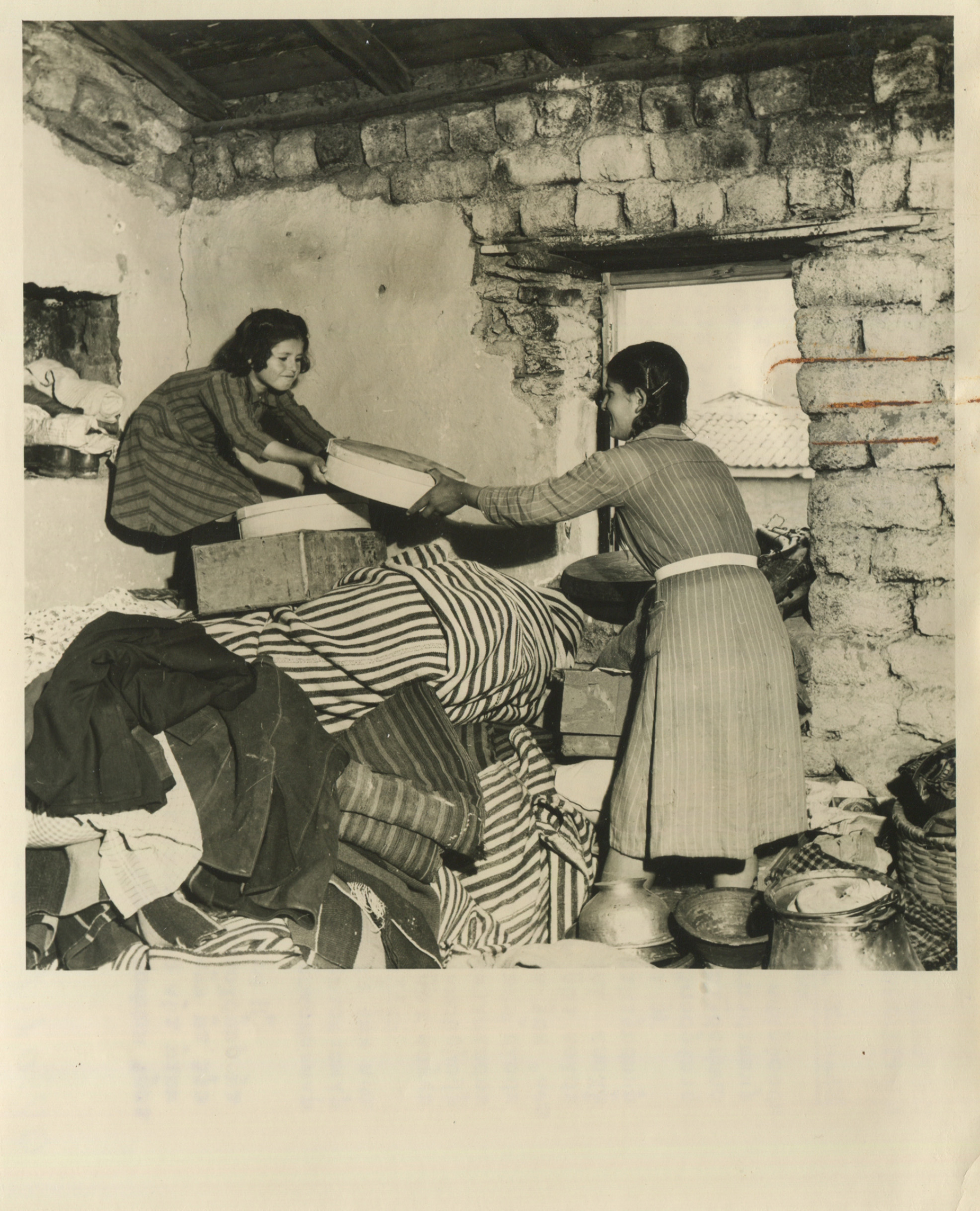
Hermione and Maria Petridi, cleaning up their home after their return to their village Olympias. Dimitris Harisiadis. 1950. National Bank of Greece Cultural Foundation, ELIA/MIET Photographic Archive, USIS collection.
The story of return starts at the ‘refugee centre’ in Larissa, from where the villagers are driven by military truck to their former homes close to Mount Olympus (Figure 2). People, baggage, and furniture all jostle for space. In an image of a truck being loaded with an iron bedframe, the caption lets us know that not all the passengers are ‘refugees’. Ioannnis Kamakas, 32 years old, who is seen helping his family load their valuables into the vehicle, is serving in the Greek army, fighting the communists. This establishes that these ‘refugees’ are above suspicion and that, if they are not their victims, they are actively fighting the communists. The depicted are not dangerous citizens. 42 Yet again, the viewer is reminded of the composed nature of this image by the presence of certain details. Observing the four ‘refugees’ lined up on a diagonal within the truck, we are struck by the fact that we can clearly see the man farthest inside the vehicle. The sharp outline of his shadow, the incongruously illuminated woman at the front and the sharpness of the details in the foreground of the image betray the photographer's flash and directing presence.
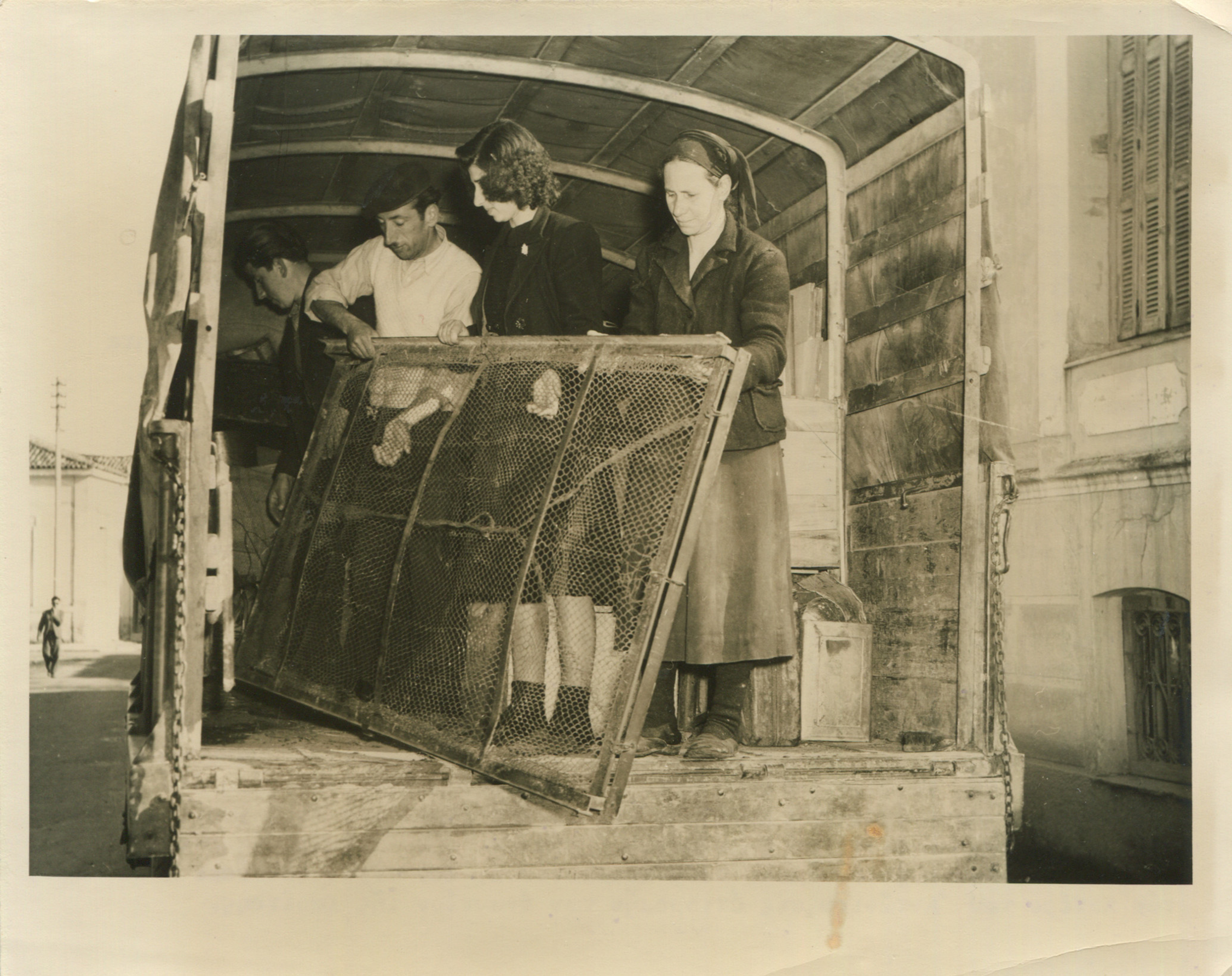
The Kamakas and Alvanou family loading a truck with their belongings. Dimitris Harisiadis. 1950. National Bank of Greece Cultural Foundation, ELIA/MIET Photographic Archive, USIS collection.
At the end of the paved road, many of the villagers still have a long journey ahead. In the seaside village of Stomion, the ‘refugees’ going to the village of Karitsa disembark and unload their belongings which will be carried to their village by donkeys, as we can read in the caption (Figure 3). The photographer captures this scene from above, dividing the image in two. In the lower half of the image, the truck is being unloaded by a group of men and women, while in the foreground an elderly woman sits by a mound of bundles surveying the scene. In the upper half of the image, we see the deserted village whose destruction is ascribed to the ‘bandits’ according to the caption. Visually efficient, the image accentuates the villagers’ struggles and hopes for the future while also stressing the devastation caused by the internal enemy. The deserted, rubble-littered street appears to lead nowhere, evoking the Civil War's catastrophies and juxtaposing them with the reconstruction taking place in the present. Another image from the series repeats this visual trope of juxtaposing the present to the past. In the foreground the Kamaka and Alvanou families are walking towards the viewer – and towards their village according to the caption. The path beginning in the lower left corner draws the viewer's gaze towards the advancing group which is marching away from the past as symbolized by the ruins in the background (Figure 4).
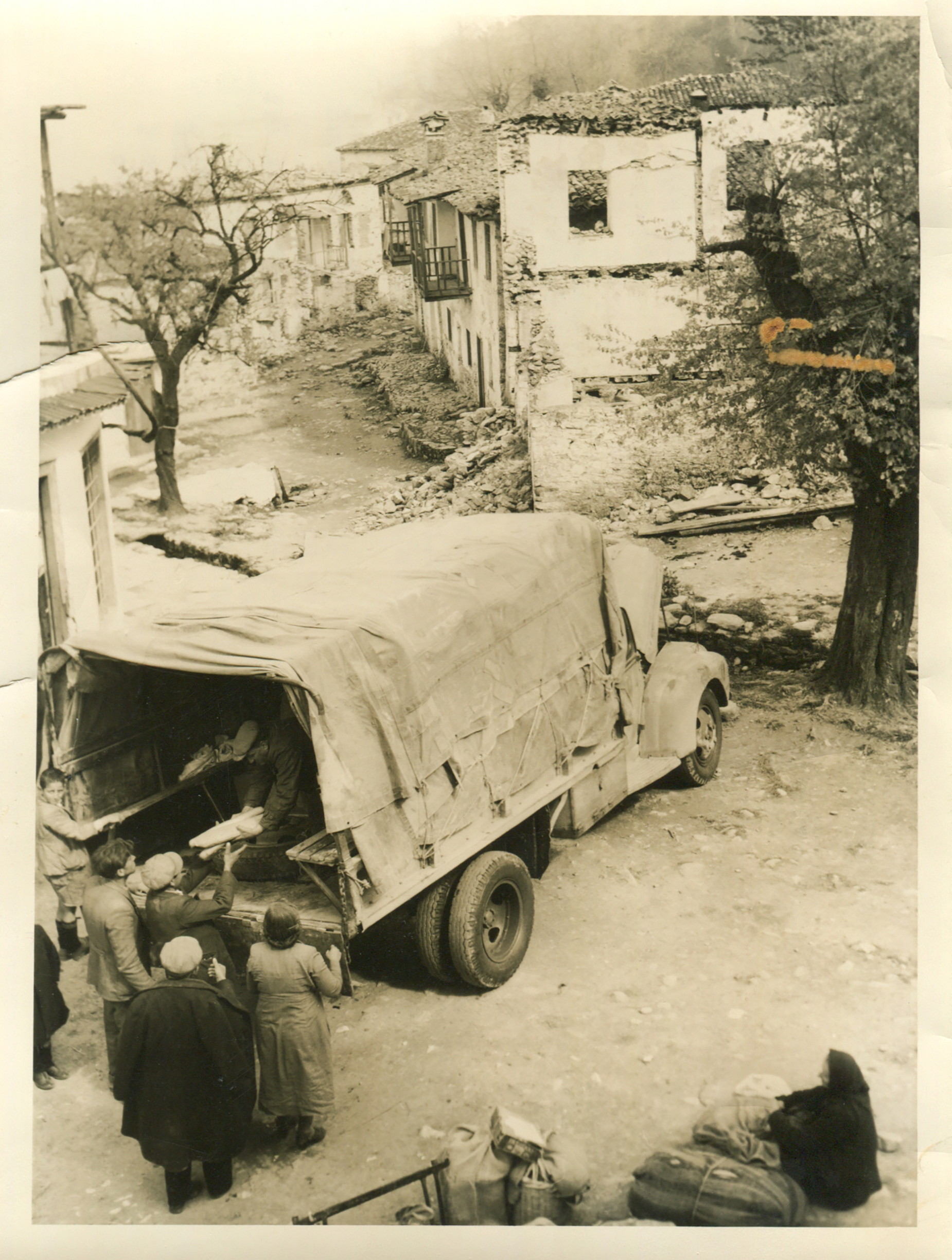
Unloading at the village of Stomio. Dimitris Harisiadis. 1950. National Bank of Greece Cultural Foundation, ELIA/MIET Photographic Archive, USIS collection.
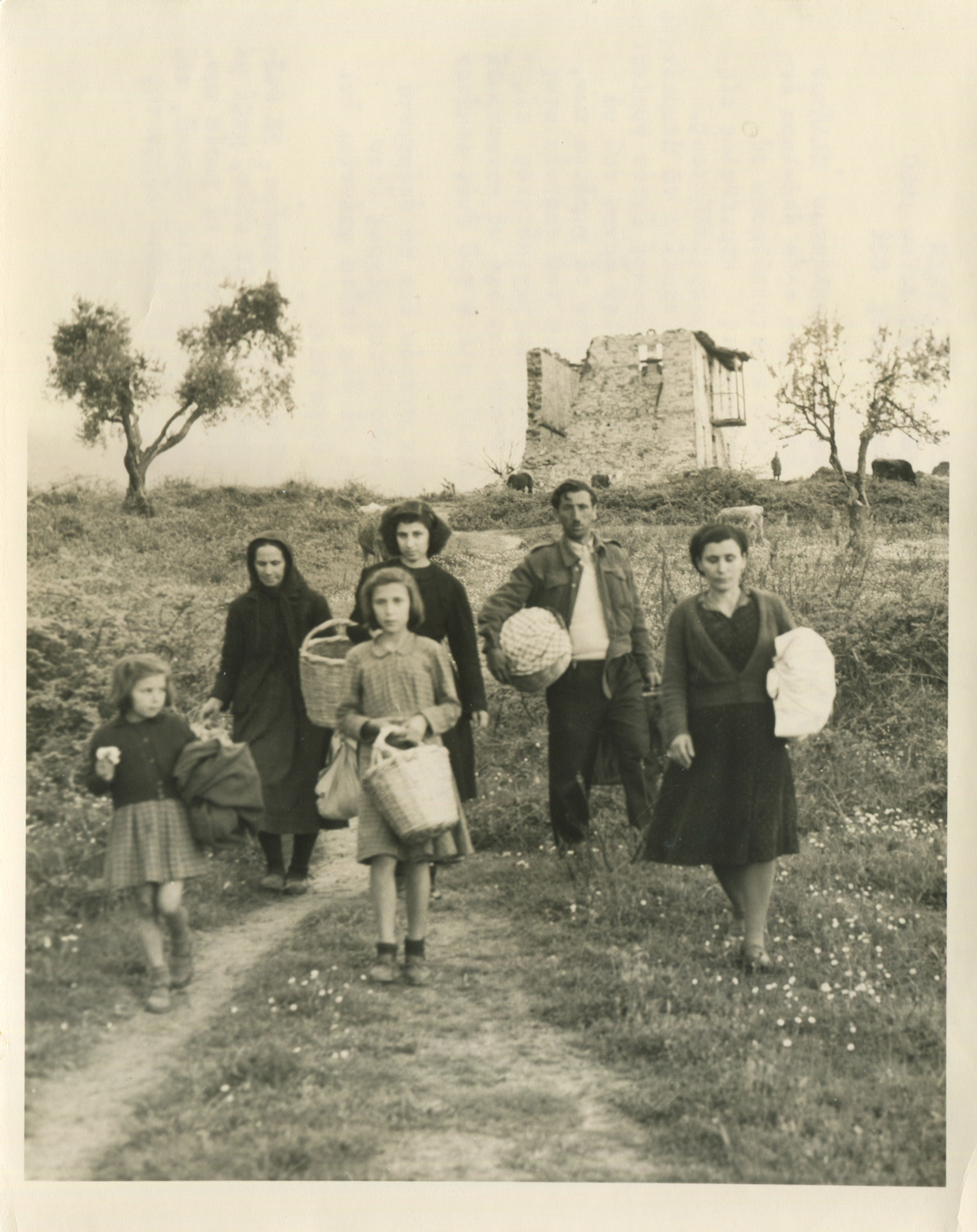
The Alvanou and Kamakas families returning to their village. Dimitris Harisiadis. 1950. National Bank of Greece Cultural Foundation, ELIA/MIET Photographic Archive, USIS collection.
In one of the other photographs from the village of Stomion (Figure 5), we see a close-up of the elderly woman sitting by the mound of bundles. She is oblivious to the photographer who has captured her with a telephoto lens right as she was adjusting a piece of cloth. The fabric and the woman's hand are blurred from the motion, lending the image documentary legitimacy which invites the viewer to read this image as a truthful representation of the plight of the returning ‘refugee’. The graffiti on the wall in the background is however noteworthy. It reads in Greek ‘Greece is an idea and it never dies’ followed by ‘5 ETP’. The text refers to the 1945 military march ‘For a new Greece’ 43 whose verse ‘Greece never dies’ is immediately recognisable in Greece even today. The nationalist verse is a visceral reminder of the violent internecine conflict and its principles of exclusion. As the graffiti was likely written by members of the Greek army's fifth light infantry battalion (5 Elafri Tagma Pezikou), we can assume that the village was at the very least cleared by the Greek army and marked as belonging to ‘Greece’ by the soldiers. Yet the inclusion of this graffiti in the photograph unintentionally complicates the established narrative of the caring Greek state and the malicious internal enemies. Without its caption, this image exhibits a malleability that sets in motion questions regarding the conditions under which the returning villagers were made wards of the state.
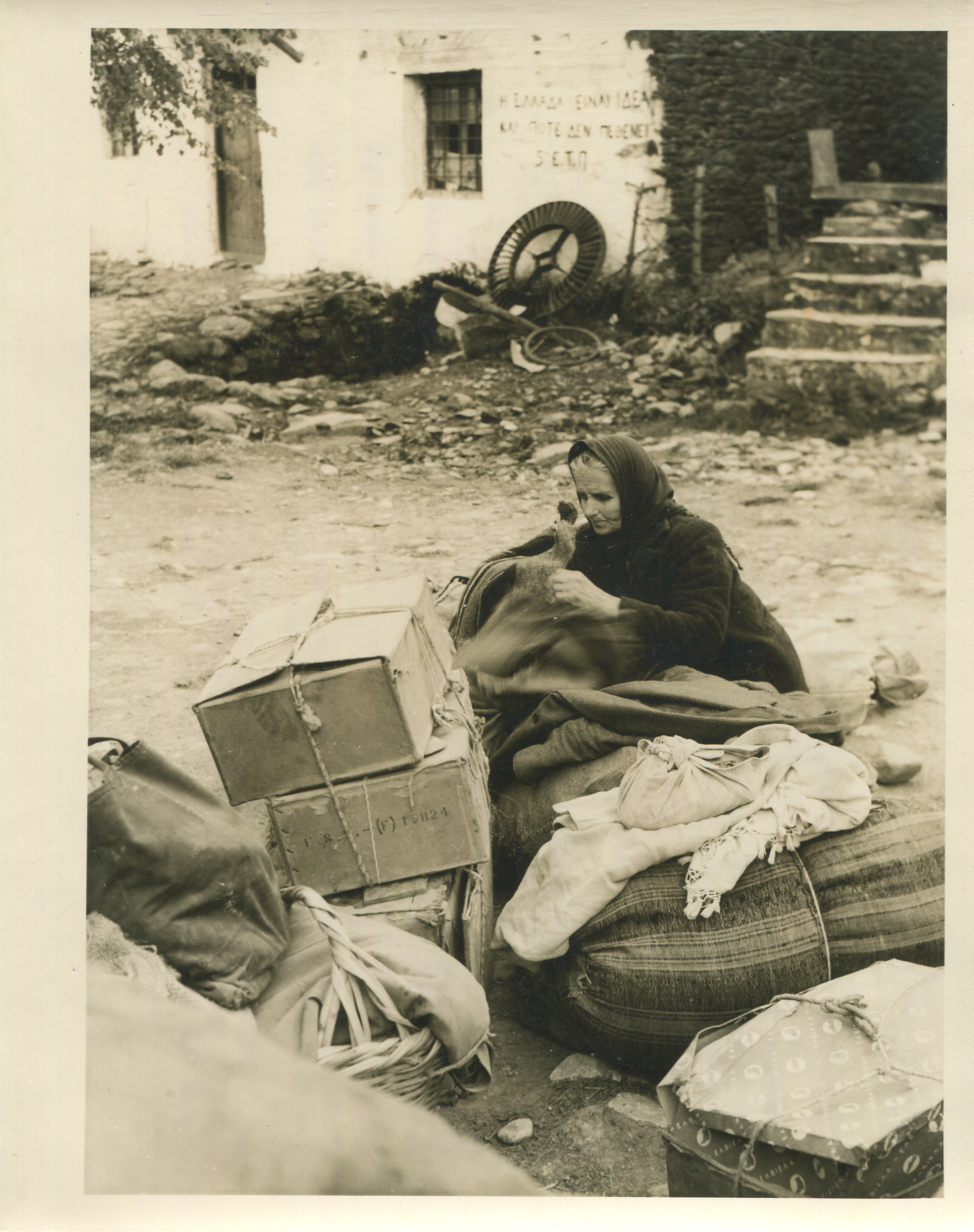
Elderly refugee waiting for her transport to the village of Karitsa. Dimitris Harisiadis. 1950. National Bank of Greece Cultural Foundation, ELIA/MIET Photographic Archive, USIS collection.
As Konstantina Kalfa notes, even the General Inspector of the Ministry of Reconstruction, Miltiadis Mylonas, acknowledged that the destruction of homes due to DSE was marginal. 44 Mylonas’ 1949 report from Epirus, one of the key theatres of the Civil War, described that the abandonment of villages led to their demise, rather than destruction by DSE soldiers. This is why some villagers would vehemently confirm their loyalty to the state, to be able to remain in their villages. 45 Such nuance is not reflected in the ECA images. Instead, the viewer is shown a partial image, one which frames the destruction of Greek villages as the sole responsibility of the ‘communist bandits’. This framing serves to shape an image of the Greek national community as antithetical to the communists and their portrayed destructiveness.
Furthermore, the captions’ description of the villages in the ECA 163 series as ‘bandit-stricken’ is severely misleading. In the notebooks compiled by Dimitris Harissiadis, the photographer of this series, a less straightforward narrative emerges. Harissiadis, who worked for US aid agencies in postwar Greece, travelled alongside the villagers on their repatriation from Larissa to their former villages in early April 1950. Harissiadis took detailed notes of the recent history of Domeniko and Olympias. Domeniko was almost raised to the ground by Italian forces in February 1943 as retribution for an attack on the Italian forces by members of the Greek resistance. More than a thousand livestock were killed, 110 homes burnt, and 118 men executed by the Italians. During the Civil War minor damages were caused by the ‘bandits’ between 1947and 1948. 46
Olympias was also raised to the ground by the German army around Easter 1943. Since Olympias was close to an area where the British were making airdrops to the Greek resistance, the Germans burned several surrounding villages to the ground. The villagers moved their livestock up the mountain and lived in caves until the liberation. During July 1943 the Axis forces suffered several ambushes by the resistance and German troops executed eight men and slaughtered or removed all livestock from Olympias as retribution. After the war, the villagers returned to the destroyed village and built huts as shelters. During the Civil War DSE began recruiting in Olympias and the villagers moved to various ‘refugee centres’. 47 None of this is reflected in the textual narratives of the ECA series which was certainly in line with the US and Greek state's goals to present a clear demarcating line between communist oppression and right-wing/liberal ‘freedom’. Yet the photographs, while participating in Cold War propaganda, do not present such a clear narrative. Instead, the photographs become visual points of entry into underexplored histories of postwar Greece.
The Greek refugees rebuilding their own homes was a most potent and affective narrative for the ECA as well as a compelling economic factor. Housing was one of the largest projects funded by the Marshall Plan. More than 35 per cent of the US aid during this period was directed towards the rebuilding of destroyed homes. It was only military aid which absorbed a larger share of US funds. 48 Hence the prominent place in the ECA photography of the rebuilding of homes. The self-housing programme for the ‘bandit-stricken refugees’ was the most important expression of the Marshall Plan's self-help initiatives, even though the self-help schemes are only one part of a larger reconstruction programme. 49 Self-help anchored the US aid to the human factor, to the people rebuilding their lives by their own actions. Thus, it tempered criticism of the Marshall Plan as a top-down, foreign intrusion into Greek society. The ‘self-housing’ as it is defined in the ECA captions and press-releases harmonised with US policies that wanted Europeans rebuilding their societies and economies on their own accord, although with US financial backing. 50 Furthermore, self-help signals that Europeans will take care of themselves in the future, extricating the USA from a longer dependency. In Greece however, the dependency of Greece on the USA was an important feature of Greek‒US postwar relations. Most importantly for Greek politicians, the US postwar aid was seen as the beginning of a long and continuing relationship, as it had been with previous instances of foreign interference. 51
While the principles of self-help are on prominent display in the ECA 163 series, ECA series 253 (6 December 1950) is solely dedicated to the ‘self-housing’ programme. Ca. 900 villages are part of this programme, but this image series focuses on the ‘self-housing’ taking place in the village of Nipsa in Western Thrace, close to the Turkish border. According to the captions, the village, destroyed by ‘communist-bandits’, is being rebuilt by the villagers with Marshall Plan funds and materials, in a new location five kilometres northwest of the old village. Only one image of the old village remains, showing the church and its belltower, which is the only thing that the ‘[…] vandal communists spared […]’ (Figure 6).
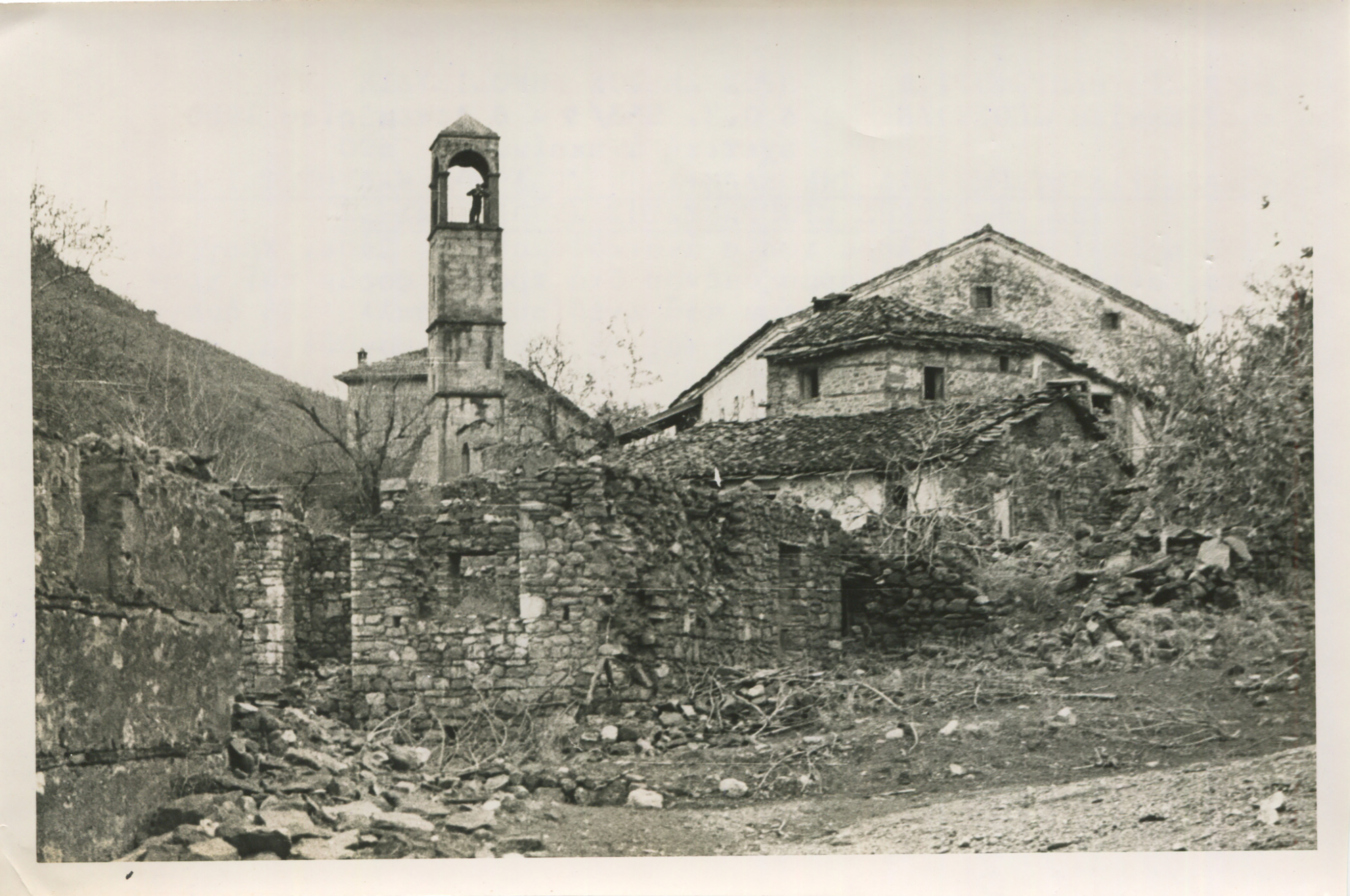
Destroyed village of Nipsa, Western Thrace. Unknown photographer. 1950. National Bank of Greece Cultural Foundation, ELIA/MIET Photographic Archive, USIS collection.
The destroyed village of Nipsa is photographed as a desolate place devoid of people except for a man standing in the church's belltower, seemingly photographing the ruins from above. Extending on a diagonal from the lower left corner to the upper right corner, the ruined structures evoke the recent conflicts and create an emblematic image of war. Yet the image itself presents certain incongruities. The caption says that the church was left undisturbed by the communists. Yet in the anticommunist rhetoric of the era, the communists were portrayed as completely hostile towards religion. So why would the ‘communist vandals’ leave the church untouched? This photograph presents us therefore with a dilemma. It offers a picture of destruction but how are we to assess the origin of destruction? Without the verbal anchor of the propagandistic caption, the photograph strikes out in ambivalence, despite its potent indexicality. Yet the insecurity of what we are seeing in the image of the destroyed village of Nipsa should make us look even closer at the image, setting in motion productive questioning about the reasons that the village was not rebuilt, but removed and set up in a new location. 52
How do self-help and self-housing relate to Greek postwar identity? Self-help was meant to empower Greeks and raise their morale, giving them hope for a better personal and national future. Building your own home had material and psychological importance, and the ‘bandit-stricken refugees’ embodied this reasoning. They had suffered war and civil war, but were still able to raise themselves up, morally and materially through their own efforts. 53 As Kalfa points out, although of US origin the self-housing programme was promoted and received as a truly popular Greek demand. The press of that period argued that Greeks had built their own homes for centuries, making self-housing a longstanding Greek practice. 54
Hence, self-housing was perceived as involving Greeks physically and psychologically in the creation of a new postwar identity geared towards the future, and towards modernity. 55 As a US idea, self-help was also envisioned as a didactic exercise, teaching societies the practices and the ethos of liberal capitalism. Thus, the reasoning went, a Greek homeowner having built or rebuilt his own home after the war, could feel pride that national reconstruction was accomplished through the Greeks’ own efforts. 56 This didacticism thinly concealed its anti-communism. The self-built home was the result of living in the ‘free world’ and cooperating with the USA, where US aid and expertise combined with the local individual efforts to create homes and well-being. While the USA was careful to conceal its own and local governments’ role in self-housing, it made sure to focus on people's own initiatives. Yet, it was obvious to most that there would be no self-housing programme without the funds, materials, and expertise supplied by the USA. 57
The latent anti-communism of Greek self-housing and self-help influenced Greek postwar subjectivities in another significant way. As foreign aid was the main source of income for Greece in the immediate postwar period, the denial of aid to those deemed not nationally-minded enough had a serious social impact. 58 It signalled that all those perceived to be against the nation did not deserve to be treated equally. Although this strategy of control is not expressed in the ECA images, it was undoubtedly lurking in the background of the narrative of reconstruction. Nowhere in the images of repatriation is there visual or textual mention of the fellow villagers who do not conform to the nationally-minded standards of post-Civil War Greece. People viewing these images at the time would have known that these villagers existed, villagers who had been sympathetic to DSE, or perhaps had simply not been supportive of the state. An erasure of these Others takes place within the ECA image series, while at the same time showing that self-helping Greeks were doing well for themselves. They had chosen the right path, the path leading to ‘freedom’.
The instrumentalization of anti-communism to shape desired Greek identities was not foreign to Greece. Anti-communism fits seamlessly within the ideology of ethnikofrosini (national-mindedness), which pervaded a significant share of Greek postwar society and the postwar ideological struggle between free democracies and totalitarian communism. 59 Additionally, it resonated with interwar Greek conservatism. This anti-totalitarianism, a cause championed by the USA, became a pillar for the ideology of national-mindedness. 60 Most importantly, ethnikofrosini came to use anti-communism as an ideology of exclusion. 61 Communists were, simply put, not part of the Greek national body and efforts had to be made to expel them. Furthermore, the USA was instrumental in influencing anti-communist practices in Greece. For example, US anti-communist legislation provided templates for similar Greek laws. 62
The doctrine of national-mindedness also pervaded the language used at the time. Describing the ‘refugees’ as ‘bandit-stricken’ (symmoriopliktoi) served ideological and propagandistic purposes for both the Greek state and the USA. It signalled that these ‘refugees’ had been run out of their homes by the communist enemy of DSE. In contrast, the state with the help of the USA, had aided these ‘refugees’, saving them from the ‘communist-bandits’. 63 However, the situation was often the opposite. It was the state that had relocated the majority of the internally displaced persons, in an effort to starve the DSE of recruits and supplies. 64 These refugees were then housed in cities, in so-called ‘security centres’, often in dismal conditions and with minimal concern for their welfare. 65
Through the Marshall Plan photographs a consistent image and narrative regarding the ‘refugees’ emerges, anchored to the themes of anti-communism and self-help. Although the various protagonists of this story are often named it is in just two images that we meet individuals. Katina Alvanou (Figure 7), a 32-year-old from the village of Karitsa, smiles at the camera despite the struggles she has endured and the hard work that lies ahead. The caption tells us that the communists burned her home and stole all her valuables and livestock. In the other portrait, Ioannis Kamakas – also smiling at the camera – has just been discharged from the army ‘after three years of hard struggle against the communists, who killed his father in 1947’ (Figure 8).
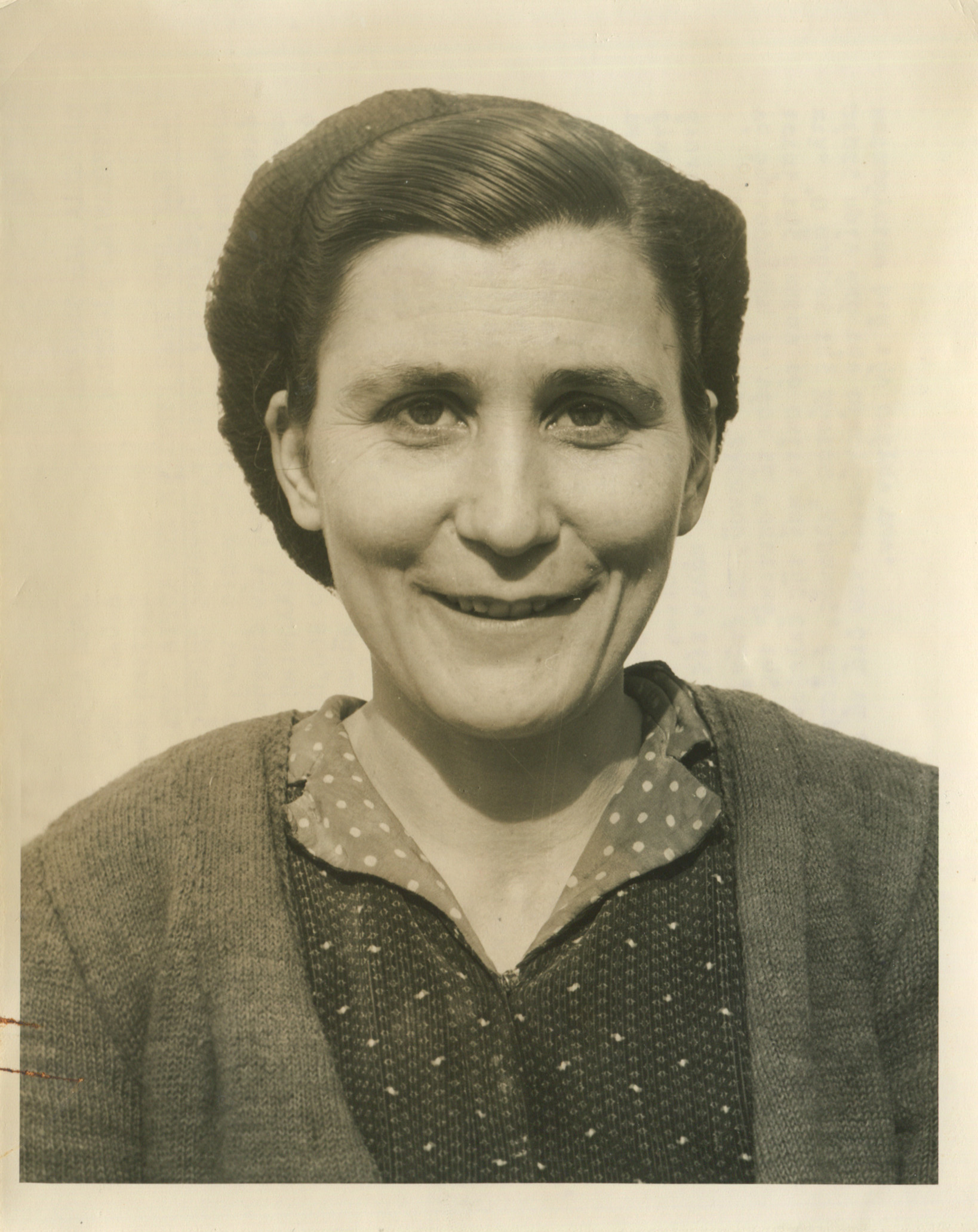
Katina Alvanou. Dimitris Harisiadis. 1950. National Bank of Greece Cultural Foundation, ELIA/MIET Photographic Archive, USIS collection.
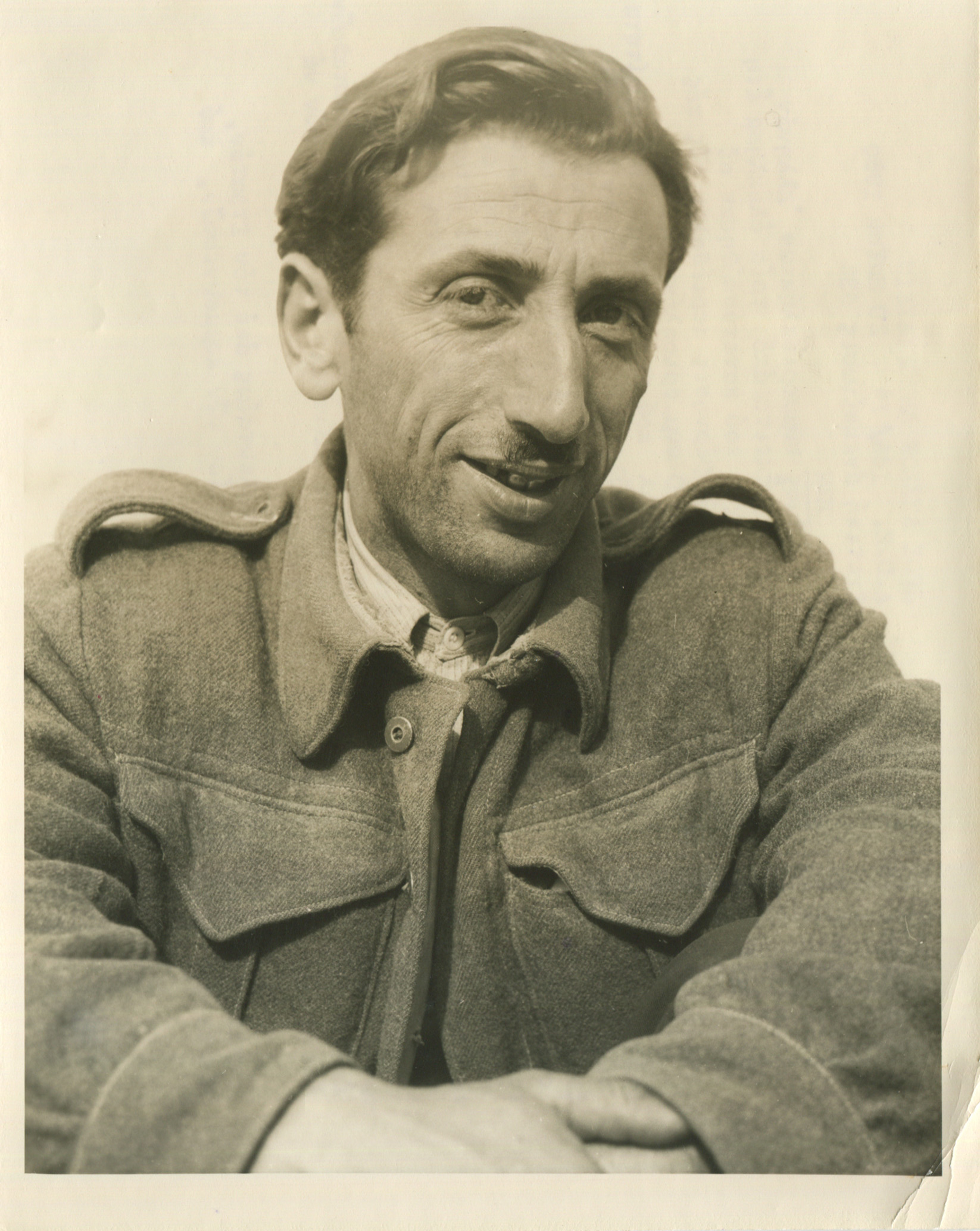
Ioannis Kamakas. Dimitris Harisiadis. 1950. National Bank of Greece Cultural Foundation, ELIA/MIET Photographic Archive, USIS collection.
Outlined in these portraits and captions is a suitable individual Greek subjectivity. It poses these villagers as victims of communist atrocities – being a communist or sympathizing with them would be un-Greek. Furthermore, it also draws attention to the gendered dimensions of this identity, where men are shown fighting this enemy of the nation while women are portrayed as homebuilders and passive victims. 66 Kamakas’ jacket is almost certainly a holdover from his army days, visually enhancing the traditional masculine role of protector and conveying the preparedness and experience of battle. Alvanou's smiling portrait and her donning of respectable and simple clothing interacts with the caption, visually confirming Alvanou's domesticity as return to a former, ‘natural’ order. 67 As mentioned earlier, the ECA and the Greek state set boundaries both physical and discursive within which the ‘refugees’ could act and define themselves. Physical boundaries were set by their return to their destroyed villages. Discursive boundaries were set by the narratives of ‘good’ citizens that are seen in the ECA imagery.
The close-up on these two villagers establishes a framework of identification for the audience of these images. Isolated against the neutral background – indicative of the staging and retouching involved – Alvanou and Kamakas are intimately introduced as avatars of postwar Greek society. Greek audiences were encouraged to identify both with the histories and futures of these two individuals. The image series as a whole appears to build up to such an identification. Throughout the visual narrative the ‘refugees’ are depicted as a collective that are returning to their villages. While some of the villagers are named, they are always amongst the Kamakas and Alvanou families. Finally, the two portraits end this narrative with approachable protagonists that can personify the desired and projected identities for postwar (rural) Greeks as well as the desired memory of the recent past.
It is difficult to assess audience reception of the repatriation narrative in ECA 163 as well as the extent of identification with the two final portraits of the series’ protagonists. Print circulation of ECA images would have been difficult, as Greece was still recovering from war and civil war. Illustrated magazines capable of printing extensive image series did not appear in Greece until the mid-1950s, with publications such as Eikones. 68 USIS produced its own illustrated magazines with ECA images during the Marshall Plan, as well as supporting other publications. Many ECA images are to be found in USIS magazines such as Eleftheros Kosmos [Free World] and the USIS-supported Ethniki Amyna [National Defence]. 69 Here as well, it is difficult to assess the circulation of these magazines, their audience size, and audience reception. The USIS publications were available for free at USIS offices and information posts all across Greece, yet little is known about the magazines’ impression on the Greek public. It is clear however that imagery played a significant role in the main Eleftheros Kosmos publication, which regularly ran features that were driven as much by the images as by the accompanying text. Furthermore, the Ministry of Coordination printed a weekly pamphlet entitled Agon Epivioseos [Battle for Survival] to inform audiences about the reconstruction. First published in September 1948, it was funded and closely supervised by the ECA mission in Greece. The title indicates the tense atmosphere of the Civil War period as well as its Cold War undertones. 70 The anti-communist struggle painted everything in a militarized light diminishing reconstruction efforts physically and rhetorically. Although almost exclusively published in Greek, there are also issues that were published in English.
What is remarkable is that significant effort was expended into producing and circulating the ECA images but with very uncertain returns. There was certainly a desire by the Marshall Plan higher-ups to use photography as an effective language of communication that was also universal. Photography was therefore wedded not only to the documentation of reconstruction, democracy (anemic as it was in Greece after WW2), and postwar modernity but also to its imagination. As Jame Rolleston observes for the German photo-journal Heute (1945–1951) published by the US occupation authorities, photography and the photo-essay reimagined what postwar Germany would look like.
71
Rolleston makes the crucial observation that in early 1948 the Marshall Plan was not yet a reality: its socio-political success could only be imagined and would by definition depend in part on the mental commitment of Heute's readers.
72
A similar dynamic is also operative in the Greek Marshall Plan images, where the images are crucial in (re)imagining what Greece would look like after the war and the Civil War.
Hence, an important contribution of the Marshall Plan photography was to provide an opportunity for the development of a photographic language that was invested in the modernization of Greek society and a melioristic postwar modernity. This can particularly be seen in Harissiadis’ photography and the aforementioned magazine Eikones. After the Marshall Plan ended Harissiadis went on to frame Greece's modernization both as an industrial photographer and as a nostalgist for a vanishing Greece which was threatened by this same modernization. Harissiadis’ professional photography reified capitalist and technological progress while keeping a cool distance to the major societal changes he was visualizing. 73 Such a melioristic visual language suffused important organizations such as the Greek Public Electricity Corporation (DEI) – that Harissiadis also worked for. 74 Eikones, as the most important illustrated magazine of its era, played a decisive role in visually fostering attitudes and consumerist desires geared towards a Western, capitalist way of life. Furthermore, its publisher, Eleni Vlachou, was also closely linked to USIS and later on USIA. Together with USIS Vlachou put on the Family of Man exhibition (1958) in Athens, as well as the A Decade of Progress (1957) exhibition. 75 This last exhibition – featuring Harissiadis’ images – celebrated the 10-year anniversary of the Marshall Plan and hoped to instil pro-Western ideals in Greek audiences. 76
To return to the ECA 163 series, while it does not appear in the USIS publications I have studied, the series does appear in the pages of the Greek daily papers. This gives us a better indication of the images’ and the series’ narrative absorption in Greek public discourse. On 25 May 1950, three images from the ECA 163 series appeared in the major Eleftheria daily: the Alvanou and Kamakas families walking towards the viewer (Figure 4), the two Petridi sisters cleaning up their home (Figure 1) and an image of two workmen rebuilding Theodora Zangka's home in the village of Domeniko. 77 The images do not illustrate a text but occupy a demarcated box in the paper (Figure 9). The accompanying text is nearly identical to the ECA caption, 78 with the difference that the Alvanou family in the first image (Figure 4) is misidentified. Ioannis Kamakas is listed as the father of the Alvanou family, when there is no kinship to the Alvanou family. Perhaps Eleftheria wished to present a tidy narrative of a nuclear family in this image.
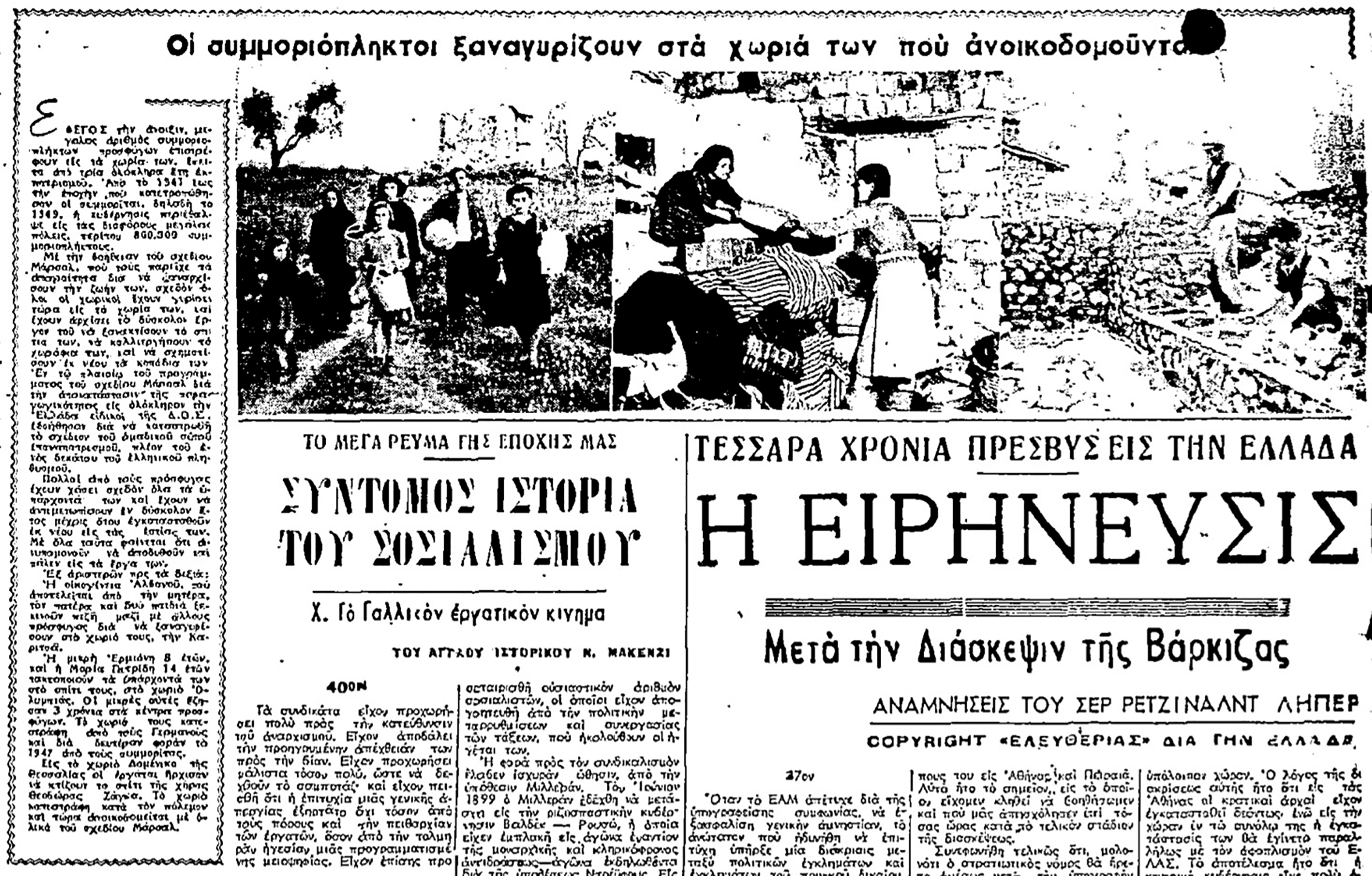
ECA 163 images in Eleftheria newspaper. 25 May 1950.
Regardless, the Alvanou and Kamakas families appear to be chosen protagonists by the ECA, the Greek state and the press to tell a specific narrative of repatriation and reconstruction. Even before the ECA 163 series was released, the Alvanou and Kamakas families were centred as representations of the good returning ‘refugees’. In the Empros daily's 7 April 1950 issue we read D. Avramopoulos’ report of the ‘refugee’ repatriation from Larissa to the village of Karitsa. In the company of ministers Gklavani (Health and Social Welfare) and Malamida (Public Works, Housing, Reconstruction and Employment), Avramopoulos writes that this was the first time journalists were able to get close to the returning villagers and speak to them about their return home. The one direct quote we find in Avramopoulos text is from Ioannis Alvanos – a relative of Katina Alvanou we should assume – who according to Avramopoulos offers ‘a characteristic image of the situation’. Alvanos expresses frustration about the lack of housing, tools, and livestock he expects to find on his return to Karitsa. Avramopoulos in a somewhat patronizing manner writes that he informed Alvanos about how his new life would develop under the repatriation programme. Crucially, Avramopoulos says that ‘we told him […] that the officials [of the repatriation programme] could inspire in him a sense of optimism, in parallel to the practical implementation of the repatriation programme’. The importance of a future-facing meliorism is distinctly highlighted here by Avramopoulos.
Almost two months later, the protagonists of Karitsa make another appearance in the daily Ta Nea's 25 May 1950 issue. The anonymous author describes the last phase of the refugee repatriation programme, reporting from one of the military trucks that is heading to Karitsa. The elderly Eleni Kamaka, Katina Alvanou – identified only as Alvanou – and her two daughters Stavroula and Dimitra are all mentioned in the article. Most of the protagonists of Figure 4 are accounted for in this article. The article is however not reporting on a repatriation in May 1950 but rather the return to Karitsa in early April, which both Avramopoulos and the photographer of this series, Harissiadis, participated in. The recurring appearance of Karitsa, Domeniko and Olympias alongside their returning inhabitants reflects a planned effort on the part of the Greek state and the ECA to narrate the repatriation programme. Significantly, while the written accounts in the press differ slightly between each other, the photographic visualizations of these returning villagers as examples of good Greeks remain the same. The ECA 163 photographic series represents therefore a desired visualization of the repatriation processes and the desired attitudes of postwar Greeks, embodied in the ‘refugee’ protagonists of this and other ECA photographic series. The Alvanou and Kamakas families become symbolic of desired postwar Greek identities: productive, future-facing and anti-communist.
Despite their hyperlocal and individualized narratives, the Greek villagers’ photographic visualizations are symbolic of Greece's status as pioneering Cold War battleground and frontline state. 79 The Greek Civil War is often described as the earliest ‘hot’ conflict of the Cold War, pitting communist forces against a US-backed state military. Hence the ECA pushed visual narratives that stressed the malignant intentions of communism and the material benefits that the anti-communist liberal West provided via the ERP. 80
In contrast to other ERP nations, Greece as defined in the ECA imagery focuses on rural areas 81 and a greater concern with the effects of the Civil War, rather than on the preceding Second World War. 82 It is striking how little the German occupation of Greece figures in the ECA images. The past that is referred to in the ECA images is almost exclusively that of the Civil War, further entrenching the images’ and Greece's central participation in the early Cold War. This is very much in line with what Mark Mazower observes elsewhere, that ‘the conflict between communism and anticommunism had overlaid and superseded the struggle against fascism’ in Greece. 83 The very recent history of the German occupation is strategically downplayed, partly because West Germany was an important actor and ally for Greece in the developing Cold War. While a complete amnesia of German involvement in the ECA imagery would have been unrealistic, the Greek Civil War offered a potential way to reframe the extent of German destruction in Greece. West Germany's and Greece's participation in the ERP, brought two former adversaries into close cooperation with each other.
From the perspective of the USA, this closer cooperation was a positive strategic development. W. German economic commitments in Greece increased after the reduction in US aid and beginning in 1950, Greek‒W. German relations began a steady process of normalization that would be completed by 1958. 84 Both states’ anticommunism and experience of being Cold War frontline states established shared values and interests, smoothing over interstate relations and the recent past. As Hagen Fleischer argues, memories of the German Occupation terror as well as Greek enmity against Germany are selectively brought up in Greek public discourse after 1949. Nazi crimes against humanity were viewed through of a lens of totalitarian extremes, rather than as a historically situated and recent event. 85 Furthermore, German diplomats after the war disqualified the wartime Greek resistance to the German occupiers by using terms like ‘bandits’, which had also been used by the wartime German occupation forces to describe the same resistance forces. This harmonized with the national-minded Greek elites that were running the country postwar, who called the DSE forces ‘communist-bandits’ as we saw in the ECA images. 86
The photographs of the repatriated villagers of Domeniko, Karitsa, Olympias and Nipsa have allowed us insights into the visualizations of projected postwar Greek attitudes and subjectivities geared towards anticommunist and national-minded behaviours. Through these microhistories I have explored the key themes of self-help and anticommunism that underpin the narrative construction in the ECA photographs. These themes have also informed us of Greece's participation in the broader dynamics of the Cold War. While anticommunism had firmly established roots in Greece prior to the Cold War, Greece's alignment with the USA in the Cold War allowed the appropriation of self-help as a local Greek practice and attitude. The photographs of self-housing and the reconstruction of destroyed villages visualized the Greek villagers embodying desired attitudes and identities for the postwar era. The minor historical protagonists of these visual narratives were projected as avatars of postwar Greeks: hardworking, anticommunist, and future-facing.
Multiple historical strata intersect in the Marshall Plan images discussed. As a microhistory of postwar Greece, the images visualize the villagers’ return to their destroyed homes and livelihoods. This in turn is part of a larger national Greek history of material and social reconstruction after the Second World War and the Civil War. Self-help and anticommunism, key themes of the ECA photographs, are themselves connecting lines to the participation of Greece in the Cold War on the side of the ‘Free World’. 87 At the same time, the Cold War engendered a selective amnesia in the ECA images. The Second World War is but a faint memory in the photographs discussed, highlighting Greece's particular history as early Cold War frontline state.
Looking beyond the narratives of return and desired Greek national-minded attitudes explored in this article, the Marshall Plan photographs might serve as sources for alltagsgeschichte and social history of the immediate postwar era. Recent and prior research on the experience of civilians during the Civil War provide important points of departure for viewing the ECA images anew. 88 As I have shown, taking photographs seriously and dwelling on the ‘the provokingly unsatisfactory knowledge gained through photographic images’ 89 can reveal points of rupture and complexity that add to our understanding of post-civil war Greece as an early Cold War setting. Lastly, much work is still to be pursued on the visualizations of a postwar world in the Marshall Plan images both in Greece and in Europe, highlighting photography's role in imagining this postwar future.
Perhaps most importantly, the embrace of photography by major postwar international organizations as tools for imagining a better world, calls for a syncretic approach that brings these photographic cultures into conversation with one another. The (Greek) Marshall Plan's big investment in photography might speak to the photography-as-universal-language at the centre of UNESCO's postwar cultural diplomacy. 90 UNRRA's photographic reframing of modern humanitarianism, which shifted the focus from immiserated victims to the ‘pleased recipients of efficient rescuers’, 91 rhymes with the central self-help ethos in many of the Greek Marshall Plan visual narratives discussed. Last but certainly not least, comparative study of the Greek Marshall Plan images alongside images from other ERP recipient states as well as socialist and Soviet states would also provide important insights into the transnational and ideology-spanning visual histories of postwar reconstruction, material as well as social. 92
Footnotes
Author's Note
Carl Mauzy is also affiliated with University of Amsterdam, Netherlands.
