




Abstract
This article traces the evolution of ‘national security’ from a rarely used phrase to a central concept within Australian political life. Where existing genealogies have located the origins of ‘national security’ in the United States, this article reveals that the principal genesis of ‘national security’ was in the international disarmament debates of the early 1930s. Taking Australia as a case study, we show how the concept was utilized to express national identity, debate key issues, and expand federal power in a critical period of nation-building. Surveying uses of the concept across the decade, we found that issues became ‘national security’ problems when they threatened the nation in more than one way. Such dynamics manifested in two of the central security issues of the decade. In the national insurance debate, the capacious language of security gave expression to deep-seated anxieties that emerged from the Depression, while the National Security Act of 1939 that legislated emergency war powers tapped a broader sense of insecurity to centralize federal powers. By the end of the decade, ‘national security’ in Australia was closely associated with military strength, preoccupations around White identity, and entrenching political authority – an early precursor to its uses and abuses today.
The phrase ‘national security’ is today associated with a broad swathe of issues, from terrorism, asylum seekers, foreign interference, cyber-attacks, and great power rivalry, to the effects of climate change and the COVID-19 pandemic. 1 It is used by political leaders to add weight to issues and exert power. Yet ‘national security’ is also deployed to deflect scrutiny: in Australia, for instance, the phrase has been used to shield allegations of spying and war crimes, prosecute whistle-blowers, and silence the media. 2 It is a concept that can contain everything, but which exists more in abstract than in concrete form. This notion of ‘national security’ as a capacious, unwieldy concept is not new. Observing the growth of the US security bureaucracy in the early years of the Cold War, Arnold Wolfers argued that ‘national security’ had become ‘an ambiguous symbol’, used to generate sympathy, exert power, subordinate other concerns, and emphasize national over international authority. 3 Existing scholarship has located the origins of ‘national security’ to strategists in the US during the Second World War. However, this article locates a longer, more international history, revealing that ‘national security’ became a widely used phrase in international disarmament debate of the early 1930s. Through the case study of Australia, we show how ‘national security’ was increasingly deployed across the decade to define national priorities, express national identity, and assert national authority.
The concept of security has a long history in international politics. In the late Roman Empire, ‘securitas’ was used to describe the physical safety and political liberty afforded to citizens under the Pax Romana. 4 This political usage, and its English equivalent ‘security’, became dominant during the Enlightenment period, with philosophers such as Thomas Hobbes claiming that ‘security could only be guaranteed by a political authority’. 5 Political usage referenced the economic framework of guarantee: Hobbes’ ‘social contract’ drew on financial metaphor to describe the citizen yielding certain rights to ensure protection from the state. 6 Historians Beatrice de Graaf and Cornel Zwierlein argue that from the seventeenth century, when Hobbes was writing, ‘security became one of the main arguments for the new modern states to expand and legitimize their reign and authority’. 7 Yet the word ‘security’ was also used to describe individual calm and confidence. Soon after Hobbes, John Locke conceptualized security as the capacity to pursue a life of freedom, ‘safe and secure’. 8 His liberal view of individual security was later reflected in the emerging discipline of psychology focussed on an internal sense of security, and its opposite, ‘insecurity’. 9 Key to such conceptualizations of security is the notion of risk, or danger. As Cornel Zwierlen and Rüdiger Graf argue, ‘fear is the mental and emotional counterpart to security’. 10 Historian Eckart Conze extends this logic to argue that it is the breadth of possible threats that generate the malleability of security. 11 Conze also notes that ideas of security also always involve ‘ideas of the future’, with implications and expectations for what security will provide and prevent. 12
Much of the existing scholarship on the concept of national security locates its emergence in the United States in the late 1930s and early 1940s. Mark Neocleous shows that the national security state that emerged after the Second World War had its roots in ‘the social security state’ created by Franklin Roosevelt's New Deal of the 1930s, but argues that until the very end of the decade, the ‘ideology of security’ was primarily associated with social welfare and economics. 13 Andrew Preston suggests that ‘the concept was invented’ in the US, identifying Roosevelt as the key adopter who ‘made the connection between insecurity at home and insecurity abroad’ from 1938 onwards. 14 Dexter Fergie concurs, claiming that ‘references to “national security” in newspapers, policy discussions, and scholarship were sparse’ prior to the development of the term by the Princeton Military Studies Group in the 1940s and that uses of ‘security’ in the 1930s were ‘bound to the economy’. 15
Implicit in this concept of national security is the notion that the preservation of the state is essential to the security of its people, a view that security is ‘first and foremost [about] state security’. 16 This view was taken on by political realists in the latter half of the twentieth century: political scientist Hans Morgenthau defined national security as ‘integrity of the national territory and of its institutions’. 17 Critical security studies scholars argue that underpinning such constructions of security are notions of national identity and shared values, and that the concerns that are elevated to ‘national security’ issues tend to threaten the state's identity. 18 In perhaps the most famous articulation of US ‘national security’, historian Melvyn Leffler suggests that by the end of the Cold War, the concept had come to encompass ‘the decisions and actions deemed imperative to protect domestic core values from external threats’. 19 Complementing this capacious definition, political scientist David Campbell urged that we view major articulations of foreign policy and national security as definitions of identity and foreignness. 20 In 1995, Ole Wæver coined the concept of ‘securitization’ to describe the process in which state actors deploy ‘speech acts’ to name political concerns as security issues, and in doing so legitimize the use of extraordinary powers by the state. 21
In fact, expansive uses of ‘national security’ were actually deployed in countries around the world much earlier than the existing scholarship on the US suggests, and far from being a creation of policymakers and scholars in think tanks, the concept was already in the vernacular, widely circulated in international media. In reports from Britain, France, Germany, and Japan published in Australian newspapers throughout the early 1930s, ‘national security’ was frequently used in relation to the disarmament debate, where the promise of peace and international cooperation was at odds with the impulses of individual countries to defend their sovereignty through rearmament. 22 The term grew in use during the 1930s as a counterpoint to ‘collective security’.
The emergence of ‘national security’ as a popular concept was particularly evident in Australia. Throughout the 1930s, ‘national security’ was utilized by politicians, journalists, and everyday Australians in ways that were politically mobilizing and contested. It lent urgency to the unfinished work of federating six self-governing colonies into the Commonwealth of Australia. Tensions between ‘national security’ priorities reflected competing ideas about what kind of nation Australia would be, as the concept was used to respond to different kinds of threats: from fears of invasion, to damage to international alliances, economic competition for Australian products, food supply shortages, and the undermining of civil liberties. It was drawn on to express anxieties about identities and foreignness, increasingly used in conjunction with another political slogan, ‘populate or perish’, reflecting a popular sense of the small White population's insecure hold over a big continent. At the same time, there was a strong, socially progressive take on national security as part of Australia's successful settler experiment. In the aftermath of the Great Depression, advocates for comprehensive social insurance positioned it as part of a holistic vision of national security, providing for ‘a contended and prosperous people’. 23 By the end of the decade, however, ‘national security’ was increasingly used by the federal government to exert authority, culminating in the 1939 National Security Act, a comprehensive set of war powers that extended federal authority over all aspects of Australian life. The Australian case study shows that national security could ‘go big’ as it informed different aspects of public policy, but it could also shut down debates. When wielded by those in power, national security could narrow the parameters of debate over a nation's direction, steering public conversation determinedly in one direction, at the expense of others.
This article traces the emergence of ‘national security’ from a rarely used phrase to a central concept within Australian political life. What follows is a broad survey of the uses of the concept in Australian newspapers and parliamentary debates, followed by close case studies of the national insurance debate and the development of the National Security Act in 1939. We show that a concept of national security was already part of a broader international discourse about disarmament in the 1930s, and argue that Australian leaders and commentators drew on the concept to debate defining issues about authority and identity in a key period of nation-building.
Prior to the 1930s, the phrase ‘national security’ was used sporadically in Australia, associated with issues ranging from defence spending, growing prosperity, immigration rules, gender roles, and housing. 24 The phrase was not used widely nor consistently enough to establish a core meaning, but was loosely associated with protection, safety, confidence, and identity. But in the 1930s, usage of ‘national security’ in Australia exploded. Taking Australian newspapers as an example, the number of articles using the phrase ‘national security’ in the 1930s (12,071) was nearly double that of the previous three decades combined (6440). 25 This evolution took place in the turbulence of the 1930s, when the shocks of the Great Depression, the collapse of the disarmament movement, and the prospect of a second world war generated deep anxieties. While international reports in Australian newspapers indicate that the concept gained traction around the world in the early 1930s, the Australian case study is particularly illustrative. Only 30 years after the Federation, ‘national security’ became a key concept in debates about who the young nation comprised, what it needed protection from, and who ultimately had authority over it.
We conducted a systematic review of the term ‘national security’ in Australian newspapers and parliamentary records in the 1930s, concluding the search at 9 September 1939, when the passage of the National Security Act made the term so ubiquitous that manual coding became untenable (see Figure 1). We coded every use of ‘national security’ in parliamentary records (113 sources), but took a sample approach to the more than 12,000 results in the Trove (Australia) database during the 1930s: a daily from each state capital/territory, selecting newspapers with the highest usage of ‘national security’ across the decade (the Age, Sydney Morning Herald, Telegraph, West Australian, Mercury, Advertiser, Canberra Times, Northern Standard) along with a regional from each state (Newcastle Morning Herald, Gippsland Times, Queensland Times, Kalgoorlie Miner, Advocate, Recorder), and national papers for particular interest groups (Australian Worker, Daily Commercial News, Women's Weekly). 26 Accounting for syndication across papers, we had 2365 newspaper entries. While most of the newspaper articles using ‘national security’ were reports of speeches from politicians or editorials commenting on political events, the concept also increasingly appeared in letters to the editor and in articles commissioned by local organizations, indicating growing recognition and use of ‘national security’ as the decade progressed.
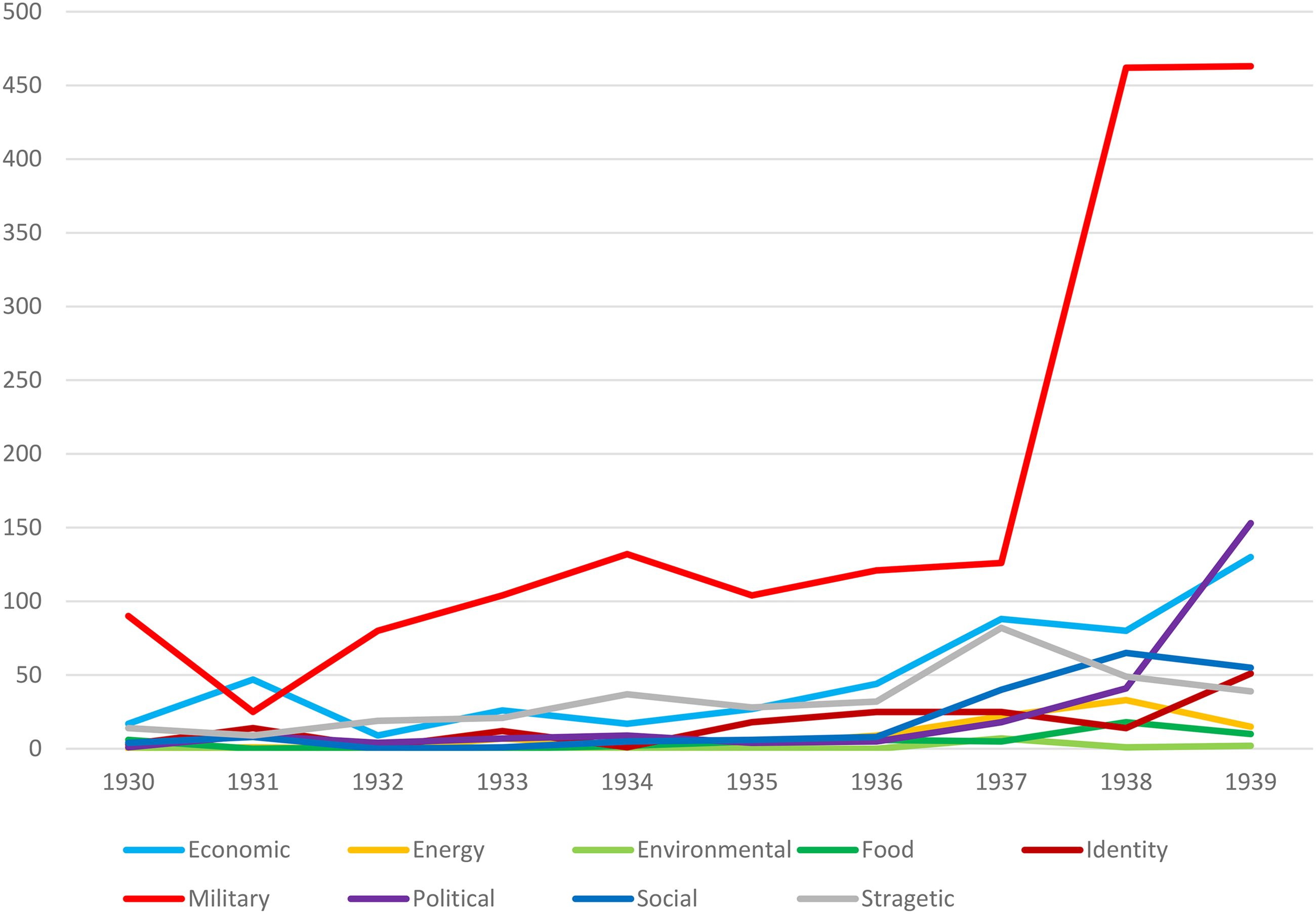
Aspects of security, 1930–9.
Analysing the content of these parliamentary records and newspaper archives, we identified nine different aspects of security within uses ‘national security’ (see Figure 1): military security (defending the country from war and invasion), economic security (shoring up the financial position of the nation), social security (promoting the welfare and wellbeing of the Australian community), strategic security (harnessing international relationships to maintain or strengthen the nation's global position, e.g., through alliances or trade), political security (tensions between the Federal Government and the States, the protection of civil liberties), identity security (anxieties about who makes the ‘national’ body, how the nation fits within the British Empire), food security (protecting agriculture), energy security (ensuring supply), and environmental security (protecting against fire, flood, and drought). 27
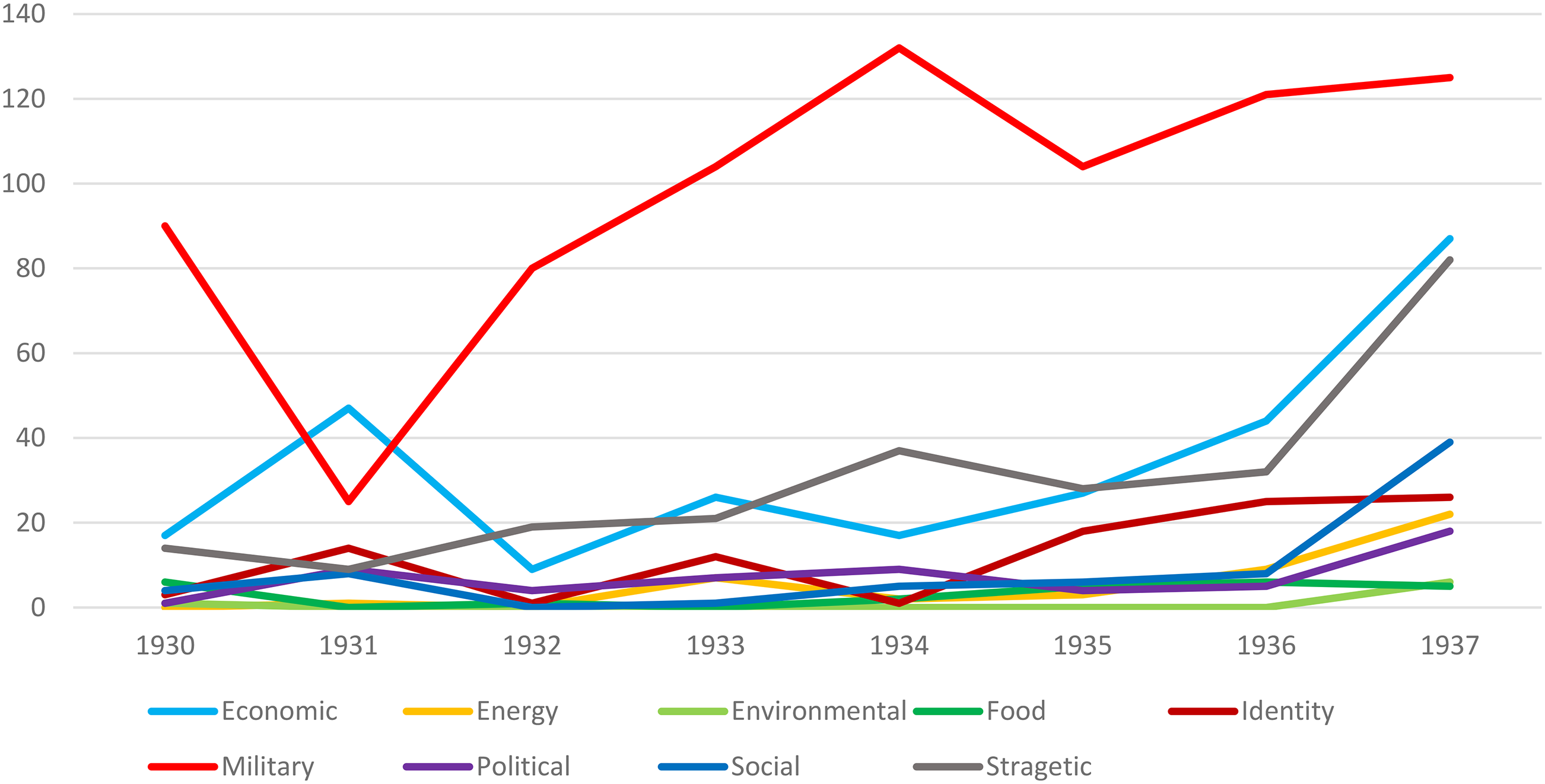
Aspects of security, 1930–7.
Through the process of coding these security themes, it became apparent the key issues of the decade tended to involve more than one aspect of security, indicating that issues became entrenched ‘national security’ concerns when they threatened the nation in more than one way. Multiple security threats generated conflicting ideas about how to provide security, leading all sides of a debate to invoke the concept to add weight to their proposed solution. Military and identity security concerns co-occurred with others particularly frequently, reflecting memories of war, fears of invasion, and deep-seated anxieties about establishing a coherent Australian identity as the young nation developed.
The main use of ‘national security’ in Australia in the early 1930s was around disarmament. In the aftermath of the First World War, members of the League of Nations agreed that preventing another war required the ‘reduction of national armaments to the lowest point consistent with national safety’. 28 This agreement was formalized by the Washington Naval Treaty in 1922, which acknowledged the right of the Five Powers (Britain, France, Italy, Japan, and the United States) to revisit the terms of the treaty if changing circumstances affected ‘the naval defence of its national security’. 29 The language of ‘national security’ was then carried through in the London Naval Treaty of 1930. It was in this context that Australian media deployed the term, frequently misquoting the Covenant of the League as referring to the ‘reduction of national armaments to the lowest point consistent with national security’. 30 Widespread media coverage of the international disarmament debate thus established an enduring link between the concept of national security and military preparedness. Notably, Australian media reports of the ongoing disarmament conferences were frequently joint authored by ‘British Official Wireless and Australian Press Associations’ and quoted statements by world leaders, indicating that such usage of ‘national security’ was widely accepted around the world. 31
Justifications for rearmament often invoked borders, might, and pride, articulating national identity as a key component of ‘national security’. In June of 1932, just four months into the World Disarmament Conference in Geneva, the Queensland Times reported that the German Minister for Defence was determined to defend Germany's frontiers and ensure ‘national security, also seeing that the spiritual and physical forces forming an indispensable foundation to the country's defences are strengthened’. 32 In October, Australian commentary observed that removing limitations on arms for Germany was ‘closely related to national prestige and the essential feeling of national security’. 33 Concerns about national identity were thus complementary to military uses of ‘national security’ in the international disarmament debate.
Yet another, very different, kind of security was conceptualized in the disarmament debate – one that spoke of security through peace, or alliances: strategic, or ‘collective security’. While military-identity uses of ‘national security’ invoked threats of war and invasion to push against disarmament, strategic uses argued that those same threats could be neutralized through ‘political agreement’. In January 1930, the UK government argued that treaties such as the Kellog-Briand Pact, the Locarno Treaties, and the Four-Power Pact had made a ‘great advance … in the provision of national security’ and that national security was ‘inherent in all disarmament negotiations’. 34 Three years later, responding to the concerns of anxious powers reluctant to draw down their arms, British Prime Minister Ramsay MacDonald argued that a warlike ‘habit of mind’ was inhibiting collective peace, preventing ‘a great change in our attitude to militarism as a means of national security’. 35
Thus throughout the 1930s, there was a core disagreement about how security should be provided – through cooperation, or rearmament. Proponents of both sides of the disarmament debate harnessed the phrase ‘national security’ to make their case. While France and Germany expressed anxiety about relying on international cooperation without rearmament, Britain (and Australian papers with it) despaired at ‘Europe's craze for what the French call security … spend[ing] more on the engines of destruction’. 36 Even scholarly reports of the time acknowledge the differing understandings of ‘security’ in the international community, with political scientist H. Arthur Steiner acknowledging that ‘the most keenly fought issue was this very point: should “security” in the French sense precede disarmament, or should disarmament precede “security” in the Anglo-American sense?’ 37 Indeed, the insistence on national as opposed to collective security throughout the early 1930s likely helped establish neologism as a widely used concept in international and Australian politics.
As a young White-settler nation on the periphery of the debate, Australian leaders were conflicted about the consequences of disarmament. Many Australian leaders voiced their support of the British position, arguing that other nations ought to match their leadership in disarmament: ‘no Power has made or proposed greater sacrifices than the United Kingdom’. 38 Yet these sacrifices also caused anxiety within Australia about the ‘over-optimistic’ British position and the dwindling strength of the Empire defence. In 1930, Opposition leader John Latham voiced concerns that Australia, viewing itself ‘of the British race’, had viewed the British Navy as ‘sure protection’ and its strength ‘a matter of primary importance’, but now faced the need to build up its own forces in the Pacific. 39 As the decade progressed and the failures of the disarmament movement became apparent, concerns grew that Britain ‘honoured her agreements to the point where she can no longer claim the position of the first naval power’, while Japan ‘has already her eyes turned towards this huge unpopulated continent of ours’, generating vigorous debate over where and how Australia should shore up its military security. 40 A clear difference emerged between the two major parties on this topic in the 1937 election: the conservative United Australia Party emphasized strategic security located in the imperial relationship and the protection afforded by the Royal Navy, while the Labor Party led by John Curtin proposed disentanglement from conflicts in the northern hemisphere and reliance on increased air power in the face of aggression. The press characterized the issue as a choice between ‘collective security’ or ‘isolation’, in what was labelled the ‘national security’ election. 41
Underpinning Australian debates about disarmament was concern about the population growth of Anglo-Australians. The phrase ‘populate or perish’ was deployed by Australian farmers, politicians, and workers in the early years of the Federation, reflecting widespread anxiety about the implications of a sparse population on the vast continent. 42 A slogan connected to the White Australia Policy, which prohibited the immigration of non-Europeans, ‘populate or perish’ bridged military and economic aspects of security, as well as identity concerns – bleeding together fears of invasion, worries about development, and racial anxieties – and in the 1930s, the concept of ‘national security’ was frequently deployed alongside it, demonstrating the depth of concern about the topic.
The two main approaches for developing population growth were encouraging migration from the UK and attracting more people to undeveloped areas. In 1936, the Taxpayers’ Association of Queensland published an article in the Telegraph arguing that the popular slogans ‘“populate or perish” and “immigration or invasion”’ were ‘words of truth and meaning … plainly requisites to progress and, what is more, to national security’.
43
Later the same year, the Premier of New South Wales returned from a trip to the UK and expressed his hope that state and federal authorities would encourage British migration: They should realise the great truth that by the increase of population through migration, they were not only increasing the national security of Australia, but were providing the purchasing power for the development and extension of their primary and secondary industries.
44
Social concerns were a key element in these discussions about birthrate. ‘Populate or perish’ was taken up as a slogan by then Minister for Health and Repatriation, William Morris (Billy) Hughes, to campaign against the falling birthrate.
46
As part of his campaign, Hughes advocated for improved antenatal care to foster ‘healthy mothers’, to prevent Australia from ‘bringing weaklings into the world’ and ‘commit[ting] national suicide’.
47
Engaging in the national debate, young adults pointed out that improved living standards would encourage them to start a family. In a letter to the editor of the Advocate, a concerned citizen, T. E. Cornelius explained Personally I would like to marry and have a family, provided I knew that my future was secure, and that I was bringing children into a world that had something better to offer than cannonball, poison gas and national debt … Building homes and raising the living standard will increase the population and raise the standard of citizens physically, mentally, and morally. This is a matter which commands the attention of every Australian, and more especially the leaders of our churches, as national security is the basis of collective security, and collective security is the basis of world peace, which is very necessary for the preservation of the Christian people.
48
In fact, the argument that national security rested on social security was fairly widely held in the earlier years of the decade. The Great Depression was primarily an economic issue, but also involved social concerns about falling living standards. For instance, in May 1930, Attorney-General Frank Brennan acknowledged ‘that the undermining of basic standards must be reflected in increased destitution, reduced purchasing power, inroads upon the primary necessities of the working class in the community, with consequent and dangerous impairment of national security and solvency’. 50 Thus the Government acknowledged that the threat to national security was equally the social burden of the Depression on everyday Australians and the impact on Australia's larger economic position.
Discussions of ‘national security’ during the Great Depression also touched on food security, with much emphasis placed on the security of farmers. A newspaper article, ‘On the Land’, in the Newcastle Morning Herald, lamented that ‘there is little consideration for the standard of living for the men and women whose days are spent on the land, and whose work is so essential to national economic security’. 51 The position of wheat farmers was a particular focus for politicians in the Depression. Already in trouble from a dip in global demand from the late 1920s, the fall in commodity prices hit the wheat industry hard. 52 In December 1930, the Federal Government proposed a bill guaranteeing the price of wheat to relieve the pressure on farmers. When the Commonwealth Bank refused to advance funds for the guarantee, the Government threatened a public campaign of ‘the Banks vs National Security’. 53
Yet protections for workers also clashed with other security priorities in debates over tariffs and trade. In 1932, the Ottawa Agreement established preferential trade with limited tariffs within the British Empire. The following year, as the Australian Parliament debated the ‘British Preferential Tariff’, Australian Worker ran an article accusing the Lyon's Government of ‘treacherously sacrific[ing] our industries on the altar of Imperial Preference’. 54 Responding to those in Parliament who accused the government of making the Australian worker the ‘sole loser’ of the agreement, former wartime leader Billy Hughes invoked memories of the war to advocate for imperial preference, even at a cost to Australian workers, because ‘if we strip ourselves of any illusions which we may have as to our economic welfare and national security’, it becomes clear that ‘our dependence upon the Empire is absolute’. 55 The following year, the Associated Chambers of Manufacturers of Australia broke its tradition of ‘refrain[ing] from active participation in party politics’ by issuing a statement arguing that the policies of the Federal government ‘belittle[d] the policy of protection’ which ‘is the only legislative instrument which can be used to maintain that satisfactory sense of national security’. 56 Economic historian Kosmos Tsokhas argues that the strength of opposition from the Labor Party, manufacturers and the press prevented the Lyons government from fully implementing the Ottawa Agreement in Australia. 57 Thus the competing priorities of maintaining the imperial relationship and bolstering Australian workers were fought out with the rhetoric of security, and implicitly, with conflicting ideas about what kind of nation Australia would be.
These conflicts over aspects of security in trade continued to reverberate well after the peak of the Depression. In the late 1930s, the Australian media discussed the role of economic security in contributing to or inhibiting strategic security, a debate inherently wrapped up in the nation's relationship to the British Empire. Acknowledging that trade barriers contributed to international tensions, in 1937 the Sydney Morning Herald reflected that after the Great Depression, ‘economic nationalism became an expression of political policies; it was engendered by fears for national security; and now it has increased those fears and tensions in such a way that a return to cooperation is not easy’. 58 The following year, the League of Nations report on living standards was picked up by Australian media, with the comment that ‘a world-wide increase in the consumption of primary products and clothing would reverse the trade recession and improve the national security’. 59 Australian trade policy reflected both visions of security: economic nationalism of a sort was expressed through Imperial preference, with the goal of improved trade relations beyond Empire to ensure security through strategic cooperation. As Minister for Commerce, Earle Page explained that Australia had to balance ‘safeguarding our position in British markets’ with ‘seeking new outlets as well’, arguing in 1938 that the ‘Government's policy is one of national security, economic security and social security, but the only sound basis for such a policy is security of markets’. 60
The multifaceted nature of ‘national security’ in the 1930s is perhaps best demonstrated by the National Security Act, declared in September 1939 (as detailed further below). While the Act ensured defence readiness, it also provided all-encompassing emergency war powers including the regulation of prices, essential industries, public services, food and energy supplies, migrants, and communications: advancing military security and protecting economic, social, food, energy, and identity security during the war. However, the Act also threatened political security in the Lockean sense of the term: the freedoms of individual citizens.
61
Politicians debated whether certain powers – such as censoring the press, interning migrants, limiting freedom of assembly – served the interests of national security, with some comparing the legislation to ‘Hitlerism in Australia’.
62
Challenges by members of parliament led Prime Minister Robert Menzies to acknowledge: Legislation of this kind can be made an instrument of repression in bad hands, just as it can be made an instrument for national security in competent and sensitive hands … the greatest tragedy that could overcome a country would be for it to fight a successful war in defence of liberty, and lose its own liberty in the process. There is no intention on the part of the Government to use these powers when they are granted, as I am sure they will be, in any way other than to promote the security of Australia.
63
One particular way in which the concept of security was invoked during the 1930s was in debates about the introduction of a scheme of social insurance, or ‘national insurance’. These debates had been around since the early twentieth century, as Australian intellectuals and politicians looked approvingly at schemes that had been introduced in Germany, Britain and Scandinavia. 65 A review was commissioned by the Deakin government in 1910 which recommended the introduction of a scheme similar to that of Britain, and subsequent governments expressed their intention to implement the policy. However, its introduction was stymied by the interests of private insurers, doctors and some members of the Country Party, who feared that rural and regional Australians would be less well serviced by such a scheme.
In the wake of the First World War, social welfare provision increased moderately around the world. The Versailles Peace Conference in 1919 had affirmed a conviction that world peace was impossible ‘until workers in industry were assured a measure of security from the vicissitudes of social and industrial life’. 66 The governments of liberal democracies responded positively, in part to provide for returned soldiers and mollify a potentially combustible section of society, but also because of a prevailing, idealistic spirit of postwar reconstruction. 67 In the 1930s, the deprivations of the Great Depression generated debate across the world about ‘social security’, a state of certitude wherein people would be protected from unemployment, sickness, disability, widowhood and impoverished old age. The term social security, rather than insurance, was introduced by economist Abraham Epstein in the United States, who wrote in 1933 that ‘the struggle for human progress has been a battle for security’. 68 His concept was adopted by the Roosevelt Administration with the Social Security Act of 1935, which provided unemployment insurance, old-age pensions, grants for mothers and children, and a massive program of public works for the unemployed.
The Great Depression revived debate about the need for national insurance in Australia, with advocates calling for the provision of jobs, health, and financial security, along with ‘a feeling of security’. 69 The former New South Wales Labor premier, Jack Lang, adopted the new language of security in his pitch to voters during the 1934 federal election, telling voters that his party sought what he called ‘a mandate to restore security, happiness and comfort to the Australian people’. 70 In the 1935 New South Wales election, he campaigned on the issue of ‘national security’, claiming that the incumbent United Australia Party ‘offered no hope of happiness for the future, no security for the homes of the people, no prospects for the bewildered army of youth, no means of increasing the volume of business, and no improvement of the conditions of the families existing on relief work pay and the dole’. 71 Labor, on the other hand offered ‘concrete proposals to restore the standards of every section of the community and set in train the national happiness and comfort that can come only from national security’. 72 In response, Lang's opponents also harnessed security rhetoric and countered his claim to the concept: a 1934 editorial Sydney's The Sun argued that ‘the Lang regime’ in New South Wales had resulted in massive unemployment which ‘lacked very conspicuously that feeling of security, happiness, and comfort’. The editorial encouraged the public to instead ‘vote for security’ by returning the Lyons government. 73
Proponents of social security in Australia made explicit links between the well-being of ordinary people and the prevention of war. William Caldwell, an officer in the International Labour Organization at the League of Nations in Geneva, told a Sydney League of Nations Union luncheon in April 1936 that social security was the key to lasting world peace: ‘If all the workers of the world were contented and felt secure, there would be no cause for war’.
74
While this link between social security and military and strategic security was more often made by those on the left, it was not confined to them. A member of the conservative United Australia Party, Frederick Stewart, claimed that ‘social security for the individual was essential if we were to achieve collective security for the nation’.
75
As unemployment remained high throughout the 1930s and the international situation deteriorated, the link between internal and external security was increasingly drawn. The Australian High Commissioner to London and former prime minister, Stanley Bruce, told the League of Nations in 1937 that ‘there could no longer be any doubt that the principal factor in creating world unrest today was the feeling of insecurity which hung like a pall over so many people’.
76
The (Melbourne) Age newspaper continued its campaign for a national insurance scheme in Australia, stating in November 1937: External security is the supreme quest of nations; internal security is the supreme desire of their citizens. In the attainment of both lies humanity's best hope of world peace and individual happiness. Each is vitally essential, but the social security of any people is calculated to keep them from becoming readily involved in external trouble.
77
Prime Minister Joseph Lyons’ conservative coalition government also embraced the language of security. Country Party leader Earle Page was a nation-building politician of grand vision who juggled an agrarian populism with an instinct for centralization and fiscal restraint. While many in the Country Party were suspicious that national insurance would benefit the cities over rural populations, Page himself had advocated for national insurance in his first budget speech in 1923, calling for a system to ‘remove that cruel sense of insecurity which haunts great masses of our people’. 81 Page's 1937 election policy speech proposed a broad vision in which ‘national security must be our aim – national security in the present by provision for adequate defence of our people and our assets created; national security in the future by effective permanent occupation by a healthy, happy race, and full development of resources’. 82 Page argued that this holistic security would be achieved through economic stability, expansion of industry, population growth, improved transport services, favourable trade policy and adequate defence, but also through social security, including health insurance. 83 In fact, Page proclaimed that ‘the best guarantee for national security is a substantial population of contented and prosperous people’. 84
Following victory in the 1937 election, the Lyons government began to enact plans for a national insurance scheme. The Treasurer, Richard Casey, rebutted suggestions that the government should delay the scheme because of pressing matters of national defence. Rather, it would pursue ‘“defence” in a twofold sense – the building up of our national defences against possible aggression – and the building up of the defences of the individual Australian family against the unexpected emergencies of life’.
85
Casey went further in his effort to combine military and social security under the same umbrella of national security: This national insurance scheme is a practical application of the principle of collective security for the protection of the individual worker. Insured persons, through their contributions, will be able to secure on easy terms a right to benefits which many of them could not hope to secure by a lifetime of individual saving. The Government is convinced that the provisions of this measure will appeal very strongly to all who seek security for themselves and their dependants, and who, at the same time, value independence and self-reliance.
86
When rumours began circulating about the possible abandonment of the scheme in November 1938, supporters rallied, repeating the links between social and military security. The Age, one of the most ardent supporters of national insurance since 1911, argued that claims about the cost of rearmament were a pretext, ‘a device to kill the scheme’, for ‘national security and social security are part of a single programme’. 90 The Sydney Morning Herald agreed, emphasizing the importance of national insurance as a complement to ‘vigorous defence measures … the more the common people have to defend, the stronger the popular support for the country's defence’. 91 The Parliamentary Under-Secretary of the Treasury, J.N. Lawson even made the bold claim that without social security, the government had no mandate to call on Australians for military service: ‘if Australia cannot afford national insurance and give security to its lower paid employees, it has no claim upon such persons to defend the country’. 92
This rear-guard action proved futile. By March of 1939, the scheme was reduced to include only health and medical benefits, before being abandoned altogether. The scheme failed because it had many critics but no great champions; any ‘concession to please one sectional group was almost certain to raise the ire of another’. 93 But the mounting military crisis provided an effective rhetorical device for the government, which cited the need to increase defence expenditure in a deteriorating world system as the reason behind the decision that the scheme be ‘postponed indefinitely’. 94 Thus while the concept of national security had expanded to include social and economic aspects with the insurance debate, when the prospect of war became real, these concerns were subsumed by the demands of military and strategic security. 95
While momentum behind social insurance faded away, Australians were increasingly concerned about the prospect of war. In 1938, the government began working on legislation to provide emergency powers. One of our key questions for this research was why this legislation took on the ‘national security’ concept, when earlier iterations (the War Precautions Act) had not. From mid-to-late 1938, Australia's Attorney General's Department produced several drafts of emergency legislation for the outbreak of war. For the first half of the year, the draft bill was called the Defence (Emergency Powers) Bill, following the British example. From late September to early October, someone whose identity remains obscure began crossing out this title and handwriting ‘National Security Bill’ as the title – the first so-named act in the world. 96 The renaming of the bill reflects the increasing popularity of the concept in the 1930s as Australia prepared for another global conflict. 97 It also reflected an attempt to demonstrate national unity during a period of profound anxiety about social and political cohesion, and crucially, it worked to privilege national over state authority.
From the mid-to-late 1930s, the Australian press featured hand-wringing editorials about how little the nation was pulling together in a time of great danger. Political behaviour was rowdy and divisive at all levels: within the major parties; between the parties; between the Commonwealth and State governments; and within State parliaments. Opinion pieces such as ‘A Lamentable Example’ bemoaned short-sighted behaviours, from internal disagreements within the coalition government to the stubbornness of State governments demanding compensation for their cooperation. 98 Labor factionalism attracted criticism throughout the decade, and as war became a near certainty the media complained that the party ‘cannot forget its feuds and offer the country a united, positive contribution to national security’. 99 Industry leaders decried overlapping economic activities between states and the federal government, and a lack of coordination. 100 As war approached, the concept of ‘national security’ was increasingly used to tamp down on unrest and division: the Hobart Mercury condemned union opposition to ‘plans intended to provide for national security by preventing panic’ – such as compulsory service – as ‘if not technically at least morally, treason to the Commonwealth’. 101
The draft legislation's revised nomenclature might also have owed something to Australians glancing across the Tasman. In 1936, the New Zealand government abandoned its Committee of Imperial Defence in favour of an organization for national security. This new body comprised 12 special committees: mapping, national supply, shipping, imperial communications and censorship, manpower, emergency precautions, prime ministers, chiefs of staff, joint overseas and home defence, war emergency legislation, co-ordination, and meteorological. 102 In Dunedin, it was reported that this new scheme provided for ‘comprehensive control of the city and suburbs in the event of an enemy air raid or a national disaster, such as an earthquake, fire or epidemic’. 103 In August 1937 an Australian newspaper commenting on recent secret measures to control and coordinate Australian resources upon the outbreak of war added that in New Zealand a ‘national security organization’ was to operate similarly. 104
The concept of national security thus responded to perhaps the central governance issue for Australia in the 1930s: the operation of the Commonwealth and States governments in relation to each other, and to London. The decade began with an Imperial Conference that produced the Statute of Westminster, increasing the sovereignty for all British Dominions. Although the Statute came into force at the end of 1931, Australia would not ratify the powers for another decade, because the States felt their position had been weakened: they ‘tended to see in London, a protector, an ally against Canberra’. 105 The concept of ‘national security’ was then deployed repeatedly throughout the 1930s in challenges between the states and Canberra. In one of the most spectacular examples, the Western Australian government, long vexed at high tariffs set by the Commonwealth, attempted unsuccessfully to secede in 1933. At the time, the West Australian observed that both the secession and union cases ‘have a common starting point, and they hold in view a similar objective – the attainment of national security’. 106 Despite 66.2 per cent of West Australians voting to secede, Britain ruled that the Statute of Westminster prevented the British parliament amending the Australian constitution, deferring authority back to the Commonwealth. 107
Later in the decade, as preparations for war developed, the states became anxious about cuts to spending on public works, and about the distribution of defence industry preparation across the country. 108 Yet, as the likelihood of conflict in Europe increased, ‘it was quickly apparent that State representatives recognized the supreme urgency of national security’ 109 Just as the disarmament debate had set national against collective security, here ‘national security’ worked to supersede state authority. Passing national legislation based on an elevated notion of national security was a means of cementing Canberra's over-arching authority in decisions over the use of essential resources.
In fact, the idea of a ‘national security’ program providing federal authority had been at the heart of those most responsible for to the passage of the Act itself. In 1936, Major-General John Dudley Lavarack laid out the groundwork for military-security intelligence to be in the driving seat of an expansive notion of what he called Australia's national security. Lavarack had served in the War Office in London in the early part of the First World War, working his way up to Chief of General Staff of Australia's Army in 1935. He felt that his colleagues in Defence were overly focussed on Britain's Royal Navy for protection, at the expense of much-needed spending on Australia's army.
110
To persuade his opponents, Lavarack adopted a strategy of going high and wide in his description of the problem at hand – the Commonwealth government's constitutional responsibility to protect all aspects of Australian life, internally and externally – and then funnelling the solutions into particular forms of intelligence capability and military preparedness. In a 1936 paper titled ‘National Security: the intelligence aspect’, he argued: This is, of course, in conformity with the aim of every civilised community to maintain for its citizens the undisturbed and permanent enjoyment of independent nationality, individual freedom and collective wealth. This wealth consists of many aspects – concrete and abstract – such as material prosperity, moral prestige, powers of resistance against aggression. So long as any of these assets are liable to capture, destruction, injury or depreciation at the hands of an enemy, the State must provide for their security.
111
The Federal Cabinet noted Lavarack's paper with interest, and Defence mobilized a committee comprising other government departments to provide further views. 113 Lavarack's call to action was aided by the burst of sustained rhetoric on the topic of national security in the late 1930s: Page's election platform cited above, the emerging insurance debate, increased activity by the Communist Party of Australia, and the looming prospect of war all contributed to a ‘national security’ election in October 1937. 114 In February 1938, the Federal Cabinet considered intelligence and national security and broadened the debate to include seven government departments (Defence, External Affairs, Trade and Customs, Commerce, Postmaster-General, Attorney-General, Interior). 115 As other government departments were added to discussions, the issue of defining civil and military intelligence grew more thorny, with protracted arguments over who should bear the responsibility, and costs, of different forms of policing. 116
Lavarack's programme for national security through intelligence informed the eventual National Security Act itself. Pointing to the rising membership of Australia's Communist Party, he made clear that the threat of subversion from within could come from any direction, and thus required vigilance everywhere. 117 Drawing on the popularized rhetoric of security, the National Security Act established an expansive vision of the concept that foregrounded military threats but also the threat from within, and cemented federal control over all other aspects of security. It provided for the executive's ruling and delegation of powers over matters deemed to be related to the ‘safety and defence’ of Australia, without recourse to parliament. 118 It worked to supersede the states’ authority and drew on the accumulating and compounding notions of national security that were partly shared with like-minded democracies and partly distinctive to Australian circumstances.
The passage of the National Security Act in 1939 was the culmination of a decade-long preoccupation with (in)security in one of the most turbulent periods of Australian history. The Act responded to key issues for Australia in the 1930s: the national identity of the young, settler country, the military, strategic, and political relationship with Britain, and the vexed issue of federal-state tensions at a time of emergency. The concept of national security, popularized across the world by the disarmament debate, gave expression to key concerns about identity, independence, and modernity. Thus while in the US, historians have viewed ‘national security’ as a progressive concept stemming from Roosevelt's social security state, the earlier, international origins of the concept were innately conservative, emerging in reaction to disarmament and carrying connotations of the state's self-interest and self-preservation. The multifaceted nature of threats in the 1930s generated debate about how best to provide this security, with competing claims evident in discussions about armament, the economy, trade, political systems, the social fabric, and preparations for war. The insurance debate revealed how capacious ‘national security’ could be. Yet the eventual failure of the Insurance Bill, followed by the passage of the National Security Act, demonstrates that in Australia, military security took pre-eminence over social and economic concerns. It was not the case that social and economic concerns fell silent, but that ‘national security’ in Australia warped in ways that privileged the vitality of the British empire and its protective powers as the starting point for ensuring the wellbeing of those within the nation.
The pre-eminence of military security in Australia can be explained by two key themes in the nation's security debates in the 1930s. The first is the anxiety attached to the sense of a fragile White racial hold on a vast, sparsely populated land, and consequent efforts by political leaders to shore up an emerging Anglo-Australian identity. This anxiety inflected discussions about threats of invasion, population growth, and the development of the land, and also manifested in the insurance debate with handwringing about Australia falling behind other modern nations. Advances in technologies that had made Australians feel more connected to Britain and other parts of the world also ensured that more of the world knew of Australia's bounteous qualities. In the context of huge, racially defined programs of violence and change in Europe and Asia at the time, perhaps this was not so much distinctively Australian as a particular variant of a dominant racial strain of national security thinking.
This preoccupation with identity is closely linked with the second key theme of ‘national security’ in Australia in the 1930s: political authority. Questions of political legitimacy manifested in state-federal tensions and anxieties about Australia's position within the British Empire, permeating discussions about global disarmament, economic management, trade, development, and insurance. Over the course of the decade, ‘national security’ was increasingly used to assert and then entrench state power, resulting finally in the National Security Act. In fact, when the Australian parliament finally approved the powers conferred by the Statute of Westminster in 1942, it was not accompanied by proclamations of independence but instead entitled: ‘An Act to remove doubts about the validity of certain Commonwealth legislation, to obviate delays in its passage, and to effect certain related purposes’. 119 That ‘certain Commonwealth legislation’ was the National Security Act, where the federal government wanted to be in absolute control of key aspects of security and resource management. In this sense, the Australian experiences of national security in the 1980s were a portent of things to come. Australian politicians in the 2020s continue to exploit the concept for extraordinary powers and reach. 120
Footnotes
Acknowledgements
We are grateful for the insightful comments from colleagues at the ‘Ideas and Concepts of National Security: Australia and Europe in Comparative Perspective’ workshop at the University of Marburg, which provided us with feedback on different aspects of this research. In particular, we thank Eckart Conze and David Ecklabdh for their thoughtful discussions about our research. Nicholas Ferns, Ebony Nilsson, Rohan Howitt, Hannah Viney, and Bernard Keo gave helpful feedback on an early draft of this paper. We also thank the peer reviewers whose generous feedback improved our manuscript.
Funding
The author(s) disclosed receipt of the following financial support for the research, authorship, and/or publication of this article: This research was funded by an Australian Research Council Discovery Project 2021 grant (DP210102254).
