



Abstract
The article deals with the spatial policies of the Slovene communist authorities in the border area of the North Adriatic between 1943 and 1954. At that time, this territory was claimed by several state entities with different ideological and political systems. All of them sought to establish their sovereignty over the region not only politically and militarily but also culturally. Those endeavours included processes of ideologically charged transformation of public space. This also applies to the Slovene communists, whose spatial policies were characterized by a mixture of nationalist and communist impulses. Although the communist authorities agreed in principle to the idea of internationalism, their interventions actually led to spatial Slovenization. At the same time, the communist dimension manifested itself in the negative attitudes towards buildings associated with ideological enemies of communism, especially the Catholic Church and nobility.
Keywords
The North Adriatic area, situated at the junction between Croatia, Slovenia and Italy, can be described as a typical European border region, marked by its ethnic diversity and frequent changes in political borders. 1 Its northern part, today divided between Slovenia and Italy, is known as Primorska on the Slovene side of the border, while it is called Venezia Giulia in Italy. 2 The competing use of different names testifies to the contested history of the region, which experienced radical political and cultural upheavals in the first half of the twentieth century. After the First World War, this former Habsburg territory was annexed by the Kingdom of Italy with the Treaty of Rapallo in 1920. During the Second World War, between 1943 and 1945, this territory was administered by Nazi Germany as part of the Operational Zone of the Adriatic Littoral. After the end of the Second World War, the area of the former Austrian Littoral was first occupied by the Yugoslav and Anglo-American authorities 3 and then divided between Italy and communist Yugoslavia under the provisions of the Paris Treaty of 1947 and the London Memorandum of 1954. 4 The redrawing of political boundaries was accompanied by deep changes in the political fabric, as new borderlines often entailed the transition not only to a new state but also to a new political regime, ranging from (partial) democracy (during the late Habsburg era and early years of the Italian rule) to various forms of (semi)totalitarianism (Fascism, Nazism, Communism).
The (frequent) border redrawing and political changes constitute the most important part of the border character of the region, as they contributed to its pronounced political and national indeterminacy. 5 Consequently, the competing state apparatuses and politico-ideological systems were forced to invest a lot of effort into ensuring the legitimacy of their rule, 6 not only through diplomatic activity, political actions and repression 7 but also through memory politics and other symbolic actions. This recognition has, in recent years, brought a new scholarly interest in spatial politics in the region, i.e. attempts to symbolically appropriate and reshape public space in order to ensure political legitimacy and/or to undermine the opponents’ claims, for example by changing place names, erecting monuments, etc. As spatial politics is situated at the complex intersection of political and cultural power, ideology, memory politics and state legitimacy, the study of this topic has proven to be fruitful for a more complex understanding of the historical development of the region.
This article continues this line of research by exploring the spatial politics of the Slovene communist movement in the region from 1943 to 1954. As the new political power in the form of the Slovene Partisan movement under the leadership of the Communist Party of Slovenia 8 began to gain strength following the collapse of Italian rule in September 1943, it was confronted by two main goals. On one hand, they had to legitimize the Slovene national claims over this territory, which had been a part of Italy for over 20 years, while, on the other, the Slovene communist movement also sought to achieve a communist revolution. Those intertwined political goals were reflected in interventions in the local cultural landscape. My argument is that this duality led to a particular case of spatial politics that can be conceptualized as a kind of synthesis between communism and (Slovene) nationalism.
By focusing on this topic, this article brings forth a new contribution to the state of the art in the field of spatial politics and its characteristics under communism. Although ideologically charged spatial interventions, in general, are a frequent topic of research, including the North Adriatic area, 9 this cannot be said about the topic of this article, as communist spatial politics in the Italo-Slovene borderlands has barely received any scholarly attention. Furthermore, this article also opens up dialogue with other branches of humanities, especially in the fields of border studies, history of communism, nationalism and their intersections, due to the fact that communist spatial politics in the region was characterized by an inseparable duality between the national and revolutionary dimensions, the former being itself influenced by the ‘indeterminate’ nationally mixed 10 character of this border region. As Martin Mevius pointed out in his seminal article in 2009, the idea that nationalism and communism are mutually exclusive is a popular myth. 11 Many recent works on this topic have mostly put that myth to rest; 12 however, studies dealing with the implication of that aspect of communism on the reshaping of public space have been much rarer. 13 There have been even fewer studies dealing with the role of communist spatial politics in border regions, 14 even though the nationalist aspects of communism were especially neuralgic in nationally mixed areas, as the case of the North Adriatic clearly demonstrates.
From the methodological point of view, this article is based on two pillars. When analysing the functionality of spatial politics, I follow the approach of the so-called Tartu school of semiotics (J. M. Lotman), which emphasizes the communicative dimension of, inter alia, public space and distinct spatial features. The second pillar is the recognition that communist spatial politics in the region was not merely impositions ‘from above’ and that concrete interventions were not only a reification of a clear ideological vision. On the contrary, they were often the result of a complex intertwining of official party line and spontaneous or at least not tightly controlled activities of local activists or even local communities. Throughout the article, I therefore also emphasize the view ‘from below’ and the agency of the local population. On this basis, three selected case studies of ideologically charged spatial interventions are analysed: the removal of Italian spatial markings, the creation of a ‘Partisan landscape’ through public inscriptions and monuments, as well as the attitude towards buildings symbolically connected with the ‘old order’. As the secondary literature on this topic is scarce, the historical reconstruction of those three typological cases is mostly based on primary sources, especially archival material. Most of it consists of various official reports, which provide a view of the KPS leadership and its subordinated organs. This kind of material has been supplemented with published memoirs and eyewitness reports, in order to gain a glimpse into the non-organized dimension of spatial politics.
The role of ideologically charged spatial policies can only be understood on the basis of the complexity of the relationship between man and the environment. This relationship is multifaceted. Above all, for man, space does not represent only the ‘external’ physical environment. People naturally transform their place of living into an emotionally and symbolically marked space, into a place. 15 In the cultural sense, space thus ceases to be only an external physical framework and is also something culturally constructed, being a result of social relations and practices, cultural hierarchies, etc. 16 Accordingly, certain settlements, regions, natural elements or other spatial phenomena can take on secondary meanings for a certain community. This can be concretely observed if we take into account the special importance many cultures attach to prominent mountain peaks, trees or the forest as a whole. 17
Since culture is formed within individual communities, the symbolic meaning of spatial phenomena is ‘readable’ for individual social (sub)groups, for whom space has its own ‘language’. 18 The environment is thus (also) an expression of the cultural values of individual communities, shaped in accordance with their values and aesthetic systems. For individual cultures, space imbued with meaning becomes one of the formative elements of their own collective identity. 19 Taking only the historical period since the nineteenth century into account, the rise of nationalism as a central political ideology was essential, as the emergence and then domination of nationalism gave rise to a new, nationally marked understanding of space. 20 Later, with the rise of totalitarian ideologies of the twentieth century, public space was likewise heavily used in their quest to achieve political dominance and to create a ‘new man’. 21
Those processes manifested themselves in the nationally divided borderland of the Austrian Littoral especially pronouncedly. The research done so far has confirmed that since the beginning of the rise of national movements in the second half of the nineteenth century, public space in the region had been heavily ideologized. Various nationalist, imperial and totalitarian ideologies conceptualized public space as something exclusively their own. Control over public space, manifested in the ability to erect one's own monuments or public inscriptions in one's own language, thus became a field of political and cultural struggle. In addition, various spatial phenomena were often used in the process of constructing nation-building narratives and consolidating the legitimacy of political aspirations. Italian and Slovene groups tried to achieve and consolidate their political goals by (re)shaping the physical appearance of local settlements in accordance with their own ideological presuppositions. This process reached its pinnacle after the First World War, when the Italian authorities began an extensive programme of (spatial) Italianization, encompassing a wide range of spatial features, from building monuments to renaming toponyms. After the rise of Benito Mussolini's regime in late 1922, this process was gradually merged with the propaganda campaign of the Fascist Party, which sought to merge Italian nationalism with its own ideology. 22
As Italian fascism sought to incorporate earlier nationalism and irredentism and, finally, to completely subsume them under the banner of fascism, the ideological dimension of interventions in the local cultural landscape was mostly confined to the national dimension until the Second World War. Until then, the spatial politics in the region was, on one hand, a reflection or a particular dimension of a wider national conflict, but also, on the other, contributed significantly to the spread of national feelings and antagonisms. With the rise of communism, these dialectics were expanded with the postulates of communist ideology and its view on the nature of the relationship between nations and the character of the local society and history. Although the KPS was in principle anti-nationalistic and proclaimed a policy of Italo-Slovene brotherhood in the fight against fascism, the concrete situation was more complex. 23 Consequently, in order to understand communist spatial politics in the region, it is necessary to take into account the reasons for the rise of the KPS in the North Adriatic borderlands and its specific position on the national question.
Before the outbreak of the war, in the North Adriatic, there was hardly an opportunity for the rise of communism, as the fascist regime successfully repressed all attempts at opposition organizing. 24 As the region belonged to Italy, there did not exist a Yugoslav, but an Italian Communist Party (Partito Communista Italiano – PCI), which local Slovene communists had joined already in 1919. 25 However, despite achieving some success in the early 1920s, the PCI was weak in the region, but it continued to have some Slovene members. 26 However, with the rise of the KPS in the neighbouring Provincia di Lubiana, 27 (Slovene) communism began to spread west in late 1941, corresponding with the establishment of first Partisan units west of the Rapallo border. The resistance Partisan movement in the region achieved a breakthrough after the capitulation of Italy and the succeeding disintegration of the Italian armed forces in September 1943, when a widespread insurrection broke out. 28 People began to massively join the Partisan movement under the leadership of the Liberation Front. The rise in the popularity of communism was thus directly conditioned by the fact that it was the force which most forcefully organized an armed resistance against the Italians. On 11 September 1943, the National Liberation Council for the Littoral was established and immediately proclaimed itself to be the sovereign political power in the region. Under the impression of the insurrection, the Supreme Plenum of the Liberation Front announced the annexation of the ‘Slovene Littoral’ to the new Yugoslav state, as it was to be formed after the end of the war, on 16 September 1943. This conclusion was then also confirmed at the so-called Assembly of Envoys of the Slovene Nation in Kočevje on 3 October 1943 and then by the second session of the Anti-Fascist Council for the National Liberation of Yugoslavia. 29 Despite the fact that quite a lot of Italian workers, especially from Trieste and Monfalcone, joined the Partisan forces, which included some organized Italian Partisan brigades and finally the Italian division ‘Garibaldi Natisone’, these units were subordinated to the Slovene Partisan forces, themselves part of the Yugoslav National Liberation army. 30 So, the Partisans were de facto a local Yugoslav military force, and the KPS led a policy of absorbing the territory of the Julian March into Yugoslavia.
As communist principles were sharply opposed to (bourgeois) nationalism and strongly rooted in notions of proletarian internationalism, it might seem paradoxical that Slovene Partisan units simultaneously acted as the main Slovene nationalist force in the region. However, the specific historical development in the area led to great changes from earlier communist positions. If the leading Slovene Trieste communist Dragotin Gustinčič (1882–1974), for example, did not condemn the Treaty of Rapallo in 1920, reasoning that the incorporation of the Julian March into the (capitalist) Kingdom of Yugoslavia would not represent a real act of liberation, 31 the situation during the Second World War was very different. The shift was gradual and could be first perceived in the 1930s, with the beginning of the Comintern policy of establishing people's fronts, after which communist parties began paying more attention to national problems in Europe. 32 However, the deciding change came with the attack on Yugoslavia by Axis powers and the subsequent establishment of the Liberation Front in Slovenia, when communists began to ‘speak the language of the nation’. 33 One of the leading programmatic points of the Front was the demand for the liberation and unification of the Slovene people. What this meant in practice 34 was then gradually worked out by leading Slovene communists and other leading politicians in the Liberation Front. 35 It should be taken into account that the deliberations were not undertaken separately from the events quickly unfolding or the general situation and attitudes of the population, but had to take those into account, as well as to respond to other political groups and their proclamations, as the leading Slovene communist Edvard Kardelj put it in his letter to Tito in December 1942: ‘Probably half of all slanders concern the attitude of our party towards the “borders”. With this, they are trying to prove that we are patriotic only in words but are actually selling parts of Slovene land to Germans and Italians in the name of “proletarian internationalism”’. 36 Finally, this process led to maximalist political demands, requiring not only the incorporation of predominately Slovene territory but also the nationally mixed port city of Trieste into the new communist Yugoslavia, as well as all those lands ‘inhabited by Slovenes or which were in the last imperialist phase violently denationalized’. 37
The fact that Slovene communists ended up as a force of Slovene nationalism might seem paradoxical, and it actually took some of the leading party ideologues a bit of time to adjust to this new reality. 38 However, this circle was actually not so hard to square, especially in the North Adriatic borderlands. As Slovenes and Croats in this area were a repressed national minority under the fascist regime in Italy, it was not very hard to link the struggle against the foreign invaders with the international workers’ struggle against the capitalist economic order. Italian people were accordingly understood as victims of an oppressive and reactionary fascist regime, which meant that the national liberation struggle was not conceptualized as a fight against Italians and Germans as such, but only against their ruling elites. At the same time, it must be emphasized that the situation on the ground was in many ways ahead of the deliberations from the top, as the rising resistance movement on the ground was infused with nationalism, most of the (Slovene) population supporting it primarily due to the wish to get rid of Italian rule, not due to revolutionary sympathies. It is hard to imagine how the KPS could maintain its momentum without assuming a more nationalist course, especially since the collapse of Italian rule in the region after 8 September 1943.
The capitulation of Italian armed forces, followed by their chaotic rout home, led to an outburst of national euphoria and spontaneous acts of establishing Slovene national presence in the public space. At the same time, the collapse of Italian rule was accompanied by initially spontaneous acts of violence against symbols of the Italian state. A great majority of the local Slovene population was jubilant and expressed their joy through attacks on the Italian spatial symbolic hierarchy. Slovene flags began to appear en masse all over the country, people began to build triumphal arches, as well as to remove Italian symbols, such as public inscriptions and (some) monuments. 39 These were examples of spontaneous action, which is most eloquently witnessed in some memorial records. Alojzij Novak, dean in the village of Črniče in the Vipava Valley, noted in his diary: ‘The young and the old are on the road, Slovene flags are flying – they even hung one in the bell tower, despite my prohibition (as I have never allowed to hang an Italian one, because it is a church for all nations, I have also prohibited hanging ours).' 40 The next day, on 10 September, the inhabitants began to build a triumphal arch for the ceremonial reception of village girls returning from Italian prisons. 41 In the market town of Kanal in the central Isonzo valley, locals expressed their joy by destroying the monument dedicated to Italian general Francesco Scodnik (1804–77), which was situated in the main town square. According to an eyewitness report, the decision to remove the monument was not an act of any kind of organization, but arose spontaneously, following a suggestion by one of the residents. A group of locals took up this suggestion enthusiastically, and the stone monument was then taken down from its pedestal and thrown into the Isonzo River. 42
Partisan units also destroyed or damaged some other Italian monuments, such as the memorial park on the top of the Monte San Michele hill, 43 but there was no systematic programme of destroying this legacy of the Italian state at that time, as most of them survived until the postwar period, even though they were perhaps the most visible sign of spatial Italianization attempts. Nevertheless, apart from the spontaneous actions of local inhabitants, there were also systematic attempts to de-Italianize the local cultural landscape, targeting other examples of spatial Italianization. In the first weeks and months, these policies included the removal of Italian propaganda slogans, public inscriptions and signs from public space, which were used to give the region an appearance of exclusively Italian character.
Soon after the capitulation of Italy, local Partisan leadership issued a special order concerning the removal of Italian public signs, published in its local mouthpiece, Primorski poročevalec. The order was, it seems, only slowly implemented. District secretary of the KPS in the Gorizia district Julij Beltram thus warned the subordinated committees in a circular in early November 1943 that this order had not yet been fully implemented, further requesting that ‘all Italian inscriptions should have disappeared a long time ago, all signs in Italian the same’. 44 However, even such admonitions seem to have had a rather limited effect, as many Italian signs and inscriptions of various kinds remained standing till the postwar years. Accordingly, on 15 August 1945, the then Minister of the Interior, Zoran Polič, ordered all local people's committees to take severe action in this regard: ‘Also, it is necessary to remove all the invader's inscriptions from all walls and various buildings. It isn’t enough to just paint them over, it's also necessary to scratch such inscriptions off well so that every trace disappears, and only then it's good to paint them over. […] Once and for all, all signs in a foreign language must disappear […].' 45 How successful local authorities were in carrying out this order probably varied among different localities. It is undoubtful, however, that some non-Slovene inscriptions and signs remained even some years thereafter. The District of Gorizia, for example, alerted all subordinated localities about this problem in November 1949, requesting to remove all such signs before the beginning of December 1949. 46
In the postwar years, a decisive change also came in the attitude towards Italian monuments, but not immediately after the end of the war. Since many of them were situated in the areas controlled by the AMG, their immediate removal was unfeasible. Furthermore, as many of them were dedicated to fallen Italian soldiers or cultural figures, it might be assumed that their destruction in the time of continuing border negotiations was considered to be counterproductive. In June 1947, the District People's Committee in Tolmin addressed a question to the Slovene Ministry of Education, inquiring about the possible removal of the Dante Alighieri bust in Tolmin. The possible removal of this monument was discussed at a mass meeting, but without reaching any decision. Consequently, the bust was removed during the night by some locals on their own initiative. The authorities in Tolmin worried that this removal, although welcome in principle, might be used by Italian propaganda in order to paint Yugoslavia as a place of barbarism and therefore requested guidance on how to proceed. 47 It is clear that the authorities at first failed to develop a coherent concept of behaviour towards Italian monuments. This was ‘rectified’ only in late December 1948, when the People's Assembly of the District of Gorizia adopted a decision to remove all such signs of the fascist past. The decision was confirmed by the Slovene government. Based on this decision, in the spring of 1949, there was a wave of widespread monument destruction. In the Gorizia district alone, 11 major Italian war monuments were destroyed, as the Slovene Ministry of Interior reported to Belgrade. 48 I have been unable to find data about the Tolmin district, but there was certainly at least one major case of monument destruction there too, namely the dynamiting of a monumental mountain hut (monumento-rifugio) dedicated to fallen Italian captain Alberto Picco below the top of Mount Krn in the upper Isonzo Valley.
The destruction of Italian ideologically charged spatial features represented only a part of the creation of a new spatial order. The constructive side of the same process also began simultaneously. The destruction of Italian spatial markings was thus accompanied by an explosion in Partisan propaganda graffiti and, later, the building of memorials to fallen Partisans and other victims of German and Italian violence. Both sides of this process led to the creation of a ‘revolutionary landscape’ expressing the values and vision of the Liberation Front and the KPS. On one hand, this vision was national, as it aspired to the annexation of Primorska to Yugoslavia. On the other, this process was, from the very beginning, likewise characterized by the communist vision of building the so-called ‘people's government’.
During the war, the most important role in this regard was played by Partisan propaganda graffiti, which began to appear right at the beginning of the resistance, and especially massively after the capitulation of Italy. The actual work of writing those signs was mostly done by activists of the League of Communist Youth of Yugoslavia, especially young female members.
49
Unlike the destruction of Italian spatial markings, the creation of Partisan propaganda graffiti was a much more strictly guided process. The documents of propaganda commissions active as part of the KPS apparatus in the region clearly show how the communist authorities shaped this process in various aspects, most of all regarding the content. For example, the District Committee of the KPS for the Gorizia region sent a circular to all activists on 16 January 1944, warning that not enough attention has been paid to writing campaigns lately. Therefore, the committee ordered: All the walls, especially those along the main roads, must be marked with the following inscriptions: LONG LIVE COMRADE TITO, THE FIRST MARSHAL OF YUGOSLAVIA! / LONG LIVE AVNOJ! / LONG LIVE THE NEW GOVERNMENT OF YUGOSLAVIA! / BOYCOTT THE INVADER! / NOT A GRAIN OF THIS YEAR'S HARVEST TO THE INVADER! / DEATH TO THE WHITE GUARDS! / DEATH TO GERMAN SLAVES! / DEATH TO TRAITORS! / ALL JOIN THE NATIONAL LIBERATION ARMY!
50
Similar actions followed in the coming months, especially in connection with various celebrations and anniversaries, such as May Day or the anniversary of the Basovizza victims (6 September) and the capitulation of Italy (8 September). 51
Actions of writing such and similar inscriptions, as well as symbols of the red star or sickle and hammer were often combined with other actions, for example the hanging of red and Slovene national flags, lighting bonfires, etc.
52
In this regard, Novak's writings again offer the most vivid description of the course of these processes: This is one side of the activity of our activists: preparing celebrations, festive gatherings, writing on the roads various exclamations of ‘long live’ to all possible bigwigs, hanging red flags with a hammer and sickle on roadside trees – work that is done entirely at night and mostly by girls. The Partisans are clever, because only girls aged 18–26 are such stupid geese and cows that they think it is a great ‘national deed’ to write and hang them on the roads, so they gathered these cows, who do not understand anything, but blindly obey – Partisans, of course, but not the parents or the parish priest. And it is the same in all the villages, all over the country: the girls are the craziest, as if they’re possessed.
53
The documents also reveal that communist authorities insisted on such actions even though they exposed local inhabitants to heavy repression measures, as the German authorities demanded the removal of Partisan inscriptions, threatening to otherwise burn down houses and execute hostages. For example, in the village of Miren in the lower Vipava Valley, the Germans threatened to burn down the village and shoot hostages if not all Partisan signs and leaflets disappeared from the village. The behaviour of the locals, who then removed the signs, was not met with understanding in the eyes of the party activists: ‘Of course, at that time the wavering and cowards immediately went to work and removed all the signs. But our conscious youth immediately wrote again and stuck posters on the walls. As you can see, the people have a considerable fear of the invader – especially old women’. 54
Another big wave of propaganda graffiti writing followed after 1945, when the future of the region was in flux. The writing of wall propaganda could be understood as a sort of struggle for superiority against the AMG, which in July 1945 forbade the writing of any kind of political propaganda slogans on the walls and threatened to punish lawbreakers. 55 This order was then repeated in November 1945 by the Municipality of Gorizia, 56 as local pro-Yugoslav activists had no intention to obey. On the contrary, in order to defy the AMG, local communist organizations intensified their efforts to show Slovene and communist superiority in the public space, especially in Zone A under the control of the AMG. To circumvent the order, they decided to place pictures of Tito behind display windows of various stores and inns. 57 But the most intense campaign of public inscriptions occurred in early 1946, as part of the propaganda campaign accompanying negotiations in Paris. 58 More specifically, most of them were prepared before the arrival of an Allied commission of experts who visited the North Adriatic region in March and April 1946 in order to study the new borderline between Italy and Yugoslavia. 59 The arrival of the commissioners was greeted by mass demonstrations of local Yugoslav inhabitants, but also with a massive campaign of writing public inscriptions. Like during the war, the content of pro-Yugoslav graffiti was again tightly controlled by the local Party propaganda commission, which had a branch in almost every village. In order to make a good impression on the experts, those commissions were willing to manipulate the content of the slogans, for example in the village of Nabrežina/Aurisina near Trieste: ‘We will change the signs “We want people's government” and also those that proclaim death to the reaction, because the delimitation commission does not care about “people's government”, they only care about how far the Slovenes go and where the Italians are. […] We will also remove the flags of the Soviet Union and also those with the hammer and sickle’ (Figure 1). 60
At the same time, the local landscape was increasingly marked by memorials to fallen Partisans. As monuments are inherently connected with the expression of political power, legitimization of ideological systems or social order, 61 their emergence testifies to the emergence of a new social and political order. By referring to the Partisan resistance, which was the central reference point for the whole Yugoslav postwar political system, they shaped collective memory, creating and reinforcing the dominant narrative about the past. 62 However, in this concrete case, their emergence and functionality were, at least at first, actually more complex. Especially in the first postwar years, Partisan monuments were usually built as a result of spontaneous desires or needs of the local population, relatives of the fallen or communal organizations. Only in the second phase, that is in the early 1950s, did the authorities begin to impose a more direct control on their construction and form, thus ensuring their ideological appropriateness.
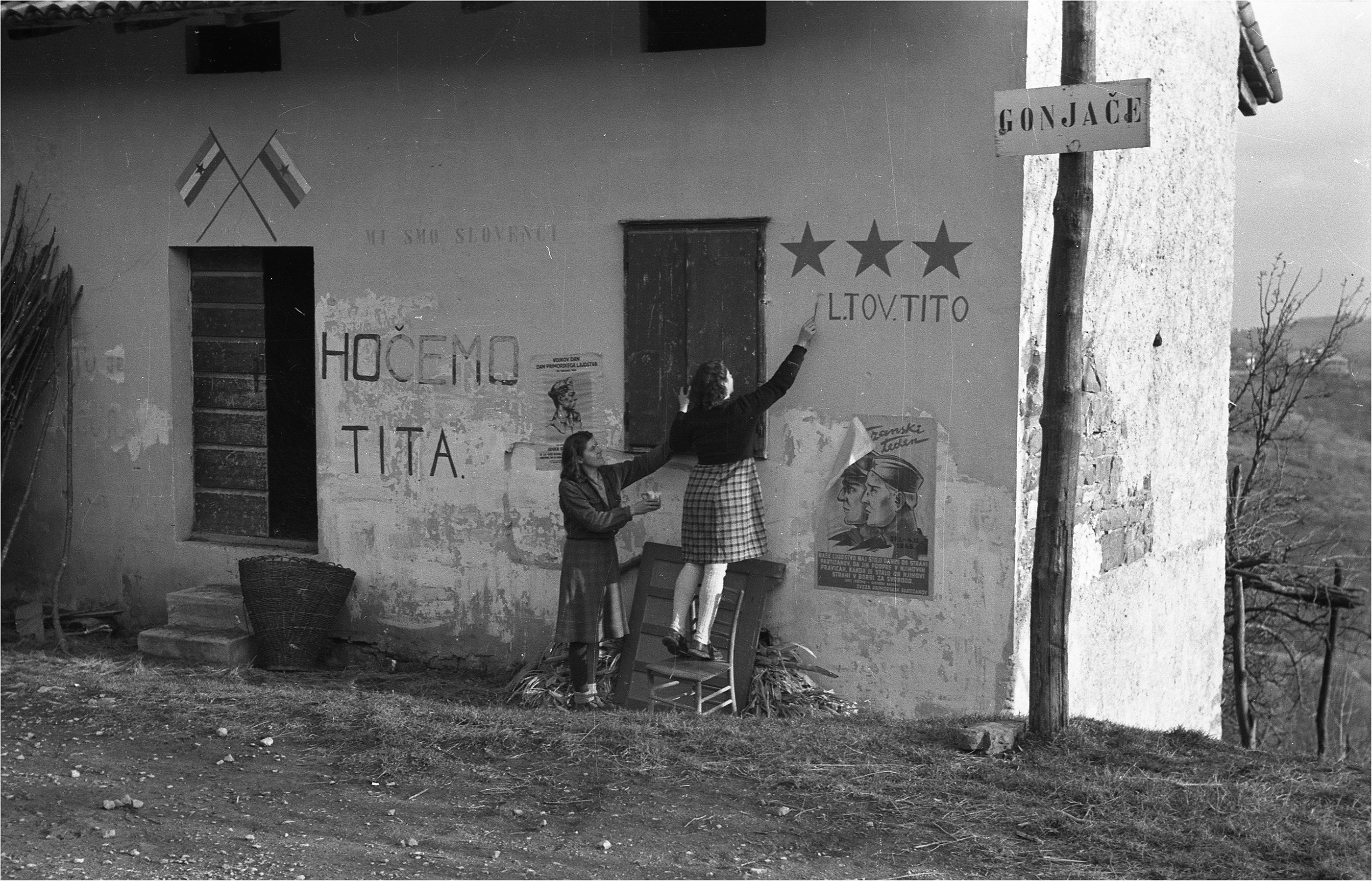
Girls writing pro-Yugoslav graffiti in spring 1946 in the vicinity of Gorizia. Source: National Museum of Contemporary History of Slovenia, FS3076/29a, photo by Marjan Pfeifer Snr.
Almost immediately after the end of the war in May 1945, Slovene authorities issued orders regulating the burials of fallen Partisans and other victims of Italian and German violence. 63 At the same time, the Slovene Ministry of Interior also ordered the destruction of all graves or memorials of Axis soldiers, as well as members of domestic anti-Partisan forces. 64 Opponents of the new ‘people's government’ were meant to be erased from the collective memory, in which the Partisan movement was to have a central place. However, in the first postwar years, the concrete work on arranging Partisan burials was mostly left to their relatives and fellow villagers. Their work was mostly inspired by the need to cope with their grief and to make sense of the colossal loss of life, 65 not to provide the state-building aspect of this process. Accordingly, when preparing the first memorials, the organizers did not pay attention to formal requirements and did not look for trained architects. 66 The authors of the monuments were usually village masons, and they were constructed by the whole village communities. The first Partisan memorials were mostly simple structures, for example in the form of a pyramid, a column or of the stylized mountain Triglav, which had by that time become one of the central Slovene national symbols. Most of them have a plaque in the middle with the names of the fallen. What is ubiquitous is the red star, as the central symbol of the Partisan movement. 67 In some cases, the red star was even combined with the Christian cross (Figure 2), 68 which testifies to the fact that this process was at least partially led bottom-up, not top-down. The number of such monuments is large; in the first two years alone, there were 24 new Partisan monuments erected in Zone A and Zone B of the Julian March. 69 In the next years, the number continued to grow; by 1958 it reached 173. 70
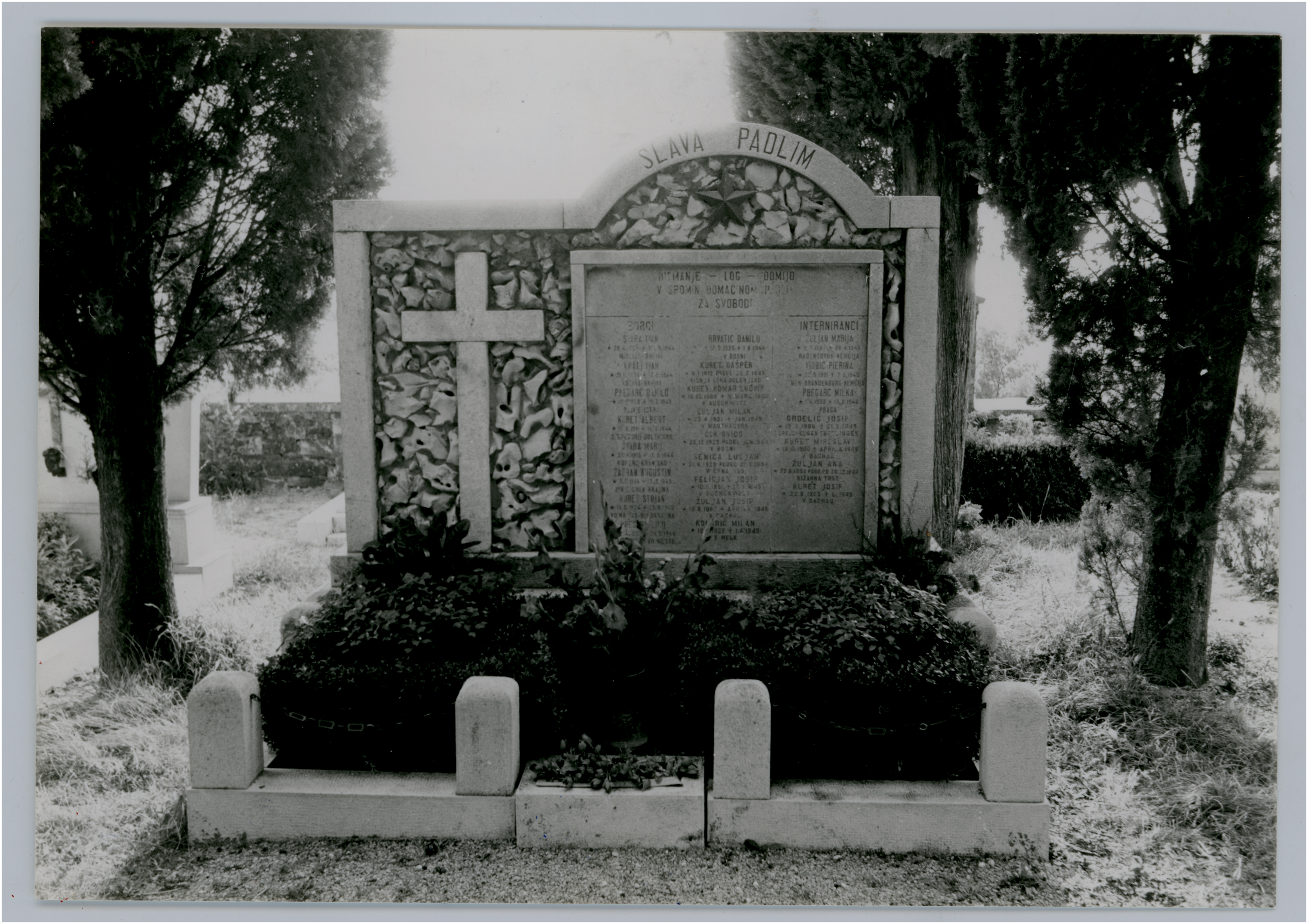
A memorial to fallen Partisans in the village of Ricmanje near Trieste with a cross and a red star. Source: Department of History and Ethnography of the National and Study Library Trieste, Fond NOB, Spomeniki.
After the first postwar years, the KPS and its auxiliary associations took a more active role in the monument construction. The most important organization in this regard was the Veteran Combatants’ Association of the National Liberation Struggle of Slovenia. In 1948, it began to gradually establish local branches. From then on, the number of erected monuments began to increase rapidly. In line with the active role played by the Combatants’ Association in propagating the construction of monuments, the main committee established an expert commission to review the proposed projects. 71 In 1954, the Association also issued a rulebook, which stipulated that local organizations for erecting monuments must ‘[…] find an expert who should draw up a plan for the monument. If they do not have one locally, they should ask for help from the commission for erecting monuments at the main committee of the Combatants’ Association of the National Liberation Struggle of Slovenia. In any case, they must inform the aforementioned commission about the decision to erect the monument’. 72
In accordance with those efforts to control and shape the monument-building process, we can observe a gradual change in the characteristics of the Partisan monuments since the early 1950s. On one hand, some of the leading contemporary Slovene architects (Jože Plečnik and his students, Edvard Ravnikar, etc.) and sculptors (Boris Kalin, Frančišek Smerdu, Tone Kralj, etc.) were increasingly involved in this process. On the other, the characteristics of monuments erected after 1952 underwent significant changes. Newly built monuments were of higher architectonic quality, but also much more monumental and imposing, often including sculptures of heroic Partisan fighters or suffering civilians. 73 In this way, they represented a reification of the KPS vision of the (ideologized) past and thus contributed to the legitimization of the regime, as well as its synthesis of communism with Slovene nationalism. At the same time, as Borut Klabjan has shown, this does not mean that the efforts of the authorities to mould the characteristics of this process were straightforward; on the contrary, they often had to adjust to the wishes of local communities and organizations, which did not always welcome orders from the centre. The dynamics of the process were thus quite complex, as the authorities, at least in some cases, had to take local concerns into account in order to achieve a greater legitimacy of newly built monuments and their communicated vision of the past. 74 However, those adjustments occurred within clearly set limits of what was allowed, so that the main ideological thrust of the regime memory politics was not actually threatened, as the characteristics of newer monuments clearly demonstrate.
The revolutionary communist side of the new spatial order which was being created in the region also manifested itself in a negative attitude towards those spatial features that were symbolically connected with the main ideological enemies of the new political system, especially the Catholic Church and the nobility. As the new times in the Julian March that were to begin with the annexation to Yugoslavia were premised on ‘doing away with the murky past and harmful consequences of the centuries-long enslavement’, 75 the perception of buildings associated with the old order was negative. This was also true of the local Venetian and Habsburg cultural heritage, which was likewise seen through nationalist lenses. 76 After the first exploratory tour of the Primorska region in the summer of 1947, the Slovene Monument Protection Office bemoaned the fact that previous states had paid attention only to classical archaeology and artworks of foreign character. The report thus concluded: ‘The greatest attention must be paid to the maintenance of monuments of local character, i.e. monuments of native Slovene provenance […]’. 77
However, if ancient remains were at first benignly neglected, local castles, manors and churches were often actively targeted. The former were problematic from two distinct points of view. First, they were seen as the living embodiment of the past and feudal tradition, which was synonymous with oppression. Second, from the national point of view, the nobility was almost exclusively of non-Slovene origins and thus perceived negatively. Churches were likewise an example of unwanted heritage due to the communist negative attitude towards the Catholic Church, which was seen as the main ideological opponent of the new regime. On one hand, this was based on incompatible worldviews between Christianity and Marxism, and on the other, on associating the Church with the old social order. Especially in the early postwar years, until a certain normalization of church-state relations in the 1960s, this attitude resulted in a strong persecution of the Church, that is, of priests and believers. There were show trials, long prison sentences and even extra-judicial murders of priests and laypeople. 78
It is not surprising that this hostile attitude towards the Church and nobility also reflected on castles and churches, the buildings materially and symbolically associated with them. The fate of many of them in this period was grim. The turning point for the fate of local castles and manors was the collapse of the entire Italian administrative apparatus after 8 September 1943. Since the nobility was considered a class enemy, the owners were forced to leave their homes, which were often burned, partially destroyed or at least looted. Many of them were destroyed by Partisan units, either during battles or, more often, to prevent their occupation by the Germans and their auxiliary forces. In the Primorska region, at least 3 important mansions and castles were burned and blown up for this reason. The mansion of Haasberg near the village of Planina, property of the famous Windischgraetz family, was one the most beautiful and richly decorated mansions in the wider area. The mansion was burned in the spring of 1944 by a Partisan unit, ostensibly in order to prevent its occupation and fortification by German forces. 79 A similar fate befell the castle of Rihemberk in the Branica Valley and the mansion in Štanjel at the edge of the Karst region. Both were dynamited in early 1944 to prevent the Germans from using them as fortified garrisons (Figure 3). 80
It is doubtful if this justification really encompasses the whole mental process of Partisan leaders who decided to burn and/or blow up those ancient buildings. Their military value was certainly not very important. Furthermore, the cost-benefit analysis of gaining a questionable military advantage in comparison with the loss of such important cultural artifacts
81
reveals the importance of ideological hostility towards this part of local cultural heritage. The memoirs of Milovan Đilas provide us with valuable insight into the forma mentis that enabled such actions: Among the Slovenian Partisans there was a special animosity toward manors and castles – an intellectual heritage from the peasant wars, as well as the result of their battles with the Italians and the White Guards, who used castles as strongholds against the more poorly armed Partisans. ‘The castle burns – the count has fled,’ is an old saying which in those days I frequently heard from Kardelj and Kidrič.
82
The negative attitude towards manorial architecture continued even in the postwar period: the nobility was expelled from the country; their dwellings and estates were nationalized. The nationalization did not lead to the state taking proper care of its property. Thus, in the period after the Second World War, the castles performed a wide variety of functions, without the state taking necessary precautions to preserve them. Some castles were used for housing; others for schools, warehouses, workshops, garages; some were taken over by the army. Regardless of the various uses of the castle buildings, they all more or less had in common that the castle chapels were completely destroyed, being used as storage rooms, garages or even coal warehouses. 83
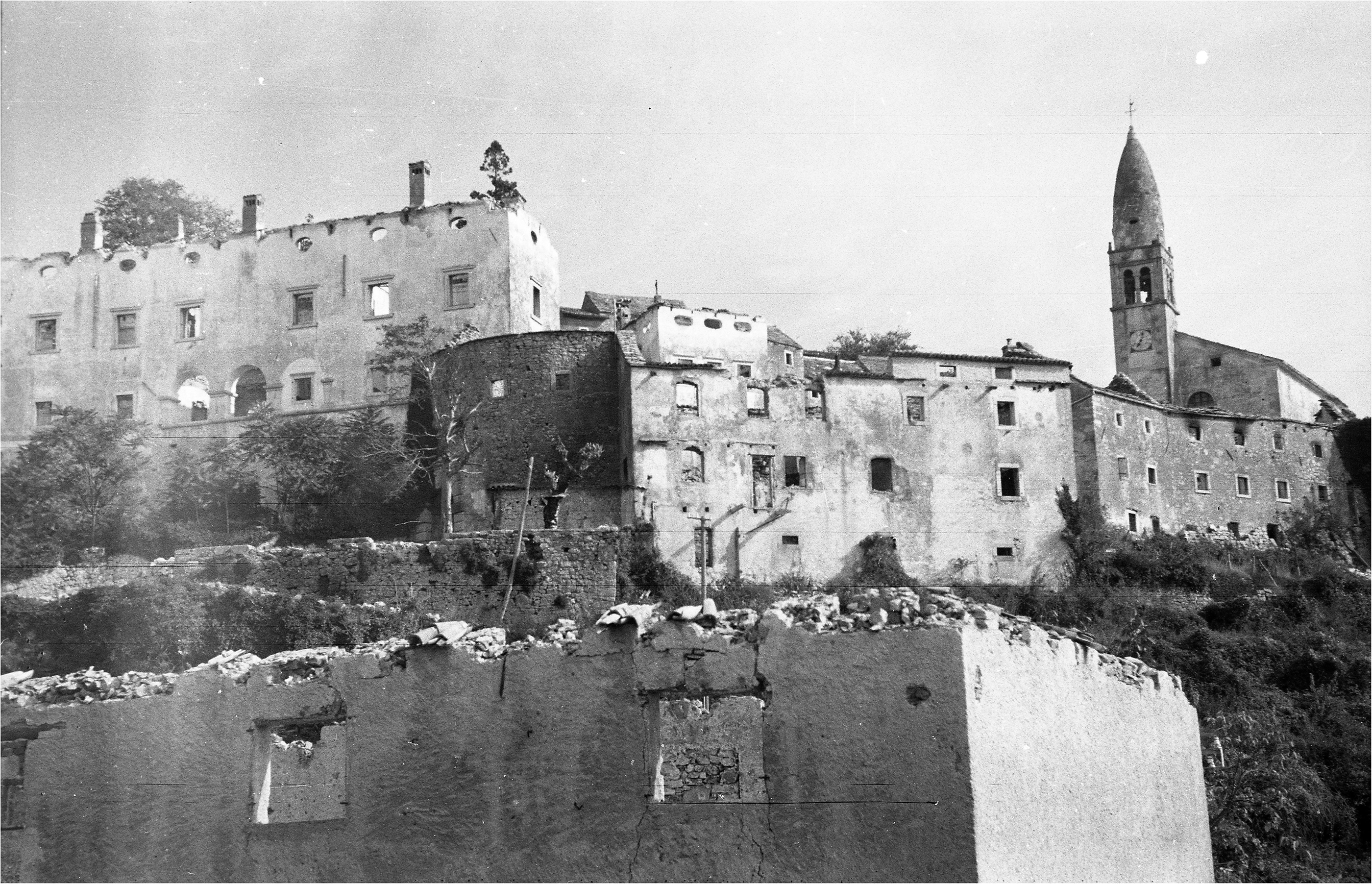
Destroyed castle in Štanjel in 1945. Source: National Museum of Contemporary History of Slovenia, FS2908/3, photo by Marjan Pfeifer Snr.
Many castles that had already been severely damaged during the war were then exposed to demolition, as they were used as quarries to collect building materials for reconstruction. This not only took the form of actions of individuals or small groups, but the initiative also came from municipal organizations. A report from the Monument Protection Office from 1949 vividly describes the process: ‘Where the Office was not able to quickly intervene and protect the damaged building with appropriate measures and duties, it happened many times that individuals and local people's committees arbitrarily removed the ruins and used them to build private homes, public buildings or cooperative homes […].'
84
How was it possible that such actions continued long after the war? Why did the state not provide protection to those buildings, despite the existence of monument protection laws? The postwar deprivations certainly played a role; however, the prevalent negative attitudes towards those buildings likewise must be taken into account. Indirect information about the hostility to those buildings in postwar revolutionary fervour is actually provided in the aforementioned report, which emphasized their oppressive history: In reality, many castles across Slovene land are monuments of our feudal, oppressive era, which arouse anger and resistance in many people. […] The Slovene people built them with bloody blisters and after a few centuries took them into their possession with the revolutionary liberation struggle.
85
Like with noble residences, this rejection was reflected in the attitude towards local sacral architecture. During the war, many churches were damaged by military clashes or Allied bombing. In the postwar years, the hostile attitude of the new government towards the Catholic Church manifested itself also as acts of vandalism against local churches and shrines. Although it cannot be said that there was a systematic KPS-led program of targeting local churches, unlike in the restricted Kočevska region, where all churches were systematically demolished, 86 the general hostile atmosphere towards the Church, which was planned and encouraged by the communist authorities, contributed to the fact that many acts of vandalism occurred. Radical activists graffitied them with communist symbols (hammer and sickle, red star) or inscriptions. Such acts were condemned as a kind of ‘sectarianism’, which was counterproductive at that time. 87 In some cases, the vandalism reached much heavier proportions, for example in the filial church of Saint Mark near the village of Žabče in the vicinity of Tolmin. In the first postwar years, the church was still used for religious services. However, in 1948, the church was desecrated by some Yugoslav soldiers from the military garrison in Tolmin. The heaviest damage was inflicted the next year, when the local magistrate instigated two youths to vandalize the church, first giving them a bottle of brandy. The boys defecated on the altar and then lit a wooden part of the altar on fire. Statues of saints from the church were hanged on a nearby walnut tree, from which they were later removed and stored by a local. Later, in 1951 and 1952, the church was used for the mortar targeting practice of an army unit. The ruin was then left alone until the early 1990s, when the church was rebuilt and re-consecrated in 1994. 88
However, the most common tactic used by the KPS was denying permission to rebuild damaged churches. This exposed them to further damage. Leaving many churches unrepaired allowed the authorities to demolish them entirely after a few years. It did not matter that some of the demolished churches were old valuable buildings from the Late Middle Ages. One such example was the old filial church of Saint Mark in Vipava. The then already desecrated church was demolished in the late 1940s by the command of the president of the local people's committee. 89 But the most prominent case of denying permission to rebuild in order to remove the church from public space occurred in the mining town of Idrija, where the parish church of Saint Barbara, located in the main square, was badly damaged in an Allied bomb attack in the spring of 1945. After the war, the dean, Janko Žagar, and the faithful began to collect building materials for the reconstruction, but the city administration refused permission, as the new regulation plan did not foresee the church in the main square. Žagar, however, did not take the hint and appealed to the central government in Ljubljana. After Žagar's complaint, the matter was discussed at ‘mass meetings’ in Idrija, where the hostility to the Church, but also the desire to remove the church from a prominent place in the town centre, clearly came to the fore. In the final report submitted to the government, the local leadership in Idrija stated: ‘Our intention is that the town becomes a truly socialist town that already shows such an appearance from the outside […].' 90 The permission was therefore denied. 91 However, the story did not end there, as the dean was arrested in March 1949 and subsequently put on a show trial, where he was sentenced to 20 years in prison. 92 In the early 1950s, the remains of the church were completely demolished. This has completely changed the symbolic character of the town centre to this day, since the new church, which was built in the late 1960s and early 1970s, stands on the outskirts.
The political and social turbulence that characterized the North Adriatic area between 1943 and 1954 was accompanied by deep changes in the local landscape. The rise of the communist-led Partisan movement and then the establishment of the communist state system were also reflected in spatial order, where new spatial hierarchies were created. In the Italo-Slovene borderlands, those were characterized by a synthesis of communism and Slovene nationalism, as the communist attitudes towards nationalism underwent significant changes in the quickly changing circumstances of war. This synthesis led to the ideologization of some hitherto non-ideologically conceptualized spatial features, such as local manors and castles, most of which were subjected to ruin. Furthermore, the intertwining of nationalist and revolutionary layers of meaning can be observed in other cases of spatial interventions, from removing Italian spatial markings to the hostility towards local castles and manors, which were conceptualized as foreign.
The research into this topic can be placed into different research approaches dealing with the history of communism, first of all within the study of communist spatial politics, which has been extensively employed by a number of communist regimes. However, unlike most hitherto existing studies, which have mostly focused on toponyms, architecture and urbanism, a much broader range of ideologically charged spatial features have been revealed and analysed. Second, the results fit with the recent rise of works dealing with the relationship between communism and nationalism. In this regard, the article offers further arguments for the conclusion that communism and nationalism were not mutually exclusive, but could rather be closely intertwined, as argued by Martin Mevius. However, this state of affairs was contingent on the historical developments since the 1930s, being strongly influenced first by the new Comintern policy of establishing people's fronts and then by the developments during the Second World War in today's Slovenia. Furthermore, the aforementioned synthesis must be understood in relation to the specific border character of the North Adriatic region, which had been a place of contention since the second part of the nineteenth century, taking into account the ‘indetermined’ and contested nature of the territory. The Italo-Slovene borderlands imbued with historical experiences and legacies of competing national aspirations and, first of all, forced Italianization in the interwar period could be therefore understood not as a passive recipient of impositions ‘from above’, but also as an ‘actor’ influencing decisions of the competing powers in a special way, i.e. by forcing them to confront regional specifics, first of all the strained interethnic national relationships and the longing of the great majority of the Slovene population to be free from Italian rule.
This is further confirmed when taking into account the role of the local Slovene population in shaping and implementing communist spatial politics. The unorganized efforts of Slovene inhabitants cannot be categorized neatly. In some cases, they were based on pre-political needs (e.g. the building of memorials to fallen Partisan forces) and had to be ‘guided’ in the ‘right’ direction by the Party; in others, they were completely in accordance with the official line. Furthermore, in some cases, local activists were even more radical than the authorities (e.g. when targeting churches), so they had to be partially reined in. Regardless of case-based specifics, the non-organized efforts of the populace played an important role in the concrete shaping of all the studied interventions. Moreover, the enthusiasm of the populace was of central importance for the success of the KPS’ goals, especially during the Second World War. All of this testifies to the complexity of this process, as well as revealing insight into the dynamics of power that characterized the emergence and subsequent consolidation of a new political system in the North Adriatic borderlands in the first decade of its existence.
Footnotes
Acknowledgements
The research was carried out as part of the postdoctoral research project ʻFluid Landscape: Architecture, Identity and Border Space in the Northern Adriatic from 1943 to 1954' (Z6-3222), which was funded by the Slovenian Research and Innovation Agency (ARIS). The author would like to thank the anonymous reviewers of the text for their suggestions, which have improved the original manuscript.
