



Abstract
The Direct Action Committee (DAC, 1958–62) and its parent, the Non-Violent Research Group (NVRG 1949–62) occupy a minor position in British postwar peace historiography where they are generally depicted as a well-meaning fringe group whose political naivety limited their impact. This perspective assumes that success means inaugurating a mass movement or forcing a policy change. It overlooks the group's objections to these strategies and underplays the research dimension of their activities. This article argues that while unilateral disarmament was the DAC's short-term priority, it was always connected to a larger goal of cultivating non-violence as a practical political philosophy and theory of social change. During the 1950s, the group developed an ‘artful science’ of activism which included a poetics of protest inspired by the Gandhian concept of satyagraha. Later, their fieldwork experiences further informed a prosaic theory of activism attentive to the everyday business of organizing as a vital space for building democratic capacity.
The Direct Action Committee (DAC) (1958–62) emerged from the Non-Violent Resistance Group (NVRG) (1949–58), an offshoot of the Peace Pledge Union (PPU, 1936–), to research and test non-violent resistance methods. Among its core organizers were Pat Arrowsmith (1930–), Hugh Brock (1914–85), April Carter (1937–2022), and Michael Randle (1933–). The group were heavily influenced by Gandhi's concept of satyagraha meaning truth force or insistence on truth. Satyagraha had two aspects: a visceral sensation of something being ‘true’ and a way of life that conditioned people to be open to that sensation and live according to its principles. 1 In Gandhi's teachings, this was understood spiritually, but in the sceptical, secular atmosphere of Cold War Britain, it was prudent to shift the emphasis from religion to science and toward a psychological reading of satyagraha as a mechanism for social change. By leading this process, the DAC contributed to an ‘artful science’ of modern activism.
Historiography on postwar British Cold War peace activism focuses on the Campaign for Nuclear Disarmament (CND) and treats the DAC as a minor fringe group of limited importance. 2 Granted, the CND wielded more influence as a mass movement, but over-concentration here overlooks the significant intellectual contribution the group made to activist theory and practice. For example, Holgar Nehring's account of the 1958 Aldermaston march spotlights the CND as lead organizers despite the fact the project was devised by the DAC (before the CND even formally existed). Moreover, Nehring argues correctly that the 1958 march marked a shift in British postwar activism because of the unique culture it generated, (as Peggy Duff, CND secretary, said, it gave a glimpse into a ‘new sort of politics’), 3 but all the elements he singled out as key to this – the role of music, the eclecticism of the marchers, the apparently spontaneous addresses from speakers at break times – were anticipated and carefully facilitated by DAC organizers. Many of these features were lost or diluted the following year when the CND assumed full control. 4
Where there has been deeper engagement with the group, they are viewed with a mixture of patronage and criticism. Richard Taylor and Colin Pritchard found that while there was ‘much to applaud’ in the DAC's sentiments, they exhibited ‘the politics of immaturity: the desire and the belief that dramatic and immediate anti-authority political action would secure their objectives’. For Taylor and Pritchard, the group was limited by being both a ‘radical elite’ and ‘essentially a Liberal movement’. 5 They were further criticized for naivety in their relations with the organized working class (Trade Unions and co-operatives) and the Labour Party, a factor contributing to their ‘failure’ to stimulate a mass movement. 6
The Daily Mail, 12 January 1952.
Against this, Sean Scalmer acknowledged the DAC's creativity in updating Gandhian principles of non-violent resistance. Scalmer situated this as part of a wider period of experimentation in mid-century Britain and America. While the 1950s were a relatively quiet period for activism (at least in contrast to the 1960s), activists in both countries thought hard about how to translate Gandhian principles into different national arenas and apply them to distinct issues such as civil rights or nuclear disarmament. He argued the fruit of this period of reflection was a move to a more disciplined approach to organizing, executing, and evaluating protest. 7
Mildenhall protest, 28 June 1952.
Building on from Scalmer and responding to Taylor and Pritchard's charge of political naivety, I argue the DAC's combination of political ambivalence and experimentalism connected with two intersecting Cold War histories: the quest for a new politics, and the expansion of the social sciences. Before the fifties were over the decade was dismissed as conformist and apathetic. 8 Contesting this, Lawrence Black has argued that apathy was not always apolitical but marked a transition in political culture. The Cold War did not just fuel suspicion toward socialism but toward politics in general. According to left-wing journalist Nicolas Walter, ‘commitment in the age of the Cold War, the Welfare State, and the Affluent Society’ was ‘autonomous and antinomian, adhering to no ideology and demanding no shibboleths’. His generation cared more about what was ‘bogus or phoney than cruel or wicked’. 9 Dissatisfaction with ‘politics as usual’ led to what Black called a transition from ‘political bodies’ to the ‘politics of the body’ and the search for new forms of political participation (such as Michael Young's Consumer Association, 1957) which offered an ‘alternative to the partisan political world – a sphere for plural, participatory, democratic citizenship’. 10
In addition to the Cold War, the Welfare State also prompted a move to ‘political bodies’ by fuelling social science research. A decade on from its implementation, it not only generated more data than ever about ordinary people's lives – their health, education, behaviour and misbehaviour – but consequently required a workforce able to apply this knowledge. An increase in government funding and co-operation (the Advisory Council of Scientific Policy was set up in 1947) permitted further expansion in social science research and teaching in British universities (AH Halsey records 35 sociology professors in 1945 rising to 200 by 1965, and, in a related development, the British Sociological Association was founded in 1951). 11 As such, Welfare was both the product and producer of a social scientific ‘turn’ in intellectual culture but one bearing little resemblance to the holistic scientific social planning characteristic of the thirties. 12 As Mike Savage points out, the postwar ‘turn’ was typically empirical in method, limited in ambition, and technocratic in nature. Yet while critics found it parochial, myopic, and deceitful in concealing its liberal ideology, advocates welcomed it as open and more democratic. 13
Mathew Thomson observed that of all the social sciences, psychology prospered the most. The reasons for this were, first, the Cold War was primarily experienced as psychological warfare, not just in terms of the clash of ideologies, but through the political levering of distrust it engendered, with major government investment into the mechanisms of ‘radicalization’. In addition, the sheer scale of threat posed by the bomb, along with the uncertainty surrounding its deployment, fostered a perpetual sense of existential anxiety. 14 Second, the combination of welfare in conjunction with affluence and migration contributed to rapid social change. As the Committee on Children and Young People reported (October 1960), ‘the material revolution is plain to see […] It is not always so clearly recognised what a complete change there has been in social and personal relations […] and also in the basic assumptions that regulate behaviour’. 15 Given this, psychology seemed the discipline best placed to interpret and explain the workings of a society in transformation. 16
The clearest synthesis of the ‘new politics’ and the expansion of the social sciences was reflected in what Matthew Hilton and co-authors described as the ‘privatization of politics’ and the attendant professionalization of activism. They charted this through the rise of the non-governmental organization (NGO) and the emergence of the expert who was able to provide more detailed diagnoses of social problems, more precise policy recommendations, and more effective direction on campaign strategy. Hilton et al argued that this figure provided a more relevant ‘intermediary between the social and the political’ than the traditional politician. The politics of expertise encouraged a new form of activism, issue-led and scientifically informed, along with new patterns of participation, discretionary and provisional. While acknowledging that voluntary associations of this nature were no guarantee of progressivism, the authors commended how, overall, public concerns became ‘better articulated by those who understand them comprehensively’. 17
The DAC clearly link to this process but with important qualifications. They too wished to enlarge the scope of what constituted political action and who counted as a political actor. They also valued fact-based accounts of problems and applied psychological principles to their campaign plans. Yet they stood in opposition to the politics of expertise. Instead, they sought a more substantial redistribution of power from the political centre. As the primary concern of most of the emerging NGOs was, at this time, to lobby parliament for change, either directly or through mobilizing public opinion, they did not seek this. For the DAC, however, taking direct action was inseparable from pursuing direct democracy as a whole way of life. This distinction in their views on this matter from that of the CND, for example, was most evident in their often-strained relations with the Labour Party. Rather than believing that the political system, if properly held to account, was sufficient to achieve their ends, they came to see the idea of the state itself as reliant on perpetual conflict to maintain its power internally and externally. Without first dismantling the state and dispersing its power among the people, peace could only be the temporary absence of explicit violence.
Focusing on Britain and the DAC, I show how the group re-rendered Gandhi's satyagraha as a two-pronged strategy for democratic revolution involving disruption on the one hand, and devolution on the other. Disruption meant confronting power, exposing its claims to protect people as false, and creating a space in the public mind for alternatives. Devolution meant increasing people's practical capacity to take over democracy in everyday life. These dual strands were realized through an ‘artful science’ of activism or, in other words, an aesthetic theory of social change which assumed that (a) how people saw the world determined how they acted in it, and (b) how they imagined the world and its possibilities could be transformed through deliberate intervention.
Activism as an artful science had a poetic and a prosaic component. Jeffrey Alexander describes the poetics of protest in terms of an immersive social performance aimed at stimulating deep emotional responses in participants and spectators. This connects it back to theatre's roots in ancient rituals which similarly choreographed experiences to induce a sense of change. 18 From the start, DAC activists grasped this clearly and poured over the design of their events, contesting each point of form, structure, and style for its potential to trigger emotion.
By contrast, the prosaic part referred to the everyday experiences of activism, the mundane details of co-operating with others to organize a campaign. In its philosophical form, prosaics presumes the importance and radical potential of ordinary life. It can be traced through modern thinkers from Leo Tolstoy, Ludwig Wittgenstein, Gregory Bateson, 19 Agnes Heller, and Michel de Certeau, and has a clear resonance with the reconstructive dimension of Gandhi's satyagraha. While the poetics of protest strive to create a large, unified image, the prosaics of activism is untidy and digressive, attentive to minutiae. Although this sounds far from what activists usually want to achieve, Donatella Della Porta contends this ‘daily business’ offers a vital mine of democratic creativity. 20 By permitting the free play of subject matter rather than the refinement of systems, more people can participate in ways suited to their interests and dispositions.
The value of everyday activist practice for enhancing democracy has been acknowledged for mid-century American activists, 21 but not for their British counterparts. I argue that DAC activists recognized the importance of the whole activist experience as equal to the outcomes of activism and gave much thought to improving the quality of it. In doing so, they attempted to connect the strategic and philosophical dimensions of satyagraha, or, in other words, to fully integrate revolutionary means with revolutionary ends.
First, I trace how the NVRG read and then experimented with scientific readings of satyagraha. Initially, these experiments were only small-scale events but began increasing in ambition from 1956, culminating in the first Aldermaston march (1958). Second, I look at how the DAC's less well-known Aldermaston summer picket (July–September 1958) highlighted the importance of the experience of activism as a form of democratic pedagogy for participants.
In making this case, I have drawn on the DAC archive (Commonweal Library, University of Bradford), Hugh Brock's articles (also held in the Commonweal collection), and Pat Arrowsmith article's (held at the London School of Economics). As part of the process of theorizing satyagraha in scientific terms, the group documented all their campaigns extensively covering everything from inception to reception. Material includes meeting minutes which summarized debates in detail, itineraries covering everything from catering costs to route maps, drafts for volunteer briefing sheets, and annotated leaflets, questionnaires, and press release copy. Taken ensemble, this offers a rich insight into the evolution of their thinking about satyagraha as a holistic theory of democratic revolution.
The NVRG was part of the PPU's postwar rethinking. Throughout the thirties, PPU was Britain's largest British Anti-War movement. Its iconic postcard pledge campaign attracted thousands of supporters. During the War, however, support waned and never fully recovered. To many, it seemed Hitler had permanently discredited pacifism as anything more than the otherworldly creed of cranks and moralists. Overnight, the bomb changed everything. The harrowing images coming out of Japan returned many to active campaigning. This was reinforced in 1947 when Clement Attlee committed to an independent British atomic bomb policy, appointed William Penney as head scientist on the project, and committed Britain to a programme of nuclear testing. 22
With the movement renewed but unsure how to proceed the NVRG was convened in 1949 to research non-violent methods, and Hugh Brock was appointed as chair. Brock was the printer of and a writer for (later editor) the PPU's journal Peace News (PN). Like several others in the new group, he was a Quaker and former conscientious objector. During the War, he served a six-month jail term for refusing War-related work. Under Brock's guidance, the NVRG group was charged with investigating ‘the place of non-violence in pacifists’ faith or philosophy; its day-to-day and emergency methods, relationships between them, appropriate types of self-discipline and public demonstration’. 23 This quote, taken from the minutes of their first meeting, shows how from the outset they thought about change on two levels. In the short term, they wanted to mobilize individuals against the bomb. In the long term, they wanted to convert this mobilization into a full social revolution toward a permanently peaceful society.
As Scalmer showed, when it came to answering this question, Gandhi dominated their thoughts. This was not new, PPU members had had a long relationship with the Mahatma. PN had covered his campaigns avidly. Several of its writers, including Reginald Reynolds and Wilfred Wellock, went out to live with him in India. Moreover, at the dawn of the 1950s, it was natural they should look to him as the most successful non-violent campaigner in living memory.
Gandhi's concept of satyagraha was key but ambiguous, even in his own use and teachings. While its intellectual roots and implications were disputed, at its core it was the idea of truth as a psychosomatic force experienced by individuals as a repulsion at injustice. Those wishing to stimulate that feeling in others had to convert it into a physical language – like a performance – powerful enough to trigger an involuntary resonance in participants and spectators alike. Gandhi taught this could be done by making a partial sacrifice of oneself, by demonstrating compassion before wrong-doing, truth became visible. Once truth force had been experienced, it had then to be turned into a whole non-violent way of life based on mutual aid.
The Quaker members of the NVRG were familiar with the idea of self-sacrifice, which was central to their creed, but they realized this needed translating into secular terms to get wider traction. When it came to Gandhi, much of this translation work had been started for them. From the 1930s, a series of books by Indian, American, and European commentators recast the religious elements of Gandhi in terms of modern psychology and military strategy. The group read everything they could and took turns in reporting back. Favourites included Krisnalal Shridharani's War Without Violence (1939) which claimed Gandhi had always been a political pragmatist and RR Diwaker's Satyagraha (1949) which reinforced how satyagraha must be felt as a physical need, like hunger, and expressed in the forms and languages familiar to ordinary people. 24
The most influential commentary was Richard Gregg's The Power of Non-Violence (1934) 25 which placed Gandhi's writings in dialogue with selected ideas from evolutionary biology, psychology, and military theory. Gregg, a veteran American activist who worked with Gandhi in the 1920s, believed the greatest obstacle to non-violence was fear, ‘the oldest and strongest of emotions’, which, when it took hold, dominated the entire body, driving out more refined capacities for reasoning or sympathy. As such, it was a primary tool of political manipulation. Nevertheless, humans were malleable and environmentally responsive, they could resist. He re-presented satyagraha as ‘moral jujitsu’, a technique for redirecting the intense build-up of energy that fear induced.
How did you apply moral ju-jitsu in practice? The group deconstructed Gandhi's individual campaign strategies to find out. What stood out here was their specificity. Only one issue at a time was pursued, with each element of that campaign co-ordinated to amplify the main message. Moreover, whatever means or resources were to hand were put to work. In General Smut's South Africa, for example, when the government passed a law invalidating Indian marriages, Gandhi had Indian women (who were rarely seen in public) march alongside their husbands. When they were arrested for protesting, images of them in prison camps were sufficiently shocking to mobilize Indian and European opinion against South Africa, forcing Smuts to concede a public inquiry into the Indians’ complaints. 26
The effectiveness of the single-issue method was evident in contemporary campaigns such as the land share initiative led by Vinoba Bhave in India (1950), a sit-down protest in Wales to prevent land seizure for an army camp (1951), a joint African, Indian, and ‘White’ protest against apartheid in South Africa (1952), a (mostly) non-violent revolt in East Germany (1953), and the paralysis of a Soviet prison camp through strike action (1953). 27 The group poured over all these examples too.
Not all accepted these techniques uncritically. Meeting minutes show there was concern over the issue of compromise and how compatible it was with the ultimate goal of a permanently peaceful society. For example, should they work with institutions like the Church of England or The National Council for the Abolition of Nuclear Weapons Tests? In the public eye they were seen to uphold high moral values, yet they did not support total disarmament or direct action. 28 Similarly, should the group appeal to national values even though they believed that nationalism was one of the main causes of violence?
These disputes exposed a note of tension between satyagraha as a non-violent strategy and a non-violent ideal. The former demanded a degree of manipulation and contrivance that seemed ill at ease with the latter's creed of tolerance. Determined to amend theory through practice, a subgroup, Operation Gandhi (OG), again led by Brock, was formed to conduct experiments. The first hurdle they faced was that OG activists visualized the style and tone of satyagraha very differently. Alex Comfort, pacifist, psychiatrist, and anarchist writer in his early 30s proposed ‘The Umbrella Man’ campaign which used the umbrella to signal the futility of defending oneself from nuclear bombs (it also carried overtones of the bowler-hatted bureaucrat signing off on civil defence policy from the safety of an office). The journalist in Brock saw great potential. With Comfort, he imagined an escalating programme starting with umbrella parades, followed by the umbrella symbol appearing all over London or crowds holding umbrellas appearing at VIP meetings. 29
The umbrella idea was creative, exciting, and likely to appeal to a younger, spiritually ambivalent, audience but the others had reservations. Kathleen Rawlins, a Quaker, and veteran peace campaigner of several decades, did not think the plan sufficiently captured the idea of suffering. The whole thing was too polished and clever, like a student prank. Protestors should be prepared to look foolish but not insolent. 30 Brock was disappointed but changed tact.
The next project proposed was a War Office sit-down protest. Picketing outside of government offices was not new but this would introduce an element of disobedience outside of ‘the heart of British militarism’. 31 OG activists would arrange themselves into a tableau of human vulnerability by first sitting, then refusing to move, and then having to be dragged away. Importantly, this would not be for the benefit of the politicians inside (as conventional pickets usually were) but entirely for the public gaze.
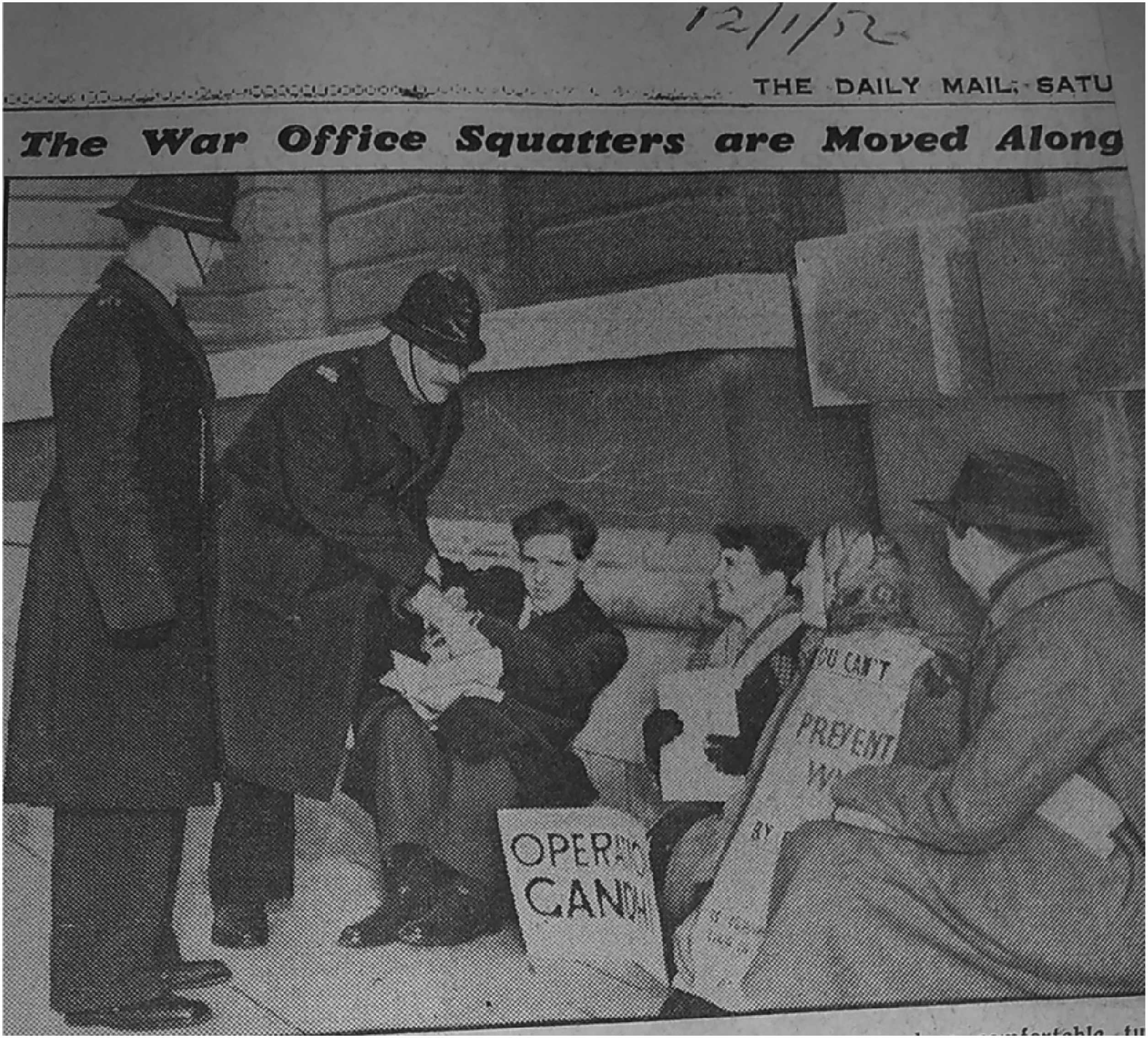
The plan was accepted and on 11 January 1952, 11 OG members – a mixture of men and women, mostly middle aged, all respectably dressed – made their way on foot to the War Office and, on reaching it, sat down on the pavement outside (see Figure 1). Alongside their smart clothes, they carried leaflets intended to further stress their ordinariness: We owe you an explanation. We are not crackpots and we are not Communists. We know we look silly. We are doing it to appeal to your intelligence and your conscience, although it may lead to arrest and imprisonment […] In this tragic situation there is one question we must ask: Is the power to inflict suffering and cause mass destruction the only power in the world?
32
The whole incident lasted no more than half an hour but when the group reconvened on 27 January to analyse the action, this did not concern them. The amount of time was less important than the impact. Brock reported the press response. Of course, PN gave the event good coverage, as had The Daily Worker. Of the mainstream articles, The Evening Standard had focused on the court case, The Daily Mail had carried a long caption which, although bemused, was not hostile. More importantly they included a picture:
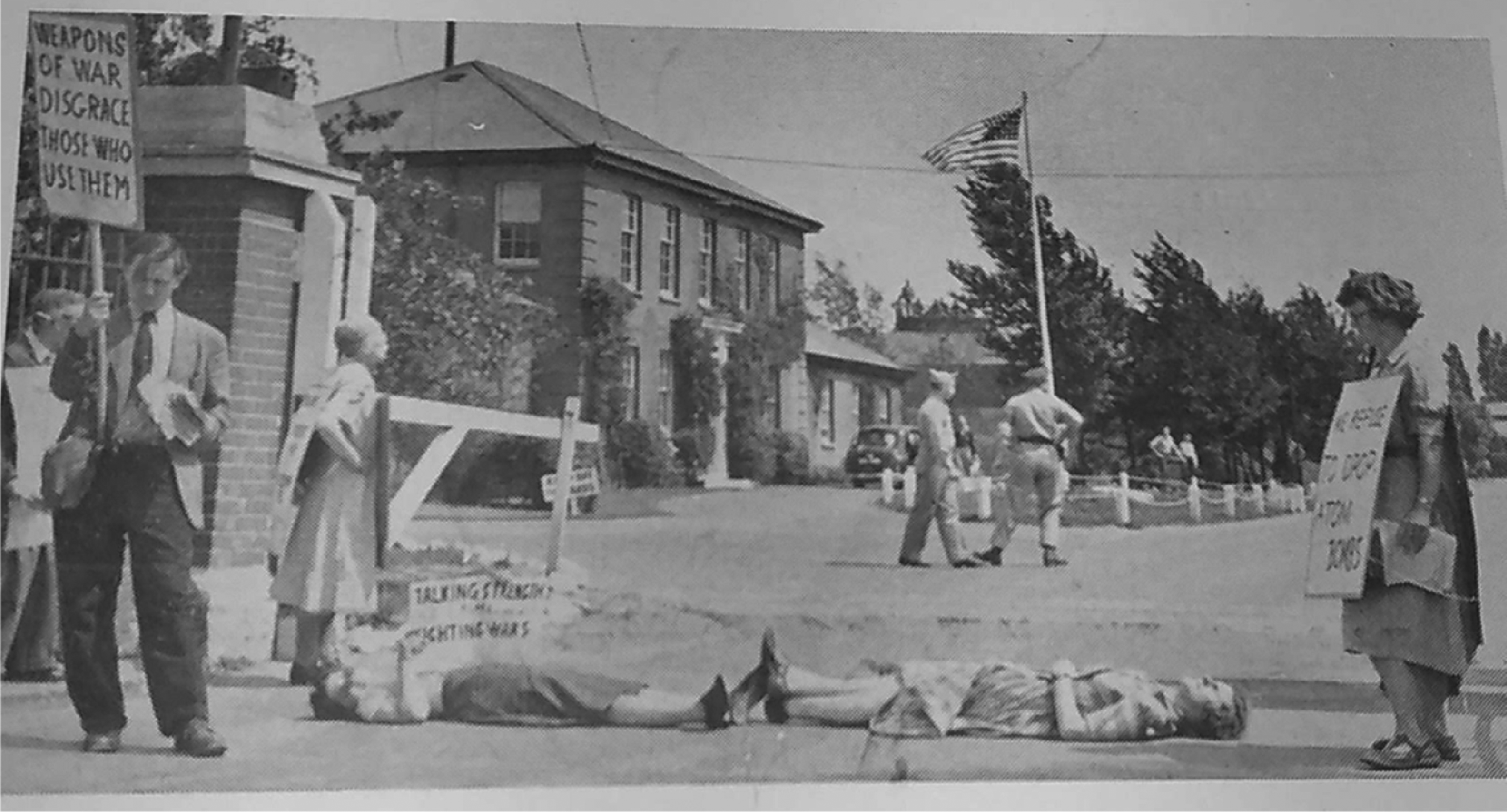
Encouraged, OG made further experiments in the performance of sacrifice. On 28 June 1952, they travelled to Mildenhall airbase in Suffolk. Gathering outside of the base, two members, Connie Jones (a social worker) and Dorothy Morton (a teacher) lay down to toe-to-toe outside of the gate for 20 min (see Figure 2). Sure enough, this caught local media attention: ‘Pacifist Demonstration Fell Flat’, sneered the Cambridge Daily News, ‘They aimed to preserve peace. All they got for their trouble was scorched legs’. 34 The Eastern Daily Press quipped that it was ‘in every sense, a very peaceful demonstration’. 35 The Bury Free Press and the Newmarket Weekly sneered at the ‘pacifist failure’. Again, PN, The Friend, Socialist Review and The Daily Worker were sympathetic, but their readers did not need persuading.
Reviewing Mildenhall, Brock listed the problems. Yes, the intervention had presented sacrifice with the two women lying before the gate, but this had not resonated with anyone. It looked silly rather than poignant. Were two people (even when they were women), too little? Was 20 min too short a time to lie down? He further observed there was no prior engagement with local groups or unions which meant no one came to join them. The whole thing lacked ceremony, there were no speeches, no debates, and no literature stand. The whole business had indeed fallen flat, it needed better organization, a stronger presence, and more flare. 36
At this point (July 1952), they were visited by Bayard Rustin, the American activist superstar of the peace and civil rights movements, who offered advice. Although much of what he said repeated what they had read in Gregg, his choice of emphasis illustrates some of the differences between British and American satyagrahists. He told the NVRG they needed to raise their game, appoint strong leaders to do the talking to the press, stick firmly to one issue at a time, and train their recruits better before events. He also advised they be less severe, ‘suffering which is cheerfully accepted touches people, you cut more deeply into the feelings of the community’ but also more forthright, ‘go to people with Peace News and a statement about the atom bomb and ask up-front for a contribution towards this way of life’. 37
Rustin's unapologetic insistence on discipline and leadership stemmed from how satyagraha the use of satyagraha in the American civil rights movement. Civil rights protests involved greater social diversity of participants, including many from poor Black communities unused to protest culture. There was also a greater threat of violence to protestors which made it too dangerous to leave anything to chance. By contrast, the NVRG were mostly White, middle-class, highly experienced campaigners who were accustomed to the trials and indignities of minority causes. Admittedly members like Brock had faced violence for their beliefs during the War, but in peace time, the group received more derision than physical attacks. They could, then, indulge more reservations over imposing discipline and leadership.
OG continued experimenting throughout the mid-fifties, but it was not until 1956 and a change in the political climate that they finally made an impact. The Soviet Union's invasion of Hungary and the Suez Crisis discredited both sides of the Cold War equation simultaneously and prompted large public rallies in Trafalgar Square, including hundreds of students. Meanwhile, the British nuclear programme gathered pace, and Operation Grapple (the testing of the first British hydrogen bomb in the Pacific) began in 1956. The NVRG responded by reinventing itself as the Emergency Committee for Direct Action Against Nuclear War (Emergency Committee).
The sense of urgency combined with the angry public mood and the group's by now considerable experience, increased their ambition, as did the input from their younger members who now trialled their own ideas. Michael Randle, who joined the group in 1952 aged 19 (having registered as a conscientious objector to military service in 1951), walked to Hungary from the Austrian border in solidarity with the Hungarian people and to promote non-violent resistance against the Russians. He completed the 3-day trek but was immediately sent back to Britain by the Austrian authorities. PN covered the story but no one else did. Undeterred, Randle wrote in PN that he hoped to ‘stimulate other pacifists to work out more imaginative ventures. There is a real need for such experiments in non-violence’. 38
The challenge was answered the following spring when Harold Steele, a 63-year-old family man from Worcester, volunteered to sail out into the Pacific nuclear testing zone. This time, the effect was electric, overnight Steele became a star of the movement. Ultimately, the plan came to nothing, but the impact the mere idea of it had in the public imagination was instructive for the Emergency Committee. In fact, over 30 activists volunteered to join Steele, 2 travelling with him first to India, and then on to Japan to seek support there. In the event, however, the others were mostly airbrushed from the public accounts, something, it seemed, Steele and Brock were slightly complicit in. Writing to Brock, David Graham, one of the volunteers from the Indian trip, complained The last time I heard Harold Steele talk in the Xmas Island protest he forgot to mention the other volunteers beside himself […] On ITV he was billed as ‘one man against the world’ I passed this as a commercial TV gimmick. However I read in PN [Peace News] this week of ‘HS who attempted to get to Xmas Island to make a one-man stand against the H bomb […]
39
Small-scale, highly theatrical events suited the Emergency Committee, not least because they were easier to design, organize, and execute on limited resources. Nevertheless, they were interested in the benefits of ‘mass’ actions for raising public awareness, even if they were harder to control in terms of the effect they had on people. In a meeting on 23 November 1957, a 3-day march to the Aldermaston nuclear weapon research establishment (AWRE) was proposed. Meeting minutes recorded a debate on the value of processions to the satyagraha principle. It was objected that marches were not sufficiently related to their object – could they really make people feel the wrong of nuclear weapons? In terms of artistry, they conjured images of an angry mob demanding redress from the powerful. What room did that leave for stinging individual consciences into action?
Supporters argued that marches featured prominently in the Gandhian repertoire (for example the Salt March in 1930) and offered an opportunity to promote a sense of sacrifice among the general public. Pro-marchers carried the day but on condition, the tone of the event be carefully pitched. The event should be solemn, but not morose, ‘black sashes for the procession would be too mournful’. There must be optimism and hope that change is possible. To that end, the group wrote march songs, invited bands and singing groups, and had record players rigged up to vans. 40
They settled on the 1958 long Easter weekend for the march because it offered a combination of ritual and festival. Easter invoked Christian themes of resurrection, redemption, and, of course, sacrifice which the group played up by including repentance and dedication ceremonies, collective pledges to humility and a commitment to peace. 41 For secular marchers, there was a pagan quality of revelry and rebirth they could exploit. Marchers were off their usual ‘routine’ and, in a sense, holiday making. Shared discomforts induced a sense of camaraderie and mutual aid as they might at a campsite. The music lent a party-like air, as did the ample opportunities to socialize while walking, at camps, or during meals. This break from ‘normal’ life nurtured the belief that other worlds and different other forms of human relationship were possible.
As plans gathered pace, the DAC joined forces with the newly inaugurated Campaign for Nuclear Disarmament (CND), headed by Bertrand Russell but organized, in practical terms, by Peggy Duff, who rallied the Campaign's supporters and celebrity members to the cause. 42 They were also aided by activists from the first British New Left who, with their roots in the universities, connected them to the student population. On the weekend itself, around 6000 people met for the opening rally in Trafalgar Square on Good Friday, and 1000 made all the way to Aldermaston by Monday morning despite the atrocious weather conditions.
Aldermaston marked a sea-change in postwar British activism. Suddenly a handful of well-meaning moralists had become a serious movement cutting across traditional social and ideological lines. For the organizers, this was a success beyond their wildest dreams. Immediately, they embarked on plans for drawing marchers into more intimate, intensive forms of direct action like fasting, withdrawing national savings, withholding taxes, or picketing rocket bases. These actions were intended to capitalize on the intellectual and emotional space the march opened for individuals, propelling them closer toward a longer-lasting state of satyagraha. 43
Notably, the Committee were not very interested in repeating the march. As far as they were concerned, it had served its purpose. They willingly ceded control to the CND with promises to continue supporting it. The CND executive council were more cautious in their assessment of the 1958 march's success. The mainstream press had been triumphant in recording the dropouts (around 5000 between London and Aldermaston). 44 The arrival in Aldermaston had also been muted. No big rally, no speeches from well-known figures, people just drifted away home. All this could be easily corrected by reversing the direction of travel, departing from Aldermaston, and arriving in Trafalgar Square. They were correct. In 1959, 4500 people left Aldermaston, by the time it finished in Trafalgar, numbers reached 15,000 (according to police estimates). 45 Not even the most cynical Fleet Street journalist could scorn this spectacle.
Despite the obvious pragmatism of the switch, this is not what the Committee would have done. To them, it diluted the pathos of the experience for the marchers themselves. Travelling to confront the trouble in their midst, feeling their vulnerability as they stood before it, was profoundly affecting. Going the other way only deferred responsibility for peace to the same political class whose existence depended on sustaining conflict. The question of direction, then, revealed a sharp fault line between the Committee and the CND's notions of the purpose of non-violent protest. While the former saw protest as a catalyst for individual transformation and, consequently, social change, CND leaders prioritized spectacle as a tool for political leverage and forcing policy change in Whitehall.
For this reason, the Committee voted against full integration with the CND when the option arose, fearing ‘a danger of any plans for radical direct action being held up’. 46 They reformed as the Direct Action Committee (DAC), defining their function as pioneering the use of non-violent techniques, and stressing ‘the need for careful study of the more radical techniques, and their applicability in the nuclear weapons campaign […]’ 47 This remit meant that while, of course, they wanted to achieve the abolition of nuclear weapons, this was secondary to studying direct action as a mechanism of change. As such, their next major project, a 9-week picket at Aldermaston, was as concerned to monitor the experience of activism for the participants as it was to chart the effect of the campaign on its intended audience. 48 Pat Arrowsmith (1930–2023) was appointed to lead both the protest and its evaluation.
Arrowsmith got involved in activism when she joined the Crusade for World Government as a student at Newnham College, Cambridge, in 1950. On leaving Cambridge, she went to Ohio College (US), to study social sciences, going from there to a job as a junior organizer for the Hyde Park-Kenwood community conference on the South side of Chicago. i Chicago had long been a laboratory for community experiments. In 1938, Saul Alinsky, the Godfather of American community organizations, started the Back of the Yards project which organized White, working-class Catholic packing workers into neighbourhood council federations. In 1949, the Hyde Park-Kenwood Community Conference (HPKCC) (1949), adopted a similar model forming resident block groups which fed representatives to larger neighbourhood councils.
Unlike Back of the Yards, HPKCC had a socially and racially diverse community which could make effective organization hard. Organizers set up the Community Leadership Seminar programme to train local leaders in managing complex groups. Arrowsmith's job was to minute the meetings of the Seminar. In 1952/53, the class had thirty members, eighteen of whom were women from the neighbouring communities. ii Seminars began with participants pooling problems they had encountered in their blocks which the group then discussed. Issues tended to be split between handling difficult individuals and motivating whole blocks to identify issues and maintain work together on long-running campaigns.
Back in the UK, Arrowsmith encountered the DAC when she volunteered to join Steele in the Pacific venture. Later, she became a field secretary for the Aldermaston march and was consequently appointed as an Aldermaston picket organizer. Drawing on her academic training in social science and experience at HPKCC, she brought professionalism to the task of monitoring the picket. As an organizer, she instated the keeping of a daily logbook and regular interviewing of individual picketers. Afterwards, she invited written feedback from them all. This, along with her own participant observation, provided the raw material for her report analyzing the picket.
The picket's objectives were ‘to reach the conscience of all those working at Aldermaston, to meet and discuss with them, and to persuade employees to refuse to cooperate with the manufacturer and leave their jobs […], to arouse the interest of all those in the Aldermaston area in nuclear disarmament, and in particular to arouse local feeling against the use of the plant for atomic weapons research […]’. An additional aim was to: draw together those interested in ‘direct action’ and enable them to get to know each other in order to form a ‘hard core’ for future direct action. It is also hoped those joining the camp will be able to pool ideas and discuss possible forms of future action […].
49
Recording the outcomes, she was pleased to report promising signs: 26 workers signed a petition urging the plant to be turned over to peaceful work, 4 lorry drivers signed a CND petition calling for unilateral disarmament, 1 worker gave a donation, another who had finished his contract, declared he would never work at Aldermaston again, 4 workers’ children, and 2 teenage sons of security guards supported the picket by handing out leaflets, and 3 residents who had applied for jobs at the plant withdrew their applications. Almost a year after the picket ended, a clerical worker wrote to say he had left the plant. It was rumoured a scientist had also left on conscientious grounds. Residents had been tolerant with a few actively sympathetic (only the local clergy was un-cooperative). 50
Yet these successes, while not unimportant, were not what really concerned Arrowsmith. Her report dwelt more heavily on the ‘faults in conception, organization, and leadership’ which made the picket ‘the most difficult and least encouraging project ever carried out by the committee’. In the short term, identifying the cause of these issues was intended to help the Committee refine its approach to organization. Long term, it allowed them a better understanding of the practical challenges in realizing the non-violence, democratic culture they wished to promote. 51
Surveying the picket training ground, she noted the group's composition constantly changed. In total, the Aldermaston picketers numbered 145 with the majority male and under 30. There were 10 married couples. Some brought children along ranging from toddlers to teenagers. Picketer occupations included a printers’ reader, builder, several teachers, a painter, a sculptor, a businessman, a couple of journalists, an architect, students, housewives, a councillor, and an ex-atomic physicist. 52 In terms of nationality, other than 2 Australians, 1 Indian, and 1 Austrian, the group were British. A range of religious and political views were represented with several active Labour Party members, 1 Liberal and 1 Conservative, 8 ex-communists and 6 anarchists. Only a minority considered themselves members of a church – 18 Quakers, a Roman Catholic couple, a Baptist couple, and 1 Methodist – most were atheist or agnostic. The 15 vegetarians were occasionally subject to good-humoured repartee but no real hostility. There were a handful of ‘social misfits’ who were either tolerated or treated with a ‘welfaring approach’. The 2 camp leaders (including Arrowsmith) were both women in their early 20s and DAC members. 53
Picket life was arduous. Shifts began at 6 am and days often ran late. Alongside their main duties – leafleting, canvassing, and petitioning – picketers had to share the mundane work of repairing equipment, mending banners, as well as general camp care. Meals were prepared and taken communally. Inevitably, the conditions shaped group relations. Given the transience of picketers, relationships were cordial without becoming close. ‘A lot of minor friendships’ were struck up but no grand passions. 54 In a sense, this was helpful as it meant the picket itself remained the focal point for group cohesion. Picketers all displayed friendly, understanding, attitudes toward the workers, security guards, and residents, taking in good spirit the jibes and banter they received. Most showed sensitivity about what they were asking workers to do.
The difficulties of picketing, like constant rejection and derision, caused despondency. As such, any little victory became ‘a major boost to morale and promoted sense of group achievement. It was noticeable, for example, how the sense of working together as a team was induced by the news of the first picket “success” – a lorry driver's written statement that he would never work in the plant again’. Other points when group dynamics flourished were in village meetings. While these were poorly attended (a ‘good’ meeting attracted around 12 adults) and involved a lot of extra work arranging and publicizing them, ‘most pickets seemed to look forward to an evening meeting at the end of a long picketing. The meetings helped involve the pickets, giving some of them an opportunity of speaking in public’. 55
The biggest source of friction was the group-leader dynamic which, the report acknowledged, was always going to be delicate as picketers were ‘likely to be critical and to resent being ordered around or being asked to do things they disagreed with’. 56 The 2 leaders approached the role differently, one (Arrowsmith) ‘acted it out aggressively and became known as a slave driver on the picket. She was the target of a good deal of teasing, to which she responded in kind, and tended to soften her orders with jocularity’. She provoked both respect and irritation in equal measure. The other was quieter and indirect, this worked well but ‘there were times when she should have been more overtly forceful’. 57 In both cases, however, their youth, inexperience, and heavy workload led to insecurity, they repeatedly recorded the strain of motivating people to do their share of camp work and dress appropriately for the picket line. Leaders also struggled to persuade picketers that going unshaven or wearing outlandish clothing undermined the importance of not appearing radical but presenting as ‘ordinary’ people expressing ‘reasonable’ concerns about the H bomb. 58
A greater problem was the lack of group discussions around policy and the philosophy of non-violence in general. A weekly discussion session began well inspiring lively talk about the problems of non-violence and generating various practical proposals for action, but the leaders cancelled it when the extra work became too much. At points, the sense of being excluded led to dissent. One picketer, bored of inaction, tried to form a splinter group to break into the plant and sabotage it. Others were less extreme than that, but still questioned the strong phrasing of the leaflets urging workers to leave their jobs and demanded to be consulted before future literature was printed. 59
This was only what Arrowsmith observed personally. The written feedback from ex-picketers reinforced her points. Thomas Woodall felt some objected to ‘taking orders from a young girl’ and found the organizers ‘a little dictatorial at times’. Colin Shaw thought the pre-planning was excellent but believed the whole event needed much more drama to better inspire participants.
60
Freda Hudson sent back a commentary on Arrowsmith's final report which concluded, This project has probably been very valuable for learning to cope with administrative and organisation details which add to general sense of well-being. It does not appear to have contributed much towards a solution to the problem of purposeful group functioning of people who reject the authoritarian approach. On the other hand, instances of lack of enthusiasm, co-operation, and disturbing behaviour could be attributed to doubts, conscious or otherwise, about the value and purpose of the project.
61
Direct Action is intrinsically democratic, but the democracy it expresses is not that of majorities and minorities, votes and elections and resolutions. It is a method which individuals can directly influence the course of events. Anyone who associates with a direct action project does so voluntarily, and thereby undertakes to abide with the discipline of the project, although he may be able to have a voice in the realisation of the action. The recognition of the ‘leadership’ of those responsible for initiating and carrying out a particular activity does not mean recognition of an overall centralised bureaucratic ‘plan’ or body as the final authority. On the contrary the aim of direct action is to decentralise, and to inspire other groups or individuals to create their own projects and make their own experiments.
63
From 1959, the DAC deliberately cultivated a lively mixed ecology of activity with different tiers of engagement. Twice yearly, they organized general conferences open to all current and former project participants, which ranged across non-violent philosophy, theory, and method. Attendees formed working groups on the questions that most interested them. In the October 1959 version, these included:
On what basic assumptions are we working?
A pressure group within a political framework
Marxist interpretation of ‘capitalism’ as primary evil to be eliminated before nuclear disarmament possible?
Anarchist interpretation of power of state primary evil, to be tackled first?
- What have the assumptions underlying direct action go in common with a,b, or c? Do we see the DAC primarily as a ginger group for the whole campaign or as a movement in its own right? How far does this campaign compare with past movements and how far were these movements successful because of the part played by the people?
65
Others preferred more specific problems like how to work with trade unions or local faith groups. At the end of each day, groups reported back to the others a stimulating mass discussion. Conferences rarely resolved anything, this was not the point of them, when it came to campaign planning, the DAC invented ‘buzz groups’, small volunteer teams, to lead operations and logistics. Where volunteers were new to direct action, they were offered organizer training which, like the Chicago model Arrowsmith had worked on, concentrated on skills in handling difficult individuals and maintaining group morale.
Inevitably, people attending conferences, taking organizer training, and participating in DAC events wanted to run small projects of their own. For the DAC, this prompted mixed reactions. On the one hand, as the Aldermaston report noted, this was exactly what they wanted. Not only did it spread the reach of the disarmament campaign beyond their London base, but a springtime of direct action by independent groups working in loose association with one another was more-or-less how they imagined a permanently peaceful society would function. They offered support by promoting individual projects in PN and DAC briefings, ensured their own events did not clash, and even sent Committee field workers out as mentors when requested.
On the other, the old tension between the short-term strategy for achieving nuclear disarmament and the long-term goal of the peaceful society reared once more. There was no doubt that overall campaign unity risked dilution without a consistent message and style. What should they do, for example, if a direct-action campaign appealed for help but did not share all their values. Moreover, as the CND appreciated, only mass movements wielded any influence at the policy level. No matter how sceptical individual Committee members were about the compatibility of government and sustainable peace, the global situation was becoming too desperate to wait for the gradual culture change needed to make government unnecessary.
In 1960 matters came to a head. Believing the nuclear race to be at a crisis point, Russell helped galvanize activists from the CND, the DAC, and the New Left to form the Committee of 100 (C100). The C100 committed to a campaign of mass civil disobedience combining the DAC's ethos with the CND's sense of scale. Their first action, a sit-down outside the Ministry of Defence, in February 1961, drew 4000 participants, including celebrities. In September 1961, approximately 15,000 people squatted in Trafalgar Square. Accepting the change in public mood, the DAC disbanded with members throwing their full support behind the C100.
In fact, it was not long before the C100 faced the same dilemma as the DAC had the previous year. As individual members grew confident in leading their own actions, attendance at large events dropped. Given how the C100 depended on attracting large numbers, any protest unlikely to get a minimum of 2000 people was cancelled. In 1962 the original C100 dissolved and reformed with a co-ordinating group in London and 13 regional groups across the UK. These were all active but never commanded anything close to the numbers of the September sit down. After the Test Ban Treaty in 1963, public interest in nuclear weapons waned and by the mid-1960s the C100 splintered again with members absorbed in new causes such as solidarity with Greece (after the coup), and later support for Vietnam against America.
In terms of achieving nuclear disarmament, the DAC were indeed a minor force that achieved minimal impact on influencing British defence policy, but this was only ever a secondary aim for the group. What marked them out was their curiosity about activism as a holistic social process. Inspired by an updated re-reading of Gandhi's satyagraha, they recognized this process must both disrupt power and build capacity for change at the same time. They also grasped how the discipline needed for the former and the openness and tolerance for the latter were difficult to reconcile. Their extensive monitoring and evaluation of projects informed efforts to convert these principles into an organizational framework.
To this end, the Committee devised an ‘artful science’ of activism comprising three aspects. First, they outlined a poetic theory of satyagraha by testing a range of affective performances of sacrifice from the individual or small group gesture to the large processional march. Second, they came to appreciate the prosaics of activism or the extent that everyday experiences of organization supplied a valuable democratic pedagogy which nurtured future organizers and non-violent democrats alike. Finally, they found ways of connecting the two by curating a mixed ecology of activity accommodating all the different rhythms and impulses attendant on the activist lifecycle.
Footnotes
Acknowledgements
Thank you to the editors and anonymous readers of this journal for their thorough and thought provoking comments (all errors or misjudgements remain entirely my own). I would also like to acknowledge the Royal Historical Society's small grants programme for enabling me to complete the research underpinning this article.

Notes
1
Joan Bondurant, The Conquest of Violence (New York 1958), 16.
2
Holger Nehring, Politics of Security (Oxford, 2013). See also, Christopher Hill, Peace and Power in Cold War Britain (London, 2018); Brown and Hogg, eds, British Nuclear Mobilisation Since 1945 (London 2016).
3
Peggy Duff, Left, Left, Left (London 1971), 133.
4
Colin Ward, ‘On the Road … But How Far?’, Freedom, 4 April 1959, 1.
5
Richard Taylor and Colin Pritchard, eds, The Protest Makers, (Oxford, 1980), 75–9; Richard Taylor, Against the Bomb: The British Peace Movement 1958–1965 (Oxford 1988).
6
Richard Taylor, ‘The Labour Party and CND’, in Richard Taylor and Nigel Young (eds), Campaigns for Peace: British Peace Movements in the Twentieth Century (Manchester 1987), 100–30.
7
Scalmer, Gandhi in The West: The Mahatma and The Rise Of Radical Protest (Cambridge 2011), 137–67.
8
See: JB Priestley, Thoughts in the Wilderness (London 1957); Allsop, The Angry Decade (London, 1958); Mackenzie, ed., Conviction (London 1959); Thompson ed., Out of Apathy (London 1960).
9
Nicolas Walter, ‘The “new wave” in Britain’, Anarchy 1 (1961), 27–9.
10
Lawrence Black, Redefining British Politics (Houndsmills 2010), 1–7.
11
AH Halsey, The History of British Sociology (Oxford 2004), 89–113.
12
Daniel Ritschel, The Politics of Planning (Oxford 1997).
13
Mike Savage, ‘1948–1962 The Remaking of Social Class Identities’, in Savage, Identities and Social Change in Britain Since 1940: The Politics of Method (Oxford 2010), 215–37.
14
Mathew Thomson, Psychological Subjects: Identity Culture and Health in Twentieth Century Britain (Oxford 2006), 209–49.
15
HMSO, ‘Committee on Children and Young People Report’ (1960).
16
Roger Backhouse and Philippe Fontaine, The History of the Social Sciences Since 1945 (Cambridge 2010), 184–254.
17
Matthew Hilton, James McKay, Nicholas Crowson, and Jean-François Mouhot, The Politics of Expertise: How NGOs Shaped Modern Britain (Oxford 2013), 8.
18
Jeffrey Alexander, The Drama of Social Life (Cambridge 2017), 4–6.
19
Gary Saul Morson, Mikhail Bakhtin: Creation of a Prosaics (Stanford 1990), 15.
20
Donatella Della Porta, How Social Movements Can Save Democracy: Democratic Innovations From Below (Cambridge 2020).
21
Francesca Polletta, Freedom is an Endless Meeting (Chicago 2004); Marc Stears, Demanding Democracy: American Radicals In Search of A New Politics (Princeton 2013).
22
Ceadel, Pacifism in Britain 1914–1945: The Defining of a Faith (Oxford 1980), 88–90; Martin Ceadel, ‘The Quaker Peace and its Contribution to the British Peace Movement: An Overview’, Quaker Studies, 7 (2003), 25.
23
NVRG, ‘Meeting Minutes, 16 November 1951’, Commonweal (CWL/Hugh Brock Papers (HBP)/1, University of Bradford.
24
NVRG, ‘Meeting Minutes 12 December 1951’, CWL/HBP/1.
25
Martin Levy, Ban the Bomb, (New York 2021), 39.
26
NVRG ‘Meeting Minutes 12 December 1951’.
27
Pat Arrowsmith, ‘Gene Sharp's Pamphlet – Notes, 1957’, Arrowsmith/06, London School of Economics.
28
NVRG, ‘Minutes of the Group For Direct Action Against Nuclear War, 23 November 1957’, CWL/HBP/1.
29
Alex Comfort, ‘Letter to Hugh Brock, Umbrella Man, undated’; Hugh Brock, ‘Letter to Alex Comfort, Umbrella Man, 29th December 1951’, CWL/HPB/1.
30
NVRG, ‘Meeting Minutes, 12 December 1951’.
31
NVRG, ‘Draft Press Statement for War Office Protest, 11 January 1952’, CWL/HBP/1.
32
NVRG, ‘Operation Gandhi – a call to YOU, 11 January 1951’, CWL/HBP/1.
33
NVRG, ‘Operation Gandhi, Court Notes, 12 January 1951’, CWL/HBP/1.
34
Anon, ‘Pacifist Demonstration Fell Flat’, Cambridge Daily News, 30 June 1952.
35
Anon, ‘Mildenhall Demonstration in Every Sense Peaceful’, Eastern Daily Press, 30 June 1952.
36
NVRG ‘Operation Gandhi meeting, 31 July 1952’, CWL/HBP/1.
37
Connie Jones, ‘Notes on Operation Gandhi, Sunday 13 July 1952’, CWL/HBP/1.
38
Michael Randle, ‘Walk to the Frontier’, Peace News, 15 February 1957, 1, 4.
39
David Graham, ‘Letter to Hugh Brock, 11 January 1958’ CWL/HBP/1.
40
Emergency Committee, ‘Minutes of the Committee for Direct Action for the Campaign for Nuclear Disarmament, 30th January 1958’, Commonweal (CWL)/Direct Action Committee (DAC/5/1).
41
Holgar Nehring, The Politics of Security, 190–1.
42
Ibid.
43
Emergency Committee, ‘House of Commons Meeting to Discuss Future Direct Action’, 21 April 1958’, CWL/DAC/5/1.
44
‘Heavy Fall Out of the Road to Aldermaston’, News Chronicle, 7 April 1958.
45
Colin Ward, ‘On the Road … But How Far?’, Freedom, 4 April 1959, 1.
46
‘Minutes of the New Committee to Campaign Against Nuclear War, 16 April 1958’.
47
Emergency Committee, ‘Minutes of the Direct Action Committee Meeting, 4 June 1958’, CWL/DAC/5/1.
48
Ibid.
49
Direct Action Committee, ‘Return to Aldermaston Briefing – July 1957’, CWL/DAC/5/1.
50
Pat Arrowsmith, ‘Report on Aldermaston Picket 21 July-22 September 1958-A10’, Arrowsmith/06, London School of Economics.
51
Ibid., B13.
52
Ibid., B1.
53
Ibid.
54
Ibid., B5.
55
Ibid., B7, B3.
56
Ibid., B12.
57
Ibid., B9.
58
Ibid., B8.
69
Ibid., B2, B11, B8.
60
Thomas Woodall, ‘Letter, 20 October 1958’, Colin Shaw, ‘Letter, undated, c. Oct1958’, CWL/DAC/5/1.
61
Freda Hudson, ‘Letter, May 1960’, CWL/DAC/5/1.
62
Arrowsmith, ‘Report on Aldermaston Picket-B12’.
63
Ibid., B13.
64
Ibid.
65
DAC, ‘Conference Report, 3–4 October 1959’, CWL/DAC/4/2.