




Abstract
In 1971 the Sri Lankan Prime Minister tabled the Indian Ocean as a Zone of Peace at the 26th United Nations General Assembly, marking the state's international debut at the global stage. This article analyses the trajectory of this highly significant initiative in the context of rapidly evolving political instabilities within Sri Lanka and across the Indian Ocean region. It argues that Sri Lanka's pursuit of peace during the 1970s and 1980s stemmed from multiple threats to its sovereignty combined with the state's desire to develop strategic allies and the material donations that flowed from those relations. The pursuit saw Sri Lanka align with India, the USA, the Soviet Union, and Britain at moments of political deterioration. These alignments enabled the Sri Lankan government to seek material supports to address breakdowns of political relations with the Janatha Vimukthi Peramuna in the south and Tamils in the north and east. The article argues that the Sri Lankan pursuit of peace irrevocably transformed Indian Ocean internationalisms and shows how a small state aligned to suit its political needs. The pursuit also linked Sri Lanka's Indian Ocean peace efforts to a liberal order in problematic ways and strengthened international backing for violence against its citizens.
During the 1970s and 1980s, Sri Lanka emerged as a crucial player in the fields of diplomacy and oceanic governance, concurrently garnering international support to uphold its sovereignty as a unitary state. This approach enabled the Sri Lankan government to suppress political dissent that was erupting across the island without drawing international scrutiny. In a remarkable display of internationalism and leadership, in October 1964, Sri Lankan Prime Minister S. Bandaranaike proposed the idea for an Indian Ocean Zone of Peace (IOZP) at the Cairo Non-Aligned Summit. The summit concluded by declaring that the removal of military bases and denuclearization that was fundamental to the IOZP ‘are steps in the right direction because they assist in consolidating international peace and security and lessening international tensions’. 1 She proposed the idea again at the Lusaka Conference of the Non-Aligned States in September 1970, and at the Singapore Conference of Commonwealth Prime Ministers in January 1971. 2 In October 1971, Bandaranaike tabled the IOZP at the 26th United Nations General Assembly in New York where she called on UN members to ‘respect the Indian Ocean as a zone of peace from which superpower rivalries and competition as well as bases conceived in the context of such rivalries and competition should be excluded, and declaring that the area should also be free of nuclear weapons’. 3 Throughout the next two decades, Sri Lankan officials would lobby allies near and far to establish the Declaration of the IOZP. 4 Every facet of this pursuit of peace was contradicted and undermined, however, when Sri Lankan officials invited constant foreign economic and military assistance to contend with violent revolts from the Communist Party in the south and the Tamil national liberation movement in the north and east.
The Sri Lankan pursuit of peace reveals an untold contemporary history of Indian Ocean internationalism that examines local, regional, and international politics during the 1970s and 1980s through the lens of a small state. It is situated within what Jeremi Suri expressed as the ‘dynamic, contingent, uneven’ period which recognizes that there were ‘many Cold Wars’. 5 Both the Soviet Union and the United States viewed the Indian Ocean region as a viable source for basing naval missiles, setting up monitoring facilities, and seeking ownership of oil tanks. 6 Yet they faced limitations on their respective abilities to operate their maritime power. Although both countries possessed navies, neither of them had adequate infrastructure to support much more than one-off missions or encounters. 7 This highlighted the huge significance of building stable relations with states in the Indian Ocean to support their military bases and project maritime power.
Without this Cold War framing, however, Western historians’ discussion of the Indian Ocean at a time of heightened international concern has lost its edge and sense of relevance. Scholars typically under-examine the ‘critical geography’ of the Indian Ocean, especially how states – both superpower and small – viewed oceans as strategic security zones. 8 India tends to be the dominant source of discussion, although this is not entirely surprising given its dominant size, population, resources, economic, and military potential. 9 Small states, in particular, are viewed as ‘pawns’ who struggled to come to terms with developments taking place ‘so to speak above their heads’. 10 At worst, small states are labelled passive subjects of dominant and superpower demands. At best, they are touted as champions of international cooperation within new geostrategic interests. While the Indian Ocean region was of growing interest to far-away states, it was also an area where tensions between regional states and non-state actors represented a highly volatile political environment. It contained internal conflicts that were not always related to or determined by the global struggle for power between the USA and the Soviet Union, although this struggle certainly had an important effect on the political outcomes of the region. 11 The political history of the Indian Ocean during the 1970s and 1980s must be understood as a result of entangled local, regional, and international actions.
The idea of the IOZP is not only about viewing the Indian Ocean as another theatre for the Cold War, but as a multilevel political history comprising external and internal factors (for example, racial discrimination, class inequities, poverty, conflicts over resources, lack of democracy and weak state capacity), old and emerging conflicts, and increasing compromises against the Non-Aligned Movement (NAM). 12 To consider this political history requires paying attention to the complex motivations and actions of states, to understand the conflicts and contradictions that coloured local and regional contexts in particular. Through these new scholarly understandings, Third World states showed great enthusiasm for the IOZP including the denuclearization of the Indian Ocean region, but they also submitted – and requested – military assistance which reinforced the pulls and pushes of local, regional, and international tensions.
This article is about how Sri Lanka, a small island state in the Indian Ocean, demonstrated a distinct form of (inter)nationalism during the 1970s and 1980s: pursuing oceanic peace while conjuring international support to inflict political violence on its citizens. It contributes to a body of new historiographies that are re-positioning Third World states in the Indian Ocean as active agents in shaping international relations while remaining sensitive to their local and regional security agendas. Drawing on government documents, newspaper articles concerning the IOZP, and interviews, two central claims are made in the article that critically examine the altruistic Sri Lankan pursuit of peace during the 1970s and 1980s.
First, the Sri Lankan state used its geographical location across critical sea lines of communication amid the sudden interest of the USA and Soviet Union over the entire region to ascend the international stage. 13 Cloaked under a rhetoric of non-alignment, Bandaranaike pursued peace through the IOZP by highlighting the vulnerability of Indian Ocean states, including Sri Lanka's central position astride important lines of communication to the north-west Indian Ocean, the Middle East and Europe. Sri Lankan expressions of geopolitical vulnerability enabled it to manoeuvre through a double Cold War: between the USA and Soviet Union, and between India, the USA, and Sri Lanka. Like other South Asian states, Sri Lanka capitalized on its geographical location to negotiate concessions and economic supports from states near and far, negotiating a balance between domestic interests and regional security interests. Towards the end of the 1970s, Sri Lanka more explicitly aligned itself with the USA when the USA attempted to set up monitoring facilities, although by the late 1980s, India's grip on Sri Lanka limited the relations between them. 14
But Sri Lankan dynamics were not simply the result of geographic contingencies. They were historically constructed through social, cultural, and political developments that forced the Sri Lankan state to adopt strategic allies to quash internal threats and uphold its sovereignty. Thus, the second point is about the ulterior motivation underpinning Sri Lanka's role as an international advocate for regional peace. This pursuit of peace enabled Sri Lankan officials to gather allies to quash fresh waves of violence that threatened the sovereignty of the state. Just months before Bandaranaike travelled to the UN in October 1971, violence engulfed Sri Lanka: the Janatha Vimukthi Peramuna (JVP) carried out an armed revolt against the government and its institutions. And by the end of the decade, Tamil militant movements began an armed liberation movement to secede the north and east. At each instance of political fracture, the government swiftly turned to its international allies to seek military assistance to quash these revolts, rather than seeking a political solution. It highlighted the critical avenues opened through the IOZP that addressed internal political instabilities and as such, local and regional security interests frequently fuelled Sri Lanka's foreign relations. 15 Through these foreign relations, Sri Lanka steadily became one of the most heavily militarized states in the Indian Ocean region. The UN endeavour was unsuccessful in advancing the IOZP, which by 1989 was undermined significantly with the withdrawal of the USA, France, and UK from the Ad Hoc Committee. At first glance this failure demonstrates another outcome of the ending of the Cold War, 16 however, the following article provides the first analysis of another outcome through a key actor whose role points to a far more complex picture of Indian Ocean internationalisms during this period. A small state, by lobbying to declare the Indian Ocean as a zone of peace, decisively gained international legitimacy that paved the way for it to inflict violence on its citizens in plain view of the political world. Shaped like a tear drop, Sri Lanka sits in critical sea routes in the Indian Ocean, southwest of the Bay of Bengal, and southeast of the Arabian Sea that has made it historically valuable to multiple colonial powers. Ceylon (as it was known before 1972) was colonized by the Portuguese (1505–1658), Dutch (1658–1796), and British (1796–1948), each of whom capitalized on it as a naval, military and trading port in the Indian Ocean. They used Ceylon to protect their colonial and imperial interests in the Indian Ocean, turning it into a major regional power centre in times of war and peace. In fact, during the Second World War, Sri Lanka was the most important naval base for the British between the Cape and Australia in the Indian Ocean. The British, who had declared the Indian Ocean the ‘British Lake’, had used Trincomalee in the east to control the Indian Ocean and to protect India against attacks from the sea. 17
After gaining independence from British colonial rule in 1948, the newly established Ceylon government inherited the effects of three centuries of colonization, including the violent re-mapping of the island which enveloped Tamil and Sinhala kingdoms into one unitary state. Recent scholarship points to the fact that demarcations of what and who constituted the ‘national’ in the post-independent period were not a foregone conclusion, but an active struggle. 18 Sinhalese Buddhist nationalism underpinned the new state's post-colonial identity, to the detriment of an ethnically diverse population. 19 According to Sinhalese Buddhist nationalists, the new state espoused a communal identity in which Sinhalese Buddhists were the ‘owners’ of the country whose ancient civilization had been destroyed by Tamils, Muslims, and European colonizers. 20 These nationalist currents were at the forefront of successive Sinhalese Buddhist nationalist governments that had institutionalized racism, fuelled riots, and provoked political resistance from impoverished communities. 21 That these occurred with bipartisan support uncovered a deeper anxiety among Sinhalese Buddhist nationalists who embodied what Stanley Tambiah articulated as a ‘majority with a minority complex’. 22 Their biggest source of anxiety were the Tamils in the north and east who shared the same ancestry as some 70 million Tamils living across the Palk Strait in India. 23 Throughout the 1950s and 1960s, a major sticking point in Indo-Ceylon relations was the citizenship of half a million Indian Tamils in Ceylon who migrated as indentured labourers under British colonial rule. They worked on tea, rubber, and coffee plantations and frequently suffered from poor working and living conditions that were dangerously akin to slavery. When Ceylon gained independence, the government declared these Indian Tamils stateless and denied them citizenship. The language and religion that was distinct to Sinhalese Buddhist nationalism operated in the post-colonial period with the greatest effect at the level of the linguistic and regional exclusion of Indian Tamils. Moreover, the Sinhalese fear of Indian invasion or indirect control was central to suppressing their citizenship. As observed by William Wriggins, Indian Tamils were ‘considered a social, economic, and political threat to the safety and wellbeing of Ceylon. Some argue that they are a potential Indian fifth column, a strategically placed south Indian bridgehead in the middle of the island, should the Indian Government one day decide to engulf Ceylon’. 24 Keeping India at arms-length was crucial to preserving Sinhalese Buddhist nationalism, independent from India. India is almost 50 times Ceylon's land area and population. Its point of view could not be ignored, but political and public sentiment was clear about preventing Sri Lanka from becoming.
The anxiety among Sinhalese Buddhist nationalists about their lack, and consequently desire, for transnational networks, partly explained the new state's drive to seek sympathy and support from the international community when it began to pursue foreign relations in the 1950s. Crucially, this included the incorporation of Buddhism in foreign policy messaging, as in President J.R. Jayewardene's speech at the 1951 San Francisco Peace Conference to determine the status of Japan in the international order after the Second World War when he stated, ‘We do not intend to [seek reparations] for we believe in the words of the Great Teacher [the Buddha] whose message has ennobled the lives of countless millions in Asia, that hatred ceases not by hatred but by love’. 25 Jayewardene's Buddhist references articulated a specific political purpose: that the international community legitimized the sovereignty of the Sinhalese Buddhist state to the detriment of the heterogenous populace comprising Tamils, Muslims, and working-class Sinhalese communities. 26
Bipartisan support for Sinhalese Buddhist nationalism underpinned the distinct concept of peace that the state pursued to maintain its sovereignty and the broader territorial status quo of the region. Its intellectual origins of self-preservation can be traced to the nineteenth century when the Buddhist clergy promoted intolerance against ethnic minorities and by extension threats to the territorial status quo. For Sinhalese Buddhists, who are the most powerful actors in Sri Lankan politics, violence, manipulation, and majoritarianism are inherent to the concept of peace. In the post-independence period, the harbouring of political Buddhism in the name of Buddhist identity and its discrimination and majoritarian domination has contributed to ethnic strife and has been used to justify the preservation of Sri Lankan borders that was inherited from colonial boundaries. 27 It is precisely this insecurity that explains the predisposition of the state towards the maintenance of nationalist hegemony and the maintenance of regional orders. The goal was to pursue international resolutions to pre-empt possible secessionist claims from within. 28 Thus, it was unsurprising to find growing local interest in Sri Lanka's involvement in regional matters. 29 The IOZP was not only Bandaranaike's ‘pet foreign affairs project’, 30 becoming the ‘brainchild of the Ceylonese’. 31 It was conceived within Sinhalese Buddhist nationalism which, by the 1970s, was fully ingrained into local, regional, and international relations.
The Sri Lankan state's desire to ascend the international stage began shortly after gaining independence. In the months leading up to the Bandung conference of the NAM in April 1955, the government hosted a meeting for the Prime Ministers of India, Pakistan, Burma, and Indonesia. 32 The final communique of the meeting noted the different concerns of the Third World leaders but remained unresolved and deepened the rifts between them. 33 The Sri Lankans felt ‘lukewarm’ about another meeting later that year in Bogor, where they expressed fear that the two largest countries – India and China – would be ‘dominating countries’. 34 Their fears were exacerbated by the decline of British involvement, as well as the eruption of the Sino-Indian border war from October 1962 that had exposed Sri Lanka to new regional and global orders. 35
Shortly after the Sino-Indian border war began, on 10 December 1962 Sri Lanka hosted a conference of neutral Afro-Asian countries, comprising Burma, Ghana, Indonesia, Cambodia, and Egypt to produce a mediation plan. 36 Bandaranaike stressed the seriousness of the conflict which she believed required ‘immediate and concerted attention’ in order to ‘avert the outbreak of a world war’. Tensions between China and India added to the growing discord between Third World states, with China focusing on building momentum among the Bandung group while India gave up on the very movement due to dwindling Afro-Asian support. Nevertheless, Sri Lanka continued to pursue regional unity, proposing for the first time the IOZP at the NAM conference in Cairo in 1964. The final communique of the conference, in referring to the achievement of peace in the Indian Ocean, ‘condemns the expressed intention of imperialist powers to establish bases in the Indian Ocean, as a calculated attempt to intimidate the emerging countries of Africa and Asia and an unwarranted extension of the policy of neo-colonialism and imperialism’. 37 Furthermore, the conference recommended the establishment of denuclearized zones covering the oceans of the world that reflected the various measures adopted and under consideration in pursuit of disarmament in the early 1960s. 38
By the end of the 1960s, however, there was a qualitative shift in how Indian Ocean states perceived regional security that was largely due to the US military base in Diego Garcia in the middle of the Indian Ocean and the presence of the Soviet Navy. 39 The implications of an explicit concern about US and Soviet Union military presence marked an important shift in the Sri Lankan pursuit of peace in the Indian Ocean region. The third non-alignment meeting in Lusaka in 1970 had seen the former ‘British Lake’ already become the subject of intense interest due to the role of outside powers – the USA and the Soviet Union influence added another layer of complexity to existing local and regional tensions. Unsurprisingly, in Lusaka, the subject came up for reflection and discussion. Indian Prime Minister Indira Gandhi was concerned about Britain's supply of arms to South Africa which hindered the ‘Indian Ocean to be an area of peace and cooperation’, while warning that ‘military bases, of outside powers, will create tension and great power rivalry’. 40 Bandaranaike echoed Gandhi and her earlier sentiments in Cairo and elsewhere, and pleaded that ‘the Indian Ocean area be declared a nuclear free zone. We urge that all countries bordering the Indian Ocean should join us not only in giving effect to this proposal but also in keeping the Indian Ocean as an area of peace’. 41
The proposed plan for a peace zone passed a formal resolution and pledged to work towards declaring the Indian Ocean as a zone of peace. The group urged that ‘a declaration should be adopted calling upon all states to consider and respect the Indian Ocean as a zone of peace from which Great Power rivalries and competition, either Army, Navy, or Air Force bases, are excluded. The area should be free also of nuclear weapons’. 42 Informal exchanges about the subject continued after the Lusaka conference and preparations were underway to present the proposal for the IOZP at the next general assembly at the UN in 1971. Yet, there was very little evidence to suggest a sense of community or shared identity (an intersubjective ‘we feeling’) among members in the region, including mutual empathy and loyalties. Despite bearing witness to the tensions and widening rifts between states in the Indian Ocean region, the Sri Lankans relentlessly pursued regional peace.
Bandaranaike's tabling of the IOZP at the UN in 1971 could not be more significant for Ceylon's entry onto the international stage. It was the first time a Sri Lankan Prime Minister had addressed the UN since S.W.R.D Bandaranaike had participated in the 1956 Suez-Hungary debate. Ceylon's representative Hamilton Shirley Amerasinghe was a front runner to become the next President of the United Nations General Assembly, and together with the IOZP proposal made Bandaranaike's trip a serious claim to stature within the international community. Even before this trip, Amerasinghe gave central importance to the declaration in a letter penned to the existing UN Secretary-General. He expressed concerns about the militarization of the Indian Ocean and the urgency for the declaration in response to the Cold War frictions: ‘the presence of the military and naval forces of the great powers in the Indian Ocean areas has not yet assumed significant proportions’. 43 He added that ‘the countries of the Indian Ocean need conditions of peace and tranquillity in which to transform and modernize their economies and societies’. 44
The Indian Ocean gained renewed political attention from the 1970s in the face of several local, regional, and international changes. 45 This included the outbreak of war between India and Pakistan in December 1971 that saw Sri Lanka provide over-sight facilities, transit and refuelling supports for Pakistani aircrafts and naval vessels, a response that irritated India but did not negatively impact the relationship between them. Sri Lanka's efforts to play off the two countries was an indication to the international community that its internal problems made it less ready or able to co-operate with the international community. 46 Thus, the Indian Ocean region had suddenly shifted from being a site of abundance to one of growing scarcity, conflict, and securitization. 47
Overturning simplistic analyses of endemic instability in the Indian Ocean region beyond superpower rivalry, Selig Harrison and K. Subrahmanyam have observed more urgently the sensitive focal points of such instability that included the ethnic tensions in Sri Lanka, and India's aspirations to strengthen naval capacity through assisting small island states, such as Mauritius, Seychelles, and Sri Lanka. 48 India's approach to peace in the Indian Ocean leading up to the 1970s was not determined by rivalries between the USA and the Soviet Union, but instead by the vacuum left by the British that would allow China to extend regional influence through cooperation with Pakistan. 49 Thus, threats from regional neighbours and China's conventional and nuclear threat primarily dominated India's approach to securitizing the Indian Ocean. If China dominated India's policies on the Indian Ocean during the 1960s, the next decade would see a drastic shift in India's behaviour due to change in the US strategy towards Beijing. In the face of the Sino-American nexus, India's policy of selective alignment veered towards the Soviets and its policies on the IOZP shifted accordingly. 50
The Sri Lankan pursuit of peace succeeded in highlighting the great concerns held by states in the Indian Ocean about the possibility of multiple confrontations. According to Abhijit Singh, Sri Lanka's efforts to pursue peace were not ‘so much about peace and tranquility in the Indian Ocean region, as it was about circumscribing the presence of Western powers in the region’. 51 Moreover, Sri Lanka feared growing Indian naval power particularly after the Indian navy launched an attack on Karachi in 1971. Viewed in this light the IOZP was seen as an attempt by Sri Lanka to ‘buy some insurance’ against Indian intervention in Ceylon. 52 However, these analyses insist on viewing the Sri Lankan state as a passive agent in the power struggles in the Indian Ocean region. This was not the case, with Sri Lanka actively aligning itself with different states at certain moments to protect its sovereignty from threats primarily at the local level.
On 16 March 1971, seven months before Bandaranaike was about to embark on her most ambitious call for international cooperation in the Indian Ocean, the Ceylonese governor-general declared an island-wide state of emergency. The declaration was a response to the failed revolution of the JVP, the communist political party, that brought Sri Lanka to the attention of the world when it launched an abortive insurrection. 53 It was remarkably localized and reflected competing ideas and institutions within Sri Lanka. 54 The JVP took the Maoist and Vietnamese models of ‘peasant revolution’ as its ideological reference points, rejected Soviet Union ideologies and obtained some support from North Korea. Formed during 1966–7 by a small splinter group out of the Communist Party (Peking), the JVP under the leadership of Rohana Wijeweera had by the time of the insurrection in 1971 recruited and trained thousands of youths, mainly in the Sinhalese south. Wijeweera was arrested on 13 March and a state of emergency was declared three days later. On 2 April, a meeting was held by the senior leaders of the JVP, where they discussed Wijeweera's plans for the group to publish posters and leaflets across the country, and that in the event of the insurgency starting, 500 cadres be sent to Jaffna to break him out of prison. That day the senior leaders decided that on 5 April, the JVP would attack all police stations, since police stations were the government’s principal element of power locally and their core aim was to topple state power. They also prepared to assassinate Bandaranaike at her private residence, however, the police had wind of the plans and moved her to another residence.
Bandaranaike's campaign to declare the IOZP at the UN succeeded in popularizing a key dimension of Ceylonese internationalism: seeking international approval and support to respond to internal threats without scrutiny. Following the JVP revolt, Bandaranaike turned to foreign nations with whom she was lobbying regarding the IOZP. Several of these countries swiftly responded to Bandaranaike's calls: navy troops from Pakistan, helicopters and ammunition from Singapore, aid and fighter bombers from the Soviet Union, and the USA sold helicopters to Britain so that Britain could sell them to Ceylon thereby circumventing any adverse reaction in Congress to a direct sale. 55 In addition to providing helicopters and cadres from India, the Indian navy operated its ships off Ceylon to blockade arms, ammunitions and stores for the JVP. Foreign diplomats were led to believe that Ceylon was in a state of political chaos and attempted to find out ‘what exactly is wrong with the country at present’, but it was ‘not at all clear’. 56 Yet the response from the international community was swift and Ceylon's political violence went unquestioned. The country remained in a state of emergency rule for the next six years under the Bandaranaike government, while it embarked on an international quest to strengthen its international standing and strengthen foreign relations, in turn summoning economic and military assistance to curb intensifying local conflicts.
The Ceylon government's aim was to gain assistance from countries differing widely from one another in their political and economic systems, and the pursuit of peace revolved around strengthening these alignments, rather than influencing them to take actionable steps towards declaring the IOZP. So heavily did Ceylon rely on foreign relations that it was not deterred from its pursuit of peace when it called for broad international support to crush the JVP uprising. On the contrary, Bandaranaike remarked in her maiden speech to the UN General Assembly when she tabled the IOZP that international cooperation within the domestic framework of political stability and security was vital for strengthening relations between states. She went so far as to reference the ‘prompt and substantial assistance’ received from several member states of the UN General Assembly in response to the ‘severest test early this year when an attempt was made by a revolutionary group to shatter the fabric of the system by violence’. 57 The idea that Ceylon wanted to deter ‘Great Power conflicts and rivalries’ became less convincing as it pursued a weakening of its non-alignment policy. 58
The pursuit of peace and strategic alignments during times of internal political crisis also reflected Ceylon's break with empire that allowed it to explore communist orientations locally and internationally. In 1972, Ceylon detached itself from its former British colonial name, Ceylon, and removed Queen Elizabeth II as the head of state, although the country remained a member of the Commonwealth. It became known as the ‘Democratic Socialist Republic of Sri Lanka’. The change was part of Bandaranaike's general election win in 1970 and the Sri Lanka Freedom Party's (SLFP) constitutional goals to discard all the trappings of Westminster. The SLFP had a socialist orientation to the state's economic development, including arrangements for the Soviet Union to double its purchase of tea from Sri Lanka from 1971. 59 A year later, the Soviet Union's Leonid Brezhnev visited the country, signalling to local and international communities of Sri Lankan desires to strengthen relations with the Soviets. It further demonstrated the significance of Sri Lanka to the Soviet Union since Soviet naval presence in the Indian Ocean began in 1968 when four ships from Vladivostok made a ‘good will’ visit to most of the littoral countries.
Sri Lankan advancements in foreign relations occurred in stark contrast to the increasing difficulties that Amerasinghe was facing regarding the IOZP. Amerasinghe was elected as the Sri Lankan representative to the UN at the first organizational meeting of the Ad Hoc Committee on the Indian Ocean held on 27 February 1973 in New York. One of the biggest disappointments to advancing the IOZP occurred in relation to the UN General Assembly, when the Secretary-General was requested to prepare a report with experts about the superpowers’ military presence in the Indian Ocean. Published in May 1974 the report was criticized by almost every committee member because of its inaccurate representation of the military goals and intentions of states in the Indian Ocean. At the request of Amerasinghe, the report was revised, however, the revised version was criticized by the Soviet Union representative, who penned a letter to the UN stating that ‘in its revised form the report of the experts on the great Powers’ military presence in the Indian Ocean is still lacking in objectivity and biased. It repeats unfounded statements which distort the true facts about the situation in the Indian Ocean and the policy of the Soviet Union in that area’. 60 The Soviet response differed little from the initial criticism that the ‘Soviet Union's policy in the Indian Ocean region has been presented in a completely distorted fashion’ in which they argued that ‘the Soviet Union has never had, has not established and is not now establishing any military or naval bases in the Indian Ocean region’. 61
As a moment in Indian Ocean internationalism, the Sri Lankan pursuit was a failing one. Connections between national security and Indian Ocean internationalism were popular refrain by this time among both external and regional powers. Speaking to the Daily Pakistani Times in 1974, Bandaranaike explicitly couched the IOZP as a response to new external threats and to support a policy of denuclearization, ‘naturally, all the world will join us to condemn any nation that uses the Indian Ocean for belligerent or war-like purposes’. 62 This was a direct response to India's nuclear policy, which culminated in ‘peaceful’ nuclear explosions later that year. 63 Despite criticism, India maintained that it was not breaching international agreements nor did it anticipate that the explosions would lead to proliferation and nuclear weapons developments. 64
By 1976 enthusiasm for the IOZP had further waned, while Amerasinghe became the President of the UN General Assembly in 1976. Some representatives described the meetings in May as having ‘the air of a compulsory school class in an unpopular subject’. 65 One of these meetings lasted only 30 minutes, and when Amerasinghe threw open the meeting for informal discussions, only the representative for Democratic Yemen spoke. It was clear that the conference proposal would not be significantly advanced that year, with several committee members ‘in a state of sloth’. 66 Amerasinghe himself was quoted as having to ‘drag himself along’ to these meetings. One of the main action items of these meetings was to hold an international conference. Approximately half of the littoral and hinterland states of the Indian Ocean indicated their positions regarding the conference on the Indian Ocean. India, Madagascar, and Australia largely, however, pressed that further consultations and an exchange of ideas and discussion of definitions of the IOZP were necessary to discuss among committee members before organizing the conference. However, Rasolondraibe of Madagascar expressed concern that Amerasinghe made no mention of the possibility of arriving at a treaty at the conference; there would not be much point in discussing definitions or having a conference if the ideas would not be embodied in a treaty. 67 Australia further stressed that experience had shown that it was essential to achieve consensus on some issues if a conference was to be successful. 68
The support for establishing the IOZP received the strongest voices from countries that were part of the NAM. The NAM conference that occurred in 1976 in Colombo saw not so much a rejection of the military presence of the Soviet Union and the USA in the Indian Ocean region as a shift in desire for Third World countries to enter global political regimes to meet their own political needs. 69 The IOZP became a discussion point through which Third World states could put certain questions on the global agenda including peace and disarmament which they viewed were not only the business of the larger states but indeed was the interest of all the states within the UN. 70 In a very real sense, the NAM sought to embark on concrete programs that all nations could broadly agree upon such as the IOZP, despite onslaught from western media noting that the movement was a ‘union of beggars’ who had no right to bargain with their donors. 71 One of the most important features of the conference was the presence of the Secretary General of the UN, Kurt Waldheim, who saw the NAM as being part and parcel of building a truly global world. Bandaranaike, the chair of the session, insisted that the states’ actions would become a major force in ‘the shaping of history as it unfolds itself’, urging them ‘to a law of challenge and response. To be masters of history, we should seize its constructive opportunities’. 72
Yet the rise of a unified voice from the NAM was anything but a foregone conclusion, as Sri Lankan politicians boldly rejected the non-aligned stance and asserted an open-door policy to building foreign relations. In an interview leading up to the 1977 general election, opposition leader J.R. Jayewardene stated that Sri Lanka would be inclined to align with the US and Western powers, ‘I don’t know whether we want the Americans to get out of the Indian Ocean. If things changed in India and there was some kind of threat to Sri Lanka, we might need Diego Garcia’. 73 The USA had viewed Diego Garcia, located directly beneath Sri Lanka in the Indian Ocean, as a prized strategic point of military vantage due to its proximity to India, which emerged as a potential ally of the Soviet Union. In 1971, the USA transformed Diego Garcia into a military base and displaced the Indigenous community from their homeland. The Jayewardene government viewed this military development as a way of recognizing the escalation of conflict regionally and internationally. It was a view Bandaranaike did not express in equally frank terms but increasingly recognized, as détente and the end of the Vietnam War inched closer to producing a West-led global order. But the most significant motivation for discarding neutrality continued to be directed at the Indian threat. From a defence perspective, Sri Lanka was as important strategically to India as Eire is to the UK or Taiwan was to China, that is, ‘as long as Sri Lanka is friendly or neutral, India has nothing to worry about’. 74
Sri Lanka's alignment with the USA revealed much more than the expansion of the Cold War into the Indian Ocean. Using its status as a middle-path nation to advocate for regional peace, it continued to receive considerable amounts of international donations to support its armed efforts against Tamil armed uprisings across the north and east. Sri Lanka's weakening non-alignment was a direct response to these internal threats. While Sri Lanka rejected the notion that the world could be divided into arbitrary geographical divisions such as the north–south conflict or east–west conflict and attempted to pursue regional peace at the UN, it was articulating a functional characteristic of building foreign relations, namely that these strategic relations would be necessary to address the escalation of threats to the Sinhalese Buddhist state.
By the 1980s, the loudest opposition to holding a conference that would progress the IOZP came from the USA, while Sri Lanka's campaign towards its advancement continued to be the strongest mounted by any of the littoral or hinterland states in the Indian Ocean region. The USA viewed Soviet strategic capability in the Indian Ocean, most significantly in the Persian Gulf, from Soviet ‘hinterland’ territory as being fundamental to dampening the security situation in the region. It came as no surprise then that the USA would not come to an agreement on a definition of the principles that would advance the Declaration on the IOZP and the Non-aligned proposal for a meeting of the Ad Hoc Committee in Colombo. 75 The intention of the West was to reject any advancement towards resolution 2832. 76
At a very general level, Sri Lankan discussions at the Ad Hoc Committee matched its long-standing emphasis on restraining the rising hegemony of India; and, in a broader realm, it matched its growing distance from being truly non-aligned. A focus on ascending the international stage with a Western slant grew from 1977 with the election of Jayewardene. 77 Sri Lanka was desperate to attain a higher level of international standing, seen further in its role in the United Nations Convention on the Law of the Sea (UNCLOS). 78 In addition to his role in the Ad Hoc Committee for the IOZP, Amerasinghe served as the first President of the third UNCLOS between 1973 and 1980. In a departure from usual practice, he remained in the role after the change of Sri Lanka's government in 1977, a fact that reflected the lack of clarity surrounding voting procedures and the high regard which he was held by member states. 79
In keeping with Sri Lankan goals to stake out a place in the international arena, Sri Lankan representatives persevered in their attempts to convince the Ad Hoc Committee members to organize a conference. 80 Yet the failure of the Ad Hoc Committee to achieve any successes became vivid at the turn of the new decade when Sri Lankan representatives began to echo the views of the West that a conference in Colombo ‘could be counter-productive’ and ‘reinforce antagonistic positions’. 81 The Sri Lankan Chairman of the committee Mr Balasubramaniam instead conveyed in private conversations with the Americans and Australians of the possibility of downgrading the proposed conference to a ‘high level’ meeting of the Ad Hoc Committee. 82 Thus, the conference – and the work of the committee – failed at least partly because Sri Lanka began to privately display concerns about the withdrawal of external powers that would leave India to ‘fill the vacuum. The Indian Ocean would then become an Indian lake’. 83
Publicly, the overwhelming nature of the criticism of the proposed Declaration of the IOZP rested on technical details. The Ad Hoc Committee met in 1984 to encounter further disagreements about the final limits of the Indian Ocean as a zone of peace beyond its ‘natural extensions, the islands thereon, the ocean floor subjacent thereto’, as well as the ‘littoral and hinterland states and the airspace above’. 84 The question of treaties relating to non-nuclear weapons, argued the Sri Lankan representative, was imperative to the IOZP and that nuclear weapon-holding states such as India should do better to adhering to the existing Treaty on the Non-Proliferation of Nuclear Weapons and the Partial Test Ban Treaty. 85 These comments contributed to the lack of progress being made in transforming the Indian Ocean into a nuclear weapon-free zone; rather, the ‘superfluous’ acts of states ‘oblivious to their twice-proclaimed determination to discontinue nuclear tests’ reiterated the growing disparities among states. 86 Moreover, the US representative agreed with taking a ‘broad definition’, but he also explained that the Soviet invasion in 1979 of Afghanistan – a hinterland state – posed grave consequences on the security of the region and was incompatible with the goal of establishing a zone of peace in the region. This inclusion of the war in Afghanistan shed light on wider issues of peace and security in the Indian Ocean that went hand in hand with the ‘New Cold War’. 87
The New Cold War differed from the earlier one in one fundamental sense: it was being fought not in Europe, but in various regions of the Third World. 88 Soviet activities in the Horn of Africa, followed by the US intervention in Afghanistan in December 1979, indicated different Cold War interests in the Third World. 89 It was this perception of the Soviet threat that led US President Carter to announce as part of his State of the Union Message to the US Congress in January 1980 that ‘an attempt by any outside force to gain control of the Persian Gulf region would be regarded as an assault on the vital interests of the USA and that such an assault would be repelled by any means necessary, including military force’. 90 It is with this explicit turn that the Indian Ocean became a major theatre for superpower confrontation. 91
Like Diego Garcia, the USA was keen to establish military infrastructures in Sri Lanka. In 1983, the Sri Lankan government signed an agreement with the USA that permitted the USA to set up low-frequency transmitters through a ‘Voice of America’ broadcasting station in Puttalam to detect Soviet nuclear submarines in the Indian Ocean. At the same time, the Sri Lankan government urged the British government to renew a defence treaty that became defunct in 1956, when the Suez Canal closed and the British no longer needed Sri Lanka as an Asian military base. Fears of Sri Lanka becoming a US military base concerned India, not least because of the USA establishing a monitoring station and potentially taking control over a large oil tank in Trincomalee, which interfered with India's security interests in the Indian Ocean region. In rejecting the Declaration on the IOZP and the Non-aligned proposal for a meeting of the Ad Hoc Committee in Colombo, the West was aware that the Sri Lankan pursuit was driven by domestic political instabilities.
92
Global awareness of the internal strife translated into a remarkably vivid observation about the violent wrath of the Sinhalese Buddhist nationalist state: ‘self-preservation is the cornerstone of Sri Lanka's foreign policy’.
93
At the time, the Sri Lankan concerns were squarely focused on strengthening foreign relations with different states to gain material support as it prepared for all-out war with the Tamils from 1983. Although there were anti-Tamil riots before the 1980s, the ‘Black July’ massacre in July 1983 marked a turning point in the country's political deterioration. On the morning of 24 July 1983, the streets of Colombo were full of goondas (mobs), government-backed strong-arm brigades, and rapid-deployment forces.
94
Rioters carried lists of Tamil names and addresses that were taken from the Register of Electors, from the Parliamentary Voters’ Lists. They rampaged through whole areas of Colombo, torching Tamil households and businesses, killing approximately 3000 people.
95
Oral history interviews undertaken with Tamil survivors revealed the extent of racialized violence which asserted their status as second-class citizens in Sri Lanka: They were just stopping cars along the way. They were checking ID and if you were Tamil that's it.
96
Government sanctioned the release of the electoral rolls. The mobs had all the electoral rolls and with Identity Cards you could see who was Tamil. It was very deliberate which is why it's such a scar and trauma for the Tamil community because they were targeted, it wasn’t just an indiscriminate burning, they were really targeted.
97
The mob that had come from … made up of fisher people, like the fishing people near the beach they had come to the front gate, and they were brandishing weapons.
98
For day after day, Tamils (of both the ‘Sri Lankan’ and ‘Indian’ varieties) were beaten, hacked or burned to death in the streets, on buses, and on trains, not only in Colombo but in many other parts of the island – sometimes in the sight of horrified foreign tourists. Their houses and shops were burned and looted. 102 the massacre comprised ‘deliberate acts’ of a ‘concerted plan, conceived and organized well in advance’. 103 By this definition, the massacre was not a spontaneous upsurge of communal violence among the majority Sinhalese people, nor was it a popular response to the killing of 13 army personnel in an ambush by Tamil militants as the government claimed. Instead, it was a carefully coordinated plan by the Sinhalese Buddhist nationalist state.
Although Jayewardene did not receive direct military assistance from all foreign states when the war erupted following Black July, there was overwhelming international support that the Sri Lankan government's attack on Tamil militant groups and civilians was justified. Britain, the former colonizer, and fellow member of the Commonwealth avoided committing any military assistance to the Sri Lankan government, however, it indirectly supplied arms on a commercial basis. From 1984 to 1987, British military contractor Keenie Meenie Services (KMS) supplied the Sri Lankan government with patrol boats, rifles, ammunition, armoured cars, and deployed a Special Task Force to train soldiers. The British government covertly supported this commercial engagement within its permissive policy towards the KMS. 104 The KMS and other British arms companies coached the Sri Lankan paramilitary in tactics which included indiscriminately attacking Tamil civilians. 105 A phone conversation between a distant relative of Jayewardene and British Secretary of State revealed that following the outbreak of war, the government was ‘at a loss to know what to do next’, and was expecting Britain to ‘come to their aid’. 106 This was not an insignificant interaction but rather conveyed the significance of Sri Lankan international diplomacy as a means of countering domestic problems. Perhaps more importantly, it demonstrated the regional and international acceptance of Sinhalese Buddhist nationalist violence and its altruistic motivations for pursuing regional peace and ascending the international stage.
The British government's reluctancy to publicly offer military assistance to the Sri Lankan government was partly to avoid being seen to support violence in its former colony. For, in relation to crimes against humanity, international human rights organizations argued that Sri Lankan government forces were abusing their powers under the emergency regulations to detain, torture, and kill Tamils on mere suspicion of being Tamil militants. During British Prime Minister Margaret Thatcher's visit to Sri Lanka and India in April 1985, she continued to avoid publicly committing military assistance to Jayewardene, instead viewing that a solution to the conflict would need to be settled at the local and regional level (Figure 1).
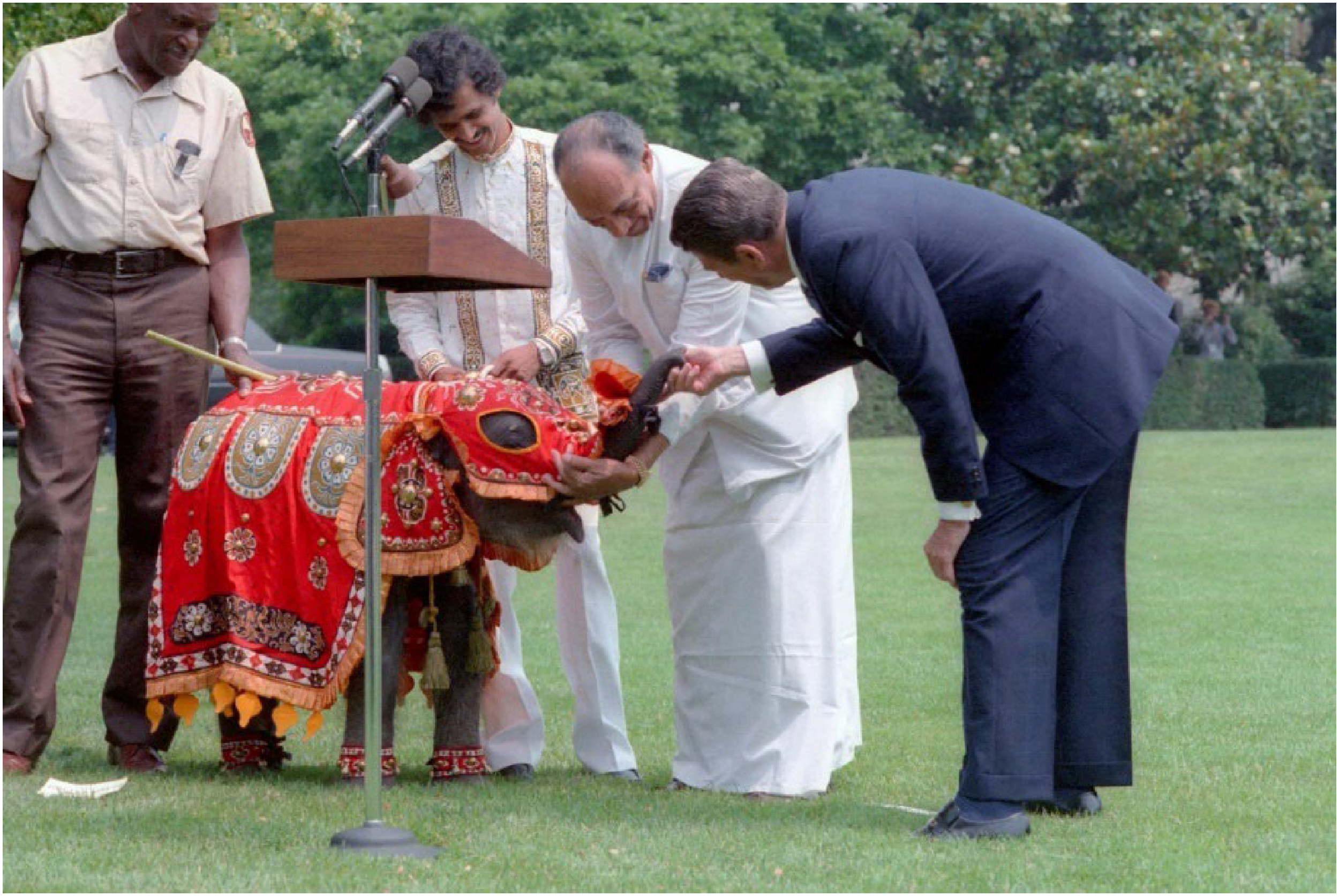
U.S. National Archives and Records Administration, “President Jayewardene of Sri Lanka presents a Baby Elephant to President Ronald Reagan and the American People on the South Lawn”, photograph, NAID: 75853465, Local ID: C22628-16, June 18, 1984. <https://catalog.archives.gov/id/75853465>
In contrast to Britain, the USA refrained from supplying military resources to the Sri Lankan government following Black July. In June 1984, Jayewardene visited the USA to engage in talks with the Reagan administration, in which he pressed the Sri Lankan urgency to quash ‘Tamil terrorism’. However, the USA made no commitments to offer military aid to fight against Tamils and framed the war as a matter of local and regional concerns. Upon returning to Sri Lanka, a disappointed Jayewardene announced that he would be seeking Israeli assistance. 107 That same year, the Israeli government established a presence in the US embassy in Colombo. 108 Muslim Tamils were outraged by this connection and protested Israeli presence due to Israel's violence against Muslims in Palestine. Brushing aside these concerns the Sri Lankan government continued to rely on Israeli military assistance throughout the 1980s, which by now was viewed as being politically vital to eradicate the Tamil ‘terrorist problem’ to protect the state. 109
But the US response must be viewed within the new Cold War context, in which the USA was attempting to improve relations with India and Pakistan. Pakistan's ports of Karachi and Gwader were viewed as being more strategically placed harbours compared to Sri Lanka's ports of Colombo and Trincomalee. 110 It is noteworthy that Pakistan, which adopted the same stance as Sri Lanka on the IOZP, was the only country in South Asia to provide military assistance to the Sri Lankan government following Black July. One month after Jayewardene visited Pakistan in April 1984, the Sri Lankan government received arms and ammunition. It was followed by a Pakistani military mission which trained government forces in Pakistan. Sri Lanka continued to receive arms and helicopter gunships until the Indo–Sri Lankan Accord was signed in 1987. 111
The Indian government was initially outraged by the actions of the Sri Lankan government and its expanding relations with Pakistan, Britain, and the USA, and expanded its support for the Tamil national liberation movement. But it did so in order to address what it viewed was the biggest sticking point in its political agenda with Sri Lanka at that time: the US ocean surveillance system in Sri Lanka. Tamil journalist Sivaram explained that it was this wider security interest that influenced India's decisions to pressure the Sri Lankan government to ‘toe the line’, rather than any serious interest in resolving the conflict regarding Tamil national liberation: By 1987 the Sri Lankan government realised that it could not counter India's tactics in arming the Tamil movement. India still had no interest in seeing Tamils seceding from Sri Lanka because then it would have a rebound effect in South India. So, they wanted to use the Tamil liberation movement as an instrument to bring pressure on the Sri Lankan government and then to compel the Sri Lankan government to sign a treaty where the Sri Lankan government gave up its external self-determination.
112
Sivaram suggested that these competing interests in Sri Lanka from the US-led coalition and India had produced a ‘Cold War within the Cold War’ and noted, ‘Sri Lanka is becoming internationalised’. 116 He had noted that there were two different sets of pressures from India and the USA which produced this double Cold War. Yet these pressures were also driven by the Sri Lankan government's distinct form of Indian Ocean internationalism: to pursue foreign relations to protect the Sinhalese Buddhist nationalist state at any cost and without any serious concerns raised by the international community. Sri Lanka was not entirely restrained by this double Cold War and mobilized assistance from each of the competing sides to advance its war efforts against the Tamils. By the late 1980s, both the USA and Britain were providing military assistance to the Sri Lankan government, while the IPKF attempted to enforce the cessation of hostilities.
However, Tamil anticipation of peace from the IPKF was quickly shattered by military confrontation between Indian, Sri Lankan and Tamil armed forces, thus marking a qualitative transition from an uneasy ‘peace’ to the resumption of fighting.
117
What transpired was one of the most brutal periods of violence in the history of the war.
118
The transition to violence is best captured by a Tamil survivor who remembered vividly life under the IPKF: One day we were all cheering for the Indian army to come there and they were supposed to be peace keepers and a couple of months later the same people were abusing everyone so a lot of round ups, people couldn’t get out of their houses they had to move away. One particular incident I remember most because my younger sister was just born. She was only a week old and there was some round up thing and we had to get out of the house. No one was allowed to stay in the house, we all had to go to this oval, football ground so the whole village had to go there so they could go and search for any suspects or arms. I remembered this because my little sister she was just a baby, not even one week and we had to take her to this oval.
119
The Indo–Sri Lanka agreement offers some important insights into Sri Lankan internationalism in the 1980s at a time of dramatic democratic deterioration. The Sri Lankan shift away from the USA towards India was less about power struggles in the Indian Ocean region than it was about acquiring military assistance to quash the armed Tamil liberation movement. If Bandaranaike's blunt survey of the Indian Ocean in 1971 positioned Sri Lanka as a mere observer in the ‘disturbing development’ of the ‘militarization of the Indian Ocean’, of ‘increasing naval presence of the Soviet Union and naval fleets in the Indian Ocean’ and ‘various islands and land-based facilities … being utilized to facilitate the operation of these fleets’, 121 then the 1980s positioned Sri Lanka as an active player in these escalating operations to address internal threats. And while neutrality is often touted as a characteristic of small powers in which states chose to depend merely on their dependence capabilities without seeking any potential allies, 122 a pro-West leaning Jayewardene government at a certain moment prioritized the USA. As armed conflict with the LTTE escalated in the mid-1980s, however, Jayewardene rejected the USA in favour of India. 123
After engaging relentlessly with different foreign relations throughout the 1980s, Sri Lanka experienced the international failure to declare the IOZP as a reflection of a new militarized reality of the Indian Ocean region. Yet it continued to participate in international forums to push for the IOZP by offering to host the international conference in Colombo in 1989. A year earlier, representatives from 27 countries including Sri Lanka attended the International Conference on IOZP Antananarivo to advocate for the Colombo conference. They condemned that ‘militarization of the zone continued unabated – contrary to the frequently expressed desire of the peoples of the region’. 124 They shared their desire to ‘set up the international legal framework susceptible to promote Peace in this region in a concrete way’. To President Kenneth Kaunda from Zambia, conference participants pointed to the important resolution adopted by the heads of state on the occasion of the 17th ordinary summit session at the UN, which asserted that the militarization of Diego Garcia was a threat to Africa and the Indian Ocean as a peace zone. However, Sri Lanka stood apart as it had already demonstrated its willingness to compromise with the USA about Diego Garcia in exchange for participation in the IOZP. Harnessing President Robert Mugabe's status as the chairman of the NAM, the conference participants called on him to take all the necessary measures for holding the UN international conference the following year in 1989. They pressed the point that the conference needed to happen to implement UN Resolution 2832, which aimed to dismantle all foreign military bases in the Indian Ocean area and withdraw all nuclear weapons from the Indian Ocean region.
In the end, Sri Lanka and the Ad Hoc Committee had failed to reach a consensus about the conference or the declaration of the IOZP, but its rise to international standing was successful in other ways. It demonstrated how to be a non-aligned player who espoused liberal values of peace while demonstrating a remarkable adaption to the different power plays to suit its own political needs. Sri Lanka spearheaded international calls for the IOZP as dictated by its non-aligned foreign policy; privately, Colombo relied on all sides to pursue a military solution to its internal conflicts. For Sri Lanka, then, the pursuit of peace through political negotiations only applied to the regional sphere.
Through the pursuit of peace, Sri Lanka expanded its foreign relations and ensured that its internal political ambitions remained unchecked. In this political history, Sri Lanka's critical role in the fall of the IOZP in 1989 was not only supportive of the conduct of the multiple Cold Wars but also to the extent that it could use the opportunities provided by the power struggles in the Indian Ocean region to further its own ends, even determinative of the process. Indian Ocean internationalisms must therefore be understood as the result of local, regional, and international interests. Like the vastness of the Indian Ocean, island politics offers a vital context for examining the layers of interactions and motivations. To borrow historian Peter Gatrell's expression ‘thinking through oceans’, interrogating the meanings attached to island politics amid local, regional and global tensions highlights the importance of acknowledging but also problematizing the centrality of the state as the main reference point in historical accounts of island politics. 125 I have acknowledged the Sri Lankan state here because of its post-independence ambitions to perceive itself as an island bulwark whose Sinhalese Buddhist nationalism is deemed triumphant over the political aspirations of politically minoritized communities at a time of immense political instability.
To press harder on the pulse of the ‘loss of political freedoms’ in the Indian Ocean, however, is to draw attention to the multiple struggles that have shaped the tensions and co-operations of how the Indian Ocean region became a place of contestation across time and space. Indeed, in the case of Sri Lanka, it is worth emphasizing the increasingly prominent role of local struggles in shaping contemporary political histories of the Indian Ocean. This has brought into focus the agency, motivations, and outcomes of the heterogeneity of the Third World states towards a more wide-ranging and pluralistic interpretation of contemporary histories of the Indian Ocean in the 1970s and 1980s. The post-colonial identity of the Sri Lankan state is important to these discussions. Considered a small state, scholars have concluded that Sri Lanka has characteristically enacted actions reflective of its minimal role (or influence) in international relations: neutrality and non-alignment, regional security arrangements and Finlandization (relying on larger powers to protect the smaller states). 126 Yet as this article has shown Sri Lanka's efforts to pursue Indian Ocean peace had paved the way for it to carry out major political injustices against its citizens, a story that should provide some historical insight into its approach to peace. Perhaps the more important point here is that the international community showed next to no criticism or tangible actions to pressure the Sri Lankan government to enter political negotiations with the affected groups to address the escalation of violence. There was no intention from the international community to condemn the loss of peace internally, so remaining silent or providing military assistance worked in Sri Lanka's favour – in turn setting the international norms that accepted the violence of the Sri Lankan state.
Footnotes
Acknowledgements
This research has its origins in funding provided by the Contemporary Histories Research Group at Deakin University in 2020 – Professor David Lowe and Dr Carolyn Holbrook were generous mentors during this time. I thank Professor Sheila Fitzpatrick, and the two anonymous reviewers for providing invaluable feedback and Amritha Sandhu for outstanding research assistance.
