




Abstract
The data collected during the author's ‘History of Azerbaijan’ class at Baku State University in 2014 showed that both the young and old generations felt great sympathy for the Soviet polity. Social life after Stalin was seen as a period of political stability and social prosperity. However, the official party and government documentation as well as individual memory reject this understanding. This article examines the collective and individual memory of Azerbaijani society in the post-Stalin period to understand why the social grievances and dissatisfaction of the time are discounted by modern-day Azerbaijanis, who see the time as one of social prosperity. The research is based on various primary sources from the Azerbaijan and Russian Federation archives. Data from surveys of 796 respondents, as well as ten interviews, were involved in the research. Mixed methods, a combination of descriptive qualitative and quantitative methods, were used for this research.
Keywords
Modern Azerbaijani historiography claims that the last decades of Soviet history from the death of Stalin to the mid of 1980s were a period of economic prosperity, political stability, and social equality for Azerbaijani society. 1 However, archival document and individual memory do not support these claims and reveal deep social grievances and protest against the Soviet political establishment. This article addresses the complicated issues of collective and individual memory in Azerbaijani society to understand why post-Stalin social dissatisfaction and grievances are ignored in assessments of late-Soviet social satisfaction by present-day Azerbaijanis. To do this we will examine what role contemporary political power in Azerbaijan plays.
There are few studies of Azerbaijani society after Stalin. Azerbaijani scholar Jamil Hasanli's two books investigate political issues and cultural changes in Azerbaijani society for 20 years after Stalin. 2 Giving unprecedented credit to the ‘nationalizing behavior’ of Azerbaijani leadership, Hasanli focused his attention on the communication manner between political elites and other elite groups, especially the intelligentsia. He does not, however, look at how political power affects the historical consciousness of ordinary Azerbaijanis. This article, therefore, is the first attempt to understand perceptions of the society toward the post-Stalinist era through memory-making concepts and strategies of political power in present-day Azerbaijan. This article also attests to the utility of both qualitative and quantitative methods for a better understanding of the principal problems of memory.
Research on memory studies claims that the nature of memory politics in democratic countries may differ from those in authoritarian regimes because of the lack of basic rights and freedom in the latter. As both democratic and authoritarian regimes, in general, have a very similar goal in politics of memory—to create coalitions and bases that support or, at least, don’t oppose their exercise of political power—I argue that the tools, means, and mechanisms they use for memory construction are not distinctive. In Azerbaijan, the authoritarian regime encourages a generous interpretation of the Soviet past to justify the poor governance of both the Soviet and modern political establishment. The findings of this study demonstrate that because of its deep connection with the former communist leadership—many emerged from its ranks—modern Azerbaijan's political establishment effectively conceptualizes collective memory through national narratives, media, and political rhetoric to build a bridge between power and society. However, this bridge has a strong backlash. Ignoring the political flaws of the Soviet past, the Azerbaijani state finds itself in an awkward position because it inadvertently draws attention to the current social injustices.
The present study covers the so-called ‘Khrushchev Thaw’ period and scrutinizes contemporary society's collective and individual memory of the 1950s–60s. From 1953, the year of Stalin's death to 1969, Soviet Azerbaijan was ruled by the political group structured and shaped by Stalin's prominent protege Mir Jafar Baghirov. In this article, we first touch on different aspects of social life in Soviet Azerbaijan to reconstruct the life of society after Stalin. For this purpose, we employ primary and secondary sources. The primary sources we use are official documents stored at the Archive of Social and Political Documentation of Presidential Administration of the Republic of Azerbaijan, State Archive of the Republic of Azerbaijan, while the secondary sources are those such as history textbooks and the products of media outlets. The majority of archival documentation was classified as ‘top secret’ during the Soviet period and marked only for internal usage. Another primary source used was two folders consisting of four hundred pages stored in the Russian State Archive of Contemporary History. There are letters, appeals, and remarks sent from Baku and other Azerbaijani regions to Moscow. In some of these latter sources, we see many denunciations (donosy), which were a result of rivalries among the political elite that disclosed important nuances of the social life of the local party leadership. Donosy are usually arranged by employees, secretaries of the Central Committee of the party, and top managers of the Council of Ministers. These sources usually contained confidential information that could be confirmed exclusively by top secret party documentation. The majority of the letters/complaints, however, were written by ordinary people who protested against social injustices, irresponsibility, and misrule of Soviet leaders. These sources recounted private problems, related individual appeals, and expressed personal grievances. We use these archival sources in the research to understand what social life was liked in 1950s–60s and whether society was really satisfied with social conditions. We include the historical narratives and textbooks published recently by order of the Azerbaijani government as a part of the official historiography. These narratives help us understand the politics of memory and discover a discrepancy between primary and secondary sources. We also examine some articles about the post-Stalin period of history published by modern media outlets. It is important to point out that the Azerbaijani media sphere is largely controlled by the government. Neither during Khrushchev's Thaw nor after independence have Azerbaijani intelligentsia or representatives of the political establishment published any memoirs about post-Stalinist Azerbaijan. Thus, media is considered to be an extremely important space for educating society on the Soviet past.
The second stage of the research is an attempt to understand the collective and individual memory of modern Azerbaijani society and the relationship between them. Thirteen surveys (five in 2014 and eight in 2019) were conducted for these purposes. The students were also asked to question one of their elder relatives to understand the relationship between the memories of older and younger generations. Ten respondents, selected at random, were then interviewed in-depth to compare the content of collective and individual memory of the older generation. Semi-structured questions were used for the interview. At the request of the participants, interviews were not recorded. The descriptive method was used for interview data. Each interview lasted approximately an hour; two interviews were conducted via Zoom and two via Whatsapp. It is important to indicate that the older generation's memory is a mixture of personal and collective remembrance of the lived past usually tinted by the Soviet grand narrative; for the younger generation, their interpretation of the Soviet past appears to be a combination of the transmitted memory of the older generation and a modern interpretation of Soviet reality.
In his essay ‘General Introduction: Between Memory and History’, Pierre Nora contrasted memory and history where memory is considered to be life embodied in permanent evolution, while history appears as a problematic and incomplete reconstruction of this life. 3 Made from nearly similar material both memory and history are the result of conscious manipulation and they are both biased, unreliable, and socially conditioned. 4 The distinction between collective memory and the historical past depends on the elucidation of the finite regime of collective memory and of the real temporal context of the historical past that the historian claims to retrieve. 5 Some scholars argue that novels, not academic research, may well better illustrate the reality of the past because written history is not a faithful record of the past, just a personal interpretation of a historian. 6 To the contrary, Huyssen argues that our culture around memory often rejects archival documents even as collective memory is not possible without those written narratives. 7 Reconstructing the past through narratives, annals, chronicles, and other written sources, historian interprets historical events from a temporal perspective.
Scholars identify and analyze the values and aspirations that can confer control over memory and examine the ways and policies political power uses for the implementation of this control. Re-writing of history, interpretation of specific cases, and creation of traumatic narratives are important mechanisms for the institutionalization of memory historically. As an accepted part of the nation's legacy, this manipulated context of history appears in school curricula, textbooks, and voices in scientific conferences, and circulates widely and publicly. Another sphere where manipulated history uses by political power for its justification is legislation. 8
Researchers who investigate the connection between history, memory, and political power point out the important role of memory in bridging power and society. 9 In authoritarian and semi-authoritarian countries, the ability of a society to produce an autonomous, alternative narrative of history is restricted because ‘the elite is the owner of the interpretation of the past and history focuses solely on the foundational “master-narrative” of the state’. 10 Using history as a tool for the legitimation of their power, authoritarian leaders effectively control and rule the content of collective memory. This governance of history creates enormous potential for the manipulation of memory that is framed by the social and political needs of modernity. In this context, state-sponsored and state-controlled tools for the manipulation of social memory have become an extremely important aspect of memory studies.
Both democratic and authoritarian regimes recognize the extreme power of media for the manipulation of public opinion and the mobilization of people. However, in authoritarian societies, state-controlled media have exclusive control over the society due to the lack of freedom of speech and the press. Researchers who focus on the relationship between memory and media for understanding the conjectural use of collective memory by political power have characterized media as a convenient implement for its commercialization and exploitation. 11 This approach is mainly supported by the theory of the transmission model of communication. In countries like Azerbaijan, history narratives cannot be completely free from old Soviet frames of history, and public debate on certain historical and political topics is taboo. Therefore, the media appear as an essential memory-maker. Using effective images and appropriate terminology media can be used to distort the past and the present. 12
Communication between generations and the transformation of the old generations’ recollections to the young generation is another component that plays an important role in making the memory of society. Intergenerational transmission of memory has been widely explored in the research of psychologists, sociologists, and anthropologists. 13 Filling an informational gap between generations, the memory of the old generation could answer many questions that historiography and media outlets prefer to keep silent. However, generations that went through difficult trials of history because of the wrong decisions of the authority generally prefer not to speak about what happened. Scholars investigate three patterns of communication between generations: (1) complete silence; (2) partial avoidance; and (3) open communication. 14 The old generations avoid speaking about the past when traumatic and dangerous memories prevailed in their remembrance. In this case, the young generation compensates lack of knowledge about the ancestors’ past through books, school curricula, and movies. 15 Direct interactive communication is possible when there are interpersonal linkage and tolerance between generations and both generations have the motivation to learn and share their experiences.
Within a year of Stalin's death, a number of his lieutenants were pushed out in the ensuing power struggle. One of the principal figures to go was Lavrentii Beria, the head of Stalin's secret police, the NKVD, until the Soviet leader's death. Just two months after his execution, Mir Jafar Baghirov, the party boss of Soviet Azerbaijan since 1933, was expelled from party leadership and exiled from the republic. In February 1954 Baghirov's promoter Imam Mustafayev was appointed First Party Secretary of Azerbaijan.
Azerbaijani historian Jamil Hasanli introduces Imam Mustafayev as the first political leader punished for ‘nationalism’, a charge understood in the Soviet Union as ‘chauvinism’, after the death of Stalin.
16
In July 1956, the Presidium of the Supreme Soviet of the Azerbaijan Soviet Socialist Republic, under Mustafayev's direction, introduced a suggestion that the Azerbaijani language be adopted as the republic's state language. That suggestion was made law the same year in August. Three years after the adoption of Azerbaijani as the republic's official language, in July 1959, the 9th Plenum of the Azerbaijani Party Central Committee dismissed Imam Mustafayev from the first secretary position. The official reason for Mustafayev's release was his failure to implement the national economic plan; however, the unofficial reason was believed to be his ‘nationalism’. At the 9th Plenum itself, Mustafayev was accused of everything but nationalism. Colleagues blamed him for bribes, corruption, money laundering, nepotism, and other miscarriages of justice.
17
According to the Central Committee, ‘he had used his influence within the Ministry of Internal Affairs as well as the backing of central and provincial party secretaries to suppress democratic discussion and disregard decisions and opinions of the Bureau of the Central Committee, an elected executive body within the Party’. They also accused him of letting ‘his wife continuously interfere in state affairs’.
18
When one of the Bureau members, Mehdi Huseyn, also the head of the Union of Soviet Azerbaijani Writers, expressed his surprise at the detailed information about Mustafayev's private life, the head of the Azerbaijani KGB, Fyodor Kozlov, explained it simply: The Prime Minister of the Republic Sadikh Rahimov used his close friendship with the former KGB leader of Azerbaijan, Anatolii Gus’kov, who by the way had very bad relations with Imam Mustafayev, to collect compromising information against the party boss and his colleagues’.
19
In his final speech in the 9th Party plenum of July 1959, Imam Mustafayev admitted nearly all accusations voiced against him. It was a way to save face and avoid strong party punishment. He was sent to the Academy of Sciences. Vali Akhundov, Prime Minister of Azerbaijan became the Party First Secretary. Vali Akhundov held the first party secretary office longer than his two predecessors, from 1959 to 1969. His political career started immediately after World War Two, in 1946, and was very successful. Born to a former factory worker and Soviet clerk, Vali Akhundov was a physician by training. He served as a doctor on the Transcaucasian and Belarusian fronts in World War II. 20 In 1949, the 33-year-old physician was appointed as head of the Trade Union of Medical Workers (the Republican Committee of the Health Service Employees’ Trade Union). 21 His appointment was backed by his brother-in-law Zulfugar Mammadov, then the rector of the Azerbaijan State Medical Institute, who ironically lost his post the same year because of serious flaws in the institute's management. Akhundov proved to be an extremely capable person. Two years later career growth brought him to the position of Deputy Minister of Health. From 1954 to 1958 he served as Minister of Health.
The gap between ordinary Azerbaijanis and elites deepened during Akhundov's leadership, as proved by various sources, written and oral. Bread, milk, meat, and other food supply sharply decreased; essential production shortages became more visible and could not be denied by party leadership.
22
One of donosy sent to Moscow in 1966 described how the food shortage and poor social welfare policies led to protests in Sumgait in November 1963: ‘Hundreds of demonstrators of the parade in honor of the 43rd anniversary of the October revolution set up a chant of Bread, work, and normal life’.
23
The author of the donos indicated that two years later another protest took place in Baku. In May 1965 when party leaders gathered for a holiday demonstration in honor of the 20th anniversary of the victory over Nazi Germany, participants decided to voice their resentments, disagreements, and demands publicly.
24
The unfair distribution of state-built apartments caused deep grievances and protests among ordinary people. In 1960, 2860 complaints sent from Azerbaijan to the Kremlin were on the issue of housing alone. In these letters, people expressed their ‘deep dissatisfaction with social discrimination and the incredible rudeness of high-level managers’.
27
A worker in the Battery Plant of Ministry of Automobile Transportation Bulakin wrote that for more than twenty years his family of eight shared an 8-square-meter podval that was not suitable for living, and he had no idea when the situation would change because the head of the Azerbaijani Ministry of Automobile Transportation refused to include his name on the list of the housing queue.
28
The situation in education and medicine also lagged behind what the Azerbaijani public had increasingly come to expect from postwar and post-Stalinist conditions. The party and other government officials continuously criticized social injustices and ‘violations of the socialist legality’, however, they rarely named perpetrators. The report introduced to the Central Committee in 1960 by the joint Commission of the Party-State Control Committee of the Central Committee of the Azerbaijan Communist Party and Council of Ministers pointed out that universities’ admission and scholarship systems are terribly corrupt. 30
The fact that qualified medical treatment was nearly impossible without payment is confirmed by Council of Ministers’ documentation. The head of the Otdel Kadrov (Human Resource Department) Mammadov in his report to the chair of the Council of Ministers Rahimov described irresponsible and unprofessional activities committed by heads of healthcare departments across the republic; a lack of qualified medical staff and equipment; widespread corruption; and whitewashed reports of activities.
31
Mammadov noted that there are no surgeons in the Central City Hospital Semashko, no specialists for emergency surgery and, as a result, the death rate of patients grows every year; misdiagnosis is the cause of many deaths.
32
Modern national historiography, which is in large part based on the seven-volume history of Azerbaijan prepared by scholars of the Azerbaijan National Academy of Sciences, introduces Imam Mustafayev and Vali Akundov as nationalist communists. 35 Contemporary history textbooks prepared for educational institutions under Ilham Aliyev's presidency have a similar rhetoric: the era from 1956 to 1982 appeared to be an era of economic development and social prosperity. 36 This is exactly what Nets-Zehngut describes as manipulation of the past for the interests of the present. 37 National historiography questions neither the content of the Soviet social agenda nor the economic and legal satisfaction of the Azerbaijani Soviet people. Certainly, these skewed narratives are an attempt to legitimate modern politics through the memory of the past. Ivan Kurilla has argued that availing themselves of such skewed narratives, ‘states endeavor to legitimate themselves by turning fact-based history into sensorial memory’. 38 Documenting the post-Stalin period of history, Azerbaijani scholars have preferred to indicate economic achievements and Heydar Aliyev's late-Soviet ‘successful political mission’ as party leader, ignoring the social dissatisfaction of Soviet society. 39 But even so, this storyline didn’t entirely meet current president Ilham Aliyev's expectations.
Ilham Aliyev expressed his deep dissatisfaction with the post-Stalin history interpretation immediately after his first election in 2003. Speaking at a meeting of the Editorial Board of the Azerbaijan National Encyclopedia in April 2004, he clearly announced what he would like history to read. 40 His ‘right history’ is based not on chronological occurrence but on ‘right interpretation’; he linked the period of independence with his father Heydar Aliyev ignoring the period and elected officials before his presidency. His version of the Soviet period sees a straightforward linkage between the past and present without mentioning unnecessary names and events. His new narrative appeared on school desks in 2016. 41 The 20-year history of Azerbaijan after Stalin fits onto one page in that textbook. This one page described social prosperity and political stability in post-Stalin Azerbaijan. This successful history reaches its culmination under Heydar Aliyev's leadership. Andrew March has correctly described it as a creation of an ideological conception for an expansive political consensus between power and society. 42 State-sponsored media was actively involved in the implementation of this mission; stories appeared in media outlets introducing former political leaders as heroes and advocates of the nation. 43
The surveys for this research were first conducted in person in a mandatory course entitled ‘History of Azerbaijan’ in Azerbaijani language at Baku State University and ADA University in 2014 and then again among groups of students in an online format at Azerbaijan Tourism and Management University and Azerbaijan State Pedagogical University in 2019. Between 2008 and 2014, Azerbaijan went through some significant changes in its socio-economic and political situations. Thanks to the significant oil revenues that were poured into the national budget, the country enjoyed a period of social and financial stability. However, in 2015, things took a turn for the worse when the national currency was devalued by a whopping 99 percent. The significant decline in oil revenues since 2014 has had a noticeable impact on the socio-economic status of the population.
Additionally, the political landscape underwent a significant change in 2013 when President Aliyev was able to secure his third term in office thanks to an amendment in the constitution. From 2014 to 2019, as a result, civil society in Azerbaijan faced an unprecedented crackdown.
We focused on students with these surveys to capture their views of the past as an age group. The average age of students is 19 years. In the 2014 survey, there were 101 male and 98 female participants. For the 2019 survey, there were 82 male and 117 female participants. Out of the 199 participants in the 2014 survey, 150 studied Business Administration while the remaining students were History majors. In the 2019 survey, 60 students studied Social Sciences and 139 studied History. Due to the sensitive nature of ethnic and social identity in Azerbaijani society, these topics were excluded from the surveys.
Students who participated in the 2014-year survey (N = 199) attended and graduated from school under Ilham Aliyev's presidency. However, this cohort was educated and learned the history of Azerbaijan through the textbooks created mainly under the presidency of his father, Heydar Aliyev. Students who were involved in the 2019 survey (N = 199) learned national history that was conceptualized and contextualized by the current president. The survey initially included seven questions: four of them referred directly to the students, last three to their relatives (grandparents).
The questions were designed to gauge the extent of students’ knowledge and understanding of the Soviet period. I aimed to assess their previous knowledge before delving into new material. When questioning the older generation, I utilized the same set of questions. The students were asked four general questions: ‘How would you describe the Soviet period?’; ‘Do you think [Azerbaijan's] history textbooks effectively introduce the Soviet period?’; ‘What advantages do you think the Soviet regime had?’; ‘What disadvantages do you think the Soviet regime had?’ The share of respondents who positively evaluated the Soviet period in 2014 was 50.7 percent (n = 101); in the 2019 survey, that share was 70.3 percent (n = 140). The share of respondents who had a negative attitude toward the Soviet regime was 33.1 percent (n = 66) in 2014; in the 2019-year survey, this figure was 20.6 percent (n = 41). In 2014, 39.1 percent (n = 78) of respondents indicated that Azerbaijani textbooks properly explain the history of the Soviet period; in 2019 the students were more skeptical concerning textbooks’ interpretation. Only 28.6 percent (n = 57) believed that the official historiography successfully introduces the Soviet period.
It was believed that the favorable views of the Soviet era held by old and young generations were due to the social circumstances of the people. After examining social media, news outlets, and the opinions of local communities, as well as those of my colleagues and students, I identified four major social issues affecting society's perceptions. These include high rates of unemployment, housing that is unaffordable, exorbitant tuition fees, and a lack of medical coverage.
In both surveys, students identified free education, housing, and job opportunities as basic advantages of the Soviet regime. One hundred percent in 2014 and 95.9 percent in 2019 indicated free education as a great achievement of the socialist government. 87.4 percent in 2014 and 90.4 percent in 2019 noted free housing; 82.4 percent in 2014 and 86.9 percent in 2019 pointed out job opportunities as crucial benefits of Soviet society. According to respondents, discrimination against local Azerbaijanis (76.8 percent in 2014 and 93.4 percent in 2019) in favor of other groups was the main failure of the communist regime in Azerbaijan. In the 2014 survey, 49.2 percent designated both corruption of political leaders and police brutality as negative aspects of the life under Soviets. For the 2019 survey, 44.7 identified corruption as a negative aspect, while 49.2 percent pointed to police brutality.
The students who participated in both surveys were asked to question one of their elder relatives on these topics. The older generation was asked to answer three last questions of the survey: ‘How would you describe the Soviet period?’; ‘What advantages do you think the Soviet regime had?’; ‘What disadvantages do you think the Soviet regime had?’ The average age of these proxy respondents was 75 years (N = 199 for each survey year). Two alternative sources were used to verify the answers of the proxy respondents: outcomes of the ten personal interviews and a social network. For this reason, 598 comments on social activist Adil Ismayilov's post about the Soviet legacy were analyzed. The percentage who had positive perceptions of the Soviet regime in 2014 was 63.8 (127 respondents); 34.1 percent (n = 68) had a negative opinion about communist governance. In the 2019 survey, the result was 65.8 percent (n = 131) and 30.1 percent (n = 60), respectively.
According to the older generation respondents in 2014, the Soviet government's most successful social projects were implemented in education (94.4 percent) and housing (83.4 percent). The 2019 survey showed similar results: 89.7 percent indicated state-built housing and 85.9 percent pointed out free education as an important advantage of the Soviet government. The older generation respondents also agreed that the employment rate was quite high under communists. In 2014, 88.9 percent (177 respondents) and in 2019, 68.3 percent of respondents (136) indicated job availability as a principal element of social stability in the Soviet Union. In 2014, the older respondents indicated police brutality (63.8 percent), and the black market (38.6 percent) as disadvantages of the Soviet regime. The 2019 survey shows that respondents believed police brutality (51.2 percent) and suppression of human rights (39.1 percent) to be the main failures of Soviet governance. The respondents who indicated corruption and the black market as disadvantages of the Soviet regime were respectively 38.6 and 37.6 percent in 2019. Only 22 percent in 2014 and 18 percent in 2019 criticized the nationalities policy of the Soviet Union by which they meant the failure to properly advantage national minorities to counteract the dominance of Russians.
A group of ten interviewees with diverse ethnic backgrounds was randomly selected. The group consists of six Azerbaijanis, one Armenian, one Jew, one Greek, and one Kurd. The gender balance is equal, with an even number of males and females. Six of the interviewees reside in urban areas. Five members are part of the Soviet intelligentsia, whereas three are former collective farm workers (kolkhozniki), and two have worked in factories previously. One person is politically active, while two are content with their present social status. They were asked to answer three groups of questions. The first group of questions was related to the individual experience of interviewees in housing, education, medical service, and job opportunities. The second group of questions was about the relationship between the citizen and power. Interviewees were asked to evaluate party leaders’ activity, national policy, and human rights issues under the Soviet regime. The third group of questions was aimed at understanding an individual's perception of the Soviet legal system. The average age of the interviewees was 75. All ten interviewees confirmed that the social conditions in the 1950s–60s were difficult and unfair. Police brutality, the cruelty of party and government leaders, corruption, and the frequent theft of socialist property (sources of the black market or secondary economy) were commented upon by interviewees. Education was free; however, the admission process was corrupt. Medical services were officially free, however, the respondents noted that you need to pay for qualified services. Respondents also recalled that there were job opportunities for everyone, but if you want to work in the party and government structure you need to pay or be backed by a powerful figure. The interviewees across the board indicated that the party leadership had great privileges and operated outside the law. ‘Laws and orders applied only to ordinary people’ declared seven of ten respondents. Respondents confirmed that the nationalities policy was quite fair, and all nationalities had equal opportunity.
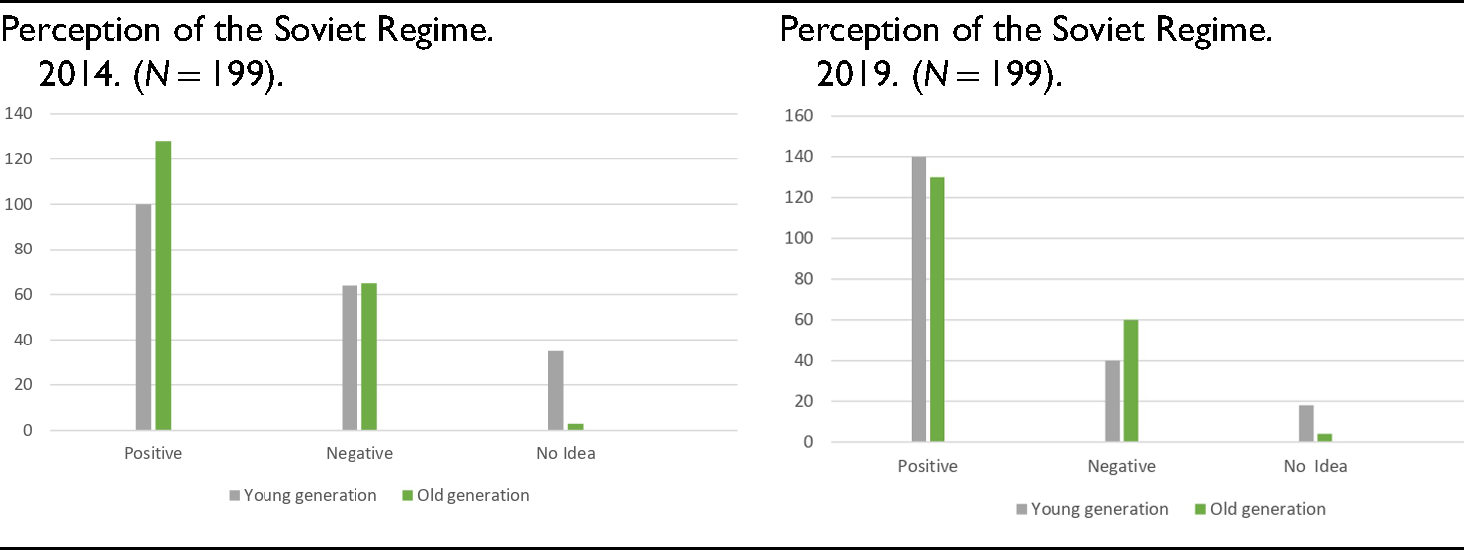
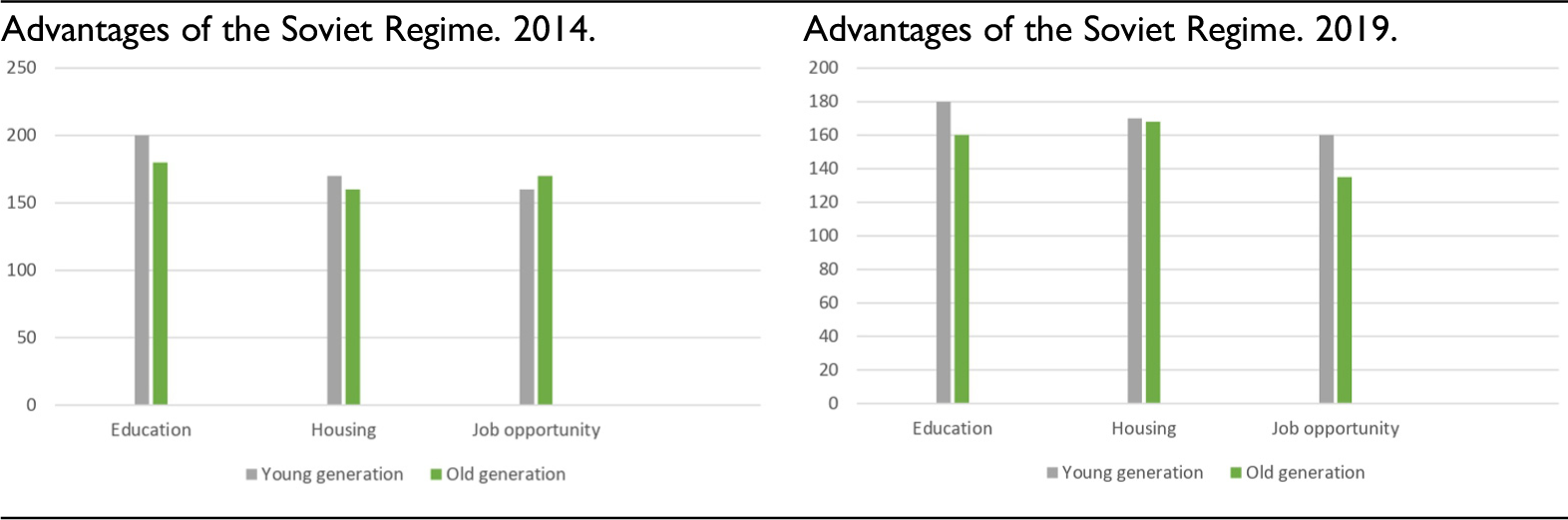
Individual memory treats the Soviet government through personal experience. The ability to recall and reconfigure individual experiences through socially accepted standards does not repudiate the autonomy of private remembrance. To the contrary, selective remembrance and forgetfulness of the past testify to that autonomy. The individual memory of members of Azerbaijani society remembers and recognizes the similar social conditions of the Soviet Union's different social groups. Yet we noticed how, in answers to the questions, individuals, when they remembered a personal setback under the Soviet Union, tended to generalize that individual memory to a societal critique that was at odds with how the majority evaluated the system. For example, those respondents (five of ten interviewees) who failed to matriculate to university education because of corruption outright rejected the positive sides of Soviet education policy. Similarly, those (four of ten interviewees) who faced what they believed to be an injustice while seeking career promotion did not support job availability as an advantage of the Soviet system. Individual memory, though sometimes constrained by collective memory, also acts independently upon an individual's recollection of broader societal experience.
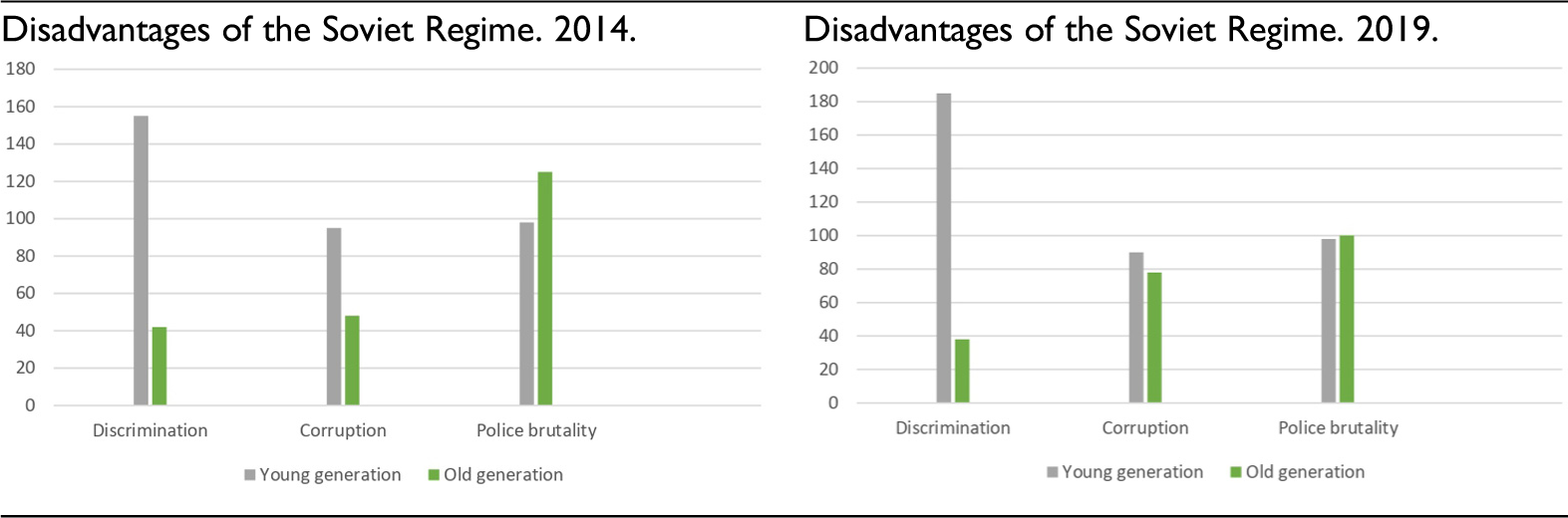
For Azerbaijanis, remembrance of the socialist past is related to the imagination of social justice. 47 This distorted image of the past, however, neglects that social justice in governance was rarely achieved. Both collective and individual memory confirm corruption and police brutality as main failures of the Soviet government. The memories of individuals also clearly recall the suppression of human rights in personal experiences. Thus, the Azerbaijani government's need to legitimize the present state of things by simplifying the historical narrative of the Soviet past, in fact, undermines its own goals. By underplaying the corruption and lawlessness of the Soviet past to elide the current elite's role in them, the Azerbaijani state inadvertently draws attention to current injustices and lionizes the Soviet system as a panacea to them.
In this article, we examined modern Azerbaijani society's collective and individual memory of the 1950s-1960s in order to understand the role contemporary political power plays in the construction of those memories. We first analyzed official party and governmental documentation for the reconstruction of the social life of post-Stalinist Azerbaijan. We then looked at how, in contemporary Azerbaijan, official history discounts and ignores the social conflict and injustice testified to in those documents, and instead, creates a narrative of continuity. In this narrative, which the state poses as the dominant narrative of the past and present, the Azerbaijani political establishment justly looked after the people's social justice needs while defending their national interests against a Russian imperialist Soviet state.
The creation of this narrative was possible due to two factors. Firstly, the historical background of the Azerbaijani nation was constructed and conceptualized for the first time only at the beginning of the twentieth century with the encouragement of the Soviet regime. It was the only possible interpretation of national history under totalitarian governance. Secondly, in modern Azerbaijan, the national elite interprets history through the ethnonationalist conception which does not allow scholars to target native leaders for their failed politics. Instead, it asserts, as noted above, that all national political elites in the Soviet period had been united in their goal of an autonomous and eventually independent Azerbaijan. Not only pro-government scholars but even the political opposition supports this interpretation. The prominent Azerbaijani historian, and the main political opponent of Ilham Aliyev in the 2013 presidential election, Jamil Hasanli maintains this ethnonationalist approach throughout his historiographical work. Indeed, sometimes political leaders from the past are invited to serve the present politics’ interests, thus supporting the ethnonationalist historiographical narrative unity, despite its obvious flaws. During the Ganja coup d’état in 1993, Heydar Aliyev asked Imam Mustafayev, the former First Party Secretary once accused of nationalism by the Soviet state, to be a mediator in the conflict between democratically elected president Abulfaz Aliyev and rebel colonel Surat Huseynov. Mustafayev's mission ended with the dismissal of the president of the republic, while Heydar Aliyev became president of the republic. Mustafayev's presence served to support the narrative unity, even as the coup d’etat undercut it. In 1996, Heydar Aliyev organized the 80th-anniversary celebration of Vali Akhundov where the latter was introduced as a great Azerbaijani politician, despite, as noted above, the many grievances Azerbaijanis held against him in the 1950s–60s.
The surveys conducted for this research helped to understand the old and young generations’ attitudes toward the post-Stalinist period of Azerbaijani history. Both generations’ perceptions are based on positive sentiments and proved by the social policy of the Soviet government. Meanwhile, comparative analysis of the collective and individual memory allows us to recognize conflicting edges that relate to the personal experiences of the individual memory. Individual memory in some cases rejects the constructive quality of the Soviet social policy that the collective memory recognized.
Modern Azerbaijani society's perceptions of the Soviet past can be considered a model for understanding the manipulation, both failed and successful, of collective and individual memory by authoritarian governments across post-Soviet space. The conditions of the social life and social welfare programs of the Soviet government are contradictorily reflected in collective and individual memory. Collective memory tends to match the historical narrative, while individual memory is filled with many grievances and objections against the Soviet regime. The memory of the younger generation often reflects that of the older generation's regarding Soviet social welfare. Both generations largely remember the Soviet past's social equality promises, such as universal education and employment, fondly. Likewise, both generations are skeptical of the contemporary Azerbaijani state's provision of social welfare.
In general, the findings of the research and methodology used for facilitating learning of the modern Azerbaijani society's perceptions toward the post-Stalinist era could be applicable to understanding the story-telling and memory-making policy in authoritarian societies. This paper demonstrates how the skewed national historical narrative attempts to smooth out discrepancies between individual and collective memory of the past in order to justify the present. Yet, in so doing, the narrative actually creates as new problems by funneling discontent with the present into an uncritical nostalgia of the past.
