




Abstract
This article examines relationships between architecture and ideology in socialist Yugoslavia by exploring the cultural interpretation and appropriation of the Balkan house in achieving modern, specifically Yugoslav architectural expression. Through the contextualization of the period's different narratives on the Ottoman vernacular and various architectural designs related to it, the aim is to demonstrate how Yugoslav architects relied on Marxism to appropriate vernacular architecture into the modernist discourses. Dialectical materialism was used as a key for the interpretation of the opposition between what was seen as the negative and positive elements of the Balkan house, which challenged banal polarization between the traditional and modern and led to a more nuanced understanding of backwardness and progress in vernacular architecture. The idea of architectural metamorphoses of vernacular to modern forms was justified by evolution and revolution, the basic concepts of the Marxist understanding of processes in society and culture. The Yugoslav interest in the Balkan house represented a living, perceivable example of how the relationships between tradition and modernity, the past and the present, as well as men and their environment, became incorporated into new architecture of ‘socialism with a humane face’, which stood at the heart of Yugoslav social and political experiment.
Keywords
‘The Balkan house’, 1 a residential building type spread across large swathes of the Ottoman Balkans in the eighteenth and nineteenth centuries, got a prominent place in the cultural imagination of the universal language of modern architecture. Since the period of the ‘heroic phase’ of architectural modernism before the Second World War, the Ottoman vernacular has been interpreted as a preeminent anticipation of both the concepts and language of new design based on humanism, structural rationalism, fluidity of space and the interconnectedness between the interior and exterior, mainly due to the ideas promoted by Le Corbusier and other architects. In the interwar period, the interest in vernacular architecture as a source of modern ideas was also, albeit in a modest scale, developed among modern architects in the first Yugoslavia. 2
Yet only in the architectural culture of socialist Yugoslavia in the 1950s and 1960s, vernacular forms got significant ideological overtones. The Balkan house, apart from representing a local cultural heritage, was appropriated as a framework for the conception of a new socialist architecture in a way that it legitimized the ideological tenets of Marxism and demonstrated the effectiveness of dialectical materialism, both crucial for the cultural imagination of the new Yugoslav state.
The new socialist federal Yugoslavia, whose foundations were laid during the Second World War, had originally been closely tied to the Soviet Union. However, after the Informbureau resolution of 1948, and the expulsion from the Soviet political orbit, the country begun to establish its own, authentically Yugoslav variant of socialism, which was officially dubbed by the regime ‘the evolution of self-management and socialist democracy’. 3 ‘Today we alone build socialism’, declared the country's life-long president Josip Broz Tito in 1950, ‘not according to misleading and ossified models, but by using Marxist learning in paving our own path, while taking into consideration the specificities of our system’. 4 More specifically, Yugoslav Marxists aimed to develop the ideas of a humanistic, creative and non-dogmatic socialism relying on Marx's ideas on individuality, creativity and the autonomy of the individual, as well as critical attitudes towards the plurality of existence as a necessary condition of human emancipation. 5 This was markedly different from the Soviet ‘doctrine of reflection’. 6
In the context of cultivating new ways to socialism, Edvard Kardelj, a chief creator of the Yugoslav socialist ideology, underlined that the ‘organizational building of socialist democracy should be developed out of its own foundations in order to bring about the forms which would organically emerge from its essence’. 7 In such an ideological environment, the interest in the Balkan house came to fruition and was appropriated as a ‘home-grown’ architecture that represented genuine Yugoslav traditions. This building type, which marked the urban agglomerations in central and southern parts of the country – in Bosnia and Herzegovina, Serbia, Kosovo, North Macedonia and Montenegro – was seen by numerous architects, ethnographers and historians as a model for a modern Yugoslav architectural identity. And it was not only due to its almost ubiquitous presence, but primarily because it proved the instrumentality of dialectical materialism, for a new socialist humanism as the principal outcome of the Yugoslav project.
This article explores relationships between architecture and dialectical materialism in socialist Yugoslavia by studying the cultural interpretation and appropriation of the Balkan house. The article starts with the premise that the architectural culture of the 1950s and 1960s reinvigorated a modernist discourse of the Balkan house, which was developed as a mode of conceptualizing the Yugoslav Marxism's stance on the issue of culture. Through the contextualization of the period's different narratives on the Balkan house and various architectural designs related to it, the aim is to demonstrate how the basic tenets of dialectical and historical materialism, as understood by Yugoslav intellectuals and architects, determined a kind of vernacular ontology of contemporary architecture. By utilizing basic premises of dialectical materialism – the law of unity and conflicts as opposites, the relationship between quantitative and qualitative changes, of revolutionary and evolutionary transition, as well as the dialectics of negation – the modernist discourse of the Balkan house served as a useful means for discussing relationships between tradition and modernity, common and universal, typical and particular, that preoccupied Yugoslav elites. However, although focusing on socialist Yugoslavia, this article raises broader questions about the relationship between architecture and ideology, which is crucial for understanding architectural culture in the Cold War world. This is particularly pertinent to the reinvigorated status of vernacular architecture in the 1950s–60s, which brought about a profound impact on the roles of modern architecture.
Architecture as a critical practice in socialist Yugoslavia can be understood only in a wider context of the ideological transition associated with the particularly Yugoslav variant of socialism. ‘The art of design’, wrote architectural historian Andrija Mohorovičić in 1950, ‘should become not only an exponent but also a protagonist of the most profound ideal structure of the entire social life’.
8
Many other writings on architecture in the early 1950s upheld that the task of ‘nascent Yugoslav architecture is to take a critical stance towards entire cultural production, by employing all active, progressive moments of contemporaneity’.
9
These words by the architect Neven Šegvić, published in his programmatic article about new architecture's ‘creative components’, on the eve of Yugoslav cultural transition to self-management socialism, largely echoed discussions about tradition and modernity that permeated architectural culture. Perhaps, the most conspicuous testimony of this discourse, which prompted architecture to become an integral part of a new, authentically Yugoslav ideological project, was written by Jovan Krunić, a key protagonist of the Balkan house's Yugoslav afterlife: We know that our country develops its own form of socialism and that our politics is that of full autonomy and independence. We think this position should be reflected in our architecture too; our architectural expression must be a specific, indigenous product of our own conditions and possibilities. […] for, it would be an absurd thing if we had our own path to economy and political conception while remaining epigons, disciples and followers in the domain of architecture.
10
While fully understanding and exploiting all the components of our actuality, we ought to advance our tradition and expect the most desirable outcomes of the past which feature abundant cultural manifestations. In treating this problem, the Council has acknowledged a need for thorough evaluation of our architectural heritage, which comprises great creative impulses rather than schemes and ready-to-use forms as in the case of the USSR architects.
11
The idea of achieving continuity with tradition, and that the old, inherited values should not be used as formal models, but transposed into an ‘inspirational base for new buildings’,
13
became omnipresent in Yugoslav architecture. The country's leading avant-garde architect of the 1960s, Vjenceslav Richter, who otherwise showed no interest in vernacular tradition, pointed out that the relationship between modernity and vernacular culture was a prerequisite for the freedom of expression and humanistic values, which were key social values upheld by Yugoslav Marxists. The fact that even Richter, who was acclaimed for his innovative, extremely modernist ideas, advisedly pointed out the authentic values of local tradition which resonated with the preoccupations of the Yugoslav regime, clearly showed the importance of the modern vernacular discourse. In this respect, ‘Socialist Yugoslavia is the only country’, claimed Richter, ‘in which socialist advancement in society is followed and documented by the possibilities of free architectural creation. Untrammelled creativity has comprised the appropriation of autochthonous and authentic traditions, not their formal and formulaic imitations’.
14
Socialist in content, because it will suit the needs of the people, aiming to improve [our] socialist building; and socialist in form too, because as it develops from the socialist content, it will comprise all those conditions including the living, creative components of architectural heritage.
15
The interpretation of the Balkan house, however, should be seen in the context of complex and conflicting views towards Ottoman heritage in socialist Yugoslavia. 16 On the one hand, the Ottoman period was described as a ‘foreign occupation’ or ‘Turkish yoke’, which justified the ongoing process of ‘De-Ottomanization [which] was rapidly pursued in a systematic, authoritarian and brutal manner in the name of socialist progress’. 17 On the other hand, the Ottoman vernacular culture was detached both from the Ottoman political sphere and high culture through the theses of its cultural hybridity, supra-national and integrative identity and supposedly demotic character, which corresponded with the ideals of Yugoslav socialism. 18
Leading authorities in the field of architectural history and theory, such as Bošković, developed precise elaborations about the essence of architecture, including the Ottoman vernacular, ‘which, in its entirety, does not belong to any particular people […] but can be owned only by a certain class which may be part of a nation or chunks of different nations who are of the same social standing’. 19 Statements like these reinforced a sense of supra- and transnational character of the Balkan house and facilitated its inclusion in the ideological narrative of the multinational, federal state. This was the main reason why Yugoslav architectural historians developed such an inclusive model of its interpretation contrary to other nation-states (like Greece, Bulgaria, Romania and Turkey), which claimed the Balkan house as the heritage of their own. 20
On the other hand, the interpretation of the Balkan house as a product of a ‘democratic society’ was grounded on the presumption that the Ottoman residential architecture, ‘which was built for the well-offs, did not differ in layout and appearance from that constructed for the poor’. 21 This conformed to the ideas about ‘socialist democracy’ and classless Yugoslav society. The Balkan house became a prime example of architecture, which was related to everyone and consequently became an archetype of a ‘truly popular, intrinsically democratic architecture’. 22
Finally, the idea of the ‘organic’ growth of new Yugoslav architecture was built up by various narratives about ‘modernization from tradition’, 23 which advocated the idea that the Balkan house in its essence was already and intrinsically modern. Hardly was there any narrative about ‘modernization from tradition’ that was more profound and influential than Architecture of Bosnia and the Way to Modernity (Arhitektura Bosne i put u suvremeno, 1957), a monograph by Sarajevo-based architects Dušan Grabrijan i Juraj Neidhardt. The book was a comprehensive study of the Bosnian variants of the Balkan house, which the authors believed to be a cornerstone of new, socialist modern architecture in Yugoslavia. 24 The foreword was written by Neidhardt's cher maître Le Corbusier, in whose atelier in Paris the architect had worked in the mid-1930s. Le Corbusier highly praised the idea of rescuing the local vernacular and its inclusion into modern architecture, stressing what would become one of the key ideological concepts that underpinned the entire Yugoslav interpretation of the Balkan house – namely, the duality of being simultaneously universal and particular, national and regional, traditional and modern, which corresponded to the ideological backbone of multi-ethnic, federal Yugoslaviat. Le Corbusier also acknowledged that the advancement of this Yugoslav vernacular discourse could span the gap between the past and the future. 25
These conceptual attitudes characterized the entire school of thought among leading Yugoslav architects and historians. One of its proponents was a distinguished Yugoslav architectural historian Radovan Ivančević, whose essay ‘Old and New in Architecture and Urbanism’ outlined that ‘there is no need to prove that anyone who acknowledges man as a historical, individual and social, but not an absolute being’ – that is, man seen through the Marxist lens – should accept that ‘our relationship with the past (and also with the present) cannot be other than contemporary, our own’. 26 In line with the cultural Zeitgeist of the 1960s, Tomislav Premerl, another architectural historian, wrote an assay which he ambivalently (and symptomatically) named ‘Contemporary Heritage’. He claimed ‘the vitality of heritage contributes to the creation of modern architectural thought only if seen properly, in a unitary flow of future time, because it prompts further processes and constantly transforms the image of the world. 27 Aleksandar Freudenreich, the most prominent researcher of vernacular architecture in Croatia, in his seminal book How the People Builds in Croatia (1972) similarly idealized ostensibly autochthonous building traditions which he believed to have represented a ‘living organism which independently evolves and develops’, 28 as an organic counterpart to the civic, historical architecture of the city. The same spirit of universality and the same attempt to idealize vernacular architecture permeated the work of all these authors.
Apart from referring to the local heritage, the appropriation of vernacular tradition linked Yugoslav architectural culture to global architectural trends, so the reinterpretation of the Balkan house justified not only the Yugoslav architects’ attempt to jump on the bandwagon, but also the country's momentum towards modernity. 29 A vision of human, anthropocentric architecture, which was so powerfully incarnated in the Ottoman vernacular – with its pure, geometric expression devoid of superfluous decoration and ornaments, openness to nature, interconnection of interior and exterior space, complex arrangements and multifunctional interiors with scarce built-in furniture, the half-timbered construction which allowed greater flexibility in house design and façade arrangement – all these features almost perfectly embodied the ideals of contemporary architecture which ought to reflect socialist Yugoslavia's way to modernity (Figure 1).
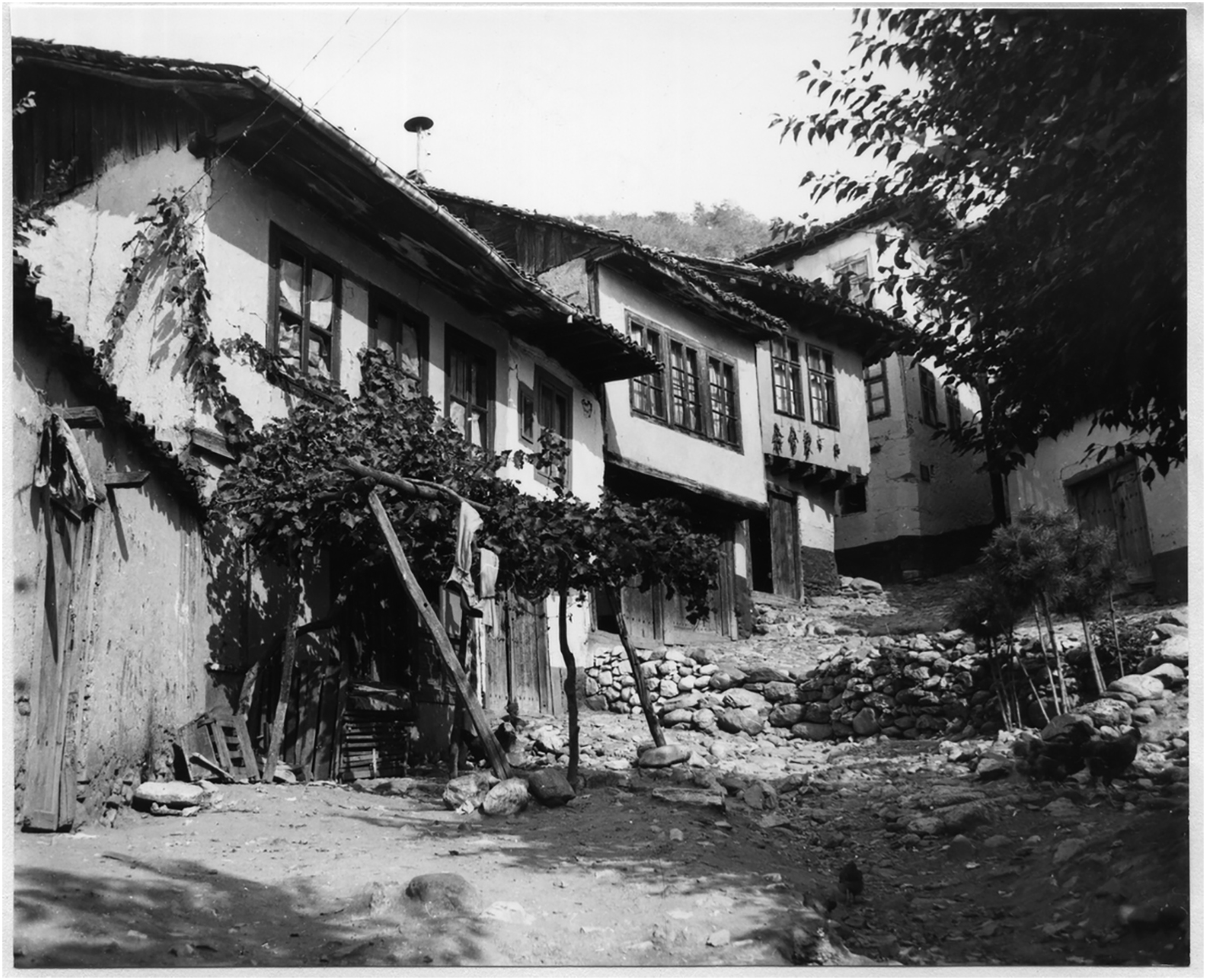
Street at Podkaljaja Neighbourhood, Prizren.
Over the course of the 1950s–60s, more and more architects were experimenting with the conceptual duality of modern and traditional, universal and authentic, ultimately striving to envision a distinct, contemporary Yugoslav expression. The dialectics of tradition and modernity is perhaps best reflected in the house in Konjic, Bosnia (1952) done by Andrija Čičin-Šain, one of Neidhardt's assistants at the Faculty of Architecture in Sarajevo, where he worked as a professor (Figure 2). The project was presented as an example of Yugoslavia's contribution to ‘genuine contemporary architecture’ and its humanistic ideals at the first International Exhibition of Contemporary Yugoslav Architecture that was staged in the countries of both East and West in 1959. 30 The house was formally conceived around a protruding balcony, which resembled a traditional porch of the Balkan house, while ‘its functionality, simple forms and sharp clean lines, as well as the rhetoric of materials, were the characteristics that Čičin-Šain's inspiration drew from modernism’. 31 One of the most acclaimed Yugoslav architects, Ivan Antić, also took lessons from the Balkan house, most strikingly in his design for the Artisan School of Niš (Serbia) in 1959. While the school's layout characterized pragmatic functionalist approach, some notable elements were unequivocally associated with the architecture of the Balkan house. This was further stressed by the school's immediate surroundings dominated by an old Ottoman mosque. Perhaps the most outstanding example of this architectural trend of integrating Balkan idioms with global trends in architecture was the National Library of Serbia (1957–72) by Ivo Kurtović (Figure 3). With its horizontality and wide porches set around an elevated ground floor, this building was conspicuously inspired by traditional Balkan architecture. 32 Despite the fact that it featured copper-clad hip roofs and wide projecting eaves supported by the slender, bare concrete columns, the building was disparagingly seen as a ‘personification of folkoloristic ideas’. 33 Kurtović's allusion to the Balkan house, as well as his experimentation with fluid space and dynamic forms (which mirrored some elements of typical Ottoman interiors), played a crucial role in achieving modern, specifically Yugoslav architectural expression. However, in the harsh reality of mass immigration to cities in Yugoslavia after the Second World War, the discourse of ‘modern vernacular’ was both too elusive and extravagant to be successfully integrated into the extensive construction of new housing. For numerous reasons, the attitudes and ideas of many architects during the postwar first two decades, apart from individuals like Neidhardt, significantly differed from what they actually built. Ultimately, the lessons of the Balkan house remained more important for the cultural imagination of new socialist architecture than for the large-scale housing projects in a country with limited resources.
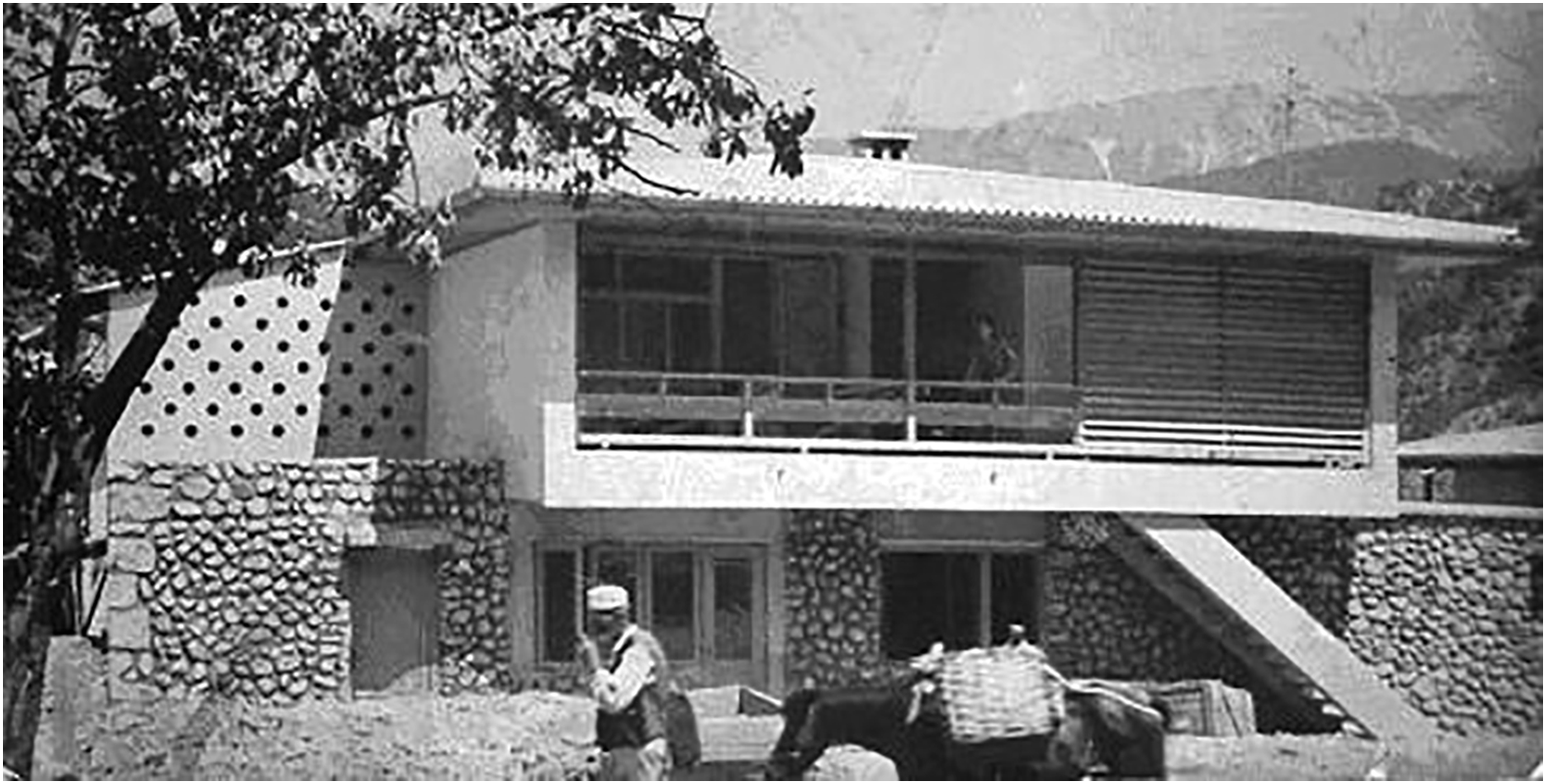
Andrija Čičin-Šain, House in Konjic, Bosnia, 1952.
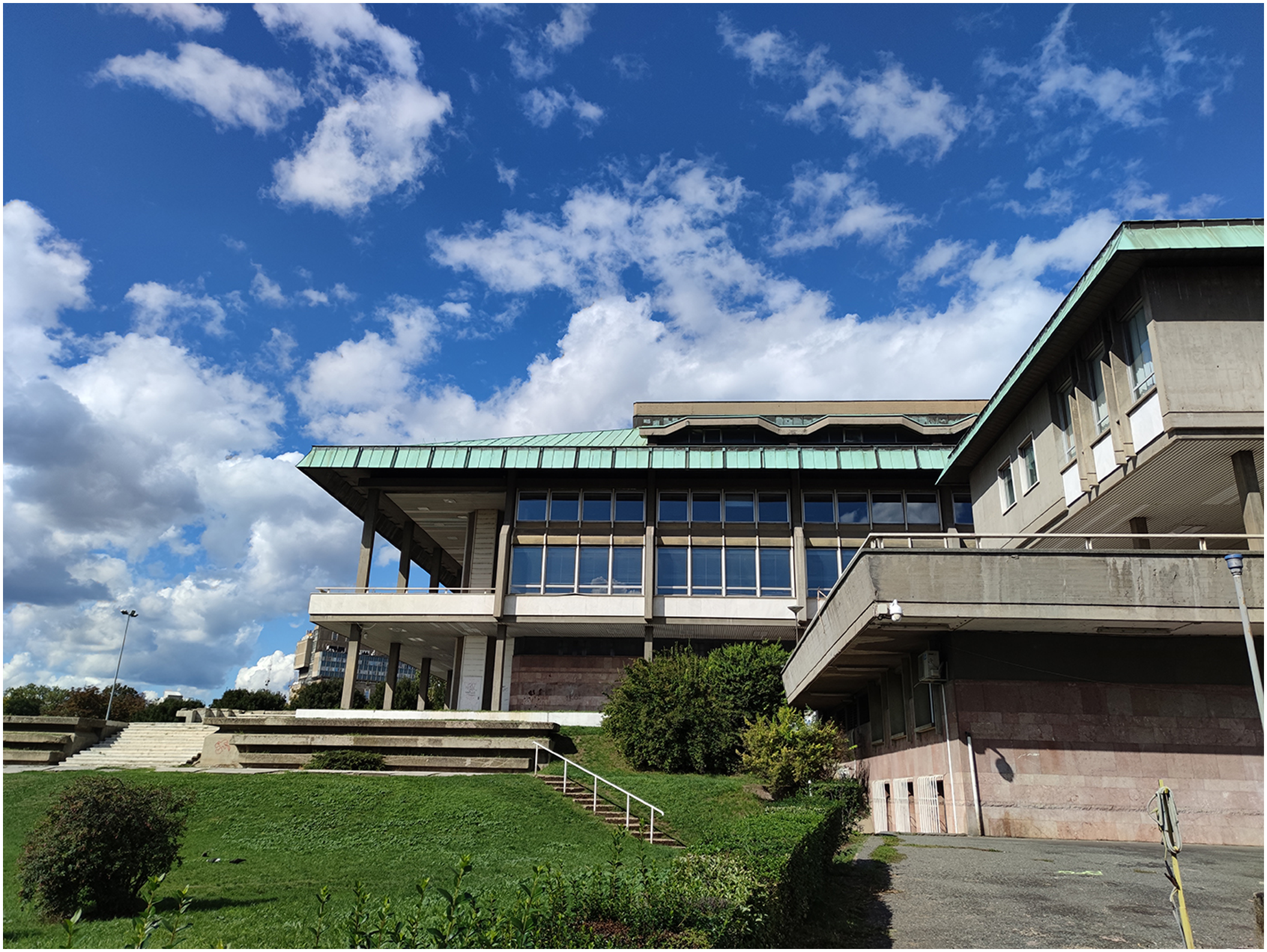
Ivo Kurtović, National Library of Serbia, Belgrade, 1957–72.
When studying the Macedonian variety of the Balkan house in 1951, Dušan Grabrijan explained that his claim that architecture represented a ‘totality embracing many factors’ was firmly based on dialectical materialism, 34 this was not merely a convenient phrase to express the ideological position of his work. The Marxist worldview indeed marked not only his, but the writings of many architects and theoreticians who included the Balkan house into the Yugoslav architectural discourse. Although it was customary for them to refer to dialectical materialism, there was a range of different approaches, from uncritical adulations to more thoughtful and sensitive understandings. Basically, there were three Marxist concepts included into the interpretations of the Balkan house. First, there was dialectics as a method of examining the relationship between vernacular tradition and modern architecture; second, the materialist approach to architecture which was seen as a purposeful and practical activity as it was expressed in architecture's ability to transform both nature and society; and, finally, there was humanism as a primary preoccupation of Yugoslav cultural elites.
In their efforts to establish a materialist interpretation of the world as a process, and also to refute what they saw as the dogmatic theories of Soviet etatism, Yugoslav Marxists eagerly embraced the classical foundations of the doctrine and went back to the original teachings of Marx and especially Engels and his ‘science of dialectics’. 35 However, their aim was not simply to reiterate the original teachings of the founding fathers but, as Gajo Petrović, one of the leading Yugoslav philosophers put it, ‘to further develop a vital revolutionary thought which was [only] inspired by Marx’. 36 These coordinates of self-tailored Yugoslav Marxism and the ‘authentic path to socialism’ were not mere abstractions but were integrated into the specificities of social and cultural practices including architecture. ‘The creative spirit which permanently emanates from [our] cultural heritage’, as Juraj Neidhardt stressed on many occasions, ‘has been a necessary condition for us to successively pave our own way to contemporary architecture, [which would be] organic and living, not merely imported’. 37
Yugoslav architects used methods of dialectical materialism as a critical tool by which they simultaneously reinforced the social relevance of their work and, more specifically, upheld the already developed ideas about the necessary interconnection of the past and present, local and global. On the one hand, the analytical and synthetical approach to the Balkan house, the study of its characteristics – both the ‘progressive’ and ‘regressive’ ones (which was typical for the language of Marxism) – justified the validity of the laws of dialectical materialism. On the other hand, the creative processes of critical research and design – using what was commonly seen as the universal principles embodied by evolution which resulted from the ‘model adaptation’ of vernacular architecture 38 – gave acceptable explanations about the validity of dialectical materialism as a method. This was related not merely to learning, but also to deeper understanding and changing the world – from more general principles, such as objectivity, versatility and specificity, to dialectical analysis and synthesis as well as the key Marxists’ postulate about the unity of theory and practice. 39 In this way, architecture as a critical practice in the socialist state became inseparable from the construction of cultural experience, playing an important role in Yugoslavia's modern identity. The dialectical relationship between tradition and contemporaneity represented another aspect in the modernist imagination of vernacular architecture in socialist Yugoslavia. A key reference point for Yugoslav architects was a premise of dialectical materialism by which ‘any examination of certain phenomena should lead not to finding out what the old, negative elements of heritage were […], but to discern all the positive elements which would be kept [in order to] generate the continuity of development’. 40 Almost the entire ethos of those who were interested in vernacular architecture and were trying to develop modern architectural idioms closely corresponded to this dialectical principle of ‘positivity in tradition’, which derived from the dialectical law of unity and conflicts as opposites. ‘The science of architecture’, wrote Branislav Kojić, one of the staunchest protagonists of the vernacular modernist discourse, ‘has proved that the traditional Balkan house consists of positive achievements despite the fact that the former [Ottoman] society was arrested in its general development’. 41
The way of seeing the Balkan house and its intrinsic duality (backward society-progressive architecture) closely corresponded to what the leading Yugoslav architectural theoreticians, like Bošković and Šegvić, recognized as a method of analytical confrontation between the negative and positive approach to vernacular and historical elements of the built environment. Starting from the idea that the essence of any creative activity was governed by the ‘basic laws of dialectical materialism’, Bošković argued that ‘artistic creation is pervaded by opposite forces, which are sometimes present in the state of equilibrium – when they form a single whole, and sometimes can be antagonistically confronted – when they upset the previously achieved balance and encourage the creation of new equilibria’. 42 These remarks clearly recalled the dialectical law of unity and conflicts as opposites, which explained how conflicts between the regressive and progressive components of vernacular heritage could facilitate its further development over time. ‘It is beyond any doubt that being bewitched by the past, in terms of its retrospective resonances instead of the prospective ones’, wrote Šegvić in his study of vernacular architecture, ‘would lead to the metaphysical variation of obsolete forms which are adapted to new purposes. But it is also inevitable that the unconditional repudiation of the past and heritage […] would bring about a false and pointless contrivance’. 43
Whether by eliminating or altering certain formal elements of the Balkan house (such as primitive technical solutions or materials) or vestigial functions (like those determined by the ‘archaic’ social patterns and cultural norms, such as patriarchy, class divisions or religion), Yugoslav architects emphasized another set of its features. They were interpreting them as the true ‘germs of development’, like the traditional house's intrinsic functionality, its structural rationalism, economy of materials; or, its innate humanism, sensitivity to context, etc. For example, on the House of the Macedonian Academy of Arts and Sciences (1976), Boris Čipan used modern building materials and reinforced concrete skeletal system in order to demonstrate the usefulness of the beam and post-construction of the Balkan house from Ohrid (North Macedonia), 44 which allowed free design of floor plans and façades – in line with early Le Corbusier's ideas (Figure 4). On the other hand, the semi-open and open spaces, which are distinctive features of the Balkan house, characterized Peter Muličkoski's National and University Library in Skopje (1971). He deliberately used ‘čardak’ or veranda, a characteristic element of the Balkan house, in order to meet modern requirements for protection against noise and direct sunlight. 45
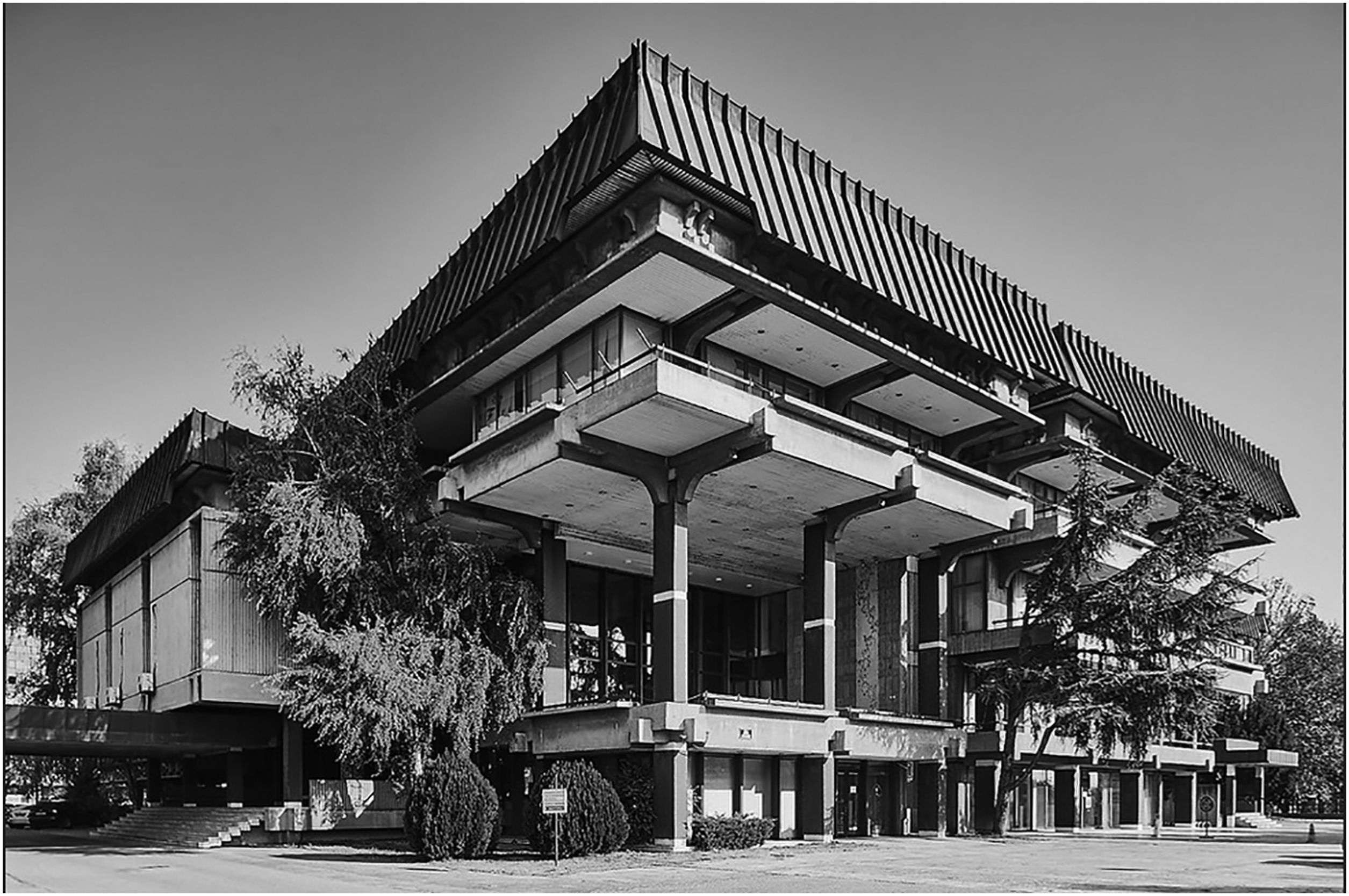
Boris Čipan, House of the Macedonian Academy of Arts and Sciences, Skopje, 1976.
In the light of the Marxist idea of continuity of interrupted succession, architecture testified to the claim that ‘analysing any phenomenon should aim not only to obtain its outmoded and negative sides […] but also the active internal elements of advancement, the positive in the old, which would be kept and further developed [in order] to form a new quality, eventually causing the continuity of growth’.
46
In other words, the principle of dialectical negation provided a firm theoretical basis for a multitude of relationships between vernacular and modern architecture discussed by architects and historians. A highly popular Introduction to the Basic Questions of Marxist Philosophy, which was standard reading for students and intellectuals in the 1950s–60s, elucidates exactly this point: The negation of old and the affirmation of new phenomena is not a mere rejection of the former or their annihilation whatsoever, but a process of overcoming their restraints and positive aspects […] A qualitatively new phenomenon, being the moment of attachment, retains many positive qualities and attributes of the old, elevating its level and forming a new link in the chain of indefinite progress of the material world.
47
These ideas were also discussed among practising architects and authors on a tidal wave of criticizing popular ‘folkloristic’ designs, which were quite common throughout the period. For example, Bogdan Nestorović's design for the Executive Council of Kosovo (1948), distinguished by a rather uninventive use of certain elements of the Balkan house (such as open porches, clay roof tiles etc.), came under close scrutiny by Bashkim Fehmiu, a professor and architect from Priština, who believed that, in spite of being inspired by vernacular forms, the ‘completed building is not distinguished by the quality of an artwork which every piece of architecture should possess’. 50 On the other hand, it was Neidhardt who was most imaginative in his redesign of the same object in 1960, creating a dialogue between the vernacular and contemporary in the juxtaposition of the verticality of the building core (echoing the typical ‘kula’ from Kosovo) to the horizontal lines of the added annex. Neidhardt's referring to the dialectics of negation as a creative principle in design comprised exactly this reversal of the blunt imitation of traditional elements by the use of quite new architectural forms. The idea that such contradictions were to be the source of architectural expression represented the basic impulse for designing contemporary architecture, corresponding to the intrinsic modernity of the Balkan house, which Neidhardt enthusiastically advocated. In his National Assembly of Bosnia and Herzegovina (built in several phases between 1954 and 1974), he employed a number of vernacular motives such as traditional clock tower, domes (transformed into modern shell structures), atria, porches and columned porticos (Figure 5). The achieved result represented a modern architectural ensemble which only conceptually relied on local traditions in order to, as the architect put it, ‘symbolize our [Yugoslav] nation-building idea’ 51 which was rooted in the Marxist principles.
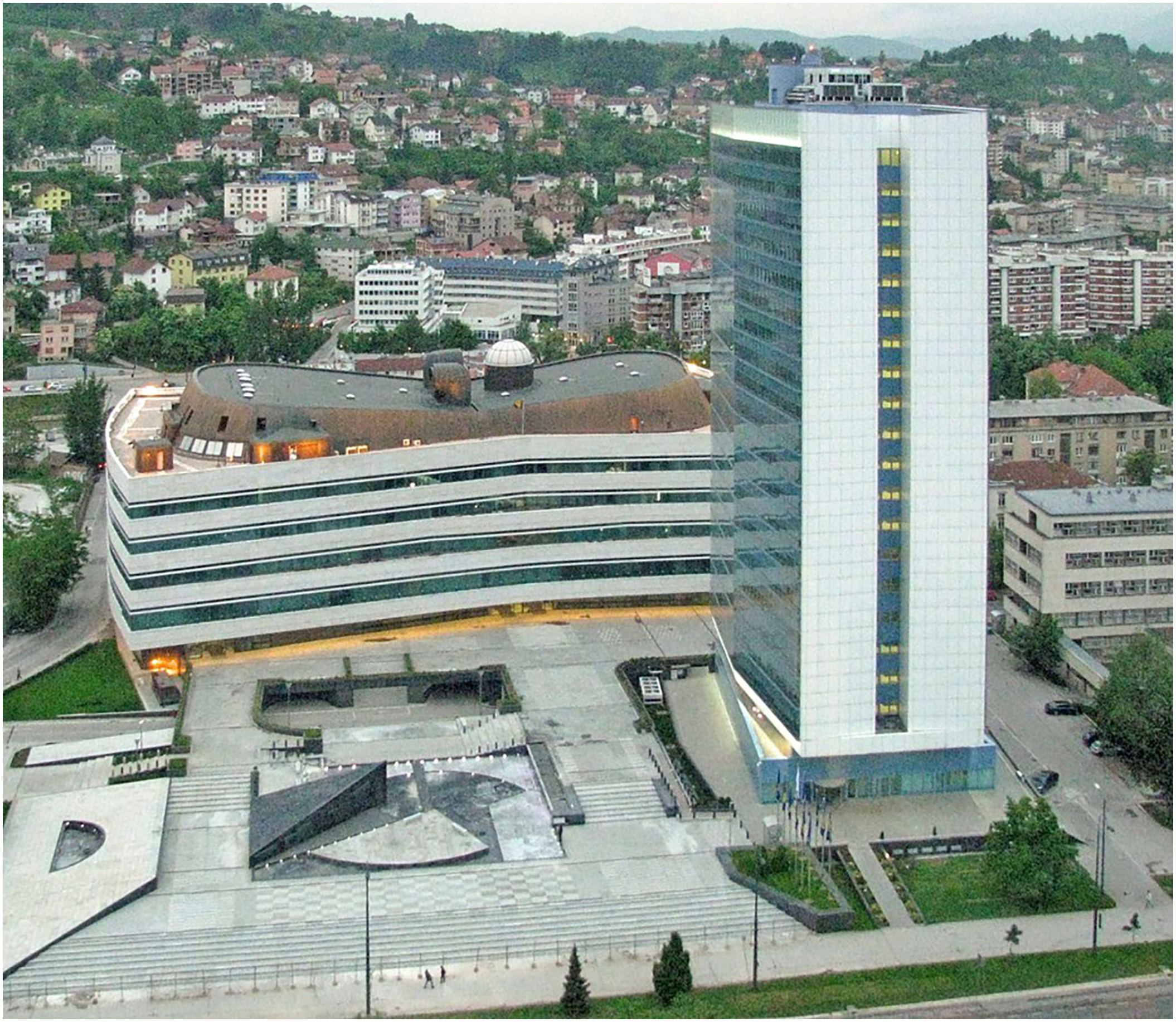
Juraj Neidhardt, National Assembly of Bosnia and Herzegovina in Sarajevo, 1954–74.
The dialectics of negation was also relevant for the reinterpretation of traditional urban agglomerations of the Ottoman era in Yugoslavia, which were marked by a harmonious interplay between buildings and their natural environment. This interest was cultivated alongside the global reassessment of the functionalist paradigm of urban planning and heightened awareness of cultural contexts for urban design. Over the course of the 1950s and 1960s, the crisis of high modernism was, among other things, brought about by questioning architecture's role in shaping communal values, cultural identity and regionalism. It was in this context when the renewed enthusiasm for vernacular architecture was being invigorated by many authors. 52 Yugoslav architects, too, took a critical stance towards rigid, geometrical layouts and saw traditional urban plans as a valuable heritage which had already, albeit spontaneously, achieved humanistic ideals that they strove to accomplish. The Diplomatic Colony in Dedinje district in Belgrade, designed by Stanko Mandić in 1954, shows an imaginative arrangement of 26 detached small villas, seemingly randomly distributed along winding paths and surrounded by lush greenery, resembling the traditional ambiance of Ottoman towns (Figure 6). This was further underlined by the architectural features of the villas, which were situated in accordance to the terrain and styled to echo the sophistication of the Balkan house, with its open porches, projected bay windows and verandas. A number of the period's residential settlements show similar attempts to harmonize architecture and its immediate surroundings, which would, in line with the Yugoslav Marxists’ narrative of ‘socialism with a human face’, serve as models for a more humane built environment. Numerous plans for workers’ colonies that Juraj Neidhardt had accomplished in Bosnia aimed to promote human scale and values derived from the Balkan house (Figures 7 and 8).
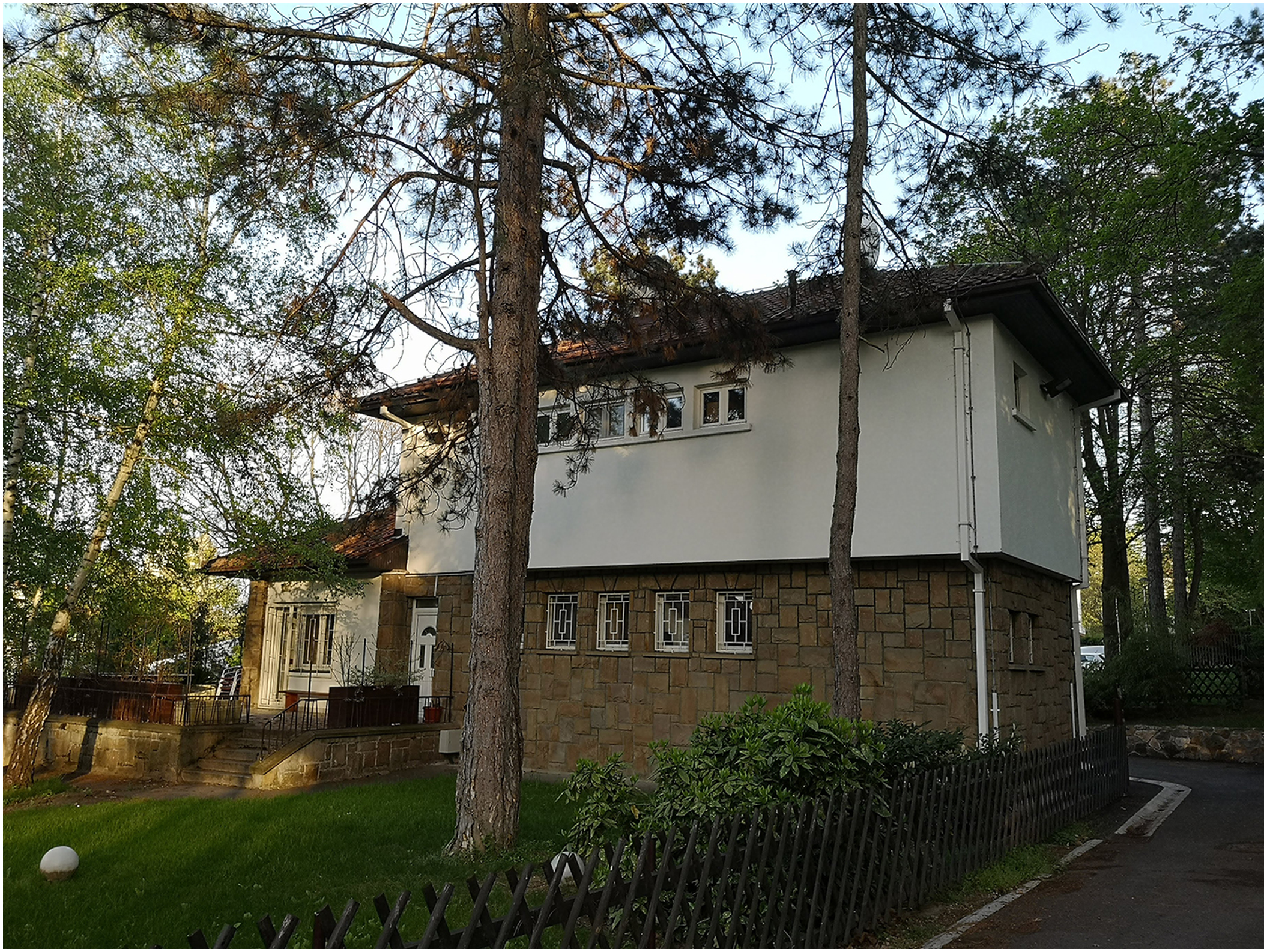
Stanko Mandić, The urbanism of the Diplomatic Colony in Dedinje district in Belgrade, 1954.
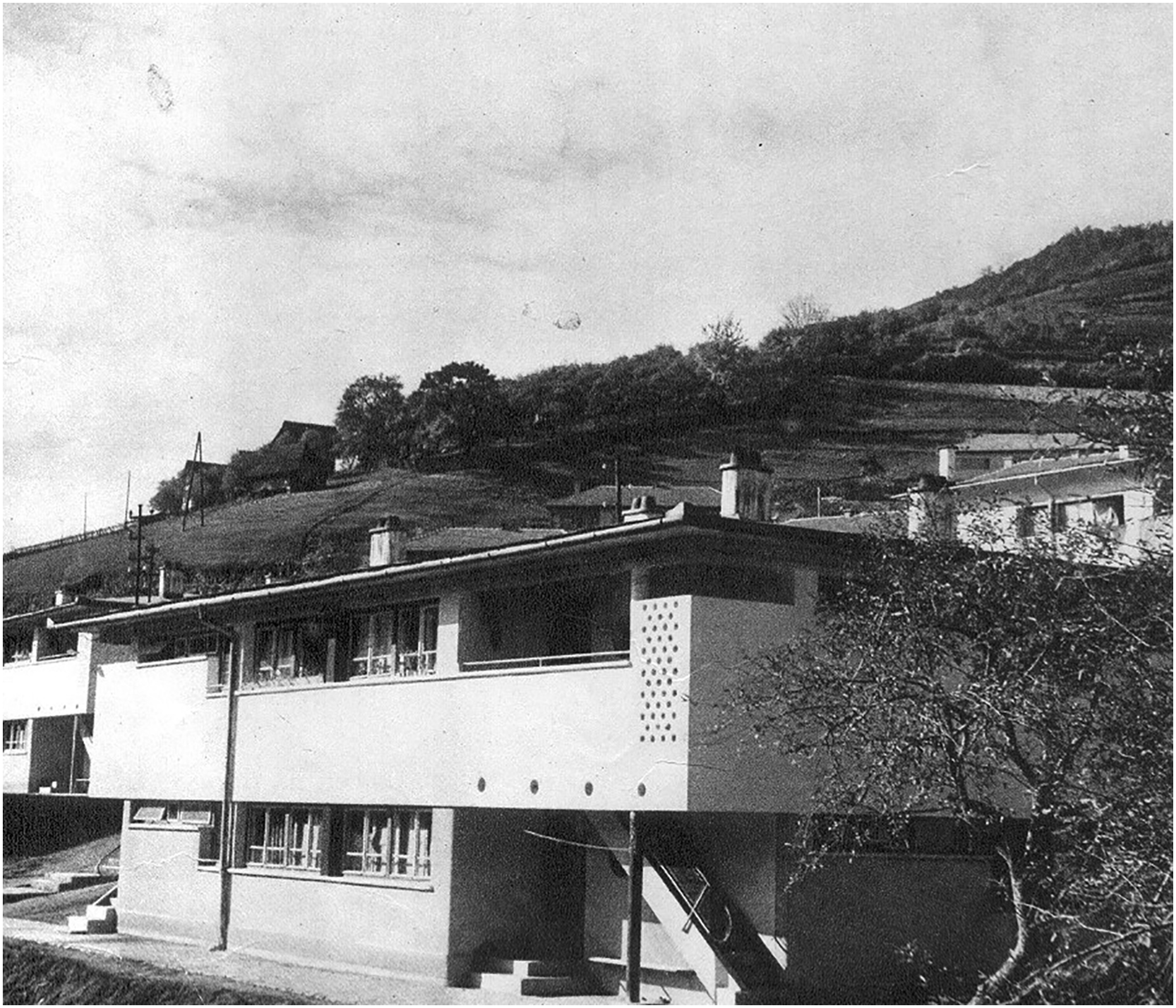
Juraj Neidhardt, Workers’ colony in Vareš Majden in Bosnia, 1947.
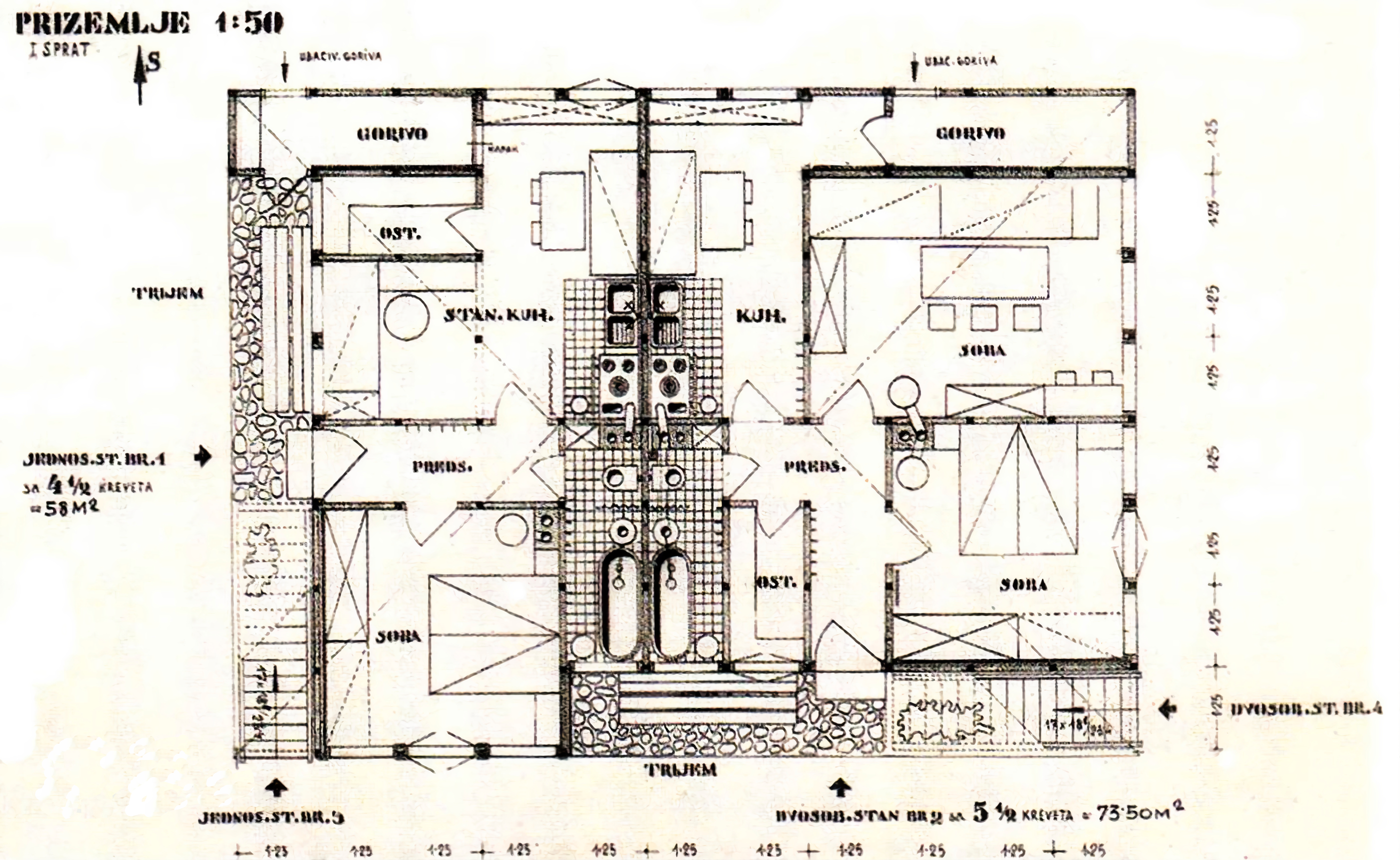
Juraj Neidhardt, Blueprint of the working house with four apartments.
The transition from primitive, but vital elements of vernacular architecture to more advanced architectural forms which, according to Jovan Krunić, was understood as the ‘annihilation of backwardness’, from the pre-modernity of the vernacular to contemporaneous modernity, was also understood through the prism of Marxism. 53 The interdependence of gradual-evolutionary and abrupt-revolutionary changes justified a basic law of materialist dialectic, which was about the transformation of quantitative into qualitative changes. While discussing the course of cultural evolution, Djurdje Bošković pleaded that contemporary culture did not emerge solely from one's inner creative impulses but historical experiences, ‘as a living phenomenon which resides in ourselves’. 54 This evolutionary approach was the motto of mainstream architectural historiography, theory and critics. ‘All great architectures of the past’, stood in the conclusions of the ‘Dialogues between Yugoslav Architects’ held in Otočac (Croatia) in 1963, ‘have been accomplished by evolution’. 55
The architects’ notion of evolution was rooted in what Yugoslav Marxists described as the polyvalency of certain phenomena, according to which everything in society and nature had intrinsically different, coexisting and contradictory components. 56 In the light of this argument, a transition from primitive, vernacular forms to more advanced architectural solutions in the past, which had led to the formation of the Balkan house and its regional varieties, went hand in hand with the development of technical and technological aspects of the building. Such an architectural transition legitimized one of the key premises of materialist dialectic, namely, the law of the passage of quantitative changes into qualitative changes. Yugoslav Marxists thought that this dialectical relationship between material, measurable features of the existing things and their essential, intrinsic aspects could be applied to all social and cultural processes. 57
Many architects shared this viewpoint and thought that vernacular architecture had been developing slowly through centuries, ‘gradually and thoroughly, never prematurely’, and always ‘by the course of evolution’ – as Aleksandar Freudenreich, one of the most proliferated Yugoslav authors in the field of vernacular heritage, stressed in his review of Bernard Rudofsky book Architecture without Architects: A Short Introduction to Non-pedigreed Architecture. 58 The echo of this globally popular book further encouraged Yugoslav architects to appreciate their concern for those ‘permanently proper’ elements in the vernacular which, as in the case of the Balkan house, had been developing and perfecting ‘for hundreds of generations’. 59
Dušan Grabrijan's study Developmental Way of Our Contemporary House, which was published long after its author's premature death, started with a significant premise. ‘I would like’, wrote Grabrijan, ‘to signal the embryonic beginnings, developmental ways, casual connections, influences and functional relationships’, pointing out that the history and structure of the Balkan house, ‘represented a key to contemporary architectural evolution, on the cusp of ending one evolutionary process and the beginning of another’. 60 In his second study, dedicated to the Macedonian variant of the Balkan house – which he considered to exemplify the ‘evolution from the Oriental to European lifestyle’ – the connection to dialectical materialism was even more explicit. Having relied on organicist metaphors, he emphasized that ‘we, therefore, should contrive to find embryonic forms and links […] which connect our past to the present’. As a result of the analytical process of identifying and interpreting a proper architectural tradition, Grabrijan imposed a method of ‘synthesis’ conceived to give an answer to the question of ‘how our new, socialist architecture should look like’. 61
Both Grabrijan and Neidhardt shared theoretical premises grounded in the Marxist thought. ‘Because man as a sociable being is subject to historical-social evolution’, they stressed in Architecture of Bosnia, ‘his achievements too, including architecture as a spatial and plastic art and the phenomenon of human activity, are caused by social and economic development and the way that societies live’. 62 Similar conclusions were drawn by other Yugoslav architects, among whom was Fehmiu, who wrote about dialectical relationships between architecture and society and a ‘symbiosis of material and spiritual heritage with the contemporary’. 63 This symbiosis was imagined as evolutionary development in which the horizon of expectation – in line with the Marxist view of history and society – shaped the past and represented a main impulse in the economy of architectural evolution. This line of thought was perhaps most conspicuously represented by Andrija Mutnjaković, who spoke about architectural evolution of the vernacular and the necessity that contemporary architecture ought to rely on evolutionizing the ‘archaic forms’ of regional identity. 64 Mutnjaković, who was generally interested in experimenting with various cultural patterns and the idea of kinetics in architecture, aptly demonstrated his theoretical acumen in an avant-garde design for the Palace of the Academy of Sciences and Arts of Kosovo (1976) by creating a ‘dynamic architectural expression related to the [Balkan] Prizren and Ohrid house’. 65
The Balkan house became an epitome of cultural evolution, locating the relationship between tradition and modernity in the architectural culture of socialist Yugoslavia over the course of the 1950–60s. A number of Yugoslav architects used elements of the Balkan house, which they thought of as the living germs of tradition. These elements, of course, included not only formal features – inherently prone to the universal law of architectural evolution – but also conceptual principles that were rooted in tradition and could develop in the future, such as ‘the cult of neighbourhood’, ‘the right of view’ and, as Neidhardt put it, ‘any unwritten law by ancient master builders’. 66 For example, many architects employed the porch as a distinctive Balkan house motive not as a mere functional element, or a link between interior and exterior space, but as a paradigm of men's need to enjoy broad vistas, open air and sunlight. What Neidhardt saw as the ‘orgiastic frenzy of [wooden] porches’ in the Balkan vernacular, which had arisen from our predecessors’ ‘poetic impulses’, might have reached apotheosis, for ‘concrete and steel enable a growth of enormous proportion of cantilevered architecture’. 67 This architectural evolution from traditional open porches to their modern metamorphoses distinguished numerous Neidhardts's works, from a ski lodge at Mountain Trebević (1947) to the housing block in Djure Djakovića St. (today Alipašina St.) in Sarajevo (1958). Another example of utilizing the concept of evolution were numerous department stores of the 1960s–70s, which were inspired by the architecture of the Balkan house, like in Jajce (Bosnia) by Radivoje Jadrić, Džemal Karić and Nedžad Kurto; Skopje (North Macedonia) by Tihomir Arsovski; Prizren (Kosovo) by Stanko Mandić; and Smederevo (Serbia) by Milica Šterić, Pavle Pašić and Aleksandar Keković. They all demonstrated the idea of architectural metamorphoses from vernacular to modern forms, while keeping the ‘poetic impulses’ of the former.
With the development of technical, technological and programmatic aspects of contemporary architecture, the idea of inherent modernity of the Balkan house further justified the concept of evolution. Many Yugoslav architects strove to reaffirm the humanistic dimension of the architectural heritage from the Ottoman era. ‘The right of view’, a hierarchy of private and semi-private spaces, as well as the abundance of verdant gardens, among other principles of traditional Ottoman urban culture, were most used in new architectural production with Neidhardt as the leading author (Figure 9). The workers’ colony Vareš Majdan (built in 1952) was characterized by a zig-zag arrangement of the houses, which framed undisturbed vistas and formed residential micro-ambients in lush greenery (Figure 10). Neidhardt remained dedicated to this concept, which was most ambitiously expressed in his housing project ‘Honeycomb’ (Pčelinje saće) for Sarajevo (1977). Many favoured similar architectural poetics. For example, Ivan Štraus, although he took up a fighting stance against Neidhardt's teachings, designed housing blocks called ‘The Sun’ in Sarajevo (1972) on the principles of ‘the right of view’; two years later, Radovan Delalle and Namik Muftić designed similarly conceived ‘Djuro Djaković’ housing estate in the same city (Figure 11). They all saw the advantage of the terrain and uphill slopes for creating stepped and serrated buildings with terraces, which not only paid homage to Sarajevo's old neighbourhoods, but also demonstrated the vitality and inherent transformability of the Balkan house as a valuable resource for many other similar projects, primarily in Bosnia, North Macedonia and Kosovo, where the Ottoman influence was most prominent.
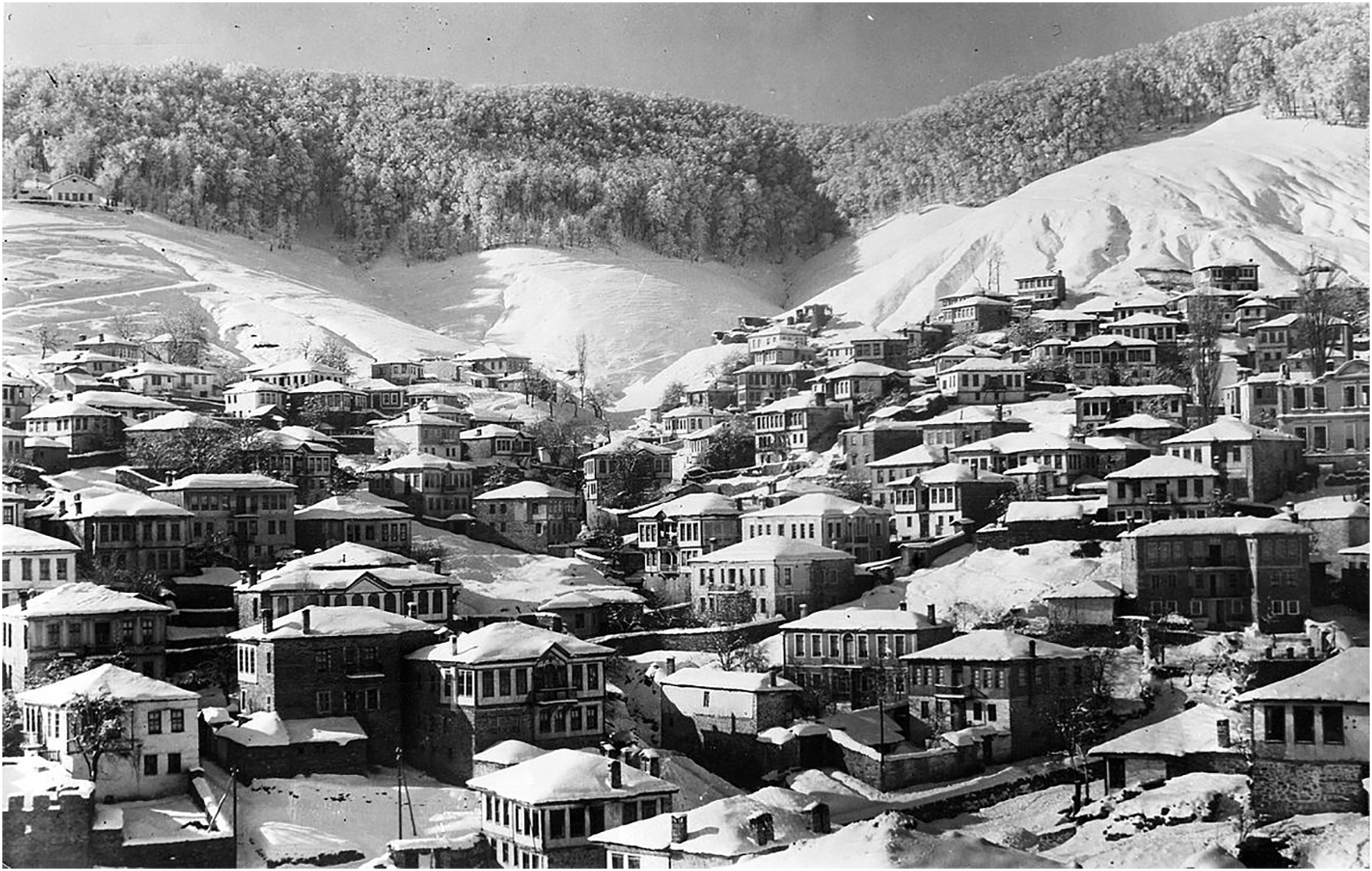
Ottoman urbanism and the rule of ‘the right of view’ in Kruševo, 1930s.
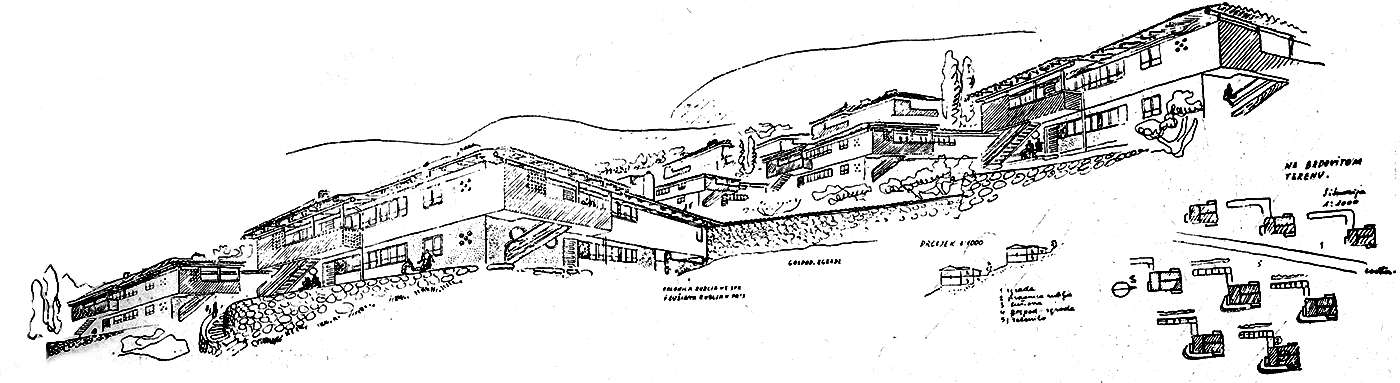
Juraj Neidhardt, Workers’ Colony in Vareš Majden in Bosnia, 1947.
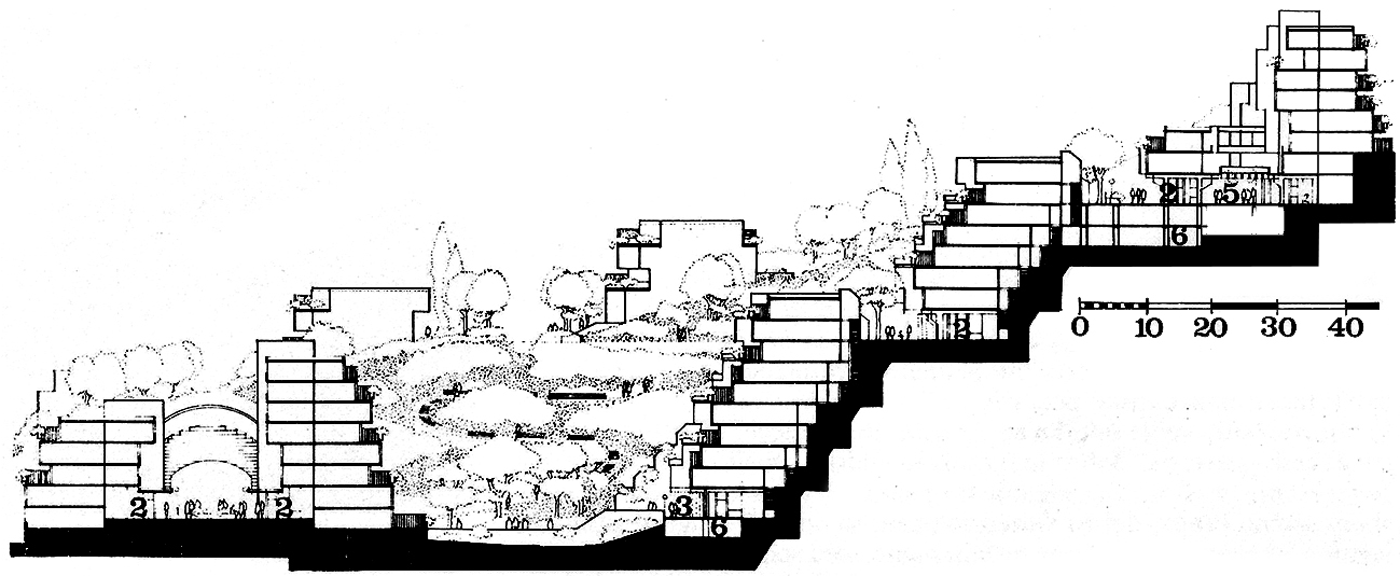
Radovan Delalle and Namik Muftić, Housing blocks ‘Djuro Djaković’ in Sarajevo, 1974.
The concept of architectural evolution, however, was not incongruous with the idea of architectural revolution, by which radical transformations of architectural theory and practice occurred with the advent of self-management socialism in Yugoslavia. Namely, Yugoslav Marxists discussed that every change in society and culture was comprised by the mutual interaction of quantity and quality, ‘synthesis of evolution and revolution, continuity and discontinuity of development’. 68 This argument gave theoretical support to the idea of the interconnectedness of evolution and revolution in the modernist discourse of vernacular architecture in Yugoslavia. Djurdje Bosković clearly stated that in the domain of architecture one could see two, ‘closely related [principles]: evolutionary progress and sudden leaps from one state to another’. He made this theoretical assumption more comprehensible by assuming that ‘this sudden surge can be attributed either to revolutionary changes in the material base, or to the quantitative accumulation of structural or any other [functional, formal, stylistic] architectural elements’. 69
In the architectural culture of socialist Yugoslavia the Balkan house stood as a prime example of vernacular, popular and demotic building type which served not only as a basis of authentically Yugoslav, modern, democratic architecture, but also as the epitome of Marxist theory of dialectical materialism and proof of its positive vitality. The Balkan house represented a living, perceivable example of how the relationships between tradition and modernity, the past and the present, as well as men and their environment could become incorporated into new architecture of ‘socialism with a humane face’ – from its initial phase in the early 1950s, up until the mid-1970s. Having been part of the so-called ‘modernism from tradition’ discourse, the Balkan house held not only theoretical, but also wider social relevance. It was exactly this interdependence of the theoretical and practical that cultivated a distinctly Yugoslav modernist aura around the Balkan house through the work of numerous architects – Juraj Neidhardt and Dušan Grabrijan from Bosnia, Boris Čipan and Petar Muličkoski from North Macedonia, Jovan Krunić, Djurdje Bošković and Ivan Zdravković from Serbia, Neven Šegvić and Andrija Mutnjaković from Croatia, Behim Behmiu from Kosovo, etc. Their interdependent theoretical and practical projects were much more than a mere application of dialectical materialism to architecture, because they always implied that the modernist discourse of the Balkan house justified Marxist ideas that theoretical work ‘is not disconnected from reality and practical agency’. 70
The concept of the evolution from vernacular to modern architecture, along with other concepts that the Balkan house epitomized, cannot be fully understood if seen beyond the ideological context in which these ideas and analogies were created by architects, theoreticians and historians. The importance of this part of vernacular heritage for the social and cultural imagination in socialist Yugoslavia was tremendous, sharply marking the federal state's architectural culture, even if it was complex, fragmented along national borders and subject to various interpretations. In a certain sense, the Balkan house provided a unitary, trans-national architectural project which served the Yugoslav regime in its policy of cultural cohesion, complementing the dominant narrative of the constitutively separated nations of Yugoslavia.
More importantly, the Balkan house proved to be exceptionally useful in demonstrating the legitimacy and authority of dialectical materialism as a worldview and building block of self-management socialism, which contributed to its wide currency beyond the ivory tower of academics and state ideologues. The explanatory capabilities of the Yugoslav interpretation and appropriation of the Balkan house dealt with materiality of architecture concerning the classical Marxist theory. Firstly, it was concerned with the base-superstructure model, because it vindicated the interdependencies between the two; secondly, this building type played an important part in the teleology of Yugoslav architectural modernity, challenging divisions between the categories of old, new, vernacular and modern. The dialectics of negation brought out the inclusion of pre-socialist and pre-Yugoslav traditions into contemporary architecture, which was the process otherwise featured in the Yugoslav master narrative. And finally, the interpretations of the Balkan house through the concepts of evolution and revolution justified the Marxist understanding of processes in society and culture. In the context in which vernacular architecture was conventionally believed to be spontaneously developed from the needs of the ‘common men’, the Yugoslav interest in the Balkan house was animated as an anticipation of a much sought-after harmony between man, society and nature and those humanistic ideals which lay at the heart of the Yugoslav socialism experiment.
