




Abstract
During the Second World War, the Axis states looted a great deal of gold in various forms, both from individuals and countries. Following that war, the western allies established the Tripartite Gold Commission (TGC) to organize the restitution of monetary gold that had belonged to central banks in occupied Europe. One of the claimant countries was Yugoslavia. Drawing upon hitherto unused TGC records, the article examines the looting of Yugoslav monetary gold and its restitution via the TGC, which is a little-known episode in postwar history. Of the four Yugoslav claims submitted to the TGC in 1947, the majority were recognized as valid, yet the final adjudication was not published until 1958. The reasons for this protracted process of restitution and for the rejection of some of the Yugoslav claims are set out and note is made of the issue's recrudescence in the 1990s, when the TGC sought to distribute the final Yugoslav share. The break-up of Yugoslavia made this concluding allocation of gold a demanding task, and it did not end until 2004. By comparing it with other claimant countries, the article demonstrates that in some ways Yugoslavia was in a better position than the states behind the Iron Curtain.
To state that the Axis powers looted a great deal of gold during the Second World War is something of a cliché. According to postwar estimates, the value of the gold robbed from various sources in 1939–45 was approximately US $545–550m. 1 Varying in form and scale depending on the policy pursued in the occupied country, the methods by which the Axis states obtained it, which included requisition from central banks, financial institutions and citizens, were often very sophisticated. The restitution of gold was therefore one of the hardest postwar tasks to accomplish. As they extended their frontlines eastwards, the Allies were discovering and recovering large amounts of gold, and the trend continued once the occupation of Germany had begun. Having gained possession of it, the question arose of what should be done with it and how it should be restituted. The latter issue was inextricably linked to postwar compensation: to reparations and indemnities. The deliberative body established to make the necessary arrangements was the Paris Conference on Reparations, which sat between 9 November and 21 December 1945. Under the terms of the Potsdam Agreement, all of the countries whose claims to reparations were to be satisfied from within the western zones of occupation were invited to the conference. 2
The foundations for the restitution of gold were laid down in Part Three of the Final Act and Annex of the Paris Conference on Reparation, which was signed on 14 January 1946. 3 It stated that monetary gold found in Germany was to be, ‘pooled for distribution as restitution among the countries participating in the pool in proportion to their respective losses of gold through looting or by wrongful removal to Germany’. In this way, all signatory countries able to present a detailed and verifiable claim for a definite amount and to prove that the gold had been looted after 12 March 1938 were to receive a proportional share of the gold pool. Under the terms of the agreement, they were to address claims to monetary gold to the governments of the USA, Great Britain and France: the western powers occupying Germany and Austria. 4 Although the term monetary gold had yet to be defined, the agreement clearly provided that only gold held by a central bank to cover a state's currency – and not gold held by individuals – would be restituted. The provisions of the Paris Conference were implemented on 27 September 1946, when the United Kingdom, France and the USA established the Tripartite Commission for the Restitution of Monetary Gold (Tripartite Gold Commission [TGC]). 5
In respect of Yugoslavia, which had been strongly affected by occupation and was among the signatories to the Paris Agreement, previous studies dealt only with robbery of Yugoslav monetary gold. Jozo Tomasevich, who has made a very considerable contribution to the historiography of occupied Yugoslavia, mentions only the Germans’ takeover of the Bor Mines, which yielded gold as a by-product of copper extraction. 6 In a significant book, Miloš Timotijević gives a detailed description of gold robbed during the war and deconstructs various myths that arose in postwar Yugoslavia around this issue. 7 However, no detailed study of the restitution of that country's monetary gold has yet appeared. In fact, only one study, by an American researcher, Arthur L. Smith, has so far attempted to investigate the Yugoslav case in the wider context of restitution. 8 Though it describes the Yugoslav claims – mistakenly established at 11.7 tons – and identifies their sources, it provides no details of the restitution process. That it refers only to American sources, including Department of State documents, is a further shortcoming. It should be recorded in mitigation, however, that Smith expresses his regret that he was denied access to the TGC archives. 9 Dušan Biber, who wrote a paper for the Slovenian delegation to the London Conference on Nazi gold (2–4 December 1997), 10 is another scholar who has stressed the importance of the TGC records. In addition to identifying gold looted during the occupation, he also explains what happened to Yugoslav gold evacuated from the country prior to the invasion. It is unfortunate that the paper, which is more of an outline than a comprehensive study, deals only with the period until 1951, long before restitution. In fact, it is unlikely that he would have produced it had the conference not been organized – a point that will be enlarged upon later. That there is an evident gap in the research is not the only reason to take an interest in this topic. The restitution of monetary gold is a story not only of diplomatic negotiations, but also of Yugoslavia's experiences during the war, which were particularly difficult and complicated – not least where the looting of gold is concerned. As we can see, the task confronting the TGC was not an easy one.
The TGC's three commissioners, who were supported by a secretary general and experts, represented the three countries charged with the disposition of the gold. The body was established to formulate restitution procedures and to receive and adjudicate claims submitted by governments. Though the Inter-Allied Reparation Agency (IARA) could be considered a twin organization to the TGC, they were separate institutions with separate tasks, even though the three TGC commissioners were simultaneously delegates to IARA and the TGC communicated with the claimant countries, which were also involved in the work of the IARA via their representatives to that body. The restitution of gold, which had been expected to be settled swiftly and efficiently, in fact took until 9 September 1998, 11 when the TGC – by then one of the longest surviving relics of the Second World War and the Cold War – was finally dissolved. To study the restitution of monetary gold by Yugoslavia, or indeed any country, it is necessary to analyse the TGC records. Yet so far, almost no one has taken advantage of these vital primary sources. 12 What follows is thus based mainly on an examination of hitherto unknown sources relating to gold restitution held at Centre des Archives diplomatiques de La Courneuve (CAD). The research also consulted Yugoslav primary sources held in the Diplomatic Archive of the Serbian Ministry of Foreign Affairs (Diplomatski arhiv Ministarstva spoljnih poslova) and in the Archives of Yugoslavia (Arhiv Jugoslavije).
On 13 March 1947, the TGC sent a questionnaire and covering letter to all IARA delegates explaining the basic criteria and terms of restitution, such as ‘looted’ and ‘wrongfully removed’, 13 which had to be understood very broadly owing to wartime allied declarations and other international agreements. 14 The TGC was aware that the Axis states sometimes acquired their loot by refined and discreet methods that preserved a semblance of legality. For its part, the TGC understood the subject of restitution as follows, ‘gold was monetary gold if a genuine relation existed between that gold and the claimant country's monetary system’. 15
The questionnaire, which was written in February 1947 and preceded by a memorandum specifying the interval to which claims must relate (12 March 1938–30 June 1945), served as more than a means for countries to submit their applications. It was also intended to provide the TGC with as much data as possible on the movements of monetary gold during the war. In the first of its three parts the claimant government was to provide as much information as possible on the monetary gold lost both by itself and by other governments whose gold had been looted from the claimant's territory, including its form (coins, bars, other forms). Governments could, however, only submit claims on their own behalf. They were also to include an account of the circumstances in which the gold had been lost (whether the Germans had ‘receipted’ the looted gold, for example) as well as any information regarding its subsequent fate. Here, claimant governments could also inform the TGC of other movements of gold during the war they knew of. The second part of the questionnaire, whose layout was similar to that of the first, was devoted to the monetary gold, if any, that the country had managed to recover. The third section was summary in nature. All of the data concerning gold were to be given in kilograms. 16 The TGC set 15 September 1947 as the deadline for the receipt of applications. 17
Before attending to the details, it is worth mentioning how much monetary gold Yugoslavia possessed before the war. After 1945, the communist authorities in Belgrade accused the pre-war government of wasting resources, robbing the gold, and running away from the country after the Axis states attacked. In fact, the royal government had done everything it could to protect the country's monetary reserve. By the time war broke out in Yugoslavia, most of the gold (52.8 t, 83.1 per cent of all reserves) had been placed abroad and only 10.7 t of gold remained in the country. All in all, Yugoslavia possessed 63.5 t of gold on the eve of war. The amount had been considerably higher before March 1941, when 20 t were sold. 18 Despite the unfounded accusation formulated by the communists, it was in their interest to do everything to secure the restitution of the stolen assets, which were vital to postwar recovery.
Belgrade's interest in robbed gold began well before the commission was established. After liberation, in 1945, the Yugoslav government started to collect information about gold looted by Italy and Germany, which involved a number of different institutions and ministries, including the Reparation Commission of the Federal People's Republic of Yugoslavia (Reparaciona Komisija Vlade FNRJ), the National Bank of the Federal People's Republic of Yugoslavia, the Ministry of Foreign Affairs, the Ministry of Finance, the Yugoslav Restitution Missions in Germany, and other agencies where required. 19 Since Yugoslavia was an IARA member, its delegation to this organization was authorized to make representations to the TGC.
The government issued a memorandum on 20 May 1945 to the allied powers (the USA, the UK, France, USSR), requesting them to provide information about the possible location of robbed gold. 20 Only the Americans, who stated they had no information on the matter, but if any appeared Yugoslavia would be informed, responded promptly. 21 Belgrade also attempted to raise the profile of the gold question on the international agenda by addressing a memorandum to the Council of Foreign Ministers on 28 January 1947. In it, the government appealed for the robbed gold to be returned ‘as soon as possible’. 22 Shortly after the TGC was established in September 1946, but before Belgrade had received an official invitation to submit its claims, the Reparation Commission indicated the need to prepare all of the materials necessary to support claims to robbed monetary gold. 23 The Yugoslav government was thus clearly determined to press the issue of the restitution of monetary gold and was, to some extent, well prepared for the process of doing so.
The Yugoslav delegate to IARA, Milan Bartoš, returned the questionnaire with a covering letter dated 14 May 1947, supporting documents and an explanatory note from the Minister of Foreign Affairs of Yugoslavia of 8 May 1947. The country's claim amounted to 12,624.92418 kg of fine gold. Even the material submitted by the Yugoslav government for adjudication, which ran to 68 pages, was more extensive than that of other countries. The TGC divided all of the Yugoslav claims to monetary gold into four categories, which are shown in Table 1.
Yugoslav claims to monetary gold.
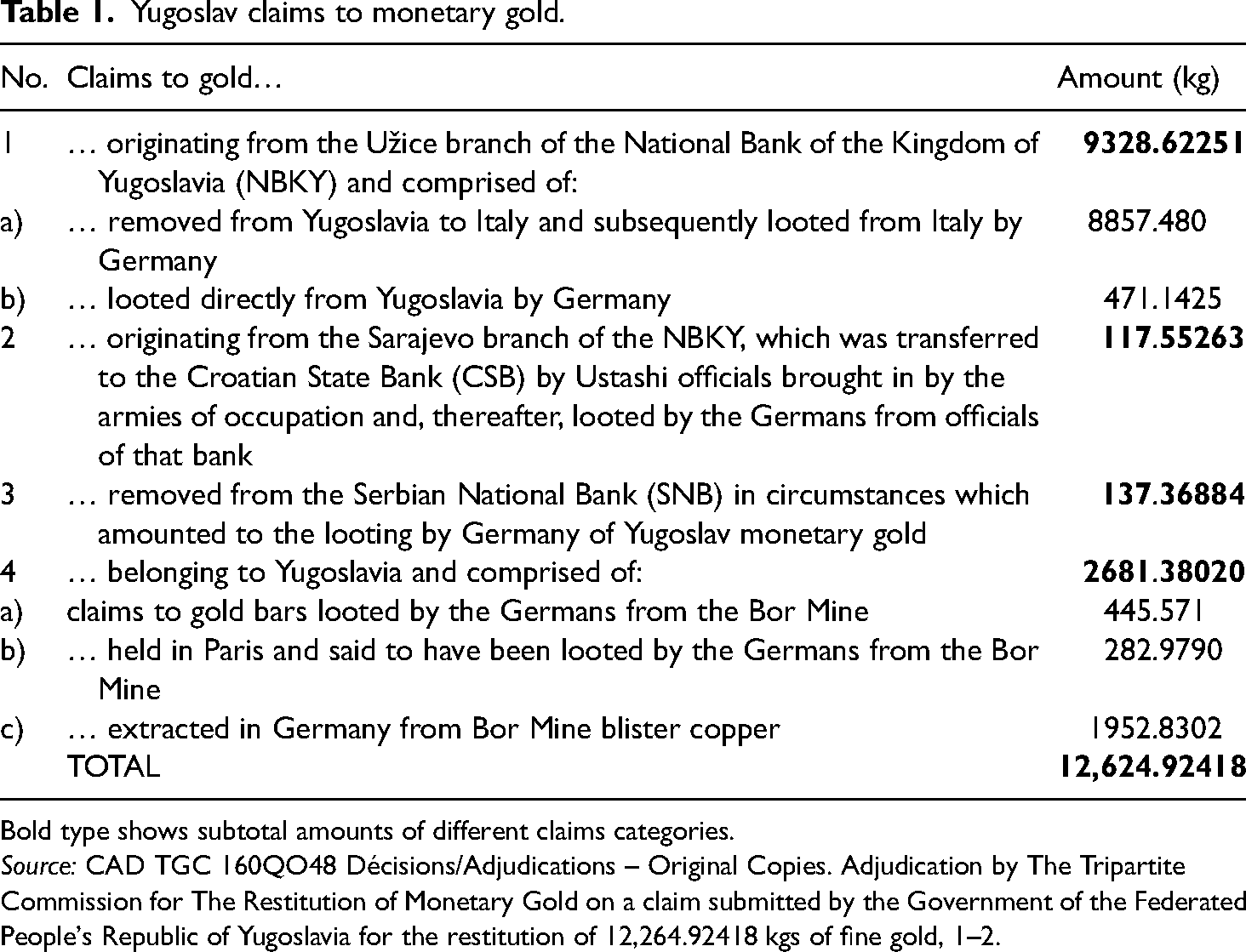
Bold type shows subtotal amounts of different claims categories.
Source: CAD TGC 160QO48 Décisions/Adjudications – Original Copies. Adjudication by The Tripartite Commission for The Restitution of Monetary Gold on a claim submitted by the Government of the Federated People's Republic of Yugoslavia for the restitution of 12,264.92418 kgs of fine gold, 1–2.
Before turning to a detailed discussion of these claims, we may note the complexity of the Yugoslav case, which reflected the division of Yugoslavia between Germany and Italy and the ensuing creation of puppet states, such as the Independent State of Croatia (Nezavisna Drzava Hrvatska) and the Territory of the Military Commander in Serbia (Подручје Војног заповедника у Србији).
In its preliminary analysis of the Yugoslav claims, the TGC noted a lack of documentation from Belgrade 24 to justify them. Having presented the requested additional evidence to the TGC in this first instance, Belgrade responded to further requests for extra evidence on 5 March and 21 June 1948 and on 1 March 1952. 25 It was further noted that a claim to the gold, which had been looted by Italy, had also been submitted by Rome. It should be noted that there were differences between this claim and the Yugoslav one. 26 Given its country had been divided by the Axis Powers and its archives and records thrown into a state of confusion during the occupation, it was difficult for the government of Yugoslavia to collect its documentation and particularly so to determine what portions of its monetary reserve had been removed by Italy and what by Germany.
The Yugoslav government had originally claimed that all of the gold originating from the Užice branch of the NBKY, which held 9611.30811 kg of fine gold, had been looted. The difference between the latter figure and Yugoslavia's original claim, which was 9328.62251 kg of fine gold, was explained by the fact that, when it had left the country, the Yugoslav government in exile had taken with it some of the gold originating from the Užice branch, which portion, of course, was not claimed for. In respect of the number of gold cases taken, the claim for the gold which was taken directly by Germany from Yugoslavia was based on eyewitness statements and in respect of the fine weight of gold claimed it was based on the average fine gold content of one case. The original figures given for the gold taken by Italy had to be rectified. 27 What is the story behind this looting? How could a former enemy, Italy, have been allowed to make a claim for restitution?
In view of the threat of war, the National Defence Council of Yugoslavia decided in May 1940 to send the greater part of the NBKY gold reserves to London and to New York. The total assets of 9611.3081 kg of fine gold were comprised of coins originating from the Sarajevo branch (7738.36649 kg) and of coins (260.27347 kg) and bars (1612.4685 kg) originating from the bank's headquarters in Belgrade. Pursuant to the order of 26 November 1940 executing the decisions taken in May 1940, they were sent to the Užice branch of the NBKY, where the gold was stored in a specially constructed strongroom. When war broke out on 6 April 1941, the NBKY management and the bank's remaining moveable assets were removed to Užice, where the Minister of Finance had established temporary offices. In view of the unfavourable trend of events, the latter issued a decree, which was enforced on 8 April 1941, to the effect that the gold should be transferred without delay to the NBKY branch in Mostar, where it was thought that it would be safe. Accompanied by Todor Karanovic, departmental manager of the bank, Jovan Zivadinovic, chief clerk, and Marjan Krisper, clerk, the 204 boxes of gold were duly transported by motor lorries to the Mostar branch.
On 13 April 1941, General Milojko Jankovic telephoned the manager of the Mostar Branch, Kristic, and ordered the gold to be transferred to Nikšić. On the night of 13–14 April, the 204 cases of gold were once again loaded onto motor lorries and despatched. On the evening of 14 April, they reached Bileća, where they were transferred to a railway wagon. That same evening, the train containing the gold set off for Nikšić, where it arrived on the morning of 15 April 1941. Officials of the bank, led by the chief clerk, Zivadinovic, arrived a few hours later to supervise the removal of the 204 cases of gold, which were taken in motor lorries to the Trebjesa grotto for storage. 28 It had been the intention of the Yugoslav government to have all of this gold removed by air to a place of safety abroad, but it was prevented from doing so by the inauspicious course of the military operations and a shortage of aircraft. In this way, when the Yugoslav government went into exile on 16 April 1941, it was able to take only six of the 204 cases with it.
On that same day, 16 April 1941, while the government was in the process of leaving the country, 100 cases of the gold – accompanied by Captain Gojnic, Lieutenant Jankovic, Second Lieutenant Slepcev and a military clerk, Jukic – were sent in motor lorries to Cetinje. At the same time, 10 cases were loaded onto a motor lorry and driven to Ostrog Monastery, where Patriarch Gavrilo (Gavrilo Dožić) had taken refuge. Before leaving Nikšić, Captain Gojnic witnessed the departure of the gold sent to Ostrog Monastery. He later claimed that, in addition to the three motor lorries he had escorted to Cetinje, a fourth lorry, supervised by a police lieutenant, had been loaded with 10 cases of gold, which were delivered to the patriarch at Ostrog Monastery. A further 88 cases were transported from the Trebjesa grotto by Captain Svetislav S. Nesovic, Air Lieutenant Vladimir B. Rajkovic and Air Sergeant M. Radulovic and left at Nikšić in the offices of the chief of the district administration, Miras Radonic, and his chief clerk, Kotlica. The gold which had been hidden in Ostrog Monastery was found and seized by the German forces on 24 April and 27 April 1941. They boasted of their treasure haul in an article in the 1 May 1941 edition of the newspaper Panzer am Balkan 29 that is striking in its detail – as if the Germans were quite unaware that it could serve as evidence of their illegal deeds.
What had happened to the gold sent to Cetinje? The 50 cases that arrived there in motor lorries late in the evening of 16 April 1941 were, following various consultations between Yugoslav civil and military authorities and removals from one hiding place to another, eventually placed in the strongrooms of the Banovina Administration at Cetinje. This is where the Italian forces discovered them in May 1941 before looting them in the following month. The second consignment of 50 cases arrived in Cetinje shortly after the first. But as the Italian Forces were in the neighbourhood, a decision was taken to disperse it. In this way, eight cases were unloaded and hidden in a private house in Cetinje and the rest of the convoy was directed by the Ban of Zeta Banovina to proceed to Herceg novi, where the remaining 42 cases were stored in the supply department of the Bay of Kotor headquarters. These 50 cases were discovered by the Italian Forces and gradually removed to Italy, where they came into the possession of Germany following Italy's capitulation in 1943. The summary of this claim shows Table 2.
Fate of cases of gold originating from the Užice branch of the National Bank of the Kingdom of Yugoslavia.
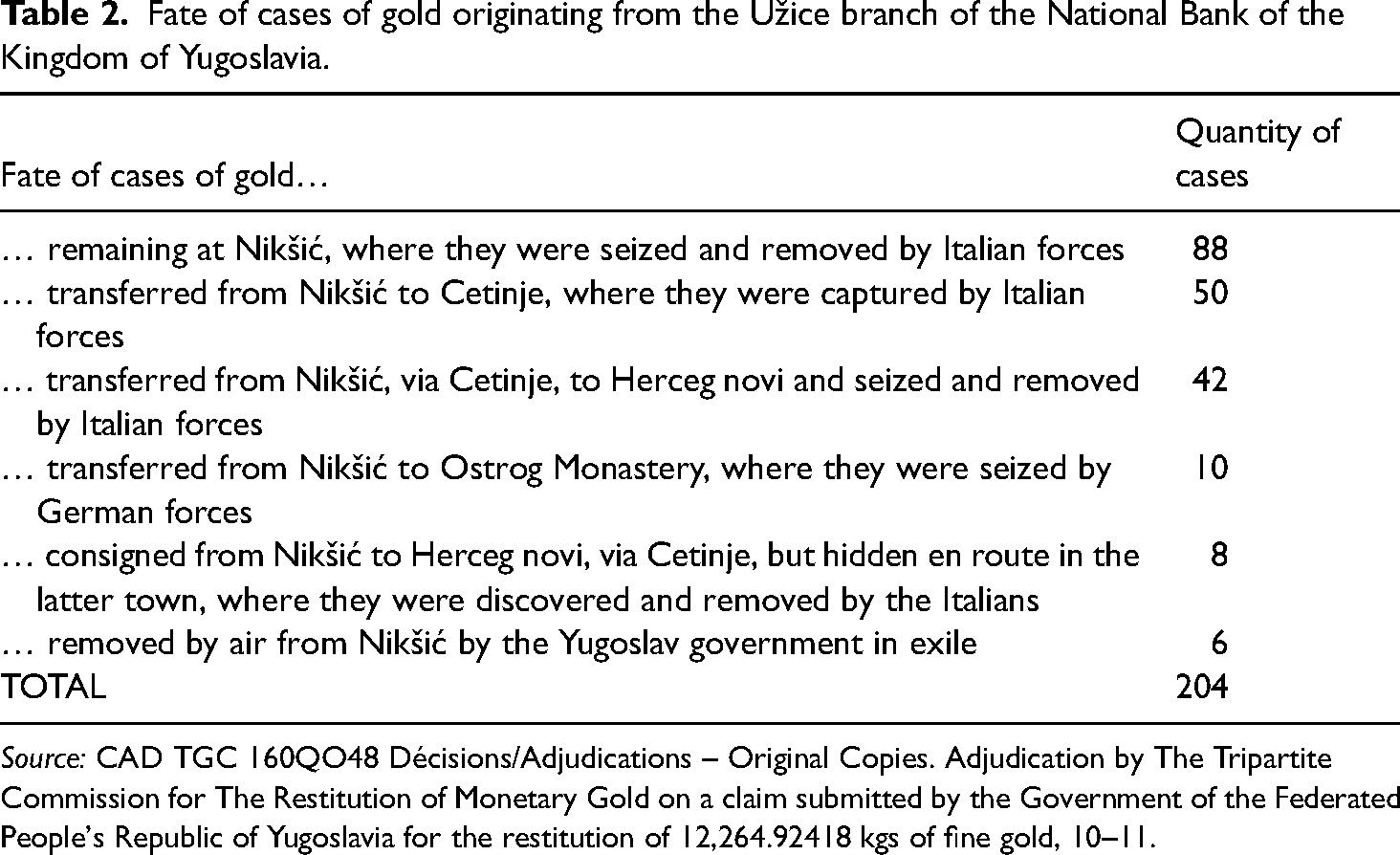
Source: CAD TGC 160QO48 Décisions/Adjudications – Original Copies. Adjudication by The Tripartite Commission for The Restitution of Monetary Gold on a claim submitted by the Government of the Federated People's Republic of Yugoslavia for the restitution of 12,264.92418 kgs of fine gold, 10–11.
For the TGC, this was a unique claim. After all, it involved a former enemy, Italy, which had looted gold from Yugoslavia and deposited it with Banca d’Italia – only for it to be stolen later by Germany. Indeed, it was one of 14 claims categorized by the TGC as generating further problems. 30 Although Italy was an Axis power, it had been thought even before the submission of claims began that some would involve Italy. The three western powers therefore decided that a questionnaire should be sent to that country. 31 The peace treaty concluded with Italy on 10 February 1947 stipulated at paragraph 8, article 75 that Italy would return all looted gold, including gold transferred via Italy to any other Axis state. As a consequence, the return of looted gold was one of the conditions on which Italy was permitted to participate in restitution. The protocol admitting Italy to the pool of monetary gold of 16 December 1947 obliged Rome to refund all of the monetary gold it had looted from France and Yugoslavia. 32
Although Belgrade was unofficially informed by London of these conditions, the Yugoslav authorities were afraid that Rome would fail to fulfil its obligations. 33 The fears proved unfounded and Italy was willing to talk. 34 Despite the fact Yugoslavia was not party to the negotiations with Italy on its admittance to the gold pool, bilateral arrangements between Rome and Belgrade were made. 35 It was established that approximately 8857 kg was to be returned to Yugoslavia. That Italy and Yugoslavia had both submitted claims to the same gold and, furthermore, that restitution was influenced by the peace treaty, presented difficulties. How were they to be solved?
On 2 September 1948, Yugoslavia formally withdrew the claim which it had lodged directly with the TGC relating to 188 cases, which its government estimated to contain 8857.480 kg of fine gold. It simultaneously agreed that the amount removed by Italy was 8393 kg of fine gold and not 8857.480 kg. The former amount (8393 kg of fine gold), which the Yugoslav authorities finally agreed to, was proposed by Rome based on its calculations and sources.
The only remaining claim (in this group) was to 10 cases estimated by the Yugoslav government to contain 471.14251 kg of fine gold taken by the Germans from Ostrog Monastery. This was not tantamount to Yugoslavia relinquishing a claim to the gold looted by Italy. The TGC formally allocated this gold to Italy, but it was decided that Yugoslavia would receive a portion of that country's share. Where the gold looted from Ostrog Monastery was concerned, the TGC did not agree with the methods used by Yugoslavia to estimate it. Instead, it launched further investigations, concluding finally that the quantity in question was in fact 452.7143 kg. 36 The Yugoslav delegation to the TGC's seventieth meeting, which was led by Miro Anastasov, Envoy Extraordinary and Minister Plenipotentiary of Yugoslavia in Brussels, received two orders drawn on the Bank of England (where the gold at the disposal of the three powers was deposited) for 8393 kg and 215 kg. All of the necessary documents were countersigned by the Italian ambassador, Pasquale Diana. 37 The resulting delivery of a total of 8608 kg of gold was the first to be received by Yugoslavia.
As Aleksandar Pilatić, a legal advisor to the Reparation Commission emphasized in an internal note, Yugoslavia derived greater benefits owing to the paradoxical fact that this gold had not originally been robbed by Germany, but by Italy, and the latter country was obliged under the terms of the peace treaty to return all the gold. Had Belgrade's claim been considered via the TGC, it would have received less gold because the claims to monetary gold exceeded the amount of monetary gold recovered by the western allies. In the 1940s, the TGC calculated that only 40 per cent of a claim recognized as valid would be satisfied, 38 though this proportion increased over time as the western allies were able to recover more gold from neutral countries.
The second group of claims involved the activity of the puppet states the invaders established in occupied Yugoslavia. The claim to 117.55263 kg of gold transferred to the Croatian State Bank (CSB) by Ustashi officials, which originated from the Sarajevo branch of the NBKY, in fact consisted of two claims: to gold looted from this branch and to assets plundered from private individuals. Having invaded, the Germans established the Serbian National Bank (SNB) and CSB as banks of issue. Both, and especially the CSB, were mere instruments: although the Germans were not formally represented as directors at the two institutions, they exercised control of their operations. 39 After April 1941, the Germans transferred 1089.80216 kg of gold in various forms – the majority, 1065.25795 kg in the form of bars – from the Sarajevo NBKY branch to the CSB. A few years later, in July 1944, the CSB transferred 980.45443 kg of gold to the Swiss National Bank for safekeeping. This meant that 109.34773 kg was the amount that remained of the gold looted from Sarajevo. 40 During the occupation, the CSB purchased gold and it was looted by the Ustashi and the occupiers from Serbs, Jews and other adversaries of the puppet government. This gold (8.20490 kg), together with that mentioned above, was taken away by the Ustashi, among them Colonel Cirilo Kralj and Major Mirko Vutuc, on 7 May 1945 when they were fleeing Zagreb.
According to the TGC, the first part of the claim (109.34773 kg from Sarajevo) had definitely formed a part of the pre-war monetary reserves of Yugoslavia (as understood in Part Three of the Paris Agreement) and had been wrongfully removed. The TGC therefore admitted the claim. In no sense could the Ustashi be construed as followers of the genuine Yugoslav Government, which was in exile at that time. 41 Instead they were instruments of German power and the German economic position in the Croatian puppet state was, from the very beginning, a dominant one. 42 Because it concerned gold looted from private individuals, the second part of the claim was, however, rejected. 43 The TGC was very consistent in its adjudications, so that it was not only in the Yugoslav case that claims were rejected for this reason. Similar claims were submitted by Austria, Holland, Greece and Poland. Though looting from private individuals – as perpetrated either by the Germans or by occupier administrations controlled by the Third Reich – was a form of robbery, this gold had no relation with the financial system of a specific country and hence was not monetary gold. 44 It is also worth recalling that following its liberation, Yugoslavia was able to recover this gold, which had been transferred to the Swiss National Bank by the Ustashi, from that bank. 45
The third claim, which was connected with the occupation of Serbia, was in many ways similar to the second. The amount in question, which had originally been 112.61669 kg, was 137.36884 kg. During the occupation, the Germans introduced the compulsory surrender of gold and foreign currencies. Using all of the means at their disposal, dedicated organizations, known as Devisenschutzkommando, were responsible for finding any gold and foreign currency in the possession of the population of Serbia. The basic regulations obliging all gold, foreign currency and foreign exchange to be offered for sale to the SNB were set out in the Devisenverordnung für Serbien of 10 June 1941. It was this that allowed the SNB to compulsorily ‘purchase’ 220.58683 kg of fine gold from the Serbian population. It was dispersed as follows:
0.26185 kg remained in the SNB safe and was recovered after liberation 107.70829 kg were removed from the SNB on 12 September 1944 by Chetniks, and some of this gold (85.46798 kg) was recovered there following liberation 112.61669 kg were ‘sold’ at different times during the occupation to various German entities.
Probably owing to a misunderstanding, the Yugoslav government increased its claim by 24.75215 kg to 137.36884 kg. It was clear to the TGC, however, that this gold, which had been obtained in the same way as it had been by the Ustashi, was not monetary gold.
46
As in the previous case, it dismissed the claim. The decisions in both cases were taken at meetings held between 31 July and 30 October 1951.
47
It took the TGC more time to adjudicate these final claims because they were more complicated than the other Yugoslav claims.
The fourth claim – for 2681.38020 kg – was entirely related to the Bor Mine and was, in a sense, affected by the Cold War. In 1903, the government of Yugoslavia had granted a concession for the extraction and refining of blister copper from an area of land situated at Bor in Yugoslavia, near the Bulgarian frontier, to a French company known as La Campagnie Francaise des Mines de Bor, whose headquarters were in Paris. The copper, which contained 40–50 g of fine gold per ton, was considered a by-product of the mine. Under decree no. 3358/1 proclaimed by the Yugoslav Government on 4 August 1934, all mines on Yugoslav territory were obliged to hand over any directly or indirectly produced gold to the NBKY to increase its gold reserves. The refining capacity of the Bor Mine in Yugoslavia was strictly limited, which meant that the company had to export most of its blister copper for refining. This was probably why the same decree specified that the gold resulting from this copper refining abroad had to be repatriated and delivered to the central bank. 48 It should be noted that the Yugoslav finance minister and the French company concluded two agreements, of 30 December 1939 and of 31 October 1940, in the relevant period.
The Germans issued the first regulation establishing their control over all of the mines in the country almost immediately after the Yugoslavs had capitulated. The copper extracted from the Bor Mine was vital, which meant that it played a special, central role in the system of occupation implemented by the Germans, 49 who also ordered the liquidation of the NBKY. 50 Indeed, taking control of the Bor Mine was one of the priorities of the German occupation plan. 51 During the occupation, the German controlled SNB and the German authorities applied different interpretations of the pre-war regulations. The SNB requested the gold extracted from the Bor Mine, but the Germans, who had stated when the occupation began that all pre-war regulations would remain in force, did not deliver it. In his letter of 29 July 1944, moreover, Serbia's military commander stated that he had issued an order releasing the Bor Mine from its obligation to hand over gold to the National Bank, which was a flagrant breach of the pre-war and occupation regulations. Meanwhile, the Germans looted 445.571 kg in bars from the Bor Mine. The greater part of this plunder – 85 bars of a total net weight of 305 kg – was removed from Belgrade by the German administration of the Bor Mine Company in 1944, taken to Germany and deposited with the Reichsbank in Berlin. Together with other quantities of gold from the Reichsbank, it was transferred to the famous Merkers salt mine in Thuringia, where it came into the possession of the US Army. Though the SNB requested the return of this gold, 52 none was forthcoming.
The Germans also looted blister cooper from the Bor Mine and removed it to Germany, where they refined gold from it. Originally, this part of the claim was not submitted because the Yugoslav government did not come into the possession of documents justifying it until the deadline for submitting the questionnaire had passed. Despite this, the TGC permitted the claim to be filed and even increased it – from 1649.0260 kg to 1952.8302 kg. 53 The blister copper the Germans looted from the Bor Mine was sent to Norddeutsche Affinerie in Hamburg, where the Germans extracted 1952.8302 kg of fine gold from it. 54
The theft of Bor Mine gold was made even easier owing to events that had occurred before the German invasion of Yugoslavia. Prior to the German occupation, the Third Reich had invaded France and compelled the French shareholders in La Campagnie Francaise des Mines de Bor to sell it their shares. The Third Reich thus took control of the company and renamed it de Bor Kupfergwerke und Hutten A.G. and then took ownership of its actual property following the invasion of Yugoslavia in April 1941. 55 During the war, the administration of the company had deposited all of the gold in the company's name with Banque de France in Paris. In 1943, this gold was transferred to Belgrade and afterwards to Vienna, where it was deposited at the Kreditansttalt-Bankverein. Following this, in 1944, the German administration of the Bor Mines ordered its transfer to Germany. By 1948, the gold had been discovered in the safe of the Landeszentralbank in Hamburg. 56 The claim submitted by Yugoslavia amounted to 282.9790 kg of fine gold.
This was the case that presented the TGC with the greatest difficulties. First, there was an intense debate about whether or not this was monetary gold. The claim to gold looted from the Bor Mine and taken to Germany had been rejected when it had first been considered. 57 There was even a dispute about whether it was looted copper rather than looted gold. 58 The complexity of the war in Yugoslavia is illustrated by the fact that another proportion of the Bor Mine gold (16 bars; 51 kg) was found after the war in the British Zone of Occupation in Germany. Furthermore, Belgrade was not sure whether the Bor Mine gold could be considered monetary gold. It was against this background that internal discussion, as well as a number of disputes about competence, developed on the Yugoslav side. The TGC Adjudication for Yugoslavia claimed that the Yugoslav Restitution Mission there was not aware at that time that this gold constituted a de facto part of the Yugoslav claim lodged with the TGC. It therefore filed a claim with the British Zonal Authorities, who promptly delivered the gold to the Yugoslav Restitution Mission. 59
Yet a different picture emerges from the Yugoslav sources, according to which the Restitution Mission attempted to convince the British Zonal Authorities that the Bor gold was ‘industrial gold’ and could be returned under the ordinary restitution procedure applied on the territory of occupied Germany by the allied authorities. At the same time, the Yugoslav Delegation to the IARA sought to prove to the TGC that it was monetary gold, which was a deliberate tactic Belgrade applied because it was not sure how it would be able to secure the Bor gold. However, this device was opposed by the delegation to the IARA as it was clear it was undermining its argumentation. Mato Topić, of the Yugoslav Restitution Mission in Germany travelled to Brussels in September 1948, where he discussed the issue with Svietozar Orlić, a member of the delegation to the IARA. Orlić stated his opposition to the line that the Bor gold was industrial gold and explained that the TGC could only make contact with the delegation to the IARA. Nevertheless, Topić was able to arrange an unofficial meeting with the TGC's secretary general, John Watson, which proved fruitless, as Watson merely repeated what Orlić had said: that the TGC could only make contact with the delegation to the IARA. 60 Following the delivery of 16 bars, which represented a proportion of the gold looted directly from the Bor Mine, the Yugoslav authorities submitted a claim for the remaining amount of gold (282.9790 kg, 23 bars) to the British Zonal Authorities. When it was realized that the TGC was responsible for considering claims to monetary gold and that it was therefore the agency that should conduct further investigations, the delivery of this gold was suspended. 61 Finally, in its negotiations with the TGC, Belgrade agreed that the already delivered proportion of Bor gold would be taken into account in any future allocations of Yugoslav gold. 62
However, there was another reason why this claim could have been rejected. While the British and American commissioners were generally in favour of accepting it, the French commissioner was not. The Bor Mine company had been nationalized by the Yugoslav authorities and the French and Yugoslav governments had reached an agreement regarding compensation. However, the French commissioner was strongly against including Bor Mine gold looted by the Germans from Paris (282.9790 kg, 23 bars), 63 which had been discovered in the British Zone and was at the disposal of the British, in the claims. According to the French commissioner, the agreement excluded 23 bars, ‘The nationalization could not affect anything outside Yugoslavia’. 64 The TGC decided to try to solve this problem by inviting Slobodan Karic, a counsellor at the Yugoslav Ministry of Foreign Affairs, to set out the Yugoslav position at a TGC meeting held on 12 January 1953. He stressed that when the nationalization agreement had come into force, the French government had undertaken not to contest Yugoslavia's title to the gold seized by the Germans. 65 For their part, the American and British commissioners pointed out that this claim was in full accordance with the expert opinion provided to the TGC by Professor Georges Sauser-Hall that had defined monetary gold. 66
Paris was not the only capital to attempt to solve its problems in respect of Yugoslavia by means of nationalization there. Washington took advantage of a request by Belgrade to unfreeze assets belonging to the Royal Yugoslav government in exile, which had been deposited during the war with the Federal Reserve Bank of New York, to pay compensation for nationalization. The agreement, whose provisions included the return of 4166.7 kg of fine gold to the country, was signed on 19 July 1948. 67
In fact, this gold had not been looted according to the definition of looting set out in Part III of the Paris Agreement. Nevertheless, this issue demonstrates how useful the gold question was as a political instrument. Since 1945, the American authorities had not only been holding on to Yugoslav gold deposited in New York, but also preventing the sale of industrial equipment and grain to Belgrade. The official reason for freezing the gold was that it represented payment for weapons provided to the Royal Government by the Americans. Belgrade accused Washington of discrimination and illegal decisions on many occasions between 1945 and 1948, and it was a narrative it applied in both internal propaganda 68 and in the international forum. 69 Tito even claimed that the freezing of the gold was one of the reasons why Yugoslavia had been denied participation in the European Recovery Program (the Marshall Plan). 70 At the beginning of 1948, he endeavoured to convince Cavendish Cannon, the US ambassador to Yugoslavia, to change the American position, arguing that his government would use a portion of the gold to make necessary purchases in the USA. 71 Interesting though it may have been, the tactic made no impression in Washington. More important was Yugoslavia's unexpected willingness to negotiate a compensation agreement. 72 There is no evidence, however, that the USA attempted to combine negotiations for compensation with those for restitution via the offices of the TGC.
The draft version of the adjudication in the case of Yugoslavia appeared in July 1953. The only difficulty was the French position. Indeed, the Quai d’Orsay even took the step of conveying a demarché to Belgrade with a view to the withdrawal of this part of the claim. It is perhaps surprising, then, that one year later, the French commissioner did not know his government's position regarding the Bor Mine gold. 73 He was in a minority, though, as his British and American counterparts were equipped with powerful arguments in support of the Yugoslav claim. Yet as the TGC could take only unanimous decisions, they had to wait for the French position to become clear. This did not occur until 1957, when the French commissioner stated that he had no objection to the recognition of the claim. 74 A number of other complicated cases were being examined at this time, which meant that the TGC was in a position to announce its decisions in respect of all of the countries only in June 1958. What is more, a wholesale change in the personnel making up the American representation and the time consumed by making translations into French did not exactly expedite matters. 75 The prolonged wait for a decision obviously caused concern within the Yugoslav government, which was in communication both with the three governments and with the TGC. In February 1957, it resorted to dispatching a pro memoria to the TGC. The lack of a response from the commissioners, who had seemingly decided that a reply was unnecessary, must have been dispiriting. 76
While awaiting a decision, the TGC furnished Yugoslavia with the documents necessary to withdraw the gold from the gold accounts held at the Bank of England and the Federal Reserve Bank of New York once the recovered gold had been deposited. The various withdrawals Belgrade made in 1948–1951 amounted to a total of 10,205.470 oz. of fine gold in bars (317.426 kg – excluding the share from the Italian pool). In this way, Yugoslavia participated in what is known as the preliminary distribution of gold. 77 These claims, which were unquestionably valid and justified, were satisfied. 78
The TGC finally issued its settled adjudication of the Yugoslav claims, along with a detailed schedule of them on 9 June 1958. The total claim to monetary gold was 12,264.92418 kg. Belgrade formally reduced one of the claims, which included gold looted by Italy, from 8857.480 kg to 3407.44418 kg. The TGC recognized claims to 3243.44223 kg of fine gold as valid 79 , which included 452.7143 kg of gold looted by Germany from Ostrog Monastery, where it had been hidden within the Yugoslav monetary reserves, 109.34773 kg of gold robbed by the Ustashi from the Sarajevo branch of the former NBKY, and 2681.38020 kg of gold originating from the Bor Mine. The TGC also included gold directly recovered by Yugoslavia from the British Zone (51.14 kg) in this amount. It saw fit to reject, however, claims amounting to 164.00195 kg of fine gold, which included 8.20490 kg of gold purchased or looted from individuals by the Ustashi and 137.36884 kg of gold purchased from individuals, held in the SNB, or looted by Chetniks and Germans. The leftover amount of 18.4282 kg represents the difference in estimations of gold looted from Ostrog Monastery. The TGC did not recognize the original Yugoslav estimation of 471.1425 kg.
It might seem obvious, then, that Yugoslavia should have received 3243.4422 kg of fine gold. However, from the moment it had received the countries’ claims, which proved to considerably exceed the amount of gold recovered by the three governments, the TGC had estimated that it could satisfy approximately 40 per cent of any claim approved. 80 The proportion finally settled upon was 64.1316 per cent of a validated claim, 81 which meant that Yugoslavia was entitled to receive 2080.0714 kg. So it was, that on 5 November 1958, having deducted the amount representing the preliminary distribution, the Bank of England transferred 1749.999 kg of fine gold to Yugoslavia, which comprised of 31,613.597 oz. in bars and 24,650.190 oz. in coins. 82 The advantage of bars was that their market value was approximately 20 per cent lower than that of coins. 83 It is likely that the TGC considered this means of repayment as enabling the conditions of restitution to be kept equal. It might also appear that the question of the restitution of monetary gold to Yugoslavia had now been settled. Yet the issue was to recrudesce under altered conditions at a time of great difficulty for the entire Balkans.
In October 1996, half a decade or so after the fall of the Iron Curtain, gold was finally restituted to the last country to receive it: Albania. That its distribution had been delayed was on account of the Corfu Channel Incidents of 1946, whose implications led the United Kingdom to refuse to agree to the distribution of gold to Albania. 84 The TGC began to prepare for the final distribution of gold and sterling, 85 which was obtained by selling bars for administrative purposes. Why was it, though, that some gold remained at the disposal of the three governments when, as demonstrated above, the claims exceeded the gold pool? Is this at least partially explained by the fact that the processes of recovering gold and restituting it were in progress at the same time? The final tranche of gold was included in the gold pool only in 1996. 86
A shadow was cast over the distribution of gold to Albania by a colossal scandal that broke out in the mid-1990s, when intense popular interest in Nazi gold and other assets looted by the Third Reich – coupled with news of Switzerland's role as a banker to the Germans – prompted the three governments to consider what should be done with the remaining gold. The TGC, as well as Paris, London and Washington also received confirmation of something that had until then been a public secret: that the gold of Holocaust victims had been included in the pool after the war. In this situation, the three governments decided to arrange a definitive distribution. All of the claimant countries were to be informed of the amount of gold due to them. The three governments also resolved to convene an international conference, at which they would propose that the claimant countries donate to a special fund for German victims. 87
It was now possible for the TGC to begin to prepare for the final distribution. There is no doubt that Yugoslavia was not the same country in 1996 as it had been in 1958. Discussion of what should be done with Yugoslavia's final share (1209.781 oz.; 37.63 kg; £33,612.04) began in March 1996. In the case of the former Socialist Federal Republic of Yugoslavia (SFRY), the TGC stated that, ‘there is no sign of agreement between the countries so far’. 88 Though the TGC was convinced that the dissolution of the SFRY should not be delayed by the Yugoslav case, the three governments were proposing different solutions to the problem. One of them suggested that the gold be passed to the Bank of International Settlements, which would distribute it when the successor states of Yugoslavia had finally reached agreement. However, this idea was rejected. For its part, the British government conveyed demarchés to the five successor states suggesting that they use the fund to make donations, but there was no response to this correspondence. 89 Finally, at the TGC's last meeting on 28 August 1998, the commissioners transferred their administrative authority over the Bank of England accounts to a designated official at the Foreign and Commonwealth Office (FCO). Under this arrangement, the successor states were expected to address their claims to the FCO once they had reached agreement on how to divide the gold and sterling. The signatures of the three governments would still be required on the receipt issued prior to the disbursement of the gold. 90 Though the successor states did not reach an agreement at that time, Croatia and Slovenia attended the London Conference on Nazi gold, where they contributed to discussions on war atrocities and the looting of assets. 91 No arrangements were made between the successor states following this conference.
The final share in the TGC gold pool became part of a broader agreement on all monetary gold at the National Bank of Yugoslavia of the former SFRY that was concluded on 29 June 2001 in Vienna. The final share, which is displayed in Figure 1, was divided in the same manner as other foreign assets of the SFRY. The agreement entered into force on 1 June 2004. 92 So ended what had been, for Yugoslavia and others, one of the Second World War's longest chapters. Yet the question remains of how to place the restitution of gold to Yugoslavia in a wider context. The fate of the gold looted during the war demonstrates that the scale of the plunder was unprecedented. Though the Yugoslav authorities took steps to disperse its assets to try to prevent looting, they proved unable to thwart the occupiers’ efforts to find it. The Italians were the first to loot a part of the Yugoslav gold, followed – after Rome's capitulation in 1943 – by the Germans, who did not hesitate to loot gold from the former NBKY branch in Sarajevo. The Third Reich was also responsible for looting gold (in various forms) extracted from copper blisters at the Bor Mine. The looting methods applied by the Axis states were typical for occupied Europe. It took until after the war had ended, though, for the long process of recovering the looted assets to begin.
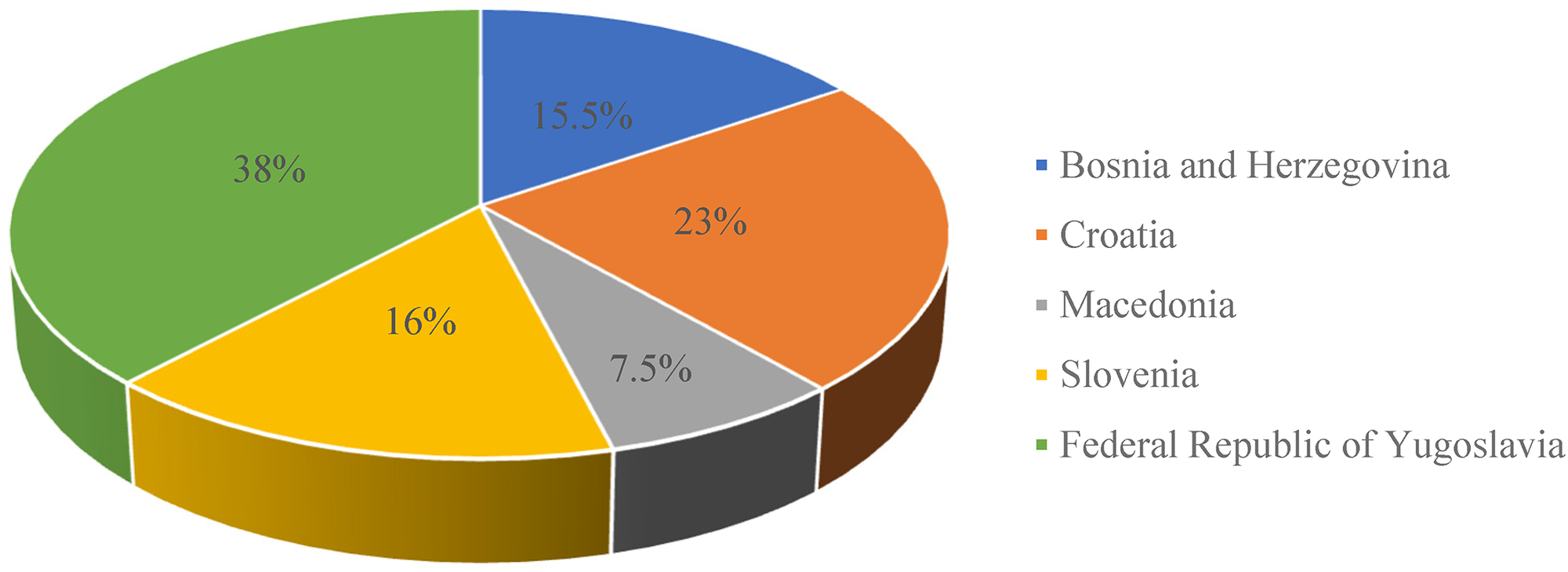
Final share of the TGC gold pool according to the Vienna agreement (29 June 2001).
When restitution began, the internal political calculations of the three governments placed Yugoslavia in the same category as Poland, Albania, and Czechoslovakia, that is, as countries they were reluctant to treat in the same way as the western claimant countries. 93 Where the postwar restitution of monetary gold was concerned, these three Soviet satellites faced many difficulties. The Albanian case has already been explained above. Most of the Polish claims were rejected by the TGC and the country was not able to receive the Danzig gold until 1976. 94 Turning to Czechoslovakia, we see that it was obliged to pay compensation for the nationalization of American property, which it did by restituting monetary gold in 1982. 95 France tried to take similar steps by blocking recognition of the claim to Bor Mine gold, but did not receive the support of the British or Americans. Yugoslavia fared very well by comparison. Could the split between Moscow and Belgrade in 1948 have also affected the attitude of the three western powers constituting the TGC to the restitution of monetary gold to Yugoslavia? There is no evidence in the sources to support this hypothesis. Moreover, the freezing of Yugoslav gold by the USA was primarily caused by non-political American interests. Washington wanted to force Belgarde to conclude a wider agreement on mutual economic affairs. 96 It should be recalled that the sources from which Belgrade received gold included, apart from the TGC, Italy, the Swiss National Bank (direct restitution) and the British Zonal Authorities. Yugoslavia was treated on equal terms: not better and not worse. After all, there were western countries, such as the already-mentioned Holland, whose claims did not correspond with the definition of monetary gold. The division of the definitive Yugoslav share in 2001 closed the long and difficult chapter of the restitution of monetary gold.
Footnotes
Acknowledgements
I would like to thank all the archivists who helped me during my research. I would also like to thank the two reviewers of this article for their suggestions to improve the quality of my work.
Funding
This work was supported by the NAWA STER Program as part of the Internationalization for Training and Research Excellence project at the Doctoral School of the University of the National Education Commission, Krakow.
