




Abstract
Across the world, the ‘difficult heritage’ of discredited monuments has prompted pitched disputation. This article explores the fraught origins and fate of Leipzig's Karl Marx monument. From its unveiling in 1974, it was one of the East Bloc's most controversial landmarks, as it stood on the site of an intact Gothic church dynamited in May 1968 in the face of East Germany's largest mass protest between the 1953 Uprising and 1989 Revolution. Enthroned on Leipzig's central Karl Marx Square as an ideological triumph, the post-communist expulsion of Marx to a remote courtyard evolved out of a selective, contingent process, wherein asymmetrical power relations culminated in ‘events’ when the monument acquired an ideological charge. From a myriad of potential destinies, the decision to exile (rather than retain or destroy) Marx's effigy can only be deciphered by unpacking the layered symbolic messages players ascribed to the evolving aesthetics at its initial location before and after 1989. Informing disputes about landmarks from Ukraine to the American South, the rise and fall of Leipzig's Marx monument exemplifies how and why a metal object can become a lightning rod for controversy, as well as how its re-exhibition can facilitate discussions about trauma, guilt, and redemption.
In 1974, the 33-ton bronze relief entitled Karl Marx and the Revolutionary, World-Shattering Essence of his Teachings was affixed to the recently completed Karl Marx University (KMU) main building on Leipzig's Karl Marx Square. Known as Aufbruch for short, the looming representation of the brow-furrowed German philosopher, whispering his incitement to revolution to clusters of workers and intellectuals, formed the centerpiece for Germany's second-oldest university, located in East Germany's second-largest city, through the last 15 years of Socialist Unity Party (SED) rule 1 (Figure 1). Even after Marx's name was expunged from both the university and central square in 1990, his effigy survived 17 years of fierce debates about its fate until its unceremonious expulsion to a remote corner of campus in 2006.
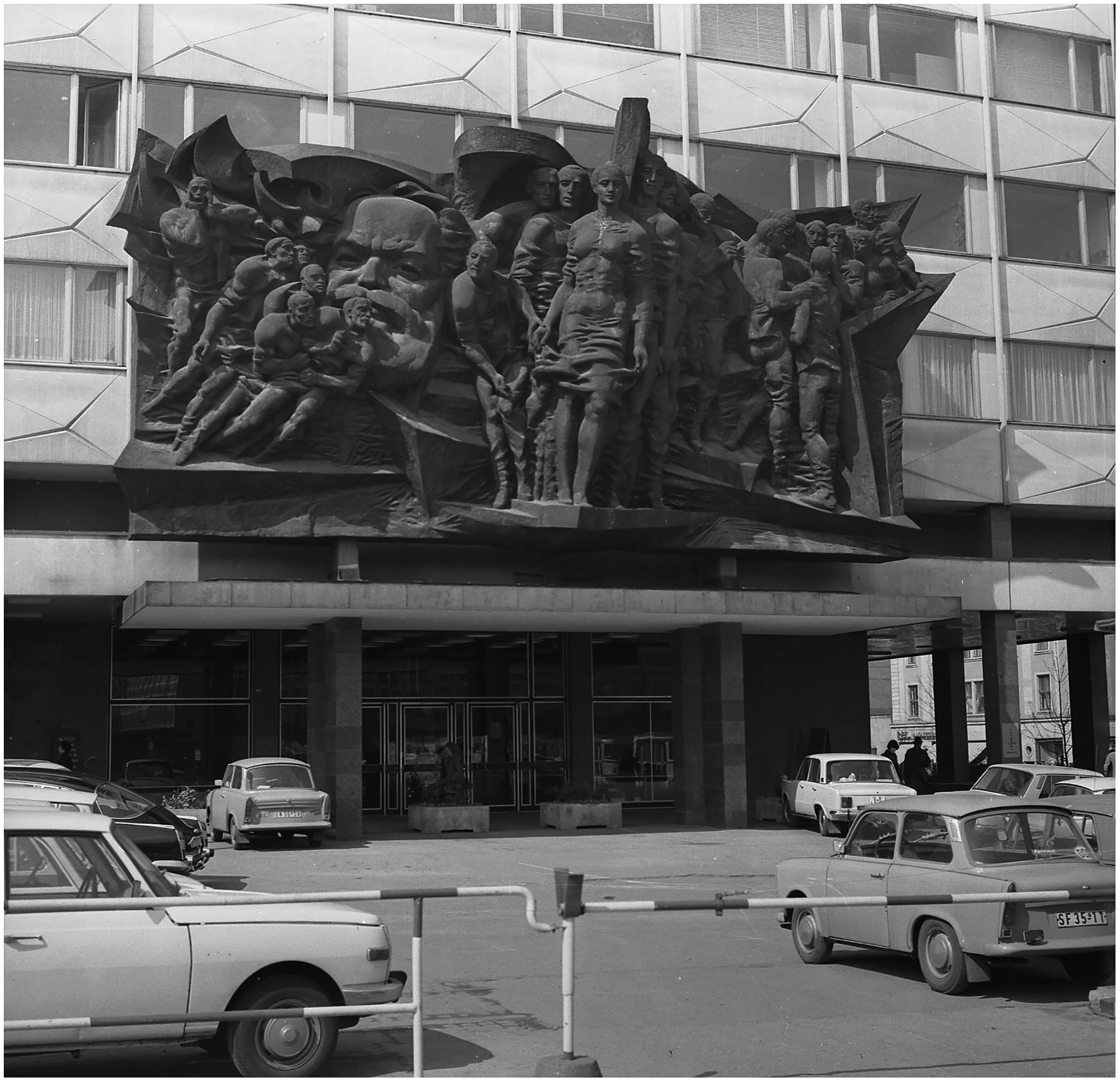
Universität-Hauptgebäude, 1978. Photographer Herbert Lachmann. StadtAL Best. 0563 BA 2003/41590.
In their overblown campaign to christen the square (1945), the university (1953), and the monument (1974) after Marx, SED authorities proved their paranoia that Leipzigers were not adopting Marx as their intellectual, cultural, and political identity. And their fears were well-founded. Amid preparations for the philosopher's 150th birthday on 5 May 1968, a KMU administrator bemoaned to the university president that ‘inadequate participation’ at Free German Youth (FDJ) meetings meant that logistical organization had to be outsourced to district party leaders. 2 Turnout at the anniversary festivities was so poor that many events were simply canceled, and the hostile bearing of those compelled to come meant that no discussion was permitted after any given talk. Perhaps the most glaring failure came when an historical lecture on Karl Marx, planned for an audience of 150 students, was summarily withdrawn ‘due to poor attendance’. 3
SED authorities reacted with sweeping assertions of public support. As the festivities drew to their lackluster finish, Marxist ideology was invoked to claim that every citizen had been participating in regime decisions, not least in the pending demolitions and modernist remaking of Karl Marx Square. 4 By August 1968, the vice-president for student affairs declared that, with the construction of a modern university complex (complete with Marx monument), KMU would at long last be worthy of its name. 5 At the October cornerstone ceremony for the new campus at the site of the recently demolished University Church, a leading East German education official affirmed that the ‘mighty work’ they had commenced that day symbolized ‘the unity between socialism and scholarship’ first demanded by Marxist-Leninist ideals. Texts by Marx were prominent inside the time capsule as the foundation stone was set into the ground. 6 While party leaders and select construction workers toasted their champagne glasses in the construction pit, however, amassed onlookers could only gawk from above. Much as Alexei Yurchak has observed a ‘performative shift’ in how the last Soviet generation of the 1970s waved flags but looked to the West or the private sphere for substantive meaning in life, Leipzigers had experienced a ‘performative shift’ in the years leading up to 1968, by which time ‘Marx’ barely registered as a public identity. 7
Leipzigers had good reason to dislike their Marx monument – and this had little to do with Marxist ideology, much less Karl Marx himself. From 1960 to 1968, thousands of petitions had beseeched officials at all levels to preserve Leipzig's intact University Church on Karl Marx Square. Spurning this rising chorus of dismay, a broad array of political and planning elites had demanded the dear landmark's destruction to make way for a modernist campus that ultimately featured Aufbruch (Figure 2). Though far smaller than Prague Spring, ‘Leipzig's 1968’ proved to be East Germany's largest public protest moment between 1953 and the buildup to 1989; drawing petitions from across the republic and ending with open demonstrations across the city, the dynamiting on 30 May 1968, remained emblazoned in many memories as state-instigated ‘cultural barbarism’. Hence, before it was ever forged in 1973 and subsequently perched on the new main university building's boxy façade, Aufbruch was tainted. When Leipzigers poured onto Karl Marx Square to ignite the 1989 Revolution, Marx's bronze likeness could only watch as history passed it by. Considering the vandalism and destruction that befell so many other East Bloc monuments after communism, Leipzig's Marx monument got off lightly with its pending sentence of exile.
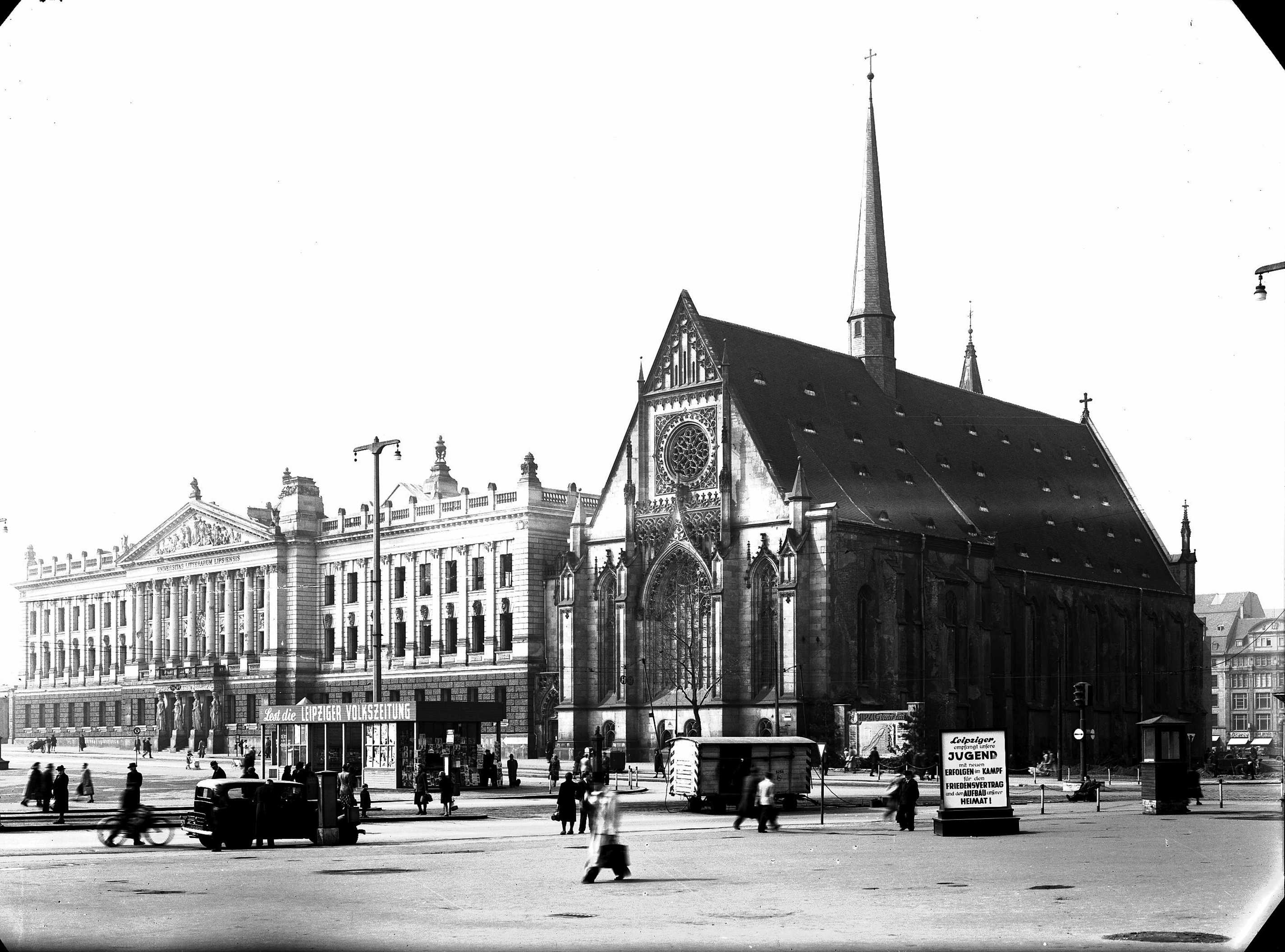
Universitätskirche St. Pauli, 1 April 1952. StadtAL Best. 0563 BA 1991/33499.
This article applies untapped archival and private documentation to analyze how and why a rectangular bronze propaganda piece came to challenge a city's post-communist identity. On the one hand, Leipzig's Marx monument exemplifies Tunbridge and Ashworth's theory of ‘dissonant heritage’ as ‘contemporary uses of the past’ under totalitarian and pluralist capitalist democracies alike. On the other hand, the monument embodies Sharon Macdonald's concept of ‘difficult heritage’ as specifically ‘a past that is recognized as meaningful in the present but that is also contested and awkward for public reconciliation with a positive, self-affirming contemporary identity’. 8 After years in which locals and visitors alike inevitably confronted them as a supposedly redemptive physical backdrop for everyday life, awkward monuments have been destroyed, rebranded, or deposited in obscure corners so as not to disrupt the staging of a seemingly post-traumatic society. Akin to debates which Macdonald traces about how to deal with the ‘difficult heritage’ at Nuremberg's Nazi rally grounds, the erstwhile Marx monument on the western side of Leipzig's onetime Karl Marx Square stimulated rich discourse about ghosts and continuities from a delegitimized past; how to come to terms with this unnerving past (Vergangenheitsbewältigung, a process that never truly concludes); and the sheer selectivity in how memory is exhibited in prominent architectural configurations. It also epitomizes how top-down measures to overcome the difficult heritages of Nazism (using Marx) could beget a new difficult heritage after communism.
To fully contextualize this selective, contingent process through which statues or structures – in and of themselves mere metal and stone – get vested with ideological meaning, three clarifications are crucial. First, the ‘difficult’ object is assigned diverse meanings by engaged citizens and officials (at various levels) in power asymmetries that fluctuate over time. Although official decisions often come after a chaotic process determined by political and economic pressures, such complexities seldom matter for perceptions from below. It was ‘common knowledge’ that the decision to put Marx's face on the new façade for KMU on Karl Marx Square had been a premeditated gesture that had come from the highest levels. This perception only strengthened once the monument finally appeared in 1974, and authoritative discourse assigned it a redemptive meaning after Nazism. 9 As post-1989 debates reveal, local people who remembered the 1968 demolition had long associated Aufbruch with communist tyranny. Forced into private spheres after 1968, this widespread excoriation became a dominant discourse after 1989. Some who hated the monument even attained leading roles in the debate about how to deal with it now that so many who had ensured its creation were delegitimized.
Second, few architectural and monumental objects ever become sacred sites, difficult heritage, or otherwise ideologically meaningful. By the same token, politicians, planners, preservationists, and the public often engage in heated debate over the configuration of parks, edifices, and even monuments that, while obviously meaningful, are devoid of any ideological value or burden. Neither constant nor ubiquitous, Ian MacKenzie observes ideology takes place when ideas and events crystalize in multifaceted and evolving conversations at historical junctures (such as revolutions, protests, or demolitions) that can prove formative toward future understandings. 10 The result, I have argued, is that ideology is ‘attributed, not inherent in a building's stones. A site thus becomes ideologically charged (socialist, anti-fascist, etc.) when actors in power positions above or engaged citizens from below perceive it as such and seek to perpetuate this understanding’. 11 These perceptions can change over time, as objects gain or lose this ‘electric charge’ of ideological connotation. Although the effigy of an idealogue like Marx might appear preordained to summon ideological meaning, my concluding discussion of the diverse fate of Germany's Marx monuments reveals that it is above all human attribution based upon preceding events which made Leipzig's Marx monument so deeply difficult at discrete historical moments, while other Marx monuments have survived in place since 1989 and even become icons for local identity.
Finally, those rare locations which receive strong ideological connotation over time typically involve a layered, ‘palimpsest’ inscription process. 12 Like a medieval parchment, the contested built space is inscribed, erased, and reinscribed over time; fragments, relics, or replicas sometimes burn through a reigning contemporary inscription with starkly different meanings than they had held before. The western side of today's Augustus Square had long hosted a medieval church. Despite mass protest, it was deliberately erased, then reinscribed with a modernist, socialist campus ideologically anchored to a Marx monument, which was in turn erased to allow for a triumphal/tragic postmodern, post-socialist representation of the lost church. Extending the metaphor, multiple layers of the palimpsest were briefly made visible in the 1990s, when Aufbruch coexisted with a steel-truss memorial to the vanished church, along with diverse banners that espoused competing approaches to mastering the past. By contrast, the contemporary site of Aufbruch on the distant Jahnallee sports campus is striking for its very lack of such layered history. Nobody really cares about what was there before, because the entire site is peripheral to urban identity. And so, even as the historically awkward relief is inscribed with a negative ideological connotation via pedagogical plaques, the banal setting otherwise neutralizes any hostile heritage Aufbruch might convey to Leipzig's larger identity by keeping it accessible only to those few who might find it.
This article's exposition of the rise and fall of Leipzig's Marx monument comes as landmarks around the world have become lightning rods for fierce disputation. From the Ronald Reagan statue that has grinned down visitors to Washington's National Airport since 2011 to the Vladimir Lenin statue that a Ukrainian artist recycled into Darth Vader at an Odessa factory in 2015, the politics of ‘difficult heritage’ haunts, confounds, and agitates diverse contemporary contexts. Across the United States, monuments ascribed racist meanings (both by racists and by those who confront them) have been removed by authorities or destroyed by protesters. After standing for decades as emblems of white power on prominent sites across the country – their ideological charge like a steady, dull buzz in the background – many find them intolerable. The buzz has risen to a roar. Though the weekend market thronged around the Robert E Lee memorial in Charlottesville with seeming indifference in the summer of 2018, it came down in 2021, entered the possession of the Jefferson School African American Heritage Center, and (lawsuits notwithstanding) is scheduled to get melted down into ingots for ‘a new work of public art’ in keeping with the center's program ‘swords into plowshares’. 13 Meanwhile, my writing of this article has taken place amid daily reports about the ongoing demolition and reshaping of Soviet-era monuments across nation-states that were once forcibly embraced by the authoritative discourse of Moscow-led socialist friendship of the peoples. Russia's war in Ukraine has forever changed how Soviet architecture is ideologically interpreted – sometimes as ‘ours’, but often as vestiges of imperialist tyranny.
Conscious of this charged historical moment, I feature the contested inception, perception, and eviction of Leipzig's Marx monument to highlight how local players debated and dealt with one of the most difficult pieces of heritage from former East Germany. Meant to inform other instances of difficult heritage, each with their own context, this article's contentious monument developed its own distinctive ideological charge based on decisions from those who made the monument, perceptions from below, and the unique question of why people cared about what had existed on the site. My analysis proceeds in three sections, starting with the controversial origins of the Marx monument on the western side of one of the Europe's largest squares. From 1945 onward, the square and ultimately university which bore Marx's name required a Marx monument, but its approval was repeatedly delayed in part by competing political demands for figures including Stalin and SED Party Secretary Walter Ulbricht. Out of this symbolic chaos, Marx became the mandatory monumental replacement for the widely cherished historic university ensemble dynamited against public protest in 1968. More than any latent distaste for Marx or his teachings, it was this prehistory that predestined Aufbruch to become ideologically charged as a difficult heritage. The second section sketches the creation of the Marx monument and subsequent 15 years of simmering public disenchantment with SED leadership that erupted in 1989, in which Karl Marx Square served as a backdrop for revolution. The third section then features the post-communist debate about dethroning Marx and remaking the difficult heritage site into a redemptive architectural narrative. Amid the pitched battles over how to ‘master the past’, the Marx monument itself momentarily facilitated the staging of a multifaceted aesthetic discourse about the past. Its elimination then effaced access to awkward palimpsest layers in favor of a new triumphal narrative. Anyone who looks for the monument in its remote location, however, has ample inspiration to reflect on its troubled story. Finally, the conclusion explores the fate of Marx monuments in other German cities to illustrate why objects commemorating the same man escaped destruction and even became local icons, whereas – after much contestation – Leipzig's Marx was exiled into the dustbin of history.
Demolitions – endemic to urban history – seldom acquire ideological meaning. Leipzig's genteel Augustus Square (named in 1837 for the first Saxon king) grew out of the demolition of early-modern fortifications. Formerly just within the city walls, the western side of the square featured a medieval Dominican cloister and church (Paulinerkirche) which had been part of the university grounds since 1543. Dubbed Leipzig's ‘University Church’ by Martin Luther in 1545, the Paulinerkirche only acquired its strong ideological charge when protesters contested its demolition and replacement with Marx under SED rule. By contrast, few noticed in the nineteenth century as the cloister was replaced by the university's main building, called the ‘Augusteum’, and the spartan eastern front of the University Church (until recently abutting the city wall) received a decorative facelift. By the founding of the German Empire in 1871, the spanning square had attained its renowned proportions as Leipzig's ‘Cultural Forum’, featuring a theater (northern side), post office (eastern side), art museum (southern side), and university ensemble (western side). The university's square-facing façades were further embellished by the famed historicist architect Arwed Rossbach with Neoclassical and Neogothic trimmings they largely retained until 1968. 14 The university had thus evolved into a prominent landmark when a December 1943 bombardment rendered virtually every landmark on the square a burned-out shell. The University Church marked a significant exception: thanks to a mix of luck and rapid civic action, it survived the war intact. It was the trauma of this ensemble's 1968 demolition that made the Rossbach façades of the University Church and Augusteum, rather than any earlier version on the palimpsest site, the static object of desire by activists calling for ‘restoration’ after 1989.
Immediate postwar planning proves that there was no straight path to demolition and a Karl Marx monument, nor did officials have a coherent plan in the 1960s for precisely what sort of monument should replace the University Church. After years of chaotic top-down disputation over how to inscribe communist identity into Leipzig's main square, Aufbruch itself took its final form and location after the University Church was already gone. Such complexities failed to matter for engaged Leipzigers, however, for whom Aufbruch was inextricably associated with the 1968 demolition.
My earlier scholarship – in which the Marx monument played just a cameo role – focused upon the politics of architecture on Leipzig's Karl Marx Square writ large, and detailed how shifting agendas at the university, city, and district levels never predestined the historic ensemble for destruction, though this outcome became far more probable as key structures decayed or vanished. 15 Walter Beyer, the city's first postwar planner, had intended to restore most of the square, including the Augusteum. After he lost political favor in 1949, his successors neglected structures he had reinforced for pending reconstruction. While provisional repairs allowed courses to continue in the less damaged historicist grandeur of the Albertinum directly behind the Augusteum, weathering steadily worsened the state of the gutted Augusteum façade facing the square, as it did the post office and city theater (soon cleared away) and the art museum (dynamited in June 1962). This trend increased the likelihood of a complete remaking of the square. Whereas structures with far less architectural significance like the Bamberger & Hertz department store (also on the square's western side) and the flashy historicist Mendebrunnen fountain (in front of today's Gewandhaus on the square's southern side) were restored, by the end of the 1950s a diverse array of state, district, city, university, and urban planning authorities increasingly saw the intact medieval Gothic University Church, surrounded by ruins, as the chief impediment to a fully modern remaking of Leipzig's university. 16
During this interim phase, when popular support for restoring at least part of the historic square might have found some satisfaction, a Marx monument could have appeared at an entirely different location. Once more proving the contingency of planning outcomes, in 1958 a Leipziger Volkszeitung mouthpiece dreamed to his readers of ‘magnificent urban planning’ that would result if the Mendebrunnen were replaced by ‘a mighty Karl Marx statue’. 17 Such conceptions built on longstanding support for a Marx monument by the powerful district party chairman Paul Fröhlich, who declared to the KMU senate in 1953 that Marx was ‘the greatest son of the German Volk. His revolutionary teachings, carried onward by Lenin and Stalin, fundamentally changed the face of the world. Today this is the scholarly foundation of our struggle for the reunification of our fatherland and the creation of the bases of socialism in the German Democratic Republic’. 18 A token to this effect manifested when a Marx banner partially covered the ruined Augusteum façade for the renaming of KMU on Karl Marx Square for the ‘Year of Karl Marx’ in 1953 (Figure 3). But it was a passing specter. And through the next 15 years, it was glaring that Marx was missing from his square.
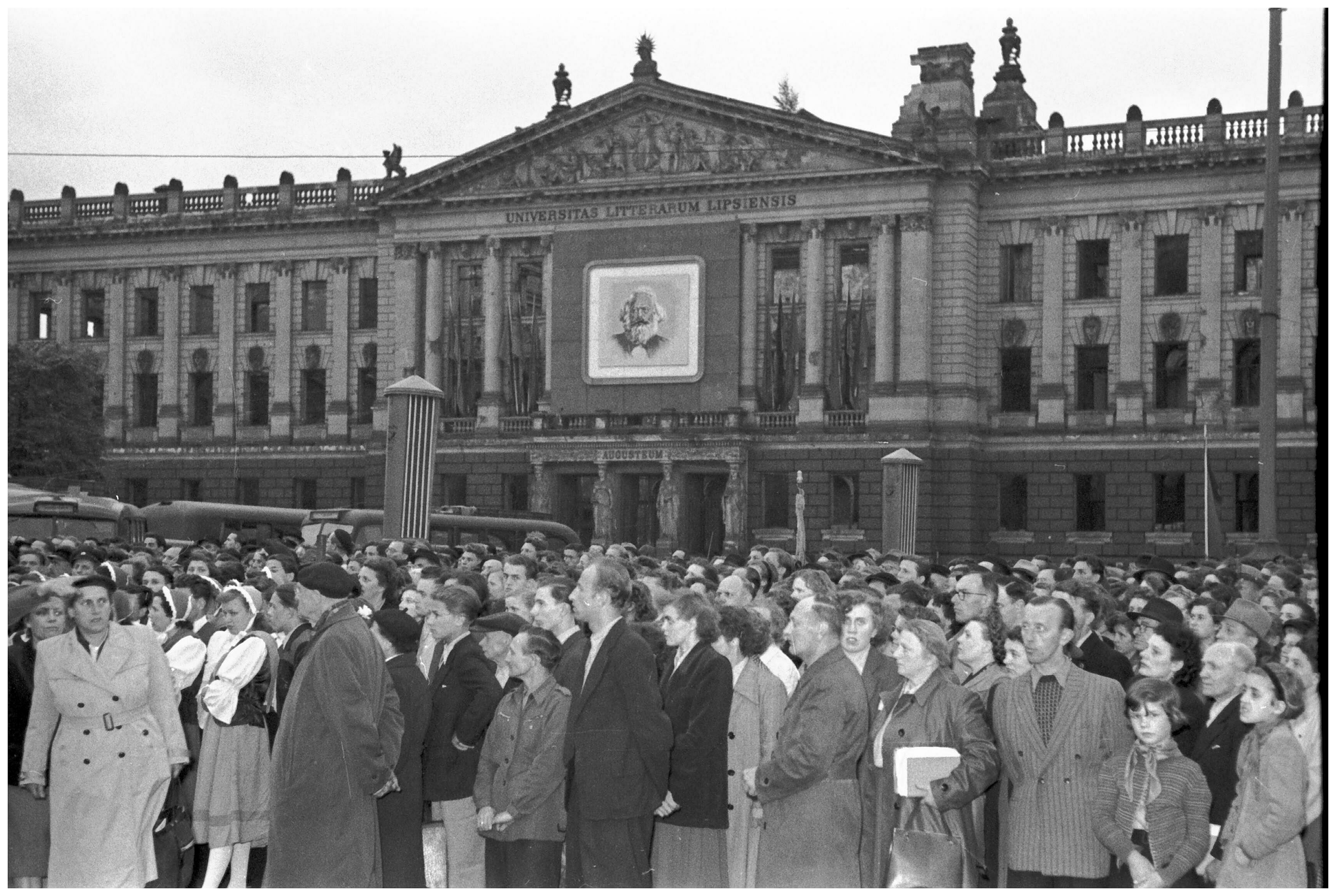
Festveranstaltung auf dem Karl-Marx-Platz, Namensverleihung, 1953. Photographer Georg Zimmer. StadtAL Best. 0563 BA 1989/29696.
In the age of Stalinism, a massive Stalin monument had to come first – even on Karl Marx Square. 19 On 27 August 1952, the Leipziger Volkszeitung asked citizens to recommend where Stalin should go as a sign of ‘the great love and friendship of Generalissimo Stalin for the German Volk’. 20 Regardless of aesthetic advice from the public, a huge Stalin statue was finished just on time for the dictator's death in March 1953, his hand resting in a Napoleonic gesture in the front of his jacket. Just across from the University Church, the ephemeral bronze landmark smiled out from the vacuous northern side of Karl Marx Square, where three ideologically hamstrung architectural competitions had failed to yield a viable opera house in place of the demolished city theater since 1950. By the time Leipzig's Opera, with its boxy meld of Stalinism and modernism, was finally inaugurated in 1960, the Stalin monument had long since been a victim of destalinization. Yet the ‘difficult heritage’ of Stalin's likeness, though erased, was never truly forgotten. Even today, older Leipzigers still share the rumor that metal from Stalin was surely recycled for the bronze Marx relief when it finally made its debut in 1974.
Although the Stalin fiasco (in front of a yet-unbuilt Opera) evinced signs of SED incompetence for ‘redeeming’ East German urban landscapes after Nazism, state and local authorities persisted in disregarding public opinion as they rapidly shifted toward demanding an optimistic, modern, socialist urban future for the same square. An urban legend remains widespread that, when Ulbricht presided over the inauguration of Leipzig's new Opera in 1960, he pointed across the square at the University Church and declared: ‘that thing must go’. This gave him singular responsibility when it blew up 8 years later. In reality, Ulbricht had already signaled the direction of discussion at a November 1959 meeting with Leipzig politicians and planners. Gesturing over a model of Karl Marx Square, he had complained that ‘the space between the church and street is so narrow, you can’t build a beautiful building there. On this [western] side the square has no finish. This church is just impossible. That is the reason why it has to go away’. 21 Autocratic though he may have been, however, Ulbricht's aesthetic opinions only gained ground because every one of the architects and functionaries at the meeting supported his vision for a modern campus. And the university administration was eager to be rid of the historical ensemble, complete with the University Church, to make way for high-tech facilities that suited what they saw as a progressive future.
Although from the start it was clear that Karl Marx had to dominate the modernist Karl Marx Square, no consensus prevailed about what this should look like, nor that the monument should stand precisely in place of the doomed church. In keeping with ongoing discussions, in 1967 city cultural minister Rudolf Gehrke recommended that the new university main building carry a representation of ‘Karl Marx and the victorious development of socialism in the world and the German Democratic Republic’. 22 A city council resolution on 6 May 1968, reinforced the typical platform that Karl Marx Square – the political and cultural center of the socialist metropolis – needed architecture that bespoke the greatness of Marx, in this case, symbolized by the long-planned construction of a skyscraper at the square's southwestern corner to embody ‘the revolutionary, world-changing essence of Marxist teachings’. 23 On 9 May 1968, the city's SED leadership professed that the very ‘power and spirit’ of Karl Marx had to flow, not just from the KMU's scholarly output, but also from its new aesthetic layout, somehow dominated by Marx. 24 The next section will show how, after 1968, these vague professions crystallized into the comparably modest Aufbruch monument.
When framing their objections, the thousands of citizens who courageously issued protest letters sometimes hijacked regime symbolism to assert that Marx himself would disapprove of the cultural destruction planned for his square. Just days before the demolition, KMU professor Siegfried Morenz entreated Soviet General Consul I.I. Wassiljev to intervene to protect the University Church, as he argued the Soviet Union had protected its own cultural monuments. Despairing for his own belief in socialism, he declared that ‘what is about to take place here is ultimately, quite simply, an affront to Karl Marx, whose name shines over the square of the University Church and over Leipzig's University’ 25 (Figure 4).
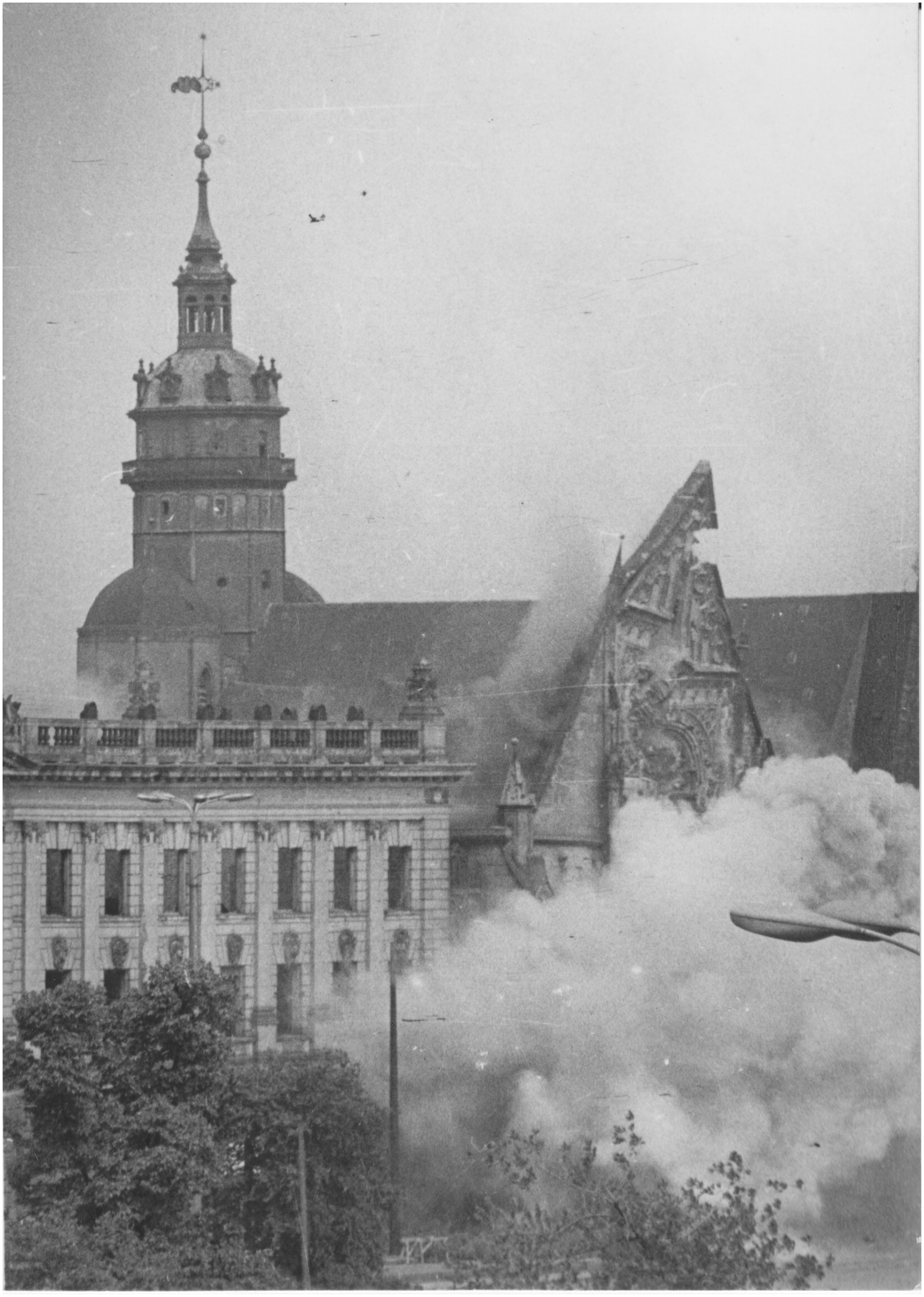
Demolition of Leipzig's University Church. 30 May 1968. Photographer Fritz Tacke. Permission Obser. Archive Paulinerverein.
After the University Church was dynamited in view of thousands of onlookers on 30 May 1968, it is intriguing – in keeping with the theme of contingency – to note which proposed monuments were not constructed to complement the anticipated Marx monument. In December 1969, Werner Röder, the city's influential SED education and cultural secretary, called for a frieze depicting ‘the revolutionary, victorious working class and its youth, joyfully anticipating the future’, guided by their ‘Marxist-Leninist Party’, on the façade of an Auditorium on the square's southern side which, if completed, would have given them a view ‘to the skyscraper of Karl Marx University’. Because the southern side of the square remained an open lawn until the construction of the Gewandhaus a decade later, Leipzig was spared this piece of socialist hubris. An even more monumental chunk of ‘difficult heritage’ would have been the giant statuary ensemble plotted for the new campus's inner courtyard with the theme ‘Comrade Walter Ulbricht in Conversation with Scholars and Students’. Given Ulbricht's notorious hostility toward free inquiry, the projected appearance is as unsettling as it is fascinating: ‘the lifelike configuration should have as its basis that Comrade Walter Ulbricht, first secretary of the central committee and chair of the DDR state council, born in Leipzig and honorary citizen of Leipzig, [is] deeply bound to the worker movement in Leipzig, as well as to the development of Karl Marx University’. Imbued with all such aspects of his eminence, the autocrat was to be depicted ‘leading a candid discussion with scholars and students’. 26 Ulbricht's replacement by Erich Honecker as First Secretary of the Central Committee in 1971 doubtless played a role in preventing the creation of this particularly awkward monument right next to the grounds of the demolished University Church.
Whether Marx would have condoned the intentions of those who celebrated his name is both doubtful and irrelevant. As Katherine Verdery argues, dead bodies – seemingly mute – become ‘sites of political conflict related to the process of reordering the meaningful universe’ in times of upheaval. 27 Amid the search for a usable identity, corpses (or the names associated with them) are said to embody new ideas about morality and the sacred that may not bespeak what the living figures might have wanted. The same might be said of ‘the political lives of dead men's monuments’. 28 Here too the dead don’t have a say as their effigy of sculpted metal or stone becomes godlike or demonic, because only the living have power to bless or curse it.
After supply issues and bureaucratic wrangling delayed and cheapened the modernist KMU campus, Marx was finally affixed to the main building's eastern façade with little resemblance to anyone's initial intentions. Early plans for the monument exist in the same 1969 file, wherein Röder proposed an Ulbricht monument. Over the projected main university building's entrance, the education and cultural minister had imagined the culmination of Karl Marx Square's new symbolic message. To the theme of ‘Leninism– the Marxism of our Epoch’, the monument was to depict how the Volk, free from capitalist exploitation and led by the Marxist-Leninist party, would help German workers develop the whole world under Soviet guidance. 29
Of the 11 submissions, the artistic collective of Frank Ruddigkeit, Rolf Kuhrt, and Klaus Schwabe won the July 1970 architectural competition with a relief that featured a student, rather than Marx, because it was presumed that a Marx statue would dominate the square's center. When budget cuts eliminated a freestanding monument (and any other ideological garnish for the new façades), the heightened political attention to the winning collective's frieze quadrupled Aufbruch in price and scope as its girth thickened and depictive complexity deepened. 30 Already in the fall of 1970, state officials realized that Aufbruch was to be ‘the only outdoor monumental artwork on the ensemble of the reconfigured Karl Marx Square’. 31 At a cost of 890,900 DDR marks, the redesigned behemoth was forged at Lauchhammer with a 3-m depth whose weight would have overwhelmed the structural integrity of the new building, had it not been separated from the façade by its own steel construction frame. While Marx (peering to the left) dominated the center-left of the relief, the representation also featured workers, demonstrators, and youth of various nationalities (Figure 5). The only other major symbolic opus for the sparse new ensemble was a wall painting inside the main building's lobby. By 1973, Leipzig's star artist Werner Tübke had produced his 8-foot-tall, 45-foot-long depiction Working Class and Intelligentsia. Here political leaders who had helped ensure the destruction of the University Church on the same site, notably district party secretary Paul Fröhlich, district council chairman Erich Grützner, mayor Walter Kresse, and former KMU president Georg Mayer, ascended into a utopian future, wherein their idealized figures exuded fatherly support to over 100 KMU students and construction workers.
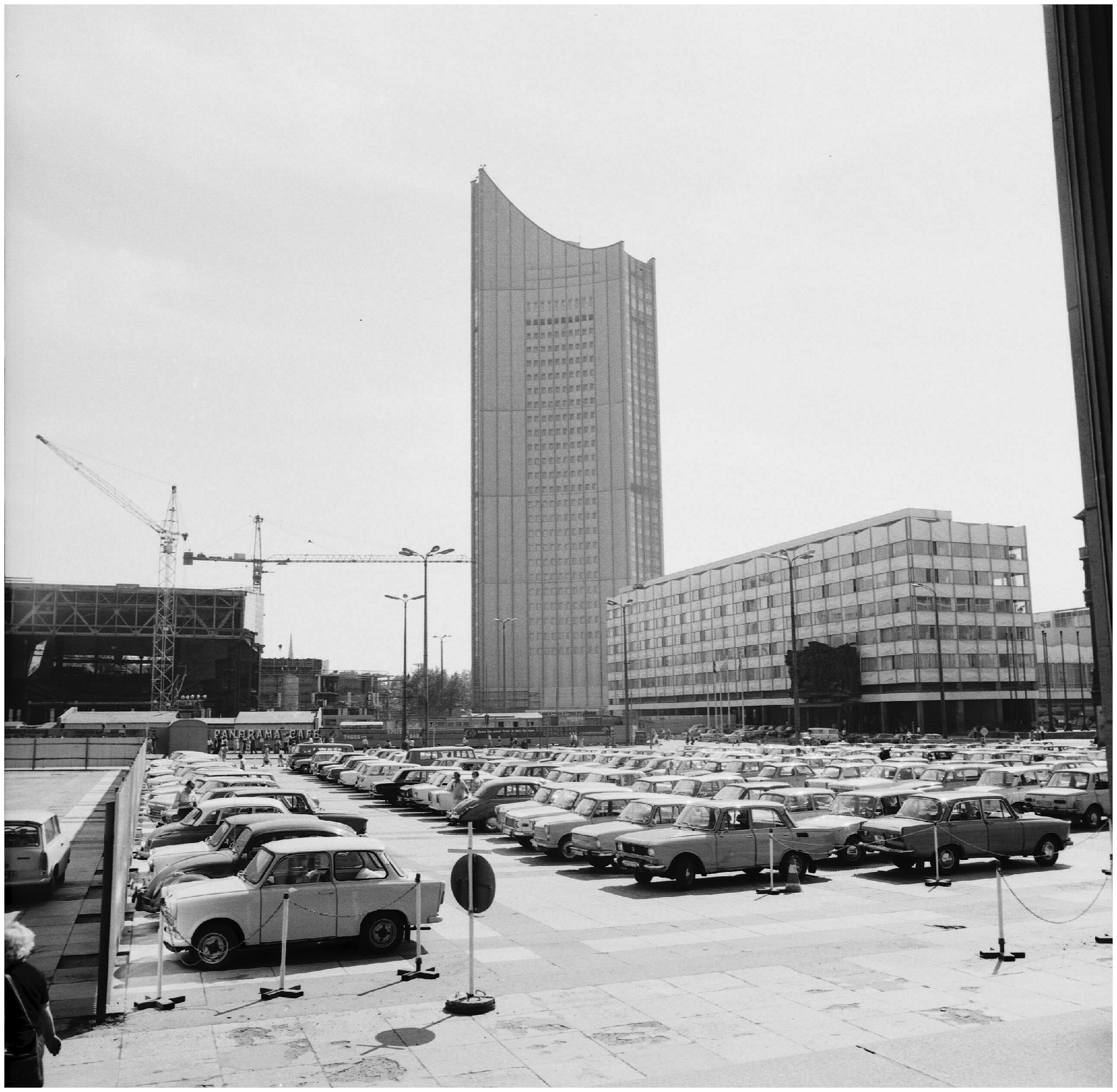
Karl-Marx-Platz, May 1979. Photographer Dagmar Agsten. StadtAL Best. 0563 BA 1979/7246.
Across East Germany, Leipzig's Marx monument was officially celebrated as the ‘symbol for the new Karl Marx University’ and embodiment of Marxism-Leninism as the epoch's reigning ideology. 32 Of course, the German word ‘Aufbruch’ also implies an impulse toward revolution. And for SED rulers keen to crack down on Prague Spring or cordon off any potential influence from the 1980s Solidarity movement in Poland, any whiff of revolution against their reigning authoritative discourse, much less physical overthrow, was treason to be surveilled by the Stasi and suppressed. Even mild reform was off the table.
As a result, Aufbruch – tied from its inception to SED tyranny – never came to embody revolutionary hopes against the SED regime. Firmly established as a representation of repression, it could only loom as a stage prop for the peaceful demonstrations in October 1989, when thousands of engaged citizens marched to demand reform and, ultimately, revolutionary change.
History was not supposed to end in a revolution on Karl Marx Square. But when Gorbachev's government refused to roll the tanks and East German police held back from lethal force against peaceful protesters on some tense October nights in 1989, the supposedly attained ‘real existing socialism’ abruptly imploded. The authoritative discourse had long since lost legitimacy. Now it lost power. And those monuments which had been most deeply tied to regime ‘tyranny’ became a difficult heritage. As Leipzig art historian Thomas Topfstedt recalls, by replacing the ‘brutally cleared’ University Church with ‘a monument to the victory of socialist social order’, Marx and his modernist surroundings took on a ‘negative valuation’ that was compounded after 1989. 33
‘Which memory do we need?’ This was the question which a 2003 public colloquium raised to address the ‘dispute about the university’. 34 By then, the word ‘dispute’ was a rather mild way of putting the passionate struggle over what to do with the site from which Marx still reigned as the seeming victor of history. University president Volker Bigl had just resigned in protest when the Saxon state government had supported an historically faithful replica of the University Church in stark opposition to Bigl's demand for a modern campus that served the functional needs of teaching and research.
Diverse books have recounted each twist and turn in the bitter post-1989 debates about the ‘difficult heritage’ on the western side of Augustus Square (renamed even as the KMU dropped its ‘KM’ in 1990). 35 While this analysis draws out how the Karl Marx relief featured in this unfolding sequence of events, it would be unproductive (and impossible) to disentangle debates about its fate from feuds over recreating the University Church, whose decimation had predestined Aufbruch to be an intense piece of ‘difficult heritage’. A Marx statue at the square's center might have survived; presiding from the precise spot where helpless onlookers had watched the University Church's Gothic façade crumble in a blast of dynamite in 1968, the Marx relief could not help but stand at the very center of controversy. It was said that in 1960 Walter Ulbricht had pointed to the University Church and insisted: ‘that thing must go’. Now there were many who pointed at Marx with the same intention.
Battle lines were drawn from the outset, reinforced by over 20 years of seething trauma about the demolition. As KMU chemist and activist Martin Helmstedt recalls, countless Leipzigers well remembered the ‘traumatic experience’ of the University Church's destruction, notwithstanding regime efforts to ‘purposefully extinguish public memory’, such as by excluding mention of the University Church from books about Leipzig or the university. 36 As KMU geophysicist Ulrich Stötzner contends, the Marx Relief was hated as an ‘Ersatz-Altar’, having stood almost exactly where the Christian altar had stood in the former University Church. 37 Already in 1991, Leipzig high school teacher Joachim Busse wrote a letter to the Sächsische Tageblatt to float the idea of reconstructing the destroyed University Church, proposing a civic initiative to that effect. Meanwhile, the university (which had played a key role in the 1968 demolition) called for the renovation and retention of the 1970s modernist ensemble, complete with the Karl Marx relief, officially out of cost considerations.
A host of university professors, preservationists, engaged residents, and alumni responded with demands for a replica of the vanished University Church, forming a civic initiative called the Paulinerverein in 1992. Named for the vanished ‘Paulinerkirche’, the 200-member Paulinerverein (later chaired by Helmstedt and then Stötzner) dedicated itself to ‘preserving the public memory of the barbaric and brutal act of destruction’ of the University Church and Augusteum through ‘reconstruction’ of a replica of the original, as well as ‘to support Leipzig University in the retention and care for surviving works of art’ from the lost structures. 38 In light of the heated discussions, that same year city building director Niels Gormsen called for an architectural competition to brainstorm how the troubled site might best commemorate its past while also looking to the future.
The result was a 1994 architectural competition, whose guidelines called for retaining existing 1970s structures, while honoring the vanished University Church with salvaged relics and ancillary leftovers such as the ‘Schinkel gate’, preserved from the 1836 portal of the main university building before its late nineteenth-century Rossbach facelift. 39 The 116 submissions generally avoided stylistic gestures to the University Church in favor of faceless blocks – an outcome that incensed and unnerved the Paulinerverein and its supporters.
Meanwhile, highlighting the subjectivity of how communities selectively impose ideological meanings and construct a usable past, the 142-m-tall University Tower was much beloved by the population. Recalling discussions from his childhood in the 1980s, Birk Engmann insists that, while his neighbors celebrated the University Tower, the main building with Marx always remained scar tissue (Narbengewebe) on the cityscape due to its association with the 1968 demolition. 40 Affectionately called Leipzig's ‘Wisdom Tooth’ due to its incisor shape, the tower was bought by private investors in 1999, renovated with granite panels to become the ‘City Tower’ by 2001, and promoted as Leipzig's chief marketing symbol. 41 Having summarily sold the tower due to its ‘dysfunctionality’, Arnold Bartetzky observes, the university regretted the loss of ‘the free advertising impact of this architectural emblem soon thereafter, and demanded its return, but it was too late’. All that remained to the university was the main building, ‘which didn’t exactly belong to the most brilliant achievements of DDR modern’ architecture and was ‘rotting at high speed’. This quandary prompted a fresh architectural competition to fully remake the remaining campus in time for the university's 600th anniversary in 2009. 42
When failed competitions in 2001 and 2003 yielded yet more modernist drafts that were, if anything, just as blind to the site's historical burdens, Jacques Poumet observes, campaigners for effacing Marx and restoring the University Church ‘occasionally equated opponents of reconstruction with those who had demolished the University Church’. 43 Here university president Volker Bigl famously sustained the university's besieged argument that regrettable though the 1968 demolition may have been, the replacement campus should be functional and therefore modern, with any relics from the dynamited campus merely exhibited as scattered museum pieces. After Bigl resigned and modernist prize results were leaked to the press, public pressure ensured that Dutch postmodernist Erick van Egeraat was given the highest prize in 2004, and ultimately tasked with designing a new campus that strongly cited (but did not replicate) the lost church. It was a given, at this point, that Marx would have to go.
In the interim, Aufbruch had become an aesthetic staging ground for each side's claims. In the mid-1990s, a banner (‘Verhängung’) with an image of the vanished University Church and Augusteum was hung from the Marx relief with the words: ‘30. May 1968, 10:00 AM, Demolition. Why? Pause and consider’ 44 (Figure 6). Thirty years after the 1968 demolition, Leipzig citizens and businesses funded graphic artist Axel Guhlmann's production of the ‘Installation Paulinerkirche’: a 34-m-tall red steel frame that superimposed an outline of the University Church against the 1970s main building with a citation of the lost rosette directly over the Marx relief (Figure 7). ‘The interlocking constellation of artwork willfully redefined the perception of architecture and history on this square’, a Paulinerverein brochure noted. 45 Even a key opponent of a University Church replica, Mayor Wolfgang Tiefensee, upheld the Installation upon its completion as Leipzig's most impressive ‘memory work’. 46 Supported by the Paulinerverein and erected with permission from the city and university, Helmstedt notes, this ‘visible and unmistakable counter-monument was created against the ideological arrogance of the relief Aufbruch. The originally anticipated lifespan of 100 days was far surpassed: the steel gable stood on this site until 2006’, 47 despite a failed attempt by the university to eliminate it in 2000. Opposition to a replica (analogous to Dresden's Frauenkirche) was also staged at the open-ended installation. For instance, to militate against a campaign to encrust van Egeraat's conception with the vanished University Church façade, the university's student council (StuRa) draped a banner above the Marx relief (still framed by the 1998 Installation) declaring ‘Leipzig is not Dresden, thank God!’ (Figure 8). By the time pending construction plans necessitated the dismantling of the Installation in 2006, Engmann recalls, many felt it had become the ‘emblem of the university’, and in the tense climate it facilitated a much-needed ‘coexistence of diverse opinions’. 48 It was thus a scandal when the university finally cleared the installation ‘as a prerequisite for the following dismantling of the Marx relief’, but Marx remained: alone and unchallenged. The Paulinerverein protested to the university president: ‘the disappearance of the installation and intentional remaining of the Marx relief once more demonstrates the spirit that apparently still reigns over your university to the present day’. 49 This ephemeral phase, in which Marx once more reigned alone over the square, coincided with the peak of debates over the politics of memory.
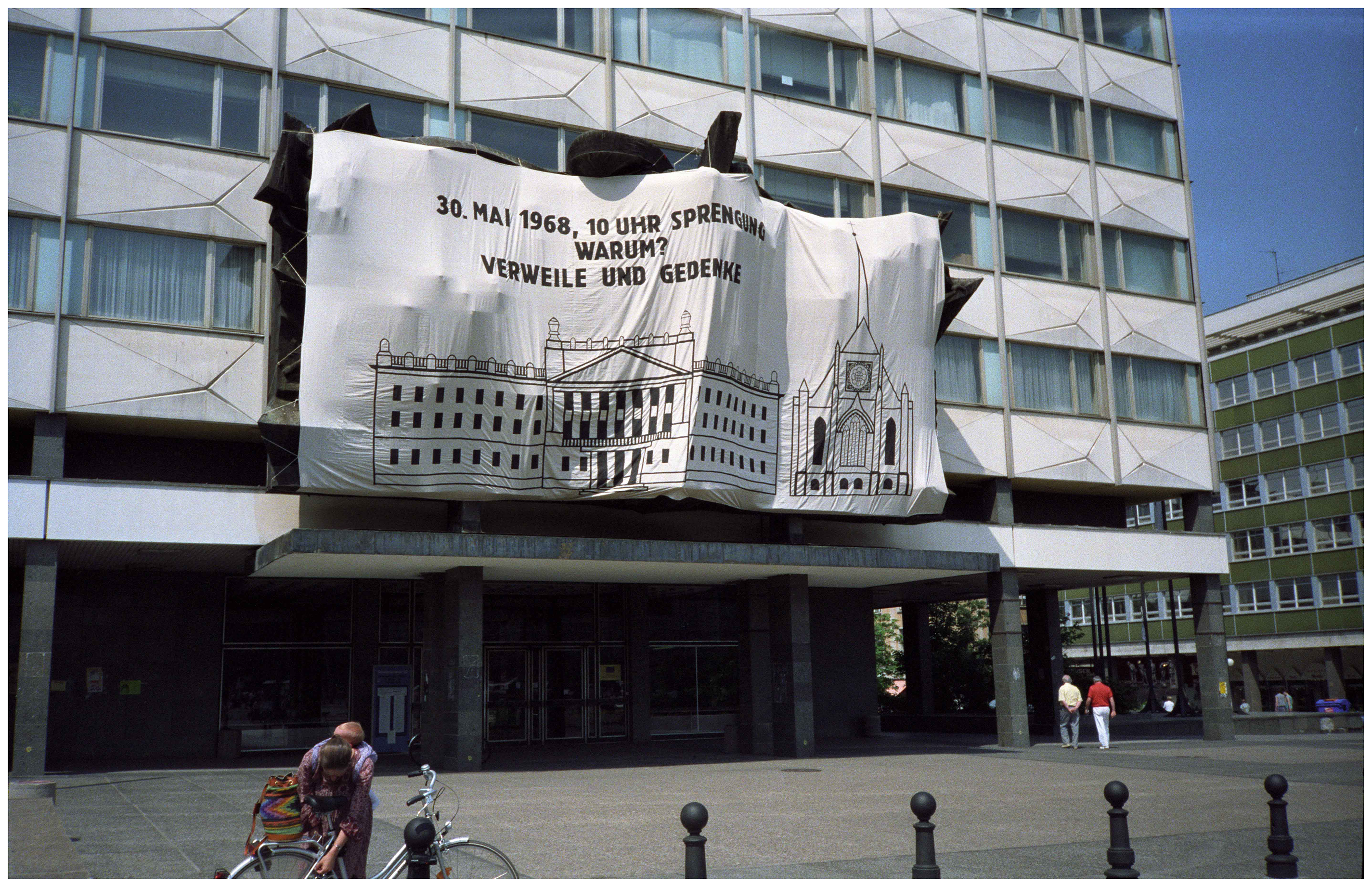
‘Verweilen und Gedanken’ banner, early 1990s. Archive Paulinerverein.
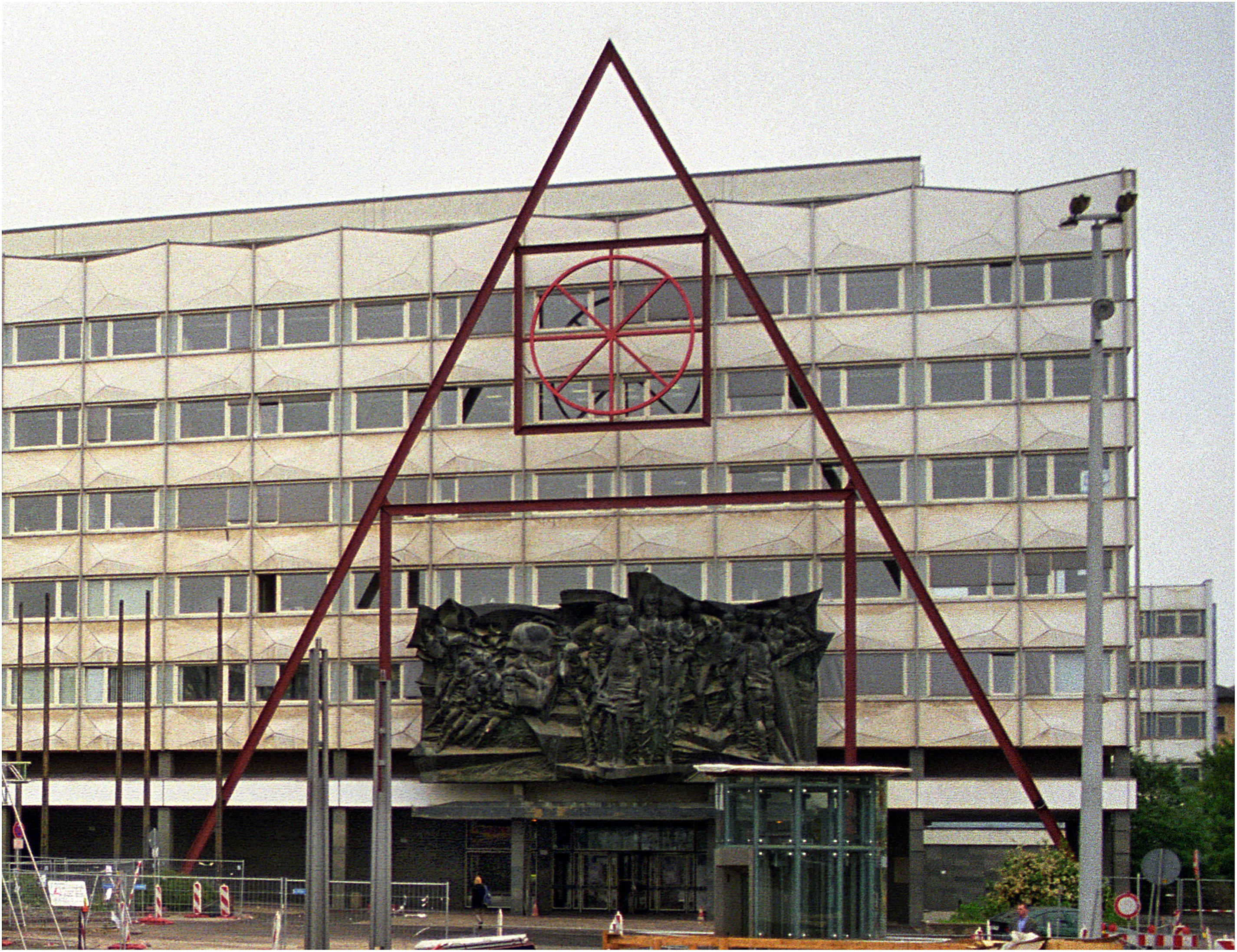
Installation Paulinerkirche, 1998. Archive Paulinerverein.
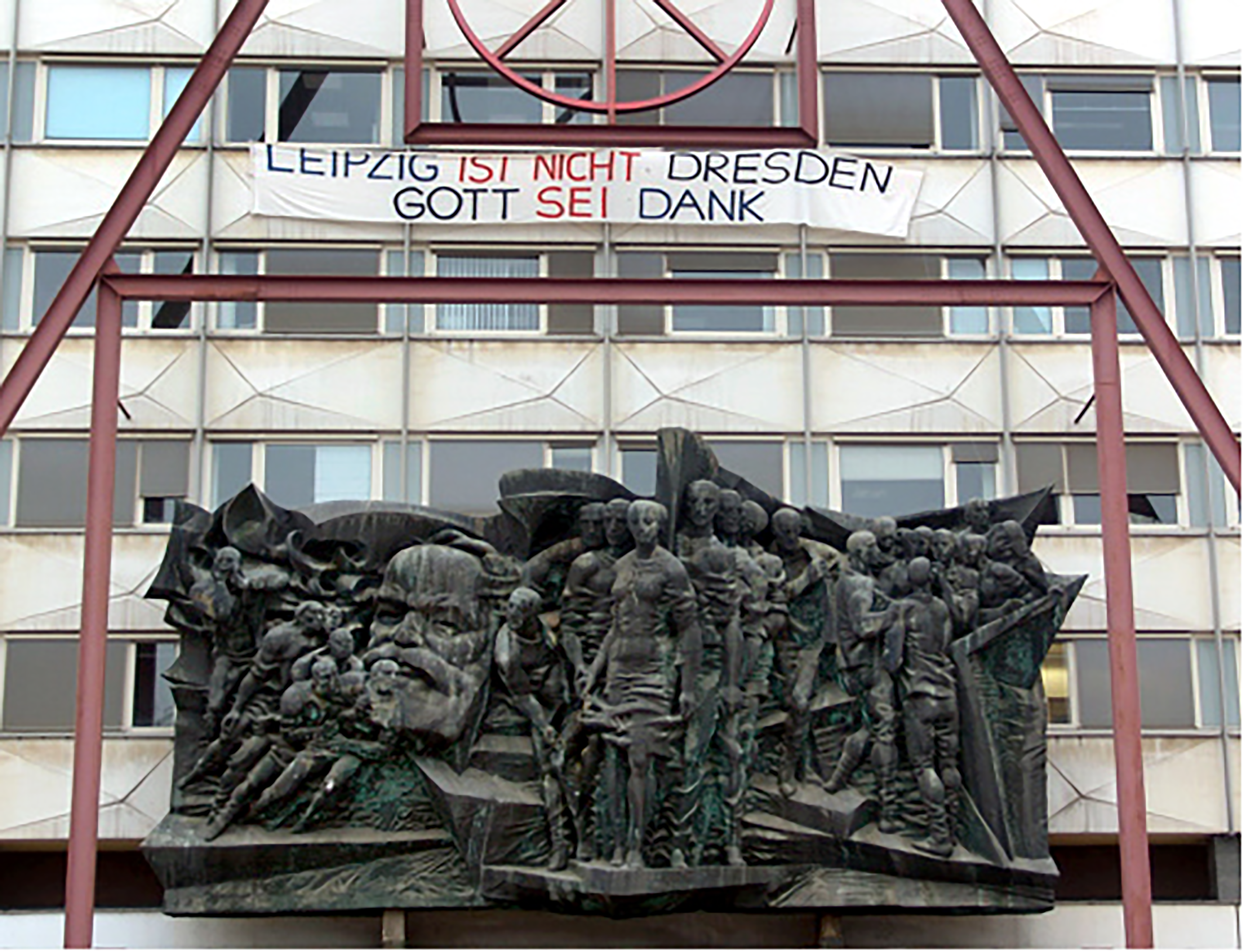
‘Leipzig ist nicht Dresden’ banner. Archive Paulinerverein.
Battlelines over memory politics were already drawn when the university established its legal weight in the disputes (its ownership of Aufbruch) and formed a 12-member expert art commission in November 2004. It was to determine what to do with historical university property from the site, and ultimately submit this proposal for a final decision from the university leadership (Rektoratskollegium). Because both Aufbruch and surviving University Church relics fell under the same committee's jurisdiction, they were unwittingly interconnected at each meeting. 50 East-West tensions further burdened public perception of the committee, whose chairman, university art custodian Rudolf Hiller von Gaertringen, had arrived from the West in 2002. Perceiving a Western plot, Paulinerverein activist Manfred Wurlitzer asserted in 2006 that the monument's continued domination of the square was only possible, because ‘the responsible committee overwhelmingly consists of people who didn’t have to live a single day under communist dictatorship’, and thus failed to comprehend that the monument still ‘stands today for an expression of the repression and bullying of the DDR population’. 51 Such aspersions overlooked the reality that some commission members were local patriots from Leipzig's 1989 revolution.
After years of steadily increasing ideological charge, Marx electrified into a full-scale ‘event’ when its fate was decided in the summer of 2006. Leading representatives from Leipzig's 1989 revolution, including Gewandhaus conductor Kurt Masur and East German SPD founders and Bundestag parliamentarians Gunter Weißgerber and Rainer Fornahl, demanded Marx's removal. In an ‘appeal to the University of Leipzig’, Fornahl recalled on behalf of all ‘victims of totalitarianism, indoctrination and terror’ that ‘on the site of this crime [of demolition] a monstrous work of art’ came into being as ‘a symbol of indoctrination and totalitarianism and, in light of the university, spiritual repression’. As such, ‘this symbol of ignominy is not worthy of further exhibition in Leipzig's public space’. 52 The ideological ‘event’ peaked as Leipzigers weighed in on how to punish or exonerate the metal object for the crimes of the regime that had created it. Already in November 2005, the rightwing fringe German Social Union (DSU) party proclaimed ‘that Leipzig isn’t the playground for red guardsmen, and that in Leipzig, too, the peaceful revolution of 1989/90 overcame the Marxist “dictatorship of the proletariat”. The politically mindless Karl Marx relief – an affront to free instruction and research – has no place on the Leipzig university campus’. 53 The Leipzig Student Council (StuRa) shot back in its periodical that the artists had produced the monument, ‘in no way out of ideological grounds, but simply derived it from the former name of Karl Marx University’. They were outraged that, ‘over the heads of the students and artists’, the university was engaged in ‘denying Leipzig University's history’ with its plans to expel Marx from campus. Their response was to hang a banner from the monument one night with the phrase: ‘Bildung finanzieren statt Marx demontieren’. 54 When the Linke party (successor to the SED) suggested displaying Aufbruch at the center of town, Christian Democratic Union Party (CDU) youth leaders demanded permanently locking it away, asserting that ‘the Marx relief on the university building symbolically stands for the dogmatism of Marxism-Leninism in the DDR, and thus for a lack of academic freedom. That isn’t compatible with the ideals for which Leipzigers struggled in 1989/90. If the successors to the SED are interested in keeping the Relief, they can attach it to the back side of their party building’. 55 Letters to the editor attacked the CDU proposal as an arrogant and iconoclastic approach to dealing with city history. While Tübke's foyer painting Arbeiterklasse und Intelligenz could be hidden away in the university's art depot ‘for the next hundred years’, Topfstedt recounts, another plan was for Aufbruch to get ‘torn apart and – virtually as an act of compensational justice – dumped onto the heaping pile of rubble from the Paulinerkirche in Probstheida’. 56 As Leipzig's fiery poet Erich Loest (who had fled DDR persecution) declared at a two-hour June 2006 public discussion about Aufbruch as a ‘work of botched propaganda’ [Propaganda(mach)werk], ‘it is astounding that this object has been able to survive for so long in such a visible place in the new era. Since it has to be taken down and dismantled anyway, why not put the broken pieces on the debris of the Paulinerkirche in Probstheida and wait to see what sense future generations make of it?’ Aufbruch sculptors Frank Ruddigkeit and Klaus Schwabe were understandably appalled. ‘I’d never have come up with the idea of dumping a work of art on a rubble pile’, Ruddigkeit retorted (never touching on the fact that substantial artwork from the University Church comprised that pile). ‘Why should there be such ideologization?’ Schwabe added: ‘botched work sounds to me like degenerate art [entartete Kunst]’, a term the Nazis had used for art they had proscribed. University President Franz Häuser concluded the discussion by reminding everyone: ‘the relief is our property’, and hence ‘to be preserved as a work of art that is part of this university's history’. 57
Parallel to such public exchanges, Häuser's art commission had been refining its suggestions for the monument's fate. At its first meeting, the commission proposed re-exhibiting Aufbruch in a new courtyard behind its current placement on the square. By pulling the monument ‘from its pedestal’, it would ‘lose the effect’ of its ‘ideological content’ and thus ‘relativize’ it. Moving it to the Moritzbastei fortification adjacent to a nearby park, they feared, would open the university to accusations of ‘disposing of and failing to contend with the university's socialist past’. 58 Already at its second meeting, however, the commission agreed that placement of Aufbruch in the new main courtyard would hardly disarm its power, but sustain it as the university's chief symbol (a role better delegated to an historic Leibniz monument). 59 Soon the city decreed that even the Moritzbastei was too close for comfort. Although the Aufbruch creators had explicitly favored the Moritzbastei at a meeting with Häuser in 2004, 60 the city (which owned the park) had refused to exchange properties to allow the university to place Marx just five-minutes' walk from Augustus Square in the company of venerable monuments including Friedrich Schiller and Robert Schumann. Another idea was to simply melt it down, a prospect that the artists (citing their ‘copyright’) promised would end in court. 61 Even some of the monument's fiercest opponents preferred preservation in obscurity to outright destruction. No less than Paulinerverein chairman Stötzner opposed casting bits of Marx onto the rubble pile in Probstheida, lest ‘the symbol of the intended victory over the spirit of humanity and the Christian religion’ desecrate the grave of his dear University Church. 62
Within days, it looked like Aufbruch might simply disappear into storage after all, a prospect that prompted Rolf Kuhrt, the third artist who had created Aufbruch, to protest to city leaders: ‘any interim storage is like virtual destruction’, since the monument would be ‘out of sight, out of mind’. 63 Even as some engaged citizens proposed displaying Marx on one of the spanning blank walls inside the foyer of Leipzig's new art museum, museum director Hans-Werner Schmidt retorted that the monument should get torn into ‘puzzle pieces’ across the city as ‘a symbol for the failed societal idea’. 64 Rather than destroy the suddenly impossible monument, however, most Leipziger Volkszeitung readers were keen to see it exhibited on a ‘worthy site’ as ‘part of Leipzig's history, just as Karl Marx was for a time the name of Leipzig's university’. One reader excoriated Schmidt's plan to chop up Marx and scatter his remains, insisting: ‘shouldn’t a museum preserve rather than destroy?’ All in all, letters to the editor exemplified the ‘ideological moment’, as numerous residents observed that Marx's monument had become little more than a ‘specter’ [Gespenst] as the years wore on, and needed environs that allowed critical analysis of its history. 65 Subsequent advice from a ‘hobby historian’ to move Marx onto the finance office façade as a critique of capitalism failed to win serious attention. 66
Ultimately, the university did not give in to the myriad ‘iconoclastic dreams’, nor, as Topfstedt claims, was its exile an attempt to ‘hide’ it away. Instead, the university's art commission elected to present this ‘uncomfortable work’ in a public space, 67 though (due to the city's obstructionism since March 2006) not on the more central Moritzbastei façade as had been hoped. 68 ‘On historical grounds, a majority of the commission still favored exhibition in the city center’, Hiller von Gaertringen stated in the commission's decisive 23 February 2007 report to president Häuser. That the city had rejected the university's wish to so commemorate ‘the socialist, ideologically determined circumstances’ of the time was a result they ‘met with regret’. The only alternative to long-term storage – the remote sports campus location – was ‘far from an ideal location’. 69 ‘At any rate’, he later concluded, ‘it was a partial success that the work remained intact as such’. 70
Combatants on both sides complained but accepted the outcome as better than their worst fears. Though pleased that it was not destroyed, Aufbruch creator Frank Rüddigkeit groused from his taxi window as it was removed from the doomed university building by two cranes in just ninety minutes on 21 August 2006: ‘Marx has been getting torn down for almost 150 years … this here is just another episode’. 71 When it was exhibited in the sports campus courtyard in October 2008, Paulinerverein chairman Stötzner fumed that any pains had been taken at all to retain the ‘purely propagandistic Relief’; nonetheless, he was pleased that Marx had been shunted off to a remote plot of university property, so that ‘the past and the future of the University Church’ could dominate memory on the city's main square. 72
Alone in his exile, Marx looms much closer to ground level now. Without any attached building, he dominates his grassy niche (Figure 9). Ever still, he whispers to the revolutionary workers on his bronze relief. But now informational plaques on polished steel stands educate any visitor (amid images of the University Church dynamiting) that this is a fraught heritage.
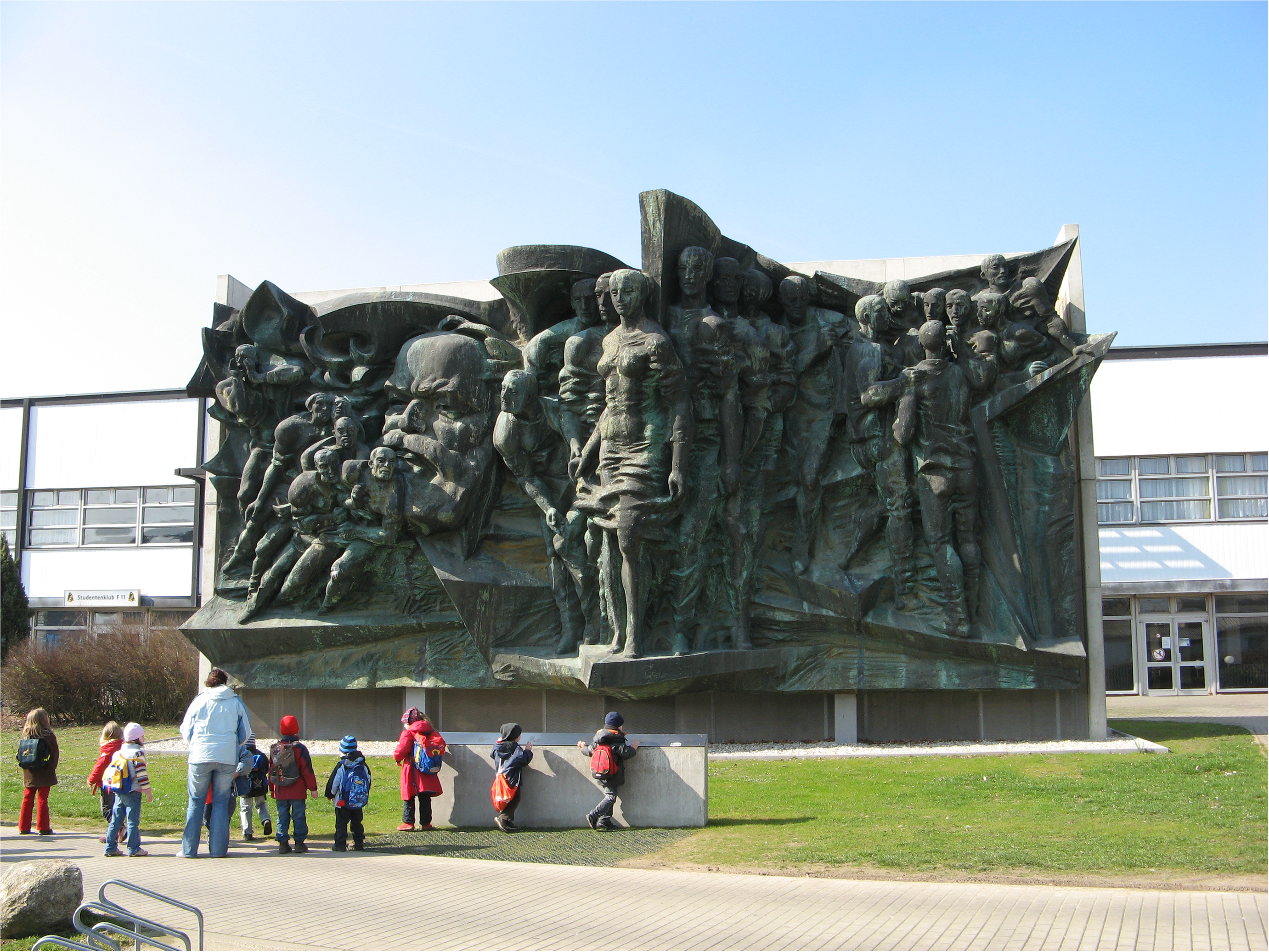
Marx in exile, 2009. Photographer Martin Helmstedt. Archive Paulinerverein.
Nostalgia, triumphalism, and general amnesia have characterized Marx's afterlife in obscurity. Speaking at the end of October 2008 in Leipzig's Thomaskirche, Bundestag representative Weißgerber recalled: ‘the victor named “Leninism– the Marxism of our epoch” threatened to celebrate its “heroic success” from then on in the form of a relief in place of the former university gable – until it was eviscerated [entleibt] from its state-foundation by the people's uprising of 1989/90. It has recently been allowed to make historic commentary about its own transience on another site – a dictatorship would have melted the relief down’. 73 Looking back in 2011, an alumnus posted to an online architectural forum: ‘I’m actually thankful that I was able to enter into [the main building] under the Marx [relief] back in the 1990s’, adding that to be able to ‘drink in so much Ostmoderne was alien and beautiful for me’. Likely from the West and born about a decade after the 1968 demolition, this new Leipziger's nostalgia imagined the ‘East Bloc-style modernist’ box with its outdated Marx monument as groovy exoticism. Within hours, a ‘senior member’ of the forum (from Leipzig) lectured the former student that ‘it's quite possible that back in those days nobody explained to you [the story about] the site on which this building had come into being, and which events were tied to it. It's quite possible as well that no one told you about the role of the SED Kreis leadership of Karl Marx University, which was housed just a few meters from the Marx-Relief to which you refer’. The alumnus rebutted that it was a ‘considerable cultural crime to destroy interesting Ostmodern buildings’. To this, another older member from nearby Altenburg expressed his weariness of claims about ‘interesting Ostmodern buildings’. Such structures had ‘neither aesthetic nor architectural value for the overall urban plan’, but rather ‘brutally pushed themselves into the existing urban fabric without consideration of what was lost’. 74
Like triumphalism, nostalgia can be short-lived. As residents acclimate themselves to their daily surroundings, general amnesia sets in, and the ideological charge disperses. By 2014, Topfstedt noted that the KMU main building was ‘already almost forgotten’ on a square dominated by van Egeraat's new postmodern-Gothic showpiece. 75 Though exiled on its lonely corner of campus, however, the ‘difficult heritage’ of Leipzig's Marx monument need not end in obsolescence. Anyone who takes the trouble to find it and read its informational plaques can explore what it was, and why it is there.
Every contested monument evolves with its own distinctive ideological charge and impact on civic, even national identity. 76 In the aftermath of Nazi misrule, political and planning elites across the former Reich had sought to forge redemptive local and national symbols on ‘sacred sites’ to anchor a usable past, present, and future. 77 In the Western occupation zones, debates had raged in Frankfurt over how to aesthetically reconstruct Goethe's birthplace as a shrine to humanism and the Paulskirche as a ‘cathedral of democracy’ for having hosted the first German parliament in 1848. That the faction for a streamlined modernist remaking of the Paulskirche interior won out – and that this iteration has framed speeches about democracy and humanism until today – should remind us that modernist architecture was hardly an invention, much less an imposition from socialist ideology. Some combatants for an historical reconstruction of the Paulskirche had even accused Western modernists of succumbing to ‘architectural dictatorship’ (Baudiktatur) reminiscent of the Third Reich. 78 In Leipzig, meanwhile, it was hardly the case that every communist-supported monument fell into disgrace after 1989. The contested transfer of J.S. Bach to the Thomaskirche and establishment of an elaborate grave memorial there in 1950 proved so popular that, since the fall of communist power, few remember that it came about thanks to communist support. 79 The communist ideological stamp on Bach's grave has been forgotten, while the monument itself defines civic identity. The fruit of extensive debate from state and non-state actors alike, each of these sacred sites was devised to overcome the difficult heritage of physical and ideological destruction under Hitler. After wrangling that exposed glaring unequal power relationships on both sides of the Iron Curtain, the Paulskirche, Goethe, Bach, and many other usable heritages ultimately succeeded as seemingly self-evident, even eternal bases for local and national identity.
By contrast, Leipzig's Marx monument exemplifies how a sacred site forged to redeem local and national identity after the difficult heritage of Nazism became a difficult heritage in and of itself. When the SED regime that had imposed Aufbruch in the face of public rejection fell from power, the massive relief's very prominence became a liability. There on the central Karl Marx Square (once more Augustus Square), elite and grassroots visions clashed over how to ‘revise’ architectural redemption on the site of the demolished University Church. Through the 1990s, Aufbruch became a magnet for creative ‘counter-monuments’ that proposed a new sort of ‘redemption’ through pedagogical banners and even a steel-frame ‘installation’ that traced the vanished church façade. This collage of dueling narratives dissipated when Marx was erased and replaced by a postmodern citation of the dynamited landmark – Erick van Egeraat's glass-and-steel Gothic edifice with its off-center rose window, stark white vaulting, and fluted glowing pillars that never reach the ground, but terminate in sparkling chandeliers (Figure 10). It is as if the medieval landmark has been transfigured, freeze-framed at the instant of its destruction. Marx has no place on a central square whose postmillennial architectural showpiece forever captures the architectural crime of Aufbruch's supposedly Marxist creators.
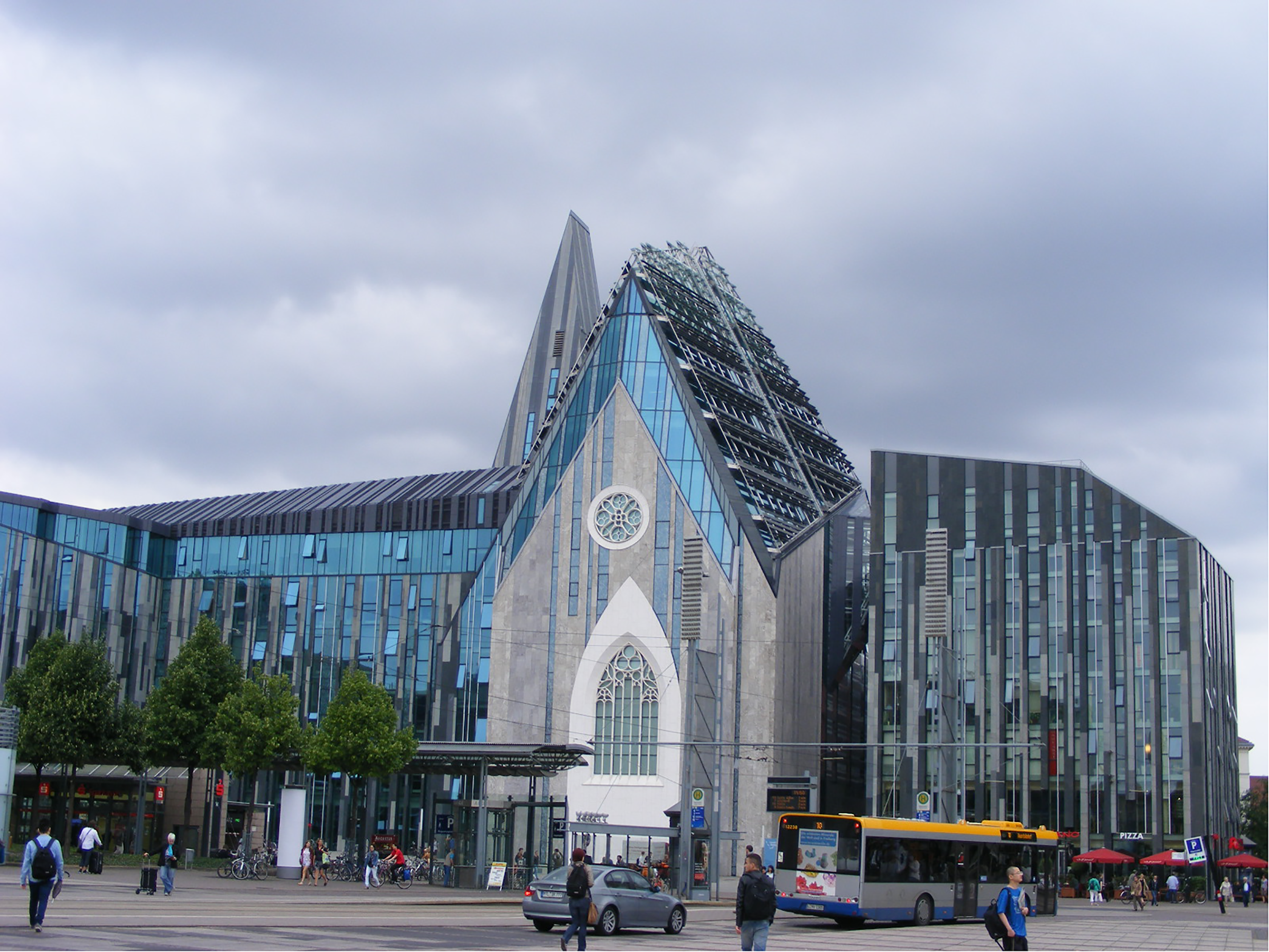
The postmodern-Gothic Paulinum, 2015. Photographer Andrew Demshuk.
Yet this need not have been the only outcome for this most awkward piece of difficult heritage. Contingency was ever a factor. Who had legal rights to the monument? Could these rights be challenged or steered by intervention from engaged citizens? To what extent did factions in the debate circumvent or muster public sentiment to their advantage? And which random elements intervened? As this discourse evolved over the course of discrete events, officials and engaged citizens alike attributed ideological meaning to the monument, until its fate was ultimately decided. Survival was not the only possible outcome, but when the judgment fell for exile rather than execution, a new debate arose: how was it to be exhibited – and treated – once removed?
To underpin the contingency of when and how a monument acquires ideological charge, it is useful to survey three other Marx monuments in Germany. Yes, Germany really is limited to just three particularly prominent Marx statues, and no university bears his name. One should think that Marx – a German thinker whose ideals revolutionized the course of human history – should get at least as many monuments across Germany as Luther, Leibniz, Goethe, Humboldt, Bismarck, Wagner, and a great many figures few Germans can easily identify. Instead, the surviving Marx monuments are rarities. In former East Berlin, Marx sits next to Engels on the banks of the Spree with a radically altered stage to the politics of architecture behind them: the postmodern/replica remaking of the Hohenzollern Palace (dubbed the ‘Humboldt Forum’) on the site where (when the Marx and Engels monument first appeared in the 1980s) the orange-glass box of the Palace of the Republic had shimmered as a modernist socialist future atop the erased palace's foundations 80 (Figure 11). In Chemnitz (formerly named ‘Karl Marx City’) a massive Marx bust survives to terrify generations of post-communist children; notwithstanding some talk of removing it after 1989, the 1971 metal behemoth has taken on cult status in the former industrial town. 81 When Hans-Werner Schmidt spoke of breaking up Leipzig's Marx relief into ‘puzzle pieces’, he even asserted that Aufbruch was not to be compared with Chemnitz's ‘massive Marx-head’, which he claimed ‘appears to have a different level of quality’. 82 Artistic quality, rather than lesser ideological burden, seemed the safest approach for Leipzig opponents to Aufbruch when confronted with the fact that Chemnitz had valorized, rather than exiled, its Marx monument. More recently, Chemnitz's Marx has even served as a counterweight against rightwing forces seeking to hijack local identity, and it has bolstered Chemnitz's successful bid to become European Cultural Capital in 2025 (Figure 12). Finally, Trier's enormous Marx monument was gifted from China in 2018 for the bicentennial of the world-changing revolutionary thinker's birth within its very walls – an awkward origin for a monument outside of former East Germany.
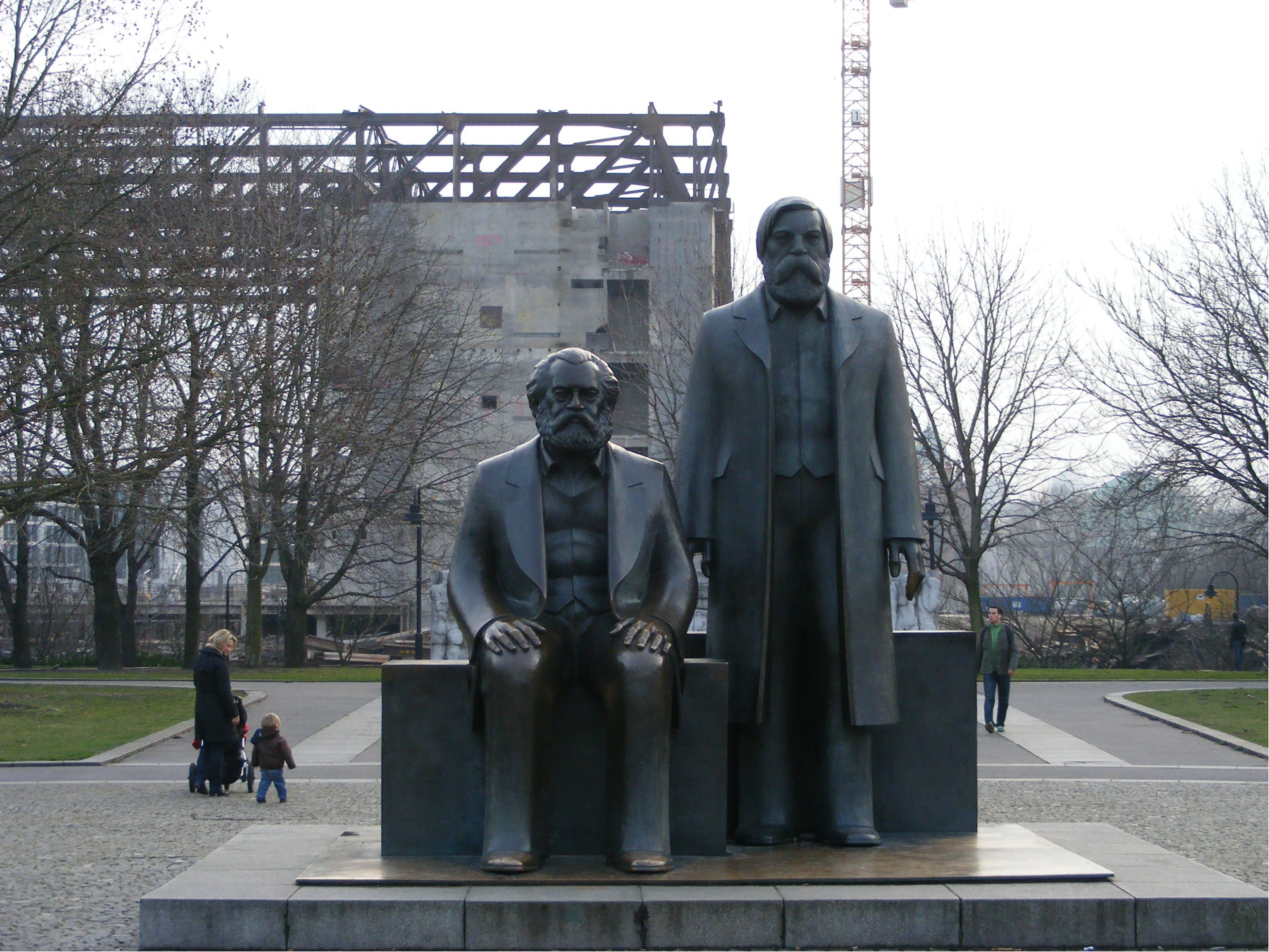
Marx-Engels Monument in Berlin with partially disassembled Palast der Republik in background, 2008. Photographer Andrew Demshuk.
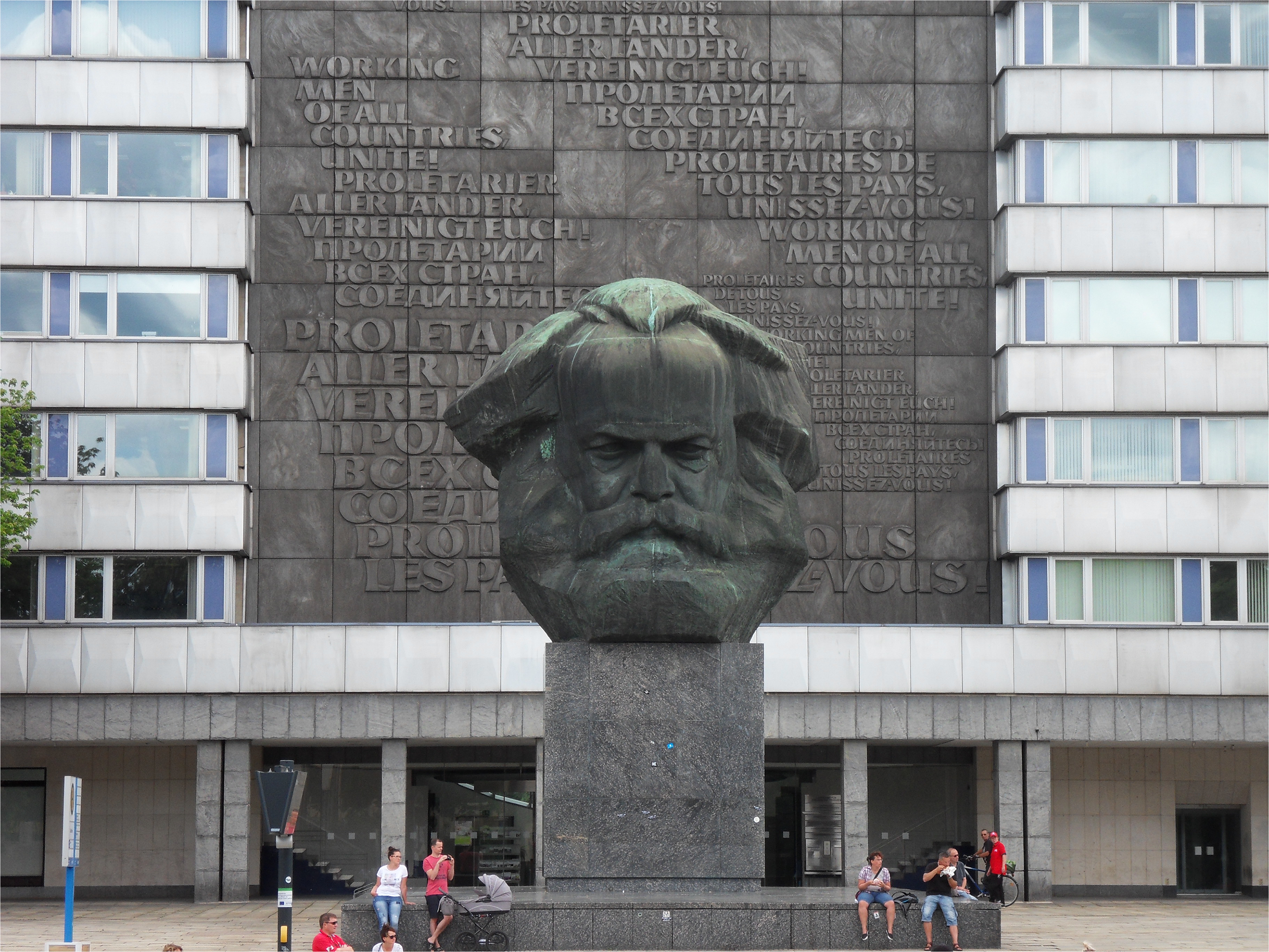
Marx Bust in Chemnitz (formerly Karl-Marx-Stadt), 2017. Photographer Andrew Demshuk.
So how ‘difficult’ is ‘difficult heritage’, and who decides? How does the electric charge of ideological burden evolve due to coalescing factors at discrete moments over time? What is the role of pedagogy, propaganda, and contingency? The other three Marx monuments show that, without such blinding ideological charge, Leipzig's Marx monument might have survived on or very near to Augustus Square. As an ideologically ‘cursed’ monument, Aufbruch still could have ended up in a statue park or museum. And plentiful proposals had circulated that wanted Marx disfigured, melted down, or otherwise effaced forever. Instead, the monument is ready and waiting for anyone who wishes to find it – appropriately free of charge – to learn about how its state-imposed redemptive message was indelibly tied to a profoundly unpopular demolition that tainted its existence before it was ever made.
Footnotes
Acknowledgements
I wish to thank the Leipzig Stadtarchiv, Staatsarchiv, and University Archive, the family of Fritz Tacke, Rudolf Hiller von Gaertringen along with the Archiv der Kustodie der Universität Leipzig, and Martin Helmstedt along with the Paulinerverein for making documents and images available to me for this article. I am grateful to Rebecca Mitchell, JCS special edition editors Nick Carter and Claire Copley, my anonymous reviewers, and members of the Middlebury St. Stephen's reading group for their advice and assistance on earlier drafts. Support for this article came from American University, the Alexander von Humboldt Foundation, and the Leibniz Humanities Center for East-Central Europe (GWZO) in Leipzig. Finally, although his name recurs throughout this article, any resemblance between the deceased philosopher Karl Marx and his monument is circumstantial at best.
