




Abstract
From the 1960s onwards, the sustainability of the modern diet became a topic of fierce discussion in industrialised societies. Vocal critics proposed radical alternatives to the prevailing modes of production, but their impact remained fairly modest. To understand how Western European countries nonetheless became ‘light green societies’ (Michael Bess), this article assesses the distinct interpretation of sustainable food consumption which was championed by consumer organisations since the 1960s. Tracing the steps of the Nutrition Education Bureau (Voorlichtingsbureau voor de Voeding) and the Consumers Union (Consumentenbond) in the Netherlands between 1960 and 1985, it analyses the reactions of these well-known intermediaries to the alternatives proposed by more radical environmentalists. The article demonstrates that after a period of reluctancy, the position of the two consumers organisations evolved, with both acknowledging that the health of consumers and the health of the planet were inextricably linked. Adopting long-standing consumer concerns, the two organisations popularised a definition of sustainable food consumption which took the individual's right to choose as a vantage point and prioritised concerns about health and affordability.
The 1960s saw a renewed interest in sustainable production and consumption in industrialised countries. In 1962, Rachel Carson's Silent Spring, which revealed the effects of pesticides on the environment and on the health of consumers, became an international bestseller. 1 According to one Dutch journalist, the book had ‘sown fear in the hearts of millions of readers in the United States and ha[d] occupied scientists from all over the world for months’. 2 Five years later, the work had already been translated into twelve languages. Then, in 1967, Carson's friend Cornelis Briejèr corroborated her analysis. In his work, this Dutch botanist condemned what he saw as the ongoing pollution and exhaustion of the earth. Nonetheless, Briejèr tried to end on a hopeful note by pointing to pioneers who were exploring sustainable ways to produce healthy food – though such initiatives were still at an early stage of their development. 3
Both authors sought to generate awareness of the effects of modern food production. The post-war surge in large-scale animal farming and intensive agriculture in countries like the USA and the Netherlands had positively impacted food availability and affordability, but it also entailed the structural use of fertilisers, pesticides and animal medicine. 4 Vocal critics like Carson and Briejèr worried about people's health and about the future of the earth, and urged their readers to produce and consume in a more sustainable way. In countries like the Netherlands, their appeals led to a renewed interest in the (small-scale) production of organic food, which carried the promise that it was free of toxicants and that it was better for the environment. As a consequence, the 1970s and 1980s saw the emergence of a heterogenous alternative food movement, whose adherents propagated divergent modes of production. 5
As scholars have started to examine the histories of environmentalism and sustainability, these outspoken voices have received the most attention. More generally, the field of environmental history, as Sverker Sörlin observes, has often been focused on ‘the growth of environmental movements and indeed environmental politics’. 6 This means that the historical role of other agents in debates about food safety and sustainable production, such as consumer organisations, remains underexplored. However, their role is crucial to understanding the level of recognition that alternative modes of consumption received from the 1960s onwards.
This article analyses which ideas about sustainable consumption reached a broader audience through consumer organisations, and which proposed solutions these organisations endorsed. It demonstrates how ‘mainstream’ consumer organisations articulated a distinct interpretation of sustainable consumption which prioritised food safety and affordability. Through its focus on the history of sustainable food consumption, it bridges two strands in the historiography of sustainability. 7 On the one hand, academics in this field have zoomed in on the introduction of ‘sustainable development’ in the 1980s, which was meant to reconcile economic, social, and environmental interests by stating that economic development could only be sustainable if it had no negative social or ecological impact. 8 Another line of scholarship has extended the history of sustainability to early modern history, analysing people's attempts to simultaneously utilise and preserve natural resources. 9 In focusing on the attitudes of consumer organisations between 1960 and 1985, this study shows how health and frugality took a central role in early debates about sustainable food production and consumption, helping to explain how support for these practices was slowly building outside the realm of intellectual critics and alternative food activists.
This article centres two crucial actors in the field of Dutch consumer education, the Voorlichtingsbureau voor de Voeding (‘Nutrition Education Bureau’) and the Consumentenbond (‘Consumers Union’). 10 The former, a government-subsidised organisation, had been founded during the Second World War to help people in the Netherlands make smart nutritional choices in times of need. In the decades after the war, the Bureau quickly became a well-known authority on food, inserting itself in public debates about the national diet. During these years, it managed to reach a great number of consumers, selling more than half a million brochures per year and organising over two hundred lectures per year. 11 By the mid-1970s the Wheel of Five – the Bureau's main instrument, loosely based on the USDA's Basic Seven – was a familiar sight to a majority of the Dutch population. 12
Like the Nutrition Education Bureau, the Dutch Consumers Union was one of the first of its kind in Europe. Founded in 1953, it was modelled after the Consumers Union in the United States, an organisation which representatives from the Netherlands had become acquainted with during an instructional tour on ‘the consumer’. 13 Though it initially focused on the prices of groceries, the Dutch Union soon started testing and comparing products, as other consumers’ movements in Western Europe did at the time. 14 It quickly established itself as a champion of the consumer's interest. In the early 1960s, the organisation strengthened its position by confronting the tobacco industry, becoming officially recognised as a member of government commissions on consumer policy. 15 By the time the Union celebrated its 25-year anniversary, in 1978, it could boast that it was ‘the biggest consumer organisation in the world’, with almost half a million members. 16 Hence, in a country marked by fierce competition between different actors claiming to represent consumer interests, 17 the Nutrition Education Bureau and the Consumers Union claimed a significant stake.
Such consumer organisations played a pivotal role in navigating the consumer societies which emerged after the Second World War. The post-war years brought unprecedented wealth to Western Europe and North America, where consumers were increasingly encouraged to think of buying products as an inherently political act. At the same time, however, consumption was also becoming more complex. To illustrate: between 1961 and 1967, the number of Dutch supermarkets rose fourteen-fold, while also growing significantly larger and facilitating the rapid differentiation of food products. 18 Pundits and policymakers started to use the label ‘consumer societies’, problematising the societal focus on consumption and to signal the drawbacks of the abundance of commodities. 19
Because of the historical contradictions harboured by Dutch society, focusing on the Netherlands offers a suitable case study for examining the ‘mainstream’ adaptation, modification, and rejection of the propositions of the organic food movement and other proponents of alternative ways of consumption. On the one hand, the country was the site of some of the most intensive agriculture and animal farming in the world. For example, the number of broilers (chickens raised for meat production) in the Netherlands rose from 2.4 million in 1956 to 41.1 million in 1990. 20 In part, consumer demand spurred on the highly efficient production of animal products: per capita meat consumption more than doubled between 1950 and 1980. 21 Because many farmers scaled up to try to remain competitive, post-war crop farming and animal farming typically became sizable operations, while the total number of agricultural businesses cut in half between 1950 and 1970. 22 At the same time, however, some of the most vocal opposition to intensive food production emerged in the Netherlands. As we will discuss below, the 1960s saw the proliferation of many different initiatives to popularise alternative, purportedly more sustainable consumption. The country's public debate about the future of agriculture, therefore, has been particularly lively. 23
To analyse the attitudes of the Nutrition Education Bureau and the Consumers Union regarding sustainable consumption, this article assesses primary sources produced by these two organisations. Of the Bureau's 7.5 m archive, residing in the National Archive in The Hague, material geared toward the public was selected: press releases, posters, brochures, and lectures. These were supplemented by documents that addressed consumer education in a more indirect way: the organisation's annual reports and the minutes of board meetings and advisory council meetings between 1960 and 1985. Between 1960 and 1985, the Consumers Union published 1169 articles in its monthly Consumentengids (‘Consumer Guide’) on food products and food production. Along with the documents of the Nutrition Education Bureau, these articles were scanned and then searched (with the help of Optical Character Recognition) for 72 different keywords (‘activist*’, ‘cultivation’, ‘eco*’, ‘planet’, ‘sustain*’, ‘toxic’, et cetera). The material that emerged from these searches was closely examined, with a particular focus on the presence or absence of environmentalist arguments, adjectives, emotive words, and visions of the future.
The article's first section is focused on the period between 1960 and 1971, and traces both organisations’ early reactions to concerns raised about the effects of conventional food production. Its second section spans the years between 1972 and 1985, during which the Bureau and the Union witnessed the maturation of the alternative food movement, motivating both to alter their stance toward the topic of sustainability. 24
Concerns about pesticides and additives took centre stage in the years between 1960 and 1971. ‘Do pesticides in agriculture and horticulture harm the consumer?’, a press release by the Nutrition Education Bureau asked in 1958. 25 The Bureau saw reason to address concerns about the effects of the use of pesticides well before the publication of Silent Spring placed the topic firmly on the international public agenda. Its press release – primarily targeted at (female) dieticians – noted that the past years had seen several pesticide-related incidents. These substances could indeed be dangerous for consumers, it explained, but only if they were applied inexpertly. The Bureau went on to clarify the ratio-nale of producers for using pesticides, reassuring consumers that they had little to fear. Farmers tended to rely more on pesticides because they could not afford the risk of losing entire crops to vermin or disease. Neither could the public, the organisation explained, as production levels had to be maintained in order to feed the ‘global population’. 26
The Bureau cited the expertise of food producers, pesticide manufacturers and government inspectors to further dispel fears about traces of pesticides in consumer goods. Not only were manufacturers obliged to supply detailed guidelines on the use of substances, a national commission also supervised their utilisation in agriculture, and inspectors monitored trace amounts of pesticides in food sold in markets. According to their latest report, based on a thousand samples, in ‘only’ three instances had produce contained unsafe levels of pesticide. 27 Hence, without denying the dangers pesticides posed to human health, the Bureau counted on producers and government regulators to heed their professional duties and to manage the risks involved. The trust bestowed on these actors by the Nutrition Education Bureau was perhaps not surprising, because it was subsidised by, and reported to, the Ministry of Agriculture, Nature and Food Quality.
The Consumers Union, however, took a similar position. Because the Union exclusively represented the interests of Dutch consumers, its main activities were lobbying policymakers and companies and providing its readers with information on products to help them make sensible choices. 28 Reacting to concerns about pesticides in the wake of the publication of Silent Spring, the Consumers Union did acknowledge the dangers of these substances, but focused on their household use rather than their application in agriculture. Concerning the latter, it noted that this was first and foremost an issue in the USA, because American farmers employed pesticides on a much larger scale. Like the Bureau, the Union explained that the use of these substances was closely monitored in the Netherlands, while the amount of residue allowed in food was considerably lower than it was in the USA. 29 The Union was more apprehensive about the private use of spraying cans to repel insects. Homemakers were urged to read the instructions carefully and to not spray more than advised. Incorrect use could even pose a risk for food: ‘The housewife needs to take care not to let foodstuffs come into contact with these substances. If one wants to use the spraying can in the kitchen, make sure all leftovers are covered or out of reach’, the organisation advised. 30
The Consumers Union's trust in Dutch regulating agencies was perhaps affected by the fact that the association was in close contact with the Nutrition Education Bureau. Though the Union chose its own topics and its own angle for their magazine articles, it often sent the Bureau drafts to double check its nutritional facts. Between 1958 and 1965, the latter's annual reports often made mention of its advisory role to the association, going as far as to call the Consumers Union a ‘regular client’. 31
There was a marked difference between the two organisations: in its appreciation of producers, the Consumers Union deviated from the attitude of the Nutrition Education Bureau. When a new law concerning commodities was discussed in Dutch Parliament in 1961, the former stressed the need for strict guidelines and inspections, claiming such regulations were critical for the protection of consumers and for a healthy balance of power between government, business and consumer representatives. In its discussions on this balance of power, the association often turned to food, a topic that made up an average of ten per cent of its total articles. 32 In its discussion of the 1961 law, the Consumers Union referred to a recent food scare involving Planta, a new brand of margarine (see Figure 1). The product was taken off the market mere months after its introduction, because it was determined that a new emulsifier used by manufacturer Unilever was toxic. In the short period before Planta was recalled, tens of thousands had fallen ill, and four people had died. 33
The Consumers Union used the Planta scare to make a larger point about food safety. According to the association, these incidents could be avoided if companies would have been obliged to publish a full list of ingredients for their products. 34 This seemed particularly true for the Planta case, as the emulsifier had already been used in West German products, with similar health effects. 35 Pointing to other food safety issues, such as the use of hormones in the poultry industry and the spread of salmonella bacteria in eggs, the Consumer Guide concluded that producers could not be trusted to take other interests of consumers to heart. 36 Therefore, it argued, the protection of consumers required the further regulation of producers and a system of strict public inspections.
Between 1960 and 1971, the Nutrition Education Bureau and the Consumers Union discussed production methods in the context of food safety. Despite lively discussions of the environmental impact of pesticides in national newspapers in the early 1960s, 37 neither organisation dwelled on the broader ecological effects of farming. Both employed a narrower definition of the consumer's interest. The two organisations could not be swayed by the concerns of environmentalists, who felt that the use of pesticides and food additives was under-researched. The long-term effect of such components, according to these critics, was that they risked people's health, while further estranging them from nature. 38
The Nutrition Education Bureau and the Consumers Union approached food and health from a more technocratic point of view. In warning its members of the potential dangers of sweeteners, the Consumers Union based its advice solely on the potential risks of excessive use because of a lack of research into the effects of these substances. 39 Discussing the use of additives in its Consumer Guide, the association mainly considered the lack of transparency for consumers and the limitations of existing government regulation. The focus, it felt, should be on obliging manufacturers to specify which additives they used in their products. 40 The Consumers Union's perspective on additives, therefore, was comparatively tolerant. This was not a given: in his study of two Belgian consumer organisations, historian Filip Degreef has demonstrated that just south of the Dutch border, attitudes toward additives were much more severe. 41
In assessing food production methods, Consumer Guide articles frequently discussed the financial implications for consumers. The efforts of Elisabeth Aiking-van Wageningen provide a clear example. This early environmentalist strove to curtail household waste through campaigns primarily directed at housewives. She founded the NGO Stichting Milieuzorg (‘Environment Care Foundation’) in the early 1970s, which successfully lobbied for the introduction of a system for collecting glass waste. By the early 1980s, about 12,000 waste bins for collecting glass could be found in the Netherlands, and by the end of that decade, about half of the glass produced in the country came from recycled material. 42 However, when Aiking-van Wageningen had initially approached staff members of the Consumers Union in the 1960s, they showed little interest. On the topic of packaging, the Union was mostly focused on potential price increases, and on the importance of transparent materials – so that consumers could judge the contents with their own eyes. This attitude was part of a broader trend: almost half of the articles on food products in the Consumer Guide during the 1960s discussed price issues. 43 On glass packaging, the Union's position was that the raw materials used in its production were not scarce, and that the environmental impact of glass production was low. Not consumers, but manufacturers carried a responsibility, it argued. Instead of making the former ‘trudge around with empty bottles’, the Union explained, manufacturers should be obliged to consider the environmental impact of their products. 44
The Nutrition Education Bureau tended to appeal to authority in its assessments of food production methods. It cited existing government regulations and emphasised that the latest scientific insights were being followed. An example was the Bureau's stance on irradiated products. Research on food irradiation had been promoted by the Dutch government during the 1960s, resulting in the introduction of irradiated potatoes by the end of the decade. However, people were worried about radiation, because of its association with the effects of nuclear warfare. The Bureau reiterated the government's position on the subject, pointing out the advantages of irradiation for improving the durability of foods. It published a brochure, in which it attempted to dispel any doubts by stressing that relevant processes were strictly monitored. 45 Similarly, growing concerns about the effects of pesticides on the long-term health of both consumers and the environment were met by words of reassurance. ‘The government in our country ensures that substances added to food items do not put the health of the consumer at risk’, a 1970 brochure guaranteed readers. Furthermore, the Bureau asserted, there was no need to worry about additives, since manufacturers provided an advisory board with all the technological and toxicological data needed to assess whether they were being used in a safe way. In turn, the advisory board rigorously adhered to the guidelines established by national and international health experts. 46
The 1960s saw a prolonged debate about the environmental impact of food production, particularly regarding the use of pesticides, in Dutch media. Yet the Nutrition Education Bureau and the Consumers Union were reluctant in adopting environmental concerns, and seemed unenthusiastic about organic alternatives. The Consumers Union focused on price and food safety, criticising food producers for failing to prioritise the well-being of their customers. Similarly, the Nutrition Education Bureau took a relatively narrow view by focusing on the health of consumers, not the health of the broader ecosystem. In its discussions of the effects of modern food production, the Bureau put its trust in the expertise of scientists. In the years after 1972, the production of organic crops expanded and professionalised, while anxieties about the large-scale production of foodstuffs appeared to deepen. Against this background, the attitudes of both organisations on the environment and on animal welfare would gradually start to shift.
‘Alternative’ food production in the shape of biodynamic and free-range farming became the new focal point around 1972. The Club of Rome's The Limits to Growth, published in 1972 and eventually translated into thirty languages, provoked further debate about the sustainability of existing agricultural practices. In the years that followed, environmental NGO's in many industrialised countries saw a surge in membership. 47 Furthermore, sustainable production gained a degree of legitimacy in the 1970s because it managed to draw the interest of policymakers, as demonstrated by the fact that the Council of Europe designated 1970 the European Year of Nature Preservation, and by the 1972 UN Conference on the Human Environment in Stockholm. 48 In the Netherlands, in part because of the publication of the The Limits to Growth, the topic of sustainability increasingly reached the general public. Several national TV shows, for instance, focused on the ecological impact of modern production. 49 Surveys conducted in the 1970s demonstrated a high degree of awareness and concern about the environment among the Dutch. According to a 1970 poll, almost the entire population (96 per cent) agreed that the national government should take ‘far-reaching measures’ to deal with the problem of environmental pollution. When asked the same question five years later, many (89 per cent) still felt such a comprehensive intervention was imperative. 50 Another opinion poll, taken in 1971, revealed that even before the Club of Rome's hotly debated report, 45 per cent of the population considered ‘environmental pollution’ one of the five largest societal problems of the Netherlands. 51 Hence in the 1970s, more than ever before, the adverse effects of modern production and transport, of which agriculture and intensive animal farming were a big part, were garnering mainstream attention.
From the year 1972 onward, the Dutch Nutrition Education Bureau seemed to gradually change its perspective on alternative modes of production and consumption. Not only did it publish press releases in the mid-1970s on packaging and the environment, 52 on mercury in fish, 53 and on the ‘problems surrounding pesticides’, 54 it also gave a short list of cookbook recommendations (1975) in which it mentioned two macrobiotic options, helping to normalise diverging lifestyles. 55 Correspondingly, after a long period of scepticism about vegetarianism, 56 the organisation published a brochure titled A Healthy Diet without Meat in 1976, followed by Cooking without Meat or Fish two years later. Both brochures sold reasonably well in the late 1970s and early 1980s. 57 At the same time, in 1976, the Bureau openly questioned all nutrition education efforts, claiming that it had thus far failed to truly offer the information requested by consumers about ‘chemical additives, pesticides, etc.’ and that the Bureau needed an answer to the ‘growing environmental awareness and the emotions related to the world food supply problems’. 58
Such statements indicate that the Bureau's increased interest in the relationship between food and the environment in the mid-1970s was at least partially motivated by appeals from its audience. In these decades, consumers could get into contact with the Nutrition Education Bureau either through mail or by telephone. Both methods were popular: in 1979, the organisation's annual report stated that 1,400 questions had been answered by mail, whereas the number of phone conversations ‘could not be counted’. 59 However, in 1980 the Bureau did start counting its phone calls, claiming that it was answering about 9,100 questions per year, 60 a figure which would rise to 13,900 a decade later. 61 Between 1972 and 1985, annual reports noted recurring themes in these calls and in letters from the public. For all of those fourteen years, they made mention of a significant interest in ‘vegetarian diets, macrobiotics, and biodynamic agriculture’, or more broadly, in ‘alternative foodways’. 62
The growing interest in a sustainable diet had reinvigorated the organic movement. This movement had its own history: around the year 1900, a range of experimental ways of producing and consuming had already been attempted across the world. 63 Now, sixty years later and backed by new research into the detrimental ecological effects of pesticides, plastics and air pollution, 64 activists launched new attempts to transform global economic relations and limit the impact of consumption on the environment. With their appeals to national and international bodies failing in most instances, many of them turned toward effectuating practical changes in their own immediate environment. 65 In the Netherlands, the publication of the Club of Rome's report in 1972 coincided with the foundation of De Kleine Aarde (‘The Small Planet’), a non-profit organisation which published a magazine and ran an experimental eco-village. Other Dutch groups, such as Impuls (‘Impulse’, 1974) and De Nieuwe Lelie (‘The New Lilly’, 1974) soon followed, seeking to popularise alternative ways of producing food. 66
Initially, the Nutrition Education Bureau was careful to provide information about, but not to endorse, ‘alternative’ consumption. Even when it agreed that it was important to decrease the use of pesticides, it warned against possible negative effects on the agricultural yield. 67 Most of the organisation's material still focused on the stringent control of intensive agriculture by trusted government agencies, which regularly checked the quality of produce and the living conditions of animals. By contrast ‘biodynamic’, the Bureau warned in a press release titled Reform Products: Sense or Nonsense? (1974), was not a legally protected term, and ‘biodynamic’ products were generally sold in places where government agencies had little oversight. 68 Three years later, another press release (That Is What Activists Are Fighting For, see Figure 2), sincerely explained the objectives of different types of (environmental) pressure groups, but also warned against their ‘rather emotional motives’. 69 Hence, by the mid-1970s, though educators at the Bureau were still suspicious of ‘alternative’ foodways, they felt obliged to at least inform those who had chosen to fundamentally alter their diet, to make sure they did it in a way that was nutritionally sound.
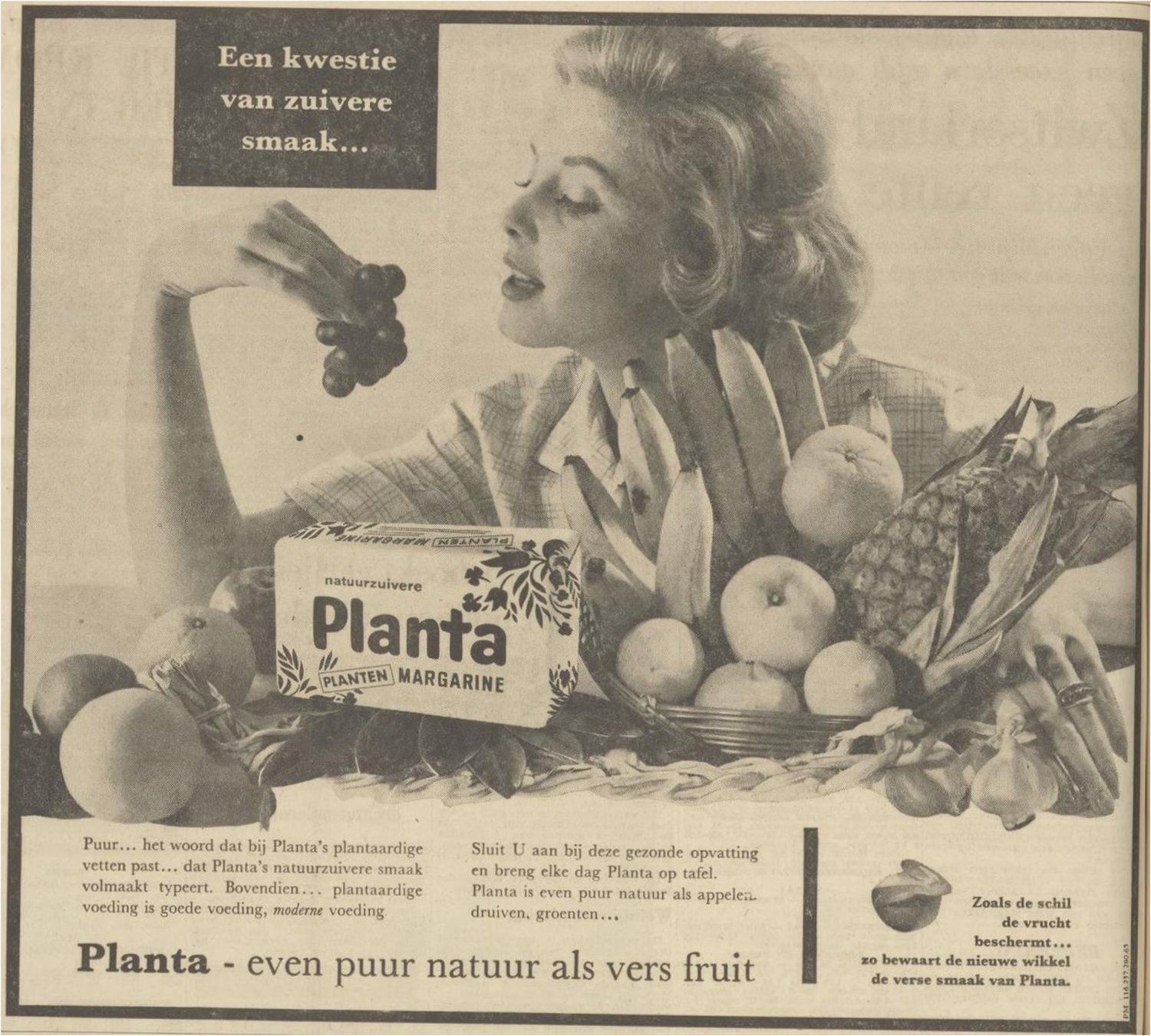
An advertisement for Planta margarine in Algemeen Dagblad, 17 August 1960, six days before it was recalled. The text of the ad stresses the product's ‘purity’.
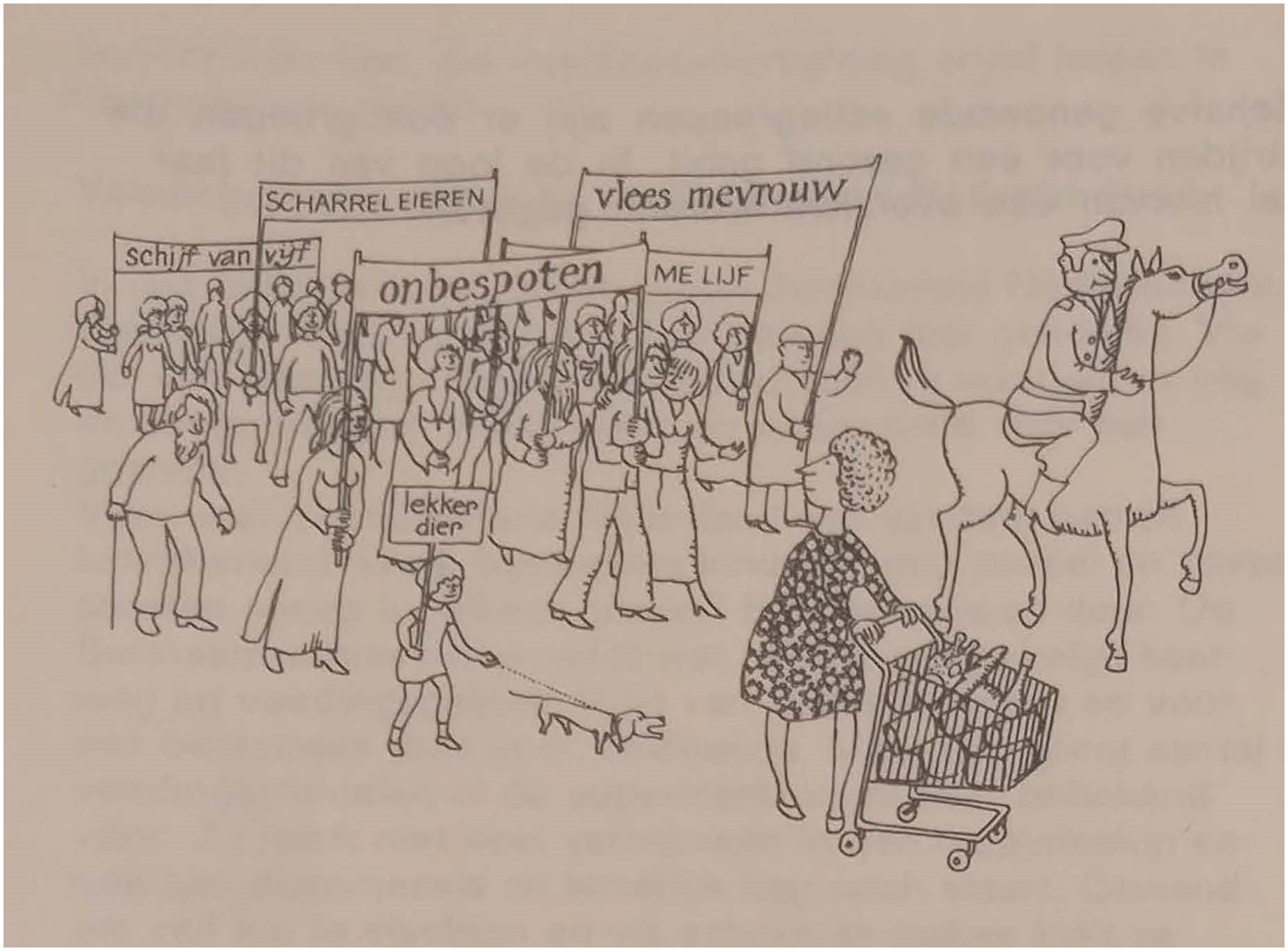
A group of ‘activist’ consumers. Illustration for press release no. 1664 of the Dutch Nutrition Education Bureau, ‘Dáár strijden actiegroepen voor’ (1977).
However, from 1976 onward, a more fundamental shift took place. Despite scepticism about emotional motives, that year the Bureau started working together with pressure groups. It collaborated with the activists of De Kleine Aarde for a television segment on regular and biodynamically grown spinach, while a lecturer of the Bureau also visited the eco-village to give a presentation. 70 Cooperation between the two parties continued into the 1980s, with the two working together for a radio show and a television programme in the year 1980. 71 By 1983, the Bureau reported that it was ‘intensifying’ the contact with both De Kleine Aarde and the Dutch Vegetarians’ Association, and that it was developing a brochure in collaboration with the former, acknowledging ways of ‘eating differently’. 72 Nevertheless, De Kleine Aarde remained critical of many of the Bureau's choices in the 1980s. In its own magazine, also called De Kleine Aarde, it published articles questioning the Nutrition Education Bureau's aversion to vegetarianism, and condemning its appearance in a McDonald's brochure, showing that many disagreements continued to exist between the two organisations. 73
A 1988 publication by the Dutch Nutrition Education Bureau, titled How Safe is Our Food?, affirmed its stance on intensive agriculture and ‘alternative’ nutrition. The 240-page book had the explicit goal of ‘restoring [people's] trust’ in the production of food by finding a ‘balance between extremes’. 74 Its author explained that his intention was neither to indict nor to soothe. 75 This effectively meant that the book made mention of the negative environmental effects of modern food production, acknowledging the ‘explosive’ development of intensive animal farming, the surplus of manure in recent years, and the plastic waste caused by manufactured food products. 76 At the same time, however, it concluded that additives carried little health risks, and that farmers used pesticides much more responsibly than they had done in the years following World War II. Regarding the safety of foods, it echoed earlier publications, encouraging readers to trust government agencies tasked with supervision, and reassuring them that despite errors in the past, the widespread employment of scientific research meant that most products were completely harmless. Despite the fact that the book offered the Bureau a chance to go into more depth about food production methods and their effects, ‘alternative’ production was mentioned only briefly. Reiterating the Bureau's earlier concerns, the author lamented the absence of trustworthy quality label for biodynamically or ecologically produced foods. This, he warned, meant that consumers would remain distrustful of these types of products. 77
Unlike the Dutch Nutrition Education Bureau, the Consumers Union had a history of distrust against producers of food products, a tradition it continued after 1972. Striking an alarmist tone, over the course of the 1970s its monthly guide warned against pesticides, heavy metals, and other harmful chemicals and hormones in products such as milk, oranges, meat, and canned tuna. 78 In the 1980s, too, the contamination of foods was a topic of great importance in the Union's magazine, evident in articles on insecticides such as DDT, aldrin, dieldrin, and also traces of lead, cadmium, nitrate, mercury, and antibiotics. 79 The Union's stance was severe, even in cases where it found amounts that were supposedly harmless. About cadmium, for instance, it wrote in 1982 that it was a ‘poison which sneaks into our bodies through numerous food products’. 80
In part because of its sustained focus on toxicants, the years between 1972 and 1985 saw the Consumers Union pay increasing attention to the effects of intensive agriculture and animal farming. A 1974 article on ‘alternatively produced vegetables’, was still somewhat cautious, explaining that although excessive use of artificial fertilisers ‘disturb[ed] the natural balance in the environment and [could] threaten the health of consumers’, these chemicals were vital for making sure the entire world could be fed, an argument also used by the Nutrition Education Bureau. 81 In the 1980s, the Union struck a more critical tone. For example, a 1982 article explained that soybean production harmed the position of small farmers in developing nations, and that consumers could read up on the matter in a joint publication of a Dutch fair trade organisation, Solidaridad, and a Dutch NGO founded in 1971 called Vereniging Milieu Defensie (‘Association Environment Defense’). 82
On occasion, while reporting on harmful substances, the Union's guide approvingly cited the instructions of the Dutch Nutrition Education Bureau. 83 But in its criticism of both producers of food as well as the governmental agencies tasked with supervising those producers, it deviated significantly from the Bureau's talking points. The Union felt that the treatment of calves, for instance, was not adequately monitored, and warned in 1980 that ‘the assertiveness with which the government claims that Dutch veal is hormone-free therefore seems to be motivated more by economic interests than by facts’. 84 Correspondingly, some years later, it lamented the Dutch government's rather ‘liberal-minded’ approach to the use of veterinary medicine. 85 A decade earlier, in 1974, it had already posited that the regulation of food quality was a global issue, explaining that as a member of the International Organisation of Consumers Unions (IOCU), it was arguing for an honorary code for producers as well as what it called a ‘Food Interpol’. 86
But while some members of the public were convinced less intensive farming methods could solve (some of) these problems, the Dutch Consumers Union was hardly a champion of ‘alternative’ food production in the 1970s and early 1980s. That is to say, it viewed farmers embracing ecological or biodynamic principles with the same scepticism as more conventional agriculturists. From 1974 onward, the Union's main objection was the same as that identified by the Nutrition Education Bureau: because the Netherlands lacked a legal framework for ‘alternative’ farming, no trustworthy food label for these products existed. 87 In a 1982 article on ‘alternative foods’, the Union asserted that ‘a lot of fairy tales surround the alternative product, and that the customer who chooses to eat differently, in the absence of legal support, is at the mercy of the shaky foundation of basic trust’. However, this trust would have to be earned, the Union concluded after its ‘journey through the magical world of reform, macro- bio- and eco’. 88
More importantly, despite the fact that the Consumer Guide often discussed the negative effects of intensive farming, it almost always focused on health, not the environment. There was little use to eating alternative produce, it explained in a 1981 article, if you were going to continue eating white bread with sprinkles all the same. 89 A year later, an article contrasting regular and ‘alternative’ produce made the priorities of the Union strikingly clear. In the comparison, the production method for these foods was taken out of the equation. The idea that for some consumers, the environmental impact of a product might take precedence over price and/or health effects, was inconceivable to the Union's reviewers. 90 In such tests, any claim that alternative modes of production could have a positive environmental effect was therefore irrelevant, unless there was an apparent health effect. Occasionally, such a situation presented itself: a 1982 test of spinach and endive found ‘a lot less nitrate’ in biodynamically produced variants. 91
The mid-1980s marked a turning point for the Consumers Union. In 1983, a short article argued that even if pesticides could not be found in store-bought produce, their use still harmed the ‘biological environment’. It presented ecological alternatives as superior, explaining that these farmers not only refrained from using pesticides, but that they also limited the use of (artificial) fertilisers and they had ‘a lot of respect for (soil) life’. 92 Two years later, another article presented over-fertilisation, a ‘growing problem’, as the consequence of intensive animal farming (the ‘bio industry’), maintaining that this development could best be stopped by fighting it at its source. 93 The severe stipulations followed by ‘biological’ and ‘ecological’ farmers, on the other hand, were ‘good for farmers as well as consumers’, the magazine claimed, ‘even if they harm the sales of chemical companies’. 94 The Union's focus on the health of the environment, instead of the more narrow focus on the health of consumers, was a new development.
A similar change occurred in the mid-1980s in the Guide's writing about meat production, which now started to include discussions of animal welfare. Although the Union had published about vegetarianism and meat substitutes before, it had remained silent about either the well-being of animals or about environmental concerns. 95 This changed in 1983, when a longer article on the production of pork meat discussed the phenomenon of free-range farming. Modern, ‘factory-like’ animal farming increasingly drew resistance, its author noted, not least among the members of the Consumers Union, of whom two-thirds said they were willing to pay a bit more for meat produced under better circumstances. In the case of pigs, the magazine explained, free-range production meant no battery cages, less antibiotics, no castration, and a more positive impact on the soil. The label ‘free-range’ was managed by pressure group Rechten voor al wat leeft (‘Rights for All That Lives’), the article went on to say, though the term still lacked a legal foundation. 96 While sometimes animal rights were discussed in terms of their effect on the flavour of the meat (less stress resulting in a tastier product), 97 now intensive animal farming was also discussed as an unacceptable practice in itself, with the Union arguing for a ‘reorganisation’ of existing production methods. 98 By 1984, animal welfare had become a recurring element in the Guide's discussions of animal products. Especially the situation of laying hens received special attention, as they were housed in a way that was ‘unworthy of animals’. 99
Finally, the Consumers Union arrived at a similar approach as the Nutrition Education Bureau, increasingly opting to collaborate with environmentalist organisations. In 1985, while explaining that the government regulation of free-range meats was taking too long, the Union reported that two NGO's, the Dierenbescherming (‘Animal Protection’) and Lekker dier (‘Tasty Animal’) had decided to start sending their own supervisors to producers. In a striking break from the past, the Union's magazine presented Lekker dier not just as a pressure group, but also as a legitimate and professional inspection agency, telling readers that they could call the organisation if they wanted more information. 100 Relatedly, after some years of denouncing the rise of plastic bottles and their contribution to the ‘trash problem’, 101 in 1984 the Union started working together with the aforementioned NGO Vereniging Milieu Defensie, which had become the Dutch branch of Friends of the Earth in 1972. Together, they called upon the ministry to develop better policies regarding ‘throw-away packaging’. 102 To the Union, it seemed that returnable bottles were a win-win: good for both the environment and the wallets of consumers.
In retrospect, this positive view of recycling presented a remarkable turn away from the Union's oppositional stance toward recycling at the start of the 1970s. The organisation had apparently become more willing to entertain the idea that individual consumers bore some responsibility, and had adopted a less dismissive stance toward cooperation between businesses and consumers. This change was part of a broader pattern: both the Consumers Union and the Nutrition Education Bureau had taken up a more cooperative attitude toward alternative food producers – up to a point. It seems likely that this shift in strategy was at least partially motivated by the fact that NGO's and ‘alternative’ producers quickly professionalised during the 1980s. 103 Now, these groups actively worked on becoming more transparent, which made collaboration with these parties more attractive. On top of that, activists increasingly managed to dominate public discussions about modern agriculture, as evidenced by the information on alternative food production which the public demanded of the Nutrition Education Bureau. The topic of the sustainable diet was becoming difficult to avoid. Perhaps this is why the importance of the environmental impact of food production and of animal welfare were now acknowledged by the Bureau and the Union. More and more, they collaborated around issues such as the consumption of organic food and environmentalism, while sidestepping concerns about the global impact of Western European food production and activists’ ideological preferences for small-scale producers. But the more constructive approach of both organisations was also rooted in longstanding concerns, such as the health of consumers and the dangers of pesticides, which had only become more relevant by the 1980s.
In conclusion, by the end of the 1980s, the Netherlands was well on its way to becoming a ‘light green society’. 104 Many people shared at least some concerns about the environment, demonstrated by the fact that in 1991, 17 per cent of Dutch adults was a member or donor of an environmental NGO (around 2.2 million people). Other industrialised countries had seen a similar rise in these concerns from the mid-1960s onwards, though worries among consumers in the Netherlands may have been particularly high. 105
As propagators of ‘mainstream’ ideas about nutrition, Dutch consumer organisations were in a position to influence existing ideas about sustainable food production and consumption. The Consumers Union and the Nutrition Education Bureau, two organisations with a large audience, certainly tried to do so. However, between 1960 and 1985, their positions on sustainability and the environmental impact of the modern diet were not fixed. Initially, the Dutch Consumers Union and the Nutrition Education Bureau were reluctant to accept the alternatives proposed by activists. In the 1960s, both organisations framed pollution and other problems related to food production mainly as issues of food safety. While the health of consumers was of great concern to the Union and the Bureau, the health of the planet, they felt, was not within their purview. Moreover, they represented the criticisms of alternative food activists as overblown and contended that these groups failed to offer a credible alternative.
The 1970s saw both the Dutch Nutrition Education Bureau and the Consumers Union hesitantly take up some of the criticisms of industrial food production. Their writings testified to an increasing awareness that the health of consumers was, in fact, inextricably linked to the health of the planet. Both organisations changed their messaging on what kind of consumption was sustainable and even started to cooperate with organisations in the field of alternative production and consumption. By the 1980s, the Union and the Bureau articulated a distinct view of sustainable consumption, which continued to prioritise consumer health in light of the rise in the use of pesticides and additives. While granting credence to concerns about the impact of food production on the environment and animal welfare, both organisations held back from making such concerns guiding principles for the evaluation of products. Consequently, neither advocated for the more systematic changes to food production promoted by activists.
The reactions of both organisations can partially be explained by their societal positions. The government-subsidised Nutrition Education Bureau closely followed the logic of policymakers, citing the importance of scientific evidence and putting its trust in existing regulations. The Consumers Union, on the other hand, generally took an oppositional stance toward all food manufacturers, both conventional and alternative. However, its focus on high prices – a common factor for foods presented as more sustainable – meant that producers of alternative products faced extra scrutiny.
Nonetheless, by stressing the importance of trustworthiness, the Consumers Union also opened up a pathway toward mainstream acceptance for alternative food producers: developing transparent, reliable standards. Seizing the opportunity, the Dutch alternative food movement had established an eco-label by the end of the 1980s. This helped to reframe sustainable consumption. No longer reserved for marginal outsiders, from the 1990s onwards, alternative products could increasingly be found in large supermarkets. 106
The public acceptance of this particular form of sustainable consumption and its widespread adoption by manufacturers and other commercial parties point toward the significance of the consumer organisations as gatekeepers of the ethics of consumption. Yet at the same time, this history highlights the limits of their influence on public debates, as neither the Consumers Union nor the Nutrition Education Bureau was apparently in a position to disregard the concerns activists voiced about modern food production. The latter in particular discussed these themes with some reluctancy, as sources show how members of the public had to contact the Bureau again and again to get the organisation to cover the topic of sustainability and alternative diets. Lastly, both the Union and the Bureau had little say over the actual contents of the standards for the eco-labels or the specific products offered to consumers under this header. This means that their ability to shape the rules about ‘good’ consumption was counterbalanced by their inability to influence other parties, as long as these actors could claim to adhere to these rules.
Hence, the interplay between influential consumer organisations and alternative food activists has laid the foundation for the current status of ‘alternative’ food in industrialised societies. Certified organic foods are now a familiar sight in supermarkets and form a part of many people's daily consumption patterns. Discussions about the price and the health effects of these products, which dominated the writings of the Nutrition Education Bureau and the Consumers Union between 1960 and 1985, persist until this day. In our time, consumer organisations continue to police these issues in the name of an autonomous consumer, whose right to choose remains unquestioned.
Footnotes
Acknowledgements
Both authors have contributed equally to this article.
