



Abstract
The story of the Obor Foundation is important for several reasons. Firstly, it covers the contribution of an up-till-now largely overlooked Western philanthropic enterprise to promote a cohesive national cultural identity for Indonesia in the wake of the fall of Sukarno. Secondly, Obor was an attempt to move beyond previous Cold War efforts to spread liberal ideas globally, most notably by the Congress for Cultural Freedom. To overcome critiques of top-down Westernization and neocolonialism, Obor sought to establish local control over the publishing process in a reciprocal arrangement of shared responsibility. Thirdly, it was symbolic of the move of the Ford Foundation, which had invested a great deal in the modernisation (i.e. Westernization) of Indonesian education, towards introducing a greater level of autonomy in their operations from the late 1960s onwards, expressing a general confidence in (and sufficient monitoring of) Western-trained and/or -oriented local leadership.
On 27 March 1973, Ivan Kats, director of the Obor Foundation, wrote to Howard Dressner, secretary of the Ford Foundation, thanking him for the allocation of US$42,000 towards a social science publishing project in Indonesia. Kats recognised the significance of this decision: This first grant by a foundation is of an importance which far exceeds the size of the grant: on the basis of your support I know we shall now be able to find the required balance of funding elsewhere. Thus the Ford Foundation will have helped set up the first small foundation of this type in Southeast Asia: locally directed, and multinationally funded.
1
This marked both the end of an intense period of lobbying by Kats and his supporters and the beginning of what became a 26-year period of consistent support on the part of the Ford Foundation for Obor publishing operations. The Obor story is important for several reasons. Firstly, it covers the contribution of an up-till-now largely overlooked Western philanthropic enterprise to promote a cohesive national cultural identity for Indonesia in the wake of the fall of Sukarno. Secondly, Obor was an attempt to move beyond previous Cold War efforts to spread liberal ideas globally, most notably by the Congress for Cultural Freedom (CCF). To overcome critiques of top-down Westernization and neocolonialism, Obor sought to establish local control over the publishing process in a reciprocal arrangement of shared responsibility. Thirdly, it was symbolic of the move of the Ford Foundation, which had invested a great deal in the modernisation (i.e. Westernization) of Indonesian education, towards introducing a greater level of autonomy in their operations from the late 1960s onwards, expressing a general confidence in (and sufficient monitoring of) Western-trained and/or -oriented local leadership.
Despite the novelty of this mission, Kats and Obor have not garnered much interest from Cold War, transnational, or cultural historians. David Hill's study of the Indonesian intellectual and close business partner of Kats, Mochtar Lubis, covers the importance of Obor for promoting Lubis's own cultural interests and vision, but has less to say about Kats himself. 2 Janet Steele, focusing on the intellectual trajectory of Goenawan Mohamad, places Kats as a middle-man in the CCF's efforts to encourage and support Western liberal ideas among the younger generation of Indonesian activists in the 1960s. 3 Wijaya Herlambang's critique of Obor focuses on Kats’ expectation that ‘Indonesian intellectuals should be thankful to the West for its influence in liberating their nation from communist threat [sic] and creating a more democratic way of life in their country’. 4 This article explores the steps that went into the Kats’ creation of Obor, the philosophy of cultural development that lay behind it, and how Kats sought to promote a Western-orientated, culturally sensitive liberalism through first the CCF and later through the publishing operations of Obor. It seeks, through a close reading of Kats’ determination to foster Indonesian cultural self-awareness following the extreme political violence of 1965–6, to chart the emergence of Obor out of the CCF and the determination to implement a different form of cultural philanthropy. 5 Kats was not complicit with that violence, but neither did he condemn it outright. And while he was sensitive to issues of local autonomy, it is also the case that he created Obor as a more effective means to bring across largely the same Western literary and philosophical canon as the CCF and Ford had done before. The article thus contributes to wider debates on the place of liberalism in post-colonial nation-building and the cultural transitions associated with those processes.
Since the late 1960s and especially the late 1990s, the ‘cultural cold war’ has become a vibrant research field encompassing the efforts to shape the public spheres and belief systems of societies around particular ideologies, using everything from outright negative propaganda to more subtle cultural strategies. Much of this has been critical of Western – predominantly American – interventions in social life, aiming to shape the desires of others around a modern/ist liberal capitalist future, in doing so closing out possible alternatives. Counter-narratives to this have sought to open up the complexities of cultural communication, refusing to accept a one-dimensional interpretation of power or its effects. 6 Historians, cultural and literary scholars have been giving more attention to the agency of actors in the Global South, in terms of their resistance to Cold War norms and the contribution of local actors to the debates that raged on cultural identity, national unity and modernisation. 7 Over the past decade, a new wave of research has explored the cultural meaning and influence of the Cold War in Southeast Asia. Critiquing the Eurocentrism of many Cold War perspectives, Tuong Vu spoke of the need to ‘challenge the notion of an Asia vacuum waiting for the superpowers to fill’. 8
This has recently taken a new turn regarding the place of liberalism within post-colonial nation-building. Critical studies have investigated how the Indonesian political and economic sphere was deliberately shaped to influence the nation's future development in a pro-Western direction. Inderjeet Parmar's study of the Ford Foundation's promotion of free-market economic theory in Indonesia universities states that American elites wished to ensure that Indonesia entered the American orbit; was open to economic, financial, and commercial relations with the West; and was aligned against the communist powers in international politics …. Indonesia was politically and economically transformed and integrated into the American/Western orbit.
9
Likewise, Bradley Simpson has chronicled the decades-long US commitment to fostering ‘military-led modernization’ in Indonesia, propelled by a ‘complex constellation of national and international political and economic forces’: US development aid, military assistance, foundation philanthropy, social scientists and international organisations such as the World Bank. 10 Others have looked beyond the economic sphere to draw direct linkages between the cultural realm and the elimination of the Communist Party (PKI) in 1965–6. Focusing on the CCF's nurturing of a Western liberal ideology centred on anti-communism, Herlambang has argued that the ‘universal humanism’ of the Western-orientated students and intellectuals effectively laid the groundwork for the ‘cultural violence’ that accompanied the denigration of communist ideology and the dehumanisation and destruction of its followers. 11
There has been some push-back against this accusatory tone. In his study of CCF activities in Africa and Asia, Roland Burke has related how its agenda focused on ‘the nature of freedom…the purpose of sovereignty, and the place of the new nations within the Cold War’. Addressing these issues at African and Asian seminars in the 1950s that mixed Euro-American intellectuals with their local counterparts, the CCF searched for a middle ground of compromise: Wary of extremity in all its species, be it nativist reaction, messianic nationalism, or bureaucratic and technocratic statism, the variegated collection of participants were generally unified in a kind of urgent insistence on caution and care in navigating the threats to freedom.
12
In his recent book on Philippine nation-building, Lisandro Claudio has gone further, reconstituting the liberal strand of belief and practice that was present throughout the nation-building processes of the nineteenth and twentieth centuries. 13 Going against the flow of post-colonial studies that have intimately linked liberalism with imperialism and colonialism, Claudio instead asserts that liberalism was a politics of moderation looking to guarantee personal freedoms against encroaching powers of tradition, class, religion or state. 14 Treating liberalism as a synonym for Westernization effectively delegitimises it as a political value in nations looking to assert their independence and cultural autonomy. This is effectively what has happened in the case of Indonesia, where liberalism was discredited as a term of reference under the Sukarno regime. The counter-narratives of Burke and Claudio argue for reconsidering whether liberalism should be seen as purely an intervention from outside, directly tied to the violence involved in reshaping those societies, or as a set of values that resonated within the nation-building processes from the very beginning, and thus removing the inside/outside divide.
The argument here attempts to take both sides into account. For a start, liberalism is not a coherent body of thought when the practices of democracy are placed next to the demands of neoliberal economics. Liberalism is neither a coherent set of principles that could be applied the same way universally. Recent work on the history of internationalism has rightly pointed to ‘the moments of intersection of liberal and illiberal politics and policies in the modern era’. A study of Obor therefore needs to take into account the ‘ideological liminality’ of liberalism and the ways in which the liberal ‘model’ was distorted in cultural settings outside the West. 15 Ivan Kats tried to accommodate this by providing his intellectual allies in Indonesia the means through which they could pursue their own version of a ‘good society’. But there were still tensions regarding the level of local autonomy in this process.
As Burke and Claudio have claimed, the CCF aimed to foster a liberal, Western-orientated intelligentsia in Indonesia, and during the 1960s and 1970s both the Congress and its successor, the International Association for Cultural Freedom (IACF), were funded by the Ford Foundation, a key ally of the US state in promoting modernisation across the Global South. Peter Coleman has recounted how the early efforts of the CCF to build connections with Indonesian intellectuals started to fade out in the late 1950s. The increasingly leftist nationalism of the Sukarno regime's ‘Guided Democracy (1959–1965)’ made it impossible for the Congress to establish any solid base in a tense political environment. Those in media and education who supported a liberal post-colonial Indonesia, including a free press and an independent judiciary protecting citizens from an encroaching state, were themselves either in prison or in exile. Journalist and author Mochtar Lubis had attended the CCF's Cultural Freedom in Asia conference in Rangoon in 1955 and was a Magsaysay Award winner in 1958, making him a logical focal point. 16 His arrest and detention without trial from 1956 to May 1966, with only a brief respite of freedom during April–July 1961, made that impossible, although he was allowed to continue working and corresponding. Takdir Alisjahbana went into exile after 1957, telling the CCF's executive committee that there was no hope of establishing a formal representation in Indonesia in the prevailing political circumstances. 17 Looking to hold on to what footholds existed, in the early 1960s the Congress ‘adapted its East European formula to Indonesia’, began sending selected literature to around 150 ‘democratic intellectuals’ and university libraries, and involving individuals in CCF-sponsored conferences elsewhere. 18 The person who ran this operation and who sought to adapt and maintain it in the post-CCF (and post-Sukarno) era of the 1970s and 1980s was Ivan Kats.
Kats came from a Flemish Jewish/Catholic family and was born in Brussels in 1926. Facing an impending war, his family undertook a dramatic journey to Lisbon via Marseilles to arrive in the United States in 1939. After gaining a BA in philosophy at City College in New York, he returned to Europe in 1948 to study at the Sorbonne for a Philosophy doctorate that was never completed. Details on this period of Kats’ life are scarce, and he seems to have drifted through a series of teaching, writing and translation jobs, including for NATO's public relations office at SHAPE, where he set up their audio-visual language courses and became managing editor for the monthly Occident-Western World in the mid-1950s. It was in this role that he met the CCF's manager, John Hunt, apparently at a cocktail party, following which Hunt recruited Kats to the CCF staff around 1959. By this stage, Kats had developed as a translator and editor, and after a couple of years of learning the ropes in the CCF HQ, from 1962 to 1963 he was working closely with Hunt on how to effectively coordinate and expand Congress activity across the Middle East and Asia. 19 From 1963 this involved a determined focus on Indonesia. Kats’ mother came from a family of military and civil service administrators in the Dutch East Indies, and his father had built up a commercial trade in clothing with the same colony. Kats had been raised with a fascination for Southeast Asia, and he now channelled his upbringing into a new cultural mission.
What kind of modernisation did Kats desire for Indonesia? In his own mind, he was not advocating for a simple Westernization, let alone Americanisation. In a sense, he was a proponent of ‘alternative modernities’ – modernisation processes that would maintain the cultural distinctiveness of a nation in relation to the West.
20
As he wrote to the CCF's South Korean contact, Kim Yong-Koo, in 1963: To say that a nation modernises simply implies that it brings some facets to its life up-to-date: its industry, principally. To say that it becomes Westernized implies adoption or imitation of the whole of the Western pattern of life and ethos. I can very well imagine a partisan of modernization opposed to outright westernization.
21
The hierarchical logic here is unmistakable: just as industry needed to become ‘up-to-date’, so too did culture, and a modernised, liberal culture meant a free marketplace of ideas that rejected authoritarian voices on the right as well as the left (at least in theory). Yet there is also a sensitivity to how Westernization could easily be interpreted locally as the (post-colonial) imposition of ideologies from outside. This placed him in tune with the heated debates within Indonesia itself, on the extent to which allegiance to universal humanist values meant accepting and adopting Western cultural norms. The increasing imposition of a national cultural ideology (Pancasila) by Sukarno as a means to steer the newly independent country away from lingering Dutch cultural influence, as well as the rising power of the pro-communist Institute of People's Culture (LEKRA), created tense conditions for such cultural arguments. By the early 1960s, the open expression of liberal views was not tolerated by the influential organs of the PKI. 22
In 1963, having fulfilled what looks like a two-year apprenticeship as PA for John Hunt, Kats was given more responsibility regarding CCF programmes across Africa and Asia. Correspondence with contacts in Korea, the Philippines, Australia (James McAuley), India, Pakistan and Kenya (Es’kia Mphalele) filled his time. From March 1963 Kats began to coordinate a book distribution programme for the CCF in Indonesia, building a list of recipients and supporting ‘the few remaining democratic magazines’. 23 Careful not to elicit problems for the recipients, Kats arranged for the publications to be sent out under his own name using his home address, avoiding an overt connection with the CCF. A budget of US$400 was initially allocated for this fledgling operation. 24
In terms of local political allies, the CCF had been most closely aligned from the early 1950s onwards with the Socialist Party (PSI), a minority group of largely urban secular cosmopolitans under the leadership of Sutan Sjahrir. Proponents of a form of democratic socialism, the PSI opposed the personality cult and national chauvinism of Sukarno as much as it did the communists, and it was eventually banned in August 1960. 25 Although avoiding the term ‘liberal’ due to its connotations with Western imperialism, the PSI's promotion of individual freedoms and openness to outside intellectual currents made it a logical ally for the CCF's liberal anti-communism. 26 The names of those Kats corresponded with from the early 1960s onwards – Soedjatmoko, Mochtar Lubis, H.B. Jassin, Arief Budiman and Goenawan Mohammed – were all part of the PSI's political milieu, and the CCF – particularly for Lubis during his long periods in detention – represented an intellectual lifeline and form of international recognition. Soedjatmoko, a member of Indonesia's first mission to the United Nations and a Magsaysay Award winner (1978), became Indonesia's Ambassador to the United States in 1968. 27
Another key contact in the PSI–CCF association was P.K. Ojong, a Dutch-educated editor who was closely aligned with anti-communist, often Catholic circles in the Indonesian military and government. A trip to Europe in 1960 to attend the Eucharist Congress in Munich and the 11th Conference of International Historians in Stockholm provided the opportunity for a meeting in the offices of Encounter in London in September. 28 From then on, Kats maintained a regular correspondence. Kats would later refer to Lubis, Goenawan, Ojong and Soedjatmoko as the four central figures with whom and around whom he established Obor. 29 Through Ojong, Kats was able to identify, contact and support younger intellectuals, often students, who were opposing the PKI. Many signed the August 1963 ‘Cultural Manifesto’, a document that was not sponsored by the CCF but which expressed similar demands for a liberal-style, apolitical (but not l’art pour l’art) cultural realm in attacking LEKRA's increasing control. A memo from Kats to John Hunt in May 1963 indicates that Ojong had proposed Goenawan, Soe Hok Djin (Arief Budiman) and Taufiq Ismail for CCF seminars abroad to internationalise their outlook. 30 Interesting is the reference to Ismail as ‘a good Muslim’. Kats had been keen to link with moderate Islamic intellectuals, providing subscriptions to the CCF's Beirut-based journal Hiwar and attempting to secure Indonesian participants for seminars in Pakistan. In 1964, Kats arranged a scholarship programme to bring invited grantees to the College de l’Europe for a year's study, and both Goenawan and Budiman would benefit from this in the following two years (Goenawan leaving Indonesia just before the 1965 upheavals, having become a banned author for the Department of Education that August). 31 For his advice, Ojong received a CCF allowance paid via trustworthy Catholic organisations in the Netherlands or West Germany, but he avoided becoming the official CCF representative due to the sensitivities of his Chinese origins. 32 Kompas newspaper, founded in 1965, was central to Ojong's subsequent Gramedia publishing conglomerate, soon the most powerful and influential publishing enterprise under the New Order of Suharto. 33 This reflected the overall transition in cultural production ‘from rivalry between competing political groups [in the 1950s and 1960s] to control by a strong centralised state [in the 1970s]’. 34
Following the attempted coup of 30 September 1965, a military-led backlash against the PKI erupted three weeks later. Estimates of deaths across the archipelago range from 500,000 to 1 million, the violence taking place for several months in later 1965 and early 1966.
35
In the immediate wake of this carnage, with the PKI severely weakened and Sukarno still in power but increasingly at the mercy of the military, Kats unapologetically saw an opening for Western cultural philanthropy to re-shape Indonesian intellectual life. In early March 1966, at the end of a long Asian tour, Kats visited CCF associates in Indonesia ‘for three days and nights’ in the midst of the tense political situation. The killings had abated by that point, and Kats must have encountered a society barely emerging from an extreme phase of violence. Hunt had originally forbidden him to go due to safety concerns, but Kats convinced his boss that what he had heard on the grapevine in Singapore and Kuala Lumpar meant it could be managed.
36
Following his visit, Kats sent a 28-page letter to Hunt from his hotel in Bangkok, describing a country riven by poverty and political turmoil: ‘a revolutionary situation, to which the recent slaughter of the last months was but a prelude’. Sukarno was still regarded as the ruler, but the military was increasingly the ones in charge, and Suharto was becoming more prominent as its spokesperson. Drawing on his meetings with Ojong, student activist Soe Hok Djin, retired general T.B. Simatupang, and above all Soedjatmoko (‘Koko’ in his correspondence), Kats focused more than anything on the heroic militancy of the student movement ‘which has to be viewed in the lights [sic] of the innate sense of justice of the young, of their disgust with all the dirty corruption that surrounds them’. His praise went so far as to condone violence: ‘All the parties, or at least several of them, agree that only student action can bring the Army elements back to their anti-PKI activities. Meaning killings, arrests, etc.’ A strong sense of foreboding permeates the letter, but Kats is searching for ways to act, intervene, move ahead and shape events: What I would like is for me and Goenawan [Mohammed], our scholar in Bruges, to call upon them. I shall have in my possession posters, some photographs, etc., together with a factual documentation which is to reach me in Paris soon after this letter. In two weeks or less, Goenawan and I can work out the text, on the basis of this material; a brochure will be produced and sent out, and an international solidarity movement started.
37
Kats was sanguine on the CCF's capabilities to support embattled intellectuals faced with political repression – ‘we have had some experience in the case of Budapest or Thibet’ [sic] – but it would also have to deal with ‘the Indonesian almost pathological distrust of foreign interference, of any sort’. The CCF's avoidance of anything resembling ‘Nekolim’ (Sukarno's term for neocolonial-imperial threats to the Indonesia revolution), in Kats’ view, had been the reason for the failure to seize the significance of the 1963 Manifesto in the West. He concluded his letter to Hunt with an overview of projects to take forward. Central among them were efforts to revive the connectivity of Indonesian intellectuals: CCF-sponsored scholarship programmes in Manila and Tokyo, a journalist training scheme, exchanges with Pakistan for ‘liberal muslims’ from the Jamia Academy and the Institute of Islamic Research, a plan to bring ‘hand-picked’ candidates ‘to study under careful personal supervision of a top Dutch scholar and politically wise person’. But Kats had wider ambitions to shape political behaviour and identity: 2) Book project ‘The Struggle for Cultural and Academic Freedom 1958–1965’ …. To have some kind of permanent record of the struggle and, in the years to come, provide young Indonesians with detail of this important chapter of their history, which otherwise will be utterly lost.
6) Book project on ‘Disintoxication’ … A series of essays (by various hands) on ideological intoxication – how it works, how to remedy it. Psychologists as well as social scientists to contribute. This is a pet project of mine. 38
Kats also laid out for Hunt the first blueprint of what would become Obor several years later: 9) Translation scheme of small (40–60 p.) pamphlets to illustrate Western critical thinking. Select chapters of A.J. Ayer, Koestler's book on psychology of invention, Shils on Indian intellectual [sic], Pierce's [sic] essays on what to believe, Russell on authority, etc. Each case, a preface by an Indonesian scholar …. URGENT.
In short, a transition to democracy looked impossible for the foreseeable future: ‘Time needed to reintroduce alternate ideology’. But the CCF should begin to piece together the foundations.
After returning to Paris, Kats was emboldened to capitalise on his connections in Indonesia. 39 It is important to contextualise his actions at this point. On 27 April 1966, ignoring requests for caution from Director of Intelligence John McCone, the New York Times published the third of a series of articles on the CIA, in which it was stated that the Agency had ‘supported…anti-Communist but liberal organisations of intellectuals such as the Congress for Cultural Freedom’. 40 As the year progressed the CCF would disengage from various projects, including its Indonesian commitments, to devolve responsibilities and keep projects safe from impending media scrutiny. As part of this damage limitation, Kats was searching for a way to prolong his campaign under different auspices, outside the CCF. His correspondence in mid-1966 lays out unabated a variety of proposals, all of which aimed to place Indonesia in a transnational web of cultural exchange involving India, Australia, and Japan as ‘alternating focal points’. 41 With the proposed book on the struggle for cultural freedom to provide the heroic narrative, Kats now aimed for a new cultural centre in Indonesia as a multi-functional publisher, bookshop, meeting-place and liaison point for international contacts. 42 Part of the CCF's efforts to devolve included a proposal for an Asian Institute of International Relations, located in Australia, which would enable CCF activities across the Philippines, Thailand, Pakistan, South Korea and Indonesia to be coordinated from the Southeast Asia region. 43 The Institute would never see the light of day, but it did provide another blueprint for Kats’ own plans with Obor. However, while the goal of regional coordination was similar, Obor would differ in terms of its greater focus on local ownership of cultural production.
By this stage, his Indonesian allies had created a new outlet for themselves in the form of the cultural magazine Horison, launched in July 1966. A product of Arief Budiman and the recently released Mochtar Lubis, it united the Cultural Manifesto group with others from the student movement around an internationally orientated publication that ‘was almost as strong in its anti-communism as in its opposition to Sukarnoist populism’, cultural chauvinism and xenophobia. 44 Hill mentions that ‘around 1970’ the Horison group sought financial support from the IACF, yet in fact a subsidy of US$150 a month had been provided from the very beginning, and by late 1968 this monthly figure had risen to US$450. 45 From day one, therefore, Horison was very much a part of the CCF–IACF stable of publications.
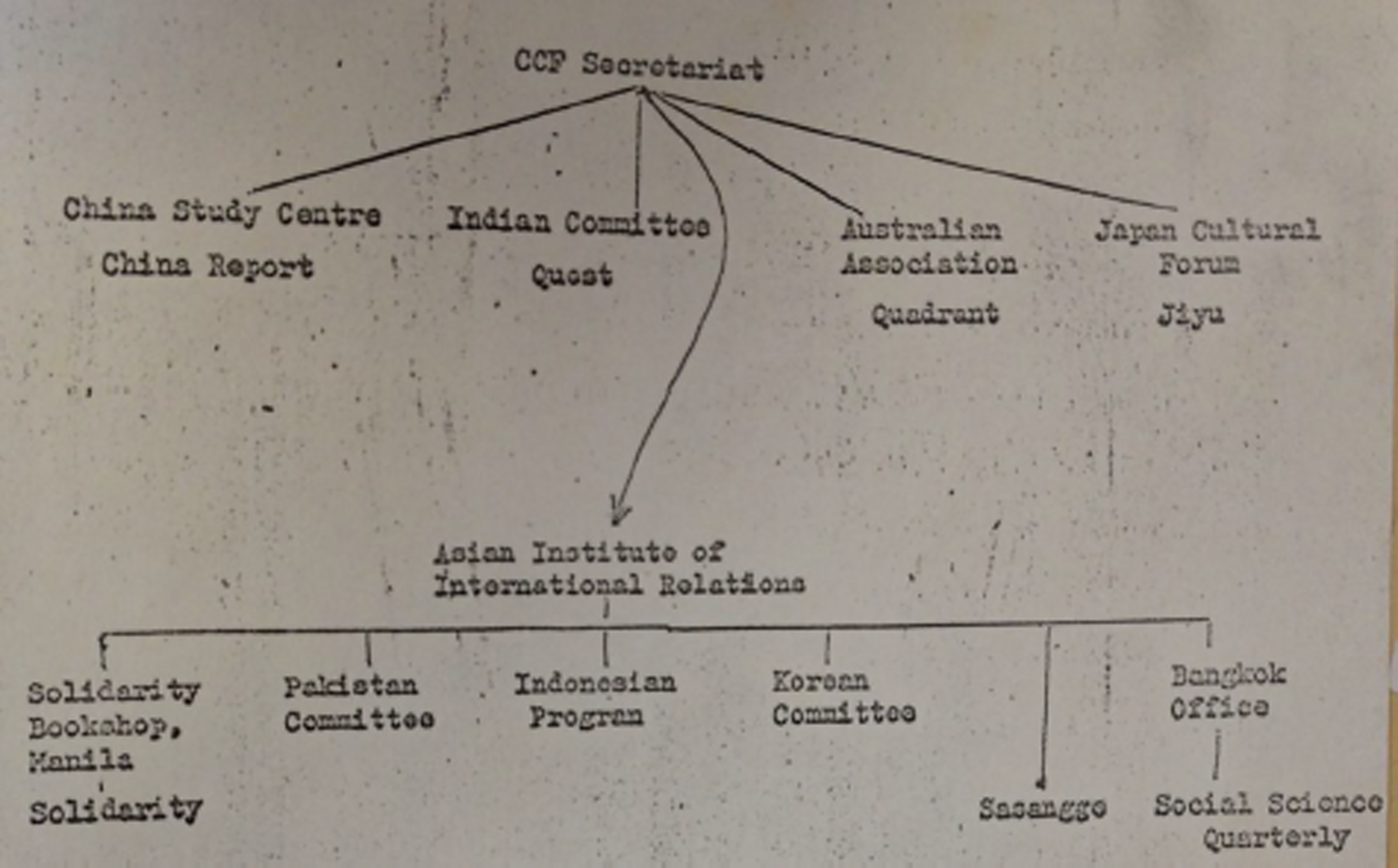 The plan for the Asian Institute. Box 9, Ivan Kats Papers, Yale University.
Kats’ departure from the CCF was clearly amicably arranged, but the specific details remain obscure. Writing to Lubis in December 1966 following a reconnaissance tour around US universities, he announced that he would be an Associate at the Center for Southeast Asian Studies at Yale the following year. The letter indicates that Kats had official sanction to reconfigure the CCF's cultural agenda under a different guise: ‘there are a good many projects concerning Southeast Asia which the Congress will no longer be financing; these I shall continue to run while doing research at one of the American universities’. 46
Yale was an interesting choice. Berkeley and Chicago had also expressed interest, but there was no mention of Cornell, which possessed a strong Southeast Asia programme but whose leading scholars – Benedict Anderson and George Kahin – were very critical of the political violence of 1965. An early version of Anderson's ‘Cornell paper’, which challenged the pro-Suharto narrative that the PKI was behind the murder of the generals on 1 October, was already circulating in early 1966.
47
It is highly probable that Kats’ project was not well received in that environment. Yale's programme was the home of professor Harry Benda, an Indonesian expert and a critic of the Vietnam war, but, significantly, also someone with strong ties to the Netherlands via his connection to the Royal Institute of Linguistics and Anthropology based at Leiden University. Benda, like Kats, was also a Jewish survivor of the Second World War, having been sent in time by his father out of Prague to work with a Dutch trading firm in what was then the East Indies, but then having to endure several years in a Japanese internment camp.
48
Since incorporating Dutch intellectual and financial support into the Obor project was a crucial part of Kats’ strategy, Benda's Dutch links will have been significant for the decision to relocate to New Haven, alongside family wishes to be located on the East coast. Kats had asked Lubis for a letter of recommendation to bolster his bona fides, an interesting case of reverse patronage. Kats needed this support, being effectively a failed student from the Sorbonne who had spent the previous seven years working for an organisation with covert ties to US intelligence. A contemporary of his at Yale provides some insight: he was informally marked as an outsider – CIA links suspected – older than most, and married …. He was subjected to Benda's harsh sarcasm, probably more than he deserved. This was during the anti-Vietnam demonstrations and Benda, and others, were angry at the US government's position.
49
John Hunt acknowledged this situation in a letter to his old friend in May 1967: ‘I devoutly hope that you did not experience any difficulties of any kind as a result of your years at the Congress and derive much pleasure from the thought of you busily pursuing your Doctorate at Yale’. 50 Kats definitely felt that the CCF's mission was badly misunderstood due to the critical reporting of its links with the CIA. 51 Did he also engage directly with the CIA himself? Was there a covert sanctioning of his new post-CCF mission? A full itinerary of Kats's US trip of November 1966 is unfortunately unavailable. Yet Kats spent the next five years trying to convince potential investors of the merits of the Obor model, which does not suggest there was any backroom support. Many postwar Yale alumni did join the CIA, perhaps an added factor behind Kats’ arrival there in 1967. 52 Yet Harry Benda, who accepted Kats, was not part of that particular Yale tradition.
Writing in 1968 to Shepherd Stone, the president of the post-CCF–IACF, Kats again reflected on the opportunity to fulfil the CCF's mission in the post-Sukarno era: Then of course there has been this ‘Civil War’, and an upheaval which brought into positions of influence the people the Congress had been in contact with and had helped a good deal while they lingered in jail or inactivity. The young people, particularly, for whom we provided scholarships in 1960–65 now have a chance and many have acceded to positions where they can exert some influence. That is just what we had trained them for.
53
The goal of the Indonesia book project was very much to portray the student movement as the liberal vanguard who heroically held out against communist pressure and ultimately triumphed. Although it never materialised – the draft chapters can be found among Kats's papers at Yale – in 1969, he did realise a reduced version of the project by guest editing a special issue of Quadrant, the CCF–IACF Australian journal. The contributions came from Indonesia's literary avant-garde – Goenawan Muhammed, Arief Budiman, Mochtar Lubis and Taufiq Ismael – but also Pramoedya Ananta Toer, formerly of LEKRA. The inclusion of Pramoedya's 1955 essay ‘Letter to a Friend from the Country’ is significant, not least because its author was at the time imprisoned on the island of Buru. The essay, a call to arms that ‘our revolution must give birth to a new race’, was prefaced with the significant comment that it had been written, ‘when Pramoedya had not yet given up literature for politics’.
54
Kats was demonstrably able to secure cooperation from a wider circle than only the PSI and Horison. He opened the issue thus: Indonesia's literature after some 40 years has come to constitute a modern cultural history which runs parallel to the social and political evolution, and which can be read as the sensitive record of a struggle for self-realization.
55
Kats then charted the way forward: The problem that looms large in the background of this inquiry is of course the profound deterioration of Indonesia's schools and universities; of the world of book and newspaper publishing; of all those social and cultural and educational institutions and facilities which, after having educated the citizen, normally provide him with employment, and weave a web of modernism and opportunity around him, so that he may use his learning for his own and society's benefit… Is Indonesia able to bear the burden of reconstruction in this area by herself?
56
Having joined Yale and moved to Connecticut, Kats set about attracting financial support for the Obor project. This would turn out to be a drawn-out process covering the years 1967–72. He pursued two paths in search of the necessary funds. One was to entice US corporations with an interest in Indonesian raw materials and markets to back such a cultural venture declarable against tax. Kats recorded later that he invited Lubis to the US so that they could present the project together. Assisted in their networking by Lionel Landry of the Asia Society and former US Ambassador to Indonesia Marshal Green, in 1970 they eventually landed a fund-raising luncheon hosted by the president of International Nickel Corporation (INCO), Harry Wingate. INCO possessed a large mining presence in Papua New Guinea, and it would soon be joined by other mining and raw material concerns such as Shell, Goodyear Rubber and Philip Morris, who were keen to exploit Indonesia's potential. In 1972, Obor Inc. was incorporated as a public foundation in New York State, with assets of US$20,000 from corporate contributors. Kats, as director, was the only employee, and John Page, vice-president of INCO, served as chairman. Lubis's reputation was pivotal in securing the official patronage of Prince Bernhard of the Netherlands, his renown as one of Indonesia's internationally-known authors being a vital asset. 57
Alongside corporate sponsorship, Kats was active in seeking philanthropic support. Here, family connections played a useful role. Already in late 1966, prior to leaving the CCF, he approached Alexander Aldrich for an entrance to the Rockefeller Brothers Fund (RBF). Aldrich, via marriage to Kats’ wife's sister Elizabeth Hollins Elliott, was a brother-in-law, and he duly approached John D. Rockefeller 3rd's wife, Blanchette, as a way to open up a conversation. Two days later he wrote to Rockefeller himself with more information. Rockefeller himself had a great interest in Asia, having established the Asia Society in 1956 and was a key figure in setting up the Magsaysay Awards in 1958. Aldrich described Kats as ‘a thoroughly honorable and intelligent person’ but the CCF–CIA revelations in the New York Times had already poisoned the philanthropic well.
58
Rockefeller himself was adamant: My impression is that the reason why the funds were cut off for Mr Kats’ work in Indonesia for the Congress for Cultural Freedom is that they may have been CIA funds. If so I respect CIA for their decision!
59
The dossier was passed down to James Hyde, an international lawyer who acted as a consultant for the Fund, and a cautious correspondence with Kats began that lasted for several years. To start things off, Kats shared with Hyde a full overview of CCF projects in Indonesia as of August 1966. Significantly, top of the list by now was a survey of higher education in Indonesia, partially under the leadership of Soedjatmoko, to lay the ground for ‘An educational plan based on empirical considerations rather than on ideology’. Kats identified a great need for cheap books and other research materials for a university system emerging from years of political influence from the PKI. 60 Obor would provide the means to establish such a publishing operation in Indonesia itself.
Yet Hyde would remain sceptical, and the RBF would only come around to contributing to Obor's mission in the late 1980s. Partly this was due to the Fund never giving the Southeast Asia region its real attention, but there is no doubt that the fall-out from the CCF–CIA connection cast a long shadow. In a memo from November 1975, Hyde related the following dismissive details to an RBF colleague: ‘For a long time [Kats] was handicapped because he either had CIA contacts or else was handicapped by those of the Center for Cultural Exchanges [sic] (until 1966 which has since changed its name) and which the RBF has supported’. 61 The fact that Hyde could so badly mistake the name of the CCF already shows his lack of interest.
Kats would ultimately have far more success with the Ford Foundation. Having run a large programme in Indonesia prior to the closure of its offices there in the hostile political climate of 1965, the Ford was keen to re-calibrate its operations in the different circumstances of Suharto's New Order regime. Between 1953 and 1969 the Foundation had allocated around US$20m to Indonesia, predominantly in programmes for English-language training, teacher training, and ‘helping to build economics faculties whose training was necessarily western-oriented, in the midst of a nominally socialist society’. 62 Entering the 1970s, the emphasis was shifting away from the funding of large-scale multi-year projects towards support for small-scale, specific endeavours in partnership with others. Encouraging more local autonomy in project direction, Ford now stated that ‘a premium has been placed on Indonesian leadership and management skills. Where strong Indonesian leadership is in place, it appears possible to mobilize widespread resources’. 63
The early 1970s were a pivotal moment for Indonesia's culture industries. With economists in the lead, social science publishing expanded through the creation of new outlets such as the Institute for Economic and Social Research, Education, and Information (LP3ES). These were closely aligned with the nation-building enterprise of the new regime, and ‘intentionally or not, many became architects of the authoritarian Soeharto government’. 64 Kats may have expressed support for local initiatives and ‘alternative modernities’ to move away from simply proselytising Western values, but he also needed to adapt and kotow to the changing political environment to secure official local support for the Obor enterprise.
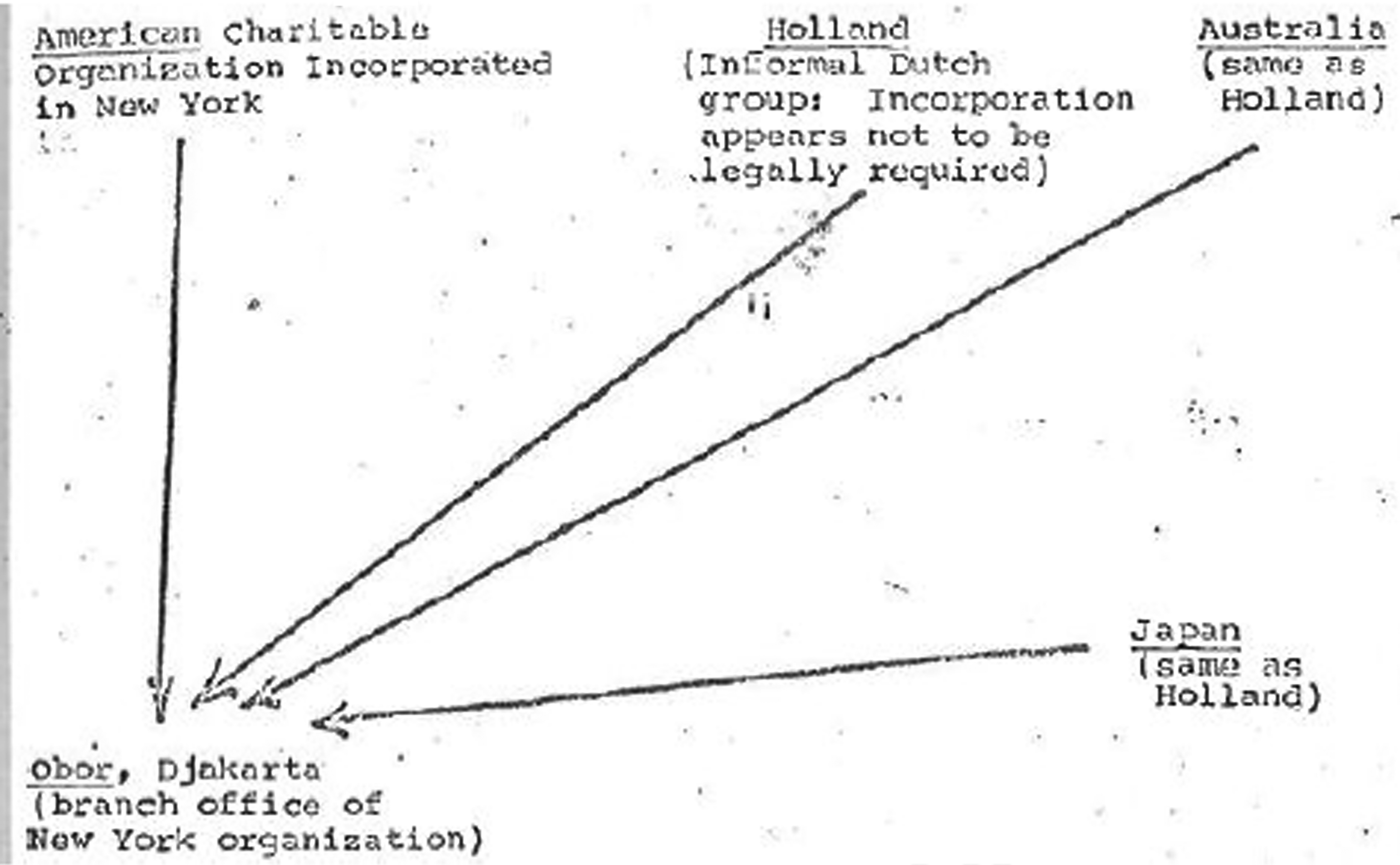 Ivan Kats, ‘A Multilateral Aid Project to Indonesia's Cultural Reconstruction: A Pilot-project in the Field of Publishing’, February 1970.
By 1972 the project was starting to gain traction. Ford's representative in Indonesia, John Bresnan, was still feeling perplexed ‘about the center of gravity in the Obor project’, wanting to press the point that operations had to be run from ‘Jakarta, not New York’. 65 By January 1973, Bresnan had relented due to the impressive level of support coming from Indonesia and elsewhere. At this point, Obor's Council in Djakarta included Goenawan, Soedjatmoko, Ismail, Ojong, Lubis and Budiman, among others. Obor Inc.'s board of trustees was led by former Treasury Assistant Secretary and Agency for International Development administrator John C. Bullitt, and the International Advisory Board included Clifford Geertz and Gunnar Myrdal. Testing the waters one last time by requesting Lubis to acquire a letter of support from ‘an appropriate Cabinet officer’, Bresnan soon received exactly that from Foreign Minister Adam Malik. 66 In May 1973, Suharto himself outlined to a gathering of publishers and intellectuals at the state palace in Bogor that national development relied on the large-scale availability of ‘good’ books to educate the populace. 67 That same year, UNESCO would publish Book Hunger, a study of how the lack of cheap publications in the Global South was holding back development. 68 The political context had now definitely changed in Obor's favour. Kats had won out with his goal of ‘setting the precedent of a new, humbler, and more international approach in cultural exchange programs…. Our chief earmarks – our small size, our informality, our multinationality – are in themselves what matters most to us’. 69 Partially to satisfy Ford’s demands for devolving decision-making and partially for formalising its position within Indonesia itself, in 1975, Yayasan Obor Indonesia (YOI) was registered as a local independent entity under the leadership of Winarti Partaningrat. While the New York-based Obor Inc. led by Kats continued to function for fund-raising, copyright clearance and networking, YOI ran the editing and production process. By 1991 it had grown to consist of 12 employees and was able to cover around 70% of its overall costs through royalty earnings. 70
Kats wanted to do more than simply produce cheap books for mass education. As his previous book project had demonstrated, he saw this enterprise as ‘participation in Indonesia's search for self-definition, both in its restoration of the national heritage and in its encounter with contemporary thought’.
71
Looking back in the early 1990s, he emphasised this point once more: A considerable amount of writing had been done in recent years by American and European specialists, and increasingly by Australians, but Indonesians themselves had practically no role in this writing or scholarship at the time. Indonesia had become an object culture, as it were; the country was being described by foreigners while Indonesians themselves played hardly any role in this evaluation. We saw a real humiliation in this passive status.
72
Obor would soon put together a long list of publications, ranging from environmentalism and family planning to civic activism and philosophy. It sought to publish three types of book: ‘short classics on Indonesia not available in Indonesian translation’; readers on specific subject fields, made up of collected essays by selected authors and meant to serve as basic texts for university education; translations of key works such as Rachel Carson's Silent Spring. 73 Important for the process of incorporating these books into the Indonesian context was the inclusion in every publication of a preface that situated the given text within the local intellectual idiom. In this way Obor paved the way for a sense of local ownership of foreign texts, allowing for selective appropriation and critical examination as opposed to the assumption that texts could simply be transferred across cultures without disturbance.
Turning the tables, Kats now confidently projected the Obor model back to his former mentors. Writing to IACF President Pierre Emmanuel, Kats lamented the ‘exclusively European emphasis’ of the Association's outlook. Returning to the ideal of transnational connectivity that the CCF had sought to nurture in previous decades, Kats emphasised how ‘men who for reasons rooted in their own lives chose to devote their time to the democratic development of their country’ needed ‘a base outside, the protection of an international group. Your [sic] are that group. They can operate only with that protection’. Charting the way forward, Kats referred to Obor as a ‘test case’ where ‘program decisions should rest truly in local hands, while financial backing would be multinational’.
74
Current institutions, private and public, are too large and formal and formidable. Permanent dependence is being created in the poor nations on the richer, while opportunities for native philanthropy remain inhibited. Obor shows, in a very small way, one way of countering this.
75
Kats also mentions that ‘I think I described it to you in 1965’, indicating the long incubation of the Obor model during his time with the CCF. Emmanuel's reply as to the possible example of Obor for remodelling the IACF is unfortunately not recorded.
While Obor did represent a new way forward for cultural philanthropy in the post-CCF years, there are major caveats. It expressed a distinct philosophy of action that placed it apart from previous such operations. The Congress had been about connecting like-minded liberals on the transnational journey of modernisation, with Western ideas providing the guidance. It was about transfer, with little space for adaptation. It also adopted a dogmatic ideological ring-fencing to delegitimise all communist or communist-associated discourse, arguing that ‘true’ culture could only flourish in an ideological-free zone. 76 Obor, in contrast, sought to practice a more conciliatory, facilitatory, and (in the words of Kats himself) ‘humble’ form of liberalism. As Lionel Landry put it in the special issue of Quadrant, it reflected ‘an important recognition that aid planned in a completely ethnocentric America situation can have something wrong with it’. 77 The multinational impetus behind Obor, which eventually brought American, Dutch, Australian and Japanese philanthropic outlets together in conjunction with their Indonesian partners, suggested a shared cause and identity. There is no doubt that he became attuned to the need to escape the Eurocentrism of a Congress based in Paris and relying on telegram, letter and occasional international travel for orientation and liaison purposes with its intellectual allies abroad. As he admitted to his Pakistani contact Sherif Al-Mujahid already in 1963, ‘I must agree that we in Paris or London cannot always take the perspective which we could take if we were in Karachi’. 78
Central to the whole endeavour was the focus on Indonesian ownership. Through its journals and conferences, the CCF had provided outlets for cultural expression around the globe, but still based on the belief in a universalist liberal value system with little to no cultural relativism. In contrast, Obor was about empowering those like-minded groups who were looking to advance their societies by means of Western know-how, but wanted to do so on their own terms. This was in contrast to other publishing operations such as the Franklin Book Program, although Franklin also allowed some regional autonomy. 79 Yayasan Obor Indonesia was incorporated as an Indonesian legal entity with this purpose in 1975, and as of 2021 continues as a major publishing enterprise. 80 Kats thus not only distanced himself from the US-based modernisers of the 1960s, but also tapped into the same zeitgeist of small-scale, local entrepreneurship that make Obor a cultural equivalent to Muhammad Yunus's microcredit Grameen Bank, established in 1976. 81 In a way, Obor was meant to function as a kind of ‘cultural buffer’ between Westernising universalisms, big philanthropy's grand schemes, and the local cultural entrepreneurs themselves, translating philanthropy's patronage both literally (into texts) and symbolically (into defining local needs). The ambition to spread the Obor model elsewhere did yield results, with Mashal (‘torch’ in Urdu) established in Pakistan and Kobfai in Thailand. It would ultimately founder in attempts to expand to Vietnam and the Arab world during the 1990s. But the prime location for the Obor mission was and has always been Indonesia. This was not only due to its crucial significance in the East–West contest of the Cold War, but also for the vibrant internationalism represented by Sukarno's Bandung conference of April 1955, and the search for what Indonesian culture and identity meant in the post-colonial era as a whole. 82
Nevertheless, it is important to avoid romanticising the Obor approach as some kind of perfect, culturally sensitive aid operation. Kats was a linguistic polymath, speaking English, Dutch, French and Spanish, and a cosmopolitan, being from a Belgian Flemish Protestant-Jewish family background and becoming an American citizen. Yet he was never able to master Bahasa Indonesian despite taking courses at Yale, and he always corresponded with the Obor offices in Jakarta in English. He respected local autonomy, yet often ran into confrontation with the Yayasan Obor office due to disagreements over decisions. From this perspective, it is hard to portray him as the even-handed ‘cultural broker’ he saw himself to be. 83 James Scott, the renowned anthropologist based at Yale who knew Kats well, described him later as a ‘cosmopolitan elitist’ who was devoted to Indonesia’s modernisation in a Western-orientated image. Kats would almost certainly have denied it himself, but there is a strong neo-colonial, even patrician air surrounding his mission to Westernise Indonesian intellectual life. John Shingler, another Yale contemporary, spoke of Kats’ aim to introduce Western intellectual traditions to bring ‘a wider expanse of freedom and stability’ to Indonesian intellectual life. 84 Even though Sukarno's regime was forged on nationalist anti-colonialism and Suharto's on military authoritarianism, the space for critique in civil society was equally narrow under both regimes. Mochtar Lubis was imprisoned by both Sukarno and Suharto for demanding the right of freedom of expression in the press, an indication that the margins for manoeuvre in the fields of cultural expression were narrow, regardless of which regime was in power. Ivan Kats wanted to widen those margins in the name of a Western-style liberalism adapted to local needs, but to do so he also acted in tandem with the interests of an exploitative regime that used ‘the same methods of domination and coercion like its colonial predecessor’. 85
Ultimately, Kats’ wish to write the history of the cultural liberalisation of Indonesia met with only partial success. The Manikebu (Cultural Manifesto) circle, providing the local intellectual foundation, was able to use Obor as a vehicle for their own ends, but they also had to compromise with the New Order demands of the Suharto regime. Indonesia's modern history would be written not by the intellectuals alone, but by the military. By enforcing interpretations of its own leading role in society, the military was able to ‘promote internal military unity, bolster its legitimacy and create a sense of ever-present enemies within Indonesia society’. 86 Kats and Obor were able to negotiate their way through this political force field, compromising principles along the way to ensure that, via their publications, at least a truncated version of liberalism would maintain its presence within Indonesian civil society.
Footnotes
Acknowledgements
The author would like to thank Greg and Nicolas Kats, Anne Foster, Taufiq Hanafi and colleagues at the KITLV for their assistance with this research.
