




Abstract
This article sheds light on why there was, and why Nazi Germany pursued, only comparatively little economic cooperation between the two most important axis partners, Italy and Germany, during the Second World War. In particular, the article looks more closely at the two countries’ cooperation in terms of raw materials, crucial to the war economy: why did Germany not deliver more raw materials to Italy and why did an underutilized Italian industry not export more manufactures to the Reich? Based on comparisons with other axis partners and occupied nations, the article argues that this was primarily the case because Italy could resist German economic pressure and, in contrast to many other countries in wartime Europe, maintained its sovereignty. Unlike Italy, these other countries readily (if not always voluntarily) financed larger bilateral German balance of payments deficits at favourable conditions and could not prevent Germany from implementing and monitoring a rigid raw material regime in their factories. Under these circumstances, greater economic cooperation with Italy seemed too costly to German officials and economic experts. Ironically, economic cooperation between the two Axis partners was so limited precisely because they were allies.
Keywords
Allied cooperation during the Second World War is commonly characterized as a success story. By contrast, the Axis is normally seen as a dysfunctional alliance driven by national egotisms, without shared political goals and a common strategy, beset by distrust. 1 The Axis alliance, scholars have shown, lacked just those elements that made the Allies successful, as a joint planning of military campaigns and a common policy of sharing scarce resources in the field of war economies. In the course of the war, David Reynolds holds, ‘Germany, Italy and Japan would squander their advantages through … an overall failure to cooperate.’ 2 The economic cooperation between Italy and Germany, the two most important European Axis partners, is considered especially flawed, to the strong detriment of the Axis’ overall war effort. True, Italy sent workers to the Reich to mitigate Germany's huge workforce shortage, and, according to official trade statistics, the two countries became each other's most important trading partners. But scholarship on German – Italian economic cooperation – sparse to begin with – paints a rather negative picture. 3 Ambitious plans for economic cooperation, such as the creation of an integrated ‘Großwirtschaftsraum’ (economic autarky sphere) were tellingly never realized. 4
Several factors are usually said to have hindered a stronger bilateral economic cooperation, particularly the development of even closer trade relations: shortages, a lack of economic complimentary, diverging interests, rivalry, egoism and mutual distrust. 5 Some scholars highlight that the shortage of raw materials and transportation problems greatly limited the trade of raw materials. The Nazi regime did not ship raw materials to Italy (although Italy increasingly depended on German supplies from mid-1940) to the extent it had promised and in 1942 even reduced its deliveries. Instead of cooperating, the two countries competed for scarce raw materials in south-eastern Europe. Others hold that the underemployed Italian industrial capacity was not further utilized for German orders because of a dispute about how to finance them and, in particular, because of a German neo-mercantilist trade policy that sought to maximize exports of manufactures and restrict their imports. 6 This trade policy, it is argued, made the Nazi regime reluctant to supply Italy with raw materials so as not to decrease the Italian import demand for German manufactures. In addition, keeping production in the Reich meant that goods could go directly to the Eastern front which Hitler considered a far more important theatre than the Mediterranean. All these interpretations suggest that Italian – German economic relations were primarily driven by national interest – not the demands of a joint war effort.
Yet, these interpretations have some serious flaws: First, the hypothesis of raw material shortages as a barrier to cooperation is contested; it is not clear whether the Third Reich could have increased supplies to Italy without reducing its own ability to wage war. 7 The Italian case has not been thoroughly examined in the light of Germany's actual raw material supply situation. Second, scholars have not really explored the claims made by German authorities that their supply decisions were driven by economic considerations, aiming to maximize the joint output of the Axis. Scholars working on German – Italian relations often mention a statement of Hitler made during a meeting with the Italian ambassador Dino Alfieri in late 1940, in which the ‘Führer’ outlined his ideas of efficient German – Italian economic cooperation. 8 In cases, in which raw materials were not scarce, they should be delivered to Italy to make use of its underutilized workforce and industrial capacities. However, when raw materials were scarce, the joint output could be maximized by sending Italian workers to the Reich (and German manufactures to Italy) because of German advances in substitution and conservation. However, this statement suggesting a division of labour between the Axis partners as well as similar German claims remain essentially uncommented. Instead some authors speculate that traditional German export interests may have played a role in proposing such a division of labour. 9 These claims, it is sometimes suggested, were at least partly instrumental or a pretext. Yet, it is doubtful whether a neo-mercantilist doctrine really defined Nazi Germany's trade policy during the war. New findings show that wartime Germany imported a huge number of manufactures, especially for the Wehrmacht, from all over Europe. 10 To get to the bottom of Italian – German economic cooperation, then, requires a reexamination of their bilateral trade relations in a comparative perspective. And was there really, as Hitler claimed, a gap between Italian and German industries with regard to substitution and conservation? And if so, in how far were substitution considerations to blame for the low level of cooperation? Would more cooperation really have maximized the joint war effort, as scholars seem to assume? Put differently, was Germany's behaviour economically wise or was it shaped by different considerations, such as Germany's post-war export interests or even, as in the military sphere, by prejudices and stereotypes towards Italy 11 ?
In addressing these questions, the article makes at least three contributions. First, it deepens our knowledge of the bilateral economic relations between Italy and Germany during the war, an area that decisively shaped the relationship and the power imbalance between the two Axis partners. Secondly, by comparing German – Italian economic relations to Nazi Germany's economic relations with other countries at the time and by considering new findings of its strategic raw material policy we can identify more general factors which hampered or fostered from a German perspective economic cooperation in wartime Europe. Third, this article challenges the general premise of many scholars that the lack of economic cooperation weakened the Axis economic war effort; under the prevailing circumstances and at least from a narrow economic perspective this was not the case.
The article is structured in four sections. Section I shows that the scope of German raw material deliveries was not only restricted by a lack of availability and transport problems but also, exactly as sometimes claimed, by a lack of German willingness. Based on a revision of Germany's import statistics I argue in section II that the unwillingness of the Nazi regime was not caused by a German neo-mercantilist trade policy. In fact, the Nazi government fundamentally changed its trade policy during the war, making the Reich a net importer of manufactures. Yet, Italy did not considerably benefit from this change; Italy's relative importance as a supplier even significantly declined between 1940 and 1943, especially in favour of occupied countries. As Section III shows this relative decline owed to the fact that Nazi regime could force the occupied countries to finance Germany's net imports, whereas Italy granted only small loans with not very favourable terms, compared to some allied partners of the Reich and even some neutral countries. German authorities were also reluctant to supply Italy with more raw materials and to place industrial orders in the underutilized Italian industry because of a significant technological gap in terms of substituting and conserving scarce strategic raw materials, as shown in section IV. Moreover, Germany could not monitor the Italian industry's economical use of scarce raw materials to the same extent as in occupied countries and smaller Axis countries. Yet, contrary to scholarly opinion, German behaviour did not undermine but actually maximized the productivity, that is, the efficient use, of scarce raw materials. Ironically, then, the economic cooperation between the two countries was limited precisely because they were allies. As the article's comparative perspective shows the fact that Italy was not really an economic satellite state and could usually resist German demands, led Germany to abstain from entering deeper economic cooperation with what was otherwise its closest ally. 12
Italian – German economic cooperation – or the lack thereof – can be very well explored through raw materials. Raw materials were usually comparatively short in the area dominated by Axis powers just as they are indispensable for war economies. Without iron ore, copper, nickel and other raw materials, there will be no tanks, shells or aircrafts; without fuel aircrafts cannot fly, war vessels cannot sail, and tanks cannot roll. With regard to raw materials, the two Axis partners were only to a limited extent complimentary. 13 In the case of nonferrous metals such as copper and tin, many steel alloys like nickel, or oil both countries predominately or near exclusively depended on imports. Since a substantial part of these imports came from overseas both countries were also extremely vulnerable to sea blockade. Only in the cases of bauxite, pyrites, coal, mercury and vanadium, of which one of the countries was short, the other country had abundant deposits or (as was the case with vanadium) large production capacities. As a consequence, both countries had agreed to trade exactly these complimentary raw materials in case of war. 14 Already before the war coal supplies from Germany had been important for the Italian economy. When Britain threatened to blockade Italy's coal supply if it failed to announce its permanent neutrality in March 1940, German guarantees to fully supply Italy with this commodity proved one decisive factor for Mussolini's entry in the war on the side of the Reich a few months later. 15
Yet, abundance in one country did not necessarily imply sufficient supplies for the other country. Additional factors like labour shortages and transport capacities constrained supplies. As a consequence, German wartime coal deliveries were, as already during the pre-war period, often in arrears and produced diplomatic tensions between the two countries. 16 The shortage of sufficient transport capacities doubtlessly contributed to this situation. 17 But the Nazi regime also seems to have been unwilling to fully support its partner because, measured by its energetic level, the quality of the coal shipped to Italy deteriorated substantially over time. 18 One could object, of course, that coal was indeed short in the German war economy and that Germany eventually almost completely delivered the quantities it had promised. However, there are also examples of strategic commodities, in which the situation was different, such as steel and copper. In the case of these commodities, Italy was substantially relying on German supplies, too. In contrast to Italy, the German steel industry had a sufficient supply of iron ore during the war because of access to Swedish ores and deposits in occupied Western Europe as well as in the Reich. The steel production of Germany (and the territories under its control) was limited by labour shortages and not the lack of industrial capacity. But with steel, too, the Nazi regime did not fully meet its delivery promises and the quality of the supplies deteriorated. 19 In addition, German negotiators did not only disguise their own supply situation in order to mitigate Italian demands but also provided outright false information. In early 1942, they justified arrears in the delivery with a shortage of steel. Yet, this claim is not quite convincing, at least if one does not rely on the (inflated) demands made by the Wehrmacht. A different story emerges if we instead analyze the figures on German steel production as well as steel consumption, the latter of which implicitly consider the workforce constraint in the German war economy: in 1941, monthly steel production surpassed monthly consumption by 200,000 tons. 20 This was more than enough to cover the shortfalls of the deliveries to Italy. This was not the only time Germany provided false information: in summer of 1942, the German economic minister, Walther Funk, told to the Italian minister for foreign trade, Raffaello Riccardi, that the Reich had to reduce its steel exports by 50 per cent given that the German production would have experienced a ‘massive reduction’ since 1941 but the German armament programs would require an increasing supply. 21 Yet, there was no massive reduction in steel production. 22 And although the Germans tried obscure their production figures, the Italians were quite aware that the steel supplies they demanded were minuscule compared to the German production. 23
The example of the strategic raw material copper, important for a range of armaments such as shells or electrical equipment, suggests, too, that the low level of cooperation owed not always to physical shortage or (given the very small quantities of supplies demanded by the Italian government) a lack of transport capacities. When in early 1942 Italy asked the German negotiators to increase the monthly copper deliveries from 1850 tons to 3000 tons, they refused. 24 German authorities in turn wished to reduce supplies to only 1200 tons; in the end, Italy had to accept 1650 tons. One could assume that this behaviour was caused by both countries’ reliance on imports to satisfy their demand, i.e. that the Reich was simply not able to deliver the amount desired by the Italian government, as indeed German negotiators claimed. Yet, on closer inspection, such an interpretation is too simplistic and even outright wrong. In contrast to Italy, Germany had built up considerable stocks when the war started and in addition to domestic sources such as ores and recycling, it could cover a substantial amount of its copper needs by metals looted in Western Europe and deliveries from German-dominated Europe. 25 When the Italian government asked for an increase in Germany's copper deliveries, German stocks were thus only slightly lower than they had been in September 1939. Increasing its copper deliveries to Italy from 1942 onwards would have reduced the ability of the Reich to wage war – based on that raw material – by about 6 months, or from 29 to 23 months. 26 In early summer 1942, Germany's supply prospects were even significantly better because the Nazi government had just decided to replace copper wires across the country with open wires made of aluminium and an iron-zinc alloy. 27 A least at this point of the war, increased deliveries to Italy would have been easily possible. But the German negotiators even claimed that the Reich's copper supply had further deteriorated. 28 Due to the German refusal to increase supplies, 14 m. shells produced in Italy could not be finished; a situation the German authorities were well aware of. 29 In early 1943, the German supply situation had further improved owing, especially to substantial substitution and conservation measures. From 1943 on, satisfying Italy's demand (the Italian government demanded 2,600 tons per month) would have made Germany run short of copper in the late summer, rather than December, of 1946! 30 But instead of supplying Italy, the German economic administration claimed that the German situation allowed for no more than 800 tons to be supplied. 31 In mid-1943, when German stocks had grown even larger German negotiators refused to increase the monthly copper deliveries by 400 tons for the second half of the year unless Italy allowed Germany to run a metal mobilization – a collection of metal items still in use – in the Italian zone of occupied France. 32 In other words, the Nazi government could have easily delivered substantially more copper to Italy without jeopardizing its ability to wage war in the medium term (in early 1942) or even in the long term (from mid-1942 on). In the case of some other metals, the situation was similar.
These examples confirm the suspicions of the Italian Under-Secretary for War Production Carlo Favagrossa that Germany was – at least in some instances – more unwilling than unable to deliver raw materials. 33 But why did the Nazi government hamstring, or so it seems at first glance, the common war effort and allow the joint armament output to go un-maximized? Was it because of the German neo-mercantilist trade policy, i.e. because German authorities preferred to export manufactures, as they had during the pre-war period? To address these questions, it is necessary to turn briefly to German – Italian trade relations.
German wartime import data, long used by scholars to analyze German – Italian trade relations, have recently been shown to have grossly underreported the true size of German imports. 34 Several factors were responsible for the underreporting of German imports in the official trade statistics. One important reason, and crucial for the examination of German – Italian trade relations in a comparative perspective, was that from 1939 on imports of the so-called Wehrmachtgut (goods owned by the Wehrmacht or goods imported to be used directly by the military) were exempt from statistical registration. 35 This leads to the stunning insight that goods produced on the behalf of the Wehrmacht all over Europe, i.e. in Axis, neutral and occupied countries, are only partly included in official German trade statistics. 36
Revised, and more accurate, data, however, show that German imports were at least twice as high as those reported in official trade statistics. 37 Yet, this was not true for Italy. Actual imports from Italy between 1940 and 1942 only slightly exceeded those displayed in the official German trade statistics and imports from Italy grew significantly slower than those from many other countries, especially from occupied countries. 38 In contrast to what the official trade statistics suggests, Italy became not more important as a supplier for Germany during the war; at least prior to its occupation. Nor was it even ranked high among the most important import countries. According to official statistics, Italy was Germany's single most important trade partner. In reality, it was less important than the ‘Protectorate’, France, Netherlands and Belgium in 1942. 39 This massive decline in Italy's relative economic importance corresponds to the political – military power balance between the two Axis partners, which shifted strongly in German favour from 1940. This decline was the result of the German occupation of large parts of continental Europe. This clearly affected Italy's negotiating position towards Germany when it came to German exports of armaments or raw materials.
Based on revised statistics, it becomes clear that the German import boom did not only change the rank order of Germany's most important suppliers but also its import structure: the Reich became a country that predominantly imported manufactures, i.e. manufactures for final use and intermediate products according to the German trade taxonomy. 40 Italy benefitted from the German import boom, enabling the country to export – as wished during the pre-war period as part of its industrialization strategy – an increasing share of manufactures. 41 Yet, Italy underperformed: whereas its share of manufactures had been above the average on total German imports before the war, Italy fell increasingly behind during the course of the war. 42
Responsible for the structural change of Germany's import composition towards manufactures and the reason why more and more countries surpassed Italy as major German suppliers was primarily the so-called Auftragsverlagerung, i.e. the placement of industrial orders for manufactures by German companies all over Europe fostered by the Nazi government. 43 German companies began placing orders all over Europe starting in 1939; first in annexed countries, and increasingly from 1940 in occupied, and from 1941 in allied and even neutral countries. 44 If necessary, Germany normally shipped raw materials and semifinished goods required to carry out these orders to the respective countries. In order to stimulate its industry to place orders abroad, the German authorities provided a range of incentives and tried to push companies. Auftragsverlagerung included civilian products and armaments, but orders on behalf of the Wehrmacht clearly dominated. By placing civilian orders abroad, German authorities aimed to free up domestic industrial capacities for armament production and, by using idle capacities of foreign companies, to avoid unnecessary investments. In the case of armaments, orders were placed predominantly for intermediate goods, not manufactures for final use. This was not, as Italian authorities believed, due to the alleged German neo-mercantilist policy with a close eye on postwar competition, but rather the result of general German considerations. 45 From the late 1930s, the German authorities fostered an increasing division of labour and outsourcing in the production of armaments to realize economies of scale and learning effects. Moreover, the production of intermediate goods made it easier for companies to adapt to the frequent changes and modifications of the armaments without additional investments. 46
From this follows that some scholars’ interpretations of Nazi trade policy during the war, and alleged German motives in wartime cooperation with Italy, are inaccurate. The Nazi government did not, as in the pre-war period, adopt a neo-mercantilist trade policy, i.e. fostering the exports of manufactures with the help of substantial subsidies and constraining their import. 47 Quite the contrary, Germany adopted the very opposite approach: its goal now was to attract especially imports of manufactures by manipulating exchange rates, by providing incentives for Auftragsverlagerung, and even, in the second half of the war, by subsidizing imports. 48 This fundamental change of the German trade paradigm was a pragmatic consequence of the insatiable demand of the German war economy which simply could not be met by the domestic industry. Accordingly, German authorities deserted not only their pre-war trade policy, but de facto at least from 1941 also the doctrine of the so-called ‘supplementary economies' in South-eastern Europe, i.e. the idea of a division of labour between the highly industrialized Reich in the core and the more backward countries on the periphery focusing on the production of foodstuffs and raw materials. 49
This fundamental change in German trade policy can not only be traced in German import statistics, as shown above, but also in the case of exports: whereas over decades, propelled by export subsidies during the 1930s, the share of manufactures on German exports was rising, it dropped sharply during the war. 50 This applied also for German exports to Italy. 51 This new trade policy was not welcomed by export-oriented German industrial companies, nor was it observed with enthusiasm in the German Foreign Office (Auswärtiges Amt), tasked with executing trade negotiations based on the guidelines made by the Reich Economic Ministry (Reichswirtschaftsministerium). 52 Besides continuing to lobby for the export of manufactures, German companies developed different strategies to delay (or avoid altogether) placing orders abroad which they had promised to governmental agencies. 53 They were especially reluctant to place civilian orders abroad, out of fear of strengthening their postwar competitors. This was especially the case because placing orders normally included a transfer of blueprints and tacit production knowledge. 54 This reluctance partly explains why armament imports far exceeded the import of civilian manufactures.
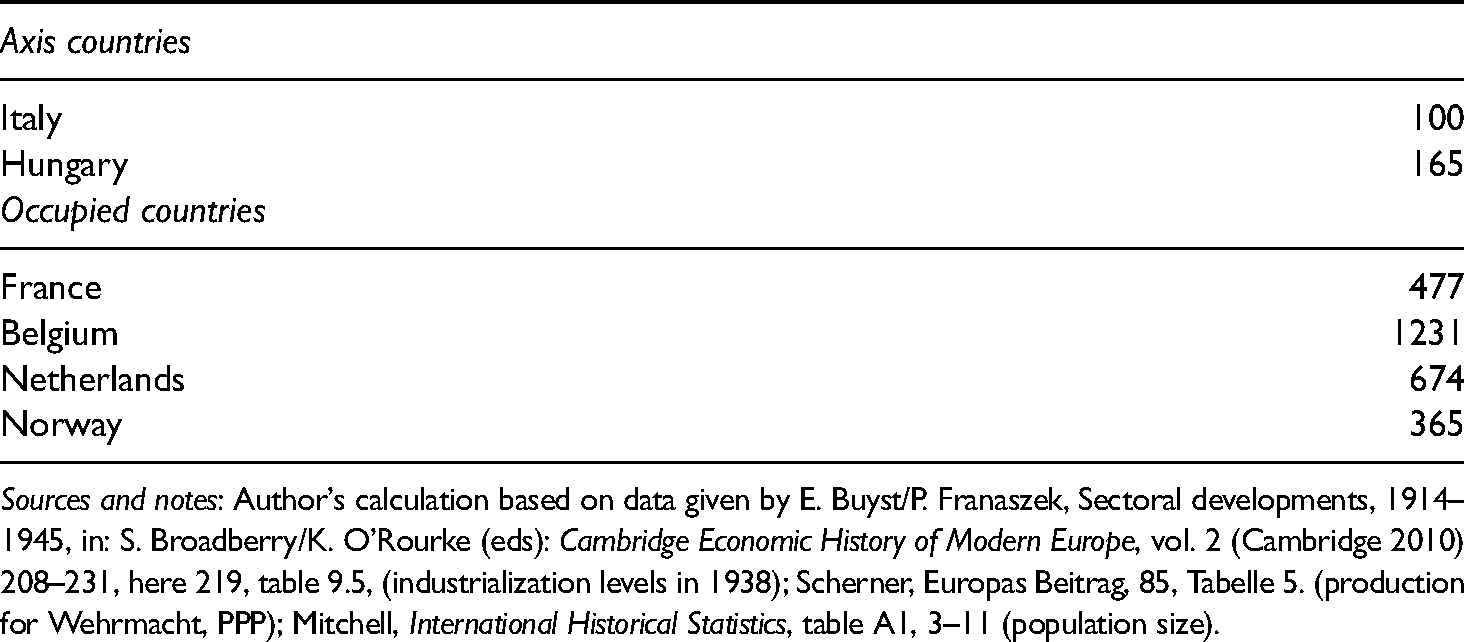
As should be clear by now, the German government had a pronounced interest in increasing the import of manufactures during the war. But why did Italy not fully benefit from this new policy? This is all the more puzzling since Italy's industrial capacities, measured both in terms of capital stock and labour, were significantly underutilized, and German authorities were well aware of that. 55 In early 1942, both Axis partners estimated that based on existing capacities it should be possible to place annual armament orders amounting to at least 4–5 bn Lire (about 600 m RM). 56 Yet, these levels were never even remotely realized before the occupation of Italy; on the contrary, less than 30 per cent of possible orders were produced in this period. Compared with other countries, adjusted for purchasing power parities (PPP), pre-war industrialization levels and population size, industrial production on behalf of the Wehrmacht in Italy was quite low, as Table 1 shows.
Industrial production for the Wehrmacht in 1942, adjusted by industrialization level and population size (PPP) (Italy = 100).
Sources and notes: Author's calculation based on data given by E. Buyst/P. Franaszek, Sectoral developments, 1914–1945, in: S. Broadberry/K. O’Rourke (eds): Cambridge Economic History of Modern Europe, vol. 2 (Cambridge 2010) 208–231, here 219, table 9.5, (industrialization levels in 1938); Scherner, Europas Beitrag, 85, Tabelle 5. (production for Wehrmacht, PPP); Mitchell, International Historical Statistics, table A1, 3–11 (population size).
Table 1 suggests that this low amount may have been caused by the country's status vis-à-vis the Reich: as far as data are available, adjusted real exports of Wehrmacht orders were larger in occupied countries than in Axis countries. This can also be shown for Italy. After the country was occupied by German troops, orders carried out on behalf of the Wehrmacht increased sharply. In 1944, they were (in constant prices) about three times higher as in the years 1941 and 1942 though only the (highly industrialized) northern part of Italy could be used for German orders. 57 Yet, as Table 1 shows, the amount of orders placed in Italy before 1943 was also low in comparison with Hungary, another Axis member. 58 In addition, the Hungarian industry benefitted significantly from the huge German demand for manufactures in general, i.e. beyond Wehrmacht orders, which in turn propelled the country's industrialization: Hungarian exports of manufactures to the Reich increased by a factor of 16 between 1940 and 1942, far more than the Italy's factor of 7. 59 As a consequence, and in contrast to Italy, Hungarian industrial capacities were fully utilized, even producing a shortage of industrial workforce from 1942 on. 60 The comparatively low amount of orders placed in Italy did not go unnoticed in Germany. In late 1942, Emil Leeb, head of the Heereswaffenamt, an agency of the German army in charge of R&D in weapon technology and of the procurement of armaments, complained about the lack of cooperation between the Axis partners. 61 In his eyes, they did not sufficiently exploit their synergies. Besides highlighting the problem that each army had their own weapon types preventing an efficient all-Axis production which exploited economies of scale and avoided unnecessary R&D efforts he emphasized especially the ‘embarrassing low amount’ of armament orders Germany had placed in the underutilized Italian industry. 62
Archival sources make clear that this was not due to a lack of interest on the part of Italian companies to produce for the Reich. Similar to Hungarian firms, for example, they even seem to have preferred to carry out German orders over those of their own government. 63 Nor is there any evidence that German companies would have preferred to place orders in countries other than Italy; their interests were generally defined by the considerations above. In German documents, several factors are mentioned in order to explain the ‘embarrassing low amount’ of industrial orders carried out in Italy 64 : (i) the lack of raw materials in Italy; (ii) the problem of how to pay for these orders, that is, in kind (through armaments or raw materials) or in money, (iii) the inefficient Italian war administration, and (iv) the uncooperative attitude of the Italian war administration. The latter, in particular, was considered some sort of retaliation for the arrears of German raw material supplies, for increasing German clearing debts and for German criticisms about the Italian allocation system, which the Italian authorities deemed intrusive. Finally, the uncooperative attitude was due to asymmetric information-sharing among the partners. The Nazi government insisted that Italian authorities should reveal more information about its armament program, while being unwilling itself to provide information on its production and consumption of strategic raw materials. Most of these problems could, as the German war administration was well aware, be changed by Germany herself. 65 So why was the Nazi government reluctant to do so?
Two factors seem to have been responsible for the German policy. The first relates to the balance of payments. The specific neo-mercantilist trade policy the Nazi government had pursued before the war was caused by the balance of payments restrictions the Reich faced in the 1930s. In order to earn enough foreign exchange to finance essential imports, i.e. foodstuffs as well as raw materials and semi-finished goods for rearmament Germany had to export manufactures. 66 Manufactures that could be produced domestically should not be imported because Germany's foreign currency reserves were chronically low, and because it could not hope to attract substantial foreign loans to cover trade deficits at least after its one-sided debt moratorium in 1934. The clearing agreements the Nazi government signed with more and more countries during the 1930s did not substantially alter this situation. 67
The outbreak of the war and the conquest of large parts of Europe fundamentally changed Germany's balance of payments situation. 68 In order to foster exports from occupied countries to the Reich, it fixed exchange rates that overvalued the Reichsmark relative to the currencies of occupied countries. At the same time, the Nazi government forced these countries to grant Germany substantial clearing credits. A second source of foreign credit besides clearing stemmed from Reich treasury bonds some occupied countries had to buy. De jure all these funds were credits foreign countries granted to the Reich, de facto they were an important exploitation device. This is not only evident by the fact that the Nazi government dictated the terms and amount of these loans but also by German plans that future reparations by the occupied countries would offset these commercial debts. Finally, occupied countries had to pay occupation tributes, which far exceeded the actual occupation costs as fixed by international law. 69 All these financial means – of which occupation tributes were the most important – freed the Reich from any balance of payments restrictions during the war with the occupied countries.
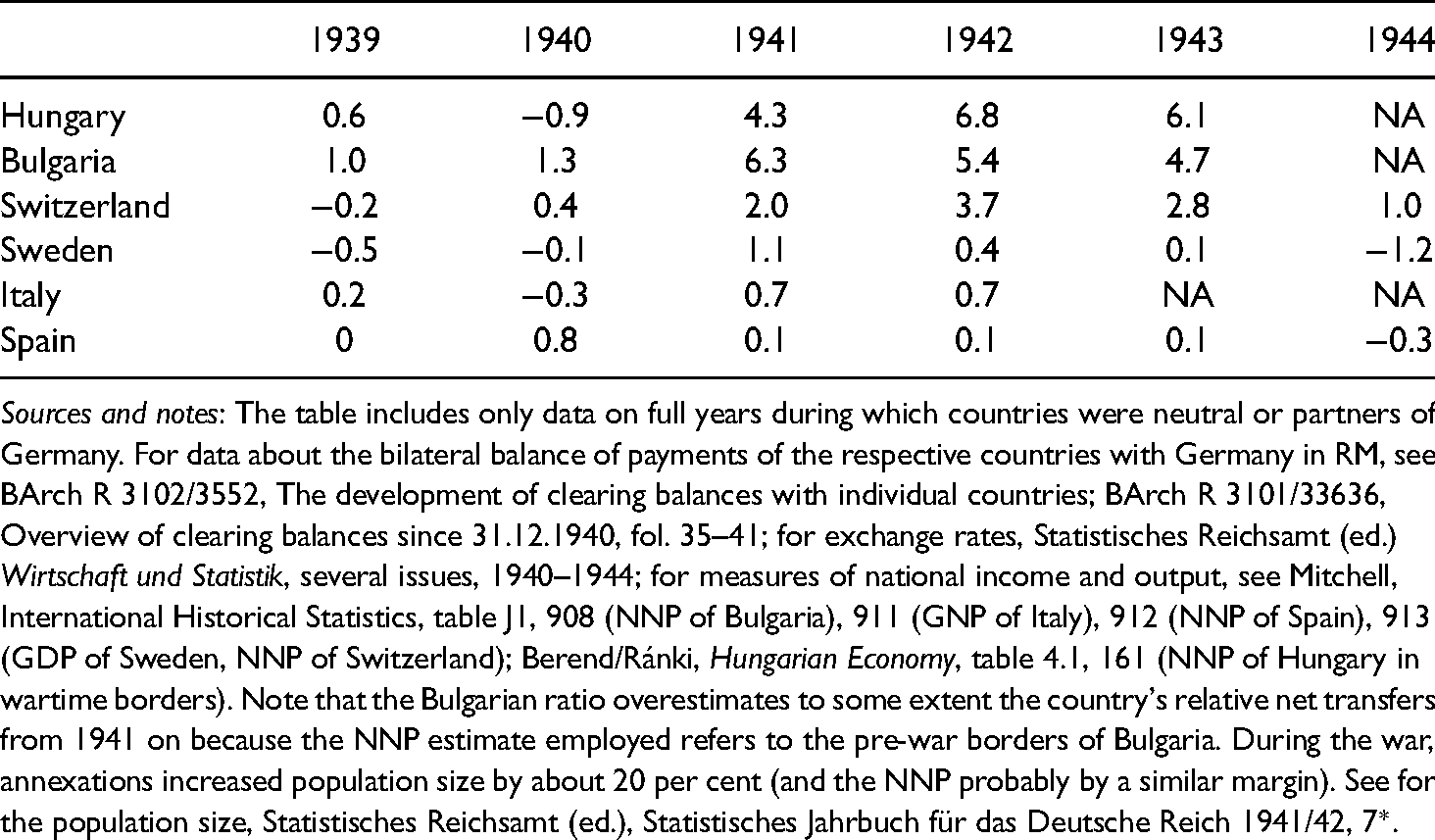
Normally, Germany's allies, as well as some neutral countries, were, at least when the war seemed to develop in favour of the Reich, willing to grant some loans. Yet, these loans were small compared with the financial means the Reich got from occupied countries. Compared to some Axis countries and even to some neutral countries, Italian loans were not especially large. This is shown in Table 2, which relates the annual net transfers of several neutral and Axis countries, i.e. their balance of payments surpluses with Germany, to measures of national income and output of the respective states. Scholars have put forward the plausible proposition that the size of net transfers to Germany in war-time Europe indicates in how far a neutral or Axis country was de facto a satellite of the Third Reich. 70 If we accept this plausible proposition, we have to conclude that at least in the realm of the war economy Italy (as long it was not occupied) was not really a German satellite during these years, certainly less so than Hungary, Bulgaria or Switzerland at the same time.
Relative net transfers to Germany of some selected not-occupied countries, 1939 – 44 (in per cent).
Sources and notes: The table includes only data on full years during which countries were neutral or partners of Germany. For data about the bilateral balance of payments of the respective countries with Germany in RM, see BArch R 3102/3552, The development of clearing balances with individual countries; BArch R 3101/33636, Overview of clearing balances since 31.12.1940, fol. 35–41; for exchange rates, Statistisches Reichsamt (ed.) Wirtschaft und Statistik, several issues, 1940–1944; for measures of national income and output, see Mitchell, International Historical Statistics, table J1, 908 (NNP of Bulgaria), 911 (GNP of Italy), 912 (NNP of Spain), 913 (GDP of Sweden, NNP of Switzerland); Berend/Ránki, Hungarian Economy, table 4.1, 161 (NNP of Hungary in wartime borders). Note that the Bulgarian ratio overestimates to some extent the country's relative net transfers from 1941 on because the NNP estimate employed refers to the pre-war borders of Bulgaria. During the war, annexations increased population size by about 20 per cent (and the NNP probably by a similar margin). See for the population size, Statistisches Reichsamt (ed.), Statistisches Jahrbuch für das Deutsche Reich 1941/42, 7*.
These comparatively small transfers from Italy were the result of cumbersome loan negotiations. 71 Hungary, Bulgaria and Slovakia, on the other hand, immediately granted loans to Nazi Germany at the same time and were – in the eyes of the Germans – rather cooperative. 72 Not surprisingly, the amount of orders German agencies intended to place in small Hungary in 1943 alone matched those placed in big Italy between 1941 and May 1943. 73 Without doubt, the size of loans was one major factor in the amount of orders placed in a country. When Romania, for example, declined to increase a loan, the economic representative of the Wehrmacht recommended placing an order for mines in occupied countries instead of Romania. 74 In addition, the financial conditions of Italian loans were less attractive than those of some other axis partners: Germany had to pay interest rates, and they had only short-term character. 75
Yet, the size and the financial conditions of loans in favour of Germany were not the only factor in the low amount of orders placed in Italy. In fact, only about half of the credit line offered by Italy for German orders was used at all. 76 The explanation also lies in the issue of raw materials. Italy requested not only raw materials necessary for carrying out the German orders (a fairly commonplace practice) but in contrast to other Axis partners also demanded to get paid the value added of the production through additional German supplies of scarce raw materials or to get the fossil fuels necessary for production. 77 This was unacceptable for the Nazi government. In addition, Italian loans would have to be repaid in kind. 78 But it was especially a third and very important factor that made the German authorities reluctant to place more orders in Italy, namely the question of the efficient use of the raw materials. This question was of utmost importance, as clearly shown in Hitler's statement mentioned above and in internal sources of the Reichswirtschaftsministerium and the Reich armament ministry, responsible for the raw material allocation. 79 This situation also explains why German authorities were not willing to increase their supplies of raw materials where possible, and why they even tended to cut their supplies over time.
With regards to the question of the efficient use of the raw materials, three specific reasons made German economic authorities reluctant to fully meet the Italian raw material demands and to place more orders in the Italian armament industry. They feared first that the raw material demands made by Italian companies for carrying out German orders would be inflated, and that a part of these raw materials would be used to produce non-war-related commodities like consumer goods. 80 As they explicitly noted, it was crucial to prevent short raw materials being used in Italy for purposes prohibited in the Reich. 81 Second, they assumed that the Italian authorities, too, exaggerated Italy's raw material need to get more deliveries from Germany and use them in the civilian sector, probably to pacify the population. 82 Third, the Germans feared that raw materials – even if used for the designated purpose – would be less economically used than in Germany. 83
All these concerns were not unjustified. Let us start with the last point. Archival sources abound with examples of German authorities and experts believing that the Italian scarce raw material productivity (RMP), i.e. the ratio between output and the input of raw materials was lower than the German one. 84 These claims were neither a pretext for denying supplies nor unjustified. First, such German claims can also be found in documents for internal use and in reports of bilateral expert commissions which were set up from late 1940 on the instigation of the Nazi government to identify possibilities to conserve scarce raw materials. 85 Second, the sources clearly show that this was not a universal critique; there are also cases in which German experts believed that the differences were not significant. 86 Consequently, when German authorities believed, based on information available and German consumption patterns as a yardstick (a common practice), Italian demands to be justified, they met them; if not, they did not. 87 Third, there are also data on actual consumption (for Germany) or consumption requirements (for Italy, where actual consumption data are not available) of key raw materials which clearly suggest that the German RMP far exceeded Italy's in the case of strategically important raw materials such as copper and nickel in 1940, i.e. when Hitler outlined his ideas on German – Italian division of labour. Copper could be substituted by steel (in the case of ammunition) and aluminium (in the case of electrical equipment). Nickel, which was almost exclusively used as a steel alloy, could be conserved by innovative steel types or be replaced by other alloys. Thus, comparing in both war economies, the ratios between the demanded or actual consumption of copper or nickel on the one hand and the one of steel (or also aluminium in the case of copper) on the other hand suggests how economically these scarce nonferrous metals nickel and copper were used. The data show that the ratio between the amount of copper and aluminium requirements in the Italian economy was almost four times bigger than the respective consumption ratio in Germany; the one between copper and steel almost twice as high. 88 In the case of nickel, Italian relative requirements exceeded the German ratio by 25 per cent.
This higher RMP in Germany was not only due to the fact that the country was technologically more advanced but also a result of different path dependencies stemming from the different experiences of the Great War. During the Great War, the Reich had to cope with blockade and to implement substitution and conservation measures on a grand scale. Learning the lessons from this experience, the Nazi government implemented a specific policy during the 1930s aiming for war preparation. In the case of nonferrous metals, this specific policy started in Germany already in 1934, producing soon impressive effects. 89 In 1936/7, for example, the use of substitutes, such as light metals or plastics, and metal-conserving constructive modifications had reduced the domestic consumption of copper already by 31 per cent. In the late 1930s, the content of nickel in construction steel was reduced by 80 per cent compared to 1935/6. Based on pre-war preparations, this policy continued after 1939 particularly in the armament sector. In the ammunition production, for example, the use of copper, which hitherto made up about two-thirds of the total copper amount allocated to the Wehrmacht, was increasingly substituted with steel. In early 1941, the copper – steel ratio of the ammunition production had been reduced by almost 70 per cent compared to pre-war levels; one year later by almost 95 per cent.
In contrast, Italy's pre-war autarky policy seems to have been far less comprehensive than one of its Axis partners. 90 Compared to Germany, it was rather a latecomer with regards to substitution and conservation research for scarce raw materials. 91 When the German industry had already significantly and successfully replaced tin and copper, Italians reported many technical problems in this field. 92 Despite some success, pre-war plans to substitute and conserve scarce metals were widely not implemented. 93 Substitution of copper with aluminium in the electrotechnical industry seems to have started only in the late 1930s. 94 The recycling of aluminium scrap started only after Italy was involved in the war, i.e. at a point of time when recycling covered already 27 per cent of Germany's aluminium consumption. 95
Because of its head start, the Nazi government had offered early on to share the German technological know-how with Italy. 96 In the context of trade negotiations, expert committees for different scarce raw materials were set up from late 1940 on and it was German authorities who wanted them to start working as soon as possible. 97 These joint raw material committees should not only advise the members of the governmental committees which negotiated the trade flows between the two countries but should also facilitate the exchange of new methods, especially regarding conservation and substitution of raw materials. 98 During the meetings, measures implemented in Germany were introduced and industrial plants employing these methods were visited. 99 In addition, German authorities used carrots and sticks to increase substitution and conservation levels in Italy. For example, Germany made it clear that the size of raw material deliveries would depend on how German suggestions on substitution and conservation were implemented. 100 In some instances, Germany offered valuable know-how on to conserve resources but also cut supplies at the same time. 101 But there were also carrots: to create a positive incentive German negotiators were willing to deliver more steel provided Italy would use this additional amount to conserve zinc and aluminium. 102
Still, it took time to implement the conservation and substitution measures as well as measures on the supply side which had been realized in Germany years ago. In contrast to Germany where recycling of metals had been massively expanded in the 1930s, metal scrap was not fully collected in Italy before late 1941. 103 Not until 1941 were newly installed open wires in Italy increasingly produced with aluminium instead of copper. 104 Comprehensive prohibitions to use some nonferrous metals for certain purposes and increasing substitution seem to have been only introduced in early 1942. 105 Even though a clear tendency towards substitution of copper with steel can be observed in Italian ammunition production between 1940 and 1942, more than 70 per cent of shells with calibres 20–47 mm were still made out of brass in 1942. In total, only 50 per cent of newly produced shells in Italy were made from steel in 1942, i.e. at a point of time, when copper was almost completely eliminated in the German ammunition production. 106 Still, in mid-1943, i.e. almost 2 1/2 years into the joint meetings, German authorities were not satisfied with the progress made in the field of substitution and conservation in the Italian armament production. 107 In their eyes, the lower RMP in Italy limited the number of Italian firms to which orders could be placed and restricted the number of armaments that qualified for such a placement. 108
This slow progress can be partly explained by the fact that it takes considerable time to modify the production process because of substitution and conservation measures: it requires not only know-how which Germany was normally willing to provide but in some cases also new machines. 109 Besides, workers had to learn to process the new materials. In addition to these rather ‘natural’ barriers of imitation, a lack of Italian efforts, or so the German authorities believed, also inhibited a more efficient use of scarce raw materials. It did not suffice to implement the German rules and restrictions regarding the use of raw materials, as the Italians were willing to do, but they also had to be enforced. 110 In that respect occupied countries were more similar to Germany than Italy: there, the occupation authorities simply implemented and enforced the same restrictions on the use of raw materials as in the Reich. 111 Companies in these countries had to produce along with the lines designed by the German customers. Furthermore, whereas German firm could expect that their patents in occupied countries would not be violated, the situation in Italy was more complicated and produced repeated irritations and concerns on the German side. 112 The Italian case was more complicated than that of other Axis partners such as Slovakia or Hungary where Germany could easily monitor foreign suppliers. 113 From the German perspective, Italian independence was a real problem.
The lack of monitoring possibilities was also decisive for a second German fear, i.e. that Italian companies would inflate their raw material demands when carrying out German orders. German authorities suspected – sometimes rightly – that a part of these raw materials would be used for the civilian home market production. 114 This, however, reflected not a special distrust towards Italian companies but towards companies more generally. German authorities had previously had similarly negative experiences with German companies 115 – and they now feared that Italian companies would do the same.
The German authorities were also aware that companies in occupied territories exploited information asymmetries. 116 Generally, the companies’ information advantage over the state stemmed from the fact that it was difficult for the authorities to correctly assess the quantities of raw materials, machinery and workforce needed by a specific firm for producing a commodity demanded by the state. 117 Especially in the case of complex products like armaments which consisted often of thousands of different parts, the authorities never managed to fully resolve this problem. The only way to contain, if never to eliminate, the attempts of the companies to exaggerate their requirements was to monitor the firms and threaten them with fines. But precisely these possibilities did not exist in Italy; the Italian government even barred Italian companies from revealing to the Germans the use of the raw materials supplied for the orders 118 : as a sovereign country, it was not willing to accept German wishes to monitor its companies – quite in contrast to the occupied countries or Italy after September 1943. 119 This was also, as mentioned above, a difference to Hungary, where German representatives had access to companies carrying out German orders or to Slovakia, where from January 1940 armament firms were even formally under the direct control of the Wehrmacht. This access also made it easier than in Italy to find companies with free capacities where German orders could be placed. 120 Finally, the lack of monitoring possibilities made German authorities reluctant to trust in the raw material claims made by the Italian government. They believed that Italian civilian consumption of scarce raw materials and their scarce substitutes was, compared to the situation in Germany, almost unrestricted by the Italian allocation policy. 121 This was especially the case, because Italy – in contrast to Hungary, for example – was rather reluctant to provide quantitative information which could be used by the Germans to assess its raw material needs. 122 German distrust was not particular to Italy but applied also to other allied countries like Romania: in late 1942, the German central planning committee believed that steel in Italy was misallocated to investment projects not important to the war effort and thus decided to cut steel deliveries to its axis partner by 50 per cent. At the same time, it agreed to double steel supplies to Romania if its government detailed the (war-related) use of these deliveries. 123 The German war economy administration, in other words, was disposed to increase deliveries only to those countries, which granted Germany the right to monitor the use of these commodities in their countries.
To sum up, when the war broke out, rigid restrictions on the use of scarce raw materials and substantial substitution measures had already been widely implemented in the German economy. Whereas some of these measures could be introduced rapidly in territories occupied by the Wehrmacht, the situation in a sovereign Italy was quite different. The German authorities could neither enforce their rules or restrictions nor monitor their implementation or the actual consumption of companies. These factors made German authorities reluctant to place orders in Italy and convinced them that it was more efficient to supply Italy with manufactures instead of supplying raw materials that Italy would waste or misuse, or supply substitutes that the Italian industry did not know how to process. Given the German lead in substitution and conservation, the more advanced state of German industry and the fact that German capital stock in terms of machinery was only partly used, it made sense to severely limit the supplies of raw materials to the comparatively backward partner country. From a narrow economic perspective, maximizing total armament output required allocating scarce raw materials to the most efficient factories available. This was particularly the case if one operated with a longer time horizon, i.e. assumed that the war would not be won in a short period of time. For the Axis, this was certainly the case from the end of 1941 onward, when it began to face a war of attrition with the end of the Wehrmacht's advance in Russia and the US entry in the war. But such long-term thinking probably started even earlier. The massive German investments in armament industries in 1941, e.g. only made sense if one did not rule out a longer war. 124 Only if one had anticipated a short war, and hence everything had had to be done to equip as many troops as possible as quickly as possible, would it have been economically expedient to allocate scarce resources to the underutilized, but less efficient Italian armament industry. As things stood, however, the withholding of scarce raw materials was more sensible. Whether a more accommodating behaviour on Germany's part could have reduced Italy's suspicions and strengthened the alliance, i.e. whether the military benefits might have ultimately outweighed the economic disadvantages of allocating raw materials, is a different question altogether. Although the strategy chosen by Germany focusing on raw material productivity in the long run also suited a scenario where Italy and Germany were competitors again after the end of the war, neo-mercantilist considerations played at best a minor role in German discussions. 125 What really mattered was raw material productivity and how to maximize the output of the Axis. 126 Ironically, this meant to stay clear of Italy, otherwise Germany's closest ally.
The findings of this article suggest that the comparatively minor trade cooperation between Germany and Italy during World War II owed, ironically enough, to the fact that they were Axis partners. Italy was certainly not on equal footing with Germany in terms of population size, economic and military potential but neither was it a satellite like e.g. Hungary. From a German perspective, this fact made closer trade cooperation with Italy less attractive. Stronger cooperation with Italy would have especially required increased German deliveries of raw materials, or cumbersome negotiations to raise Italian credits – while placing orders in occupied countries was basically free for the Nazi regime. Moreover, in spite of increasing German dominance in the Axis partnership Italy also remained, partly due to Hitler's insistence, 127 a sovereign state, which understandably did not permit German monitoring of Italian companies. This limited German influence and created a disincentive to increase supplies, especially given the attractive alternatives in some smaller German allies and especially in German-occupied Europe. Since Italy had no commodity indispensable for the German war effort, Italian complaints about a shortfall of deliveries and the generally low level of supplies fell on deaf ears. Although the addressees of the complaints, leading Wehrmacht generals, the German foreign office and even Hitler were not totally inactive, their interventions with the German agencies responsible for the allocation of raw materials were often half-hearted at best and usually asked for increased deliveries only ‘if possible’. 128 Germany's raw material administrators, for their part, deemed it ‘not possible’.
Finally, it was neither German post-war interests nor, at least in some important instances, an imminent lack of raw materials which made cooperation difficult; rather it was (besides the financial question) the remarkable German lead in the substitution and conservation of scarce raw materials. This technological asymmetry was not only a result of the fact that Germany was more industrialized but rather a result of the non-simultaneity of German and Italian war preparation and Germany's specific experience in the Great War, and the lessons it had drawn from it. Under existing conditions of technological asymmetry, blockade and Italian sovereignty, larger German supplies of raw materials would have been possible, but dysfunctional. From a purely economic perspective, the Axis war effort was, at least from late 1941 onwards, ultimately better served by limited cooperation. Thus, if we compare the Axis and the Allies and try to assess how successful these alliances were, at least in terms of economic cooperation, we should consider their dramatically different access to economic resources. This access, in turn, affected the level of economic cooperation as well as the level of conflict and competition among the partners: whereas the Allies relative abundance allowed them to pay less attention to aspects like raw materials productivity, the Axis’ raw material scarcity forced it to take such questions far more seriously. In other words, the level of wartime cooperation was not only a product of shared political goals or trust among the partners but also of the relative abundance or scarcity of resources.
Footnotes
Acknowledgements
I am grateful for financial support to the Research Council of Norway. I thank Elisabeth Piller for very helpful suggestions and comments.
