




Abstract
This article argues that the objectives pursued by Nazi propaganda in Spain went far beyond merely securing Spanish participation in the Second World War. Through the examination of under-utilized materials from Spanish and German archives, including the previously inaccessible archive of José Luis de Arrese, general secretary of the Falange, this article shows that propaganda campaigns varied in means, content and dissemination, depending on the evolution of the conflict. The aims of these campaigns reflect in turn Nazi interests in Spain, from protecting economic assets in the Peninsula, to ensuring the supply of raw materials to the war effort, and turning Spain into a bridgehead for German interests in North Africa and Latin America. The article shows how a combination of ideology and opportunism, conveniently balanced by the ambassadors’ realpolitik, allowed for fruitful collaboration with the Falange. This was central to the development of the propaganda campaigns. I contend that by looking more closely at the ramifications of Spanish neutrality, we can further analyse how Spain fitted into the Nazis’ overarching foreign policy and evaluate whether this was the product of opportunism or historical continuities with pre-war policies, including German propaganda aims in Spain during the First World War.
In 1938, a dark, small and apparently inoffensive Austrian national of Armenian origin, Hans Josef Lazar, following Ribbentrop’s orders, arrived in Spain as representative of the Transocean news agency. 1 Shortly thereafter, he became press attaché for the German Embassy in Madrid and confidant to ambassador Stohrer. Within a few months, he and the ambassador managed to get rid of the Sonderstab Köhn, the propaganda team that Goebbels had sent to Spain during the civil war, and take charge of all propaganda operations in the country. 2 The wide network of interests and contacts both with German and Spanish authorities Lazar built ensured that he would continue as the main architect of German propaganda campaigns in Spain throughout the Second World War. Even amid the power struggles between Ribbentrop and Goebbels, and between the parallel channels and the ambassadors, as well as the Axis defeat, Lazar managed to survive – both figuratively and literally. In 1945, after striking a deal with the Spanish government, his name conveniently disappeared from the list of Nazi officials that the Allies pretended to extract from Spain in order to de-nazify it. 3
Historiography concerning the dissemination of Nazi propaganda in Spain during this time all points to Lazar as the man behind the curtain. However, when it comes to analysing the propaganda that was being disseminated, all studies limit themselves to investigating the propaganda networks or the propagandistic service of the Falangists to the Reich. 4 Moreover, they do not really enquire about the objectives of said propaganda, which are always treated as secondary. This could be explained by the fact that most studies dealing with German–Spanish relations during the Second World War have usually centred around Spain’s potential entry into the war. Even though a considerable number of studies have pointed to the usefulness of Spanish neutrality to Nazi Germany, the debate about when, how and why Spain could have entered the war remains under the spotlight. Study and analysis of the Nazi propaganda campaigns in Spain, however, highlight how the objectives pursued by German propaganda went beyond bringing Spain into the conflict. Depending on the course of the Second World War and the needs of the Reich, propaganda campaigns varied in means, content and dissemination. These changes reflect, to an extent, the different objectives of German foreign policy regarding Spain, from trying to provoke its entry into the conflict to strengthening the ideological, economic and cultural links between both countries and guaranteeing Spain’s support for the German war effort, to counteracting Allied influence on the peninsula and aiming at turning Spain into a bridgehead for German interests in North Africa and Latin America. In the end, the stories of both Lazar and Nazi propaganda in Spain are stories of opportunism and survival.
Had the gamble Hitler played in order to harmonize French and Spanish interests been fruitful, the year 1940 might have been the year that the Axis powers managed to bring Spain completely over to the Reich. In the end, however, preventing the French colonies’ defection to the Allies eliminated the possibility of a belligerent Spain. 5 In fact, Franco’s imperial dreams cooled off as the negotiations progressed throughout the year and, by January 1941, when the question re-emerged, the Spanish government position turned evasive. Ribbentrop’s reaction was to order Stohrer to maintain a cold and distant position throughout the year. 6 After that there would be little to no chance to move on the Iberian Peninsula, 7 and Ribbentrop decided to support – for the most part – a policy of neutrality in Spain. However, even afterwards, when Germany’s strategy had mostly pivoted to the Eastern front, Germany did not halt its vast investments of men and resources into Spain. In fact, by 1941 the German embassy in Spain was the largest in the Reich and, by 1942, 432 people worked directly for Lazar. 8 While it is true that even between 1941 and January 1943, the so-called parallel channels kept trying to provoke Spain’s entry into the war, these were mostly members of the NSDAP pursuing their own agenda in Madrid and bypassing – or working against – the ambassador while keeping contact with Ribbentrop through Erich Gardemann. The parallel channels’ activities, the optimistic – and not very realistic – reports they sent to Berlin and the success of Operation Torch made Ribbentrop’s support of a neutral Spain waver. The minister even considered a shift in policy. However, the parallel channels’ power play failed and Ribbentrop completely re-embraced his policy of neutrality in February 1942, which was confirmed by the signing of the Spanish-German Secret Protocol. Hitler and Ribbentrop actively accepted that a neutral Spain was a better bet than a belligerent one. 9
As several studies show, Spain’s usefulness to the Reich was not limited to its potential participation in the war. We could mention the provision of raw materials, cooperation between the Spanish and German police or the establishment of complex espionage networks across the Peninsula as further proof of this reality. 10 In matters of propaganda, both this investment of resources and the effort to influence Spain’s public opinion continued. According to Peter Longerich, Lazar managed to build the most effective propaganda apparatus that Germany had abroad and was the press attaché who received the most detailed instructions from the press department of the German Foreign Affairs Ministry, especially until late 1941. 11 In fact, it was throughout 1942 and 1943 when Lazar and Stohrer developed their most important propaganda campaign, the Große Plan. By then, the potential entry of Spain into the war was out of the question.
Things might have looked different had the parallel channels taken over propaganda operations, but the fact is that the people in charge of propaganda during this period, Eberhard von Stohrer and Hans Lazar, had no interest in bringing Spain into the war. Stohrer thought that Spain would be counterproductive as a belligerent and was more useful to the course of the conflict as a neutral party. Consequently, he opposed the numerous plots by the parallel channels and worked hard to protect that neutrality. 12 Lazar, who, despite not being a member of the NSDAP, would prove to be very loyal to the ambassador and those who came after him, complained bitterly about the activities by the Sonderstab Köhn, the propaganda team that Joseph Goebbels had sent to Spain during the Spanish Civil War partially to compete with the Wilhelmstrasse in propaganda matters. According to the press attaché, their dirty work, which aimed at bringing Spain into the war at all costs, did nothing but cause unrest and isolate the ambassador. 13 Stoher and Lazar’s style fitted better with a more traditional image of politics and diplomacy. More than bringing Spain into conflict, they focused on working towards the stabilization of Franco’s regime, and ensuring its constant assistance in the war effort. In order to do that, Stohrer managed to dissolve the Sonderstab and place Lazar as head of all propaganda activities. 14
Since his arrival in 1938, Lazar expanded his network of contacts, establishing a strong relationship with high officials in the Spanish government, the Falange, and the editors of the major newspapers. His ability to establish connections with key players in the government had already proved useful during his stay in Romania, where he had worked for the Austrian government, before offering his services to the Germans on the eve of the Anschluss. 15 However, he also owed his success to strong German–Spanish cultural relations and the connections between the NSDAP and the Falange, both of which were becoming ever closer. 16 The fact that the Spanish Civil War had served an important role in Nazi anti-Bolshevik campaigns and had seen an increase in propaganda activity on the peninsula helped as well. 17 By 1934, the Deutsches Nachrichtenbüro (DNB) had signed an agreement with the Spanish news agency Fabra, 18 which paved the way for a more important agreement. When, in November 1938, the rebel government created the national news agency EFE, it decided to use the DNB and Stefani as main sources of information, showing clear adherence to the Axis. Such a strong dependency was heightened because its two correspondents, José Antonio Giménez Arnau and Ramón Garriga, ardent pro-Axis Falangists, were established in Rome and Berlin. Additionally, some Spanish journalists who worked in Berlin during the Second World War had served in the Sonderstab Köhn. 19 Lazar built upon these contacts and managed to broker a deal with the newspapers ABC, Informaciones, Madrid and Vanguardia in order to allow Spanish correspondents in Berlin to send their articles and opinion pieces directly to the Spanish press through the EFE, which guaranteed the German embassy considerable control over media coverage of the war and in some cases prevented Spanish censorship. 20 Meanwhile, the embassy made use of two minor Spanish news agencies, Arco and Faro, to disseminate articles and opinion pieces to provincial newspapers and created the Berliner Briefe, which provided articles to 50 newspapers, who were unaware that the articles came from the embassy. 21 Moreover, Lazar met daily with the editors of the main Madrid newspapers and established very close friendships with prominent Falangists, particularly those linked to the press department, such as general press officer Enrique Giménez Arnau, general propaganda officer Dionisio Ridruejo and José María Alfaro, whose appointment as undersecretary of press and propaganda was celebrated at the press attaché’s apartment in Salamanca. 22
Between 1939 and 1941, Lazar ensured that the Spanish press provided a vision of the war that was clearly favourable to Germany and aimed at fostering mistrust toward Great Britain. Thanks to him, even some newspapers previously critical of Germany shifted their views. 23 However, the press attaché’s social skills eventually came to be combined with bribery. Out of his monthly budget of 200,000 pesetas for the purpose of buying advertising space for German companies, 175,000 were used to bribe Spanish journalists and publishers. 24 Lazar’s friendship with prominent Falangists made it possible for German authorities to occasionally censor publications on the international situation issued by the Spanish Ministry for Foreign Affairs. 25
Nazi propaganda during the Second World War focused on two core messages. First, presenting German foreign policies as proportional reactions to the mistreatment of Germany, epitomized by the Treaty of Versailles, showing that even though Germany had not started the war, it would win, not only because of its military and economic strength, but also because its cause was just. Secondly, exploiting and increasing anti-British sentiment, capitalizing on the experiences and propagandistic leitmotifs of the First World War, which in turn transformed Germany into a protector of neutral parties. The first message was unoriginal and common to other propaganda campaigns; however, conveying it involved certain difficulties, which demonstrates the limits of propaganda even in friendly nations. The second message, which showed strong continuity with Germany’s First World War propaganda, would prove very effective in a country already predisposed against Britain, a sentiment rooted in a historical imperial rivalry and stoked by Francoist rhetoric and the experience of the Spanish Civil War.
Lazar was able to spread these messages widely by inserting articles in the Spanish press and broadly distributing two specific publications: ASPA, a weekly bulletin created by Goebbels’ propagandists that had proved its effectiveness during the Spanish Civil War, and the official bulletin for political information issued by the embassy and addressed to the Spanish authorities, which, thanks to Lazar and the Francoist government, was disseminated to a larger audience, while the British one had far fewer readers. 26 The bulletins, which appeared three times a week with a circulation of 45,000 to 60,000, 27 made an effort to justify German actions, especially the attack on Poland. Following the same arguments Nazi propaganda had been using since May 1939, 28 they attempted to prove that Poland had been persecuting its German minority, in turn criminalizing the nations that had crafted the Versailles Treaty. This propaganda framed the repatriation policies established by the Polish government as a clear de-Germanization policy, part of an extermination campaign against the German minority that resulted in 58,000 deaths, and was the product of a ‘twenty-year orgy of violations and destruction’. 29 However, it was not easy to convince Spain of the righteousness of an attack on a friendly, Catholic country. Franco’s government ordered journalists to refrain from making damaging references to Poland, a friendly and anti-Bolshevik nation, always without endangering the friendship with Germany. Lazar acknowledged that his fight against this attitude produced only mixed results. 30 It was equally difficult to handle the coverage of the Russo–Finnish War in the press. In January 1940, Fiedhelm Burbach, consul-general in Bilbao, reported on the harsh critics of the Soviet Union and recommended ignoring the issue so as to not provoke critics of the Ribbentrop-Molotov pact. However, following Ribbentrop’s orders, the press office managed to blame the Allies for the Finnish situation with some success, making this conflict proof of the modernity and value of totalitarianism. 31
More interesting were the constant references to British imperialism. Through 1940 and 1941, following orders from Paul Karl Schmidt, chief of the Foreign Affairs Ministry Press Office, the embassy focused on spreading the image of the greedy British Empire who, worried only about protecting its world power, preferred to fight its wars far from home, not caring if that meant endangering neutrals. Schmidt ordered that Chamberlain and Churchill’s speeches be manipulated to convey the idea that they were merely portraying neutrals as victims in order to breach their neutrality and open new theatres of war, where they could have better chances and fewer risks in defeating Germany. The information bulletins disseminated the same ideas, but highlighted aspects of trade, using navicerts as definitive proof of Britain’s anti-neutral attitude. 32 In April 1940, Stohrer reported on the success of these tactics. In fact, in subsequent months the Spanish press became violently anti-British while maintaining a neutral attitude toward France. 33
It is clear that Nazi propaganda during this period aimed at bringing Spain closer to the Axis powers, but not at bringing it into the war. In fact, Gibraltar featured only twice in the information bulletins, once in March 1940 and another as a passing mention on the occasion of the Spanish occupation of Tangier. Furthermore, it did not feature as a topic of interest in the correspondence between the press office in Madrid and the Foreign Affairs Ministry in Berlin. On the contrary, propaganda activities show clear continuity with one of the main objectives already pursued during the Spanish Civil War: cutting off and preventing further influence from Great Britain and France over Spain. 34 This objective, in turn, contributed to strengthened economic relations between Germany and Spain, thus taking advantage of Spanish neutrality, which was what Stohrer pursued.
Things would get complicated in 1941. In February, after Franco postponed entry into the war indefinitely, the Spanish government forbade its citizens from holding positions of power in foreign press agencies, as well as from acting as foreign correspondents for Spain while working for a non-Spanish entity. 35 In practice, the order did not curtail the activities of those already working for Germany, but it did highlight the change in the attitude and pragmatism of the Francoist regime. On top of it all, 1941 registered a spike in Allied propaganda, which prompted Stohrer and Lazar to devise their largest propaganda campaign yet, the Große Plan. Stohrer’s experience in propaganda – he had already been in charge of propaganda in Spain during the First World War 36 – and Lazar’s skills combined to create an extensive programme whose success depended on the support of the Spanish government and the Falange’s commitment. The good relations established by these two men with key members of the government and the Falange’s self-serving interest for all things German presented the German embassy with a unique opportunity.
Approved in January 1942, the plan sought to counteract enemy propaganda by intercepting it and disseminating pro-Nazi black and grey propaganda. 37 Appearing as anonymous or independent publications, none of the materials distributed by this campaign revealed their true origin, although in some cases they suggested a Falangist origin. In fact, the plan relied heavily on the Falange’s cooperation, as both the interception and the dissemination of new pamphlets and materials were in the hands of this organization. 38 The plan differed greatly from previous campaigns, as it was ‘purely Spanish’, devised from the Spanish position, taking into account Spanish thoughts and arguments and counting on collaboration and resources from the Spanish people. The plan was put in motion through private and state organizations, and it targeted and specified different audiences, from old Falangists, to Catholics and Carlists. More importantly, the plan had the support of Spanish Foreign Minister Ramón Serrano Suñer and, by mid-1942, had Franco’s direct approval. However, Franco also told Stohrer, who tried to convince him of a potential British coup against the regime, that he was painting too black a picture since the only effective British propaganda was pro-Catholic. Nevertheless, with a budget of 150,000 pesetas against the alleged 6 million the British embassy invested in propaganda, the ambassador managed to set up an apparatus that could distribute 2 million leaflets per month – and up to 10 million if necessary. This depended on cooperation from the Dirección General de Seguridad, and thousands of covert volunteers, mostly Falangists and veterans from the Spanish Civil War and the Blue Division. 39 A tight budget could go a long way when counting on the power of a receptive state.
The Große Plan was more than black propaganda; it was the epitome of a symbiotic relationship between the Falange and the German embassy, a close collaboration that benefitted both parties. For Germany, this meant an extensive propaganda apparatus that disseminated messages specifically targeted to the Spanish audience, and that would attempt to keep the country free from Allied influence, and economically and culturally integrated into the New Order. 40 For the Falange, it meant an attempt to capitalize on their German connections and experience to pursue its own agenda, to consolidate and, if possible, extend the party’s influence over Spanish domestic politics. 41
From more traditional tactics, such as using news agencies and including opinion pieces in the press, to designing crossword puzzles, comic strips and religious leaflets, the plan aimed to influence Spain’s view of the war, fostering viral anti-Bolshevism, encouraging anti-British sentiment and focusing on the certainty of German victory. The attack on the Soviet Union, which allowed for the re-emergence of those anti-Bolshevik arguments that, although temporarily discarded at the beginning of the conflict, had worked so well during the civil war, 42 made the propagandists’ task slightly easier. Counter-propaganda, however, was at the core of the Große Plan. During 1942, the embassy published 56 different information sheets, of which they circulated 9 million copies. 43 Many focused on counteracting one of the most effective arguments of Allied propaganda, that of the anti-Christian character of National-Socialism. Leaflets like The Pope and the caudillos and rulers of Europe fight communism, Hitler: Arm of God or Spanish Catholic! Read and reflect, as well as newssheets like Catholic and Anti-Communist Newssheet and hundreds of parish leaflets which presented short, war-related comments inserted among the readings for the weekly mass, or the wide distribution of the papal encyclical against Communism, were good examples of it. 44
Religious propaganda was not new, as both the Allies and the Axis realized from very early on that in terms of propaganda, religion was one of the main battlefields in Francoist Spain. Therefore, this kind of propaganda had featured in German campaigns from the beginning. 45 However, the increase in Allied propaganda and the possibility of linking it, once again, to anti-Bolshevik leitmotifs made it even more prominent now.
The plan also focused on the use of irony, humour and entertainment to spread anti-Allied sentiment. Crossword puzzles thematically connected to the course of the war, other publications like Humor de bolsillo (Pocket Humour) and illustrated fiction stories were widely distributed. 46 Most of them aimed at making fun of Stalin, Churchill and Roosevelt, especially showing that Stalin could not be trusted (Figures 1 and 2). Additionally, the plan had an economic purpose, that of integrating Spain in the New Order. The embassy had begun to issue a brand-new bulletin of economic information in early 1941. Throughout 1942, these bulletins, addressed to the Spanish authorities, increasingly mentioned the self-sufficiency of the European continent and highlighted how all occupied areas, from the Netherlands to Poland, were economically thriving under German rule. 47
However, the collaborative character of the Große Plan and the appointment, in September 1942, of Francisco Gómez-Jordana as Foreign Affairs Minister sparked tensions between the latter and the Falange. Jordana’s appointment came to provoke a shift in Spanish foreign policy, which became more neutralist than ever before. 48 That did not sit well with the General Secretary of the Falange, José Luis de Arrese y Magra. These tensions spiked in the aftermath of the signing of the Secret Protocol, which confirmed a new era in Spanish-German relations. The presence of the Allies in North Africa, developments in the Eastern Front, the signing of the Iberian Pact in 1942, and the Spanish economic needs, especially regarding supplies of oil and grain, which came to be entangled with German needs and Allied pressure, made Jordana’s neutralist policy a necessity, albeit a very tricky one to manage. This reality clashed with the Falangist belief in the Axis victory, a belief not only based on an ideological affinity, but in domestic necessity, as the Falange knew that an Axis victory was its best bet to increase its reach and power within the Francoist regime. In this context, Arrese also maintained a balancing policy. Extremely loyal to Franco, he accepted that the totalitarian discourse was no longer appropriate for the times, and applied gradual but important changes to official Falangist rhetoric. At the same time, although he did call for censorship – for the first time – of Axis publications, 49 he did little to rein in the Falangists’ pro-Axis views, which inevitably filtered into the media, which was controlled by the party. In fact, facing constant requests from Jordana, Arrese managed to protect the development of the collaborative campaign, constantly excusing the party and frequently criticizing, or at least sowing doubts about, the ever-present complaints from the British and US embassies. 50 The Foreign Affairs minister, who was not in the loop about the Falangist-German character of the Große Plan, complained bitterly to Franco, 51 who, in a way very characteristic of him, did not censor Arrese for his attitude, nor did he lessen his support of Jordana.
In 1943, US ambassador, Carlton J.H. Hayes, complained to Jordana, because the police had made it very difficult for them to distribute their information bulletins, while German propaganda encountered no such difficulties. He even accused the Spanish press of Axis psychological warfare. 52 In response, in addition to pressuring Arrese, Jordana tried to counteract Falangist actions by creating a new censorship department at the provincial level and by allowing for an increase in non-violent, pro-Allied propaganda, 53 but this did not put an end to the incidents. Falangists, especially from the student organization (SEU) and the youth front, kept distributing pro-Axis propaganda and hindering the distribution of Allied propaganda, while Arrese kept deflecting, arguing that they were people posing as Falangists and trying to spark incidents, or stating that Falangists tend to distribute propaganda for both sides, depending on their personal preferences. 54 In one particular case, after the British embassy complained about the detention and torture of a number of people who had been caught reading the British bulletins, Arrese questioned the innocence of the victims and suggested that they might have been Communists, hiding their activities behind a feigned allegiance to Britain. 55 This was not the only complaint about Falangist violent behaviour, which correlates with a spike in anti-British demonstrations between 1943 and 1944. 56 These incidents confirmed the reach, tactics and strongly anti-British character of the Große Plan.
Replacing Eberhard von Stohrer with Hans-Adolf von Moltke in early 1943 did not halt the campaign. On his arrival, the new ambassador gaped at the size of the healthy and very active embassy in Madrid. With more than 500 people officially working for the embassy, not everyone could fit into the building for his first reception as ambassador. It is no wonder that he came to describe the embassy as ‘a hydra with many heads’. 57 More concerned with the activities of the parallel channels and with continuing Stohrer’s overall policy, Moltke did not interfere with the propaganda campaigns. His replacement by Dieckhoff later in the year did not halt the Große Plan. Thanks to the FET’s support and financial help from I.G. Farben, Lazar managed to keep it active until 1944. 58 That year, the arrival of José Félix de Lequerica to the Foreign Affairs Ministry and the development of the conflict consolidated the policy established by his predecessor. By September, Lequerica ordered the elimination of any pro-Axis sentiment in the press. 59 There was no space for German propaganda in Spain anymore.
But the objectives of German propaganda in Spain were not limited to halting the Allied influence on the peninsula, integrating Spain in the New Order or ensuring continued Spanish cooperation in economic and espionage-related matters. The country also had potential as a bridgehead to influence other areas, particularly North Africa and Latin America. In the first case, the occupation of Tangier by Spanish forces in 1940 provided Germany with a golden opportunity to set up a centre for espionage and propaganda in Morocco, aimed not only at tracing Allied activities in the area, but also at fostering and financing anticolonial movements. The German presence in Tangier became noticeable very early on. The Spanish authorities made an effort to hinder the dissemination of British propaganda and delay the censorship of their publications, while pro-Axis and Spanish publications encountered no such obstacles. Additionally, they placed speakers in every city in the Spanish protectorate, which broadcast Falangist and German propaganda. 60 Germany even proposed the development of a joint propaganda campaign, a plan that was delayed by Juan Beigbeder. 61 German propaganda published in Arabic, aimed to convince Moroccans of German military superiority and to exploit anticolonial sentiments, which on more than one occasion meant criticizing Spanish imperialism. 62 This did not sit well with Luis Orgaz, high commissioner in Morocco since May 1941, whose strong nationalism and dislike of the Falange made him particularly wary of these activities. He did, eventually, agree to them as long as they did not imply the dissemination of propaganda among the natives that could be considered harmful to Spain. To ensure this, he invited Lazar to visit the Protectorate and receive some personal orientation in this regard. 63 However, clashes with the German authorities would lead to Orgaz’s dismissal in April 1942.
The problem was that Morocco, and especially Tangier, was an area overcrowded with propagandists from both sides. 64 Besides, the Axis defeat in Tunisia in May 1943 brought the German military effort in North Africa to an end. This, however, did not halt the dissemination of propaganda or other activities of German agents based in Tangier, which continued until the closure of the German consulate in May 1944. 65
But it was the transformation of Spain into a bridgehead to influence Latin America that symbolized perfectly the opportunistic and pragmatic character of German propaganda in the country. This concern with Latin America was not new; during the First World War Germany had aimed at exploiting the cultural links to Spain and ideas of Hispanidad to counteract the influence of the USA and guarantee Latin American neutrality. The intensification of cultural and trade relations confirmed that Spain could be used as a bridgehead to further influence Central and South America after the conflict, and eventually crystallized in the creation of the Ibero-American Institute in Berlin in 1929. 66 During the interwar period, the institute continued this policy, particularly under Wilhelm Faupel, who pursued his own policies, especially in connection to the Falange, regardless of what the German embassy in Spain was attempting to achieve. 67 Faupel led the institute between 1934 and 1945, except for the time he served as ambassador to Spain during the civil war.
However, this interest for Latin America was not exclusive to the Ibero-American Institute, other organizations pursued similar policies. In February 1939, the Deutscher Fichte-Bund, an anti-communist organization founded in 1914 but clearly connected to the Nazi Party, proposed an agreement to the Spanish single party. They wanted the Falange’s foreign section to disseminate their propaganda in Latin America. 68 There is no confirmation that the Falange agreed, but we know that, thanks to Lazar’s skilful intervention, the Falange regularly reproduced articles from the embassy’s bulletins in their publications for Latin America during the Second World War. 69 In fact, according to Ramón Garriga, one of Lazar’s first missions on his arrival in Spain as a correspondent for Transocean was to establish a radio station in Spain that served to broadcast all agency news to Latin America. 70 As will be explained shortly, Lazar’s initial failure was not the death knell of the project.
The initial directives showed strong continuity not only with initial propaganda campaigns during the Spanish Civil War, but most notably with First World War policies, persuading Spain to take point in protecting Latin American neutrality and highlighting that any US advancement in the area would damage Spain’s interests and prestige. 71 But Spain’s situation in the Second World War was quite different from that of the First World War. The country’s position within the strategic and economic planning of the European war added another dimension to the propaganda campaigns. On his arrival, Ambassador von Moltke, for example, was quick to notice how events that took place in South America, particularly the breakdown of relations with Chile, could endanger the German position on the peninsula. 72 Throughout the conflict, Paul Schmidt also made a habit of indicating which articles should also be circulated to Latin America, but also which Latin American events should be subject to polemic in the Spanish press. Moreover, both Stohrer and Lazar mentioned in their correspondence how delicate it was to push certain items related to Latin America, as it was important not to interfere with Spanish interests in the region. The situation became even more complex when Spain became dependent on the USA for oil, which prompted Lazar to dissuade Berlin from pursuing the publication of certain news in the Spanish press in order to protect oil shipments. 73 In parallel, the Falangist and cultural policy pursued by the Spanish government in the area, especially through the creation of the Hispanic Council in 1940, could be both an asset and a liability to German propaganda objectives. That year, a high point in the imperialist aspirations of the Falange, Schmidt asked to restrain the imperialist tone of the Falangist newspaper Pueblo, not to cause mistrust in Latin America. 74 Rejecting Spain could easily give way to rejecting the Axis and a closer alliance with the USA.
This situation made it hard to strike a balance between influencing the Hispanic world and preventing a clash between Spanish and German interests that could harm both countries’ relations with Latin America. Still, German propagandists managed to develop widespread campaigns based on close monitoring of the Latin American and Spanish press, in order to keep the region out of the war and far from the economic and strategic reach of the USA. In this sense, knowing as he did that news published in the embassy’s bulletins made its way to Latin America through the Falange and the Spanish news agency Arco, 75 Lazar used the new economic bulletin as a key tool in this campaign. This publication constantly mentioned the exploitative and imperialistic character of US policies in the region, pointing out how US weakness could only be partially alleviated by looting raw materials from Latin American countries. Tungsten, aluminium, chromium and silver were raw materials that, because of the Japanese advance, could only be provided by these countries. The bulletins also talked about how this economic dependency on the USA would destroy Hispanic culture in Latin America. 76
Furthermore, two events came to provide Schmidt and Lazar with an excellent opportunity to prove their point. The first one happened in Bolivia, where an alleged Nazi coup was discovered in the summer of 1941. The key piece of evidence of the thwarted coup was a letter from Major Elías Belmonte, the Bolivian military attaché in Berlin, to the German ambassador in La Paz, Ernst Wendler. Although the letter had been fabricated by the British intelligence service, apparently unbeknown to the US government, it served its purpose, namely eradicating all pro-Axis influence in the country, bringing Bolivia closer to the USA economically and eventually culminating in a declaration of war in April 1943. 77 The publication by the Spanish media of a press release confirming the official version of events by the Bolivian government provoked an intense correspondence between Schmidt and the German embassy in Madrid. He wanted not only for Lazar to protest to the Spanish authorities, but to portray the Belmonte case as a US attack on Latin American sovereignty and as an example of their ‘Jewish criminal gangster methods’. However, it was not so easy to leak these ideas to the press, with the exception of a few newspapers, notably Informaciones, whose editor had been at the service of the German embassy since before the Spanish Civil War. Other newspapers ignored the event or limited themselves to publishing the German press release in response to the one published by the Bolivian government without comment. 78 It was easier to manage coverage of the ousting of the president of Panama, Arnulfo Arias, in a coup d’etat backed by the US government. 79 This, as well as other anti-US messages, filtered quite easily into the Spanish press.
The Hispanic Council became another piece on the chessboard. The council, created to help Spain achieve a relevant position within the New Order, sought to draw Latin American countries closer and neutralize US influence in the region. However, the imperialist character of the institution was not lost on the Latin American press. Newspapers in Argentina, Mexico and Guatemala commented on it. For some it was a mere adaptation of the Consejo de Indias to the realities of the twentieth century, for others it was the advance party of Nazi imperialism. 80 However, the council was not an instrument in the hands of the Axis, but rather a key piece of Spanish foreign policy, especially now that the Francoist authorities were increasingly worried about the growth of Pan-Americanism, which in their mind threatened to erase the remnants of the Spanish culture in Latin America. 81 Nazi propaganda stoked these fears, while denying that Germany had any military interests in America, a message frequently spread by Allied propaganda. Roosevelt’s declarations about the existence of a secret German map, which would prove the Nazis’ global aims and the threat to the American continent, caused concern in the Reich. Paul Schmidt strongly denied all points made by the US president, and ordered Lazar to ensure this denial featured clearly in the press, which he did. 82 Furthermore, German interest in Latin American neutrality had become noticeable right after the USA entered the conflict, when Ribbentrop became receptive to the possibility of Spain leading a neutral block alongside Chile and other nations. The plan did not work, as most countries, except Chile and Argentina, decided to align themselves with the USA in January 1942. 83 Later on, under the auspices of Jordana and foreign policy director José María Doussinague, the Hispanic Council pursued a neutralist policy, focused on the dissemination of cultural Catholic propaganda and the estrangement from the Axis, especially after mid-1943. 84
The last propaganda project that attempted to leverage the cultural traction Spain had in Latin America was the establishment of a radio station on the peninsula that, although ostensibly Spanish, would serve German interests. Even though early attempts by Lazar to ensure Spain’s cooperation in this matter failed, his efforts came to fruition during Ramón Serrano Suñer’s trip to Berlin in 1940. During the visit, Antonio Tovar, undersecretary for press and propaganda, and EFE director Vicente Gállego, met with Paul Schmidt. In the event that Transocean could no longer function in America, Schmidt wanted the EFE to disseminate Nazi propaganda and news in the region, without revealing, of course, the origin of such information. As the EFE director refused, Lazar continued negotiations with Serrano and Tovar, which resulted in the Schmidt-Tovar agreement in June 1941. 85 The Schmidt-Tovar agreement entailed, among other things, the installation of an EFE broadcasting station on the Spanish border, paid for by the German government.
Interestingly, this was not the first project of this kind that Schmidt ran on the Iberian Peninsula. Another broadcasting station, under the name of Radio Mondial, operated from Lisbon. Portuguese in origin, it was soon put to the service of German propaganda, managing to operate from several European capitals, including Madrid. The station, Schmidt’s personal project, was a model of what German propagandists wanted to achieve in Spain. Intended to counteract the advances of Allied propaganda, Radio Mondial specialized in broadcasting news in a clearly neutralist tone, so as to not raise suspicions and thus guarantee their influence over neutral countries and non-combatants. This tactic did not do them much good, as the project came to be discovered not only by the Propaganda Ministry, who had not been informed, but by almost everyone in the Allied camp and the Portuguese government. By September 1941 it was an open secret that Radio Mondial was no more than a covert propaganda operation by the Reich. On top of that, the rivalry between the Ministries of Propaganda and Foreign Affairs prompted Goebbels to push for the station’s closure, alleging their contacts with Britain as a motive. The station eventually ceased all operations in March 1942, but only because the Portuguese government had revoked its licence. 86
The Schmidt-Tovar agreement fitted, therefore, into Paul Schmidt’s broader strategy regarding the use of radio abroad. But it also fitted within the imperialist Falangist agenda. As early as 1938, the Falange had started developing propaganda campaigns with the intention of uniting the Latin American nations under Spanish leadership. To achieve this, they wanted to launch a unified campaign, which would be coordinated from Havana, Buenos Aires and Lima. 87 The project shared the spirit that drove the creation of the Hispanic Council, but was more openly imperialistic. Its failure explains why the Falange was so eager to support the Schmidt-Tovar agreement, whose fulfilment would allow them to reactivate and develop the project via their collaboration with Germany.
The Schmidt-Tovar agreement was a very good example of close Nazi-Falangist collaboration. The selection and dissemination of any propaganda materials via the new broadcasting station, which was supposed to stress neutralist and international aspects, would be managed by a joint commission formed by Falangist and Nazi officials, and would be partly financed by Germany. The agreement would also provide Germany with all relevant information about developments in Latin America. However, the project did not have the support of a key player, EFE director Vicente Gállego. 88 Gállego was closer to the hierarchy and organizations of the Catholic Church than to Falange. 89 Not in vain, he had been a close collaborator of Ángel Herrera Oria, with whom he had worked in the editorial department of El Debate, and the editor-in-chief of another newspaper, Ya, characterized by the Press Office of the German embassy as clerical. 90 Wary of both the Germans and opposing pressures from the Falange, he purposely slowed down the process, preventing the agreement from being fully applied. By the end of 1941, and under pressure, he had only approved four of the 30 EFE correspondents suggested by Lazar, even though Serrano had approved the list personally. All of them were exclusively paid by the EFE, in an attempt by Gállego to contain any German influence. Interestingly enough, one of them was the correspondent assigned to the USA. This would do them little good as the US government had already been informed about the project, at a time when everyone already suspected that Portugal’s Radio Mondial was nothing more than a covert Reich operation. In the end, despite the Falange having laid off Gállego with Arrese’s support because of the former’s opposition to Lazar and the FET’s plans, as well as his allegiance to pro-Allied Foreign Affairs Minister Francisco Gómez-Jordana, the agreement was not fulfilled. 91 This does not mean, however, that the EFE or the Spanish radio broadcasts had no hand in spreading news that came directly from Germany or favoured German interests. The dismissal of Gállego in January 1943 allowed the Falange to bypass Foreign Affairs censorship and take control of the news that made its way to the agency. Once again, the Falange’s support, more specifically Arrese and the Vicesecretaría de Educación Popular – the organism in control of all press and propaganda matters – was key. When German activities in South America were halted at the beginning of 1942, the EFE served as a conduit for news items. 92 Moreover, well into 1943, Jordana was still reproaching the party’s Secretary General, José Luis de Arrese, over the pro-Axis orientation of the party’s press, which was contrary to his directives. 93
But nothing could hide the fact the tides of war were changing. When, in 1943, Germany tried to proceed with the installation of the broadcasting station, Jordana’s campaign to limit Lazar’s and Falange’s pro-Axis activities escalated, and Franco’s faith in a complete German victory began to waver, which, alongside Spain’s economic needs, allowed for improved relations with the Allies. Jordana claimed the agreement had been signed without his knowledge, and only when Lazar showed him his own copy was Franco brought into the loop. The dictator said that such an agreement had been made without his consent and ordered the return of the broadcasting material to Germany. 94 It is doubtful that Franco was ignorant of these projects, considering that just a year earlier he had given his approval to the Falange’s collaboration in the Großes Plan. In any case, his refusal was a confirmation of a shift in foreign policy that had already started with Jordana’s appointment in September 1942.
Nevertheless, Lazar managed to find a solution. At the same time that he was negotiating the signing of the Schmidt-Tovar agreement, he established contact with Enrique Meneses, a Spanish national working in Paris who, following the fall of France, decided to offer his services to Germany. He owned a news agency, Prensa Mundial, which had originally been used to disseminate French propaganda to Latin American countries. In 1941, Prensa Mundial began to disseminate Nazi propaganda in the region and eventually even provided Germany with the long-awaited broadcasting station. 95 Moreover, the agency seemed to be not an alternative to the Schmidt-Tovar agreement, but a loophole for fulfilling it. Even though it was originally owned and led by Enrique Meneses, its management changed in 1942, when Gregorio Marañón y Moya took charge, a position he retained until 1944. He maintained close contact with Juan Bellveser, who managed the offices in Paris and led the reorganization of the agency in November 1943, when its ownership was transferred from Enrique Meneses, by then living in Estoril, to Saro and Rodríguez Acosta. Additionally, the agency counted on the collaboration of renowned Spanish writers such as Azorín, Carlos Sentís, Rafael Sánchez Mazas and Álvaro Cunqueiro, and sent news to the peninsula as well, where they were properly supervised and, if need be, censored by Lazar. 96 The support and protection of the agency by the Vicesecretaría de Educación Popular, 97 and more clearly the direct involvement in the project of Marañón y Moya, who had been head of Secretaría Política of the General Secretariat of the Falange between 1940 and 1941, confirms yet another close collaboration in terms of propaganda between the Falange and Lazar. In fact, in July 1943, Jordana noted how broadcasts to Latin America controlled by the SEU would portray international events in the exact same way as Prensa Mundial. 98 Not even the new censorship measures taken by the Foreign Affairs Ministry were sufficient to curb the Falange’s pro-Axis enthusiasm. 99
Given Lazar’s skill at managing propaganda campaigns, it is not surprising that Hitler came to describe the Spanish press as the best in the world.
100
Years later, when writing his memoirs, Lazar would try to tone down his contributions during the war by jokingly reflecting on how he should have tried to make the Spanish press less pro-German.
101
However, not even the most skilled propagandist could counteract the hard realities of the front and the conflict’s trajectory. The shift in Spanish politics established by Jordana found, albeit slowly, its counterpart in the Spanish media. This new attitude provoked confusion among the Falangists, as the complaints of one local leader of the single party reflected: [I don’t know] if I should bust the heads of all those new Anglophiles, if I should incarcerate them at the mere provocation, or if, on the contrary, I should shake hands with them and turn into one of them.
102
The Axis defeat put an end to a history of cooperation between the Falange and Lazar, but this did not mean the end of either. The Falange, conveniently steered by Secretary General José Luis de Arrese, came to accept that it was time to take a backseat and ensure its own survival within the regime in a world where the New Order was no longer a possibility. Regarding Lazar, the wide network of contacts among Spanish elites he had established came to be very convenient when the Allied authorities came knocking at his door. In the end, alongside other prominent officials, he gained protection from the Spanish government. Doussinague guaranteed this protection in exchange for Lazar destroying his copy of the Schmidt-Tovar agreement. 103
As we have seen, with skilful leadership by Lazar and the decisive support and assistance of the Falange, German propaganda in Spain served a varied set of aims, defined by many different considerations and circumstances. These could be summarized as follows: preventing Britain and France from expanding their influence on the peninsula, guaranteeing Spanish assistance to the war effort – which implied its economic and cultural integration within the New Order – and using the country as a bridgehead to further influence other regions, particularly North Africa and Latin America. Some of these aims presented clear continuities with Germany’s pre-Second World War foreign policy, but they also developed within a framework marked by the interaction of three elements: an ideological affinity with Franco’s regime, particularly with the Falange; the practice, first by Stohrer, and later by other ambassadors, of realpolitik that, as opposed to the parallel channels, looked kindly on Spain’s neutrality and fearfully on her belligerency; and finally, opportunism, of which Lazar’s accomplishments would be the clearest example. The Stohrer-Lazar tandem managed to navigate these circumstances, taking advantage of the Falange’s ideological affinity and interests when needed and adapting – sometimes even toning down – their propaganda so as to benefit the Falange’s agenda and Germany’s economic, strategic and propagandistic needs. The combination of ideology and opportunism, which had already characterized German intervention in the Spanish Civil War, 104 conveniently balanced by the ambassadors’ realpolitik, allowed for fruitful collaboration with the Falange. This in turn highlights how Spanish-German relations overall in this period should be considered within this same framework.
Nazi Germany looked for Spanish allegiance but that allegiance did not necessarily have to take the form of full belligerency; Spain’s neutrality was also useful to the German war effort. Moreover, although multiple historians have shown how this situation allowed for fruitful economic exchanges, extended espionage networks and the refuelling of German submarines, the study of propaganda suggests that we might need to look more closely at the ramifications of Spanish neutrality, instead of focusing too much on Spain’s potential entry into the conflict, which might obscure the overall picture. By changing our perspective, it would be possible to further analyse how Spain fitted into the Nazis’ overarching foreign policy and evaluate whether this was the product of historical continuities with pre-war policies, opportunism or long-term planning.
Footnotes
Funding Statement
This research received funding from the Irish Research Council and the Royal Irish Academy.
1
This article is based on archival research conducted at Spanish and German archives, more precisely: the Archivo General de la Administración in Alcalá de Henares, which holds the records of the Spanish single party, and the documentation of the Spanish Foreign Affairs Ministry, particularly the secret diary of German ambassador Hans Adolf von Moltke; the Auswärtiges Amt in Berlin, which holds the documentation of the German Foreign Affairs Ministry, particularly the correspondence between the ministry and the German embassy in Madrid, as well as the papers of the embassy and the personal files of its members; the Bundesarchiv which holds the information of the Reich Ministry of Public Enlightenment and Propaganda; the Archivo General de la Universidad de Navarra, which holds the private papers of key political actors in Francoist Spain, specifically, José María Doussinague, general director of foreign policy, José Ibáñez Martín, minister of Education, Gregorio Marañón y Moya, head of the political secretariat of the single party, and more notably, the previously inaccessible archive of José Luis de Arrese y Magra, general secretary of the single party and key figure in the transformation of Falange into a state party, and the elaboration of an official discourse that could distance the party from the Axis. Finally, the Akten zur deutschen auswärtigen Politik, 1918–1945, which contain hundreds of German diplomatic documents published and released to the general public, have also been studied for the elaboration of this article.
2
Auswärtiges Amt/Politisches Archiv (AA/PA) Hans Lazar Akt 8.624 and 8.627, Botschaft Madrid Personalakten Hans Josef Lazar; L. Waddington, ‘The Anti-Komintern and Nazi anti-Bolshevik propaganda in the 1930s', Journal of Contemporary History, 42, 4 (2007), 582–3.
3
Archivo General de la Universidad de Navarra (AGUN)/José María Doussinague/008/002/048.
4
I. Schulze Schneider, ‘La propaganda alemana en España 1942–1944', Espacio, tiempo y forma. Serie V, Historia contemporánea, 7 (1994), 371–86; I. Schulze Schneider, ‘Éxitos y fracasos de la propaganda alemana en España: 1939 – 1944', Melanges de la Casa de Velázquez, 31 (1995), 197–218; E. Ruiz Bautista and P. Barruso Barés, ‘La propaganda alemana en España durante la II Guerra Mundial', in A.C. Moreno Cantano (ed.) El ocaso de la verdad: propaganda y prensa exterior en la España franquista (1936–1945) (Gijón 2011), 191–214; I.B. García, ‘Libros, bibliotecas y propaganda nazi en el primer franquismo: las Exposiciones del Libro Alemán', Hispania Nova: Revista de historia contemporánea, 7 (2007).
5
N.J.W. Goda, Tomorrow the World: Hitler, Northwest Africa, and the Path Toward America (College Station, TX 1998); J. Tusell and G. García Queipo de Llano, Franco y Mussolini (Barcelona 1985), 84–93, 107; X. Moreno Julia, Hitler y Franco (Barcelona 2007), 135–75; C. Leitz, Nazi Germany and Neutral Europe during the Second World War (Manchester 2000), 122.
6
Tusell and García Queipo de Llano, Franco y Mussolini, 118–22; K.-J. Ruhl, Franco, Falange y ‘Tercer Reich’: España en la Segunda Guerra Mundial (Madrid 1986), 26; Hans Adolf von Moltke’s Secret Diary, January–March 1943, 20, Archivo General de la Administración (AGA), 10, 82/11809.
7
D.S. Detwiler, Hitler, Franco und Gibraltar (Wiesbaden 1962), 51.
8
Ruhl, Franco, Falange y ‘Tercer Reich’, 279; R. Garriga, Las relaciones secretas entre Franco y Hitler (Buenos Aires 1965), 57.
9
Ruhl, Franco, Falange y ‘Tercer Reich’, 211, 254–8; Hans Adolf von Moltke’s Secret Diary, January–March 1943, 3, 6, 36, 41, AGA, Foreign Affairs 82/11809; E. Sáenz-Francés San Baldomero, ‘Las Memorias Secretas del Embajador von Moltke. Un Estudio Preliminar', Letras de Deusto, 36, 110 (December 2005 – February 2006), 98–9; E. Sáenz-Francés San Baldomero, ‘The Ambassadorship of Hans Adolf von Moltke (1943): The Turning Point in German-Spanish Relations during the Second World War', German History, 31, 1 (2013), 25–37.
10
R. García Pérez, Franquismo y Tercer Reich: Las relaciones economicas hispano-alemanas durante la segunda guerra mundial (Madrid 1994); C. Leitz, Economic relations between Nazi Germany and Franco's Spain, 1936–1945 (Oxford 1996); Leitz, Nazi Germany and Neutral Europe, 119–20, 132; J.R. González, ‘El espionaje nazi', in E. Grandío Seoane and J.R. González (eds) War zone: la Segunda Guerra Mundial en el noroeste de la península Ibérica (Madrid 2012), 209–42; X. Moreno Julià, The Blue Division: Spanish blood in Russia, 1941–1945 (Chicago, IL 2015); X.M. Núñez Seixas, Camarada Invierno: experiencia y memoria de la División Azul (1941–1945) (Barcelona 2016).
11
P. Longerich, Propagandisten im Krieg: die Presseabteilung des Auswärtigen Amtes unter Ribbentrop (Munich 1987) 305; AA/PA, Botschaft Madrid Presselenkung 757 and 758.
12
Ruhl, Franco, Falange y ‘Tercer Reich’, 44, 254; Hans Adolf von Moltke’s Secret Diary, January-March 1943, AGA, Foreign Affairs 82/11809; Sáenz-Francés San Baldomero, ‘The Ambassadorship of Hans Adolf von Moltke', 27, 30.
13
E. Sáenz-Francés San Baldomero, Entre la antorcha y la esvástica: Franco en la encrucijada de la II Guerra Mundial (Madrid 2009), 152–3. According to Spanish journalist and correspondent in Berlin, Ramón Garriga, Lazar refused to inform on Stohrer to Berlin, Garriga, Las relaciones secretas, 341. This loyalty was well rewarded by Stohrer, who prevented, on several occasions, the NSDAP’s attempts to remove Lazar from office, AA/PA Botschaft Madrid Personalakten/Hans Josef Lazar; Ruhl, Franco, Falange y ‘Tercer Reich’, 42, 313. On the origin and nature of the Sonderstab, see Waddington, ‘The Anti-Komintern', 582–3.
14
AA / Botschaft Madrid Personalakten / Hans Josef Lazar and Akt 8.627.
15
In 1935, because of his valuable contribution to the protection of Austrian interests, and thanks to the recommendation of an Austrian legate in Bucharest, as well as the recognition he had among the Romanian elites, he was awarded the title of Regierungsrat, AA/PA Hans Lazar Akt 8.624; Garriga, Las relaciones secretas, 56.
16
J. Hera Martínez, La política cultural de Alemania en España en el periodo de entreguerras (Madrid 2002); M.J.i. Miret, ‘Relaciones culturales en el «Nuevo orden»: la Alemani nazi y la España de Franco', Hispania Nova: Revista de historia contemporánea, 75, 251 (2015), 805–32; W.H. Bowen, Spaniards and Nazi Germany Collaboration in the New Order (Columbia, MO 2000); A. Morant i Ariño, ‘“Una importante expresión de amistad hispano-alemana”. Les visites de Pilar Primo de Rivera l’Alemanya nacionalsocialista, 1938–1943', in A. León and H. Urzáiz (eds) I Encuentro de Jóvenes Investigadores de la Asociación de Historia Contemporánea (Zaragoza 2008); A. Morant i Ariño, ‘Envers la Nova Europa (i tornada). La collaboració de la Sección Femenina i del Frente de Juventudes en les activitats “culturals” de les Joventuts Hitlerianes (1940–1943)', in Cabana, Lanero and Santidrián (eds) VII Encuentro de Investigadores del franquismo (Santiago de Compostela 2011), 571–81.
17
Waddington, ‘The Anti-Komintern', 573–94; A. Peter, Das Spanienbild in den Massenmedien des Dritten Reiches 1933–1945 (Frankfurt am Main 1992), 85–145.
18
I. Schulze Schneider, ‘Alemania y la guerra civil española: información y propaganda', Spagna contemporanea, 26 (2004), 59.
19
Establishment of EFE news agency, AGUN/José Ibáñez Martín/139/574; A.C. Moreno Cantano, ‘Los servicios de prensa extranjera en el primer franquismo (1936–1945)', unpublished PhD thesis, University of Alcalá de Henares (2008), 120; R. Garriga, La España de Franco. Las relaciones con Hitler (Madrid 1977), 99–100.
20
On the interaction between foreign press services and the Spanish government, including the implementation of censorship policies, see A.C. Moreno Cantano, ‘Los servicios de prensa extranjera en el primer franquismo (1936–1945)'.
21
Organisation of the Press and Propaganda Office in the Madrid Embassy, Eberhard von Stohrer to the Foreign Affairs Ministry, 16 September 1939, N.6510/39, AA/PA Botschaft Madrid 716; Eberhard Von Stohrer to the Foreign Affairs Ministry, 10 October 39, N.6685/39 AA/PA Botschaft Madrid 788.
22
Longerich, Propagandisten im Krieg, 305; Moreno Cantano, ‘Los servicios de prensa', 127; Hans Lazar to the Foreign Affairs Ministry, 29 August 1939, AA/PA Botschaft Madrid 788.
23
Press Office Report, 27 September 1939, N.6571/39, AA/PA Botschaft Madrid 716.
24
Schulze Schneider, ‘La propaganda alemana', 374.
25
Moreno Cantano, ‘Los servicios de prensa', 148.
26
Hans Kröger to the German Embassy, 12 May 1939, N. P97/39, AA/PA Madrid Botschaft 716; M. Ros Agudo, La guerra secreta de Franco, 1939–1945 (Barcelona 2002), 282.
27
Schulze Schneider, ‘Éxitos y fracasos', 202.
28
A.A. Kallis, Nazi Propaganda and the Second World War (New York, NY 2005), 96-97; J.W. Baird, The Mythical World of Nazi War Propaganda, 1939–1945 (Minneapolis, MN 1974), 42.
29
R. Blanke, ‘The German Minority in Inter-War Poland and German Foreign Policy – Some Reconsiderations', Journal of Contemporary History, 25, 1 (1990), 88; Information Bulletins 1940, AGA 9 (17.12) 51/20898 and Bundesarchiv, R901-60302.
30
Hans Lazar to Erich Heberlein, 8 August 1939, AA/PA Botschaft Madrid 788.
31
Report December 1939, Friedhelm Burbach, Bilbao, 3 January 1940, AA/PA Spanien 5, R103027; Joachim von Ribbentrop to the German Embassy in Madrid, 8 December 1939, N.594/07; Telegram, Eberhard von Stohrer to the Foreign Affairs Ministry, 9 December 1939, N.2193/9; Telegram, Eberhard von Stohrer to the Foreign Affairs Ministry, 14 March 1940, N.789/14; Telegram, Eberhard von Stohrer to the Foreign Affairs Ministry, 15 March 1940, N.809/15, AA/PA, Botschaft Madrid Presselenkung 757.
32
Paul Schmidt to the Madrid Embassy, 6 April 1940, and 3 May 1940, AA/PA, Botschaft Madrid Presselenkung 757. Gustav Braun von Stumm to the Madrid Embassy, 21 December 1941, N.4566, AA/PA, Botschaft Madrid Presselenkung 758; Information Bulletins 1940 and 1941, AGA 9 (17.12) 51/20898 and Bundesarchiv, R901-60302-60304.
33
Eberhard von Stohrer to the Foreign Affairs Ministry, 8 April 1940, N.1038/8, AA/PA, Botschaft Madrid Presselenkung 757; D.W. Pike, Franco and the Axis Stigma (New York, NY 2008), 12; Moreno Cantano, ‘Los servicios de prensa', 138.
34
W.L. Bernecker, ‘Alemania y la Guerra Civil Española', in España y Alemania en la edad contemporánea (Frankfurt am Main 1992), 144.
35
Moreno Cantano, ‘Los servicios de prensa', 158.
36
Waddington, ‘The Anti-Komintern', 573–94; Organisation of the Press and Propaganda Office in the Madrid Embassy, Eberhard von Stohrer to the Foreign Affairs Ministry, 16 September 1939, N.6510/39, AA/PA Botschaft Madrid 716.
37
Black propaganda hides its origin ‘to be produced by clandestine organisations within the enemy country, not necessarily totally opposed to their government. Sometimes it pretends to come from the target audience’s own authorities. … Grey propaganda is anonymous; it bears no signature and leaves the target guessing its origin’, S. Newcourt-Nowodworski, Black Propaganda in the Second World War (Stroud 2005), 4.
38
O. Dankelmann, ‘Der faschistische “Grosse Plan”. Zur Propaganda-tätigkeit des deutschen Imperialismus in Spanien während des zweiten Weltkrieges', Zeitschriften fuür Geschichtswissenschaft, 5 (1969), 601–10; Ruhl, Franco, Falange y ‘Tercer Reich’, 41–2; Schulze Schneider, ‘La propaganda alemana', 371–86.
39
Stohrer to the Foreign Affairs Ministry, 11 February 1942, N.369, AA/PA Grosse Plan R67661; Stohrer to the Foreign Affairs Ministry, 16 July 1942, Auswärtiges Amt, Akten zur deutschen auswärtigen Politik, 1918–1945 (Baden-Baden 1950), Serie E, Vol. 3, doc. 98; Stohrer to the Foreign Affairs Ministry, 17 July 1942, ADAP, Serie E, Vol. 3, doc. 104; Ruhl, Franco, Falange y ‘Tercer Reich’, 41–2, 139.
40
During the second half of 1942, against prospects of an Allied landing in the Mediterranean, Spain regained a crucial role in German planning, particularly in economic terms. In fact, 1943 came to be the high point of the economic German-Spanish relations. Leitz, Nazi Germany and Neutral Europe, 130.
41
On Falange’s tight collaboration with Nazi Germany, see Ruhl, Franco, Falange y ‘Tercer Reich’; Bowen; W.H. Bowen, ‘Spanish pilgrimages to Hitler's Germany: emissaries of the New Order', The Historian, 71, 2 (2009), 258–79; Morant i Ariño, ‘“Una importante expresión”; Morant i Ariño, ‘Envers la Nova Europa'. Furthermore, Federico de Urrutia, propaganda delegate for Madrid, and one of the main liaisons with Lazar, elaborated, within the framework of the Grosse Plan, several leaflets that aimed to ease the tensions between Falange and the Army, like Comrade, Here There Is Your Enemy!, AA/PA R67661.
42
In August 1941, the Foreign Affairs Ministry ordered the increase of anti-Bolshevik propaganda linked particularly to religious worries. Gustav Braun von Stumm to the Madrid Embassy, 20 August 1941, AA/PA Botschaft Madrid Presselenkung 757; a solid study on the anti-Bolshevik character of the Nazi propaganda during the Spanish Civil War can be found in Waddington, ‘The Anti-Komintern', 573–94. This study serves to show how these campaigns aimed primarily to support the emergent Franco regime and to exploit the civil conflict for the benefit of their anti-Bolshevik campaign both at home and abroad.
43
Schulze Schneider, ‘La propaganda alemana', 371–86; Ruhl, Franco, Falange y ‘Tercer Reich’, 41–2.
44
AA/PA Grosse Plan R67661-67662; Schulze Schneider, ‘La propaganda alemana', 371–86; Dankelmann, ‘Der faschistische “Grosse Plan”', 601–10.
45
A.M. Barrio, ‘La segunda guerra mundial y la guerra de propagandas: el tema religioso', Razón y Fe, 982 (1979), 294–302; A. Marquina Barrio, La diplomacia vaticana y la España de Franco (1936–1945) (Madrid 1983), 192–200, 262–7.
46
AA/PA Grosse Plan R67661 and R67664.
47
Bulletins of Economic Information issued by the German Embassy in Madrid, AGUN / José Luis de Arrese y Magra. ‘Pocket Humour’, propaganda leaflet (Auswärtiges Amt/Politisches Archiv R67664). ‘Pocket Humour’, propaganda leaflet (Auswärtiges Amt/Politisches Archiv R67661).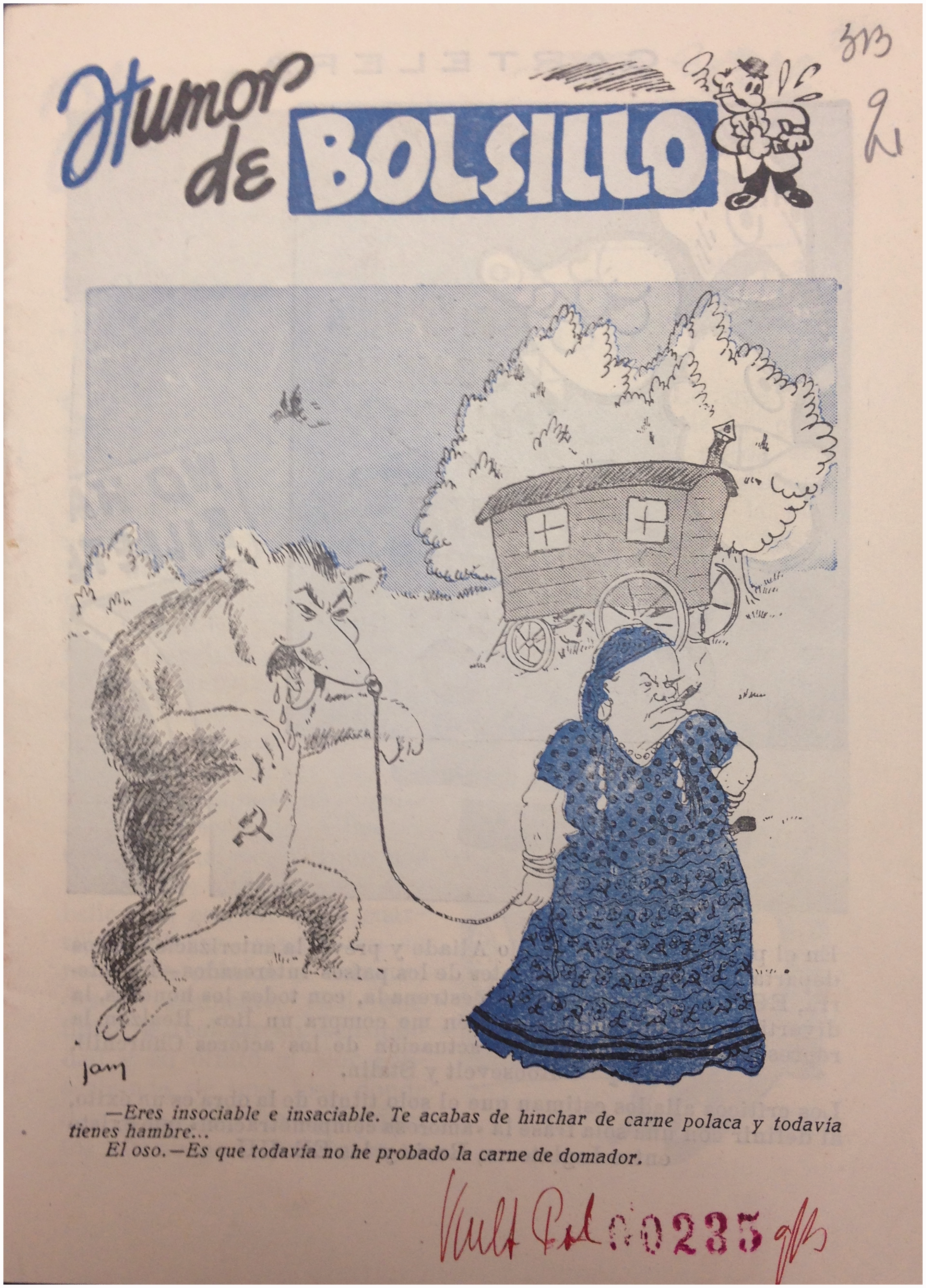
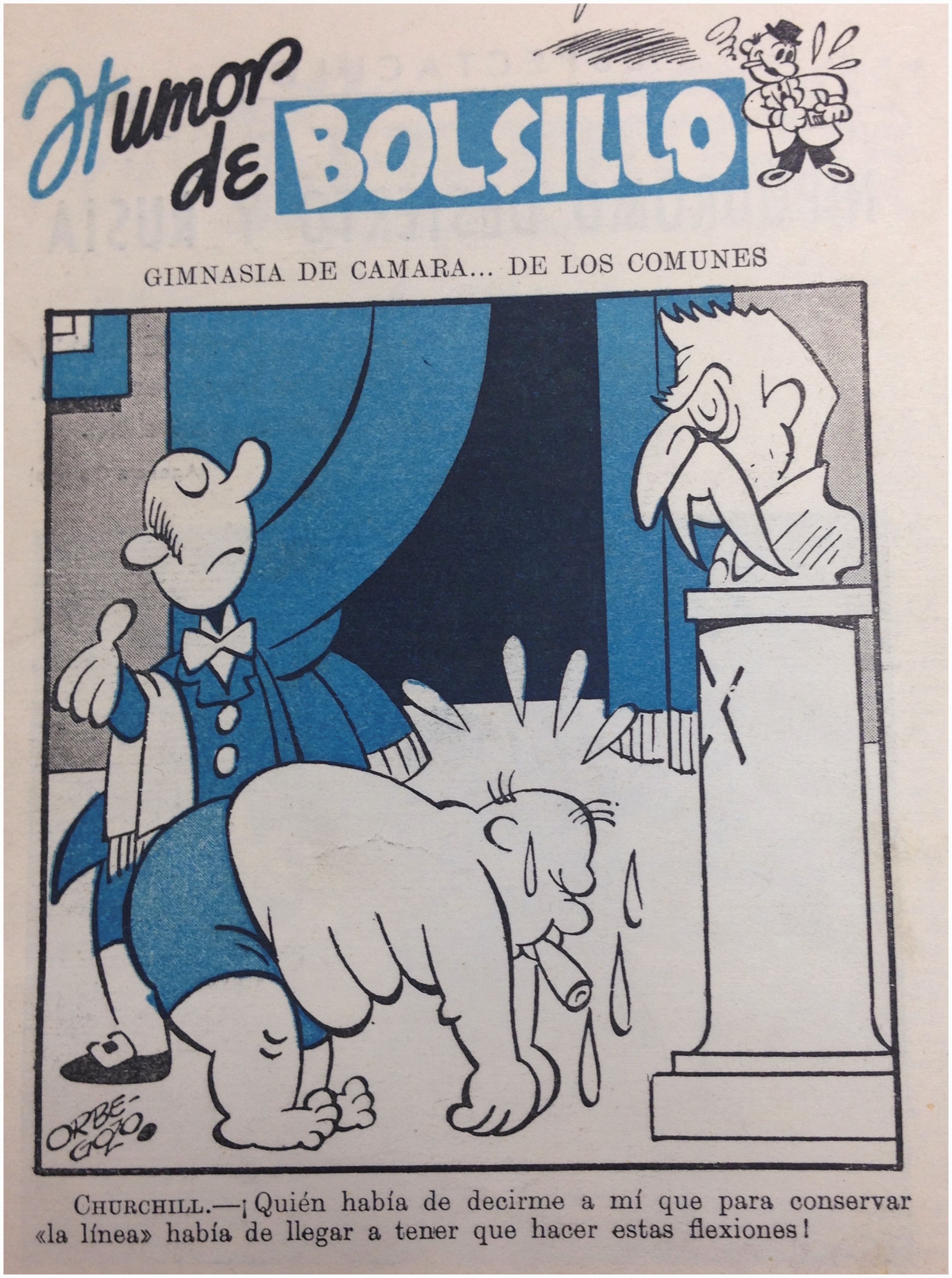
48
J. Tusell, ‘La etapa Jordana (1942–1944)', Espacio, Tiempo y Forma, Serie V, H. Contemporánea, 2 (1989), 169–89.
49
M. Peñalba Sotorrío, La secretaría general del Movimiento: construcción, coordinación y estabilización del régimen franquista (Madrid 2015), 368–77; Monthly Report, April 1943, National Delegation of the Foreign Service, AGA 9 (17.12) 51/18969.
50
Correspondence Jordana-Arrese, AGUN / José Luis de Arrese y Magra.
51
Ros Agudo, La guerra secreta, 297–8; F. Gómez-Jordana Souza, C. Seco Serrano and R. Gómez-Jordana Prats, Milicia y diplomacia: diarios del Conde de Jordana, 1936–1944 (Burgos 2002), 228–9.
52
Carlton J.H. Hayes to Jordana, Madrid, 1 June 1943, AGA Foreign Affairs, 82-03690; Jordana to Arrese, Madrid, 9 October 1943, AGUN / José Luis de Arrese.
53
Moreno Cantano, ‘Los servicios de prensa', 281; Note from the Foreign Affairs Ministry to the Overseas Department, AGA Foreign Affairs, 82-03690.
54
Correspondence Jordana-Arrese, October 1943–June 1944, AGUN / José Luis de Arrese.
55
Arrese to Jordana, 29 April 1944, AGUN / José Luis de Arrese.
56
Jordana to Arrese, 6 and 29 October 1943; British embassy to Manuel Valdés Larrañaga, 5 April 1944, AGUN / José Luis de Arrese. A good example of these anti-British demonstrations were the incidents that took place during the parade in honour of Franco on 1 October 1943, British embassy to Jordana, 3 and 14 October de 1943, AGA Foreign Affairs, R-2198/7.
57
Hans Adolf von Moltke’s Secret Diary, January-March 1943, pp. 1–2, AGA, Foreign Affairs, 82/11809.
58
Schulze Schneider, ‘La propaganda alemana', 371–86; Ruhl, Franco, Falange y ‘Tercer Reich’, 41–2.
59
Moreno Cantano, ‘Los servicios de prensa', 322.
60
S. Sueiro Seoane, ‘España en Tánger durante la Segunda Guerra Mundial la consumación de un viejo anhelo', Espacio, Tiempo y Forma, Serie V, H. Contemporánea, 7 (1994), 142–4; Stohrer to the Foreign Affairs Ministry, 7 November 1941, ADAP, Serie D, Vol. XIII, doc. 455.
61
Ros Agudo, Las relaciones secretas, 301–2.
62
Sueiro Seoane, ‘España en Tánger', 146; J. Herf, Nazi Propaganda for the Arab World (New Haven, CT 2009), 121–2; Memorandum by the director of the Information Department, 25 November 1941, ADAP, Serie D, Vol. XIII, doc. 499; Hans Adolf von Moltke’s Secret Diary, January–March 1943, 14, AGA, Foreign Affairs, 82/11809; Sáenz-Francés San Baldomero, ‘The Ambassadorship of Hans Adolf von Moltke', 105.
63
Sueiro Seoane, ‘España en Tánger', 146, 157; Stohrer to the Foreign Affairs Ministry, 7 November 1941, and Memorandum by the director of the Information Department, 25 November 1941, ADAP, Serie D, Vol. XIII, doc. 455, 499.
64
Stohrer to the Foreign Affairs Ministry, 7 November 1941, ADAP, Serie D, Vol. XIII, doc. 455; Hans Adolf von Moltke’s Secret Diary, January–March 1943, 15, AGA, Foreign Affairs, 10, 82/11809.
65
Herf, Nazi Propaganda, 159; Tusell and García Queipo de Llano, Franco y Mussolini, 248–9.
66
J. Albes, Worte wie Waffen: die deutsche Propaganda in Spanien während des Ersten Weltkrieges (Essen 1996), 244–8, 372; L. Delgado Gómez-Escalonilla, Imperio de papel: acción cultural y política exterior durante el primer franquismo (Madrid 1992), 148; Hera Martínez, La política cultural, 106.
67
On Faupel’s leadership, see R. Liehr, G.n. Maihold and G.n. Vollmer, Ein Institut und sein General: Wilhelm Faupel und das Ibero-Amerikanische Institut in der Zeit des Nationalsozialismus (Frankfurt am Main 2003). Hans von Moltke mentioned Faupel as one of the key men who integrated the parallel channels. Secret Diary, January–March 1943, AGA, Foreign Affairs, 82/11809.
68
Bowen, Spaniards and Nazi Germany, 54.
69
Miguel Moya to Hans Lazar, 8 October 1940, AGA, 9 (17.12) 51/20891.
70
Garriga, Las relaciones secretas, 57.
71
The director of the political department to the German embassy in Spain, 17 October 1939, ADAP, Serie D, Vol. VIII, doc. 265.
72
Hans Adolf von Moltke’s Secret Diary, January–March 1943, 13, AGA, Foreign Affairs, 82/11809.
73
Lazar to the Foreign Affairs Ministry, 7 November 1941, AA/PA Botschaft Madrid Presselenkung 758.
74
Paul Karl Schmidt to the German embassy in Madrid, 6 August 1940, AA/PA Botschaft Madrid Presselenkung 757.
75
The German embassy used Arco to distribute articles in Latin America, Stohrer to the Foreign Affairs Ministry, 31 July 1940, AA/PA Botschaft Madrid Presselenkung 757.
76
Bulletins of Economic Information issued by the German Embassy in Madrid, 1941–1943, AGUN / José Luis de Arrese y Magra; Schmidt to the German embassy in Madrid, 31 October 1941, AA/PA Botschaft Madrid Presselenkung 758.
77
C. Blasier, ‘The United States, Germany, and the Bolivian Revolutionaries (1941–1946)', The Hispanic American Historical Review, 52, 1 (1972), 31–9.
78
Telegram from Schmidt to the German embassy in Madrid; the German embassy in Madrid to the Spanish Ministry of Foreign Affairs, official press release, 28 July 1941; The German embassy in Madrid to the Foreign Affairs Ministry, 28 July 1941; German Consulate in Cartagena to the German embassy in Madrid, 29 July 1941; Draeger to the German embassy in Madrid, 29 July 1941, AA/PA Botschaft Madrid Presselenkung 757.
79
Schmidt to the German embassy in Madrid, 16 October 1941; The Foreign Affairs Ministry to the German embassy in Madrid, 13 November 1941, AA/PA Botschaft Madrid Presselenkung 758.
80
Delgado Gómez-Escalonilla, Imperio de papel, 271–8, 284; Paul Schmidt to the German embassy in Madrid, 11 December 1940 and October 1941, AA/PA Botschaft Madrid Presselenkung 757 and 758.
81
Delgado Gómez-Escalonilla, Imperio de papel, 277.
82
F.D. Roosevelt, Address for Navy and Total Defence Day, 27 October 1941, available at:  (accessed 24 April 2017); Stohrer to Serrano Suñer, 29 October 1941; Stohrer to the Foreign Affairs Ministry, 29 October 1941; Lazar to the Foreign Affairs Ministry, 2 November 1941, AA/PA Botschaft Madrid Presselenkung 758; Joachim von Ribbentrop, Speech on the liberation of Europe, 26 November 1941 in Bulletin of Economic Information issued by the German Embassy in Madrid, n. 54, 22 December 1941, AGUN / José Luis de Arrese y Magra. However, it is interesting to notice that Lazar seemed even more concerned with denying the second accusation present in Roosevelt’s speech: the idea that Germany would eliminate all religions and create a national church. Not surprising, as even Franco had noticed the effectiveness of Allied religious propaganda.
83
Ruhl, Franco, Falange y ‘Tercer Reich’, 76–7.
84
R.M.P. Sanz, ‘José María Doussinague, un director general de política exterior para tiempos duros', in A.C. Moreno Cantano (ed.), Cruzados de Franco: propaganda y diplomacia en tiempos de guerra (1936–1945) (Gijón 2011), 169, 174; Delgado Gómez-Escalonilla, Imperio de papel, 61.
85
Garriga, Las relaciones secretas, 211–13; Ros Agudo, La guerra secreta, 277–82.
86
A. Uzulis, Nachrichtenagenturen im Nationalsozialismus: Propagandainstrumente und Mittel der Presselenkung (Frankfurt am Main 1995), 124–9.
87
Moreno Cantano, ‘Los servicios de prensa', 155–6.
88
Garriga, Las relaciones secretas, 212–13; Moreno Cantano, ‘Los servicios de prensa', 157–8; Ros Agudo, La guerra secreta, 277–82.
89
On the debates about the existence of different political sectors, at times called political families, in Francoist Spain and on whether or not Franco’s regime as a whole should be characterized as fascist, see the competing historiographies of Ismael Saz and Ferrán Gallego. I agree with Saz’s interpretation, which characterizes Franquismo as a fascisticized regime. Gallego contends that the regime was supported by one completely fascist political culture, and not by an alliance of different political cultures. I. Saz, España contra España: los nacionalismos franquistas (Madrid 2003); F. Gallego, El evangelio fascista: la formación de la cultura política del franquismo (1930–1950) (Barcelona 2014).
90
J.A. Martín Aguado and J.R. Vilamor, Historia del ‘Ya’: sinfonía con final trágico (Madrid 2012), 30; AA/PA Botschaft Madrid Presselenkung 757 and 758.
91
Ros Agudo, La guerra secreta, 277–82; Moreno Cantano, ‘Los servicios de prensa', 157–9; AGUN/José María Doussinague/008/002/048.
92
Longerich, Propagandisten im Krieg, 176.
93
Tusell, ‘La etapa Jordana', 178. Jordana’s attempts to tone down the pro-German character of Spanish media seem to have found support among other Spanish authorities. This is particularly noticeable in light of the Stalingrad defeat, as the reticence to continue to screen more and more German films increased, and the radio programs on the adventures of the Blue Divisions started to dwindle until they were suspended in November 1943, J. Montero and M.A. Paz, La larga sombra de Hitler: el cine nazi en España (1933–1945) (Madrid 2009); S.G. García and J.M. Quevedo, ‘A crusade over the airwaves: the Blue Division on Radio Nacional de España (1941–1954)', Historical Journal of Film, Radio and Television, 37, 2 (2017), 307.
94
AGUN / José María Doussinague / 008 / 002 / 048; Ros Agudo, La guerra secreta, 288.
95
Ibid., 282; Garriga, Las relaciones secretas, 214.
96
Correspondence Gregorio Marañón y Moya – Juan Bellveser, May 1942–November 1943, AGUN/Gregorio Marañón y Moya/ Folder 61.
97
Garriga, Las relaciones secretas, 214.
98
Jordana to José Luis de Arrese, 28 July 1943, AGUN/José Luis de Arrese.
99
Moreno Cantano, ‘Los servicios de prensa', 281–2.
100
A. Hitler, N. Cameron, R.H. Stevens and H.R. Trevor-Roper, Hitler's Table Talk, 1941–1944: His Private Conversations (New York, NY 2000), 694.
101
Lazar’s memoires in Sáenz-Francés San Baldomero, Entre la antorcha y la esvástica, 164.
102
Local Chief of Falange to the delegate of Popular Education, 8 October 1943, AGA 5 781.
103
AGUN / José María Doussinague/008/002/048.
104
Bernecker, ‘Alemania y la Guerra Civil Española', 145.