




Abstract
Motivated by the history of military alliances during and after the Cold War, we study the sequential expansion of the hegemonial alliances of two great powers. Geography matters for the allocation of the collateral damage of a future military conflict. Current frontline countries bear a major burden. They would prefer to pass this collateral damage on to new members. This motive can drive expansion, which comes to an end only when all remaining non-affiliated countries have been absorbed by one of the two alliances. Those countries are willing to make concessions as part of the accession negotiations, and the overall value of the concessions can reach multiples of the actual collateral damage of military conflict. As a result, alliance expansion may continue beyond what would be optimal from a security perspective.
Introduction
States that become the battleground of international military conflicts suffer high levels of damage (Menon and Snyder 2017). A comparison of war deaths in global conflicts such as World War II documents the special burden on battlefield states. 1 Member states at the external border of allied countries and buffer states between rival blocs of countries 2 are particularly at risk, as illustrated by Belgium at the beginning of World War I and Poland in World War II. Which state ends up as a buffer state or frontline state and possibly becomes a battlefield in a war is not random; it is largely the result of geographical location, negotiations and the process of formation and the expansion of military alliances. Our study analyses how the concern of becoming the battleground of a military conflict shapes the formation of military alliances. We show that the incentive to shift the frontline and to escape being a possible battlefield can be exploited by the leader of an alliance and may drive alliance expansion further than what might be optimal from a security perspective.
In a game-theoretical analysis, we consider the processes of sequential expansions of the alliances of two rival great powers through the accessions of further allies. The two great powers actively shape the alliance of supporting states and bargain with accession countries in a geographically predetermined order: At each stage, each great power can make an offer to a non-member country that is directly adjacent to their alliance territory. The accession candidates must decide whether to join an alliance and on what terms. As the alliance grows, further countries in the area between the two alliances become accession candidates. The alliance formation process comes to an end when there are no non-member countries left to negotiate with. Alternatively, it can stop earlier and turn the non-affiliated countries into neutral buffer states. Conflict may break out in a phase following alliance formation. In equilibrium, the potential accession candidates take into account the future expansion of the alliances. For example, a new member may join as a frontline state but might become a hinterland state if further countries join. In anticipation of this, the accession countries are willing to make concessions to keep the process of alliance expansion alive and eventually escape the role of a state whose territory becomes a battlefield.
In political reality, the goal of not ending up as the battle zone is obviously juxtaposed with other, sometimes interdependent goals (Smith 1995). Russett (1968) discusses many of the complexities of alliance formation. Great powers may benefit from a larger sized alliance but, at the same time, they do not want to overexpand their alliance (Riker 1962). 3 Accession states may seek protection against an opposing superior power or try to counterbalance a dominant player (Walt 1985). Alliances may serve different purposes for partners with large asymmetries in their capabilities (Morrow 1991). Further motivations for the formation of alliances relate to the economic sphere (Li et al. 2024). Conflict over the spoils of war can also emerge inside the alliance. 4 Olson and Zeckhauser (1966) allude to strategic free-riding problems. Smith (2021) considers informational problems when there is uncertainty about the alliance partners’ willingness to fight. Zielinski and Grauer (2020) review the literature on governance issues and contribute empirical insights on how the command structure inside an alliance influences its effectiveness on the battlefield. A recent, important focus is on commitment problems when the alliance formation changes the power distribution (Benson and Smith 2023).
For the hegemonial type of alliances we study, Krainin and Wiseman (2016) discuss the potential role of alliances in helping to prevent actual conflict from breaking out. The hegemon in an alliance might include further alliance members so as to enhance the own security level directly or to avoid a particular state from being snatched away by the rival hegemon and thus increasing the rival’s power. Iwanami (2024) considers the formation of an alliance for reasons of restraining or deterrence. The formation of alliances can change individual members’ decisions to enter into hot conflict with other single states outside the alliance (Benson et al. 2014). Small countries might hope that the hegemon will provide its members with protection and security, and might be willing to pay for it in economic or political terms. Similar concessions of small countries emerge in our model but due to a different reason: to avoid being located in the battle zone of a possible war.
Geographic location is central to the concept of buffer states and their effectiveness for conflict outcomes (e.g., Chay and Ross 1986; Partem 1983). The likelihood of states surviving can crucially depend on their geographic location. Fazal (2007) shows that a location as a buffer state between rival powers significantly explains state death. Her argument relies on the strategic value of (military) control over the buffer state, which makes it particularly vulnerable to conquest. Our analysis does not account for a military advantage from control over–or an alliance with–a buffer state and the resulting commitment problems. Instead, we focus on the war damage for countries that lie in a buffer zone and the consequences for their desire to ally with a great power.
The sequential formation of alliances by great powers relates to the more general contract theory analysis of dominant players that contract sequentially (e.g. Aghion et al. 2007; Genicot and Ray 2006; Segal and Whinston 2000) where these single contracts impose an externality on other agents. Iaryczower and Oliveros (2017) highlight the role of competition between two principals for the same agents. Our set-up has elements of this general logic but differs both from the principal’s monopoly and the principals’ competition framework, as the geographical structure of the problem rules out direct competitive offers by two principals but still causes an interdependence.
Our formal analysis adopts important structural assumptions from the classic literature. We use a basic element from Niou and Ordeshook (1994) who consider an alliance-building process that takes place prior to a conflict resolution phase. Similarly, our model separates the alliance formation process from the conflict phase. Benson and Smith (2023) provide a compelling analysis of a possible interplay of alliance formation and the outbreak of war. In their model, if means of commitment are weak, an alliance might be perceived as a threat to non-members. This consideration might trigger several kinds of interactions in anticipation. Alliances may consciously refrain from territorial expansion in order to prevent the opposing alliance from taking preventive military action. The controversial discussion about the question of NATO’s eastward expansion after 1990 and Russia’s invasion of Ukraine in 2022 provides a good illustration of the relevance of such interaction. 5
To identify the burden-shifting motive and the conditions under which it operates, it makes sense analytically to start with a set-up in which the outbreak of war is an exogenous stochastic event. Our assumptions seem reasonable if alliance formation is followed by a long phase of cold war in which relative strength, technology, and political goals change in unpredictable ways. The fact that the outbreak of war sometimes obeys its own probabilistic logic can be illustrated using examples from the Cold War where there were several times when accidental outbreak of military combat was very close (see, e.g. Ellsberg 2017; Allison 2018, 234). For instance, the false alarms in which signals were mistakenly recorded as missile attacks by Russian defence on the night of 25–26 September 1983 did not cause war only by luck and due to the skepticism and willingness of officer Stanislaw Petrowa to disobey the standard protocol and regulations to pull the trigger (Leffers 2017). And the threat of medium-range missiles and the resulting extremely short warning times in the 1980s made a possible preemptive attack by the USSR an event with positive probability. 6
Unlike in theory, the specific motive of avoiding the role as the battleground is typically supplemented by other motives and cannot be easily identified empirically. Evidence shows, however, that the likelihood of becoming a battle state was and is a matter of great concern. During the Cold War, the “Fulda gap” in Germany was considered the most likely route for an attack. Events like the Berlin crisis 1961 and the Cuban missile crisis (Ellsberg 2017; Sachs 2013), if turned into military confrontation, would presumably have made Berlin the hot zone of combat. Any such event might have escalated and may also have affected the alliance’s hinterland with some probability, but the collateral damage for Germany as the front country would have most likely been more drastic. 7 This asymmetry in exposure within NATO has received considerable attention among German politicians 8 as well as outside of Germany. 9
It was the expansion of NATO towards the East after 1989 that released Germany from the decades-long role as a would-be battlefield of war as the front state and made it join the group of hinterland countries. In the years before and during the Russian invasion starting February 2022, Ukraine was a buffer state and became the battlefield in the proxy war between NATO and Russia. In this role and location, Ukraine suffered a disproportionate war burden. Thinking beyond a possible peace treaty for this conflict, today’s concerns in Poland are not a surprise. The incentive to pass on the role as most likely battlefield country further East would manifest itself in Poland’s support of NATO membership of Ukraine. Our model predicts that this incentive can lead to alliances that overstretch in size beyond what would be optimal in terms of security.
The Game
We study two competing great powers that use negotiations with smaller states to change the size and regional scope of their alliances. To isolate the specific aspect of burden-shifting we start with a framework in which many important considerations of alliance formation discussed in the introduction are absent.
Players
Consider 2n + 2 countries, sorted geographically along a line: A is at the far-left end, on the right and adjacent to A is country a1, followed by country a2 and so on until country a
n
. Similarly, B is at the right end of the line, adjacent are b1, …, b
n
, The two countries a
n
and b
n
are just on the left and right to the middle of the line. A and B are great powers with hegemonial ambitions and agenda-setting power (in a spirit similar to Aghion et al. 2007). The countries a
i
and b
i
do not have such ambitions or agenda-setting abilities. We sometimes refer to them as small countries and additionally number them by 1, 2, …, 2n from left to right so that country number 1 ≡ a1 and country number 2n ≡ b1; compare Figure 1(a). Geographic structure and labelling of the countries. (a) Geographic structure of the framework, (b) A possible state: (kA, kB; t) = (3, 2; t = 4).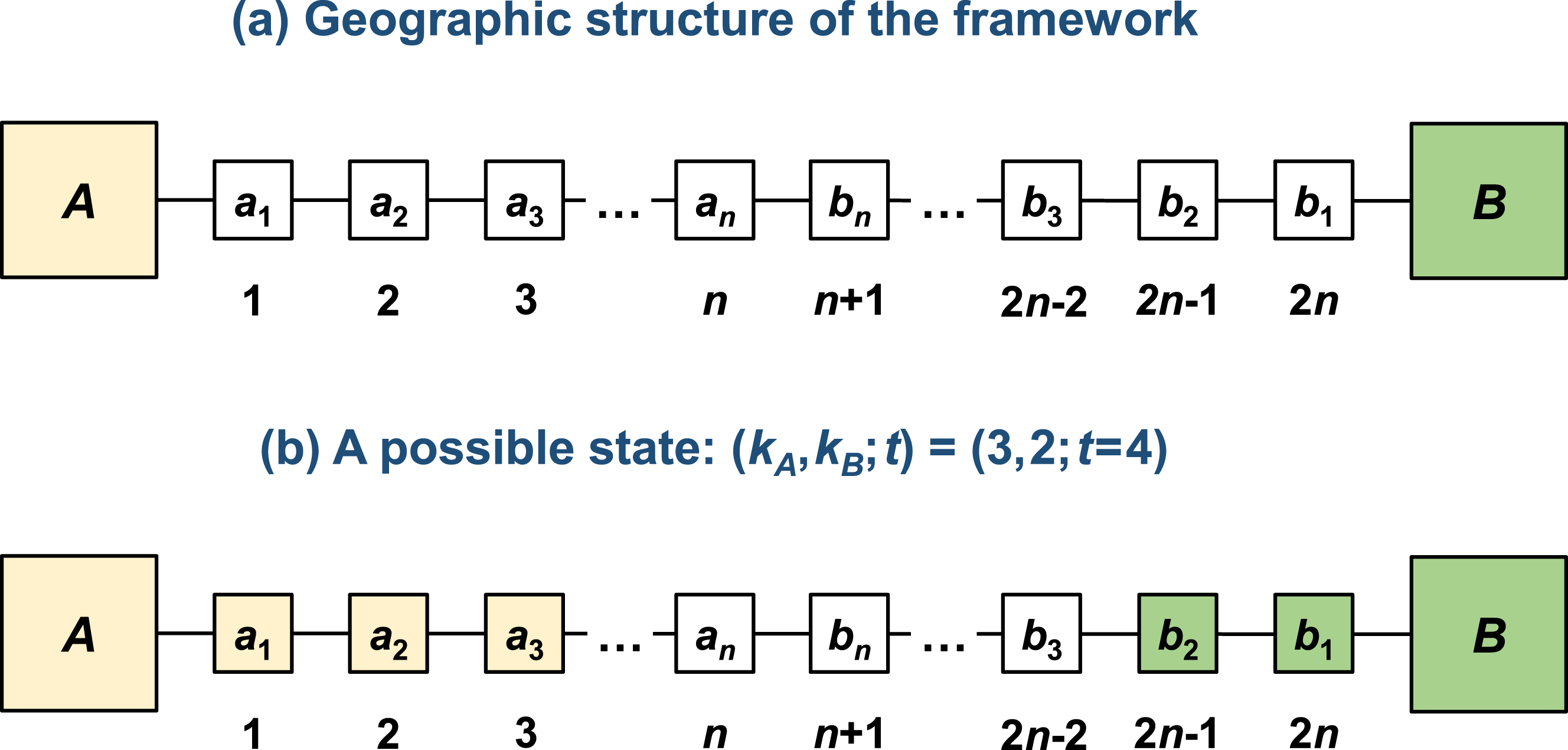
Dynamics
Interaction between the countries takes place in two phases.
Phase 1: Alliance Formation
The alliance formation phase consists of a series of periods, denoted by the count variable t = 1, 2, … The great powers A and B may try to expand their alliance. An alliance must, at any time, encompass a connected area. Only countries that are adjacent to an existing alliance can be admitted. At the beginning of a given period t, the status of the alliance formation process is described by a partition of the landscape of 2 + 2n countries into three sets of contiguous country territories, illustrated by Figure 1(b): there is a set {A, a1, a2, …}, a set {B, b1, b2, …}, and a set of small countries located between the two other sets of countries. A short notation of such a situation in a given period t is (k
A
, k
B
; t). Here,
In each period, great power
The actions of the players at state
First, suppose that k
A
= k
B
= t − 1 at state
Second, suppose that k
A
= t − 1 but k
B
< t − 1 at state
Third, if k A < t − 1 and k B < t − 1 at state (k A , k B ; t), the alliance formation process stopped for both great powers at alliance sizes k A and k B . The requirement that the alliance must be contiguous makes the admission of countries closer to the middle impossible in this state. So, once immediately adjacent countries on both sides opt for neutrality, the alliance formation process cannot continue.
These rules define a history of the alliance formation process as well as the feasible transitions at a given period t. Different histories of series of offers and acceptance decisions may lead to the same state
Not all historical processes of alliance formation strictly follow this principle. Maps are two-dimensional and topographical features, ideologies and other factors may play a role. However, an illustrative example of this geographical and sequential pattern is the development of NATO, which gradually expanded its borders, mostly towards the Warsaw Pact. 10 Following the dissolution of the USSR, NATO enlarged towards Russia. The former socialist satellite states and Sweden and Finland followed in several waves (1990, 1999, 2004, 2008, 2017, 2020, 2023), leaving Ukraine as a buffer country that expressed the desire to join NATO as well.
Phase 2: The Conflict Phase
Once the alliance formation process comes to an end, the great powers A and B, respectively their alliances, will enter the phase of possible military conflict. No decisions have to be made in this phase. As described in the introduction, war is assumed to be an exogenous probabilistic event. We allow the probability of conflict to be a function of the number of buffer countries between the alliances: p0 denotes the conflict probability if there are no buffer countries between the alliances, and p1 denotes the conflict probability in case of at least one buffer country. In line with the literature that emphasizes proximity or contiguity as providing opportunity and motivation for military conflict (Starr 1978) and the empirical evidence on the effect of common borders (Toft 2014), we assume that the existence of a buffer zone (weakly) reduces the war probability but not by more than half; formally,

The war phase itself is not modelled as a game. Great powers A and B win with given probabilities q
A
and q
B
= 1 − q
A
. The values of winning are V
A
and V
B
and the values of losing are v
A
and v
B
and go to the great powers A and B. To remove all the incentives of the great powers in the conflict phase, we assume that the win probabilities are independent of the relative alliance size and

Section “Sensitivity Analysis” below discusses the assumptions on the probability of war and the expected war payoffs of the great powers.
War causes collateral damages. These damages are the main focus of the analysis. The total size of this damage is denoted by
The attribution of collateral damages to battlefield countries and buffer states mirrors the motivating evidence discussed in the introduction. In case of a Cold-War Soviet attack, would NATO have waited until the tanks had passed through Germany to attack them only when they reached the border of France? The probabilities p0 and p1 reflect that the existence of a buffer zone makes the logistics of food and military supplies more difficult. However, would a buffer country prevent war and where would the battlefield be located? Would the alliances have been more reluctant or less reluctant to use tactical nuclear weapons to stop the invasion in a territory that was not part of their own alliance? These considerations make us assume that, in the case of military conflict, the collateral damage (or at least a major share of it) is allocated among the buffer countries if there are any. Section “Sensitivity Analysis” below discusses the assumption on the distribution of damages.
Payoffs
The payoffs are determined by the probability of military conflict, the value of winning or losing, the collateral damage of fighting, and the transfers made in the bargaining process. Denoting by (k
A
, k
B
; max{k
A
, k
B
} + 1) the final state at the end of the alliance formation stage and using (2), expected payoffs for the great powers A and B are


If k
A
+ k
B
< 2n and i is one of the (non-affiliated) buffer countries (i.e., i ∈ {k
A
+ 1, …, 2n − k
B
− 1}), then i’s expected payoff is

If i is neither a frontline nor a buffer country, i’s payoff is
Equilibrium
Our equilibrium concept is that of subgame-perfect equilibrium. The alliance formation process starts in state (0, 0; 1), at which A requests a transfer
A subgame-perfect equilibrium in which there are buffer countries at the beginning of the conflict stage does not exist.
A proof of this and the next proposition is in the appendix. Proposition 1 shows that the non-affiliated small countries are all absorbed by one or the other great power. If a small country j t joins an alliance and expects alliance expansion to continue, j t will eventually become a hinterland country and avoid any damage from war. By rejecting the offer to join, country j t can remain a neutral buffer zone country. Anticipating, however, that other buffer zone countries share the same considerations and hence the other alliance will expand towards country j t , the buffer zone will eventually consist of j t only so that rejecting brings small country j t into a strategically disadvantageous position. (Lemma 1 formally shows that maximum expansion is the unique equilibrium path in the subgame following the unilateral rejection of one small country.) j t is better off joining in the first place and eventually becoming a hinterland country. The assumption p0 < 2p1 becomes relevant for the last state only. It implies that a small country prefers to join an alliance as a frontline state over remaining the single buffer country.
Proposition 2 shows existence and summarizes the structure of equilibrium alliance expansion.
In the subgame-perfect equilibrium, two alliances form: {A, a1, …, a
n
} and {B, b1, …, b
n
}. For the last countries a
n
and b
n
that join, the transfers are equal to (p1 − (1/2)p0)D. In earlier periods t < n, transfers from the interval The class of equilibria characterised in Proposition 2 has several properties. Great powers expand their alliances to the maximum because each new member makes (economic and/or political) concessions to join. Alliance expansion takes place until all n small countries closer to A are absorbed by A and all n small countries closer to B are absorbed by B. In the equilibrium the great powers demand positive transfers from a well-defined interval. In periods t < n, the lower limit of the interval depends on the period t in which the negotiations take place; it is the expected collateral damage that a small country has from being one of The countries absorbed in the last period t = n become border countries of the alliances: their frontiers touch each other and they bear some of the collateral damage in case of war. For these eventual border countries, the transfer payment for accession is still positive and is uniquely defined. If one of these frontline countries rejected the offer to join, it would remain as the only neutral buffer country in the subsequent period. This situation is even worse than being one of two frontline states, at least as long as p1 > p0/2, that is as long as the existence of a buffer country does not reduce the conflict probability dramatically. The multiplicity of equilibrium values of concessions that all lead to full absorption might appear as a surprise. Intuitively, rejecting moderately high offers is attractive for a small country a
t
only if b
t
rejects at the same time and both end up in a large buffer zone comprising many countries and dispersing the battlefield costs among them. But when rejecting, a
t
risks the worst outcome of simultaneous acceptance by b
t
in which case a
t
would eventually end up as a single buffer country. A and B make sure to choose transfers that avoid such coordinated outcomes of simultaneous rejection, but even though rejection cannot be part of an equilibrium, these possible coordination outcomes (out of equilibrium) cause a whole range of offers that can be supported in equilibrium. As discussed in the introduction, a motive for expansion has been attributed to the great power’s desire for higher security. The existence and possible practical relevance of this motivation is not denied. However, by setting up the formal analysis in a way in which this security motivation is absent, it cannot be the driving force of alliance formation in this framework, which allows us to highlight a different, additional motive. The result in Proposition 2 also shows that the security motive and the economic motive can be in conflict with each other. If the war probability decreases in the presence of a buffer zone, a situation with buffer countries causes lower expected collateral damage. However, as shown here, the small countries’ incentive to shift a possible collateral damage and become a hinterland country leads to a maximum enlargement of the alliances–hence, to an outcome with a lower security level. Another motive discussed in the literature is that small countries seek protection by a great power. This might also be an important motive not to be dismissed. By design of the formal framework, however, this motive is inoperative in the analysis. This is to make clear that the enlargement outcome does not require a protection argument. In our framework, a common protection umbrella is not the driving force for why small countries would seek admission to an alliance. War-burden shifting is a sufficient motive on its own and small countries are willing to make extensive concessions even if this does not reduce the probability of war. They make concessions to avoid becoming the battlefield of military conflict. Based on Proposition 2, we can derive some comparative statics properties.
In the equilibrium with the highest value of transfers, the total amount of transfers collected by great power Proposition 2 and Corollary 1 illustrate that the formation of alliances is a lucrative activity for great powers. Small countries other than a
n
or b
n
will not be a battlefield country in the equilibrium. Even in the absence of a protection promise, they are each willing to make concessions with a value up to p1D, that is, an amount that corresponds to the full expected damage from war. Hence, the value of the sum of these concessions can amount to more than
Sensitivity Analysis
This section discusses some key parameters for the characterisation of equilibrium in Proposition 2: the (exogenous) war probabilities p0 and p1 as in condition (1), the great power’s war payoff given in (2), and the size of the damage D.
Importance of the Buffer Zone
Condition (1) incorporates the possibility that the probability of war increases in the absence of a buffer zone but limits this increase to less than 100 percent, that is p0 < 2p1. The case of p0 > 2p1 can be analysed analogously, with a major difference only occurring in the very last negotiations. Here, in a subgame where only one alliance formation process is active (as in Lemma 1), the last non-affiliated country would reject all non-negative amounts of concessions: for p0 > 2p1, this last country suffers a lower collateral damage of war as a single buffer country (p1D) than as one of two frontline countries (p0D/2). For the outcomes in all previous states, the relation of p0 to p1 does not matter for the small countries’ decisions to join an alliance; hence, equilibrium behaviour in all previous states is robust to allowing for p0 > 2p1. In particular, if the game reaches state
Another assumption fixed the probability of war at p1 if the number of buffer countries is k ≥ 1. Extending the framework to allow for a more general probability of war
Motives for Alliance Expansion
Condition (2) mainly served to avoid the burden-shifting motive from being superseded with additional relevant motives for alliance formation. If there are further motives in favour of alliance expansion, this typically strengthens the logic that leads to maximum expansion. Also, countries already absorbed into an alliance might have a willingness to pay for further expansion, for instance, to move the battlefield even further away from them. Allowing for multiparty negotiations, great powers might consider options to strike further deals with existing small alliance members, which would strengthen the tendency for overexpansion.
Battlefield Costs
Modified assumptions on the size and allocation of battlefield costs in phase 2 modify the precise characterisation of the equilibrium but do not change its fundamental logic. For instance, if the battlefield costs are more dispersed in the borderline region between the two alliances, this will change condition (1) which establishes the equilibrium in Proposition 2. To illustrate, suppose that the buffer zone (if it exists) bears only a share
Endogenous Probability of War
The potentially most restrictive assumption in our analysis is that the key parameters discussed here, including the probability of war in phase 2, are exogenous to the alliance formation process in phase 1. This is a more reasonable assumption in some historical circumstances than in others, as illustrated in the discussion of accidental war in the introduction. In other instances, alliance formation and war onset may interact. Powell (2006) emphasizes commitment problems as a cause of bargaining failure when the distribution of power is expected to shift. Benson and Smith (2023) relate such commitment problems to the expansion of alliances and derive conditions under which preventive wars in response to an anticipated power shift can be avoided. Debs and Monteiro (2014) highlight the importance of observability of investments in military power for the emergence of preventive wars. Smith (2024) discusses the relevance of dynamic commitment problems for understanding the ongoing war in Ukraine.
Our analysis draws attention to the distribution of war damages. Highlighting this issue, it disregards that the burden-shifting motive we study could interact with the anticipation of the consequences of power shifts. Nevertheless, our analysis is also relevant if the probability of war is affected by alliance formation. To get some intuition for the possible effects of an endogenous probability of war in an extension of our model, suppose that unilateral alliance expansion induces a power shift (change in the win probability) and a great power can trigger a preventive war after its own offer was rejected. Consider the decision of great power B whose offer was rejected while A’s offer was accepted. B’s decision on preventive war would balance B’s reduction in win probability if it lets A’s alliance expansion continue against the expected payoff in a preventive war. Intuitively similar to what has been discussed in the literature, preventive war might be chosen if the size of an unfavourable power shift in terms of reduction in win probability is sufficiently large.
What would such an incentive for preventive war imply for the small countries’ incentive to join an alliance and the resulting alliance structure? In the candidate equilibrium in which two symmetric alliances of sizes k
A
= k
B
= n form, consider a deviation by b
n
in the last period t = n. If this deviation makes war more likely (preventive war triggered by B or war triggered by A due to its resulting power advantage), b
n
’s incentive to deviate from the candidate equilibrium becomes weaker–and its willingness to pay to join B becomes stronger–compared to the baseline model above. Thus, if anything, B’s payoff from alliance expansion becomes larger. In an earlier period t < n, if b
t
anticipates that B will trigger a preventive war in case b
t
rejects, deviating from the equilibrium path yields a payoff of −D/k as one of
Conclusions
Great powers typically shape the sets of their allies and often work on an expansion of allied territory. This might have a number of explanations. Security reasons feature among the most prominent ones. The analysis here unveils a different, but potentially important motive: economic or political concessions of new member countries due to a desire to avoid being a buffer state in a possible battle zone. In a formal model we show how great powers can take advantage of this desire. They can siphon off the willingness to pay caused by this concern, by allowing small countries to enter the alliance in return for economic or political concessions. Even in the absence of an impact of alliance formation on the outcome of a potential war, these economic or political concessions alone are sufficient for a great power’s incentive to make its alliance as large as possible.
Our model makes several distinct comparative statics predictions. First, a great power’s benefit from alliance formation is larger if there are many possible accession countries it can admit to its alliance. Second, the economic and political concessions it can demand are higher if the fear of war is stronger: either because a future war becomes more likely or because the damage from military action is expected to be larger. Third, the lower bound of equilibrium transfers to the great power is smallest for countries farther away from the rival power and hence the prospective frontline, and it increases as the alliance expands towards its rival. This holds except for the last country that negotiates and that eventually ends up as a frontline country: This country still prefers to join an alliance but may make weaker concessions in anticipation of remaining in the battle zone.
The damage-shifting motive unveiled here may operate independently and in addition to other, more prominent motives for alliance formation. Similar to the asymmetric alliances with great powers as considered, for example, by Morrow (1991), the great powers benefit from political concessions (reduction in autonomy) by the small countries. Here, however, a great power has no cost of providing security or any other direct cost or benefit of alliance formation. The mutual benefits stem from the externality that the expansion decision imposes on non-member countries. The sequential nature of alliance expansion allows the great power to benefit from the same externality passed further on in each of the accession negotiations so that the total value of political concessions it can demand exceeds multiples of the actual expected war damage. Our results suggest that alliances have a tendency to overexpand. If proximity between the alliances makes aggressive actions more likely, the great powers will expand their alliances further than what would be optimal from a security perspective.
Footnotes
Acknowledgments
We thank participants at presentations at the APCC in Melbourne, the Conference on Contests in Reading, the EPCS 2025 in Riga, the EconPol Summerschool in Berlin and an anonymous reviewer for valuable comments as well as Jenny Rontganger for language checks. The usual caveat applies.

Funding
The author(s) received no financial support for the research, authorship, and/or publication of this specific article. It was part of their regular positions. The Max Planck Society provided funding for open access.
Declaration of Conflicting Interests
The author(s) declared no potential conflicts of interest with respect to the research, authorship, and/or publication of this article.
Data Availability Statement
Data sharing not applicable to this article as no datasets were generated or analyzed during the current study.
Notes
Appendix
In this appendix we first prove a lemma on a subgame off the equilibrium path, which is useful for the proofs of propositions 1 and 2 below.