



Abstract
Reciprocity is a well-known influence on international cooperation. However, we lack an explanation for how reciprocity at the international level affects individual beliefs and attitudes. How do people interpret situations where countries return favors, or fail to? In this study, we present a micro-level explanation of reciprocity based on the theoretical framework of Unbounded Generalized Reciprocity, where reciprocity operates as an informational shortcut about the trustworthiness of others. In an experimental survey of US adults, we test the roles of exposure to between-country reciprocity, perceived similarity, and costliness on trust toward a counterpart country, using the context of cooperation during the COVID-19 pandemic. We find that reciprocity, compared to a reciprocity violation, predicted significantly more trust, and this was not moderated by similarity or costliness. We interpret these results as supporting evidence that reciprocity, at the individual-level, acts as a heuristic tool for determining the trustworthiness of other countries.
Keywords
Introduction
Cooperation involving reciprocity, or the returning of a behavior, is commonplace in international relations. Violations of reciprocity, or not returning an expected behavior, can lead to breakdowns in cooperation. Reciprocity can thus determine whether relations between states are cooperative or conflictual. The COVID-19 pandemic serves as a poignant example, where the security stakes for states were extremely high. Countries like Brazil and South Africa, for instance, volunteered to share virus-related data in order to help other countries develop vaccines, and in return expected to receive access to these vaccines from the countries they shared information with. 1 A spokesperson for China, one of the most hard hit countries at the beginning of the pandemic and a beneficiary of substantial pandemic-related aid, cited reciprocity as the main reason for later sending aid to other governments: “For countries that have assisted China in its fight against the epidemic, we will reciprocate their kindness without any hesitation if they need it.” 2 Countries also violated these expectations of reciprocity, such as forcing other countries to buy back coronavirus supplies that were originally received for free. 3 And yet, in spite of the visibility of these types of reciprocity behaviors, the motivations behind them and their ramifications have not been fully explored.
Reciprocity has long been associated with international cooperation. A long line of research shows that states have used reciprocity for strategic gains (Axelrod 1980; Keohane 1986; Oskamp 1971; Wilson 1971). However, the impact of reciprocity at the international level on beliefs and attitudes at the individual level is unclear. Most existing research focuses on state-level reciprocity, often in highly abstract scenarios, where two players are given a choice between “cooperation” and “defection.” Such scenarios contrast starkly with the nuances of real-world politics, such as politically charged questions of whether, and on what conditions, to provide COVID aid to other governments. The discipline also lacks an understanding of how individuals make sense of reciprocity alongside other common influences on cooperation, such as trust, similarity, or costly signals (Gartzke and Gleditsch 2006; Kertzer et al. 2020; Kydd 2000; Mattes and Rodríguez 2014). We fill this gap by developing a micro-level theory of international reciprocity, and by empirically demonstrating how reciprocity in international cooperation affects individual attitudes toward other countries.
As an initial test of our approach, we specifically examine whether reciprocity affects individual levels of trust toward a counterpart state. We use trust as our main outcome because, in many socio-political contexts, trust is a well-known, crucial determinant of cooperative behavior (Keohane 2005; Kydd 2007; Rathbun 2011; Uslaner 2002). To our knowledge, this link between reciprocity, trust, and cooperation at the individual level has yet to be tested in international relations. We are additionally interested in whether other known influences on cooperation, such as similarity and costly signals, moderate the relationship between reciprocity and trust.
Our hypothesis is straightforward: when individuals observe a country reciprocate a positive act, they are more trusting of that country and more willing to support cooperation. Our micro-level explanation of this response draws from social psychology and the theoretical framework of unbounded generalized reciprocity (UGR) (Balliet et al. 2014; Imada et al. 2023; Mifune et al. 2010; Romano et al. 2017). We argue that reciprocity affects individual trust toward other countries through reputational concerns and a reliance on heuristics. Out of a need to efficiently find partners and reap the benefits of cooperation, humans have evolved to use reciprocity behavior as an informational shortcut that sheds light on the trustworthiness of other actors (Fehr et al. 2002; Friedman 1971). Rather than sift through the many strategic considerations associated with engaging in potentially risky cooperative endeavors, individuals simply observe whether a counterpart reciprocates positive behaviors. Reciprocity, when it occurs, increases an individual’s confidence that a counterpart will continue to engage in positive behaviors in the future and avoid exploitation. Individuals also have an incentive to build their own reputations for trustworthiness by returning reciprocity when they see it, and to punish those who violate reciprocity—even when doing so is costly in the short run (Fehr and Fischbacher 2004; Yamagishi et al. 1999; Yamagishi and Kiyonari 2000).
We leverage an experimental survey on a nationally representative sample of US adult citizens to causally test whether reciprocity affects individual trust toward another country. Respondents were exposed to information about a counterpart country either reciprocating a positive act by the US or violating reciprocity by failing to return the positive act, and they were then asked to assess the trustworthiness of this counterpart country. The instances of reciprocity given in the experiment were based on real events that occurred during the COVID-19 pandemic. 4 Additionally, we manipulated the counterparty country’s similarity to the US, and also the costliness of the reciprocal act, in order to test whether similarity and/or costliness moderate the effect of reciprocity on trustworthiness.
The results align with our expectations. Reciprocity significantly increases individual trust toward the counterpart country. Further, neither similarity nor costliness directly affect perceived trustworthiness, and neither variable significantly moderates the effect of reciprocity. We interpret these findings as support for our argument that individuals use reciprocity as a heuristic cue about trustworthiness. Further, our findings indicate that in the presence of reciprocity cues, other theoretical considerations like group affiliation or adding costs to signals of behavioral intent are perhaps less influential than previously thought.
Literature Review
Reciprocity features prominently in the study of international relations, where it is often viewed as indispensable in achieving cooperation between states (Keohane 1986). Reciprocity typically takes the form of tit-for-tat strategies, such that players reward cooperation with cooperation and punish defection with defection (Axelrod 1980). In both game-theoretic models and laboratory experiments involving human subjects, reciprocity successfully elicits cooperation from players in prisoner’s-dilemma-style settings (Axelrod 2006; Oskamp 1971; Wilson 1971). Yet, for at least two reasons, these highly stylized approaches are limited in their ability to help us understand international cooperation.
First, existing work does not consider the effect of reciprocity alongside other prominent determinants of cooperation, such as costly signals and political similarity. The relevance of costly signaling is perhaps most apparent in reassurance games. Kydd (2000) shows that when players face uncertainty about one another’s willingness to cooperate, taking actions that impose nontrivial costs on the sender facilitates cooperation by increasing trust. Kertzer et al. (2020) explore this logic in an experimental setting and find that human subjects indeed update their assessments of an adversary’s intentions in response to costly signals of reassurance. These findings raise a number of questions, such as whether reciprocity plays a role even when costly signals are apparent, and whether reciprocity must itself involve costliness in order to effect cooperation.
Scholars have also explored similarity as a determinant of cooperation, with the caveat that “similarity,” as a concept, has been used in diverse ways. In constructivist scholarship, similarity most often refers to sociocultural categories like religion, ethnicity, and language (Gartzke and Gleditsch 2006). In this view, similarities lead to shared identities and the emergence of “intersubjective communities,” which particularly facilitate group-based cooperation (Hopf 1998). Other, more rationalist approaches argue that political similarities, especially in terms of regime type, facilitate the sort of credible commitments required for mutual cooperative endeavors (Lai and Reiter 2000; Leeds 1999; Mattes and Rodríguez 2014). This research overlaps with an extensive literature on preference similarity, typically defined as similarity in alliance portfolios or voting patterns in the UN General Assembly (Bailey et al. 2017; Bueno de Mesquita 1975; Signorino and Ritter 1999). When states share foreign-policy interests, they may be less likely to view one another as threats and more likely to agree on common approaches to collective-action dilemmas (Gartzke 1998; Koremenos 2005; Lupu 2016; Neumayer 2008), which is broadly consistent with game-theoretic work showing that preference similarity solves cooperation problems (e.g., Morrow 1994). Beyond political science, research across social-scientific disciplines shows that homophily leads to higher levels of cooperation (e.g., Centola 2011; Habyarimana et al. 2007; McPherson et al. 2001; Simpson 2006). Regardless of whether similarity involves a deeper sense of shared identity or is limited instead to compatibility in interests, the empirical expectation is the same: the more similar countries are, the more likely they are to cooperate. As with costly signals, the prospective influence of similarity raises questions about whether reciprocity interacts with underlying similarities between actors.
Second, studies of reciprocity often focus on stylized outcomes—“cooperate” versus “defect”—that make it difficult to determine when and why reciprocity promotes cooperation in real-world interactions. While formal models and laboratory experiments show that tit-for-tat maximizes utility in game-theoretic settings, these approaches operate at a high level of abstraction that limits applicability to international relations. Specifically, we lack micro-level, behavioral explanations for why a given actor chooses to reciprocate a cooperative act. Empirical research similarly ignores the underlying motivations for reciprocity. Early work focused on reciprocity among the major powers—particularly the US, Soviet Union and China (Goldstein 1991; Goldstein and Freeman 1991; Ward 1982; Ward and Rajmaira 1992)—while extensions of this research examined variations in reciprocity across issue areas and the unique influence of third-party or “triangular” interactions (Goldstein and Freeman 1990; Rajmaira and Ward 1990; Rhodes 1989). This research finds higher-than-expected levels of observed reciprocity among virtually all types of actors, but it provides little insight into the more fundamental question of why states reciprocate.
Larson (1988) points out the need for experimental work on individual perceptions of reciprocity in international relations. Citing evidence from psychology, she argues that humans use subjective criteria to impose meaning on social interactions and draw inferences about other actors’ motives and intentions, which complicates the task of discerning “cooperative” from “defective” behaviors; reciprocity may lead to outcomes that are not easily explained by game-theoretic approaches (Larson 1988). Rathbun (2012) further explores the psychological underpinnings of reciprocity. Drawing on a distinction first made by Keohane (1986), he argues that multilateral cooperative endeavors, such as military alliances, depend on “diffuse” rather than “specific” reciprocity—and, in turn, diffuse reciprocity requires a general sense of moralistic trust among participants. Other research has explored individual motivations for reciprocity, such as dispositional characteristics. Kertzer and Rathbun (2015) find that “prosocials” engage in reciprocity and cooperative behavior more often than others because of their underlying personal values, such as a commitment to fairness and equality. While this literature provides valuable insights into individual-level mechanisms of reciprocity in international relations, it has not yet explored questions on how reciprocity between governments affects individual perceptions of trust, or how reciprocity compares to other commonly studied determinants of trust, such as costly signals and similarity.
Trust, Cooperation, and Reciprocity
We focus on trust as the main outcome of interest for two reasons. First, trust is a well-known determinant of international cooperation. Leaders and policymakers frequently cite trust when justifying cooperation with other states (Kydd 2007). In 2001, amid discussions on improved US-Russia relations, US president George W. Bush famously said of Russian president Vladimir Putin: “I looked the man in the eye. I found him to be very straightforward and trustworthy […] I was able to get a sense of his soul.” 5 In 2018, following a joint statement on denuclearization of the Korean Peninsula, US president Donald Trump—as if to illustrate how uncertainty about trustworthiness imperils cooperation—said of North Korean dictator Kim Jong Un, “He trusts me, I believe, I really do. I think he trusts me, and I trust him.” 6
Trust also plays a central role in academic work on international cooperation. In game-theoretic models, particularly in reassurance games, successful cooperation requires a minimum level of trust, as untrustworthy partners pose too great a risk of exploitation (Keohane 2005; Kydd 2000; Williamson 1993). Social-psychological research particularly emphasizes the importance of “relational” trust, where past interactions inform future partners of one’s dependability and intentions (Coleman 1990; McAllister 1995; Rathbun 2011; Rousseau et al. 1998; Uslaner 2002). Relational trust differs from game-theoretic approaches in that partners may still consider one another generally trustworthy even if they occasionally violate specific commitments. Constructivists in international relations have utilized relational trust to explain cases of regional cooperation like NATO (Cronin 1999; Hemmer and Katzenstein 2002).
Second, trust is a crucial link between cooperation and reciprocity. In Osgood’s classic GRIT strategy—developed during a period of profound mistrust between the United States and Soviet Union—repeated acts of reciprocity are essential to building trust among adversaries and avoiding conflict (Lindskold 1978; Osgood 1962). In a study using repeated economic investment games, Berg et al. (1995) find that reciprocal patterns of behavior are attributable to trust as a mechanism. A more recent study finds that trust mediates the relationship between reciprocity and cooperative behavior in multiplayer cooperation games (Zheng et al. 2021). Further, leaders and policymakers recognize these connections. For example, in its annual defense priority statements, China’s foreign ministry explicitly cites “guidelines of […] reciprocity” as “conducive to promoting mutual trust and cooperation.” 7 Yet, the causal links between reciprocity, trust, and cooperation—especially in the context of international relations—have not been sufficiently explored. In particular, the discipline lacks a micro-level explanation for how reciprocity affects individual levels of trust directed toward other states.
Following Rousseau et al. (1998), we define trust as “a psychological state comprising the intention to accept vulnerability based upon positive expectations of the intentions or behavior of another.” This definition captures aspects of trust that generalize across literatures—specifically, vulnerability and expectation—and thus accommodates myriad approaches to the study of trust (Evans and Krueger 2009; Rousseau et al. 1998). Trust fundamentally involves a willingness to accept the risk of a negative outcome, based on the expectation that others share an interest in achieving a positive outcome. This definition is consistent with strategic approaches to trust, such as Kydd’s definition of trust as “the belief that the other side prefers mutual cooperation to exploiting one’s own cooperation” (Kydd 2007). It is also consistent with relational trust in social psychology, which treats trustworthiness as a characteristic of actors rather than a preference toward cooperation/exploitation across strategic situations. Overall, then, our interdisciplinary definition of trust encompasses the more common ways trust has been invoked in the literature.
How Reciprocity Increases Trust
To develop a micro-level theory of how reciprocity affects trust in international relations, we integrate insights from political science with concepts from social psychology. In particular, we draw on the literature on unbounded generalized reciprocity (UGR) (Balliet et al. 2014; Imada et al. 2023; Mifune et al. 2010; Romano et al. 2017). UGR assumes that humans have evolved to use behavioral rules of thumb, or heuristics, to achieve cooperation. Because cooperation generates personal benefits, individuals attempt to behave in ways that encourage others to cooperate with them. However, cooperation can also be exploited. Heuristics thus provide a mechanism for trustworthy individuals to cooperate with one another while avoiding exploitative partners. Reciprocity is one of the most fundamental ways humans have evolved to achieve these cooperative goals.
UGR falls within a larger body of work examining individual-level reciprocity—specifically, the theory of bounded generalized reciprocity (Yamagishi et al. 1999), which theorizes that individuals utilize the reciprocity heuristic to act more cooperatively with ingroup members than outgroup members or strangers (Balliet et al. 2014; Romano et al. 2017). Bounded generalized reciprocity assumes that ingroup members are more trustworthy than outsiders and are more likely to share the same goals and to reciprocate cooperation in the future (Balliet et al. 2014; Romano et al. 2017; Yamagishi et al. 1999; Yamagishi and Kiyonari 2000). In unbounded generalized reciprocity, by contrast, the reciprocity heuristic helps individuals determine a counterpart’s trustworthiness regardless of ingroup/outgroup dynamics. Existing research on UGR finds that, in the presence of reputational cues, groupness does not influence the likelihood of interpersonal cooperation (Imada et al. 2023).
Reputation is the primary mechanism that drives reciprocity from the UGR perspective (Romano et al. 2017). Returning a cooperative act with another cooperative act communicates one’s trustworthiness to potential partners. Similarly, punishing those who don’t follow reciprocity shows one’s commitment to cooperation and damages the reputation of exploitative actors. To determine when their reputations matter, individuals rely on cues. The mere knowledge that others are monitoring, or at least aware of, one’s past behavior is sufficient to trigger reputational concerns and encourage reciprocity—even when there is little prospect of future interactions with those observers (Romano et al. 2017; Wu et al. 2016). In experimental economic games, subjects are often willing to incur costs in order to reward others who act cooperatively and punish those who do not (Henrich et al. 2001). Overall, the UGR perspective views reciprocity as a self-interested heuristic for achieving long-run individual benefits, even if adhering to reciprocity sometimes leaves individuals worse off in the short run.
In contrast to theories of reciprocity in IR, which privilege the state as the main actor of interest, our approach to reciprocity focuses on the individual level. As such, it offers particular utility in understanding how individual observers assess and respond to world politics. While the public is not typically a direct participant in interactions between governments, individuals nonetheless have a stake in the politics of foreign policy and international relations (Baum and Potter 2008). Further, recent research finds that exposure to “vicarious reciprocity”—or observing actors engage (or not) in reciprocity without participating directly—affects individual assessments of others. For example, exposure to interracial reciprocity in news stories and entertainment media alters beliefs about racial outgroups (Ellithorpe et al. 2022; Holt et al. 2022). Such findings suggest that although governmental actors dominate international relations, members of the public who vicariously experience international reciprocity—e.g., through news reports, social media, or policy statements—may be affected in their views of foreign governments.
Importantly, the general logic of reputations, cues, and long-run gains that defines UGR is also apparent in relations between states. Both cooperative and hostile interactions are typically highly visible to global audiences. Reputations are a common topic of diplomatic discussion, and governments exhibit a keen awareness of, and interest in, their status among peer governments (Weisiger and Yarhi-Milo 2015). While international relations scholars tend to view reputations strictly in terms of resolve, reputations are multifaceted (Jervis et al. 2021). In the 1990s, for example, officials in the Clinton administration warned North Korea that its continued belligerence in the face of conciliatory efforts by the US and its partners would “worsen their international reputation” and destroy “prospects for improved diplomatic and economic relations with the international community.” 8 More recently, Lithuanian president Dalia Grybauskaite—the “Baltic Iron Lady”—worked to cultivate a reputation for toughness toward Russia, which she then leveraged to advocate for security cooperation in defense of Ukraine. 9
Synthesizing the individualist logic of the UGR perspective with international relations implies that individuals observe the actions of other governments and, drawing on reciprocity heuristics, make assessments of those governments’ reputation and trustworthiness. While we suspect that the UGR perspective explains how both diffuse and specific reciprocity behaviors might influence individual assessments of trust towards other countries, we focus on direct, specific reciprocity in this study as an initial test of our theoretical expectations. If a counterpart country reciprocates cooperative acts, individuals should update their beliefs about that country’s reputation, express a higher level of trust, and be more willing to support cooperation with that country. By contrast, if a counterpart country fails to reciprocate cooperative actions, individuals should express a lower level of trust and reduce their support for cooperation. We thus hypothesize:
Individuals exposed to reciprocity by another country toward the US will express more trust toward that country than individuals exposed to a reciprocity violation.
Similarity as a Moderator
We also consider the possibility that effective reciprocity requires some degree of similarity or group affiliation among individuals, which is consistent with the bounded generalized reciprocity perspective discussed above (Balliet et al. 2014; Romano et al. 2017; Yamagishi et al. 1999). Cooperation is costly and poses a risk of exploitation. Ingroup members are likely to be more trustworthy than outsiders, to share the same goals, and to reciprocate cooperative actions (Balliet et al. 2014; Romano et al. 2017; Yamagishi et al. 1999; Yamagishi and Kiyonari 2000). This preference toward the ingroup occurs even when a clearly defined outgroup does not exist (Balliet et al. 2014; Yamagishi et al. 1999). BGR thus offers a differing perspective on the social-psychological reciprocity heuristic, where individuals condition expectations of reciprocity on ingroup status.
This emphasis on group-based reciprocity overlaps with social-scientific research showing that perceived similarity in values, beliefs, or interests leads to higher levels of trust (e.g., Montoya and Horton 2013; Siegrist et al. 2000; Ziegler and Golbeck 2007). Scholars of comparative politics have found that political trust, such as trust in governing institutions or in the intentions of political opponents, is generally higher among groups that share salient characteristics, such as political ideology or ethnic identity (Dinesen et al. 2020; Öberg et al. 2011). And an extensive literature on networks shows that homophily or “assortative mixing”—i.e., the tendency of individuals to prefer interactions with similar others—drives tie formation in social, political, and economic networks (Currarini et al. 2009; Gerber et al. 2013; Kossinets and Watts 2009; McPherson et al. 2001; Newman 2002).
In the study of international relations, similarity has long played an important role. For example, democratic peace theory asserts that countries that share a particular attribute—i.e., democratic political systems—are less likely to engage in militarized conflict with one another (Russett and Oneal 2001). Gartzke (1998) likewise argues that as countries grow more similar in their foreign-policy preferences, their likelihood of fighting declines. With regard to outcomes involving cooperation, Lai and Reiter (2000) show that countries with similar regime types are more likely to cooperate in military alliances. Gartzke and Gleditsch (2006) consider aspects of similarity beyond political institutions, including cultural categories like religion, ethnicity, and language.
Merging this focus on similarity with the logic of BGR leads to the possibility that the effects of reciprocity depend on the perceived degree of similarity or “ingroupness” between the US and the opposing country. Expectations of reciprocity are higher among ingroup members, and reciprocity violations among group members are more likely to be viewed negatively. In other words, a reciprocity violation by a similar country should decrease trust in that country even more. By contrast, if expectations of reciprocity toward outgroup members are low, then reciprocity violations are unlikely to have a significant effect on perceptions of trustworthiness. Overall, this synthesis of BGR and the IR literature suggests that similarity moderates the effect of reciprocity on trust. We therefore hypothesize the following:
The effect of reciprocity on trust is conditional on perceived similarity, such that trust will be lower when the opposing country violates reciprocity and is more similar to the US.
Costliness as a Moderator
Finally, the extensive formal literature on international cooperation offers another perspective on how reciprocity influences trust. In game-theoretic approaches to cooperation, trust is a function of information (Kydd 2007; Sartori 2013; Tomz 2008). Specifically, players lack information about one another’s respective preference for engaging in cooperation versus exploiting others for unilateral gain, or “trustworthiness” (Fearon 1998; Morrow 1994). Even in reassurance games, where the consequences of cooperation failure are more an inconvenience than a catastrophe, players are often uncertain of a prospective partner’s reliability (Kydd 2000; Schultz 2005; Ward 1989). If this uncertainty is sufficiently large, players will prefer unilateral strategies over the risks of cooperation.
The primary barrier to reducing information asymmetry is credibility. In the anarchy of international relations, talk is cheap. Political leaders may publicly profess an interest in cooperation while harboring exploitative intentions (Grieco 1988). Even authentic initial efforts at cooperation may be contradicted by subsequent political or economic events, such as domestic political resistance, leadership turnover, or economic crisis (Milner and Rosendorff 1997). From this rationalist perspective, players must acquire credible information about another’s intentions in order to build trust.
Costly signaling is by far the most commonly studied means of conveying such information (Fearon 1997; Spence 1978). In the context of international cooperation, costly signals are actions or policies that inflict nontrivial costs on the sender, such as yielding control of an important resource or making substantial concessions in a treaty negotiation (Fearon 1998; Kydd 2000). Such actions reveal information about the sender’s trustworthiness because states that prefer exploitation should be unwilling to incur the costs of sending the cooperative signal. As players grow more confident in their assessments of one another’s trustworthiness, prospects for cooperation improve.
When applied to reciprocity, this signaling logic implies that acts of reciprocity only increase trust if they are costly. Because costless acts of reciprocity impose no burden on the sender, they are equally likely to be pursued by both cooperative and exploitative states. Costless reciprocity thus reveals no credible information about the sender’s intentions and is equivalent to cheap talk. A costly act of reciprocity, by contrast, reassures others that the sender prefers cooperation to exploitation and is willing to incur costs in pursuit of cooperative outcomes. This logic yields the following testable hypothesis:
The effect of reciprocity on trust is conditional on costliness, such that trust will be higher when the opposing country incurs higher costs for acts of reciprocity.
Research Design
To test our hypotheses, we implemented a survey experiment that assesses individual-level trust directed toward a specific state actor. Experiments using the public as subjects have known limitations, especially in international relations (Hyde 2015). The public may not have coherent foreign policy views, and/or respondents may differ in systematic ways from leaders and decision-makers (Baum and Potter 2008). Yet, experiments also allow us to test micro-level explanations of how reciprocity influences individual behaviors, attitudes, and perceptions of trustworthiness. We can precisely manipulate the main variables of interest; define and measure what constitutes reciprocity and trust; and easily observe the relationship between the two.
Further, while we are generally agnostic on the question of whether or how individual assessments of trustworthiness percolate up to the level of foreign policy, recent work has found empirical support for studying members of the public in experimental settings. Public opinion on foreign policy is often more coherent than previously thought, and leaders are at least occasionally attentive to public opinion when making foreign-policy decisions (Aldrich et al. 2006; Chiba et al. 2015; Gartzke and Gleditsch 2004; Holsti 2004; Tomz et al. 2020). Recent research shows that while elites and the public vary in their attitudes and traits, they exhibit strikingly similar decision-making processes and often respond in the same way to stimuli that affect foreign-policy considerations (Kertzer 2022; Yarhi-Milo et al. 2018). Overall, then, an experimental approach not only illuminates the causal effects of reciprocity on trust at the individual level, but it may also provide insight into reciprocity dynamics between governments.
Experiment and Treatments
We conducted a survey experiment on a nationally representative sample of 423 US adults in the fall of 2022, recruited through Qualtrics Panels. 10 Participants answered questions on demographics, familiarity with the countries used in the stimuli, and foreign policy orientation. They were then randomly assigned to one of eight conditions in a 2 × 2 × 2 between-subjects design, with treatments determined by exposure to successful reciprocity or a reciprocity violation, similarity or dissimilarity between the US and the opposing country, and a costly or costless act of reciprocity.
We based the stimuli on news stories covering a real issue of international reciprocity: the sending and returning of COVID-19-related aid—specifically, ventilators—between countries.11,12 We modified the stories to manipulate reciprocity and costly signaling, as detailed below. We also standardized the target country to either Mauritania or Burkina Faso—chosen because polls show these are countries Americans know little about—to avoid confounding by prior attitudes. 13 For simplicity, the examples below use Mauritania as the country name, but participants were randomly assigned to read about Mauritania or Burkina Faso. Stimuli are provided in the appendix and on Open Science Framework (OSF), where the study was preregistered.
We manipulated similarity within the instructions for the news article. All participants read a short descriptive paragraph on the opposing country (e.g., Mauritania). In the high-similarity condition, participants were then told that the United States and Mauritania share many attributes, such as democratic governments, membership in the same international organizations, free speech protections, a free market economy, ethnic diversity, and populations that are majority Christian and English speaking. Subjects in the low-similarity condition were told that the US and Mauritania differ sharply on all of these dimensions.
Participants then read a news article that discusses countries sharing ventilators during the first COVID-19 wave in spring 2020. The article informs participants that the US need for ventilators is high, and that the US had donated 1,500 ventilators to Mauritania before the US was itself badly hit by the virus. The article then specifies either that Mauritania has returned the ventilators to the US willingly (reciprocity), or that Mauritania has asked the US to buy the ventilators back (reciprocity violation). Further, the article describes Mauritania either as experiencing a dire need for ventilators itself (high cost), or as not experiencing a dire need (low cost). 14 After reading the article, participants answered the manipulation check questions, as well as the focal outcome measures.
The experimental conditions allow for an assessment of the direct effect of reciprocity on trust proposed by H1, as well as the potential moderating effects of similarity and cost proposed by H2 and H3, respectively. Additionally, by measuring perceptions of trust among the public and using vignettes based on real life examples, we avoid limitations of previous research on reciprocity in IR, such as overly stylized game-theoretic scenarios, manipulations that lack real-world political context or substantive connections to salient foreign-policy issues, and abstract “cooperate/defect” outcomes.
Measures, Outcomes, and Empirical Strategy
Measures of Trust (11-Point Scale).
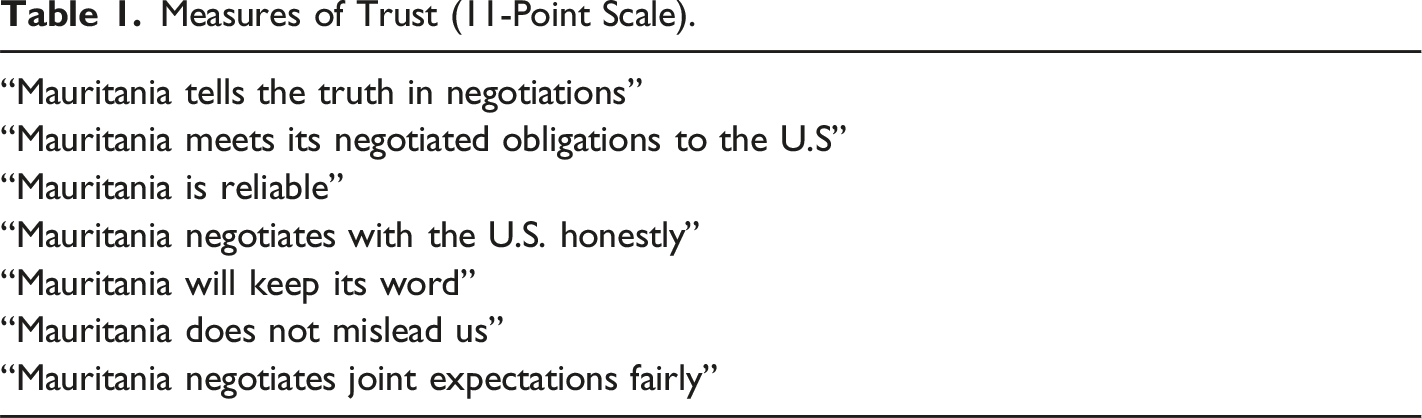
We measured several demographic and attitudinal variables (gender, age, education, party identification, political orientation, foreign policy orientation, and COVID-related experiences) that might affect trust evaluations or support for cooperation. We also used manipulation checks to assess whether respondents recognized and understood the content of our treatments. 15 Participants were debriefed at the end of the study that the reciprocity behavior and image of the country had been manipulated.
We used multiple linear regression to estimate the effects of our treatments on trust. This approach both addresses demographic or attitudinal variable imbalances in our condition groups, and also allows us to estimate the direct and interaction effects of our treatments. Covariates were normalized to range from 0 to 1 for ease of interpretation and comparison.
Empirical Results
Figure 1 provides a descriptive overview of our results, considering the mean response by treatment group. We observe that respondents’ mean level of trust in the foreign government is systematically higher in the reciprocity condition than in the reciprocity-violation condition, and this effect appears to be insensitive to similarity and costliness.
16
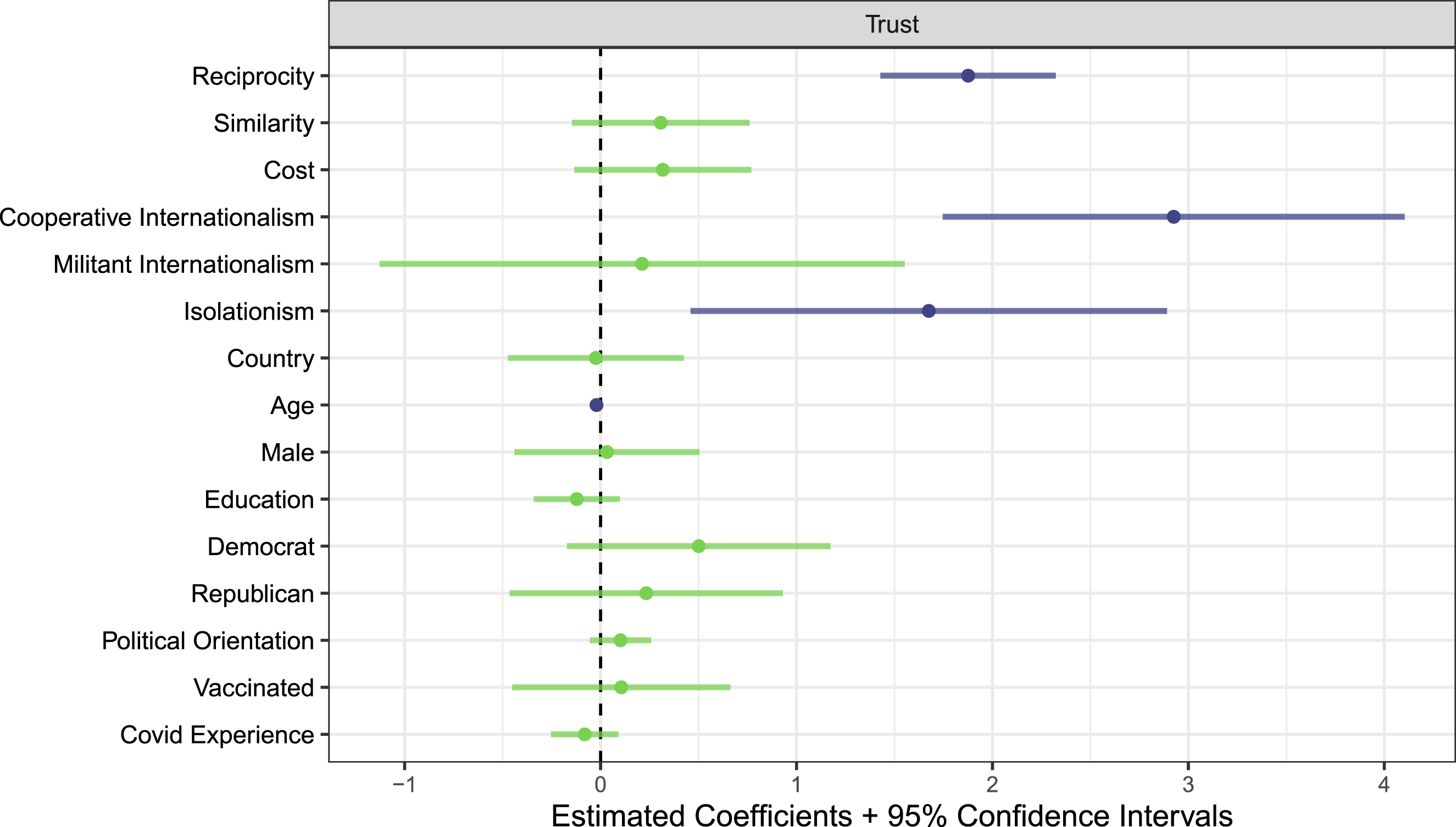
Figure 2 illustrates parameter estimates from a linear regression model, which includes the reciprocity, similarity, and cost conditions, as well as control variables for foreign-policy orientation, demographic characteristics, political orientation, and COVID-related attributes. Trust by treatment group. The reciprocity effect on trust.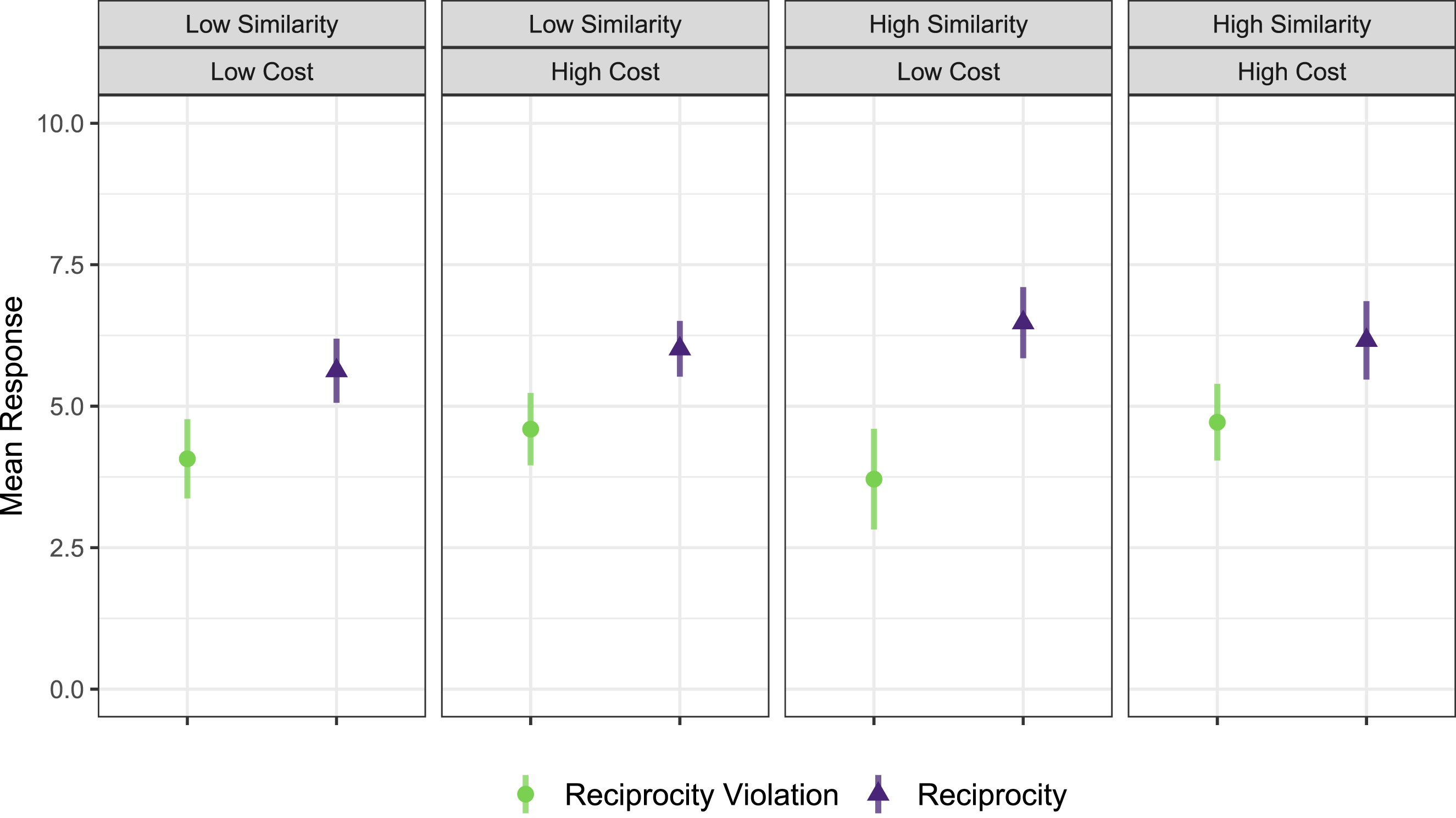
The Effect of Reciprocity on Trust
H1 predicts that individuals will trust another country more when that country reciprocates a prior positive behavior. In our experiment, the prior behavior was the United States donating COVID-related aid to Mauritania for free. Mauritania either freely returns the aid (reciprocity condition) or returns it at a price (reciprocity-violation condition). Thus, if reciprocity exerts an effect, respondents in the reciprocity condition will be more trusting of Mauritania than their counterparts in the reciprocity-violation condition.
The findings strongly support H1. Respondents in the reciprocity condition are significantly more likely to trust Mauritania than those in the reciprocity-violation condition. Figure 2 shows the estimated treatment effect, as well as estimates for the covariates. The results indicate that, on average, respondents in the reciprocity condition are nearly 2 points more trusting of Mauritania, on an 11-point trust scale, than those in the violation condition, which is a sizable effect. Put differently, the estimated level of trust among respondents in the violation condition is 4.4 on the 0–10 point trust scale, indicating that, on average, respondents found Mauritania untrustworthy. By contrast, the point estimate for respondents in the reciprocity condition is 6.3—a nearly 50 percent increase in levels of trust, and an indication that, on average, respondents find Mauritania more trustworthy than not. 17
Is the Effect of Reciprocity Moderated by Similarity or Cost?
Next we evaluate whether the effect of reciprocity on trust depends either on the degree of similarity between the US and the other country (H2) or on the costliness of the act of reciprocity (H3). Figure 3 illustrates estimates for the constituent and interaction terms from the respective moderation models. Regarding similarity, we find no evidence that similarity moderates the effect of reciprocity on trust. In the low-similarity condition, moving from the reciprocity violation treatment to the reciprocity treatments results in a 1.5 estimated point increase in trust. In the high-similarity condition, moving from the violation condition to reciprocity condition results in a 2.2-point increase in trust. Although these estimates suggest that the effect of reciprocity is slightly stronger when similarity is high, the estimated moderation effect is statistically insignificant. These results suggest that reciprocity unconditionally improves trust, irrespective of shared attributes between countries. Reciprocity conditional on similarity and costliness.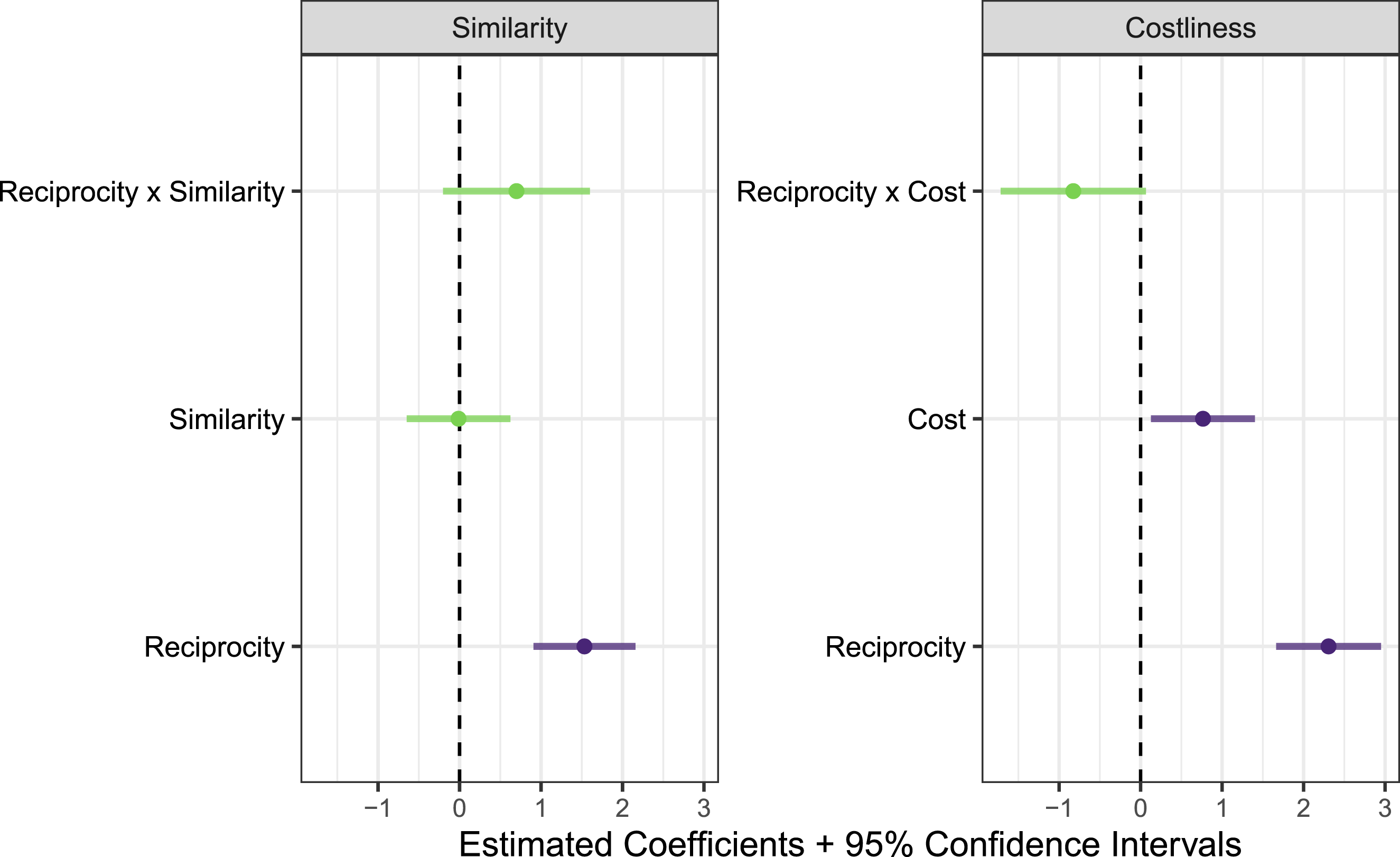
The reciprocity effect is also not significantly moderated by cost. In the low-cost treatment, where respondents are told that Mauritania’s need for ventilators is not dire, our model estimates a substantial and statistically significant 2.3-point increase in trust, or an estimated 4.2 response in the reciprocity-violation group to 6.5 in the reciprocity group. In the high-cost treatment, where respondents are told that Mauritania’s need for ventilators is dire, the effect of reciprocity appears to be negative rather than positive—the opposite of the outcome predicted by H3. However, this estimate does not reach statistical significance at conventional levels. Interestingly, costliness has a weak but statistically significant effect in the reciprocity-violation condition. That is, when Mauritania forces the US to buy back the ventilators, our model predicts that when subjects know that Mauritania is in dire need of ventilators, trust should increase by 0.7 points, from an estimated 4.2 to 4.9 on the 0–10 scale. Overall, these results indicate that, although costliness may have an independent effect on trust—as hypothesized by much IR literature—reciprocity has a much stronger independent effect, even when acts of reciprocity appear to be costless.
Conclusion
We find that exposure to reciprocity increases trust toward a target country. Further, commonly cited influences on trust, such as costly signaling and perceived similarity, do not significantly moderate this effect. Overall, these results are consistent with unbounded generalized reciprocity, in which individuals use reciprocity as a heuristic cue to determine whom to trust. The mere act of reciprocating a cooperative behavior may be sufficient to convey sincere intentions, thus laying the groundwork for cooperation. Our findings also suggest that reciprocity has the potential to affect lay views on foreign policy and international cooperation—perhaps more strongly than costly signaling or similarity. While the finding that reciprocity increases is trust not necessarily surprising (e.g., Lindskold 1978), micro-level evidence of this effect—specifically in regard to international relations—has thus far been lacking. Our project fills that gap.
These findings have several implications for our understanding of reciprocity and cooperation. First, the results confirm previous research showing that the processes outlined in the UGR perspective are relevant not only to rational-actor tasks (e.g., the prisoner’s dilemma), but also to more generalizable outcomes, such as trust perceptions, which in turn have implications for international relations (Ding et al. 2022; Velez et al. 2021; Velez et al. 2016; Verheijen et al. 2019). Further, the results find support for the logic of vicarious reciprocity in foreign-policy settings, where observation of reciprocity between governments affects individual opinions (Ellithorpe et al. 2022; Holt et al. 2022). While research on reciprocity in international relations has tended toward a game-theoretic, state-as-actor approach (Larson 1988), our results suggest that state behaviors can influence public attitudes in complex ways. Overall, the strong causal effects associated with social-psychological mechanisms support the relevance of that literature to the study of international relations.
Second, our study provides insight into why public support for or against international cooperation sometimes appear to be divorced from the immediate utility of cooperation. If reciprocity in IR follows the logic of UGR, then individuals may support reciprocity even when the immediate benefits are low, so long as they believe that their country will benefit more broadly (e.g., by developing a cooperative reputation). Conversely, individuals may oppose seemingly utility-maximizing reciprocal actions if those actions are unlikely to yield long-term reputational benefits. This logic helps bridge an academic divide between rationalist explanations of reciprocity, where reciprocity is purely strategic, and critics who cite examples of individuals behaving irrationally in cooperative settings. According to our theoretical approach, individuals have learned to use reciprocity simply as a heuristic; they are not locked in to short-term gains, and neither are they irrational creatures, concerned only with in-group loyalty, fairness, and altruism. Rather, following an evolutionary psychology logic, individuals follow cues that generally leave them better off, which includes engaging in reciprocity. In the realm of international relations, where government interactions are routine and ongoing, and where individuals can distinguish between an isolated strategic interaction and larger questions of reputation, cooperation, national interest, and long-term benefit, the expectations of the UGR perspective may hold more relevance than the tit-for-tat dynamics of game-theoretic models.
Third, increasing trust through reciprocity in international relations may be more straightforward than previously thought. Consistent with other psychological research on reciprocity, we find that simply returning an action of similar value builds trust (Zhang and Epley 2009). Perspectives that emphasize ingroups or credible signaling complicate trust building, as they imply that, absent group dynamics or costliness, reciprocity has little effect on trust. Our results indicate that these conditional influences are perhaps overstated. On the other hand, our results also indicate that reciprocity violations are particularly devastating. The moderation analysis shows that once a country has violated reciprocity, ingroup status is not sufficient to rebuild trust; individuals may require more elaborate justifications when such violations occur. Overall, then, our findings leave room for optimism in that cooperation is possible even between adversaries, but also pessimism in that countries that lack the resources or opportunities to engage in reciprocity may suffer perpetually from a trustworthiness gap.
This study is not without limitations. First, while we based the vignettes on a real news article in order to improve external validity, there are potential drawbacks to this approach in terms of generalizability. The article in question is about the COVID-19 pandemic, which may limit the relevance of our findings to other issue areas. For example, the “we are all in this together” messaging of the pandemic may have increased expectations of reciprocity, thus making reciprocity failures all the more egregious (cf. Sobande 2020). On the other hand, the intense polarization that emerged around the pandemic may have had the opposite effect, dampening expectations of reciprocity (Druckman et al. 2021). The sample is also limited to respondents in the United States. The US occupied a leading position in the global narrative surrounding the COVID-19 pandemic, and the US pandemic response became highly politicized—a unique combination of features that my further limit generalizability. Future work should explore additional issue areas using respondents from outside the US.
Second, in terms of internal validity, the language in our vignettes was drawn from real news articles and left mostly unchanged, which may introduce additional confounders, such as moral sentiment and diffuse reciprocity considerations. For example, the news articles include words like “sinister” in describing reciprocity violations. The vignette language may further evoke general, diffuse reciprocity considerations (i.e., sending defective supplies to other countries) rather than the specific reciprocity that characterizes relations between the US and a counterpart country. Nonetheless, using actual news articles accurately represents how individuals encounter information about reciprocity in real-world politics. Further, our analyses show that, even when controlling for emotional responses to the vignettes, reciprocity has a direct effect on trust. Our analyses also show that respondents understood the specific reciprocity messages in the vignettes; that is, respondents significantly adjusted expectations of reciprocity specifically toward the counterpart country. 18
Finally, although the manipulation checks for similarity and costliness indicate that the treatments were successful, the design of the experiment—e.g., the costliness manipulation was embedded in the same news vignette as the reciprocity manipulation—may have diluted the potential effects of these treatments. And the positive independent effect of costliness (Figure 3), combined with a nearly significant negative interaction between reciprocity and costliness, suggest that there is more room for exploration.
Supplemental Material
Supplemental Material - The Effect of Reciprocity on Trust: International Cooperation and COVID Aid
Supplemental Material for The Effect of Reciprocity on Trust: International Cooperation and COVID Aid by Andrew Roskos-Ewoldsen, Morgan Ellithorpe, and Brandon Kinne in Journal of Conflict Resolution
Supplemental Material
Supplemental Material - The Effect of Reciprocity on Trust: International Cooperation and COVID Aid
Supplemental Material for The Effect of Reciprocity on Trust: International Cooperation and COVID Aid by Andrew Roskos-Ewoldsen, Morgan Ellithorpe, and Brandon Kinne in Journal of Conflict Resolution
Footnotes
Acknowledgments
For their helpful and insightful comments, we would like to thank: Sean Ehrlich, Hao Zhang, Giorgio Malet, Stefanie Walter, Richard Clark, Christoph Mikulaschek, Julia Morse, Andrew David Lugg, Jared Oestman, and Brett Ashley Leeds as well as other participants at the 2023 annual conference of the American Political Science Association; Maisa Borg, Stephanie Smith, Jeremy Youde, Nivedita Jhunjhunwala, and other participants at the 2024 annual conference of the International Studies Association.
Declaration of Conflicting Interests
The author(s) declared no potential conflicts of interest with respect to the research, authorship, and/or publication of this article.
Funding
The author(s) received no financial support for the research, authorship, and/or publication of this article.

Data Availability Statement
Data sharing not applicable to this article as no datasets were generated or analyzed during the current study.
Supplemental Material
Notes
References
Supplementary Material
Please find the following supplemental material available below.
For Open Access articles published under a Creative Commons License, all supplemental material carries the same license as the article it is associated with.
For non-Open Access articles published, all supplemental material carries a non-exclusive license, and permission requests for re-use of supplemental material or any part of supplemental material shall be sent directly to the copyright owner as specified in the copyright notice associated with the article.
