



Abstract
Peacekeeping has been found to be effective in containing conflict and civilian victimization, while the findings for the effect of aid on violence are indeterminate. So far the effects of peacekeeping and aid on violence have mainly been studied separately, this article investigates, at the subnational level, the effect of humanitarian aid on one-sided violence conditional on the deployment of peacekeeping forces. Although humanitarian aid can occasionally exacerbate violence, it is argued that peacekeepers reverse this unintended consequence of the provision of aid. We argue that they do so by means of sharing information and the provision of security bubbles. Empirically, we look at the coincidence of subnational location of humanitarian agencies and peacekeeping troops and find support for the idea that the effect of aid on violence against civilians is conditional on the presence of peacekeepers.
Introduction
The international community uses a range of instruments to address security and humanitarian concerns in conflict-affected areas. UN peacekeepers commonly operate alongside organizations delivering humanitarian aid. Even though they share a common objective to alleviate the impact of conflict on civilians, peacekeepers and humanitarian agencies have different approaches to conflict resolution and commonly disagree on how best to deal with local actors (Abiew and Keating 1999; Metcalfe 2012). Humanitarian agencies also differ in their willingness to cooperate with UN peacekeepers. While some agencies cooperate with UN peacekeepers to facilitate the delivery of humanitarian aid (Hilhorst and Schmiemann 2002), others refrain from cooperation because they worry about compromising their impartiality and the security of their staff on the ground (Eckroth 2010).
Recognizing the variation in cooperation between peacekeepers and providers of humanitarian aid, our research question is how this affects the security situation, particularly the level of violence against unarmed civilians (also known as one-sided violence (OSV)). Recent research has shown that UN peacekeeping operations can reduce violence (Walter et al. 2021) and highlights specific mechanisms by which UN peacekeeping curbs violence against civilians. Fjelde et al. (2019) argue that the presence of peacekeepers raises the costs for armed groups to use violence against civilians. Ruggeri et al. (2017) further argue that peacekeepers contain violence locally via policing and mediating between armed factions. In contrast, the effect of aid on violence is indeterminate. Undoubtedly, humanitarian agencies aim to reduce violence or at least alleviate the consequences of conflict for civilians (Bradley 2016). However, aid may have unintended consequences, e.g., Wood and Sullivan (2015) argue that the humanitarian aid presents opportunities for looting and that foreign aid can challenge the authority of local actors.
Whether peacekeepers affect the security of humanitarian aid workers is also contested. Karlsrud (2017) and Hoelscher et al. (2017) argue that peacekeepers reduce the humanitarian space and that their presence can increase attacks on aid workers. However, Duursma et al (2023) show that attacks on humanitarian workers where peacekeepers are present are largely an artefact of them operating in the same geographical locations. Levin (2023) demonstrates that UN peacekeeping troops, but not police and observers, reduce attacks against aid workers. Yet, here our focus is on one-sided violence (OSV), which goes beyond direct attacks on aid workers and rather focuses on violence against unarmed civilians.
We propose two arguments for why peacekeepers could make the delivery of humanitarian aid safer. Firstly, humanitarian agencies and UN peacekeepers can share information allowing each of them to better carry out their activities and to reduce violence more broadly. Secondly, UN peacekeepers provide local security bubbles enabling humanitarian agencies to carry out their activities without risking aid to become a catalyst for violence. Is the effect of aid on violence against civilians indeed conditional on the presence of peacekeepers? Empirically, we set up the analysis at the subnational level using detailed information on the deployment of peacekeepers and the provision of humanitarian aid to examine the conditions under which they may reduce OSV. The analysis at the subnational level allows us the identify areas where only humanitarian agencies or peacekeeping are present and to contrast these with areas where both are active.
Examining whether the effect of humanitarian aid on OSV is indeed conditional on the presence of UN peacekeepers contributes to three strands of literature. Firstly, there is an emerging interest in the complementarity or substitution of different conflict management methods and actors. The UN itself advocates the integration of its resources and to mandate multidimensional peacekeeping missions in support of a comprehensive peace. Howard (2019) highlights the use of economic instruments by peacekeepers, such as aid and trust funds, as inducements for peace. Other scholars research the integrated effect of peacekeeping operations and mediation (Beardsley et al. 2019; Clayton and Dorussen 2022; Greig and Diehl 2005). Secondly, it bridges the literature of civilian and military components in peacekeeping operations; for example, Lucius and Rietjens (2016); Seybolt (2007) and Friis (2020) examine civil-military relationship in UN peacekeeping operations. Here, we examine humanitarian agencies as civilian organizations separate from, but related to, military peacekeeping. Thirdly, our research contributes to quantitative analyses of the effectiveness of various conflict resolution tools at the subnational level (Duursma 2021; Fjelde et al. 2019; Ruggeri et al. 2017). So far, research on subnational peacekeeping has not controlled for humanitarian aid. Using country-level data, Wood and Sullivan (2015) and Wood and Molfino (2016) find that robust multidimensional peacekeeping can alleviate the unintended consequences of humanitarian aid on violence. 1
The next section reviews the literature examining the effectiveness of peacekeeping operations. Existing research about the impact of humanitarian aid on conflict is indeterminate. We contrast arguments how humanitarian aid may exacerbate conflict with how it can contribute to peace. Then, we summarize the normative and practical issues hampering collaboration between peacekeeping operations and humanitarian aid workers, while also identifying opportunities for cooperation. Next, we show how possible cooperation mechanisms, i.e., via information sharing and security bubbles, may reduce conflict, in particular OSV, and derive our key hypothesis that the effect of aid on OSV is conditional on the presence of peacekeepers. In the remainder, we present the research design and demonstrate that the effect of aid on OSV is indeed conditional. We also explore the robustness of this finding.
The Relation Between Peacekeeping, Humanitarian Aid, and Violence
Humanitarian Aid and Violence
Humanitarian aid “is designed to save lives, alleviate suffering, and maintain and protect human dignity during and in the aftermath of emergencies” (Zürcher 2017). 2 It commonly bypasses national governments and supports the delivery of goods and services directly to the population via third-party actors such as (I)NGOs. Humanitarian agencies shoulder the main responsibility of implementing humanitarian aid. In conflict situation, humanitarian aid directly aims to save the lives of unarmed civilians.
Howard (2019, 86) rightly emphasizes that humanitarian agencies offer aid to save lives and not necessarily to create peace or to reduce the number of violent incidents. Still, Bradley (2016) argues that humanitarian agencies generally aim to reduce violence and threats posed to civilians. Moreover, the presence of international humanitarian agencies, such as the International Committee of the Red Cross / Crescent (ICRC) or the UN Refugee Agency (UNHCR), offers passive protection: armed actors are less likely to threaten civilians when they risk being observed. 3 Because of their activities on the ground, humanitarian agencies regularly observe coercion and abuse of civilians. Humanitarian agencies also frequently document such violence providing civilians with an opportunity to report abuse and to reduce their own vulnerability. Persons who are known to humanitarian agencies are less likely to be mistreated, killed or to disappear (Bradley 2016). Monitoring and reporting violence can also be used to change the behavior of armed factions and convince them to reduce levels of violence against civilians. Since reports of violence against civilians undermine the legitimacy of armed actors, humanitarian agencies can use dialogue and advocacy to engage with the perpetrators of violence, including the police and government security services, to influence their activities. We recognize that not all armed actors are equally concerned about their legitimacy which may explain why naming and shaming is not universally effective.
Lyall (2019) argues that aid can either increase or decrease levels of violence, or have no-net effect. He argues that aid decreases violence if it reduces the grievances groups may hold. Out of gratitude for receiving aid, victims may become willing to provide intelligence and information, limiting the ability of rebel groups to operate. Yet, notably humanitarian aid is not the same as protecting civilians (Mahony 2013), and treating aid as part of a strategy of ‘winning hearts and minds’ can increase violence (Findley 2018; Karlsrud 2017). When civilians are perceived to collaborate with ‘foreigners’ and to assist a counterinsurgency, they may be seen as legitimate targets. Wood and Sullivan (2015) argue that rebels can perceive (foreign) humanitarian agencies as a challenge to their authority. If so, they may want to expel these agencies from the area under their control or at least to dictate their activities, if necessary, by means of force. They can also target civilians who engage with humanitarian agencies. Aid can have other unintended consequences; most notably, the influx of resources into an area presents opportunities for looting and predation. (Foreign) aid workers may become targets of kidnapping for ransom. Armed factions can target persons who have received aid and force them to hand over the resources, and civilians can get hurt simply as by-standers.
Empirical findings concerning the impact of aid on violence are also mixed. Studying Afghanistan, Lyall (2019) finds that aid reduces attacks of the Taliban towards ISAF. Lyall also observes that humanitarian aid did not provoke the Taliban to target civilians. Several cross-national studies have found that aid leads to increased levels of conflict and extends the duration of insurgencies (Narang 2015; Wood and Molfino 2016; Wood and Sullivan 2015). To summarize, both theoretically and empirically the impact of aid on conflict is indeterminate. As an unintended consequence, the provision of aid risks increasing violence against civilians. Humanitarian agencies have an obvious interest to minimize the risk, but vary in their approach; in particular, regarding their willingness to collaborate with security providers such (UN) peacekeepers.
UN Peacekeeping Operations and Violence
Quantitative analyses of peacekeeping effectiveness generally observe that UN peacekeeping reduces conflict and violence as measured via the onset and duration of violent conflict and the number of battle-related deaths and victims of one-sided violence (Walter et al. 2021). Arguably, UN peacekeeping operations (PKOs) use deterrence, commitment, and providing information as methods to keep the peace. Beardsley and Gleditsch (2015) and Ruggeri et al. (2017) show that peacekeeping contains local hostilities. UN peacekeepers also increase the military costs and political costs of targeting civilians (Hultman et al. 2013, 2014), and the presence of UN peacekeepers in (formerly) rebel-held areas thus poses a credible deterrent threat. Fjelde et al. (2019) show that UN peacekeepers reduce violence against civilians by rebel actors, but they also find that peacekeepers are not necessarily effective in reduce OSV committed by government actors. Their findings suggest that the distinction between violence committed by rebel and government may also be relevant when it comes to the ability of peacekeepers to deal with violent events surrounding humanitarian aid.
UN peacekeepers increasingly share common objectives and develop similar activities as humanitarian agencies. They are commonly mandated to assist humanitarian organizations, e.g., Lloyd (2021) includes facilitating the delivery of humanitarian assistance and the protection of humanitarian personnel among the tasks assigned in peacekeeping mandates. Howard (2019) identifies persuasion and inducement as peacekeeping mechanisms that go beyond coercion, or the military dimension of peacekeeping. Persuasion relies on peacekeepers providing reliable information allowing them to mediate in low-trust environments. Peacekeepers further provide inducements via economic methods, such as the provision of aid and supporting local projects. Howard (2019) draws attention to the relevance of cooperation between multiple actors to realize the objective of resolving conflict. Maekawa (2024) shows that peacekeeping increases the amount of foreign aid made available. Gizelis and Cao (2021) explain the positive relationship between peacekeeping presence and maternal health improvements based on UN PKO’s direct effect of providing medical and training facilities, and an indirect security effect improving access to maternal health. Finally, UN missions use quick impact projects (QIPs) to engage with local populations weakening the distinction between humanitarian and military aspects of UN involvement.
Civil-Military Engagement and the Principle of Distinction
Peacekeeping mandates increasingly include supporting and even delivering humanitarian aid, but humanitarian agencies still often advocate for a clear separation between humanitarian and military activities. For example, in response to policy recommendations made by Collier (2007) to allocate foreign aid in combination with military intervention, Easterly (2008) writes that “the hubris of the military imperialists was bad enough without adding to it the hubris of the aid imperialists”. Even though UN PKOs aim to be impartial, NGOs tend to insist on full neutrality, impartiality, and independence. Invoking the principle of distinction, they refrain from collaborating with military missions to protect their neutrality (Eckroth 2010). NGOs also express concerns that coordination with security services and even cooperation with UN peacekeepers is seen as serving the interests of national authorities or the UN, in particular the major powers represented in the Security Council (Abiew and Keating 1999).
In contrast, advocates of resilience humanitarianism propose a more pragmatic approach leaving more room for NGOs to cooperate with government authorities and external interveners such as UN peacekeepers (Hilhorst 2018). To operate more effectively – or even to be able to operate at all – humanitarian agencies are often pragmatic and interpret principles contextually rather than universally (Hilhorst and Schmiemann 2002). Resilience humanitarianism treats humanitarian interventions as spaces where multiple actors operate which necessitates engaging with national and rebel authorities, as well as local institutions and external actors, including UN peacekeepers. For example, support for refugees and internally displaced people often requires NGOs to engage with host governments and UN agencies since they are formally responsible for their safety.
Some NGOs choose to directly engage with UN peacekeeping operation out of pragmatic considerations, such as the logistic support and security provided by UN peacekeepers. In humanitarian and protection clusters NGOs exchange information with UN agencies such as the UNHCR, UN Women and UNDP. Some UN missions, such as MONUSCO in the DRC, have signed up to a framework of civil-military relations with regular meetings between NGO field officers and UN peacekeeping officers. Yet Dorussen and de Vooght (2018, 5) report that “NGOs often feel that communication remains one-sided where they are not provided with relevant information, e.g., on the caveats made by specific peacekeeping contingents, while information by NGOs can be used for military purposes”.
UN peacekeepers are increasingly aware of the importance of cooperation with humanitarian agencies. Since the 1990s, the protection of civilians has become a standard mandate for peacekeeping missions, which has encouraged UN peacekeeping missions to increase their contacts and collaboration with humanitarian agencies both inside and outside the UN system (O’Neill 2004). The establishment of the Inter-Agency Standing Committee (IASC) in 1991 aimed at coordinating the UN system for humanitarian action. Yet so far, IASC does not include a representative from the UN’s Department of Peacekeeping Operations (DPKO) showing the reluctance of the humanitarian community to work with military officials.
The changing attitudes can also be observed in the practices of the ICRC. Traditionally, the ICRC has strictly guarded its autonomy, resisted coordination, and only reluctantly attended protection cluster meetings (Natsios 1995). Compared to other IGOs and NGOs, the ICRC is most likely to “express reservation at the increasing “blending” of humanitarian action and military operations/personnel” (O’Neill 2004). Regardless, even the ICRC has “begun engaging in violence-prevention and violence-reduction activities, compromising its neutrality and limiting dialogue with some armed groups” (Bradley 2020). In an article posted on the ICRC’s website, Sommaruga (1997) expresses the concern that engagement with UN peacekeeping risks integrating humanitarian efforts into a political process and becoming politicized, and “strongly advocated the creation of a humanitarian space, thereby emphasizing the need to leave room for independent humanitarian action in situations of conflict”. In 2018, however, the ICRC (2018) used its website to emphasize its close working relationship with armed forces including the UN peacekeeping operations at strategic, operational, and tactical level.
In short, although humanitarian agencies still commonly invoke the principle of distinction, in practice civil-military relations have become a key part of the effective delivery of humanitarian aid in conflict-affected areas. Both humanitarian agencies and UN peacekeepers have changed their attitudes, but not all missions have adopted a framework of civil-military relations, and some humanitarian agencies remain reluctant to collaborate with UN peacekeepers, especially military personnel. As Dorussen and de Vooght (2018, 5) conclude “there is large variation in the NGO willingness to engage with UN peacekeeping missions, ranging from open-minded to extremely cautious attitudes” (see also De Coning 2007). The variation in attitudes explains the empirical variation of co-deployment of peacekeeping and humanitarian agency or aid and gives an opportunity to examine the relationship between aid, peacekeeping and the dynamics of violence against civilians in more detail.
Information-Sharing and Security Bubbles as Means to Reduce One-Sided Violence
De Coning highlights information-sharing as an example of cooperation between humanitarian agencies and peacekeepers, … cooperation refers to a maximum state of civil-military coordination where there is a range of cooperative relations between the humanitarian community and a military force that is not regarded as a combatant force, typically including joint planning, division of labour and sharing of information. (De Coning 2007, 7)
Joint planning is a further example of sharing of information and facilitates a division of labor where peacekeepers are typically charged to provide security. Security bubbles enable humanitarian agencies to operate in challenging circumstances. As we argue below, both mechanisms not only facilitate peacekeeping and the delivery of humanitarian aid but should also reduce levels of violence against civilians; in particular, violence that is linked to aid as a lootable resource.
Peacekeeping operations and humanitarian assistance both rely on the collection of timely and accurate information. Consequently, humanitarian agencies (Sagun et al. 2009) and UN peacekeepers (Abilova and Novosselo 2016) invest in multiple sources for collecting relevant information. Information sharing between peacekeepers and humanitarian agencies allows them to collate pieces of information and to cross-check the quality of their information. Some of the information is directly relevant from a security point of view, such as the “location of anti-personnel landmines, illegal checkpoints, movements of at-risk populations, militia command and control structures, location of food and supply warehouses and the existence of arms or drug trafficking networks” (O’Neill 2004).
Depending on specific types of intelligence to be collected, either peacekeepers or humanitarian agency may be privileged. Humanitarian agencies commonly have better “knowledge about beneficiaries and their needs and customs, something the military lack” (Heaslip 2012). Humanitarian agencies are better suited to collect information about circumstances in refugee hosting areas, because of their direct and extensive experience in running activities there (Eriksson 1997). At the same time, their capacity to gather and analyze information is constrained by restricted access, limited staff capacity, or government objections against intelligence gathering (Bradley 2016). UN-led humanitarian agencies such as UNHCR and OCHA are often in a better position to collect information on population movements (O’Neill 2004), including safe havens or refugee camps and possible violence there, and generally have direct responsibility for managing refugee flows (Uzonyi 2020).
UN peacekeepers and humanitarian agencies are unlikely to share information fully. Some balance between secrecy and openness needs to be struck, since both sides have concerns about possible misuse of sensitive information (Holt et al. 2009; Karlsrud 2017). Duursma et al (2023) discuss how intelligence sharing as part of counter-insurgency operations in Mali risked undermining the neutrality of humanitarian agencies and potentially endangered aid workers. Regardless, sharing of information between UN peacekeepers and humanitarian agencies is often essential to enable both sides to carry out their jobs and to ease violence. Information-sharing helps humanitarian agencies to better assess any security risks and to protect their aid from being looted and their workers against kidnapping. At the same time, humanitarian agencies commonly observe increased instability in specific locations where they operate. Sharing such information enables UN peacekeepers to deter violence against civilians and to facilitate the safe delivery of aid.
Formalizing earlier information-sharing practices, Joint Protection Teams (JPTs) have facilitated information sharing between UN peacekeepers, MONUC, and humanitarian agencies in the DRC. A JPT includes staff members from different backgrounds and expertise in various MONUC departments. The experts such as “human rights, civil affairs, political, gender, or police officers” and including “humanitarian agencies” are deployed to locations where civilians may be at risk. The teams analyze and identify threats of violence, and therefore, help the military component to develop more comprehensive protection plans or responses (DPKO 2020). JPT models have been extensively used in MONUC and MONUSCO but have so far not been instituted in other missions. 4
Even though JPT are not standard across missions, missions tend to explore ways to engage with humanitarian agencies leading to different degrees of civil-military cooperation. For MONUSCO in the DRC it was more common to meet with NGOs compared to MINUSCA (in the CAR) where NGOs and the UN had not agreed on a framework for civil-military relations. Different coordination methods in various missions are usually supported by humanitarian agencies and UN peacekeeping operations. The Office for the Coordination of Humanitarian Affairs (OCHA) and the United Nations Humanitarian Civil-Military Coordination (UN-CM Coord) are placed in the humanitarian staff structure (DPKO 2022; IASC 2004). UN CIMIC, the United Nation civil-military coordination, belongs within the structure of the UN peacekeeping operations (De Coning 2007). All these different structures and activities aim to protect civilians and reduce violence.
Sharing information intends to increase the security of surrounding the delivery of humanitarian aid and, hence, is not fully distinct from the ‘security-bubble’ mechanism discussed below. Sharing information helps humanitarian agencies to direct their aid to areas where it is most needed or could be delivered effectively. It also helps them to decide where to store – and along which routes to deliver – humanitarian aid. Peacekeepers can also facilitate dialogue between aid workers and local communities to reduce the risks surrounding the delivery of aid. Yet, the two mechanisms are not identical either. Although sharing information helps peacekeepers to create so-called security bubbles, it is not the only (or even more prominent) mechanism by which peacekeepers create such safe zones.
Providing security is a core mandate of UN peacekeeping and extends beyond the safe delivery of aid. UN peacekeepers aim to create security bubbles to promote cooperation and reduce violence against civilians. Mvukiyehe and Samii (2021) introduce the notion of security bubbles to argue that peacekeepers can lower the (perceived risk of) victimization in those areas where they are deployed but find only limited support for their effectiveness (also see Metcalfe 2012). Peacekeepers aim to create security bubbles by means of guarding and patrolling, demobilizing, providing protection of refugee sites, improving infrastructure and demining.
Humanitarian agencies benefit from a more secure environment in multiple ways. Firstly, UN peacekeepers can provide direct security support to humanitarian agencies. Peacekeepers can be tasked to deliver humanitarian aid (as in UNPROFOR), or to escort the delivery of aid and to protect the safety of aid. UN peacekeepers often provide reconstruction and engineering expertise to help (re-)building infrastructure. Better infrastructure improves the safety of humanitarian supply chains and the transportation of humanitarian aid. Yet, the deployment of UN troops does not always solve aid obstruction problems in more challenging circumstances; Newland and Meyers (1998) report that casualty rates were higher in UNPROFOR escorted convoys compared to non-escorted convoys. Still the presence of UN peacekeepers should reduce opportunities for looting and ensure that the humanitarian aid is delivered to civilians. Finally, the effective delivery of humanitarian aid also mitigates grievances and avoids civilians getting caught up in violence that could otherwise ensue.
Secondly, the security bubbles provided by UN peacekeepers create a safe environment allowing humanitarian agencies to implement their work. For example, in Somalia UN military troops, collaborating with WFP and NGOs, “restore sufficient order to allow for the relief and resettlement of displaced Somalis” (Hopkins 1998). In this case, the delivery of food aid was combined with robust peacekeeping. In Sierra Leone in the 1990s, NGOs found it nearly impossible to fulfill their missions due to the lack of security. Therefore, peacekeepers in UNAMSIL “received a mandate to collect weapons from rebels, disarm them, integrate them into the national armed forces, while protecting humanitarian aid workers and NGOs in Sierra Leone” (Jackson 2017). A similar situation happened in East Timor when NGOs called for help from UNTAET.
Depending on their specific mandate, UN peacekeeping missions vary in their authorization of the use of force and whom they are expected to protect. Still, the protection of civilians has become a common element of the mandate of UN PKOs. If UN peacekeepers protect civilians against violence by means of guarding and patrolling, they – at least indirectly – also support the work of humanitarian agencies. The presence of UN peacekeepers can deter violence against refugees and counter any attacks via the proactive use of force. In collaboration with UNHCR, UN peacekeepers generally protect refugees and internally displace people (IDPs) in refugee-hosting areas. Yet combatants often attempt to blend in among refugees (Lischer 2005), making refugee-hosting areas important predictors of OSV in Africa (Fisk 2018). Humanitarian agencies also distribute food and medical aid within refugee-hosting areas, and aid can easily get looted when these areas are left unprotected. Working with UNICEF and other child-focused NGOs helps peacekeepers to assist vulnerable persons, in particular women and children (Metcalfe 2012). Furthermore, many peacekeeping missions have a role in demining, which leads to close cooperation with humanitarian organizations in this area.
We do not necessarily expect the reach of UN peacekeepers to extend beyond the specific area under their control, hence the use of the term, security bubble. Peacekeeping may thus well coincide with increased levels of criminal violence overall (Di Salvatore 2019), but we expect this to happen mainly beyond the immediate reach of UN peacekeepers.
In line with previous research, we expect that UN peacekeepers reduce violence against civilians, while the effect of humanitarian aid is indeterminate. Moreover, we argue that the impact of aid on violence against civilians is conditional on the presence of peacekeeping. Cooperation between UN peacekeepers and humanitarian agencies enables them to share information and to maximize the benefits of the security bubbles provided by UN peacekeepers. Cooperation allows aid to be protected, making it less vulnerable to looting and reducing any positive link between aid and violence.
Humanitarian aid reduces violence against civilians conditional on the presence of UN peacekeepers.
Our research strategy is to rely on the location of humanitarian aid projects and UN peacekeepers, since we lack complete and consistent data on cooperation between humanitarian agencies and peacekeepers. We assume that the joint presence of humanitarian agencies and UN peacekeepers at a particular location implies at least tacit cooperation. Accordingly, to test our hypothesis that the effect of aid is conditional on peacekeeping, we consider whether the spatial overlap in the presence of humanitarian agencies and peacekeeping reduces violence. Arguably, humanitarian agencies that are concerned about any form of coordination with peacekeepers decide to distance themselves from areas where peacekeepers are deployed. In other words, humanitarian agencies that are unwilling to cooperate ‘stay far away’ from UN PKO deployments (Eckroth 2010). If the sub-national UN peacekeeping deployment overlaps with the location of humanitarian agencies, aid should reduce violence against civilians.
Our main hypothesis does not differentiate between OSV committed by rebel or government forces. The mechanisms that we identified in our theoretical discussion, namely information-sharing and security bubbles, do not obviously apply differently for rebel and government forces. Looting results primarily from a lack of discipline or control over troops on the ground, which can apply to rebel as well as government troops. Rebel, but also government forces, may target humanitarian aid if it is perceived as undermining their control over the local population. There is, however, some evidence that peacekeepers target and impact rebel activities more strongly than those of government forces (Dorussen and Gizelis 2013; Fjelde et al. 2019). 5 Accordingly, peacekeepers may be more effective in protecting humanitarian aid from rebels compared to government forces. We explore this possibility further as a robustness test below.
Research Design
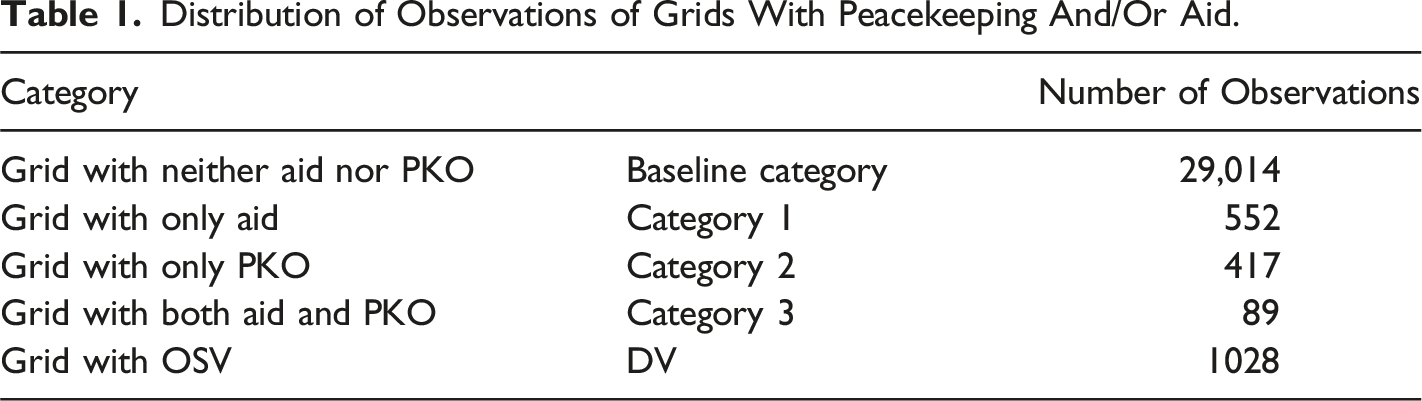
To examine the local interaction effect of UN peacekeeping operations and humanitarian aid, we use disaggregated information to capture any subnational effects. We limit our sample to Sub-Sahara Africa and use the following inclusion criteria: (1) UN peacekeepers were deployed to a country at some point since 1990, (2) a series starts with the first year of recorded conflict, and (3) the series ends with the withdrawal of the peacekeeping mission, or when data are no longer available. The sample includes the following countries: Angola, Burundi, Democratic Republic of Congo, Ivory Coast, Liberia, Sierra Leone, Sudan for which subnational peacekeeping and aid data are available. Our unit of analysis is grid-years, where the PRIO grid with 0.5 × 0.5 decimal degrees cells defines the geographic units and we rely on yearly observations.
Dependent Variable
Our dependent variable captures whether there are attacks on civilians in a grid cell in a particular year. We use data from the UCDP Geo-referenced Event Dataset (Sundberg and Melander 2013). We construct two versions of the dependent variable, the binary variable version of one-side violence (OSV) and the continuous variable version of OSV. The cutoff point for the binary measure of OSV is set as 25 civilian deaths. To reduce the impact of extreme outliers when we analyze OSV as a continuous variable, we take the log of OSV (where we add one unit to avoid having to take the log from zero). To reduce the possibility of reverse causality, the 1-year lead of OSV is used (which is equivalent to lagging all independent variables by 1 year). It is important to emphasize that the UCDP data on one-sided violence include attacks against all unarmed civilians and thus go beyond attacks against humanitarian aid workers. The UCDP data do not allow us to identify attacks against aid workers. Levin (2023) has collected data on attacks against aid workers. In the online supplement, we compare both datasets and find that the overlap between them is only limited. In other words, our findings apply to one-sided violence in general and not to violence against aid workers specifically.
Main Independent Variables
We use data on the subnational deployment of UN peacekeepers (Dorussen and Ruggeri 2017; Ruggeri et al. 2017; Cil et al. 2020) and geo-coded data on foreign aid (Findley et al., 2011; Tierney et al. 2011). 6 The availability of aid data limits our sample to the time period from 1989 to 2007. 7 To examine the conditional effect of the UN peacekeepers and humanitarian agencies, we construct as dummy variables for peacekeeping (PKO) presence and aid presence. Therefore, we identify four types of grids: with both PKO and aid presence, grids with only PKO presence, grids with only aid presence, and grids with none. Grids without either peacekeepers or aid agencies are used as the baseline.
Non-Random Application of UN Peacekeeping and Humanitarian Aid
The deployment of UN peacekeepers and humanitarian agencies is not a random process, and the selection effects may influence the analysis of effectiveness of violence-reduction. Peacekeepers are generally deployed to so-called ‘hard cases,’ areas and countries with higher conflict intensity or more civilian casualties (Fortna 2008; Gilligan and Sergenti 2008; Gilligan and Stedman 2003; Hultman 2013). This pattern also holds at the subnational level (Fjelde et al. 2019; Ruggeri et al. 2017). Wood and Sullivan (2015) also find that humanitarian aid is sent to conflict-areas.
Existing research on peacekeeping (Fjelde et al. 2019; Ruggeri et al. 2017) and humanitarian aid (Wood and Sullivan 2015) uses various techniques to address the non-random assignment, such as matching and recursive bivariate probit models with instrumental variables strategies. For our research, the key issue is to address the simultaneous non-random assignments of UN peacekeepers and humanitarian aid. Since there is no obvious way to address this issue and the approaches taken in previous subnational studies may well become misleading, we use simple linear models with fixed effects (see also Blair 2021). 8 The models include two-way fixed effects, including a grid fixed effect and a year fixed effect. The grid fixed effects eliminate all time-invariant confounders, while the year fixed-effects reduce the bias from the serial correlation. We also report on the sensitivity of the reported results because of violation of random assignment of the aid and peacekeeping treatments. In the online supplement, we further present selection models on aid and peacekeeping separately to show the robustness of the main findings.
Control Variables
The models include standard confounding variables: OSV, UN peacekeeping deployment and presence of humanitarian aid can be influenced by degree of feasibility and accessibility, geographic characteristics, and various socio-economic characteristics of a grid cell. 9 Control over hard-to-reach areas is often contested between government and rebel forces which makes it more likely for both sides to commit OSV. The accessibility of specific locations also influences the deployment of UN peacekeepers and humanitarian agencies. Ruggeri et al. (2018) suggests that peacekeepers are primarily deployed to areas with are most in need for peacekeeping. Similarly, the priority for humanitarian aid would be areas where civilians are most in need. Direct clashes between government and rebel forces are directly correlated with increase in OSV, and conflict intensity in a grid cell is measured via battle-related deaths from the UCDP event data (Sundberg and Melander 2013).
Further geographic characteristics of a cell are terrain and precipitation. Terrain is measured by the percentage of mountainous terrain within a cell. Precipitation not only influences accessibility but also impact agricultural practices linking it to patterns of conflict and violence (Miguel et al. 2004). Relevant socio-economic characteristics of a cell are population density (Doxsey-Whitfield et al. 2015) and infant mortality rates as an indicator of economic deprivation (CIESIN 2005; Storeygard et al. 2008). Highly populated and deprived areas are most susceptible to violence and in need of humanitarian aid while agencies and peacekeepers commonly find it difficult to access these areas.
Finally, the models include controls for humanitarian tasks mandated to peacekeepers (Lloyd 2021), where we count the total number of mandated tasks that plausibly impact on OSV including refugee monitoring, assistance in demining and humanitarian assistance, protection of humanitarian personal and UN missions, quick impact programs, and protection and children and women. Relevant models also include a dummy variable for the mandate to assist with providing humanitarian aid.
Empirical Results
Descriptive Evidence
Distribution of Observations of Grids With Peacekeeping And/Or Aid.
To illustrate of the distribution of peacekeepers, aid and OSV, the six maps in Figure 1 show the location of peacekeeping forces, aid and OSV in the DRC from 2002 until 2007. Peacekeeping presence is indicated by blue dots, aid by green stars, and grids with OSV are highlighted in red. In the DRC, OSV mainly occurs in North and South Kivu. Over time, the deployment of peacekeepers concentrated into these districts, and patterns of OSV become more sporadic over time. The provision of humanitarian aid not only covers the DRC more broadly but remains quite stable over time. In contrast to the deployment of peacekeepers, there is not an obvious increase of humanitarian aid into conflict-affected areas – although aid is also provided to the eastern DRC, so violence does not exclude the provision of aid. A final noticeable feature is that only relatively few grids have both peacekeeping deployment and the provision of aid. Grids with both peacekeeping and aid seem, however, to be areas where (in previous years) OSV can be observed. The most likely explanation for this pattern is that peacekeepers are indeed deployed to areas with conflict and OSV. This also suggests that we are dealing with intricate spatial and temporal dynamics that need to be disentangled with some care. Peacekeeping, aid and one-sided violence in the DRC.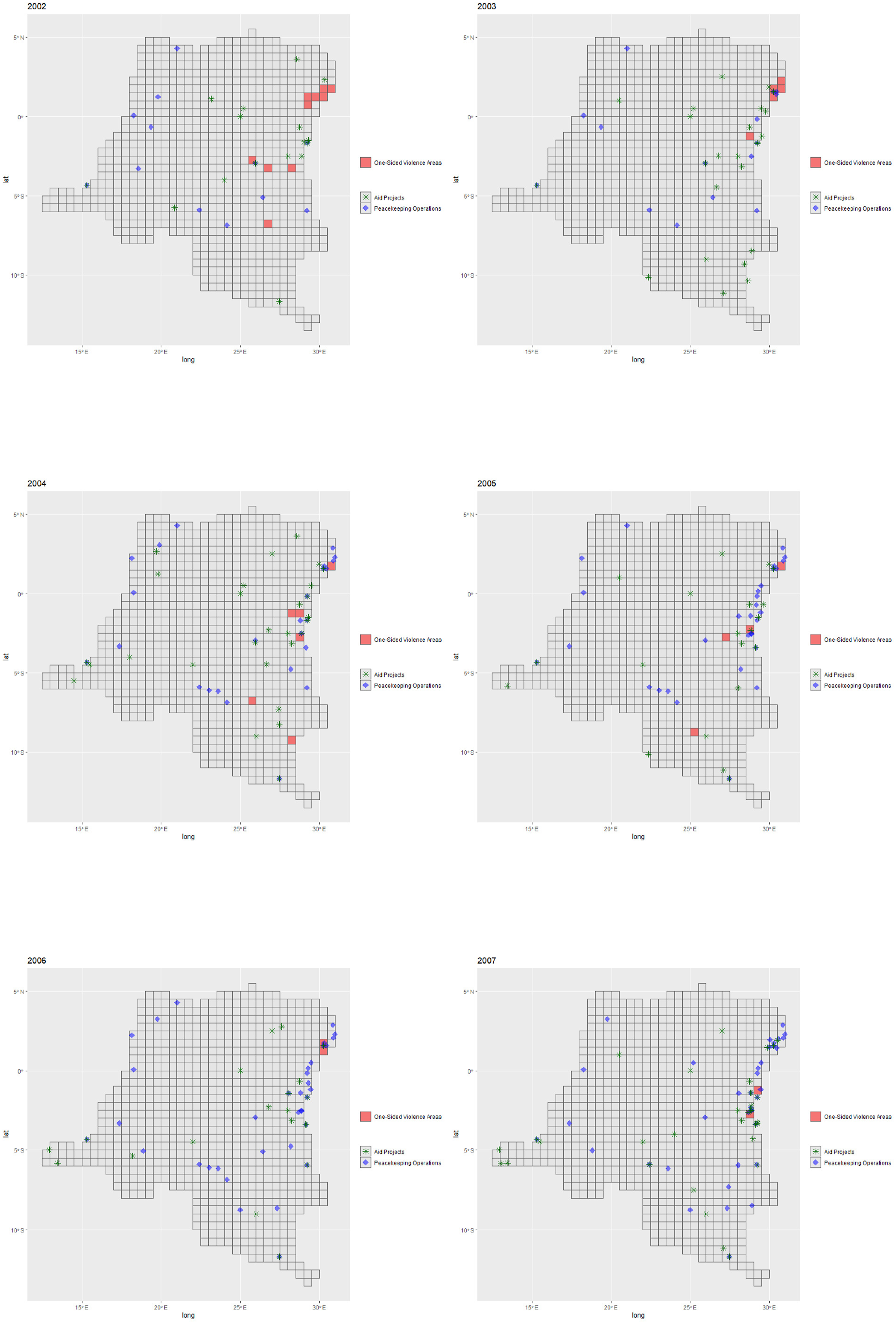
Linear Models with Fixed Effects
Aid, Peacekeeping Deployment and One-Sided Violence (log_OSV(t + 1)).
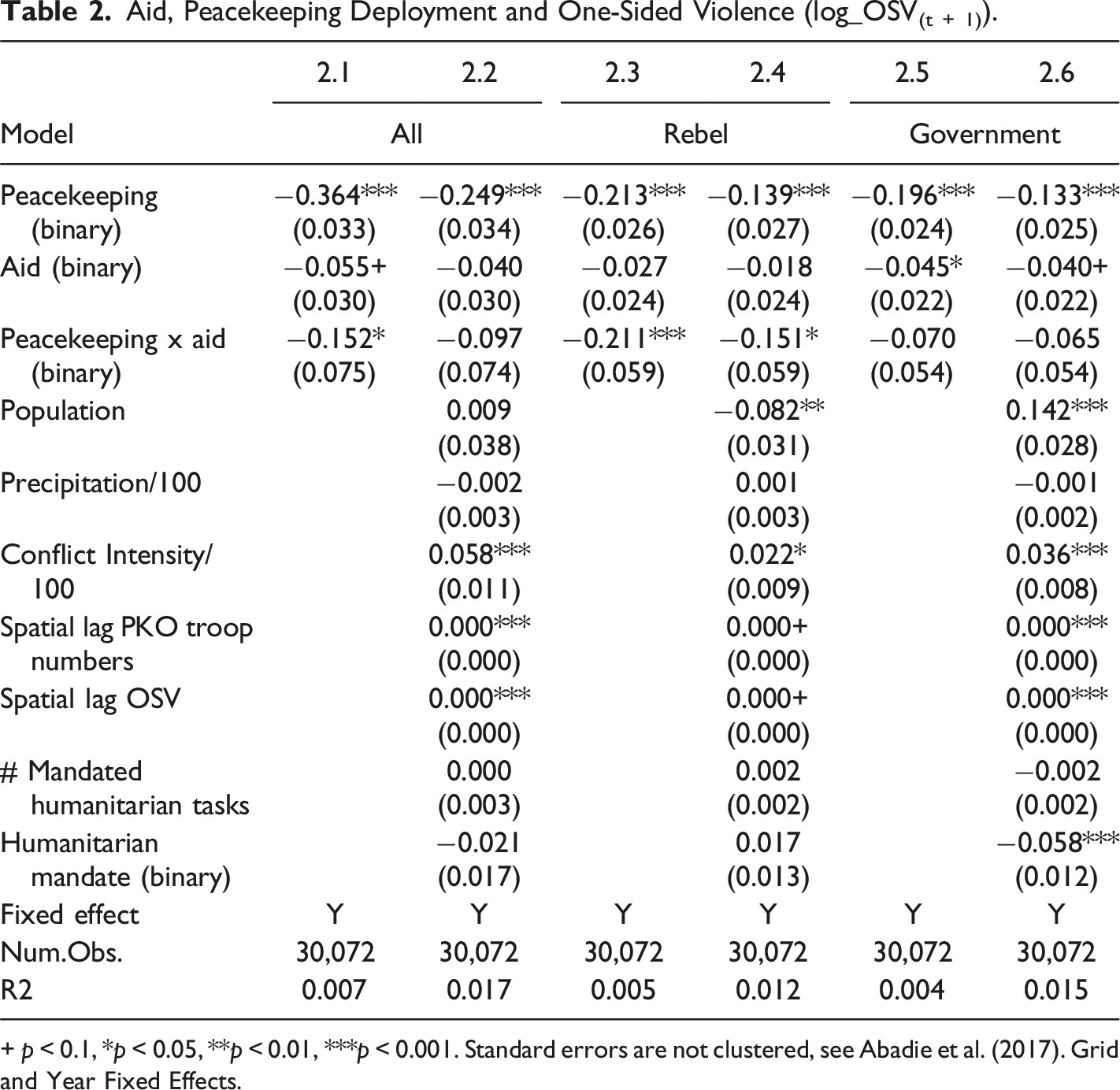
+ p < 0.1, *p < 0.05, **p < 0.01, ***p < 0.001. Standard errors are not clustered, see Abadie et al. (2017). Grid and Year Fixed Effects.
Aid, Peacekeeping Deployment and One-Sided Violence (OSV(t + 1) Binary).
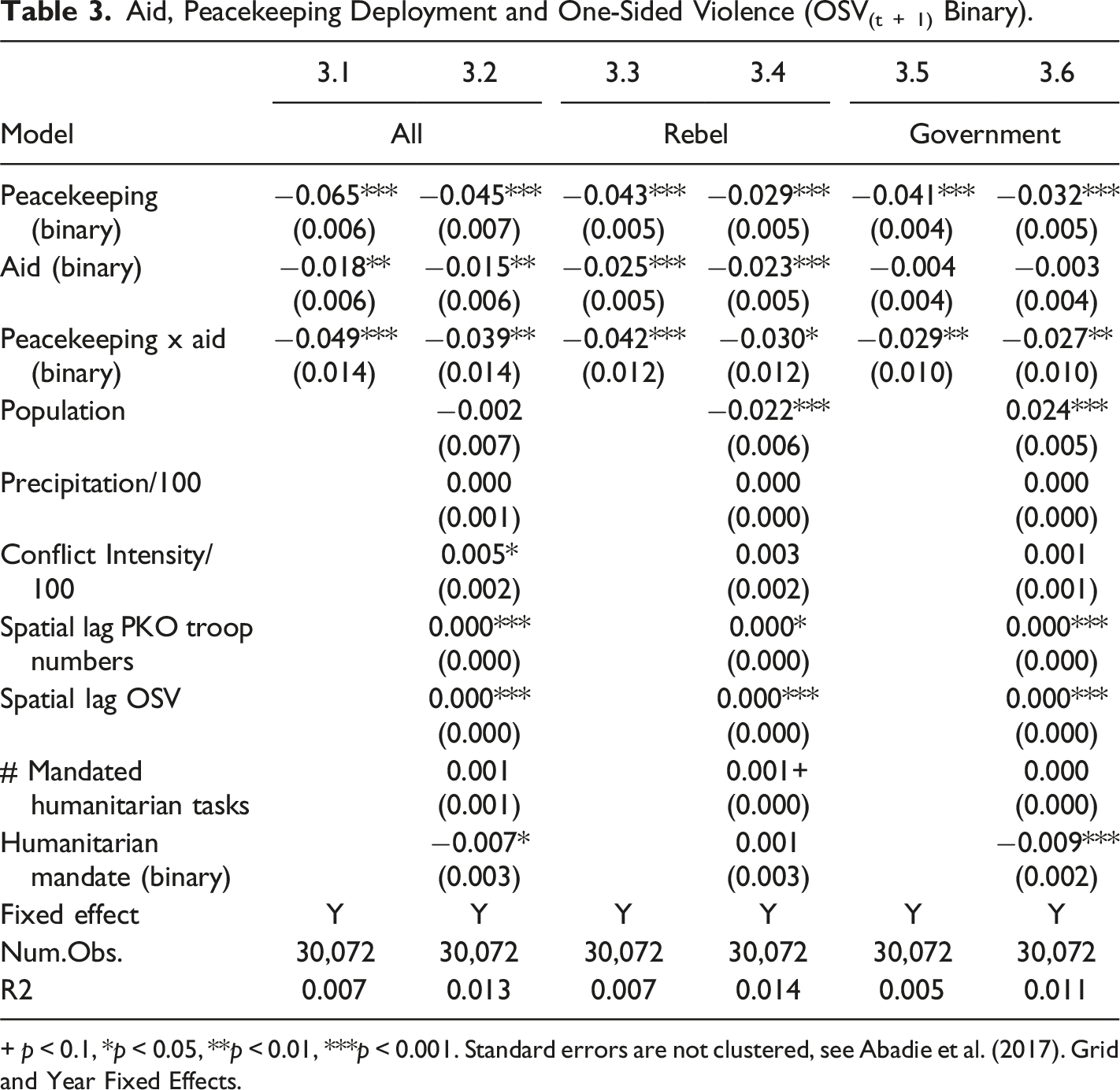
+ p < 0.1, *p < 0.05, **p < 0.01, ***p < 0.001. Standard errors are not clustered, see Abadie et al. (2017). Grid and Year Fixed Effects.
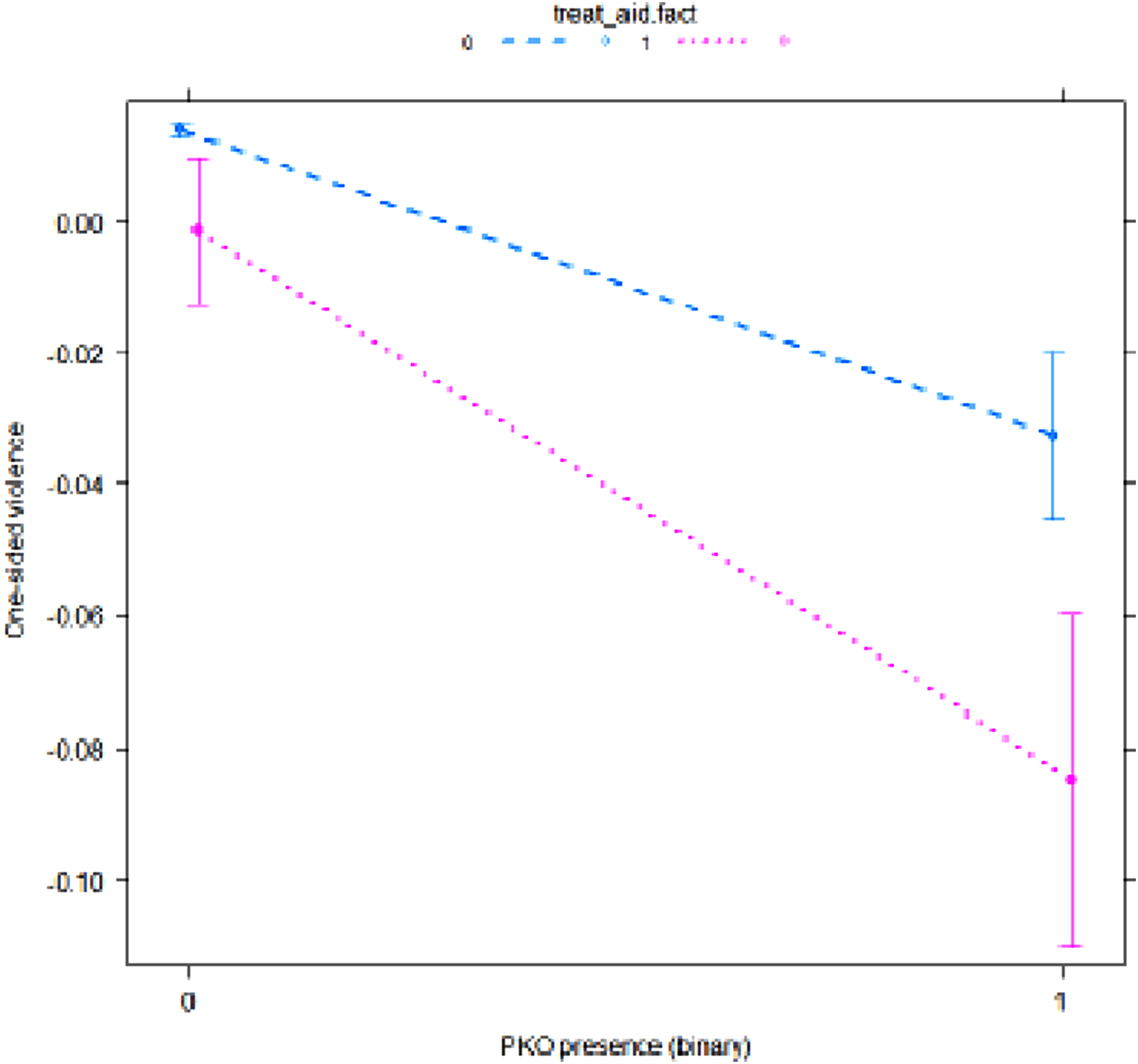
The effect of aid on OSV conditional on peacekeeping (PKO) presence.
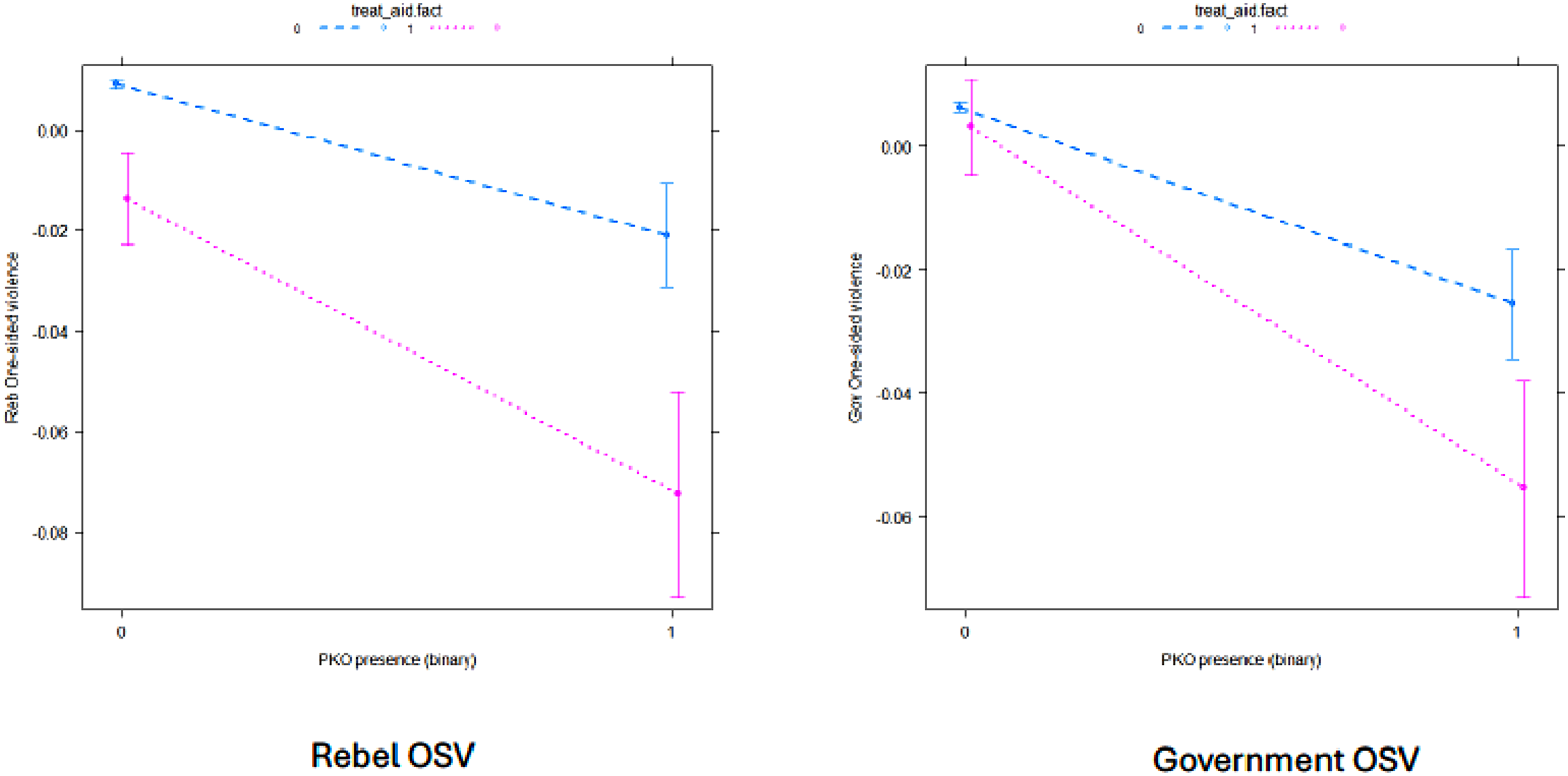
The effect of aid on rebel or government OSV conditional on peacekeeping (PKO) presence.
Figure 2 is based on Models 3.2 for incidents of OSV without distinguishing between rebel and government forces and illustrates the effect of aid on conflict conditional on the presence of peacekeepers. In the absence of peacekeepers, providing aid marginally reduces the risk of one-sided violence, but any impact of aid on OSV is not statistically significant. When peacekeepers are deployed to a particular grid, they reduce the likelihood of observing OSV. The impact of peacekeepers is stronger when aid is also provided. In other words, we observe an integrated effect of aid and peacekeeping on the risks of OSV.
Figure 3 distinguished between OSV attributed to rebel forces (left) and those attributed to government forces (right). On its own aid significantly reduces OSV attributed to rebels which runs against our expectation that aid would increase rebel OSV because of looting. When in a grid only aid is delivered or only peacekeepers are deployed, their impact on rebel OSV cannot be statistically distinguished. Aid and peacekeepers deployed simultaneously however clearly reduce the probability to rebel OSV. The effect of aid (on its own) on OSV attributed to the government is indeterminate, while peacekeepers clearly reduce government OSV. The joint deployment of aid and peacekeepers reduces government OSV further but there is relatively large uncertainty about the expected effect in this case. This reflects the relatively low number of grids in which government OSV is observed when there is aid as well as peacekeeping.
Alternative Analyses
Aid and Peacekeeping as a Nominal Variable
The Impact of Peacekeeping Deployment (PKO) and Aid on One-Sided Violence; Combined Effect Modeled as a Nominal Variable.
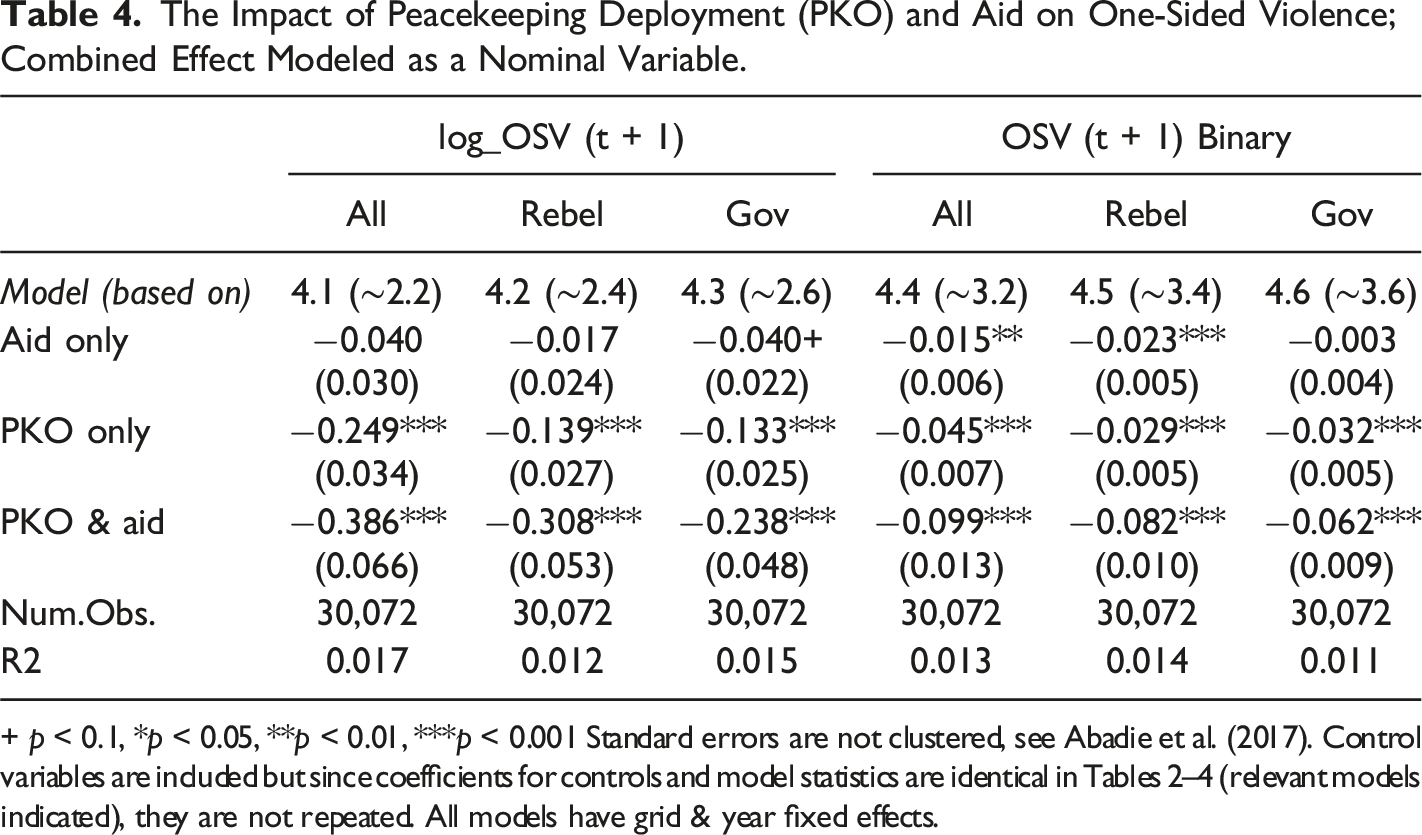
+ p < 0.1, *p < 0.05, **p < 0.01, ***p < 0.001 Standard errors are not clustered, see Abadie et al. (2017). Control variables are included but since coefficients for controls and model statistics are identical in Tables 2–4 (relevant models indicated), they are not repeated. All models have grid & year fixed effects.
Ultimately, Table 4 relies on the same information as Tables 2 and 3, but the different presentation illustrates the combined effect of aid and peacekeeping more clearly. Grids where both peacekeepers are deployed and humanitarian aid is dispensed have a lower risk of OSV compared to those where neither is provided. Grids where only peacekeepers are deployed are also less likely to witness OSV compared to the baseline, i.e., grids with neither peacekeeping nor aid provision. Grids with only aid provision are largely indistinguishable from the baseline (also see the Online Supplement Table S.6).
Interestingly in Table 4, and contrary to Fjelde et al. (2019), it is less obvious that peacekeepers target and impact rebel activities more strongly than those of government forces. The coefficients for only aid, only peacekeeping and both being present are robust across the models. Peacekeeping by itself reduces OSV committed by either rebel or government forces, while the effect of aid tends to be insignificant. Finally, aid and peacekeeping reduce OSV in all models supporting that the effect of aid on OSV is conditional on peacekeeping.
Sensitivity Analysis
Fixed-effect models can ease the endogeneity problem but cannot solve non-random assignment problems. Given that our case is difficult to identify appropriate instruments (see Online Supplement section 2 for a fuller discussion), we rely on sensitivity analysis.
We use the framework of Cinelli and Hazlett (2020) to evaluate omitted variable bias. Their method considers the vulnerability of our results to unobserved confounders. In other words, if we had included all possible confounders, would our conclusions alter? Cinelli and Hazlett argue that if a confounder explains all residual variance of the outcome variables – in other words, brings down the estimated effect of treatment variable to zero – the partial R2 of the treatment with the outcome should be equal to the partial R2 of the confounder with the treatment. Their method thus assumes the ‘worst case scenario’, namely that all explained variation in the outcome is due to a specific confounder. They encourage the applied researchers to show contour plot for when the confounder is three times as strong as the variable of interest to inspect whether the effect of the latter is still distinct from zero.
In our case, the non-random assignment of PKO presence and aid presence can be considered as an unobserved treatment assignment variable that influences both PKO or aid presence and OSV. The literature argues that PKO is likely to choose the hard cases. Peacekeepers are likely to go to the severe conflict areas (Gilligan and Stedman 2003; Ruggeri et al. 2018) and places with more civilian casualty (Fjelde et al. 2019; Hultman et al. 2013). We could argue that conflict intensity is the most important confounder as it probably explains more of the residual variation in assignment of peacekeepers. The same logic can be applied to the aid assignment. We can assume that the conflict intensity be the confounder that explains all partial variation except the main terms.
We conduct the sensitivity analysis in two ways. Method 1 treats the interaction of peacekeeping and aid as a separate term to see whether a particular confounder – in our case, conflict intensity measured by battled related deaths – can change the direction of its coefficient. In Method 2 we exclude the interaction term and exaggerate the effect of the aid variable coupled with the conflict intensity variable as a confounder. This explores whether it changes the direction of the coefficient for peacekeeping. If the effect of aid is strengthened three times without changing the direction of peacekeeping on OSV, we can say that PKO variable is robust also when aid is provided.
The models that we use for sensitivity analysis via Method 1 are based on Model 3.2, 3.4 and 3.6 in Table 3. In the Online Supplement section 3, we display the extra models in Table S.4 used for analysis via Method 2. As before, we first consider all instances of OSV and then distinguish between rebel and government OSV.
Figure 4 presents six plots. The left panels conduct the sensitivity analysis on the interaction term with the strengthening effect only on Conflict Intensity, while the right panels evaluate the PKO treatment by strengthening the effects of Conflict Intensity and Aid. Sensitivity analysis plots.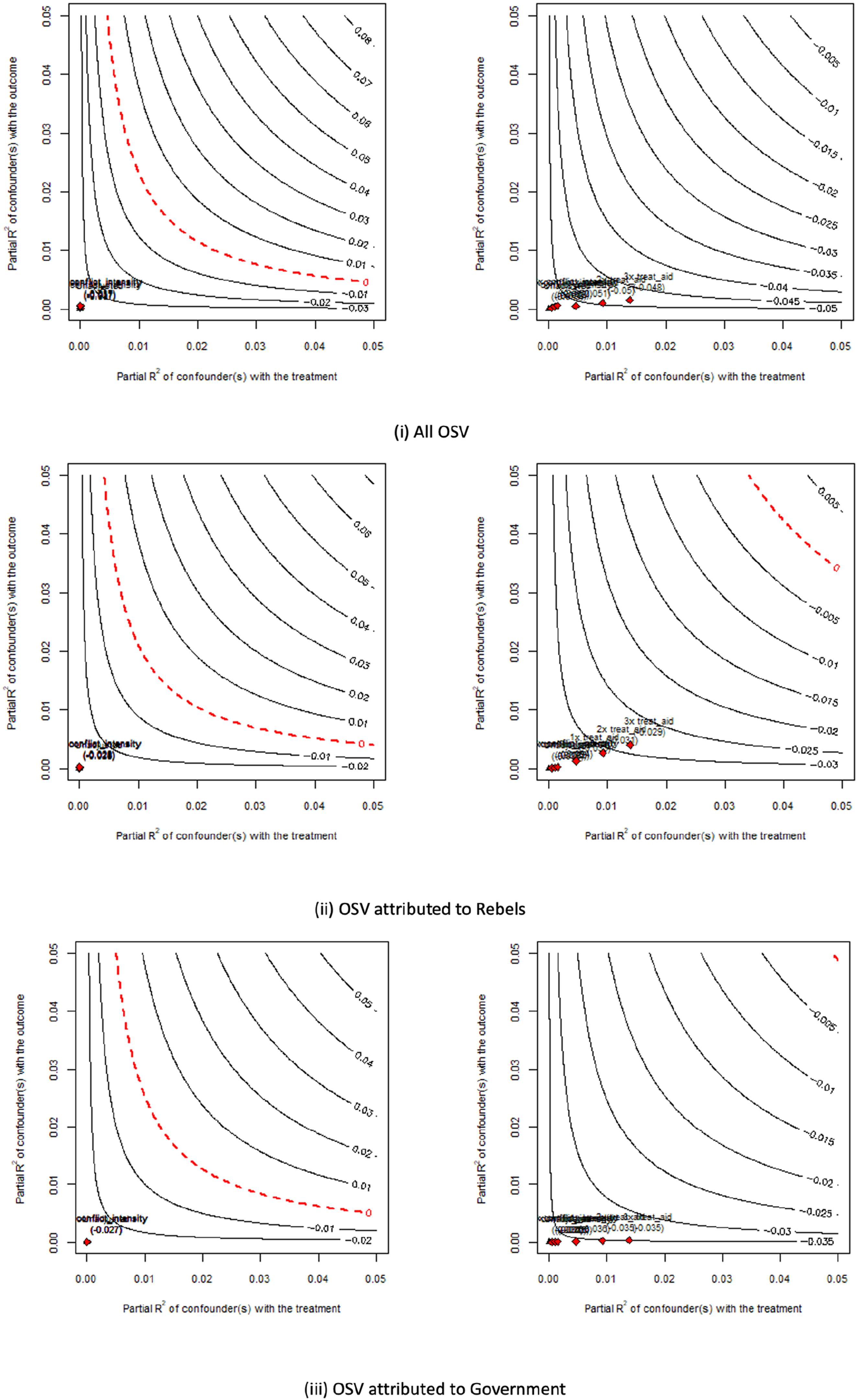
In the left panels, the strengthening effect of Conflict Intensity barely changes the coefficient values of the interaction term; note that the fixed-effect models already exclude most residual variation. In the right panels, the Conflict and Aid treatments do not influence significantly either OSV or the PKO treatment and the negative effect of peacekeeping presence is robust. There are no notable differences in the sensitivity analysis comparing all, rebel and government OSV. Overall, the sensitivity analysis shows that the findings for the conditional effect of peacekeeping and aid in decreasing OSV are robust for the exclusion of possible confounders.
Further Robustness Tests
We find that peacekeeping generally decreases OSV while the impact of aid on one-side violence tends to be insignificant across a variety of different model specifications. When aid and peacekeeping are both present, we find that they more strongly decrease OSV. This conditional effect of peacekeeping and aid is quite robust. Yet, in the Online Supplement section 4, we show that the conditional effect of peacekeeping and aid is harder to identify when using continuous measures for peacekeeping and aid. The coefficients for the continuous measure of aid as well as the interaction term with peacekeeping are very small and no longer statistically significant. A larger deployment of peacekeepers still significantly reduces violence. By shifting the baseline for comparisons, Online Supplement section 5 illustrates the joint provision of peacekeeping and aid not only reduces OSV relative no intervention at all, but also to having only peacekeeping. Table S.1 (in the Online Supplement) shows that the number of valid observations differs between countries with – unsurprisingly given their size – many more observations from the DRC and Sudan. In Online Supplement section 6, we show that the main findings are largely robust for excluding individual countries from our analysis. 11
Conclusions
The analyses above demonstrate that, as found in previous studies, that peacekeeping reduces OSV while the impact of aid on violence is rather indeterminate. One contribution of our paper is that we show that these findings also hold in analyses fully executed at the subnational level. Our particular interest was, however, to explore a possible conditional effect of aid and peacekeeping. Does the presence of peacekeepers mitigate any risks of aid on conflict? We find support for our main hypothesis that peacekeeping and aid have complementary effects. These findings are robust across different model specification, and sensitivity analysis suggests that they do not simply result from selection bias.
It is interesting that we observe relatively few instances where peacekeeping and aid overlap. This may result from humanitarian agencies indeed actively avoiding peacekeeping operations. It may also simply reflect the quality of our data on the activities of humanitarian agencies. A further possibility is that aid and peacekeeping are primarily seen as alternate instruments where the application of one largely precludes the use of the other. In our subnational analysis, we clearly observe that humanitarian agencies commonly operate in areas where peacekeepers are not active. At the same time, peacekeepers are regularly mandated to provide humanitarian assistance which would contradict such strict division of labor.
Our findings are in line with results reported by and Duursma et al. (2023) that peacekeeping does not increase attacks on aid workers. Levin (2023) even finds that military peacekeepers decrease attacks on humanitarians and attributes this to the ability of peacekeepers to reduce attacks on roads. Although not fully comparable, direct attacks on humanitarian aid workers are also instances of OSV. One-sided violence, however, also includes attacks against civilian by-standers who may well be attracted by the availability of aid. The provision of basic security, or what we refer to as ‘security bubbles’, would seem indeed a key contribution of UN peacekeeping. Above we suggest sharing of information as a further mechanism for cooperation between peacekeepers and aid workers. So far, our analyses cannot distinguish between any effect of security bubbles and information provision. For future research, it would also be helpful to have access to data on different forms of cooperation between humanitarian agencies and peacekeepers.
Supplemental Material
Supplemental Material - Does Peacekeeping Mitigate the Impact of Aid on Conflict? Peacekeeping, Humanitarian Aid and Violence Against Civilians
Supplemental Material for Does Peacekeeping Mitigate the Impact of Aid on Conflict? Peacekeeping, Humanitarian Aid and Violence Against Civilians by Shenghao Zhang and Han Dorussen in Journal of Conflict Resolution.
Supplemental Material
Supplemental Material - Does Peacekeeping Mitigate the Impact of Aid on Conflict? Peacekeeping, Humanitarian Aid and Violence Against Civilians
Supplemental Material for Does Peacekeeping Mitigate the Impact of Aid on Conflict? Peacekeeping, Humanitarian Aid and Violence Against Civilians by Shenghao Zhang and Han Dorussen in Journal of Conflict Resolution.
Footnotes
Declaration of Conflicting Interests
The author(s) declared no potential conflicts of interest with respect to the research, authorship, and/or publication of this article.
Funding
The author(s) disclosed receipt of the following financial support for the research, authorship, and/or publication of this article: Shenghao Zhang acknowledges financial support from the Chinese Fund for Humanities and Social Sciences, 21&ZD167, the Postdoctoral Fellowship Program of CPSF, GZC20231388, and the Shuimu Tsinghua Scholar Program.

Data Availability Statement
The replication files for this article are available at: https://dataverse.harvard.edu/dataset.xhtml?persistentId=doi:10.7910/DVN/LEOTU9; published in Harvard Dataverse (view at: https://dataverse.harvard.edu/dataverse/harvard, Dorussen, 2025).
Supplemental Material
Supplemental material for this article is available online.
Notes
References
Supplementary Material
Please find the following supplemental material available below.
For Open Access articles published under a Creative Commons License, all supplemental material carries the same license as the article it is associated with.
For non-Open Access articles published, all supplemental material carries a non-exclusive license, and permission requests for re-use of supplemental material or any part of supplemental material shall be sent directly to the copyright owner as specified in the copyright notice associated with the article.
